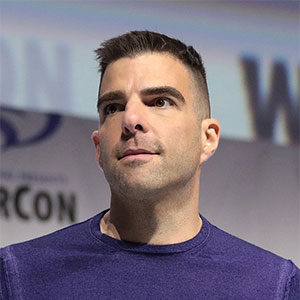
You’ll learn about Zachary’s classical theatre background. We explore the Shakespearean themes found in Star Trek and why science fiction in general is a perfect canvas for the themes and drama of Shakespeare. Find out more about Zachary’s role in Heroes and In Search of… You’ll also find out why shows work best when they “stick to their own rules.” We discuss why Heroes ultimately lost its audience due to “retroactive continuity.” We explore retconning even further as Neil brings up the Kessel Run from Star Wars.
Lastly, you’ll learn about science fiction storytelling. We debate which element of storytelling science fiction should focus more on: telling morality tales or indulging in escapism. Charles explains why, when debating things like this, you must consider the medium in which the story is being told. All that, plus, Neil tells us why science fiction’s job is to illuminate the human condition.
Thanks to our Patrons Pat Mallon, Kyle Rhodes, M. Tristan Moody, Wil Jay (wil_n3rd), Mateo Monsalve, Adam Honaker, Foluso Ogundepo, Christian Lundgaard Torstensen, Brandon Kellerhals, and Steven Pugh for supporting us this week.
NOTE: StarTalk+ Patrons and All-Access subscribers can watch or listen to this entire episode commercial-free.
Transcript
DOWNLOAD SRT
Welcome to StarTalk, your place in the universe where science and pop culture collide. StarTalk begins right now. This is StarTalk. I'm Neil deGrasse Tyson, your personal astrophysicist. I've got with me Chuck Nice, co-hosting. That's right, sir. All right,...
Welcome to StarTalk, your place in the universe where science and pop culture collide.
StarTalk begins right now.
This is StarTalk.
I'm Neil deGrasse Tyson, your personal astrophysicist.
I've got with me Chuck Nice, co-hosting.
That's right, sir.
All right, and tweeting at ChuckNiceComic.
Thank you.
I follow you.
I follow you, too.
To the ends of the earth and beyond, to the gates of hell.
And the trenches.
I will follow you.
And I've got Chuck Liu.
I can't call you Chuck because he's Chuck.
Charles Liu.
You can call me whatever you want.
No, I'm not calling.
I just said I'm not.
OK.
OK.
Charles Liu, professor of astronomy and physics at College of Staten Island, City University of New York.
And our fan base knows that if you are my guest on a show, we're going to get geek.
That's right.
OK.
We're going to roll out some geek on you.
Get your geek on.
Get your geek on.
I can't wait.
All right.
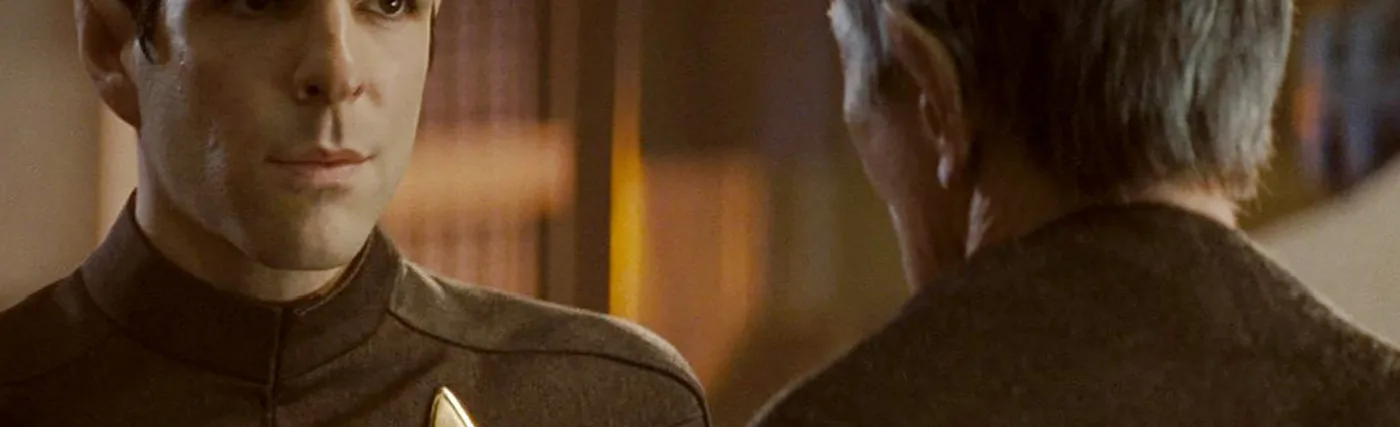
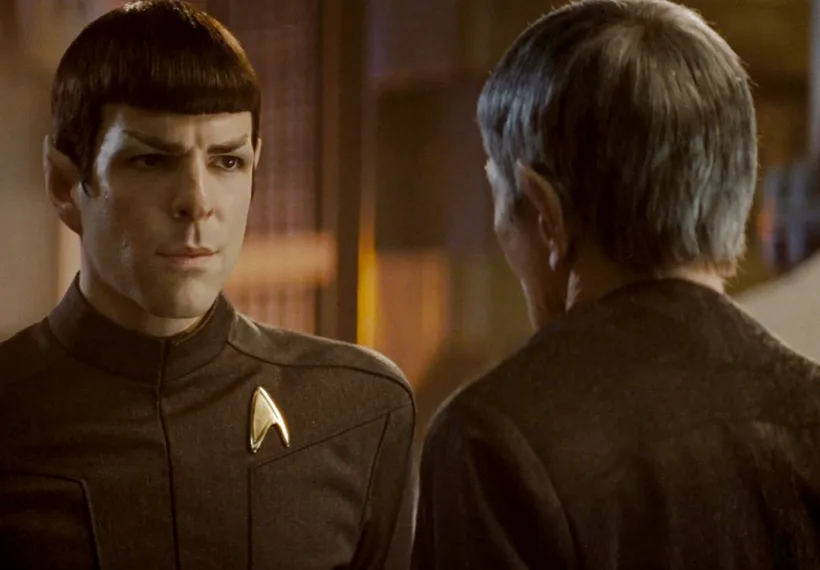
We're featuring my interview with actor Zachary Quinto.
You know Zachary Quinto?
Yes.
That's Mr.
Spock.
He's Mr.
Spock.
He's like the next generation rendering of the iconic hyper-rational character from the original Star Trek series.
He is the actor with the highest scoring name in Scrabble.
Wow.
OK.
Why do you know Zachary Quinto?
You got a Z and you got the Q.
Put it on the triple word score.
You are all set.
I mean, he spelled his whole name out.
He spelled his whole name out.
A Z and a Q.
OK, he's got some A's in there.
They're not worth much.
The C is 3, the H is 4, and the Y is 4.
The rest of them are 1.
There you go.
Idiot.
You didn't know.
There you have it.
No, Zachary's been my hero in part because of that extremely, extremely.
I would bet he would want to be your hero for reasons beyond that.
Oh, and he is too.
So, we're going to explore the science of science fiction.
Excellent.
We're using him as an excuse to do that.
Excellent.
And there's no better excuse for that because he's a hyperlogical alien.
Yes.
He's a Vulcan.
A half-hyperlogical alien.
Oh, that's right, because he's got a-
He's half-human.
A mammy.
That's right.
His mammy is a-
He's got a human mammy.
Right.
I couldn't resist the lure of those Earth women, because Earth girls are easy.
That was What's-His-Face.
That was Downtown Julie Brown.
No, not Downtown Julie Brown.
No, Earth Girls Are Easy was-
Was it Weird Al Yankin?
I'm the fly.
That guy, the fly.
Jeff Goldblum.
Jeff Goldblum was in the movie Earth Girls Are Easy.
That's right, but the song Earth Girls Are Easy was formed by someone named Julie Brown, who also did Trapped in the Body of a White Girl and Everybody Run, the Homecoming Queen's Got a Gun.
Wow.
Nice.
I mean, I don't know.
Anything you just said.
But you said it with such authority.
Everybody run, you know.
Homecoming Queen's Got a Gun.
No?
Oh, I don't know this song.
I kind of remember.
From the 80s?
I did it for Johnny.
Was it from the 80s?
It's from the 80s.
No?
Alright, alright.
It sounds like George of the Jungle.
So he's got, as all good actors do, they have an acting pedigree that extends back.
He's trained in classical theater.
And I asked him about the transition from these formal background into science fiction in both film and television.
So let's check it out.
I mean, there is something inherently theatrical about science fiction, which I find interesting.
You know, the world of Star Trek, I think, is Shakespearean in a way, if you really break it down.
And the canon of stories and the lineage that overlaps itself, I think, is really theatrical.
And so much is happening on television now that the landscape is entirely different than it was even five years ago.
It's amazing we can all agree.
It's a golden age of television.
Yeah, and the challenge now, I think, is really grabbing people's attention and then holding people's attention.
Because as there are more and more platforms, you know, it's just like that.
How do we get people and direct them in the right way?
It's interesting.
It's an interesting double-edged sword in a way.
So Charles, explain what he means by Star Trek being Shakespearean.
Because I followed a little bit, but I think you would have a deeper insight.
How is Star Trek like Shakespeare?
Let me count the ways.
Oh, the world's a stage.
Let me just…
Let me just quote Christopher Plummer in Star Trek VI, The Undiscovered Country, playing General Chang the Klingon.
To be or not to be.
The Klingons.
In Klingon.
Yes, in Klingons.
The Klingons all thought that Shakespeare was written originally in their language.
Those idiots.
No, no, no, because of the rhythms or the-
The rhythms, the human Klingon condition.
The whole point of Shakespeare is that his body of work demonstrates all the different highs and lows and in-betweens, comedies and tragedies of the human condition, of life, of society, of individuals interacting with the whole.
And so there's a universal truth to it that transcends any culture.
If it's properly translated, Klingons, Romulans, humans.
And for the first time, you've used the phrase universal truth in a literal meaning.
Yes.
Most people, when they say universe, they're talking about Earth.
Like Miss Universe, it's just Miss Earth.
We didn't compare it with Miss Mars.
No, that ain't how that happened.
Miss Alpha Centauri wasn't here.
Shakespeare appears over and over again throughout Star Trek on purpose and sort of accidentally, just as it does on just about every other major science fiction space opera type place.
But wait a minute.
Shakespeare wrote about practically everything in many different ways.
So for it to have a story and say it's Shakespearean, can't you say that about every story?
As long as...
Telling Jerry is Shakespearean.
Maybe.
But what we're talking about...
Right, because if it fits everything, then it fits nothing.
If it fits everything, it fits everything.
It also fits nothing.
The point is...
Shakespeare really told the story of Tom and Jerry better.
Is that the difference?
That's why Shakespeare is so involved.
Even Star Trek 6, the movie I just quoted, the subtitle is The Undiscovered Country, which is Hamlet, as is to be or not to be.
Now, in the movie, the Chancellor of the Klingons said that the undiscovered country was the future.
But of course, in Hamlet's soliloquy, the undiscovered country was death.
And so that became a theme in that movie, where do Klingons really fear death or do they fear the unknown, the future?
I'm going to go with the unknown.
Exactly.
Because they definitely want to die a glorious death in battle.
Exactly, which is what caused a central tension in that movie and the plot and so forth.
And then the evil, well, I don't want to say evil, but the General Chang to which I referred, as he was fighting the final battle against Kirk, he was quoting Shakespeare over and over again, cry havoc and let slip the dogs of war, from Julius Caesar, all these other kinds of fighting things.
And that's why he lost.
That's why he lost the battle.
I actually saw Christopher Plummer on Broadway with Lynn Redgrave in Hamlet.
Not in Hamlet.
Macbeth.
Macbeth.
Yes.
Macbeth.
So imagine the joy that the actor Christopher Plummer must have had in full cling on armor, fighting a space battle, saying as his final words before his ship explodes, to be or not to be.
Nice.
Shakespeare and Star Trek.
Wow, that was quite the trek in itself.
Man, dude.
Wow, Chuck.
God.
Charles.
Please, feel free to call me Chuck, Charles.
Thank you for that recitation.
For that soliloquy.
Just one piece of it.
See what I did there?
You see what I did there.
Alas, poor Neil.
I knew him well, Horatio.
A host of infinite jest.
I'm not quoting Shakespeare.
I'm done.
The fault, dear Charles, is not in your stars, but in yourself.
All right, then.
Nice job.
Out, out, brief candle.
And by that, I mean this conversation.
No.
Life's but a walking shadow or poor player that struts and frets his hour on the stage and is heard no more.
It is a tale told by an idiot full of sound and fury, signifying nothing.
People do not know this, that Chuck Nice is also classically trained.
Yeah, let's not go there.
We don't want people knowing that kind of stuff about Chuck Nice.
Man!
I'm unworthy.
So am I.
So am I.
I don't know how I can get back in this conversation.
I've got to quote a Shakespeare thing just to hang with you two.
Let me think.
So I'm sorry I don't have Shakespeare just sitting in my head, but I have quoted him before and I will quote him now, but I've got to read what I wrote on it.
This is my second book ever, okay?
In the chapter called Celestial Winding.
Here it is.
And it's a segment from Ballswell that Ends Well.
Helena displays a sharpness of wit as she comments on the valor of Paroles.
Here it is, Helena.
Monsieur Paroles, you were born under a most charitable star.
Paroles, under Mars, I.
Helena, I especially think under Mars.
Paroles, why under Mars?
She replies, the wars hath so kept you under that you must needs be born under Mars.
Paroles.
When he was predominant?
When he was retrograde, I think.
And Paroles says, why think you so?
Helena replies, you go so much backwards when you fight.
That's great.
That's just a Shakespeare astro-burn.
Shakespeare, this is my second book.
I quoted Shakespeare there.
Just to hang with you two, because you were all having a love duel there.
And I was just sitting there on the outside.
Sweet.
That's cool, though.
That's a burn.
That's a burn.
That's probably the most eloquent way to call somebody a coward ever.
Well done.
Nice.
All right.
So before Zachary Quinto was Spock, he was Sylar.
Yes, on Heroes.
On the supervillain in ABC's hit sci-fi series Heroes.
Yes.
That's the one that no one understood, correct?
Oh, it was great for the first season.
Then it jumped the shark.
Oh, really?
Jumped the shark?
That early?
You're not supposed to jump the shark that early.
Well, they kept like changing everything.
Let's see what he says about it.
Zachary Quinto on Heroes.
Check it out.
You had the power to take people's powers.
Yeah.
That's badass.
I stole people's powers.
I was sort of omnipowerful.
But I had to murder them viciously in order to get those powers.
So there was that little caveat.
But remind me, did you have an Achilles' heel?
Oh, an Achilles' heel?
Interestingly, I did have an Achilles' heel.
I still remember.
But they kept changing it.
Like, I was invincible unless they killed me in this one way.
And then as the show went on and they wanted to keep the character around, they kept changing it.
So part of the deflation of the role, and I think ultimately the series, was they had to keep changing their own rules.
And so audiences felt a little bit like they didn't know what to invest in.
And that's the nature of having to keep a successful show going for so long.
So that show went four seasons.
So it's like a hundred episodes of just trying to sustain these characters, many of whom probably should have died last season, in order to keep the story going.
But it was also a different era.
It was like a trap of the success of that show.
Because it was a different era still, and it was a network show.
So it was really working to kind of keep up that pace.
I think things are entirely different now.
And I must confess, my original urge to watch it was because the O in Heroes was a total solar eclipse.
That was the only reason why I first watched the show.
So Charles, why is it important to not break rules when you're storytelling?
Any narrative has to be within a context, at least the literary.
What do you mean it has to be?
Just because they have been doesn't mean it has to be.
You can do postmodern literature where the rules keep getting broken all the time, but then you know that the rule is that the rules are meant to be broken.
When you're telling a narrative, an epic, an opera, a story, or something like that, if you are invested in a character or a storyline and then it no longer has significance, that's not cool.
Like if you love a character and the character dies, it has significance.
But then if you find out that any character can be risen from the dead merely by giving an injection of somebody's blood, then death means nothing.
And then what you cared about isn't important anymore.
If you knew at the very beginning of the story that anyone who dies can come back to life, fine.
But if you find that out in season two...
So what you're saying is that they're kind of making this stuff up.
Yeah, they were.
I don't think they expected it to go past one season.
But it was a great story in part because of great actors like Zachary.
He played this watchmaker.
Okay, Siler wasn't even his real name.
Siler was the name of a watch that he was working on when his power manifested.
And he was really what you could call, you know, Hannah Arendt's idea of the banality of evil.
Somebody who you wouldn't think is like vicious and likely to kill anybody, but just presented with a circumstance.
He was a watchmaker.
He cared about details.
And then all of a sudden he opened up somebody's brain and figured out that person's superpower.
And then went on and on and on until it became this addiction where he...
Slip down that slope.
Yeah, because he was a psychopath.
That's really the deal.
There's a word for that.
Yeah.
And one of the things that was born out in the show was, was he a psychopath and then this power showed up?
Or did he become a psychopath because of his powers?
There was an alternate...
An interesting duality.
Yes, exactly.
There was an alternate timeline in that show where it showed Siler not calling himself Siler, but Gabriel.
He had adopted a young person and actually had become a hero, been a good person, but then was not able to sustain that because of the pressure.
Okay, so what shows have kept to their own rules best, would you say?
Well, Star Trek does pretty well.
Although, although, although, which episode in the original season where Spock did something where he almost died or went blind, but then there was an extra eyelid that prevented him from going blind.
And Bones said, I should have known you'd come up with something like this.
So they even knew in the script that they had to sort of say something about that.
Because you didn't know in advance that he had a special eyelid that prevented him from going blind.
The concept of retconning, right?
Retroactive continuity is allowable when you have these huge kind of sprawling stories.
But you still have to every time explain what was going on.
Star Wars, for example, not so good.
The Kessel Run.
Don't get me started on the Kessel Run.
Yeah, I know.
No, skip that.
We're on the same page.
Because I will blow a gasket.
I know, I know.
And then they had to retro...
Just to be clear, for people to know, when he says the Minoanime Falcon did the Kessel Run in under 12 parsecs, that's like saying, you know...
If I say, Chuck, how much do you weigh?
You say, I weigh $3.50.
How fast are you driving the car?
72 degrees Fahrenheit.
These are different units.
It's complete idiocy.
But in the movie Solo...
No, they doubled down on it.
I don't want to hear about it.
They doubled down by retconning the whole process.
And that messed up a lot of people.
It makes people unhappy.
Yeah, like me.
And that's why you can't go back and mess things too much.
So he went from super villain to...
I don't want to call him super hero, but super alien Spock in the Star Trek, the reboot of the Star Trek films.
So let's just get a snippet of him reflecting on becoming Spock.
Check it out.
It's one of the most recognizable characters in the world.
I mean, up there with Mickey Mouse and Jesus.
I mean, in terms of like the iconography of Spock and the visual familiarity that people have with that character and his ears and his gestures and all of that.
So I guess there was that kind of floating around me.
And I didn't allow myself to get swept away in any of the things that are attached to that role.
To protect herself.
Yeah, I mean, I couldn't have done my job, I think, if I had allowed myself to go with the magnitude of who that character is and what he represents to so many people for so long.
I just had to focus on what was right in front of me.
You know, Leonard was involved at that time.
And I got to...
I mean, Leonard and I became incredibly close to that process.
So it was a creative and professional gift, but also a tremendous personal gift to become so close with Leonard as well.
Leonard who?
Leonard Nimoy.
Leonard Nimoy.
So the original actor portraying Spock was his mentor, it sounded like, in this bit.
So, Charles, explain why Spock was such an iconic character.
Well, first of all, Spock as a character was the first alien that really had a prominent role in any television or movie show that lasted and showed that had characterization.
So he was fascinating because he was other and yet similar to us.
But more important in my opinion, it was the brilliant acting of Leonard Nimoy that made Spock so iconic.
Fascinating.
He reacted to the script and the ideas that made it happen.
There are television critics, historians, for example, who will talk about Kirk played by William Shatner becoming increasingly emotional, increasingly melodramatic, as the series went on.
And what Spock, Leonard Nimoy did was simply become that foil, become even more less emotional, even more detached, even more logical.
And then they canceled the show.
It created that balance, which then led to that rich idea of yin and yang, equilibrium, Kirk and Spock.
Seat in the pants versus total logic.
And then they play chess and Kirk wins every time because he's not making logical moves.
Which I never got.
No, no, totally.
The first time I beat a computer at chess, I only was able to do that, fooling it into thinking I was making one move relative to another.
And it would organize all of its piece strategies, thinking I'm going to make a move and I don't, and then it came in the back side and beat it.
But that's how we play chess anyway.
We always try to fool our opponent, right?
Whether it's a computer or a human being.
Yeah, okay.
No, thank you.
Thank you.
That's old days.
The first time I beat a computer is in the future.
Oh, another timeline in another universe.
There you go, exactly.
All right, we're going to take a break.
And we will talk more about emotion versus logic in the next segment of StarTalk Return.
We're back on StarTalk, featuring my interview with Zachary Quinto, actor.
Modern day's best known for playing Young Spock.
Young Spock.
They look just like what Spock wouldn't look like.
He really does, that's what kind of helped him.
There's some serious casting they did there for that.
It's not even Young Spock, it's different timeline Spock, really.
That's right, that's right, think about that.
And so, I had to ask him about Spock's notorious reliance on logic over emotion.
Sweet.
It's interesting to get an actor's take on that.
Let's check it out.
There's these two parts of Spock.
His human essence and his Vulcan essence, and I think that I can relate to that.
I process things in an intellectual way, personally.
And emotion is always underneath that, right?
So I feel like, I don't always go to intellect first, but I definitely lean toward intellect.
And then emotion is surrounding it and under it.
Oh, so it's not in the center of it.
No, I don't think so.
That means you make rational decisions in times when-
I think I'm pretty rational.
Other people make emotional decisions.
I definitely have an ability to separate my emotional response from my rational or intellectual response.
A little bit, yeah.
Interesting.
So he's feeling the character.
I was gonna say, yeah.
He thinks he's Spock.
He just got out of therapy before he had that.
So Charles, tell me about your irrational and emotional minds.
I believe that my emotional reactions and my logical reactions are knit together as tightly as a tapestry, a flannel pattern.
I can't separate the two of them very well at all.
So you're very logically emotional.
Or emotionally logical.
Or emotionally logical.
Yes, so I can reason out things, but I'm always informed by my own feelings.
And I can always feel about something, but I always think about, wait, why am I feeling this?
How am I feeling this?
And it's all knit together.
And I actually don't want to separate them.
I think that's what makes me like the human that I am.
Possibly human, yes, right.
Which is one of the things that was explored in the Star Trek universe.
Vulcans actually have very strong emotions, but society compels them to suppress emotion and only exhibit logic.
And this is what makes it very difficult for them.
Tremendously powerful, but also an Achilles heel.
You know, Star Trek's Spock, his logical approach to life is almost always at odds with Captain Kirk's.
Yes, of course.
And so, I asked Zachary about that dynamic on screen.
Let's check it out.
Kirk and Spock are probably one of the most iconic duos in popular culture history.
Who would you rather be?
Obviously Spock, obviously.
Because you're still playing the roles.
You can tell them.
I definitely feel like they are inextricably connected on a spiritual level.
They're two sides of the same coin.
I think as Roddenberry envisioned these characters, they represent an exploration and examination of what it means to be human and what it means to be alien and how those two parts of ourselves as people are often in proximity and often in conflict.
Spock and Kirk function very differently, but I don't think either would function as effectively without the other one.
So Chuck, who would you rather be, Kirk or Spock?
That's a really hard question.
And here's why Mr.
Spock, so logical, so methodical, so meticulous and so knowledgeable.
I mean, you know, the Vulcan brain is like, you know, he is a human computer, able to calculate.
Are you out of your Vulcan mind?
One of the lines from the movie.
But, so for all those reasons, I wanna be Spock.
However, Kirk, I wanna sleep with a green woman, man.
All right, I'm just not gonna lie.
Yeah, yeah, so Spock not getting any intergalactic.
Spock does not, except for like once every 10 years, he has to go Cali-fee, Cali-fowl, or some old crap where he gets, he goes in the heat, then he goes in the Vulcan heat, and then he still doesn't get any.
It's like, you know, I don't know.
They touch fingertips, remember?
Yes.
Okay, so it's gonna be, Kirk.
I'm going with Kirk.
I'm going with Kirk.
I'm going with Kirk.
Get your green button.
So Charles, this thing about yin and yang, and comment on that.
Well, obviously, life is in equilibrium.
You and I, we are all here and doing what we're doing today because there's a balance between the energy that's going through our bodies and coming out of them and whatever is being put into them, like food or metabolism and so on and so forth.
Also, there are three evil versions of ourselves in another universe.
We'll get to that in a moment.
Okay.
And one of them, there's a Chuck in another universe with a goatee.
Wait, you have a goatee here.
You're the evil Chuck.
Give us the good Chuck.
You've called me evil Chuck before and somebody on Twitter said, from now on, you're Chuck Rude.
Anyway, my point is that if we are to explore life itself, then we are thinking both spiritually and physically, psychologically about balance, about an extreme that needs to be balanced.
And so things moving forward and around and around is what causes us to have all these different cool things happen.
Fiction is fundamentally about society coming out of balance and what happens to bring it back.
Right, but balance implies that it's teetering on falling in one direction or another.
Whereas you can have balance without that.
A marble on a flat surface is balanced.
Right.
All right, but you wouldn't say there's a yin and yang operating on it.
Yeah, because that's a meta-stability, right?
I don't know what we call that as physicists.
You know that.
So imagine instead the marble in a dip, in a valley.
And then once in a while, something pushes the marble up the hill.
Okay, and a force where there's a restoring force.
It's a restoring force that brings it back down into the equilibrium point down below.
When you have something that's meta-stable, like a table, and you're rolling the marble, it keeps going, and then it falls off the table.
That's not life.
That becomes something more extreme, which can be studied, but it's not.
That would be the end of life.
That would be the end of life, that's one example.
Interesting.
That was a little philosophical.
I liked it, yeah, I still like it.
I would quibble with something you said.
Oh dear.
Life, by its very nature, are centers of highly disequilibrium phenomena.
I see what you're saying.
Yes, because we are examples of the local thermodynamic equilibrium being violated.
Violated, correct.
Because we are forced to.
Your body temperature is 98 degrees, and it's 72 degrees, you are out of fricking equilibrium, dude.
But I am out of equilibrium with my surroundings.
Yes.
Within myself, I have to be 98.6 plus or minus a degree or two at all times, or I stop living.
So the therapy told me that, within myself.
I am at peace with myself.
I'm glad it's doing something.
Even though I'm at disequilibrium with the rest of the universe.
Another disequilibrium part is, we inhale oxygen, it oxygenates the iron, the iron then goes through and it deposits the oxygen in our muscles and comes back without oxygen.
So in our same body, we have reduced and oxygenated iron living in the same vessel.
And in nature, you don't see that.
Either all the iron is oxidized, or all the iron is not oxidized.
But that's because of an equilibrium process.
Because we're not in equilibrium, that's all I'm saying.
That we are able to maintain that.
That's all I'm saying.
Very cool.
That's all I'm saying.
Well said.
Well, so when...
I can't believe we just got there from fricking Spock.
That was amazing.
So when the original Star Trek franchise was rebooted, what was it, 2009, so they kept all the same characters, and they sent them in a different direction.
Yes.
Let's figure out how that went down with Zachary.
They created an alternate timeline in our first film in 2009.
Was that just to, because they backed into that?
He, I mean, I think it was to open up the narrative possibilities of our universe, to set us apart from the original series.
It's very producer of you.
There was definitely...
You're an actor, Jim, not a producer.
Give me an actor answer.
There's a bit of backlash, I will say, from the fans, but I feel like it really reset the clock, so to speak, and it gave us a new point of departure and a new springboard into a whole other landscape of stories.
Part of the joy of Star Trek is the infinite possibilities of storytelling, you know?
And so I feel grateful to be a part of that because we weren't hindered by anything that happened before.
And it was a powerful new direction that it allowed us to go in.
So we'll see where it takes us from here, you know?
So Charles, what's the difference between an alternative universe and an alternative timeline?
Just semantics.
That's what I thought.
Usually when you think of alternate timelines, they kind of converge back.
So you can have something separate, but then you returns.
But really it could be an alternate universe that goes off in its own direction, whatever, if that makes sense.
So for example-
Not really, but okay.
The mirror universe, for example, is an alternate timeline, right?
Where you have people that can interact with our timeline and they come back and forth.
Alternate universe is something that's so different that there's no interaction.
Sometimes that's-
Yeah, but if you're splitting into that, that means you had access to it.
Well, there's the many worlds hypothesis of quantum mechanics, which suggests that you can split into that and then no longer have the possibility to interact.
So do you think there are other versions of us in another timeline?
Well, if we think that the many worlds hypothesis of quantum mechanics works, then there are an infinite number or nearly infinite number of each of us in a completely different timeline.
There's an evil Charles Liu.
And there's a great Charles Liu.
Which one did we get?
I hope you got someone in the middle.
Chuck.
That's cool.
That's very Rick and Morty.
But we come back.
Third and final segment of my interview with Zachary Quinto on StarTalk.
Hey, we'd like to give a Patreon shout-out to the following Patreon patrons, Pat Malan and Kyle Rhodes.
Guys, thanks so much for all of your support.
We couldn't make this trip through the cosmos without you.
And for those of you listening who would like your own Patreon shout-out, go to patreon.com/startalkradio and support us.
Thank you.
We're back on StarTalk, featuring my interview with Zachary Quinto, the actor who portrays Star Trek.
The entire series, as acted by Zachary Quinto.
By Spock, on Star Trek.
But I had an issue with this sort of reboot of the Star Trek series.
And I had him there, so why not give him a smack down?
Get up in his face.
Let's see what went down.
One of my regrets was the original Star Trek, most of the time, two-thirds of the time, they were morality tales.
And I didn't see that as a mission, as a storytelling mission, carried forward.
Oh, in our film?
Yeah, yeah.
Just it's more sort of a big screen action entertainment.
Interesting.
Which sells.
Right.
It'll put people in a seat.
But I wanted more of the, oh, that's holy, wow, that's a mirror to our own culture, our own civilization.
I think, you know, I think our culture is a little bit less inclined toward morality tales these days.
We want to escape.
I can fully accept that I'm just awful.
A little bit more.
I'm okay with that.
That was pretty great.
You totally, you threw him a little bit, man.
He was a little offended.
If you listen to that, he was like, oh.
I thought it was a very kind, no, it was a kind acknowledging.
But the point was, Neil, where you are is you're comparing a TV show with dozens of episodes, right?
The ability to take many bites at the apple and feature films which get one shot at entertaining and putting people in the seats.
So you said two thirds of the show were morality plays.
That means one third of them was pure escapism.
Yeah, pretty much, yeah.
So you didn't give the feature film enough credit.
He sounded like, like, like.
He sounded like Zachary, like, no, no, he sounded like he's actually informed Zachary on his answer.
Well, no, Zachary's answer was right.
We these days may want more escapism in our entertainment than morality plays.
But in Roddenberry's day in the 60s, if you watch shows like Bonanza or, you know, Wagon Train, they were all one after another, one morality play after another, two thirds of the time.
And then one third of the time was just escapism with guns firing and horses running.
So what should be the balance?
Depends on the medium you're working with.
With a feature film, it might go with I guess Roddenberry would have figured out a way to take the morality play and put it in the modern day Star Trek feature film.
It's possible.
I'm not sure.
And not to be heavy handed, but I mean like for instance, what's his name that does the blue people with the tails?
James Cameron.
Thanks.
The guy who got coronavirus messed up.
With the USB ponytail.
Pugs and everything.
Avatar, yes.
Avatar.
But if you look at that, there are several overarching morality messages that are inculcated in that film.
You know, one of which being that we only get one planet, okay, and we should take care of it.
Another being like, hey man, imperialism is not all that cool.
You know, there are several.
Is it so wrong that I want to have a better world?
I don't think he's super heavy handed with it either, even though some people would say he was.
He was.
He whacked me over the head with a sling hammer.
Well, that's because you're a smart person.
But you know, for somebody who's not like...
You're like regular people?
I do not ascribe to that distinction between, quote, regular consumers and, quote, intellectual consumers.
See, that's the problem.
I'm sorry, I got to push back on this.
See, you're the problem.
You're the reason why we're in the mess that we're in as this country, because we don't believe that there are stupid people.
There are stupid people.
Damn it.
There are stupid people.
That's why Chuck is, Charles Liu is to blame for this, because he doesn't recognize that everyone else is stupider than he is.
Yes, it's just smart people like Chuck Liu who will not acknowledge that there are a bunch of dumbasses out there that makes it very difficult for us to progress as a nation.
I think we'll just have to agree to disagree.
Okay, so where was, I don't even know where I'm going here.
I derailed this.
I apologize.
Okay, so here's my pushback.
You push back, I'm gonna push back too.
The pushback is I think if you're creative enough, you can fold a dose, you can apply a dose of morality tale in your escapism and end up accomplishing both.
Or if you do two of them, you get dose doses of morality tale.
Chuck, he needs more lessons from you.
Bring him to your-
No, yes, the best movies can do that.
Can do that.
But those are not common.
And you gotta give the feature film genre a little bit of credit in trying to do what it can do the best it can.
Okay.
Well, Zach, so he also not only rebooted Spock, he also rebooted the series in Search Of.
Oh, did he?
Yes, he did.
Wait, Leonard Nimoy's in Search Of?
Yeah.
You know with the Loch Ness Monster and stuff?
I remember.
Is that the one?
Leonard Nimoy first did that.
Yes.
Right.
And so now, following the ghost of Leonard Nimoy, he is the reboot of the science series in Search Of.
I asked him about it.
Check it out.
In Search Of was a show that Leonard hosted in the late 70s and early 80s.
Excuse me, you're on first name basis.
Yeah, well.
I have to say Leonard Nimoy.
No, you can say Leonard.
I give you permission.
I am now, by proxy, giving you permission.
But he hosted this show in the late 70s and early 80s called In Search Of and the original episodes were like In Search Of Bigfoot or the Loch Ness Monster or the Bermuda Triangle.
And so they approached me about redoing the show and hosting it and also producing it.
So we are keeping some of the hallmarks like we did an episode on aliens, one of the monsters of the deep.
But then we are veering off into territory that I find really compelling and interesting like artificial intelligence, life after death and mind control.
And so it has been a real adventure.
I have been all over the place.
I got to go to CERN in Geneva, hang out with your people.
It is the biggest machine ever built.
Ever built by man on the planet.
I mean, it is amazing.
And to be in the presence of it and to know that they had to build something so gargantuan to look at things that are so infinitesimally small, I found that paradox very humbling.
And talking to them was really interesting and got to go to the Green Bank Observatory in West Virginia.
They are your people, man.
So we have had a good time.
We have got good people.
You have great people and really inspiring because, you know, the thing that I have found with the show, and I know you can relate to this, is the idea of people who are devoting the entirety of their vocational lives to the exploration and discovery of things that they may never arrive at themselves.
And yet, the magnitude of it in service of humanity in generations to come is what motivates them and drives them.
And there is something so moving about it, actually.
And to meet these people who have been working at the Green Bank Observatory for 30 years and know that they probably will never find the thing they're looking for.
So he got into what my people do.
It's the quest.
You have to, at some level, learn to love the questions themselves.
Yes.
Right.
Learn to embrace the search.
Because it's the search that is the task.
The discovery is what the press talks about once every 50 experiments that are conducted.
A quick thing about the Green Bank Telescope, that zone is a radio-free zone.
Correct.
It's a radio telescope.
I don't want signals to be messing up their signals.
So what do people use, Dixie cups to talk to each other?
Landlines.
Landlines.
Oh, just regular landlines.
Okay, I forgot that.
How far away do you have to be for, I mean, what is the buffer zone?
I don't remember the exact number of kilometers, but it's miles.
Yeah, you got to go quite a ways.
Yeah, I mean, the Green Bank Telescope itself, right?
Imagine a piece of metal.
This is Green Bank, West Virginia.
Yes.
That's a town, and the telescope is named after the town.
And this telescope, named after Senator William Byrd, actually, named after Senator Robert Byrd.
Imagine a piece of metal mesh that's the size of a football field that you can move around and aim at any spot in the sky.
That's cool.
Listen to signals as if you were right there, you know, trying to understand anything from anything from you're loosely using the word listen to yes because it's still electromagnetic energy.
You can turn it into an audio signal on the other end, but it's not sound coming through space.
I just want to make that clear.
It's a signal coming through signal that you detect and then you can convert it into something you can hear if you choose.
That's right.
Or you can make a visual map of it.
Yeah.
And that's a picture.
And imagine using that technique to listen to anything from the pulsing of a spinning star to the signals from an alien intelligence.
All kinds of amazing.
Is that more effective or less effective or does it make a difference of an array like SETI?
They do different things.
Yeah.
They all have different strong points and weaknesses.
But this single-
So arrays are multiple telescopes all moved in synchrony.
Right.
But the single stirruble dish is a very, very cool thing.
A single stirruble dish can detect a weaker signal than an array can.
That's it.
There's the difference.
The point of the array is to pretend you have a much bigger telescope than you do.
Yeah, so it's a clever backdoor way because you're not going to have a telescope that large that's stirruble.
So that's part of the part of the engineering trade-offs.
So one's a net, the other's a giant hook.
Well said.
Yeah.
Every once in a while.
Chuck with the metaphors.
We need this guy in our community.
So do you have a favorite example of what like a physicist might be looking for?
Because they found the Higgs boson, what's left?
Wow.
Dark matter and dark energy.
Oh, of course, dark matter and dark energy.
Yeah.
95% of the universe we don't know anything about except how it behaves on the largest scales.
Yeah.
There's all kinds of neat stuff.
Yeah, we're pretty ignorant about that.
What is the most effective means of studying such a phenomenon?
What effect they have on other things that we can detect.
Right.
And you keep doing this until you, or it does this in that condition, let's write that down.
And there's a boundary to it.
It does this in that situation, write that down.
Okay.
You keep doing this and eventually the elephant takes shape.
That's it.
And maybe you have an elephant there.
But you don't know that if you're only looking at little bits of it.
So all the creativity in our field right now is finding out other experiments that you might conduct on space probes, on telescopes to try to characterize dark matter and dark matter as much as you can.
As it affects something else.
Yes.
And then eventually you head in the other direction.
Zachary mentioned CERN.
Right.
This big machine.
What you do is...
The European Center for Nuclear Research.
Once you find enough barriers or boundaries to the thing like the Higgs boson or something, then you take your machine and you look in that space where you think it's bounded to see if a particle like the Higgs boson exists.
And sure enough, after years, it was found.
So what you're saying is you look at all this, hey, something's happening over here.
Now focus down on that.
Well, something interesting.
Then focus down on that.
Because you wouldn't know to do that coming out of the box.
You've got to work your way there.
So science is way more arduous than it's ever captured in newspaper articles that only report on discoveries.
Yes.
And yet it is so much fun, isn't it?
Don't you think?
Oh, yeah.
I mean, as scientists, we just…
That's why we do it.
It's the journey.
It really is.
And if we get paid to do it, that's a bonus.
That's even better.
Oh, it's not a bonus.
It's whether or not I eat and sleep indoors.
Would you be a scientist for free?
Yes, but I'd much rather be a scientist for free.
I'm a citizen scientist.
Back in the day, nobody paid anybody to be a scientist.
No, but back in the day...
They did something else and they did their science on the side.
No, that's not how that worked.
Back in the day, in almost every case, the people who had the luxury of being a scientist were wealthy.
They were wealthy anyway.
So, if I were wealthy, I would still be a scientist.
Or they were monks.
They were provided for on a daily basis.
Didn't have much else to do.
Like Gregor Mendel, for example, who figured out some genetics.
You're saying that most of the scientists back in the day were just bored.
I would have been back then.
Right.
Think about it.
It's great.
Yeah, so it's quite a commitment.
It's a devotion, really, is probably the best way to say it.
Yeah.
So, let me give you some…
We gotta land this plane.
So, what kind of final thoughts do you have, Chuck?
You know, I'm…
Just reflecting on storytelling, aliens, any part of what we just went through in these three segments.
You know, I just think that the power of what we call science fiction is ever growing in its influence on society and I just hope that it continues to inspire people to be more involved in science because that's the great power that it possesses and I don't think it's appreciated as much as it should be.
I think we got the good Chuck.
Yes.
Most assured.
Okay, wait.
Now, let me give you evil Chuck.
Now, here's evil Chuck.
Man, I love smoking weed and watching Star Trek.
No, that's the deadbeat Chuck.
Alright, Charles, what do you have?
Zachary is yet another example of a classically trained thespian, an actor who knew Shakespeare, then takes it to the next level to science, to science fiction, aliens, but in the end, he is still illuminating the human condition for us all.
Bravo to Zachary.
Okay.
I would say it's the job of any fictional storytelling to illuminate the human condition or aspects of it.
What I like in particular about science fiction is that you get to set storytelling on a stage that you might think is over there, but in fact, it's right beneath your own feet.
So, I think science fiction gives you wider birth to tell stories that reflect back on your own condition.
Think of how many people wouldn't do it if it was a lesson against them, telling them they're misbehaving or telling them that their ways are misguided.
Nobody likes being lectured to, okay?
But if you said, oh, those are aliens doing that, and then one day you wake up and say, oh, they were talking about me the whole time.
Damn you, Gene Roddenberry.
So, I think science fiction is an important dimension, not only for us to figure out who we are, but also to give us a vision of a future that we might one day embrace.
And I will end with a quote from Gene Roddenberry, a paraphrase, who, having written stories about apocalyptic futures, was once confronted by a woman who said, why do you write about such dismal futures?
Is this because that's the world you think we will have?
And he said, no, madam.
I write about apocalyptic futures so you know you need to avoid them.
Ooh, very nice.
Charles Liu, Chuck Nice.
Thank you, Neil.
Thanks for being in the house.
Thank you.
Thanks for watching, possibly listening to this episode of StarTalk.
I've been your host, Neil deGrasse Tyson, as always, bidding you.
See the full transcript



 Unlock with Patreon

 Become a Patron