Find out why Al Gore deemed it was time to make a sequel to his Oscar-winning documentary, An Inconvenient Truth. You’ll hear more about the sequel, An Inconvenient Sequel: Truth to Power which was released in 2017. We discuss why the solutions to solving climate change are still complicated. You’ll learn how to deal with climate deniers. We explore the shared tactics of the fossil fuel industry and the tobacco industry when it comes to releasing information to the public. Andrew explains the importance of telling the truth when science reporting.
How do you balance fueling a capitalist society and safeguarding the Earth? Our panel tries to solve that seeming paradox. Al Gore tells us why in order to solve the climate crisis, we must first solve the democracy crisis. Learn more about the Paris Agreement from 2016. And, Chuck has an idea how to convince the current President to rejoin the agreement. Investigate how bad humans have made the Earth for other species. You’ll also investigate humanity’s general impact in the Anthropocene era.
Get details on the DSCOVR satellite: Al Gore’s involvement, why its launch was delayed, how it was resurrected, and what it currently studies. Kate tells us about the “feedback loops” of global warming. We answer fan-submitted questions on climate change including “Can the Earth reset its own climate?” Al Gore gets a chance to ask Neil some questions on the multiverse hypothesis. All that, plus, our panel ponders what will happen to our planet in the next ten years.
Transcript
DOWNLOAD SRT
From the American Museum of Natural History in New York City, and beaming out across all of space and time. Welcome to the Hall of the Universe. I'm your host, Neil deGrasse Tyson, your personal astrophysicist. And tonight, we're gonna...
From the American Museum of Natural History in New York City, and beaming out across all of space and time.
Welcome to the Hall of the Universe.
I'm your host, Neil deGrasse Tyson, your personal astrophysicist.
And tonight, we're gonna discuss the science and politics of Earth's climate.
Featuring my interview with Nobel Prize-winning environmental advocate and former vice president, Al Gore.
So let's do this.
I got with me my comedic co-host, Chuck Nice.
Love you, man.
Love you too, man.
Tweeting at Chuck Nice Comet.
Thank you, sir.
Yes, I am.
Very nice.
I follow you?
I follow you too.
Okay.
To the ends of the Earth.
Also joining us is environmental journalist, Andrew Revkin.
Not your first rodeo.
Third or fourth time back on StarTalk.
We'll be tapping your expertise tonight as we discuss my recent interview with one of the most recognized leaders of the environmental movement, former vice president, Al Gore.
He held the first congressional hearings on climate change back in 1976 as a freshman congressman.
And in 2006, the film Inconvenient Truth was an Oscar-winning production, and that alerted us all to the dangers of global warming, people who might not have thought about it.
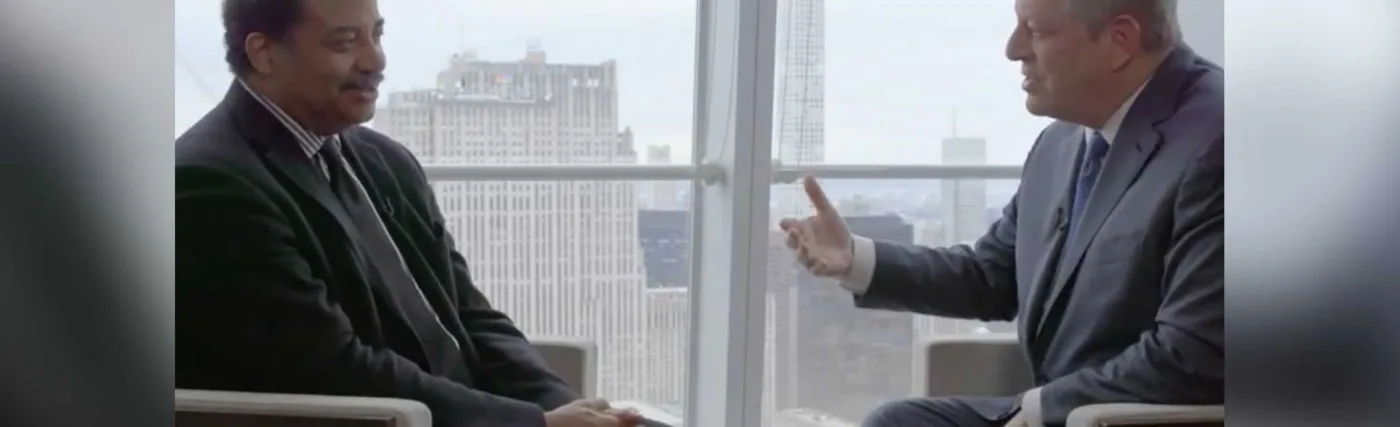
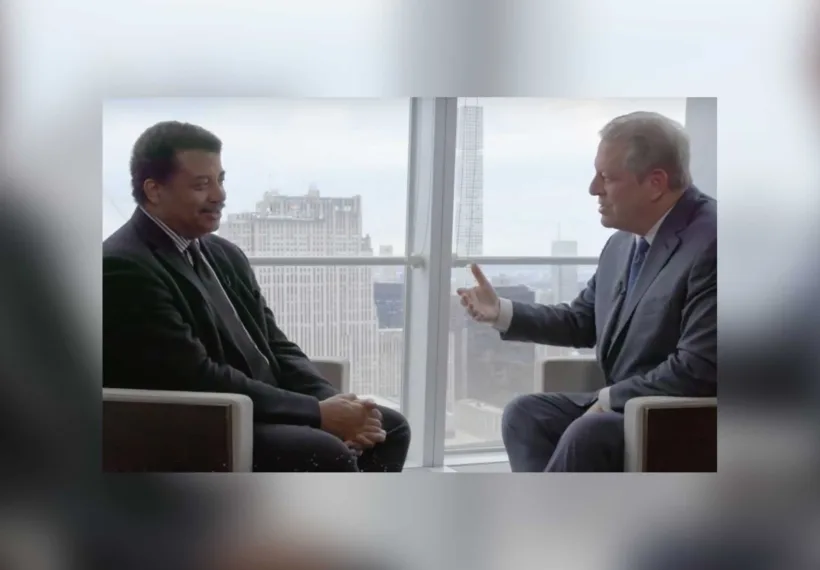
I had the occasion to sit down with Al Gore on his last trip to New York City.
It was just after the release of his follow-up film, an Inconvenient sequel, Truth to Power.
Here's my first clip.
Check it out.
Check it out.
So I'll just relax.
I know it's an interview and you're unfamiliar with this kind of thing.
You too.
So it's been 10 years.
11 actually.
11, more than a decade.
And you just back in it.
You couldn't leave it alone.
Were you thinking you needed a sequel all along?
When did this sort of hit you?
Well, over the last decade, since the first movie, there have been two big changes.
Number one, rather obviously, the climate-related extreme weather events are way more destructive and more frequent.
Tropical disease is moving into our latitudes.
More floods, more droughts, more mudslides, more strong storms.
It's a parade of horribles.
And the risk to the economy is very great as well.
But the second big change is very positive.
We have the solutions now and they're affordable.
They're getting cheaper all the time.
They're spreading around the world much faster than anybody would have dared hope.
So that was worth telling people that, yeah, it's worse than the scientists predicted and it's getting worse still, but we're on the way to really having a chance to effectively solve this crisis.
So that's Al Gore really pissed off.
So Andy, is it true that extreme weather events have been worse than predicted?
Cause that's what, for a lot of climate change, they're not skeptics, they're deniers.
They often would cite whether the models were accurate.
They wanted to know is it gonna be an extra two inches of sea level, six storms at such a level, and if it didn't match it or, so what is, what's, what does it look like now?
I hate to use the word complicated, but it is a little complicated.
Heat waves, hot, the hot thing, the warming part is absolutely measurable in the data, and it's linked through modeling to greenhouse gases.
But things like tornadoes, for example, are kind of a counter example.
No one really understands tornadoes yet, and how they form, and in that area, there's no statistical relationship to what's been happening in the climate.
And even with things like flooding, it's NOAA, the National Oceanic and Atmospheric.
Oh, I thought you meant the Bible, dude.
NOAA, all right, flooding NOAA.
You said flooding, and then you said NOAA.
I was just, you know.
Yeah, yeah, what else could he mean?
Right, right, right.
Build me an ark.
No, but are they more severe or not?
Or are you saying we don't know?
Flooding, flooding.
We had Hurricane Harvey and Irma and Maria.
Devastating.
Hurricanes are the hardest thing.
When I wrote my first article in 1988 about global warming, Kerry Emanuel, the most, the Dean of Hurricane Climate Stuff at MIT, I quoted him and he said, you know, at that time it was thought to be a 50% increase in the intensity of hurricanes in warming planets, sort of like in 2050 or so.
And now the science, the best science is this murky thing where it says there'll be fewer hurricanes overall, but the ones that form have a higher chance of getting to a stronger category.
So is that manifested in the hurricanes of the 2017 season?
No.
No?
And how about the wildfires in the mudslides in California?
Rainfall, rainfall.
Oh, we could do a whole show on wildfires.
In the sense that there's many things contributing to what gets hammered in an event.
No, I understand there are many things that factor in.
Yeah.
We just wanna know that is what we are experiencing, the drought and extreme heat waves across the globe and the wildfires and mudslides in California and Mondo hurricanes plowing in through the Caribbean.
Can we blame any of that on climate change?
Links, we need links.
Well, as I said, heat waves, yes.
The heating of places like California that dries out the landscape so it's more flammable, yes.
But the thing that's driving the losses, what we care about is if things burn up or get flooded.
There's other things we're getting in the way.
There's a guy at Villanova, Steven Strader, he said it's important to remember that we're changing too.
Where we live, how we live.
I've written about around Baton Rouge, Louisiana, epic flood, that storm, the drop of rain of 30 or more inches is very consistent with what you expect in a greenhouse heated planet.
But the losses were these houses.
There's a house, I wrote this piece, where there's a house that was built in the colonial era on stilts.
Because back then they knew you need to keep your house up if you don't want it to flood.
And there's these houses, there's a picture of that one, a guy at Louisiana State gave me.
And then he took a picture of like a 1980 ranch house, completely flooded.
And if they had just raised it.
So the answer to climate change you're saying is stilts?
Well, no, no, the answer to climate vulnerability.
Vulnerability is acting now in places where we know that we're vulnerable, California's wildfires, and the decarbonization thing, which is essential if we want to avoid centuries of climate change, is a long-term imperative as well.
But you can't like get away from the need to do the other thing too.
So Chuck, have you seen Al Gore's latest film?
I did.
I saw, no, I saw Inconvenient Truth, which was the first film.
Yeah.
The second film...
Inconvenient Sequel.
Well, if you're gonna make a film 11 years later, it shouldn't be called Inconvenient Sequel.
It should be called an inconvenient, hey, I can't believe we're still talking about this.
Seriously, guys, come on.
Let's do something about this.
What the f...
So, as a journalist, what's the upshot of this?
Well, to me...
What's working and what doesn't?
A lot of what has been tried has failed.
I wrote about this first back in 2006 when The Time Magazine had a cover.
The cover image is a polar bear with some open water, and it said, be worried, be very worried.
And it turns out that was the scariest science of all.
See, but that's scary if you're a polar bear.
Well, no, no, no, here's the deal.
Someone telling you to be worried?
These psychologists say that just...
What are they thinking?
We have peer-reviewed science that says that's...
You can't impose...
Okay, so you can't say, tell someone be worried.
You have to have something in front of them that convinces them on their own that they should be worried.
Right, and that's hard because, you know, those who really understand the system have this desperate urge to use it.
We have consensus.
There is scientific consensus, and there's also consensus that human activity, I mean, not just recent, but like over the entire century, has contributed to climate change.
But there remains a powerful movement to deny this fact.
Okay, so I asked Al Gore what he might think is the source of that denial.
Let's check it out.
In Tennessee, where I live, there's an old saying that if you see a turtle on top of a fence post, you can be pretty sure it didn't get there by itself.
And the same thing is true of this persistent climate denial.
A hundred years ago, one of the great muckraker journalists, Upton Sinclair, wrote, it's difficult to get a man to understand something if his salary depends upon him not understanding it.
And I think that's very much at play here.
I think that the coal industry, oil industry, certainly the tar sands industry, and now to some extent the natural gas, methane industry.
Fracking is all part of that as well.
Fracking is all part of it.
They have seen this rising awareness that we face an existential crisis as human civilization.
They see it as an existential crisis for their companies.
And just as the tobacco companies delayed for 40 years, the translation of the scientific consensus on smoking and health into appropriate public policy, their whole plan is to delay the recognition of what the science really is telling us for long enough that they can squeeze more profits out of using the sky as an open sewer.
So, Annie, will objective evidence win out eventually?
Well, scientists and journalists like to think so.
So, what would you say is your responsibility as a journalist?
There's a conflict, you know this.
In your journalistic ethos, we have to give both sides equal time.
You were trained this in journalism school.
I think the first rule for a journalist, and if you're writing a story about climate change, is what kind of story is this today?
If it's a story about a paper that just came out on sea ice trends in the Arctic, you talk to people who study sea ice.
You don't call Greenpeace and you don't call a think tank that's paid for by fossil fuels.
I don't know that all journalists follow that.
No, they don't.
That rules, right.
I asked Al Gore if politics failed in addressing the root of American climate change denial.
Let's check out his response.
We're a capitalist democracy.
This is not some secret that people care about money, that corporations care about money.
So, Ken, is it, am I allowed to say that these companies were not handed a political solution, political economic solution to that very problem, to their own existential risk?
I think they actually were handed a solution.
They just fought against it.
By putting a price on carbon and fully integrating the environmental and climate consequences of what this industry and all of us do, we could have seen an appropriate and gradual transition.
But back to your question, the premise of your question is that somehow our democracy failed in not handing on a silver platter to the large carbon polluters, an easy plan to transition their business to something else.
I would say that a little differently.
I would say-
I'm putting a top spin on it.
Let me put a side spin on the top spin.
Sure, but, you know, I'm a scientist.
And so I don't spend much of a day thinking about how people react politically.
Right.
So when I go to Washington, I can say something like, gee, this would be great if there weren't so much politics in the air.
But you, as a senator, go to Washington, you can't then complain, oh, there's so much politics, how am I going to get work done?
Politics is the currency of action in a democracy.
So to be surprised that a company doesn't want to die, rather than having a built-in solution that satisfies the political checkboxes.
Can't I make such a goal an obligation of elected officials?
Yeah, yeah, it's fair.
But you're, I don't know how to say this, but I sense that your mental model of our democracy is aligned with the model our founders gave us two centuries ago.
You correctly called our system a capitalist democracy, but what's happened in the last 50 years is that the capitalist side of that sphere has encroached upon the democracy side of that sphere.
And our democracy has been hacked long before the Russians hacked our democracy, lobbyists and big contributors hacked our democracy to the point where actually a lot of the proposed laws and regulations are literally now written by the lobbyists themselves, and by, in this case, by the polluters.
And that has corrupted the process to a shocking degree.
I know this may sound like a radical analysis.
Look, I've lived through it.
That's why I'm asking you.
I saw this happen when I went in the mid 70s.
The horse's mouth right here.
When I went in the mid 70s to the Congress, it was not that way.
And I watched it degrade over time.
And since I've been out of politics, it's gotten much, much worse.
But it needs to change back to a point where ideas and the best available evidence and rational discourse can actually play a role again.
Andy, how do you reconcile the needs of capitalism, which is like maximized profits, with safeguarding the planet?
You spur innovation and invention.
We all pay attention.
Oh, just innovate and invent.
Well, no.
You had me at innovate.
No, like, Elon Musk gets a lot of credit for all of his inventiveness, but everything he builds is based on technologies that came out of the space race or the Cold War, realistically, that government did the basic heavy lifting on.
So if you're not putting in that fertilizer and we're not building an education system in which science matters...
Well, you can do that, but then politicians have to sort of be on board.
Oh, I know.
So, Chuck, what would you do to motivate politicians to do something about this?
Because they're in charge.
Well, no, yeah.
Scientists are not in charge.
Scientists are not in charge.
And I think you'll agree that climate change disproportionately affects people who are poor and disenfranchised.
And politicians are none of that.
And so what you got to do is make them feel like those people that it affects, which means, like, for instance, they have to live in uninsured houses next to coastlines.
Like, that's a good thing to make them...
So a storm will take them out.
Yeah, exactly.
Or how about they have to drink water only from fracking sites.
Oh, okay.
Or make it rain on them.
And I'm not talking weather.
I'm talking what they understand.
That's right.
Just make it rain.
That's right.
Back it up, Senator.
Up next, we assess the risk that civilization poses to life on Earth when StarTalk returns.
Unlocking the secrets of your world and everything orbiting around it.
This is StarTalk.
Thank Welcome back to StarTalk from the American Museum of Natural History.
We're featuring my interview with environmental activist and former US.
Vice President Al Gore.
We discuss the politics of solving Earth's climate crisis.
Check it out.
Our democracy is not working the way our founders intended it to work.
And in order to solve the climate crisis, we have to spend some time fixing the democracy crisis.
Maybe we should stop thinking federally about this and then look locally, because locally there's very big differences in how people vote and how people act and how people think of the environment.
And so you go to places where they're kind of on board with this green thing, and then let that transition to 100% renewables and watch jobs go to those places.
And then all of a sudden, the economies are rising in states that embrace this.
And if you're a state that has had not, the money then just drives it like a flowing river.
Yeah, that's happening now.
And in your film, you showed cities that went 100% green.
Yeah, including Georgetown, Texas, 65,000 people.
In the heart of oil country, with a conservative Republican Trump supporting mayor, who happens to be a CPA, ran the numbers and figured out that his citizens' electricity rates could come down if they went 100% renewable.
They've now done that and everybody's thrilled about it.
And it's kind of a pleasant side benefit that they're helping save the future of humanity.
Now, states like California have led the way, New York state, a lot of other states.
After President Trump announced his intention to pull out of the Paris Agreement, I worried that that would cause other nations to use it as an excuse to do the same.
Didn't happen.
And the next day, every other country in the world said, no, we're still in.
And all of those states and hundreds of cities and thousands of business leaders said, no, we're still in.
And it looks pretty clear now that the US is going to meet its commitments under the Paris Agreement.
And by the way, legally, the first date upon which the US could withdraw from Paris is the day after the next presidential election in 2020.
So if there's another president, excuse me a moment, then a new president could give 30 days' notice.
Interview.
Interview.
Al is pulling God into the equation.
So, Andy, could you just remind us what the Paris Agreement is, the stipulations?
There was a treaty way back in 1992.
There's only one climate treaty, and then there are all these, like, addendums, and the latest one was in Paris.
And it's basically the first time in this treaty process that all these negotiators realized, if you want to get everybody at the 200 countries basically at one table agreeing on something, it can't be binding.
It cannot be.
It has to be soft.
There's this thing called soft diplomacy.
I didn't know.
And so it's soft, and everyone comes together every five years and will build momentum toward a decarbonized world.
That's the idea.
So Chuck, how would you convince Trump to not withdraw from the Paris agreement?
It's super, super easy.
You just got to rename it, you know?
He's a little xenophobic, so Paris accord it.
No, no, like, you know, just rename it, like, the most bigly awesomeness negotiated accord accord.
And he'll do it.
Or just like the huge hands accord, you know?
Or the big, beautiful wall accord and...
Oh, then he's on.
He's on.
He's all in.
All in.
Well, here's more of my interview with former vice president Al Gore.
Check it out.
We're now in the sixth great extinction.
You know, some of these little critters like bees are actually really important to us, and a lot of others that we don't even fully understand why they're important are endangered now.
We could lose half the living species with which we share this Earth in this century.
We're seeing...
This is the extinction brought about by the existence of human conduct and civilization.
Yeah.
The sixth great extinction.
It's the disruption of the climate balance, land use conversion, polluting of the oceans, the amount of plastic in the oceans by weight is about to exceed the weight of the fish in the ocean, literally.
And there are many insults, but the biggest and most serious is the climate crisis.
And...
So just to be clear, we had 70% extinction from an asteroid.
We could possibly approach that just by human beings being human beings.
Yeah, what collides with the Earth now is not an asteroid, but it's us.
Wow.
So, Andy.
Yeah.
How bad are we making things for other species on Earth?
A third of all animals are now threatened with extinction at some level, endangered or threatened.
Yep, and then...
And it's us.
Yeah, the only...
So one day, we'll just be the only life on Earth.
Okay, that would be...
Actually, I think I saw that on Netflix.
Finally.
Wait, then what would you eat?
Hey, man.
All I'm saying is, you're looking kind of good in these.
Well, they already...
It's people.
It's people.
Yeah, I saw that movie.
So, Andy, you've thought a lot about the influence of people on the climate.
And we've heard this term, Anthropocene.
Is that how you pronounce that correctly?
If you're British.
Oh, so how...
There are two different sort of competing versions.
Anthropocene.
Well, there's Anthropocene and...
Hey, Anthropocene.
I was on the team.
So, Andy, what is the Anthropocene?
So, Andy, what is the Anthropocene?
We'll go with the Brits.
Anthropocene.
So, Earth history is like, you know, it's split into all these eras and epochs and eons.
And we've been in the Holocene epoch or epoch, as some people say.
And it's the last 11,700 years since the end of the last ice age.
And in the 80s leading into the 90s, scientists and I, just quickly as a journalist, I wrote a book in 1992 about global warming that was part of an exhibit at this museum, 1992, which I said, you know, perhaps we've entered a post-Holocene era that should be named for the species that's creating it.
In other words, we've jogged the system enough that we've moved out of that Holocene period.
We have our own epoch because of our actions, right?
Yeah, and they're all laid down in sediment.
So what is the sediment that causes this to be the end of the scene?
I was on this group for six years.
It was the sediment of us that a later generation is going to see.
Please, God, don't let it be what I'm thinking.
I could think of...
Chuck, stop leaving your sediment around.
This Anthropocene working group, which I left when I went back to full-time journalism, they've been cogitating on that very point.
The rules of geology, of stratigraphy, the layered part of geology, are that you have to have a signal that's synchronous and global.
There has to be something laid down in the sediment that says something changed in the system in a big way.
And so they've decided basically it's the 1950s.
And the big thing is the radionuclides from bomb testing.
It's the best single indicator because you find it everywhere.
But the good news about the Anthropocene, there's been a robust debate about whether you can have a good Anthropocene.
We're beginning something now.
It's just beginning.
And how fast we can sort of turn things around, the signature that will be left in sediment is up to us.
Like, this has happened in history before.
Cyanobacteria a couple billion years ago, through all this oxygen in the atmosphere, blew everything up.
All the biology had to reinvent itself when that happened.
But cyanobacteria weren't kind of looking up going, hey, wow, what did we just do?
As far as you know.
They're microscopic things.
So here we are looking up and starting to realize something big is happening.
So, in fact, the biggest climate changers in the history of the world were the cyanobacteria that turned a carbon dioxide atmosphere into oxygen.
Right.
Chilled off a bunch of things that were relying on having no oxygen.
Wow.
Amazing.
So it's not even us.
It's a damn cyanobacteria.
Can we get some cyanobacteria back here now?
Well, up next, we're going to take your questions on the science of climate change when StarTalk returns.
This is StarTalk.
Welcome back to StarTalk.
We're featuring my interview with environmental advocate and former vice president of the United States of America, Al Gore.
And back in 1998, he, as a sitting vice president, secured funding from Congress to launch a new climate monitoring satellite.
But it was canceled.
And nearly two decades passed before it was finally resurrected.
Let's check it out.
So let's talk about your Discover satellite.
Great idea when it came out, but then nothing happened.
So again, when I see something not happen politically, I don't know that I have patience for a politician to say it wasn't launched because the politics prevented it.
You're a politician.
Get it launched.
Figure out the political maneuvering so that it can happen.
So should I have sympathy for you that you had political resistance to it?
Or should I be angry with you for not knowing that you would have had that resistance in advance and trying to sort of navigate that path?
Is there any other option?
So here's what happened.
I mean, okay, I don't want, I'm upset that the president administration has taken all mentions of global warming out of the EPA website.
Should you be angry at me for not preventing that?
I mean, somebody else is in charge.
And what happened in January of 2001 after I left the White House involuntarily, the new incoming administration canceled the launch of that satellite.
And then it went into...
So you weren't in charge.
I wasn't in charge.
But when Barack Obama was elected, I went to see him and told him the story.
He said, okay, well, let's launch it.
And he did.
And I'm very excited about it.
And what are the spate of experiments that are on it or detectors?
One of the most exciting is for the first time, it gives us the ability to measure the energy balance of the Earth as a whole.
We have been able to measure energy coming in from the Sun because it's a single point source.
But we have not been able to measure all of the energy radiated and reflected back into space because it's in 360 degrees.
But by putting this satellite a million miles away between the Earth and the Sun and watching it rotate constantly underneath the satellite, we can get the second number in that equation.
And energy in and related to energy out, that's what the problem is.
Global warming represents an indirect manifestation of the real problem, which is the heat energy buildup in the planet, including in the oceans where 93% of it goes.
Plus the reflectivity prevents some energy from getting into the system.
From clouds, from glaciers, even from oceans.
And that's changing at all moments, moment to moment.
Well, now we're in your wheelhouse.
This is your area of expertise.
You know planet science.
But now for the first time, we have the ability to measure the actual energy balance of the planet.
It also has an early warning system for solar storms, which threaten electricity grids and all kinds of circuits, pipelines and all kinds of stuff.
And we get...
Space assets are huge that grow sensitive to this, yes.
Correct.
And we also get 10 to 15 beautiful blue marble type pictures every single day, as like the one on your tie.
So joining our discussion now is an actual climate scientist.
We don't have to keep handing climate science questions to Andy.
We got like the real McCoy in the house now.
Join me in welcoming climate scientist Kate Marvel.
Thank you for joining us.
You're an associate research scientist up at Columbia University, right here in Manhattan, at the NASA Goddard Institute for Space Science.
So NASA launched his satellite in 2015.
And do we have one of these images?
We can check it out so we can talk about it.
Can we get some applause for that?
And just to be clear, this satellite is orbitally parked, in a sense, between Earth and the Sun.
It's at one of the resonance points where all the gravity balances.
And so it is orbiting the Sun while we orbit the Sun, staying in that position.
So what are you guys picking up on this?
I mean, the first and foremost thing we're picking up is that the Earth is amazing, right?
Like this is, I'm sorry, this is...
Is that the headline of your research paper?
Earth is freaking amazing.
Right, this is the best planet.
I mean, sorry, it is.
That's a paper I want to read.
This is the best planet.
I mean, sorry, it is.
It is, it so is.
No, it's super exciting to have this new perspective, where we have this satellite parked a million miles away, and we're always looking at the sunny side of the Earth.
Like, that's cool.
But it's important to know that this is just one tool in this really big toolbox that we have.
So we have been looking at the Earth for more than 30 years since the late 70s, basically.
And we're measuring all these different things.
Looking at it, but not with a satellite like this.
Not with a satellite like this, but we have other satellites out there.
And so we're looking at clouds.
We're looking at rainfall.
We're looking at the temperature of the lower atmosphere and the upper atmosphere.
We have satellites that can actually measure the mass of the Earth, and that means we can see things like ice melting in real time.
We can see aquifers getting drained.
So we have been doing this for a really long time, and we have this really comprehensive global picture.
And that's really important, right, because we're talking about global warming.
We know it's going to get warmer, but we don't know exactly how warm it's going to get.
And a lot of that is because we don't know what humans are going to do.
We don't know if we're going to cut our emissions or if it's just going to be business.
We're a loose cannon.
We're a loose cannon.
But even if you remove that loose cannon, even if you cut out that uncertainty, there's still a lot of uncertainty in the climate system.
And that's because as the earth warms up, things change and those things that are changing can actually feed back onto that warming.
They can speed it up or they can slow it down.
So, for example...
These are feedback loops, exactly.
So, for example, I think Al Gore touched on it.
When you heat up the planet, you melt ice.
And ice is really good at reflecting sunlight that would otherwise reach the planet.
And it exposes that kind of darker ground or sea underneath.
And that's more absorbent.
And so that is a process that speeds up the warming.
So we call it a...
So the more ice melts, the more you expose absorptive Earth's surface, then the hotter it gets and the faster the ice melts.
Exactly.
So that would be a positive feedback loop.
So we call it a positive feedback loop.
And I think that's terrible terminology, right?
Because that sounds great.
So it's more like a vicious cycle, I think.
A vicious feedback loop.
Like medical tests.
What's an example of a loop that goes the other way?
So a loop that could go the other way, for example, is if warming the planet gives us more of those low, thick clouds that block out the sun, then we would get less sunlight and we have more gloomy days.
Is that because you're warming the planet, you're putting more moisture in the air, and you have more capacity to make clouds?
So we don't actually think this is going to happen.
We have evidence that probably this is not going to be the case.
But it is something that is not insane to believe could happen.
So this is an example of a negative feedback loop, something that would actually slow down that warming.
Okay, so more evaporation gives you more clouds, but no more clouds reflects sunlight, and then reduces the energy budget.
But clouds are incredibly hard.
I spend so much of my day thinking about clouds, and they're really, really frustrating, because clouds both block sunlight and they trap heat coming up from the planet.
So clouds play this dual role, and it's really confusing.
And for a long time, they were the big wild card.
We didn't know what clouds were going to do.
Now you have every square inch of a cloud, you know, for half the Earth all the time.
So now why don't you have an answer now?
So Discover...
What's up with that?
We give you the data.
So Discover has only been up there since, I think, June of 2015.
2015, yeah.
And that's not long enough to really see any long-term trends.
So we're not learning nothing, but we really need that long-term record.
We need to see these long-term changes in order to attribute something to climate change.
Well, right now, we're going to go to our crowd favorite part of our show called Cosmic Queries.
Yes!
Can we take your questions about the science of climate change?
If it's on astrophysics, then we don't need the guests, but I'm not an expert here, so we have the expert.
Bring it on.
Question number one from Lenny Seth Walden from Winchester, Tennessee wants to know this.
What can I tell people who do not believe in climate change and use the excuse, well, it's been cold this year, so global warming is a myth.
Living in the South, I get this kind of nonsense more often than I should.
That's a good one.
How do you fix that?
How do you fix that?
So I think it's okay to be confused by the difference between climate and weather.
Like climate is not an intuitive concept, right?
We're talking about things that happen over a really long time period.
So this is not my idea.
I forget who I should be attributing this to, but somebody told me that climate is your personality and weather is your mood.
And what we're doing is we're fundamentally changing the personality of the planet.
We're still going to have ups and downs.
We're still going to have weather.
We're still going to have mood.
But what is really happening is we are changing that base state.
So we're actually headed for a personality disorder.
Exactly.
Mikey from Twitter, he says this, is it possible that...
I know Mikey on Twitter.
You know Mikey?
Is it possible that the Earth could reset its own climate like in the movie The Day After Tomorrow?
See, Mikey, I like where he gets his science.
So I don't know if this is going to get me fired, but I have never seen The Day After Tomorrow.
Okay, you have got to go.
No, so in the movie, what happens is a climate event does the opposite of what we all think as global warming, and it causes a weather pattern where all of North America freezes over.
The Gulf Stream shuts down.
Right, it's the Gulf Stream.
And it becomes like a snowball Earth, and you see the polar ice caps.
And what happens in that is all of a sudden, you have Americans running south trying to get into Mexico.
Take down that wall.
Well, let me repose the question.
Is there...
Does Earth have a restorative force that is bigger than ourselves?
Not that we know of.
Not that we've been able to find.
Unless you count us destroying our civilizations due to climate change and getting rid of all the humans.
Oh!
Here's your answers!
The answers are out there, people!
Oh!
There you go!
Earth says, let him keep going.
Right.
Go right ahead.
Do your thing, because I'm going to be here.
I'm Earth.
That's great.
Kate Marvel, thanks for joining us on StarTalk.
Coming up, Warner Vice President Al Gore shares a few cosmic queries of his own when we return on StarTalk.
Bye The future of space and the secrets of our planet revealed.
This is StarTalk.
Welcome back to StarTalk from the American Museum of Natural History right here in New York City.
We're featuring my interview tonight with former Vice President Al Gore, and Al is a scientifically curious guy, and he had all kinds of questions for me about the universe.
Check it out.
So, we're in a multiverse, right?
Likely.
There's good theoretical reason to think so.
Yeah, but not yet evidence.
But there are other ideas that are working very well in our understanding of the universe.
If you extend those ideas naturally to where they will take you, you come up with a multiverse.
Could you imagine a system for creating millions of proxy points in our known universe?
And when the computing power is available, could you imagine a measure for deformations that would give evidence of another universe?
So there is a chance that in one version of the multiverse you can have two expanding multiverses that know nothing of one another, but their expanding edges collide.
And that would be revealed as sort of a signature in, I don't mean little.
No, I'm saying.
Oh, the universe was here.
Like CSI.
Yeah, you would have a.
CSI multiverse.
You would have a marking that was evidence of two universes colliding.
And we would see that in our cosmic microwave background.
But we've looked for what that signature might be and no one has found it.
Yeah.
But it would be intriguing if that were the case.
Yeah.
So.
And it would likely have slightly different laws of physics.
So you don't want to be the first to visit.
Because the laws of physics that hold your molecules together could make them fly apart in another universe.
So you want to like bring a coin or something, flick it across the barrier.
Do you assume that even in a multiverse, gravity is a constant?
It might have slightly different expressions of the forces of gravity, but we have no reason to think.
So the physical constants might be different in that universe.
And so matter would manifest slightly differently to them as it does to us.
But because the laws of physics permeate all of our known universe, we'll have no reason to think that their laws of physics wouldn't also permeate their universe, not only across time, but across space.
So do you assume that life is ubiquitous in the universe?
I have no reason to think otherwise.
When you see...
But it used to be that people had no reason to think that it was anywhere but here.
Well, yeah.
Yeah, but I have good reason to think that we're not alone.
Because you look at what we're made of, the molecules, the atoms.
These atoms are everywhere.
They're not rare and they're not only found on Earth.
They're everywhere on all planets across the galaxy.
And then you look at how quickly life manifested on Earth.
Even earlier now.
Even earlier, right.
So within half a billion years, out of five and a half billion years, we have evidence of single-celled life.
And we think it probably would have started even earlier on life if it weren't for this period of heavy bombardment because Earth is still accreting material from the nascent solar system.
And if you're still getting slammed, accumulating all this extra matter, your surface is very hot and you can't sustain complex molecules.
Let that die out, Earth cools, bada-bing!
Within like 100 million years, we have life.
So it happened quickly.
In the only example we know, we're made of the most common ingredients in the universe.
So it's gotta happen all over the planet.
The list of exoplanets is rising through 3,000 now.
And that's just in our little pocket of the galaxy.
If you think we're alone in the universe, there's something else requiring that of you.
Up next, Al Gore explains how climate change can cause war when StarTalk returns.
Space and science, down to Earth.
You're listening to StarTalk.
Welcome back to StarTalk.
We're talking about Earth's climate crisis.
We're featuring my interview with Nobel Peace Prize winner Al Gore.
He's also an environmental activist.
That's why he got that Nobel Prize.
Let's check it out.
Is there something that you can think of that could happen that just wakes everybody up and said, oh my gosh, I was wrong?
Yeah.
We've got to think about that.
Well, I think there is.
And I think it's happening right now.
These climate-related extreme events are getting way more intense, way more frequent.
And every night on the television news now is like a nature hike through the Book of Revelation.
And even those who don't feel comfortable using the phrase global warming or climate crisis are now saying, this is getting a little bit out of hand.
Maybe we really do need to do something about this.
Now, of course, insurance companies and the military, they've been on board from the beginning.
Yeah.
You start displacing refugees from coastal places of impoverished nations.
This is destabilizing international security.
Absolutely.
And if you look at what happened in Syria long before the Civil War began there, they had the worst drought in the history of the Eastern Mediterranean centered on Syria, 2006, 2010.
It destroyed 60% of their farms, killed 80% of their livestock, drove 1.5 million climate refugees into their cities.
They collided with refugees from the Iraq War.
And the gates of hell opened tragically.
All hell did break loose.
Yeah, and there were other causes.
The dictators, an evil bad guy, and their sectarian proxy wars and all that.
But the baseline was the devastation of agriculture by the drought and the disruption of their whole country by the climate related event there.
So this is a political issue in the sense that many countries have a hard time governing themselves in the best of seasons.
And when you overlay a crushing burden like the climate crisis, then they can get tipped over the edge into chaos.
So Andy, are things going to get worse before they get better?
Because you have a long baseline of thinking about this as a journalist, longer than most people have been thinking about this problem.
Except Al Gore.
Except Al Gore.
So in this arc, can you see things getting worse before they get better?
I think that's a good way to think about it.
But I do see the prospects for a good outcome here.
I mean, an accurate way to think about it.
It's not good.
Yeah, well, the...
Okay, guys, let's just calm down.
But there's no magic.
There's no magic moment.
Either way, I think.
Well, when I interviewed Al Gore, he had just been releasing...
He had just released the film, or at least was in screening rooms, the sequel to his Oscar-winning 2007 film, An Inconvenient Truth.
In this final clip, I asked, what's ahead for the next 10 years on his mission to solve Earth's climate crisis?
Let's check it out.
I'm hoping that 10 years from now, we will be so far down the road to solving this crisis, really and truly, that there'll be no need for a third sequel.
As for what I...
Then we'll just find you on the beach, because you would have succeeded.
If the beach is still there.
On the inland beach.
I continue to train climate activists at the grassroots level, and I am so inspired by the millions of activists around the world who are really driving the sustainability revolution.
And that's where the real energy is coming from.
Thank you.
You know, I'm a scientist, I count myself also as an educator, and when I see this resistance to the consensus, the emergent consensus of scientists, and I try to understand that, I'm a scientist and I'm an educator, where are we failing here?
And I've thought long and hard about it.
I look back in elementary school, how do we teach science?
Instead of beat the adult on the head, let me look back in the school system.
And here's what I found.
We teach science as though it's a satchel of facts.
Here's this information, learn it, we'll test you on it.
If you do well, you keep going.
We're not taught that it is a process of querying nature.
We're not taught that it is the best system we have ever devised to establish what is objectively true in this world.
And we have politicians who are also in denial of scientific truths.
Yeah, you could beat the politician on the head, but what good is that?
They're representing an electorate that thinks the same way.
So the problem is not the politician.
It's people who vote for these politicians, who don't know any science, yet have the fate of this nation in their hands.
That's dangerous.
It's worse than dangerous, you know what it is?
It is the beginning of the unraveling of an informed democracy.
And that is not the country I grew up in.
So I don't often appeal to this viewing public, but I can tell you now that without that, we're just gonna slide off the backside of the mountain while the rest of the world passes us by.
And I don't even want to know what that feels like.
This has been a Cosmic Perspective.
And you've been watching StarTalk.
I bid you to keep looking up.
See the full transcript



 Unlock with Patreon
 Become a Patron