


 Unlock with Patreon
About This Episode
Could we use robots to explore the oceans of Enceladus? In this episode, Neil deGrasse Tyson and co-host Harrison Greenbaum dive deep into the EELS Project, an effort to send a snake-like robot to Saturn’s moon Enceladus with Matthew Travers, a roboticist at the Biorobotics Lab at Carnegie Mellon University.
What comes to mind when you think of robots? We explore how the gap between science fiction and reality is closing faster than you might think. We discuss the ethics of robotics and whether we should name robots. Should robots resemble lifeforms, or should they be designed purely for function? Discover the engineering challenges of creating robots with multiple degrees of freedom, like those with six legs, and the complications that come with increased control and articulation.
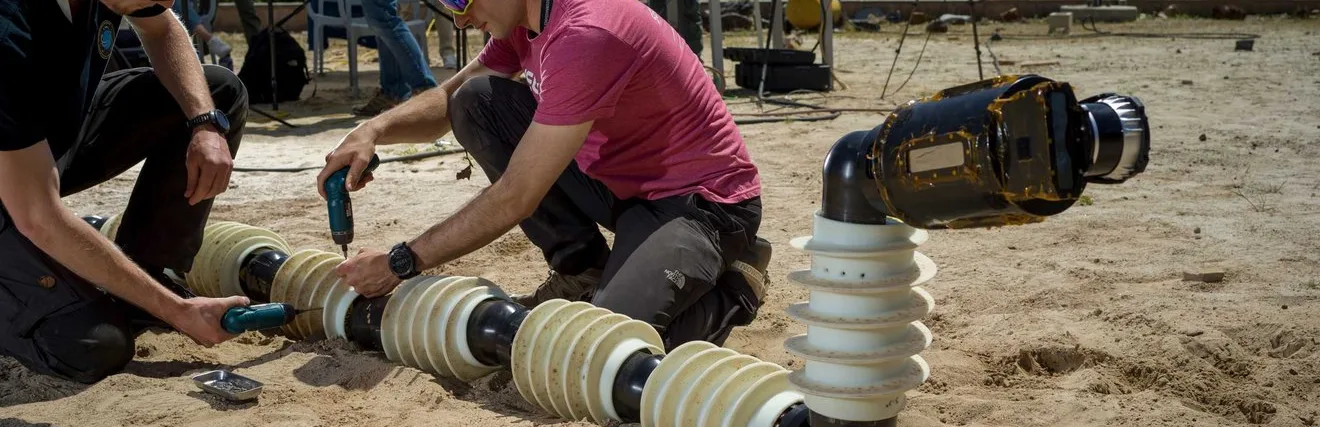
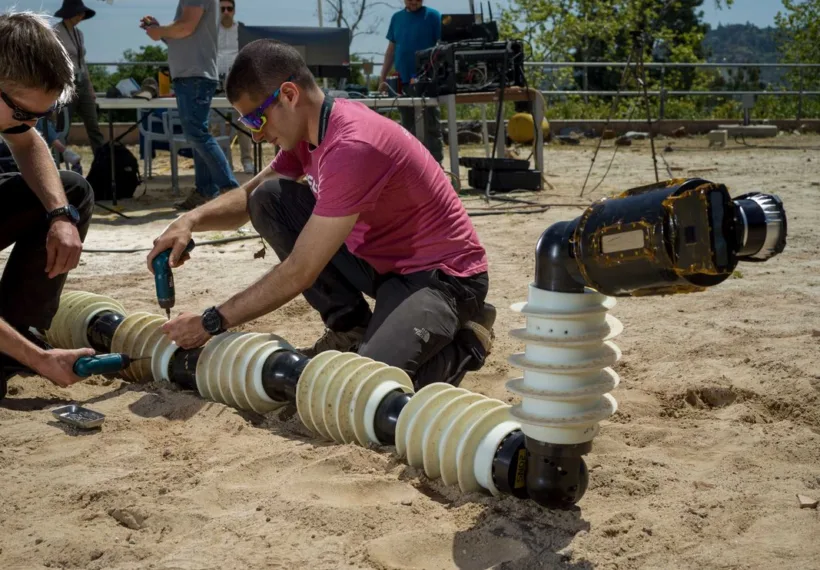
Learn about the EEL Project, an effort to send a snake-like robot to Saturn’s moon Enceladus. This robot, designed to navigate the treacherous geysers and sinkholes of Enceladus, will be tasked with exploring subsurface oceans and collecting samples. WE explore the intricate design of the robot, built with eight segments and 16 motors to ensure redundancy and reliability on this daring mission.
Tune in to discover how engineers are pushing the boundaries of robotics, working alongside NASA, and tackling some of the most complex challenges in space exploration. Plus, get a cosmic perspective on why robots in movies might be more unimaginative than you think and why a tandem review of robot morality is essential as we venture further into this technological frontier.
Thanks to our Patrons Sam Gmail, Juraj Petrovic, Teresina Rojas, Nichole Buck, Don, Jeremy Berry, Antonio Johnson, Mike Feinberg, AGM-Prism✦, Micheal Brown, and Jason Lie for supporting us this week.
NOTE: StarTalk+ Patrons can listen to this entire episode commercial-free.
Transcript
DOWNLOAD SRTSo Harrison, we had a roboticist in my office from the Carnegie Robotics Lab.
This is Institute, it was an institute.
Yeah, it was amazing.
I mean, they might replay this video when the robots take over and go, they could have stopped them then.
So this, this, That was the key point in, This was a part of the timeline where things went dark.
Timeline of civilization.
Yeah, both exciting and terrifying what can happen in a robotics lab.
But what we’re trying to do is put robotics in the service of exploration of space.
And that’s most of what that conversation was about.
There could be life on Saturn.
Yeah, yeah, we’ll keep looking.
All right, coming up on StarTalk.
Welcome to StarTalk.
Your place in the universe where science and pop culture collide.
StarTalk begins right now.
This is StarTalk.
Neil deGrasse Tyson, your personal astrophysicist, have got with me as my comedic co-host, Harrison greenbaum.
Harrison, welcome back.
Thank you, it’s so nice to be back.
You were last here, BC, before COVID.
Yes, before the pandemic, absolutely.
Right, like four or five years ago.
Just welcome back.
And you’ve been busy since you had a stint in Vegas.
I was in the hot, hot deserts.
Whoa.
So you’ve been getting around.
It was like a residency in Vegas, right?
Yeah, I was the first comedian to headline a Cirque du Soleil show and probably the last.
I think they realized they’re maybe not prepared for a clown with opinions.
Do you have to swing from the rafters?
I aggressively campaigned for my…
My first entrance was through a lift in the floor, which is very cool.
They give you like a safety training because they don’t want you to get hurt in the lift.
Of course.
And this is a true thing.
The two main companies that make it are Otis and Schindler.
So I was like, let’s not have a Jew killed by Schindler’s lift.
I don’t want to be a part of that obituary.
But for my second entrance in the show, I really wanted to come in Miley Cyrus style on a giant bagel.
And I campaigned real hard for it.
And I never, that’s a dream unrealized.
Still to come.
Still to come.
Exactly.
All right.
Excellent.
So you know what we’re going to talk about today?
We’re going to talk about robotics.
Love it.
Nobody doesn’t love robotics.
So we comb the land.
Yes, we did.
And we found Matthew Travers.
Matthew, welcome to StarTalk.
Thank you very much for having me.
Yeah, you came in all the way from Pittsburgh.
That’s correct.
That would be the home of Carnegie Mellon.
That is absolutely correct.
And they have one of the greatest robotics labs around.
Yeah, that’s right.
The home of the Robotics Institute.
Yeah, so it’s not just a lab.
Institutes.
The Institute.
And then the next level is about society.
No, Institute, that’s a good fundraising level for the title of what it is.
So you would call yourself a roboticist.
That’s correct.
Okay.
And I’ve got you here, Senior Systems Scientist.
That’s correct.
Carnegie Mellon.
I’m doing well for myself.
Okay.
Robotics Lab, Biorobotics Lab.
That sounds a little scary.
And MATLAB.
What is MATLAB?
The MATLAB is my lab, lack of a better description.
Oh, MATLAB, Matthew Travers Lab.
That’s correct.
Oh, no, no, no, I will not allow that.
I know what I’m saying for the scientists out there.
I don’t need to brag, but we’re currently in the Neil Institute.
There’s another MATLAB, not to be confused with the MATLAB.
Okay, I can’t believe you went there.
Okay, gosh.
But anyhow, we want to just get all into your stuff.
Please.
So Matt, tell us, what do you think when someone says robot compared to what your average person on the street thinks?
because you know, robot, it’s got to have two arms, a head and legs, and not sound exactly human, right?
It’s got to have a robot voice.
Yeah.
For example, there’s a gap there.
Is one of your goals to close that gap between imagined robots and reality, or you just don’t care?
You’ll make robots serve whatever the needs are of those who come knocking on your door.
Yeah, no, it’s an interesting question.
So, I mean, I think it’s probably philosophical more than anything else.
Well, bring it on.
What’s a robot?
Right?
Like a coffee maker could be a robot.
I would call it a robot.
It does a task that you wouldn’t otherwise do or want to do or don’t care about.
Yeah.
It’s arguably one of the most, by that definition, one of the most reliable robots at the Robotics Institute without any question.
Works day in, works day out.
You know, provides a service.
But, yeah, I mean, it’s a daily activity, right?
We work on robots of all different shapes and forms.
And it’s everything from, you know, sort of more mechanical systems, like you’re talking about, things that are biomimorphic, things that, you know, look like humans, look like dogs, look like snakes.
You know, all the way down to us, what we consider, you know, more on the intelligence side.
So, what have you been working on lately?
A bunch of different things.
So, big program with NASA.
I think we’ll talk a little bit about.
I’ve been working in recycling robots for quite some time, and I’ve been doing a bunch of work.
Robots that recycle?
Or recycling current robots?
Yeah, how many people are done with their robots?
They’re not even going to recycle.
Well, that coffee maker has been rebuilt so many times and just wants to end it.
No, no.
Say, oh, so these would be robots that know how to sort recycling materials.
Yeah, that’s correct.
Okay, so that’s a mechanical thing with some AI built in, right?
So it’s got to be a whole AI dimension of what you’re doing.
Yes.
There’s a lot of interest in the robotics community and AI right now, sort of like overnight.
Right.
So let’s unpack this a bit.
Obviously, the coffee maker is not making decisions for you.
Oh, it’s grinding the beans, right?
No, no, but you told it to grind the beans.
Yeah, that’s right.
It’s not otherwise.
It’s doing tasks for you, but it’s not deciding for you.
It’s not looking at you, get out of bed, and say, we need a triple espresso this morning.
But if you pop up wide-eyed, and then it gives you a single espresso.
So, where is the frontier now?
because it seems to me, we’re capable of building anything mechanical.
Mechanical is just some engineers in a room for a day.
It’s this decision-making that seems to me the big frontier here.
Yeah, related to the question of what actually makes a robot.
So for me, when we get down to it, actually combining the mechanical with some form of intelligence and some decision-making and some ability to sense the world so that you can get feedback.
By the way, we had as a guest on StarTalk, you can dig it up in the archives, the actor who played C-3PO.
Awesome.
Yes.
So at the time, he had written his biography.
And in there, what he said was, he’s the only person in the world who knows what it’s like, firsthand, to be a robot.
And I said, well, what do you mean by that?
And he said, I’d be standing there.
And if people chose to ignore me, there’s no social cost to that, because he’s just a robot.
Whereas if he were an actual human being, you’d have to feel some obligation to fold them into a conversation.
And so I don’t know if this gets to the point of, can robots have feelings?
Could you have feelings for a robot?
Does that matter?
Are there psychologists working in your MAT lab?
That could guide your morality and your ethics when you invent one of these things?
It’s become a very big subcategory in robotics.
It’s been ethics, roboethics, if you may.
And it’s an interesting question.
Certainly you’ll talk to people who work with bomb disposal robots.
Or people you’re starting to see more like dog-like robots, police bomb squads, and will have them.
And they start to really develop personal relationships.
So part of it is probably because people will name the robot.
Yeah.
And the moment you name it, don’t name the animal you’re gonna slaughter for your dinner.
because that affects you emotionally.
Fair enough.
Yeah, I think the emotions that they might be feeling, it becomes part of your team.
Right, so people do study psychology of teaming and that.
And so starting to extend some of that to now incorporate robots on those teams.
And the sense of co-dependency, especially in these jobs that are life critical for lack of a better description.
When you start to depend on something, you have a former relationship with it.
It becomes part of your life as well, yeah.
Wow.
Okay, so this future robot should have caution page about…
Getting too close.
Getting too close.
Yeah.
And stop there because there’s no…
My car was named Rebecca.
I’ll just leave it at that.
I won’t answer what you did with Rebecca.
So I have a question, and this has bothered me is not quite the right word, but it is the right word.
I’ve been deeply curious why anyone would build a robot that resembles any life form at all.
Just build a robot that is exactly shaped for your task, and that should not have to be something that looks like another life form.
Yeah, you’re correct.
Let’s build a bomb-sniffing dog.
No, just because dogs have good sense of smell doesn’t mean you have to build a robot that looks like a dog.
Build a robot that is for the task.
Yeah, I mean, people do definitely build platforms that are specialized for tasks, but it comes down to almost more of a philosophical question.
Doesn’t it have to be true that a specially designed robot will do its task better than a generally designed robot would?
Eh, it doesn’t have to be the case.
Speaking as an engineer, that kind of has to be the case.
Yeah, I mean, what you typically find…
One example from, you know, stuff that we work on in MATLAB is, you know, we design robots that can go up and down stairs.
So you can design a robot that’s really good at going up and down stairs, but, you know, the action is at the beginning and the end of the stairs.
Right, so like if I design a robot that’s only good for that one portion of the task, of course I’m going to, you know, have a robot that’s really good at going up and down stairs, but going and exploring a floor after it climbs the stairs might be an issue.
So there’s always going to be a trade-off.
I’m Olicon Hemraj, and I support StarTalk on Patreon.
This is StarTalk with Neil deGrasse Tyson.
So, how many legs does this robot have that goes up steps?
We use quadrupeds.
Stairs were made for legs.
Trust me when I say that.
Legs, but made for four legs, not two legs.
Eh, legs in general.
I used to walk dogs, and dogs had no-
I’ve seen some footage of past presidents.
Having legs is not necessarily all you need to go up and down stairs.
Yeah, yeah.
So, I used to walk dogs for a living, and dogs are completely fluent on stairs, okay?
Provided they’re not bred as city dogs.
City dogs don’t know stairs, but any other dog, they can just roll, and they’re perfectly fine.
And they’re pretty good on horizontal ground, too.
I don’t think I want a robot dog walker that looks like a dog.
Just a robot dog holding other dogs.
It’s actually all right with it, to be honest with you.
No, no, you need the arms to hold the leash.
So, you’d have to design a dog with six legs.
Oh, God.
They can do it.
You can do it.
Why can’t they do it?
Hexapods, more legs.
Oh, hexo, what’s it called?
Hexapods.
Hexapods.
That makes sense.
Okay.
All right.
What’s the most legs you put on a robot?
Six, personally.
The way you said it makes it sound like you want to do more.
Yeah, he sounds like he’s still aspiring.
But doesn’t six-
Octopods.
Doesn’t six legs maximize a certain efficiency of locomotion because any three points that are not in a line creates a stable foundation?
So a stool is like the minimum thing you can sit on.
If it had two legs, you can’t sit on it.
Okay?
You give it a third leg that’s not in line with the other two, that’s-
That’s the reason you don’t sit on a person.
Duh.
Two legs.
Oh, I see.
Okay.
So three legs is stable, the minimum stable number of points.
If you have six legs, at any given moment, three legs can be raised and moved forward while the other three legs give it stability.
Those other three legs go down and then it swaps three legs for three legs.
Keeping in mind that when we lift up one leg, you’re not stable.
You have to land once you’ve lifted it up.
Right.
All right, otherwise you’ll tip over unless you’re a ballet dancer and you don’t, I’m not thinking you’re a ballet dancer.
Wait, what are you trying to say?
So, do people think about the stability of what legs are still touching the ground versus which others can move forward?
I think that’s how beetles can scurry so efficiently.
Their legs do this thing.
Yeah, so it’s called an alternating tripod gait, as you might imagine.
So you got a term for it.
Yeah.
Alternating tripod gait?
That’s correct.
Didn’t know that, thank you.
You’re welcome.
I was gonna say next time, instead of spending five minutes explaining it.
I was gonna cut in, but I didn’t wanna be rude.
I was gonna call it the Matt game, but they said, yeah, it might be too much.
But you’re correct.
It might not be the most efficient, maybe the most effective in terms of maintaining static stability.
So with humans, right, sort of the main difference between what you’re talking about with Hexapods and humans is we actually have a dynamic stability, which is sort of a different…
The way a bicycle has a dynamic stability.
That’s exactly correct.
Right.
If you don’t pump energy into the mode of going forward, you’re gonna fall over.
Right.
Interesting.
But on the flip side, as I think a famous robotist once said, mow legs, mow problems.
Yeah, I think it might have been me.
Is that a problem where, like, if you have too many legs?
I feel like you have to know where each leg is gonna be at all times.
The millipede didn’t seem to have an issue with this, okay?
Yeah, it’s an interesting question.
So when we start to get into robots with even more degrees of freedom, for each of those legs as a roboticist.
So tell me about degrees of freedom.
Yeah, sorry, excuse me.
So degree of freedom is like in your elbow joint or any of your joints is a degree of freedom.
Typically one joint, so like a simple hinge joint, you can get one degree of freedom.
Got it.
But the rotation, I guess that’s also, so now I’m moving but not moving to a new place.
So is rotation a degree of freedom to you?
Yes.
Yeah, okay, good.
Rotational and translational.
Translational, all right, good.
Yeah, so as you start to add more and more degrees of freedom, you need to start to be a little bit sophisticated in how you are gonna coordinate this.
I mean, I have lots of degrees of freedom in my body, but I’m able to coherently put those into forward motion to walk, to jump, to climb stairs.
You’re not a badly connected skeleton trying to walk down the street, right?
Yeah, that’s correct.
No skeleton has ever had swagger.
They’re always ready to crumble into a pile of bones.
So as you boost the degrees of freedom, it comes with higher responsibility.
It requires more control.
Yeah.
You can articulate more.
So the overall number of, you know, better description, degrees of freedom that you have, and the expressiveness that you can get out of more degrees of freedom, the number of places that I can weave into and, you know, whatever.
Ad capability does go up, but it comes at the cost that it becomes more complicated to coordinate all of those degrees of freedom.
For me…
Into some coherent project or task.
That’s correct.
I got into a little dust up on the Late Show with Stephen Colbert, because I just…
We had both seen Dune.
We went to the world premiere.
And I didn’t hang out with him there, but we saw each other.
And I was on his show shortly after that.
I said, what did you think of Dune?
because he loves these big fantasy stories, right?
He’s a big fan of Lord of the Rings.
I said, what did you think?
And I said, well, the worm, okay.
But there’s a scene where the worm moves really fast, and it is straight as it does that.
The worm has no legs or arms or wings, so you can’t take a straight thing and just zoom down the highway, okay?
If you ever see a snake, it has to coil and then propel itself off of that.
If you ever see a stretched out snake, it is harmless to you, okay?
It can’t just all of a sudden bite you or chase you down.
That’s not gonna happen, okay?
Straight things are slow.
That’s why the Gay Pride Parade is so much quicker.
It’s so fast!
So, what good would a robot be that has no arms or legs?
because I’m reading up that you’re collaborating with NASA on this EEL project.
Okay, this sounds like a tortured acronym.
Let’s see what they pulled out of this.
Exobiology Extant Life Surveyor.
Did I get that right?
EELS.
EELS.
Okay, so this is, it’s a robot.
It’s a robot.
In design right now, presumably, right?
When will it be ready and deployed?
I believe 2028 is target.
In just a few years to come.
That’s correct.
And what is its prime directive?
The scientists at NASA believe that the greatest probability to find other biological life in our solar system is on one of the moons of Saturn, Enceladus.
Okay.
It’s the name of the moon.
It’s a ice-covered planet.
And you can see, so they’ve sent previous missions there.
In this context, he’s allowed to call the moon a planet.
Okay.
because it’s a world.
Okay, it’s a spherical world.
And I’m giving him that, okay?
But don’t come at me and say, but how about Pluto?
Okay?
Okay, go.
Woo, my bad.
All right, so previous missions have found these geysers, plumes of whatever material coming up from the surface.
Coming from below the surface through the ice.
Correct.
because there’s pressure down there.
And any time pressure and some fluid, something’s got to give.
I’m keeping it so clean.
I’m keeping it so clean right now.
He shackled the chair.
So they believe, yeah, that pressure’s being created by subsurface ocean.
And they believe that, so they, the scientists at NASA, believe that that has the highest probability for finding life.
Now if you have geysers, you don’t have to go to the ocean because it’s coming to you.
How does that help or hinder your effort?
Yeah, that’s one of the theories that you could fly through the plumes as they’re happening to try to collect data there.
There’s other thoughts that you can just go to the surface and start taking samples there.
because the geyser comes back down and it’s…
It does.
It’s water?
Yeah, well excuse me, we don’t know.
It’s very likely water, very likely.
So there’s a couple of different theories on what would be the best way to go search for life there, which is ultimately what they’re trying to do.
With this, with the EELS Project, we’re actually trying to get into the ocean via the sinkholes.
Oh.
Do we know?
Have you considered knocking?
So that means we have some idea how big the opening is.
I didn’t know that.
That’s interesting.
Sort of.
I believe the resolution of surface, any pictures that we have of the surface of Enceladus are about six meters per pixel.
So I believe that the openings into whatever the sinkholes, we think, they can see them.
But not with great enough resolution that I think you could measure down to a meter.
All right.
So it’s gotta be worm-like to get in the hole.
Yeah.
And then what does it do?
So this project, basically we’re trying to, in the same way, it’s like a boa constrictor, actually exactly the same way, can constrict around something with snake robots, which is the EELS robot is basically a snake robot.
It doesn’t look like an eel?
Good one!
Wait a second, the EEL robot is designed to look like a snake?
Harrison uncovered the flaw in your project, okay?
This is unbelievable.
A snake-like robot tried to climb down the geyser by pushing out against the sides of it, so they don’t just, we’re not gonna drop a robot, basically, down the geyser, so we wanna do a controlled descent by pushing out.
Yeah, this is like very, you know, Mission Impossible kind of, you know, yeah, okay, cool.
So you have things that protrude from the side of your EEL.
It is using its body, the body of the robot, to actually push out and create friction against the sides of the…
So does it do it in a curvy sort of way?
So it can span whatever the width is just by curving to do that.
Yeah.
Interesting.
Now you designed it to get in, but now you wanna do interesting things.
How’s the EEL gonna do that?
So that’s where I think the EEL comes in is it actually…
We wanna be able to get down through a hole and then swim in ocean and take samples and search for life.
So you have…
Where are the sensors?
So right now the sensors are in the head and in all of the individual degrees of freedom.
So the degrees of freedom in this case all have motors attached to them as well, so you can control them.
Okay.
And does it have to come back out and…
Excellent question.
So as of yet, once you collect the information, which you have to do physically, collect the samples, getting the information back out, you can do wirelessly.
Right, if you have something flying over, you have line of sight.
Okay, so whatever it’s doing, it’s information in situ, and then it sends that information back about whatever it collected.
One way to do it.
So as of yet, undecided, I think, for that program.
Okay.
So you’re leaving that poor eel?
And we’re talking about personalized…
Don’t name this thing.
Don’t name it.
You’re gonna feel real bad abandoning it on Saturn’s Moon.
It’s one thing anybody has feelings for eels.
I’m sorry about that.
Is it furry?
No?
Doesn’t have big eyes?
So this is not designed for a sample return, then.
It’s gonna get all the samples it can.
Yeah, I don’t think the answer to that question yet exists.
So you made quick mention of the constricting part of a boa constrictor.
In what way is your eel constricting?
So it’s doing the opposite, or like the complement of constricting.
It’s actually pushing out.
Oh, okay.
So it’s the same dynamic, I guess.
So you’re using forces instead of like a normal robot, you think of in a factory where it’s doing pick and place type actions, very robotic and mechanical.
In this case, it’s more biological in the sense that it’s trying to engage with the environment.
It’s trying to actually feel its way appropriately, in this case, feel its way through the environment.
So Saturn is an hour and a half away, light travel time.
So no one is giving it fast commands.
Look out for the monster.
It’s too late.
The subsurface monster.
So it’s got to have some decision-making abilities.
What might that include?
100%.
So yeah.
Just looking outside the hole.
I’m not going in there.
What are you, out of your mind?
That looks dangerous.
You go first.
Yeah, this is so annoying.
So we just had actually a paper in Science Robotics that just very recently came out that actually…
Wait, wait, that’s a journal.
That’s a journal.
Science Robotics.
That’s correct, yep.
Wow.
So that article goes into, in great detail, exactly what the autonomy system is.
But in general, very, very high level, you have sensors, you have your platform, which can move around, interact with the environment.
You have some sensors on it so that you can sense the environment.
Is there a rock over there?
Is there a crevasse over there?
What good is a robot if it can’t sense its own environment?
That’s correct.
So yeah, sensors, mobility platform, and then basically decision making at the high level so it can take in the sensor measurements and be like, all right, there’s a big hole over there.
Maybe I want to explore the hole.
Maybe I don’t, maybe that looks dangerous.
So you have a planning algorithm is what we would call it, which is making decisions.
And then something that’s doing the control, which is making sure that your robot is actually doing what you’re trying to get it to do.
And again, because of this, it’s an hour and a half there and an hour and a half back, you don’t even know if it did anything you wanted for three hours, there’s a three-hour delay, so.
In that way, Saturn is closer than Pittsburgh.
You know, I mean, it depends on how you measure it by.
He drove in from Pittsburgh earlier today.
And that was like two Saturns.
And back.
Up till now, you have not described what this thing is made out of.
Is it just hunks of metal that you guys welded together?
Is it what?
Iron Man style?
Iron Man style.
In a cave, on your duress?
Yeah, in your garage.
I cannot begin to think what you would make this out of.
Basically, it’s a bunch of metal and motors and sensors that are put together, perhaps welded in some cases, but yeah, mostly aluminum, steel, normal, that.
And how long is it?
How big is it?
It’s about two and a half ish meters.
Meters?
Yeah, so the lady is asking, five meters.
That’s right.
Yeah, and it weighs, I think, around 200 kilograms, so like around 400 pounds.
Okay, on Earth.
Correct.
Enceladus weighs practically nothing.
You probably know better than me.
Yeah, okay.
And when I think of a millipede, it’s in these little segments, and each segment has legs, because it has so many segments, it can turn in any way that it wants.
So can I presume that since this is snake-like, eel-like, it has segments that can simulate the wiggliness of a eel.
How many segments is this made of?
Approximately.
Let’s say eight segments.
Only eight.
Eight segments-ish.
Don’t exactly quote me on that, but there’s two forms of actuation, primary forms of actuation on the platform, so it can bend its body, and then it has counter-rotating screws that can actually produce forward locomotion, even if the body of the robot is straight.
It can actually drive itself forward.
So these are like an Archimedean screw, so that you can move it forward or backwards.
That’s correct.
Right, Archimedean screw has a surface, it’s what the hole diggers are, where it’s like a corkscrew, but it’s got a surface so that as it turns, the dirt rides up the screw, and you can actually empty out the hole of what’s there.
But if that’s on a surface and you turn it, yeah, it’ll propel it forward for sure.
And counter rotating so that it can go forwards or backwards.
Counter rotating so basically it doesn’t just spin in place.
You need something to have the opposing force.
Oh, so one of them is touching the outer surface, and the other one is inside not touching anything.
No, no, no, sorry.
There are two counter rotating screws on the outside of the body of the robot.
One of them is basically gripping while the other is pulling.
So they’re both, like if you just had a screw on the front of it, the body of the robot would start to rotate.
The opposite of that.
So the screw, the body of the robot doesn’t rotate, the screws are handling that additional torsional force.
Okay, so that can only be true if the two screws have opposite threading.
Yeah, that’s exactly correct.
Oh, okay, okay.
Yeah.
I was about to say that also.
I was thinking about it and I was going to say it.
I let Neil say it, it’s his thing, but that was what I was going to say.
No, I had to figure that out in real time.
If you look at a picture of it, you can see it exactly.
Okay, got it.
Thank you.
Okay, so the two screws rotating opposite directions both propel it forward.
Correct.
Yes, and thank you.
Okay, I’m here to help.
And are there a lot of redundancies in the robot?
because it’s going to take a lot of time and energy to get it to Saturn.
Do you have things like in case things go wrong?
You know what we used to do?
because there was so much to design something from scratch, we built two identical ones and we’d send one and we’d leave the other one behind so that we had a model for what in case something went wrong, we could mess with it.
Or if we had enough confidence in that, we just launched the second one.
That’s what Voyager, Voyager 1 and 2 are identical spacecraft.
They’re identical.
We said we got another one, we’re done with it, let’s send it off.
Send it off.
So yeah, part of the going to this EEL or snake-like design is you have multiple degrees of freedom that are all working together to produce one desired outcome.
So if you have like a motor, right, you have 10, 8, 16, whatever motors in the robot, if one of those motors goes down, you now have 15 other motors.
So you’re not just completely dead in the water.
You’re literally dead in the water.
You’re literally dead in the water.
Well, you made it down, yeah, you actually made it down to the grimoire.
Just expression.
Yeah, but in this case, then you also have the screws, the counter rotating screws.
So those are your two main proposals.
You can either undulate with the body or use the screws for propulsion.
So you actually have redundant locomotive methods.
So you’re doing robotics in collaboration with NASA, which has my people, astrophysicists.
So first, how are we to work with?
Just absolute pleasure.
What else is he doing?
It’s been a nightmare.
They made us call a deal, but it’s actually a snake.
NASA’s calling me on the way out of this office.
So do they come to you or do you go to them?
It’s an interesting question.
So one of the primary tech leads on this project is actually one of my former graduate students who actually worked on snake-like robots at Carnegie Mellon.
So he, I believe, was sort of the driving force for my inclusion in this project.
So is this a fully funded project?
It’s WillFly, is that right?
Or there’s some contingencies here?
I think it’s too early to tell.
All right, have you named your eel yet?
To the best of my understanding, there’s no name for the eel yet, but I could-
Neil the eel?
Neil the eel, thank you!
Neil the eel actually works.
Neil the eel, okay.
You’ll have to go over one more letter, it’s very easy.
So my understanding of engineers is, you guys love constraints.
No, because that forces you to be creative in ways that wouldn’t otherwise be required of you.
So in NASA, there’s the payload, the weight of the payload, the temperature constraints, the shake and bake constraints because it’s hot, it’s shaky, it’s cold.
So you get all these specs, and then you just go into, you know, lock yourselves in a room and come out with something at the end.
Robot.
That’ll be all, thanks.
That’s my stereotype.
To us, you’re kind of like a black box.
Just hear the specs, just do it, right?
And then great creativity comes of this.
For example, we wanted to put telescopes in space that were bigger than the rockets that could launch them.
And we said, engineers, figure out how to do this.
They said, oh, let’s create a segmented mirror that unfurls when it gets into space.
We couldn’t have come up with that.
You guys come up with this, right?
So we’re very happy about this kind of relationship.
How has it worked in practice between you and the Astro folk?
Do they hand you specs and you come back and it iterates?
Yeah, I mean, here’s a cross on one of Saturn’s moons.
We’re going to put an autonomous robot down.
We’re going to climb down the thing and go take samples from the sea.
So as an engineer, you’re like, yeah, this is awesome.
Right?
Like, this is, and I say this in the most respectful manner possible, like, this is crazy.
Yeah, it’s crazy.
It’s dope.
Yeah, it is.
But for me, as an engineer, I like challenges, and this is a challenge.
Constraints are the challenge.
That’s what a constraint is.
Absolutely.
It’s a big problem.
It’s a hard problem, and I find that cool.
All right, so let me bring some closure here.
When I reflect on portrayals of robots, mostly through cinema and other forms of storytelling, they always make them look human.
And I remembered thinking early how unimaginative that is.
because if you have tasks to perform, the human body might not be the best designed for it.
In the Jetsons, the idea that something is robotic meant a humanoid robot did it.
Even in the Jetsons, he had to fly his own car without realizing that maybe the car itself could be a robot.
So this is very limited thinking for all of us going back even just a few decades.
Now, that’s been blown wide open.
And we have no end of tasks that robots can and should perform for many reasons.
For safety, for just dignity, for things that a human being would just rather not do.
So you let a robot do it.
And I foresee that transition coming faster and faster.
because now it’s not just the skeletal, mechanical object that’s doing a simple task.
It’s actually gonna be imbued with some form of intellect, decision-making power.
Yeah, I’m good with that.
But we need a tandem review of the ethics of what you just created, and possibly even its morality for what task you would have it do, violating one or two of Isaac Asimov’s laws in a robot that you designed that brings harm to other people.
So, cautionary tale, but a beautiful one, knowing that if we do it right, it’s as bright a future as anyone has ever imagined.
That’s Cosmic Perspective.
Matt Lab, thank you for coming.
Pleasure.
So, thanks for coming in for this.
Pleasure, thank you for having me.
Right here in my office at the American Museum of Natural History, Hayden Planetarium.
And Harrison, we can find you off Broadway.
Off Broadway, yeah.
You can call me when you’re on Broadway.
Yeah.
No, what’s your show called?
It’s called Harrison greenbaum, What Just Happened.
You can go to harrisongreenbaum.com, get all the info on touring and all that good stuff.
Excellent, excellent.
We’ll look for you.
Okay.
This has been yet another episode of StarTalk.
Neil deGrasse Tyson, as always, bidding you to keep looking up.



 Become a Patron