


 Unlock with Patreon
About This Episode
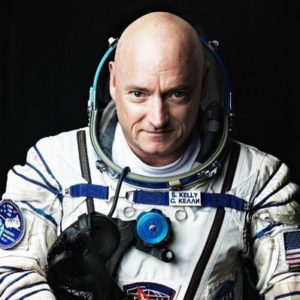
What happens when you put Captain Kirk, a NASA astronaut, and Neil deGrasse Tyson on a ship to Antarctica? Find out in this special episode recorded on board with William Shatner and Scott Kelly. We discuss exploration — from braving the Drake Passage to surviving space travel — and what it means to boldly go where no one has gone before.
This episode of StarTalk, recorded live from Drake Passage during the Space2Sea Voyage of Legends to Antarctica, is presented in collaboration with FUTURE of SPACE.
Follow or Subscribe to FUTURE of SPACE
About FUTURE of SPACE:
FoS is a media company that produces innovative content, programs, and experiential events that embrace new frontiers, celebrate the human experience, and elevate the conversation, engaging audiences in meaningful and transformative ways.
Scott shares stories of his time in space, the astronaut twin study, and his heart shrinking and growing back after his mission. Bill reflects on Star Trek’s influence during the space race and the unexpected cultural impact of the show. The conversation turns to the spirit of exploration — from Shackleton’s Antarctic expeditions to Felix Baumgartner’s stratospheric jump — and the thrill-seekers who push human limits.
The crew tackles the risk of exploration. Scott recounts preparing death letters for his family before missions and weighing the odds of survival. What does it feel like to come back from space? Bill reflects on his own brief trip to space and the finality of death. They dive into the concept of exploration — whether it’s crossing oceans, spacewalking, or pushing human physiology — and why some are willing to risk it all.
The episode wraps with a discussion on space exploration’s future, Star Trek’s lasting legacy, and a lighthearted Twitter spat between Neil and Scott. Plus, Neil shares his own rough ride in a centrifuge — with a surprising question from Bill.
Thanks to our Patrons John Shipe, Kenneth Kapptie, Dan Lee, Mark Randolph, Steven Green, David Pearson, Marius P, Sean Kershaw, Marc Bode, Jon Pulli, Sean Wins, Bessie Comer, alextravaganza, Matt in L.A., brian oakes, Tyler Carpenter, Stephan Spelde, Seymour buttz, Jeff Burton, Micheal Chinnici, stuart kim, Kathleen Ziegelgruber, Karl ryan, Fabio Later, Lorna Leigh, Abi Cats, Anthony Charlier, Zane White, Jonathan Plumb, Matthew Hinterlong, Danny K. , Muhammad Laiq Khan Rind, Khadeer Ahmed, Kathy Ziegelgruber, Bryan Smith, Shawn Nirdlinger, empty0vessel, Ruben Suarez, Jeffrey Roche, James Williams, Jules Victor, livingston ex, and Kora Celine for supporting us this week.
NOTE: StarTalk+ Patrons can listen to this entire episode commercial-free.
Transcript
DOWNLOAD SRTThis past December 2024, I was on a ship to Antarctica.
That’s one of my bucket list items.
And I couldn’t resist because there were some notables on board, and I said, this would make a good StarTalk episode.
So I snared the one and only William Shatner, Captain Kirk.
I don’t know if you know, but he is a big fan of exploration.
That’s not a hard stretch, given what he’s known for, crossing the universe during the TV commercials using warp drives.
But he’s also a deep thinker and he loves science.
So I had to get him on the program.
And also on board was NASA astronaut, Scott Kelly.
You may remember he’s a twin with Mark Kelly, and both of them have been in space, but Scott Kelly in particular was sent into orbit into the International Space Station for 340 days, almost an entire year.
He holds the record for continuous time in space for an American.
He has a lot to say about exploration, and he’s a big fan of Shackleton.
And let’s remember that every explorer who goes where no one has gone before is a risk taker.
So, if you encounter a challenge where you say, this might not work, this could be dangerous, for some people, Captain Kirk included, risk is their business.
It’s a conversation I’m having with both of them for StarTalk on board a ship to Antarctica.
Check it out.
Welcome to StarTalk, your place in the universe where science and pop culture collide.
StarTalk begins right now.
Scott, we’re in the Drake Passage right now.
Could you give us a little background on that?
Why are we listening?
Why are we feel nausea?
What’s going on here on Earth?
Yeah, well, the Drake Passage is the part of the Southern Ocean where, at the tip between South America and Antarctica.
Cape Horn, the tip, yeah.
But where the Pacific and the Atlantic Oceans meet, and it’s very deep here, which causes, you know, with the prevailing winds that are generally west to east, some pretty big swells.
And I think we’re seeing about, I don’t know, maybe 14, 15 feet right now, but they can get as high as 50 feet in this passage.
So we’re in a cruise ship.
What would this passage have been like in a wooden ship a hundred years ago?
You wouldn’t want to do it.
But risk is our business.
Yes, I said that.
Yeah, I think it would be pretty harrowing, you know, in this kind of, even in this sea state in a ship like that.
But I can’t imagine being at the swells of 40 and 50 feet.
I was just talking to my brother on the phone.
This is your twin brother?
Twin brother.
You know, when I last interviewed you on StarTalk, I said, which brother are you?
You said you’re the good looking brother.
Yeah, that’s still true.
Oh, OK.
Yeah.
But anyway, he was telling me about being in the North Atlantic on a cargo ship because we were both, when we were younger, training to be merchant mariners in 80 foot seas and losing 20 containers off the ship.
So if you think this is bad, just imagine that.
So now, Mr.
Shatner, my dear, your show, the original Star Trek series in the 1960s, was coincident with while we were priming our space program to go to the moon.
But as far as your show is concerned, we were already there.
Space was not a question about whether it should happen.
It had already happened.
It was a matter of learning to speak Klingon.
As many fans of the show managed to…
I can’t count myself among those who are fluent in Klingon.
Nor I.
So, were you just an actor at the time, or did you participate emotionally in this idea that exploration is in our DNA?
Exploration doesn’t necessarily mean going to Mars and colonizing Mars.
You can explore.
For example, may I spend a moment on exploration and why exploration?
Well, a while ago, seven years ago, I heard a story of a ranger in the forest, in the Sierras, occupying a cabin, and he was there, I guess, for fire observation.
While he was living in the cabin alone, a deer came and ate the grass and went on, and then one deer poked its head in the window to see who was there, and he struck up a conversation and had a relationship with the herd of deer and discovered that deer had posted types of personality.
There was the diplomat deer who poked his head in to see what was going on.
There was the guard deer.
There was a deer, you know.
So this herd group had assigned roles that he discovered that, my goodness, that’s how we organize ourselves.
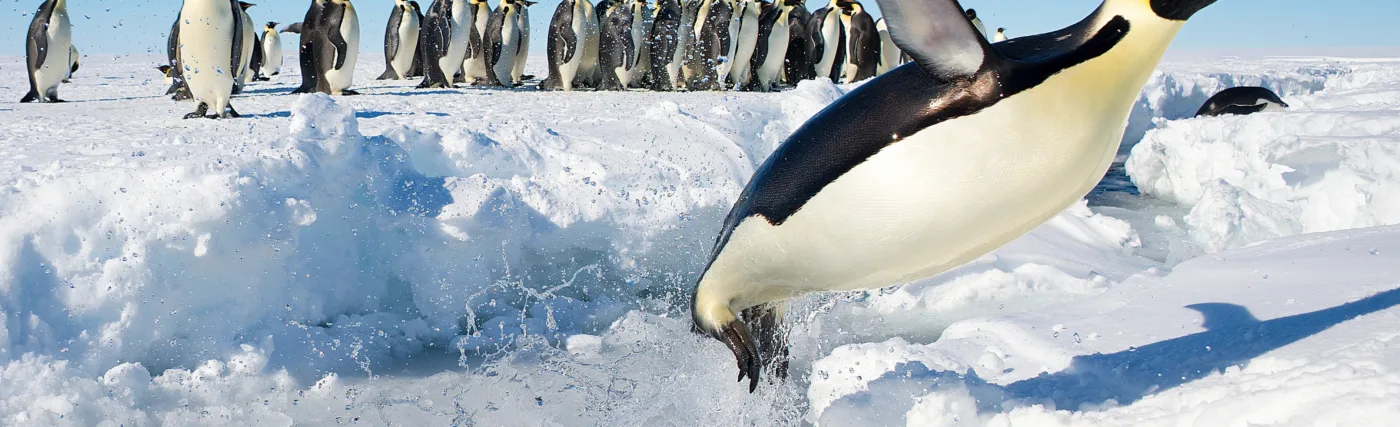
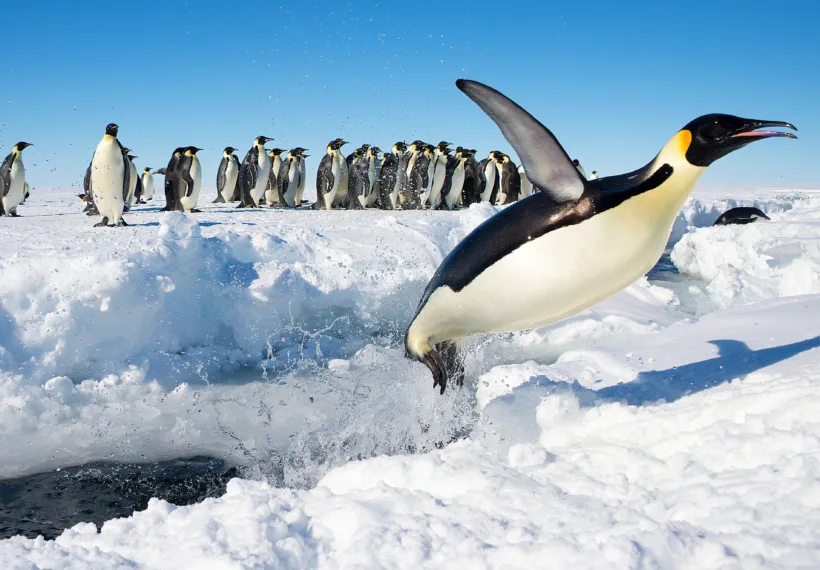
When we were on the last island with the penguins.
On this voyage, having just returned from Antarctica.
On this voyage of exploration for all of us, for me certainly, of discovering new worlds, new, whatever that, whatever the language was.
And seeing new civilizations, which were the penguins.
And a penguin came up to the group that was standing, having landed.
And the penguin, Mark, what are you doing here?
Was that what it was saying?
This was the diplomat penguin.
Okay.
And I thought, of course, this whole thing is a circle of life.
And here’s a penguin acting like the deer and the ranger and us.
And this circle, I thought, wow, what a discovery of, we’re in this arid land that’s rife with life, but you can’t see too much of it.
But it’s there.
And the penguins are a big part of it.
And it’s exploration.
And I was a discovery and I had the best time.
Okay.
So what you’re saying here implicitly and explicitly is that humans aren’t the only curious animals out there.
That’s right.
The penguin was exploring.
It was exploring in its own way.
No.
It was exploring in a very explicit way.
What are you guys doing here?
You’re two-legged.
You don’t waddle.
Well, some of us waddle, but…
You point to me that I waddle.
Let’s go back 60 years ago.
You’re an actor.
By the way, by the way, I don’t know if you knew this, but William Shatner appeared in two distinct episodes of The Twilight Zone.
Yes.
And quite memorable episodes at that.
Predating, of course, the Star Trek series.
You’re an actor in Hollywood.
And so was there anything in particular that drew you to the part?
You’re talking about Star Trek?
Yeah, Star Trek.
I was in New York doing something in New York, and they had made a pilot of Star Trek, and NBC didn’t want to buy the pilot.
They had faults with it, but they loved the idea, and they wanted, for the first time, I’d never heard of it before.
I’ve never heard of it since.
They said, we’ll give you another, whatever the cost was, to make another pilot, recast it all, and they called me.
I was in New York.
They called me when I come to Hollywood to see this thing that they had made with the idea of playing the captain.
So I was like, ushered in.
Can I presume you had no idea what impact that would have on our culture at the time?
None whatsoever, and I saw the thing that NBC had turned down.
I thought, that’s pretty darn good.
It’s a little pedantic.
It’s a little, you know, here we are.
We’re sailing the five oceans, whereas the guys in the capsules are all friendly, and, you know, there isn’t this distance between us.
I suggested a little more camaraderie and humor, and we sold the pilot.
So when I look at this, by the way, I don’t know if anybody’s ever been to Comic-Con, the one at least in San Diego.
I don’t know if they also do this in New York.
The very last session is a Starship SmackDown, where every single Starship, spaceship, ever appeared in fictional storytelling is put up on display, like drawings of them, photos of them, and you vote.
There are people arguing the case of one ship or another of which is the greatest of ships.
Of course, the year the Starship Enterprise won that, what carried the day was a simple fact, that no ship before then ever displayed in storytelling was ever designed to just explore.
Every ship you ever see someone get into and out of in a science fiction movie or story, it’s designed to take you to a destination.
That’s why those ships existed.
So this as a concept is like, oh my gosh, exploration was paramount in why the ship existed at all.
Right.
It was designed.
I mean, what you’ve said is valid.
The truth of the matter is the designer of the ship had designed many versions, put them on a wall and invited all the executives in to see which aspect of which drawing they loved.
And then he combined what everybody loves.
It was like a potpourri of…
Oh, I didn’t know that.
Yeah.
NASA’s done that before, I think.
Say that again?
NASA’s done that before.
That’s why they get canceled.
That’s the Space Shuttle.
Space Shuttle is an amalgam of ideas stapled together pretty much.
It’s a noble-looking ship.
It looks like it should go someplace.
Unfortunately, it’s not powered, right?
The Space Shuttle orbiter, it’s got wings and jet nozzles out the back.
So, it seems to me, wherever you are, you ought to be able to choose, let’s go someplace new.
And in fact, that’s what they did in the film Armageddon.
Yes, but in real life, once they start their approach, they got to land it.
That’s one of the reasons why Armageddon violated more known laws of physics per minute than any other film ever made.
So, just tell me about the space shuttle, what it meant, if its only job, as fun and versatile as it looked, if its only job was to get you to orbit.
Well, that’s not, that wasn’t its only job.
Oh, please.
So, the space shuttle is one of the most, is the most diverse spacecraft we’ve ever built, and probably will be so in our lifetime.
But it has one serious limitation, it’s heavy, and it doesn’t carry enough fuel to get out of lower Earth orbit.
But it does launch people, it launches cargo, it can build things, it built an international space station, it can be its own science laboratory, you can do spacewalks from it.
And that cargo bay is huge, as far as I can tell, because it launched, it deployed the Hubble Space Telescope, and my favorite, my favorite size analog to this Hubble Telescope, it’s about the size of a Greyhound bus.
Which means, you could lower a Greyhound bus into the payload of the shuttle.
Yeah, something that weighed up to 50,000 pounds, whereas the Soyuz, to use that as the counter example, the Russian Soyuz spacecraft is really only designed to launch three people and a very small amount of cargo.
And that’s it, it does it very well, but it doesn’t do very much.
You’ve been up more than once, have you been up on each of those crafts?
Twice on each.
Twice on each.
So, now maybe because the Soyuz is not as complex as the shuttle and the orbiter and the solid rocket boosters, the Soyuz has the best safety record of any space rocket.
They’ve had two fatal in-flight accidents, just like the space shuttle, but less people.
Okay.
Similar number of flights, but.
Oh, I thought they had many more flights.
Okay, I didn’t know that.
Where does this fit with you?
We know, we learned earlier on this voyage, you gave a marvelous talk, reviewing Shackleton, the explorer to the Antarctic, and the trials and tribulations he went through, and no one died after he got stuck in the ice.
And he’s a bit of a hero of yours, as we all felt.
And mine do.
And yours too.
So here’s someone who’s gone where no one has gone before.
Oh, I’ve heard that.
Boldly, boldly.
Boldly gone where no one has gone before.
Oh, sorry.
He’s right.
And he sounds so good on the track.
Is that you narrating it?
That was me.
Boldly go.
Oh, my God.
That was you, though, right?
That was me.
That was right.
With the very famous split infinitive.
Boldly go, go boldly.
Yeah.
And later in the later films, they said to go boldly.
Well, I wrote a book called A Boldly Go.
Yeah, we loved that.
When they tried to fix the grammar in a later movie, it was like, no, that’s just just deal with it.
Doesn’t work that way.
Yeah, doesn’t work that way.
You were talking about ships and its efficiency.
I was invited to the Cape one time.
We rolled out the red carpet.
It was Cape Canaveral, Florida.
Yeah, where they would launch all our spaceships.
And in the center of one of those hangars on a platform was the Lunar Excursion Module, the LEM.
But up the stairs and they invited me in to the LEM, which looks like whatever you call it, you know, the pergola.
Yes, exactly.
It looks, it’s the simplest and you get inside and they have a hammock to lie down.
I laid down on the hammock and it’s this ridiculous children’s toy.
And it’s got more instruments, more complications.
And that’s the result from the shuttle to the spaceship to the thing and the mud.
They’ve got a little garden tool thing to land on the moon, get out there, take a picture, get back in, and then meet up with the whatever we call it, the thing circling the air.
The command module, or orbiting the moon.
Then they get out of the limb, into the ship that’s going to take them back to earth.
And this, what happens to the, oh, that’s been, no, no.
What happens to it?
Crashes into the moon.
It crashes into the moon.
If that’s how it, eventually, I guess.
However, if memory serves, Apollo 13 realized that for their life support, they needed some of the life support that was on the limb.
So that in some of the missions subsequent to Apollo 13, didn’t they keep the lamb a little further in towards earth to make sure?
Is that what happened?
I don’t remember.
They used to use life support systems to, you know, save themselves, the life support systems on the limb.
They had to do some modifications, but they were able to use that to, you know, safely get back to earth.
Can you imagine?
And they’re saying, well, what will we do when the engineers down on earth are saying, well, try this and try that, and you’re going to die.
But when you talk about exploration and the means of exploration from what’s his name, Thor Heidel using papyrus as a raft and then getting to all Shackleton in a wooden boat.
And here we are on this modern liner, which was being explained by you, that the engines here are of a particular make.
And because we don’t hear the engines propelling this boat, as we are right now going back to Ushuaia, we don’t hear the engines.
Except every so often, and I didn’t understand why, you hear, when we’re parked, you hear a rumble.
I think, what is that?
Is that the anchor going down?
It’s not.
Well, it’s station keeping.
It’s the station keeping from…
Yeah, so you could drop an anchor, but if you don’t need to, then why?
And now we know exactly where the boat is.
So we…
It’s not my boat.
The captain knows…
All the means of exploration going on, the variety of things that we’re using to explore.
Well, let me throw a little monkey wrench in this.
As usual.
If you know that much about where you’re going and it could be done in the safety and comfort of a luxury ship, then is it really exploration if the risks have been reduced to zero?
Well, but you mean if you’re rowing in an open boat, you’re more exploring than getting a…
If you’re going where no one has gone before, that is exploration.
If you’re attempting tasks that have never been attempted before, Scott goes into orbit.
He’s a guinea pig for the doctors on Earth because he’s got a twin brother.
We’re going to learn about no one had done that before with a twin brother.
It’s incredible.
What an incredible thing.
Your brother was not the guinea pig, you were because you’re in space and you’re exposed to cosmic rays.
What happened to you?
Well, I was exposed to the environment.
He was the guinea pig on Earth that was a complete baller.
Yeah, keep telling yourself that.
He’s chilling on the safety of Earth’s surface and you’re not.
And, you know, he had people following him around the country and taking all kinds of samples and having to leave stuff outside his front door and also was like the lowest…
Stuff outside his front door.
We figured what that is.
Yeah, for people to pick up.
Lowest paid government employee at the time because they had to pay him so he was making minimum wage because he was no longer a NASA astronaut.
So I really have to hand it to him to do that.
Whereas I was like getting all the glory by being in space.
But also, like you mentioned, the radiation.
Yeah, but your heart is smaller than it was when you went in there.
Yeah, stuff happened to you.
It grew back.
It did.
But as my wife Amiko says, it’s a good thing.
I started with a big heart.
Oh, that’s great.
I just want to understand this.
So even though the exploration was not in the realm of place, it was in the realm of physiology.
It’s exploratory physiology.
I agree.
I agree.
I agree.
So what did we learn by exploring what happens to your body in orbit for how many days?
On that mission, 340.
340.
They couldn’t stay an extra 25 days and call it a year?
I wanted to, but the Russians had a certain schedule they had to meet, so we had to come back.
Because you came back on the Soyuz?
Yeah.
Let me remind people, the Soyuz does not land in water.
They just land on land.
They crash land on the parallel.
Yeah.
It’s really not a landing.
Well, it’s a landage if you walk away.
It’s a landage.
It’s the ultimate e-ticket ride when that parachute opens.
And if I hated being in space every minute for that entire 340 days, I’d do it all over again for that last 20 minutes.
Really?
Just the thrill?
The last 20 minutes of coming back to Earth?
Yeah.
What was that like?
Well, when the parachute opens, you just tumble and are thrown around like crazy.
And there have been, I know one of one particular person, and I’m sure other people have felt this way, who was an experienced test pilot.
I’m not going to say the person’s name because I don’t want to embarrass him, but he was not apparently not briefed on how dynamic the landing is.
And he started screaming because he thought he was going to die.
High pitch or low and guttural?
I wasn’t there.
Yeah.
Because there’s flames coming out of the the tile, right?
It’s like going over Niagara Falls in a barrel.
But while you’re on fire, and as soon as you realize the flames are coming up through the windows, you’re on fire.
That’s while you’re slowing down on.
But but not but shoot opens a little bit later.
Shoot opens later than that.
I understand that.
But in that moment, when I was screaming, flames are coming up.
You’re burning up and you don’t know whether the tiles are glued down and up.
They may be flipping out.
The tiles may be they literally lost some tiles.
There’s a lot of things you don’t know that’s going on.
Yeah, right.
You’re you’re you’re on the inside.
You don’t see what it’s got going on the outside.
You might not want to know what what what was it like to have three of you in the ship, right?
And one guy’s going, yeah, what’s that like?
I wasn’t there on that one, but I it was only, you know, reported afterwards that this particular person was he what did they say?
You can’t do that.
I don’t know what going on then.
You might not.
I’m an astronaut and I explore space.
I’m going to Mars.
But when I came down, I saw flames.
But I still want to get to the bottom of the advancing a space frontier by learning what’s happening to your physiology.
Oh, yeah.
Okay.
Let me get back to that.
Yeah.
Heart shrunk 25 percent, changes to my telomeres.
25 percent.
Yeah.
Telomeres, that’s like the end of your DNA or something.
Yeah.
Really an indication of your physical age.
As you get older, they get shorter, more frayed.
Initially, NASA thought that was due to the controlled diet and exercise.
Later, we learned that there were some worms that the Japanese were doing telomere experiments on too.
Their telomeres got better while they were on the space station.
Never once saw them working out on the treadmill or doing any kind of exercise.
So it turns out it was actually the radiation.
Most important result that I always want everyone to understand and point out is after spending a year in space, like you mentioned earlier, I am now not only smarter but more handsome than my brother Mark.
Would he agree to that?
Probably not.
This idea of pushing the limits of not only what a machine can do but what human physiology can do, this is exploration.
And who, you, sir, now the oldest person to ascend above the carbon line.
Do we go there again?
I am not.
My telomeres are very long.
But let me ask you this.
When I saw you go up the ladder to go into the Blue Origin capsule.
Yes.
And I said, this man is 89 years old.
How old were you for that flight?
I don’t know.
32, something like that.
No.
Times three.
Wait a minute.
I’m walking up the stairs to go and something’s venting out of a pipe.
Out of the side of the ship.
What’s that?
Hydrogen.
Hydrogen?
The zeppelin?
The Hindenburg.
The Hindenburg.
Burned.
And hydrogen was what was burning.
Yeah.
And I’m looking at this thing.
Plus, there was some coating of aluminum powder on the surface to make it highly reflective.
That burned also on the skin.
Standing electricity up the road.
Had you been in Russia, not only would the thing be venting the fuel, there’d be people smoking cigarettes right at the bottom of the launch bed.
Let us be candid with ourselves that part of the risk of exploring, on some level, is even the risk of even starting the trip.
If you’re exploring, you’re ready to die because you’re going, at some level, you’ve got to be ready to die.
Here you go.
What probability of death would you have accepted?
What’s the highest probability of death you would have accepted to do that mission?
To launch on the space shuttle?
Yes.
Well, I launched on the space shuttle, STS-103, and so we had approximately 103 prior missions, and there was one fatal accident, so that’s like a 1% chance of dying.
Yes.
What would I have accepted?
Certainly not 50%.
10%?
Maybe.
Maybe 10%.
It would depend on what we were doing.
Well, that’s an interesting question.
Yes.
Because death is so permanent, you lose the bet.
It’s 10 to 1.
You don’t just pay up, oh, here’s the 100 I owe you.
It’s your life.
1% is not acceptable.
Nothing is acceptable.
I’m going up.
I’m a test pilot.
I’ve tested this plane.
I’ve tested this thing.
I know it works.
I’m not going up to die.
I’m going to explore.
Oh, that has to be your attitude.
That has to be your attitude.
And that’s what you come to terms with.
Like, I would think about it leading up to my first flight with, you know, you kind of rationalize, hey, for one, I want to do this.
I think it’s important.
I want to serve my country.
It’s my job.
I’m a test pilot.
There is risk.
My brother and I used to exchange those like death letters for our families.
Like if the thing blows up, give this to my wife and children and we do the we would do the same.
Fortunately, never had to use those.
But it’s, you know, everything has a thing in NASA, is that a thing?
Death letters?
Maybe.
I don’t know.
It was the thing with my brother and I.
You’re a test pilot.
So, you’ve run that, it’s a new airplane and you’re testing the airplane.
So, you run that airplane along the runway, the front.
Now, you’re a foot up the ground, you make a circle, and get you 10 feet, 20 feet, 30, then you’re 50 feet.
By that time, you know the plane works.
You go up to Mars.
You know it worked.
It might not continue to work as you expand out the envelope.
Now, you can press a button, you eject, I mean, the chances of living.
Now, let’s go to Mars, guys, okay?
Shup flames, scream, ah, flames, and then finally, you’re in to orbit, and you’re going towards Mars.
You’re gonna die.
Meteorites, radiation, landing on Mars.
This is why we have engineers.
You may die.
What?
You’re not definitely gonna die, you may die.
It’s why we have engineers, to figure this out.
To die.
The chances of you surviving a meteorite hit, or lasting six months on Mars with all that radiation, and then getting back in and saying, oh, more flames, we gotta get liftoff, get out of orbit of, I mean, and land on Earth.
You’re gonna die.
Okay, none of us want to hear you say that, who uttered the words to boldly go in.
You’re gonna die.
Boldly go, boldly go to your death, and if you don’t die, we’ll congratulate you, and we’ll tell you your telomeres are lengthening.
Take this back to Antarctica.
There on the open seas, there could be monsters in the ocean.
There could be weather patterns they’ve never thought of or predicted.
They don’t know how much food they’ll actually need.
They don’t even know if there will be food there.
Devin coined the word catabatic or adabatic.
What does that mean?
100 mile an hour winds coming downwind, 100 mile an hour is going up, 100 mile an hour winds.
You got to, you’re in a robo for crying out loud.
You got to sail.
A sail?
A sail is good for 15 knots.
20 knots, you’re going to blow your sails out.
30 knots, you’re master crashing.
You’re going to die.
So what I have come to learn being a member of the species that we call homo sapiens, not all of us fear the risk of death at the same level.
Wait a minute.
Hang on, no, very simple.
There are people who ascend Mount Everest knowing there’s a real chance they’re going to die.
They got oxygen, they’ve got parkas, they’re going to slide down on their ass down the glacier to get back to camp.
They’ve got Sherpas who go up without oxygen, run up and run back.
If you need some help, sir, I’ll help you, says a Sherpa.
They probably give the, you know, all those National Geographic specials where they show someone ascending the mountain for the first time, but there’s a camera already there when they get up to the top.
So who got the camera?
The camera got there first.
The Sherpa.
The Sherpa and the camera got there first.
Exactly.
But what I’m saying is, there are people who jump out of airplanes willingly.
People who rock climb.
But they have a parachute.
They’re not going, this thing’s going to open.
How about that guy that jumped out of the, what is it, 50,000?
Yeah, bomb guard.
Felix bomb guard.
Who by the way?
He was scared.
He was a guest.
He was dead.
He was scared.
Scared.
He was going to die.
The moment he started twisting, I’m going to dive centrifugal force.
How would you like to dive centrifugal force?
Your blood comes out of your ears.
I had Felix bomb gardener on StarTalk.
Yes, he checked our archives and he’s a pretty good guy.
I thought he’d be a little weird or crazy.
What was he exploring?
He liked exploring the limits of his own body’s tolerance.
So it’s like a rock climber.
How many rock climbers lived to 40?
Nobody.
You know why?
They’re after that thrill.
After a while, a crime or rock, I got to go further.
I got to go do more.
And here’s where I want to take this.
Listen to me.
Some of us do that.
And some of them die.
Those who don’t die, figured out how to do it without dying.
They’ll write about it.
There’ll be someone documenting it.
And it opens up horizons for the rest of us who aren’t that brave.
And that’s how we got out of the cave.
Because Risk is Our Business!
I’ve heard that.
They’re adrenaline junkies.
They need the adrenaline.
And the adrenaline doesn’t flow after three times.
Dude, if we didn’t have them in our species, we’d still be in the cave.
Exactly.
They’re the explorers.
And as they’re falling, they say, I’m dying!
And that’s it.
But the next person that does it makes sure that they don’t make whatever mistake that the previous person made their own mistake.
And that’s what these guys are.
That’s who the original group of astronauts were.
I agree with you on the one-way mission is not something I would be interested in.
Having lived in an enclosed, sealed environment for a year when you cannot walk outside, Earth has like everything practically for humans.
It has everything to offer.
Scott, Scott, we went 150 years with people coming from Europe on one-way trips to the New World.
Oh, I know.
It’s for some people.
It’s not for me.
I would not want to live on Mars for the rest of my life.
However, I would watch that reality show because I think at some point, it’s going to turn into like Lord of the Flies situation.
Oh, the darker side of what it is to be human.
But we’re on to an interesting part of this thesis of what is exploration.
Those who do explore, those not the ranger with the deer and the penguin who asked a question, that’s one kind of exploration.
But the jeopardy of exploration is something to be discussed.
Who goes on what could be a one-way trip?
These guys didn’t know they were.
They had to know when that guy, when that brave astronaut was seeing flames coming up from the entry point and screaming, I’m going to die, that’s just his humanity.
But he was willing to go.
Somebody must have said, you know, son, the tiles are going to heat up and you’ll probably feel some heat and it’s going to look, oh, it’s okay, I can take that.
But when you see it flaming and it’s going to burn your parachute and you’re screaming, you’re succumbing to humanity.
So you don’t always know where your limits are.
Exactly.
Even if you have bravado leading up to that.
Exactly.
Your bravado.
But that’s what this adrenaline is.
One more rock I can climb up, I put my fingers in there, I got a grip, I got a grip.
Do I let go with the legs?
I don’t know whether I can.
Because I can tell you, the only people, friends I’ve ever had, who died prematurely were rock climbers dying in just such an accident.
I tell you, that’s why they do it.
Free climbing.
See, I grew up in a city.
The city was dangerous enough.
I don’t need to add other dangers to that.
I already was feeling it wasn’t the exploration gene, it was a survival gene enough so that I don’t need to do something else to put my life at risk.
So, what is your collective opinion on people who are looking at, like the people who are going to go to Mars?
Once the instruments go, people are going to go for at least a year and a half.
Wait, wait.
So Bill, I think the people who want to go to Mars have already noticed that NASA has plunked an SUV-sized rover on Mars following a half dozen other rovers that got there before.
And this current rover brought a helicopter.
So, Mars is not some unbreached place in this.
By humanity.
By humanity.
So, I think that they’re not thinking they’re going to die.
No, but they know that the risk, like Scott was saying, one percent, you know, out of 99.
99, one percent.
That’s pretty good odds.
I’m not going to die.
But would you put the odds at 50-50 to go to Mars?
I would say 50-50 is very generous.
I agree.
For the first ones to Mars, I’d agree.
And I think that’s what they were considering, maybe even for Apollo 11, right, Charlie?
Maybe a 50 percent chance of success?
Really?
So now you’re looking at guys in the magnificence, and they were all men at that time, in the magnificence of their manhood.
They were running on the beach.
They were the best physical shape.
They’ve learned everything.
Nine, six years of geology, as Jose was saying, wasted on him because he was-
Jose, another astronaut on board here.
They’re trained to a warrior degree.
They are wielding their swords of intellect like the ancient Spartans.
Yes.
Okay?
Yes.
They’re going to die nobly, one percent chance.
That’s what these guys were.
That’s the original 16, 19, what was it?
Original seven.
The original seven.
Well, the Mercury seven.
The original seven.
Yeah, Mercury seven.
So, and by the way, in the spirit of your exchange letters of who might die, it within a few years ago, I forgot exactly when, it went public.
The letter that Nixon was going to read had Apollo 11 not successfully left the moon.
And if it couldn’t launch, they’d still be alive until they died.
And so you’d be watching them die.
Another aspect, you couldn’t test that Lem’s takeoff, right?
The Lem’s takeoff could not have been tested on Earth.
Well, I’m sure they fired the engine many times in a vacuum.
One-sixth the gravity and suffering that journey and landing.
But we do have the laws of physics which work very well for us.
Yeah, it’s not just a random when we ignite it.
Where will it go?
I don’t know.
Not where will it go, but will it work was random.
Will it work in those kind of with that kind of G’s?
That’s why every mission before Apollo 11 was incrementally leading up to that landing.
Right up to Apollo 10, right up to Apollo 10.
We all forgot Apollo 10, but that one was important.
It got to the moon, deployed.
But if you’re in an airplane in the density of this air and you can pull a switch and eject, it’s far different from circling the moon and wondering with this little collapsible, the little hut that they were going to live in the moon, live on the moon and get it to fire to get back into orbit and then climb from that back into there and then get from there back to there.
I mean the chances were incredible.
That’s why they’re heroes.
That’s why they’re heroes.
That’s why they’re heroes.
Exactly.
So we’re running short on time here.
One feature of Star Trek in the original series, and it trickled into other incarnations of it, was that there was a morality tale.
So each episode was a lesson in how we treat one another here on Earth, but under the guise of, oh, it’s just science fiction, and it’s aliens, and it’s…
So that would get you to comment on a lot of prevailing geopolitics, social, cultural issues, racial issues, and…
My favorite episode was the one where a guy was black and white, and the other guy was white and black, with Frank Gorshin was the lead actor.
In that episode, the aliens were exactly half black, half white, and one group of them were persecuting the other group, why?
Because they were black on the other half of their bodies.
And so, again, it’s just the space, but really, they’re mirrors back to civilization, especially there in the 1960s, the civil rights movement was still in full swing.
So I just want to say, to be able to explore and still do something socially conscious, I think, was with Gene Roddenberry as the creative genius behind it all.
And yes, you shouldn’t get a lot of credit, but there were other guys that really worked on this show.
You know, people as a, and I was a huge Star Trek fan as a kid.
My early memories were watching, sneaking behind the couch, watching Star Trek episodes.
And I was like five years old when my mother didn’t know my brother and I were there.
What were you doing behind the couch?
We were just hiding so she wouldn’t see us.
We were supposed to be in bed and we would watch.
And she would be…
Same with me.
We weren’t allowed to watch TV during the week.
And it was scary.
So I had to catch most of it in reruns.
For me to see.
And Apollo 11 memories.
But as an astronaut, people would sometimes ask me a simple question.
You know the yes, no question or the binary question.
Star Trek or Star Wars?
What was your answer, Scott?
I used to say when I was a young fighter pilot, oh, absolutely Star Wars.
X-Wing fighter.
Scott, Scott, that’s real.
Scott, Scott.
Security, could you get him off of this stage?
As I got older and then…
You have test files, so you got to be in your 20s.
You know, once I got into my 40s, my 50s, you know the harsh edges have gotten rubbed off on me a little bit.
Clearly Star Trek now.
Because of the very reason you mentioned and how that show was just so far ahead of its time, decades ahead of its time.
It cared about the laws of physics, unlike Star Wars, just to be clear.
Just to be, I don’t want this to go unrecognized.
You flew for the Navy, correct?
Correct.
I just want to make sure that’s on the table here.
Why?
Why?
Why is it important that he flew for the Navy?
Well, it was a fighter pilot, oh, versus the Air Force?
Because the Navy, being a Navy pilot, much more challenging than being an Air Force pilot.
That’s why it’s important.
Sorry, Charlie.
Landing on the carriers, landing on the carrier, landing on the carrier at night apparently is the…
That’s the worst.
Because I once went on a centrifuge in Brandeis University, we were doing a show there, and they had a centrifuge, and they didn’t put it at its fastest or anything, and I got off and my lunch came out of me, so I realized I was…
Not unlike this ship right now.
I realized I was the inadequate stuff rather than the right stuff, but I can handle that, because I have other talents I think I can bring.
You know, this is the second time I’ve talked to you in the last couple of days where you’re up-chucking has been a subject of mine.
Is it a fetish with you?
I mean, are you trying to release something from inside you?
What is it?
I’m exposing my vulnerable side to the audience.
That’s who you are.
Yeah, that’s all.
You’re letting us see your insides.
So we can land this plane here, if I may use a metaphor from your…
Or land this starship.
When I look at the challenges of Shackleton and other polar explorers, it is many-dimensional.
It is the temperature.
It is the time.
It is a place they’ve never been before.
Well, do they have enough food?
There’s all manner of things that have never been breached before, and it’s all rolled up into one expedition.
And that’s got to be the scariest thing ever.
So can you just comment on that?
Reflect on how…
It’s one thing to say Mars is risk because it’s radiation.
Or maybe I’ll get a radiation suit or something.
That’s one thing.
But if you got 20 things that could kill you, you know what it reminds me of?
I don’t remember which film is one of these sci-fi films where their hand…
Oh, I remember.
Excuse me.
I remember what it was.
It was a movie, Contact, based on the Carl Sagan novel, where Jodie Foster’s character is going to visit the aliens, all right, because they sent us a recipe of how to do that.
Before she gets on board this newfangled alien spacecraft, they hand her this thing to bite on, that…
where she can kill herself, commit suicide.
Cyanide, too.
It might have been cyanide, or I don’t remember what it was.
And she says, you think I’m going to travel all the way just to kill myself?
And they leveled with her.
They said, we can list a hundred reasons why you might want to do this.
What scares us are the hundred reasons we can’t think of why you might want to do this.
I want to ask one question about that very element of torture, okay?
You’re dressed in a suit from head to toe.
I mean, it’s airtight.
It’s water is flowing through it to cool it.
There’s 200 degrees on that thing.
And your armpit itches.
What do you do?
Well, you can’t do anything.
The worst, though, is something on your face.
Oh, it’s the face, yeah.
You can’t scratch your cheek.
And you can’t scratch your cheek.
What do you do?
You deal with it.
What do you mean, deal with it?
Dude, they’re the right stuff.
They’re not going to freak out because their face itches.
No, I don’t mind dying, but I got to scratch this itch.
Not something we really ever talk about.
But it’s so practical.
As I understand, there was a variant on the spacesuit where they had, like, a thing where you can maneuver it from the outside and it can scratch.
I read about this.
Is that true?
I don’t know.
I’ve never heard of it.
I just heard about it.
You may have heard about it.
But I tested this.
He was in one, okay?
Whose word are you going to take?
So I’ve tested this.
So I tested it.
I said to myself, if I’m in a spacesuit and my face itches, I can’t scratch it.
So I said, how long can I go without scratching a face itch?
And I would stand there.
And initially, it’s a little twitchy.
Yeah.
But after a while, the itch goes away.
So I pictured myself as an FBI agent and I’m hiding in a closet and the bad guy is in the room and I itch.
I’ve got to scratch this thing and he’s going to hear me scratch.
You wouldn’t be a good FBI agent.
No, you have to deal with that itch.
Yeah, they’d shoot through the closet and then you’d be removed from the jeep.
Here, you got an itch, where is the pain?
You can resist itches.
If you wait long enough, the itch goes away.
Is that right?
I have found.
I did the experiment, at least on myself.
So now, we’ve covered that all of my shows when they have fun folks on.
I want to give you a chance to ask me a question about astrophysics, only because there aren’t many astrophysicists in the world.
In fact, if you do the numbers, is one in a million people in the world is an astrophysicist.
So if you’re ever in the same space as one of them, you better ask your question.
My ambition is to sit down and talk with you about astrophysics.
All the stuff I have no comprehension about that you do.
There’s so much to learn.
Ask me one question now.
I can’t think of one.
No, no, just…
Scott, come to Scott.
Scott, go.
Yeah, I wanted to clear something up with you, Neil.
Uh-oh.
Clear something up.
From Twitter.
October 9th in 2022, after the Top Gun movie came out, you said, late to the party here, but in this year’s Top Gun movie, Tom Cruise character Maverick ejects from a hypersonic plane at Mach 10.5 before it crashed.
Holy mackerel.
He survived with no injuries.
At that airspeed, his body would splatter like a chainmail glove, swatting a worm, just saying.
And then I responded to it.
And I said…
Thus began the Twitter dust-up.
Yeah.
So I said, depends on his altitude.
I was going Mach 25 when I left the ISS on a spacewalk, and that was just fine.
Oh, that’s true.
Which is a lot faster.
So…
And it was interesting to see this whole thing unfold because people chose sides.
Yeah, so did.
There was like, Tyson, you’ve never been in space, so I’m siding with the guy who’s been in space.
And other people said, you can’t duck the laws of physics.
So it divided right down the middle, I think.
Yeah, and they thought it was just like beef, like we hated each other.
Like, I don’t…
It’s Twitter.
Because the Internet thrives on just that kind of…
Let me ask you an astrophysicist question.
You want to leave this dangling here?
Okay, that’s fine.
I’ll come back to it.
He’s going 18,000 miles an hour with this no air.
And he’s not suffering, I think, because there’s no air.
Because there’s no air!
Right.
You’re talking about a winged airplane using air as a lift, and ejecting at 10,000, whatever it is.
Mach 10 would be 7,000 miles an hour.
But there’s almost no air where a Mach 10 airplane would fly over.
They would fly very high.
You can’t do that at low altitude.
But that’s kind of the whole point.
Where there’s less air, you can go faster so that you’re still intersecting the requisite air molecules to measure the fact that you’re going Mach 10.
Next time you’re driving down the street, 60 miles an hour, roll down the window.
Yes.
Oh, sorry.
How do you open windows?
Oh, lower the window.
Lower the window with the button.
Stick your hand out, just like that.
You can barely hold your hand straight against 60 miles an hour air.
That is a hard thing to accomplish.
Now, increase the speed of that air by a factor of 100.
You stick your hand out there, your hand will just blow away, separated from your arm.
We have missed 100 mile an hour winds here, but they happen all the time.
Now, pick up, where are you going with your question?
Okay.
The universe is expanding.
All measurements tell us that.
Okay.
So the star system that we saw, we think is the original one, is the farthest away, 13.8 billion years away.
Where is it gone?
Where is it going?
That star system, we see it not as it is today, but as it once was 13.8 billion years ago.
Because that light is only now just reaching it.
Jesus, you, yesterday, you said that it’s instantaneous.
I mean, you got to have the rules, follow the rules here.
So wait a minute.
So that still is my question.
It’s only more compounded.
So I’m looking at light from that galaxy 13.8 billion years away.
And it’s another, it’s 26, it’s 29.6 light years away now.
Billion.
So what’s going on is, there’s the light you see from objects formed at the beginning of the universe only now just reaching us.
Today, that object is way farther away from us than that.
So the universe is far larger.
You just can’t see that.
Yes.
The measurements of the universe is far larger.
It’s like 90, nearly 100 billion light years across.
So it’s like immeasurably big.
So what is space?
Gotcha.
It’s the Final Frontier.
Mic drop on that.
Let me say, Scott, it was fun doing a little dust up with you on Twitter.
Just to see how people chose sides.
Right, they thought we were just enemies and they wanted to watch it happen.
But it was fun.
It was a highly educational moment for people.
They’d see what’s going on there.
Bill, you’re my man.
You are my man.
You are treasure, not only to me, but to everyone assembled here on this ship, to the country and to the world.
Your enthusiasm, your boyish curiosity, childlike curiosity is infectious.
It is contagious.
I don’t want to use these biologically bad words.
It is contagious.
Great.
It’s contagious to us all.
That’s what I’m talking about.
This past year, you had your 93rd birthday.
My birthday is March 22nd, so it’s not that far away.
You’ll be 94.
I’ll be 94.
There’s a documentary called You Can Call Me Bill that’s out and around making its rounds right now.
It’s really good.
And I was with you for the New York premiere of that, which I delighted in.
Just to and just if I can steal another minute here, could you tell us all, recount for us all, as you did in the film?
What were you thinking after they had canceled Star Trek, after its third season?
We haven’t yet landed on the moon, and you’re living out of a trailer, trying to…
Did I tell that story in the film?
Or make it, or maybe you told me, I don’t…
But you had a trailer in regional theater, trying to make a buck.
I have three children.
They’re going to school.
I was getting divorced as the show was being canceled.
I was broke.
I couldn’t write a $15 check at the end of Star Trek.
I acquired, I think I bought an old truck with a cab on the back and a dog, a Doberman.
And I drove and I put together a summer theater show and I drove across the country to the Cape, Cape Boston, and did summer theater for 13 weeks.
Turned around, headed back home to go back to my family.
Made a point of calling my agent every day from a gas station, put the quarters in and he said, Oh, Rose Kennedy wants you to come to a party.
Can you come?
I said, Well, I’m on the road.
I can’t come to a party.
I got to go see my kid.
All right.
Call me tomorrow.
I call him tomorrow.
He says, I’m telling you, Rose Kennedy wants you to come to the Kennedy Party.
And the thing over there, I can’t come.
I get to Phoenix.
I call him.
He says, They’ll send an airplane for you.
Had I not been so blinded by coming home in this, Pilots know about the danger of coming home.
Homo itis, is it?
Where you sacrifice the rules to get home.
You’re so anxious.
I sacrificed the rules.
I could have asked her, send the plane to Arizona, fly me to Los Angeles, pick up my kids, fly back to New York, meet the Kennedy’s and fly me back.
I didn’t think of it.
And that was my journey, my initiation after Star Trek.
So, it went to a low and that it has been ascending ever since.
I’ve had good luck ever since.
And of course, you have the book, To Boldly Go?
What’s that?
To Boldly Go, but it’s more than one book out there.
Okay.
Yeah.
All right.
We’ll look for those.
And Scott, what projects you have going right now?
I do a bunch of public speaking.
I’m on some advisory boards.
Yeah.
Okay.
I write a little.
I have some other book ideas I need to start working on.
He’s a wonderful public speaker.
He’s perfect in front of an audience.
Guys, thanks for coming back on to StarTalk.
Yeah, it’s great.
So this has been StarTalk Live in a voyage sponsored by the Future of Space, an organization that’s trying to connect us to exploration.
Absolutely.
And this is the inaugural voyage of the Space2C trip to Antarctica, which brought the three of us together fortuitously.
Fortuitously.
Yes.
I am Neil deGrasse Tyson.
You’re a personal astrophysicist.
And as always, I bid you to keep looking up.


 Become a Patron