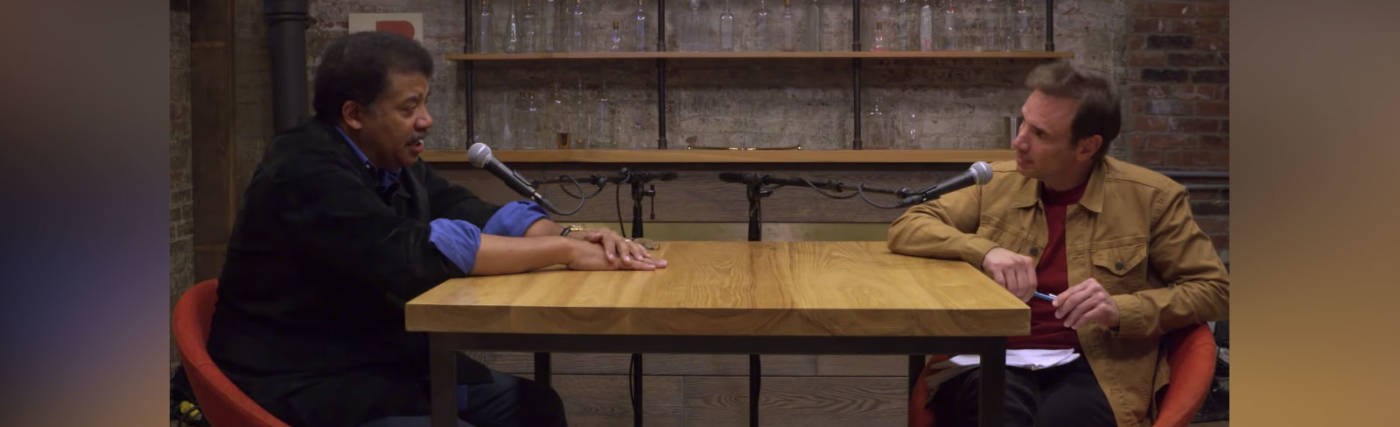

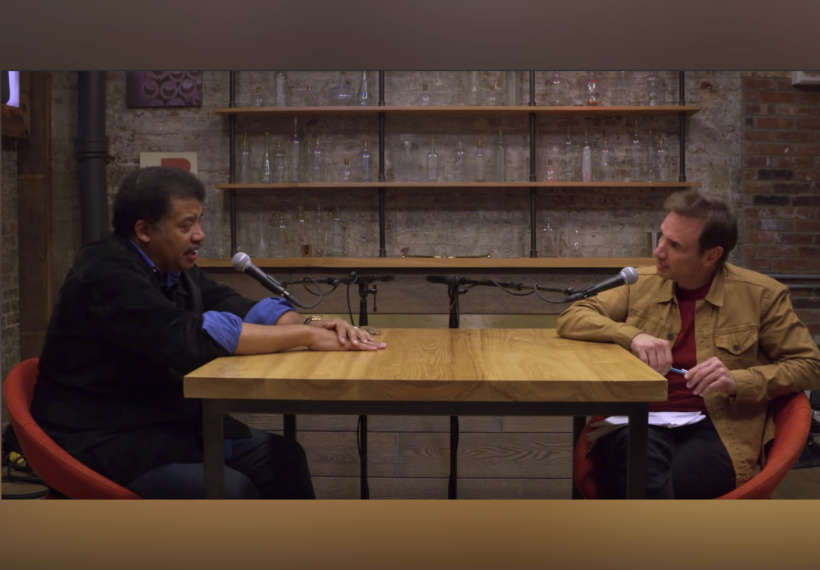

StarTalk’s Image of Neil deGrasse Tyson and Paul Mecurio in the YouTube Studios.

Quirky Cosmic Queries

Photo Credit: StarTalk.
  • Free Audio
  • Ad-Free Audio
  • Video

About This Episode

On this episode of StarTalk Radio, recorded live at YouTube Space NY, Neil deGrasse Tyson and comic co-host Paul Mecurio are back together again to answer fan-submitted Cosmic Queries. This time around, they’ll be answering the quirkiest of questions covering all corners of the universe. 

To start, we investigate binary star systems. Would planetary orbits be stable in binary star systems? Neil tells us why orbital allegiances might vary. Then, we ponder if humans would be the most intelligent species in the universe if it turns out there is no other intelligent life. Find out why it’s more likely than unlikely that intelligent life is out there somewhere. Neil breaks down the intelligence gap between chimps and humans and the possible intelligence gap between humans and extraterrestrial life. Could aliens have visited us already and we didn’t know?

We discuss the idea of immortally. You’ll learn why Neil thinks the first person to live forever is already alive. Paul shares why he thinks it’s Beyoncé. We ponder the downsides of living forever and why death gives meaning to life. 

Neil tells us what science fiction concept he would like to see become reality. We debate the merit of x-ray vision and warp drives. Discover more about ʻOumuamua, the interstellar object that passed through our solar system in 2017. Could it have been an alien space probe? Was it just another comet? Or could it have been something else?

Lastly, we dive into a passionate debate on the relationship between science and creativity. We explore the counterintuitive nature of the universe. All that, plus, we also investigate the multiverse and why, even in the multiverse, there’s still only one “you.”

Thanks to this week’s Patrons for supporting us: Daniel Kulikowski, Natalia Lalicata, Scott Eisen, Jeffrey David Marraccini, Sunil Ingle.

NOTE: StarTalk+ Patrons and All-Access subscribers can watch or listen to this entire episode commercial-free.


Transcript

DOWNLOAD SRT
Welcome to StarTalk, your place in the universe where science and pop culture collide. StarTalk begins right now. This is StarTalk, Neil deGrasse Tyson, your personal astrophysicist, Paul Mecurio, co-host. Great to be here. Welcome back. Yeah, always fun. Damn...
Welcome to StarTalk, your place in the universe where science and pop culture collide. StarTalk begins right now. This is StarTalk, Neil deGrasse Tyson, your personal astrophysicist, Paul Mecurio, co-host. Great to be here. Welcome back. Yeah, always fun. Damn near old-timer now with us. That's good. This episode is of Cosmic Queries, and they named it for me. I had nothing to do with it. Quirky questions, Cosmic Quirky Queries, Quirky Queries. Sounds like grab bag to me. So I don't know where they're coming from, but Paul, you got the question. All right. So bring it on. Let's see. We'll start with the last king's guard on Instagram. Is it possible that humans are the most intelligent species in the universe? No, next question. I agree with you. Because there's not sufficient evidence collected. Yeah, Siri, I'll give you one reason because people review plungers on Amazon. Really? I went to buy a plunger and there was 567 reviews of one plunger. I go gather your belongings and move to the woods, people. It's over. I'm not joking. Most intelligent species. Okay, finish the question. Just give them a chance. Is it possible that most intelligent species in the universe and there is no intelligent species out there other than us? Okay, so if there's no other life in the universe, I think it's fair for us to say that we're the most intelligent species that ever existed on earth and ever existed in the universe if there's no other life out there. However, who defines humans as being intelligent? And what does intelligence? No, I'm asking you. What's the answer to that question? Humans. Humans, thank you. You can see I'm not intelligent, I am. Man, you're just blowing my mind again. If I'm here and not here, where am I? I don't know. Just answer the question and leave me alone, will ya? Humans, you're right, humans. Who defines humans as intelligent? Humans do, okay? Now, what's our DNA difference from chimps? You would have learned this in biology class. How much, it's like one or 2%. Like 1% difference. Do we count chimps as intelligent? Well, sure, if you're a chimp fan, but not intelligent on the level of humans. Chimps are not building airplanes and flying to chimp cities, right? And humans aren't throwing their poop. Do chimps really throw their poop or is that just a thing? No, I've seen it. Yeah. If they have a delivery and it comes late, they go crazy. You know, FedEx is late. I wonder if it's good. I wonder if you can get them in the major leagues. We have teams, you'd be the commissioner of the poop throwing league. They just go, whoo! That's a 90 mile an hour fast ball, fast poop. So, what am I saying? So, what does the smartest chimp do? And the primatologist will bring them forward and say, I've said this before, by the way, I'm on the internet probably multiple times saying exactly this, but I'll do it for you. That smart chimp will stack boxes and reach a banana, right, will get a stick that's just right, that can go inside the termite hole and get the termites out. This takes some... And there was Coco, the sign language? Yeah, I think Coco was a gorilla, but that's fine, but same, the primates, the greater apes. And I wanted to make a joke about that. You know, he wasn't just a good gorilla. He was a great ape. I'm trying to get the right lead in to that, but that's my punchline, all right? We'll work on it later. You help me out. Yeah, we'll get you there. Get me there, you help get me there. So if there's only 1% that separates us, yet they stack boxes and we have a Hubble telescope and poetry and philosophy and art and comedians, then that they were listed last in that list. Yeah, I was going to say, thanks for, that was really just. Afterthought angry comedian. You didn't have to do that fake, like, oh, you know, make me feel intelligent. I got a comedian at my desk, at my table. Let me add that to the list real quick. Exactly. Woo hoo, yeah, that's me. So you can say, well, what a difference that 1% makes, you might say. Right. But let's take a cosmic perspective on it. If there's only 1% difference between us, maybe there's only really a 1% intelligence difference as well. Maybe stacking boxes to reach a banana is only 1% intelligence away from the Hubble Telescope and poetry and philosophy and music and art. That seems like a stretch, though. That's one, it seems like it should be more than 1%. Because you are human, and human ego knows no bounds. So let's do the experiment. Let's go out in the universe and find some other creature that's 1% smarter than us, in the same way that we are 1% smarter than chimps. What would we look like to them? What does a chimp look like to us? So our smartest human, because the smartest chimp does things that toddlers can do. Toddlers can figure out how to stack boxes. Toddlers can figure that out. But we say, oh, it's a smart chimp. Our toddlers do it. Let's bring in this other species. Show them the smartest human. Stephen Hawking, roll Stephen Hawking out. You. No, roll Stephen Hawking out. There he is. They would say of Stephen Hawking, this one is slightly smarter than the rest, but only slightly smarter, because he can do astrophysics calculations in his head. Like little Timmy over here, who just came home from preschool. How cute Tim, you just derived the principles of calculus. Put under refrigerator door. Oh, you just composed a sonnet. Show grandma. They're so intelligent. Why do they still have refrigerators? Boom. No, they don't have refrigerated doors. They don't have refrigerators. They just have refrigerated doors. Because you got to put the kid art somewhere. It's just floating in the kitchen. You think they have a mud room? You got to put the, you got to put the, so, they're so smart. Why do they have refrigerators? That's such a brilliant non sequitur. Smart people don't need refrigerators. I'm here to point out the obvious stuff that the unintelligent species, I'm representing the unintelligent. So my point is, what would their simplest thoughts look like to us? Here's a simple thought that is inconceivable to a chimp. Paul, I'll meet you tomorrow at Starbucks. We'll have a latte and we'll get on the plane together, go to Washington and have that meeting in Congress. What does any of that mean? Is it comprehensible at all to a chimp? What is a latte? That could be just a definition, but we're gonna fly to, fly? Are you a bird? No. How do you fly? Well, we invented it. How did you invent it? It required technology. It required metal and engines and fuel and understanding Bernoulli's principle. This is our thoughts that we all take for granted that is inconceivable to a chimp. I fear the simplest thoughts from this other species that they would lay down the simplest thought and we would be pouring over it with our most brilliant humans for centuries, not understanding it. And they'll just laugh at us and put us in a zoo and we'll be their entertainment. So we figuring out calculus and space flight and the Hubble telescope is to them what chimps throwing poop is to us. You hear that? Scientists at MIT, you're just throwing poop. You poop throwers. But here's the thing. What? Do you think there is life out there? I'm not given reason to doubt that there is. Given how old the universe is, how big it is and how prevalent the ingredients for life on earth are across the universe. And why do you use the word fear? No joke. Why do you use the word fear for that proposition that there may be a species out there that's 1% more intelligent than we are? No, no, the fear is they give us their simplest sentence. You can't. And we just have no idea what they're talking about. So I don't want to be that stupid. I want to say... Look at me. I know how you feel. I am totally with you on that. That's why when I'm around you, this is why I don't hang out with you a lot. Because you are that species from another planet that doesn't throw its poop. And you're like 20% smarter than I am. So... I want to believe that the human intellect is sufficient to solve any problem given enough time and enough people and enough cleverness. But the proposition that such a species exists, knowing that their simplest sentence may be incomprehensible to us, I fear it only because I don't want to be that dumb. I want to believe that all problems in the universe are tractable by the human mind. And this would be an example that clearly it's not. And it could be the best evidence for why we've never been visited by aliens. Because they've scoured the universe for other intelligent species and they saw no sign of it on Earth. Well put. Next question. And you want to know why they know that? Because people are reviewing plungers on Amazon. All right, you know, this is related to... No, my other hypothesis for why they never... They actually have visited, but they accidentally came during Comic-Con. And nobody noticed. They said, well, there are other aliens here already. You know, damn, let's go find somewhere else where we're the first visitor, you know. That is perfect. Okay, this is somewhat related. So this is a good next question. Mohamed Khan, Facebook. When do you think it will be possible to achieve immortality? I think it has been suggested, and I'm not given reason to doubt this, that the first person to live forever is already alive. Yeah, it's Beyonce. Everybody knows that. That answer came way too quickly off of your tongue. No, I was just thinking, no, no, no. So the notion, what enables that sentence to possibly be true is that, get someone who's just born today. So we're working on the genome, we're isolating the aging gene, whatever that is, if it even is such a thing, and we say, okay, we can now, that newborn person, when they're 20, they will, we take this potion and they can now live to be 150. That would be a major advance on our longevity. By the time they're 40, that we've improved the potion, now they can live to 300. By the time they're 60, now they can live to 500. By the time they're 80, now they can live to 1,000. By the time they're 100, they can live for a million years. That's the notion, that we'll make incremental improvements that will continue to accrue for the person who's just born today. And what do scientists or people in this field working on it or thinking about it see as a potential hazard of that? You mean, what could go wrong? Yes, exactly. So a couple of things, very important. One of two things has to happen. Either we colonize other planets or you stop making babies. Right? Because if you don't die and you keep making babies, that ups the population growth rate. The population growth rate relies on the fact that some people die. And food sources. And resources in general, that's correct. So you need other planets. If you're not smart enough to have technology to get to other planets, living forever is not a good idea. And I have rebuttal to living forever. What's that? What motivation would you have to even wake up tomorrow morning and get anything accomplished at all? Well, it's ego, don't you think? Because that's in there too. But what I'm asking is, isn't the, isn't the knowledge that you're going to die give focus and meaning to your life? Yes, I have a child and like, if you... All of this. And I'm being serious. I have a child. I think you have a limited amount of time on this earth. You wanna make sure you spend the time with it. Whereas if it's open-ended, it's like, I'll see you in 20 years. If I was wrong, the following wouldn't be true, okay? Have you ever given your loved one's plastic flowers? She's shaking her head. No. No. Let's do better than plastic. Have you ever given your loved one's silk flowers? No, I've stolen them from a funeral home. Now, why not? Why are you giving her flowers that you know in advance will die? I know the answer. Because knowledge that the flowers will die magnify the meaning and the attention you give it while they're alive. That is the meaning of limited longevity. You live a different way. You live a completely different way. You approach things from a different perspective. Now, let me now pull something out of my ass. Why is the dog so excited to see you when you come home? The dog only lives 14 years. Whatever is your excitement that spends seven times that amount of years alive, just imagine your entire life you now have to experience in 14 years. What would you do? You would every day outside, oh my gosh, there's a sun, there's this, oh my gosh, oh someone's butt I can smell, another butt, let me smell as many butts as I can. Oh my gosh, okay? There's everything they do has such intensity. I always say my dog is too optimistic. I'm not a big fan of it. But they're not optimistic if you only live 14 years. They're just right. So I don't mean to psychologically analyze dogs. What I'm suggesting to you is that what they look like to us is as though they're packing life's intensity in a concentrated way. Of 14 years. Yes. But seriously, why is it excited? Because they think I wasn't gonna come back? I don't have a why. I'm just, I see I'm pulling this out of my ass. I'm suggesting that we question the enthusiasm dog's exhibit. Like this was wholly unjustified. Look, I just came home. Look, I just went out to get a quart of milk. I think it's because they had an accident on the couch and they're trying to get on your good side. That too. I know I did a stain, but come on. That's in the list, but if you went out for an hour, to them it's 14 hours, maybe, right? You've gone for a day, to them it's two weeks. In our lifespan, that's what it is. Well, what just hit me with this conversation is there is such an interrelation between science and psychology and human beings and the human condition. And that you have to take all of that into account in doing what you do. I try to every day of my life. So knowledge that I will die gives focus and meaning to what I do in life. So if I live forever, it's like, what am I doing? What, what, what? So that's why. That means just the on-demand choices would be terrible. You will have seen every single thing on your cable system. No, no, they'll make, if everyone else is living forever, they'll still make movies faster than you can watch them. That's true. You're not gaining on this one, Paul. Wait, that means we can get more Police Academy movies? All right, here's one from, this is Kenyon Reed, Instagram. What science fiction concept would you most like to see in a real world application? Very clear, warp drives. I want to visit the other side of the galaxy. X-ray vision, man, you walk down. We already have X-ray vision. They're called X-ray, we can already see through things. Yeah, but I want it like in glasses and I can see what I'm, you know, people. You read too many comics as a kid where you have X-ray specs at the back where you can buy them. The X-ray vision, why do you want to see through? It's a good score around it and you have a much better view of it. Under the clothes. Oh, you want to be, that's a different issue. Have you spoken about this with your counselor? All right, so you're saying it's easy. What's the answer for you? By the way, any vision that sees through clothes also sees through flesh. Oh, you've got to ruin everything. I'm just giving you the reality of it. I'm so psyched for this. That's okay, I'm just saying. That's what it is. So you don't see through clothes and then just see the body of the person. You're seeing through the body of the person. You see their bones and rings they're wearing and their metal hip that got replaced five years ago. That's what you're seeing with x-rays. That's, no, we have much better power of longing than just, do you want to see an x-rays? Warp drives, you get anywhere you want in the universe. And you think that will be something at some point in time? That's not what the question was. It's just what would I most want to see? Not that I think what was the most likely. Is it likely that that would happen? I'm skeptical. Well, you're prescient because we have Mel Powell at Mel Powell. Next question, go, what is it? Asked warp drive someday, yes or no. That's the question and you just answered it, so there you go. I will go out on a limb and say no so that in 300 years you can go back and play the tape of me saying no as you whiz by me at warp speed. We've got to take a break. When we come back, more Cosmic Queries, Quirky Questions edition will be returned. We're back to StarTalk Cosmic Queries, Quirky Queries edition. Paul. Yes. Give it to me. I got you, here we go. Remind me, just here tweeting at Paul Mecurio. Mecurio, M-E-C-U-R-I-O, Facebook and Instagram, and you can check out my podcast, The Paul Mecurio Show. That's the name of the show? Yeah, we had a big thing. Paul Mecurio's name of the show is called The Paul Mecurio Show. We sat around the table, 12 of us, we spit ball names, and that's what we came out with. For a day, and that's what you came out with. Now, you're in good hands. There was the Andy Griffith Show. And, you know, Seinfeld, it's just Seinfeld, right? Well, I tried two chairs and a microphone for a while, which I kind of liked, but then that, whatever. But then... It wasn't as cool as Between the Ferns. No, exactly. But the other thing you helped me with, you gave me a suggestion for a show name, which I'm using. So, all right, here we go. Sammy John Lennon, Instagram. Do you believe Omou Omou was just an unusual space rock or an alien probe? I wish I wrote that question. Alien probe. Because it's long and slant. I mean, it's like, it's... What is that all about? Like, why do people jump to that when they start talking about aliens? Why? Why is it always... Is there anything that you could think of that they would do when they came here? Probing your organs, right, yeah. This is the obsession with my anus. What are they all? Are they all gastrointestinal doctors? Is that it? They all wanna be proctologists. They invent their own colonoscopy tests and they're trying to put it on us to make money? Come on, people, you're better than that. Okay, ready? The amulamula question. Ready. I have a... What's this joke? You ever heard this one? What do you call an Italian suppository? Have you heard this one? No. In a UN though. That's great. I can't take credit for that one. I'm telling every one of my Italian relatives at Christmas. You tell everyone. And you gotta do, in a UN though. I wanna make a toast for Christmas. Ding, ding, ding, before we do that. I have an Italian joke. I thought that was so funny. Too funny. So, Amuamua is the first confirmed interstellar visitor to our solar system. It's a rock, right? Can I be more poetic about it, please? Why don't you let me ride this one? So, it's got a beautiful Hawaiian name, which means scout, basically, except it's repeated. And in some languages, Hawaiian included, if you repeat something, it's done for emphasis. So, Amuamua is a scout. Amuamua, sorry, Amuamua is a scout. Amuamua is a scout scout. So, it's the first visitor from interstellar space that we have ever confirmed, moved through our solar system. And it is trivial to learn whether it belongs here or comes from elsewhere. You just look at how fast it's going. How do we know that it's from another? I'm getting there. So, you measure how fast it's going and you say at that speed, it is moving too fast for the sun to contain it. It is too fast for it to orbit the sun. It will come into the solar system in one side and come out the other side. Our gravity will alter its path, but it's not going to wrap it around into orbit. So, there are four kinds of orbits you can have. You can have a circle, an ellipse, slightly flattened circle, a parabola, which is an ellipse that's so big and open that it's open on the other side and the thing never closes back on itself. Or a hyperbola, which is even greater than everything a parabola was. And if you find something that has a hyperbolic trajectory, it was born somewhere else and it's going somewhere where you're not. So, this had, we're not ready for rock yet, okay? This visitor. Yes, so that told us it came from somewhere else outside of the solar system on a one-way visit. So now, you add up all the gravity that we have that could be affecting its trajectory and you find out it's on a different trajectory. What are you going to do about that? Different than the one you calculated? Yes, and we know how to calculate trajectories. We got this. We know Newton's laws of gravity. So the question becomes, when did it get altered and how did it get altered? Correct. Finally. Or is there somebody altering it consciously, on board? If something is moving non-gravitationally, something is in charge of it. That's not gravity. If something is moving through space and just all of a sudden starts slowing down, something is controlling it. But then why wouldn't that? In fact, that's the opening scene of the movie, the remake of the movie The Day the Earth Stood Still. We detect some fast moving thing in the solar system with hyperbolic speeds headed towards Earth and then it rapidly begins to slow down. It's alien, being controlled by aliens. But if that were true, why, in all seriousness, why would it not? It surely is sophisticated enough to be able to sense that there are beings on this planet and not stop to explore or... You mean, okay, so now it's not just, am I controlling my orbit, am I actually analyzing destinations? That's a whole... How much do you want out of this rock? So you're saying it may not be a rock? No, so because its orbit, its trajectory around the sun was not, quote, following Newton's laws, that meant something was affecting its trajectory. And some hypothesize maybe it's an intelligent craft. If there's not actual aliens on it, maybe there are active navigational tools on it that go into autopilot as they near a star. Or being controlled remote. No, because they would be too far. How do you know that? At the speed of light? If you can't define what's on there. Okay, so if they're controlling it from afar, they'd have to use subspace communication systems, such as what they do on Star Trek. Because on Star Trek, if they're going warp speed, how are they going to send a signal ahead of them if they're moving faster than the beam of light itself that they would be sending to move ahead of them? FedEx. It's amazing. They're amazing, I'm telling you. Always on time. So what you need is a FedEx that can deliver backwards in time. You know, I needed to get this there yesterday. We've got it. It's the yesterday, sir. Cost you extra. That's another $5, but boy, is it worth it. So that's why the alien reference... No, that's why there's a... Maybe aliens did it, but there are other ways a trajectory can be influenced. As you near the sun, if you have ice content, the sun will evaporate that ice and the ice outgasses. Oh, now you have little, you know, retro rockets that can alter which way your object is moving. So there are other ways that it could be influenced. And I'm not going to jump to conclusions and say it's aliens. I'm not going to rule it out, but I'd rather not... That'd be my first suggestion. And just to wrap this up on this subject, there is not... It's gone, so any analysis of it is done. Whatever we've done, yeah, it's left the solar system, correct. Well, sorry, it's exited out the back door. Right. But it's still out there, but it's no longer near enough to our sensors and detectors and telescopes to get any meaningful data any further. So Oumuamua is Hawaiian for scout. That was discovered using telescopes on Mauna Kea in Hawaii. Yeah. So just out of respect for the culture and things. It's not the only thing that has a Hawaiian name. A lot is discovered from that observance site. And they say this thing, they speculate, is between 300 and 3200 feet, something like that. Yeah, I forgot the exact number. I forgot, but it's about that. And moving that fast, again, they can do a fairly accurate measurement. Oh, yeah. Well, yeah, fairly accurate. They know it's elongated. And one of my concerns is when you have elongated things in space, it's usually an asteroid that broke apart from the tide forces of whatever it last went close to. And it gets stretched in front and behind itself. And if it's a solid object, it breaks into pieces that extend in front and behind itself. And so that it's not a solid object, that it's just this... Because it's a very long cigar-shaped object. John Laird, at JohnLaird87, Twitter, what is the most counterintuitive thing about the nature of the universe that's true despite seeming false at first glance? I love that question. And I've never been asked it before. Thank you. What's the guy's name? John Laird. John, thank you for that question. Beautiful question. Counterintuitive. Let me think. So... That there's not a Chick-fil-A at more rest stops on the East Coast. That's counterintuitive to me. Well, except that if you're traveling on Sunday, you can't buy from them because they're closed on Sundays. That's right. And... That makes sense. There's more travel traffic, you know, tourist, you know, trip traffic on the weekends. So half the time, it's not going to be there. Good point. Because on the seventh day, God rested. Yeah. And Sabara opened. To fill in the gap. By the way, you know, the actual seventh day was not Sunday. It was Saturday. Really? Yeah. That's why the Jewish Sabbath is Saturday. And why do... And what is Saturday in Romance languages? You know it in Spanish. What is it in Italian? Saturday. Aren't you Italian? Do you have Salim in? So I know it in Spanish. Sabbath, though. It's Saturday. So it's Sabbath. That's the seventh day. Why did Sunday become the seventh day? Because Christians worked very hard to distinguish themselves from the Jews who preceded them. They said, we can't celebrate the Holy Day the same day as the Jews because we're different. So they moved it, physically moved it to Sunday. So that is the Holy Day on the Christian calendar. Saturday is the Holy Day on the Jewish calendar, as you all know. And it begins at sunset the day before, on Friday. Right. So it's sunset Friday to sunset Saturday. And plus this sunset rule can only exist if you live between the Arctic circles. Because if we go north of the Arctic, the sun never sets. Or never rises. That's why there are no... Jews in the Arctic, is that what you're saying? No, when that was figured out, I mean the Holy Land that no one knew about the Arctic. I was north of the Arctic. I couldn't find a synagogue anywhere. Anywhere, anywhere in the Arctic Circle. I went north of the Arctic Circle. I could not find a synagogue anywhere. And I'm like, how is this not possible? Even like a little one, it doesn't have to be like a big one. A short one, a little one. Just like a two-seater. You know, you just get disappointed in life. Okay, John Laird, what is the most counterintuitive thing about the nature of the universe that is true despite seeming false at first glance? Counterintuitive. Alright, you ready? Let's go way back on this one. That Earth is moving through space at 18 miles per second. And you have no knowledge of this. We have to measure this. We have to figure this out with telescopes, with smart people, with data, with calculations. We associate motion with, hey, I can feel I'm in motion, I can feel that. But the more pure motion becomes, the less you feel it. That's why on very large vessels, if they start moving, you don't even know they started moving because everything around you is moving. Your chair, your window, everything. If you're on a bus, sometimes it looks like the other bus went backwards. No, you started going forward. So basically, the larger the vessel, the less aware you are of how much that vessel is moving. You could be on an ocean liner and it can start leaving port. And oh my gosh, we left. Because you're surrounded by so many things that are also moving. And everything is moving smoothly. If you're on bumpy road, you would know. Right, so if I'm on that boat and it starts... But movement through space is smooth. It can't get smoother than that. And so the relevance of that in relation to this question is you're saying that the Earth... It's not intuitive that Earth is moving anywhere. And this is why we went thousands of years with people thinking Earth was stationary in the center of the known universe. What is making it move? It's not what's making it move. It's that if it moved much slower, it would fall into the sun and we would all die. And if it moved much faster, we would escape from the solar system and we'd be a vagabond planet in interstellar space. So the only planets that survive the formation of the solar system are the ones that had the right speed at the right distance to sustain an orbit. And there's eight of them. Eight. So for me, that's an old school one. You want a modern one? Yes. It's not intuitive. Here we go. It's not intuitive that when tide waters come in and out on the shoreline, you are actually sitting on a rotating Earth passing through a tide that is stationary in space. Right. Because when I sit there, I think, oh, the water is coming in, going out, coming in, going out. You're on Earth that is rotating inside and out of high and low tides. A tidal bulge? Tidal bulge. That's right. So, to me, we had another Cosmic Queries where we spent a lot of time on that topic. But I think that's a good one. Because it looks like water is moving in and out, but you're the one moving through the tide. Yes, that to me is counterintuitive. And I wouldn't believe you. And I got another one. You ready? Yes. Okay. A lot of people want to know what happens after they die. Evidence shows, you put together all scientific evidence, biological and physics and thermodynamic. People mock you. You have no existence after you die. And you say, well, what does that feel like? If you say I have no existence, what is that like? Wait a minute. No existence as a physical body or just... Everything about you that says you exist now, that you tell yourself I exist, I think therefore I am. In terms of my presence in the universe, how I... Yes, is gone. You will have no existence on death. Laws of physics and biology tell us that. You can believe what you want in a country where we have protection of religious expression, but if you want to ask science what science has about it, you go into a state of non-existence. You can say, well, why is that? What's that like? I'll tell you exactly what it's like. It's what it was like before you were born. You're not asking yourself, what was it like before I was born? I had to have some existence. You didn't. You have no existence, a state of non-existence before you were born. So I'm not given reason to think that your state of non-existence in death differs in any fundamental way from your state of non-existence before you're born, giving that much more meaning to what it is you can and should do while you're alive in this world. That's a good point. And after life for you? No, that concept? I'm not convinced. And because I'm not convinced, I'm doing as much as I can in my own life. That's true. I don't want to say I'm looking forward to after life, so I'm going to chill on the beach. No, but it's true. You're a greeter at Walmart on the side. In my spare time. You're doing as much as you can. Next question. All right. Let's see here. This is Sampan Gosal, Facebook. Where does the line of limits lie in engineering, science or creativity? Oh, I love that. I will answer that question when we return from this next break. StarTalk, Cosmic Queries, Quirky Queries Edition. Hey, here's a shout out to the following Patreon patrons. Daniel Kulikowski and Natalia Lalicata. Thanks guys so much for supporting us. Without you, we certainly couldn't do this. And if you would like your very own Patreon shout out, go to patreon.com/startalkradio and support us. Thank you. We're back, StarTalk, Cosmic Queries, Quirky Queries edition. Paul. Nice to be here. Give it to me. Pick it right back up. Who else do you have? Sampan, Gasol, Facebook. Where does the line of limits lie in engineering, science or creativity? Ooh, it's both. People ask questions and they assume it has to be one or the other. We somehow, we don't allow blended solutions to things, and that's wrong. Sometimes the actual answer is in between the extremes, but we like arguing extremes because we like a fight. Well, I think we're also tribal by nature and we want to be in one group or the other. Ooh, that's probably the deepest reason of them all. Then I'm done right now. I'm not gonna top that. So it's, are you in my camp or the other person's camp? So I think it's both. For example, my physics professor in college discovered a new phenomenon in nature. It's that nuclei of atoms resonate with electromagnetic energy. Radiation is going, okay? Got a Nobel Prize for it. That phenomenon is called nuclear magnetic resonance. A clever engineer said, if you can identify nuclei with this method, I can build a machine, put you in that machine and make a map of the different nuclei that comprise your body. Some nuclei is fat tissue, some nuclei is tumor tissue, other nuclei is muscle tissue. Thus was born the magnetic resonance imager. It's really a nuclear magnetic resonance imager, because that's what he discovered, but that's one of the forbidden N words. You're not supposed to take away the nuclear magnetic resonance imager. Let me tell you something. This engineer is so smart. Why am I sitting in that tube and he can't pump some music in or something? Oh, I'll take it up with them. Yes, okay. I feel you're being sarcastic. Were you in the tube that long? A couple of days. My body's very stubborn. They were finding things in my body. Keys. You're not supposed to eat keys. Since I was a kid. Can I tell you my favorite MRI joke? Please. Okay. It was from. Only you would have an MRI joke. Who's the comedian, very deadpan? Like- Stephen Wright? Stephen Wright, Stephen Wright, right. Like if Salvador Dali's art were comedy, he would be it. So Stephen Wright, he said, I'm gonna have an MRI to see if I'm claustrophobic. It was. Right, right. It's just check the brain to see if the brain tells you if you're claustrophobic and you're in a freaking mood. So where, oh, so that's an example of the science had to pre-exist the engineering application of it. There is no MRI without the science that got the Nobel Prize. Hang on. So the best thing for an engineer is to have science laying around when no one did anything clever with it yet. That's the best kind of engineering solutions I've ever seen. But how about creativity? That was the question, right? Where does creativity come from? That's what I was gonna say. Is that invention that your professor discovery made, is that considered creativity? Well, there's a difference. Creativity that is not science is unbounded. Creativity that is science, if you don't come up with it, somebody else will. Bounded by the laws of nature and the laws of science? In science, nature is the ultimate judge, jury and executioner of your idea. In art, I guess public sentiment is the judge, jury and executioner, but that can shift and that could be anything. Or not. Or not or whatever. One person creates it and feels it's beautiful. And right, right. Nothing's preventing you from creating anything you want, but nature's preventing me from discovering anything I want. So that's why Beethoven's Ninth Symphony and Van Gogh's Starry Night are unique creations in the human mind. Whereas Einstein's relativity, it's not unique. If he didn't do it, somebody else would have a few years later, maybe several people stapled together to be equal, as smart as he was. So the nature of the creativity manifests differently. But hang on a second. Regarding Einstein, I can't buy that there's not some creativity, some nuance of thought, that you look at a problem differently than another astrophysicist and come at it in a different way. And isn't that by definition creativity or a form of it? I'm not saying it's not creativity. Well, I'm saying it is. And you're going to listen to me. You've got to leave because this is going to get bad fast. No, I'm serious about that. So, I'm not saying it's not creative. I'm saying it's a different kind of creativity. I cannot pull anything out of my ass and say, this is how nature works. You can pull anything out of your ass and say, this is art. In principle, you can do that. Of course, not all art survives. Not all artists get famous. And there are reasons they're not somehow connecting to the human condition in ways that other artists do. I get that. I'm just saying if Van Gogh didn't paint Sorry Night, no one ever will paint it ever in the future history of the human species. But are you saying a scientist can only apply laws a certain way and can't do it in a creative way that's unique to that person? Whatever your creativity is, it's bounded by the laws of nature that enable the world as it is. You can only do so much with the way things are in terms of the laws of nature. Correct. There you go. So I like creativity. It's just manifest a little differently. That's all. And you definitely need and want creative engineers. You definitely want creative scientists. But the engineer can invent stuff with preexisting laws of physics. They can improve on things that no one else saw. We've made major improvements on the internal combustion engine from the earliest days. These are engineers over the decades. Now we have electric cars. That's a whole jump into another place. Now they can benefit from another century of creative engineers perfecting the electric car. And then driverless cars. And the driverless cars and the like. So those are engineers perfecting on things that are not invoking new laws of physics. But I think the most fertile engineering ideas have a fresh law of physics right for the picking. They say, now let me create something on Earth that's never been here before. Some machine that exploits a law of physics that we just discovered. That's the coolest stuff out there. And I consider that creativity. I didn't say it wasn't creativity. We are in violent agreement. Really? Next question. This is Anzaman Sam A. Facebook. Is it possible to travel back in time by going to another universe that is exactly the same as ours but different time zones? So in a multiverse, our current thinking is that if there's an infinite number of multiverses, there's another universe where all these same molecular configurations exist, except you have some evil goatee and mustache, and everything else is the same, right? Is that still a thing? Yeah. Evil people have to, like, stroke something, you know? Is it the cat? What is it? Like, nervous whatever? The evil person needs a twitch. And it can't be a toy cat. God forbid it's just like a little furry. Yeah. It's got to be real. So, with that, you can imagine a universe shifted in time. I don't have a problem imagining that. Here's the difference. Even if your entire molecular configuration is reproduced in that other universe, I'm not convinced it's you. I'm just not convinced of that. Because of my DNA makeup? No, it's identical to you. It's just not you. Because of that entity's life experiences are different than mine? No, because it's a parallel universe where all of that is the same. Same mother, same upbringing, same... Sorry, the molecules' configurations are all the same. Does that entity, if I fall off my bike and scrape my knee, that that experience happened to that entity? There will be multiple universes where that happened when you were 3, 5, 7, 9, 11, didn't happen, could have happened, happened bad, happened good, you died in this other one because a truck hit you. All those combinations would exist. So, you find the one that's closest to ours but shifted by 10 minutes. That's this question. So, the one, can you go back in time into that life? And all I'm saying is, I'm not convinced that your consciousness is transportable in that way. I can make an exact replica of you over here, is your consciousness occupying this? The reason why I'm skeptical is, we already have examples of identical people. They're called twins. But they don't share each other's conscious. They are separate people. They might finish each other's sentences because they're raised together and they do the same things together. They think differently, they logic differently, they... They're not the same people, even though they are genetically identical. That's my point. And so, if you're not the same person, this is my fear of the transporter in StarTrack. All right? Beam me up, Scotty. Your body and soul are down there and they beam you up into the ship. What they did was they disassembled your atoms and reassembled them over here. Are you the same person? Or are you a photocopy of the same person? If you're just a photocopy, then do you share all of the consciousness? I think therefore I am. I think therefore am I you? How do you define consciousness in this context? Consciousness is, I think, it's a poorly defined thing. Where everybody's trying to define it. It's a very amorphous word in this context. It's amorphous in many contexts. There are whole books on consciousness. You know why they're still publishing books on consciousness? Because we don't know anything about consciousness. That's not true. We know something. But the fact that it is an active field of research, the evidence of this is that people keep publishing books on it. Consciousness explained, consciousness re-explained. My version of consciousness, their version of consciousness. This will continue until we understand consciousness and then no more books will be written about it. Why do you think it's so difficult to understand it? Because you're trying to understand the thing that is making you try to understand it. It goes back to another episode where we were talking about the brain, the mind. The mind, brain. Why only 10%? How can my consciousness understand itself? That is a challenge that we've yet to rise to. You think it's worth pursuing? Or do you think it's futile? Oh, no, I think anything that we don't know is worth knowing. You're asking a scientist, is it worth knowing? No, definitely. Check it out. It may be that consciousness is just something else. Some illusion of something else that's actually going on in our brain. But this is the, it's like on Earth, it looks like we're in the center of all motion. It looks that way and it feels that way. We feel like we have a consciousness, but go to the heart of it? No, we're in orbit around the sun. We're not in the center of anything. There's some other thing going on, perhaps. Oh, we ran out of time. I know. Why do I take so much time to answer questions? Is that okay if I do that? Yeah, I'm fine. We know you like to hear yourself talk. I'll just shut up from now on. I don't have to say anything. No, because this is why I keep saying it. You're great for people because you take things to places where you don't expect and you explain. In one question, you get six answers to things you never expected. That's how my brain is wired. Because the whole world is connected. You can just answer a question compartmentalized, but that's not where the fun thinking happens. No, and then literally in every question that I've done with you over the last couple of shows, there have been six or five revelations per question for me that had nothing to do with the question. Completely useless information that I'll never use. That's what useless means, I guess. You don't have to define useless. See, this is why people are... No, just useless information that I will never use. What the hell kind of sense is that? This is why you don't get invited to more parties, right there. You just can't let it go. Useless information. You can't let it go. You know what's true about this useless information? I never use it. You got me. Paul, we got to go. Yes. Dude, love you, man. Yeah, you too. All right. So much fun. Keep it going. Paul Mecurio, that was and will continue to be Neil deGrasse Tyson, your personal astrophysicist, ending this episode of StarTalk Cosmic Queries, quirky Queries, it was. As always, I bid you to keep looking up.
See the full transcript

In This Episode

Get the most out of StarTalk!

Ad-Free Audio Downloads
Priority Cosmic Queries
Patreon Exclusive AMAs
Signed Books from Neil
Live Streams with Neil
Learn the Meaning of Life
...and much more

Episode Topics