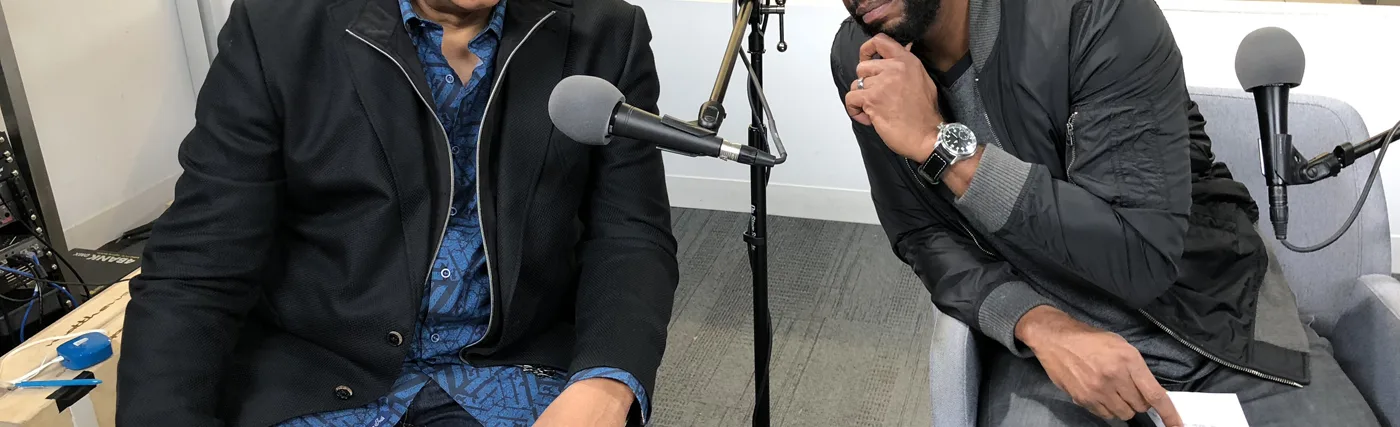
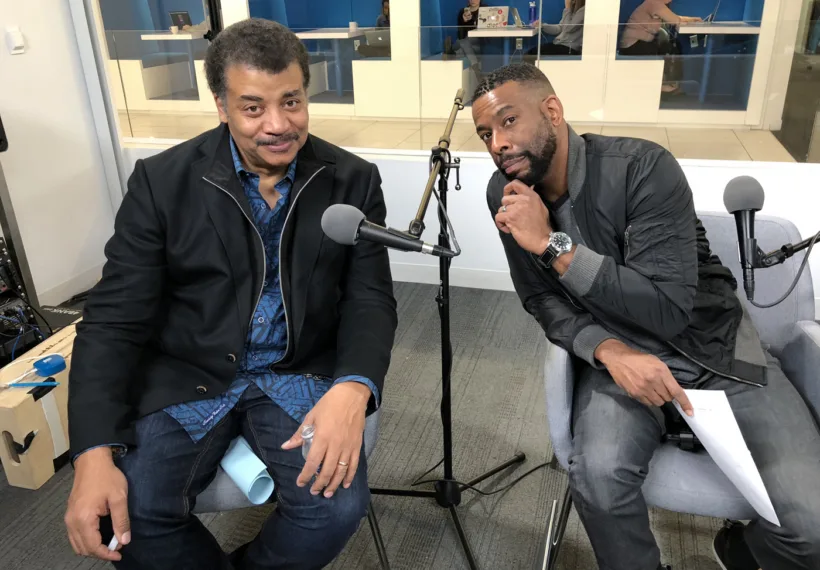
Kick off the new year with Neil deGrasse Tyson and comic co-host Chuck Nice as they discuss science predictions for 2018 featuring fans and friends of the StarTalk Podcast Network. First, Neil and Chuck reveal some of their past failed predictions involving Star Trek, automatic doors, and Twitter. You’ll then hear why Neil thinks the total solar eclipse, deemed “The Great American Eclipse,” was the most important scientific event of 2017. Of course it wouldn’t be a StarTalk Radio episode if Neil and Chuck didn’t go a little off-topic, and you’ll hear Neil discuss his multiple dealings with people who thought they were right when they were wrong. After that, we get to the predictions. Andy Weir, author of The Martian and Artemis, gives his prediction about commercial spaceflight, primatologist Natalia Reagan gives her prediction on changing human behavior and culture, and SETI Senior Astronomer Seth Shostak shares his prediction about a new planet being added to our solar system – no, it’s not Pluto. Drew Pulley, show runner for StarTalk TV on the National Geographic Channel, gives an interesting prediction about Chuck and his endeavors in the upcoming year. You’ll also hear from fans of StarTalk as they offer their predictions about faster space travel, new particle discoveries, and space mining. Lastly, Neil warns against science censorship in 2018 and the dangers it poses to democracy. Happy New Year!
Transcript
DOWNLOAD SRT
Welcome to StarTalk, your place in the universe where science and pop culture collide. StarTalk begins right now. This is StarTalk, I'm Neil deGrasse Tyson, your host, your personal astrophysicist. I serve as director of New York City's Hayden Planetarium...
Welcome to StarTalk, your place in the universe where science and pop culture collide.
StarTalk begins right now.
This is StarTalk, I'm Neil deGrasse Tyson, your host, your personal astrophysicist.
I serve as director of New York City's Hayden Planetarium at the American Museum of Natural History.
And today, I've got my co-host, Chuck Nice.
Yes.
Chuckie Baby.
How are you, Neil?
Good, good.
And by the way, I serve as patron of the Hayden Planetarium.
You are the director.
I have a guy who pays to go there.
Patron, patron.
So this is actually a first of a kind show that we're going to do.
We're going to think about predictions that people have made for 2018.
Yes.
And I'm not a good predictor of things.
People know this.
Well, those who know, know this.
I am not a good predictor of things either.
I used Bitcoin to buy Burger King.
And I don't mean the stock.
I mean an actual Burger King meal.
So.
So my famous non-prediction, I've said this like a hundred times, on the air.
I'm going to say it again because this show is about predictions.
Yeah.
Right?
Okay.
So I'm old enough to remember Star Trek in first run.
1967.
That's Captain Kirk.
Captain Kirk.
Lieutenant Uhura.
All of them.
Right.
All of them.
And that was the future.
This is the mid-60s.
We're going to the moon and here's a show about the future.
I was all there.
Remember Jetsons was the cartoon?
Absolutely.
So everybody was thinking about tomorrow.
And there they had warp drives and photon torpedoes and the early stun guns basically, put the phaser on stun.
All of this.
And I said, yeah, all that's going to happen.
And it had machines that food just came out of the wall.
By the way, that exists today.
But I'm saying, okay, I accept all of that.
What I would not accept is that the door knew you were walking up to it and just opened for you.
I said, that'll never happen.
Not in centuries.
Never.
Never.
I was so cool with warp drives and transporter rooms.
But not automatic doors.
How would the door know you were coming up to the door?
How was it going to know?
Well, yeah, I'm going to say that.
Okay, I am eight years old.
How's it going to know?
Magic?
Actually, at an eight year old, I could see it's like, yeah, like that would look like.
There was no, I didn't see, and in Star Trek, I didn't see any sensors at the door.
Right, that was, they didn't have it.
The door just knew.
The door just knew.
Right.
Yeah, and so the first doors that we had that opened when you walked up to them, it was a pad that you stepped on at grocery stores.
Right.
And that opened the door.
I remember those.
And now they have, of course, the actual sensors.
Right, right, the sensor.
What I like most about Star Trek and.
Because I looked for pads that they would step on.
Yeah, they weren't there, no.
Right.
So here's what I didn't.
And it turns out there's actually two people looking through the peephole and pulling the doors aside.
Oh my God.
That's the actual how it worked.
That's actually how they did it.
That'd be funny if that's actually how they did it on the USS Enterprise, too.
Just two dudes who, that's their whole job, is to open the sliding doors.
That's so funny.
So you don't make predictions.
No, I'm not a good, after that, after I got that wrong, I said I'm just going to stop.
I predicted that would never happen.
It's the only thing that actually did happen, right?
So that's the opposite.
So you just reminded me of in 2000, was it eight?
I think it might have been 2008 or not, 2007 or eight.
I'm not sure.
Seven or something.
Anyway, these people come to me and they go, hey, there's this thing.
It basically uses SMS technology.
It's 140 characters and you write things and then people become a part of your community and you communicate this way.
And they were like, would you like to make a tweet?
And I said, this is the dumbest thing I've ever heard of in my entire life.
Good luck to you.
And I got to admit, every day I'm on Twitter, I feel like an idiot.
I feel like an absolute idiot.
Yeah, and a friend of mine was like, yeah, there's this one guy, he has like 10,000 people who are like already with him and he just tweets jokes.
You should do that, man.
And you just said no.
I was like, this is the dumbest fricking thing I've ever heard.
So why the two of us hosting this show?
Okay, that's the end of StarTalk.
Thank you for joining us.
Or StarTalk predictors ever.
By the way, just a quick thing about Twitter.
Yeah.
On StarTalk, we interviewed Biz Stone.
Biz Stone, yeah.
Interviewed him.
He's one of the founders, right?
Co-founders and then when you hear what was in his head at the time he invented it, it's like, whoa, really, whoa, it was.
You mean he didn't invent it so that people control one another and say awful things?
What it was was you're there and there are birds in the park all doing their own thing and then something happens and they all fly away together and they flock.
Right.
And they stay in pattern.
Right.
And then something happens when they stop and they go back doing their own thing.
Until Twitter, we did not have a flocking mechanism for the human species.
Well, guess what?
He achieves his goal then.
So what happens now, you can send out a tweet, let's all do this now.
Then everybody does that now.
You're individual until that moment.
You are a coordinated mass during that moment and then you go back to being an individual.
It's a tremendous concept and it absolutely works.
And who would have thought that we were absent this dimension of what it is to be alive?
It's amazing.
I mean, it's really.
Fish flock.
We're vertebrates just like fish.
And we didn't have that, but we have it now.
The Arab Spring, as a matter of fact.
It was an example.
Fantastic.
Man, that's why I love hanging out with you, man.
That's StarTalk.
It's StarTalk.
All right, so before we get into the actual predictions.
You got a list of where you got the predictions from.
I've got a list from across a different.
Oh, this is fan base.
Mediums and fans.
You got people, like regular people making predictions.
And then you can comment on what you think about their prediction.
I would be happy to react to a prediction.
I also have some predictions from some of our other StarTalk all-stars.
StarTalk family.
And StarTalk family.
So Andy Weir, who of course you've interviewed a couple of times and you're friendly with, the Martian author.
Drew Pulley, who is the producer of our Nat Geo show, has a prediction.
Natalia Reagan, who is a StarTalk all-star and a primatologist.
And Seth Shostak, who is the senior scientist at SETI.
At SETI, the Search for Extraterrestrial Intelligence.
Good, so let's do this.
So we'll do that.
But before we get into that, I want to know since we are in the new year, looking back on last year, what do you feel is the most significant either advancement or breakthrough, which would be discovery or story?
Any one of those.
Oh, it's true, it's easy.
Easy?
Easy.
What?
The total solar eclipse.
Get out.
Yes.
But wait a minute, didn't I hear you say to me personally that total solar eclipses happen all the time.
So how can that be the most significant story in 2017?
It's going to happen again in 2018 and how?
Are you done?
Explain yourself, sir.
Are you done?
Okay, I'm quite finished.
So the moon shadow touched earth in the Pacific Ocean.
Oh, okay.
Moving east very fast.
Moving east very fast.
At basically the speed of its orbit around the earth minus earth rotation speed.
So it comes out to about 800 miles an hour.
Plus or minus, okay.
So there it goes.
It landfalls in Oregon.
Correct.
Crosses the continental United States.
Hits the Atlantic Ocean off the coast of South Carolina.
Continues in the Atlantic Ocean and the shadow then leaves earth and returns to space from whence it came.
That shadow, that total solar eclipse shadow touched no other municipality in the world other than the United States territory.
Correct.
It was a Merck eclipse.
Merck.
B, the United States is crisscrossed with roads and we own two cars per person or whatever the number is.
All right.
So, 220 million people lived within a day's car drive of the path of totality.
It may have been the most watched eclipse in the history of the world.
Because of the mobility of Americans across our entire continent, coast to coast.
So, not only that, everybody was talking about the eclipse.
That's true.
Now, you couldn't go anywhere without hearing about it.
Nobody over that time, and I tweeted this, nobody was in denial of the science behind the eclipse.
Science denialism took a vacation those months, the lead up onto the total solar eclipse itself.
Everybody wanted to find a scientist to help them learn how to look at it, how to record it, how to photograph it.
So, I think science, the luster of science restored a few notches, if we measure it that way, because of that eclipse, at least in the United States.
So the significance was-
It became an event.
An event.
The significance was, right, right.
Events matter in pop culture today.
Oh, big time.
And so that was an event.
Okay, okay, all right, so you're going to stick with that over gravity waves.
Or gravitational waves.
Love me some gravity waves.
I'm talking about, really, the pulsar crash.
The pulsar, oh yeah, that's a good one.
I'm talking about the pulsar crash, not the original.
My man is fluent.
My man reads his weekly reader.
I have no choice now.
Did I hear you subscribe to physics?
Did I subscribe to physics?
physics.org, yes I did.
physics.org.
Listen man, first of all, here's what I know.
I am, I feel the love.
You should.
Because you are responsible for that, to be honest.
Chuck, when someone says, I feel the love, you don't say you should.
That is not the proper response.
That's not how that works.
No, I mean, clearly, well here's the one thing.
Like I've told you this, I don't like feeling stupid.
Oh, that's what it is, you know what I'm saying?
But more importantly, after many years of working with you, I know that if you don't know what you're talking about, you have very little patience for people who don't know what they're talking about.
No, no, let me be clear.
If you don't know what you're talking about, and know you don't know what you're talking about.
That's what I'm talking about.
No, that's different.
I'm not talking about that.
Right, you're not talking about that.
I'm not talking about that.
That's just somebody who doesn't know.
Right.
And I'm an educator.
That's ignorance.
And ignorance is okay.
Stupidity is not.
If you don't know what you're talking about, and if you don't know what you're talking about, and you think you know what you're talking about, and you put in a little aggression, oh, yeah, I have no.
No patience.
Oh, that's when all the stuff, oh, just back them.
Right.
Back up.
So I still don't know what I'm talking about, but at least I know what the subject is.
Can I tell you my first encounter with someone who thought he knew what he was talking about and didn't?
Oh, please do.
I'm a freshman, no, I'm a sophomore in college.
This is at Harvard.
There is a student there who's a senior.
All right.
A Harvard student.
All right.
So these are learned people.
Yes.
The tops of the class.
We're talking about the element Mercury.
And I forgot how this came up.
And so I said, and so I said, so Mercury, it conducts electricity.
It's a metal.
Right.
And he said, it's not a metal, it's a liquid.
And it was like, oh my gosh.
And then you were like, community college called, they want you back.
And no disrespect to anybody who goes to community college.
So I said, even at Harvard, they're idiots.
The idiot for thinking he knew what he was talking about.
Not for just saying, oh, I didn't know it can be both.
That's what he should have said.
Exactly.
He was pre-lawed, by the way.
Oh, well, there you have it.
No, I'm just saying.
So I'm just.
You want another one?
Just another quick one?
Please do.
I know, it has nothing to do with the topic of the show.
Who cares?
It's interesting.
Okay.
Are you ready?
Yeah.
Okay, so now freshman year.
I am at a diner, basically a diner.
So I'm in the diner and had breakfast with a friend of mine.
We ordered exactly the same food.
All right.
The bill came, a single bill for both of us, and it was an odd number.
But we ordered exactly the same food.
Anything times two has to be an even number.
Oh my God.
So I looked at what the tax was, and I said, okay, if they bill us separately, then we save a penny.
Okay?
Uh-oh, you were that guy.
So I said, I called the server over.
Back then, they were called waiter and waitresses.
Actually, it was a waiter.
And I called the waiter back, and I said I would like these separate checks.
And he said, why?
And I said, oh, because it will come out less than if you give me one check.
And he says, no, the cash register does this.
The computer does it.
And I said, just do that, you will see.
And he says, no, I can't read it.
And I said, just do that.
And then the guy gets on the microphone.
Manager, come out here, we have trouble.
Oh, brother.
Trouble.
Trouble.
Okay, so now what?
So they said, do that up.
So we take the bill up to the cash register.
And I said, I'd like to pay these separately, please.
He said, but it's gonna be the same.
And I said, no, it's not gonna be the same.
And I'm holding up the line.
And people behind me, other Harvard students, said slightly loud enough for me to hear.
There might have been, in the day, this is many years ago, and this is like Boston, so this is like, it could have been a racial dimension to it.
It's Boston.
Okay, it's Boston.
It was Cambridge.
It's racist.
Right now, there are people listening to us in Boston going, no, no, no, it was racist.
So one of them says, he obviously doesn't know the distributive properties of multiplication.
Okay, so.
Okay, see, now, wait a minute.
It's just got real.
Okay, so now watch.
So, do you know how this ended?
No.
No one agreed with me.
That it would be left.
And he just gave me the penny out of the cash register.
And that was it.
So the guy behind me thinks I'm a math idiot, when he's the f***ing idiot.
Yeah.
That's, apparently, he doesn't know the distributive properties of multiplication.
Clearly, clearly, you're a Negro.
Clearly.
Not sure what your problem is, sir.
So, I was just intrigued that two people could order exactly the same thing as an odd number of pennies in the bill.
So, clearly, what happened there, it rounded up when you added the two together.
That's all it is.
And so I didn't want to pay that extra penny, in principle.
Yeah, no, that's a great story, man.
I know, it sounds petty, but...
Oh, no, it's petty.
But it's a great story.
I don't mind being treated annoyingly for saying something petty.
Right.
I'm reacting to the fact that people thought I didn't know what I was talking about.
Exactly, and that's what I was going to say.
It's really not petty in that this.
When you know you're right, and people are looking at you like, oh, dude, what an idiot.
And you're like, wait a minute, I'm the idiot and I know I'm right.
You know, that's.
Right, yeah, I would have preferred people just annoyed.
They agreed because they did the math correctly.
And they were just annoyed that I was holding up the line.
I can't believe we're out of time for this segment.
Okay, what's this show about again?
Predictions.
Let me tell you something, worth it.
I'm sorry, I don't care if we're out of time on this segment.
This was worth it.
All right, when StarTalk returns, we will get back to what we promised we would talk about.
These are people's predictions for 2018 and my reactions to them.
We're back on StarTalk.
Our future predictions, as are all predictions, future predictions for 2018.
We solicited predictions from our fan base and some in the StarTalk family.
Yes, we did.
But we just came out of a segment where you just had me railing on about people who thought they're not stupid, but they actually are and thought I was stupid.
And guess what?
That was an awesome segment that, quite frankly, That had nothing to do with this topic.
I don't care, it was so enjoyable.
I could do a whole show on Neil at Harvard.
Because you and Harvard stories, I could do an entire show on that.
I don't care.
Do you want another one?
I would like another one.
I'm in middle school.
Back then they called it junior high school.
And I like timekeeping devices.
Wait a minute, say this again now.
You're in middle school.
And what?
I like timekeeping devices.
So not just any watch, but a watch that would have dials and a stopwatch and tachometers, this sort of just complicated time.
And historically, astronomers basically invented timekeeping, all right, methods.
That makes sense.
That's why all the basic units of time are based on astronomical phenomena.
Makes sense.
A day, a year, a month, moons.
This is how you get that.
Okay, so it's culturally in my field.
And I've known I've loved the universe since age nine.
So I'm in there.
So middle school, I'm in it.
And now you've known since you were nine.
When did you come out of the closet?
11.
11, yeah, it took me two years to go public on that.
Mom, dad, there's something I want to tell you.
I'm an astrophysicist.
No, no, where have we gone wrong?
My father's a sociologist working for Mayor Lindsay in the civil rights movement.
That is correct, I know that, I knew that.
And my mother would later go back to school and become a gerontologist.
These are people caring people.
Right, yeah, they're about like social activism and making change.
Making the world a better place for people who are powerless.
And then here you come along, I want to just keep looking up at the astrophysics of the universe.
That's hilarious.
Where have we gone wrong?
So you knew you wanted to be the universe and there's time keeping things.
So I walk dogs for a living, 50 cents per walk per dog, and they get walked two or three times a day.
And the golden age of dog walking, before you had to poop or scoop them, okay?
I didn't even know it was a golden age, but it was.
Because I didn't have to do it.
I'm going to call it more of a brownish age than the golden age.
And back then I was very good at knowing where my foot landed in the sidewalk, okay?
The worst kind of incident would be a big pile of freshly laid poop.
You know it.
And you step in it and it's kind of slippery.
If you stepped and then slipped forward and then you fell backwards into it.
So it was on the bottom of your foot and on your butt.
Yeah, yeah, that was the double poop whammy.
The double poop whammy.
Anyhow, so I had money to buy these watches.
So I had several watches.
And one of them was particularly complicated, all right?
And the sweep second hand, people don't even remember what that is.
The thing to keep track of seconds.
60 minutes, the TV show, it's the tick, tick, tick, tick.
Yeah, the ticking part.
That's the sweeping second hand.
That fell off, okay?
So it needs to be put back on.
It needs to be sort of glued back in.
So I took it to the neighborhood jeweler, you know, jewelry shop, and I say I'd like to have this fixed.
And again, remember, I just see the world as the world is.
I don't see the world as the world sees me.
I'm just looking out of my eyeball window.
This is your frame of reference.
I'm just looking out of my window.
Okay, I have a watch, there's a jeweler.
I go take it in.
By the way, I bought this watch at Macy's.
Okay, and so I take it in and so I'd like this repaired.
And he looks at the watch, looks up at me, looks down at the watch, looks back up at me, and then he says, I don't have the key to open this.
And I said, oh, okay, just looks like a hex thing in the back here.
And he says, anyway, this watch is stolen.
I said, wow, I wonder how he would know that was stolen.
Was it stolen off a truck and then sold to Macy's?
I'm trying to think.
I'm trying to rationalize his thoughts of the watch being stolen.
Completely bigoted, prejudiced man that I'm not even thinking that this is what he is.
Right, right, no.
Why would you?
He sees a black 14-year-old kid.
With a nice watch.
With a nice watch, it is stolen.
Little does he know, you slipped in a lot of shit to get that watch.
I just learned how to walk.
How to tiptoe through the tulips.
So it was just the relationship with society.
My view of society was just so different from society's view of me, that's all.
Oh, absolutely.
And so there I am, I don't want to call it naivete.
I knew people could be that way.
I'm just kind of giving people the benefit of the doubt that they're not that way.
And then when I see it, because my parents told me about how people can act.
You know, I was very well-trained.
And how I should act if I'm stopped by the cops.
Well, that's a story.
Let me quickly reach into the glove compartment to show you this.
Right, exactly.
You don't do that.
Anyway, can we do predictions now, please?
All right, here we go.
Our first prediction, can we go audio-wise, please?
Let's go with Andy Weir.
Andy Weir has a prediction, and we would like you to react to it.
This is for StarTalk.
This is our first StarTalk.
Solicited just for StarTalk.
What's Andy Weir's prediction?
Hello, StarTalk.
This is Andy Weir, author of The Martian and Artemis.
Currently, the cheapest way to get mass into low Earth orbit is to buy space on a SpaceX Falcon 9 booster.
The price works out to be about $2,700 per kilogram.
I predict that in 2018, there will be at least one commercial space launch where the price per kilogram to low Earth orbit is $2,200 per kilogram or less.
And that, how much more specific can you get?
I was going to say, that's a prediction that I mean you can't, I mean, and actually, who's going to be flying the rocket?
Did you predict that too, Andy?
No, no, no, these are uncrewed.
Uncrewed, is that what they call it?
Crew, this is the gender neutral.
Get with the program, dude.
I'm sorry, man.
I didn't realize that.
I didn't know this about you.
I did not know this about myself either.
Clearly, I'm a sexist.
It's no longer unmanned, it's uncrewed.
It's the crew.
It's the crew of the vessel.
So, what he's talking about, this arc of the dropping of the cost, he mentioned kilograms, the common number we think of is $10,000 per pound to put anything, a pound of anything.
The excess fat on your belly and butt as an astronaut is costing $10,000 a pound.
Wow.
If we take off that fat, we can put extra payload of an experiment or something.
So, generally, astronauts are slender, okay?
I would so gain weight just to, oof, just to be more expensive.
So, SpaceX, their big mission in life is not so much a mission to Mars as a mission to drop, yes, they want to go to Mars, but their big role on the landscape is to drop the cost of access to space.
Right.
So, I could go with that.
That would drop from $2,700 to $2,200 per kilogram.
But that's way less than the $10,000 per pound it costs NASA to get something into orbit.
So, SpaceX, it's already cheaper.
Kilogram is like 2.2 pounds.
And so, yeah, so we're already a factor of 10.
$1,000 a pound.
How do you get the cost to come down?
Is it like, how do we do it?
Volume, or like how do you bring the cost down?
The cost of making the spaceship and launching it has to come down.
I got you.
Okay, so it could be efficiency of assembly line, it could be scale, it could be reusability, so you don't have to make it again.
All along the process, whatever you do to make it cheaper.
Everything.
Causes the payload cost to become cheaper.
Per pound, yes.
Yes, to orbit, yes.
Right.
So yeah, I'll give it to him.
I'm not going to argue with that.
He didn't say down to like free, right?
He just said 2,700 pounds, I mean dollars to $2,200.
Well, thank you, Andy Weir, and your marginally aggressive prediction.
Wow.
All right, his predictions are like my New Year's resolutions.
You know, people are like, do you have a New Year's resolution?
Yes, I resolve to eat more cookies.
Like, you know, and then I know.
Resolution's always less of something you like.
Right.
That's what I'm saying.
I want to eat more chocolate cake.
I'm going to eat more cookies.
That's what I said.
I'm going to drink more wine.
By the way, I'm winning.
That's right.
All right, let's go to one of our listeners.
And this is Amanda Lehman.
She's coming to us through Patreon.
And she says, we will get closer.
Patreon, because they kissed ass to get in the front of the list.
Oh, absolutely.
Patreon, that you give us money, we will do anything.
What he means is we will put you at the top of the Q&A list.
Okay, go.
That's part of it.
What does she want?
Amanda Lehman would like to know this, or wants to say this and wants to know what you think about it.
We will get closer to understanding faster space travel.
So, I think first of all, that's a huge space or area.
Yeah, let me take the part of that area that makes sense to me in that prediction.
All right.
That we will understand better, not so much what fast travel is like, but what for long-duration travel is like and what its effect would be on the human being.
Do you grow plants using sunlight?
Can you artificially grow proteins to make meat?
We had a whole show on that if you want to steak one night because you're not bringing a cow on board the spaceship.
No, you put a fat cartridge in a printer and print out a steak.
Print out some fat molecules, put it in with the protein molecules.
So you get the marbled meat.
So yes, we are learning rapidly what that requires and what effects it would have on our body, what innovations in food, as well as not only what the food is, but how you preserve it.
And long duration flight, how do you shield against cosmic rays and other deadly radiation.
So yes, we will make leaps and bounds for sure in 2018.
Okay, Amanda, so Neil pretty much agrees with you.
Well, for just space travel as a thing.
As an activity.
Yeah, cool.
All right, let's get into another one.
This is Jeffrey Tai from Facebook says, Neil deGrasse Tyson will announce his run for presidency.
So, first of all, here's the way this works though.
At this point in the show, I now ask you if you have any political aspirations.
Would you indeed consider a run for president or even being a part of a ticket?
No.
Now, the fact that you said that...
There's no follow on.
I just said no.
No.
The fact that you said that means that you indeed do have political aspirations because that is how the game is played.
You ask the person, are they running for president?
And they say, no, I'm not.
Which means I am definitely running for president.
So had my answer been yes.
Then you run for president.
Trial by ordeal.
There you go.
If you drown, you...
It's like finding out if somebody's awake.
You drown in sink, the devil took you.
If you drown and float, you're innocent.
You're dead both ways.
I said no, but that's how the political game works.
It's like being an alcoholic.
If you say, are you an alcoholic?
No.
Well, then you're in denial.
Are you an alcoholic?
Yes.
Okay, you need some help.
So either way.
Okay, so let me get a little philosophical on you here.
Please do.
Do you know about Cincinnati?
Okay, is that like a bizarro version of Cincinnati?
The person after whom Cincinnati is named.
Oh, no, I don't know Cincinnati.
He was called to leadership.
I think even, like, for Caesar.
God, you are so full of so much information.
No, no, I learned this recently.
I mean, seriously.
No, but I learned this recently.
What the frick?
Don't you know?
He was like a regular guy.
And he got called to serve.
And then he served.
All right.
I forgot, as some high-ranking person.
In Greece.
And ancient Greece, of course.
And then when he was done, there were all these opportunities available to him for having achieved such high office.
He says, no, I'm going back to the farm.
And I'm going to be exactly who I was before I served.
This is a principle that was adopted by George Washington.
That is true.
Who was also another reluctant leader.
Yes.
Washington was offered the king of America.
Yes.
He said, no, that's not how this is supposed to work.
We just left the king.
We just want to battle, try to get the hell out of a kingdom.
And he went back to being a private citizen.
And so, I'm intrigued by the fact that there's so many people who want to be your politician.
Right.
Why do they want this power?
What are they actually seeking?
And so, maybe power should only ever be given to people who don't want it.
Like, because maybe they are of pure spirit.
Right.
And the power is this dirty thing that they will wield only because they have to, not because they want to.
And they have, maybe they might get sucked in.
That can happen.
You know, power corrupts.
Power can corrupt, but maybe not.
Like, is it Frodo in Lord of the Rings?
That's right.
Who was keeper of the...
He was the keeper of the ring.
Because he was more resistant to its power to corrupt.
Because he didn't want the ring.
The fact that he didn't want the ring was his power to resist the ring.
And even so, he still fell and was susceptible to the lure of the ring itself.
Right, right.
So that's how powerful it actually is.
Whereas most politicians are actually the opposite running around going, Precious!
Is that what they sound like?
So maybe we should rethink a political system where people not only seek power, but they attain power and then never want to give it up.
So you don't get to sort of the diversity of view and thought that the actual electorate actually has.
That's okay.
So those are my reflections on that.
But my answer is still no.
Okay.
It's no.
Because it implies you could just be a leader and everything is fine.
I'm an educator.
And I will educate you so you can help you make a decision about who you want to put into office.
Oh my God.
Now that is what we need.
This is what I'm saying.
Then you don't have to go running after politicians beating up on politicians.
Look at how many people beating up on Donald Trump.
60 million people voted for him.
Right.
Your gripe is not with Trump.
You gripe is with the 60 million people who wanted him to be president.
If you don't like the president.
It's about the electorate.
It's always about the electorate.
In a republic.
We elect people to represent us.
And that's why we are called a representative republic.
And we're always complaining about who they are.
Right.
So maybe the real complaint is about ourselves.
Oh man.
So you better look in the mirror.
Look in the mirror.
All right.
I don't mean to go all philosophical on you.
No, that was good stuff.
We ran out of time.
Again.
Again.
Again.
But we got another segment.
We got like one more segment.
We got to knock them out.
And we'll knock out.
The whole segment will be lightning round.
On StarTalk, we'll be right back.
Bye This is StarTalk.
We're back on our prediction segment for 2018.
I didn't make any predictions, because I'm not good at that.
But we got them from others.
So Chuck, we have, like in Jeopardy, an audio daily double.
We have some audio predictions.
Yes, we do have audio predictions.
Let's go to Drew Pulley, who is-
Drew Pulley, I know Drew Pulley.
You know who he is, he's a tech producer.
Co-executive producer of StarTalk on the National Geographic Channel.
Correct, and so he has an audio-
By the way, you know what he told me?
What?
That producing StarTalk is the funnest thing he's ever done, and you know what he's done before he did StarTalk?
No.
He would hang from helicopters filming things in Tibet on assignment from National Geographic.
This guy was international producer, and now he just films me in my office talking to people, and he said that's the best thing he's ever done.
Well, let me look at the comparison.
It's like filming you in your office is a lot better than almost dying.
Okay, is that what it is?
Or freezing on the, okay, so let's hear it.
Hello, this is Drew Pulley, and I'm an executive producer for National Geographic.
And I predict that 2018 will be the year of Chuck Nice.
It will all begin when a sophisticated North Korean computer hack reroutes Chuck's flight from Philly to Pyongyang.
The Air Chuck will be forced to perform a comedy routine for the Supreme Leader, but instead Chuck will put him in a headlock and give him a Purple Nerple, bringing great shame to his honor.
The video will go viral, generating over 900 million views on StarTalk All-Access, only $4.99 per month.
And so many of Chuck's fans will write him in on 2018 election ballots that Chuck will have no choice but to accept his new role as US Senator.
Congratulations, Chuck.
You're having the best 2018 ever.
Okay, I'm going to say that that was rather amusing.
Wow.
The only difference is that...
Well, so, okay, holding aside the Korea part of that.
That's where I was going.
You know that's exactly where I was going.
Yeah, I mean, you could still do a viral video.
That could happen.
Right, you don't have to go to Korea for you to make a viral video.
No, I can just go to Dennis Rodman and, you know, who happens to be Kim Jong Un's best friend and he also has Pierce Nipples, so.
So I'd like to see a blowout year for Chuck.
I'd say 2018, the year of the Chuck.
All right.
Yes, okay.
That's the takeaway of that, the year of the Chuck.
The year of the Chuck, there we go.
I'll take it.
All right, let's go to our next audio with StarTalk All-Star and primatologist, Natalia Reagan.
Let's do it.
Hey, it's Natalia Reagan.
I'm an anthropologist and StarTalk All-Star.
And Neil, my prediction for 2018 is not rise of Planet of the Apes, but Planet of the Macaques, the second most widely distributed primate in the world.
I mean, these monkeys are smart.
They can thrive anywhere.
They're probably sick of RBS and they sometimes use hot tubs.
Kind of wish they would just take over.
Well, let's face it, the octopuses are gonna be the ones that do us in.
But in all seriousness, I do think there's gonna be a rise in better behavior in 2018 in terms of harassment.
Thanks to the Me Too movement and the exposure, sometimes quite literally of politicians and Hollywood folk, harassers are being taken to task.
Their behavior is being called out and condemned.
This behavior is no longer accepted by the group.
And since cultural evolution happens a lot faster than biological evolution and human behavior is extremely plastic, I'm hoping this trend of showing everyone respect continues into 2018 and beyond.
What do you think?
Can humans change that fast and so much?
Happy holidays and I'm wishing everyone a safe, prosperous and kinder 2018.
That's a whole dissertation right there.
That was a lot.
But I like the anthropological analysis.
Yes.
Because she's a primate anthropologist, basically.
Correct.
And so the idea that you can change a culture faster than you can change genetics, I think, has great validity.
There's great validity to that.
She's right, though.
It is easier to change a culture.
Yes.
And history has shown.
But what I think about is not so much that shift.
I'm trying to think, this is my kids all the time, because they're in this movement.
They're like of the age.
Right.
Late teens, early 20s.
They're totally there.
And they see it.
They're opinionated.
Okay, in my generation, we're all just a bunch of, you know.
Idiots.
Idiots, right.
So, I tell them, imagine something you're doing now, that your kids will look upon you and your conduct way back in 2018 as being totally stupid idiotic.
Right.
That where you can't even, you don't even have a lens to notice that.
Yep.
And that'll just creep up on you.
It's called Instagram.
No, there are things, I think one of them will be, in 20 years people say, you actually killed an animal to eat meat?
You didn't just grow it in the lab?
You actually drove a car?
You drove a car, that's the one.
You couldn't drive 130 miles an hour because they relied on your reflexes?
What would you do after you drank alcohol?
Right.
How did you survive that?
Exactly.
How did your generations, I think these are the kind of conversations they're going to have.
That's, I'm going to say that's very insightful.
So try not to take any one generation more seriously than the next one that will follow it.
Right, because we're all stupid.
Exactly.
All right, another audio daily double.
Last one, a last audio daily double from Seth Shostak.
Seth Shostak, a SETI, Search for Extraterrestrial Intelligence scientist.
That's correct.
We got him, all right, let's check him out.
Our solar system is about to recapture former glory by once again boasting of nine planets.
Caltech astronomers, Mike Brown and Constantin Batygin have amassed clues that a world far larger than Earth is cruising the dark realms beyond Pluto.
This object will be a planet no questions asked.
Children will love the idea of a world like the fictional Medea perpetually in exile.
Pluto may have had it coming, but stop crying.
Its replacement will be coming in 2018.
So, I'm trying to figure out what Tyler Perry has to do with this world planet.
Okay.
So, yeah, it's called the, it's a planet very far out in the solar system.
It's not even.
Planet X.
It's not even in the family.
So, let's not be.
And this would be, is it beyond the Kuiper Belt, or the Kuiper Belt, or would it be?
Very outer, outer, outer.
Outer, outer, outer edges of it.
But it's big enough, no one's going to wonder whether this is a planet.
Right.
If it's what we think it is, these two scientists.
And this is because of the gravitational anomalies that we see.
In other objects.
Other objects.
In the outer solar system.
So, you backstrapolate into it and say, what would have to be there in order to have this effect on those objects?
Gotcha.
And you say it's got to be something this size at that distance.
Gotcha.
And there it is.
So, good, I'm with it.
Nine planets.
Nine planets?
Yeah.
Planet nine, planet X, it's all happening.
All right.
By the way, Mike Brown, one of the co-discoverers of this planet nine, was the discoverer of the object that threw Pluto to vote.
It was an object the size of Pluto, even a little bigger, that no one was prepared to call a planet.
Right, and that made us say, well, why are we calling Pluto a planet?
Then why are we calling Pluto a planet?
Right.
So he taketh away and then he giveth.
Right, he gave us planet nine.
A way better planet.
Right, and here's a response from Pluto.
Hey Mike, F you.
Anyway, because that really doesn't help Pluto at all.
All right, let's go to.
So do lightning round.
From here, let's try to get through the rest of the predictions and you can respond to them.
Okay, this is Joachim Hansen from Facebook.
Sounds very Donald Trump, not letting you in this country.
Okay, space mining is gonna be a thing.
Ooh, ooh, I say yes, but not 2018.
Right.
We, no, we just learned, we've landed on one comet.
Right.
And so we know how to do that, but we can't wait to go there, dig, dig it up and then bring it down here and sell it.
We ain't ready for that yet.
But it's a thing, but I think we'll get culture to it in 2018, so I'd give it that.
And what would that do to commodities markets?
I mean, wouldn't that, like, seriously, if you landed on an asteroid that was filled with gold.
And you bring it back.
You would crash the gold market.
Or maybe not.
Oh.
Maybe not.
Oh, maybe you just sit on it.
No, no.
You're assuming that the higher the price of something, the more valuable it is.
Well.
Hold on.
So gold, let's call it $1,000 an ounce.
All right.
And I bring back as much gold as has ever been mined in the history of the world.
As we can easily find on Asteroid.
Absolutely.
Then gold is $1 an ounce.
Right.
Okay.
And at that price, we find more than a thousand more things to do with it.
With gold.
Yes.
And now it shoots back up.
No, no, no, no.
So it's not so much that it shoots back up, it's that everybody wants it.
Right.
So the demand itself.
I used to sell you one ounce for $1,000.
Right.
But now you want 2,000 ounces and you're going to give me $2,000.
So it's still the same.
You're still making the same money just to-
No, you make more money.
More money because-
Because the demand is so high.
I got you.
Not because you're doing the same thing as before, but you were doing more things.
Listen, you've convinced me.
Do you see how that works?
I'm with you now.
You convinced me.
And for very useful things such as gold, that could happen.
There you go.
And you know what?
I was in disagreement, but that is a very compelling argument.
Right?
And I don't know if I recited the math right on that.
No, it makes sense.
It makes sense.
You got a sense of it.
All right, here we go.
All right, there you go.
Let's move on to keep looking up at Instagram.
Says this.
That's somebody's Instagram handle?
Yeah, that's somebody keep looking up.
It sounds like a fan.
Hey, comedians are replaced by robots.
Sorry, Chuck.
That's what the person's waiting on.
I thought it was funny.
All right, here's John Marcus.
We're running out of time.
CERN discovers a new particle called karma.
However, it doesn't actually do anything.
He's being funny.
But there could be particles.
What is the likelihood?
When you enter new energy regimes, you'll always discover something new.
Physics in modern times is about, in the physical sciences at all, is about a bigger telescope to get more light than no other telescope has seen.
A more energetic particle accelerator.
And every time you do that, you're in a new place.
A new energetic place.
You will discover things.
It would be interesting if we found a particle that had no possible use to anybody.
That would be interesting.
That alone would be, wow, what do we do with that?
Or maybe we're not inventive enough to figure out how to use it at all.
That's very, yeah, yeah, I like it.
Do you know amyresium?
Element on the periodic table was discovered in America, hence it was called amyresium.
It's like, what do you do with that?
Turns out that was like at the dawn of smoke alarms and it has properties that enable smoke alarms to work.
Right.
That's why you don't see ads about flame retardant blankets anymore.
Because by the time your blankets are on fire, That's right.
You're dead.
The other thing it does is it keeps football players from taking a knee.
Merica.
Anyway.
But in Game of Thrones to take a knee is the highest form of respect.
Absolutely.
All right, here's the last one, okay?
And I don't want to end on this heavy one, but it's good.
Here it is.
Here it is, official Scaramani wants to know this, it says official Sam Carani.
That's Scaramani, it's Sam Carani.
Okay, all right.
Says this, science censorship will be a thing.
Okay, that's serious right there.
If that happens, that is the beginning of the end.
Oh, seriously?
Oh yeah, you should write a dystopic novel on that.
Yeah.
Yeah, the moment you start censoring science, which is our only pathway to objective truths in this world.
But I want to say it's the only.
It is the best available to us that we've ever thought of.
If you start censoring that, civilization will collapse.
Because then you start basing decisions on things that are not objectively true.
And then civilization becomes whatever you want it to be, not what actual laws of nature constrain it to be.
And you will learn that you cannot make it anything you want to be, if what you want it to be conflicts with the laws of nature.
So then it becomes just what you, it becomes your opinions.
Well, the.
Government run on your opinions, and we already have examples of those.
They're called dictatorships.
Out of time, Chuck.
Aw man.
All right, well thanks, always good to have you here on Cosmic Queries.
You've been listening and possibly even watching StarTalk.
Chuck, always good to have you.
Thank you.
I've been your host, Neil deGrasse Tyson, your personal astrophysicist, as always.
See the full transcript



 Unlock with Patreon

 Become a Patron