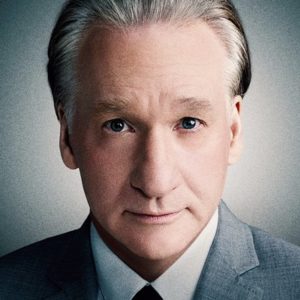
Join Neil deGrasse Tyson as he talks with comedian Bill Maher about aliens, religion, political correctness, and much more. Joined in the Hall of the Universe at the American Museum of Natural History by comic co-host Maeve Higgins and political scientist Alison Dagnes, we discuss the power of satire and the impact of comedy on society. Bill explains how he got started in comedy and how humor allows people to put their guard down. You’ll hear a clip from Real Time with Bill Maher where Neil discusses the power of seeing the universe. You’ll also hear Alison discuss the dangers of re-affirming your beliefs by surrounding yourself with like-minded people, and our panel discusses how to infuse science into debate dialogue. Neil and Bill talk about political correctness, how liberals should defend the First Amendment, and how society might be becoming too sensitive. Then, Greg Lukianoff, author, attorney, and president of the Foundation for Individual Rights and Education, joins our panel to investigate how college campuses are becoming too sensitive and threatening the “marketplace of ideas” concept. John Hibbing, political scientist and author of Predisposed: Liberals, Conservatives, and the Biology of Political Differences, joins the conversation to discuss if political affiliation can be biological and what monitoring electrodermal activity can tell us about the brain patterns of people on opposite sides of the aisle. Discover how certain generations are more susceptible to conspiracy theories, whether Bill believes in aliens, and how religion has impacted his comedy. All that, plus, we answer fan-submitted Cosmic Queries and Neil helps us look at truth from a cosmic perspective.
Transcript
DOWNLOAD SRT
Welcome to Star Talk, your place in the universe where science and pop culture collide. Star Talk begins right now. To the hall of the universe, I'm your host, Neil deGrasse Tyson, your personal astrophysicist. Tonight, we're featuring my interview...
Welcome to Star Talk, your place in the universe where science and pop culture collide.
Star Talk begins right now.
To the hall of the universe, I'm your host, Neil deGrasse Tyson, your personal astrophysicist.
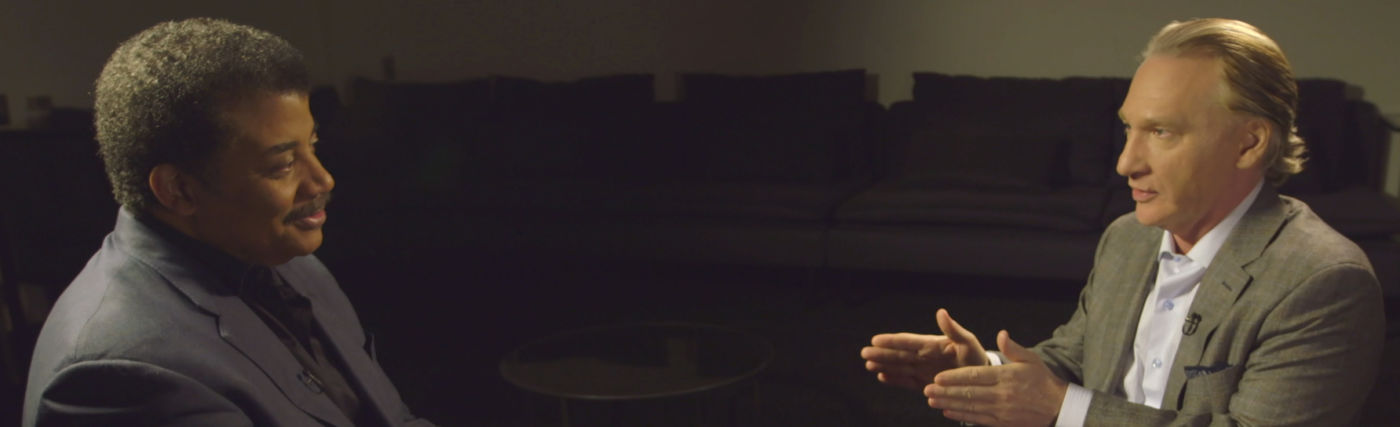
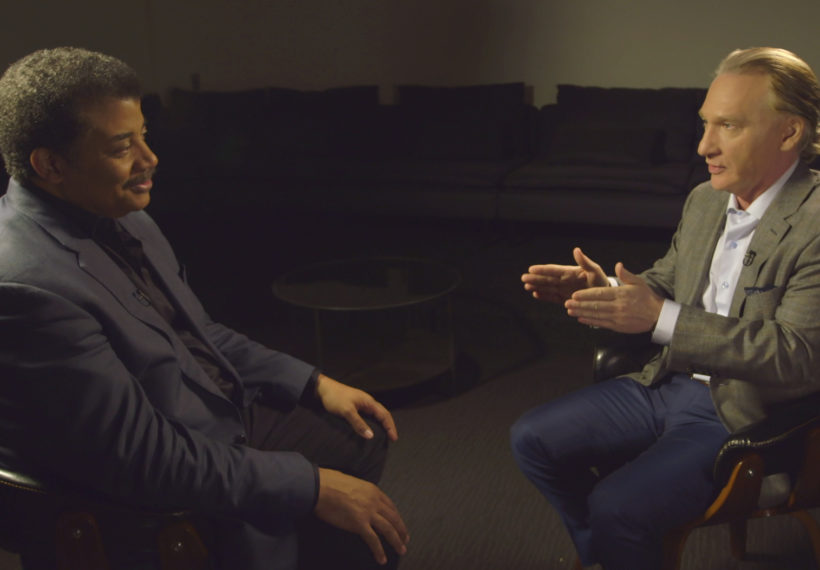
Tonight, we're featuring my interview with comedian Bill Maher.
We talked about everything under the sun, from aliens to religion to what it is to be politically correct.
So, let's do this.
Let's do this.
And as you know, I never do this alone.
My comedic co-host, Maeve Higgins.
Maeve, welcome back.
And I've got Alison Dagnes with us, professor of political science at Shippensburg University in Pennsylvania, and you research the effect of media on American politics.
I do, yep, that's my area.
You're the right person for this show because we've got my interview with Bill Maher.
And at his best, he criticizes the state of society.
So I had to ask him, where did that path to comedy start?
So let's check it out.
Oh, I could always be a class clown.
I always knew what I was going to be.
People said, what, are you a comedian?
And you said, frankly, yes.
When I was in, when I took physics for, there was literally a course at Cornell, physics for poets.
And I remember Speed of Light, C, right?
Nice, the lowercase C.
Right, if a man is traveling at 3 5th C on his wedding night, how disappointed will his wife be?
Because length shrinks as we approach the Speed of Light.
Yes, this is true.
So there's a joke.
So you knew you were going to be a comedian your whole life.
I really did.
I was very young when I thought this is my destiny.
And I, of course, was too shy and not confident enough to ever even say it to anybody, because I thought they would just laugh at me, which of course they did when I finally had to say it at me, not with me.
At me.
At you.
Yes.
So when you look to find humor, of course, you're famous for reaching into politics.
But I'm just wondering, might science be a place that you could reach for some of your humor going forward?
That's why we have you on.
So you can make fun of me.
That's right.
You're here at my studio.
You did my show tonight.
No, I mean, you bring humor into it, which is great.
Well, I think the universe is hilarious.
And I get a lot of timing cues from you guys.
I mean, you guys are just pros at it.
I mean, you are somewhat of a natural at that.
You really are.
But my advantage is if I'm giving a lecture and any of my humor fails, they're still learning something.
Right.
I mean, you're totally...
I'm way better off than you guys are.
You're a professor.
You're totally playing with the house money.
Any laugh you get is crazy.
You're not expected to get any.
It's bonus laugh.
It's not like being a comedian where they're looking for you to do that.
Yeah.
Right.
But I think it's great you still go on the road and you still do your thing.
Oh, yes.
I'll be in Cleveland tomorrow.
Because there's not...
I hate to say it, but there's nothing sadder than someone who I knew was a sharp standup comedian.
Then they do movies and TV and then they try to go back on the stage and it's not there.
It's not...
They miss something.
It's a muscle.
A muscle.
You know, I mean, you have to work at it all the time and you have to enjoy it.
I mean, I enjoy it a lot.
And you got to feel the risk of not getting your audience.
I mean, that's part of the challenge when you're standing up in front of it.
I mean, that's not much of a challenge anymore.
When people ask me about stand up and they say it's so hard, I always tell them the truth, which is that it's hard at the beginning.
It's painful at the beginning and the beginning can last years.
Plus, anyone who comes to you is a fan of yours today.
Of course.
Yeah.
I mean, anyone who pays money and good money.
Yeah, it's good money.
Yeah, it's good money.
Theater money, you know.
Of course, they are absolutely wanting me to do what I want to do for them.
Yes, and there it is.
That's why it's such a love fest.
It's because they have a, there's a specific thing I can do for them and they want me to do it.
It makes me want to do it.
And that's true of any performer.
Anybody and it's very rare in any field of show business where they quit.
Very few people have ever walked away.
Greta Garbo, Cary Grant, done.
Nobody else hangs on as long as they can, even at the expense of their dignity.
They would rather do reality TV, I'm in the jungle, get me out show, whatever show it is.
They would rather be humiliated than not be famous.
Not stay in the game.
But back to what we were saying, of course, there's nothing that makes people want to put their guard down and listen to something like humor, whether it's politics or science or anything.
Anything, right.
So Maeve, humor opens doors.
Yeah, I think it does.
That's why there's the famous joke knock knock.
Opens all kinds of doors.
Who's there?
So yeah, I think because it's surprising, often humor is surprising.
So you're like, I wasn't expecting that.
And it's in those moments that you're open to like learning something else.
So Alison, I mean, there's humor, there's political humor, which I think is a little riskier because it's one of those never talk politics or religion.
And the best comedians live in both of those spheres.
Yeah, like because if you're if somebody's preaching at me, I just shut down.
You know, if I feel like somebody is just like telling me the way.
But if somebody makes me laugh, then I like pretty much believe anything they tell me.
So I've been invited often to these shows.
And some of it is just an easy date because we're here in New York City.
And Colbert tapes here and the Daily Show is here.
So I got the sense that they were bringing me in so that they have a lifeline to science, something to anchor what might otherwise be the hot air of politics.
You don't think it was just a bit of eye candy?
No, no, no.
So I have a clip from my recent appearance on Bill Maher's Real Time.
And you get a sense of how he's bringing my science into his schtick.
Let's check it out.
You always have one of your sciencey ties.
I never know when I need to reference it in conversation.
Right.
Actually, that's good for me, because I can see it.
Now that's Saturn, right?
So four of our giant planets have rings, but this is likely Saturn.
Now I watched your show Cosmos over and over.
I love that show.
Well, thank you.
You referred to Saturn on that show as the crown jewel of our solar system.
Because it's beautiful.
If you've ever seen Saturn.
I just wanted you to give me credit for remembering that.
Oh, thank you.
You not only get credit for remembering, if you've ever seen Saturn through a telescope, it is jaw dropping.
Really?
And it can transform your life, as it did mine.
Why?
Saturn through a telescope.
It's a planet with a ring and other moons orbiting around it.
Okay, all right, all right, easy there.
We're not all nerds, okay?
We don't all look for the telescope and then orgasm about it.
So, but speaking of that.
It just means you've never seen it through a telescope.
That's evidence.
But even if I had.
You wouldn't be speaking that way.
I am certain.
Thus is the power of the universe on the soul.
You get political pundits on and they're going to argue about something they don't agree with.
Right.
Or agree on.
So, is there a role of objectively true science in the political discourse?
Absolutely.
Of course there is.
The problem...
We'd like there to be a role, but is there a role?
There is.
I think that the problem right now is that we have sort of siloed ourselves and we talk just to people who think like us and we reaffirm our own beliefs and that feeds on our confirmation biases.
I love that.
It's so much easier.
It's easier and it's more relaxing.
You don't have to think too much.
And like you feel so right.
You really do.
You really, really do.
With your shoulders too.
Yeah, you do like a shimmy thing.
But that leads to a problem because then you have one group of people who believe something about science and a different group of people who believe something different about science.
And so we have a hard time, I think we have a rejection of truth right now and a rejection of fact, and that's difficult.
And so my...
You're telling me I'm failing at my job.
I am absolutely not telling you that you're failing.
So how do you think science should infuse that dialogue?
Because if people...
Of course, you'd expect people to have different political views, but when they also take political views of a scientific fact and then choose sides, do you have insights from your research that could inform me and my colleagues how we can better show that science is true whether or not you believe in it?
Yes.
And I joke about this.
It's like, you can't just pick the science that you want.
You can't say, I gained a few pounds last week, I want to repeal the law of gravity.
You can't do that.
That's exactly right.
No, that's exactly right.
And I think that another thing that we've done is kind of this false equivalency of opinion.
You know, everyone's entitled to their own opinion.
That's what we like to say.
And now there's so many platforms out there where you can get your opinion out.
And so when you do and somebody likes it, then it's a good thing.
And you know that you're right.
And if somebody disagrees with you, then they are wrong.
And what you've done is you've kind of moved everybody into separate camps.
Exactly.
And so I think we need an asterisk system with opinion.
And so if we were to get into a debate about funding for science, then you and I would come to this debate with facts and it would be an interesting and informed debate.
But if you and I have a debate and you are talking about astrophysics and I say, I don't believe in space, then I think that you deserve an asterisk next to your opinion that says...
He would do so much worse than an asterisk.
You would go crazy if somebody said they didn't believe in space.
But I think that everybody else who could read it could kind of look at that and say, this is a person who has studied astrophysics and this is a person who has not and who is a dumb dumb.
And therefore, my opinion is not equal to yours.
Okay, so that's a fascinating point, but I would answer that a little differently.
Tell me.
Not answer it.
I have a different outlook on this.
Because if you have to believe me because I'm an astrophysicist, then I failed as an educator.
You should just believe in astrophysics.
No, no, no.
I want to convince you why it's true.
So you don't have to reference me after I've shared that information with you.
I understand.
Now you move on and you can tell others.
But don't you think that if you're looking at two opinions that we should be able to weigh where those opinions are coming from?
That we should be able just to gauge a tiny little bit?
Little bit.
Just a smidge.
Just a smidge maybe.
Because this is what you've spent your life doing.
You clearly know more about this than someone who says there is no space.
Right.
So can't we just sort of say…
Or someone who says the earth is flat.
Exactly.
Right.
They're still out there.
And don't you want us to also be able to use that in it?
Wait, wait, I was just talking about flat earthers and you said us.
I mean, sure, it's round.
But it's great to be able to pull out a name in an argument, do you know what I mean?
To be like, well, Carl Sagan said boom.
It's like, I'm a comedian, who's going to listen to me, but I can at least point to somebody else who knows more than I do.
So here's more of my interview with comedian Bill Maher.
Let's check it out.
In my 20s, when I look back, what was the thing that was just driving it?
Don't be a failure.
Succeed.
30s, it's like, get girls.
60s, live.
Keep living.
Don't die.
If you could live forever, would you?
Yes.
Absolutely.
Really?
Yeah.
I like life.
I mean, it's a good life.
What you don't know is, had you known you could live forever when you were younger, would your life have been focused enough to have succeeded in the way you have?
Well, maybe not.
Right, because there's always a tomorrow.
You get lazy, you get fat and lazy if you live forever.
Maybe knowing that you're going to die gets focused to your life.
What I would want to know is, if I live forever, at some point, would I get bored of the things that I have yet to get bored with?
Like if I was 800, would I be like, man, I've been doing this crossword puzzle for 748 years and I'm just over it.
It was good for that amount of time or sex.
Would I be like, yeah, boy, I never thought I'd get tired of this, but a thousand years and I'm ready to get a thousand years of sex and I feel like I've done it all.
Well when we come back, we'll try to push your buttons in a conversation about political correctness on Star Talk.
We're featuring my interview with Bill Maher, the comedian and political commentator, and he's made his career out of offending people.
So today, there's a rising tide of political correctness everywhere, especially on college campuses.
And I had to ask him about it.
Just what is up with this political correctness?
Let's check it out.
How do you track this wave of political correctness I now see on campuses?
So it's more than I've ever seen it before.
It's worse than ever, and it's humiliating to me because I did a show called Politically Incorrect in 1993.
I was trying to drive a stake through this beast's heart and obviously failed miserably.
The internet certainly did not help because of the anonymity.
But I'm always on liberals about this.
I think liberals got extremely lazy.
People get disinvited from universities.
They don't understand what free speech is.
The First Amendment should be to liberals what the Second Amendment is to conservatives.
It should be what they prize the most.
But they only want to hear, especially on campuses where it is the worst, what is their approved view on any particular subject.
And any view that is not that view is either a nut job or a crazy person or whatever else.
And they're like beyond sensitive.
I mean, you can't wear a Pocahontas Halloween costume because that would defend Indians and this one and this.
And it's just a Halloween costume.
I mean, they have no idea how to lighten up.
I mean, I get it here in my studio audience.
I heard it.
That was my, you begin a joke.
People react.
They pre-react.
They pre-react.
There used to be a phrase, knee jerk liberal.
That's what it meant.
Your knee jerks before you even think.
And this happens all the time.
There's been so many comedians, among them Jerry Seinfeld, whose act is so clean it whitens teeth.
It's true.
You will not do campuses anymore because nothing's funny.
Nothing's funny and that's not sensitive.
That's not, it's like, you can't laugh.
You can't laugh freely.
Maybe there's another way to bring humor to that generation and you're not, and you don't wanna invest that energy.
Well, it's Soviet humor or a puppet show or something that has, something that has absolutely no teeth to it.
What people who like me like about the humor is that it's getting in a truth.
But when you get at truths, yes, you do offend people sometimes.
Truth is offensive, but it's also for me what my bond with my audience has been.
They'll boo me one second, but they'll love me the next because I did tell the truth.
So one of my most retweeted tweets of recent weeks was one where I said, there's no constitutional amendment that guarantees that you should not be offended by the truth.
Right, there's no, just that's...
But people used to just be offended and they would move on with their lives.
They didn't feel the need to stop their life, interrupt it, try to make the person who-
Stop you.
Stop me, go away forever.
It's not enough just to remonstrate, just to register your disapproval.
They have to go away forever.
Yeah, I see things that offend me all the time.
I turn the page.
Next, I turn the channel, whatever.
I don't feel the need to stop my life about it.
So, should Bill Maher have the right to offend or should I have the right to not be offended?
We gotta bring people in to help out that question.
And who do I have here?
I got Greg, Greg Lukianoff.
Welcome to Star Talk.
You're a trained attorney and you've dedicated your career to try to get college campuses to just lighten up.
But not as a lawyer, you're president of FIRE.
What's the acronym?
Foundation for Individual Rights and Education.
You stretched that acronym a little bit, but we'll give it to you.
We can reach for it.
So what do you do?
Well, I defend free speech and due process on college campuses.
And I've been doing it since 2001, but it's only been the last couple years that we've really seen what Bill Maher was talking about, about the idea of students becoming suddenly much more sensitive.
That hasn't been the case for most of my career, but I did notice it maybe three or four years ago when there was this big push to get people like Bill Maher, disinvited.
So somebody invites them who likes his brand of humor, and then that word gets out.
And then some other community on that campus disinvites him, has the power to disinvite him.
And you can't stand that.
That's actually, we actually thought it was a joke for a long time.
And I do think actually some of it does come from a response to more diverse campuses, but it mostly is a bad response from mid to upper level administrators saying, oh, if people are gonna get offended each other and talk across lines of differences and feelings are gonna get hurt, why don't we just shut that down?
Okay, so campus is not making it illegal, they're just disinviting you.
Oh yeah.
So why don't you leave him alone?
It's their own campus.
Because we think it was reaching the point when nope, because it wasn't just they were disinviting people who were coming to speak at commencement, they were disinviting speakers that people could just choose not to go to.
And if you reach a point where campuses can't have to be play incredibly safe with who they invite, what's the point of having a marketplace of ideas in the first place?
So Maeve, are there jokes you avoid, depending on your audience?
Would you just say, here's, here's, I'm gonna feed them everything I got.
I'd probably be, I'm kind of careful not to hurt people with my comedy, you know?
Like, I feel like it's interesting what Bill Maher said about like the Pocahontas costume, because you know that was my character for, no.
No.
Because, and then he said.
Because Irish people look so much like Pocahontas, you know, yeah.
It's a spinning image.
Colors of the wind.
First thought.
But I think there's like a difference, like the way I look at it, if I'm not sure about a joke, and if I feel like, is this worth it?
Then I am like, am I punching up or am I punching down?
And so I feel like Bill Maher also talks about speaking truth to power, but usually the powerful are above you.
But I would say in the case of like Pocahontas costume, that's like Native Americans who've had a really rough time.
Oh, so they're punching down.
That's punching down.
Oh, okay.
So that's where I, like just as a writer and performer, that's my own kind of limit.
Oh, cool.
Yeah, that's how I figure it out.
That's nicely thought out.
Is there some joke that will not work now that you're gonna have to really wait a few years before it lands?
Yeah, I can tell you a joke right now, and it's gonna happen.
Okay, so basically, I'm like, and maybe, and then like, and it turned out it was my father the whole time.
Okay, too soon, too soon.
So Greg, tell me about the big buzz topic today on campuses are safe spaces.
Yes.
What, or trigger warnings.
If you put professors in a situation where they have to guess what they're allowed to say, you end up chilling speech in the classroom.
And you have professors, including the professors at Harvard Law School, saying that they're afraid to teach the law related to sexual assault because they're afraid it will be too triggering for students.
Now, of course, the irony of that is that the people who suffer the most when you can't teach the law of sexual assault are victims of sexual assault.
Okay, so how do we find the balance if it's findable at all between free speech and just respect for fellow human beings?
Free speech is basically an anarchical system where you trust in people to figure it out on their own and you don't trust in power, you don't trust in government, you don't trust in people who can punish people to make them think right.
But the most frustrating thing about the national discussion of trigger warnings and particularly safe spaces is that basically there are four or five different things that people mean when they save safe spaces and if you support them, you go with the version that is just like, well, I just want to have a group of friends that all like each other.
And when people are critical of them, they're saying the situations when students are saying, this whole university is my safe space and I don't want Bill Maher speaking here.
So they're talking past each other most of the time on this.
Okay, so vocabulary is not uniformly defined.
We're having a crisis of vocabulary.
We had that issue with Pluto, all right?
So don't get me started there.
So Greg, just thanks for coming in this segment and just putting some sort of legal expertise on what we were trying to get across here.
So up next, we'll try to answer your question.
Could your political affiliation be biological on StarTalk?
Here comes Star Talk from the American Museum of Natural History, beneath the Hayden Sphere, right here in New York City.
We're talking about the power of political satire with comedian Bill Maher.
Check it out.
So, signs of denialism.
Let's go there for briefly.
I looked carefully to see whether the denialism, perhaps in different subjects, but whether it existed for liberals.
And I came up with a list.
There's like, the New Age Remedy Movement has to reject some mainstream science for that to happen.
The anti-GMO movement is rejecting some mainstream science for that to happen.
The anti-vax movement is rejecting.
So, these are centered, or leaning left.
Lean liberal.
Yes, and I would agree with you on that.
But again, perspective is important and size matters.
From my way of thinking, the most important issue, and this is of all the issues, is climate.
Because without that, if we don't fix that, there are no other issues.
Okay, so if there is one side, and it's broken down, it's very politicized, one side thinks climate change is real and one side doesn't.
Everything else is second place to that.
That's all I was saying.
Okay, so just to be fair to you and your, I mean, as critical as you are of the right and as associated with the left, as everyone in the right makes you, you are still critical of the left when the left needs it, when they get smacked in the head.
I'm the one on the left who's critical of the left.
Right, yeah, the left otherwise doesn't criticize itself.
More than anybody else.
Everybody else just panders.
Yeah, so all I was trying to get at was, if you look carefully, there's plenty of science denialism in the left, a community that likes to think it does not deny science.
So Alison, do you agree with that?
Sure, I mean, I think that there's room for ignorance on both sides of the ideological spectrum.
But I think that Maher is right, that there is more denial on the right because there are more beliefs there that give alternate explanations for things that are scientifically proven.
And a lot of those are rooted in religion and a lot of those are rooted in kind of some old school beliefs.
But sure, there definitely is some science denial on the left as well.
So, how would you characterize that distinction between science denialism on the left and right?
Because I gave a list of things, crystal healers.
I don't know any of them that are conservative, okay?
But the crystals have power and they want to be healed by them.
This is denying science.
Yes, it is.
I think that the way that the folks in the drum circle would frame it is that this is an alternate belief in something that is greater than us and so it's essentially the same as the folks on the right who believe that dinosaurs roamed the earth 6,000 years ago.
We all occupy the same reality.
How does this happen?
Oh no, I think we're occupying two different realities at this point.
Okay, I'm a scientist.
We are occupying the same.
And like healthcare is so expensive but crystals are so cheap.
So I'm just wondering how this happens.
Is it training, is it in school?
Could it be biological?
And so there's a recent book called Predisposed Liberals, Conservatives and the Biology of Political Differences.
Who's like, yeah, let's get some science.
Roll some science into this conversation.
And it suggests that political views may be hardwired into our DNA.
Oh my God.
And we have the author of that book, political scientist, John Hibbing, standing by live right now on Video Call.
John, are you there?
So John, you operate a political physiology lab.
That's right.
And you're at the University of Nebraska at Lincoln?
That's correct.
Excellent.
So what is a political physiology lab?
Well, political physiology is an attempt to measure how people react.
You just get them thinking about stuff and you get to see how the brains differ?
That's right, exactly.
And the simple thing to do would be to show them pictures of Barack Obama or Donald Trump, but we actually go to the next step and show them non-political images and see if there are differences across the political spectrum and how they respond to those images.
Ooh, so what have you found?
Well, our kind of go-to measure is electrodermal activity.
We know that when the body is aroused even mildly, the sweat glands open up a little bit.
So this is easy to measure.
And we can see if people are tending to respond more strongly to negative images, like a picture of a bear or positive images like a picture of a loved one.
And we know overall that people respond more to negative images.
We wanna look at individual differences and see if those differences correlate with political beliefs.
So not everyone has that same reaction to something that could harm them, basically.
Exactly, some people respond a lot more to things that could harm them than to things that they love.
Other people respond about the same.
So it seems to me, if you were to make a political career, you could get everyone who has that sensitivity to vote for you by feeding that fear.
There's some truth to that.
And I think where you're going with that is that you might see some of that happening in the political arena today.
No, I wasn't, no, I, no.
So who was more sensitive to this threat of violence?
Conservatives are, yeah.
Across the board, we do a lot of things.
For example, we do things with memory.
We show them a whole bunch of pictures, some positive, some negative.
Then we'll do a distractor task.
Then we'll show them a whole bunch more pictures, some that they've seen before and some that they haven't.
And we see who can remember things.
Liberals and conservatives remember about the same overall, but conservatives remember the negative images much better.
The liberals remember the positive images much better.
Okay, so do the brains look different when you...
The different parts of lit up?
Yeah, we have done some neuroimaging work.
And it really is pretty easy to predict who is a liberal, who is a conservative, simply on the basis of looking at the brain activation patterns.
So it would have been fun to have this conversation with you with an image of your brain, like right next to you, just so we can see what's lit up or not as you spoke.
Well, I think that's none of your business.
Well John, thank you for this deep insight you brought to our conversation.
Well next in my interview with comedian Bill Maher, we'll talk about religion, aliens and more when Star Talk continues.
We're talking about satire and the state of society with comedian Bill Maher.
And he offered his thoughts about aliens.
Let's check it out.
I don't think it's at all unscientific.
I think it's possible that there is alien life, life on other planets or even life here.
You know, they could be here.
There's nothing unscientific about that.
I joked that maybe they have landed, but they landed in San Diego during Comic-Con.
Nobody noticed.
Wrong time to be visited by aliens.
I mean, we don't know that.
And Hillary wants to open up Area 51.
Yeah, I said, let her do it.
Go ahead.
People say, well, there's secrets.
Could the government?
I think if we've been visited by aliens, I don't think it's the kind of secret the government can successfully keep.
That's all.
Unless the aliens want to keep it a secret.
And they may.
They may be here.
You know that there's a whole group of people who think, there's that guy Alex Jones.
Trump goes on his show.
He's one of these right-wing nuts.
And he believes that there are lizard people among us.
The Queen of England is one, George Bush was one.
They are actually lizards.
They take human form, but if you sometimes catch them, you know, when their guard is down, you see they're lizard.
I mean, this is the whole thing.
I interviewed this guy for Religious, it didn't make it into the movie, but.
Yeah, I saw the movie.
It was not in the movie, but yeah, that's a theory that people have.
And Trump goes on this guy's show and calls him amazing.
Huge.
So Alison, are some demographics, demographic groups in America more susceptible to conspiracy theories than others?
I think so, because the root of a conspiracy theory is that you don't trust something.
You don't trust the government or you don't trust the media who are telling you this.
See, I always thought of it differently.
I thought it's people who don't understand how data works.
See, the role of data in drawing a conclusion.
Sure.
But it didn't occur to me to think that they just don't know how to trust.
Well, think about it this way.
For the last 40 years, particularly conservatives have been sort of banging this drum that the government is corrupt and untrustworthy, that the media are biased and untrustworthy, and that academics are left-leaning and thus untrustworthy.
And so after you yell this for 40 years, people tend to believe it.
And as a result of that, when these institutions come forward and say, here's some truth, the response is, I don't trust you.
And that's where conspiracy comes from.
And that leaves them open to have whatever the hell thought they want.
That's exactly right.
So Bill Maher is also known for his 2008 film, Religious.
And in it, he examines and challenges people's closely held religious beliefs.
And, but he's a devout atheist.
Can I say that?
So I asked him how his atheism and his critique of religion impacts his comedy.
So check it out.
One kind of atheism is I'm not religious.
Another kind is let's rid the world of religion.
These are two kind of different levels of militancy within the movement.
So where would you put yourself on that spectrum?
I only love to make fun of it.
If you make fun of it enough, the problem will take care of itself.
By the way, in your film, Religious, you were trying to give people their time on camera.
Yeah, and I did, right.
You don't have to make fun of it.
It makes fun of itself.
Just point the camera and ask the question.
They will do it for you.
When I pitched the movie, I said, religion is the side of a comedic barn.
If I can't hit it in this movie, I am going to get out of the business.
It is.
There is nothing easier to make fun of.
Ask Noah.
I will give you a chance to critique me.
I am on record for putting a little distance between myself and the atheist movement.
The atheist movement is like, there is some iron in there.
My point is, here is why.
I do things that people who would label me as an atheist would not expect me to do.
As a result, I end up saying, I thought you were an atheist.
As long as that continues, if I say I am an atheist, that comes with a whole portfolio of what people think I am or what I would say or what I would believe, not all of which is true.
So I say, find some other word for me.
Do you believe in a talking snake?
Then you're on our team.
I have this argument with people all the time also.
To me, it's just semantics.
So I don't know what you're talking about when you say you do things that are...
So for example, I had a friend of mine go on the space shuttle ready to fix the Hubble telescope.
On my Facebook page, I said, good luck to the space shuttle and Godspeed.
I use that phrase all the time.
People came in and said, I thought you were an atheist.
Why are you using that?
They jumped all over me.
It's like back the **** off.
And this gets back to what we were saying a little while ago about lazy liberals.
Instead of attacking the real enemies, what they like to do is find a little piece that's not quite clean enough.
It's pretty clean.
It's almost pure, but it's a lot easier to polish that up and ignore the giant pile of **** over on the other side of the room.
So, yeah, you're on our team.
That's all I care about.
Alison, can or should comedians make fun of religion?
This is the, religion is a sacred thing that our country is founded on the freedom of expression of religion.
It's kind of a cultural point of respect that's implicit in what we call civilized America.
So now you have comedians just trampling the Rose Garden there.
So what's going on?
Well, that's what comedy is supposed to do.
Comedy is supposed to sort of point at sacred cows and take them down a bit.
Okay, so this is what comedy is supposed to do.
But in addition to that, our country was founded on religious freedom, which has to include not being religious at all.
And so I think that making fun of religion is not only fair, but I think well within our history of approaching religion.
So Maeve, do you have like, religion jokes?
It's funny, I feel like I can make fun of...
I grew up Catholic.
So I feel like I can make fun of like Catholic rituals.
But I wouldn't feel as comfortable making fun of somebody else's.
So we live in a country now where the fraction of people who do not associate with a religion is growing.
Alison, the last I saw 23% and rising.
This is people who may be spiritual but not affiliated with a formal religion.
And that would include agnostics, where no one is telling them what they should believe out of some revealed truth in a document.
So that's a trend line.
Do you see that continuing?
I do.
And then I also see folks who are religious really embracing that in a strong way too.
And so this kind of leads back to that bifurcation that we're seeing sort of at large, the polarization.
You're saying the religious community is a little fearsome then?
That they would lose adherence to this growing demographic?
Yeah, the information, the data is showing that churches are losing membership.
And so they're trying hard to keep those members in line and keep them in their flock.
And that makes sense because they need a flock in order to be a church.
Maybe churches should do more pranks on their congregations.
That could be cool.
That's a really good idea.
Yeah, they should do more.
You heard it here first.
Like when you're kneeling and then you go to sit, but the priest will pull the chair away.
Yeah, just like simple physical comedy could bring people back.
Well up next, I try to explain the big bang to Bill Maher when Star Talk continues.
And every time we talk, he always tries to stump me with a question about the Big Bang.
This was no exception, check it out.
So tell me again how the universe fits inside of a little marble.
Well, it doesn't do that today, but it did that nearly 14 billion years ago.
Right.
Wink, wink.
I'm not saying it's not true.
I'm just saying I've packed a suitcase, and you really kind of, you know, you jump on it and then you, one last thing.
You're using your life experience packing your suitcase to pass judgment on the big thing.
But I was trying to get at that point that there must be so much space inside the molecule, right?
Because the atoms.
Yes, that's true, but that's not, it's still an effort to get it down there.
Right, well that's my basic question.
How could the universe have fit into a volume that size?
And I'm just saying, very high temperature, matter becomes energy out of E equals MC squared.
You cram as much energy into the smallest volume of space that exists.
But it's not stable and it must expand.
And that's what the universe did.
So you have it.
Well, that clears that out.
Now I can sleep tonight.
So that was Bill Maher's chance to ask an astrophysicist a question.
And now it's our fan's turn.
Because it's time for Cosmic Queries.
Yes.
Okay, so our first question comes from Pradyumna Padala from India.
How would the universe look if our eyes could see all the wavelengths of light?
Ooh, it would be.
Oh, I so want that superpower.
That'd be like a superpower.
Would it be like a disco, like a glitter ball?
Better.
Yeah.
Is that your measure of good things?
Biv.
Red, orange, yellow, green, blue, indigo, violet.
And we celebrate the power of our eyes to see.
However, if you lay the visible spectrum in the full electromagnetic spectrum, we are practically blind.
You go beyond red, there is infrared, can't see that.
Go beyond infrared, there's microwaves, can't see that.
Go beyond microwaves, radio waves, can't see them.
Go back the other way, beyond violet, ultraviolet, can't see it.
X-rays, can't see it.
Gamma rays, can't see it.
So the existence of things in the universe were traceable to bands of light that we didn't previously even know existed.
So if you could see all of this, the world would look so different to you.
Some would be on the phone, on their cell phone, and there'd be a glow in microwaves.
There'd be it all around the head.
You'd look at a microwave tower.
That would be the brightest thing on the horizon if you tune in to microwaves.
You can tune to infrared and all the hot things would be a glow.
And so, yeah, it'd be, really, I think about this all the time.
I lay awake at night wanting this kind of vision.
Well, great.
So our second question.
If everything in the world has a beginning, so there's a beginning of the beginning of the beginning of the beginning of the universe?
I never said everything had a beginning.
Oh, sorry, dude.
No, no, no, that's an assumption.
You can assume that's the case, then you're stuck asking questions like that.
I don't assume anything.
Maybe the universe always was.
I'm perfectly happy thinking that that's a possibility that I could then research.
But the moment you start asserting what you think the universe should be, should have been, will be in the absence of data, there's assumptions that feel good to you that you then implant on the universe.
So we've been talking about the role of comedy in shaping politics.
Featuring my interview with comedian Bill Maher.
Let's check it out.
You're old enough, we're ish the same age.
Right.
So we remember Apollo and all of this.
Sure.
That was an era.
Right.
Today, do you get any reflections?
Well, it's a shame we don't really have one.
You know, I mean, it's become privatized.
I mean, that's where space exploration has moved.
I don't know what NASA is doing.
That's one of the problems.
Do they even send the space shuttle?
They're certain they've got a mission statement that they're fulfilling, but nobody doesn't get out there.
I mean, listening to you actually is what convinced me.
You know, we should probably be exploring space.
Really?
I convinced you.
Yes, I think you did because, you know, you make the good point that it may not be an immediate result you get from it, but that's the way science works.
Sometimes you can't foresee what the benefit is gonna be.
I wouldn't spend the whole kitty on it, but I think there is a place for it.
I also think there's-
Well, I'm honored to have influenced your views.
Yes, absolutely.
You have strong views.
They're so strong, it's not imaginable that someone can come in and-
Well, that's not true at all.
Well, in the sense that I know you're a deep thinker about a lot of issues.
But if you're a thinker, then you're willing to change your views.
Of course, but if you're a deep thinker-
Especially when-
I have to think of something you haven't thought of.
Well, exactly.
And that's a challenge.
And I'm always happy when someone does that.
I used to be friends with Timothy Leary.
He once said to me, my favorite three words in the English language are I don't know, because every time I say it, I learn something.
That's as it needs be.
And then I said, pass the joint.
So Alison, I don't hear politicians say, I don't know as often as perhaps they should.
I agree.
I think we'd all be a whole lot better if they said, I don't know more often.
In my field, we live in the I don't know.
The I don't know is what gets us out of bed every morning and running to the lab or the telescope to do the experiment.
So that one day we do know and open up another I don't know.
Right.
So should we teach more I don't know in school?
I don't know.
Sorry, you walked into that one.
Yes, we absolutely should be.
But the problem with politics is that you're running on the idea that you do know that that's the reason that you want to get elected.
That's the reason that people should vote for you is that you've got this.
So they don't know that they don't know.
Well, I think that's kind of the big thing is that they don't know what they don't know.
And then when they get there, they realize, holy crap, holy crap, there's a lot that I don't know.
No, no, it's one thing to not know what you don't know.
It's another thing to think you know something that you don't.
That's another side of that.
True.
And that's just embarrassing to others who know.
That is absolutely true.
And Stephen Colbert actually kind of created a term for this a little bit.
Truthiness?
Truthiness, that's exactly right.
So there's a comedic term, you know, truthiness, when it isn't fact-based, but you kind of feel it in your gut a little bit.
So Bill Maher said he's ready to change his mind in the face of evidence.
Cited me as an example of somebody who changed his mind.
But I didn't change his political views.
I just gave him more information he didn't have.
Right.
And after we learned today that your brain is maybe hardwired, I don't know that you can change a person's political views.
I think Professor Hibbing was onto something though.
It's not really about changing views.
It's about compromise and about discussion.
And if you close off somebody else because of their views or because of their beliefs, and you don't have a conversation about it, then you're never gonna learn anything.
Maeve, where are you?
Now I'm thinking maybe I should mature my material.
I have a lot of material about how cats are snobby.
So I'm feeling a lot of responsibility after this show.
Yes.
To open people's hearts and change people's minds.
So I've always valued comedy.
It's why I wanted a co-host who's a professional always next to me, in part because I think the universe is hilarious in ways that I can think of and I know certainly others would have the power to do so.
Do you believe like if you don't laugh, you'll cry?
Like that it staves off kind of a despair?
Oh, that's an interesting point.
You have to laugh otherwise you would cry.
No, I don't believe it.
Yeah, me neither, phew, phew.
So when I think of politics and comedy, I don't know, for me it's all about the truth.
Are you after the truth or are you not?
And so then I thought, well, of course, deeply religious people are certain they have found the truth.
So what kind of truth is that?
And then I thought this through and I concluded the following.
If you are deeply religious and you have certainty that derives from scriptures that belong to your religion, we can call that a personal truth because it matters deep within you how you feel regarding that content.
Politicians have another kind of truth.
It turns out a politician can create a truth simply by repeating information we have learned through psychology experiments.
So you can have a political truth that is only true because it got repeated.
Then you have objective truths.
These are established by experiment, by observation.
And my great frustration in our modern times is how many political conversations unfold with people who think they have the truth but in fact don't.
And the more we recognize what an objective truth is versus a political truth versus a personal truth, the more we can get the job done, passing legislation that affects us all based on objective truths, and then you go home and have your personal truth of whatever kind you want.
You can go to the bar and have whatever political truth you'd like.
That's the kind of world I want to live in because I see that from the cosmic perspective.
You've been watching Star Talk.
I bid you to keep looking up.
See the full transcript



 Unlock with Patreon


 Become a Patron