Discover more about Al’s upbringing and why he knew he was a proud nerd from early on in school. We investigate the difference between being a nerd and being a geek. Maysoon leads us in a game of “Nerd Bingo” to see who’s the bigger nerd, Charles or Neil. Neil tells us about being a “nerd protector” during his time in school.
Go inside the musical process as Al shows us what it takes to create a new song. You’ll learn how he comes up with ideas, how he gets permission from the biggest musicians to parody their songs, and why it’s so important for the songs to work audibly and visually. Maysoon tells us why it’s unforgivable to steal another comedian’s joke. On the other hand, Charles and Emily explain why scientists want their work used by others as much as possible.
Find out why there’s more truth in Al’s song “White and Nerdy” than you might think. Emily explains how that song convinced her to fully embrace her nerdiness in graduate school. Rapper Ellect drops in to perform his song “Flat to Fact” live in-studio to set the record straight for Flat-Earthers. Al reminisces on playing Isaac Newton in a rap battle against Bill Nye and…Neil? You’ll hear how comedians must navigate the ever-shifting comedy landscape. Maysoon talks about her barrier-shattering performance in Palestine. All that, plus, Al gets to ask Neil a tantalizing question – how will the universe end?
Frank Kane, Ryan Morrison, James Wicker, Jeff Prime, Jennifer Shin, Richard Shirley
NOTE: StarTalk+ Patrons and All-Access subscribers can listen to this entire episode commercial-free.
Transcript
DOWNLOAD SRT
From the American Museum of Natural History in New York City, and beaming out across all of space and time, this is StarTalk, where science and pop culture collide. I'm your host, Neil deGrasse Tyson, your personal astrophysicist, and tonight,...
From the American Museum of Natural History in New York City, and beaming out across all of space and time, this is StarTalk, where science and pop culture collide.
I'm your host, Neil deGrasse Tyson, your personal astrophysicist, and tonight, we get weird.
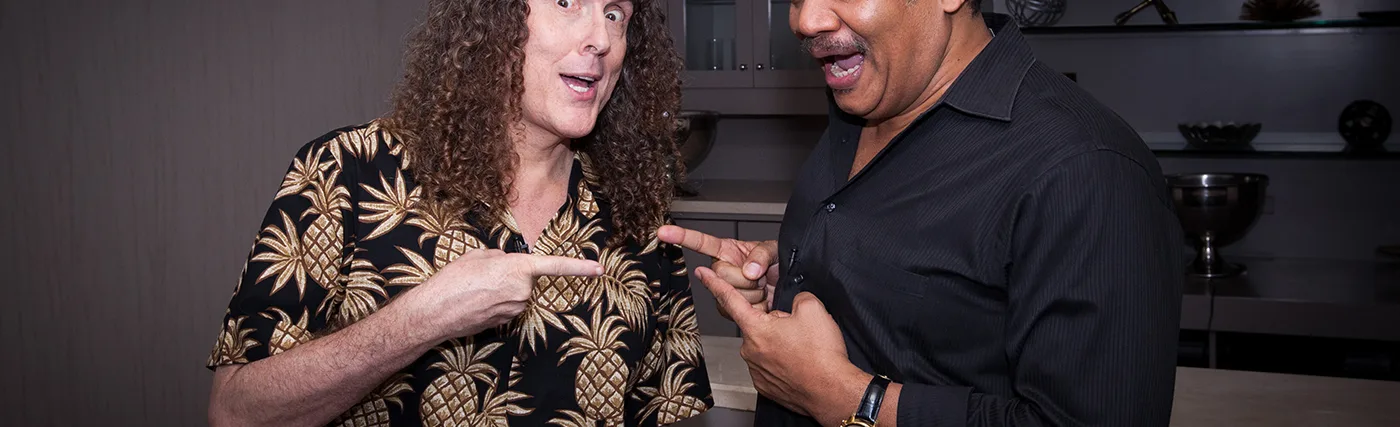
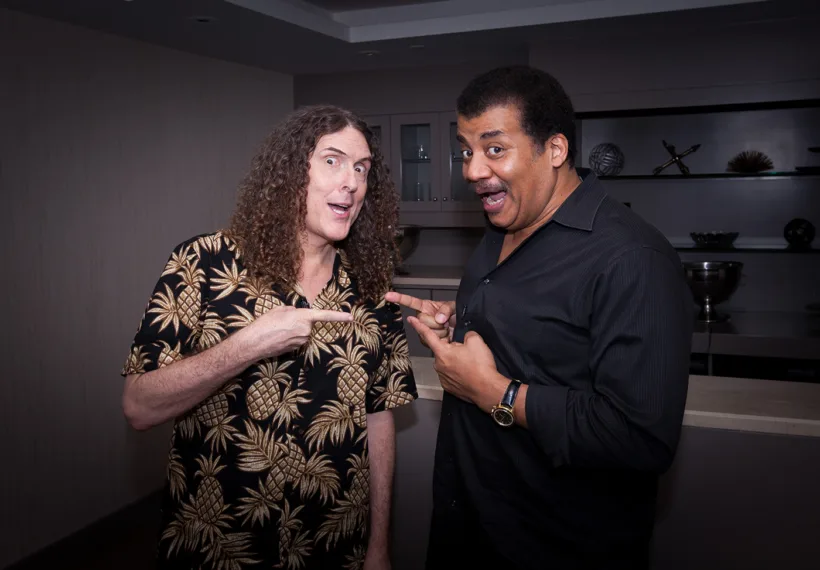
We're featuring my interview with parody songwriter and card-carrying geek, Weird Al Yankovic.
So tonight, my comedic co-host is Maysoon Zayid.
Maysoon, welcome.
And I think you're best known for your TED Talk.
I got nine-and-on problems, and Paul Z is one of them?
Uh-huh, because basically, like, in the oppression Olympics, I would win a gold medal, because I'm Palestinian, I'm Muslim, I'm a woman of color, I'm disabled, I live in Jersey.
Well, especially in Jersey.
You don't get more minority than that.
I'll fight you.
And I'm floppy.
So you rock at your TED Talk.
Well, I rock, but it's involuntary.
It's the Paul Z.
The Paul Z.
Well, all right.
Well, we got you tonight.
So thanks for coming on to StarTalk.
And also joining us is StarTalk's resident geek in chief, Charles Liu.
StarTalk fans know him as a good friend of mine and colleague.
He's a professor of astrophysics at the City University of New York on Staten Island.
And we will be tapping your full range of geek expertise this evening.
My geek mug overflows with possibilities.
Yes, indeed it does.
So we're featuring my interview with basically a geek hero.
And if you didn't know how geeky he was, you will know by the end of this episode.
Parody singer, songwriter, Weird Al Yankovic.
What he does is he takes songs you're familiar with and just makes hilarious scripted comedy out of it.
Singing the song, he's a four-time Grammy winner with hits like Yoda and Eat It.
And he's clearly a nerd himself.
How do I know Weird Al had some deep geek in him?
I asked.
Check it out.
I was very interested in math and science.
Early?
Early on, yeah.
I mean, I think I was a science and math plaque award winner in high school.
And ever since I was very young, I was always interested in science.
I think when I was a toddler, I already knew all the planets and the solar system.
I'm still not quite over the whole Pluto thing.
Don't get me started.
Fine.
And so were you good at school?
Yeah, I was my high school valedictorian.
That counts.
Yeah.
Do we agree?
And on top of that, yeah, I skipped.
I started kindergarten a year early, and I skipped second grade into third grade.
So I started high school when I was 12 and graduated when I was 16.
So I was always like the very nerdy kid.
You know, I ticked a lot of the boxes.
What are some of those boxes?
Well, you know, I was a bright student.
I was kind of obsessed with homework.
I wasn't full on obsessive.
I liked it.
You know what?
I loved math in particular.
Because I would do algebra for fun.
Because I thought it was really cool.
It was like a puzzle.
It was like solving for X.
Like this is really cool.
But stuff like that.
Like two of these would have worked.
But now you got all five.
So yeah, I would either eat lunch by myself or with other similarly dorky kids.
Okay.
So it was all that.
All the above.
Okay.
So were you in a community where this was kind of ostracized?
Well, I will tell you, there wasn't such a thing as a cool nerd when I was growing up.
That wasn't invented yet.
Exactly.
So Charles, did you have all those boxes checked when you were a kid?
Oh, for sure.
I loved doing math too.
And in fact, I even married someone who loved doing math.
In fact, she tells me that the morning before we got married, she and her bridesmaids were rocking out to Weird Al's music.
So my geek love for him increases with the passing moments.
And so how would you distinguish, just either historically or today, the evolution of nerd versus geek?
Oh, that's a good point.
Actually, we were discussing this at home recently.
The nerd is sort of more the general intellectually unpopular person, whereas the geek can be something that's specific.
Like you can be a Star Trek geek, or a Dungeons and Dragons geek, or a football geek.
But it's harder to be like a football nerd.
On the other hand, nowadays, everything's all mixed together.
So it's like apples and oranges.
Well, plus, nerds have found one another.
So to say a nerd is unpopular, that's not true among other nerds.
Or even a geek for that matter.
You know, when I was growing up, we had a group of people who hung out together.
We didn't know we were weird.
We liked each other.
We had fun solving that together.
No one told you you were weird.
Oh, they told us, but we didn't believe them.
You were in denial of a basic truth.
There was no need to accept that supposed stereotype because I had friends that we liked each other and we enjoyed each other's company.
So Maysoon, what do you think of that checklist that he presented us?
I honestly think he nailed it.
Yeah, he totally nailed it.
And I have an idea.
I feel like we should, you know, play some nerd bingo.
Nerd bingo?
Yeah, nerd bingo.
I like all the nerdy characteristics match a number.
And so Charles is going to pick from a list of nerdy characteristics.
And each one of these guys has a placard and they're going to check off when their nerdy characteristic is called.
Whoever gets three in a row, bingo.
Nerd bingo.
All right, nerd bingo.
Number B5.
B5, was in school band.
Were you in school band?
No.
Orchestra.
Nice.
Does that count?
One for Charles.
Orchestra, all right.
Apparently bingo's got points today.
Okay.
B9.
Attended Comic Con.
Oh, yes.
He gets like a double check.
The nerd is strong in this room.
Okay.
B3.
Knows what PEMDAS stands for.
P-E-M-D-A-S.
I have no idea.
Remember?
Division, multiplication, exponent, power.
It's the thing that you unravel equations with.
PEMDAS.
I have some sad news.
Charles Liu has won.
In your face.
I did not need mnemonics to know how to unfold my equations.
All right.
So there is a higher level of nerditude.
I gladly share my award with you, sir.
So Charles, in your day, what was it like being a nerd?
Well...
I'm a little older than you, so there might be an interesting comparison here.
By the time I was certifiably nerdy, it was starting to become cool.
Microsoft, Apple, some of those great billionaires that we today recognize as captains of industry...
Weren't yet billionaires.
Weren't yet, but they were starting to get some cred.
Okay, so you were never given a wedgie and slammed into the lockers?
No.
Okay, you came just in time for that to not happen.
I got very lucky.
In my day, that happened.
Oh, no.
You?
Not to me, because I was nerd jock.
Okay, so I could, you know, I carried my slide rule on my hip.
So, but I felt deeply connected with the nerd community.
So when I saw one being beaten up, that to me was an assault on all nerds everywhere.
Oh, you the man.
So I had in my head that were I to be a superhero, it would be nerd protector.
Thank you.
And I felt that deeply.
No, I mean that sincerely.
And because the nerds had no protectors in the day, not until the popular kids needed us to help them with their computer and their math homework and this sort of thing.
What was the jock side?
The jock side, I was captain of my wrestling team.
I thought it was going to be bowling.
I'm really impressed.
I have seen pictures of his six pack abs.
But I was still like getting A's in my physics class.
Doubly dangerous.
You were calculating the angles necessary to defeat your opponent on the mat with maximum efficiency.
Yes, because physics helps in everything basically.
Amen.
So Maysoon, tell me, Geek has kind of risen up to be almost like a cultural phenomenon.
And so is that a good thing or a bad thing?
I think it's a good thing because geekdom crosses all boundaries.
It doesn't discriminate based on race, religion, economics.
So it's great that we're seeing it like kind of froth up and become more powerful.
Froth up, that sounds...
You got a better adjective for that?
It's made the world moist with geeks.
And I think that's a good thing.
Because I'll take a geek over a bully any day.
And at Comic-Con, it is a full spectrum of people, not only of different skin colors and heights and weights, but different physical appearances.
There's no judgment only on your costume, not on what else you look like.
Or lack thereof.
Yeah, they will totally call you out if your costume is not authentic.
But otherwise, I see it as a...
I don't want to quite call it a love fest, but it is a celebration of being yourself.
Oh, yeah.
And it's a place to do handmade.
Where else in the world can you still make handmade costumes and be cool?
Again, this got us beat up as kids.
Candy stolen.
Now you get prizes at Comic-Con.
We are winning.
So we know that Weird Al was a totally nerdy kid.
And so, of course, he played a nerdy instrument.
Let's find out what that is.
I took accordion lessons from ages 7 to 10.
Accordion lessons?
Accordion lessons, yeah.
So nobody wanted you to get laid at all?
This is...
Well, here's my parents' logic.
My parents made the decision for me.
It was a choice between guitar lessons and accordion lessons.
And of course, my parents, having the foresight, knew that if I took accordion lessons, I would never be lonely.
I'd be a one-man band.
I'd be the life of any party.
Who wouldn't want an accordion player at the party?
Well, you know what?
I'll tell you something.
We're talking about the mid-60s here.
And the accordion had just become an unhip instrument.
The guitar rose up and became king.
Yeah, I mean, in the 60s, there was some guitar stuff going on.
Yeah, I think so.
So they were a little behind the curve.
But if you look at the 50s, I mean, the late great Dick Contino was a famous accordion player.
And you look at his album covers, and without any irony whatsoever, he's there with an accordion, and there's women draped on his legs like, ooh, accordion player, yeah.
And my friends, oh, young Alfie would love that.
So is an accordion, you know, I never really understood an accordion.
It's a piano.
It's a piano on the right side.
Okay, but like the air, what does the air do?
Oh, the air, the bellows supply the energy to push the air through the reeds to make the sounds.
So it's actually a very central instrument.
It's very dynamic.
Yeah, plus it's like a, you have to be mechanically coordinated.
Yeah, it's one of these kind of things, yeah.
Exactly, you press and click.
Right, I mean that's, and what's this angling of it?
Is that just a...
Oh, that's just for showing off.
That's for the chicks.
Look, Maysoon, is the accordion a sexier instrument than we've given it credit for?
It ain't the banjo, but it is sexy as hell.
Did you just say it's not the banjo?
Yeah, the most sexy instrument ever, but the accordion is a close, close second, and the way that Weird Al just described the moves kind of got me thinking.
Wow.
Well, up next, we get white and nerdy.
Should we leave?
With the musical parodies of Weird Al Yankovic when StarTalk returns.
The future of space and the secrets of our planet revealed.
This is StarTalk.
And I asked him about the heavy infusion of geeky science references in his music, and especially in his hit song, White and Nerdy.
Check it out.
Do you have someone vet your lyrics for their scientific?
I do that myself.
I, you know, I'll go on.
There's no one else who can vet my own lyric.
I'll have you do it from now on.
But no, I mean, you know, I make sure that it's as factual as it can be.
In White and Nerdy, I think you talk about memorizing pie.
Ain't got no grill, but I still wear braces.
What is, what are, just remind me of a couple of the.
I mean, although it's inspired by real experiences that I've had in my life.
I mean, I make exaggerations.
I don't really know pie to a thousand places.
I know like 3.14159265358979.
You know, after about 20 or 30 places, it's not really appropriate for household use, you know?
It's really too much.
It's too much.
20, 30 places ought to be good for anybody.
So, no, so I guess, you know what it is.
If you grew up as a geek, a nerd, whatever, choose your word, you see pieces of these lines and words.
Even when they're parody, even when they're caricature, it just touches something.
And I remember, you know, I was a pretty big kid in high school, so I was not bullied like others, but I resonated deeply with the community of people who were.
And so, every line in your white nerdy face.
Yeah, no, I just, it was, I felt it.
I try to have as many cultural touchstones as I can.
Even in the video, the Star Wars holiday special, like every little thing, I wanted some nerd to go, oh yeah, I'm feeling you.
Yeah, and there's no detail too obscure to touch, because somebody is going to find it.
Exactly right, exactly right.
And that's the secret.
And I think that video came out at exactly the right time.
I mean, at that point, people were like talking about nerd cred.
And like, you know, I was a nerd before you were a nerd, you know.
And as we talked about, that was not a phenomenon.
When we were in high school.
But the video was boastful, right?
Yes.
Yes, it was.
It's like an empowered nerd.
Yes.
Absolutely.
We got to bring in a new guest to help us analyze this one.
I've got an empowered nerd, a musical parody super fan, StarTalk All-Star, and fellow astrophysicist Emily Rice.
Emily, welcome back to StarTalk.
You too are a professor at the City University of Staten Island.
Yep.
And you also moonlight as DJ Carly Sagan.
Yeah.
You see what she did there?
So do you resonate with this nerdy references in Al's lyrics?
I'm going to say I resemble that.
Yeah.
So what's your favorite parody?
I'm already...
I'm super fangirl.
I couldn't even pick my favorite song.
So this is...
I feel like I grew up with Weird Al.
Like I remember, you know, I bought Thriller on vinyl, but then I loved Eat It when that came out.
I loved...
So I loved all the Michael Jackson parodies.
You know, I loved that Weird Al did the music that I already loved and like then put the new spin on it and made it that much funnier.
And now for every decade, there's a new favorite song.
He was popular with you, but you're a self-described nerd.
His music was more popular than just...
than nerds could have supplied for it.
So how do you account for that?
I think like a parody like that is another level of understanding, like another level of storytelling, another level of sharing.
And it's that much like you don't...
In order to make a parody, you don't just have to know the original song.
You have to add something to it.
And so there's like...
It's almost like sarcasm, the way that sarcasm, like when it's like funny sarcasm and not necessarily mean sarcasm, is like a way to communicate two different things at once.
You know, you can communicate kind of the actual thing that you're saying, but then there's the underlying thing that you need to, like the implied thing that you need to know, you know, the references that you need to get in white and nerdy in order to know why it's funny.
But it's still funny, you know, even if you don't understand anything, you know, all of the references.
Is it important to you as a super fan of this genre that the lyrics are accurate?
Yeah.
I mean, I'm not going to be pedantic about it.
Like, I'm not going to go around, like, you know, ruining all the movies on Twitter.
Oh, no one we know does that.
We don't know anyone who does that.
This show's over.
But I love it when they're accurate because why not?
Like, why not take 10 extra seconds?
I mean, Weird Al probably doesn't even need to Google anything.
He's out pie to Saul, but why not take the extra 10 seconds to make it a little bit accurate?
Like, add the details.
A quote, call up a scientist and help.
Yeah, put your favorite scientist on speed dial.
I kind of love it.
That white nerdy came out when I was in grad school.
I already loved Weird Al, and I was, like, coming into my own as a nerd in graduate school.
It was kind of like, well, after this, there's no turning back.
You're in.
Yeah, and I was like, you know, you guys talked already about, like, being the nerds growing up and stuff like that.
And I was always, I feel like I pretended not to be the nerd.
Like, I was the nerd that was like, no, I'm cool.
I'm cool.
And now I'm like, no, I'm a nerd and I love it.
Or maybe it's not, no, I'm not a nerd, I'm cool.
It's, yes, I am a nerd, I'm cool.
Now it's that.
It wasn't growing up, but now it is, and gosh, I love it.
Well, so no one has the street geek cred the way Weird Al does.
But there's another performer who sings about, in ways that he thinks he's got his handle on science.
He's a rapper named BOB.
And he actually raps about the world being flat.
So that's not just getting a small fact wrong that they didn't look up.
We're 10 extra seconds of research could have corrected it.
This is a fundamentally flawed approach to understanding the nature of reality.
But luckily we have a generation of scientifically literate, scientifically inspired rap artists.
And we have one here tonight to set the record straight.
And his name is Ellect, which is short for The Intellect.
Welcome, The Intellect.
Thank How's it going, y'all?
So what do you got for us tonight?
I'm about to perform Flat to Fact.
Flat to Fact?
Flat to Fact, exactly.
Was this your diss track?
Yeah, I wrote it on behalf of you, my man.
Well, because he called me out.
I know, when you call out the family, you know you got it this time.
This is my nephew.
Still gonna be an uncle.
All right, give it to me.
Let's go.
Now here's more from my interview with performer Weird Al Yankovic on how he gets permission to use other artists' music for his parodies.
Check it out.
I get permission for every single parody that I do.
Do you need permission for this?
You know, the phrase I always use in this case is, it's a gray area, because it's considered generally fair use by the courts, but, you know, for a couple of reasons.
What?
What?
What?
What?
So you say, Michael, I'm going to dress up like a huge, fat person, popping my buttons, and I'm going to make fun of your song, and the courts will call that fair use?
That's...
There should be another category.
Unfair use.
No, but tell me.
Tell me.
But, you know, we live in a very litigious society where even if I have every right to do something, I can still get sued.
And I'd rather be able to sleep soundly at night and not think that somebody's mad at me.
And more than that, really, I like to keep relationships with artists and not have them mad at me, so I always want to make sure that I have their blessing before I do the parody.
Before you do the parody?
I won't even write the song.
I'll come up with an idea and go, oh, that's pretty funny, and then we'll contact whoever and see if they're into it.
Uh-huh.
And your track record helps that going forward, I presume.
And Michael Jackson was a big part of that because prior to Michael Jackson signing off on it, it was sort of like, Weird Al who?
Yeah, we'll get back to you on that one.
But once Michael Jackson said, I could do Eat It, then we can call those people back and say, you know, Michael Jackson didn't seem to have a problem with it, so what's your deal?
What happens if someone who you check to see if they're okay with your parody, if they just say no?
If they say no, then I walk away.
Oh, okay.
That's it.
Really?
And it's pretty rare.
I mean, most artists actually kind of look forward to their Weird Al parody.
They're sort of like, you know, I like to say you've got your Grammys and your Platinum albums, then your Weird Al parody, you've really made it.
It's a dream come true for an artist to have Weird Al Yankovic make fun of them.
But you know what else?
It's a filmmaker's dream come true to be called out on Twitter by you, Neil.
It's goals.
It's filmmaker goals.
Really?
Because, you know, I used to do it a lot, and then it angered so many people, I just pulled back into my shell.
Yeah.
You got to come back out.
I got to come back?
I want me bust out?
Filmmakers need you.
You can also say nice things.
No, you cannot say no to them.
That solar flare was so accurate.
So, Emily, as a huge fan of this genre, you can imagine that there's a whole section of copyright law written just to accommodate his parodies.
I mean, that's not a stretch to imagine.
Oh, yeah, it's real.
I know nothing about it.
Is it weird that law would protect that?
No, I don't think so.
Like I say, it's creation and it's people making money.
Yeah, but who decides that the parody is funny and therefore legitimate material?
That's a big question.
If it's not funny, then it's just you're copying it and then you're not paying for it.
Well, the idea of parodying and the fair use is that you also have to add something to it.
You can't just like do it again and you know, you can't steal something.
You have to value add to it.
Yeah, you have to really.
Value add is a good term, I think.
You have to add something to it.
You have to say something about it.
You have to use it to say something else.
But so in comedy, if someone uses someone else's joke, maybe they think they could do it better.
In comedy, joke stealing is a deadly sin.
Really?
Yeah.
Yeah, yeah, yeah, yeah.
Yeah, I've seen comics like come to blows over stuff like that.
But if you do steal from me, you're going down.
But there are some parodies of you that I really dig.
Like, I love Saturday Night Live.
Oh, they did me a couple times.
And then you got Key and Peele Oscar winner.
And this last one is by far my favorite one, Playboy Bunny.
So, Emily and Charles, scientists use each other's ideas all the time.
Oh, yeah.
And that's a kind of currency.
Like, it's the...
In fact, you want your stuff to be used.
Oh, yeah.
So what we do, what we kind of get paid for is to publish papers.
Right?
Everybody's probably read all my scientific papers.
Thank you.
I bet you have, Charles.
Charles, Charles.
And then other people have to cite your papers.
And in fact, like, the kind of tradition is you put your paper online when it gets published, and then you wait for the emails to come in of all your colleagues saying, well, you should have cited this paper.
You should have cited this paper.
Because not only do we count the papers that we write, but we count how many times they get cited by other scientists.
Yeah, but if you always have to cite someone for an idea, would that mean there are no new ideas in science, Charles?
Oh, there are new ideas all the time.
But if you're always citing people who came before you, standing on the shoulders of giants...
But the newness comes from being able to see farther than the person you're standing on.
There's always something new, and that's what makes science so exciting.
That point of discovery where you look beyond and you go, wow, that's something no one else has seen before.
Okay, let's geekify this.
Emily, Weird Al's parodies kind of like creating an alternative universe in the multiverse.
Ooh, I think so.
That's what Stephen Hawking believed in terms of the interpretation of quantum mechanics.
I like it.
I would like to live in that universe.
Well, Emily, thanks for being back on StarTalk.
Thanks for having me.
Emily Rice.
Up next, we find out why Weird Al Yankovic doesn't use curse words in his comedy when StarTalk returns.
This is StarTalk.
Welcome back to StarTalk from the American Museum of Natural History right here in New York City.
We're featuring my interview with musical parody legend, Weird Al Yankovic.
And I asked him about the comedy chemistry of his hugely popular music videos.
Let's check it out.
Could you, given your life experience and wisdom, could you explore for me the value of the comedy as written words relative to the comedy as performed?
Well, I mean...
Because, you know, when you did bad...
That was Michael Jackson, I did fat.
Sorry, sorry.
We get confused all the time.
It's a good mistake.
It's a thing.
So, when you did fat, the lyrics are hilarious.
But it's more hilarious to watch it.
So, when you make these songs, are you hoping that they are first ingested by video?
They've got to work both ways.
And anything that I write has to work purely as an audio recording.
It's got to be funny in and of itself.
And the reverse is true.
Like, Eat It was a big hit in Japan.
Beat It parody of Beat It.
Of Beat It, right.
And I think that was mostly because of the video.
Because I'm not sure how many people in Japan really understood the word play in the song.
But they could appreciate the fact that it was a direct parody of the Michael Jackson video.
So, Maysoon, how does visual humor work differently from just audio humor?
Well, you gotta like use your eyes.
So, you were the first comedian, as I understand it, to perform stand-up in your family's home country of Palestine.
Yeah, it's kind of like being the first scientist.
I'm the first, but I don't know if I'm really the first.
Maybe in the 1950s in Palestine, there was this amazing comedian that just didn't have access to the internet and nobody knows, but as far as recorded history, I am the first.
And what I love about it is because I was a woman, they didn't have that stereotype that women aren't funny.
And when men comics came to the Middle East after me, people were like, how cute!
They're trying to be like the ladies.
Okay, so now your parents are Palestinian, but you're born in New Jersey.
I'm born and bred in the great state of New Jersey.
So don't try to pretend like you're American.
I'm born in the USA.
It's very, very disconcerting to a lot of people who scream at me, go back to your country!
And I always go, I'm from Jersey!
So obviously you would have some sensitivities and awareness of the Palestinian culture because your parents were, but what's it like delivering comedy in different cultures?
Because half of, to me, as far as I can tell, half or more of comedy has to fit in the culture in which it's delivered.
Alive comedy totally goes both ways.
I don't have to understand something for it to be funny.
Like for example, I understood nothing that Charles said and I laughed my butt off.
Well, so Weird Al's humor is clean, no curse words, PG rated.
So I asked him, because so many comedians rely on curse words, I asked him about his approach, that approach to comedy.
Let's check it out.
I couldn't help but notice there is no profanity or obscenity.
Is this a philosophical point?
It's not a calculated thing because a lot of people think, oh he's just doing that to get the family audience.
That's a nice side effect.
It's nice to be like the album that gets played on family car trips.
That's a cool thing.
But mostly it's just an extension of my personality.
It's just kind of the way that I was raised.
I never even used profanity in everyday life.
And it's just, you know, that's just me.
I appreciate comedy.
Were you a Boy Scout?
I was never a Boy Scout.
My folks wouldn't let me be a Boy Scout.
They were too rough and vulgar.
So, but the reason why I ask is for so much comedy, they need access to profanity or vulgarity just to round out where they want to take the humor.
So, you have found places to go that don't need it at all.
Yeah, I mean, I try to find my way around that.
I understand there are some times when it's helpful in comedy.
I mean, a lot of comedy is based on surprise and shock value and profanity fills that.
But, you know, that's just not the kind of comedy that I personally want to put out into the world.
What about the ever shifting comedic soils?
The sand dunes of comedy, where the sand dune is here today and then, like, in six months it's over there, but you're standing over here.
So, in the I'm Fat video, was there a demographic that complained about that?
Then or today?
Not so much.
I mean, I've had people say, well, you could do a song like that today.
That's what I'm asking.
That's what I want to know.
I don't know.
I mean, I'd be more sensitive about that.
But again, when I did the song Fat in 1987, 88, it's like the nerd thing.
I mean, it was an empowering thing.
I wasn't making fun of overweight people.
I was sort of like a guy that was big and proud.
And I think it's all about attitude and all about perspective.
And the guy singing the song was, you know, it was not derogatory for him.
It was like, you know, a joyous, empowering thing.
A celebration.
Yeah, yeah, yeah.
So, Maysoon, is there a fine line between comedy that empowers a person who it addresses or just is mean-spirited?
Well, the interesting thing about comedy is sometimes you have to actually try it out to see if it's offensive or not.
And I think there's a couple of different standards.
One is, is it funny?
Like, you kind of have to be funny in order for it to not be mean.
But also, is it earned?
And is it yours to joke about?
So, like, when I first became a comedian, I thought I was Andrew Dice Eddie Murphy.
And I used...
Very vulgar.
Not only was I vulgar...
I was like slurring McSlur.
Like, all I did was use slurs all day, all night.
Paula Deen had nothing on me.
And I didn't realize until I got later in my career that not only was I depending on it, but I was harming my audience.
So, like, a lot of people are like, oh, you're censoring yourself.
I don't think I'm censoring myself at all.
I choose not to be mean.
I choose not to use slurs.
I choose not to joke about things like pedophilia because I don't want to harm the people in my audience.
My, like, number one goal is to make people laugh.
So how do people react when you joke about having cerebral palsy?
They laugh.
And they're not laughing at me.
They're laughing at their own biases and fears against disability.
Because when I talk about my CP, I'm not doing it to be inspirational at all.
I'm just telling real stories.
Like, if you joke about things that people fear, or if you joke about things that people hate, that in a way you get them to no longer fear it and no longer hate it, and especially no longer try to kill you.
Oh!
OK, so now, up next, Weird Al Yankovic has a question for me about how the universe will end when StarTalk returns.
Subs www.zeanger..uk Thanks to the following Patreon Patrons for helping us make this episode of StarTalk possible.
Jeff Prime, Jennifer Shin, Richard Shirley, and thank you for your simple names.
The future of space and the secrets of our planet revealed.
This is Star Talk.
StarTalk, from the American Museum of Natural History.
We're featuring my interview with musical parody artist, Weird Al Yankovic.
And he had a question for me about the universe.
Check it out.
Well, I'm kind of curious.
I know that there's different schools of thought among astrophysicists and cosmologists, but I'm just wondering what your opinion is on how the universe is going to end.
Do you think it's gonna be, do you think that the expansion is gonna slow down and go back to a singularity and maybe have a big crunch and start over again?
Do you think there's gonna be a big freeze where the absolute temperature is gonna go to zero?
Do you think the forces of expansion are gonna outweigh the gravitational field and everything will get ripped apart on a molecular level or atomic level?
What do you, I've got money on this.
Vegas, what are the facts?
So do you want the bad answer first?
The worst answer or the worst answer?
Gosh, let's, I'm gonna go with bad.
Bad, okay.
So the bad answer is all evidence says we are on a one-way expansion trip.
We're expanding faster than the collective gravity of everything in the universe can possibly slow us down to reverse.
So it's a one-way trip.
And in that one-way trip, temperature of the universe will drop to absolute zero, asymptotically.
So not only does it become large, it becomes empty because matter becomes more and more separated and it becomes cold.
And as I say, the universe will end not with a bang, but with a whimper.
And not in fire, but in ice.
Kind of a spoiler alert, by the way.
You said in the clip that there was a bad answer, a worse answer, and like the baddest answer ever.
What was that?
The baddest answer?
Uh-huh.
All right, there's some hypotheses that the expansion of the universe will become so accelerated that the very capacity of the space-time continuum to stretch will become compromised.
And no longer will space-time stretch, it will tear.
And we have no idea what would happen after that.
A tear in the fabric of space.
Like a wrinkle.
No, worse than a wrinkle.
A tear.
If your clothes are wrinkled, you iron them out.
If they tear, it's a wardrobe malfunction.
So our StarTalk fans, every show we solicit, questions that they might have about a topic that we discussed, and they've got questions about the end of the universe themselves.
So that means it's time for Cosmic Queries.
So you're going to read questions from the internet.
We haven't seen them.
I got my man Charles here to answer every question because he's geekier, nerdier than I am.
But I might be able to add color commentary to it.
So what do you have for us?
I'm going to be the voice of your voiceless fans.
Yes, please.
Number one, at Sammy Forever on Twitter asks, how do planets end?
And if one of the planets in our solar system ended in some way, how would it affect us?
Because it's about us on Earth.
Oh, okay, Charles, let me get this.
Okay.
In five billion years, the sun will expand stupendously, so large that it will engulf the orbits of Mercury and Venus.
And its surface will become so near to Earth that Earth's oceans will come to a rolling boil and evaporate into the atmosphere.
And the atmosphere will evaporate into space.
And the ember that was once a haven for life descends into the crucible that is the center of the sun as we vaporize.
Have a nice day.
So that's what would happen to us.
It doesn't really matter because we're going to evaporate.
But Ziggy Richards from Facebook asked, do black holes ever end?
Or are they eternally crushing matter and light with their gravity?
Does it ever stop?
Yes, it ends.
Black holes evaporate through a quantum mechanical process named after Stephen Hawking.
It's called Hawking radiation.
He first came up with a long time ago.
But it will take a really, really long time.
So, as you heard from Neil, five billion years from now, our sun will die and our earth will die with it.
But you know how long it will take a black hole to do that same thing, right?
A Google years.
Ten to the hundredth power years.
Google spelled correctly.
G-O-O?
G-O-L.
Before I read the next query, are any of your scientific answers not, like, dark and deadly because I'd like to sleep again?
And right now, I'm going to evaporate and burn to death and fall in a black hole.
Wait, you'll vaporize.
That's worse than just simply evaporating.
Oh, it's better.
No, I prefer to be vaporized over evaporated.
Yeah.
Yeah?
Yeah.
Vaporize is faster.
Yes.
Yeah, okay.
I'm with you.
Okay.
Up next, Weird Al Yankovic plays Isaac Newton in a parody rap battle that I'm in.
When StarTalk continues.
This is StarTalk.
We're exploring the geeky musical comedy of Weird Al Yankovic.
And he plays my man, Sir Isaac Newton, in a science-infused rap battle on YouTube.
And it includes Isaac Newton, a parody of Bill Nye, and a parody of me.
Check it out.
Who are the combatants officially in that video?
Officially, it's Sir Isaac Newton, which I play.
And Nice Peter plays Bill Nye.
And then Charlie Tuna plays you.
And you killed it.
The lyrics are very clever.
Did people actually think that was you in the video?
They're like, oh, that was a great video you did.
No, no, no, they didn't think I was.
So, I got the last word in that video, but Isaac Newton had some good zingers before that.
And one of his lines to Bill Nye is, I'll leave you with a page from a book I wrote at half your age.
Then he goes on to say, The integral secant ydy from 0 to 1 sixth to the power of pi is log to base e of the square root of 3 times the 64th power of what?
So, Charles, is that a real equation?
Yes.
What?
The integral secant ydy actually shows up in every calculus textbook that's been printed.
I get that.
I'm talking about the whole thing.
Yeah, the whole thing, the definite integral of that function from 0 to pi over 6 is actually the natural log of the square root of 3.
So, if you take the natural log of the square root of 3...
I could figure it out in a half hour.
You're just spitting that out.
It's a thing.
But the answer there, so he wrote, he said it was natural log of the square root of 3 times what to the 64th power, right?
So, because the answer is actually the natural log of the square root of 3, x to the 64 equals 1, which means that there are 64 solutions on the complex unit circle, including i, negative i, 1, and negative 1.
Okay.
I agree.
I also agree.
Thank you.
I had a flashback to senior year calculus, and that is correct.
Well, it was a pleasure to meet and to hang out and to just chill with parody performer Weird Al Yankovic.
And he's a lovable, legitimate nerd.
That's all I'm saying.
And in this final clip, I had an idea for his next role.
Check it out.
May I make a suggestion?
Sure.
Because no one is doing this.
Or maybe they are doing it and I haven't heard about it.
I think somebody, and once you hear this, you'll know it's got to be you, has to give out the annual nerd awards.
Oh, why don't they have one already?
They don't.
It seems so obvious.
They got every other frickin award.
The annual nerd award.
We should co-host.
So the nerdiest statement in Congress, for example.
No, no.
Some members of Congress have some nerd street cred and it might come out in something that they say.
So you're not making fun of them.
You're celebrating the nerd.
There was a placard in the March for Science last year and it said, when nerds have to march, you should really worry about the state of the world.
That would be the best nerd poster.
Yeah.
Let's get on that.
This nerd geek culture, the fact that I can even use that phrase, geek culture, shows a remarkable advance of society's capacity to even recognize that demographic.
Because I'm old enough to remember explicitly when, if you were good at school, especially going to school, if you were good at math and science, you really didn't have many friends.
You know what that tells me?
It must have been long ago, some monk must have accidentally mistranslated the Bible.
That phrase, we know what phrase this is.
I think it really should have been, and the geek shall inherit the earth.
You've been watching StarTalk.
I've been your host, Neil deGrasse Tyson.
As always, I bid you to keep looking up.
See the full transcript



 Unlock with Patreon



 Become a Patron