Preparations for a manned mission to Mars continue when astrophysicist Neil deGrasse Tyson delves into the more personal aspects of space flight with NASA astronaut Mike Massimino and “Packing for Mars” author Mary Roach. Co-host Chuck Nice learns how to go to the bathroom in zero gravity, why urine recycling is critical and the dangers of methane on a Mars mission. Moving out of the bathroom and into the bedroom, find out how astronauts deal with sex on long missions, if it’s possible to conceive a child in space, what zero gravity may do to embryo development, and the risk of isolated human colonies adapting to new environments so that over generations, they become something… different.
NOTE: All-Access subscribers can listen to this entire episode commercial-free here: Packing for Mars (Part 2).
Transcript
DOWNLOAD SRT
Welcome to StarTalk, your place in the universe where science and pop culture collide. StarTalk begins right now. And now in our second hour, welcome back to StarTalk Radio. I'm your host, Neil deGrasse Tyson, astrophysicist in New York City...
Welcome to StarTalk, your place in the universe where science and pop culture collide.
StarTalk begins right now.
And now in our second hour, welcome back to StarTalk Radio.
I'm your host, Neil deGrasse Tyson, astrophysicist in New York City with the American Museum of Natural History in studio Chuck Nice comic.
Always good to have you.
Always good to be here, Neil.
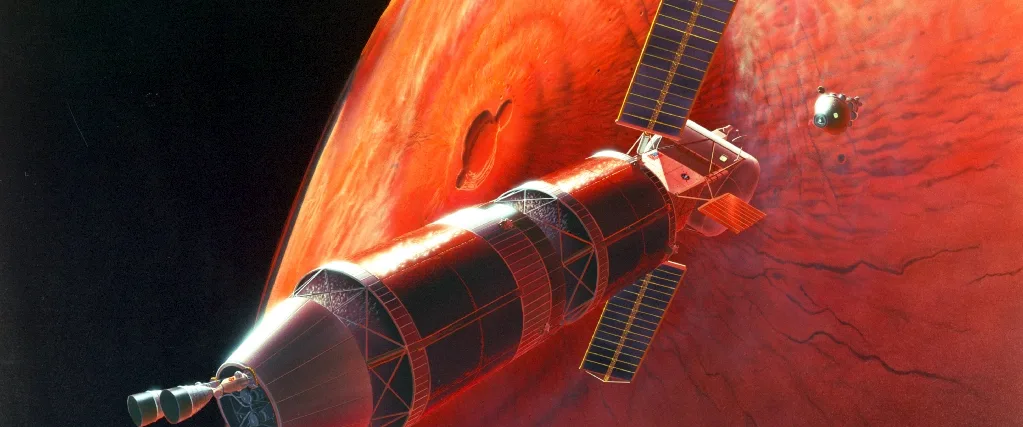
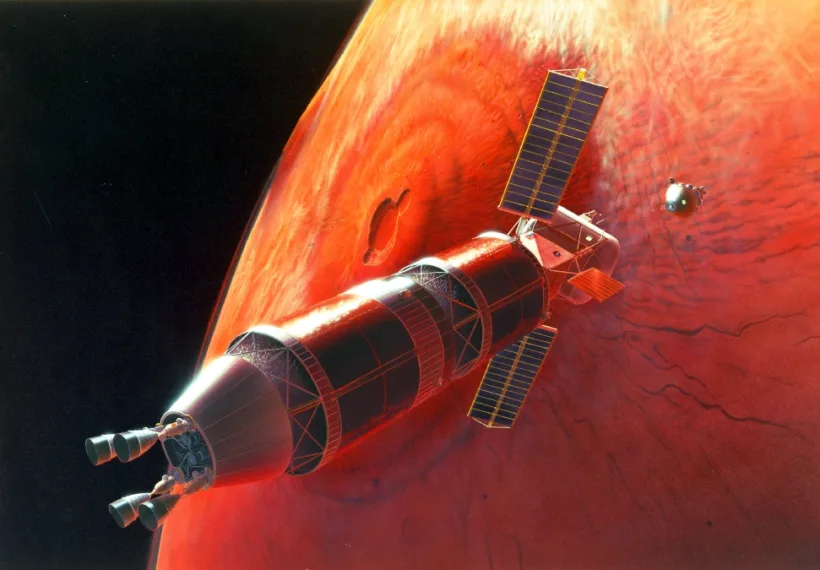
In this hour, we're talking about sending humans to the red planet.
Yes.
The red planet Mars.
And I gotta do that with an actual live astronaut, a New Yorker at that, active astronaut, Mike Massimino.
Great to be here.
Great to have you here.
And I have clips from an interview I conducted with Mary Roach.
She's a journalist and has written interesting books about unusual topics, one of which was just how to get to Mars and all the weird and odd experiments and research papers that were done to try to make that happen.
And all the consideration that you have to go through, the food, the radiation shielding, and will you tick off your other astronauts because they're tired of your jokes?
Right.
That would be me.
That's where I come in.
The first one to be jettisoned from the mission.
Nah, you keep everybody going.
Vital part of the whole thing.
So now here's something that the press hardly ever talks about, but kids do.
If you got to, Mike, am I right?
If you speak to elementary school kids, what's the first question they ask you about space?
The same one you would ask.
How do you poop and pee?
How do you go to potty?
How do you go to the bathroom?
In space.
So, so.
Everybody, you can't pour that one off on the kids.
Everyone wants to know.
But adults have, kids don't know that they shouldn't be asking the question.
Or adults tell them to ask it.
Everybody wants to know.
So, so, in my, let's find out what Mary Roach has to say and then we'll get your reaction to this on what it is to go to potty in space.
Are you familiar with a positional trainer?
I'm actually afraid to ask, but I will.
Go on.
Just to remind our listeners, there is no room that you walk into where they turn off the gravity.
So, to create zero G is essentially, it's not possible unless you go on a-
Unless you go on a parabolic up and downy flight.
Yeah, you go, yeah, on one of the airplanes that's simulated.
And they test those toilets.
So, technically, I could have been the poor schmoe who sits on the toilet to test it on the parabolic flight, but I wasn't.
But the positional trainer, it's a toilet with a video camera in it facing upwards.
It's a closed circuit TV.
The camera is in the toilet?
The camera is in the toilet and it's aiming at your butt.
What?
Okay, okay, let me explain.
This is at NASA?
This is at NASA.
This is my tax money.
This is Johnson Space Center, yeah, yeah.
It's a closed circuit.
Show me the camera looking at my butt.
It gets better.
Anything can get better after you tell me there's a camera looking at my butt.
The display, what's being filmed on the camera is right next to you on the toilet.
So they turn on the light and now you see what the camera is seeing.
Why?
Because your angle of approach on a space toilet is important.
People often sit back too far and if it's a smaller hole and if your angle's wrong, then you gum up the air holes because it works by air flow and it kind of pulls the material because there's no gravity to pull the material down into the bowl as it were.
So you've got air flow.
So it's like a shop vac, you're sitting on a shop vac.
Right, and so it's like an air flow to simulate what would have otherwise just been gravity doing it for free.
Yes, it gives you good separation.
So the camera is for your own private amusement.
The camera is for YouTube.
No, it's not being put on YouTube or on the internet.
No, no, no, it's actually not filming.
It's a monitor.
It's a monitor, thank you.
You are the only person, hopefully, that has access to what it is showing.
It's a docking maneuver.
That's what it is?
You're docking your butt to the toilet seat in the right spot.
The right angle.
It's not easy, because you're not sitting.
In zero gravity, you don't sit on a toilet.
You hover a little bit above.
You're hovering, you're floating.
You're floating, right.
So you gotta get used to that.
Mike, what is she describing here?
Well, first, she terrified me when she used the word filmed and video, and I'm glad you clarified that that thing really is all you're going into the monitor that you're seeing in front of you.
Closed circuit monitor.
But alignment is really important, and this is for the shuttle toilet.
And yes, you would, and in fact, this is important.
The only time everyone gets serious, and Chuck, even you would be serious, is when you get the brief on the toilet, because you wanna know how to use that.
You don't want any material getting loose in the cabin.
Material.
You gotta know how to use the toilet.
The health and hygiene.
And it's so important that in quarantine, you have access to that positional trainer, so that you can practice right before you leave for the Cape to go launch into space.
Wait, what is quarantine?
What is quarantine?
Quarantine, a week before the flight, we go to quarantine.
We started out at the Johnson Space Center.
We have a quarantine here.
Do we wanna keep you healthy, Mike?
Johnson Space Center in Houston.
In Houston, right?
And then we also, when we fly to Florida, and this is in the shuttle days, we fly to Florida and we go to quarantine at the Kennedy Space Center.
So one of the things-
I can't believe you said, they said those were the shuttle days.
Just sounds wrong.
Now we go further.
But one of the things you wanna practice on our shuttle flights, you'd wanna have it fresh in your mind, the right position.
And what you'd wanna do is use that camera that she described to get the right alignment, and you would try to memorize this for when you got to space.
And what I memorized was I felt like I was Peter Fonda on easy ride or riding a chopper.
I was sitting in a chopper and that was the position at work for me and the trainer.
And that's what I tried to memorize.
That body position.
So I would get a good strike in space.
Why are you in quarantine before the flight?
Because they don't want you getting sick.
So it's really, they don't want any germs to come near you.
So anyone that visits you has to get checked out by the flight surgeon, by the flight doc ahead of time.
You're in a sterile environment.
They clean the place really well, make sure there's nothing that's gonna get you ill because that could put the mission in jeopardy.
The whole mission, right.
That's if it's communicable.
As opposed to actually pooping in space and having space scat all over the place because that's healthy.
No, that's why we practice.
Space scat, oh, that's a phrase.
So where is the bathroom?
I mean, is it, you're just floating in the middle of the joint or is it, how does this work?
On the space station, there is a toilet area.
There is a space hall that's different than what we had on the show.
It's more on the Russian design, which was basically a can.
Can.
Right.
So you can poop in a can and there is a little seat on it and you don't really hover, as she described.
You do want to have a good connection with that seat.
You want to dock firmly.
You want to dock firmly.
So you can use your, absolutely.
Yeah, I disagree with the hovering.
On the shuttle, we had little arms that would come over and over your thighs that would keep you on the seat or you could push down on the ceiling.
Arms over your thighs.
It's like little handles that you can move over.
Handles that come and put them.
I was going to say, I actually hire a little person to do that for me.
Thank you for clarifying.
Arms, yeah, okay.
These little handles that would come over and push you down, on your thighs would push you down.
Or you could push against the ceiling.
And on the station, same thing, you could push against the ceiling or you could use your feet, footholds.
Or were you pushing against the floor?
Pushing against the floor.
That's a good point.
No, no, what I'm saying is, why is there a ceiling or floor at all?
You're in space weightless.
Just so you can read stuff.
You have orientation here and there and you know where things are.
But another big thing on the station is that we recycle the urine.
And you drink it.
And yeah, you drink it, you can make food with it.
All the water gets recycled.
They recover about 70% of the water.
Chuck is ready to barf right at this moment.
That is so good.
I should have brought some with me.
Yeah.
I'll bring some with me.
If you have me back, I'll bring you some water to drink.
Bring some pee water.
Can't wait.
All right, when we come back to StarTalk Radio, more on what it is to pack for Mars and all the challenges that that involves.
This is StarTalk Radio.
We're back with StarTalk Radio.
I'm Neil deGrasse Tyson in the studio of Chuck Knight's comics.
Yes.
Mike Massimino, astronaut.
What a combo I got here, a comedian and an astronaut.
Yeah.
What, you know, who gets to say that?
You don't see that very often.
We were, when we, where we last left off, we were talking about basically how you go to potty in space, but here's another challenge.
Once you go to potty, what happens to the, okay, you told me what happens to your urine.
They recycle it, they have filters, I guess, and then it, you drink it, you keep, you recycle your fluids.
Okay.
You have to, you need water.
Okay, but I would find the nearest comet.
I'd do like a swap with the comet, comet, you take my pee, I'm gonna get some nice ice cubes.
So, but when you get to Mars, for example, there's this accumulation of human waste, and this is still, I think, an unresolved problem.
What did you, do you bury it there?
Do you, and Mars is this pristine environment, and here we come.
Yeah, you don't want to.
Here we come.
Talk about leave no trace camping.
You don't want to, hello Martians, this is what we have for you.
And the thing is, when you go camping, we take for granted, in fact, it's just a fundamental part of our understanding of nature, that it will decompose and become part of the woods.
So that's why they want you to bury your trash and bury your poop, or take your non-decomposable trash out, but bury that which is decomposable.
But decompose means there are bugs out there that are chowing down on what it is that you put there and it returns it to its base materials.
On Mars, where there aren't no known microorganisms, you bury a Coke can there, it's there forever.
Yeah, it's going to come back and get it later.
Your poop is there forever, all right?
So it's a different discovery for future generations.
It's different.
So in my interview with Mary Roach, we also talked about other topics that the press doesn't usually address.
Let's find out what those include.
There was a guy who advocated one of the criteria for choosing astronauts should be what kind of intestinal flora you have so that you don't produce too much methane.
Not because it stinks, but because it's explosive.
Well, especially if they're guys, because you know, that's all they do.
They just light each other's farts.
And there was rumors that on the space station, they would use farts like rocket propellant to launch themselves across the mid deck.
That will so happen.
And it's just Newton's laws, equal and opposite reaction.
There's an astronaut who tested it and it did not.
Why not?
It has to work.
He said it's not enough because a fart is only about like three soda cans worth of air.
The human lungs hold much more.
You can't exhale and propel yourself.
He tried.
He tried.
He said it wasn't enough to accelerate the mass of 180 pound man.
No, I don't believe that.
Because any force will accelerate any mass.
He farted and tried.
He needed a little more beans in his diet.
No, what I'm saying is-
He said it was quote a-
What may have happened is-
Prodigious and rapidly expelled purge.
Wow, that's got to get the euphemism award for the year.
Prodigious and rapidly expelled purge.
And he said, I failed to move noticeably.
Okay, he's done the science.
Experiment done.
I'm guessing that the space station has air currents just simply by the circulation of air to keep it fresh and filtered.
They actually filter out the moisture and the humidity.
So I'm guessing that rapid purge was not distinguishable from other air currents going on in the room so that it could not overcome other random air forces that are operating on his body.
Otherwise it would have moved him, period.
It may have been slow, but it would have moved him and that's Newton's law.
He was going down to Cape Canaveral and he was going to ask around to see if anybody else had any input, but nobody was spilling the beans, so to speak.
So, it's anecdotal, I admit.
Yeah, so I'm saying Newton's laws win in the end, but I think there are probably other air currents that would have interfered.
He also thought, perhaps because he was wearing pants, that the people…
Well…
I know, I know, but his next flight was mixed gender so he couldn't strip down naked and try it again.
There are laws against that.
There are other laws, not Newton's.
Not Newton's laws.
Wow.
There you have it, Newton's law analysis of flatulence.
Dude, that was awesome.
Did you see the smackdown that Neil just put on Mary?
He's like, no, no, it works that way.
I'm telling you.
There's no way.
See, the problem was it was a prodigious purge.
And he just said, I got a ripper.
I'm just saying.
I just ripped one.
It wasn't a clean experiment though with the pants and the hair from the ivory.
You can't.
Yeah, if it's contained, you can't.
You can't do it.
You can't do it.
He had to be mooning while he did it.
The spacesuit needed a fart flap.
And then it would work.
Right.
He would have to call Bear Butt on the midday.
Exactly.
And give fair warning to do that.
Fair warning.
And give fair warning for people that what was going on in...
Put on your space helmets.
In the name of science, that's the way the experiment should have been conducted.
Exactly.
In the name of science.
But just to be precise, that's exactly how the shuttle lifts.
It expels gas out of one end, and the physical shuttle recoils in the other.
That's how any rocket launches.
Which makes a case for bigger and fatter astronauts, is what you're saying, Nick.
They also serve as rocket fuel.
There you go.
They channel some of that power.
Rocket fuel.
So what's interesting, getting back to Newton's laws, what's interesting here is that there, you can use Newton's laws to simulate gravity.
And so, for example, there's all this talk about how do you survive zero G and you lose your bone mass.
Have you lost bone mass while you were in orbit?
You weren't in orbit long enough.
No, I wasn't long enough and we exercised, and they've gotten pretty good about stopping that problem through sheer exercise.
So yeah, it's not as much of an issue as it was.
Right, when you're just sitting there doing nothing.
Right, right.
They've gotten pretty good at the counter effects of it.
Right, because for example, you can simulate gravity by just rotating, you get a big rotating ring, just like in 2001, rotating spaceship, and you'd walk around on the outer perimeter of it, and it's the centrifugal force enables you to-
It actually pin you to the side.
Basically pin you to the outer rim of the rotating wheel, and you get the right speed of the wheel, and you can actually create any kind of gravity you want, Earth gravity, Mars gravity, Moon gravity.
Stop the spinning, you get zero gravity.
So it's like a gravity machine in a sense.
And so my hope is that when we go into deep space missions, that this would be one way you would do that.
Another way, this is hardly talked about, is you don't just coast to Mars.
Right now when we say it takes nine months to six to nine months, it's because you're coasting.
All right?
You get enough speed to escape Earth's gravitational embrace, and then you cross over between Earth's pull and Mars's pull, and you just cross it over and then Mars pulls you in.
So the whole route you're coasting, but if instead you brought enough fuel or you had filling stations along the way, you just accelerate the whole way towards Mars.
While you're accelerating, you just simulated gravity.
That's what an acceleration is.
You accelerate at one G, the side of the craft that's behind you, that's the side you're walking on.
But now you got to slow down.
So midway, you turn the craft around, and then you decelerate at one G, but now you're standing on the other side of the ship.
And so you basically simulate your gravity the whole way while you get there fast.
And that by then you get there in a few weeks.
That is great idea.
That's awesome.
I want to know where does farting fit in the...
You'd have a window going out to space, right?
And then you would, you know, because that would help a little bit.
You know, I don't know by how much, but...
You can't get carried away.
It could jeopardize the mission, though.
That I've experienced.
You don't want to take that risk.
Well, the point is, the methane is an active ingredient in effluence.
And as Mary Roach had commented correctly, it's not that it smells, but that it's flammable and you don't want flammable gases.
Methane is the gas in your gas...
Do you have a gas stove, Chuck?
Yes, I do have a gas stove.
That's methane, very likely.
That is a methane gas, most likely, yeah.
That's what started the whole thing with lighting flatulence, which guys do around a campfire.
I believe that started with the caveman.
I'm not mistaken.
Not the cavewoman, the caveman.
Trog.
Now I know why we don't have open flame in space.
So I don't understand if you harness the power of your own fluids in terms of recycling and using them for drink, then why can't you harness the power of your own flatulence by using that as for something?
Well in agriculture schools, they do.
When they have these barns where the cows are, they capture the methane from the cow flatulence and they use that to heat the barn in the winter.
Go up to the Cornell Ag School, for example, and all the ag schools do this.
So they do recycle it.
So I don't know if you, but you still want flame to be the source of your heat, right?
Plus you need to have, you need a good circulation, you don't want it to be uncomfortable, and there's the human element to it too.
It might not be very pleasant.
Well, except to the person who did it, because it's always good to you.
Either that, or always have the O2 mask ready to go.
Emergency O2 is needed, not for smoke, but for gas, human gas.
You've been listening to Star Talk Radio.
You can find us on the web, startalkradio.net.
We're also in the Twitterverse, guess what, at Star Talk Radio.
When we come back, more on Packing for Mars.
In fact, I wonder about sex in space, stay tuned.
We're back with Star Talk Radio, the subject of today's program.
What would it be like to send a human mission to Mars?
What are the challenges?
What are the joys?
And the only way I can do that is to bring in an actual astronaut, Mike Massimino.
Mike, welcome.
It's a pleasure to be here, Neil.
Great to have you.
And I couldn't do this without Chuck Nice, because he's thought deeply about Mars missions, haven't you?
Yes, all of my thoughts are very, very deep.
Those still waters, God, I can't tell you.
So we came off of a segment reflecting on what role flatulence plays in space.
First that there's a lot of methane.
By the way, you know where the methane comes from?
No.
It's because deep in your lower intestine, you have anaerobic microbes munching down on your foodstuffs, because these are microbes that thrive in the absence of oxygen, anaerobics.
The opposite of aerobics, remember, what they used today, they call cardio, they used to call aerobics.
It's because your body would exercise in a way where you would replenish your oxygen and you can sustain that and then you'd be in training.
All right, anything that's sort of a low enough level and long, you do that aerobically.
And so when you're anaerobic, you have different byproducts and the microbes in your lower intestine, one of the byproducts is methane.
And in fact, we found methane emanating from cliff faces of Mars in recent Mars studies.
So makes you wonder, are there like Mars flatulence, essentially?
Mars is farting.
That's what got rid of the Martians.
They literally farted themselves into extinction.
It was not an asteroid.
Exactly.
So the thing is, you can get methane from natural causes, from geologic causes, but another one is through the action of anaerobic life.
And so it made for a very intriguing next set of questions about how we're going to look for life on Mars and where we're going to try to find it.
So and methane is not stable.
It wants to combine with other else.
So if you see it anywhere, it was freshly made because it will rapidly combine with other molecules to make other compounds.
So methane is unstable.
If you saw it, it was made yesterday or in the very recent past.
Just little bits of information we invoke.
I know.
I just made some right now.
You made what?
Sorry about that.
There's also hydrogen sulfide is another active ingredient in a lot of that.
It gives the rotten egg smell.
So yeah, we could do a whole chemistry show on that.
But let's switch topics.
We're still on Mars, but talk about sex in space.
It's another one that the press hardly ever mentions.
Sex is a fundamental part of human biology, right?
In a long journey, depending on your libido.
And what you say, this would be a three-year journey?
A three-year tour, yes.
Three years, yeah, it's like, what are your libidic tolerances?
I think is what this comes down to.
And picking up on my interview with Mary Roach, she did a lot of homework on sex in space.
And let's find out where she lands.
Yes.
Looking towards a two to three-year mission, you're going to have to send men, women.
There's got to be some sort of sexual interaction, I would think.
Aren't there some people that hardly ever think about sex?
So maybe one of the criteria.
Because sex really complicates the social situation, doesn't it?
Mike Collins, the Apollo astronaut, jokingly said the best crew would be a bunch of eunuchs.
Right.
But yes, that would solve.
Because that creates a social dynamic that is unstable in most situations.
Right.
I asked some cosmonauts about this.
Cosmonauts are fairly forthcoming on things, particularly after a shot of whiskey.
No, it would be vodka.
It was whiskey.
Oh.
It was whiskey.
These two guys had been up on Mir for six months together.
And I said, well, how did you?
Mir, the Russian space station, the pre-date of the International Space Station.
Exactly.
And I said, how did you handle libido?
This is an issue.
And he said, yes.
Mary, people ask me this all the time.
They're saying Sasha, his nickname was Sasha.
Sasha, how are you making sex in space?
And he goes, of course, by hand.
So there was that option.
He says, there's always a chance.
It happens in your sleep.
People go years without sex, actually, right, on Earth.
Yeah, yeah.
I think the concern is that, just the soap opera, you know, the drama of people falling in love and being jealous and all of that, is that going to interfere with the mission?
I think people could behave themselves for two and a half, three years.
I really do.
I mean, these astronauts are really motivated people.
You need a libido check.
It's gotta be it.
They give you an eye test.
They give you all these tests to make sure you're physically fit.
They should give you a libido test.
If you're above some threshold, you ain't going to Mars.
You're going to mess up the whole operation.
So, Mike, so your two-week missions, they don't give you a libido test, I don't think.
No, not that I know of.
There were some secret things that I don't know about, but no, I don't remember anything about that, no.
But yeah, I just realized, not only could I not go to Mars, I can't even make it down to the Lower East Side, I am screwed.
I don't know, Chuck, up till now, I thought you'd be the perfect astronaut, now I have my doubts.
No, I have too much handmade sex for me.
Too much handmade, so I mean, it's an issue, right?
I mean, it's at some point, because it's not just the sex, it's like I was trying to make the point in the clip, there's the dynamics of the changes, depending on, unless it's just sort of orgy time, where the dynamics is not an issue.
It's probably love and hate, and it's part of what it is to be human.
We don't wanna deny that, right?
Let me just say, I just threw my hat back into the ring once I heard orgy time.
And by the way, it's not just sex.
If you're gonna send colonies and they're gonna sort of have next generations, you gotta have fertile people going.
They gotta be able to make babies.
When we come back more on Packing for Mars and what it takes, this is StarTalk Radio.
Welcome back to StarTalk Radio.
I'm your host, astrophysicist Neil deGrasse Tyson, with comedian Chuck Nice in studio, reflecting his deep comedic thoughts on the astronautical, astronomical, cosmological, astronautical, I said that already.
Yes.
Sorry, reflections of Mike Massimino, NASA astronaut.
Mike, great to have you back.
I'm overjoyed, it was a lot of fun.
We came out of that last segment just talking about sex in space, and Mike, you're only been up for a couple of weeks.
So you can go a couple of weeks, I presume.
I can report yes.
That experiment has been, we've checked off that experiment.
The data are in.
We have empirical evidence.
That I can confirm.
Yeah, but someone says, all right, let's now go for three years.
That's a whole other thing.
I haven't tested that one yet.
Because if you go into space for the long term, there's not only presumably what is the urge to have sex, if it's really long term and you want to sort of create colonies in destinations, be they Mars or anywhere else, the sex would not only be recreational, it would have to be procreational.
Do you like the words there?
There you go.
Sounds like a bumper sticker.
Yeah, so you gotta populate the colony.
You gotta populate the colony.
And in my interview with Mary Roach, who wrote the book Packing for Mars, she did some homework on that subject too.
Let's find out what she says.
NASA has never sent married couples up before.
The idea being if there were an accident, you'd lose the whole family or they might play favorites.
So this tarps back to the military days where you wouldn't send siblings on the same ship.
Exactly.
What do you think of the idea of sending a couple who actually wants to have kids and then they procreate en route and give birth on Mars and it'll be the first child born on another planet?
It's the ultimate reality television.
Everyone would be watching.
You could fund the entire trip.
Just on the fees to watch that happen.
Yes, subscriber fees, advertising, there you go.
It'd be the most famous baby ever born.
It would be the-
After Jesus.
It would be like, what was it, The Truman Show?
The Truman Show, exactly.
It would be huge.
Everyone would be watching.
Plus, if the whole point of space exploration is one day to colonize other universes, planets, whatever, you do want to get at that question, can you even conceive in zero gravity?
Nobody has tested that.
Nobody even knows.
I'm betting you can, but yeah.
And what about the embryo development?
You know why?
Because I think you can conceive in any body orientation on Earth.
Have you tried them all?
Mm-hmm.
Where do you get this information?
I have 12 kids, and one was at each geometric angle.
No, I think the muscle contractions all work to get sperm to egg.
Oh, the Upsuck theory.
Yeah.
The chapter in Bonk on Upsuck.
Upsuck, I don't know.
It's a theory for everything, apparently.
Yes, there is.
Somebody's out there doing the research.
She's, she wrote a whole other book called Bonk on all the research that went into, that people did on sex over the centuries.
And so, in fact, you'd have to wait to another episode of StarTalk Radio to hear that interview.
Sorry.
So here's the thing, we'd have to like, sort of make babies in other colonies.
And that's an interesting sort of future of what that might bring.
I just love the concept of space Jesus.
The most famous kid in the world.
Did I get that wrong?
A baby born on Mars.
Next most famous birth since Jesus.
I thought it was perfect.
You got Jay-Z and Beyoncé's kid.
I don't know how that would all...
Okay, it'd be a close third to their kid.
Blue Ivy or Ivy Blue, whatever.
What would be weird though is that the child is raised in a slightly lower gravity.
Something we'll spend more time on in the next segment.
Then what does it mean to be raised in a lower gravity?
Then can you ever come back to Earth?
Can you overcome that to become a successful person?
Pull yourself up by your own gravity.
It would make a good college entrance essay though.
What problems have you had?
I was born in a low-gravity environment.
I was the only kid on my block.
Because what happens is if you go on a really long voyage, you not only need that generation, you need generations that follow.
So there will be whole generations that never saw the surface of a planet.
Awesome.
That would be kind of cool actually.
Would you want to be one of those?
I wouldn't mind.
I could say goodbye to Earth forever.
See you suckers.
Chuck sent it in his application again.
I think we lost him a little while ago, and now he's back in.
All right.
Let's go.
So he's back.
So let me ask you, Mike.
You got a family, right?
I do, yes.
How many kids do you have?
I have two.
Two kids.
Would you bring the whole kid in the caboodle with you?
I would.
They wouldn't want to come with me, though.
They would say, sure, we'll go.
Can we leave him at home?
One of the advantages of me being an astronaut is they get rid of me, but I would love to have them.
In fact, that's one of the things when you're in space, you don't have all your friends with you and your family, and that's probably the only bad thing about being in space.
You can't share it with everybody else.
Oh, that's a tender moment.
It is a little tender, but the truth of it is my family wouldn't want to go with me, probably.
When we come back to StarTalk Radio, more on Packing for Mars and what it takes and what it involves, and whether we can actually speciate humans into another division of the Tree of Life.
Nice.
When we come back to StarTalk Radio.
We're back to StarTalk Radio.
I'm Neil deGrasse Tyson, Ian Studio comedian Chuck Nice and astronaut Mike Massimino.
We're talking about going to Mars.
Yeah, we're going to Mars.
I don't think we left any subject untouched in these stories.
I bet you could think of a couple more, but I think we've done enough.
So let me just make sure we know, Mike, you tweet on your astronaut exploits.
I do, yes.
It's at astromike with an underscore, I hate underscores by the way, but it's just a pet peeve of mine.
Can I change my name now?
Astro underscore Mike, astromike, a Chuck Nice comic?
At Chuck Nice Comic.
And I want it.
All in one word.
And you gotta see this guy perform, he's awesome.
And you get his schedule on his website.
chucknice.com.
chucknice.com.
So we've been talking about colonies.
The early settlers that came from Europe to the New World, they were making babies where they landed, right?
And so if you're gonna go on long voyages to Mars or beyond, why not make some babies?
Take your whole family with you.
Now here's the challenge.
As you may know, but let's back up for a minute.
Can we have a quick lesson here?
Lesson planned if I may?
Oh, I love this.
It's one of my favorite parts.
All right, so watch.
The longer a species is stranded away from all other forms of life, the greater is the potential for it to get really weird because it takes on surviving biological forms and properties unique to that environment if that environment has particular stresses that other environments don't.
What that tells you is, if you had to look around the world and say, where are the weirdest animals?
Where would you find them?
People who marry their first cousins.
I'm glad you didn't say where.
We might offend people.
Yes.
Yeah, but we can imagine where that might be.
So what's the most isolated place where you find animals in the world?
I would say Antarctica.
Okay, but they're frozen to death there.
That was a nice try.
That was a nice try.
Anybody else?
Madagascar.
Yes, but those are animals who talk.
Those are different.
That's pretty weird in my book, Chuck.
Exactly.
So the most, we got a nice isolator, it's Australia.
And that's where we have, and the weirdest stuff is you got flightless birds and pouched marsupials, weird variants on what you find elsewhere in the world.
Because the entire continent is an island.
The entire continent is an island.
That's right.
I think we just failed the test though, Chuck.
You gave us the quiz and we blew it.
Our answer was Chris Rock.
As a zebra.
You get a C minus on that one.
So think about it, if you go to another, if you create a colony on Mars, and that colony does not crossbreed with anyone on Earth for a thousand generations, then you have it, there's the risk, or perhaps maybe that's what you want, of they becoming another kind of species.
And with different properties that enable their survival in that location, that would just be kind of interesting.
That would be, especially when they return to Earth to conquer us all.
I think because you know that's what's gonna happen.
That'd be bad, don't give them return directions.
Yeah, just send them out there and tell them to send video.
What's interesting is if you look at the TV show Star Trek, what's interesting there is there must have been some cross-galactic human breeding going on, because Kirk, he's always getting some tail wherever he goes.
And they look, they might be blue or green, but there's some female looking aliens, right?
They are, and you know what's weird about that?
They're always hot.
Even though they're aliens.
Like she might be green or might have antennae, but she's always hot.
You're looking at it like, yeah, I'd do it, I'd do it.
I think Chuck sent it in his application again.
The astronaut application from Chuck is coming, he's ready to go again.
It's his third iteration.
No, because think about it, yeah, it is odd that Kirk is not falling in love with aliens that don't have an obvious gender revealed in their appearance.
Right, right, it's not a sleaze stack.
And what was the Horta?
Do you remember the Horta?
That was the silicon-based life, that was basically a rock.
Right.
And, yeah, yeah, do you remember that?
Now that you've explained it, yeah.
Yeah, it's very cool.
You mean you saw the episode but didn't understand what was going on in it?
No, I remember a rock moving around.
I just remember that.
Yes, that was a knife form and apparently that was female and Kirk did not have the hots for the rock, all right?
So, but what it tells us is in that future, there's enough of sort of the human lineage so that even though it's possible, by the way, the very next species that comes, that spawns from us, we can still, our organs will still work together, whether or not you have viable offspring.
So if you have too many of those in a row, the distance can become so great.
The biological distance can be so great that you can no longer.
What's wrong with this chick?
All of her parts are in the wrong places.
Guys, we actually have to wrap this up.
I feel so, man, man, we could do this for five hours.
But you know, I need a tweet of the week to round this out.
I don't know, how creative do I feel?
You know, here's what you do.
Next Mars mission, bring all the food that has space names to it.
That's just, that would just be cool.
Like Milky Way Bar.
So here, Tasty Cosmos, Milky Way Bars, Moon Pies, Eclipse Gum, Orbit Gum, Sun Kissed, Celestial Seasonings, Mars Bar, food you might take on your journey.
But I'm curious why there's no food yet named Uranus.
StarTalk Radio, thanks Chuck.
My pleasure.
Thanks Mike.
Thanks for having me, Neil.
You've been listening to StarTalk Radio, brought to you in part by a grant from the National Science Foundation.
I'm Neil deGrasse Tyson, until next time.
See the full transcript



 Unlock with Patreon


 Become a Patron