


 Unlock with Patreon
About This Episode
What if the solar system had two suns? Neil deGrasse Tyson and Chuck Nice give a sneak peek into our patron-only Q&As with questions about the three body problem, galaxy formation, the alpha centauri system, and more.
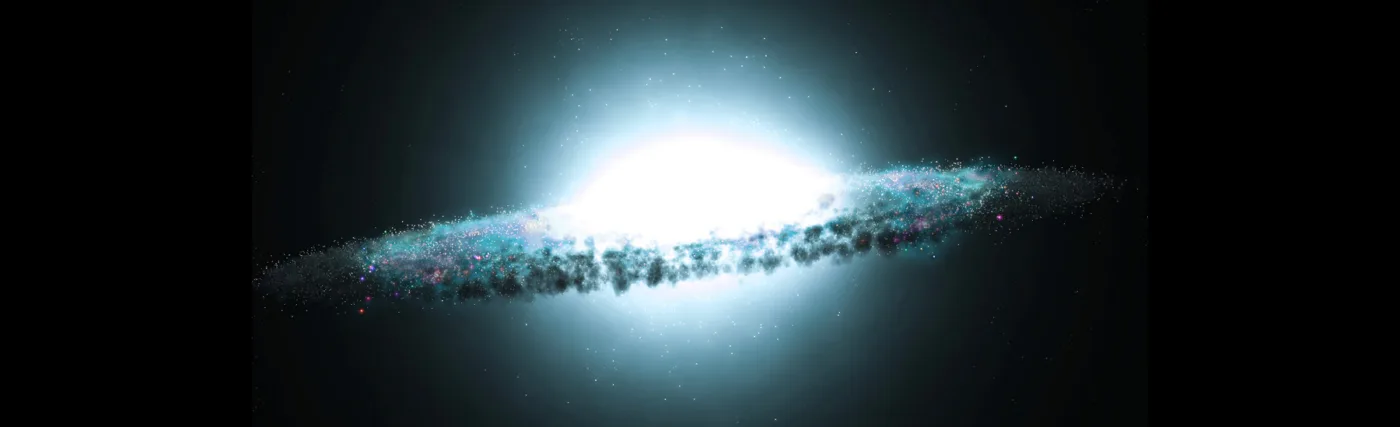
How does the expansion of the universe affect the space between our molecules? Learn about the Big Rip, accretion disks, and galaxy formation. How flat is our galaxy? Why does our universe form so many disks? What would an astronaut floating in space see if there was no matter?
Why are so many alien spacecraft disk-shaped in science fiction? Is there a best shape for a spaceship? Plus, can a moon have its own moon? We discuss the 3 body problem and figure out what a graviton is. What would Neil be doing in a parallel universe where he isn’t an astrophysicist?
Can life get a chance to evolve in a solar system with two suns? Find out about the Alpha Centauri System and how long it would take us to get there. Could we use light sails to travel the cosmos? All that, plus, is it ever too late to get into astrophysics?
Thanks to our Patrons Donald Jones, Mohammed Taha Faridi, Jon Barnett, Harmon Dhaliwal, and Sean Griffen for supporting us this week.
NOTE: StarTalk+ Patrons can watch or listen to this entire episode commercial-free.
Transcript
DOWNLOAD SRTWelcome to StarTalk, your place in the universe where science and pop culture collide.
StarTalk begins right now.
Hi, I’m Neil deGrasse Tyson, your personal astrophysicist and of course, host of StarTalk.
For this episode, we’re doing something we’ve never done before and might not ever do it again.
First, you might not know that we have a Patreon page where you can support what we do.
And when you become a Patreon member, basically become a patron of StarTalk, you give us the latitude to experiment in many different ways of bringing science down to earth.
Well, in this new tiering system, the entry level is $5 a month.
$4 or $5, what you do is you get to ask exclusive questions about the universe.
And these are exclusive sessions, only for Patreon members.
It’s a Cosmic Queries just for you.
And what we’re gonna do this time is give you a taste of what that has been.
Just at that entry level, there are other perks at other higher levels.
You can check it out, okay?
But for this episode, what we’ve done is getting the best of the Patreon Cosmic Queries.
And we put them together, and I’m there fielding those questions with my comedic co-host, Chuck Nice.
He reads me the questions.
I’ve never seen the questions before he reads them.
And we just have a fun time riffing.
And anyone can listen to this episode.
Previously, it was only available behind the paywall, basically.
And so now you’ll get a taste of what will still live behind the paywall.
And these are exclusive questions and answers for Patreon members at that base level of $5 a month.
So let us begin.
Here I am with Chuck Nice, with the greatest hits of Patreon Cosmic Queries.
Check it out.
This is Bruno Faria who says, Hello, Dr.
Neil and Chuck.
I’m Bruno from Brazil.
My question is, the space is in constant growth.
Does that matter like planets?
And for us, like the space between our molecules or the space between atoms?
Oh, he’s getting, Bruno, thanks for that question.
So first of all, right now, the expansion of space is not strong enough on the scales of solar systems and planets and moons for that stretching to manifest, okay, to reveal itself.
So, but as this continues, what will happen is the stretching power of the expanding universe will begin to manifest on solar system scales and planets will get separated from their host stars and fly off into oblivion.
Then eventually, so it will begin to overcome the gravity that’s going on in tight quarters.
Then it’ll begin to overcome the electromagnetic forces and it’ll start separating atoms in the molecules that they were once made of.
Then that’ll continue and then start interfering with a strong nuclear force and then start separating atoms.
And as that continues, in 10 to the 20, no, in 20 billion years, if the stretching goes unchecked, it will reach a point where it will want to stretch the very fabric of what comprises the space-time continuum.
The pixels, the 3D pixels that construct the universe in which we live, it will come a point where those pixels cannot even hold together and it wants to stretch those, but you can’t stretch it anymore, then you can stretch a fabric beyond a particular point.
And what happens at that point, Chuck?
The big rip, baby.
It’s the big rip.
It’s the big rip.
So Bruno, you just described the big rip.
You just laid the seeds of the big rip as this stretching force, this, this.
It’s basically dark energy, which continues to overcome these other forces that are trying to make life possible.
And yeah, if that goes unchecked, that’s the end, period.
And I lose sleep over what that even looks like, what that would be like.
Ooh.
Well, by the way, that was a painterly and eloquent description.
And I love the 3D pixels of the universe.
That is brilliant.
I don’t know what else to call them, but that’s what they are.
And it’s called a plank length.
It’s called, named after Max Planck.
Well, that’s…
Basically the…
Now, Planck length, I’ve heard, but 3D pixels of the universe, that’s…
That’s beautiful.
I love that.
Here we go.
Let’s go.
Matthew Power.
He’s like a secret agent.
Dear Neil and Chuck, what’s up?
Why does our solar system and many galaxies or what seems seem to be disc-like and not atom-like with orbiting objects going around in all manner of ways?
Look at that.
A person’s been thinking about this situation.
Yeah, because it’s like, an atom has like a round nucleus.
Well, our traditional representation of an atom has got the orbits in every angle.
So let me use that as an iconographic reference to the atom.
So, at first, it’s a brilliant question.
It perplexed people for centuries.
And the first indication that maybe we were on to something was in the mid 1700s, like the literal exact mid 1700s, 1750.
Two people independently, Laplace, a mathematician, and the philosopher, what’s the dude’s name?
It’ll come to me in a minute.
They both came up with what today we call the nebular hypothesis, okay?
Kant, Immanuel Kant.
Oh, existentialist.
Yeah, exactly, exactly.
So he did this on the side, and Laplace sort of figured this out because he knew some physics, but what they were imagining was that if you had a gas cloud, because there’s gas all over the galaxy, and if that’s what you make stuff out of, how might that happen?
So if a gas is kind of rarefied and thin, so you got to sort of collapse it, so that it can become solid stuff, okay?
So as the gas cloud begins to collapse, what they knew was that however slowly it’s rotating, as a large gas cloud, as it gets smaller, it will rotate faster.
Just like the ice skater who brings in the arms, they begin to rotate faster.
Well, as you rotate faster, there’s this centrifugal force that prevents things from continuing to collapse in that disk direction, because that’s where the centrifugal forces are preventing it.
But if you come in from the top and bottom, they know centrifugal force preventing you.
So you collapse like a pancake, keeping the flat shape.
And this would be a very natural thing to happen in the universe.
And sure enough, that’s how you get flat galaxies.
And our galaxy is flat, other spiral galaxies are flat, and they’re really flat.
And you say, how flat are they?
How flat are they?
Thank you for asking that.
So are they as flat as a pancake?
No, they’re flatter.
Flat as a crepe?
They’re like a crepe or tortilla.
Yes.
Do you want to be French or do you want to be Mexican?
Yeah.
So our Milky Way is about 100 times as wide, across as it is thick.
And that’s way thinner than a pancake.
Yeah, that’s paper.
That’s practically paper.
Right.
So you get these shapes when that happens.
So it happens to the galaxy.
It happens to the solar system within the galaxy.
Right.
So this is a very natural phenomenon.
Now, let’s say you don’t participate in that collapse.
You’re so far away, you don’t care what anybody close up is doing.
Well, you still might form things, but you’re not going to be in a disk.
Oh, my gosh, let’s look far out in our galaxy.
There’s what we call the Oort Cloud of Comets.
It’s not a literal cloud of diffuse matter.
It’s just comets filling a space that completely surrounds the sun.
And so we call that a cloud rather than a belt.
Because belts are flat, like the asteroid belt, the Piper belt.
These are belts that are flat and they go around the sun in the plane of the solar system.
You go far enough out, so those comets come in from every which way around the solar system.
So they do represent a spherical distribution of icy bodies.
Comets that come from the Earth’s cloud.
They’re very long periods, like hundreds, tens and hundreds of thousands of years.
Because it’s very far out for them to make their complete loop.
And so it’s a great question.
We think we got that one solved.
And by the way, all disks are made that way.
So, what are called accretion disks, the disks that form around black holes.
Black holes.
It’s a general phenomenon in the galaxy.
So let me ask you this then.
Oh, by the way, and people in their middle age who gain weight around their belt, in my field, we would joke and say, you have an accretion disk.
Well, that sounds a lot better than a beer belly.
Beer belly, pot belly.
I have an accretion disk.
I have an accretion disk.
Yes.
No, you’re fat.
So, the spinning can happen in any direction first to create the flap, because…
There’s going to be one.
That’s a great question.
There’s going to be one orientation that dominates.
That’s what I’m saying.
Because the cloud cannot spin in all directions at once.
Because it would collide with itself like two hot marshmallows hitting.
They collide and attach.
And so that stuff settles out and it finds the dominant axis around which to rotate.
So is that why you can look out and see galaxies in different positions?
Yeah.
So the spiral galaxies can be face on, edge on, and you get to see all of…
No, no.
They’ll form wherever their gas cloud, their native gas cloud, whatever that orientation was.
But now, here’s something.
Suppose you formed stuff…
Suppose you formed your stars before the gas collapsed to the middle.
Wait a minute, then, you’re not going to get a disk.
Because they’ll orbit around the center, but they’re not going to collapse and stick to itself.
Such a galaxy does exist, they’re called elliptical galaxies.
These are fully sort of puffed up, three dimensional, spherical, elliptical shapes.
And they have very low gas, there was no gas making that disk happen.
So we know…
It must be lovely at a party.
Gas free.
So we know that the planets of the solar system all formed after the gas of the solar system had collapsed.
The Oort cloud of comets, those formed after, okay?
And they did not form out of, they did not require the collapsing gas cloud to form.
And so they’re still in their atomic orbits around the sun.
So it’s a great question.
Here we go, Andrea or Andrea Sperini says this, Hello Neil and Chuck, if I were an astronaut floating in intergalactic space and I could remove all matter from the visible universe, where would I be?
And what would my eyes be able to see if the boundaries of the universe would wrap around my body?
That’s what accompanied me on my long walks with your podcast, my long walks to the edge of the universe.
Yeah, don’t walk too far.
Yeah, don’t walk too far, girl.
All up.
Talking about where would you be with no matter at all.
So generally, where you are only has meaning in reference to something else.
Right?
So there’s an interesting philosophical dilemma.
Right?
So, if I, we are a certain number of degrees west of the Greenwich Prime Meridian, and we’re a certain number of degrees north of the equator, all right?
So we’re basically like 74 degrees west, 41 degrees north.
So that’s where we are on Earth’s surface relative to a coordinates that have been pre-established.
Okay, but then, where are those coordinates, all right?
So the prime meridian is like zero, and so where are those in relationship to anything else?
We can say that there’s 74 degrees east of us, but that would make us the preeminent prime, you know, establisher of the coordinate system, but we know we’re not.
So, at some point, you have to arbitrarily declare the coordinate system and then reference everything else to it.
And everyone then has to agree that you’ve done that, otherwise people don’t know where they are relative to each other, all right?
You know where you are relative to some grid that you set up in your backyard, and somebody else set up some other grid, and you will never communicate accurately with each other or productively.
So everybody’s got to agree.
So, the Prime Meridian was established by international agreement, okay, to go through.
By the way, it almost went through Paris, the Paris Observatory.
France was bucking for the Prime Meridian back when it was up for grabs, and England won out.
It’s rumored that France conceded the Prime Meridian in exchange for everybody adopting the metric system, because they came up with the metric system.
So this is the quid pro quo of historical science and metrics.
But anyhow, so if you are between galaxies, and galaxies are the things that dot the observable universe, then you start removing the galaxies, yet you have no coordinate system.
But what you will know, because we kind of know this, is that you are still nonetheless in the center of your own horizon.
But you can’t see the edge of your horizon because there’s nothing to allow you to measure it.
So, and by the way, we think of horizons as two dimensions, like out at sea, but in space your horizon is all around you, in every direction, so it’s a spherical horizon.
And by the way, it’s confusing.
Now you want to talk about your wife getting mad because you don’t ask for directions.
Now you can get lost in all three dimensions.
Right, now you’re lost in all three dimensions at once.
Am I up, down, left, right, north, south, before, backwards?
Well, now we’re making an Alpha Centauri.
Never.
So yeah, so if there’s no coordinate system established, it doesn’t make sense to say where you are, other than to say you’re at the center of your own horizon, which isn’t very helpful.
But then again, do you really need to know where you are, if there’s no place to go?
Look at that.
That has been my life for an entire year now.
Well, no place to go.
That’s been my whole life for a year now.
I don’t care where my current coordinates are, because I have no coordinates I need to visit.
That’s it.
That’s a profound.
I’m not going anywhere.
That’s the problem.
But even if you were, even if you picked a direction, you’re not headed anywhere.
That’s right.
Right.
Yeah.
Because there’s no place waiting for you.
It’s all been removed from the universe by Andrea.
Andrea, I got to tell you, this got really sad very quickly.
It got sad fast.
It got sad fast.
By the way, but it is true, if you’re navigating within the galaxy, you’re not going to be using GPS on Earth.
So we’re thinking in the future, as we move throughout the Milky Way, we would set up a grid system targeting pulsars that are scattered because they’re very fast rotating and they send radio pulses for having rotated in their configuration.
And that gives you a place to look and you can get a timing system based on that and a system of locations within the galaxy, much like GPS on Earth.
So Pulsar GPS is going to be the future of space travel.
Wow.
We’re going to take a quick break, but when we return, we will continue to dig in deep to our Patreon-exclusive question and answer archive with Chuck Nice.
Hi, I’m Chris Cohen from Haworth, New Jersey, and I support StarTalk on Patreon.
Please enjoy this episode of StarTalk Radio with your and my favorite personal astrophysicist, Neil deGrasse Tyson.
Welcome back to StarTalk.
This episode is a collection of cosmic queries asked by our Patreon patrons.
We reached back into the archives of our monthly Patreon-only episodes to find some of our favorite moments of questions and answers to share with you.
So let’s find out what Chuck asks me next, fed to us by our Patreon members.
Well, let’s start at the top here, this is Denny.
Denny is saying greetings from Germany.
It says, I wonder why so many people believe the aliens will fly in a disc-shaped ship.
Is there any physical advantage in building aircrafts in that shape?
No, next question.
No, we’ve got this trope in our head, right?
And once the seed gets planted, it’s kind of hard to shake it.
And so I remember, do you remember the show Lost in Space?
Of course.
Okay, I think we talked about this once, where, you know, these spacecraft only sort of levitate when they rotate, right?
Right.
Like they’re rotating disks.
But there they are on the ship, looking out a window at the same destination, even though the whole thing is rotating.
That very much disturbed me.
Okay.
Why is everything just whizzing by left and right?
And so, yeah, it just doesn’t…
I mean, yes, a disk has nice aerodynamics, okay?
But most of a journey through space has no air, so it doesn’t have to be aerodynamic at all, really.
So there’s a lot of problems with that shape.
That’s why my favorite spaceship in all of sci-fi is the Borg ship from Star Trek, which is a giant cube.
The least aerodynamic thing ever.
There it is.
They said, you know, we got this.
We don’t need to be sleek.
We don’t need to be…
In that same vein, the Enterprise didn’t have to be that aerodynamic looking, right?
Because it was never in the atmosphere.
It was always out in the empty space.
Yeah, so that’s a great question.
And in my whole life, I have not found any legitimate aerodynamic reason or any other reason to design a ship that way.
By the way, there’s a little bit of physics that people don’t…
You know, if you’re just making up stories, you typically miss it.
If you are in open space and you set something rotating in one direction, something has to go rotating in the exact opposite way to counterbalance that.
So in other words, if it starts not rotating and then begins to rotate, something inside of it has to rotate the opposite way to cancel out what’s called the angular momentum.
If you have a flying saucer that’s just there, floating, it has zero rotational angular momentum.
I was just redundant there.
Zero angular momentum.
Zero.
So, if any part of it starts rotating in one direction, some part of it has to rotate the opposite way to cancel out the angular momentum.
Because you can’t just set yourself into rotational motion.
Unless you have rocket, little rocket vectors.
And then you’re spewing out gases in one direction, and that’s what maintains the momentum.
So to see these, all these sci-fi things, they just rotate.
No, it’s violating deep laws of physics.
Laws of physics that no alien is going to circumvent.
And the funny thing is, you see them rotating, and like you say, if there’s zero reason for it, what’s the problem?
There’s absolutely no reason for it.
Imagine a 747 saying, okay, we’re going to start rotating now.
Right.
For what?
It’s like you don’t fly and barrel roll your way over to Europe.
Exactly.
There’s no reason to barrel roll the plane the entire way you’re going to Europe.
It’s stupid.
Exactly.
Anyhow.
All right.
That was cool, man.
Great question.
Watch this.
This is Elaine in the Stars.
It says, hey, Dr.
Tyson, Lord Nice, can a moon have a moon?
Ooh.
I like the, I just love the whole, you know, positioning of that.
Can a moon have a moon?
Yes.
You sound very skeptical when you say that.
Yes.
Your yes is very suspect, Neil.
You got, it’s got to be very zonal.
So, the first moon has to be far enough away from the main planet.
So that the moon around the moon, when it orbits around, is not badly affected when it’s on the near side compared to the far side.
Right.
You got to make sure your orbits can stabilize out.
Because orbital allegiance can get very complicated.
If you have three objects, okay, it’s called the three-body problem.
And it’s very, it’s basically chaotic, the three-body problem, except in very restricted cases.
So in other words, the sun, earth and moon is a three-body problem.
But we’re so far the hell away from the sun that our moon can hang out here without thinking, oh my gosh, now I have to go hang out and orbit the sun.
It doesn’t have orbital allegiance problems.
If earth were orbiting much closer to the sun, then the moon, as it comes around the backside or the front side, will say, hey, the sun is tugging me more than you are, earth.
That’s right.
I’m going to go that way.
And then it destabilizes everything.
So the consequences of destabilized orbits is you’ll fall into the sun or you’ll fall into the main planet or you’ll get ejected forever.
We think the solar system started with at least 30 planets when it originally formed.
And it was just jockeying for stable orbits.
And not everybody wins that contest.
So there you go, planets.
What you won’t do for your moon, some other planet’s gravity will.
It’s good to take it, take it off.
Just better remember that.
Girl, you gonna let him treat you like that, girl?
You gonna let him treat you like that?
Wait, come back.
No, I’m switching my allegiance.
So moons can have moons.
In the same way, if you think of Earth as a moon to the sun, we have a moon.
You can think about it that way.
So it’s really a three-body problem.
There you go.
Yeah, and orbits tend to be highly unstable.
So, and by the way, you can invert that and say you can have double star systems, such as what was portrayed in the first of the Star Wars movies, which is, of course, Star Wars Episode IV, okay?
And he walks out, he’s on the sand planet or whatever, and he sees a double sunset.
All right?
That’s the only accurate science in the entire Star Wars series.
I felt like you needed a little Star Wars music bed for that.
That’s an iconic scene, by the way.
A long time ago, in a galaxy, far, far away.
In other words, those two stars are orbiting close to each other, and the planet is orbiting much farther away.
So that’s the inversion of this problem.
You can have two main bodies, but they have to be far away and close to each other, so that as you orbit them, you don’t know that one is closer to you than the other, because it’s a smoothed out gravity field.
But the moment those two stars are far apart or you orbit close to them, forget it, you’re in an unstable situation.
There you go.
Here we go.
Let’s go to TJ Monroe.
TJ says this, Dr.
Tyson, this is TJ speaking here.
I have nothing to do with this.
You’re pre-disassociating yourself.
I am pre-disassociating.
All right.
Dr.
Tyson, what the f*** is a graviton?
There you go.
Graviton is a proposed quantum particle of gravity.
They have yet to be detected.
So, is it a graviton is to gravitational waves, what a photon is to light waves?
Wow.
All right.
So, we think of light as waves and it moves through space.
And that’s fine.
And you can measure them as waves, depending on your apparatus, but you can also measure it as photons.
Right.
Provided you have the right apparatus.
And when you do, you have concluded and demonstrated that light behaves both as a particle, as a wave, and as a particle, both of them.
We have already measured gravitational waves.
From colliding black holes, the LIGO observatory, laser interferometer, gravitational observatory, that measured waves.
So, do we have an apparatus yet that can measure the quantum particle that gravity represents?
And we don’t.
But we’re not given reason to think it wouldn’t exist.
So, it’s out there.
It’s dangling above our heads.
Maybe it doesn’t exist.
And if it doesn’t, that would be interesting, too.
So, the graviton is the force propagator of gravity in the way that the photon is the force propagator of electromagnetic energy.
In the way that the gluon is the force propagator of the strong force.
And in the way the intermediate vector boson is the…
is the force propagator of the weak force.
So, all four forces have an on.
Photon, boson…
Gluon.
Gluon and a graviton.
There it is.
Simple.
There you have it.
So, add that to your stick-on.
Hopefully, that clears some things up for you.
Here we go.
This is Kevin, the sommelier, who is also a friend.
If you weren’t the director of the Hayden…
Kevin, recommend a wine next time.
We told you this.
That’s right, Kevin.
You’re going to put a question and call yourself a sommelier.
If you don’t recommend a wine, you know, I don’t know.
We have to part ways.
There you go, Kevin.
The gauntlet has been thrown down.
You must recommend a wine next time.
All right.
Next time.
Kevin says this.
If you weren’t the director of the Hayden Planetarium, what do you think you would be doing?
Oh.
Oh.
Oh.
And this is a question to a man who knew when he was like nine years old that he was going to be an astrophysicist.
So that’s a damn good question.
Okay.
So I have a cop-out answer, and that is, if I didn’t spend so much time thinking about how other people learn and how they think and what brings joy to them about the universe, I would just be an astrophysicist unheard of in a lab somewhere, and you would never know my name because no one would come to me for sound bites.
No, you don’t get to do that.
No, yeah, that’s…
You can’t be an astrophysicist still, okay?
Okay, he said director of the Planetarium.
This is true.
What else would I be?
I’d be hidden in a lab somewhere.
But you’d still be an astrophysicist, which means you would…
Yes, I would.
That’s not what he asked.
I know he didn’t ask that, but…
Fine, fine, fine.
Okay, you know what I’d do?
What?
But this would have to be another universe.
It wouldn’t happen in this universe.
I’d be a songwriter for Broadway musicals.
Ooh, now there we go.
Okay, because I love putting word to page and putting a rhyme that’s simple and two people fall in love, and they’re so overrun by that emotion that they have to stop and sing a song about it.
Oh my God, I can see it now.
The Night Sky by Neil deGrasse Tyson.
Don’t you love the night sky?
The reason why they have to be in another universe is because I don’t know how to sing and I don’t know how to write music.
So that’s a whole other universe, a parallel verse that I’d have to do that in.
But thanks for that question, Mr.
Solmé.
We’re going to take another quick break, but when we return, more Patreon-only cosmic queries that have never before been posted beyond the exclusive Patreon page.
Welcome back to the special edition of Cosmic Queries.
And before we bring you to the third and final segment, let me just remind you that these Cosmic Queries were mined from years of Patreon exclusive content.
And we are bringing that across the divide so you can get a taste of what an entry level Patreon membership will bring you at $5 a month.
So, picking up on the greatest hits of Cosmic Queries, here’s Chuck and me doing our best to answer some of the coolest, craziest, wacky questions on the internet.
Eric Vargas says this, Hey Chuck, hey Neil, just observing the stars in our galaxy, we know that most solar systems are binary.
Could it have been possible in the early formation of our solar system that we used to have two sons and that our son kicked out another star from our system, like an evil twin or a wife kicking out a husband after an argument?
That is not in the, that is not in the main question.
That is not in the question.
How the hell did you know that?
Did I put that in there?
That’s amazing.
So Chuck, go back out to the front lawn and bring your clothes back in and your stereo system.
I don’t need to know all your business.
And also, could light have evolved on Earth if we did have two suns?
So let me sharpen what they said.
Most stars in the night sky, when you take a telescope to them, will reveal more than one star in mutual orbit.
Right.
So more than half the stars are double multiple star systems.
Sweet.
It turns out planetary orbits are not particularly stable under those conditions.
And because their gravitational allegiance gets challenged every time, are you too close to one or too far from the other?
Come on over here.
No, come on over here.
Come on over here.
No, come on over here.
Exactly.
And so you can get chaotic orbits and even unstable orbits and they’ll fly away.
So we expect the most stable systems of planets to be happily orbiting single stars.
But it is possible to have two stars orbiting so close together and you, the planet orbiting far enough away that there’s a smeared common gravity between the two and you don’t feel this competing allegiance, okay?
So you can construct a star system where that’s the case.
And that’s what was in Star Wars, Episode IV, The Great Hope or The Hope Diamond, what’s the name of that?
The New Hope.
The New Hope.
The New Hope.
The New Hope, A New Hope.
The Episode IV where Luke is out, he’s in the sand planet, wherever, and there’s a double sunset there.
Yes.
I want you to notice that those stars are not far apart from each other.
They’re near each other on the sky.
So that planet he was on can sustain a stable orbit around it.
And you can evolve life and have everything that you would want and need.
And that is the only correct science in all Star Wars movies combined.
Damn, damn, just saying.
Oh, that hurt.
Not even the bar scene?
Come on.
Okay, the bar scene.
But other than that.
So there’s nothing wrong with having two stars as long as you’re not gravitationally disturbed by it.
Not a problem at all.
Sweet.
And yeah, it’d be fun.
You have double sunsets and you have two shadows.
But often the other sun is filling in the shadow that would be made by one of the suns.
So you’re not going to have two distinct shadows coming out from you.
The way you do on Broadway when you have two collimated beams of light, you can get two distinct shadows there because the light is only going in one direction and you have a dark place and a light place around it.
If it’s two suns, it’s showing light everywhere.
So you’re not going to get beautiful double shadows, but you get double sunsets.
Those would be twice as romantic.
Sweet.
Okay, bring it on.
This is Gabriella Descoffs.
I think they’re making this crap up now.
D-I-J-K-H-O-F-F-Z, hey, Gabriella, here’s the deal.
No, no, call Gabby.
Just shorten the whole damn thing.
Oh, by the way, I can’t believe you said that because I just looked and she ends it, thanks, Gabby.
All right, so he goes, hey, Neil, Chuck, happy new year.
What do we know about any plans for an Alpha Centauri related expedition, manned or unmanned?
Thanks, Gabby.
So, just to remind people, Alpha Centauri is the closest star system to the sun, four light years away, right?
So that’s in our backyard, cosmically speaking.
So your answer is none.
No, wait, wait, so four light years at the fastest we have ever sent a spaceship would take anywhere between 15,000 and 30,000 years to get there, to get to the closest star system.
An Alpha Centauri is visible primarily from the southern hemisphere.
You can catch it if you go as far south as like Florida, if I remember its location, but everybody in the southern hemisphere can see it.
It’s a relatively bright star, it’s bright because it’s nearby more than because it’s intrinsically bright.
And notice I call it a star system.
It was named Alpha Centauri because it’s the brightest star in the constellation Centaurus.
And so for many constellations, we see the stars and you just, in the old days, today we would do it differently, but Alpha Beta Gamma Delta Epsilon, this sort of thing.
And that’s why Star Trek has Alpha SETI V or something or whatever.
There would be Alpha SETI would be the brightest star in the constellation Cetus and V would be the fifth planet in that star system.
So these are coding.
So Star Trek was like first out of the box to try to create a lexicon for planets and planet types.
But anyhow, so Alpha Centauri, we know is a star system.
And so it’s a multiple star system.
And the nearest star in that star system is called Proxima Centauri.
I wonder why.
Is it proximal to us?
Is it?
Right?
Right.
Okay.
So that star was recently discovered to have an exoplanet.
And that’s Proxima B, okay?
A would be the main star.
We letter them by all the objects in the system.
And A is the star, B is the planet.
So, Proxima B is an exoplanet.
It’s Earth size, sort of, you know?
So fortuitously, the nearest star system, the nearest star of the nearest star system has a planet that’s Earth-like.
So yeah, that’d be the first one we’d visit if we were to go anywhere.
And can you, we have to kind of live forever for that to happen.
And you have to convince someone, would you like to spend 70,000 years or 30,000 years of living forever on a ship headed towards a planet we don’t know anything about?
All right.
And why would you, or make it a generational ship and you have babies and then 12, what, a thousand generations later, they’ll get there and they’ll wonder why the hell they got sent in the first place.
Or just invent light travel, light speed travel, and it will take four years, or invent warp speed travel and then you get there faster than light, or invent wormholes and you just step through a portal and you come out on the other side seconds later.
So yeah, so there’s no plans because we don’t know how to do anything faster than chemical rockets at the moment.
There is this something called Project Starshot, which are these micro satellites, they’re the size of a postage stamp, and you can cram all kinds of electronics on something that’s small these days, like radio transmissions and gyroscopic stabilizers and power sources because you can have a little solar panel thing that…
All right, so there’s a plan to have a boatload of these, launch them into space, have them open up a solar sail, a light sail, all right, now it’s like a sail, and then have a set of lasers from Earth beam to these sails and accelerate them towards Alpha Centauri.
If you do the calculation right and the sails are large enough and the power of the laser is big enough, the lasers will impart an impulse into these craft, it will accelerate them to 20% the speed of light.
Of course, the farther away they get, the weaker is the light signal.
So this is all factored in.
They’ll get there 20% the speed of light, which means they’ll get there in 20 years, right?
If you’re one fifth the speed of light and you’re four light years away, do the math, it’s 20 years.
And then they would beam signals back to us at the speed of light that takes four years so we could actually have an entire mission that unfolds over a 24-year period.
But the problem is, you can do that because they’re very light, light as in they don’t know how much mass.
Whereas, why can’t we do that to people because people weigh too much.
We just sent a bunch of jockeys.
Jockeys, sorry.
We just sent jockeys.
Yeah, I think that would be even lighter, Chuck, than jockeys.
Yeah, yeah.
I imagine jockeys are strapped to solar sails and then…
I think the jockey union would object, I think, but alright.
You know, also our tiny people out there are coxswains for rowing.
The coxswains used to row.
Right, because they don’t take up weight in the boat.
Yeah, I was a heavyweight boat, so I was called a heavyweight boat because I was 40 pounds lighter to row in it then than I am in this moment.
But we were all the biggest guys, you know.
I was 6’2, 196 pounds, and I was one of the littlest guys on the boat.
I rode stroke, which is the person who sits right in front of the coxswain who can’t see any other rowers.
So if I can’t see any other rowers, you have to do what I do.
That’s all they can look at.
That’s all they can look at, right.
So and the coxswain is, you know, someone who’s usually barely five feet tall, weighing a hundred and thirty pounds.
6’2, 195, and you’re the smallest guy on the boat.
What was this, like a Viking row ship?
Was there a guy, was the coxswain a guy with a drum just like boom, boom, boom?
We had a Norwegian guy in the middle of the boat.
The middle four seats is called the engine room.
Four out of the eight seats.
Wow.
And he was six, five, probably two, twenty-five, two thirty.
That’s crazy.
I can, I’ll find a picture and I’ll show you me standing next to it and another, we’ll find another excuse to show that.
When we do the physics of rowing, I’ll pull out one of my rowing pictures on the metal stand.
Got a gold medal in that race.
Anyhow, that was just one question.
Why did I blather on like that?
Well, here’s one that’s a little more personal that you’ll help someone with.
And this is the artist formerly known as James Smith.
Hey, Neil, and I guess Chuck.
Well, he doesn’t always know that you’re going to beat a guy.
But you are a guy, okay.
So he goes, I’m 37 from Indianapolis, and I have been wanting to return to school.
I really love math and science.
Is it too late for me to get into astrophysics or astronomy?
Or have the sands of time just run out on my cosmic scholarly journey?
Thank you so much for all you guys do.
Love, James.
Okay, we’re going to have to end with this question.
It’s a great question.
So here you go.
What I have come to learn, James, is that as human life expectancy increases, the cutoff times also go up with it, if there’s a cutoff time for anything.
So there was a day when, you know, why was the retirement age put at 65?
Because that’s when most people died.
Go look at the actuarial tables from the 1930s.
Whenever they put in a 65-year retirement age, we were dying between 65 and 70.
There’s no one to collect on the insurance.
So that’s how that played out.
And now people are not even leaving the job until they’re 75.
Look at old movies.
How old was the person they considered old sitting in the corner?
That person was in their 60s and at most 70.
I’ve watched old Twilight Zone episodes, Black and White from the 50s and 60s.
And the old person, the really old person in the nursing home is 72.
So all I’m saying is, if 50 years ago you used to be given up for debt at 72, and now you can go to 85, if you’re 37, you’ve got at least another 40 years that takes you to 77.
40 years, 40 years.
Look what people do between high school and graduate school to get advanced degrees.
They do that and then they’re on the market by the time they’re 30.
You got plenty of years to do this.
Just do it, don’t let anybody stop you.
And we’ll welcome you on the other side.
Chuck, we got to call it quits there.
All right, so much fun.
All right, thank you Chuck.
This is StarTalk Cosmic Query’s Patreon edition.
Neil deGrasse Tyson, keep breaking up.

 Become a Patron