


 Unlock with Patreon
About This Episode
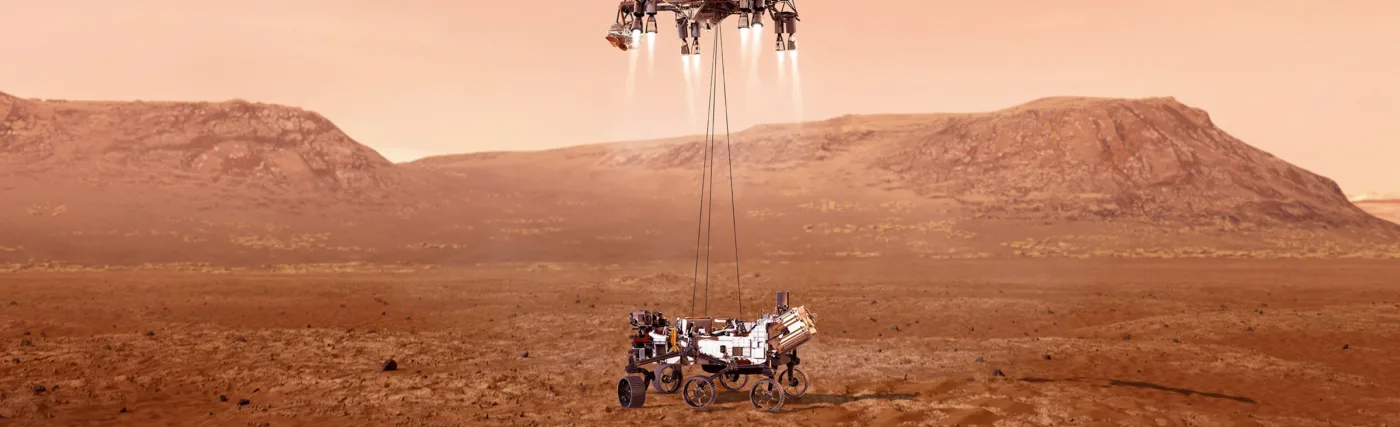
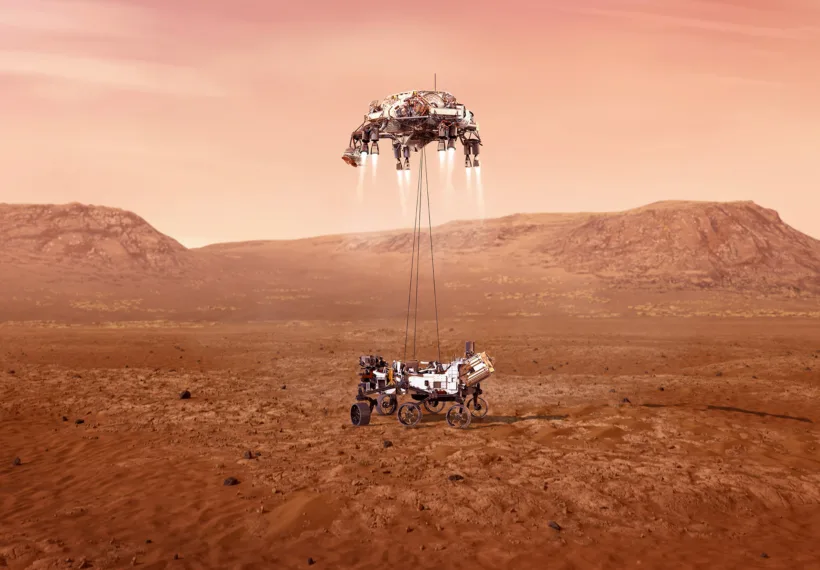
This week the Mars Perseverance rover will attempt to land on the Martian surface. On this episode of StarTalk Radio, Neil deGrasse Tyson and comic co-host Chuck Nice explore NASA’s latest rover and its red planet mission with NASA Chief Scientist Jim Green.
Why send another rover to Mars? You’ll learn how previous rover missions inform the next. Jim tells us about the necessary redundancies that are in place when building a rover. Discover why “enabling the future” is an important aspect of the Perseverance mission.
You’ll learn how Perseverance will land on the surface of Mars and how rover landing procedures have evolved over time. Jim gives details on the robotic helicopter, Mars Helicopter Ingenuity, attached to the Perseverance rover. Then, it’s time to dive into some fan-submitted Cosmic Queries. Were there any instruments Jim wanted on the rover that didn’t make it?
Find out how Perseverance’s microphones will make us able to listen to Mars for the first time. Will there be any live footage of Perseverance? What will we see on camera? Jim explains Perseverance’s sampling mission and why we might be able to find signs of past life in the rocks beneath the surface.
Lastly, we explore how NASA picks a landing spot for each rover. And, what happens to all the other rovers on Mars? Is Perseverance one of the first steps toward humans terraforming Mars? All that, plus, we discuss the expanding collection of rovers being launched from all over the globe and what Martian exploration will look like going forward.
Thanks to our Patrons Nina Barton, Yancey L Sanford, Tyrel Carson, Peter Jacobs, Laura Inger, Samuel Watts, Joshua Allen, Tom Hegedosh, Connor Haberland, and Abhay Joshi for supporting us this week.
NOTE: StarTalk+ Patrons can listen to this entire episode commercial-free.
Transcript
DOWNLOAD SRTWelcome to StarTalk, your place in the universe where science and pop culture collide.
StarTalk begins right now.
This is StarTalk.
I’m Neil deGrasse Tyson, your personal astrophysicist, and we’re here with a Cosmic Queries edition.
We love me some Cosmic Queries.
Ain’t that right, Chuck?
Yes, sir, absolutely.
You collect all the Cosmic Queries, and I don’t know if you bring them to stump our guests or what, you know, do you filter them or are they just randomly plucked from the…
They are actually taken by a randomizer, so I can’t, I cannot take credit for pulling them, which means that please don’t send me your questions personally.
All right, so Chuck, today’s Cosmic Queries, we’re going to explore the Perseverance Rover of NASA, which this month, we’re recording this in February, lands in February.
And it was launched, you know, nine months ago, 10 months ago.
And so, but I don’t have particular expert, I know a little bit something about Mars, but not specifically about Perseverance.
And I think you don’t know about either, right?
I know about Curiosity, and I’m not talking about a lander.
So we’ve got our friend at NASA headquarters, Jim Green.
Jim, welcome back to StarTalk.
Thank you so much, Neil.
Chuck, always a pleasure.
Always a pleasure to see you.
And I was looking at your full bio, and I’d forgotten.
I mean, I remember, but I forgot that you used to be head of planetary science for NASA, but now you’re head of all astrophysics.
Well, I’m just the chief scientist, so.
Oh, chief, not just astrophysics, chief scientist.
Right.
Defying all categories.
Yes, that’s true.
That’s badass, I’m just saying.
That’s good.
Yeah, I’ve enjoyed that.
I mean, it’s really all about advising the administrator on new science activities and wonderful things that are going on in the agency.
And the fact that you came to it as a planetary guy means you have good sort of geology sense as well.
So, and if you did planets, it meant you had some good astronomy in there.
So you’ve got enough of a diverse background to serve the scientific portfolio of NASA.
Is that a fair statement?
That is, that is.
I’ve got an undergraduate degree in astronomy.
In fact, I just finished my first exoplanet paper.
Nice.
You know, I’ve been involved in a lot of planetary magnetospheres and done some solar physics.
So I’ve touched on heliophysics.
And of course, one of my favorite planets is the Earth.
So this is a Cosmic Queries, but before we get to questions that people have sent our way on Perseverance, just remind us, why is this yet another rover to Mars?
I mean, how many damn rovers are we going to send?
What did you not learn last time that you’re going to pick up this time?
Well, of course, with Curiosity, we learned that Mars was really quite diverse than what it is today in its past.
We explored the past of Mars.
We found out that Mars, four billion years ago, had an enormous amount of water.
And the conditions were such that it could have been habitable.
We really didn’t know that.
And now we’re going to push the next step on that, and that is to go to an area and look for ancient life.
And that’s what Perseverance is going to do.
Ooh, okay, so each rover mission stands on the shoulders of the previous mission in the questions that it gets to ask.
Absolutely, that’s the way it works.
And you have to send a whole new vehicle to do that?
Well, it turns out, of course, Spirit and Opportunity looked so much different than what Curiosity does.
But at the end of Curiosity’s building, we had many spare parts.
And so I think we had like $200 million worth of spare parts left over from Curiosity.
It’s like an Ikea furniture.
No, that’s if you don’t know how to build it, you have spare parts.
Wait, wait, Jim, no, what are you telling me?
You make a soul, a single object, a single thing called Curiosity, and you’re telling me they’re leftover parts?
This isn’t some Heath kit that you bought from Radio Shack.
This is, so what do you mean you have leftover parts?
Well, we have duplicate parts.
I’m trying to picture the engineers, you know.
Standing around, it’s like this.
All right, well, so what are we gonna do with this?
What?
Guys?
Does it fit here?
Guys?
Any suggestions, guys, on this?
For every one of our missions, no problem.
For every one of our missions, we wanna be able, indeed, to have spare parts around or extra parts, such that if there’s a failure, we can immediately bring in the new part and not worry about ordering your supplies.
So it’s a real critical, real critical thinking.
It’s a necessary redundancy.
Indeed.
Wow, okay, you got me there, okay.
I’ll let you slide on that one.
But that’s the last time I’m letting you slide.
And tell me, you’re going up there with a helicopter, so what’s up with that?
So one of the elements, one of the important elements of this mission is actually enabling the future.
And to do that, we’re going to push the envelope in our understanding of getting around on Mars.
And a helicopter is really a unique idea to do that.
So this is what we call a technology demonstration.
We’re gonna be able to hopefully drop this helicopter off the belly pan of the rover, drive away, let it unfurl and then order it to start flying.
And we’ll do a variety of tests and it will go up and then come down and then we’ll go up and translate and then come down.
So translate means that it will just go horizontally when you say translate in its position.
Okay, so Chuck, you know what this would look like if a cartoonist drew this?
The Martians would be watching this and the rover drops the helicopter out of its belly and it thinks it was pregnant.
Right, it’s like guys, we’re babysitting all of a sudden.
So now I’ll ask both of you then, what kind of helicopter, if I’m not mistaken, Mars has a different atmosphere than Earth, so wouldn’t we have to have a different helicopter?
Indeed, indeed.
So it’s drone-like in many ways, it has a small body, but it has very long rotors, and they’re about a meter, they’re about a yardstick long, okay, and there’s two of them, and they counter-rotate.
And that enables this small helicopter, which is a box like a CubeSat, it’s about 10 or 12 centimeters by 10 or 12 centimeters in a cube, that enables this then to be locked in and fly great distances, you know, 50, 60, 70 meters before it sets down again.
So, but the real problem is the Martian atmosphere is really thin, so you have to compensate by having bigger rotors, is that the solution here?
That’s right, and the counter-rotation helps the stability so that we don’t need a rotor on the tail.
So it’s a design feature.
Now, if you can imagine this working, then the next set of missions could indeed leverage this concept and lay down additional helicopters to then survey massive regions up close on the surface of Mars.
So it’s what we’d call an enabling technology demonstration for future missions.
Beautiful, beautiful.
Cool.
All right.
Well, let’s, why don’t we get to some Q&A here and-
All right.
Oh, and one last thing.
This is landing on Mars the same way Curiosity did?
It does, it does.
So it looks very Rube Goldbergian, you know, with the drogue chute and retro rocket and that, and who came up with that?
Well, the JPL engineers.
There are some really fantastic-
Jet Propulsion Labs, yeah, okay.
Jet Propulsion Lab engineers, fantastic people that had a long experience in landing craft on Mars.
And the whole concept evolved.
You know, we started with Pathfinder, and Pathfinder is a platform for which the Sojourner Rover rode on.
We landed that, and then the Sojourner Rover came off the platform.
And then we had Spirit and Opportunity.
You bounced it with some airbags.
We did.
And we used that same concept for Spirit and Opportunity.
And they bounced, of course, and then when we deflated the bags, the Rover sits upright on a platform and then drives off the platform.
I loved how low-tech it was for something to do something high-tech afterwards.
I’m going to say, yeah, there’s something really genius about using a hoppity-hop to land a sophisticated piece of space machinery.
That’s incredible.
You know, for Spirit and Opportunity, we believe it bounced perhaps as much as 30 times before it actually settled down on the surface, where we could deflate the bags and then move it off the platform.
So imagine this now.
Now we’re going to build a bigger rover.
Okay, Spirit and Opportunity are less than 200 kilograms.
And now we’re going to do one metric ton.
Okay.
So 2,000 kilograms, 1,000 kilograms.
1,000 kilograms.
Five times what Spirit and Opportunity were, okay.
So the concept is, well, we start out with a platform.
Can we put it on a platform and then figure out how to land the platform?
The problem was the center of gravity was too high.
So if it’s on the platform, it’s going to flip over.
So now we can’t land it on the platform.
Don’t want that.
You don’t want that.
I can tell that right now.
Okay.
So then the next evolution in thinking is, okay, let’s put the platform on top of the rover.
All right.
And that gives it retro rockets all the way down to the surface and you land it.
Then the problem is, how do you get the platform off the rover?
So then the unique idea is, let’s hover it and lower the rover down to the surface while the platform is hovering at about 20 meters.
So you’re lowering it like with a joist or something, right?
That’s called the sky crane.
Sky crane.
The sky crane.
Yeah, yeah, the sky crane and when you think about that, that’s a process we do here on Earth with helicopters every day.
Dropping off cargo, picking them up, going through that process.
So why couldn’t we engineer that for a Mars mission?
Excellent, excellent.
So it’s brilliant to know, I mean, engineers, they live for this, right?
They know what has worked in one application and they modify it, add to it.
No, I love it, I love it.
So Chuck, what kind of question do you have?
Hey, let’s jump into it.
We’ll start with Leslie Murray.
By the way, let me just say, Jim, people love NASA.
Like you guys need to take a little bit more advantage of the public goodwill that you enjoy and get more money because people love NASA.
Not only domestically, but internationally as well.
True, yeah.
Yeah, I mean, people are so excited here.
It’s great.
Anyway, this is Leslie Murray.
This is from Patreon.
Jim Green.
Is this a Patreon question?
Leslie does not say, oh, actually, Patreon.
Thank you very much.
These are Patreon, these are Patreon folk first.
And as we say, we certainly enjoy anyone who supports us on Patreon because we certainly enjoy money.
So thank you.
Chuck.
I’m just being honest.
Please forgive Chuck.
He’s still in training in this process.
Listen, I’m sorry, I don’t know how to diplomatically say thank you for giving us money.
It’s very hard for me to figure out the proper way to say that.
We’ll debrief you after the show.
All right, so what’s that first question?
All right, this is Leslie Murray.
Patreon, she says this, Jim Green, very excited to ask you, if you could have added just one more instrument to the rover, what would it have been?
I love that question.
And then she says this, like every rover, I’m sure this one was on a weight loss plan.
Well, I have to tell you, of course, I was head of planetary.
We had landed Curiosity that worked great.
And we began the concept of, well, we need to bring back samples.
We need to go and get the rock samples that tell the history of Mars.
We need to bring them back.
And that was the thrust of what Perseverance is going to do and how we were able to convince NASA and the administration and then Congress to support this next move.
So the instrument I wanted that I dearly would have loved to have on it, I actually got it on.
And that is an audio instrument.
You know, we’ve never landed on Mars and listened, you know, to the wind, to what we can hear.
And we now have two microphones on audio instruments.
When you said audio instrument, you meant a microphone.
I meant a microphone.
Yeah, because I got to tell you, Jim, when you said audio instrument, I was like, what a waste of money.
You sent a radio to Mars?
Who?
Why not put some cup holders on it?
Who was listening?
Who was listening to whatever?
But no, yeah, exactly.
But no, the microphones, that’s super cool.
Okay, so that adds another dimension to our senses.
It does.
For what we think of and feel about Mars.
Very good, okay.
So, oh my God.
So when this thing lands and you deploy these microphones, we’re going to be able to go to NASA and listen to what Mars actually sounds like?
But even before we land, we’re going to turn on one of the microphones during the landing process.
Oh my God.
So we will hear what’s going on inside the capsule as it hits the top of the atmosphere and in huge temperature variation just outside the heat shield is going on as it’s burning away the material on the heat shield.
And then the sky crane all the way down to the surface.
So we turn it on right away.
Now, since I’ve been zooming for 11 months now, I just want to make sure, do you have a mute button?
Because that can be problematic.
Well, not that I’m aware of.
We do have an on and off button.
But our hope is that everything will survive intact and we’ll be able to use this engineering microphone as it moves.
And the reason why that’s so important, what we found out with Curiosity is as it went over some rough terrain, the rocks were literally breaking the aluminum wheels, you know, poking through them.
And so the engineering microphone is designed to hear the creaking and the cracking and the moving.
And then that’s an element of the diagnostic of the environment that we’re in that helps manage the rover and its assets to keep it going.
This is that old story, you take your car into the shop and they ask you, well, what’s wrong with it?
And you say, well, it’s making this sound and it goes like, like, tinkity, tinkity, tinkity.
It’s like, er, er, er.
It’s the acoustic diagnostics of what’s going on.
In this case, we’ll be able to play it.
Play it back.
Just before we go to break, is the carbon dioxide atmosphere such that frequencies will come across differently in the sound?
Yeah.
Really good point.
Will you have to shift it to like an earth spectrum of audio so we’ll actually know what’s going on or are we just going to enjoy the higher or lower frequencies commensurate with the mixture?
Well, it will be lower, you know.
So turn up your bass.
You know, the atmosphere is heavier in, you know, carbon CO2 is heavier than oxygen and nitrogen.
And of course, as we talked about, it’s a much thinner atmosphere.
So sounds that we would normally hear as high pitch will be very low.
You know, it will be bass level.
And of course, once we have that data, we can change the range and enhance it.
But I think it will be absolutely fascinating to hear the real sounds of Mars based on the atmospheric composition and the pressure.
I think it will be more fascinating if you turn the microphone on and you heard, ladies and gentlemen, thank you for tuning in to Radio Mars.
Wait, wait, wait, it will be, wait, wait.
And now, this is the Martian version of Barry White.
And then it’s a frequency so low you can’t even hear the frequency.
So we take a quick break.
We’re going to come back with Jim Green, chief scientist of NASA.
We’re talking about the Perseverance Rover of StarTalk.
I’m Joel Cherico, and I make pottery.
You can see my pottery on my website, cosmicmugs.com.
Cosmic Mugs, art that lets you taste the universe every day.
And I support StarTalk on Patreon.
This is StarTalk with Neil deGrasse Tyson.
Thanks for watching.
We’re back, StarTalk Cosmic Queries, Mars Perseverance Edition.
I got Chief Scientist James Green.
Jim, just welcome back to StarTalk.
It’s always great to know you’re there for us.
And NASA has a huge social media presence.
I think your biggest handle there is just at NASA, right?
We got a squillion followers on at NASA, not only in Twitter, but especially in Instagram, where you’re knocking it out of the park every time you put out something on the universe.
Just congratulations to all of you for creating those images and the social media team for navigating them in ways that the public can embrace.
This really to me shows that the public is very inquisitive.
I mean, it’s an element of our nature to really try to see and uncover new phenomena in new regions and take new views of the universe we live in.
Not to mention seek out new life and new civilizations.
He left out that part.
Thanks for continuing.
Yeah, where no human has gone before.
So Jim, not only does NASA have their handles, social media handles, but you have a podcast with the greatest name ever, Gravity Assist.
Very cool.
What kind of guests do you have on there?
Oh, Neil, I have some of the fabulous working scientists that are uncovering some of the secrets of the universe that really won’t end up in textbooks for many years.
And it’s a…
So Chuck, he’s compiling the secrets of the universe and not telling anybody.
Okay, that’s what that is.
So I just ended my fourth season and the podcast is called Gravity Assist.
Can’t lose with that.
Okay, good luck with that.
Good luck with that.
So let’s move on.
All right, this is Nathan, Nathan Hui.
Nathan Hui says, will there be any live footage capturing the Perseverance’s exciting landing and maneuvers?
And if so, how will it be recorded and how can we watch?
Thank you and good luck, Nathan.
Well, you know, it’s kind of cool because how do you, you know, how do you record the thing that you’re in unless you have something else recording it?
Yeah, a camera out on a boom or something.
So what are you doing there?
Right, so what of course happens is we’ll begin to unfurl a variety of things.
So, and one of the first things that will come up will be our major camera.
And this is as tall as a human is.
In fact, if I stood next to Perseverance, I would just be looking into the camera lenses that are on the mast.
This gives us a wonderful opportunity to view the area as a human would.
But, okay, but that’s after you’ve landed.
That’s after you’ve landed, but you got nothing for us.
Yeah, that’s after you landed.
You got nothing for us while you’re plunging through the atmosphere?
We do, we have a whole series of cameras in many different locations.
And so what we’ll see is we’ll see the parachute deploy.
We’ll see that.
We’ll also see the heat shield drop away and the ground below us come up rapidly.
And then we’ll see that view of the ground as we land it with the sky print.
Cool, sweet.
Well, that is cool.
I mean, this is really gonna be an exciting thing to do.
Oh, one other thing, of course, Mars is many, many light minutes away.
So if we watch this, what we think of as live is really delayed by how much?
Well, light travels, you know, an enormous speed, but it’s still gonna take close to eight to 10 minutes before we actually get the signal.
Damn, so Mars is like 100 million miles away.
Damn, when this is happening.
Yeah, it’s a ways away.
So the whole thing could have just exploded and busted up on landing, and then we will just sit there and think everything is fine for another eight minutes.
Indeed.
We won’t have any knowledge of that.
And so that’s, you know, what you’re bringing up is a perfect point.
Everything has to work the first time perfectly, and we can’t joystick it.
We can’t make any mobs.
And when it hits the top of the atmosphere, it is on its own.
Very cool.
All right.
Again, a shout out to the engineers who made that work.
Chuck, give me some more.
Here we go.
Neil, Chuck, Jim.
My name is Violetta.
I’m 12 and a half years old, and I have a very important-
12 and a half.
Make sure you got that half in there.
Absolutely.
That’s important.
Right, I am still using halves and quarter years.
What is your advice for the next generation of NASA scientists in regards to space exploration?
What should we study and dream of now if we expect to one day be the first generation that travels to Mars?
This is a 12 and a half year old asking this.
That’s really cool.
Well, it’s really all about following your passion.
Get involved in an element, whether it’s engineering or some aspect of the science, and just immerse yourself.
Enjoy it and let it lead you to these different opportunities.
Whether it’s an opportunity to work in a company or industry or laboratory that are involved in building instruments or in one of the NASA centers, and even getting involved in building space vehicles for humans.
And just to be clear, NASA collaborates with companies like Lockheed Martin and Boeing and other places to build spacecraft.
So NASA doesn’t build all their own spacecraft and spacecraft, correct?
Right.
For Perseverance and of course the Ingenuity helicopter, we built those, NASA did build both of those.
But it required instruments to be built by many different groups and universities.
Okay, so what that means is what we think of as NASA’s budget goes not only to NASA, but to innovative corporate companies, engineering companies that also do work in the service of NASA.
So they would get a paycheck that’s not signed by NASA, but signed by their own company.
But ultimately, it came from all of us supporting that enterprise.
Did I capture that accurately?
Yes, you did.
Okay, all right.
Beautiful, beautiful.
What you’re saying, Jim, is that it’s one thing to say, oh, they’re doing this now.
Let me train so I can do that when I’m their age.
That’s one thing.
Another thing is I am so passionate about this thing, whatever it is.
Maybe it’s my passion that will create an opportunity that doesn’t even exist there today.
Yes, indeed.
That is really the case.
To dream big and then follow your passion.
Follow your dream.
And then maybe other people will be the path to the door of your passion, and then you’ll be the leader, the next leader of the science at NASA.
That’s right.
And have a badass business card.
All right, Chuck, keep it coming.
All right, here we go.
This is Toby Sonnenberg, who says, Hey, Neil and Jim, how can NASA predict which rocks may hold signs of an ancient biochemistry if that biochemistry is completely alien to us?
I think, yeah.
There may be some assumptions being made in that question, but still, yeah.
No, no, they’re excellent assumptions.
So, Jim, if we’re looking for life as we know it, are you going to miss life as we don’t know it?
As we don’t.
Indeed, we don’t want to just look for life as we know it.
We need to be open-minded.
And that requires getting the samples back.
The ancient history of Mars is in that rock record.
And we’re going to, you know, create it.
So, a core is basically a cylinder that you extract from the object.
And then you have the full record of layering within it.
That’s right.
So, somewhere in this time history, life may have arisen on Mars.
All right?
So, now we have to bring this back because we can’t in any way interrogate this sample on the surface of Mars.
Where were you on the night of July 10th?
You can’t use the word interrogate in front of black people.
They have a whole other understanding of that word.
Sorry.
Not your fault.
Not your fault.
I’m just saying.
Oh, God.
You’re interrogating your core sample.
Go.
Yes.
Yes, to do that analysis, we then want to put the core in a sleeve and then we’ll lay it on the ground for later pickup by another mission.
We’re actually planning now to pick up the sticks, to pick up the cores.
Yeah.
Brilliant.
We’re building a Mars Ascent Vehicle to bring it back.
Now, the analysis of the rock record is forever.
If we get it back here on Earth, we can interrogate it, we can create theories on, hey, we might see different types of life than we expected.
The record is here to continue that discussion and then eventually prove your theories or disprove them and tell us about what Mars could have harbored life in its past.
At the risk of stating the obvious, the geologists can see back in time simply because the stratification of geologic forms and structures preserves that.
That is their analog to what we do in astrophysics, whereas we look out in space, we look back in time because light takes time to reach us.
The farther away we look, we can see a thousand years into the past, a million, even a billion.
So, I’ve always felt geologists were our kindred souls.
One looks down, the other looks up in this exercise of decoding the history of nature.
Yeah.
So, in the same analogy, astrophysicists look at different frequencies of light, because it tells them different things.
When we bring this rock record back, we’re going to use different instruments to determine the mineralogy.
In other words, how material is put together.
The composition of what those nodes are in the mineralogy, the state of the matter in terms of what we call isotopes, and so now we can interrogate all those different dimensions because we have the rock record right here at home.
So Neil, do astrophysicists ever interrogate the light that they find from when they’re studying space?
One day, we will do an explainer video of all the stuff we extract from light and it is a stupefying amount of information contained within light.
Yeah, we’ll do that Chuck, remind me.
No use holding out on us x-rays, we know what you did.
We know where you’ve been.
It’s a gamma-ray you’ve got to watch out for.
They’re right over your shoulder there.
Give me another question, maybe we can squeeze one in before we go to the break.
This is Rob Carter, he says, hello, I was wondering what protection this rover has from the Mars fine dust after the Mars digger issues last month.
This is somebody who’s following along, that’s for sure.
Is there a way of stopping the dust from gathering on the solar panels?
And if so, what’s another major issue that the rover will have to overcome?
And we will only learn about that after the commercial break.
See what I did there?
Stay tuned, Rob.
So we come back more Cosmic Queries on StarTalk, all about Perseverance on Mars.
Hey, it’s that time.
Time to give a Patreon shout out to the following Patreon patrons.
Yancey L.
Sanford, Tyrell Carson, and Nina Barton.
Guys, thank you so much for the gravity assist that allows this show to traverse the cosmos.
Without you, we couldn’t do it.
And for anyone listening who would like their very own Patreon shout out, please go to patreon.com/startalkradio and support us.
Thank you.
We’re back, StarTalk, Cosmic Queries, Perseverance.
Speaking of Perseverance, it has nothing to do with the show, but I gotta say it, this morning took my 92-year-old mom to get her COVID vaccine.
That is amazing.
Wonderful.
Up at Harlem Hospital.
So there it is, 92, and she’s ready for more.
She’s ready to rock and roll now.
She’s ready to rock and roll.
She’s like, Neil, where are we going?
Where are we going now?
Let’s go.
We can get out the house.
I said, mom, I don’t get my shot yet, okay?
My category hasn’t come up yet.
Okay, so Chuck, give me some more questions for Jim Green, Chief Scientist at NASA.
Okay, so when we last left off, Rob Carter had asked about the protection of the Mars rover from the very fine dust of Mars, citing the digger issues of last month.
We might, I don’t know what that is.
And then he says, is there a way of stopping the solar panels from gathering dust as well?
And what other issues have you foreseen that the rover will overcome?
So those are all of his questions.
So indeed, Perseverance looks just like Curiosity and it has its own power system.
It’s using radioisotope power.
It’s using plutonium-238.
And plutonium-238 is really hot.
You put this against a thermal couple, which creates a voltage difference, which charges a battery.
And then it’s like having your iPhone plugged in the wall all the time, all your instruments work.
So this can be coating with dust.
We don’t care because we brought our own power supply.
And you work at night as well, right?
It doesn’t matter if the sun is up or down, okay?
But what’s really exciting from the question, I think your listener is interested in what’s happening also with InSight, which has solar panels.
And the solar panels, of course, will accumulate dust.
But one really exciting thing that this InSight, the name of the lander on Mars, is seen is the dust is being blown off.
And it’s not from the twisters that it has seen, Spirit and Opportunity does, but it’s from the same phenomena.
It’s just not visible.
So the atmosphere has these vortices that indeed blow the dust away, and we don’t need a dust double to do it.
Well, okay, but how about the machinery and the moving parts?
You know, you can’t bring anything to the beach here on earth because sand might get in it and that ruins everything.
You certainly don’t want to ride a bicycle on the sand.
So won’t the dust get inside the moving parts?
And isn’t that bad?
Well, that’s a good point, but indeed the rover is really sealed well.
And in the compartments that it has, like Curiosity, would be meant to acquire material and then shut off.
So we don’t see that as a problem.
You know, it’s like keeping your windows up and your car doors shut, all right?
And you can operate well inside, even during snow storms.
Remind me what Insight was?
Insight is a lander that landed on Mars in November 2018 and deployed a seismic system that allows us to hear Marsquakes.
Cool.
And it’s measured over 500 of them since then.
Marsquakes.
Indeed.
And this is telling us a lot about the inside of Mars and the fact that we now believe that Mars, at least partial part of the core, is liquid.
We didn’t know that before.
Very nice.
Chuck, keep going.
Let’s go to Mikey Taylor from Illinois.
How do Rovers’ most sensitive instruments survive entry?
And is there a chance that they could be damaged?
I like that.
Yeah, that’s a really important question because we now know that we have to build them to be rugged.
So understanding that right off the bat is critical in developing the right capability to survive what we call the vibrations and the loads that occur by moving quickly, you know.
So there’s the launch sequence and the shaking of the rocket and moving at high G and then there’s the landing, you know, where we’re going to go from the top of the atmosphere to the surface in seven minutes and you’re going through various loads.
So once you know that, you have to design it and build it that way and then test it.
So you have a bunch of shock absorbers for everything built into the structure of the system, right?
Otherwise, the accelerations will be felt directly by the instruments themselves.
You want to absorb that away somehow, I guess.
That’s the task.
Well, that’s one method of doing that, you know.
Yeah, other methods are let it shake and then you have to build it such that it will withstand those vibrations.
Emiss stabilization, kind of, yeah.
Okay, no, I hadn’t thought of, I hadn’t, forgive me, I hadn’t thought about, build the sucker so that it can shake and bake and then it doesn’t matter.
Then you don’t have to waste weight on building cushions for it.
That’s interesting.
I like that idea, okay.
Cool.
All right, this is ST20IC says, will this take better quality photos?
So are we talking iPhone 5 or iPhone 12 Pro?
What are we looking at?
What are we looking at photo wise?
Well, we’re indeed looking at the beautiful Mars photos in higher resolution.
We’re also having high resolution cameras on the end of the arm so that we can get up really close to the rocks, hit them with X-ray, look at the glow and image that and really understand a lot about the mineralogy and the composition before we decide to drill a hole and bring back that sample.
Wait, is that that famous alpha proton X-ray spectrometer?
Yeah, it’s similar.
This is called Pixel.
It’s designed to zap the rock with X-rays, let it fluoresce, but also image it, also image that, okay?
So is that an acronym for something?
Pixel?
Yeah, cause I’m gonna tell you something.
In the name department, you guys are losing alpha proton X-ray spectrometer.
The geologists love that instrument.
Cause it sounds like my tax dollars went to do something.
You know, you gotta hype it up, Jim.
You gotta hype it up.
You can’t just be like, so we got this great technology, it’s called Pixel.
No, you gotta hype it up, you know.
Make it sound like a diabolical weapon on Batman, right?
Alpha base, you know, bio aqua to loop something.
All right, so this instrument sits on the end of the arm and fires a ray gun at really high intensities, glowing the rock, heating it up and letting it tell us what it’s made of.
Give that man an extra billion dollars just for that sentence.
We’re gonna call it our photo phaser.
Photo phaser?
It’s our photo phaser spectrograph like something.
Just make it sound like something that would be on Batman, out of Batman’s artillery belt.
It’s not the ray gun on stun, you know, it’s on kill.
It’s on vaporize, yes.
All right, Chuck, we’re in lightning round mode right now.
So how many questions you can get through?
And Jim, you’re in soundbite mode.
Okay.
Okay, here we go.
Samuel King.
Samuel King wants to know this.
Tell the truth, Jim, is this one of the first steps to terraforming Mars?
Could be.
And the reason why is we’re going to learn so much about the environment that will then take that knowledge to terraform Mars.
Foundational knowledge.
I like that.
Good soundbite too.
Got A plus on that soundbite.
Okay, Chuck, give me another.
Seishiro wants to know this.
How do you guys pick the right place to land?
We want to go to the best place where we can get samples, and that’s why we’re going to a delta, an ancient area on Mars where water and sediment is landed on the bottom and created rock.
A delta like the Mississippi Delta.
Guaranteed to have layers.
Because it’s been sedimented.
Sediment.
Nice.
And implicit theories, of course, Mars has deltas, right?
This is an interesting fact, all right?
Deltas enough for you to pick one to land on, okay?
Keep going, Chuck.
Why, I love the Martian blues.
Okay, so Selkukilman1 says this.
What will happen to the other rovers?
Will they just retire and leave it there as space trash?
All rovers and all instruments that are working on Mars, we want to keep them working.
Keep making new and exciting discoveries until they die.
And they will be there for us to explore as humans when we land.
And in fact, you might need those to beam signals back to Earth the way…
Matt Damon did.
Matt Damon, Mark Watney.
Was that his name?
Mark Watney?
Yeah.
Yeah, Mark Watney.
So you need those.
Yeah, you need those in case you have to rewire them and send signals back to Earth.
Of course.
Okay, Chuck, keep it going.
A couple more.
We got time for a couple more.
This is Beer Games who says, Hello, will this rover be responsible for any preparation for humans to travel to Mars?
So I mean, yeah.
The answer is yes, because we have an experiment that brings in the atmosphere and creates oxygen that we can breathe.
Oh, nice.
It’s called the oxygenator on the movie The Martian, but we call it Moxie on Perseverance.
Okay, oxygenator sounds a little better.
I was gonna say once again, you guys got to work on these terms, man.
Work on.
Yeah, oxygenator sounds way better.
Exactly.
We have to turn on the oxygenator.
Yeah, and we’ll be back to get it.
So, what you’re doing is you’re breaking apart the carbon dioxide molecule.
Right.
All right.
This is Chris Cherry, if you want.
Chris Cherry says, what is, for this mission, your chief and primary goal?
And what is something you secretly hope to discover?
We want to search the past from the rock record to see if Mars could have supported life.
And my secret wish is that we find it.
What, like a fossil bone sticking out of the rock?
I mean, what do you, what do you, what?
So a creature that crawls out from under a rock?
No, we don’t anticipate getting fossils.
But the chemical composition is just right for which there’s potential cells or microbial indications that life could have survived on Mars early on in its history.
Okay.
All right.
I’m going to take host privileges and ask you one last question.
We launched Perseverance to Mars.
Was it June?
Was it?
July.
July.
And did anyone else launch at around that time?
Because, you know, this is the months over which Earth and Mars are nicely configured for just that kind of journey.
And can we shoot them down if they be launched?
Well, we have the lasers, but they’re going to be used on Mars.
Every 26 months, Neil, you’re right, everything lines up where we can launch from Earth and make it to Mars as fast as possible.
But we are not the only nation going.
So the Chinese have launched a mission to Mars with an orbiter and a lander and a rover.
And in addition to that, United Arab Emirates has also launched a mission that will get into orbit and make atmospheric measurements and image the surface.
So the road to Mars is open and it’s busy.
I love that.
And are we collaborating?
Are we sharing information with these with everybody?
I mean, you scientists all love each other, so I mean, is that is that happening or is it more like governments?
No, indeed.
Everyone knows about the other missions.
We know when they’re going to launch.
We know how they’re going to operate.
You know, for instance, Perseverance is going to be dropped right onto the surface.
You know, we’re not going to get into orbit.
So it’s like hitting a golf ball in New York and having the ball go in a hole in LA.
You know, it’s just one straight shot.
The Chinese have a different approach.
They will first get in orbit, spend some time there, and then drop their capsule with their rover down to the surface at a later time.
Everybody has different tactics.
There are different tactics, yeah.
Cool.
Okay, so this is great.
And it’s a reminder that science really, at the end of the day, knows no national boundaries because it is the one true unifying language, not only of us all, but between us and what might be aliens that we greet one day, because they will surely be using the same science we are to get around the house and around the backyard.
And that’s great as long as America wins.
America.
All right, we got to end it there.
Jim Green, great to have you back on StarTalk.
Anytime, Neil.
Excellent.
Thanks, Jim.
Chuck tweeting at ChuckNiceComic.
Keep that going.
Thank you, sir.
Yes, I am.
All right.
Neil deGrasse Tyson, you’re a personal astrophysicist, as always, bidding you good-bye.



 Become a Patron