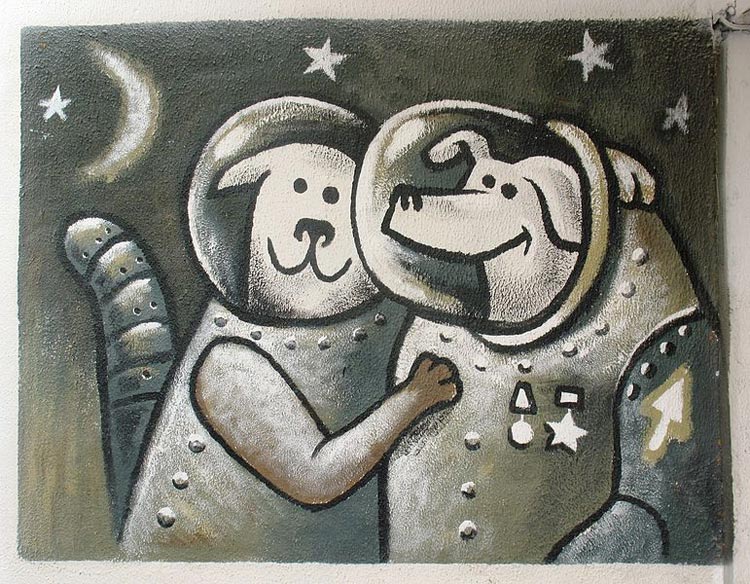
Animals have been our companions and co-workers since before the dawn of civilization. We have eaten them (or products they make), and we’ve worn their skin and fur and feathers. Scientific progress has depended greatly on animal test subjects—from the development of many medicines to determining if we could survive a launch into space (the first astronaut was the dog Laika, sent up by the USSR in 1957). We’ve even directed the evolution of many animals to better suit our needs, from pocket poodles to farm cows to lab rats.
In this modern day, with the impact raising livestock and eating meat has on the environment, as well as a growing understanding of the intellectual and emotional capacity of animals, many people are rethinking our traditional relationship with all creatures great and small. Ingrid Newkirk, president of PETA, argues that, thanks to new techniques, scientific discoveries still can be made “without the patter of little feet”.
Transcript
DOWNLOAD SRT
Welcome to StarTalk, your place in the universe, where science and pop culture collide. StarTalk begins right now. Welcome back to StarTalk Radio. I'm your host, Neil deGrasse Tyson. I'm an astrophysicist and director of New York City's Hayden Planetarium....
Welcome to StarTalk, your place in the universe, where science and pop culture collide.
StarTalk begins right now.
Welcome back to StarTalk Radio.
I'm your host, Neil deGrasse Tyson.
I'm an astrophysicist and director of New York City's Hayden Planetarium.
This week, Making the Fur Fly, Animal Science and Civilization.
To help me in studio is animal behaviorist Peter Borschel.
Applied animal behavior.
Excuse me, applied animal.
That means you're actually in the real world.
I'm in the real world.
Solving real problems.
You got your PhD in comparative psychology and animal behavior from Michigan State.
Yes.
And well, welcome to StarTalk Radio.
Thank you.
We snared you in the middle of a gig today.
What are you actually going to do today?
Well, I've got an evaluated dog up at Animal Care and Control, which is...
Evaluated dog?
What does that mean?
You know, in dog shows, they get goose, you know, when they evaluate them.
No, no.
This is all behavior.
So I've got a pit bull who apparently was sick on somebody and hurt them badly.
Who sick the pit bull on whom?
Apparently, the owner sick the dog on, I think it was an ex-girlfriend.
Oh, wow.
So why else have a pit bull unless this is the kind of thing you're going to do with it?
I guess.
I don't know.
For this program, I spent time with the president and founder of PETA.
Yes.
Yeah.
So we're going to join some interview clips later in the show.
Great.
Find out what she has to say about this whole world.
But as you surely know, we've relied on animals since the beginning, the dawn of civilization.
They're animals that of course eat us.
We don't rely on them.
We tried our darndest to find out which animals are not likely to eat us, and which ones make good eatin for ourselves, and which ones can serve our needs, which ones can pull our plows, which ones keep us warm at night.
And so they've really been our companions for thousands of years.
And so in your job, you're at the end point of this because you're worried about the behavior of domestic animals, I presume.
Yes.
Right.
So if a lion eats somebody, you're not going to study why the lion did that.
No, that's pretty obvious.
Either the lion was hungry or the person was stupid.
One or the other.
But that's right.
And the lion, you know, can't blame a lion for being a lion.
No, absolutely.
And of course, animals would not only just serve our needs domestically for civilization.
In fact, what we now call civilization rested wholly on what animals were doing for us.
Be they, like I said, the farm animals to horses.
I mean, before there were cars, there were horses, period.
You know, that was what you had to get from A to B.
And so we also know that animals have been used as test subjects in laboratories.
This has been a sort of fundamental part of scientific research over the decades.
But I don't suppose you worry much about those animals, is that right?
Well, I was in my graduate career, I dealt with them.
But I'm dealing with them.
Just as part of the normal sort of research cycle that you go through, right?
And you know, there's also this issue about what role animals play in our health.
Of course, animal meat is a very high and concentrated source of protein, which if you go off of meat, you need to explore other ways to make this up.
And of course, there's farming practices that when you grow animals, that people use to eat, then that's a huge usage of farmlands.
Like 70% of all farmland is given unto animals that we would then later eat.
Right.
On the other hand, our pets help us health-wise also.
Psychologically, I guess.
Psychologically, lower blood pressure, relax us, give us some comfort, and that's not trivial.
So, our pets are not just pets.
They're like psychological crutches for us.
They can be, yes.
Okay.
Which works better, a dog or a cat, to lower your blood pressure?
Well, since fish can do it as well.
It probably depends on the animal and the person.
And I've never pet a fish before.
Just watching them sometimes, does it?
So, it's the fact of having a creature inside your home, I guess, that works this way.
Yes.
That's interesting.
So, do you consult humans for human health with regard to pets or consult humans with regard to pet health?
Well, it's really well-being in terms of the behavior of the animal.
So, sometimes it does impinge on the person's health.
I mean, if the dog is going to bite you or cause you a great deal of stress, yes, then that's a problem.
But then what we do sometimes injures the animal psychologically as well.
We as pet owners.
So, we have to find a happy medium here.
And so, who calls you if someone has an emotionally distressed pet?
It's not the pet.
No, no.
Maybe you'd have a pet hotline.
That would be a phone ringing continuously.
If that worked, it would help my business.
No, if the owner will call me up with something, that's a problem.
The dog's aggressive or the cat pees out of the litter box or the dog's afraid of thunder or the cat gets into a fight with other cats, the whole range of things we see.
I saw a comedian joke once that we know we're smarter than cats because cats are afraid of vacuum cleaners and we're not.
And so are dogs sometimes.
But it's not odd to be afraid of thunder and lightning.
I mean, children are afraid, and we're only not afraid because we understand it.
Well, see, that's a good point because my joke with clients is that the dog thinks that the vacuum cleaner is the monster that lives in the closet and comes out periodically and growls and makes noise, and they don't understand the concept of cleaning the house.
Let's pick up with the beginning of my interview with Ingrid Newkirk.
She's the president and co-founder of People for the Ethical Treatment of Animals, which is much more famously known as PETA.
And she visited my office.
She, in fact, interviewed me for a video clip she was doing for her website, which ultimately ended up like in an ad for PETA, which was more than I had ever imagined they would do with it.
But anyhow, let's see just what she says about the treatment of animals and what role that's played in our culture.
When did you get started?
1980.
See these crow's feet?
That's not all that long ago, right?
So 30 years.
Was there some event that triggered it?
There were, in the cosmic scheme of things.
I'm sure this doesn't count at all, 30 years.
But I was a law enforcement officer and went on to...
Where?
At a place where you got your accent?
No, I'm English originally, but I moved to Maryland, and I was a law enforcement officer.
I happened to get a call about cruelty to animals, which was on a farm, and someone had moved away and left all the animals behind.
Most of them had starved.
There's one little pig who was left behind and who is still alive.
And I cradled him in my arms, took him to the water spigot, and got him something to drink.
He was dehydrated more than he was starved, but both.
And driving home that night, I started to think, oh, I'm so hungry.
What have I got for dinner?
It was before microwaves.
I had defrosted the pork chops.
And I suddenly thought, well, I haven't been to a slaughterhouse yet.
I have since, but I know they can't be pleasant places.
And here I am prosecuting people for being cruel to one pig, and I'm sure that the pig I'm about to eat didn't do well.
So I decided, I need to look at this more deeply.
So this was an existential moment for you, where you save a pig while you're about to munch down on a pork chop.
Actually, I should tell you that before that I stopped eating snails.
In America, that's not hard to put into effect.
You can start that movement and succeed by 9 o'clock tomorrow morning.
We now prevent you from eating snails.
Actually, that's a good idea to try and pass the law, isn't it?
But I picked up these snails.
They were alive.
And I'm a very bad cook.
But I was driving home with a little paper bag full of snails because they said it was so easy.
All you needed was a little wine, a little garlic and the snails.
And some butter, I thought.
You don't actually need it, but you can use it.
And I may have forgotten that ingredient.
But driving up a lonely country road, I suddenly had the feeling I was being watched.
And I looked over and the neck of the paper bag had come open.
All the snails had seen that they could get out, had come to the edge of the bag and were looking up at me.
And I thought, I can't stand this.
I let them go.
So this was another moment.
I tell you, I am a slow loner.
I had my first fur coat when I was 19.
And it was made of about a hundred squirrels.
It was a very...
Whoa!
A squirrel fur coat.
I've never heard of that.
No.
It was an arty, ginger Rogers, very special creation.
And no one was there then from an animal rights group to hand me a card that said, your coat looked better on its original 100 owners, or question the fact that I thought I was kind, and yet I also thought I was fashionable.
So it took a while.
I've eaten squirrel ones before in Texas, and it tastes like chicken, of course.
I love chickens too, but I do like them live, scratching in the dirt, enjoying the sun.
So that's none other than the president and founder of PETA.
More of that interview later in StarTalk.
So, Lynn Coplet.
How you doing?
I'm fine.
I'm a little horrified.
Who buys a squirrel coat?
Yeah, it's odd that the president of PETA owned a squirrel coat.
I wonder if it had tire tracks on it.
What a gross thing.
Only in New York would I be okay with a squirrel coat, because they're disgusting.
Where else do you get 100 squirrels if not roadkill?
What the fuck that is, Lynn?
And would she be against that, Neil?
Is that a PETA problem if you're using dead squirrels?
I don't know.
I should have had you prompt me before I had my interview with you.
I think that's what PETA should do, is they should make roadkill coats for people who want to wear fur.
But don't want to kill them on purpose.
You can wear a possum coat, an armadillo hat.
So just one thing.
Let's get back to eating meat for a moment.
It uses up a lot of resources.
By the way, I'm an omnivore, as humans, I think, were born to be.
And I enjoy it.
I eat a steak.
Refresh me.
Carnivores, you eat meat.
Like carne and meat.
Right, like meat.
It means you only eat meat.
And omnivore means you eat meat and veggies.
And anything.
And vegetarian.
And cake.
Anything that was once alive.
Anything that won't eat you back.
That's right, that's right.
Omnivore eats anything that was once alive.
And then you have the vegetarians.
And then...
The vegans.
And then I heard about the breatharians.
You hear about them?
The most annoying people on the planet?
I went to a vegan restaurant on a date and I asked for honey for my tea.
And the guy goes, we don't serve honey.
Angry.
And I said, why?
And he said, well, you would have to take that from the bees without their permission.
And I was like, well, they don't give you permission because they don't have lips.
And they can't speak.
Bees don't have lips.
I never thought that one through.
I don't think they do.
Can they speak?
Do they have local words?
They apparently speak to each other.
When we come back, more of my interview with the president and co-founder of PETA.
Welcome back to StarTalk.
I'm here with my co-host, comedian Lynn Coplitz, and we also have Peter Borschel.
He is an animal behaviorist, and we snare him from his appointed rounds today.
Thanks for...
I have so many questions about my animal's behavior.
What, you own somebody named Aldo?
Yes, he's a Yorkie.
Is that that little bitty dog that fits in your pocket?
Yeah, but he's chunky.
He's husky, is what we like to call it.
He had a knee injury in high school, and he hasn't been the same since.
So, he's a mix, a husky Yorkie.
Yeah, he's a little husky.
Now, here's my question, because I was raised with Dobermans and Labradors, and they're dogs with a GOB, you know, like, they're nice to you, they hear a noise, they're like, excuse me, I got to go home, mess something up right now, and then off they go to work.
But Aldo is like an abusive Italian man in a dog suit.
Like, he's really a different kind of dog.
Like, the terrier, like, he's really, he abuses me.
Yeah, Peter, what do you say about that?
Does he bite?
He bites when you leave.
Okay.
And he barks incessantly sometimes.
And I've seen him roll his eyes.
Peter, how often is this the fault of the owner?
And how often is it just the inbred properties of the dog itself?
I think the inbred properties of the dog are maybe a little more important.
But you go to work.
It's not all me.
See, people, everyone I date, everyone's always like, he's annoying because you're annoying.
Ah, no.
See, probably, does he bark him when he's left alone?
Nope.
He goes to sleep.
Okay, well, that's good.
He doesn't eat things.
He doesn't chew things up.
He goes right to sleep.
He barks when he wants to play.
He needs more play.
Well, don't we all, Peter?
I know.
Peter, do we have to pay you for that advice?
He needs more play.
It hurts when I do this.
Don't do that.
We'll be picking up more with my interview with the president and founder of PETA, Ingrid Newkirk, but just some little facts about PETA.
They did some controversial things, or at least under the banner of PETA.
One of them was that they created something called the Unhappy Meal, where they had Ronald McDonald looking like one of these horror movie...
Like a sad clown...
.
clown.
Yes, sad, evil, horror clown, like the Joker from Batman.
And there's a bloody rubber chicken and mutilated animal.
So there's been some hardball played there.
But my favorite was in September 2008.
PETA sent a letter to Ben and Jerry's asking them to start making ice cream with milk from humans instead of cow...
No, I've thought about this forever.
Why are we sucking the secretions of bovine creatures that are not even our species?
Why not just have farms of milk?
Really?
I'll tell you why.
Why?
As a woman, I'll tell you why.
Because now we're working, we're reading, now you want to milk us?
I'm just saying.
For your ice cream?
Really?
I'm just saying keep it in the species.
Does it hurt the cow?
I think they like getting milk because otherwise they're distended.
I mean, they're bred to be over-stuck.
They don't mind getting milked.
Please.
What are you going to call it?
Chunky Mommy?
Instead of Chunky Monkey?
Chunky Mama?
I don't know.
I'm just saying.
Now, in terms of household pets, you know, there's the dog people and there are cat people.
I confess I'm a dog person.
I never really understood cats.
I saw a comic recently.
It says, if cats could talk, and it had a guy walk up to a cat at sleep on the couch, and it says, hi kitty kitty, and the cat looks up and then goes back to sleep.
That's if cats could talk.
They still wouldn't.
So we have a clip from Brian Mallow, the science comedian.
It's a clip called Feline Existentialism.
Go for it.
I know we humans have a tendency to anthropomorphize, to project our feelings and attributes upon other creatures, even inanimate objects.
But having said that, I still believe cats are very profound creatures and more philosophically oriented than we ever give them credit for being.
For instance, the other day, my cat, Damien, he's the anti-cat.
He's a black cat.
Damien was in a funk.
He was moping around the house, walked out onto the patio, came back in, wandered into the kitchen, stirred his food around a little.
Then he came over, rubbed up against my legs, looked up at me with these hopeful eyes and gave out this plaintive meow.
Meow, which I think could be interpreted literally.
I think he was saying, me-ow.
Meow, he said.
And with those simple words, I think he was trying to express a very complex emotion, despite having a limited vocabulary and no concept of syntax.
He's followed in the footsteps of Jean-Paul Sartre, even though he has twice as many feet.
Damien, the first feline existentialist.
Damien would appreciate that.
I always imagined a conversation between the existential cat and a pessimistic dog.
Me ow.
Rough.
Me ow.
Rough.
This is StarTalk.
Brian Malo.
You can follow him on Twitter.
He's the science comedian.
Just at science comedian.
People have these odd relationships with their cats, but the fact is in the laboratory and in Bio 101, we're operating on many of these animals.
Cats, the frogs is probably the first thing you'd ever reach in high school.
This has been going on for a long time.
It's been necessary for medicines and there I say necessary for cosmetics, but the role of PETA has been trying to change those tides.
You know that old myth that cats could steal a baby's breath?
Have you ever heard of that?
They say that you don't let a cat get up near a baby.
No.
Maybe it's just my Italian family, but they say if you let a cat near a baby, because you know how cats put their little weird cat lips against your lips and they'll suck your breath out.
They don't suck the breath, but they do like milk.
And if the baby's just been nursed...
Oh, that's what it is.
That's what it is.
All right.
See, that was a good question and a great answer.
Getting back to my interview with Ingrid Newkirk of PETA, she talks about her relationship with scientists and what gives when scientists do experiments on animals in the lab and how she reacts.
Let's check it out.
What's been your ongoing relationship with scientists and lab animals?
There's a tremendous difference from when we started to now, and we are really beholden to so many scientists.
You can, of course, find the answers to everything without the patter of little feet.
Every major advance these days that used to be, you just force-fed the animal or electrocuted the animal, you can now almost invariably do in vitro.
You can do it on a computer that's programmed with human data.
Computations.
Thank you.
Gas chromatography, mass spectrometry, all these sorts of things.
But, of course, that's not to say there aren't millions of animals still used by what I call Joe Sixpack scientists.
What is a Joe Sixpack scientist?
Somebody who started out doing something, went down a particular line, never grew, never explored, pay the mortgage, and nobody looking over their shoulders, so still using animals the way their mentors did.
So you're saying they didn't invest any creative thought in how to do it differently?
Yes, and you find this with the Institutional Animal Care and Use Committees at various universities, for example.
These would be committees that regulate the ethics of the research that goes on on campus.
Yes, and more than the ethics is that they have federal regulatory obligation to look at whether there are other ways to conduct these experiments.
And often you find that they just don't.
They take the word of the Joe Sixpack scientist, oh, this is the way we do it.
These are the numbers of animals we must use, rather than seeing can we reduce them, can we replace them.
When I think of swapping out animals with some other means to test, I read about when they used to test traffic accidents, they'd strap pigs into the chair.
We now have crash test dummies, which obviously give a much better data set than what a dead pig could have given you.
You can load it up with electronic sensors and the like.
But when I think of the testing of certain medicines, for example, where you can't test a medicine on a dummy, and so you test on some other mammal, because we're mammals, and so there's a lot of biological similarity, I'm imagining there's some point where you can't simulate it on the computer, you can't do it on a crash test dummy, so you do it on a rat.
And I haven't asked, but you might be the only one who cares about the rights of rats.
And that's fine.
We're little mammals like us.
Everybody's got a thing.
But the line that I draw, which is, if I spend time, money and effort to rid my home of vermin, and if that vermin happens to be mice or rats, I have no sympathy for them in any other situation.
And so when I see rats in a lab or mice in a lab, I'm cool with that, if the experiment is to improve human life.
First, may I say that it was actually PETA who stopped all the crash tests on Beverly Hills.
Excellent.
Well, congratulations.
So it's not only a good thing, it turned out to be better than anything imagined before.
You see the mannequin on TV, you know you've got something.
Yeah, the mannequin is doing TV commercials.
You know you've created an icon of society.
But they said there was no other way to do it.
And of course, we've heard the same with cosmetics tests on animals and so on.
And we've had to really fight it in order to show there always is a more innovative way to do something.
Okay, so you don't know that there always is.
You're hoping that there always will be.
Point taken, yes.
But in every endeavor that we've embarked upon, we have been able to show that there is a better way.
So you've got a good track record.
You've got a good track record.
We do.
So since you yourself are not a scientist, you need sympathetic scientists to help you find these other ways.
Indeed.
And we have a core group of 1200 scientists, each in various disciplines.
And when we have a...
So I won't be part of that group until we find aliens, and then you're going to have to put me on the list, I guess.
Unless they zap us and we're all gone.
Unless they zap us first.
Unless they're giant rats, Neil.
And then you're in trouble.
We are so much in trouble.
And wait a sec now.
Even if you don't like them invading your home, probably we invaded their territory first, they have to find something.
Actually, they've evolved.
They don't really survive well outside of cities and farms.
They are co-evolved with our civilization.
They might have been some earlier version, some proto rat that was found in the wilderness, but right now they live best among us.
But even if you don't like someone, you really detest them and they're annoying and they've done something to you, you never wish them harm if there's another way, hopefully, if there's another way to extract information other than by harming them, putting them in a cage, and eventually bumping them off.
I think if I was given that choice, I would find some other way to get them out of the house rather than electrocute them.
We have actually wildlife biologists who can help you get rodents out of the house, even insects.
When we come back, more of my interview with Ingrid Newkirk, founder and president of PETA.
You're listening to StarTalk Radio.
I'm Neil deGrasse Tyson, joined by Lynne Coplitz, comedian, and Dr.
Peter Borschel.
Hello, and welcome back to StarTalk.
Peter is an annual behaviorist and commenting throughout this program on all issues related to human-animal interaction, human, non-human animal interaction.
So I interviewed Temple Grandin, one of the world's foremost animal behaviorists and a professor of animal science at Colorado State University.
Why?
As is true with all geniuses, they think differently from everybody else.
When she figured out that her autistic mind actually thinks in pictures, she went on to completely transform the livestock industry.
There's an entire HBO biopic about her, starring Claire Danes.
When she dropped by my office, I couldn't resist snaring an interview with her.
What follows is a clip from that conversation.
We talked about what she calls her visual mind and how her different way of thinking helped her to understand animals in a way nobody had before.
People ask me all the time, how can you care about animals and be involved in slaughtering them?
One of the things I got to thinking was those cattle would have never have existed at all.
The animals would have never have lived at all.
We've got to give those animals a decent life.
There are problems.
You know, there's problems with pushing the metabolism of a dairy cow too hard.
There's problems with beta agonist growth promote and some things pushing metabolism too hard.
Well, what happens if you do?
Well, you get lameness.
You can get stiffness.
Chickens, if they grow too fast, and that's just done with genetics, you can get leg lameness.
And one of the things that I've worked on on animal welfare guidelines is outcome standards.
I don't care what you feed them or how you breed them, but that animal better not be lame and in pain.
It better not have a good body condition.
It better be an environment where it's not going to get lung damage from ammonia.
Back in 1999, I worked with McDonald's Corporation and Wendy's to implement animal welfare audits at slaughter plants.
And boy, I can tell you, before 1999, the plants were bad.
Broken equipment, they'd have problems with, you know, you couldn't get cattle shot on the first shot because a gun was busted.
And things are not perfect today, but they're much better than what they were in the past.
And there's still room to go, but the trend lines are...
But compared to the early 90s and the 80s, things have drastically improved.
I mean, I used to go into plants on the night shift back in the early 90s and the 80s, and you'd have four broken, captive bolt guns, and they were shooting every animal five times.
It was absolutely atrocious.
These are the bolt guns that they shoot into the temple, I guess, to take...
Well, they shoot it right in the forehead of the cattle.
It's got a steel bolt about six inches long, bam, right in the forehead of the cattle.
And when it works right, it will make them brain dead instantly.
Instantly, right.
And if it doesn't work, it's like, that's bad.
Well, it's totally bad.
It's totally bad.
And these guns require a lot of maintenance.
Now most of the plants have a dedicated maintenance program.
They put the gun on a test stand to measure that it hits hard enough.
You know, before the McDonald's audit started in 1999, none of that existed.
Peter, what do you know about Dr.
Grandin?
She's a very interesting lady, and a little difficult to speak to because she doesn't have some of the social skills that autistic people do.
But she has the skill of reading animals, and particularly horses and cattle, which she was familiar with growing up with.
Well, she reads non-human animals better.
Better than she reads humans.
Well, she was aware of how animals respond to each other in groups, and was looking at simple things like, how do they respond when they're herded together in a crowded condition into a slaughterhouse.
So this completely changed the anxiety of the animals as they went for slaughter.
It did.
But they still ended up getting slaughtered.
They did.
But it revolutionized the cattle industry.
But they were more eager to go.
Lynn, you wear a lot of makeup, right?
Yeah, oh, really, thanks, Neil.
That's how you segue into me wanting to know about animal makeup testing.
I'm just asking.
Lynn, you're a painted whore.
What do you think about it?
I think it's wrong to poke bunnies in the eye with mascara and stuff like that.
I really do think that's wrong.
Although I will enjoy a good rabbit stew, I do not want to hurt one.
So you'll eat the rabbit, but...
I have that American Indian thing.
I think you should honor the animal and be grateful for it, and you can eat it.
But I don't really believe in eating things that are being treated really poorly and all that.
But it doesn't matter.
I mean, whatever.
My real question is...
I don't think we have to test things on animals, and I'll tell you why.
I don't understand why we don't test stuff on prisoners.
Why has no one talked about that?
You could get good behavior.
We'll just poke you in the eye with a mascara wand.
That's a whole other show, I think.
We'll try foundation on you.
We can load you up with all sorts of hormones and stuff.
Why not?
And bargain for years off your sentence?
Especially, like, Sex Act criminals?
Let's do it.
Well, the problem is our lawyers would ask for informed consent.
And you'd have to get written permission.
From the criminal?
Right.
That's right.
And they can get time off?
What I'm saying is you can lessen your thing if we can test on you.
It might be worth it.
The chimp doesn't have lawyers and they don't sign informed consent forms.
Yet chimps were some of the first mammals put into space.
And animals in general, mammals in particular, have been sort of fundamental to the early experiments that went on at the birth of the space program.
Let's stick criminals in space.
Let's find out.
Let's go back to my interview with Ingrid Newkirk, who is visiting New York and my office at the Hayden Planetarium, and we chatted briefly about animals in space.
Leica, perhaps one of the most famous animals there ever was, was a dog, the first animal to orbit the Earth, put into space by the Soviet Union.
They knew on launch that that dog was not coming back.
They had no way for it to reenter.
That dog was a homeless mutt wandering the alleys of Moscow and is now remembered forever.
Is there some point where you would judge, hey, okay, you turned a mutt into something famous, even though it was killed in the name of exploration?
Do you draw a line anywhere or is it all the same to you?
I draw lots of lines, but I would say, you know, NASA last year was trying to send squirrel monkeys up into space in radiation experiments, and we had the support of former astronauts and all sorts of people to say, you don't need to do this.
You can study radiation on those of us who have already gone.
In Leica's time, nobody had gone before, but I think there was a deep ethical question.
Would you send some poor person who you didn't particularly care about, say space exploration had started at an earlier time, when we really didn't care about certain other cultures, nations?
Some people versus others, yes.
Yes, would it have been...
Send your slave up.
Send your slave up.
And Leica was...
Send the court taster up.
Yes, send your architect before you put his eyes out.
Yeah, all that.
And so I think there is a deep ethical question.
No, it wasn't ethical to send Leica up and let him die out there.
He must have been extraordinarily frightened.
So you don't think in Dog Heaven, Leica is a celebrated character?
If there's Dog Heaven, he certainly is.
As is that chimpanzee who went up and came down.
Several, yeah.
The one who came down, the famous photograph of him, where they always said he was smiling upon reentry, and actually it was a fear grimace.
Oh, is that right?
Oh, interesting.
Yeah, so there's a couple of chimps.
One is Ham, but he didn't go into orbit.
And then there was Eno.
Eno actually was the first chimp in orbit.
And Ham spent, I think, 20 or more years in the National Zoo in a barren cage with nobody else, no others of his kind, with a tire.
That's how little we knew about chimpanzees then.
So we learned.
Not from that.
Not from that.
But from Jane Goodall and other people who went out and looked at them in nature.
Yes.
So the more research we do on animals, the more we learn how that they have feelings, they have thoughts, they have emotions, they care about things, they don't care about other things.
They communicate with each other.
They communicate with each other.
So one interesting point here was that for some of the animals, in fact, for one of those that went into space, they gave it a drug during the launch so that it would not react in a bad way.
But anyone would react weirdly if you're strapped on top of a controlled explosion.
But it brings me to the topic of sort of the role of drugs in not only experimenting on animals because the animals are testing drugs for humans and what kind of alternatives there might be for that.
And Peter, you're involved in animal behavior, and I've read recently, especially in places like California, where people are giving drugs to the dogs to affect their conduct at home.
Aldo's on Puppy Prozac.
Is that your dog Aldo?
Aldo is on Puppy Prozac.
For example?
Well, see, Puppy Prozac is human Prozac in a beef-flavored pill.
I know.
I take it as well, only not the beef flavor.
And dogs will show some of the same behaviors that we do in terms of anxiety, depression, fear, aggressive behavior.
And there's a day when no one even had those thoughts.
You sure we're not just personalizing what we think the dog is?
Do you think these are real emotions?
Yeah, they are.
I mean, you look at them behaviorally, and you see what the dog does.
Or you look at some physiological measures, and it's all consistent with what humans show in separation anxiety, for instance.
So we're not just projecting, you're saying?
Oh, no, we're not projecting at all.
There's some real data on this.
Yeah, when Aldo bites when you leave, that's not me projecting that on him.
He's doing that because he's anxious, like he doesn't want you to go.
Yeah, there are dogs who will do that.
They'll get in the way, try to block you and sometimes nip at your feet, or growl and even get worse.
So there are two angles here.
One is using drugs to alter the behavior of a dog.
The other is testing drugs on animals in the service of treating humans who have problems.
And of course, there's been some progress there by swapping out the studies on stem cells can grow into, you can make stem cells grow into any kind of other tissue.
And if you're testing products on tissue, you can create the tissue without it being part of a living animal in order to do so.
What I'm curious about, because my dog has had a lot of problems lately, and I've had to ask the doctor a lot of things, and she's told me how some, because an animal, especially a dog's physiology is different than a human's, that there are some pills that will have like a negative reaction, like if I gave a human pill to the dog, he would not react the same way at all.
Well, that's true.
And vice versa.
Yeah, that is true.
And there's some drugs that may work for some animals and cause paradoxical effects on others.
But that's the same thing with people.
So even something like Valium or Librium will cause hyper excitability in some people, as in some dogs and in some cats.
Well, one thing I always wondered is, there's talk about saving animals, but what about the plants?
They're alive too.
I know.
I raised this point.
I love my plants.
With the president and founder of PETA.
Let's find out what Ingrid Newkirk has to say about animals versus plants.
Something that's made its rounds among comedic circles was back when there was this Save the Dolphins movement.
When they were no longer fishing for tuna with line and rod, they were just using nets.
And then dolphins would end up in the nets.
So there's a big concern to don't eat tuna because you're killing dolphins.
How about the tuna?
Doesn't the tuna want to live too?
And all you worry about is the dolphin?
That doesn't sound fair to the tuna.
So did you take a position on that one?
Tuna saved tuna.
But I saw, I was in New York, and I saw someone wearing a shirt that said, Don't Club Seals Club Sandwiches.
And I thought, hang on, that's three kinds of animals between two slices of bread.
In Turkey, was there a third in there?
Isn't there something else in there?
No, it's a slaughtered tomato.
All right.
So, fine, we'll have an LT.
People tend to want to protect nicer looking animals than others.
Does it have a furry tail?
Does it have big eyes?
You don't discriminate one kind of animal from another, I presume.
It doesn't have to be cute for you to like it more.
We don't use cuteness.
I mean, I'd be in deep trouble if human beings were judged on cuteness.
So, Thomas Jefferson also talked about how you shouldn't judge human beings on intelligence.
That what kind of world would it be if only the attractive or the super smart were afforded any respect?
So, it's whether or not they're sentient, whether they can feel pain, and if we can avoid visiting pain upon them.
Is that a slippery slope?
Because suppose the day arrives that we can show, incontrovertibly, that animals below some certain complexity have no feelings at all.
They don't feel pain.
They don't even know the symptoms of stress.
They just exist.
And that might be so today with paramecium or...
I don't know.
I'm just imagining that there's some neuro threshold below which we can demonstrate they don't feel a thing.
If that's the case, if your argument had always been if they're sentient and they can feel pain and love and hate or whatever, then it'd be okay to just slaughter anything below that list by your current sort of philosophy.
Yeah, absolutely.
Yeah, I could care less.
I mean, if they don't feel it, take them out.
Don't care.
You heard it here first on StarTalk.
Take them out.
Obviously, we want to...
That may not be everybody's view, but I only care about stopping suffering.
Child, elderly person, animal, the work.
So how about the people?
I think they're fringe, but for the point of this conversation, how about the people who say that plants feel?
Well, you know, it's interesting, because obviously...
Yes, it's a straw dog, but...
Straw dog.
You've got a plant and an animal saying what it is.
You're mixing it, aren't you?
You're mixing a total mix.
Gosh.
Now, if someone actually thought that plants feel pain, and perhaps one day it will be shown that they do, they certainly are sensitive to light and what have you, you do know...
They have sensors.
That's a good point.
They react to light.
Yeah, and who knows what that really means.
But if you really care, then you wouldn't eat animals, because animals have to eat 10 to 100 times the number of plants before you convert.
And I think that you may have questions, do plants feel pain, but you know that animals feel pain.
So the jury is not out on that one.
When we come back, more of my interview with Ingrid Newkirk, founder and president of PETA.
You're listening to StarTalk Radio.
I'm Neil deGrasse Tyson, joined by Lynne Coplitz, comedian, and Dr.
Peter Borschel.
And consult with people to fix their animal problems.
Yes.
We'll get back to you in a moment on that.
But first, to remind people, we're in the middle of an interview that I conducted with the president and founder of PETA, the People for the Ethical Treatment of Animals, Ingrid Newkirk.
And I wanted to find out from her what she thought about people who might imagine if other animals were in charge, would they be so kind to us as she wants to be to other animals?
I just wondered about that.
And let's find out what she had to say.
What do you say about predators in the wild that play with their prey before they bite their heads off and maul them?
That doesn't look very ethical to me, and that's sort of going on in nature.
And so at what point do you say, it's okay for them to do it, but we shouldn't?
I say we can do better.
I mean, we pride ourselves on being ethical creatures and intelligent creatures and of caring.
I mean, why do we even bother to say kindness is a virtue if we don't look for some way not to enjoy torture?
So are you saying not to put words in your mouth?
You're saying these other animals, particularly those in the feline branch of animals, you know, house cats and tigers, that they don't have a choice because it's kind of genetically within them and they don't hold themselves up as being ethical anything.
They're just surviving.
Yes, and I think we have a world of choices, not only in the supermarket and what we wear, what we buy, how we amuse ourselves, but in almost every pursuit we can make a kind choice or a cruel choice.
If other animals were in charge, do you think they'd have some organization for the protection of humans?
Would they just slaughter us because it's their survival?
As they say, dog eat dog.
They'd certainly be entitled to, given how we've behaved, but I think some animals, like some human beings, are more magnanimous and empathetic.
And I think that it depends which animals were in charge.
Did you see the movie Planet of the Apes?
I did.
And there's several sequels to that.
What an exploration of who's in charge and who isn't and who gets enslaved and what's obvious in one culture versus another.
I mean, it's 40 years old, but I think it held up.
I do think that it's an interesting question as to who's on top.
In some ways, gorillas should probably have been in charge because they are gentle, they have conflict resolution far superior to our own.
And when you look at the wars that are raging on this planet, then I don't think human beings have done the best job.
Plus, any encounter between a gorilla and a human, the human loses.
The human has to have like guns and missiles to win that one.
Although they beat their chest and then they back off, unless you have done something horrible like steal their child for a zoo.
And then they come at you?
Yes.
Deservedly.
Yes.
So, PETA, as I understand this, we didn't really think of primate research as anything other than the cold sort of laboratory analysis that it was until Jane Goodall came and named the animals in the wild and ascribed emotions to them.
Would you say that was the start of human empathy for the plight of other animals?
I think it was a big start, yes.
She made a big leap even in naming the animals.
That was verboten before.
It didn't...
Was it verboten or just no one thought to do that?
Well, no.
They actually named them.
They gave them a number.
I have a social security number.
I have a driver's license number.
And she connected to them.
She did.
She connected to them.
She saw them as individuals.
That's the difference.
They weren't laboratory subjects to her.
She said, this one does this in the morning and that one does that in the afternoon.
Which raises an interesting question about how you do research.
So there's a model in which you have a large number of animals to answer a question disregarding individual differences.
And then the other side, you say, let's look at them as individuals because that's a research question right there.
What makes one animal different from another?
And that's important.
Any pet owner knows this.
You have multiple dogs, multiple cats.
They're all different.
They're all different in large ways in their behavior.
So who are we to then think that other animals that are not pets wouldn't also have similar kinds of differences?
But you know what you were saying when you were talking, and Peter backed me up on the thing with Ingrid about cats being predators and so forth and would they be as kind as...
They wouldn't because they're predators.
You know, I think certain animals in the wildlife are predators.
They're like serial killers of the human world.
Seriously, I mean polar bears are serial killers.
They will eat their baby if they're hungry right away.
But I think, of course, I think the point all along is that they know no other way to behave.
And we do.
I think that's the distinction here.
But I think if you tried to show a polar bear another way to behave, you can't domesticate them.
They're not like that.
What's that Gary Larson comic where the lions are around a zebra and one of them lifts up and says, I think I'll have a salad.
Hilarious.
But what I wanted to ask you, Peter, because I'll never get the chance to ask an animal behaviorist...
How often are we ever around an animal behaviorist?
Is that I was at the Bronx Zoo when I first came to New York.
There was a family of gorillas there.
I believe they're still there.
There was a brother, a sister, a mother and a father.
I'm telling the story fast.
And the brother was kind of a jerk.
He was like a teenager gorilla.
The father barely moved.
He kept hitting the sister in the head and pushing her into the moat.
She was just trying to pick her feet.
She wasn't bothering anybody.
And the mother kept helping her out of the moat.
And then he would beat his chest and run back up on the thing and hit her again.
And finally, I had enough and I beat my chest.
He looked at me.
I looked at him.
I beat my chest and all hell broke loose.
He threw himself against the glass, both hands, to wear, with his teeth out.
I had nannies and Hasidic women beating the crap out of me and screaming, are you crazy?
They had to close the thing down.
The person had to come in.
The father gorilla got up.
Lynn Coplitz, the gorilla whisperer.
No, I'm telling you, primates hate.
They don't like me.
They have a thing.
One whacked off at me and one tried to kill me.
You're listening to StarTalk Radio.
We're on the net.
In multiple places.
On Facebook, like a StarTalk Radio.
And also, we tweet at what other than StarTalk Radio.
For my last clip of the show, I'm going to go to science comedian Brian Mallow once again, as he reflects deeply, I think, on what it is to be free.
Modern humans go to such great lengths to shut nature out of our homes, even though we're a part of nature.
But then we choose a few select elements to bring inside with us.
When we bring plants in, it's always in just enough dirt to barely survive.
Not really thrive.
I'll pluck you from the earth, then give you about a cubic foot of soil.
Instead of the sun, you get a 40 watt light bulb.
I think you'll be okay.
We bring in a few animals.
Dogs and cats, of course, are the most popular pets.
They got in early and secured a place in our homes.
But I'm fascinated by bird owners.
Most people who own a bird, first thing they do is clip its wings and stick it in a cage.
You take the thing that is most special and beautiful about it, and that's the first thing that's got to go.
You know, if you wanted a flightless bird, why didn't you just get an emu?
They already have those.
Or how about a chicken?
Did you even consider that?
You're messing up a perfectly good bird.
Maybe you didn't even want a bird.
Maybe just get a hamster.
They come with that wheel.
You can use it to power the light that shines on the plant.
You'll have your own self-contained, off-the-grid Rube Goldberg ecosystem.
And no birds are harmed in the process.
For StarTalk Radio, I'm Brian Malek.
We got to bring this show to a close, but I want to thank my guests.
And, as always, I want to bid you to keep looking up.
See the full transcript



 Unlock with Patreon


 Become a Patron