


 Unlock with Patreon
About This Episode
What does a black hole sound like? Neil deGrasse Tyson & Chuck Nice explore the sounds of the universe using JWST and Chandra X-Ray Observatory data with astrophysicist and data sonification expert Kimberly Arcand, Live at Guild Hall.
Ever wondered how we can extract sound from space? Kim explains how telescopes see in wavelengths beyond visible light as we explore the electromagnetic spectrum. Learn how we turn space data into sound and how this process allows us to experience the universe in new ways, from supernovae remnants to star-forming nebulae.
Discover the universe’s high-energy phenomena, like black holes and neutron stars, and how the Chandra X-ray Observatory helps astronomers detect these powerful forces. How did Chandra’s technology contribute to advances in fields like medical imaging and shark population monitoring? You’ll also hear clips of real data sonification, from exploding stars to gas clouds, as we explore how sound provides a new dimension to understanding space. Plus, discover the incredible story of Wanda Díaz-Merced, a blind astronomer who pioneered the use of sonification to study visual data.
As we continue to push the boundaries of space exploration, Kim shares insights on future missions, such as NASA’s upcoming Lynx X-ray telescope. With Chandra celebrating 25 years, we explore how this technological marvel is still revealing the mysteries of the cosmos—and what might come next.
Thanks to our Patrons Deb, Linda Gibson, Dominic Hamken, JTsolept, Eric Sharakan, Rick Wallingford, Douglas Waltz, RT, Cristina, Lorraine Wright, Paul Deis, Diane Lapick, Dr. Staci Gruber, James Dorrough, Edward Bornman, GLENNA F MONTGOMERY, and David Martin for supporting us this week.
NOTE: StarTalk+ Patrons can listen to this entire episode commercial-free.
Transcript
DOWNLOAD SRTWelcome to StarTalk, your place in the Universe where science and pop culture collide.
StarTalk begins right now.
And now, please welcome to the stage your personal astrophysicist and host of StarTalk, Neil deGrasse Tyson.
Welcome.
Thanks for this warm welcome.
Tonight’s topic is titled Windows to the Universe.
Everything you ever thought you didn’t know about Windows to the Universe, you’re gonna hear tonight, just to be clear.
And we’re gonna talk about the James Webb Space Telescope, X-ray telescopes, and we’re even gonna see how we can extract sounds from data in space.
And we’re gonna see how all of that happens because we have one of the world’s experts on that with me this evening.
Before we bring her out, let me introduce my co-host.
That will be Chuck Nice.
There it goes, man.
Hi, buddy.
How are you?
All right.
There you go.
Thank you.
Thank you.
We’re gonna introduce now our official expert guest for the evening.
She’s an author and an expert in astro-visualization.
Bet you didn’t know that was a word, did you?
But not only that, beyond astro-visualization is a dimension of that called data sonification.
Welcome to the stage, Dr.
Kimberly Arcand.
Kimberly, welcome.
Thank you.
Hello.
All right.
So you’re a visualization scientist.
That’s a thing.
It’s a thing.
And it’s not an accident that our field, astrophysics, makes its way to the pages, books and headlines and the front page articles, because we not only have, I think, cool content, we have cool images.
And you’ve taken it even to new heights.
So you are, what do we call it, an emerging technology lead?
Yes.
That’s a thing.
It’s a thing.
For the Chandra Telescope up at the Center for Astrophysics in Cambridge.
So the Chandra Telescope specializes in what?
X-Rays.
So instead of taking infrared images like the James Webb does, Chandra looks at X-Ray light.
So this super high-energy light that’s out there in the universe.
Okay, so we’ll get back to that.
Just lay the stage for that.
And you are the principal investigator of NASA’s Universe of Sound Data Sonification Project.
Yes.
Okay.
So you’re just all up in this.
Yeah, okay.
Yes.
All right.
And you are author.
Yes.
This is just a stunning book, Light, the Visible Spectrum and Beyond.
This is just an expensively produced, just look at this.
It’s an expensively produced book.
So congratulations on that effort.
And you have a co-author on this.
Megan Watzke.
Megan Watzke.
And who’s Megan Watzke?
She is my science bestie.
She writes all the press material for the Chandra X Observatory, and she’s just awesome.
Okay.
So we all might wonder, as did I till I met Kim, what is data sonification?
So why don’t we just sort of give a taste of it, and then we’ll dig in deeper in a few moments.
Just check this out.
So that was real data.
Real data.
Real data.
So it’s basically the calm act for the universe.
Yes.
You know, funny, we’ve actually had people approach us asking for like meditative versions of this that they can use for those apps.
Yeah.
That made sense.
So those are the aliens who wanted this?
No, humans.
Humans wanted that.
Humans wanted that.
Aliens with anxiety problems.
Maybe, yeah.
All right, so before we get up in that, let’s just lay some groundwork.
So we’re all on the same page, speaking the same language, right?
So just a brief intro to telescopes and electromagnetic energy.
You live in that space.
And so we can look at beautiful images of the universe and what are some fundamental things just upfront you should be able to tell us about it.
because we know, for example, these objects are far away.
I can, when I’m looking at Chuck, he’s maybe two feet away.
I don’t see him as he is.
I see him as he once was two billionths of a second ago.
And believe me, I’m a changed man now.
Just letting you know.
Two billionths of a second ago.
Two billionths of a second ago.
I’m telling you, I was awful.
So that’s like not much time.
But as you go out into the universe, of course, the time delay is much, much greater.
We have to factor that in to what we’re saying about what we think is happening now versus whatever it once happened.
But also, we are seeing the universe through telescopes as our eyeballs would receive it, receive this information.
And our eyeballs are sensitive to what we call visible light.
And yeah, visible light is, we love our visible light.
But how does visible light compare to the rest of the electromagnetic spectrum?
It is a very, very tiny portion.
It’s like if you’re into the piano, if you play middle C and a couple of keys in either side, that’s your visible light.
And then all the rest of those 88 keys, that’s everything else that we’re missing out on in the world.
So our eyes suck.
They do.
They do.
We have awful eyes.
Not the best.
Not the best.
But we didn’t know that until we discovered other bands of light outside of that spectrum.
And there’s a fun story about the discovery of infrared.
All right, which is just outside of the red.
It was William Herschel.
After Newton had laid down the spectrum, red, orange, yellow, green, blue, violet, he asked the question, and this is what separates great minds from like everybody else.
He wondered if each color had a different temperature.
So he took a thermometer and put it in.
He had a prism and the light coming through, and there’s like the rainbow on the table.
And he put the thermometer in each color.
But you need a control thermometer, all right?
because you don’t know if what’s happening to that thermometer is also happening just in the ambient air.
So he put a thermometer to the side of the spectrum where there was no light, just off to the red.
There’s nothing there.
Puts a thermometer there.
And then he goes to check and to compare.
Then he discovers that the hottest thermometer was the one where there was no light coming in.
And one hundred thermometers later.
And so is it a mistake?
Is it a?
And he concluded that the sun, because that was sunlight coming through the prism, must be emitting light, quote, unsit for vision.
That was his, the first description of the discovery of infrared.
Infrared light.
More on infrared later.
But we can’t see infrared light.
We can’t.
So our atmosphere is transparent to visible light.
And what’s the best evidence of that?
What do you think?
I think the fact that we see the sun.
Yes.
Yes.
I was going out on a limb, guys.
Good one, Chuck.
Yeah.
In broad daylight, you can see the sun.
Yeah, exactly.
And we see visible light.
Right.
And it comes through the atmosphere.
But that atmosphere is not good for other bands.
So what are challenges we have?
And how do we overcome it?
Right.
So like Earth has a super protective layer, thankfully for us, right?
But that means X-ray light can’t get down here.
That means ultraviolet radiation, only some can get down here, right?
So there’s all of these things that we have to do.
We have to launch telescopes up to space.
Above Earth’s atmosphere.
Above the atmosphere.
The absorbing layers.
Yep.
Okay.
And of all of the bands that don’t make it through, visible light makes it through.
We are sensitive to visible light.
So it’s a nice match up.
We evolved under this star, the sun, under this atmosphere of Earth.
Exactly.
It would be cool if we were sensitive to microwaves or something and nothing came in and we would just be blind.
Is that the reason why our eyes suck?
It’s more reasons why our eyes suck.
So the Hubble Telescope is one of the great observatories that was launched above.
And that saw what kind of light?
Mostly optical, but also a little infrared and a little bit ultraviolet.
Okay.
And the Hubble, we all remember the Hubble Telescope.
It’s still up, launched in the early 90s.
And it was stupefying.
I remember just losing my breath every time I saw one of the images that was published.
Tell me about wavelengths and frequencies.
What’s going on there?
So light is kind of like the byproduct of this hurly-burly, frisky puppy kind of energy of matter.
All right, you might look at the chair you’re sitting on and think it’s solid and motionless.
But if you’re peering down to the atomic level, you’re actually able to see all of the movement of those atoms, right?
And so light is that byproduct of all of that activity.
So like a photon, a packet of energy is kind of like leaving the scene of the crime because there’s a collision between those charged particles, for example.
And then when you’re trying to characterize light, you’ve got frequency and wavelength essentially.
If you picture a small pond and you have a steady drop of stones into that pond, and that will cause that beautiful rippling out.
So the steady drop of stones will keep it constant for us for this little exercise.
So you’ve got these beautiful ripples going out at these beautiful speeds.
If you’re going to time essentially the time it takes for one of those ripples to make it out to a point, that is going to give you your frequency.
Then if you’re going to measure-
How many ripples per second go by?
Exactly.
And then if you’re going to measure the distance between two of the ripple peaks, that is giving you the wavelength.
So it’s giving you two really important characteristics to understand is this low energy, is this high energy, are we looking at X-Ray light or are we looking at infrared?
So all that distinguishes X-Rays from infrared is just the wavelength of the light.
Right, they’re all just forms of energy.
All right.
And so give me the full list of all the electromagnetic spectrum.
Starting with the coolest, we’ve got the radio, and it is typically associated with temperature as well.
So you’ve got the coolest material that is sort of the longest, and then you’ve got the hottest material, which is typically going to be sort of like really high.
And so you’ve got the radio, you’ve got the microwave, you’ve got the infrared, then you’ve got our tiny little puny visible, itty-bitty, right?
Red, orange, yellow, green, blue, violet.
And then you’re going to go on to the ultraviolet, and then to the X-Ray, and then to the gamma rays.
So it’s this beautiful expanse, and having all these different kinds of like, it’s like having different tools in your tool belt to pull out at any time.
So you want to use the appropriate tool.
You don’t want to use a hammer to screw something in, right?
You want to use the appropriate tool.
So if you’re going to try to look for an exploded star in the aftermath, you want to use X-Ray light.
If you want to look through-
because you know in advance, that’s a high-
High-energy phenomenon.
High-energy phenomenon.
Just going to do high-energy light.
Exactly.
Or if you want to look through to like ancient, ancient galaxies, you want the infrared light with a James Webb Space Telescope.
Wait, wait, but that’s a special case.
It is a special case.
Okay.
because those galaxies were not given off, the brand-new galaxies, they’re not given us infrared.
But you’re watching them in infrared.
Right.
So what happened in between?
Well, the Universe is expanding and things are stretching out.
So it kind of changes everything, unfortunately.
Yeah.
So one of the most brilliant features of James Webb is, we want to look at early Universe galaxies being born.
And the birth of galaxies is rich in all your favorite high-energy.
Except, since then, the Universe has expanded.
The light in the Universe got stretched, and it’s no longer ultraviolet or X-rays.
It’s been red shifted so far past the visible light into the infrared.
So you tune James Webb for the infrared, you get to watch galaxies when they were emitting ultraviolet.
Even though they’re not actually in the infrared, the Universe itself, as a medium that they’re riding on, stretched it out like if that was the car, you turn it into a stretched limo, and now it’s infrared, and now you can see it.
And you can go a step further, and you can actually use these different kinds of light together.
So, for example, a recent headline was that the James Webb Space Telescope and the Chandra X-ray Observatory worked together to find the most farthest black hole using X-ray light and infrared light.
So they found the galaxy with that infrared light, and then they looked for the imprint of the X-ray from Chandra.
And so together, using an older tool and a newer tool and time, they were able to find the earliest black hole, like 13 billion years.
So it’s a fortunate coincidence that the infrared part of the spectrum, tuned to see the birth of galaxies, is just the kind of light to see into nearby gas clouds to look for stars being born.
Exactly.
If you can combine the infrared with the X-Ray and Gamma, will you find Marvel superheroes?
I think so.
You’ll definitely find the Hulk if nothing else.
I don’t know if anyone operates an X-Ray besides Superman.
Well, there’s a…
That’s DC, right?
Non-Marvel.
Superman is DC.
Correct.
I forgive you.
I didn’t want to be that guy.
You’re on notice now.
In case you don’t get that Marvel or DC universe right.
So, I’m reminded of one of the characters in Star Trek The Next Generation, Geordi, Geordi, Geordi LaFord, Geordi LaFord, there’s the character’s name, played by LeVar Burton, Kunta Kinte, yeah, LeVar Burton.
Oh, I’m sure he’d be very happy to hear that.
From Roots, back in the 1970s, he was Kunta Kinte.
Dude, if you look on his Facebook page, it’s a picture of him as Kunta Kinte.
Okay, so he was a long time ago, though.
Okay, I’m sorry, I’m just sure, like LeVar Burton, who’s done everything in show business and somebody walks in, I’m like, Kunta, Kunta Kinte.
All right, his character had lost his vision and they outfitted him with a visor, which is in fact an acronym, V-I-S-O-R, visual instrument and sensory organ replacement.
So this enabled him, previously blind, to see every band of the electromagnetic spectrum.
That must have been chaos.
They’re saying this is good.
And I’m thinking, do you really want to see it all?
You all would be glowing in infrared because you have body heat.
I’d be seeing your cell phones lit up from microwaves.
I’d see radio waves coming through.
It would be a mess.
I gotta tell you, that sounds pretty dog on cool to me.
That’s a little too much information for me.
But again, I’m the only one up here who smokes marijuana.
So he was clever.
So the writers were clever to have that as a character in the show.
And I think he had the ability to sort of tune.
Oh, just like tune these out?
He could select what he wanted.
It wasn’t a cacophony.
That’s like a picture.
So in episode 213, he acts…
No, we’re lying.
No, you’re not.
No, but it was very believable, wasn’t it?
It was.
Just for a minute, I said, no, you do not know what episode 213 was.
There weren’t that many episodes of that show.
You’re absolutely correct.
So if JWST can see the birth of galaxies and see the birth of stars, which means the birth of planets made of ingredients of life, it gives us access to stardust out of which we are all made.
Oh.
So tell us about the Chandra Telescope and what it was designed to do and why.
Sure.
What was it named after, first of all?
So it was actually named after a brilliant Nobel-winning prize astronomer or astrophysicist, an Indian-American named Subramanyan Chandra Sekhar.
And what I love about that, actually, the naming was a little contest that NASA had held.
They do that for many of their missions.
Yes, they do for a lot.
Students wrote in, we had teachers write in, and the winning entry was for Subramanyan.
And the two winners, a student and a teacher separate, by the way, not together, both wanted to become astronomers, which I actually really love the sort of symmetry of that.
But so anyway, so Chandra gets to look at the high-energy universe, it gets to look at things like exploding stars, it gets to look at things like galaxies, it gets to look at things like clusters of galaxies, black holes.
So just to reaffirm, those things involve high-energy phenomena, and X-rays are high-energy light.
And like you said about the chair, occasionally matter barfs up a photon.
If the matter is high-energy, it’s gonna barf up a high-energy photon.
Yes, exactly.
Is the universe really just that simple?
Barfing up photons?
I think so.
I mean, I feel like that could be a book.
Okay.
Or something.
Yeah, I guess so.
You should write it.
No, people will buy that, especially young people, I’m telling you right now.
Barfing up photons, I want to go get it right now.
Yeah, that’s pretty good, that’s pretty good.
Okay, so in AD 1054, on July 4th, the universe celebrated American independence with a star that exploded.
It was recorded by the Chinese.
Yes.
And today, we observed that object on the sky as the Crab Nebula.
Yeah.
Named just because it looked very crabby.
Yep.
We have only seen it with regular telescope, and then you come along and put an X-ray telescope on it, and what did you find?
So the Crab Nebula is this beautiful example of what happens when a really massive star who starts running out of fuel, it collapses essentially on itself, and then it just explodes its guts out into the universe.
Now what happens with the crab is that a neutron star formed, and a neutron star is like this super dense, like a teaspoon of the material probably weighs more than all of the people on the planet, right?
It’s super dense, and it’s creating these beautiful rings and jet-like structures because there’s this antimatter and matter kind of collision stuff going on, and then you’re seeing essentially the results of that.
Chandra is actually able to…
You just said that casually.
I know.
Matter, antimatter.
Yeah, she actually sounded like she was on Star Trek for a second.
Like it made no difference.
I feel like that’s going more to the Marvel Universe, or something like that.
Just to be clear, just tell everybody what antimatter is, just to put it on the same page.
It’s just this particle that essentially, I mean, you explained it, I guess.
Okay, yeah, I could.
I mean, matter has an antimatter counterpart.
It was predicted and then discovered in the last hundred years, by the way.
People alive today were alive before we knew about antimatter.
So it’s a real thing before it became a science fiction favorite source of fuel.
And every particle has an antimatter counterpart.
And the universe creates antimatter routinely, happens in the center of the sun, happens in our particle accelerators.
In the film, Angels and Demons.
Oh, I liked that one.
Yeah, the Dan Brown second novel of that series.
It reports that the Catholic Church had isolated a vial of antimatter.
Oh, that pope.
And it’s walking around the Vatican with this vial of antimatter.
If anybody can do it, it’s the pope.
And it’s looking like it’s some cherished thing that nobody else in the world has.
It’s like, dude, we do this in the lab all the time.
So, no, this is not a special.
I totally forgot about that.
I saw that scene.
I was like, nah, I don’t know.
Why do they call it antimatter?
Oh, because you bring it together.
Right.
They both annihilate.
And then there’s no matter left at all.
And you just have pure energy.
Energy.
Energy.
And so that’s high energy.
When antimatter, you get an x-rays, you get all high energy there.
So, that’s in your list of things going on.
In the crab.
The crab.
Is that the crab nebula?
That’s the crab nebula.
And you can actually…
With all due respect.
It doesn’t look like a crab.
Where is the crab?
I know, I know, I know.
So, I think it was because in optical images, if you look at this object in visible light, maybe as a crab-like structure, I’ll be honest, I still don’t see it, but that’s where it came from.
because I’m gonna say, if that’s kind of like the constellations, like, you know, you look at the constellations and let’s be honest, like, you’re like, were these people high because…
I don’t see a bear.
Yeah, I don’t see a bear.
I don’t see a crab, I don’t see a guy with a bow and arrow.
Three of the 88 constellations just barely resemble what they’re supposed to.
The rest requires high imagination.
What are the three?
Oh, Orion is good.
Yes, Orion is pretty good.
That’s hard, imagining a belt, okay.
Leo the Lion is a good lion.
Yeah, I give him a lion, okay.
No, Big Dipper’s not a constellation.
No, that’s an asterism.
Oh, it’s an asterism.
But I liked the, I like the audience participation there.
In fact, in fact, in fact.
By the way, don’t act like y’all didn’t think the Big Dipper was Westie Thornton.
Everybody’s up here just like, oh yeah, look at that, Neil got her good, didn’t he?
You know, well, you thought it was a constellation too.
Okay, the point is, an asterism, like Kim said, is a more interesting subset of all the stars that make up the constellation.
It looks like a dipper, yes, but that’s not the name of the constellation.
It’s the big bear, and the handle of the dipper is a big bushy tail of the bear, but bears don’t have tails, okay?
So, so, okay.
Maybe the bear is, the bear was cooking, and had a ladle, you know, it’s just.
Maybe.
Bear cooking with the pot, right.
I see, I see.
You could have drawn the bear differently, so that it would be using a utensil in a kitchen, yes, but that’s not how the ancients thought of it.
All right, back to X-rays, yes.
Yes, more importantly.
So, we’re going down the list of what will trigger a detection in Chandra.
So, high-energy collisions, you have a pulsar, a neutron star that is very dense.
Keep going on that list.
All right, so then we get to things like clusters of galaxies, for example.
So, that gas is not part of any one galaxy.
Right.
So, it’s seeing the immersed…
Bath is the word.
That’s all I can think of.
Is it a gas bath for all the galaxies?
It’s a gas bath.
A galaxy gas bath.
That’s pretty cool.
Yeah.
Chandra gets to look at more than just that.
It is amazing because even though Chandra was built in the 90s, essentially, and launched just around the time that we were starting to understand what exoplanets were, Chandra gets to look at exoplanets.
Chandra gets to work with the James Webb Space Telescope without looking at things like star formation.
because stars, when they’re first born, they’re cranky.
They’re like cranky toddlers, right?
So, they can emit these flares, these X-ray flares.
And what’s useful about that is if it’s a very cranky star and there is an exoplanet being born nearby, how cranky that star is will have an impact on the possible habitability of that planet.
So, it’s very useful to understand, like, what the star’s tantrum years were like.
Okay, so you just said something that has a built-in fact that I want to make sure everybody’s clear on.
Why would the high-energy X-rays have anything to do with the possibility of life on an exoplanet?
because of the flares from that star.
Those are the high-energy X-rays, right?
And X-ray light going towards a young planet that perhaps does not have a super protective cover, like Earth does with its atmosphere, can do incredible damage.
And even if it does have an atmosphere, if it’s powerful enough, those X-ray flares can still do a lot of impact in a negative way to any life that could potentially form, as we understand it.
So, the molecules that are the foundations of life do not do well in the presence of X-rays.
All that radiation, not so great.
Okay, so I first realized this, getting X-rays at the dentist.
Yes.
And I always wondered, why do they go outside the room, close the door, and then they flick the switch?
Why is the switch out there?
Like, why isn’t it right next to me?
because they’re doing it 10 times a day.
Still, I just said, there’s something going on in here.
And they did not go.
So Neil told them, could you just sketch my teeth?
Yeah.
Don’t look inside.
Don’t need to.
So I want to hear more about what Chandra can detect, especially in the realm of black holes.
But I want to first hear you explore, what are the challenges of making an X-Ray telescope?
because we, a regular optical visible light telescope, is a lens where there’s a mirror and it focuses light.
We have magnifying glasses, we have microscopes.
There’s some familiarity that we have with those items in our culture.
But X-Rays is a whole nother nother.
Yes.
So what’s going on there?
All right, so X-Rays are really interesting because they’re so energetic.
You can’t have just a normal flat mirror like you could for Hubble, for example, because X-Rays will essentially just absorb.
It’s kind of like if you fire a bullet at a wall, it’ll just boom into the wall, right?
But like if you have gun expertise, if you fire it at an angle, right, you can have what’s called a grazing angle and it can ricochet off.
So the same thing with X-Rays.
You have to essentially create these really nested barrel shaped mirrors that can just kind of graze the X-Rays down a very long distance to the very sensitive detectors at the end.
because otherwise you just can’t capture them.
But in order to do that, your mirrors, they have to be not only this interesting barrel shaped, a kind of skim.
Multiple mirrors in a row.
Multiple form.
As you graze each one.
And they have to be incredibly smooth.
Like down to, at the atomic level.
Like if you took Colorado and sanded it down, Pike’s Peak would be like less than an inch tall.
Like it’s a truly like smooth process.
And to be honest, I think they might still be the most smooth mirrors ever produced to this day.
Well, I’ve still got to get through your Colorado.
Okay, Colorado, Pike’s Peak.
You’re saying if Colorado.
Took the whole state, just smoothly break down.
Which has Rockies going right through it.
If you made Colorado as smooth as the mirrors.
On Chandra.
Of Chandra.
Pike’s Peak, less than an inch.
Pike’s Peak, one inch above the surface of the state of Colorado.
And they also have to be super clean, by the way.
So if you take like the size of a.
There goes New York.
Yeah, I could see that.
So if you take something like the size of a computer monitor, you could only have one teeny tiny speck of dust on that entire size.
So they had to be very clean.
And then they had to be coated with iridium to make sure like that x-ray light could be focused down.
Iridium is very dense metal.
Very dense.
Yep.
because you don’t want the x-rays busting into it.
Exactly.
Like bullets into a wall.
You don’t want that.
So you have to create this very smooth process for the x-rays to go down 30 feet to the sensitive detectors.
Wait a minute.
30 feet.
So this is in a space-borne telescope.
How did you get it up there?
Well, it’s about the size of a school bus.
So we packed it in really tight into the space shuttle and hoped for the best and sent it up.
What do you mean, pack it in tight?
This is like luggage.
No, it was literally…
There was no room to spare.
You missed the best part of that statement.
It was?
And we hoped for the best.
I mean, I hope for the best.
I was young.
The shuttle was not a suitcase.
No, but it was kind of being treated as one.
Like it barely fit in there.
And I don’t know…
It was designed to use all the available volume.
Yes, like 100%.
And it actually made the flight for the astronauts that were bringing it up risky because if you have a very heavy payload, your abort scenarios actually become less positive.
I don’t know how to say that well, you know, less like…
I don’t want to say less likely, but…
You know what I mean?
We know they’re screwed.
Yeah, so if Chandra, if they had a problem with launch and Chandra was still on board and they had to come back, it would have been very, very challenging, very challenging.
But you just drop it in the Atlantic, I mean…
No, because they wouldn’t have had time to just empty it out.
It’s also, it goes out with the arm, like so it’s not loosey goosey in there, you know what I mean?
It’s like a pair of glasses rattling around in your suitcase, so yeah.
Yeah, they’re screwed.
Yeah.
But it worked.
But it worked, amazingly.
It worked perfect.
A shout out to the engineers that were closely with the scientists to make all this work.
Yep.
It’s not the scientists inventing that.
No, no, no.
But like everyone, the astronauts, the mission controllers, everyone, like they were just on point.
Yeah.
Give me a couple more examples.
Sorry.
I believe this requires a USA.
Oh, yeah.
That is a good one.
USA.
Well, you know, I like that.
The Olympics are over.
I know.
But it’s okay.
Not the Olympics of space, baby.
We are still gold medal.
I mean, if we could take a moment of national pride, X-Ray astronomy was created in the US.
And like, we have this incredible expertise that to this day, like Chandra is still the most high-resolution X-Ray detector that we have.
And it’s impressive.
And that’s from the 1990s.
So we’re talking 30 years.
Yes.
It’s been 25 years that it was launched just last month.
Yeah.
Well, excellent.
God, I love this country.
So you are working at the Center for Astrophysics up in Cambridge, which is the joint title of the Harvard College Observatory and the Smithsonian government, the Smithsonian Astrophysical Observatory.
I remember being there, because I’m that old, in the 70s, where X-ray astronomy was being born.
Yes.
And the earliest X-ray detectors, they didn’t have good resolution.
We just wanted to detect whatever was up there.
And I remembered the challenge that it put upon the design engineers because the payload couldn’t be very big or heavy, and so the earliest X-ray telescopes were these miniaturized X-ray detectors.
Right around that time, the US.
Congress says, we want to scan everybody walking into the airport to not have weapons.
Well, how are you going to do that?
X-ray detectors.
Did they have a portable X-ray?
No, they came to the astronomers.
You’ve got one?
Yes, we did.
So, we, my people in the day, pioneered the X-ray technology that first landed in every airport in the United States in the 1970s.
A whole company was created for that, American Science and Engineering, which had Riccardo Giacconi.
Who won the Nobel Prize for X-ray astronomy.
He won the Nobel Prize for his whole effort in X-ray.
So, the correspondence between moving frontier of engineering and astrophysics and applications on earth has a fascinating backstory there, but it keeps going to modern time.
Give me some more examples.
Yeah, so like I mentioned, Chandra was really challenging technologically to build.
And so, technology had to be invented just to create Chandra.
And so, what that means is like when today, because we have so many clever people that know how to recycle these technologies and create these spinoffs, right?
So today, when I’m getting a mammogram, like that technology has been made more high resolution and lower dose because of Chandra.
An MRI.
So mammograms are X-rays.
X-rays, yep.
When I’m doing an MRI, for example, the low dose of those magnets that they use, that’s because of Chandra.
Environmental monitoring of like shark populations has been improved because of X-rays.
Sharks?
Yes, environmental marine.
What does that have to do with X-rays?
because the way you monitor them, I mean, I’m not an oceanologist or a sharkologist.
I don’t know what that word is, but you know…
because neither of those words exist.
I know, it’s okay.
That’s why we know you’re neither of ours.
We can make it up.
We’re all friends here.
Oceanologist.
And listen, I believe I actually tried to pick up someone at a bar once and told them that I was an oceanologist.
I am clearly not working in marine affairs, but…
Chandra technology is being used to study those populations of things like shark in the oceans.
So there could be sort of algorithmic tools and tactics that are needed for the astronomy that then have applications.
Right.
That’s definitely part of it.
I mean, it’s like when you do really hard things up there, like to get up there, like you get to improve things down here.
And that’s really cool.
So I know that it gave us airport X-rays, but is it possible that Chandra could fix the TSA?
No, no.
That’s asking too much for Chandra.
Chandra’s got a lot of black holes to look at, so…
Got work to do.
We left off with pulsars, neutron stars, as high-energy places.
Give me…
Let’s keep going.
Okay.
Black holes.
Have you talked about that?
So Chandra actually became a black hole hunter.
What’s really interesting is the actual scientific point of Chandra at first was because when X-ray astronomers looked up into the sky, it was just like a sea of X-rays everywhere.
And so Chandra was created to resolve that, what was called the X-ray background.
And it was one of the first things Chandra did and it found that it wasn’t just a sea at all because Chandra brought into sharp focus and found that it was mostly black holes.
So the early detectors just couldn’t, there’s some X-rays coming from out there somewhere.
It was like taking your glasses off.
You just see a haze.
Well, I have very bad vision.
So when I take my contacts out, that’s what Chandra was able to do.
So if you take your glasses off and it’s a blur, you would just think there’s just a blur of white.
Now you boost the resolution and you say, well, there’s a source of light there.
Exactly.
So Chandra found that there were billions and billions of black holes.
Black holes?
Each one of these…
Mostly were black holes.
There was other stuff too, of course.
But wait a minute, if a black hole, if no light escapes a black hole, what are you actually seeing then to know that it’s a black hole?
Yeah, it’s a great question.
We’ll just try to slip black holes by us.
So black holes are kind of sitting there doing their thing, but they have a lot going on because they’re in an ecosystem, right?
So if there is stuff around that black hole, that black hole might need to have a snack.
If it’s an asteroid nearby and that kind of falls into its gravitational pull, there might be a little small X-ray flare.
If there’s like a big mass of star being chomped on by that black hole, now you’re going to get a much bigger X-ray flare, and those burps can cause all sorts of cool things that Chandra can see.
And it’s fed by a disk, a necretion disk, as we call it.
I have a necretion disk of myself.
The middle-aged man, necretion disk.
Where matter gathers and spirals down toilet bowl style.
But that’s a place, that’s the ecosystem, I guess you’re talking about.
And because as more matter, if there’s matter available to be consumed, it’s got to confront the necretion disk before it gets into the black hole itself.
And you’re saying that’s where all the action is.
That is where the action is, like that’s the downtown.
Some of you have probably seen the first images of a black hole from the Event Horizon Telescope, for example.
I mean, I never thought I would see that in my lifetime, I’ll be honest, like, that was just amazing.
So it gets to see the silhouette of that, right, that you were just describing.
It’s seeing the shadow of that black hole.
What Chandra sees is further out because every black hole sits in an environment, it’s not in a vacuum, right?
So we’ve got all this stuff around it, and that stuff kind of tells the story of how the black hole is acting, what it is doing, what it is eating, if it’s sleeping.
Like our own black hole right now is kind of sleepy.
They call it a sleeping giant.
The one in our own Milky Way.
In our own Milky Way.
because every big galaxy has got its own black hole.
Exactly, right.
So ours is kind of sleepy, which is what they say.
I’ll take their word for it.
Sleepy black hole.
Which means we’re in a good place though, right?
So we don’t have a whole lot going on with our super best black hole.
That’s cool.
But in something like centaurus A, it’s awake, it is super powered and it is blasting out an intense amount of energy because there’s a lot happening in it.
All right.
So even though everything wants to get in a black hole, it’s got to work its way there and not everything makes its way in.
Right.
because there’s so much activity there.
There’s some actions that actually spew matter back out.
Right.
And it’s not coming out of the black hole itself.
Right.
It’s coming out of the ecosystem.
The energy around it.
Around it.
Exactly.
Okay.
That’s very cool.
Isn’t it cool?
Okay.
So, I understand that you can also detect dark matter.
Yeah.
So, dark matter is fascinating, right?
One of the things I love about astronomy is like, it’s so humbling.
Like, we know nothing.
We know nothing.
And so, if you think of the universe as like a jelly bean jar, 95% of those jelly beans are going to be black because they’re representing either dark matter or dark energy, right?
Very unpopular jar.
Right.
So, dark matter is sort of like the thing that holds things together.
And dark energy is something that’s like pushing things apart.
That’s kind of how I like to think of them.
There’s only 5% of those jelly beans are going to be colored like normal stuffed jelly beans, like the ones that you want to eat.
I don’t like the black licorice ones.
So, like the cherry ones, the whatever the white is, coconut, I don’t even know.
5%, that’s it.
Most of the universe is dark.
And so, it was really interesting because when Chandra started looking at these clusters of galaxies, right, these bays of hot gas, if you will, one of them in particular, I’m forgetting its scientific name, Abel something, but nicknamed the bullet cluster, clearly showed that the normal matter was essentially being dragged behind the dark matter, or I should say like the gravitational information that we were getting of the dark matter.
So, you’re describing the bullet cluster.
The bullet cluster.
But you’re not directly detecting the dark matter.
You’re not because it’s invisible, but you can essentially map it through the pole, the gravitational lensing will give you, it’s like if you use a wine glass to like look at light, it kind of bends.
So, with that bending of light, you can use it as a tool to map things.
And so, the lensing, there’s a huge history behind lensing, where Albert Einstein predicts that intense gravitational fields, which dark matter would have, would distort images of galaxies in the background, and then you’d see this effect, almost like a funhouse mirror.
So, that would be the evidence that there’s still a lot of gravity there, even if all your matter was left behind.
Right, exactly.
So, it just ripped the two apart.
Right.
So, this was a technique that kind of showed it works.
So, this was the first direct proof for that, and they’ve then applied that to like dozens and dozens of clusters of galaxies since, and saw the same thing.
So, just to make sure we’re on the same page, we, on a planet around a star, our star has joined 100 billion other stars in the Milky Way, and there’s 100 billion other Milky Ways out there, but they’re not all evenly scattered.
If we look out there, we find that many of them are clustered.
The clusters of galaxies, not just clusters of stars within a galaxy, clusters of galaxies, and you just described two clusters of galaxies that collided.
Yep, yep.
Passed through each other, the dark matter kept going, the regular matter got left behind.
Exactly, isn’t that neat?
They’re crazy.
It is crazy.
Yeah, yeah.
Crazy.
So now, now that we all have a cosmic vocabulary, now you’re gonna take us away from that because we’ve been showing us pictures until now.
But that’s not even your specialty.
Your specialty is, what else do you do with those pictures?
And it’s data sonification.
What motivated you to convert visual images into sound?
So I love data, I’m just a data junkie, right?
And so I’m always trying to figure out if a scientist is gonna be working on a problem, like what kind of ways do they need their data in order to figure it out?
What might be new ways that will offer us like new avenues of opportunity?
And then conversely, I’m also thinking, and what do people like want to experience with this data?
A friend of mine, Wanda Diaz, she’s an astronomer and a computer scientist.
She’s been blind since she was a teenager.
And she talks about how when she was in school, a professor would be writing on a blackboard and she couldn’t see it, right?
Like a math equation or something.
And so later on, she went on to develop technology to essentially take data and translate into sound.
That’s the process of data sonification.
And she uses that to study stars, to understand stellar characteristics.
And I have another friend, Gary Foren, who is an astronomer who does the same thing.
He uses sonification to be able to study galaxies, for example.
So our goal was to take the data that we had been creating from Chandra and from other telescopes as well, and just mathematically map that into something that you could hear to see what would happen.
It was especially over the pandemic, so we had a little more time to play.
Do you know what I mean?
Well, we weren’t doing events.
We weren’t doing a whole lot.
There was just so much that had changed.
You’re bored.
I wouldn’t say that.
Never bored.
But we had time to think a little differently.
And sonification was just, I don’t know, I loved the way it came out.
It sounds like the data sonification not only served those who are vision impaired.
It might offer other elements of interpretation for the data, even for those who are sighted.
Yes.
It’s like another tool to have in your tool belt, right?
Particularly if you think of different kinds of objects, like a variable star is a star that’s changing frequently enough that humans can map it.
And we get a lot of data on these variable stars.
But the human sense of sight, if you’re just looking at a chart of that data changing over time, it’s a little bit challenging.
The human sense of hearing is really good to be able to pick out some of those variations, right?
And you can also train to become a better listener of your data.
There’s been research to show that.
So it’s not only a tool for scientists, it’s also a way of understanding it if you’re blind or low vision.
And it’s just been a joy of a project to work on.
So when I think of data sonification, there are a lot of different, should I call them dimensions that you can cue on?
So there’s the color, which would be like the frequency, the wavelength of light.
There’s also the intensity.
Yep.
Right, it’s a whole other thing.
Yes.
That’s not even the same as the color.
Is it brighter or is it dim?
Right, and then there’s location on an image.
These are all sort of separately trackable bits of data and you have access to all of these.
Right, right.
And you decide what would best serve the need of the moment.
Right, because you have the scientific story that’s embedded in that data and you’re trying to essentially communicate it.
So you try to figure out, all right, the best way to communicate this exploded star through sound is through a radial mapping because you’re gonna trace essentially the shape of that exploded star.
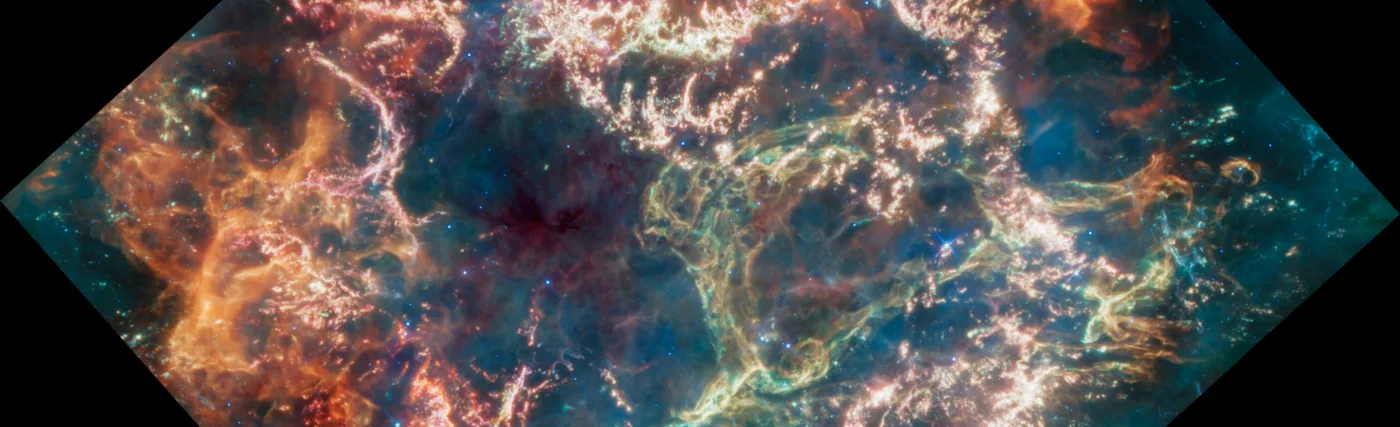
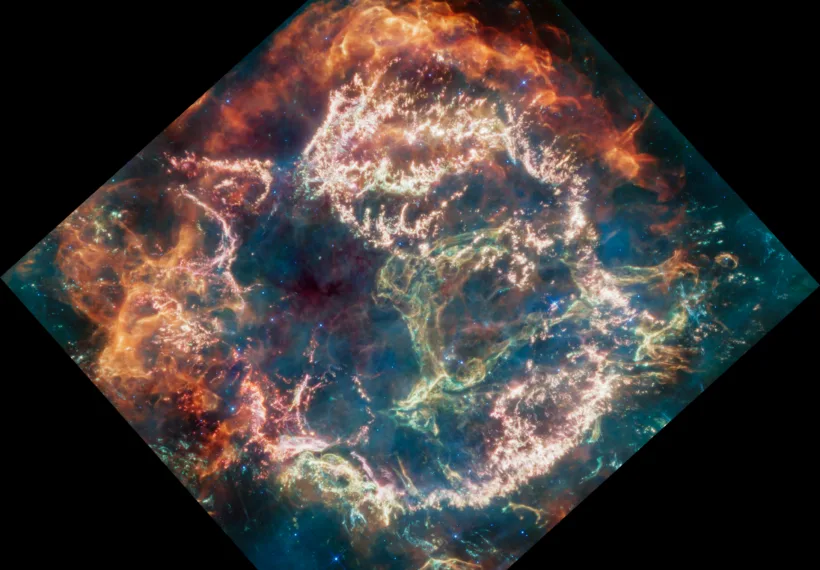
We have CAS-A?
Yes.
Was that an example?
Yes.
Okay, so tell us about CAS-A.
Yeah, so CAS-A is an exploded star.
It’s the leftover debris field from that star that exploded.
It’s got sound all over the universe.
I just want to say CAS-A is short for Cassiopeia.
A constellation who’s the queen of Ethiopia or Egypt, some African country, Cassiopeia.
And if you wanted to find her, it’s just a big W in the sky.
Yes, I actually love that one.
Asterism, a W.
because it looks like a crown.
Right, okay.
And we just name, because we find that object within the stars that track that constellation.
Exactly.
So it was the first, it was A.
It was the first A, there it is.
Okay, so pick it up.
So Chandra has looked at this object many, many times.
So has the Hubble Space Telescope and recently the James Webb Telescope have as well.
This is actually an interesting target for Chandra because it’s in such a great spot of the sky.
Chandra can look at it over and over.
So it’s called a calibration target because we can use it to make sure everything on board the telescope is working beautifully.
So it’s not only the time that scientists have proposed for it, but we also have more time because we check it for like engineering issues as well.
Oh, so I just got to clarify there.
Cassiopeia is what’s called a circumpolar constellation.
So it’s closer to the North Star.
When you’re orbiting the Earth, half the sky you can’t see because Earth is in the way.
But some of those stars that are near the poles, you get to see for much longer periods of time.
And when you said it’s almost a continuous view, that would be why.
It’s in a great view for Chandra.
I mean, Chandra does go about a third of the way to the moon, but there is still lots of stuff in the way.
And you still have to worry about all sorts of things.
So it’s in a great spot for Chandra to be able to view over and over again.
So we get this deep view.
Okay, so now what are we about to experience here?
All right, so we’re gonna listen.
So I mentioned the chemical elements.
So there’s iron in here, that’s like the purple.
There’s silicon, there’s sulfur, there’s calcium.
All of these different elements have been mapped with color.
So instead of just looking at it as a visual, we’re gonna hear those map to sound.
And so the lowest is iron.
You’ll hear it as we sketch readily from the center where that neutron star is, the leftover core of that star that exploded.
And as we go out kind of tracing the expansion of that debris field, we’ll hear it as we start to go through the iron, the silicon, the calcium, the sulfur, all the way out to the very bright blue rim, which is essentially a very bright shock from as it sweeps up into that material.
And what’s the blue rim made of?
It’s very electric, it’s electrons, it’s all of that.
Okay, so it’s not one of those elements specifically?
No, it is just the highest energy shock from that material.
Okay, so this was a supernova?
Yep.
Do we know when this supernova went off?
So I think it was about 400 years ago, but it’s like 11,000 light years away, so how old it is is relevant to Earth time or space time.
Right, so it actually happened 11,000 years ago while we’re just coming out of caves.
Yeah.
Okay.
We’re just inventing agriculture.
Yeah.
But we saw it.
We saw it.
Well, there might be tracings of seeing it.
It’s kind of one of those unclear ones, but yeah, about 400 years.
Okay, so let’s check out.
Yeah.
Listen.
Okay, this sounds like the Philharmonic, just warming up.
Tuning up, right?
What, just tuning, just before they begin.
And that was an exploding star.
Yeah, the debris field left over when it barfed its guts out of a place.
I would have thought more like, psshhh, boom.
Well, we’re only hearing the leftover part, so.
The leftover.
And it was really important to communicate.
So the iron, for example, that was like the lowest note that you’re hearing.
What’s cool about this explosion is that right before it exploded, the iron would have been at its core, right, as the heaviest element that it could produce before the explosion.
After the explosion, it’s more along the perimeter.
That tells you that this star actually turned itself inside out when it exploded, which is very cool.
And so as you’re listening to it, if you have the technique to listen well, you can hear it as that lower sound really picks up towards the perimeter.
And I’m just realizing now that you need to be trained to know how to listen to this sonification.
Exactly.
And that’s not any different from being trained to learn how to look at an image.
Right, 100%.
You need an astronomer there to tell you, well, this is that and this is that, and this is what happened there.
We provide captions to kind of help that.
But yeah, and we also separate out each piece so you can hear individually so that you can actually learn to listen yourself.
But yeah.
Got it.
So you got another one?
How about the Carina nebula?
Yes.
This is one of my favorite JWST images.
It’s stunning.
You can’t argue with this one.
No, you can’t.
because what’s going to happen here?
So in this one, we’re listening to this beautiful area of star formation.
It’s called the Cosmic Cliffs because you can see all of that really cool gas and dust down there towards the bottom that the James Webb picked up.
And then you’re seeing all of these young stars that have been recently birthed and are starting to like mature and stuff.
This one was broken down a little differently because the actual star formation area towards the bottom is so distinct from the visual of just the kind of empty space, if you will, just stars up in the top.
And so it’s divided into two pieces, and you’ll hear the difference between the top and the bottom.
All the stars are sort of like a clickety-clackety piano.
Let’s play it and see if that description makes any sense.
That was beautiful.
I should say, I don’t think I’ve mentioned it, we actually work with people who are blind or low vision to create these, because that really is that first desired targeted audience.
And then other people obviously enjoy them as well.
But we wanted to make sure, as somebody who has to listen to the world around them, that it made sense to people who are blind or low vision.
Otherwise, what are you doing?
Right.
Go home.
Right, exactly, go home.
Do you guys ever think about starting a radio station?
That would be really cool, just space.
So the gas clouds were telling us something different from the star points.
Right, exactly.
You’re getting like that whoosh of all the texture of the dust and the gas from that star formation area.
And then you’re hearing the individual stars picked out as, I don’t know, clickety-clackety.
It’s the only good thing you have to describe it.
Sure, if there’s a musician, you could find something better.
But having that differentiation of understanding them is really helpful.
That one distinction, of course, is when you’re sighted, you see the whole picture at once.
But the audio track is a scan across it, either left to right, in that case, or center to edge.
I found that actually to be really important.
I’m so glad you brought that up because I look, and I’m used to looking the most as someone who’s visual.
And I have found that I have learned things about data I have been looking at for dozens of years because I’m listening to it over time.
And it’s spoon feeding a piece, a slice of the image at a time.
It gives me time to think about what else could be happening.
And I’ve actually learned to digest it and to process it in a different way.
And I love that that’s a possibility.
Is this something that would improve if we closed our eyes?
Oh yeah, I think so.
Let’s do this again.
As an activity, like to maybe the next one, have them listen to that one.
Okay, what’s the next one?
Maybe we should just listen to it first and then I describe it as something a little different.
Okay, so the next one is?
V404 Cygni, I think.
V404 Cygni.
So V sounds like a variable star.
Yeah, and this is a what?
This is actually a black hole, a stellar mass black hole, so one of the smaller ones.
And it’s got a companion star and it’s kind of pulling off some material from it.
What that does is it causes these outbursts that then the light kind of like, I don’t know, bounces off of the gas and dust in the areas around it, causing light echoes.
Should we close our eyes?
Yeah, let’s do that.
It’ll be fun.
I feel like we’re in a meditation class right now.
Yeah, yeah, yeah, yeah.
So in that image, just to emphasize, there are these places, these sort of concentric rings that are the emitted gas from explosive episodes in the past, that continue to slowly move out.
Then you have another explosive episode, but there’s a gap between them.
And if you have another sort of episode, there’ll be an energy wave that will overtake those and then render them visible.
Right.
And so it’s kind of like, you know, if you’re driving in fog, your lights kind of scatter in that weird way, that’s kind of what we’re seeing.
And so you’re able to kind of trace the timing of this burping of this black hole in this way, which is really cool.
But all that gas and dust that it’s ricocheting off, that’s kind of what that sound we were trying to mimic as you were hearing it, almost sounds like ocean waves, which I feel like is very appropriate to the Hamptons.
And how do you determine what sound to affix?
I was going to ask that to the data.
Yeah, so it’s a few things.
So we have a whole team.
I work with Matt Russo and Andrew Santeguida, who are both musicians.
Matt is an astrophysicist.
And we also work with Christine Malik, who is a consultant who is blind as well.
And with the science story that we’re putting together, we’re trying to make sure it is as authentic as possible to the data, because it is a mathematical mapping of the data, like using Python, into this process.
And then you’re essentially selecting…
The programming language.
Yep, the programming language.
And then you’re selecting the sounds that will hopefully differentiate the objects the best, and also describe the science the best, and in a pacing that lets you process the data at the best pace.
So those are all things that we test for.
So it’s not just you, Rogue, in the back room?
No, not a conductor, no, no, no, no, not at all.
You and Dr.
Dre had a voice.
No, I know.
It would be fun, though.
That would be.
Yeah, do you have any hip-hop?
No, I don’t yet, but maybe that’ll change.
Yeah, hip-hop and the universe.
I thought it was great.
I mean, when you say black hole, there’s gotta be some hip-hop somewhere in this.
Dark matter, dark energy.
No, it fits, it fits.
Now, Hubbell had a deep field.
Yes.
So, did anyone do the crazy thing with Chandra?
Yeah.
To just look at them in the middle of nowhere?
We did the crazy thing with Chandra.
Forty days and forty nights, we looked at this one patch of the sky.
I know, it is beautiful.
We looked at this patch of the sky, and what we found was just a beautiful field of black hole.
So, it looks like you’re looking at stars in this image.
This is actually the deepest X-ray image we’ve ever captured.
So, this is really special.
If you’re trying to describe it, it’s like someone just flecked paint onto a black rectangle, right?
It doesn’t necessarily communicate the excitement of the science as I think of it.
This is the awesomest image ever.
And so, what we’re gonna do…
These dots on a page.
These dots on a page, because they’re black holes.
They are thousands of black holes.
It was the highest concentration of black holes that we’ve ever captured.
So, if Hubble had looked at this, because it can’t see X-rays, this would just be filled with stars.
Right.
Or galaxies.
Right.
Right.
But Chandra is detecting that high energy.
It’s not seeing anything else there.
Right.
It’s Geordie focusing in on X-rays, and he sees this.
Black holes.
Black holes everywhere.
It was a black hole bonanza.
because the sign was so exciting, and the image to me never really expressed it.
So, this was an important one to sonify, because I think it actually tells the story better.
So, we’re going to listen to a scan from the bottom up to the top, because it’s actually in stereo.
And each of these black holes is essentially color-coded by energy.
That’s a technique we often use in image processing.
The lowest energy material will be color-coded to red, and the highest energy material will be color-coded to blue, with the medium in green.
So kind of mimicking.
But for sound, how are you going to do it?
So, it’s the same thing.
It’s sound.
So, we’ve taken the red and coded it to the lowest note, and we’ve done the opposite.
So, the blue is the highest.
And so, you’ll hear that population of black holes, I think, in a very unique way.
Just right here, we don’t otherwise know.
Just somewhere brighter than others.
Right.
But we don’t know which has the highest frequency, okay?
Right.
Let’s check that.
Yo, that is my jam!
That’s the one!
That’s my favorite.
That is the one right there!
It’s kind of vibey.
It’s vibey.
Oh, that’s number one with a bullet, baby.
Yes, but you just listen to a population of thousands of these supermassive black holes, like billions of light years away for the most part, right?
And you’ve just heard that as you sweep through that field.
So I think it’s pretty fun.
That was beautiful.
That is.
Oh, yeah.
It was very Pat Matheny.
Yeah.
It has this kind of like indie.
Thank you, Pat Matheny fans.
Indie vibe to it.
There’s only like four of you here.
But I didn’t know what I was talking about.
That’s who I think of.
Yeah.
Those are some of the highlights of what you’ve been doing.
Yeah.
We talked about the bullet cluster, right?
On this one, we’re going to scan from left to right.
The X-rays, I believe, are like a wooshy sound.
I have to come up with better descriptors.
I’ve just realized it.
You’ll hear the stars very distinctly, and then you’ll hear a very strong note for the dark matter map.
Let’s run that one and see what you think.
Okay.
I mean, that was a whooshy sound.
I don’t know how else to describe it.
Dark matter didn’t know what hit it, didn’t it?
Right.
That one’s very sci-fi.
It is a bit sci-fi.
Very sci-fi.
Very sci-fi.
It’s no black hole deep field, I’m sorry.
I agree, that one is my favorite, yeah.
So this is a tool to show us things we already know are there, right?
So stars, galaxies, especially your high energy universe, which enchants you so.
But there’s any thinking about how you might detect dark energy, this mysterious pressure in the vacuum of space, forcing the universe to accelerate against the wishes of gravity.
We know it’s there, but we don’t know how to represent it.
There’s also neutrinos, this ghost-like particle that moves through the universe unimpeded, very difficult to detect, but it’s out there.
This, and perhaps other frontiers, await your efforts.
Thank you.
I think, yes, sonification is a very useful tool for that type of thing.
I mean, I remember when the LIGO neutron star merger story had come out in 2017.
LIGO that detects gravitational waves moving through the universe.
And there’s a very famous sonification that took the data and translated it into sound, because for that reason, you’re not looking at an image of light in that case.
So having to use some of these alternative tools to represent it, to analyze it, to me, just makes sense.
But I think there’s a lot more we can do.
Like we’ve started working in haptification, which is using, for example, on your phones.
If you’ve all got them on mute, like I’m sure you do, and you get a text, you’ll get a little vibration, right?
So that is the haptification.
So that’s a haptic.
That is a haptic.
When there’s a vibrational affirmation of something that just happened.
Exactly.
And so we’re just learning how to essentially harness that to be able to represent image data and other types of data as well.
I don’t know.
That’s weird.
It is weird.
I kind of like them because, for example, whether or not it’s your phone telling you you got a text message silently, but if you press a button and then you feel a little vibrational haptic, it’s like, yeah.
It gives you the response.
Yeah.
It’s like, I just pressed that button.
Right.
And that’s the idea, right?
So like using these other senses to be able to try to extrapolate out more from our data is something that I’m super excited about.
Yeah.
And how about other ways of visualization, which are familiar to us all, whether or not we’re embedded with them.
So virtual reality or augmented reality is another variant.
Any kind of mixed reality for me, yes, exciting because there are issues of scale, right?
And things like extended reality, mixed reality, augmented reality, whatever it might be that you’re using.
Remind us what augmented reality is.
Augmented reality is when you’ve got like say, oh, a Snapchat filter on yourself, right?
You’re adding a layer of this reality to your own reality.
Virtual reality is like a deeply immersive, you’re only in that virtual reality.
And there can be combinations as well.
And so in astronomy, I can kind of picture in the not so distant future, one of my colleagues in Cambridge is doing some kind of data analysis on a black hole and they’re working with someone in Japan.
And in real time, they’re able to step through this object in virtual reality or, you know, pick your reality of choice, right?
And they’re able to use sonification to check the variability of that black hole, perhaps whatever it might be.
Like there are all of these combinations of being able to process your data and to understand your data.
I always wanted movie theaters to do that.
Yeah, so it would be very cool.
Where the movie is just happening around you.
Yeah.
And you just walk up closer to the bar.
That is called life, Neil.
It is, I guess.
You’re right.
I can’t argue that.
So, and what about 3D printing?
You’ve been a big 3D printer lately.
Yeah, I’m a very big fan of it.
Yeah, so we have all these 3D models that we create for science, for scientific analysis, right?
When you understand the red shift, the moving away of something from you versus the blue shift was coming towards you, you can map that into a 3D representation of this object.
So then you can take that and you can move it to a 3D printer so that you can hold a version of it in your hand.
So just to be clear, until we figured out how to get the distance to anything, the sky was imagined to just be this sort of the inside surface of a spherical bowl, which would make everything at the same distance.
A weird TV screen.
No one is thinking 3D about anything in the universe.
And now that we have 3D information, you get to work on your 3D printing.
And you can represent it, 3D print it, hold a version in your hand, which is great.
Again, if you’re blind or low vision and you want tactile exploration of your data, it just gives you another avenue, and it’s very exciting.
And so you just have people exploring this, be they sighted or not, it still has value in a 3D space.
Yeah, actually CASI-PA was the first one that we’d ever done using observational data into a 3D model.
That was like super exciting for us.
And we 3D printed it, and the response to it was so fantastic.
So fantastic.
Well, excellent.
We want to see where this continues to go.
Is there a future?
What is the future of X-Ray astronomy?
Yes, so Chandra is 25, but still in amazing health because our engineers on the ground, like it’s too far to fix it.
You can’t like send up astronauts to fix it.
So anything they have to do to take Chandra to the doctor is just through coding, right?
Astronomy runs on coding, and they do a brilliant job with it.
You can just reprogram it.
You’re just reprogramming it.
You’re doing little tiny fixes here and there, if, for example, you need to look at a different kind of object, you just reprogram it a bit, whether through Fortran or whether through C++, all of these additional languages that we have, we just fix it.
Or Python, exactly.
And so that gives it prolonged life beyond whatever is imagined for it.
It was only supposed to be five years, and we’re at 25.
And there’s no expendables for like fuel and stuff like that that we have to be concerned with.
It’s just floating in orbit.
What about degradation?
You talked about these photons bouncing down this barrel.
I would assume even a photon might have a little bit of an effect like dripping water on a rock.
Honestly, most of the concern is because it’s so sensitive and the sun is close to it.
And so like there is issues with like how much it could warm up perhaps, because it has to be kept very cool in order to observe these, capture these X-ray photons.
So the sun is always kind of offering a bit of a danger, but there’s lots of fixes for it.
You know, how it’s pointing, where it’s tilting, what it’s observing at a given times.
All the engineers are so clever to figure out the best way to keep it super efficient, all from the ground.
So is there future plans?
Yeah, so there are new telescopes that are going to be coming on board.
The Ascena one is a European mission that will be coming in the 2030s, we hope.
Doesn’t still quite have the resolution of Chandra, however.
So we are hoping.
Ah, it’s because it’s Europe.
Oh no.
We’re hoping to plan like a super Chandra, right?
Like a next generation Chandra.
It’s temporarily called the Lynx Mission.
And the idea is to provide an even larger area to collect the X-Rays, even more high-def, and that would just be a dream come true.
That’s brilliant.
And we look forward to just more reporting from, because you’re doing something that none of us have ever met anyone doing what you’re doing.
So.
Who knew this was a job?
It’s like, what does mommy do?
Well, I have to explain that.
Hey, I’d like to offer some reflections on this evening and this content.
If you look at the arc of science, progress in science over the centuries, in almost every case, advances in our understanding of the universe have arrived in the presence of some clever device, some clever new way to probe the world around us.
And the people who do this, think about it.
They were not content with all the previous ways that we were decoding the world.
Our eyes were not enough.
Our ears were not enough.
So you find another way to do it and you reveal that the universe is talking to you in these places that were previously ignored or had no clue they even existed.
And so it leaves me humbled in the presence of what could still be discovered in the universe.
Are we like William Herschel, just happy with the red, orange, yellow, green, blue, violet, and that’s the whole world.
And then, oh my gosh, there’s another branch of the electromagnetic spectrum.
Little did he know that exercise would continue.
A hundred years from now, will they be saying little did him know that there’s a whole other way to look at the universe.
And back in 2024, we were practically blind.
Is that what’s missing in our understanding of the universe?
Forcing us to be blind to the 95% of the jelly beans in that canister.
We know they’re there.
We don’t know what they’re made of.
So I take this not as an occasion to celebrate how far we’ve come, but to reflect on how much farther we still need to go.
That is a cosmic perspective.
And so beautifully said.
Thank you, Guild Hall, Chuck Nice, Kimberly Arcand.
I’m Neil deGrasse Tyson, your personal astrophysicist.
As always, keep looking up.


 Become a Patron