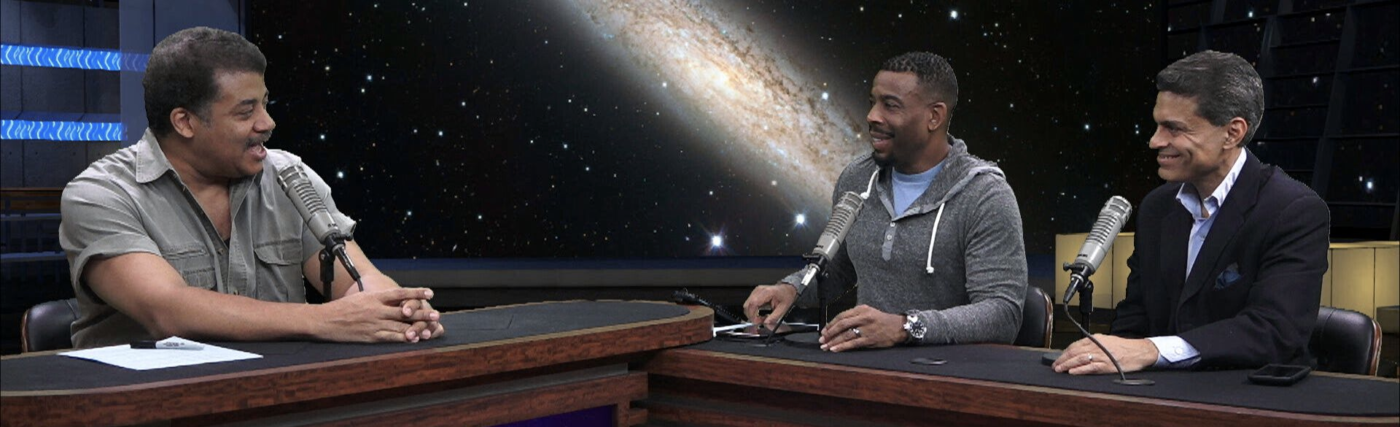
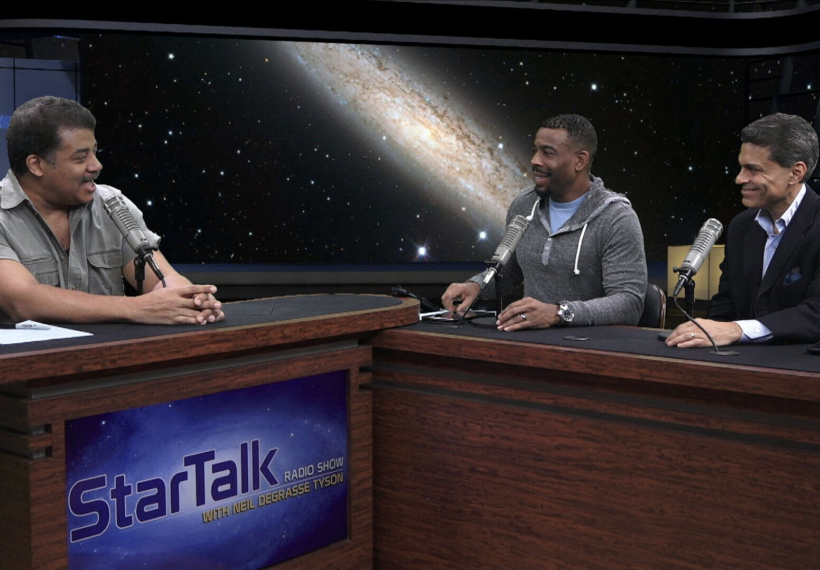
In the first episode of our special edition Cosmic Queries series, “Let’s Make America Smart Again,” Neil deGrasse Tyson and comic co-host Chuck Nice welcome CNN journalist Fareed Zakaria to break down the impact of immigration on science and technological innovation in the America. Join us for an intellectual exploration into the reasons that the United States became the world’s leading scientific and educational powerhouse after World War II, and why our current practices may threaten our leadership. You’ll learn how the Manhattan Project and the V2 rocket fed into the US space program, which was built on the backs of foreign scientists. You’ll hear about some of our highest achieving immigrants, along with why foreign nations who are creating national ecosystems where talent can flourish are beginning to reshape the academic and scientific hierarchy around the world. Neil, Fareed and Chuck debate whether it’s appropriate to require certain levels of achievement from immigrants, and the difficulty in trying to predict where you can find talent, drive, and creativity. Find out why no science has ever been done that has not had geopolitical consequences or been embedded in a political system. Investigate the concept of alternate facts, and the current assault on expertise, knowledge, and science. You’ll also hear how improving relations with Russia can be done through science, similar to the Cold War period, when scientists from opposing sides were still able to work together on the Apollo-Soyuz Mission. All this, plus, Neil reminds us how the US missed the opportunity to discover the Higgs boson in Texas had we built our own Superconducting Super Collider here at home, and why even if scientific breakthroughs don’t happen in America, we must be at least thankful that they are happening at all.
Transcript
DOWNLOAD SRT
Welcome to StarTalk, your place in the universe where science and pop culture collide. StarTalk begins right now. I'm your host, Neil deGrasse Tyson, your personal astrophysicist, and this is StarTalk. Joining me today as my co-host is someone who...
Welcome to StarTalk, your place in the universe where science and pop culture collide.
StarTalk begins right now.
I'm your host, Neil deGrasse Tyson, your personal astrophysicist, and this is StarTalk.
Joining me today as my co-host is someone who is no stranger to StarTalk Radio professional comedian, Chuck Nice.
Hey Neil, how are you?
I like the fact you put professional on the end of that.
Oh, sorry.
I was very, very kind of you.
Might be the first time I've done that.
Exactly.
You finally pay your rent off for your comedy.
Clearly I am paying my mortgage from comedy now, and somehow you got that information.
I'm very pleased to hear that.
Today we're talking about immigration policy.
Specifically, the contributions that immigrants and descendants of immigrants have made to science, technology, engineering, and math in this country.
Now, you know I'm not gonna do that alone.
I'd hardly do any of this alone.
So to help us out, we brought in special guest, the one, the only, Fareed Zakaria.
Fareed Zakaria, exclamation point.
That's right.
Do you have an exclamation point, like, born with your name?
Well, I was hoping.
It deserves one.
I was hoping to be called professional something or the other.
But I guess I'm just Fareed Zakaria.
I feel like I'm a professional, but something.
For the next 40 minutes, you're our professional, all right?
So Fareed is an Indian American journalist and author, and he's also a host of CNN's Fareed Zakaria GPS.
Right.
I assume.
I'm a fan.
I like the encore.
That's something that deserves to be said in stereo.
So you go ahead, right?
GPS.
He also writes a weekly column for the Washington Post.
So Fareed, thanks for joining us.
And we've been friends for a while, so I didn't just pick you up off the street.
Right, right, right.
So I did some homework on you.
And you have an extraordinary academic pedigree to be doing what you're doing.
So many pundits out there.
They're kind of self-made, they did a little bit of their own reading, and they have strong opinions, and people love hearing vociferously voiced opinions.
And you always have this sort of calm voice, and you have all this academic substrate there.
Isn't that always the case, though?
Isn't it always the guy who has an extensive and impressive academic pedigree?
They don't have to scream at you.
They're the guys that are just like, oh, okay, so you feel that way, huh?
Well, good for you.
Like, those are the guys.
It's always the guy who doesn't know anything that's just like, I'm telling you now!
This is the way it is!
Like, yeah.
I think of myself as a lapsed academic, maybe a little bit like you.
I mean, I don't know if you still consider yourself a practicing professional.
In my mind, I am, whether or not, in practice, I mean, I try.
The profession would regard you as such, as if.
I look forward to that, give all this up and just go back to the lab and then you'll never find me again.
So I want to just explore this.
What I bring to the table for you to react to is the fact that science in the United States, which really came of age in the 20th century, there were many drivers, but let's take, for example, the formation of the National Science Foundation.
But there were earlier indications, go back to Abraham Lincoln, who in 1963, when he clearly had other priorities, he signed into law, created the National Academy of Sciences, recognizing what role science was playing in Europe and how important it was saying, and we get me some of that for our country.
And he also created the land grant college system.
So he had tremendous foresight into the role of science and technology as a fundamental driver of everything the United States would become.
So now I look at, I'm closer to physics than I am biology, of course.
So I look at things like the Manhattan Project, so crucial to what became 20th century politics and science.
And it landed us where we became, where we were for the entire second half of the 20th century.
And most of those scientists were foreign born nationals.
And so what, from your worldview, could you just explain how this works, just?
You know, it's fascinating.
You're absolutely right to focus on the beginnings because we think that America was always the most scientifically innovative country in the world.
You know, we look at the Nobel Prizes and we take it for granted, 5% of the world's population, we get about 75% of the world's prizes.
And that doesn't even count Obama's Peace Prize, which I regard as kind of a weird one, in his first year of office.
Come on, it's like a lifetime achievement award.
Yeah, at age 25.
At age 25, it's, you know, it's like, well, you didn't really earn this, but we gotta give it to you just because we like you.
Exactly, but if you look at the early 20th century, in 1910, 1914, I forget the exact date, Germany had won more prizes in science, Nobel Prize in science, than Britain and the United States put together.
So the US becomes a powerhouse in science, basically for three big reasons.
The first is the destruction of Europe.
Basically, World War I, World War II, Great Depression, the place gets flattened, all the universities shut down.
With the last man standing.
With the last man standing, and particularly Germany gets destroyed.
Germany was the scientific superpower.
Second, we take in all these immigrants.
People forget, even in the 30s, with all the restrictions, 100,000 Jews came in from Europe, many of them scientists, as you say, many of them worked on the Manhattan Project.
After that, of course, the door opens even wider.
And the third is massive government funding.
So, let's think about it.
Europe ain't destroyed anymore.
Government funding is down to half what it used to be.
Our only hope, frankly, is that we keep taking in the best and brightest in the world.
Otherwise, you already see the world catching up.
You already see that Japanese scientists win Nobel Prizes routinely, that you now have the Chinese getting in on the action.
So, we have to recognize, we're 5% of the world.
We want to make sure that we're not winning just 5% of the Nobel Prizes.
Wow, well, that's, I mean, that very fact then is enabled only if you then not only have access to, but mutual interest in coming to the world's greatest talent.
And the world's greatest talent isn't always in your country because everybody's human and innovation is not some...
Nobody has a monopoly on this.
Innovation, it's just a matter of opportunity to express it.
And you know what, I've noticed something, Neil, which you probably know, I was for a while a trustee of the college I went to, Yale.
And there were a lot of government...
You see the way he did that?
But listen, you know what I like about the way the Fareed just did that too?
It was like a subtext, you know what I mean?
Small college in New Haven.
A little afterthought.
So here's the point, Yale is private, of course.
A lot of government cuts to public universities, some of the great public universities in America.
And we noticed that we had access to better and better scientists who were...
Well, because the University of Arizona is cutting funding.
Michigan State is cutting funding.
So Berkeley, you know.
Now, it actually happened less at Berkeley than anywhere else.
But what I was struck by, being a New Yorker, being in the world that you and I are in, Neil, I thought we were going to have to offer these guys more money.
No.
The scientists only cared about would they have good labs and good colleagues, because they wanted to be around other smart scientists.
They wanted to be able to have graduate students who were good.
So it makes me, I mean, the point you're making, people will come to where other smart people are.
That's the magnet that attracts you.
You know what's funny is that what you just said is just a fact of human nature.
When you want to do well, when you want to win, when you want to be the best, then your own personal gain tends to take a back seat to the accomplishment of a greater goal.
For instance, sports stars will take a salary cut so that really good players can stay on their team.
Or they'll give up being the number one guy on a team to go be in a team effort where they're pretty much guaranteed a championship.
This is part of the way we think.
I'm going to tell your agent that you voluntarily agreed to take a pay cut.
Be at the right comedy club.
Two things are going to have to happen.
One, you're going to have to tell my agent to get me paid first.
And then you can tell him I'm willing to take that pay cut.
So, Fareed, I hadn't fully...
That was like a missing piece of my total worldview of this.
That it's not just simply come here because you're being persecuted there.
It's come here because there are other really smart people here and then the resonance of this intellectual community will not only benefit you, but it will benefit all of science.
And any good scientist will tell you, I want to see science grow even if I'm not part of it.
Because there's a curiosity that we all carry to this frontier.
And whoever can move it, that's great.
Exactly.
I mean, you find that one of the things the Chinese were having difficulty, they've been trying to recruit back some of the best and brightest...
We trained here.
The United States trained here.
And they would say to them, we'll build you the biggest lab, we'll give you unlimited research funds.
What a lot of Chinese professors were saying is we don't have the best graduate students.
We want to work with the best graduate students and those people are at Berkeley or Harvard.
Now that's changed.
Now Beijing University and Tsinghua in particular have superb graduate students.
And so you're beginning to see all, many of the best and brightest go back to China.
So when I go back to, again, the Manhattan Project, I go back to the Apollo Project.
Each of those had sort of military motivations.
I mean, we don't like remembering Apollo as military, but NASA was in response, of course, to Sputnik and the threat that we perceived by that.
But you look at, of course, Einstein came over.
Like you said, this whole flux of Jewish scientists.
Then after the Second World War, we build our space program on the back of Werner von Braun, for example.
And now you have all these people.
Enrico Fermi.
We have labs named after this guy.
Fermi Labs.
Okay, he's Italian, his wife is Jewish, and all of this is going on.
This is America.
That's exactly right.
It's not even being fined for what that is.
It's just, of course.
And of course, to just emphasize one piece of this, massive government funding.
People don't like to point this out.
I think all government funding is bad.
Then you say, oh, the government shouldn't pick winners or losers.
So look at the microchip industry.
The beating heart of the computer revolution is the microchip, right?
Texas Instruments basically invents it.
And then the US government, through the Air Force, buys something like 60 to 70% of all microchips produced.
The cost initially is 1,000 per microchip.
It goes down to $30 per microchip because the government keeps buying it.
It basically allows for scale, which then drops the price.
Exactly the same thing that people are trying to do in the solar industry or the wind industry.
Are the people in the government who are doing this, they have this foresight?
Are you telling me this?
We normally give that much credit to government officials.
I think we have, if you look at DARPA, which is the agency in the Defense Department that does this, they're...
We actually recently interviewed the head of DARPA for StarTalk, yes.
Really good.
Defense Advanced Projects Research Agency.
Agency, and then there was ARPANET, which is the precursor to the Internet, was in fact, came up, the Defense Department, in fact, invents it.
GPS is part of the Defense Department.
I think that the main thing we have to realize is you have to throw a lot of resources at.
The science is expensive.
Basic research is the most important, but you also need the development of technologies.
Of course, you're going to miss lots.
Of course, some companies like Solyndra will go bankrupt.
But you know, if you think about it, at the same time the government made a loan to Solyndra for about $600 million, it made a loan to Tesla for $600 million.
Now, what happened?
Solyndra went bankrupt.
Tesla has gone up 10,000%.
Guess who made all that money?
The private sector, the shareholders and Elon Musk.
So when the government loses the money, we the taxpayers take the blame, but we don't get the upside.
That's just the nature of it.
But it doesn't mean that it doesn't work for science.
We do get the upside in the sense that if the government births an industry, then the industry has tax base that comes back to the government.
Exactly.
And each scientific invention produces a new one.
Another one, right.
And just for the record, StarTalk was birthed by the government on a National Science Foundation grant.
They believe in what we were trying to do.
That was a little more like the Cylindro one, right?
I thought we were doing okay.
You know, you go, just I'm looking at our notes for this, that apparently, you know, of course, Benjamin Franklin, let's go back to him, one of the first great scientists of the United States.
He, I mean, I, he wrote books on research and electricity.
So he's, he's probably, he might even be been a better scientist than founding father.
I mean, if you look at what his record is and what he's discovered in the books that he had published, but regardless, he, he, his parents fled England because of religious persecution and he's here.
And so he's basically an immigrant, his immigrant lineage, which would have been easy back then, I guess.
Pretty cool.
See, the thing is though, doesn't really count when you're, when you're not brown.
I'm just saying like, you know, it's just the way it works.
Let's get, let's get to that.
There are rules.
There are rules.
Let's get to that.
So, so, so, so, so Fareed, let me be devil's advocate here.
So we have these, I cite all the famous scientists of the 20th century that shaped modern, you know, we have Wernher von Braun from Germany who birthed the, he, he basically designed the Saturn five rocket that got us to the moon because he had that knowledge and, and awareness from his, from developing the V2 rocket.
And that's basically the first ballistic missile.
Left Earth's atmosphere found its target, fell on the target.
That's, that's a ballistic missile.
V2 being the rockets that the Germans developed and, and rained on London in 1940.
Correct, correct.
Although rain would be a little too delicate a word for what these things did.
So, yeah, they fall out of the sky supersonically.
So, it's not, it's not like, Not a whistle.
No, you do not.
You don't.
It's just, you're walking and then the block explodes.
Okay.
That's how that.
My dad was a graduate student in London in 1945 and was having coffee with a bunch of his friends in a cafe.
He was, they said to him, stay for a while.
He said, no, I got to get back.
I got to get some work done.
He walks out and he turns his back and a V2 rocket hit the cafe.
Everyone there, every friend of his died.
If he had just stayed when they told him just have one more cup of coffee, he would have been dead.
Man.
Then we wouldn't even be having this conversation.
Right.
Or I think of it the other way.
That's how it sounds.
How many others might have been having a conversation and not him?
Because they would have had to say it.
Did he ever use that as a motivated factor to get you to do your work?
Let me tell you something.
I would do it.
Yeah, you know what?
I got back to work and I'm alive.
You know, people are different.
My dad had a tough upbringing.
He was a self-made man and he always said, I went through stuff I don't want you to ever have to go through.
That was his attitude.
Well, let me just complete this list.
Steve Jobs, as we know, his family lineage is traceable to Syria, if I remember.
His actual father was a Syrian immigrant.
And Elon Musk, a South African via Canada.
Sergey Brin, Google.
And Google.
Right, all of this.
All of this.
And so...
Not to mention all the real...
I mean, the scientists.
These are all we're talking about.
We're trying to...
It's just the entrepreneurs.
Right, we're just talking about the entrepreneurs.
Okay, so now, devil's advocate.
This is a list of people any country would want.
So do you say, yes, you can immigrate, if you have these kinds of ambitions or if you're going to...
We'll let you in if you go get a degree in engineering.
I mean, is that the devil's advocate posture here that has not yet been resolved in this conversation?
So there's no question we should take any of those kinds of people.
I think Michael Bloomberg had the idea, if you get a PhD in science, you should have a green card stapled to your degree when you get it.
Makes sense.
That makes a lot of sense.
Makes sense.
There's no question we should...
Also, Newt Gingrich was a very strong posture on that.
And I think that that seems to me a no-brainer in one of the parts of immigration reform one hopes eventually will get to.
The harder question, as you say, is we've taken lots of people who are not like that.
That's called the family unification policy.
I think we've probably taken too many that way and too few who are skills and brain-based.
But there's also something to be said for the sheer drive that low-skill immigrants bring.
Obviously, in the right numbers and in a way that they can be integrated.
But the biggest problem for a rich country is you lose that drive, you lose that hunger.
We all have children and the more fortunate the parents' circumstance, the kids are going to be great.
Sad and lazy.
They can't have the same drive.
Right.
But the United Arab Emirates has a similar problem.
It's a very wealthy country, but who's going to clean the laundry and who's going to...
Right, but some guy who comes from Mexico or Guatemala or Honduras who's willing to risk everything, abandon home culture and come here to wash dishes.
Just to do that.
16 hours a day.
That's a good, some kind of drive and energy.
By the way, that person might end up doing something remarkable.
His children might end up doing something remarkable.
That's what I was going to say.
The real thing you have to keep in mind is the children of those people tend to be the ones who have that same drive, but they are also educated here in America, which gives them a distinct advantage when it comes to it.
Bigger drive than American with the same American education.
So they're, what we're doing is we're creating better Americans.
You're listening to StarTalk.
Stay tuned for another segment.
Welcome back to StarTalk.
Here's more of this week's episode.
If there's a policy that says, we'll stop all immigration, evaluate it and say, okay, here's the proscenium through which you'll walk.
If we judge that you will be the right person for this, is there risk of that abuse with that?
That kind of happened 100 years ago, didn't it?
Northern Europeans, not the Southern Europeans.
There was a lot of judgment being placed on who was worthy and who was not.
I think the big danger is that we think we can identify talent and drive and ambition and creativity, and those are complicated things.
So yes, we should do more skill-based, we should probably do a little bit less family unification, we should get the balance right.
You don't mean immediate family, you mean extended family.
Exactly, of course an immediate family would come over.
But by the way, again, in the old days, in the 19th century, one person from a village in Sicily would come and then bring the whole village.
Yeah, right, right, right.
So we have done that and we have managed to absorb it.
And that is partly what has given this country the kind of diversity and richness it has.
But in terms of balancing the numbers, maybe more more scale-based, maybe less of this, as you say, extended family unification.
But I really think it's important to remember, we don't know when we take in a 10-year-old kid, what that kid is gonna be, whether they may, he or she may be a poor Guatemalan, that doesn't mean that, you know, talent is sprinkled evenly throughout the planet.
And you might be getting amazing people, even though they look like they're poor peasants from places that are not doing well in the world.
So one other question, before we get to the queries, you solicit these from-
Yes, we have the queries from all over the internet and any incarnation where you can find StarTalk.
Excellent, excellent.
So just one other quick thing just to extract it from you, because I love having you here, because this is good.
So there's the flip side of this, that no one in America talks about.
If we are so great that everyone wants to come to us, that's a brain drain for other countries.
We're getting the best of other countries sort of sucking their intellectual capital into our borders.
If we get a stronger world, we'll be less capable to do that even if we wanted to.
So the way I think about this, Neil, it's a very good question.
As you can imagine, having grown up in India and come here, I would hear this often.
People will say, why are you leaving India?
You know, your country needs you.
But here's the truth.
I actually do think talent is sprinkled throughout.
There are millions and millions of talented Indians.
I'm not that special.
What's special is the environment that this country has created where smart and talented people can flourish.
There's another way of putting this.
There was a member of parliament, an opposition member of parliament, who stood up one day at the Indian parliament and asked the then prime minister, Indira Gandhi.
He said, Madam Prime Minister, can you explain to me one question?
I noticed when I look around the world, Indians seem to do really well everywhere except in India.
What does that tell you about how you run this country?
Oh, yeah, there's no answer, there's no good answer to that.
It's all about creating an ecosystem where talent can flourish.
It's the problem in India or China or Africa is not that there aren't talented people.
It's you haven't created the ecosystem that lets them flourish.
You know about the Einstein Project in Africa?
Looking for the next Einstein, black Einstein basically.
Oh, really?
Yeah, yeah, yeah.
In Africa.
In Africa, right, it's very cool.
I have no doubt in my mind that there is somebody as talented in terms of raw intelligence, he or she exists.
It's the question is, can you create the ecosystem that let Einstein do what he did in Germany and Switzerland?
There's a Gary Larson comic, ever see this?
There's Einstein playing basketball, right?
And they said Einstein had a promising career as a basketball player until an ankle injury turns him to the books.
Wow, well who knew there was already a black Einstein?
You know.
So what do you have, Chuck?
Well, we got our Cosmic Queries.
So let's just jump right into it since we already set up the fact of where we get these.
The first one that we always take is from a Patreon patron because they support us financially.
And we just put them to the top of the list because of that.
Right to the top of the list.
They pay, they go right to the top of the list.
Kind of like, You're not even ashamed to say that.
No, I'm not.
It's like Congress and lobbying.
Okay.
So we have lobbyists for the show.
Yeah, they're lobbyists for the show.
You give me some money.
HR supporters, you're all lobbyists.
I say drain the swamp.
Let's hear from the freeloaders first.
Drain the stars.
Drain the galaxy.
We're gonna drain the galaxy.
All right, here we go.
Here's our first from Renee Douglas since Renee's from Pittsburgh, Pennsylvania.
Says, why is it important to you that the United States lead the world in science?
She's speaking to you directly, Neil.
Are you just rooting for your own team, so to speak?
Or is there a better reason?
So I think it's natural to root for the home team.
And you don't wanna do that to the point of waging war, I think, that's my opinion in that regard.
But you root for the home team.
And I grew up in the United States in the second half of the 20th century, which had a lot of problems of its own.
You know, hot war, cold war, civil rights movement, campus unrest, but in there, we were going to the moon, and we all knew that that required innovations in science and technology.
We knew this.
And so I would be upset if that sense of inventing a future were no longer happening on the soil in which I was born.
I would be upset.
However, I'd be even more upset if it didn't happen anywhere else in the world.
So yeah, I wanted to have been the one who discovered the Higgs boson in a Texas super collider, but it got its budget cut in 1993, having judged, well, what's the value of this?
Because my view is peace had just broken out in 1989.
And when peace breaks out, who needs physicists as far as anybody thinks?
So the Higgs boson gets discovered in the Large Hadron Collider in Switzerland as a European collaboration.
We're part of that collaboration, but we're not the major leaders of it.
We're not the quarterback.
We're not the quarterback.
Just on the team.
We're on the team.
We know that is very un-American.
To not be the quarterback.
You know, we're supposed to be the quarterback.
We're supposed to be the quarterback.
As a scientist, we're all delighted, but as an American, so that's just, I'm just being honest with my feelings there.
But as long as it happens somewhere, if the whole world closed down, then we're all moving back into the cave together.
By the way, it does matter to American economics.
Basically, the way you get economic growth is two things.
How many people do you have and how much productivity do you have?
In other words, it's the number of people who are in the workforce, labor, and it's productivity, how productive are each of those people?
And productivity rises only through technology, technological innovation and science.
Yes, exactly.
And just to be clear, you can, this is a slightly controversial statement, but I want to be very frank about it.
Go ahead.
The times when the arts grows economically, in almost every case I've seen, it's because they have been touched by technology and science.
That enables it to occur in a innovative way.
I think there's also, and there's a mutually reinforcing thing, the arts feed creativity, which allows, for you, I mean, there's these wonderful stories about Einstein when he would get stuck on a physics problem, he'd stop and he'd go and start playing his violin.
He said that it would unlock something in his mind that he couldn't understand.
So ideally, you have a kind of, you know, there's a symbiosis of creativity.
Right, right.
All right, let's move on.
I love this.
Christie Borden says this.
What does the scientific community think or hope is the next big discovery on the horizon that would be really wonderful if it happened here in the United States?
Gosh, there's so many things happening that are extraordinary.
I mean, I think that if you look at some of the most dramatic new frontiers, I think, are in biology.
So if you might, my eight-year-old daughter is here because she's a huge fan of Neil's.
She's sitting outside in here.
She's cutting school, I might add.
She's cutting school for this, this counts as school.
This counts as school.
This counts as school, all right.
She was talking about the brain episode that she was watching about, that Neil did on Nova Science Now.
And if you think about how mapping the brain is gonna transform our understanding of the brain, what happens to medicine, and just to knowledge.
This is actually, in a weird way, it's uncharted territory.
Just beginning to understand it.
Best of the frontiers are just that.
A little scary, but even more exciting.
You marry it to the revolution in big data, where the brain is gonna produce, the volume of data is gonna be so large that only the new supercomputing...
Brain invented big data.
Yes, it did.
Exactly.
So it seems to me that's the one, but there's so many.
I mean, physics...
Yeah, and I agree, Fareed, the brain, neuroscience, neuroscience as a frontier.
Also, of course, AI, which is related, will we have autonomous robots that can think for themselves without having to just solve a problem that you hand it?
So that's a...
They'll come up with their own problems.
They'll be like, robot, will you solve this problem?
Solve it your own damn self.
It was like, it is self-determining.
I'm sentient now, Neil.
Yeah.
All right.
Let's go to...
You know, I gotta do this, Neil, because I've seen quite a few of these questions come across, and so I'm reading Ben Nuffelkamp's question as a representative for all of you who have written this type of question, not only for this show, but another show that I co-hosted with Bill Nye on a similar type of subject.
Neil, why does StarTalk have episodes that either have nothing to do or vaguely encompass astronomy, physics, or other science?
If I wanted liberal politics, you'll like this part, Fareed, I'd just turn on CNN.
Okay, so the reason I read that question is because this is not political, what we are talking about.
Well, we're talking about just the world as a better place, whatever, and however you slice and dice that politically, that's people's own motives, but there's some fundamental reality that has to matter here before that conversation even happens.
But I can address that, I can say, I could enter this world naively as a scientist and think, oh yeah, science, let's just do science, but then you wake up and realize that any science that happens is embedded in a political system.
I'm not an island.
And I have to beat some of my colleagues over the head who cry foul when NASA spends money on something they don't think they should spend money on, the space station or on demand program, which has always been a controversial path of spending relative to pure research.
And I go to my colleagues and I say, you are treating NASA as though it's your private funding agency when it was born in a Cold War environment and there are geopolitical mission statements that NASA fulfills and you are not the only one in town that it serves.
And in fact, the science budget of NASA historically has never been, it maxed out at about 35%.
The long-term average is around a fourth and all the rest goes to geopolitically driven decisions for what NASA does in this world.
And if you think about the point we were making earlier, if American science, if the reason we're the forefront of global science is, the three things I talked about, Europe got destroyed, two world wars, we took in lots of immigrants, and then we spent lots of government money on it.
Those are political issues.
And so if you want to create great science, yes, you have to have great scientists, but you've got to figure out how do you get them?
How do you create an environment where they flourish?
How do the ideas get back?
All of that is embedded in a political system that's got to recognize that in order to make wise decisions regarding it going forward.
That's all.
That's it.
It's not more complicated.
I mean, it's complicated, but the drivers of it are simple.
And it's not more political than that.
And by the way, this used to be totally bipartisan.
It was Eisenhower who set the spending max.
Eisenhower was spending 3% of GDP on basic science.
Reagan increased the spending.
It is recently that we have gotten into a situation where everything is political.
This used to be bipartisan.
Not only that, of course, under President Nixon, we formed the Environmental Protection Agency and the National Oceanic and Atmospheric Administration.
Right.
So you're right, Fareed, when I look historically, there's a lot of co-mingling of political platforms that are in the service of science.
And historically, even the National Science Foundation has been bipartisan, although the motives were a little different, you know, and many would complain that the R&D spending under Reagan, a lot of that went to Star Wars, which many in my scientific community objected to, but at the end of the day, even if the motives are different, science gets done.
So science is political, but we are not politicizing it.
So we're not coming down on one side or another, we're coming down on the side of science.
One could if there's a political side that doesn't like science.
If it's anti-science.
We can tell you the consequences of what it is to be anti-science.
That's all.
You're listening to StarTalk Radio.
Stay tuned.
More up next.
Next.
Welcome back, here's more of StarTalk.
Fareed, I want to hit one thing.
When I was in graduate school, at least half of everyone in the sciences and engineering were foreign nationals.
And at that time, they would come, get their PhDs, their masters, and stay.
As the rest of the world rises up, and as America fades, we become less of a carrot for those very same graduate students.
And I've seen many of them go back to their home country to China, to India.
Will there be a point when they won't even come here as graduate students, because those fully trained PhDs now train their own graduate students, and then we have this reverse flux of the intellectual capital of the world?
It's a great question.
My own sense is it'll be a long time before that happens, because the one thing that the United States still absolutely dominates is higher education.
If you look at the lists of the top 20 universities in the world, 18 are American, top 50 in the world, 36 are American, and it's hard to design a really superb world-class university, because there's lots that goes into it.
You can't do that overnight.
You can't do that overnight.
Harvard and Yale and Princeton have huge advantages having been founded in the 17th century.
They have lots of money.
I was gonna say, they're called endowments.
That's a huge event.
But I'll tell you one piece of it that I wonder about when you look at a place like China.
At the heart of Western science has been the ability to question authority.
For the graduate student to tell the professor, you're full of it.
Your ideas are wrong.
I remember reading a story.
Your ideas are outdated or I got a better idea.
Niels Bohr used to begin his lectures.
A great physicist from the turn of the century.
Used to begin his lectures in Copenhagen.
He'd tell his students, I want to start by telling you, you must approach this lecture by assuming everything that I say might be untrue.
Might be falsifiable.
In other words, that sense of really being willing to challenge authority, that is not yet true in a place like China.
And I wonder if there's a cultural barrier, which will mean that it takes even longer for that to happen.
I've thought a lot about this, and except I came to it from a less noble angle.
When I see little children in malls, if there's a toddler just steps out of a stroller and the parent says, get back in the stroller, he's like, no, I don't want to, I don't want to.
That's an American kid.
And normally they're white.
No, stop.
I'm just saying.
No, no, no.
Not too many black kids talk back to their parents.
Just letting you know.
So if it begins that early, just a kind of...
It's in the culture.
It's in the culture.
It is in the culture.
It's in the culture.
You've had skateboarding, middle schoolers.
It's also something else that you talked about.
We had a conversation a long time ago.
About the fact that in other cultures, you may not see the aspirations to do things that we take for granted in this culture.
When I grow up, I'm gonna be an astronaut.
Right, right, right.
What do you wanna be when you grow up?
What do you wanna be when you grow up?
And in other countries, unreachable goals are actually tamped down.
Right.
Whereas here, it's like, oh, isn't that cute?
Go ahead, right.
But I do wanna emphasize, it's important to remember, these are not God-given advantages the United States has.
We can lose them very easily if we don't maintain the culture of openness and creativity.
God shed his grace on thee?
What are you?
I do think there needs to be a greater focus on science.
You'll like this.
One of my favorite lines from one of Tom Friedman's books, the New York Times columnist, he was in China and he was noticing, Bill Gates happened to be there.
And people were going crazy over Gates because he was this computer whiz.
I mean, yes, he was also very rich, but the combination.
And he said, I guess I've realized the difference between China and India is in China, Bill Gates is Britney Spears.
In America, Britney Spears is Britney Spears.
Yes.
You know, we venerate pop icons.
They turn geeky computer scientists into pop icons.
Oops, you've done it again, Fareed.
Give me another one here.
All right, here we go.
Speaking of what Fareed just said, here's Bob Longmire from Facebook who says this, given the current political climate, how do you suggest we help advance scientific literacy with people who view science through a negative political lens?
Very, very good question.
Fareed, what is your solution here if, I'm trying to get people to understand what science is and how and why it works, and they're swept up into a worldview that does not allow that in.
That's, what do you do in the world of politics?
What has the world done in the history of this exercise?
You know, it's very frustrating because it's not just an assault on science.
It's an assault on expertise.
It's an assault at some fundamental level on knowledge.
And I think there's a tendency to say that all this knowledge is either biased or opinionated, or you have your facts, I have my facts.
No, you can't have alternate facts.
You can disagree, you can draw your own conclusions on the basis of those facts.
How much of that isn't fed, it's fed by the fact that in politics and in religion, people, there isn't that absolute right or wrong, and so people are accustomed to arguing what they want to be true.
Now you add science to the mix, and they feel like they can have the conversation in the same way.
But you know, I think it's coming at a populist moment where people think that all the experts get everything wrong.
I was reading the New York Times recently, there was an article about Steve Bannon, Donald Trump's chief strategist, who's having everybody read a book called The Best and the Brightest.
This is a book about how the smart Kennedy advisors got America into Vietnam.
And the moral of the book is meant to be, or the way he sees it, all these experts were wrong, disastrously wrong.
In fact, if you read the book, what's interesting is actually what it points out is all the political advisors were overconfident, arrogant.
They were not listening to the real expertise of the historians, the people who understood Vietnam, who understood China.
The cultures.
The cultures.
It was actually a story about expertise that was ignored because people had a political lens, which was anti-communism, which they filtered everything through.
Right.
That makes perfect sense.
Chuck, what else you got?
All right, let's move on, shall we, to Anne Colway.
And Anne says, Love, StarTalk, do you foresee the future of international collaborations changing as a result of the new, frankly barbaric, policies that have been put in place?
Now, this is, maybe when this comes out, this will have changed, but as of now, there is still a-
As of the recording.
As of this recording, there's still a so-called immigration ban that was in place, then a federal judge said no, and that's where we are at this juncture.
Well, I'll make a statement, and I want Fareed to react.
Scientifically, when we collaborate internationally, we do so at international conferences.
If they don't happen to be in your department or in your country, you can still collaborate because you get to get there.
We create these occasions where there's an intellectual discourse and their workshops, their international conferences and the like.
So you guys have your own science date.
It's a science date, okay.
You know what I mean?
It's like you got your own thing.
And so I've been on multiple papers where there are international collaborations with it.
And so I can say that I don't require there to be immigration.
Okay.
For me to still collaborate, the internet enables that.
Right.
International conferences enable it.
So Fareed, what do you say if all the world is this fertile landscape of communication, then who needs immigrants at that point?
There's no question that you can do more electronically than you ever have been able to before.
But again, it comes back to do we want the United States to be the center, the place where people meet?
I remember after 9-11, there was a period where there was similar kinds of pauses and immigration slowdown and increased vetting.
We didn't call it a xenophobia.
We didn't call it vetting.
A lot of scientific conferences were canceled that were going to be held in the United States, and they held them in Europe, they held them in China.
Now, if we keep doing this kind of thing, you know, it's not the end of the world, but it certainly will mean that the center of mass is gonna shift.
The center of mass will shift, and frankly, the Europeans are more than happy to pick this up.
There's a French presidential candidate.
I just read about this.
He said, you know, I just want everybody to know, anyone who finds that they are having difficulty doing science in America, come to France, we will give you, we'll roll out the red carpet for you.
And that's the French.
Let me tell you something, and that alone should be a huge wake-up call to everyone in this country.
That is like Ryan Gosling talking to your wife at a cocktail party and says, listen, if this a-hole ever, if you ever get tired of this jackass over here, hi, I'm Ryan Gosling, you're more than welcome to come over and have coffee.
Let me tell you something, you're gonna start treating your woman a little differently.
I had a similar earlier thought when I read this news and I read this news article about this attempt to get ready for the next asteroid so we can deflect it out of the sky.
And by the time I got to the bottom, it was Russia organizing it, asking who's with them to make this happen.
And I said, and I felt like, wait a minute, I was just so expecting that it would be us inviting others to participate.
And I realized that this, if when you fade, it's not a cliff, you just sort of slowly disappear and everyone else rises up and they have conversations at their table whether or not you're invited.
And I love the fact that you said when you fade, it's not a cliff, it is indeed a slippery slope.
And when people use that metaphor, they need to take in mind exactly what the visual is.
It is a 45 degree angle where you are slowly sliding down, you're clawing it but it's not getting any traction, you're just sliding away.
So that's what it is.
Out of view.
Out of view.
You got to have one quick one, if you got a quick one.
Okay, here's a quick one.
A quick one and this is for Fareed.
As terrible as things are, could better relations with Russia improve science and space exploration?
Yeah.
Sure.
Look, we should have good relations with Russia.
We should have good relations with China.
We should have good relations with all these countries.
The problem is, you know.
They have space ambitions, each one of them.
When Russia invades its neighbor, when it annexes parts of another country, something that basically hasn't happened for decades and decades and it contravenes international order, you've got to do something about it.
So there's got to be a way, and we, by the way, managed to do this even during the Cold War, to cooperate, but also have certain rules of the road that matter.
But I think that ultimately-
Wait, wait, just right there.
Wait, so, I don't want you to go quickly past that.
While we were still in Cold War with Russia, we had the Apollo-Soyuz Joint Space Program.
And this was like the early signs that maybe we can be friends.
So, just because there's transgressive behavior in the world from one country to another, should that, that should not have to stop what might be science or space collaborations.
I think, in fact, it's all the more reason to do it.
Because you want to build as many bonds as you can between countries.
We don't work better in isolation.
There's this wonderful book by Matt Ridley about the, why did human beings manage this extraordinary rise from being just animals?
And the most important thing he points out is, whenever we encountered diversity, we flourished, just even scientifically.
But as human beings, the more we can encounter the other, the more we can collaborate with people who think differently, look differently, study differently, the end product is better.
Who's the wit of 100 years ago who said, there's no greater pain to the human spirit than the prospect of coming up with a new idea?
I haven't heard that one, so I think we're going to say it was Neil deGrasse Tyson.
You can take it.
Yeah, so what you say is, I think, can be clearly demonstrated, but there's the soul speaks differently about who you want to hang out with.
We want to create the homogeneous bubble.
But that's why you want to get past your comfort zone and into that area of unfamiliarity.
It's hard.
It seems to be against human nature, to welcome in the people who look different from you and sound different from you and think differently from you and have a different religion or political ideology.
We've been part of the same tribes for thousands and thousands.
If you think about it, for most of human existence, we grew up, we grew old and died one mile from where we were born.
Now we're saying all these people who come from.
Abandon that and embrace the whole world as your tribe.
And even though those tribes are not sending you their best, they're sending you criminals, they're sending you rapists.
It sounds like it's time to end this episode.
We're out of time, Chuck.
I'm talking about the tribes.
I'm talking about the tribes.
Thanks, Chuck, for co-hosting today.
And thank you to our special guest, CNN.
What do they call you guys?
Anchors.
Anchors, CNN anchor, Fareed Zakaria.
You all know his show, GPS.
And don't miss it.
Thanks for listening to StarTalk Radio.
I hope you enjoyed this episode.
Many thanks to our comedian, our guest, our experts.
And I've been your host, Neil deGrasse Tyson.
Until next time, I bid you to keep looking up.
See the full transcript




 Unlock with Patreon

 Become a Patron