
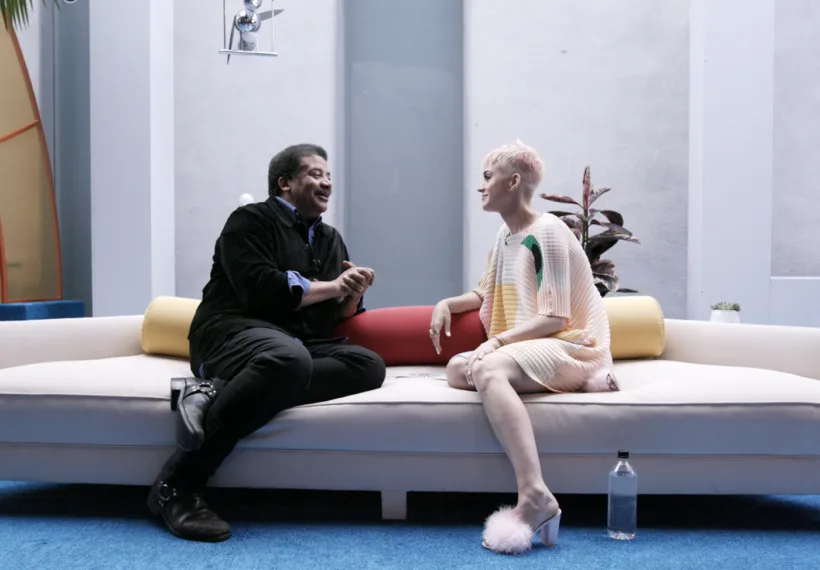

Jon Betz' photo of Neil deGrasse Tyson and Katy Perry.

Katy Perry’s Cosmic Curiosity

Neil deGrasse Tyson and Katy Perry. Photo Credit: Jon Betz.
  • Free Audio
  • Ad-Free Audio

About This Episode

On this episode of StarTalk Radio, Neil deGrasse Tyson talks to one of the biggest stars in the world about her untapped cosmic curiosity – Katy Perry. Even though she used such terms as extraterrestrials, prisms, and more in her music, on this episode we focus on her curious mind and even hear about some of her science crushes. In-studio, Neil is joined by comic co-host Sasheer Zamata, former cast member of Saturday Night Live and who has some Star Trek origins in her name, and astrophysicist and StarTalk All-Stars host Charles Liu. Katy and Neil discuss Katy’s upbringing and how she was never really interested in math and science until later on in life. Together, they explore how math is the language of the universe and how math and music are forever intertwined. Charles and Neil ponder whether mathematics was invented or discovered. Katy and Neil also discuss her use of scientific terms in song titles. You’ll learn about Katy’s curiosity for knowledge, and Neil explains why being curious is a fundamental principle to human life. Sasheer leads us in a game of “What Don’t We Know” which includes topics like time, gravity, and SpongeBob SquarePants lingerie…  yes, SpongeBob lingerie. Katy then reveals that she has a ticket to fly on the Virgin Galactic commercial space flights and Charles explains what really happens if you vomit in zero gravity. Next, Neil and Katy discuss Katy’s ant farm, and her thoughts on extraterrestrials and the possibility of humans being an ant farm colony controlled and watched over by a higher species of life. Find out whether Katy would sing or talk to aliens if they contacted her, or if she would do neither. Katy and Neil also talk about our universe and the likelihood that we’re living in simulation. We answer fan-submitted Cosmic Queries about the starry sky, the gravity of gas giants, and Uranus, and Katy has a Cosmic Query of her own for Neil. You’ll discover more about the Fermi paradox and Charles gives us more insight into the cosmic perspective. All that, plus, we discuss the cross pollination of science and faith, and Neil gives his closing thoughts on the importance of staying curious in school and beyond.  

NOTE: All-Access subscribers can listen to this entire episode commercial-free here: Katy Perry’s Cosmic Curiosity.

Transcript

DOWNLOAD SRT
Welcome to StarTalk, your place in the universe where science and pop culture collide. Star Talk begins right now. Welcome to the hall of the universe. I'm your host, Neil deGrasse Tyson, your personal astrophysicist. Tonight, we're featuring my interview...
Welcome to StarTalk, your place in the universe where science and pop culture collide. Star Talk begins right now. Welcome to the hall of the universe. I'm your host, Neil deGrasse Tyson, your personal astrophysicist. Tonight, we're featuring my interview with pop superstar Katy Perry. I was delighted to discover that she has deep curiosity. From the idea that we all might just be ants living in an ant farm, to her total crush on Isaac Newton. So, let's do this. So, my co-host tonight, my comedic co-host, is the one and only Sasheer Zamata. You all might know her as a former cast member on SNL. Now, Sasheer, just so you know, we don't bring on just any comedian to be my co-host. You got to have a little bit of street Greek geek cred. Oh, street geek cred. Street geek cred. Yes, and I understand that you are named after an alien crystal from one of the original episodes of Star Trek. This is true. Yeah. Whoa. Yeah, my parents are Trekkies. Whoa. And the episode was called By Any Other Name, which is very apt. Also joining us is my friend and colleague, Charles Liu. Charles. So he's a fellow astrophysicist, but that's not why we have him on this show. Really? Yeah. You are a fountain of knowledge on all things pop culture, as well as astrophysical. Tonight, we're featuring my interview with pop star Katy Perry. She has sold more than 100 million albums worldwide. She is the number one followed person on Twitter with 100 million followers. She has three triple platinum albums, and her latest release is an album called Witness in 2017. I recently was invited to drop by her pad, her digs in Los Angeles, just to hang out and chat about the universe for StarTalk. Let's check it out. Hello. Well, thanks for inviting me to your space. Do they have names? This is Nugget. Hey, Nugget. Hello. She's barking at you just because she wants attention, just like her mother. I used to walk dogs when I was a kid, and I used that money to buy my first telescope. Really? Yes. Hey, Nugget. No barking. Be a good girl. All right. Let's go outside. I am so... I love what you've done with the party... . excited to talk to you. So have a seat. Thank you so much. It's called StarTalk. StarTalk, yes. Oh, my gosh. And how long have you been doing the show? So for many years, we first started with a grant from the National Science Foundation. And we said, how about the people who don't know they like science? Right. Or better yet, the people who are pretty sure that they don't like science. Why don't people like science? Well, I don't know. They might fear it. Maybe they didn't do well in school. I think they're scared of it. Yeah, yeah. Exactly. Scared of the unknown. That's what we do. I'm scared of the unknown sometimes. You're in a dork-safe space with me. This is all we're going to do. Amazing. Totally geek out. So of course, I did some homework on you. And so you were homeschooled, right? I mean, you were by teachers? I went to Christian school, but we moved around a lot because my parents started churches all around the country. Oh, OK. And so we would live in one space for only like a year and a half or so. Mm-hmm. And then we would move. So I would be taken out of different schools that were kind of pop-up schools or like... So there were no science teachers or math teachers that had any influence on you, positive or negative? No, no, in particular, I didn't... I wasn't ever good at math. I was always promised no math. There will be no math on this show. Maybe by the end, you'll be good at it. I know. And then, is math related to science? Math is the language of the universe. Numbers. If you want to go to China and speak to Chinese people, you learn Mandarin? Yeah. Go to Spain, you learn Spanish. You want to go to the universe, you learn math. It's that straightforward. I know that people have done this before on your show, but I just want to go and do it once. Yeah, so that's why math is so fundamental. Right. And it's kind of mysterious, because we invented math out of our head, yet it applies across the universe and across time. Right. So it's completely amazing. Amazing. That this thing that came out of our head even works. Yeah. To describe the universe. Yeah, we kind of invented it. As a language. Yeah, as a language to communicate with great precision what's going on in the natural world. Because regular language isn't precise enough. That's why regular language is good for emotions and other things that are kind of fuzzy and abstract. You know, but when it comes time to actually measure something you need the math. Measure twice, cut once. That's right. So Charles. Yeah. You've heard people try to pick a fight. Was math invented or discovered? So where are you in that camp? It was definitely invented. Yeah, I have to agree with you. Yeah, counting systems developed all around the world since prehistory. You can clearly show from petroglyphs and things like that how the progression of mathematics and arithmetic came about even before we had language to describe it. But over time... But you say math predates language. In many ways, you can see some evidence. There are some historians that suggest this. But the ancient Greeks are credited often with creating that level of math where you're going beyond the practical, the counting for arithmetic or geometry to build pyramids or something and really do math as its own thing. So in the same way that, say, we use language like English, there are scientists, linguists, that study language in its own. The study of mathematics as its own thing is a relatively new phenomenon in human history. So math is also, of course, is the foundation of what we think of as music. Absolutely. So even if you're not formally trained in math, say if you're a great musician, you may actually know a lot of math intuitively, even though you may not write an equation down. Simply because of the music that you have covered. Because you have intuitively understand it. So with Katy Perry, she might, even though she declared math ignorance, she may have a little more sensitivity to math than she openly knows. I think so. Because my analogy to that is an outfielder in baseball. So you're playing the outfield and the ball gets hit, and it's not in front of me, it's not behind me, it's off to the side somewhere. So I have to run to my side and farther away, and then I will be where the ball lands when the ball lands there. That's a physics equation. It's a complete physics equation, but I'm not consciously doing that in my head, but some part of my body knows this. That's right. The human brain is probably the greatest physics and math computer ever created on Earth. Well, Katy, she has a physics reference in one of her album titles. I knew this, so I had to ask her about it, so let's check it out. Your previous album, I love the title, Prism. Were you thinking prism? I mean, prism is a physics thing. It's a piece of glass that it's triangular and it takes white light and it breaks it into its component colors. Were you thinking that or you had another application of the word prism? Well, I had someone call me a prism and it seemed like a compliment. I would take that as a compliment. It means you take ordinary light and break it into all of its beautiful colors. That was geeky brilliant to say that. And they call me a prism and it stuck with me because I do think that like that's what I do sometimes is through my songs I take an information, I digest it and then I make songs out of it and then I go, and it turns into all these colors and that's why we're sitting in a rainbow right now. This is a beautiful space here. It's a bit of a prism. Love what you've done with the place. But I didn't know that it was so science-based. Yep, it's completely science-based. Secretly, I've loved science my whole life and I didn't even know it. So what happens is the different colors travel through the glass at different speeds and they break apart from one another and they emerge on the other side in this beautiful rainbow. And you can remember the colors because it's Roy G. Biv. Biv. Yes, I remember that. Red, orange, yellow, green, blue, indigo, violet. So it's a beautiful thing. Isaac Newton discovered it. Love him. Not me. Love me some Isaac Newton. I have a crush on him and Socrates. Is that right? Oh, oh, wait a minute. Oh, so that accounts for your one phrase bio. What do you mean? I know nothing. What do you mean? That's Socrates. Is it? Of Plato via Socrates. I didn't even know. I really didn't know that. I appreciate philosophy and science so much. And spirituality, of course. And the things that I don't understand, I appreciate. And the more I thirst for knowledge, because I'm so thirsty. If I'm thirsty for one thing, it's knowledge, right? Not enough people are. And education. And so I love educating myself, and I'm such a spun, and I'm so curious, and that's what it's got me here. But the more that I learn, the more I realize I know nothing. Well, so what happens is as the area of your knowledge grows, so too does the perimeter of your ignorance. Because that's the boundary between what is known within the circle and what is unknown outside of it. So every new thing you learn, you stand in a new place and see things you never even knew you didn't know. I know. That's the thing, is like, what I thought I knew four months ago, I've changed my mind, and it's not because I'm a woman. It means because you're curious. It's because I'm curious, darn it! So Charles, to be curious, this is an important thing. It's everything. It's the fundamental of everything. Katy is like the kind of student that I would love to have in my astronomy and physics classes. Curious, interested, it doesn't matter how formally capable she is of doing an equation or writing down a problem set or anything. I just want her in my class so that she can learn and I can learn from her too. There's another important element to that because she knows when she doesn't know something. Yes. That's even more important. There's a humility and an authenticity to her curiosity which I think is just wonderful. So that's a fundamental part of science. It is the most important. The most important thing. Yeah, what you do. That brings us to... What? Oh, you got something? I came to your show to bring you something. You got something. I have a game show. Oh, I didn't know that. Yeah. You want to play? It's called What Don't We Know? I'm going to list three questions of things we may not know and then you have to figure out what is the question we don't know. Does that make sense? Yes. Okay, great. All right, so the questions are, how powerful is gravity? Why does gravity happen? What is influenced by gravity? Which one do we not know? We do not know why does gravity happen. We don't know why it happens. Because we know that matter is influenced by gravity and we know that gravity's power is way, way weaker. Yeah, we can measure it, but we don't know why. It just is. But we're cool with that. We can land stuff on Mars knowing how gravity behaves even if we don't know what it is. Let's see if you're right. You're right. Very good. Now, there are people working on that. Quantum gravity ideas, grand unification, the separation of gravity. These are top people working on it. People way beyond my pay grade. All right, here's another one. How does time affect entropy? Is time constant? Why does time flow in one direction? The third one. We don't know why it flows in one direction. I must agree. Although there are particles that travel backward in time, right? We call that antimatter. No. Well, no. Okay. Let's... No, we don't know why we can move forward and back, up and down, left and right. Three spatial coordinates. We can move in any direction. The time coordinate in which we are embedded as a prisoner of the present. We... Okay. We have no access to what happens behind us or in front of us. We have no understanding of why time has an arrow. Yeah. You're right. Why does time flow in one direction? We don't know. We don't know? We don't know. And we'll be the first to tell you. We have no idea. Yeah. Yeah, yeah. No, it's fun to be ignorant. You know what? What? Just the way you did that, like the finger came out. It's going to be dumb, ready? One Direction's time ended a long time ago. Oh! I thought it burned, so they broke up. Next question. Time was not on their side. Which one do we not know? Why did Brangelina end? Will Game of Thrones, the show, overtake the book? And how is SpongeBob lingerie a thing? I got to go with SpongeBob. SpongeBob. Lingerie. SpongeBob. Let's see. How's it a thing? Cool. Is it really a thing? I actually don't know. I mean, he wears underwear, right? Yeah. Well, yes, he does wear underwear, but I think for people, people are wearing SpongeBob lingerie. Probably not from Victoria's Secret. How did you find out? He does live in a pineapple under the sea. Are you ready? Katy Perry's curiosity might even take her to space. She officially has a seat reserved on the suborbital commercial flight. Check it out. Did you buy a ticket on the Virgin Galactic flight? Okay, so I bought one and I... So do you want to go? Well, hold on. I bought it for my ex-husband. And then I took the ticket back. Oh, good. I'm glad. In the separation. Because if not, I got people who could have done that for you. I still have the ticket, and I'm very curious. But the point being is that... This is brave of you and forward of you. Well, yeah, but listen, I'm not going to go... I'm not number one. Okay. Me neither. No, no, no. I'll be number 562. Okay. I'm a little bit anxious about it. You should. Why not? Because it's the unknown. And like, you know, gravity and stuff. Just the simplicity of gravity. You have to watch out because when you're in zero G, you feel a little nausea. If you throw up in zero G, the vomit just floats around and gets in your hair. And splashes. Yeah, yeah. But it holds together, right? It can, yeah. It's actually called surface tension. If you get enough vomit in one area, it'll blob into one spherical ball, undulating ball. That's good that you knew that. Well, I kind of assumed. It's good physics. Yeah. So, Charles, did I miss any physics in that 0G vomit? Oh, no, it's good. But it's actually worse than that. The surface tension, if you're able to eject the vomit out of your body, they will form nice little spheres in the air. But if you only get it part of the way up, the surface tension will cause the vomit to stick to your face, go up because there's no gravity stopping it. It's going to go up your face, into your nose, over your eyes, make it hard for you to breathe. So it's a really gross thing. So Charles, have you booked a ticket on Virgin Galactic? I have not. It's a little bit... I'm pretty sure you're not paid enough. That is 100% true. But beyond that, I think I want to win. The tickets are, it's a quarter million dollars a seat. Okay, then I'm definitely not waiting. And is this trip just going to space or are you landing somewhere? No, no, no, no. The first round is just going to be above sort of the atmosphere and you do a sort of fall down back and you're weightless for a period of time. You're not orbiting the earth, not in the first round. Oh, just up and down. Yes, up and down. Ultimately, they'll orbit the earth and you'll be weightless for like hours. You could do that at Six Flags. For way less. Right. If you throw up, it's not an issue. Exactly, it'll go down, not on your face. Well, up next, pop star Katy Perry will tell us about her mild obsession with aliens when StarTalk returns. Welcome back to StarTalk from the American Museum of Natural History right here in New York City. And we're featuring my interview with global pop superstar Katy Perry. And I asked Katy about her hit song called ET as in extraterrestrial. Check it out. So tell me about Aliens. You have a song about ET. Was it metaphor? Was it literal? Well, it's metaphor, but that's the thing is like I have an ant farm in there. How do you know we are not an ant form equivalent of a species that found humans that found humans entertaining and said let's make a place for them where they think they are free? That's why I put it there. And they put them on earth. Where they think they are free. That's why I have a song called Chain to the Rhythm. You know, it's like you think you're free, but we're all chained to the rhythm to the rhythm. You know, drink this one's on me, but we're all chained to the rhythm. And so when I look at ants, and I just think I'm an ant, I just think I'm a speck of sand. We kind of are, but yeah. We are, but I think also like sometimes we're that speck of sand that like accidentally gets in your mouth and is like, I can feel that. It's this big, but it's completely there. It's there. I don't like it at all. Or I do like it, or who knows. But that's what the ant farm in there represents is just that like, you know, sometimes we are chained to this idea and constructs and things that we think we should be or things that the world tells us to be and like, how do we think for ourselves? Or can we even think for ourselves? So if one morning you woke up and the ants catapulted themselves out of the ant farm, they thought for themselves. Would you celebrate that or would you freak out? The ants achieved consciousness. They realized they were in a matrix and that their creators were humans. Who constructed this prison that they think is a universe unto itself. Could that be us? I'm just going to press control-alt-delete on this whole situation. So do you guys have an ant farm? I didn't. Sasheer? Yeah, yeah, I have an ant farm. I carry it with me everywhere. Yeah, there it is. They're really moving and grooving. Yeah, there's Barry, there's Joe. Tito, Marlin. And then they're making little paths for themselves and just living and loving life. So I thought only kids had ant farms, but apparently... So, Charles, why do you think this is a thing? Well, I know that some psychologists think that when you're developing as a child, you like to see how other things behave so that you can model your own behavior after them. But as we grow older, of course, we don't behave like ants, so I suspect it's more along the lines of curiosity and trying to see what will happen. It's almost like watching a TV show you don't know the answer to or watching a sporting event where you don't know who's going to win and just seeing what develops. And that itself is a fascinating thing that allows us to sort of explore behavior. So what do you think of my hypothesis or the plausibility argument that I gave that we could be an ant farm of an intelligent alien species and they establish Earth for their own entertainment to watch us Earth? Well, there are plenty of science fiction stories that suggest some similar things like this. I'm just wondering, are you with that or not? Well, the rationalist philosopher René Descartes suggested that we would not be able to tell the difference whether or not we were in somebody's ant farm or whether... René Descartes of Cartesian coordinates. That's the one. I think therefore I am... That one too. That guy. Yeah, that guy. So when we're thinking about whether or not we are in some sort of other creation, the only thing that matters to us when we're in it is are the rules consistent, right? If I drop something 10,000 times, will it always fall in the way I predict it or will on the 10,000th and first time suddenly it flies off into space? That inconsistency is the thing that will tip us off to suggest that there's something non-natural going on. Like a glitch in the Matrix. Yes, like that glitch. Like a glitch in the Matrix. The black cat came twice. Well, I asked Katy Perry what she would do if aliens ever visited us here on Earth. Maybe they are observing us, but maybe one day they just want to come down and chill. I just have to find out what she thought about. Check it out. So, if an alien came, would you want to sing to it or talk to it? Only if I would want to talk and sing to me. Not sing to me, but just like, I think it would be more like I would just listen. I would just try and... You are the first person ever to say that. Why? It's beautiful. Just listen. If you counted to an alien, you would listen. Oh my gosh. Nobody says that. They want to do all the talking. And I agree with you. If they got here on a spaceship, they're going to have more to say than we do. Oh, hello. We can only go to like, what? 35,000 feet without costumes? I'm going to listen. Right. Time to listen. It's time to sit and listen. And they might be coming anyways because it's like you ain't been listening. You've been messing up. So what would you do if aliens visited? I think I would listen too. That's a good point. Yeah, yeah. She's got a point there. I want to know what they have going on in their part. I, on the other hand, would explain to them everything about humanity. That's a thing about humans, I think, that we want to explain everything away and just put our points like at the forefront. Yeah, regardless of what anybody else says or thinks. And that would be like, human-splaining. And then when we try to colonize other areas that don't belong to us, it's human-spreading. Human-spreading. Big thing lately on the New York City subways. Yes, a lot of that happened. And every time I'm sitting here with my legs all like that, I say, no, people are looking at me. You got to close it up, make room. So if men wore skirts, they'd be a little more conscious of spreading their legs. I don't even, are you sure? I don't think there's any concern about that. So Charles, if they came across the galaxy and they landed, what do you think the first thing they'd say to us? In a more serious vein, the first thing they would say to us is either, give us your women and children and precious metals, or we're here and we're not going to hurt you. One of the first two things that they're going to try to communicate. But I don't think they're going to be... Okay, but wait, wait, wait. But we've learned from all the history of science fiction films that the first thing they'll say is, take us to your leader. Yeah. You know... Yeah, we're about to take that one through. I don't know if I want to take him to my leader. Actually, please take the leader. So, of course, we've been trying to not so much communicate with aliens, but listen for signals, radio signals, that they might have been sending. We haven't heard anything yet. Not yet. So what's your call on that? Well, there's one... So SETI, Search for Extraterrestrial Intelligence. There's one school of thought that simply says that life is so rare in the universe that they're so far away technologically that chances of our contacting each other are essentially zero, just by random chance. That's sort of expressed by something called the Fermi paradox. Enrico Fermi, who said something, said... He was asked... Physicist. Yes. Mid-century. Yeah, who actually helped to create the atomic bomb. Nobel Prize winner. And he was once asked, what do you think about the possibility of extraterrestrial life? And he answered, well, where are they? Why haven't we seen them yet? Surely with our technology and telescopes, we would have seen evidence of some sort of life out there. So the other hypothesis is that they're hiding. They don't want us to find them. Either they are running the ant farm, or they're just not even in the sphere of our understanding that they don't even want to bother with us. And the alternate idea might be just as terrifying that maybe we are alone in the universe. I would rather not be. Yeah, nor I. Well, I wanted to find out... I would like to be alone. I need space. We have more of my interview with pop star Katy Perry when StarTalk returns. We're discovering the deep curiosity within pop superstar Katy Perry. Katy had an unusual question for me about the science of musical notes. Check it out. Aren't there notes that can make you do things? Well, like they can break glass. Yeah, if a high enough frequency of note, that's right. And also poop your pants. Yeah. That's what they call the brown note. It's real. I heard that one. You had it? No. Well, I don't know if it's real. I want you to be the one to tell me if it's real. If such a note exists, I bet it's a low frequency note. Yeah. That makes you just drop your balance. That just gets through you and jiggles your inner body. Speaking of your gut, speaking of your gut. Your second brain. This cosmic perspective that I think about all the time. It's what the world looks like from above, looking down. The cosmic perspective doesn't only come from the universe. It can also come from biology. So, deep inside your gut, one centimeter of your lower colon lives and works more bacteria than there are humans who have ever been born. And we want to think that we're in charge. You know what you are to a bacterium? You're just a vessel of dark anaerobic fecal matter to a bacterium. Oh my gosh, Neil just called me a vessel of anaerobic. I'm basically poop. Ha ha ha ha ha. Charles, have you ever heard of this brown note? Yes, I have. It's also known as the disco dump. Is it real? Like I said, I didn't know, but I would imagine it had to be low frequency. So you wouldn't even hear it, you would just feel it. Yes, it was hypothesized to exist and some people played with it and thought, maybe you can make your bowels jiggle and things like that. Maybe like nine or 10 times per second kind of sound. Very, very low, beyond. So nine hertz. Yeah, something like that. But that was completely debunked. Oh, okay. Yeah, myth busters, actually. So it's all a bunch of crap. It's a load of it all right. Oh! Yes, no, but the things that cause us to have bowel movements, they're so complicated. Just a single note won't do it. There's a lot going on. You need a symphony of notes. So, do you agree with me? We agree on so many things, it's almost pointless for me to ask, but just to verify for my own satisfaction, I think a cosmic perspective doesn't have to only come from the universe. Absolutely. It's just a sense of what is our relationship to things outside of ourselves. Right, the realization that we are both as wonderful and as simple as every star in the sky or every flower in the field or every bacterium in your gut, right? Whether we're important or not important, it's kind of like what Katy was talking about, that grain of sand. You can notice it on your tongue, but I don't think of it as so much a grain of sand as a grain of sugar or a grain of salt, where we can have flavor or sweetness. That just comes from that realization that despite our simplicity and our smallness, in our humility, we can still achieve a lot of joy, a lot of enlightenment and a lot of cool life. Ooh. That's beautiful. Isn't that beautiful? Isn't that beautiful? Well, Katy Perry had another quirky cosmic query for me. Let's check it out. Why are there seven million people? And why do each one of us have our own fingerprint Even twins have different fingerprints who are otherwise genetically identical? Why? Would you rather we were all the same? No. I'm just asking why. Why is that more odd to you than the fact that we all have different personalities? We have different talent. But personalities can be based on- And what you learn. Environment, nurture and not just nature. Right. So I thought about it the other day and it kind of made me spin. It's just like we all have different fingerprints. Okay, I get it. Grand design. Well, so it's an intriguing fact. But here's something that may relate. Most people who could be born will never be born, will never even exist. So the fact that- Like sperm. Okay, yeah, sure. Yeah, yeah. One gets- I mean, it's science. The rest don't. So where do they go? They're part of the number of human beings that will never ever be born. So the few of us- Well, is that because there's not enough souls? There's already so many people in the world. That would be something if you ran out of souls. What would a soulless person look like? Do you believe you have a soul? I don't know what a soul is. I know there's what- Here's something that freaks me out every day. Every morning I wake up and I say, how is it that every morning I wake up as me and not as someone else? Oh, yeah. Yeah, I have that same feeling sometimes. It's like, this is weird being me. What is it like being you? Right. What's I'm saying? It's like, why am I me every day? Why? How does that happen? Again. We have these electrochemicals in our head, and somehow that's me. And I'm me every day as far as I know. As far as... Now I wonder if I woke up as a different person each day, would I know it? I don't... I can't know that. I'm going to have to unsubscribe right there. That's where the spiral starts, because I don't even know. Think about it. If tomorrow I woke up as you... And you woke up as me, how would we know? I'm not doing it. If I wake up as you, I will know all your friends. I'm not doing it. Should we just like chest bump? So... Oh my gosh, you're blowing my mind. Well, up next, we tackle more of pop star Katy Perry's pure cosmic curiosity when StarTalk returns. To StarTalk, from the American Museum of Natural History, we're featuring my interview with pop superstar Katy Perry. And she had an intriguing question for me about the very nature of the universe. Check it out. Are we living in a simulation? Tell me right now, please. Tell us on the record. I hate to break it to you. You want to know? Well, I mean, what does that mean? Okay, I'll tell you, all right? You've played video games before. Yes, that's what it means. Have you any game come to mind? Super Mario Brothers. Super Mario Brothers, okay. Mario runs around, jumps. Yeah, because we push buttons. And he'll jump off a cliff, but then scurry and come back to the... All right, so he doesn't fall? Yeah. If you were in that game, and you were a scientist, you would start asking yourself, what are the laws of physics in my world? And I decode all the laws that are operating there. You mean you get all the cheat codes? Okay, that makes you better at it. So there you are. Yeah, you warp tunnels that way. There you go. So there you are, and that's your world. Why is that any different from this world, where I'm a scientist trying to figure out how this world works? And so I cannot guarantee for you that we are not in a simulated universe. I just can't... I can't guarantee that. Cool. Ha, ha, ha. So both of y'all, if you found out tomorrow that we're living in a simulation, how would that change your life? I guess it wouldn't. Yeah, for me, it would be no different. We would just be still in the simulation? Yeah, you'd still be in the simulation. Charles? I'd have to think about it the same way that Keanu Reeves or Neo thought about it in The Matrix, right? Mm-hmm. Do you want to take this pill or that pill? And the decision will affect how you live your life, and it's totally OK one way or the other. I mean, it kind of feels like we are in a simulation. When we're sleeping, it's like you're putting the game on pause or turning the game off or something. You have rich parents, like cheat codes. Everyone thinks that men are running the whole game, but women really built the thing. This is secret. This is the foundational knowledge. Well, that brings us to the part of the show called Cosmic Queries. Whoo! So tonight we took questions about cosmic queries that we may have always wondered but have never asked. And I got Charles Liu here to help me out. So, Sasheer, do you have questions for us? Oh, I got questions for you. We haven't seen these before. A cult from our fan base on the Internet. Yeah. Question one is from Amadou Bago from Sao Paulo, Brazil. If there are a huge amount of star constellations when we look at the night sky, why do we see a lot of black regions? Ooh. Well, do you want to get into the Olber's Paradox thing? No, just go straight up here. There are just a whole lot of stars, but the universe is even bigger than you can imagine. And so, even if you look in every direction, there's still a lot of empty space. If a bumblebee were the size of a star, if there were four bumblebees scattered into the United States, that would be about the right average distance between stars and our galaxy. So the galaxy is a whole lot of nothing. Really? Yeah. Yeah. I thought there was more out there. No. I hate to bring the news to you. There is more. It's just really far away. Yeah, yeah, yeah. Matter and particles and stuff you care about, there's hardly any of it in the universe. Where you have planets and stuff, this is an extraordinary concentration of matter. And our brains are extraordinary expressions of biochemistry. All right. Next one. Question two. Paul Cooksley from New Zealand. I know this is probably an easy question for you, but why hasn't the gravity of the gas giants pulled all of the matter into a smaller solid planet? Good question. So this would be Jupiter, Saturn, Uranus, and Neptune, the gas giants in the solar system. And they got strong gravity. So why didn't it just pull us all into a ball? Charles. As it turns out, there is a safe distance from objects where you can go, beyond which you will not be sucked in or pulled together into a single ball. As they say, there's no such thing as gravity. Earth just sucks. That's geek humor, by the way, if you... Yeah. So just as we have not fallen into the sun because of our orbit around it, it gives us enough distance to keep it away from the gravitational potential of the sun itself. The same is true with all the gas giant planets. And black holes as well. That's why we're all just falling into a black hole. Yeah, yeah. They're far enough away. We have speeds that prevent that. You get close enough, you're hosed. But beyond certain critical distances, we good. Thank goodness. We good. Let's go to lightning round. Sound bite answers. Okay, let's go. Charles, can you give a sound bite answer? Yes. As can I. Let's do this. Anna Bacon from Aurora, Nebraska asks, My childhood question sounds so simple, but how did Uranus get sideways? It got hit by something. We don't know what. And I would have called it Uranus. It's Uranus until like you're eight years old, and then after that... Is it really pronounced Uranus? It's Uranus until like you're eight years old, and then after that... Yeah. It's Uranus until like you're eight years old, and then after that... So I agree with Charles, something hit it after it formed, and we don't know what, something early in the solar system likely. Early in the formation of the solar system. Okay. And you watch out for the asteroids around Uranus. It's an old joke. It's a geek joke. And the Klingons. The Klingons. All right. Up next, I discuss science and beliefs with pop star Katy Perry when StarTalk returns. We've been featuring my interview with super pop star Katy Perry. And it turns out she's a real supporter of science. Check it out. You know, there was a science march and things like that. You tweeted about the science march. I retweeted it. Oh, okay, but still that meant it mattered to you. Science, as the tweet was, science predates... Ideology. Ideology, yes. Well, thank you for that because the struggle continues. And things that you should believe, like believing in something is important. And I believe in God. I believe in higher consciousness. But with science, you know, sometimes people dismiss it. Here's how it goes. The people who dismiss God, okay? I can't speak for all of them. Many of them are angered because some people who believe in God will use their scripture as a science textbook. They're going to say, it says it here. The universe was created in six days. Now put it in the science classroom. It says here, the universe is 5,000, 6,000 years old. Put it in the science classroom. Then there's a problem because actual data on the actual universe don't agree with that. So that's where you have the conflict. Most religious people perfectly embrace science. And it's most, all right? There's a small minority that are pretty well organized and loud, and so they kind of overrepresented in the news. But no, and even Galileo. Can I tell you a quote from Galileo? Please. Love me some Galileo. I want to know about Galileo. Galileo, he said, the Bible tells you how to go to heaven, not how to heavens go. He was a religious man, but he had his telescope and he saw that he was getting different answers. So he decided not to use the Bible as a science textbook. He used it for his own spiritual fulfillment. Absolutely. I also now have a crush on Galileo. So Charles, you have a science crush on Galileo? Well, Katy may now love Galileo. I actually named one of my sons Galileo. Whoa. So, but never minding that, actually my favorite, probably science, probably my favorite science crush has got to be Madame Marie Curie. Oh, okay. Marie Curie. Two-time winner of the Nobel Prize. In science. And Marie Curie's younger daughter Eve wrote a beautiful biography of her. And the story is so sweet and so touching. I just feel like this is a woman that was not only just a great scientist, but a great human being. And I just love her from afar for it. Whoa. You got a celebrity science crush. George Washington Carver. Does that count? Oh, nice. Good one. Made a lot of good products. Good one. That I use and consume. To this day. To this day. Nice. Nice. So I have one, I think. I think Hypatia for me. Yes. Hypatia. Way back, she made a lot of progress in our understanding of orbits and geometry. But at a time when women were not really supposed to be acting that way. And so it was a challenge getting that out and having her full intellect embraced and realized by the community at the time. But to have the courage to come out and be that and do that in spite of the resistance and the pressures against it. So it's the will to speak the truth. It is the fact that you have the truth to speak in the first place and to advance our understanding of the physical universe. An excellent choice. Yeah. Well, as I was wrapping up my conversation with Katy, she shared some of her own sort of personal cosmic perspective with me. Check it out. Look, I believe in something much bigger than me. I wrote a song on this record called Bigger Than Me. And even if it's just a feeling, it's a constant reminder that it's just not me that's here. I don't know if it's the god that is old and has a long beard and sits on the throne, but I think it's- A force of some kind. It's a force, yeah. It's like, even if you do believe in the Big Bang or whatever the Big Bang was, what was before the Big Bang? We don't know. We got top people working on it. Oh, do we? Yeah. Okay, great. It's a frontier. It's that frontier that moves. Exactly. But actually, I'm sure whatever that is, if it's God or consciousness, it's just kind of like LOLing at all of us going like, what is it? And he's like, just live your life. Like, stop trying to figure out who I am. Try and figure out who you are. It is weird that we spend so much time trying to figure out the universe. That's an interesting fact. Well, we're curious. We're curious. So, do you have any parting thoughts? I agree with Katy that we do spend a lot of time trying to think of, you know, why does this work and how does this affect this and that and that? Like, when we're talking about the bacteria that lives in our bowels. You gotta bring that up again. It comes out of your anus. You know, like, their life is just being there. And we're kind of living like that on Earth. So yeah, I don't know. It's just, it's interesting to think about how we're a smaller part of a really big thing. Katy Perry is down to Earth and yet thinks amongst the stars. That kind of energy, regardless of your formal training, whether you're a scientist or not, you are a scientist. Ooh, Charles. A point we've made incessantly in this episode is the value of curiosity. When I think of K through 12 education, even college, how do we define being educated? They test you on how much you know. I don't think at any time do they test your depths of curiosity. And so for me, coming out of school, if you are not curious, your education has ended. But if you remain curious, you will continue to learn for the rest of your life. You know, when I think of curiosity, I think of something that we've had since childhood. But often that gets lost. It gets lost while you're in school. There's some point where the majesty of the natural world and learning about it somehow becomes a chore. School, for whatever mysterious reasons, beat that out of you. They leave us thinking that to be educated is to know stuff rather than to be curious about what you do not know. And that concerns me because you will spend many more years not in school after you have graduated than you ever would have spent in school. Is school the end of education? We know these people. They come out from the front door on the last day of school, they toss their notes into the air, and they say, no more school. What is that? If that's how your students feel on the last day of school, the school system has not done justice to that generation. I think what happens in the last week, you get exams. They test you. Last week of your senior year of college, last week of your senior year of high school, you are tested. And we think of that as the beginning of the end, of the end of your education. But if you are curious, as we know we all were as children, if you retain that curiosity through that last week of school, then that last week of school is not the beginning of the end of your education. It is the end of the beginning of a life of learning, and that is a Cosmic Perspective. You've been watching StarTalk. I've been your host, Neil deGrasse Tyson. And as always, I bid you to keep looking up.
See the full transcript

In This Episode

Get the most out of StarTalk!

Ad-Free Audio Downloads
Priority Cosmic Queries
Patreon Exclusive AMAs
Signed Books from Neil
Live Streams with Neil
Learn the Meaning of Life
...and much more

Episode Topics