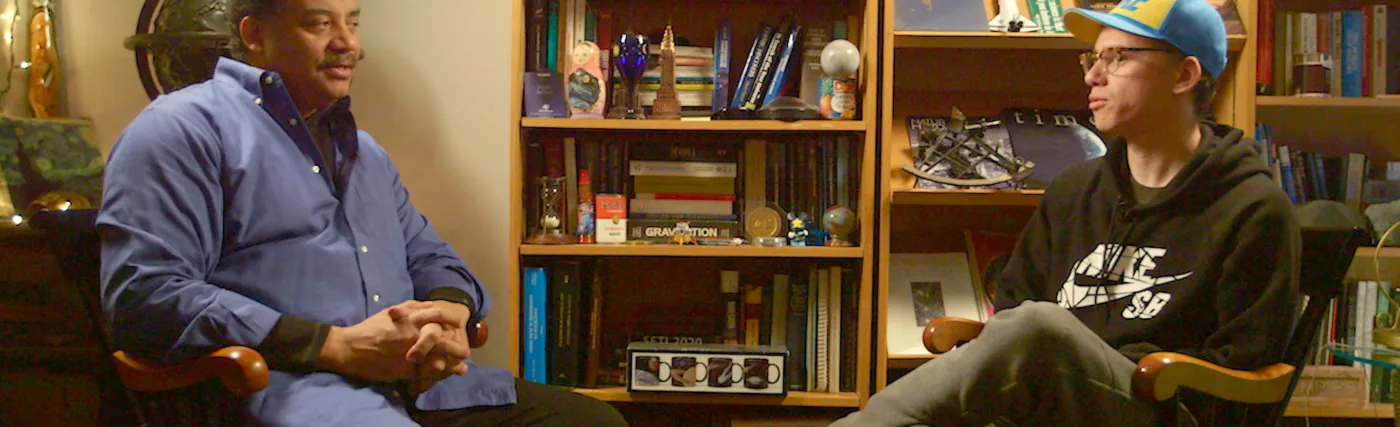
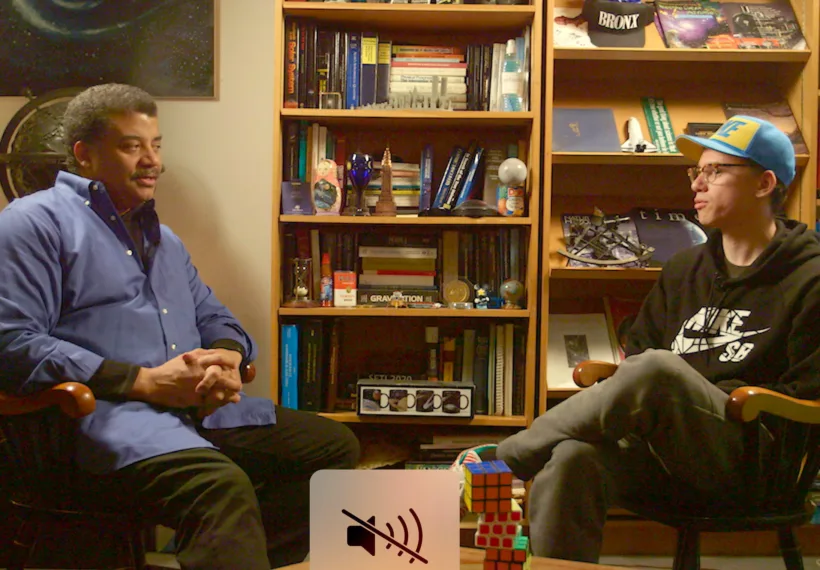
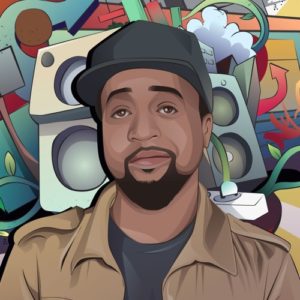
Neil deGrasse Tyson sits down with rapper Logic to talk hip-hop, science and more, along with comic co-host Chuck Nice, and rapper/educator/DJ Steve Tyson, a.k.a. The Intellect. You’ll learn about Logic’s upbringing and how it helped him shape his career and use his platform to engage in discussions on social issues. Explore the legacy of violence and hip-hop, the unfortunate attachment of violence to the genre, and then listen to Steve break down where that unfair attachment comes from. You’ll hear about hip-hop culture: how rap fits into hip-hop, how it was born from a mixture of different racial backgrounds, and why “genuine” is a defining word in hip-hop. Neil and Logic also discuss Logic’s geek underbelly, and their shared interest in Rubik’s Cube. Find out how turntablism was born out of an exploration of science and technology. You’ll also hear why Logic thinks failure is important, why he believes one should follow their dreams, how music saved him from other paths, and why his message is always positive. All that, plus, you’ll discover Neil’s soft spot for creative artists and the story of how Logic invited Neil to be on his new album, Everybody.
Transcript
DOWNLOAD SRT
Welcome to StarTalk, your place in the universe where science and pop culture collide. StarTalk begins right now. Welcome to StarTalk. I'm your host, Neil deGrasse Tyson, your personal astrophysicist, and I'm also the director of New York City's Hayden...
Welcome to StarTalk, your place in the universe where science and pop culture collide.
StarTalk begins right now.
Welcome to StarTalk.
I'm your host, Neil deGrasse Tyson, your personal astrophysicist, and I'm also the director of New York City's Hayden Planetarium at the American Museum of Natural History.
And I've got with me my co-host, Chuck Nice.
Chuckie Baby, long-time veteran of StarTalk Radio.
Absolutely, and the director of My Home.
Keep telling yourself that.
Ha ha ha!
But you're actually host of the new spin-off from StarTalk.
StarTalk has got so badass, we got a spin-off.
That's right, my friend.
We spun-off because our sports shows were doing so well that we said, let's just make a whole thing.
Yeah, so it's called Playing With Science and it features Gary O'Reilly, who was the co-host of the show, along with yours truly.
And he's an ex-footballer from the UK.
He's an ex-footballer from the UK.
And it's a science sports smash-up where, as you say, jocks and geeks collide.
And as I say, without a concussion.
So today, it ain't about any of that.
We're talking about the fusion of hip-hop culture and science.
Featuring my interview with the rapper Logic.
Nice.
Yes, yes.
Well, that's a great name for a rapper who's interested in science.
Yeah, and joining us in studio today is hip-hop artist and educator, Steve Tyson.
Welcome.
Thank you, glad to be here.
So, where'd you get the name Tyson from?
Well, I was born with it, as you might know.
Ha ha ha, there you go.
The dude's my nephew.
That's right.
He's my nephew.
Now, normally when your nephew shows up to be a guest on the show, because you couldn't think of anybody else and you ran out of folks.
Right.
But not in this case.
No, no.
Just to make that clear.
This was an actual attempt to have, he was a first choice.
Yeah, first choice.
First choice.
First choice, just to make that clear, in case anybody's wondering.
Right.
Now you gotta demonstrate why that was the case.
No pressure, no pressure at all.
See, I like that.
He's got the swag.
He's like, no problem.
No, he got it.
He's on it.
And you're also known as DJ Ear to Ear.
Is that your performing name?
Yeah, whenever I DJ.
When I'm rapping, I'm known as the intellect.
Oh, nice.
All right.
And you're working on your doctorate in?
In educational leadership.
Okay, all right.
And where are you working on that?
I'm currently studying at Arcadia University.
Where I also teach.
Arcadia Teach, okay.
Oh, okay.
And your co-founder just listed in entertainment?
Yep, that's right.
My boy is just.
Why, you are.
You're a busy young man.
Yeah, gotta keep the attention focused on everything.
Yeah, I see it runs in the family.
And some of our fans might know that they might recognize his voice.
Just say anything right now, say.
It's StarTalk, all stars.
Science, that's how it all starts.
Nice.
Yes, he wrote, produced and recorded the intro theme to our StarTalk all-star show.
Yeah.
So that's it, he's got it, he's feeling it.
Also, what else did you do?
We had you perform StarTalking at the Apollo Theater.
Yes.
For us.
Yeah, that was great.
That was good, that was good.
But this is actually your first time as a studio guest.
So thanks for having me.
Thanks for having me.
Take your time out of your study schedule.
We had your dad on the TV show.
That's right, that's right, with Sean Lennon.
That's right, yeah.
Yeah, so tell uncle to get his act together.
You gotta catch up to us, man.
Yeah.
Tell you again, get no respect.
Get no respect.
So Logic, Logic dropped an album in 2017.
Titled Everybody.
And it just showed up at number one on the Billboard Top 200.
Cool.
There it was, number one.
And I actually appeared twice on that album.
What?
You didn't know that?
You didn't know that?
I just thought it was like he had a guy that sounded like Neil deGrasse Tyson.
Okay, we'll get back to that.
But that's not why we're talking about it, right?
He's actually a deep thinker and he uses his platform as a performing artist to engage discussions of social issues.
Plus he's got serious street geek cred.
Street geek cred.
I like that.
Yeah, cause some geeks on the street.
Right.
Exactly.
Not all geeks are in the lab.
Right.
Exactly.
Street folk.
Right, exactly.
Give me your lunch money.
Now allow me to calculate exactly how I will be able to use this.
Smartest hustlers.
So, that's, we get this.
And now, but Steve, you're pursuing a PhD and you also want to be a hip hop artist.
You are a hip hop artist.
Excuse me.
I didn't want to say anything.
I was like, this is a family thing.
I'm gonna stay out of it.
When you said I want to be, I was like, oh snap.
The family holding you down.
The family holding you down.
He was like, and you want to be a hip hop artist?
It just got real.
Cause I'm still little Steve, no matter what.
Yeah, it's like my mom, I go home and my mother's just like, so I saw you on the TV the other day, so that was nice and, what's your backup point?
Right, telling them jokes, Chuck.
Can you really make a living telling jokes?
So how are you cross pollinating hip hop and your educational degree?
I mean, they're synonymous to me.
Between all of the studies that I've done academically, whether it was undergrad, my master's, or my doctorate, hip hop has permeated all of that.
I mean, so it's who I am.
Yeah, but I think most people don't know that they're permeatable.
So you're going to be evidence that it's not only possible but something that could even be promoted.
Yeah, I mean, but I think that there's also some people who have done that in the past, but might not necessarily have either forayed into the artist side as much or, you know, whatever the case may be.
But I don't think I'm the first one, but I'm definitely here.
All right.
I like it.
That's the kind of confidence we need when it comes to hip hop education.
In the house.
So, I mean, I sat down with Logic.
He came through town, visited my office, and he's well known as someone who delivers a message of hope through his music.
That's always a good thing.
And this is hope instead of despair, because there's so much despair in the world.
And so he talked to me about some of the challenges he had to overcome in order to become who he is today.
So let's check it out.
So I came up on welfare, food stamps, section eight housing.
Unfortunately, both of my parents were addicted to drugs and alcohol.
And my father wasn't really there that much in my life, unfortunately.
Now here's the crazy thing.
In fourth grade, just the people at my school kind of knew that my household wasn't that great.
And so they believed that because my mother had problems that I had problems, even mentally, or that I was disturbed or had whatever the case may be.
And because of this, they put me in a special needs class, but it was more so for like the just people that had been emotionally disturbed or something like that.
So I was dealing with like pretty badass kids that wanted to like fight me all the time.
So when they put me in this program, took me out of my school, put me in a completely different school.
I had to take the short bus.
It sucked.
Short bus.
Short bus.
And that's fine.
And so, but anyway, so I get there and, you know, these kids are like trying to fight me and just all these things, but I couldn't do it.
I couldn't fight back.
I knew that I couldn't act out even to defend myself because I would then just be proving their point that I deserve to be in this class.
So at this point, it was just so...
You're resisting the cookie-cut mold that they're trying to put you in.
Yes.
And they tried to say I had ADD and I had all these different things, which wasn't the case.
It was just that I wasn't being challenged and I wasn't being taught the right way how I needed to be taught myself.
So my mother took me out and she homeschooled me.
Now this was like the crazy...
So she homeschooled me for three years.
Now unfortunately as I said my mother was an alcoholic so she would sleep all day and she wouldn't teach me a thing.
So three years went by and now I'm supposed to be in 8th grade and essentially the state calls and they go, hey, you have to put your son back in public school or there's going to be a problem.
You know what I mean?
We're going to take your son from you, did it out, whatever.
So she goes, okay, okay, hadn't really taught me anything except a little bit of hooked on phonics and goes, all right, we're going to put him back.
And the school system puts me in 8th grade with a 4th grade education.
And within 6 months, I went from a 4th grade to an 8th grade education.
I did well on all my tests, with the exception of math, I wasn't that great at math.
I was more good at English and words.
But I did it, and I left.
But the crazy thing is-
So you basically skipped 4 grades.
Yes.
And it was hard.
And I did it, though.
I did it.
But it made me who I am.
Yeah, I reflect often on the fact that, well, there's the saying, that which doesn't kill you makes you stronger.
And, also, people say, you know, I had a messed up childhood.
I wish it weren't messed up.
I wish I had a regular childhood.
And then you run the clock back and give them a normal childhood, and there's a chance they wouldn't then become the creative, insightful person that they were as an adult.
I used to ask myself that all the time.
You know, I'd be like, why would I be in this position?
God, or whatever.
Why would you put me here?
And it was to teach me a lesson.
And it was to make me stronger.
And it was to give me the writing material that I needed, you know, as a musician and as an emcee, to spread a positive message of light at the end of the tunnel.
I truly believe it.
Steve, yo mama has a Ph.D.
in psychology.
Yes she does.
Yo daddy has an MFA, Master in Fine Arts.
That's right.
So he comes out of-
What's your argy story?
You don't have enough tragedy, man.
Where's your-
You need some tragedy.
So because my parents were educators, therefore I have no tragedy.
Well, I take that-
No, no, let's turn that into a question.
So we hear a case where he is reaching into his life experience growing up as a source of his need to change the world through his creativity.
So you are also doing this, but clearly it's a different background.
So where are you reaching to for this?
So, for me, my use of hip hop as a form of expression stems from growing up primarily in Johnstown, Pennsylvania.
So it's a-
Rust belt.
Not only rust belt, but it's a hotbed of racism.
I was about to say, when you said Johnstown, Pennsylvania, I don't know why, but racism is just popping to my head.
He's from Pennsylvania.
So my parents are educators, but they taught at the University of Pittsburgh at Johnstown.
So I had to grow up in Johnstown, Pennsylvania, battling off racism.
And so then I turned those physical fights I was constantly getting into, into just shutting people down lyrically or verbally.
And yeah, so that's, I guess, where my-
That's where you use words as weapons.
And by the way, so now we know.
Because there has to be some type of pain, I believe.
And it doesn't have to be, you know, exactly what happened to Logic or, you know, it's just, which is really kind of weird.
You know, like you got Jay-Z is just like, I'm Mossy Projects.
You know, I grew up in Mossy Projects, 50 Cent.
I was shot nine times, you know, and then Logic just like, I was home schooled, B.
Home school.
You know, that's, that's not as tough.
Plus a lot of other issues that he had to deal with.
Well, that, that's the bad part.
That's the bad part.
Yeah.
So Steve, so tell me about this, this legacy of violence and hip hop, the two being associated with one another.
Ooh.
So I think that...
You jumped right into it.
Yeah, just, just, yeah.
Violence and rap music can be...
Not only violence surrounding rap events, but violence within the lives, the modern wealthy lives of successful rap stars.
So I think that whenever one is comparing violence and just negativity with hip hop, a lot of the times what they're referring to is rap music, which is a facet of hip hop culture.
So in my opinion, if hip hop was the human body, rap music is like the nervous system.
It can be angry, it can be peaceful, it can be whatever the body is feeling at that moment.
So rap music absolutely has negativity, has violence, it also has peace, love and positivity.
But at the end of the day, hip hop as a culture was founded on peace, unity, love and having fun.
And by the way, I think that there is some unfair attachment of violence specifically to hip hop because violence is found in all music.
Absolutely.
And just in American culture, global culture.
For some reason, there's something about hip hop, I'm not sure what it is, that causes it to stand out.
Do you know Art Garfunkel?
Simon and Garfunkel?
Of course.
His first solo album, which is just ballads basically.
Was called I'll Kill You B****.
Can be synonymous.
So one of the songs in that album, the album is titled Angel Claire, one of the songs is is a beautiful ballad about this guy who lures his girlfriend to the water's edge, feeds her burgundy wine and then stabs her to death and then dumps her body in the river.
I like my title better.
That's in there, but nobody would say, Violent, Violent Art Garfrock.
But in there, and it's sung beautifully.
You hear these beautiful words, and I say, now this time that I listen, let me pay attention to the lyrics.
And then it's like, wow, so I mean, that's, that's a bloody sight.
I threw her body in a minute was like, oh my gosh, this is like a bloody murder.
I think that if you're like in the comparison of Art Garfunkel writing violent songs about killing a woman and just generic hip hop violence in a song.
I mean, at the end of the day, nobody like it's all historic.
So, you think of black men predominate hip hop culture and you think about how black men are perceived.
You're going to think violence, anger and the like.
And so whenever you have black men, that's a good one, getting shot and getting shot.
So, whenever you have black men talking about these experiences and talking about these realities, it's like, oh, well, that's what they are.
And so you have, and so it gets highlighted and reenforced as opposed to Art Garfunkel where it's like, oh, well, that's an anomaly.
I couldn't imagine this curly haired singing individual to go stab a woman by the river's edge.
But I don't know it.
But you never know it, Art, because.
His hair does look awfully like an afro.
I'm just saying.
Tell me the difference.
You addressed it, but let me hear it more in a more dictionary definition style.
The difference between hip hop and rap.
So, Webster might say that hip hop is a culture that embodies rapping, breakdancing, graffiti, DJing and just a general knowledge and awareness of life, while rap music is an expression.
It's just how you choose to express yourself.
It can mean.
There are hip hop artists who might sing.
Hip hop is the culture where you can define yourself.
So if you want to say, I'm a hip hop singer, you're a hip hop singer.
But you got to be able to rap to be a rapper.
Absolutely.
Yeah.
Absolutely.
You don't want to be a candy rapper.
Bars?
What?
Candy bars?
You got me.
You got me off-card on that one.
I'm telling you.
You know, it worked on so many levels though, you know?
So Logic's got a geek underbelly.
This is the fun part on a StarTalk interview.
You come into my office at the Hayden Plantam and you got a geek underbelly, I'm going to find it.
Ah.
Yeah, yeah.
So Logic, he's got a love for space and science.
Sweet.
I know.
Let's check it out.
So where comes your interest in space or learning or...
Because it's infused throughout your persona.
Completely.
Honestly, I've always loved space and I've always loved the idea of space travel and time travel and sci-fi and there's an artist named Kid Cudi and Kid Cudi, his whole theme is always space and I was like, damn, I really love space.
I wish I could do space.
And then I woke up one day and was like, Kid Cudi doesn't own space.
I'm sure you won't mind if I poke my head in here a little bit.
And I thought, man, what could I do?
And obviously...
Space is a big area.
Yeah, it's not Highlander.
Okay.
There's not just one.
There's billions.
Right.
And so I was like, man, I really want to do this.
And I was actually extremely inspired.
I went to...
It all happened within the last few years.
And I went to go see Interstellar by Christopher Nolan, who I know you sat down with.
And he's one of my favorite directors, him and Tarantino, which are kind of like, they're both like over here.
But...
Yeah, it's like what?
It's like Super Blood or like Super...
What's wrong with you that you like them both at the same time?
I'm just awesome.
No, but yeah, so I saw this film and it really, really inspired me.
So I remember watching it and the biggest thing that I took away from it was the connection just of human beings.
I was like, oh, wow, we're just so connected.
I remember like being in the car.
I literally have one of my lines on the album is about how...
On The Incredible Truth.
And, you know, basically about how like we're all connected and I'm, you know, in a space station, I'm on another mission, but back on earth, everybody bitching.
And to me, that's a metaphor for like, when I saw that movie, I felt so connected to mankind and human beings.
I'm like, wow, we're all so beautiful and we're here together.
And then I pull out my phone and it's like I come back to earth and I go on Twitter and somebody's like, your music sucks.
Coming up, we'll explore more of the intersection of science, hip hop, and B2B when Star Talk returns.
We're back on StarTalk.
That's right.
That's correct, at ChuckNicecomment.
And our special guest today is Steve Tyson, AKA DJ Ear to Ear.
Nice.
And we're gonna find your work.
It's on Just Listen, right?
Yeah, justlistenent.com, J-U-S-L-I-S-T-E-N-E-N-T.
So justlistenent.com.
And I'm on SoundCloud, Dr.
Tyson.
Yeah, Dr.
Tyson, all right, we can find you.
Excellent.
So he's here to help us sort of unpack the phenomenon that is Logic, who's a rapper and a person who's thought deeply about this interconnection, all right, between humanity and especially for him as a person of mixed heritage.
And so as he explores these ideas through his music and his creativity, let's check it out.
So you said you were mixed heritage?
Yeah, black and white.
Black and white, okay, okay.
I feel like I've seen a lot of things differently.
Do you know what I mean?
Like kind of not being accepted by both races at one time or accepted by one more than the other.
You see things differently because other people require that of you.
Yeah.
Otherwise you're just there.
Yeah.
Right?
But I like it.
I think it also does give me a unique perspective on things, especially being black and white and in this country.
In your music, does it allow you or does it force you to say, I wanna speak to more than one group?
Is that even possible?
No, it's 100% possible.
But I think as long as certain sects within that group actually care to listen to you.
So for example, there's some people who could look at my fair skin, which is almost transparent.
I'm just kidding.
But yeah, and say like, oh, try to negate or just ignore the fact that there is African American in my blood, which I think is ignorant.
Because for me, a lot of it is culture.
Like even hip hop in itself is culture.
Music is culture.
It's less about race, specifically, at least from what I've experienced, and it's more about culture.
So like being raised in a predominately black household, but my mother was white, however, I'm the only bastard child, if you will, between my white mother and black father.
And then, you know, my father has children on his end and my mother has children on their end, but I'm the only one in between them.
So for me, imagine being home and being in a black family, that's all you know, but then going to school and kids being like, oh, you're white, or look at this white boy, or blah, blah, blah.
That could be very confusing.
So I'm kind of glad that I overcame that, I guess.
And I had to do the same within hip hop.
Because it could otherwise mess you up.
No, it could totally mess you up.
Because even with hip hop, there was almost reverse racism, where people would be like, oh, you're not good because you look white.
And then somebody will be like, oh, but he's black though.
And they'll be like, oh, he's cool then.
Yeah, but that doesn't even make sense.
That's so ignorant, you know what I mean?
But those are the things, once you stop caring, that's a big deal.
When you stop really, truly caring what other people think, or at least the people that aren't important, the people who are ignorant and just make such just harsh statements.
Because when you put that out of your mind, you become much more happier.
Wow, so he's like even more different strokes.
The white kid in the black family.
So Steve, do you agree with Logic that it's not about race?
Well, about hip hop culture?
Yeah, yeah, it's more about culture than about race.
Absolutely, I mean, hip hop was born of an amalgam of people of a variety of different racial backgrounds, but at the same time, it's been an expression of predominantly black and Latino underserved communities, primarily in the Bronx, which is where it came from.
So, but if it's an amalgam, I mean, I don't want to create a fight or anything here.
If the hip hop culture is inclusive and multiracial, as you've described, what accounts for the pushback of some hip hop artists, either Eminem or I was thinking in particular Iggy Azalea?
Here's a blonde haired woman shaking her butt and she's from Australia.
And so, if you're inclusive, why have pushback at all?
So, I think that if you're bringing up an example like Iggy Azalea, that pushback comes whenever you think about cultural appropriation because she's from Australia, yet she did move to Miami, but then adopted a persona and a style that was very specifically Miami and was leaning heavily on Trina.
And the other thing.
No, because you can't, in your song, go, tell me who that, who that?
And then after the song is over, it's like, good eye, mate.
Like, no, no, I'm sorry.
You don't play that.
Yeah, it just can't happen that way, okay?
So, all right, so it's multiracial and inclusive for people who are genuine in the product that they are.
Genuine is a defining word for that.
Fine, fine, so that answers it.
I got you there.
Authenticity.
Because this whole thing about race, I find so odd, because any time anyone asks me, well, what race are you?
And I say, last I checked, I'm the human race.
You got another question?
And to try to slice and dice people, I just don't find that to be productive.
I know how you think of me, because I've been stopped by cops.
I know how I'm seen in society.
But as a living homo sapien in this world, I think of where the human race, and then they move on from there.
I think that for the lot of the human race who are enlightened, identifying as a member of the human race is right on point.
But I also think that whenever you consider what's going on currently in America, and you think of police relations in black community, that identifying with your categorized race can also be empowering.
So for example, you're an astrophysicist.
If you, instead of saying, or in addition to saying I'm a member of the human race, also said I am Afro-Caribbean, I am biracial, I'm Afro-Caribbean and Puerto Rican, that would also help to uplift many Puerto Ricans who live near Arecibo, or many Afro-Caribbeans who look at the stars.
Arecibo is a major radio telescope.
Exactly.
And so that could also be very empowering too.
So there is empowerment in saying I'm a member of the human race, I'm beyond the construct of race, but at the same time there is also power in saying if you want to talk about the construct of race, here's who I am.
I'm Neil deGrasse Tyson, an Afro-Caribbean Puerto Rican astrophysicist.
Yeah.
Might drop on that one.
Who knew that you were such a rare beast?
He don't tell nobody, that's why.
My priority is like getting people scientifically right, so that the civilization will continue into the future.
Thank you.
Right.
So, you know.
West science story.
So, somewhere in the interview we end up talking about the Rubik's cubes.
A boy like that, he do experiments.
Okay, I'm sorry.
That's like from West science story.
Yeah, that's what I was doing, but it was West science story.
For those who just found out that you're part Puerto Rico, that's all.
You know.
My mother's name is Shochitl Maria Feliciano Tyson.
Yup.
Yeah, that's how that played out.
That's true.
Look at me telling you that's true.
I was telling you that all the time.
All the time.
I'm like, some people might think you're joking when you say that, you know.
I think ultimately everyone is African, cause we all, the species came from Africa.
Now, wait a minute.
Now, just hold on one minute there.
You ain't gonna come up in here and talk to one old miss like that.
I'm a good Christian man, I'm a good Christian man.
You ain't gonna come up in here and tell me about being from some old Africa.
All right.
Christian man, Bible's written in English.
That's right.
Darn, dude.
Anyhow, so somehow I forgot how the subject of the Rubik's Cube came up in my conversation with Logic.
You have one on your desk.
Oh, man, that could have been it.
Yeah, I have a Rubik's Cube that exists in a higher dimension than just the cube that...
Of course you would.
I'm just saying.
Of course you would have.
His Rubik's to the fourth is what he has.
This one.
He's the only one with a multi-dimensional cube.
I'm sorry.
If you do it wrong, you get sucked out of this dimension, never to be seen again.
Exactly.
Anyway, what happened?
Anyhow, so we chatted about creativity in the Rubik's Cube.
Let's see what came out of that.
I will boast and say I'm probably the fastest rapping Rubik's Cube in the world.
If not the only.
If not the only.
My fastest time that I've ever done it in was 23 seconds, when I was obsessed.
You can ask my wife.
We'd lay down and be watching movies, and I'd just be cubing.
She'd get really upset.
My fastest is 76 seconds.
That was 25 years ago.
When it was invented?
It was early in the day, when it was still kind of like a conversation piece.
What is that?
Why does it do that?
Lately, my old age, five minutes.
I can't pull it under five minutes.
Here's the distinction.
I solved the Rubik's Cube after 80 hours just messing with it.
It's about 80 hours.
I should have been doing 22 other things.
I was in graduate school, trying to get a PhD in astrophysics.
I'm sitting there on the couch.
There's like, no, no, no, I'm just saying.
But I've never actually looked at algorithms for it.
I thought to myself, should I?
But then I'd be following instructions rather than figuring it out.
Oh, thanks.
I'm not that great, I guess.
What it tells me is if there are faster ways to do it, it means there are algorithms I've yet to discover.
That's true.
I mean, wow.
But that's almost like with everything, right?
You know, like, what's the key to happiness?
There's certain things you haven't discovered yet.
Algorithms of the universe.
Right, right, right, right, right.
And so the fun thing about being on the frontier of science is there is no answer already derived in the back of the book.
You have a foot in what is known, a foot in what is unknown, and you're like, you don't know.
But that's the best part.
That's how I feel, so my next journey is going to be film.
So I wrote this film that I plan to star in, which I know is very ambitious, but so was being a rapper, and I'm here.
And that's what I want to do.
And so I feel like with music, it's ever growing, and there's so many different things that I can do, just like with the Cube.
There's different ways to solve it, or tricks, or things that you can do.
But I'm pretty solid, like I know how to make an album.
I know how to sell an album.
It got me here right now.
But now I feel like with film and other forms of just expressing myself in writing, it's like that in the dark.
And I love that.
That's my favorite part.
That means you're going places nobody's gone before.
Yeah, trying to.
Isn't that what that has to mean?
I guess, I suppose so, yeah.
Otherwise you just copy somebody's thing and then you just cookie cut it out.
So would you be one who would look up the instructions and do the puzzle?
Or would you try to solve it on your own?
I've been a guesser the entire time.
But after 32 years, I need some algorithms in my life.
How about you, Chuck?
I just peeled the colors off and rearranged them.
You solved it like that.
I was like, there's your answer.
That's your answer.
But puzzles are, I think, people who are committed and love unsolved problems, I think are friends of puzzles.
So would you say that any sort of creative person would just love puzzles in general as a general thing?
I mean, as far as being a rapper, definitely.
I mean, the way that we put together words is very much like a puzzle.
It's a Rubik's Cube itself.
If you put this word here, some other word's got to get bumped and make it work in another way.
Absolutely, or even the way that we DJ and we'll find different segments of songs that match well with one another, go crate digging to find that little sampler, that little thing.
So, there was a time, were you with me when I was with Logic on Sway?
Wait, no, I was with you on Sway.
No, but I was with Logic once on Sway.
At a different time.
And they wanted him to spin a rap about something he invented in the moment while he was doing the Rubik's Cube.
So, he saw the Rubik's Cube while he was spinning an invented rap.
Yeah, I saw him do that on Power 105, Big Boy, I saw him do that too.
Yeah, that was crazy.
Because I can't do that.
So, maybe there's like a kind of schizophrenia where you have whole parts of your brain devoted to that, doing something else, and your brain does ten different things.
That's honestly how freestyling is.
I was trying to explain this the other week.
I was freestyling at my sister's graduation party.
And I was asked, how do you end up doing that?
The only answer I could come up with was God, because the words are coming out.
You know what you're about to say next, but it's writing itself as it's coming out.
It's almost like when Michael Jackson said he goes to climb trees and the songs just pour in from the universe.
It's very similar to that in my experience.
So rather than credit your own intellect, you're saying it's God.
If you're choosing between the two.
Like I said, this is a family thing.
I'll stay out of these family things.
God gave me my intellect.
So we also talk about Logic's hit album, The Incredible True Story.
And so do equal parts entertainment and nerd, right down to the core.
So ask them about it.
Let's check it out.
Now this is the cool thing that I loved about creating this.
Because you can imagine that as a rapper, when I walk into Def Jam Records and go, oh yeah, I'm gonna go ahead and go make an album about space inspired by anime, they're like, what?
You know what I mean?
But then I, you know, it went on to sell over 135,000 in the first week.
And you know, it was the number one rap album.
I sold more than pop artists and some of the biggest rappers in the world off an album about space.
And it's so crazy that I pulled it off in Here's How.
Because the theme...
Here's how you sell 135,000 in a week.
The theme of the album has nothing to do with the music.
Now, this allowed me to just rap my ass off, make some really fun songs over some dope funky beats, but keep a concept within the skits from the script that I wrote for the voice actors to live in almost two separate dimensions with one, you know, kind of equal goal, which is to entertain and educate.
So, entertainment and education, that's not a weird combination of the two, but geek culture and hip-hop culture, when I think of that Venn diagram, I'm not thinking there's hardly any, he might be alone in the intersection of that.
That's interesting.
When I think of that Venn diagram, they overlap.
Yeah, there's a very large overlap between the geek culture and hip-hop culture for younger people, Neil.
I would even say for older folks.
So, you think about Grandmaster Flash, right?
I'm just messing with you.
You think about Grandmaster Flash, right?
There would be no turntablism as we know it without him being a science and tech geek.
So, he was exploring and everything.
Dare I say, not enough people fully embrace that fact?
Yeah.
Well, you know, and you're right about it.
Now, there is a very important fact to just bring up because there is actually, there's kind of like a pushback against kids who want to portray that geek culture.
You know, and I think it's because the other kids are stupid and jealous.
Thanks for that analysis.
I just got, you know.
More on the intersection of hip hop, creative science, and StarTalk continues.
Welcome back to StarTalk.
Special guest, Steve Tyson.
Hip-hop artist, DJ, PhD student.
You're totally, you're hitting it.
Covering all bases.
Covering all bases there.
That's how you do it.
So in this episode of StarTalk, we're featuring my interview with Logic, and his 2017 album, Everybody, it hit number one on the Billboard 200 list.
So fans of Logic may know that I made sort of a cameo appearance on his album as God.
You were Morgan Freeman?
That's how good Morgan Freeman was as God.
People not even say, well, you were God?
Like Morgan Freeman?
No, you were Morgan Freeman?
That's even more impressive than being God.
Yep, it was God and in this next clip, you'll hear the moment where I was actually officially asked to do just that.
Let's check it out.
Cool.
Let's put it this way.
I'm inviting you to play God.
The role of God on my album.
Is it just the voice of God you need?
It's the voice of God.
Okay, so I joke about this, that we go to planetarium director school, where you learn how to get your voice, the planet, welcome to the universe.
Yo, it's like that.
Like it's crazy.
You don't understand.
So, like, I'm gonna tell you this.
I'm gonna tell you this.
The voice, it's gotta come from down here.
I'm gonna tell you really quick, okay.
Try it, try it.
Welcome to the universe.
Welcome to the universe.
That's good, that's good.
That's good, I like that.
Well.
But it's about God and it's about this gentleman named Adam.
And it's about how we're all connected.
And it's about reincarnation, it's about religion, it's about science, it's about all these things and how they play a role and how we're all connected.
And how this person, Adam, was actually, and I name him Adam because of the first man, was actually everything.
He's like, yeah, I'm Neil deGrasse Tyson, bitch.
No, yeah, but so it's...
God is talking to a man named Adam.
Adam, yeah.
Adam after the first human, okay?
But he's every human being that has ever existed, both man, woman, dead, so we'll talk about it another time.
But I will say that the role is yours and I think it's very special.
I think people will enjoy it.
Well, if I aspire to be God?
Morgan Freeman.
Oh, I know.
With my voice, that's one thing I don't have on my resume yet, to be the voice of God.
Or to be God, he was in God.
He was in...
He was God, Bruce Almighty.
Oh yeah, in Evan Almighty and Bruce Almighty, right.
I think that'd be funny.
But we'll see.
I know you're a very busy man.
Well, I have a soft spot for artists who reach out to me to add science to their creativity.
I'm there every time, just cause it's the mainstreaming of science when artists touch it and wanna sort of make it their own.
And of course it's worked both ways, it turns out.
I'm glad I have somebody in the fam who came to my defense when a rapper dissed me for getting on his case about saying Earth was flat.
So we live in a time where you get attacked for attacking someone who says Earth is flat.
But he's a rapper, I can't just say you're wrong.
I gotta like rap back at him.
Or somehow, so I said, how am I gonna do this?
And so I combed the, I said, Steve, can you help me out here and you did.
You did, on the spot.
Flat to fact.
Flat to fact, overnight.
In a few hours, yeah.
Yeah, he spun this in a few hours.
I posted it and I said, damn, there you go.
So thanks Steve for coming to Uncle's rescue.
I tried.
And suck it, VLB.
The point was, VLB was on the internet saying Earth is flat and saying he's invoking physics to show it.
Now the moment he said that, that cult.
He slapped you across the face with a white glove.
Pistols at dawn, sir.
And I'm his shooter.
Right, because if he didn't say, I invoke physics, I wouldn't even care.
Let him think it's a free country.
Think what you want.
But you're going to evoke physics.
That I'm going to be all up in your situation, which I was.
But then that wasn't enough.
I needed the rap to back it up.
And so there was.
Sweet.
There was.
So Logic is not old.
I think of him as like a kid, but he's seen a lot of life.
I mean, he's, and so I asked him about what it took to become a good rapper.
Cause he's been rapping most of his life.
Let's check it out.
I think mistakes are great.
A lot of people can see like failure is something that's negative, but it's like.
They've not been properly trained.
Yeah, no.
They don't understand what creativity actually is.
I've been, I can't tell you how many times I've been in, you know, in the recording booth trying to rap a verse really fast.
You know what I mean?
And like, cause I have different ones that I could do.
Like, oh, I'm ripping and living and striving.
The killer, the ripper, he's calling what goes when he flows.
Just fun slang and like trying to get it and trying to get it.
And then I'm ripping and living and striving the killer to rip.
He calling what going to flow.
You know, he's pursuing it, doing it, moving it, grooving to stop it.
If I could have talked it, walking it, flipping it.
So it's like, it's like, but it's took, took me years to be able to do that.
But at first, I would stumble and fall and get angry.
And I'd be like, oh my God, why can't I do this?
And now I'm known as like someone with good pronunciation.
Clearly.
Yeah, but you know, and it, but it all comes, it's all wired, I think.
So Steve, we need brain scans, brain scans of rappers.
Just like you said, you're pulling parts.
It's getting woven as it comes out of your mouth with powers beyond your awareness.
Yeah.
So FMRIs would be functional magnetic resonance.
Absolutely, absolutely.
It would be really good.
Functional where, because regular MRI, you're just.
Right.
You're just.
In that little tooth.
So functional MRI is where you're actually doing something active.
You're monitoring your brain in real time as that happens.
So it's gotta be fascinating to see one of those for a very active producing rapper.
No question.
We can go to Mount Sinai right now and get it done.
And so, let me ask you, can you learn to do this?
Or do you think it's something that's deep in you that you're reaching for that's always there?
As far as freestyle?
Yeah, freestyling.
I think that it's two part, so.
Just to be clear, freestyling is you're just pulling out of your head.
Yeah, you're just out of your head, really.
For some people, it's the same thing, but I don't know.
Yeah, for some rappers, they might be, some rappers might be pulling it from somewhere else, but I don't even remember what the question was, so.
Can you learn it, or is it really something that?
Yeah, can you learn how to freestyle, or is it?
Or is it something you have and then you perfect it?
Yeah, exactly.
I think that freestyling is two-fold.
I think that not only is it something that you might have an inclination for naturally, but in order to actually be good and to continue to be, you know, known as a freestyler, you've got to practice.
Repetitions, the father of learning.
You've got to work it.
Well, as you know, we're featuring my interview with Logic, and in this last clip, he tells us about the importance of following our dreams.
Oh.
So, let's see how that goes, go.
My whole message is peace, love, positivity, follow your dreams, think it and it will happen.
Truly the law of attraction, you know, living it, breathing it, saying it.
Like, as I always tell people all the time, like, you know, I meet so many people, I say, hey, what's your dream?
What would you do?
If you could do anything, what would it be?
Some people go, oh, well, I'd travel, but you can't do that.
Well, yes, you can.
You could, there's a million reasons that you could travel the world and do what you love.
And they, well, I would, but, and they, that's it, right there.
As soon as you say, but, game over, you ruined it.
You know what I mean?
As Pee Wee Herman once said, everyone has a big but.
Everyone does have a big but.
I would have done it, but, I don't know, but, yeah.
You gotta do it.
Anytime there's a but in somebody's sentence, there's some excuse coming down the line.
I mean, there does need to be realism.
Because I was like, I wanna be a rapper.
But the difference wasn't like, oh yeah, I just want women and money.
And like, no, like when you think about it, that's completely, I looked at it, you know, the key to success to me is just, you know, determination, persistence, realism, wanting success more than your next breath.
But a big part of that is realism.
You know, I tell people all the time, you can do anything you want.
You can be a rapper, singer, actor, dancer, you can be a doctor, a lawyer, the best mother in the world, the best father in the world.
You can do it because you're special, but you have to believe in it.
But that realism factor is a big thing, though.
You can't just go, oh, I'm gonna do this.
You have to plan.
It's a reality check.
Completely.
Like even, like, you know, this is a business.
Even what you do is a business.
And when you look at it, you go, okay, this is what I have to do in order to attain this.
But once I attain it, I can do it how I want.
You know what I mean?
So, for a long time, for many years, I was actually talking to my wife about this, I've been literally going nonstop.
I've never had a vacation, I've never had a break.
If you love what you do, what you do is the vacation.
Yes, but sometimes you need a vacation for the vacation.
You know what I'm saying?
Like, literally, I got married and jumped on a tour bus to go promote my album.
But I believe, man, if you, like, one thing that if people are listening to this, or watching this, anything could take away from it, it is do what you love.
Please do what you love.
Please do what you love.
Because I'll tell you, man, like, if it wasn't for music, if it wasn't for me just taking that leap, I would either be selling drugs, doing drugs, in jail, that's what my whole family, their line, what?
You know what I mean?
And I'm so blessed to be here.
This is kind of surreal, though.
This is crazy.
He says, do what you love, suppose you love selling drugs.
Okay, I think that wasn't the idea.
That wasn't it?
That was not where that was supposed to go.
I missed the bust on that one.
My interpretation is do what you love and you will never work a day in your life.
That's cool.
Man, I think that with hip hop culture, hip hop culture was defined on you can do anything.
It was created as something from nothing.
It was definitely from nothing.
No question.
And that mindset of you can do anything led hip hop to be what is currently the most financially influential as well as culturally influential art form on the planet.
On the planet, yes.
Absolutely.
So you could do anything.
In the 1970s, when I heard the first rap song that made the charts, which was the Sugarhill Gang, Rapper's Delight, and it blew our minds.
I remember in college, we would just dance in and sing in and sweat into it.
But I said, this is a flash in the pan.
It's kind of cute just somebody just reciting words that rhymed.
It's disco that will really last.
So don't ever try to get me to predict the future.
If you ask me in 30 years, what would it be?
Like, no, no.
All right.
You've been listening to StarTalk Radio.
I'm Neil deGrasse Tyson.
Chuck Nice, always good to have you.
My pleasure.
Steve Tyson Jr.
Thanks for having me, guys.
Nephew dude.
You can find him Just Listen Ent.
Yeah, justlistenent.com, but I'm also on SoundCloud.
All right.
Thanks for being here.
Neil deGrasse Tyson, signing off as always.
See the full transcript



 Unlock with Patreon

 Become a Patron