What is a geek? What’s the difference between a geek and a nerd? Can you be a geek of just one thing? Like a theatre geek, a comic book geek, a sports geek? Olivia tells us why she thinks “geekdom” means freedom. We discuss why comic books are such a staple in geek culture. Charles also tells us why he thinks biohacking is the next great geek frontier.
You’ll learn about Olivia’s upbringing and how her early struggles in algebra shaped her work ethic today. We explore her role as Psylocke in X-Men: Apocalypse. Find out what superpower Olivia would give herself if she could choose. You’ll hear why Neil’s superhero alter ego would be “Java Man.” We investigate the power of science to bring superpowers to the real world: the Iron Man suit, genetic mutation, immortality, and more. Discover more about the relationship between science and magic. We also grapple with the idea that “if everyone is special, no one is special.”
To finish off the episode, Olivia has a couple Cosmic Queries for Neil. We ponder the existence of aliens. Neil explains why he has no reason to doubt that we are not alone in the universe. We ask: wouldn’t it be calming to know we’re not alone? Or, would it be frightening? Then we ask – are we alone in our intelligence? Lastly, Olivia checks in with Neil to see if the planets can impact humans individually. All that, plus, Neil and Charles reveal how much humanity actually “knows” about the universe.
Thanks to our Patrons Genesis Perez, Braden Thomas, Joe Aguirre, Ayush Kapri, and Aden Parker for supporting us this week.
NOTE: StarTalk+ Patrons and All-Access subscribers can watch or listen to this entire episode commercial-free.
Transcript
DOWNLOAD SRT
Welcome to StarTalk, your place in the universe where science and pop culture collide. StarTalk begins right now. This is StarTalk, I'm Neil deGrasse Tyson, your personal astrophysicist and host. And we are coming to you from my office at...
Welcome to StarTalk, your place in the universe where science and pop culture collide.
StarTalk begins right now.
This is StarTalk, I'm Neil deGrasse Tyson, your personal astrophysicist and host.
And we are coming to you from my office at the Hayden Planetarium of the American Museum of Natural History right here in New York City.
Co-host Chuck Nice, Chuck in the house.
Good to be in the Cosmic Crib.
Tweet, oh, we hadn't called it that in a while.
That's right.
That's what it is and has always been.
Always will be, the Cosmic Crib.
Tweeting at Chuck Nice Comic.
Thank you sir, yes.
All right, and I got with me Charles Liu.
The one and only.
If Charles Liu is in the house, you know we're going to do some geeking.
That's right.
Looking forward to it.
Thank you, thank you.
Thank you so much.
Because this topic today is about aliens and superheroes.
Yes.
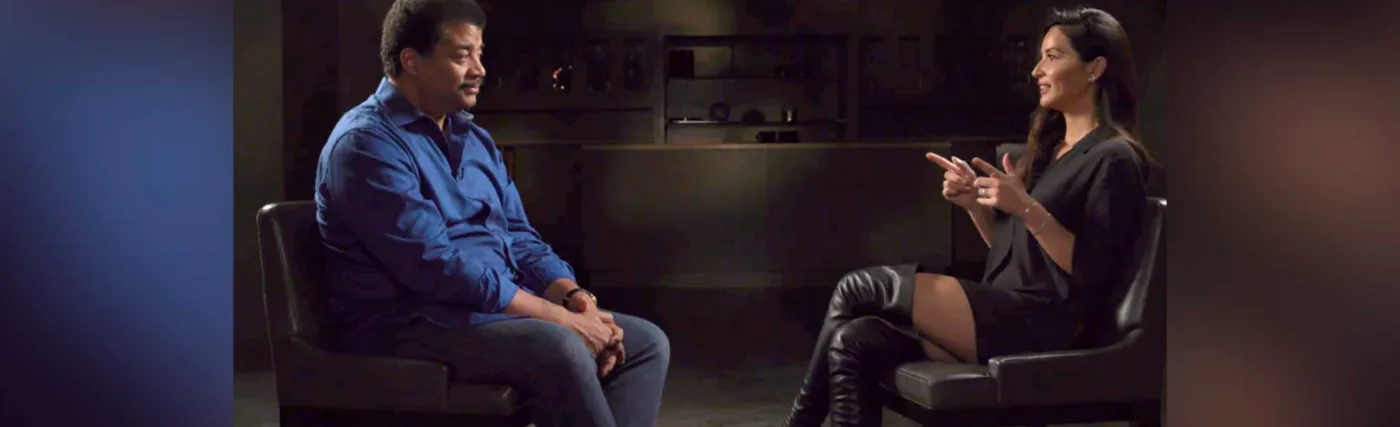
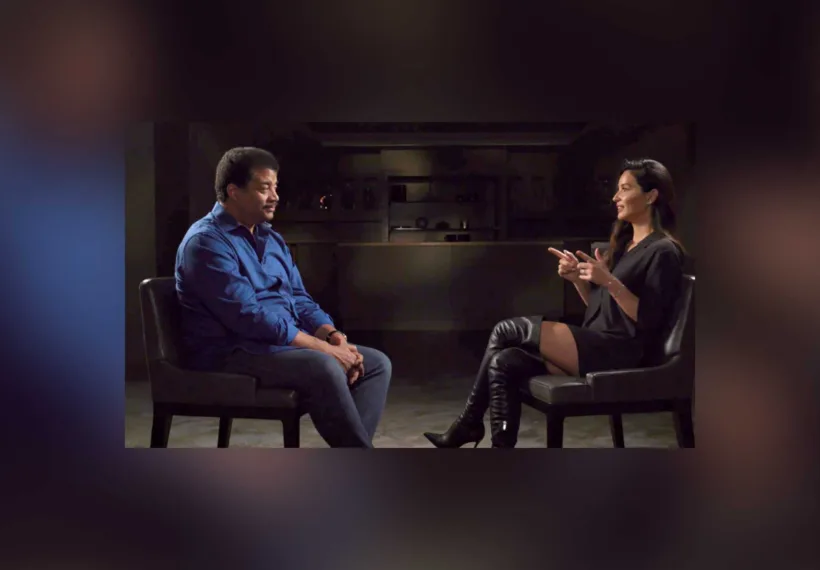
And we we snared an interview with sort of geek icon, geek goddess, Olivia Munn.
Yes.
I was out last time I was out in LA.
I got an interview with her.
It was great.
Yeah.
Last time I was out in LA got a restraining order.
From her.
Yeah.
Last time I was in LA.
I was 12.
Really?
Really?
You got to get out more, dude.
I do have to get out more.
You got to get out more.
Especially to the West Coast.
So just the whole universe of mutant super heroes to be specific.
Well, she is an X person.
Oh, yeah.
Because the X man are mutants.
She played Psylocke.
Psylocke.
In the Age of Apocalypse.
That's correct.
Okay.
There you go.
And it's a...
So she's been associated with geek culture simply through her acting roles.
But there's also some of that in her.
Because you don't have to be a geek to be a geek actor.
But it helps.
It does.
You want it to be true.
Right.
When someone has that kind of portfolio.
It's better to be a fan of what you're doing than just to do it in a mercenary type way anyway.
That's a good point.
But mercenary.
Whoa.
Actor-mercenary.
Actor-mercenary.
And so she also wrote a memoir titled Suck It Wonder Woman.
The Misadventures of a Hollywood Geek.
She's also a talk show host about geek culture.
And I had to ask her, because she's thought about, I've thought about it, we all thought about it, but she's like in it, performing it, is embodying it.
And I had to ask her just what in her mind defines being a geek.
Let's check it out.
There is a misnomer that being a geek is just playing video games or being awkward or just or having a pile of comic books.
I think being a geek is somebody that just thinks differently than the rest of the crowd.
You know, that it's not just what's laid out before you.
There are different ways to think about it.
And that's why comic books have been so popular with geeks for so long, because there is a group of people that operate a different way, think a different way.
Superheroes, like, they are ostracized because of their abilities to be different.
And I think that all geeks operate that way.
We're just called geeks.
Oh, so superheroes never really fit in.
Well, neither did the geek set.
Yeah, and I think that's what people identify with.
I mean, when you're in school and your brain works differently and you're not picking it up on like everybody else is, it's not that you're dumb.
It's that you have to figure out a different way.
And like, and that comes with, you know, when whether people are autistic or on the spectrum or are shy or uncomfortable or socially awkward or really smart and clever.
And they could be the college quarterback, but also be into astrophysics, you know?
It's just anybody who allows their brain to think differently.
It's a movie titled The Astrophysics Quarterback.
So, Charles, you are StarTalk's resident geek-in-chief.
I'm honored to be that.
I don't remember who first knighted you that.
It wasn't me.
I totally agree with it.
But somebody upped that.
Right?
And it landed on you like rogues.
A ton of bricks.
No, no.
Oh, the geek-in-chief.
Like royal rogues.
So, what was your arc through life to become the geek-in-chief that you are?
For me, geekdom is essentially freedom from the norm, from the constraints of social or familial or other kinds of pressures.
But we generally associate comic books, video games.
Attendance at Comic Con.
These are kind of card-carrying behaviors.
Yes, but they're also theater geeks.
They're art geeks.
They're opera geeks.
They're music geeks.
They're sports geeks.
They're all kinds of geeks.
When you are just different, then you become a geek in the eyes of many.
And then you have to ask yourself, what are you going to do with it?
I myself fortunately had such a strong sense of self, some people might say arrogance or egotism, that I didn't care what other people thought of.
Sounds like he's been to therapy and they're trying to get that through to him.
That does sound like that, doesn't it?
Yeah, so I didn't really care that I was off to the side of what was supposedly mainstream.
Yes, I was bummed at times when I felt excluded or otherwise not part of the in-crowd, but I was fortunate that I did have a few good friends who were like me, who were interested in the same kinds of things that I was, so that I did not have a problem with a social group that made me feel comfortable, and as a result, my geekdom gave me freedom.
You found family.
I did.
Okay, so now, but geek, to me, should also mean not just an interest in something, but some expertise that you could put on the table.
Something that you know more about than other people.
About the average person.
So Chuck, I like you as my co-host because you hang with the geek folk.
So I think you got some geek underbelly from your past that you have not fessed up about.
I lived most of my life as a closet geek.
And then, believe it or not, 10 years ago when I started working with you is when I came out of the closet.
Yes!
I felt like, you know, I was like, you know what?
Why am I hiding this part of myself?
Whoa!
I'm cool.
I'm okay.
Geek liberation.
I was liberated.
As a matter of fact, I could say, like, you know what?
Yeah, I really enjoyed this.
I love science.
I love all this stuff.
So finally you had a way you can express it professionally.
It was correct.
Yeah.
Charles, what's the next geek frontier?
Is it, because it tends to track technology.
Yes, it does.
Is it like VR worlds?
Is it augmented reality with video games?
So far, so good.
This sounds great.
The geeks tend to be at the moving frontier of how technology applies to ways to not go to work.
I believe the next great geek frontier, at least right now, is biohacking.
Really?
I think the idea of, like, say, somebody is paralyzed, they can't move their arm because their nervous systems can't get from their, get signals from their brain to their arm.
Instead, you put, say, a wireless thing up against your temple, which then allows you to do some other way of communicating, maybe through 5G, maybe through some sort of wireless or Bluetooth signal.
6G.
Right, at that point.
At that point.
Yeah, at some point.
Which then allows that person to move the arm.
So you have completely convinced me that you've watched too many science fiction movies.
Well, this is the point.
Put on this helmet and then you become...
Let's see if that's happening now, though, in a way.
Frontier, you asked me what the frontier was and that's what it is.
And we're not talking about, like, cyborg terminators or anything.
We're talking about people whose lives can be improved.
But that's not just a geek frontier.
That's a medical frontier.
That's not just geeks.
I don't know.
There are people who are right now just geeks who can do cool things with a screwdriver and a webcam.
They might lead the charge to make this happen.
I think there's some neat stuff.
I don't think there's gonna be talking about, like, people inserting devices into their gray matter or anything like that.
I'm talking about...
We have a very episode of Black Mirror on Netflix.
Just a little bit too crazy.
It involves brain and face.
Exactly.
I'm not talking about that kind of thing.
I'm talking about the other kinds.
There's also biohacking in agriculture, growing plants that...
It's called GMO.
Gementically modification.
But I really like what you said, that geeks are people that don't fit in because they have interests that they want to preserve within themselves and not succumb to social pressure.
So, Olivia also had thoughts about this, about what it is to think differently growing up, especially when you have peer pressure in school.
Let's check it out.
I'm half Asian, so, you know, there is a very strict, like, you know, grade system.
Like, there's, like, the Asian F is a B.
So, it was like...
And I am...
So, in my family...
It's really true.
It's 100% true.
And so, I remember I had to work so hard to understand...
Because it was just going so fast.
And I just...
I needed more time to absorb it.
In fact, I got really good at cheating because of it.
Like, I had to learn when I was, like, really young, I had to learn, like, how to come up with a little system of dots or dashes, like, on my notebook or on a chalkboard or whatever.
So, I would see, like, the formulas everywhere because you couldn't have them out.
But I would, like, sketch them into, like, little dots, and I would come up with a whole, like, an alphabet based on dots and dashes just because that's how my brain had to work.
I was, it was so much easier to come up with that than to just learn the actual formula.
It was easier for me to learn a whole new, like, system.
This is the beginnings of cryptography.
Right, yeah, yeah.
I mean, it worked for the way my brain worked.
But there was Mr.
Theck, and that was in eighth grade.
I was 13.
And I remember there was a time where he called and he said, look, your daughter is flunking on her algebra.
And my mom was normally a yeller, but she sits me down, and I was like, oh my gosh.
Normally she's like the screaming Ellie, but that moment she knew it was more serious, and she sat down and she says, okay, so you're making an F right now in algebra.
And I was like, oh gosh.
And she said, now I asked him, what would it take for you to make an A?
Because obviously it's either A or nothing.
And he said, you have to make 100% on every quiz, test, pop quiz and homework, and all the bonuses on all of those for the rest of the semester.
And I was like, well, there's just no way I'm doing it.
I was like literally calling the funeral home.
I was like, I need a casket, ASAP.
This is not going to end well.
And my mom said, you're going to do it.
So every day I would come home and she'd say, did you do your homework?
And I said, yes.
And she says, let's do it again.
Like, oh, I don't.
And she would normally like, when we would be studying and stuff, she'd be like, no, it's this, it's this, she'd yell.
This time, this whole period of time, my mom was just, just took her time with me.
A little more tender.
Yeah, and she understood that I was trying, but that I needed someone to just explain it slowly and in a different way.
And by the end of it, I made an A.
I made 100% on every single quiz, test, pop quiz, homework, plus the bonuses.
And I mean, so that's what has helped me in my life now.
And I think something seems hard or I don't understand it.
I will say to myself, I know I can do it.
I just need to stop down and think about how my brain works.
Charles, you're on sabbatical right now, but otherwise you actively teach at the College of Staten Island or the City University of New York.
How do you handle people who learn differently?
Or at the college level, do you have the luxury to not care?
Because they paid, they just could learn or get out.
Here's the information, get it how you get it.
You always have the option to not care, but I wouldn't be in what I'm doing in my field if I didn't care.
And you do have to work on it.
Well, thank you.
Let me first shout out, give a shout out to young Olivia for getting through that really difficult period of time academically, and a shout out to Olivia's mom for doing exactly the kind of thing that I would have done in the circumstances there if I were enlightened enough to do so.
So she knew there's a point where yelling is not gonna work.
We need to go to plan B.
We need a different approach.
Okay, so now what about the fact that we always hear that some people just can't handle math.
What do you do about that?
What you do is you realize that these people cannot handle math class.
They cannot handle math curriculum, or math teaching, or math tests.
Isn't that kind of everything?
Yeah, I was gonna say, what's left?
Yeah, what's left, what's left, Charles?
And that's what we find out, right?
We all are excellent mathematicians.
We just have varying degrees of ability to look at something in an abstract form and then write it down on a piece of paper because somebody else told us to, right?
Our calculation abilities on a regular basis are remarkable.
Our geometry, in order to walk or to run, our physics, in order to lift things, to put them down.
What people often talk about is, and by the way, obviously professional players do this best, but anyone can do it.
If I throw you a ball, and it's not where you're standing, you will run to it and arrive where the ball will land as you catch it.
Most people will do this successfully.
That's right.
All right?
Which means there's a calculation going on.
You're making that calculation on the fly.
There's a parabolic arc, and it speeds up as it comes down.
You're going to intersect it at the right time and at the right place.
So the human brain is capable of doing math, and I don't care who you are, you can do it.
Can you write it down?
Says the Asian person.
Yeah, you know, Olivia's point is well taken.
It's a very good stereotype.
It's well taken.
And Olivia's half Asian.
Yeah, half Asian.
Which is why she was only half good at math.
No, look, she summoned the Asian gods for that, when she needed to get all the perfect scores.
The amazing thing is that the Asian stereotype of academic success is really a combination of both the American dream, people working hard and a sort of confluence of cultural things in East Asia for literally a thousand or more years.
You got ahead in society by doing well on tests, by taking exams, whether they were public exams, civil exams, school exams and things like that.
And so in places like Japan, for example, which Olivia was mentioning, and also South Korea, some of these other places in East Asia, it's very unhealthy for the young people because all they're thinking about are tests, tests, tests, tests, but then they come to America like I did when I was fortunate, when I came to America when I was four years old.
And now all of a sudden, these-
You said like he took the boat.
I know.
You see a young Chuck, right?
You know, one ticket please.
I took a plane with my parents.
My mother brought us over.
My father was a-
From Taiwan.
Yes, and my father was a graduate student already here in America.
So what happened was that when we brought those cultural values over to America, all of a sudden, those values became the things that were valuable for colleges and universities, or the ability to get success in the academic realm.
And so it all worked out.
It became a natural extension of it.
It wasn't that we were somehow miraculously more intelligent than people who were not Asian.
It was just that this is how the confluence of our values combined.
So Charles, what works best for you to learn?
Me?
I'm going to say, sleeping while listening to tapes.
Oh, shit.
No.
I, you know, I think for me, what I would do, the best thing for me to do, and I see this in my son, is to read and then to listen to it.
Multiple inputs, multiple inputs, really smart.
By the way, that's what I do when I give a public talk.
Really?
Because they say, are you going to stand behind the podium?
No.
No.
I'm going to walk around, I'm going to use my body gestures and tap in some dance moves.
It drives the camera people crazy.
Yeah, they hate it, but I'm not doing it for the camera people.
And so what do you think about her dot system?
Is that cheating or is it?
Yeah, that's cheating.
Come on.
And by the way, I had some news for her.
There is a system that's been invented.
It's called Morse code.
Morse code.
She could have just learned that.
Yeah, but she was a kid, right?
Right.
No, cheating is a fascinating concept, bending the rules.
How many of us have never watched a movie online without paying for it or downloaded a song to hear it without going through the proper copyright?
All of us have found some rule that they found onerous or they'd rather circumvent and then gotten around it.
Well, also, too, it's whatever.
Sometimes you're more motivated to cheat.
For her, she had pressure to perform.
Yeah, I almost don't even blame her.
Yeah, that pressure to perform, she's like, I'm going to get killed if I don't, you know.
Believe me, that's a lot of pressure.
I've been there.
Too much pressure.
All right, when we come back, more of my interview with Olivia Munn and we get into mutants and superpowers.
Excellent.
When StarTalk returns.
We're back, StarTalk.
We are talking about superheroes of the mutant kind.
And we got Charles Liu, who is our geek-in-chief, talking about superheroes.
Yes, absolutely.
And so, Olivia Munn, she was in one of the X-Men movies.
She played Psylocke in Age of Apocalypse.
Save Psylocke, X-Men Apocalypse, P-S-Y-L-O-C-K-E.
And she even did her own stunts in the fight scenes.
I don't know if you knew that.
I did not.
I did not know that.
Yeah, yeah.
So, let's get a little bit of insight into this appearance in that film as we rejoin my interview with actress Olivia Munn.
So, you do martial arts?
Yeah.
What kind?
Taekwondo.
We grew up doing taekwondo.
All five kids, we had to.
Again, we have to play a musical instrument and we have to make A's and we have to do that.
And kick some ass.
Well, your character in X-Men kicks serious ass.
Not just with this blade thing that comes out.
Is there a word for that?
It's a psionic sword.
Psionic sword.
Yes.
So, Psylocke, her ability is to be able to create anything with her mind.
In my opinion, she has always been the most powerful because if you can create anything with your mind, there you go.
Done.
Game over.
Right, right.
And so, the reason why Psylocke doesn't just create a boulder and just shut the whole thing down because she could is because when you have, in my opinion, when you have a power that great, you get a little bored and it's so much more fun and intimate to kill with a sword because you have to get up close.
And I, as a fan, when I watch, if people have super human powers, I want them to tear each other apart like that's really what I want.
And these kind of movies, I want to see what it would be like if you have these powers.
What would it really be?
So, Charles, tell me about the powers in the S-Men universe.
All right.
Well, Psylocke specifically was the sister of Captain Britain.
The Captain Britain and the various British Marvel comics in the 80s were very much favored by American collectors back then who were older than the children's crowd because they weren't controlled as much by the Comics Code Authority, you know, that had to keep everything all family friendly and things like that.
They meaning the UK.
The UK had more freedom.
They had more freedom and the US did not.
And so, this character, Betsy Braddock, actually was originally Psylocke, an intelligent person who also had powers of telepathy, telekinesis, things like that, eventually came and joined the X-Men and was there for a while.
But then, around 1989 or so, Marvel changed the character dramatically.
First, they gouged her eyes out.
And then they added cybernetic eyes.
And then she was brought over to, I think Hong Kong, somewhere in Asia, brainwashed by an assassination team called the Hand.
And then she became the seriously scary kick-ass character.
So, her character-
Charles, why do you know this much about this?
Psycho-Lock.
So, Olivia Munn wasn't too far off the mark.
So-
Charles, why do you know this much about this?
I know, that's an inordinate amount of information to know about a C-level character in the Marvel universe.
I was just saying, that's amazing.
That's amazing.
Charles?
Yes.
Charles?
Yes.
I don't-
I'm sorry.
It's just a thing.
I don't know who you are.
That's pretty cool.
But what happened was that transformation did turn Psylocke from a sort of a C-level character to a very popular Marvel character.
Got you.
Because then she had this sort of hard edge to her, which became very popular amongst the 20 somethings that were starting to read comics much more than the teens and the children that were reading it beforehand.
So that dark sharpness that Olivia was describing in the clip is very much reflected in the current Psylocke, which has the ability not just to read minds and so forth, but actually creating your mind energy.
So there's others, Magneto, Professor X, Wolverine, that's a lot of people's favorite, and Cyclops.
Cyclops, she beams out of the eye.
I kind of like storms.
Storms is cool.
Storm quiz is kind of cool.
Me and the weather go way back.
Nothing like a meteorologist that has super powers.
Looks like storms.
Yes.
No, looks great.
Oh, yeah, I guess they're a storm.
No, I got this, it's a storm.
I don't want to go to the picnic.
So, Chuck, what would you do if you had her ability, Psylocke's ability?
Psylocke?
What would you make?
Listen, first of all, that's not the only, like, the idea of creating something with your mind, Green Lantern has the same thing, it's just the power is in the ring.
But whatever he thinks of comes into existence in an energy form.
So, I mean, it's not, I don't like that power.
Did you just mix two different universes?
Yes, the DC and Marvel.
Oh, is that, you know, that's a punishable crime.
Yes, but.
My power would be like Sebastian Shaw.
That's who I would like to be like.
He's a guy that can absorb any energy, any energy.
Blow up, set off a hydrogen bomb.
And guess what?
He can absorb that.
Isn't this what the material is that was featured in in Black Panther?
Yes, Vibranium.
Vibranium does that.
He's essentially living Vibranium.
He's living Vibranium.
Living Vibranium.
He's a living Vibranium.
To me, that's what I would want.
So, there's her character.
Olivia Munn's character can materialize anything with her mind.
I asked her if she could choose her own superpower, what would it be?
It has to be to fly.
Well, I mean, if you, I mean, you're astrophysicist, so if you could have any power in the world, what would you have?
It would be to read people's minds.
Interesting, and what would you do with that?
You would know before someone committed a crime that that's what they were about to do.
So you don't have to beat them up, you can just prevent them from doing it.
Like Minority Report.
For example, although that's a little creepier, the way, how they create it.
But my point is...
You would stop them.
Yeah.
There they are in the act of committing a crime, and then you have to fight them and then drag them to prison.
Or you know they're about to.
And then what do you do?
Well, you say, hey, let's come over here, let's go have a cup of coffee.
It wouldn't make a good movie.
You think Hitler just needed a cup of coffee?
You think Hitler was just waiting for Neil to come through, be like, hey, hey, hey, come here.
Let's go to the beer garden.
But so that isn't interesting.
So that way you don't have to be strong.
You can be intimately clever about how to distract someone from whatever might have been their nefarious plan.
That is awesome.
Neil deGrasse Tyson is Java Man.
Hey, Terry.
Yes, please don't wreck New York.
Come have coffee with me.
Hey, buddy, let's talk about this.
That's great.
Actually, well done.
It's a great idea.
Would you like some Madagascar cinnamon on the top?
So, Chuck, what superpower do you think you would have?
One superpower.
That's a great question.
At one time, I thought that maybe I would want the same superpower as you as thinking, you know, being able to read minds.
But then I found out that most thoughts are never realized.
Thousands of thoughts.
There's a whole episode of The Twilight Zone on that very fact.
Yeah.
Every time we read a book, we have new thoughts.
Every time we imagine something, new thoughts, the only things that actually matter are what come out in the real world.
We cannot, like, in like Minority Port or other kinds of environments, castigate someone for their thoughts as long as they don't act upon them.
Right.
So, that episode of The Twilight Zone, someone, some coin was spun and it ended up standing up on its end and that changed the universe.
And he could hear people's thoughts and he went into the bank and the bank guard was thinking, after everyone leaves, I can enter the safe because the safe will be unlocked.
I can open the thing and he's like alerting the police and everything.
And then he finds out the bank guard has those thoughts every day.
It's a little fantasy, right?
And so you can't distinguish their fantasy from their, what they would actually act upon.
So I agree with you.
Thanks, so my desired power is instead to be able to know exactly the right thing to say or do at any given moment.
Towards what end?
Toward either making someone-
Peace and love and happiness?
Either making someone feel better or stopping something bad from happening or-
Isn't that my cup of Joe?
That is?
You guys have the same power.
It's the same idea, but instead of talking about thoughts, we think about-
He gets a scone with the car.
Tuck scones.
Tuck does the scones.
I'm picky about my scones, but good scones are no substitute.
My wife makes the best scones in the world.
Now you tell me.
Puts little Zomkak parents in it.
I was at your house two weeks ago.
You didn't tell me she made good scones.
Well, next time.
You weren't going to commit a crime.
You were going to commit a crime.
You would have got a scone.
So preventing crime with actions rather than thoughts.
Yes.
Okay.
Very good.
Chuck, how about you?
Oh, man.
You know, I'm not...
See, you guys are too damn thoughtful.
I just want to be able to vaporize people.
With your eyes.
Exactly.
It's been done.
It's called Cyclops.
Oh, yeah.
I guess so.
I guess so.
All right.
So, Charles, what do you think science can do to create a superpower?
Oh.
Actual, you know, a real...
Great point.
So, you know, we have the Iron Man suit.
That comes closest to imagining that.
There are now cybernetic suits.
They're not nearly powered by, you know, some arc generator or whatever, but it's certainly...
You can move or be protected from things.
What about genetic mutations?
Yeah.
Those things happen now.
Genetically mutate you so that what?
So that you don't catch diseases that are otherwise lethal.
Okay, that's not superpower.
Yeah.
That's just being healthy.
It's a superpower in the jungles of Africa.
But if it's true for any disease, then you become immortal, then that's a superpower.
No, but it's not a superpower if everyone has it.
We learned that in The Incredibles.
Why not?
It's still a superpower.
What's the mantra?
If everyone is special, no one is special.
Then no one is special.
Now, I disagree with that point.
Different from a superpower, it's just power.
Well, see, that's a small-minded interpretation of what superpower truly is.
You just call me small-minded.
No, no, I'm talking.
Meet me outside.
This is how small-minded I am after I keep, after you pull my foot out of your ass.
I was going to say, that's astrophysics, fighting words right there.
That sounds like, what you say about my mama?
I'm saying that your mama is special.
That's mama talking about astrophysics.
I'm saying your mama is special and so is everybody else.
That's hilarious.
Yes.
No, no.
This is a very Pollyanna-ish idea of what being special means and so on.
But the idea that we can all benefit from something and therefore be super as a result is not at all an alien or a bad concept.
I have no problem with, for example, everybody being able to live as long as they'd like to live in a healthy manner.
That is a true superpower, is it not?
Yeah, but it's also a big-time fantasy because what kind of taxation on the earth would that create?
We would need more planets.
We would need to expand.
The universe is large.
That's true.
I forgot.
I was talking to you.
We already know.
4,000 planets and counting outside our solar system.
Don't worry.
We got a little circle around us.
We got a planet.
We're in good shape.
We're good.
We're good.
Remember what Arthur C.
Clarke said, right?
Not only was he a great science fiction writer, but he also patented, for example, the communication satellites, so a very intelligent engineer and scientist.
He said, and I paraphrase, I think, that any sufficiently advanced technology is indistinguishable from magic.
That's not just a paraphrase.
That's a quote.
I got it?
I think you got it.
I think you got it.
So if magic is essentially a superpower, like being a wizard is super powerful or supernatural or something, then that means all of us who have the technology, who know how to wield it and who how to create it, it just looks like it.
But theoretically, neither is the Iron Man armor, right?
I know what you're saying.
Or Wolverine's 100% with you, right?
That's my take.
Okay.
When we come back, we devote an entire segment to Olivia's Cosmic Queries.
Awesome.
You know she has some.
I'm sure she does.
You know.
So when we come back, like, what's your favorite coffee?
Kona, from the side slope, the eastern slopes of the...
When StarTalk returns.
More of my interview with Olivia Munn.
Hey, it's time to shout out the following Patreon patrons.
Genesis Perez and Braden Thomas.
Hey guys, thanks so much for your support.
Without you, there's no way that we could do what we do here at StarTalk Radio.
And for those of you listening who would like your own Patreon shout out, go to patreon.com/startalkradio and support us.
We're back, StarTalk, featuring my interview with patron saint of geeks.
Oh!
Olivia Munn.
All right.
Yeah, she had, actress, you know, she's got good street cred for being a geek.
And in this final segment, I just thought, why don't I see if she has questions, for me, about the universe?
Because you know she's a deep thinker, and she's thought about this stuff.
So let's get her first question for me right now.
I want to know if you think that aliens exist.
I have no reason to doubt that the galaxy and the universe isn't teeming with aliens.
I'm so happy that you said that.
But it's not because I want it to be true.
No, because the science shows you that, right?
The science is compelling when you look at what we're made of as life on Earth, humans.
We're made of the same ingredients in rank order as what the universe is made of.
So the fact that life started here on Earth, there's no reason to think that was some special occasion, some special thing.
And now we have catalogs of exoplanets that is growing into the multiple thousands now.
And that's just in our little sector of our entire galaxy, one of countless billions of galaxies in the universe.
To say that we are alone in the universe, there is no, that's inexcusably egocentric to think such a thing.
I agree.
Chuck, why do you think people get so excited, maybe people like Olivia, but maybe others, are excited at the prospect that aliens are out there, rather than scared?
I think that...
Or maybe there are two camps, there's the scared camp and the happy camp.
Yes, I think there are two camps.
But I think that being alone makes this so incredibly random and worthless.
I think that's really from a, I think it's more philosophical than anything else, you know?
We don't want to be that special.
We don't want to be that special, you know what I mean?
Because that really does, it does make this whole thing so random and worthless that it almost doesn't count.
So, Charles, what do you think of the chances that we are unique in the universe?
Zero.
Zero.
Zero.
Statistically speaking, the chances that we are unique are zero.
But...
Wait, wait, wait, wait, let me back up, let me back up, let me back up.
So, Earth spent billions of years...
To create us.
Featuring single-celled life.
Right.
And then billions more with interesting life, but still, by today's standards, simple.
Okay?
So, the life we think of as complex and intelligent and all that is a very recent phenomenon.
Yes.
In the tree of life.
And it's only happened in one branch of the tree of life, the vertebrates.
And the intelligence we think of is even in sub-branches of that, the mammals of the vertebrates of the tree of life.
So, the contingency of that.
Suppose something happened on Earth way back that just snipped at that frequency.
One chain.
Snipped the vertebrate chain.
You would never have the apes, you would never have the hominids, you would never have the humans, and you just have everything else.
So, I'm not asking you, do you think it's obvious there's life elsewhere?
I'm asking you, do you think we could be alone in our intelligence?
Wow.
Every species that has ever existed or will exist is unique in its own way.
Yep.
So, in that-
Which is what unique means.
I have no rebuttal to that.
Right, right, right.
I'm just, you know, I don't mean to be Merriam-Webster here, but I'm just saying.
So, in that particular vein, there is no other species like us, anywhere ever.
Right.
Right.
But if you want to compare ourselves to any possible aliens that have something like intelligence that we can recognize, that has a backbone or a spine like we recognize, or some other kind of combination or permutation.
Or even intelligence without an invertebrate intelligence.
Right.
Like squid are pretty intelligent.
Yeah, they are, yeah.
And let's look at this spineless character.
Right.
So you're right, you don't have to have a backbone to have intelligence because we got squid and octopuses by most measures an intelligent creature.
So if you draw your boundaries in a way to say, is there life that we would recognize as intelligent and communicative and so forth, the odds of that happening are essentially 100%.
Cool, all right, I got a question for both of you.
Yeah, but are they gonna be able to do the Pythagorean Theorem?
Yeah, well math is really good.
If they don't have a backbone, why would they need to do the Pythagorean Theorem?
I don't even know how you get that sentence.
If you're a super intelligent octopoid species and you're zipping around the universe, why do you need hard angles of three, four and five?
Why not create?
You're not in a straight line.
That's right.
Why not just have fluid boundaries?
They have a whole other kind of math.
Exactly.
Fluid boundary math.
And it is well known, even with our limited intelligence, that relies on geometry and hard boundaries, that there are non-Euclidean geometries that do not rely on, say, all the triangles adding up 180 degrees, things like that.
I think there's a lot of potential that none of us have even thought about, if anything.
I know we gotta move on, but I wanna ask you guys this.
Since she's kind of based, not really.
How much do you think that we know, since you're talking about how, if there's life in the view of you, what would you say is, from one to 10, using decimal places if you want, what is the amount of knowledge that we actually have with respect to what is knowledge that exists?
One half.
Really?
Between zero and 10, one half.
Between zero and 10, one half.
Oh, between zero and 10, one half.
Yeah.
Neil is being generous.
I thought you meant one half all the way to zero.
Like, that would be a five.
No, no, no.
You mean.5?
No, wait, wait, no.
Yeah..5..5.
You know why?
Why?
Because.
Go ahead.
Because dark matter and dark energy, we have no idea of what those are, and they comprise 96% of what is driving this universe.
All right.
That's a very good.
So, on a scale of one to 10, we know half, basically.
Neil is being generous.
Even in the part, the 0.5 out of 10, that we know about in terms of protons, neutrons, electrons, neutrinos, things like that.
All the familiar stuff that you know is in that half.
We still know less than 1% of what's actually going on in our observable universe alone.
So, in the stuff that we actually know, we still don't know.
That's right.
In the stuff that we know.
So, I feel like we're at 0.01 of 0.5.
All right, Dan.
Charles, can't you give us a little bit, man, what you doing on ego?
Oh, I'm not saying that's a bad thing.
I'm saying that the fact that we've learned that much, just being on a little mud ball here in the middle of the solar system, is completely unremarkable.
Dan, he just dis-earthed, too.
Mud ball.
Man, he's in a dis-in-mode.
You know what, I just see now an alien race showing up here, people of the mud ball.
And I would stand up to that alien and say, and what, right?
Because it's really neat that we have such humble origins from a scientific, biological point of view, and yet we still understand so much already, and we can't wait to learn more.
All right.
Okay, here's why I think it's not that bad.
Okay.
All right?
Sure.
And I think I can convince you, because we have similar brain wire-ings, we train the same sort of things.
I think I got him here.
Okay.
He doesn't know what's coming.
All right.
All right, you ready?
Bring it on.
In the history of civilization.
Yes.
Before science, up to the modern methods and tools of science, into modern day.
Things would happen in the world that we wouldn't understand.
And so you invent gods, you invent...
The god of the gaps.
Yeah, the gods of the gaps.
And gaps implies you knew stuff to the left or right of it.
There were not even gaps.
Everything was explained this way.
All right.
As we moved on, things would get explained.
It was no longer a mystery.
Other things would show up.
Oh, that's...
You know, what is that?
This lightning coming from, you know, moving through the air.
What is that?
Oh, it's electricity.
It's got electrons.
All right, we got that.
All right, what is this thing?
It moves a needle on a...
Oh, that's a magnetic field.
So now we got that.
Oh, by the way, they're two sides of the same coin.
Electromagnetism.
All right, we got that.
What else?
Oh, the atoms are behaving weirdly.
Oh, let's discover quantum physics.
And now we can explain that.
All right?
And so my point is, how much today is in our world experience that's a phenomenon that completely defies explanation?
This is my point.
Yes, you know you make an excellent point.
See, I told you.
Yeah, right?
Yeah, yeah, yeah, yeah.
I see what you're saying.
When Faraday passed a wire through a magnetic field and a meter moved, that's mysterious.
Oh my gosh.
We have to figure out a way to explain this.
And we did.
Right.
We understood electricity.
Faraday laid the, tilled the soil for all of the later understanding of electricity to unfold, including the efforts of, which partly based on what Benjamin Franklin, our boy, was able to write.
He has a book called Experimental Researchers Into Electricity.
All right.
So I'm asking today, are there things moving, and we don't understand what's making it happen?
Is there some force operating that defies our account?
So you're saying that the reduction in the number of mysteries.
Yes.
Absolutely.
Something's moving, something's making it move, and we don't understand what that is.
So the forces of nature, which we've condensed down to just four operations in this world, the strong force, the weak force, gravity and electromagnetic forces, that accounts for all of this.
Right.
Okay?
Yes, we still don't know dark matter, dark energy.
That's a big unknown, but I'm prepared to limit our unknown to that right now.
And I'm not going to go down that hole with you.
Fair enough.
I can accept your-
Look, he's just looking at me and nodding.
Whoa!
I can accept your current explanation.
There are little niggling skeptical holes that I would poke in that.
But overall, you're out of your social.
Yeah, you can't use the word niggle in front of a Black person on each side.
Damn, man.
What's happening?
I mean, it was a very civil conversation, and all of a sudden, you just like, you know, niggle, please.
Gentlemen, gentlemen, I humbly apologize.
There's another word that got outlawed, niggardly.
Niggardly, which means-
Oh, geez.
Spicily and cheap.
Stingy, yeah, that word got outlawed long ago.
You know what, somebody actually said that to me.
They were like, no, niggardly means cheap.
And I was like, no, it's gonna be me.
You didn't punch.
That's what it's gonna mean.
Okay.
Please, gentlemen, let me rephrase.
Okay.
There are small details of what you just said that I might poke at.
Quibble.
Yes, but your idea is sound and I can see how you can defend the position that you've taken.
Very good.
Yeah, excellent.
Very good.
So, Olivia had one last question for me.
All right.
In this interview.
And it had to do with invoking science to make sense of the world.
Let's check it out.
Do you know when people talk about like planets, like, oh, when the moon comes in and it affects people this way or when Mercury is in retrograde, people will say, oh, Mercury is in retrograde.
That's why they're like late or they're...
I've noticed.
Yeah, they say that a lot.
Do you believe that the planets affect us individually?
So, you can measure, like, how much light is coming from a planet or how much gravity you would feel from it.
So, you can measure this.
So, let's take, for example, let's say you're about to give birth and there's Mars in view.
Oh, you're born under Mars.
Well, you can calculate how much more light is coming to the delivery table from the lamp relative to Mars.
Well, it's hundreds of thousands of times the intensity of light.
How about the gravity from Mars?
I can calculate that.
We've known this since Isaac Newton, how to calculate that.
And you calculate it and you learn that the gravitational field of the midwife or the medical doctor who is helping you deliver the baby is greater than the gravitational force from Mars on you and your soon-to-be born child.
So, if you're to appeal to Mars, you're going to have to say, oh, there's something scientists have yet to discover about it.
But you can't talk about the light, you can't talk about the gravity, because we got that.
Okay, so now you have to say, there's some mysterious thing that's affecting us that scientists have yet to measure.
Okay, well, we have five senses, five traditional senses.
Some people say they have a sixth sense.
They can know what someone is thinking, or know something that they don't otherwise have direct access to.
I don't have a problem with people saying they have a sixth sense.
What I can tell you, however, as a scientist, I have access to dozens of senses.
What is science if not, there is something to be measured in this world that my human physiology has no clue what it is or how it works.
And I've built this machine that can tell you it's there.
You'd have to say there was something going on between you and Mars that all of my access to my dozens of senses cannot measure.
And it does make sense understanding that when people want to blame other things, and that's a big part of it.
That's why you see a lot of people who believe in all this stuff, where their lives are still just like, they're all anxiety-induced, and you're like, well, clearly it's not making things more peaceful for you.
Because they've just got something else to blame it on.
They've got something else to shift it on.
They have not taken control of their life.
Yeah, that's the truth.
Yeah, it's the gap that they're trying to explain using scientific language like Mercury and retrograde, but it's not actually science.
That's just pseudoscience.
Right, so I guess the point is the power of science to explain what you think is a phenomenon is extraordinary.
Yes, amazingly so.
And people who don't even understand it or don't know about it will use it even incorrectly because it helps explain the unknown.
So we need some parting thoughts.
Chuck, do you have anything deep to share with us?
Deep?
No.
Chuck, you're putting too much pressure on me.
Okay, so Chuck, we need some parting thoughts.
Do you have anything shallow to share with us?
Absolutely.
No, I just really appreciate the fact that Olivia is a person who is scientifically curious.
And you know, I think the more that people in entertainment show that side of themselves, the more we might see a reflection of that in society.
Charles, how about you?
Hooray for Olivia Munn for not only embracing who she is as a geek, but also recognizing that she learns differently and that she is different from others.
And yet she embraces all those things, owns them and says, here I am, just like the title of her book, Suck It Wonder Woman, right?
She is great in her own way.
And it doesn't really matter what people are going to compare her to because she's cool just as she is.
And only Wonder Woman hates her.
Yeah, I don't know that I can add to what the two of you just shared.
What I will say is it's a reminder that when you're growing up and you don't quite know who you are yet or what you want to be, emotionally, personally, professionally, and what is going on around you, there are social forces to homogenize you into what others would have you become.
And what that does is it robs you of your individuality when you do such a thing.
So true.
And so much of what has shaped this world has been via the expression of individuality.
So imagine what this world would be today if everyone were afforded the opportunity to not have to comply with social forces.
Imagine how diverse in the expression of intellect this world would be.
Imagine how much more fun the world would be.
And I think Olivia Munn is a best example of that who's entered a field that previously never really embraced who we are as geeks, and she's taken it right to the camera lens.
And I agree with you, Charles, it's someone to applaud and let there be many more Olivia Munns to grace the screen.
Absolutely.
All right.
You've been watching, listening.
You've been consuming StarTalk.
Our addition on superheroes and geeks.
With some cinnamon on top.
With some Madagascar cinnamon on top.
I just want to thank Olivia Munn for giving us that interview.
And Charles Liu, always good to have you.
Thank you so much.
Chuck Nice.
Yes, sir.
You're my man.
You got it.
All right.
I'm Neil deGrasse Tyson, your personal astrophysicist, as always, bidding you to keep looking up.
See the full transcript



 Unlock with Patreon

 Become a Patron