We discuss the economics of asteroid mining: would resources brought back from an asteroid completely de-stabilize global markets? How feasible is asteroid mining as an economic solution? What would happen if you brought back water from an asteroid? You’ll learn why an influx of resources from an asteroid might create industries we haven’t seen before. Also, Neil explains why weight is the most important thing when moving things in space.
Next, dive into the trends of a recession. You’ll hear whether recessions happen in cycles and if they’re easy for economists to predict. Stephen and James give their assessment of our current economic climate. We debate private vs public space exploration and how space exploration serves as an engine for future economic growth. Neil weighs in on whether we should send people to the Moon or to Mars and Stephen wonders how concerned we should be about an Earth-ending asteroid.
Find out why Stephen says you have to set aside your moral compass when studying analytics. Discover what the most important thing to look for is when using statistics. We also discuss why the United States healthcare system is “bizarre.” Stephen gets to ask Neil his own Cosmic Query about the dangers of contaminating our solar system with Earthly microbes. All that, plus, we look towards the future and investigate the use of artificial intelligence in the world of economics.
Transcript
DOWNLOAD SRT
From the American Museum of Natural History in New York City and beaming out across all of space and time. I'm your host, Neil deGrasse Tyson, your personal astrophysicist, coming to you from my office at the Hayden Planetarium, right...
From the American Museum of Natural History in New York City and beaming out across all of space and time.
I'm your host, Neil deGrasse Tyson, your personal astrophysicist, coming to you from my office at the Hayden Planetarium, right here at the American Museum of Natural History in New York City.
Today is a Cosmic Queries edition of StarTalk, and we will focus on economics, not just any kind of economics, Freakonomics.
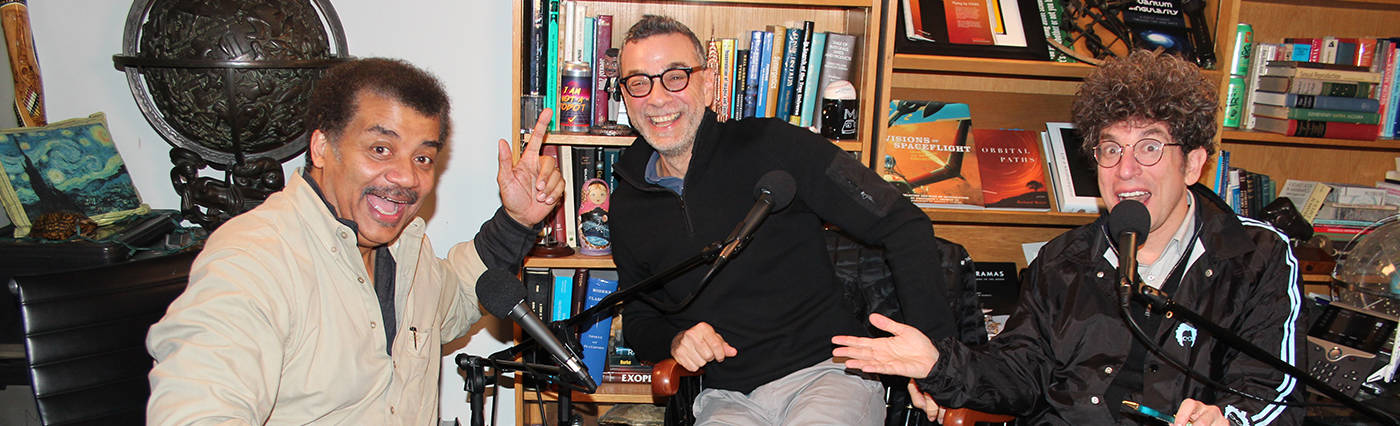
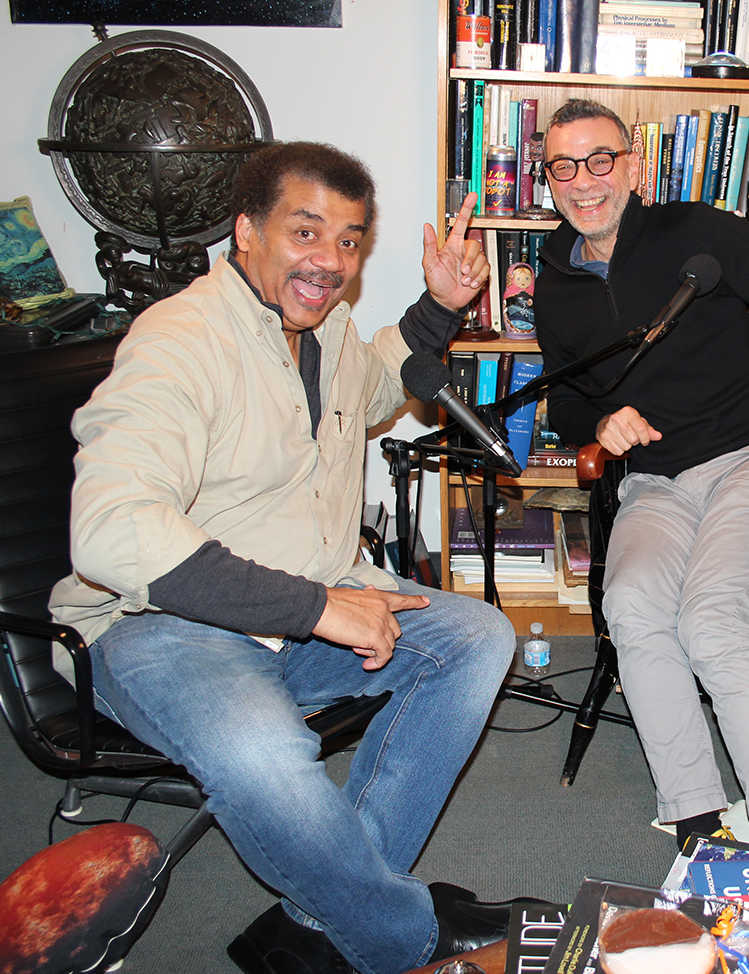
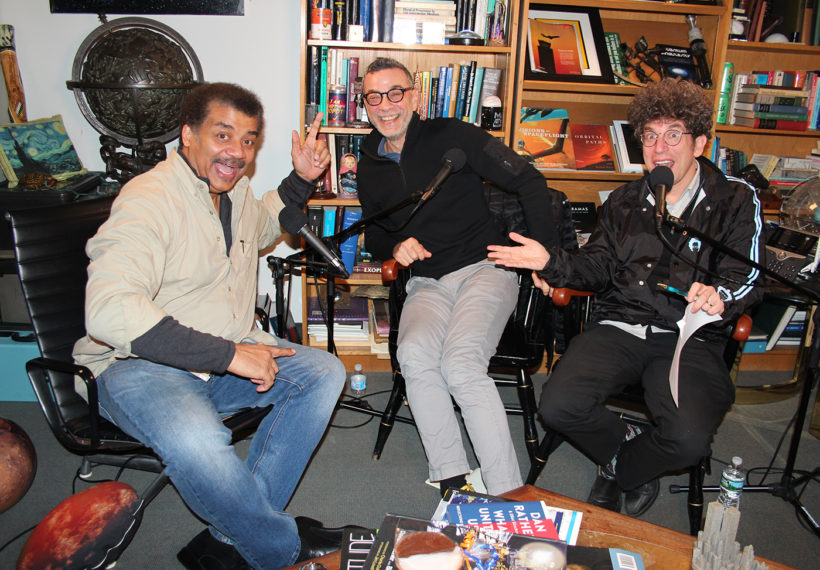
We have a special guest, Stephen Dubner.
Stephen, welcome.
Thank you very much.
And let me first introduce my co-host.
First time co-host.
First time.
James Altucher.
And so, James, you are host of a podcast.
Yes.
And...
When you've been on?
When I asked you the name of the podcast, I learned, it's the James Altucher podcast.
Yes, I'm very egotistical.
I need my name everywhere.
Everywhere.
Or I forget it.
I think I'm getting older now, and I start to forget things.
Everyone is getting older at all times.
So, Stephen, you have a podcast yourself.
It's called Freakonomics Radio.
Freakonomics Radio.
So the book just took over your life, huh?
It did, yeah.
I liked writing books a great deal.
Interviewing people, which is, I mean, I'm a writer, I've been interviewing people forever.
I always felt bad about wasting the 95% of the conversation.
When you interview someone for a magazine article or for a book, you'd use the choicest bits.
So, I really wanted to have an interview show.
So, Freakonomics Radio is kind of a blend.
To put in all the stuff that is not choice.
Yeah, exactly.
That's what he just said.
Exactly.
Well, but here's the thing.
Here's the thing.
Let me ask you this.
When you get written about...
Remember, you're not the interviewer here.
Go on.
I'll let this one slide.
Go on.
This is a tick.
I like to ask the question.
But when you get written about, let's say the New York Times writes an article about your vanity fair or something, and you read the things that you say, does that feel like a good representation of you?
That's my question.
Of course not.
I would say two profiles out of 100 that I've read accurately capture who and what I am.
So I would argue that mathematically there's a very obvious reason for that verity, which is that most articles have a little bit of the talker and a lot of the writer.
So there's a bunch of narrative around a little quote.
A podcast or radio show or interview show, whatever style it is, can flip that.
And then the listener or the reader, whatever the listener, actually has what I feel is a truer experience of what the smart person you're interviewing has to say.
And I like that.
Just call himself the smart person.
No, I'm being the opposite.
I'm the dumb person.
He is the smart person.
But you bring up an interesting point, which is that if you, the subject you know best is yourself, and if most of the articles written about you, you see are 98% wrong, that does suggest that every other article that we assume is correct is probably 98% wrong.
That's that famous adage, every article is correct except the one that you know something about.
Exactly.
So fake news is actually probably the average news story.
Yeah.
Yeah.
So, James, we've solicited questions from our fan base, and you've got them.
I've never seen them.
You've never seen them.
I don't think Stephen's ever seen them.
He's definitely not.
I know I haven't.
I'm not sure you haven't, but I'm going to believe you because I believe everything else you've told me earlier.
I'm going to ask a question.
James, give it to me.
So this is related probably to a tweet you did recently, but Daniel J.
Saltzman on Instagram says, what is the economics of meteor slash asteroid mining?
If you're able to bring back a huge meteor of diamonds, for example, wouldn't that immediately devalue the commodity?
So, so.
Well, that's a particularly interesting.
So the.
Let me quantify this.
So we have there's there's more gold on an average metallic asteroid than has ever been mined in the history of the world.
There's more water on a comet, on a typical comet, than all humans who have ever been born have ever drank.
So the resources of the universe, of our own backyard, our solar system, are extraordinary given what we're fighting over here on Earth to gain access to.
So it's wrong, I presume, we know, it's wrong to say here's the value of that resource using today's dollars on Earth.
Because you're right.
If you make a significant change in the quantity of a freely traded resource that is made available, that changes the economics of it.
So what would you see as the future if I bring down scads of gold to Earth?
So it's interesting.
Is there a Freakonomic angle to that?
So you change it to gold.
So yeah, I would say.
Gold, just to take a benchmark.
No, well, gold is a...
Because there's an actual market for gold.
Gold is a good example because there's an actual market for it.
A free market for it, unlike diamonds, which is a controlled market, yeah.
Well, not only is diamonds a controlled market, but diamonds are not particularly rare, and they're not...
I mean, there are those who argue that they are more beautiful, that their value is somehow intrinsic, but most people would say that that's not the case.
That it was a market that was created by a kind of very, very well done monopolistic endeavor.
So really, I would love to see the asteroid full of diamonds brought down just to break up the diamond cartel, which has convinced every...
Why are you so mean?
He doesn't like cartels.
He's anti-cartel.
I don't like cartels.
Diamonds have a cartel, so that they don't represent a free market.
By the way, there are places in the universe that also have scads of diamonds, but not large, pre-cut diamonds.
They're very tiny.
Some of them are almost microscopic.
They serve the industrial marketplace for diamonds.
But tell me about gold.
I bring barns worth of gold to earth.
What happens?
Yeah, it changes a lot in ways that I can't even begin to imagine.
Anyone that's even kind of pretending to work off a gold reserve idea, which we don't work off an actual gold reserve.
We used to, I guess.
We used to.
But now we work kind of off the idea of it.
No, it's a precious metal that would change the, I, so I could be-
Is it precious because it's rare?
Rare or is it precious because it's useful?
That's a very good question.
Gold, historically, yeah, it's pretty useful.
It's soft.
It's really useful.
But silver has a lot of the same uses, right?
No, well, gold is softer than silver.
Silver is also, is silver not antimicrobial too, or can it be?
It is, that's why it's silverware.
Well, I think you make compounds that would be antimicrobial.
But I would be more interested in water, personally, because gold, you know, gold has functions and uses and it's beautiful and functional.
Diamonds, you know, mostly a decorative thing.
But water supplies, so that's awesome.
So I would be, so if we're starting to talk about asteroid mining or resource mining, then yes, I am, it would...
You're going for the water.
I would go for any resource that is necessarily consumed by everybody on Earth, way ahead of gold and diamonds.
So for instance, I've learned recently, you probably know about this.
I don't know anything about it other than that satellite imagery now allows us to map out global water supply in aquifers that we never used to be able to do.
So that's really useful because...
It's multi-spectral imagery you get different...
That's what I was going to say, multi-spectral imagery.
So the notion of asteroid mining or resource mining, I think is revolutionary, generally fantastic, and most so because it would help put resources in the power of the global citizenry as opposed to the cartels or whatever that have done a pretty good job of monopolizing resources over...
James, you're pretty socialistic there.
Yeah, and it's not quite so obvious because first off, there would be an enormous amount of resources required to get to the asteroid mining.
And bring it back for sure.
You have to take it into the atmosphere.
Second, gold's primary use was because it was rare, it became a currency because it was hard to mine.
So it will, in the long run, affect the price downwards, supply and demand, but I think the resources would be so difficult to get it, it would be a long...
This is why all the space resource people are talking about.
If you're going to get it in space, it's to deliver to some other location in space, where there's a colony or there's a station getting built.
Because if you're building something in space, and you don't have to launch it from Earth, then just build factories in space and take all of your raw materials, and you can give them bottles of water.
This would be like Trump Hotel on Mars.
If he finds gold, and then they make a whole...
He can move that gold to his hotel and gild everything in his hotel.
Right, like Trump Mars would be amazing.
Trump Mars would have gilded toilet seats.
What kind of resources are most easily moved from out there to here?
Any?
It doesn't matter.
All that matters is its weight.
To accelerate it, to slow it down, to move it from one point in space to another.
So it could be a pound of gold or a pound of water.
It will cost you the same to move the thing around the solar system.
And depending on where it is in the asteroid, the mining effort would be the same.
If it's a few feet down or half a mile down in the asteroid, that's effort.
So liquid, solid gas, none of that matters.
Just weight.
There's not going to be liquid out there, but it will just be the weight.
Yeah, the state of the matter doesn't.
You can bring down ice.
You can't have liquid gold in the center of an asteroid?
No, you need high pressure temperature, and you're not getting that in the center of an asteroid.
So here's the thing.
So gold, here's the problem.
Gold is very heavy.
It's one of the densest known things.
When we joke about dense things, we talk about lead, right?
You got a lead foot, you're driving fast on the highway.
Lead is nothing compared with the platinum group elements.
Osmium, platinum, gold.
Osmium is the densest of all metals.
One cubic foot of that weighs, last I checked, I calculated this in middle school, I remember, 1,800 pounds.
Gold, just slightly less than that.
It might come in at maybe 1,650, 1,700 pounds.
Let me add something that I think you left out here.
Just because there's a lot of it, doesn't mean it would become as devalued as you think.
Because there are uses that previously are not economically tenable, that then become economically tenable, and the demand for that use goes up.
Fair enough.
What's a good point?
A gold is one of the highest conducting metals, conduct electricity better than copper, in terms of electrical conductivity.
Another use is highly malleable.
That's why you have gold gilded statues.
There might be some need to hammer gold thin and layer it onto something out there that could benefit from that fact.
Gold hardly ever corrodes if you need highly non-corrosive material.
The famous Voyager record that was sent into space that contained messages and sounds from Earth, that was a gold record.
It would last a billion years.
Someone could invent a new reason to use gold and that would completely transform the marketplace.
What about battery storage?
Here's one.
Aluminum is a modern element.
It was not known to the ancients.
As common as it is today, you think they've always not known.
It was locked up in bauxite, the ore that knew that aluminum was a thing to take out of it.
When aluminum was extracted, you know what the first person said after that?
That's the end of the silver market, because you can make silver ore out of it for less, and there's more of it, right?
Although the cost, economic as well as environmental costs, of extracting it is high.
But not anymore.
Anyhow, we've gotten better at it.
My point is, once aluminum rose up, it was like, oh, it's light and it's strong.
We can make airplanes out of it.
All of a sudden, you can do things that you never thought you could do before.
Do you remember Howard Hughes' famous airplane?
It was on display in Los Angeles.
You know why it's called the Spruce Goose?
It's made of wood.
It's made of wood.
Because wood is light.
Before a lot of aluminum was available.
And I always wonder, if we never discovered aluminum, what would we be making planes out of?
Would we be making them out of wood?
I don't know.
Would we have made so many planes?
Yeah, we'd all be flying a lot less.
Probably is my guess.
Yeah, so the existence of a single element and its properties, unique on the periodic table, birthed entire economic industries that then created a demand far above what you would ever declare to be its value as a cherished object to put on your shelf.
It makes me want to ask you, if you know anything about, I know nothing about this.
So there's silicon chips, right?
So we've been doing well with it.
But what about organic semiconductors?
You know anything about that and the stuff that's used in those?
And whether, is that a difficult problem to solve?
If it's organic, it's made of the most common ingredients in the universe.
I'm not worried about rarity there.
But apparently, we haven't yet found the ones that are cheap and pliable enough, that conduct well enough.
So then either we will, and then that will transform the industry, or we won't, and it's just a failed...
But we don't need any asteroids for that.
Oh, no.
All the elements on asteroids are on Earth.
They're just in greater abundance, rare stuff.
So what should we be...
All the rare Earth elements, they're on asteroids.
But they're rare here.
Except in China.
They're common in China.
China has most of the rare Earth elements within their borders.
Which, by the way, is used heavily by the semiconductor industry.
Yes, indeed.
Alright, another question.
Another question, give it to me.
It's from Arik Supermonium on Instagram.
Are there ways to notice the onset of another recession?
Is recession an inevitable event happening in cycles?
Ooh, I like that.
And actually, I'm curious about your answer first.
You're not going to get the answer to that until we return on StarTalk.
Unlocking the secrets of your world, and everything orbiting around it.
This is StarTalk.
We're back on StarTalk, Cosmic Queries, Economics.
Not just any kind of economics.
This Stephen Dubner kind, Freakonomics.
And I got James Altucher.
Altucher.
I can't even say it.
James, first timer.
Yes, thank you for having me.
Yeah, when he speaks, you're just listening.
You're supposed to interrupt him and tell him why you should.
He's very hard to interrupt.
I feel he's been interrupting.
We've been doing podcasts for 20 years.
I can't interrupt this guy.
So, we entered the commercial break with a question about, read the question again so we can have it.
Are there ways to notice the onset of another recession?
Is a recession an inevitable event happening in cycles?
So, let me broad, who asked that question?
Arik Suranyam from Instagram.
I feel, by the way, I get your cadence all of a sudden when I'm talking, like, you know, are there ways to notice the onset of another recession?
Is that how I speak?
I don't even think.
Well, I don't speak like that.
Somebody in the house is speaking that way.
So let me broaden that by saying, why should economics have cycles at all?
Why isn't it just a straight line?
Why there's boom and bust?
Why, why?
Well, by the way, does, is there such a thing as cycles?
I don't necessarily believe cycles is a thing in reality.
Let me not even use that word.
Why do things go up and down?
Why?
I mean, the shortest answer I could give is because-
Give me a Freakonomics answer.
Because the world is stochastic.
It just is, right?
And then if you look at the economy, so to answer the question-
Isn't the point of the Federal Reserve to modulate the stochasticity?
Well, imagine how less modulated it would be if there was no then.
By the way, stochastic to define for those who, not everyone knows the definition of that word.
Randomish, I would say.
Something stochastic, it can be sort of predictably random and analytically random, yeah, so.
It's not completely, the reason economics is a science is not completely random.
There's some things you can predict.
You guys do it in Freakonomics.
It's nice of you to say that economics is a science because there are those who would argue that it's not.
It's a social science, technically.
But in answer to that, so the questions specifically about can a recession be predicted?
So there's one saying that economists have predicted like 18 of the last three recessions, right?
So there is such a thing, there's a technical definition of a recession which has to do with a decrease in, is it employment?
You would know that too.
But the National Bureau of Economic Research declares a recession.
It's a decline in GDP.
But James would know that because he has prior history.
He does have prior history.
We all have prior history of recessions.
No, fess up, you're kind of...
So before you became a comedian...
I was a hedge fund manager.
Hedge fund manager.
And I was a hedge fund manager through two recessions.
And you weren't making enough money, so you said, I'm going to be a...
Oh no, I made enough money.
That's why I could be a comedian.
I was going to make a joke about that.
You totally messed up my whole joke.
I get it, I get it now.
Did you see the joke coming?
I didn't.
You didn't make enough money as a hedge fund manager, so you decided to take up comedy.
Right, because performing in front of 12 people on a Monday night...
Yeah, at a cocktail table.
It's so lucrative.
It's so lucrative.
So, isn't it true that if everyone is right about what will happen, they will bet in such a way that prevents it from happening?
That their behavior will be such that it won't happen.
But that's the problem, is that they're very bad at predicting.
Yeah, we're bad at predicting.
There's also arbitrage, so when there's an obvious opportunity for some people to profit from a downturn, right, that gets baked into the, maybe pulled out of the markets.
But bottom line, we have gotten much better at, we, like I have something to do with it, the modern world has gotten better at moderating or modulating the way the economy works.
So what you're left with, in fact, right when the Great Recession happened, which was 11 years ago now, right?
It began 12 years ago, 2007.
Sorry, the Great Recession, the Great Depression.
Sorry, sorry, I get my greats.
There's the Great War, the Great Recession, the Great Depression, the Great Generation, the Great, oh yeah.
Great big gobs of great Gatsby, grimy gopher guts.
But so tell me the Great Recession.
The Great Recession.
From 2008.
Yeah, 2007, 2008.
There were most economists who watched the macro economy at the time in the long run.
They were talking about the period that we were in right then, 2007, 2008, as what they called the Great Moderation.
They were trying to name our era then the Great Moderation.
What they meant by that is there will be no more big recessions.
So that's how good macro economists are at predicting the future.
And they said the same in 1999, right before the 2000.
Although that one was in some ways, I don't want to say easier to see, but the proximate cause was staring us in the face more.
Whereas...
Yeah, but if it was that obvious, people would have bet the other way and it wouldn't have happened.
Well, there were people who bet the other way in the markets.
There would have been more people who would have bet the other way to have buoyed that effect.
But fear and greed sort of comes to place in maximums right before a recession starts.
So this blinds everyone.
Maximum fear and greed happens right before a cycle change.
So that's what happened in 1999 and 2006.
What good is that for you to say it after the fact?
Nothing.
Alright, so...
If you don't know when you are maximally blinded by fear and greed, to say it after the fact doesn't help anyone do anything.
Alright, so let's put skin in the game right now and say here we are in 2019.
On a scale of let's say 1 to 10, how vulnerable do we feel the American economy is in let's say a five-year time window?
For five years.
Let's say five years.
Ten being catastrophic and one being everything kind of great, okay?
On the scale of...
On the count of three, we say our number.
Ready?
One, two, three.
Okay, interesting.
But I will say it's going to be great for the next two years and then it's going to be potentially horrible.
Would you bet on that?
Yeah.
You would?
Yeah.
Okay, so you're going to short every stock in two years?
I would just make sure.
That's betting on it.
No, being in cash is betting on it because I think it's going to be so bad.
That's not betting on it.
I'm a conservative guy.
That's not betting on it.
It is because I think the value of cash will go up.
It's fine, but if you really think everything's going to tank, you will short everything and you'll make even more money as we all learned in the Big Short.
So you're not actually betting on it.
You're wimping out by pulling out your cash and waiting for things to happen before you jump back in.
Thanks for announcing to the world I'm an Omega male instead of an Alpha male.
Stephen, am I correct that he's not actually betting?
I love that you're encouraging him to engage in the most reckless behavior possible.
Right, you could go broke shorting.
Who's your financial advisor?
You could go broke that way.
Next question.
What do you have?
Oh, by the way, creative investments in science and technology are reliable engines of tomorrow's economic growth.
So if you want to talk about boom and bust, the busting is usually going to happen when you don't have some meaningful return on your or no investments at all.
Well, this is related to our next question.
Industries that could actually keep you buoyant.
What do you have?
So this is from the Musial Studio from Instagram.
Do you feel that investing more in space exploration can help boost our economy?
Oh, God, yeah.
By the way, I'm going to ask also public versus private.
Should the government be investing or should billionaires be investing?
Okay, I wrote an entire book on this called Space Chronicles, and I write books so that I never have to talk about that subject again.
Can you write a book about politics then, please?
So I have an unorthodox answer to that, and I'd like to get your, Stephen, your feedback on it.
So people think of spinoffs.
If you value all the spinoffs, direct spinoffs from NASA relative to what we're spending on NASA, they do not pay for NASA.
So, the spinoff argument is...
What's a spinoff?
I'm asking.
Tang.
Oh, yeah.
Do we sell $18 billion a year in tang?
So we're talking about technology inspired by the work, technology derivative of research done to put people and maintain their lives in space, people and robots, space endeavors.
And creative people have to invent something to solve a problem.
Hey, this works on Earth.
One such example is Tempur-Pedic mattresses, Tempur-Foam.
That was invented for space exploration.
Yet it's an entire industry of mattresses now.
It's not an $18 billion a year industry, which is approximately NASA's budget.
So that's not the argument.
But wait, let me just ask you, what about, let's say, the computing effort that were put into early space?
So there are a lot of people who say that that computing environment accelerated the development of computing generally, which led to things like the development of the internet, et cetera, et cetera.
It made it happen faster, but it didn't create computers that wouldn't have been created already.
Well, it's interesting you make that argument because you've made the sort of opposite argument with like bringing in a bunch of gold, let's say.
In other words, we find uses for and grow, right?
We change our world based on the resources available.
I mean, how do you know that?
The computers that were used for NASA were not usable in your room.
Someone has to step up and say, let's make this a home computer.
The internet was initially funded by DARPA, Defense Advanced Research Project Agency, which you could argue was affiliated with the space development.
Well, it was very useful in space and plus the connecting computers was invented by physicists at a particle accelerator in Europe at CERN.
So this is again the engine of tomorrow's economic growth.
My point is very different from all of these.
If we agree that innovations in science and technology are tomorrow's engines of growth economies, I don't think that's a controversial statement.
For the sake of argument, I'll agree with you.
Yeah, I don't think it's a controversial statement.
Then if you have an active space exploration program, which would require government investment, private industry can't do what I'm about to describe.
You want to advance a space frontier, and companies will fail at this because there's no marketplace for advancing a space frontier.
It's too expensive, it's too costly, it's too dangerous, excuse me.
It's too expensive, it's too dangerous, and the return on that investment is indeterminate until it becomes routine.
Except for the last question where we did feel, oh, okay, let's get gold from the asteroids and water from the asteroids and that will feed the world forever.
That's an engineering frontier.
We've already been to asteroids.
That's not advancing a space frontier.
We've landed on asteroids.
So now you just have to land and dig and bring it back.
So the government landed on an asteroid before private enterprise did.
That's the only point I'm making here.
Private enterprise is not going to do anything first in space because to do something first in space has no obvious next return on that investment.
But a government can do it because a government has a much longer time horizon than your quarterly report or your annual report required of investors, be they public or private, in private enterprise.
So the point is, watch what happens.
We go into space in a big way and we say we're going to put people on Mars.
Well, we're going to go there in 15 years.
Well, who are those astronauts going to be?
Well, they're in middle school now.
Let's go find them and have like the Mercury 7, but now they're like 14 years old.
And they'll be in Teen Beat.
They'll be in all these magazines and we'll all be watching.
Are they eating well?
Are they not doing drugs?
Are they?
What's their social life?
Do the teachers like them?
And we follow them into adulthood and they are heroes that we send.
And everybody gets jazz about going into space.
And to do that requires advances because no one's sent people to Mars before, requires advances in electrical engineering, mechanical engineering, in physics, chemistry, biology.
The entire portfolio of STEM fields is stoked by an entire generation of students who have as their hero people whose journey is enabled by creativity in those fields.
That would transform our economy like no other force exists.
You know what we're doing now?
We got to go to country.
We need money to have a program to tell people that they should study science.
If you have kids selected who are going to be the first ones going to Mars, people will be jumping over each other to try to learn science and you don't need a special program to make it happen.
So your answer to that question is yes.
In the way I described, yes.
What's the point of sending people to Mars?
There's no point.
That might be the answer.
But, Stephen, let me ask you.
How nimble is the investment community in seeing opportunity that could open up new opportunities?
Nimble is an interesting word.
They're super nimble, but they're also fairly cowardly.
No, not even slow.
Here's an argument that some people make and that I find has some truth in it, which is that venture capital and private equity have built a great reputation for funding a lot of innovations.
Of the Silicon Valley sort.
Of the Silicon Valley sort.
But also SpaceX, Blue Origin.
Well, that's a little bit different because a lot of those are more vanity projects.
That's not all, but some are.
Which is a little bit different.
I think they want to make money.
Yeah, yeah.
But they're funded.
As Elon Musk said.
They're just funded differently at this point.
As Elon Musk said, if you want to make a small fortune in space, start with a big fortune.
But the argument is that the story that we tell ourselves about venture capital and private equity is these are unbelievably brave pioneers who seek out, right?
Whereas in fact, what they are are smart, motivated people who take pension funds primarily that have been earned by California school teachers and find a place to park it in something like an Uber or a Lyft.
That's great.
And there's some upside to that.
But there is an argument to be said that government funding of science, basic R&D, bench science over the years in pharmaceuticals, in space and computing, etc.
are wildly, wildly, wildly underappreciated and undervalued in part because it's the government's own fault for not getting a return on those investments.
But wait, when's the last time you took a drug that was made by the government?
Yesterday.
Every drug that's for sale now was basically funded by always the Institute of...
The first round is no return on the first round.
You have to know the thing exists first.
That requires huge investment and often it happens in collaborations with universities, this sort of thing.
So, yeah, so great point and here's something we all use.
Touchscreen monitors, touchscreens, that was invented on an NSF grant at the Library of Congress to have people interact with a screen that didn't have to require a mouse.
And so some innovative people invented the touchscreen.
So the government doesn't toot its horn, but what the government does do is release the patents so that you make a boatload of money and then you pay taxes back to the government.
But I'm very intrigued by your proposal that if you had the Teen Dream Mercury team, Mars team, what it would do, I think that's really an interesting scenario to consider.
Do you?
They would come back heroes as people who have been explorers in the history of civilization have been.
Well, I'm also just interested in what you're saying.
No one's ever had a ticker tape parade for a robot.
Right.
But what their existence would do to the next generations of people, because you're right, we tell people, learn STEM because it's good for you and it's good for us.
And they're looking, why, because there's no landscape out there for them to arrive on after they've actually gone through that exercise.
But could you imagine how annoying these kids would be though, like, if before you're 13, we're going to set up your Instagram account also, boom, like, you know, it's like quantum mechanics.
Once you start observing something, the behavior changes.
Now you're going to start observing, the whole world's going to be observing the new right stuff.
They're going to be like all Lindsay Lohan or whatever.
I don't want those kids.
On that note, we got to take a break when we come back more economics, specifically Freakonomics on StarTalk.
This is StarTalk.
StarTalk, we're back.
I'm Neil deGrasse Tyson.
I've got Stephen Dubner here.
I've got James Altucher.
Each of them has a podcast.
Only one of them named the podcast after himself, and that would be James, wouldn't it?
I feel like I have to apologize now.
I should have just called it, like, I don't know, Freakonomy.
The word freak is good.
Stephen Dubner, Freakonomics, best-selling book, internationally best-selling book.
Just congratulations on that for that to fly.
That's really good.
Can I tell him one story, Stephen, about the book?
Yes, please.
Okay, so this is almost 18 years, 17 years ago, whenever it was.
The day before the book comes out, Stephen and I are having lunch.
You were worried, I'm not gonna say what you said, but you were worried you didn't know how the book would do and you were scared.
And I said, I was lying, I was just being nice.
I said, don't worry, it's gonna be a big hit because I read the galley, but I just was being nice, I didn't know.
And then you called me a few days later.
You said, check out Amazon's rankings.
And I figured, oh, it'll be like number 1,000, number 2,000.
And you're like, no, just check out the rankings.
Okay, number one was Harry Potter.
Number two, Freakonomics.
For the next year and a half, it was number two was Freakonomics.
I was really jealous, but you were wrong.
Wait, wait, wait, that's a story.
That's a story.
He was nervous.
It's really a story about Harry Potter, really.
Unfortunately.
All right, we got more questions.
Yes.
Let's see, we only been through three questions today.
Let's see if we can get some more.
Okay, this is from Launchpad Cat on Instagram.
What is the most important thing to look for when determining if studies slash statistics are trustworthy?
Great question.
Depends if you're a scientist or not, if you know how to read the scientific paper.
I think there's anything a lay person can say, which is how big is the sample size?
What are the confounding factors?
What are the alternate explanations?
And what is your degree of confidence in your conclusion?
Those are some basic questions.
I would say in physics, we have it easy.
In economics, they have it hard.
Because in physics, if we find a new law of the universe, it will repeat every single time.
Whereas in economics, if you discover a new pattern and then you invest knowing that pattern, the act of investing changes what that pattern becomes.
Right.
True.
So you become, as James, you had mentioned earlier, you become sort of a quantum participant in the experiment itself.
Yeah.
And also, I feel with economics, the observer effect.
Most, right.
But most things are like bell curve statistics, but there's also the power law of earthquakes involved.
And you can never predict that as the problem, which is why it's a social science rather than a science.
I would not say we can never predict earthquakes.
We just don't know how now.
We don't know how now.
True.
But it's a different kind of statistics as far as we know.
But in physics, okay, you're an observational physicist.
In theoretical physics, I don't know if you can say that about theoretical physics papers.
Say what?
Like, let's say you have a...
Well, the frontier, most are wrong.
But once everything agrees and it matches observations, we have a new understanding of the universe.
It's why we have modern civilization.
Yeah, economics has about one law that's like a physics law.
And it's basically supply and demand and how price works within that.
But even that gets violated sometimes.
So yeah, it's a very different kind of science.
Next question, go.
James, you're picking them.
I'm going to pre-answer yes.
OK, private versus public health care, what's better for the economy?
And what's better?
What's more moral?
There's, I don't know, I don't do moral.
You don't do moral?
I think it's a mistake to do moral as a...
I think it's good to do moral as a first step.
But then when you get into analysis and descriptive policy and so on, you got to turn off, put away the moral compass.
Yeah, but moral compass could deeply influence.
For example, in my field, with regard to possible future contact with alien intelligence, if an alien shows up on earth and it's smarter than us and you kill it, is it murder?
If it's not itself human, right?
So our laws only talk about humans, but something more intelligent than you.
So these are things I think are worth folding in to how you think about the problem.
I think morality is hugely important, but when it comes to doing analytical...
Okay, here's a counter example.
I think morality is really, really important, but what kind of sentence is that?
Let me finish the sentence.
Morality is important, and...
Okay, if you want to be an and guy instead of a but guy, you're welcome to be an and guy, but it's incredibly important to put aside your personal moral compass when you're trying to analyze a particularly social issue, because, and this is why we see so much bad policy, you see people making policy decisions based on what they hope or wish will happen or fear may happen, and we humans are just smart enough to find confirmatory evidence of what we believe and ignore evidence that would negate it.
And so, I just go into situations trying to think, you know what, whatever I feel about this particular issue, gun control, climate change, whatever, whatever I feel about it, move it to the side and let's try to look at the data first.
So, that's what I mean by putting it on the side.
Like, so, like, let's say the government says in 1965, oh, we're going to back all student loans.
Nobody's ever done it in the US, so there's no data.
And now, tuitions go up 10x faster than inflation.
Well, but you can't say that because, I mean, a lot of European governments do actually guarantee, I mean, they guarantee universal education through college.
Like, like health care.
Use universal differently.
Ah, sorry, sorry, sorry.
Earth-wide education.
For everyone.
Universe is, like, bigger than Earth.
Noted.
All right, so for Earth-wide.
This universe is, like, prettiest person on Earth, not in the whole universe, okay?
So, so Earth-wise, getting back to the health care question, the question, what's better?
I think the answer is, I'm not going to say what's better or worse.
I think the answer is, it is bizarre that the United States is the only rich country in the world, that A, doesn't have a national health care system.
I say bizarre, not terrible, bizarre.
And it's also bizarre that we traditionally have had a health care system that's been tied to employment, which is basically an accident of history going back to the Second World War.
Do you think if people knew all of this, they would all think and vote differently about health care?
Not really, honestly.
But here's where I think the conversation needs to happen.
I think if people want to talk about socialism being wonderful or terrible, they need to understand what socialism is.
And most of the people who are promoting socialism as wonderful and terrible for that matter, don't know what socialism is.
So what they admire are socialist democracies like Scandinavia.
But that doesn't mean that the state owns the...
The oil company.
Right, exactly.
So when we look at Scandinavia and other countries that have good earth-wide health care...
I gotta get used to that one.
It's hard, it's really hard.
It's worth noting that that is not socialist in the way that it's used as an epithet.
And so would it be better for the economy for there to be some kind of a reform system where costs could be controlled?
Then the answer is a gigantic huge yes.
The problem is, I mean, I'm guessing you see this in your science a lot more than we see it in our science.
When there's a lot of entropy or inertia or whatever, how do you undo that?
The healthcare lobbies are really rich and really strong and why would they wanna undo it?
So that's a big, that's a big, big, big barrier.
And also look where government, like does the FDA really help the drug approval process?
And this is even related to the scientific studies question.
How many drugs get recalled even after they've been through all the studies?
I mean, some would say that the FDA for thalidomide per se was one of the best uses of public science in the history of the world.
I mean, that was actually, that was an FDA, you know, thalidomide was widely used in Europe and other places of the world.
The reason it wasn't here was because of, I think it was a single FDA officer.
And she just said, I think we haven't seen enough data to make a call on this.
So, but even that really set the stage for the next 45 years of maybe some reluctance or what not.
All right, another question.
Another question.
Give it to me.
This question is from Ari Moody at Patreon.
How is AI gonna change statistics and economics?
Yeah, where's AI landing right now?
How is AI going to change statistics?
AI will become the richest thing there ever was.
I just want-
Divine thing.
I don't know what AI is, if it's not animal, vegetable or mineral.
It's mineral, right, I guess.
So, if I have an AI computer and it's smarter than I am and it figures out the market and it becomes a trillionaire overnight.
Right.
And we'll just stare at it.
And there it is, it goes off on its private jet.
And wonder if it's gonna kill us?
They have AI though that plays chess, that flies planes, but not a single AI can tell me if an apple tastes good.
So, can they really replace humans?
I would say not yet.
Not yet, it's to come.
But get back to AI in economics.
Isn't that kind of what these complex trading programs are doing?
Yeah.
They're using hardcore statistics rather than AI.
Well, they're making decisions on the fly.
Based on information it had never seen before.
But primed by what has happened in the past.
That's what any of us do.
So I'm not going to say that's not AI.
There's strong AI, weak AI and general AI.
Okay, we can slice and dice.
But if you have a computer making buying and trading decisions based on information that it is getting on its own, then it has the potential to be the richest thing in the world.
I don't know if that's true.
And we really do pretty much have that now.
That sounds like you know it's not true when you say you don't know that it is true.
Are you being skeptical?
What's your skepticism?
The problem is in the markets, one of the biggest factors in the markets is human psychology.
So AI, we're always going to be better at that, the machines.
Not necessarily analyzing it.
Sorry, we won't be better at analyzing.
We'll always be better at producing it.
Because we introduce that chaos into the system.
But to me the biggest, I think about AI the way you were describing, let's say we bring back boatloads, boatloads full of gold.
What does AI do for the human experience?
We don't know yet.
Will it expand it and augment it and make it awesome?
I'm sure on some dimensions.
Will it make it very constricting?
I'm sure on other dimensions that's true.
I think, you know, dogs used to be animals of labor.
They did a lot of pulling stuff and they did a lot of labor for us.
And then we found better things to do that, including machines.
And then we turned them into pets.
So we actually have more dogs around now than we did when they were workers.
So I like to think that we humans, we could be lovely pets for the robots.
Absolutely.
I think we'd be, you know.
For the wealthy AI that's trading, you know.
Here's the problem that happens is that once you have AI that is making money, everybody else sees it and then they make AI to model that.
And so it gets, you mentioned it earlier in another question, it gets arbitraged away.
So advantages change very quickly.
And you always have to have the next AI very fast to change, to take advantage of that.
Yeah, so just it's second generation AI that kicks the ass of the first generation AI.
And then in the future, there'd be the hundredth generation AI that then controls the universe.
Let me get one last question.
Let me see if you're good at sound bites.
Go.
Okay.
Do you think that the economy would react better to a moon base or a long-term mission to Mars?
Ooh, good question.
A moon base or a long-term mission to Mars?
How would the economy react better?
Moon base.
Moon base because of what you said earlier, rare earth minerals.
Yeah, you want a way station for bringing back the...
No, I said they're on asteroids.
No, moon has hardly any.
No, but you want a close place to process stuff, don't you?
That has value, but it has less ambition.
Yeah, but it's like an Amazon warehouse in New Jersey.
I don't need to come all the way from Seattle.
I need my coffee tomorrow.
You're right.
The moon is three days away.
So moon prime, if we want our lunar rocks yesterday, better for our moon base.
Delivered by space drone.
Right.
You make a good point.
I retract my statement about Mars being cooler because the moon will be much more practical.
We can disagree.
That's okay.
I'm comfortable with that.
If you have good arguments.
What's more interesting to you, somebody landing on a passing asteroid or someone landing on Mars?
Mars will take more innovation to pull that off.
And as a scientist that likes seeing the moving frontier of our knowledge, Mars landing.
But what if someone's going to use the asteroid as their rocket to get to Mars?
Boom!
Yeah, it's better to just use your own rocket.
Really?
Then an entire planet?
Because the asteroid would be head straight for Mars.
And if it is, you're going to be dead when it hits.
So yeah, it's just not a wise thing.
How worried are you about an Earth-ending asteroid strike generally?
A life-on-Earth-ending asteroid.
Earth will be here longer.
A life-on-Earth-ending asteroid.
Yeah, we should all invest some amount of money to mitigate that risk.
So for all of our guests, we give them a chance to ask me a question if they've been harboring any unanswered thoughts about the universe.
I've been harboring.
I do have a question for you.
I think this is a really minor thing, but it's something that I wonder about, which is contamination.
I'm sorry if I smell.
So I know that at JPL, Jet Propulsion Labs in Pasadena, California, which does a lot of NASA research, It's a branch of NASA, yes.
They and others are concerned that everything that we send into space doesn't spread our microbes around and the things that come back from wherever.
Is that a major concern?
Oh, yes.
It's an entire office of NASA called the Office of Planetary Protection.
And it protects other planets from our microbes and it protects our planet from whatever microbes might come back if we have what we call a sample return mission.
Or if we send astronauts and they might come back contaminated.
The original Apollo 11 astronauts were put in a, what do you call that?
Containment, whatever, a quarantine.
Yeah, they were in quarantine, but I keep saying Winnebago, but it was not a Winnebago.
It was a Gulf Stream, the metal, the air stream, thank you.
So the astronauts were put in like an air stream and you can only talk to them through the window and through the telephone.
And that was to make sure that they didn't bring any bugs back from the moon.
We learned that they didn't because as we know, it can't survive on the moon.
But it was still, the gesture was an important fact that, look people, we don't want to cross contaminate.
When that has happened in the history of exploration on Earth, it has never boded well for typically the people who got visited by the...
It would be so interesting to know, however, if there were antibodies or whatever, any kind of microbes that would be useful in our Earth science here.
We certainly never evolved them in our bodies though.
Well, we don't know that.
I mean, you know a little bit more about the Big Bang than I do, but isn't there a chance that there's a piece of that in all of us, yes?
A piece of what?
Whatever is in us is out there.
Yeah, the atoms.
So, theoretically, there may be some underlying principles of cancer that we haven't yet understood well because we haven't seen it modeled in a way that we can...
What we would do is get, do a download on the brilliance of the aliens who have come to visit us.
They will know more about practically everything.
We got to end it there.
Guys, thanks for coming on.
Thanks for having me.
Throw a little economic twist to all of this because, as they say, freshly minted graduates, scientist, engineer and economist, and they pose a question to the life they're about to lead.
The scientist asks, why does it work?
The engineer asks, how does it work?
The economist asks, how much does it cost?
And that is the civilization we have come to know.
You've been listening to, possibly even watching, StarTalk.
I want to thank Freakonomics, Stephen Dubner.
Stephen, thank you for being on.
My pleasure.
James Altucher.
Recently married.
Congratulations.
Thank you.
And thanks for coming on.
Thank you very much.
Thanks for having me.
All right.
I've been Neil deGrasse Tyson, and I still will be even after we finish this podcast.
And I want to thank you for listening to, possibly even watching, StarTalk.
As always, I bid you to keep looking up.
See the full transcript



 Unlock with Patreon


 Become a Patron