


 Unlock with Patreon
About This Episode
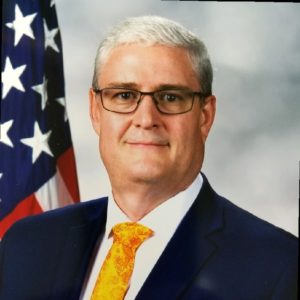
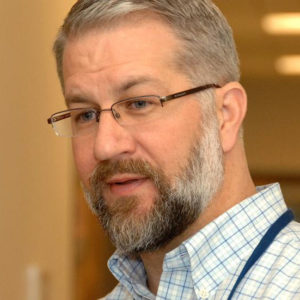
How do you identify human remains? On this episode, Neil deGrasse Tyson and comic co-host Chuck Nice explore DNA and the task to identify the remains of fallen soldiers with biomedical scientist Tim McMahon and forensic anthropologist Franklin Damann. What is the Defense POW/MIA Accounting Agency?
How do you collect and process DNA for identification? Learn about the Department of Defense’s mission to recover and identify remains from past wars from the Director of DNA operations Tim McMahon. How has 23andMe helped identify these fallen soldiers? You’ll learn about collecting DNA out of osteocytes, investigative genetic genealogy, and DNA magnets. What are other applications for DNA research? What are the main differences between nuclear and mitochondrial DNA? Is it really easier to extract ancient Neanderthal DNA than a more recent sample?
Next, we speak with Defense POW/MIA Accounting Agency’s Deputy Laboratory Director, Franklin Damann. Find out how they process the remains aboard the USS Oklahoma. How do you sift through so many commingled bones? We discuss exhuming remains and what this project has done for the families of these missing soldiers. Is there any other valuable information learned from these identifications? What is the best environment for recovery? How big of a sample do you need to get enough DNA for identification?
How many missing and unidentified soldiers are there? How is artificial intelligence used to help identification? How do you identify 13,000 individual bones? What is the clavicle method? All that, plus, we explore the “CSI effect” and how projects like these get many scientists and world governments to collaborate.
Thanks to our Patrons Jon Scherer, Thibault Deckers, Jimmy Jam, Evan Cooper, Barnato, Justin Ross, James Nichols, Lori, Emilie Talles, and Roy Slettbakk for supporting us this week.
NOTE: StarTalk+ Patrons can watch or listen to this entire episode commercial-free.
Transcript
DOWNLOAD SRTWelcome to StarTalk, your place in the universe where science and pop culture collide.
StarTalk begins right now.
This is StarTalk.
Neil deGrasse Tyson here, your personal astrophysicist, and I got Chuck Nice with me as usual.
Chuck, baby.
Hey Neil, what’s happening?
All right, very good, very good.
You know, we got a really deep subject today.
Oh, my gosh.
Which is why I was trying to figure out why I’m here.
When I saw the actual copy for the show, I was like, I think they got the…
Did I receive this by mistake this email?
Using forensic science to identify missing soldiers.
Yeah.
Oh, my gosh.
Very important work.
And of course, I mean, why wouldn’t this be a thing, right?
I mean, you know, we got forensics for crime.
We got, you know, we got DNA for exoneration.
And it seems like there’s a lot of bits and pieces there.
You put it all together in one sort of scientific chemistry, biology, work universe.
And so the Department of Defense has an entire branch of itself that specializes in just this.
And we’ve got two guests today who will take us deep into what those operations are, how they work, and what their success rates are.
And they’ll just keep us up to date on what has been happening over these recent years as it tracks the progress of science.
And leading off, we’ve got Dr.
Tim McMahon.
Tim, welcome to StarTalk.
Neil, thank you, Chuck.
Nice to meet you as well.
It’s an honor for me to be here and chat with you on DNA.
Excellent, thank you.
You’re a biomedical scientist and director of the DOD, Department of Defense, DNA Operations.
So, of course, that’s got to be a thing.
It’s very Men in Black, Tim, I got to tell you.
Well, you know, I’ll give you Men in Blue since blue suits are my favorite.
And also, for those who can see this in video, Tim is wearing a vibrant red tie.
So that’s not Men in Black uniform, for sure.
But let me ask, the defense prisoner of war and missing an action accounting agency, that’s a mouthful.
What can you tell us about that?
So the DPAA is actually, they’re the organization that is in charge with the recovery and identification of missing service members.
My organization is the Armed Forces Medical Examiner System, and we’re actually partnered with the DPAA.
We actually provide all DOD with human remains DNA identification.
So not only for the past accounting mission, where we helped the DPAA identify our fallen heroes from World War II, Korea, Vietnam and the Cold War, but also all of our current day losses as well.
And you were talking about DNA and crime.
The first time DNA was used in a criminal case was in 1987 in England.
In 1991, the military used DNA for the first time to assist with the identification of a service member from Vietnam, but also with current day losses at the close of Operation Desert Storm or the First Gulf War.
That actually set up our laboratory and established the DNA laboratory under the Armed Forces Medical Examiner System.
It’s not just remains in a battlefield.
There are places where fallen soldiers have been buried anonymously.
We think of the beaches of Normandy.
I’m just thinking Korea, Cambodia, Vietnam.
Not every place is just here’s a box of remains go to work.
It’s got to be more complicated than that, isn’t it?
It is much more complicated.
And my cohort at the DPAA, Dr.
Franklin Damann, who you’ll be chatting with, he will be able to give you a much more in-depth on that.
But we are mandated by the United States government.
We leave no man behind.
And so there’s been active recoveries, for example, for Vietnam since the close of the Vietnam War, and then with Korea in World War II.
But for example, in our own cemetery, in the National Memorial Cemetery, the Pacific in Hawaii, there are unknown service members who were recovered, but could not be identified.
Those are the DNA samples for one set of types of remains called disinterments that come to my lab that we will test and obtain the DNA out of those and then run a couple of different tests on them.
But unlike a modern crime scene where, for example, if I committed a crime, they could take a swab from my cheek and they could do that direct reference that way, we don’t have that ability.
So we actually have to rely on family members to donate samples to us that we can then compare to these unknowns to assist with the identification effort.
So when you exhumed, well, I suppose you don’t need to exhum an entire body because if it’s DNA, you only need a sample.
And then what do you do from there?
You create a database or do you create a familial database and then work backwards?
So that’s it.
Chuck, that’s actually an excellent question.
We have proactively been collecting references since 1992.
So for example, for the original 8100 missing at the end of the Korean War, I have family references in a database for 92% of those missing.
So we do have that family reference database.
For Vietnam, we’re at about 86%.
And then World War II was recently added in about 2010.
And so we have about 18% of the original 72,000 missing.
But if you look at, for example, the USS Oklahoma…
Wait, just to be clear, US Oklahoma, that’s in Pearl Harbor, so December 7, 1941, the ship sank with servicemen inside the ship entombing them.
Right.
If I understand this correctly.
And then the ship was righted and those remains were recovered and they were interred in the National Memorial Cemetery of the Pacific as unknowns.
In my lab, we received 363 out of 394 references, so we had references for 363 of those, which once you start getting really over 80% coverage, DNA becomes a strong supporting line of evidence for identification.
But Chuck, to answer your question, when we disinter, you’re going to hear from my esteemed colleagues all about the excellent work that they do.
And it’s not just DNA.
DNA is one means of identification.
It’s about all of the information coming together.
For example, their stature, which is anthropology, and there’s dental, and there’s historical evidence and things like that.
So it’s about building the full picture.
I’m just one cog in that picture, which is the DNA portion of it.
But normally when we think of bones, we don’t think of DNA.
We think of, like you said, cheek samples or skin samples.
But there is sort of living tissue inside of bones at some point in their history.
Is that where you get the DNA?
Because otherwise the calcium, I don’t think, would be very helpful.
No.
So you’re absolutely right.
So the actual osteocytes, which is the formal word for the DNA containing cells within the bone, that DNA is protected.
And so we actually can take a portion of the bone and grind that bone up into a powder.
And then we add a buffer to it.
We call it demineralization buffer.
It’s a big word.
But I want you to think of turpentine.
If you drop turpentine on the hood of your car, you dissolve that paint completely.
Well, do I know that?
So that buffer dissolves that bone powder completely and frees up all of the DNA.
But when we do that, in that liquid now is not only human DNA, there’s bacterial DNA, there’s fungal DNA, anything that was in the environment that could have soaked into that bone as well over time.
And so we have to purify the DNA.
And what I tell people the most is you think about that last cup of coffee nobody wants to drink because all the grinds in it.
If you were to pass that coffee back through a filter, the grind would stay on top and you get the pure coffee.
Well, we have a specialized filter that the DNA binds to and we can wash away everything we don’t want.
But then we have…
That’s being very clever.
I mean, presumably you didn’t have that initially and someone said, I have an idea.
I have DNA Velcro.
Yeah.
And so, no, this, I mean, you’re speaking like, yeah, this is there, but oh my gosh, people are inventing this stuff all along.
It is.
So the earliest point that DNA was identified was in 1950s.
It was in the 60s that the first purification methods came out, but it wasn’t that filter didn’t come around until 1984.
And now we can actually use magnets.
We can bind the DNA to a special particle and then use a magnet to pull the DNA out of it.
It’s crazy how it changes.
That’s just, okay, that’s sci-fi insane right there.
So please, dude, just that process for a second, you know, and then Neil can tell me, can you magnetize anything?
No, I’m going to presume Tim means that it’s a chemical magnet and magnet is metaphorical.
I’m going to assume that Tim.
No, so actually…
Oh, ow!
Okay, don’t say anymore because you’re top secret clearance here.
No, actually it’s a small sphere that is charged and it then has a special binding agent that allows the DNA to bind to it based on a charge.
And because it’s metal, you can then hold a magnet against the side of the tube and that pulls that metal sphere with the DNA to it and then we can wash away everything else and then you rehydrate the DNA at that point and that breaks the bond off of that sphere and you get the pure DNA.
It’s called science!
It is called science, but I’m going to tell you, and no disrespect to the process or the importance of it, but they do the same thing with cocaine.
Are you serious?
It is a chemical process, you know?
And the easiest way I tell people is, you know, when we grew up, there was that little toy that looked like the face and you had the magnet, the ferrous metal in there, and you could draw the beard on it.
That’s what we’re doing, is you’re basically buying the DNA and then putting a magnet and pulling it out that way.
Fascinating.
And Chuck, I didn’t know that about cocaine.
I have no such knowledge.
It’s not exactly that, because as much money as these drug dealers have, they don’t want to spend it on science.
All I know is that drug dealers were metric fluent before anyone in the United States was.
That’s true.
They’re selling kilos and things.
That is a true statement.
Tim, I know there’s a lot of research, not only in private industry, but also in the DOD.
So who is leading the DNA frontier today?
Is it your kind of research, because you’ve got deep government pockets for that, or is it 23andMe, right?
Because that’s an entire commercial enterprise that’s driven by market forces.
So, Neil, that’s a great question.
It’s actually a combination of both.
So we do the exact same tests that your state and local and the FBI do for criminal casework, because any unidentified human remains that are found in the local fall underneath your local police jurisdiction.
So that’s where you see they’re using these commercial tests, and now you see through investigative, what’s called investigative genetic genealogy, where they’re able to utilize what we call direct-to-consumer companies, where they can then use, build off of the 23andMe and ancestry.com and guide police into identifying either a cold case perpetrator of a crime or an unknown person who died and they had no way forward.
The difference is those are geared toward modern DNA samples.
These are DNA samples that have been protected over the years.
We have to take either what’s been commercially developed, break it and make it work for ours that have been in the environment 80 plus years, have seen chemical insults from being prepared for burial or from post-traumatic fire from a crash in an airplane or in a lot of it, I call it fit for use.
We have to develop that test.
So the police and 23andMe, they’re collecting samples for the purposes of identification and lineage, whereas you guys have to create that yourself.
Right.
So what the police do is if you have a cold case and they isolated DNA, let’s say from an unknown human remains.
So this is an individual that was found in the woods.
The police get it, they develop a profile.
They then search the FBI’s missing person database.
It doesn’t hit to it.
The investigators have no leads.
It’s now a cold case.
They can work with companies like Orthrom and Parabond and a lot of other direct to consumer companies out there to develop this what we call a single nucleotide polymorphism profile, which is your ancestry markers, your identity markers.
And then they can search JetMatch, which is a searchable database, and they can identify potential leads of who this person may be.
And then the police investigators will investigate, they will find, and then if they find a reference, they will collect a reference from that person, match it, and then make an identification that way.
So every day that goes by, the database gets better for everybody?
In the commercial sector, yes.
The more people that get in there, the better the database gets.
But for our case, we have already developed that database, but those commercial assays won’t work with ours.
So, for example, what I tell people is, if you…
And I’m a knuckle-draggers from being a mechanic when I was younger in school, is I was there when we switched from standard sockets to metric sockets.
I hear the drug dealers had that same kind of…
They had to start figuring out how to go from pounds to kilos.
But, you know, if you have a standard socket, there’s a 716.
A 10-millimeter may work on it once, but then it will strip it.
And so, what we have to do is we have to make that test to work.
So, for example, the chemically-treated sample…
So, at the end of the Korean War, as part of Operation Glory, the United States received about 4,000 sets of remains.
About 850 of those could not be identified.
They were buried in the National Memorial Cemetery of the Pacific in Hawaii as unknowns.
When the DPAA went in, disinterred, we could not get a DNA result from them.
And it took 16 years and science to catch up.
But in 2016, we developed and validated a method that allowed us to get DNA results from it using what we call next generation sequencing.
That’s those instruments that you hear about personalized medicine.
So we adapted from the medical side, brought it in, created a test that is not commercially available.
And since 2016, we’ve gone from seven samples a month to over 70 samples a month and went from a 20% success rate to over 68% success rate just with that.
And it’s led to over 200 new identifications for people who previously would not have worked because the commercial tests like 23andMe and ancestry.com or the commercial short tandem repeat tests, which are the markers your state and local prime labs use, wouldn’t work.
We’ve had to make them work with our type samples.
And just to remind people, you mentioned, did you say customized medicine?
Or I want to just remind people that we can imagine a future where the medicine you are prescribed knows about your entire DNA profile so that you can minimize side effects and have the medicine do exactly what it needs to do.
We’re not quite there yet.
But from what you’re saying, we’re on the doorsteps of this sort of thing.
And it’s being used.
I mean, some of the new drugs that have come out for say pancreatic cancer has been based on that deep sequencing of multiple different types of pancreatic cancer.
And I will say, you know, a family member of mine is the benefit of those new drugs.
He was a type 3 basically when you think about that and is now in full remission because of the technology and the ability to look at multiple people very quickly and multiple different types of strains to personalize that medicine to help people out.
Now tell me, you know, I have rudimentary awareness and knowledge of DNA.
What does it mean to track mitochondrial DNA versus nuclear DNA?
What is going on there when you guys pick and choose what aspect of the molecule you care about?
So it’s very quick.
So within your body, you have two types of DNA.
And I tell people to think of a computer.
The hard drive is like the nucleus within your cell.
And that hard drive tells your computer what to do, the operating system and everything.
That’s like the nuclear DNA.
And that’s those 23 pairs of chromosomes.
You get half from mom, half from dad.
It tells you how fast you’re going to go white.
And if you’re videotaping, I started going white at 25, how tall you’re going to be.
I’ve been trying to go white my whole life.
I think you mean gray.
I think you mean gray.
Whoa, I didn’t know people, you know, Michael Jackson did that.
And there’s only one copy of that.
Now, the battery of your computer gives it the energy.
Well, within your cells, you have mitochondrion.
They are the energy producing organelles within, and that has its own DNA called mitochondrial DNA.
And that actually only comes from the mother.
Mother.
And there’s thousands of mitochondrial copies per cell to that one nuclear.
And so where most labs focus on the nuclear DNA, we actually focus on both of those because it’s about getting answers.
We can use all of those to help include or exclude individuals to support identifications through the DPAA.
Before we let you go, because we’re going to continue this with your colleague, tell me, I’ve read that Neanderthal DNA, which, you know, we’re now tens of thousands of years ago, is sometimes and in some cases easier to extract than some of the DNA you’re obtaining.
How’s that even possible?
That’s a great question.
So Dr.
Marshall, who’s the head of my emerging technology, we’ve partnered with the Max Planck Institute.
And we took over some…
In Germany, yeah.
So we took, we partnered with them and took over some of our chemically treated.
And they do a lot of ancient DNA.
But when you think about that Neanderthal DNA, a lot of it is found in caves that are very deep, very cold, very well preserved at that point.
And so when we did the extractions and we looked at the chemical damage and the amount of human DNA, in fact, we were equivalent in damage to 30,000 to 40,000 year old Neanderthal DNA.
But the 20 samples that we took over actually had less human DNA than the Neanderthal.
And what we end up doing is we end up having a lot of bacterial DNA.
And we’ve had to figure out methods to enrich for the human DNA.
So I tell people to think the way we do that is, when you’re walking down the street, if you saw that silver dollar in the rain gutter, you could put a piece of gum on a stick and you could stick it down and pick up that.
Well, we developed methods that allowed us to bind specifically the human DNA and then using those magnets, pull the human DNA out from the bacterial DNA.
By the way, I just want to let you know that we have too much money to be worried about a silver dollar in a drain.
No, I’m joking.
I thought you were better paid than that, Tim.
Tim, we gotta call it quits there, but thank you for joining us in this first of three segments where we’re exploring the efforts of the Department of Defense to just do right by missing soldiers and those who are otherwise unidentified.
So, Tim, Dr.
McMahon, thanks for joining us on StarTalk.
Chuck and Neil, thanks very much for having me.
It’s been my pleasure.
And thanks for telling the story of our families and our fallen heroes.
We guarantee this will be seen and heard far and wide.
We’ll make sure of it because we have power over the universe.
The podverse.
The podcasterverse.
The podcasterverse.
Up next, we’re going to be joined by forensic anthropologist Franklin Damann, who will help us delve deeper into the forensic science of it all in the Department of Defense when StarTalk continues.
Hi, I’m Chris Cohen from Haworth, New Jersey, and I support StarTalk on Patreon.
Please enjoy this episode of StarTalk Radio with your and my favorite personal astrophysicist, Neil deGrasse Tyson.
We’re back, StarTalk.
We’re talking about forensic science as applied to fallen soldiers in the Department of Defense of the United States of America.
And we were introduced to this department I had never heard about, the DPAA.
And we’ve got someone who is the Deputy Director of that laboratory, who is a forensic anthropologist, Dr.
Franklin Damann.
Dr.
Damann, welcome to StarTalk.
Thank you.
It’s a pleasure to be here.
And in that first segment, I think you might have eavesdropped on it.
We made a quick mention of the USS Oklahoma.
Could you just tell me, give me a little more details about what went on there?
Because I thought that they were going to leave the fallen sailors, Navy personnel, entombed in the Oklahoma and that itself would be the burial site.
So when did that change or did I not remember that correctly?
No, you’re correct.
It has been a standard Navy policy that the ship goes down.
That is their final resting place is with the ship.
You see that with the USS Arizona as a memorial out of Pearl Harbor.
The USS Oklahoma is a little bit different in the sense that for four years after that ship capsized, there were salvage operations.
So salvage divers would go in under water, into the ship, trying to find what they could.
What they could find, they buried in one of two temporary cemeteries.
It was the policy at the time that we’re not, the government is not going to fight a global war and also identify and repatriate the fallen soldier to the families that would take place after the war.
And so at the conclusion of World War II, those two temporary cemeteries were exhumed and there was a laboratory, a central identification laboratory at at Schofield Barracks in Hawaii, where they attempted to segregate these remains, right?
It’s dark and the ship is capsized, there’s oil everywhere.
They’re just moving by feel to try to find what they can find.
Wait, just to be clear, Second World War was a segregated army.
So the way you’re using the word throws me a little bit.
You meant separate out the remains from other things that could contaminate the remains.
That is correct.
Here we have 429 sailors and marines that died on that ship.
And after four years, what became skeletonized remains became co-mingled, is the word that we use, mixed with one another.
And that cemetery, was it known in advance that you would exhume what was buried there?
Well, no.
So they did their best to identify what they could.
They identified 35 service members at that time.
So can you, before you go any further, because when you talk about the forensics of it, what is the kind of like regular investigative identification?
How’s that done?
Because 35, what makes you, if you’re saying there’s this commingling, how do you know that this 35 is indeed the 35?
That’s an excellent question.
You’re picking up on some of us here.
There’s, those 35 IDs were made by dental comparison.
So each of these service members has a medical history, has a medical file.
And it’s really kind of important to understand throughout any of our identification effort is we can be the best forensic anthropologist.
Tim can hire the best molecular biologist in his lab, right?
Where you can squeeze DNA out of a bone and pull it out with a magnet.
But unless they have something to compare it to, if I have a dental pattern and a set of remains, I need that anti-mortem that in living, you go to the dentist and they record your restorations, your decay, that’s what I need to compare to the remains to make an ID.
And those 35 are all dental identifications.
If I can say something more even just fundamental about science, when we make any measurement in the universe, we need reference standards against them.
Otherwise, it’s just floating data with no way to even think about it or to interpret it.
So I think it’s a way more fundamental reality in doing science than even just in this application.
And that is foundational across all of what we do in this mission.
We know what we know about a population biology approach.
I know that if I measure a bone, this bone can tell me how tall a person was because I have a reference dataset of people that I know in life, how tall they were, and I know their bone measurements.
So it’s kind of a juxtaposition of knowing the population biology and then layering in all of these different data points to then tease out what is an individual from a population.
So that’s the anthropologist in you, right?
It is indeed.
Yeah, yeah.
And so just remind me again, just the military practice, because the Oklahoma did not sink, it came under a different category from ships that do.
Because these were buried and they ultimately ended up in the National Cemetery, the National Memorial Cemetery in the Pacific at Punchbowl in Hawaii.
And because those were in the cemetery, I think it made it a little easier to justify.
You also had, one of the other really cool things about what we do in the government as scientists is it’s the kind of the apply application of science to public, right?
It’s public science in a way, and that we’re doing this to meet a policy, we’re doing it to meet a statute or law.
And here, when you have families, family groups that have demonstrated significant interests and desire to have these cases exhumed and analyzed and individually identified, I think carries a significant amount of weight in our mission.
Of course, definitely.
And so just to be clear, missing in action is often, the person is presumed dead, correct?
So, but the family doesn’t know for sure.
And so even if they’re confirmed dead, they wanna be able to at least have some kind of ceremony or burial ritual to bring closure to this unknown.
Is that a fair characterization of what role you’re playing in this journey from soldier to memorial?
I think that’s absolutely fair.
I think when you, it’s in our mission statement, when we say accounting for, to account for a missing person, we’re really, we’re talking about telling their story, like who was that person?
And then providing that family the primary next of kin, the information about their loss.
I mean, even if we can’t get ever to an identification of somebody that’s just not gonna happen, we still have information and research that our historians have produced and investigations and multiple attempts and trying to do field archaeological recoveries.
And all of that information is valuable to a family who’s just looking for anything.
So with respect to the story being told, and I hope this isn’t too morose, is there any other information that the identification might be able to divulge as a part of that story?
Like I read something about Machu Picchu where, you know, they buried bones inside of these tombs inside the mountain, and they pulled the bones out and they realized that the diet of corn like rotted most people’s teeth because it’s very high in sugar.
But I mean, is there people want to know like, you know, injuries?
Chuck, Chuck, it was the candy bars in the machine at the commissary.
The one that came down, probably dropped down onto the-
That’s something like a Gary Larson comic, actually.
Exactly.
Right, right.
But are there any other stories that can be told?
The forensic story, the cause of death, what?
Right.
Yeah, sure.
That’s what I’m trying to say, the cause, those markers.
Yeah, so I think that’s a really, there’s a really cool connection between what our historians do and our researchers as they’re looking into like who’s missing, the over 80,000 that are missing from World War II to our wars in Iraq.
They’re the ones who were charged with doing the research to find out who they are, where were they last known to be alive?
What information do we have about them?
And a lot of the time they’re looking at primary source documentation, secondary source, so published books about engagements and battles.
And when you can marry that information, historical information, secondary source, against what comes through the lab.
What has recovered?
Who gets identified?
Maybe you’re identifying a guy who historically was said they were way up north, right?
But yet their body was found and we have proven the medical certainty that they were down here.
You in a way can contribute to rewriting or understanding engagement, right?
The battle and how the movements of people and time and space.
So does this go back to the Civil War?
Because a lot of burial sites in battlefields, because I think that was just before they could move a dead body without it putrefying to its back home.
So you bury it on the spot.
So is that part of the mission statement that you’re undergoing here?
Yeah, so the mission that’s in statute, we’re really looking from World War II to the Iraq Wars.
But the logistics, like the moving a body, it had always been the policy up until the Korean War that it was called temporary interment.
Bury that temporary cemetery after a war, we’d come back and exhume you and identify you.
In fact, it was World War II, there was a massive program.
It was called Return of the Dead program that picked up in 45.
It was in fact a curator at a place you may have some familiarity with, the American Museum of Natural History, who received a letter from the Quartermaster General of the Army who was responsible and said, okay, now the war’s over, I need help.
I don’t know what to do.
Oh, okay, okay, interesting.
Under invitation from the Army, Harry Shapiro went over to Europe, looked at some of the battlefields, looked at what was going on and said, I think you need to hire a bunch of anthropologists.
And so in Europe, they had European anthropologists working in Stroudsburg and Hawaii.
You had a fellow by the name of Charles Warren, who was one of the first anthropologists working for the government and fulfillment of this mission.
So, okay, so that’s a reminder that when you’re on the frontier of what is known and unknown, you have to sort of invent solutions that previous people hadn’t thought of, right?
And so it sounds so obvious today that of course you bring in anthropologists because they think about this stuff all the time, but in the service of these military projects, that would have been a major point of advance in terms of our understanding of what’s necessary.
It did.
And that policy changed.
As I was halfway through the Korean War, they realized, hell, we could do a much better job identifying these guys if I got them back to a mortuary sooner.
And so that’s when you have this startup in Korea and do concurrent return is the policy.
And that’s what we’ve been doing ever since.
That’s what takes place in Iraq and Afghanistan.
So what’s the best, if you were to rank environments in which, if you were to exhume a body, it’s like the best environment for full recovery.
Is it the desert?
Is it the jungle?
The tundra, is there?
No, no, let me answer.
I know the best one, a glacier.
Freeze you in a glacier.
Oh yeah, ice man.
Ice man.
That’s the only one I know.
But anything else you guys say, great, good news, they’re in a bog or whatever.
So what does an anthropologist say about this?
Well, you’re right in the sense that you’re looking for environments that don’t change much.
Right?
In the earlier segment, we talked about Neanderthal DNA.
You heard about Neanderthal DNA in these caves where it’s constant temperature and moisture.
And that does well for preservation of organic material.
One of the complicating factors in our mission is that we weren’t necessarily fighting in bogs or glaciers.
We do have cases that take us out to glaciers, aircraft losses, but a lot of them are airplane crashes and skirmishes that take place in your, the way in which the death event occurs has a significant impact on what we can actually recover.
You know, if it’s a Vietnam-era jet aircraft as opposed to a tank loss or a ground loss in Europe in World War II.
Well, that’s the question.
What is the bare minimum that you would need in order to make an identification?
Yeah, when we think of DNA, is it like a single strand?
Is it a molecule?
I mean, how many molecules, DNA molecules do you need?
Most of our work does require DNA analysis and if evidence comes into the lab and I have a large enough sample that I can submit, we will, and if it’s successful, we can make an ID.
And so right now we’re shooting for at least a minimum of two grams of hard, compact cortical bone that we can send.
And just to remind people, two grams is not very much, right?
That’s like a tiny fraction of an ounce.
That would, it’s about the size of your, the end of your thumb.
That’s insane.
If we, if we had a tooth, we’ll pull the organic material from the inside of a tooth and send just milligrams of powder.
And what is the best material to receive?
The person walks in and dies on the spot and then you can identify them.
And they have their wallet on them and they tell you their name.
And their social security.
Then we good here.
We good here.
You want something that’s been pretty well preserved, right?
That’s been in a pretty stable environment that has large enough sample that you can send off for DNA.
When you’re talking about individual bone types, a lot of it has to do with the in-lab molecular techniques that they use to prepare bone.
You want to make sure you remove as, you know, bone is a living tissue, right?
It’s always gets constantly turning over.
It’s constantly changing.
And it’s porous.
And so when it sits in the archaeological context, it’s taking on those things like microbes and fungi and all kinds of other decomposers that are out there.
And you want to be able to clean that off as best you can.
And so usually we’re talking about those hard compact bone.
So your femur, your upper leg bone, some of the internal structures of the cranium, your head, tend to be right around the ear, the inner ear area.
And now that you said that about the conditions, it just reminded me of the best place to gather that information.
And I learned this from Neil, the moon.
What are you talking about, the moon?
Because you said that there are no microbes to actually decompose a body.
Correct, correct.
That’s right.
Yeah, if you’re in a place that’s not organic, there’s no organic decomposition of you.
Right.
It’ll just sort of stay there.
It might desiccate, but yeah, definitely.
But I don’t think the DOD is worried about bodies on the moon, Chuck.
Not according to my conspiracy theories.
That means it’s time to take a break.
And when we get back, when we get back more with Dr.
Franklin Damann, and we get deeper into his lab and find out what are the methods, tools and tactics that he engages on this edition, this military edition of StarTalk.
We’re back, StarTalk.
I’m here with Chuck Nice.
Still tweeting at ChuckNiceComic?
Yes, thank you, sir.
Yeah, and I noticed that your Brain Games series dropped on that Geo channel.
And actually, you find that through Disney, I guess, correct?
Disney Plus, if you have Disney Plus.
Disney owns everything, so just go to Disney, you’ll find whatever you’re looking for.
And now they own me.
All right, all right, I’m slowly binging them, if that’s possible, but it’s always good to see what our human shortcomings are in our capacity to think and interpret reality that’s sitting blatantly in front of us.
So I’ve always enjoyed that series.
Yeah, I’m just a dad to bring you that.
You wanna know shortcomings, that’s where I’m a Viking.
Well, in this episode, we’re talking about the challenges and the triumphs of identifying fallen heroes who were unknown, who we only have fragments of their bodies, DNA perhaps, but not always.
And we’ve got Dr.
Franklin Damann, who works for the Defense Prisoner of War and Missing and Action Accounting Agency.
And so, Dr.
Franklin, could you just walk us through the bureaucratic sequence of what happens before a loved one or a family member is notified of your success?
I certainly can do.
And it’s, you know, the 80,000 who are missing from World War II to the wars in Iraq.
There are a couple of ways in which we find evidence and get it into the laboratory.
Really, it starts with our model as researchers and analysts go find out who’s missing.
That launches a team out to do an investigation, talk to witnesses.
Hey, what did you, what do you know?
Did you see a plane crash here 30, 40 years ago?
Yeah, it’s right here.
That leads into either an excavation of a site, if you’re out in the jungle somewhere on the side of the Oshawa Valley in Vietnam, or if you’re looking into remains that the government already owns in a national cemetery somewhere across Europe where they were recovered, they attempted ID, but they couldn’t do an ID.
They’re buried under a headstone that says unknown.
We have all of those records.
And what can we do today with our science today to put a name to that set of remains?
Once that happens, it comes into the laboratory, and that’s when our laboratory procedures take place.
We have a lab out in Hawaii, a main lab in Hawaii.
We have one here in Nebraska, and we’ve got about 150 staff working this mission.
And everything from anthropologists and dentists, data scientists, forensic chemists, doing the work to combine as much information as possible about a set of remains so that our group of case coordinators can look at who’s missing and try to match up that post-mortem information that’s collected, what we call in the blind.
So they know nothing about a case as it comes in.
And they just look at the evidence and produce the report and their information.
And then another set of people look at it and match it up against who’s missing.
And that’s when our medical examiner says, yes, everything matches up.
And this is this person beyond any other reasonable possibility.
And you get the military person that goes to the door and rings the bell, I mean, that we see in movies.
I mean, how do you notify the kin, the kinfolk?
Once the medical examiner makes the identification, that notification goes to the respective service casualty officer.
So if it’s Army goes to Army, Navy goes Navy.
That service casualty officer in turn is the responsible party for communicating to the family.
Within 24 or 48 hours, they’ll initiate a phone call to say, hey, we now have identified the remains of your relative.
And that then leads into a series of conversations about, you know, where they’re going to be buried, when they want to be buried, and everything kind of is back planned from there.
So this is like one of the most collaborative projects I’ve ever heard of in anything.
I mean, the chemist, the biologist, the medical doctor, like you said, the dentist, the anthropologist, and the historians.
This is a brilliant use of academic resources.
And as an academic, fundamentally, I think this is a beautiful reality you have created.
Yeah, the only thing that’s missing is David Caruso from CSI Miami.
No, but what he’s saying is way harder than anything CSI has ever had to tackle.
I’m looking at CSI now.
Oh, you all got it easy.
Let me change channels.
You guys make CSI Miami.
They should have their own TV show.
No, we need a DPAA TV show.
CSI is like the romper room of what you have.
Romper room.
Those guys are like, they’re like kindergarten.
Yeah, we got the body.
It was shot right here on this street corner.
You know, I got, what do we have on these guys?
You look at these guys and you’re like, what do you want, a cookie?
God, everything was already done for you.
We call it the CSI effect, right?
That’s actually a real thing that we contend with and talking to families and trying to get them to understand that sometimes it’s not always so easy.
Doesn’t happen in the 45 minutes and there are no commercial breaks.
So the, so people are actually biased by the fact that they watch this kind of representation of the science and technology play out in this tiny little short period of time.
Yeah, I believe so.
Wow, that makes sense.
And everybody’s young and good looking and you know, the whole thing is what…
I was waiting for it.
That one was too easy.
That was too easy.
So I’m intrigued by what role the moving frontier of AI and machine learning and big data might play in your work.
Because that stuff changes weekly, right?
And if you want to take full advantage of it, somebody in your office needs to be tracking that.
So what role does that play now and what role do you see that can play for the future?
Yeah, we’re just beginning to scratch the surface of it.
And I think it’s going to be huge for us as we continue to move forward.
Really right now we’re just doing very simple, what I call simple AI, I think it’s referred to normally, where we’re just looking to automate boring tasks that you would normally have an anthology.
I’ve got a board certified forensic anthropologist that’s working.
And if they’re spending a lot of their time just messing around with an Excel spreadsheet and playing with data, that’s not really living up to their, what they went to school for.
And it’s my job to put them in front of the bench, on the table, working with the remains.
And I can have my data scientists work with these spreadsheets to automate some of the work.
An example of what we’ve done, we’ve talked about the USS Oklahoma.
When those, I think there were 62 graves that were exhumed and they came here into the laboratory, the first thing we do is a full inventory.
So that’s just right at every bone that comes in.
We had over 13,000 individual bone specimens that came into the lab that we needed to segregate into individuals from a co-mingled assemblage back into what is one person.
When I got here in 2015, we were walking around with clipboards and a government skill craft pen collecting our inventory, which made it awfully difficult to do any downstream work with.
And so through our partnership initiative that DPAA has allowed to do, we worked with University of Nebraska, Ohio and the College of Information Science and Technology and built a database that allows us to, simple users use it, we’ve got standards, it’s cloud-based, the data that goes in gets peer reviewed within the system, and we’ve got security layers over the top of it.
And the nice part is because it’s standardized, we can then work with the data in a very simplified way, where I can search and filter and start looking at pulling that data out.
And they take all of my 13,000 specimens that are in this space and put them in this graphical space, and then let me look at relationships and associations between left bones and right bones.
And if I take my standard measurements across one bone, we’re all pretty symmetrical, right?
Bilaterally, left to right, we’re all as humans, we’re pretty symmetrical.
Mostly on the inside, too.
You have one pancreas and one liver, and one heart, but yeah.
And so we can look at automating the comparison.
So if I have traditionally, if I’m looking at an upper arm bone onto the left, and I need to compare it to 300 rights, I have to do that like one to 300, but I have to do it 300 times because I got 300 lefts to go at.
And it takes an analyst like a full week to do that work.
But if I have the measurements and I can run them through my automation software, I can focus on the tails, the people that are excluded, right?
And just focus on those 20 and my analyst can do those in a morning.
But we also are moving into 3D technology, surface scanning, looking at, you know, everything so far is just two dimensional measurements, looking at linear measurements, but now we’re looking at actual surface models.
Volumetric, yeah, excellent.
What is the clavicle method?
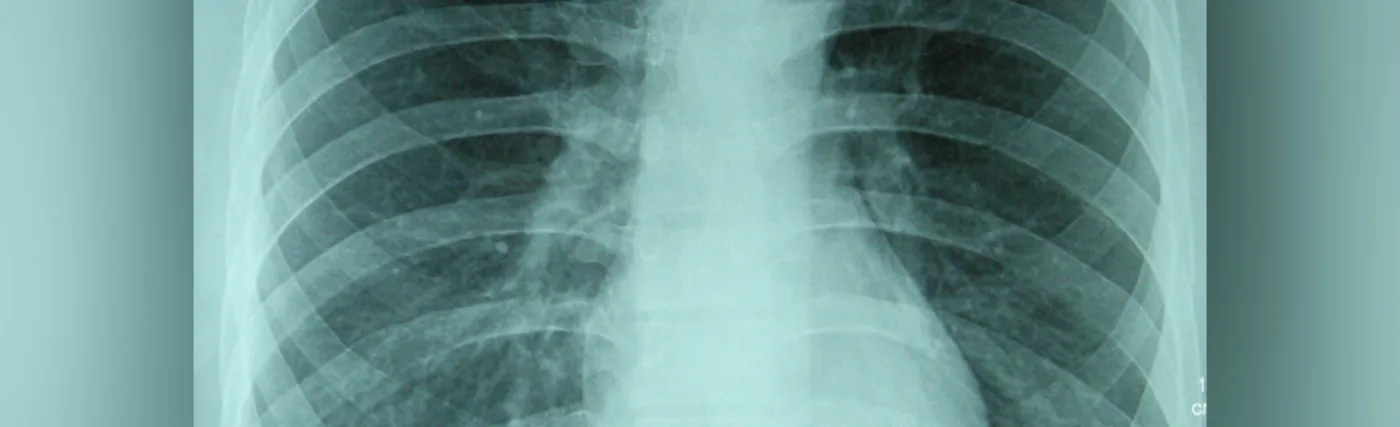
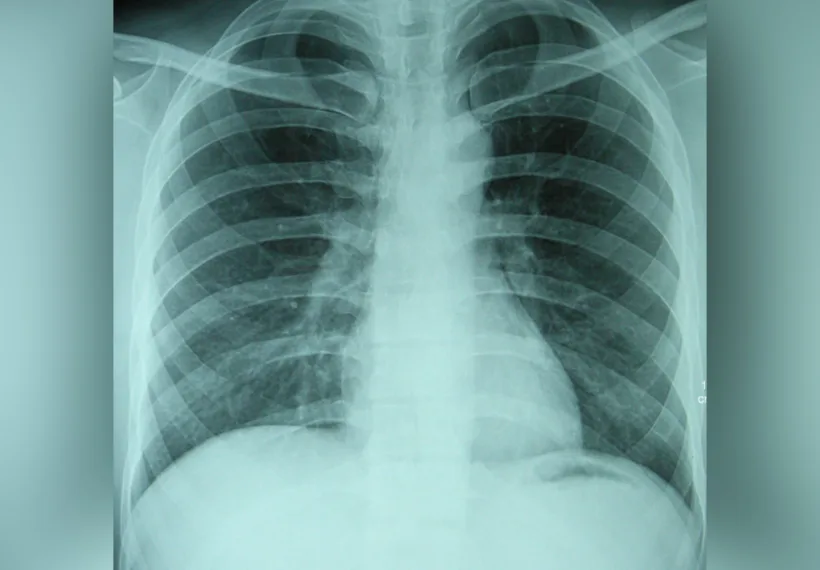
Yeah, so that’s something, you know, we’re looking at x-ray comparisons.
That’s all we’re doing.
We’re looking at post-mortem, after death, to pre-antimortem, before death images.
And much like you go to the dentist and you would have a dental x-ray, we have the same thing from these service members, except they’re not teeth or clavicles, they’re your collarbone, right?
We have service members in the 40s and 50s would show up to these medical clinics and have chest x-rays taken to look for tuberculosis, whether you fit for service.
So you got the clavicle for free out of that data set.
So here’s our massive data set of antimortem chest radiographs that we have access to.
And not only do we have access to them, because it’s the military, there’s a very particular technical manual that defines how you’re supposed to take that image.
So you know exactly how far they are away from the subject, from the capture device, how they’re standing, all of that information, and we can recreate that.
So we go out and we exhum an unknown.
We have the bones of the neck and we have the collarbones.
And we can position them into a couple of different triage or a couple of different positions, and we can take an X-ray.
And then what we do is we take the X-ray against maybe a list of five people we think it could be, and we start looking for pattern matches, right?
I’m looking at the densities, the opacity within the X-ray itself to see where am I finding or excluding someone from that match to the remains.
Okay, this sounds like we already have face recognition software, so now we just need clavicle recognition software, and then you can automate that just fine.
We have part of the original research development was to look at all of these anti-mortem X-rays and look at how unique the shape is, just the shape of the shaft of the clavicle, not even the part where it comes in.
I didn’t know that, didn’t know that.
And that is, we can run an automated search that returns your top 10 hit list of who this possibly could be based off of the shape of your clavicle.
Now the clavicle is not the strongest bone in the body.
In fact, I used to wrestle, and in high school I actually broke a guy’s collarbone.
I took him down in a takedown pin.
There’s some takedowns that are also a pin maneuver when you hit the mat.
What high school did you go to?
Cobra Kai?
Cobra Kai High School?
Sweep the leg.
Sweep the leg?
No, no, but when it cracked, the whole room heard it.
It was like, there it is in his body, and it was like, oh my gosh, what just happened?
So I have this relationship to the collarbone that I didn’t really want to have, so that’s why I’m a little more sensitive to what you’re describing for it.
Yeah, you think you’re sensitive.
You should see the guy you broke his head.
Having broke my own once as a child, it’s not a fun experience now.
Well, so we gotta land this plane safely, I hope.
Can you tell us, what can we expect in the next five years, 10 years, based on your crystal ball read of the science, the direction science is going, and also geopolitical cooperation in this exercise seems to be paramount.
Yeah, two totally different questions there.
I’ll hit the innovation one first and where we’re going.
I think the biggest thing that we’ve got going on right now in our research area and what we’re looking to validate is the use of stable isotopes as tracers.
And this is, we’re looking primarily at carbon, carbon-12, 13, looking at ratios that we’re finding in remains in order to differentiate on whether somebody is of a possible US origin or not.
And is this something that I need to send off to Dr.
McMahon and AFDIL to run a DNA sample or is it one that we need to be concerned about because it’s not part of our mission set?
By the way, in my field, isotope ratios are everything.
When we have a rock, a meteorite that doesn’t match other meteorites in the asteroid belt that we can trace them to and someone went into a pocket of air inside of it and noticed that the isotope ratios of the gas equaled what you find in the atmosphere of Mars.
And it became the first unambiguously Martian identified meteorite because of isotope ratios.
So my people know full well the power of isotope ratios, so the power to you as you bring that to your field.
Yeah, it’s all based on what you eat, right?
What we figured out many years ago, the chemists and the C3, C4 plants and how the carbons are being incorporated.
One question I have for you, everything that we’re doing here is tied to what is known in the ratios here on Earth.
I guess your comment, what do we know of the isotopic ratios of 12 and 13 and other stars or planets?
Yeah, there’s some places where there’s only carbon 12 and carbon 13 is extremely rare.
But in your case, there are other isotope ratios that changed in the era of nuclear weaponry.
Correct.
So if you were in a place and a time, there’s certain in your bones, in your calcium, you have different ratios than if you were in a different place at a different time.
Plus it’s glowing.
No, I’m sorry.
The first indication you were at a nuclear bomb test.
And that’s how we’re using mistracers, exactly.
No, so wow.
So that’s a very fertile field.
This sounds like you’re just beginning to tap into.
So how about there?
Now tell me just geopolitically how that works.
Our mission requires that we interface with other nations.
There are about 46, 50 different nations that we deal with and work with, I shouldn’t say deal with, but we have proper cooperative relationship on a daily basis.
You know, and I think that’s part of our mission set that doesn’t really get mentioned as much is the geopolitical relationships that we are able to establish through this mission.
In fact, it was one of our former presidents and his interactions with North Korea and the four points that were raised.
The fourth point there was this mission and turning over remains of missing US service members that were in possession of the North Koreans.
Mm-hmm, mm-hmm, mm-hmm.
So this is hopeful, and plus what it tells us is even where relations might be tense, there’s a deeper humanity in what it means and what it is you do that perhaps we’d like to believe at least permeates all nations of the world.
Yeah, I like to think of it as exactly in those terms, right, that I’m a human, we’re all humans, we all have basic core needs and beliefs, and I’m a son, I’m a husband, I’m a brother, and so are they and so are the folks that we talk to and work with, and it makes it easy to understand, I think.
Well, Dr.
Damann, it’s been an honor to have you on this program, representing such an important branch of what is going on at the Department of Defense that hardly anybody knows about.
I mean, I didn’t know about it, but I don’t know that I should be my representative, I don’t know, of the knowledge base of Americans and of this world, but to the extent that we can get people to see and hear this podcast, we will do it.
I’ve always been a big fan.
Likewise.
All right.
Dr.
Franklin Damann, thank you for your time.
And how do we find out more about your, is there a web page that we can go to for the DPAA?
Absolutely.
DPAA.mil and we also have a page on Facebook, a new Twitter account as well.
But not yet TikTok.
Okay, you got to work on that.
Let’s get the youngins involved.
Yeah, I’ll call your people.
We’ll figure out what we can do there.
All right.
Again, thank you, Dr.
Damann.
Chuck Nice, always good to have you, man.
Always a pleasure.
I am Neil deGrasse Tyson, your personal astrophysicist, as always bidding you to keep looking up.
 Become a Patron