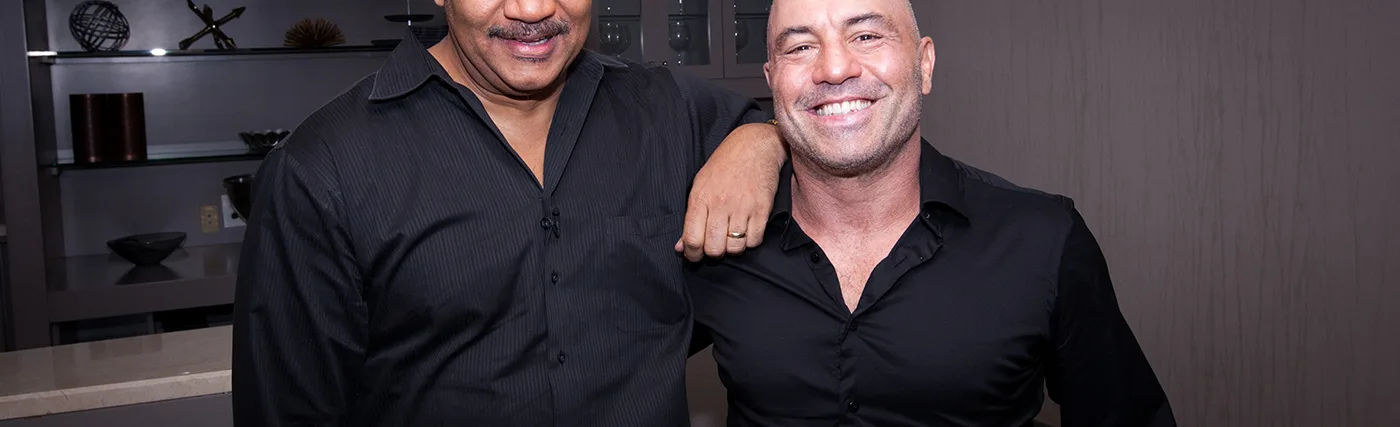
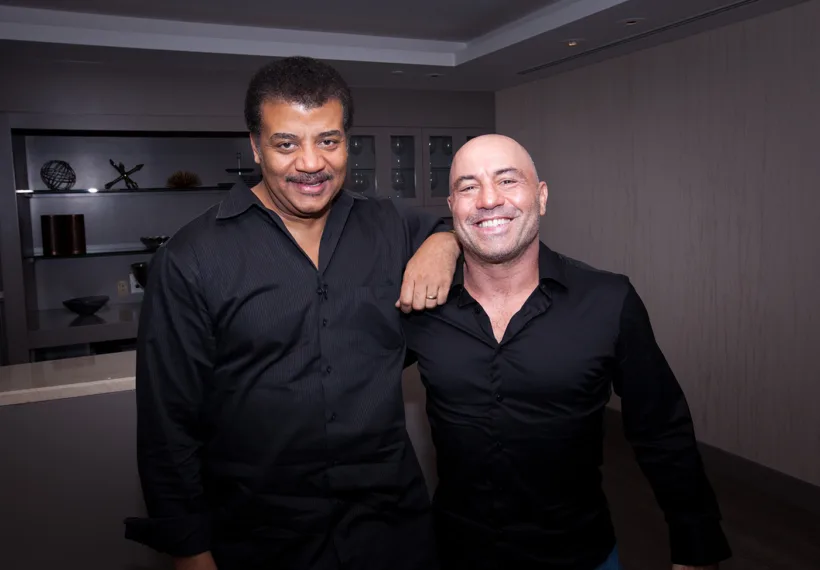
Why do we fight? Is sensory deprivation a viable mental health option? Isn’t it weird we’re all floating in space right now? On this episode of StarTalk Radio, we answer these eclectic questions and a lot more as Neil deGrasse Tyson sits down Joe Rogan, comedian, MMA commentator, and host of The Joe Rogan Experience. In-studio, Neil is joined by comic co-host Sasheer Zamata, and Jonathan Gottschall, literary scholar and author of The Professor in the Cage: Why Men Fight and Why We Like to Watch. You’ll learn about Joe’s early science and martial arts influences that shaped his worldview. Jonathan tells us about his experience joining a cage fighting gym and explains why storytelling is a good device for spreading science. Dive into the philosophy of the different teaching forms of marital arts. Ponder the “riddle of the duel” and why Brazilian jiu-jitsu is the most scientific form of fighting. Jonathan takes us inside the ring as he shares what it was like to be knocked unconscious. Find out if fighters think about physics during a fight. Investigate the physics and kinetic energy transfer that take place during a punch. Join us as we debate the effectiveness of a punch vs a kick. Discover why the introduction of gloves made fighting more dangerous. You’ll hear StarTalk correspondent Chuck Nice visit an MMA gym to get choked out in the name of science. Shifting gears, we step inside the brain to explore mental health. We also discuss the underappreciation of teachers and why Joe thinks society over-values celebrities. Sasheer leads the panel in handing out “Teachies” to influential teachers. All that, plus Joe shares his love for sensory deprivation therapy, Dr. Leah Lagos stops by to share techniques to help us connect and feel the world more deeply, Joe gets to ask Neil his own Cosmic Query about the beginning and end of the universe, and Neil ponders the future of fighting against the backdrop of the cosmic perspective.
Transcript
DOWNLOAD SRT
Welcome to StarTalk, your place in the universe where science and pop culture collide. StarTalk begins right now. Welcome to the hall of the universe. I'm your host, Neil deGrasse Tyson, your personal astrophysicist, and tonight we're featuring my interview...
Welcome to StarTalk, your place in the universe where science and pop culture collide.
StarTalk begins right now.
Welcome to the hall of the universe.
I'm your host, Neil deGrasse Tyson, your personal astrophysicist, and tonight we're featuring my interview with comedian and mixed martial artist commentator, Joe Rogan.
We're going to explore the science of fighting and the primal mind.
So let's do this.
I've got my comedian co-host Sasheer Zamata, Sissy, welcome back.
You got old timer on the show now.
I know, I'm a vet.
Oh my gosh.
Thank you.
And welcome.
You're tweeting at TheSheerTruth.
Yes.
Great, great Twitter handle right there and also joining us is professor and author Jonathan Gottschall.
Jonathan, welcome.
Welcome back to the show.
I'm a vet too.
And your latest book, Professor, I love this.
Professor in the Cage, Why Men Fight and Why We Like to Watch.
Joe Rogan blurbed your book.
That's right.
So he says here, a fascinating story, a great fucking book.
Joe Rogan, UFC commentator.
I thought he had more vocabulary available to him.
That's one of his favorite words.
So we'll be tapping your perspective and expertise tonight as we explore my interview.
And I've been on his podcast a few times.
And what intrigues me is given all the rest of what he is in his profile, he has a deep curiosity about the universe.
So I asked Joe if any science teachers early on in his life may have helped kindle his cosmic curiosity.
Let's check it out.
I had one science teacher when I was in seventh grade that probably changed my life.
Really?
Yeah.
One science teacher.
For the better.
For the better.
Yes.
We have to say that to him.
Yeah.
He talked about the nature of the size of the universe.
I remember one class where he said if you want your brain to hurt, just think about something that has no end.
Think about the idea that you cannot see the end of space.
You look above, look up into the sky, this goes on forever.
You think you can rationalize or you can conceptualize forever, but just think about that.
I remember thinking about that so much after that.
I would think about it years later.
Years.
Years later because he was an intense guy.
Everything we do, we're in a room, it's this big, that tall, that wide.
There's a map, I'm driving to San Diego, that's a distance.
Everything, so much of our lives is contained by a measurement.
Yes.
And he, in my small little mind at the time, he planted a seed.
And that seed was this concept that we take so often for granted, the idea that above you is forever.
And that notion, it's above and below, it's everywhere.
And we're in this, and I don't have to tell you.
But this concept is, it's so hard for us to wrap our minds around, yet so ever-present, and we ignore it.
We ignore it.
And it's become a big part of my act of, I've had several bits about space.
Is it that we ignore it or we don't even know to recognize it?
Maybe it's so overwhelming that we choose to somehow or another put it in the back of our mind.
People concentrate on weird things about life, and there's so many weird things about life.
But the weirdest thing by far is that we're in space, and it's almost never discussed.
You go throughout your day.
We're just there, there's nothing around the Earth.
Above us is a thin layer of gas that protects us from rocks that periodically slam into the planet and kill everything.
You know how thin that layer is?
It is to Earth what the skin of an apple is to the apple.
Just to put punctuation on your usage of the word thin.
Continues.
I say there's a fireball floating in the sky.
It's a million times bigger than Earth.
If you stare at it, you'll go blind.
It's trying to give you cancer, and if it's not there, you get sad.
Like, we're in a.
So, Jonathan, you teach storytelling as a science, and what do you think of his seventh-grade teacher telling him this story about our place in the universe?
Why do you think it resonated?
Was it because it was a story, in a story form, or because just the facts were so mind-blowing?
My feeling about that is that, you know, hopefully you've all had an experience of like this, where a teacher has sort of cracked you up, just open like that, right, sort of suddenly, almost violently, to the whole wonder and magic of a subject area.
That seems like what happened to Joe there.
You know, we had this experience where he saw that science is kind of magical, kind of stirs the soul, right?
Sort of like great art does, or like a great, you know, poem does.
It fills you with that sense of wonder, and it fills you with a sense of odd humility about your place, you know, in the universe.
And a good poem, or a good other source of art, you can think about it years later, just as he thought about the universe.
Right, it sticks with you.
Years later.
Well, in his teens, he was national taekwondo champion.
Yes.
And he then transitioned to a career as a stand-up comedian, which continues to this day.
And then he hosted, of all things, the TV reality show Fear Factor.
Correct.
And what was it?
It was on NBC, I think.
That's where you stick your head inside of worms and stuff.
It was like, ooh.
You eat horse penises, too.
Really?
That was a thing.
So you remembered that.
Oh, yes.
If you see something like that, you don't forget.
You don't forget that.
And now he's hosted one of the top ten podcasts in the world called The Joe Rogan Experience.
And he discusses his experience in MMA fighting, philosophy, overall physical and mental wellness.
And I asked him what stirred him, what motivated him to be so intense in such a diversity of topics.
So let's check it out.
I think it really started out with martial arts.
Like, martial arts is what really started me thinking.
It's really got me into psychology because I was very concerned with why I was so nervous and is there a way to combat that.
Is there a way to calm myself down to four fights?
Is this middle school, high school?
Yes, this was high school.
Yeah, I started fighting when I was 15.
And I did that pretty much every day of my life until I was 21, 22.
And then I started doing stand-up comedy at 21.
And I realized I couldn't do both things.
And I realized I didn't really want to fight anymore.
I was very concerned about brain damage.
I was very concerned about...
I knew a bunch of people, especially with kickboxing, a bunch of people that were starting to show the effects, slurring words and just absent minds.
It's very scary.
Very scary stuff.
It's a ride.
You have to know when to get off.
And you have to be really cautious about it.
But martial arts being such a dangerous thing and an exciting thing in so many different ways, psychologically, physically demanding, it demands so much of your discipline, is so much of a management issue, like managing the way my brain worked.
I think that's really where I got most of my curiosity from.
So it was discipline and structure in your life.
And some philosophy, like the Book of Five Rings, Miyamoto Musashi, I still read a lot of ancient samurai work because they dealt with the most stressful thing possible, a one-on-one sword fight with a person.
So I felt like his philosophy in particular was very relevant.
And a one-on-one sword fight, it's eye-contact.
Yeah, it's pretty intense.
You're not behind a ridgeline shooting a bullet 300 yards.
Yeah.
And Musashi killed, I think it was like 60 men in combat in one-on-one combat with swords.
Sometimes he got bored, he didn't use a sword anymore, he used an oar from a boat.
Yeah, he was a maniac.
So these are your heroes?
Heroes?
So, Sasheer, how many people of your heroes killed?
Well, what killed me was your face after he mentioned his heroes killing people.
Right, that's just weird.
Can we see that picture?
That was like, who am I interviewing here?
So, Jonathan, you actually join a cage-fighting gym.
So, let me ask you, is this from what you've experienced in the culture, looking from the outside and the inside, is fighting like a guy thing?
Is it primal?
Is it evolutionary?
Yes, to all, I think.
Yes, to all.
Women do fight.
They're in a distinct minority, though.
It's still an overwhelmingly male thing.
It's a male thing when it comes to sports fighting.
It's a male thing when it comes to fist fighting in a bar.
It's a male thing when it comes to murdering somebody.
It's a male thing when it comes to genocidal warfare.
So, what's this I've heard about the riddle of the duel?
What is that?
The riddle of the duel is my question about, you know...
That's in your book.
Yeah.
The question we have when you read about somebody like Alexander Hamilton, one of the smartest Americans who ever was, who got himself killed in a really stupid duel over nothing.
The riddle of the duel is, why would these really smart guys get themselves killed over nothing?
And the answer is, they weren't really fighting over nothing.
They were fighting over something really important.
They were fighting over honor.
We call it respect.
And back then, this really had a lot of social currency.
Honor was precious coin, bought the best stuff in life.
So this thing where the man is this symbol of strength and conquest, that's a little creepy to me that we stuck with this evolutionary baggage.
And Joe Rogan, his heroes are combinations of philosophers and samurai warriors.
And he's got some strong feelings about the way the public idolizes celebrities instead of other roles that people have in society.
Let's check it out.
It's a hijacking of our human reward system.
Yeah.
And that's why we treat actors as if they're anything other than just entertainers.
I mean, they're just entertaining.
It's fun.
You go to the movies.
It's great.
You know, the guy's piloting a starship, he's shooting at the bad guys.
Yay.
But all it is is entertaining.
But they get duped by it themselves and they start talking like as if their opinion is like something of like extreme significance because of who they are, because of their stature that they've achieved by pretending to be somebody.
It's very strange, really.
I mean, there's very few positions in life that are less relevant in terms of like the real world than someone who's completely faking being someone.
Like you're not doing anything heroic.
You're faking it.
Everyone knows you're wearing makeup.
There's a green screen behind you.
It's all bullshit.
And yet people are treating it like it is one of the most important things they've ever seen.
Everyone wears suits and ties with little bow ties.
And they go to this award show to see who is the best at bullshitting, who pretended the most effectively.
You had me convince you were Abraham Lincoln, sir.
That was amazing.
And that's all it is.
I mean, it's very, very strange that that is treated as such an important part of our culture.
Whereas, teachers are treated so insignificantly and so flippantly dismissed.
And the wages they get in comparison, if you look at actors, it's crazy.
The impact that a teacher could have on your life, that should be one of the most valued and cherished positions in our culture.
So, Jonathan, would you agree that there's some hijacking of this primal reward system?
And that if you're big up on a screen, you are the person who brought home the food, but really you're not.
I would strongly disagree.
Really?
Yeah, I think that the reward system is responding appropriately the way it was designed to be.
So we want to value our teachers.
Yeah.
We value them highly, but we don't.
So is that disconnect purely that teachers are not as good as storytellers as Hollywood?
There is something catastrophic and something very sad about the way that society undervalues its teachers.
So Sasheer, what do you think we could do to give like teacher roles more value?
I think we could give them awards.
Everyone pays attention to award shows.
Yes, we do.
And I just created one.
You got one.
It's called the Teaches.
And I have little trophies that we can give.
So I want you to...
Oh, there's apples on top.
Isn't that cute?
Oh, that's cute.
I made them.
Oh, you would lie.
No, that is really cute.
So I want each of us to talk about the teacher we would give a teachee to.
Do you have an idea?
Yeah, I'd probably give it to an English teacher I had in college named David Pollard, who made me want to be not only an English teacher, but an intellectual.
I wanted to be a scholar when I grew up after seeing him in class.
That's great.
That's beautiful.
That's beautiful.
I would give my teachee to Professor Teresa Davis because she always had candy in her office and that was great.
But also...
She had candy in her office.
Yeah, for like herself, but also for the students.
But also she like really pushed me as a performer and made me really want to actually pursue this as a career.
And then you can give yours.
I didn't have a single teacher in my life.
It was an amalgam.
Multiple teachers, bits and pieces, some here, some there.
And they weren't really teachers.
They were people I met in life.
Educators, for sure, scientists, but I was not accountable to them the way a student is accountable to a teacher.
So, but nonetheless, they had expertise I valued and respected.
And I'm not done.
I would make my role models a la carte.
And I staple them together.
We're featuring my interview with Taekwondo champion and UFC commentator, Joe Rogan.
And I asked Joe about the philosophy of the different teaching forms of martial arts.
Let's check it out.
When you're teaching people martial arts, if you establish that sort of relationship between the master and the student, people believe all kinds of nonsense.
And so there's a lot of people out there that are teaching and demonstrating nonsense, like death touches and stunning people with sounds.
Right, I've seen that thing.
Having them fall over.
And there's like three feet behind the person.
Yeah, and they believe it.
Falls back from the spirit energy that got sent in their way.
That's the most extreme example of it.
But Brazilian Jiu Jitsu has bypassed that.
And Brazilian Jiu Jitsu is way more open-minded.
And if you came in and you were a white belt, but you had an idea and you said, okay, why don't I just try it this way?
To the instructor, they would go, let me see.
Try that out, let me see it, do it.
And okay, then the person you're doing it to, can you resist?
And then they would look at it.
They'd look at it as a science.
That's an impossible exchange.
Yes, in Taekwondo, it would be impossible.
You would never do that.
You would never say, why don't I do it this way?
Let's test it.
Yeah, well, they know how to do it.
They're gonna show you how to do it.
You need to learn the techniques properly and you need to listen.
And then you say, yes, sir, and that's it.
That's the end of it.
In Jiu-Jitsu, they're gonna teach you the technique, but if you have some, you never know.
Jiu-Jitsu is such a broad language and I talk about it as a language because I think what martial arts really are is a way people exchange and very much like a conversation and someone who has a larger vocabulary, who understands what they're saying more and who has a broader grasp of the concept as a whole will do better in a conversation than someone who has a limited grasp of the language, only knows a few words.
So it's very similar and Jiu-Jitsu is a much, much broader conversation than any of the other martial arts.
Much more science-based, like what is effective, what is not.
When it's not effective, chuck it aside.
Don't keep trying the death touch.
It doesn't work.
Okay, now, if there's no such thing as the death touch...
No such thing as the death touch.
It's pretty deadly.
Doesn't happen after the.
Interview.
Right, we did our death touch.
And I think I would extend it to the MMA gym in general, and I think Joe would too.
An MMA gym really is a sort of science lab, devoted to the constant testing, the constant refinement of these martial arts hypotheses.
And it works because it's a combat science, whereas, as Joe was suggesting, traditional forms of the martial arts are closer to combat religions.
They have all these sort of dogmatic articles of faith that they abide by.
So if you just walk in there as a novice, people know not to kill you?
They know not to kill you, absolutely.
There's no glory in killing the new guy or the big guy in killing the little guy.
It's actually a fairly civilized environment, and the rules are pretty clear.
There's rules and codes of behavior.
So if I walked in as a novice, people would be like, oh, let's take it easy on her because she doesn't know anything yet.
Absolutely.
And then I would trick you, I know everything, and I would take you all down.
Right, so in comedy, what have you walked in as a novice?
Like Monday night, open mic, whatever, right?
I mean, you kind of have to.
At some point.
Yeah, you can't approach the stage already an expert.
People could get scared and be like, oh, I need to write this perfectly before I even get on stage, but you don't know if it's good or not until you get on stage and actually put it in front of an audience.
So you kind of do need to fall in head first.
So it's battle tested.
Yeah.
So when I think of fighting, I think it's all about physics and force and leverage and mechanical advantage.
So I asked Joe Rogan how much he thinks about physics during the fight, while he's fighting.
In the fight, you're not thinking much about anything.
In the fight, you have to be as zen as possible.
Yeah, but in training, it's very, very important.
It's all about physics.
It's all about how you, the right way to get leverage into a technique.
If you do a technique from this position, is it less effective than you do it from this position?
And why?
Oh, your weight is lower.
You're pushing off the back leg in this position.
You get that extra thrust off the back leg.
You're turning your hip into it.
It accentuates the power.
But I bet many are not thinking about it in terms of physics.
They're just thinking, I guess this works better.
Let me do it this way.
So they have to do more experimenting to find the sweet spot.
But if you're thinking physics, you could bypass some of that testing because you know what the fulcrum is and the lever and the weight, especially the center of mass.
All of this.
So I'm just curious if more MMA people should be taking physics classes.
I think anything where you would be more aware of how to generate power or how to avoid the impact of something, that's also a big factor.
I think that would most certainly help.
But I think in terms of, especially with Jiu-Jitsu, Jiu-Jitsu is filled with nerds.
Like if you go to a Jiu-Jitsu class, you would think it's going to be a bunch of thugs and big neck guys.
No, it's mostly nerd assassins.
Pencil neck.
Well, they have pretty thick necks because you're constantly using your neck as a muscle and you have to strengthen it.
But they're mostly nerd assassins.
The best guys are very, very intelligent.
That's quite a...
That's a phrase right there.
It sounds like a great movie I would go watch.
So, Jonathan, let's explore some of the physics of fighting, okay?
You call the fist a messenger.
That's very literary of you.
So what do you mean when you think of that?
Well, that came from my cage fighting professor, Professor Mark Schrader.
That was actually his face.
He called the fist a messenger.
And the idea is that the body is generating a tremendous amount of force as you step into the punch, as you turn your hips, as you twist your shoulders.
And if you're a big, strong fellow, as a lot of these guys in the gym are, a lot of energy, a huge amount of energy is being delivered and focused into the knuckles of that hand.
Because they have a body behind the punch.
Body and all that motion behind that hand.
So it's not only the body, but generally in most sports, speed matters.
So if you can throw a fast punch, I mean the physics of it that I would think of is the higher kinetic energy.
And you want to impart kinetic energy from your fist into the target.
It could be your ribs or your face or whatever else.
So that tells me that you can't, you have to ask where is your fist moving as fast as?
Is it like here?
Is it at the end?
It's probably somewhere in the middle.
So it's probably an uncomfortable distance you'd have to be to have maximal sort of kinetic energy transfer.
That's just thinking off my feet right now.
Uncomfortable in terms of the danger you're in?
Yeah, yeah, yeah.
Absolutely.
Yeah.
To be in punching range is a very dangerous place to be.
Kicking range feels a little safer.
But punching range is very dangerous because in order for you to land, the other guy is going to be in range too.
Exactly.
The head movement is so important.
I'm sorry they say, because there's some weaponry that if you're shooting at night, there's a visible phosphor.
Tracers.
Tracers.
And so that's where you can know what you're hitting.
But for every phosphor tracer that comes out, the enemy knows exactly where your gun is.
Right.
Right.
So even though it helps you target.
They can trace it back to you.
So it doesn't always work in your favor.
Tell me about the gloves, no gloves debate.
In other words, big fluffy pillow boxing gloves for like the old days.
Well, gloves were added in the 19th century in an honest effort to make the sport more humane.
And it backfired catastrophically.
Most people think gloves make the sport safer.
And they do make it safer.
They make it safer for the hand.
But they make it catastrophically more dangerous for the brain.
Because once you armored that fist, you make it basically invulnerable to damage.
And you turn it into a brutal club that men can throw around with wild abandon.
With no consequences to their hand at all.
Otherwise, you'd just be breaking your fist to pieces against people's skulls.
Skulls are heavy and strong.
They're probably stronger than the bones of your hand.
Much heavier.
Much more.
And so what the glove allows you to do is to bypass the brain's very formidable defenses, the skull.
And so it's been a real catastrophe.
When we dig up fossils, you always find the skull.
You don't find the little bones in the hand.
Right.
Skull makes it all the way.
These are little tiny fine bones.
So compare now the effectiveness of a punch and a kick.
I would kind of rather be punched than kicked.
Natively, I think this.
The one reason you might rather be kicked is I'm more likely to miss.
You're over six feet tall.
My kick, my foot has to travel probably nine feet to get to your head.
So kicks are worse if they land, but punches are easier to land.
So there's actual data on this.
And the last time I looked a few years ago, about 85% of KOs and TKOs in professional cage fighting came not...
So they're knockouts?
Yes.
So the most serious head trauma came not from the elbows, not from the knees, not from the feet, but from the hands.
The most dangerous weapon in the sport is still the armored hand.
Because it's most accessible to you.
It's close and it's fast.
Hands are fast.
But when a kick lands, the person's down.
It can be real bad.
The person's down.
But they're very hard to land.
Because I'm looking at the mass of the thigh, I mean the mass of a leg relative to the arm.
There's no contest here.
It's so much more powerful.
And you're usually hitting them with the shin.
And the shin is one of the biggest, densest bones in the body.
So have you ever gotten knocked out cold?
Yeah.
Yeah, once I did.
What did that feel like?
I've never been knocked out cold.
I was sparring this big heavyweight named Clark Young.
And Clark always took it easy on me.
But he was so big and strong that it didn't really matter.
And one day, you know, he knocked me out.
And I just went away for a minute and I came right back.
I didn't even know that I had been gone.
And I got up and kept trying to spar.
And he just kind of grabbed me and hugged me and said, Oh, man, you went to sleep there for a minute.
So it was very confusing.
He's a gentle giant.
He's a nice guy.
Yeah.
I just kind of he hugged me and I kind of buried my head in his cleavage.
And he kind of cut my head.
That's how I like to fight with hugs.
Well, there's a lot of hugging and fighting.
It's a very affectionate thing between guys, actually.
It's kind of weird.
It's all this kind of violence and aggression, trying to kill each other.
And at the end of the fight, it just dissolves into these very heartfelt hugs and congratulations.
They're not a sworn enemy.
No, they've actually become friends.
They've actually fallen in love a little bit by the end of that fight.
We sent our StarTalk senior science sidewalk correspondent.
You know, we have one of these.
Chuck Nice to an MMA gym here in New York City.
Just to find out a little bit more about the physics of fighting, let's check out his dispatch.
What's up, Leo?
I'm here at JKDNYC School of Mixed Martial Arts, and I'm standing here with Chris Moran, who is a master of the physics of fighting.
All right, Chris.
Before we get into this, I want to let you know that I got some skills.
So maybe I should show you what I got, okay?
But I'm going to come at you for real, okay?
That's okay.
You cool with that?
Wait, I'm going to warm up first.
Here we go.
Hold on.
All right, that's a joke.
You good?
All right.
All right, here we go.
No, we're not playing patty cakes, man.
What's this?
Come on, you ready?
I'm good.
I'm ready to go.
You sure?
Yeah, let's go.
There you go.
Ready?
Let's go.
Oh, damn it.
All right, you know what?
Maybe you should show me a few things.
Yeah, let me show you a couple of things.
Okay, please.
Let's go.
So what happened?
All right, so I had my hands up, and while you were attacking me, I defended that and put a solid structure into your hand.
Okay.
Now I'm going to come in with overwhelming force.
Now as I take control of your neck, I'm going to bring you down using gravity and my body weight.
So now, I put you in a submission.
Getting choked out in the name of science.
Featuring my interview with comedian Joe Rogan.
His podcast, The Joe Rogan Experience, plumbs the depths of his favorite topics, and they include hunting.
Let's check it out.
I got into hunting because I had seen too many of these factory farming videos, and I decided that I was either going to become a vegetarian or I was going to be a hunter.
And so that's how I get all my food now.
I go on three or four hunts a year.
Bring it back, freeze it?
Yes.
Hack it out of the freezer.
Yeah, that's why I like elk, because elk is like 400 pounds of meat, so basically I could eat it for a year.
Then I got into archery, and I realized this is an even more difficult way to do it, because I literally have to get inside of 40, 50 yards.
I can't, you know, I can't, I'm not that accurate outside of 50, 60 yards.
I've shot a deer at 60 yards, the longest I've ever shot anything with a bow and arrow.
With a rifle, that's easy.
With a rifle, 100 yards is nothing.
200 yards is pretty easy.
But with a bow and arrow, it requires much more discipline, much more work, much more practice.
I practice every day.
And to me, it is also a moving meditation, where I'm concentrating on a target, and I'm just drawing back and looking at a target in my yard.
That is all that is on my mind.
I'm just thinking about my shot process, concentrating on the target.
And in doing that, I find that it just sort of slowly eases me down, relaxes me from stress and pressure.
So it's very much a discipline, a martial art, a meditation, and it's a way I get my food.
So there's a lot of things to that.
When I eat that food, like if I cook an elk steak, or I cooked an elk steak last night, I have a deep attachment to that.
That was a screaming giant forest horse with trees growing out of its head, running up a hill, and I shot it with an arrow.
And it's hard to do.
It's very difficult to do.
So in my mind, I earned it.
And there's an intense connection to my food that way.
So Jonathan, you've written about how human evolution affects our behavior today.
So is Joe tapping into this deep evolutionary primal urge by hunting his own food in modern time?
I guess he must be.
I mean, this is a, I don't know, sort of the deepest, oldest male occupation, I guess, being a hunter.
I am so not a hunter that I'm not really qualified to comment on it, though.
Well, so if hunting and fighting is sort of manly, then Joe Rogan is the man's man's man.
Yeah, he's sort of a cartoon almost.
So I asked him about the manliness of hunting and fighting and being the man's man.
Let's check it out.
You do man things.
Are you just a caveman manifested in modern day?
There's definitely some savages in my past for sure.
But for me, those are just...
I'm interested in all these things.
I find martial arts to be exhilarating and I'm fascinated by it and I find them to be extremely rewarding.
Translation, he has an academic interest in kicking people's ass.
Yeah, but getting my ass kicked too.
That's a big part of it too.
The humility that comes from that.
It's very important.
Very important.
One of the things that you get from Jiu Jitsu is you get strangled a lot and you get humbled a lot.
There's a lot of people that I could call up right now and I'd say, hey, you want to go train?
And I'll just go and get my ass kicked.
And it's going to happen 100% of the time.
There's people that I'm going to kick their ass 100% of the time that I know.
And I can call them up too if I feel bad.
What, do you need a little ego boost?
Yeah, but I know plenty of people that could fuck me up every day of the week.
I could wake them up at 3 o'clock in the morning and they could choke me unconscious.
It's just the way it is.
There's no getting around that.
And I think that gives you a more honest understanding of where you fit in the food chain.
Hunting, I'm interested in that.
Archery, I'm interested in that.
All these things that I pursue, I don't look at them and go, oh, that's a manly thing.
I want to be manly.
Let me go learn how to do some manly shit.
No, it's just entirely what I'm interested in.
Well, up next, we'll have more of my interview with comedian and podcast host Joe Rogan when StarTalk returns.
And Joe hosts a podcast that explores mental and physical wellness.
And I asked him about sort of the health fad of sensory deprivation.
Let's check it out.
I'm a big proponent of the sensory deprivation tank.
I have one in my studio now.
I have my new studio.
And you're a studio?
Yes.
Have you done it before?
No, no.
Oh, you gotta do it.
I have nothing in principle against it.
You gotta do it.
I just like making weird faces about it because it's...
Well, it's an odd thing.
It's odd.
Yeah.
I like my senses, okay?
Don't take them away from me.
Well, it's not taking anything away.
What it's doing is there's a large tank and it's filled up with water that's heated to 94 degrees, which is roughly the temperature of your skin.
And then there's a thousand pounds of Epsom salts in there.
So you float.
And half your body, like if you sectioned your body in half, half of it is underwater, half of it is above because of the density of the salt in the water.
And you need that because you have very low fat content and your muscles would sink otherwise.
That, but most people are gonna sink, unless you're in an ocean.
I mean, if you can float in the ocean without anything, go to a doctor and get on a diet.
Because there's way too much fat in your body.
But yeah, I'll sink like a rock.
So this tank with this warm water that's filled with salt, when you lay in it, you can't tell where the water is and where the air is, because it's all the same.
So once you relax, once you settle in, you're completely floating, you're breathing, your eyes are closed.
But even if you open your eyes, you're in total darkness, your ears are in the water.
Because there's a coffin lid that goes over you.
It's a big, mine is like a meat locker.
Shut this big giant door, it's a really big tank.
And you lie down in this thing, and in the absence of sensory input, because you're hearing nothing, you're seeing nothing.
Feeling nothing.
You're feeling nothing.
You're not eating anything.
No, your brain is like supercharged, because you have access to so many more resources.
What's the difference between that and someone who meditates to achieve similar internal?
Well, I meditate in there, and I think it accentuates meditation.
I think that, look, if we were having this conversation.
So, not only do you go sensory deprived, you meditate on top of that.
Yes, yeah.
So, have you been to the surface of Mars in your mind while you've been in this tank?
Oh, I've had crazy experiences in the tank.
Well, your brain produces psychedelic experiences on its own in the absence of sensory input over long periods of time, if you relax enough.
It's like layers of the onion.
It peels back and peels back.
The beautiful thing about that is that people that are curious about psychedelic experiences but don't want to just try mushrooms, you can have a psychedelic experience that's completely natural.
And it ends instantaneously when you open the door.
It's like, this is too freaky.
You open the door, you get out, and it's just normal life.
Yeah, your brain, in the absence of sensory input, completely alone in the dark, your brain starts, you start tripping, you start dreaming.
It gets very weird.
All right, joining us for our discussion of technology and mental wellness is clinical psychologist, Leah Lagos.
Leah, welcome to StarTalk.
This is your first time on StarTalk.
Welcome.
Thanks for joining us.
So you use techniques like technology, biofeedback, to help patients sort of train and focus their minds.
Is that a fair characterization?
Yes.
Of what you do.
So are there proven mental health benefits to a sensory deprivation tank?
Or is it kind of a fad thing?
There's mixed and anecdotal evidence.
And certainly we're moving to this world of psychophysiology, where we're addressing the mind and body simultaneously.
So the idea of shifting the physiology to shifting the psychology is emerging in technical devices like sensory deprivation tanks.
So these are tools to organize senses.
That's right.
So that you can isolate or enhance or suppress.
Exactly.
We're reducing the noise to amplify the signal.
And the signal can be different depending on what type of performer you are in life.
Whether you're a neurosurgeon and you need to have a clear mind for operating, you're an MMA fighter and need to have a clear mind so you can access muscle memory.
The signal can serve different functions.
So you treat athletes as well as others who are highly specialized in their talents.
So what's going on in the brain?
Lots of times ruminations of the past and the future and not being very focused on the present.
What's that chemical?
I mean, what's happening chemically?
Well, what often happens is called beta waves in the brain.
I call them squirrels.
They're running around and running around and keeping the brain very active as opposed to being in more of a meditative or alpha-like state, which is what the sensory deprivation tanks do.
So these would be distractions.
Correct.
But learning to control pieces of the physiology, heart rate variability, for instance, allows you to gain control over your cognitions, your decision making.
The vagus nerve connects from the heart to the brain.
So actually gaining control over your heart rhythms affects how your brain functions.
Well, up next.
Joe had a question for me about the universe.
Check it out.
My number one question that I've always had about the universe is, do we think of the beginning of the universe and then the potential end of the universe?
Do we think of it that way because of our own biological limitations of birth and death?
No.
No.
I'll tell you why.
Why?
I have a collection of books, school textbooks that go back two and a half centuries.
So you look at the astronomy books and the mix of topics changes as we learn more about the universe.
But none of the books talked about the universe as a thing that had a beginning, middle or an end.
It just wasn't even there.
And then relativity comes up and Hubble discovers the expanding universe.
Wait, we're expanding?
That means yesterday we were smaller than we are today.
And the day before that we were even smaller.
Let's run that clock back.
Holy shit!
There's a day when the whole universe was in one place.
There's a day when it had a beginning.
Nobody thought about a beginning before that, other than biblical beginnings.
Nobody scientifically thought about a beginning.
So there was no urge, there was no human urge to wrap the universe in a tidy box with a beginning and an end.
Sorry, maybe there is such an urge, but we never even had the occasion to think about the universe in that way.
It was just the data.
Once the data came in, there it is.
It's got a beginning.
And right now, as far as it looks like, there will be no end.
No discrete end.
We will expand forever.
What about the idea that it all will eventually contract back down?
That's what I'm saying.
It's impossible?
Einstein's relativity allows that as one of the solutions to his equation.
But solutions to equations of the universe don't have to be what the actual universe is about.
You want to look at the parameters that control the actual universe.
And when you do so, we don't have enough mass to re-collapse the universe.
So in other words, I can toss a...
Give me your shoe for a minute.
Converse All-Stars.
Very nice.
Grew up on these.
So if I toss this up, it comes back.
That's a universe that has enough mass so that even though it's expanding, it's slowing down, one day stopping and re-collapsing.
But there's a speed with which I can toss this so that it will never come back.
That's the escape velocity of Earth.
That's 7 miles per second.
If I throw it at 7 miles per second, Earth will keep trying to tug on it.
It will still get slower but it will get to infinity before Earth slows us down to zero.
The universe is expanding at its escape velocity.
It's never coming back.
Thank you for your show.
So, Joe, in addition to all the other things that intrigue him, he's just thought deeply about the connection between wellness and our place in the universe.
And I'm wondering, Leah, do your patients, are they in search of something bigger than themselves?
If not religion, then some spiritual connectivity?
Or they just need a simple fix to get through their day?
Connection is one of the most important and frequent desires that I hear amongst all age groups from this big to this big.
Really?
Connect to what?
People, as well as emotions.
So there's a type of emotional relating that's restricted.
And I see it often where people who can't let go then operate from a subset of frequencies when they have this beautiful, radiant emotional range.
And so by being able to cultivate the ability to let go through alternative techniques that we've been talking about, physiologically mediated sensory deprivation, biofeedback, meditation.
You let them out of the box.
The emotional box.
And they're able to feel the world more deeply, feel emotions, perceive other people's emotions and connect in a richer way.
Well, in this last clip I asked Joe Rogan for his thoughts about the connection between physical and mental health, just to try to tie a bow on the conversation that we've been having.
Check it out.
A poor physical state will affect your mental state.
It grinds on you.
If your body is uncomfortable, if you feel sick, everybody really appreciates health and wellness when they get sick.
So wellness is the combination of the mind and body.
Yes.
Yeah, I think so.
It's a combination of vitality and a clean mind, you know, or a healthy mind.
And how much of that do you get from supplements versus diet versus any kind of things you do just for mental peace?
I think it's all combined into one big mandala of effects.
And it's always been very unfortunate that people have associated fitness and exercise with morons and meatheads because it's made people averse to exercise.
You're the dumb jock.
Yeah, you don't want to be that guy, so you don't want to go to the gym, you don't want to be around those people.
Those are the people that picked on you in high school.
Yeah, gave you the wedgie, shoved you in the locker.
So people have this association.
Back when bullying meant physically accosting.
Right.
Right, now it's a way broader concept.
Yeah, back when I was in high school, you got the shit kicked out of you.
When I got bullied, it was violent.
It wasn't like today.
But yeah, so the idea that any of those things are separate, I think, that's an illusion.
They're all connected.
And even brilliant people who don't exercise, I think could benefit from it.
I think the greatest minds that we have that don't exercise are doing themselves a disservice.
I really believe that.
It's a mental and physical thing.
When I was in college, I wrestled.
And it was a two-hour workout each day from four to six.
Dude, you were a stud when you were young.
I saw some pictures of you.
In the day.
You were Jack.
You look at those pictures and just go, man, I gotta get back to the gym.
So, there's a lot in tonight's episode, and I will recognize, confess, that there's something primal to this element of combat, but I see primal things in other expressions of what it is to be human.
Do you know anyone who doesn't enjoy a beautiful sunset?
We all do.
Why?
The sun is going away.
It's going to get cold in a few minutes.
It's, but somehow we all participate in a communal beautiful moment.
Why don't we say that that's primal?
Why don't we say that taking a stroll in the park, holding someone's hand, is primal?
So, I think of a future, not of one where we're all watching fights.
I think of a future where our species comes together in ways where we find what we have in common and celebrate that, rather than under a microscope try to find what is different and fight each other because of it.
And that is a cosmic perspective.
You've been watching StarTalk.
I've been your host, Neil deGrasse Tyson.
As always, I bid you to keep looking up.
See the full transcript



 Unlock with Patreon


 Become a Patron