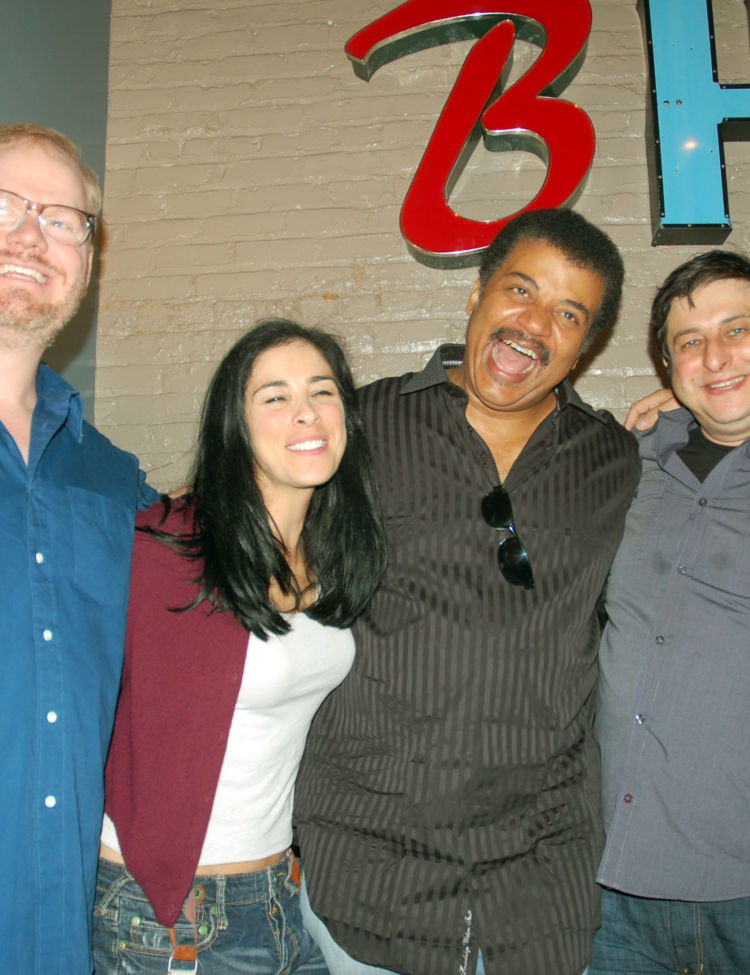
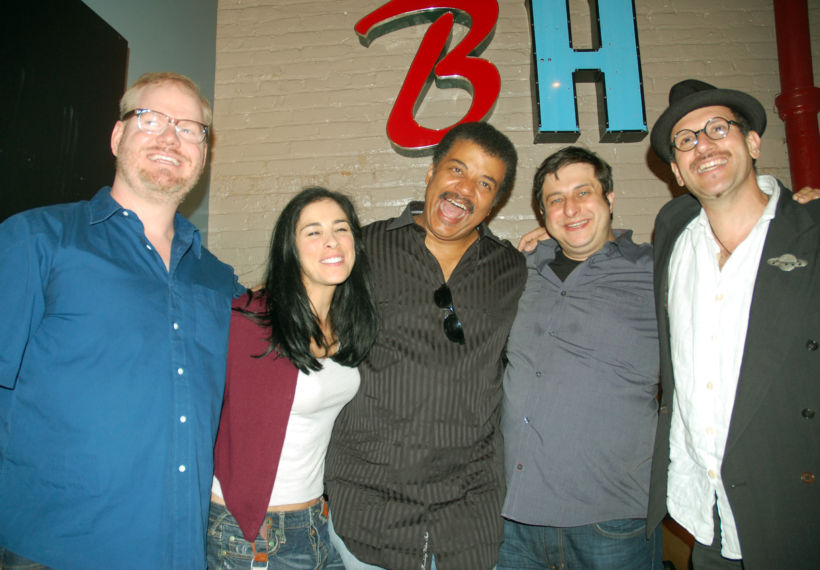
In honor of the 4th anniversary of Curiosity landing on Mars, we’re revisiting our StarTalk Live! show where we descended on The Bell House in Brooklyn, NY on 9/14/12 to celebrate the landing of the Curiosity Rover on Mars and the exploration of our solar system. Astrophysicist Neil deGrasse Tyson and comic co-host Eugene Mirman were joined by David Grinspoon, a co-investigator on the Radiation Assessment Detector, one of the experiments on the Mars Science Laboratory, and comedians Sarah Silverman and Jim Gaffigan (Mr. Universe). Part 1 of the show is focused on exploring the Red Planet. You’ll find out why Curiosity needed a nuclear power source… what an Alpha Proton X-Ray Spectrometer does… what Mars has in common with Earth… what stratigraphy is… what gives Eugene Mirman joy… how scientists fall in love… and the real origin of the giant face on Mars.
Transcript
DOWNLOAD SRT
Welcome to StarTalk, your place in the universe where science and pop culture collide. StarTalk begins right now. Welcome to an amazing evening of StarTalk Live. It is my very great pleasure to bring to the stage, Neil deGrasse Tyson....
Welcome to StarTalk, your place in the universe where science and pop culture collide.
StarTalk begins right now.
Welcome to an amazing evening of StarTalk Live.
It is my very great pleasure to bring to the stage, Neil deGrasse Tyson.
This evening, the topic will be the exploration of the solar system.
Yeah.
And I reached into my Rolodex, found one of my colleagues.
He is actually a curator of astrobiology at the Denver Museum of Nature and Science.
He's an expert on the solar system, and he's worked on the Mars Curiosity Rover.
Give me a warm welcome for Dr.
David Grinspoon.
David, welcome.
Thanks.
Good to be here, I think.
Get ready to do science party.
And now, I'd like to bring out the wonderful Sarah Silverman.
She brought her backpack in case there is studying to be done.
And ladies and gentlemen, Jim Gaffigan.
All right.
Wait, before we begin, Jim, you came out with an album called Mr.
Universe.
That's right, I did.
Okay, I'm gonna hold you to that.
Just so you know.
I'm an expert on everything in the universe.
All right.
Probably the smartest person here right now.
I'm not intimidated.
I'm just saying.
Before we begin, I consulted with your bartenders in the back bar, and there is a special drink tonight called the Martian Sunrise.
And I confess, the sunrise is just a little lemon that's hanging over the edge of the cup.
So it looks like a little sunrise, but the drink is certainly red.
And a tiny bit of bacteria from Mars that will kill you within ten seconds.
And you'll wake up with someone that looks like a Martian.
And you'll be able to jump really high?
Exactly.
We'll get to John Carter in a moment.
So, David, it was page one story.
An SUV-sized rover was plunked down on Mars.
Like, what's up with that?
Well, we're really glad it made it.
Yeah, I was scared.
I said this is not going to work.
Because you go nine months, and then it wasn't just the airbags like the old ones did, right?
That was scary, but I got accustomed to the airbag landing.
This one, it had, like, heat shields and then a hypersonic drogue chute and then retro rockets and then a hoist crank.
It was something Rube Goldberg would have designed.
And I'm thinking, I don't want Rube Goldberg on Mars.
Yeah, well, there's OK videos.
Let's make that T-shirt.
Why does it have to be an SUV?
I mean, I wish they would do something a little better for the environment.
Well, the last one was a Mini Cooper.
Electric?
Well, the last one was solar.
This one's got nukes.
So, first of all, how confident were you that this whole sequence of landing devices would have worked?
I wasn't confident at all.
I was shitting bricks.
The thing is, I'm on the science side of this thing.
So, we've got our instruments.
We want to get them onto the surface of Mars and go to interesting places so we can learn things.
And the engineering side of it, those guys tell us, don't worry, this will work.
And then we say, so how are you going to do it?
And they describe this thing, you know, it's going to come in at hypersonic velocity and make these S turns and then drop off the heat shield and there's a parachute and it's going to fire these rockets and then it's going to stop 50 meters up and hover and drop things down on this...
On a hoist.
And we're like, you got to be kidding me, that's not going to work.
And it was scary.
We were scared.
I was not confident at all.
This sounds literally more complicated than making Avatar.
Just to put it in perspective.
And even more expensive if you can believe that.
Barely.
So would you say like twice the cost of Avatar?
Actually, it was about 10 times the cost of Avatar.
Now, you tell me if it's worth 10 times as much as Avatar.
I was going to say yes.
I think we should measure everything in terms of the cost of Avatar.
Yeah, this drink is just like a fifth Avatar.
Call that the AU, the Avatar Unit.
Avatar Unit.
So...
So it landed on the Mars place.
So it landed.
Back to where we were.
Wait, did you know that I had a private Twitter conversation with the rover just before it landed?
I don't think it was a rover.
Excuse me, I had a relationship.
Meaning you tweeted the rover and the rover was like, Hi, Neil.
The rover tweeted.
You know what?
It was probably just some old guy pretending to be the rover.
It was like, can't talk now.
I'm about to go through seven minutes of terror.
76 rockets have to fire in weird directions.
There was a video all about that.
Because you were mentioning this tension between the scientists and engineers.
One of my last two questions was, who do you like better?
Scientists or engineers?
You asked the rover this.
I asked this of the rover.
Oh, and what did she say?
Yeah, it's a she.
It's a she, actually.
Sure it is.
Scientists have to build a lady and send it to Mars.
That's how they fall in love.
She said she would not pick between the two, that they are both important to her life.
She loves us both.
She loves us both, yes.
So it worked.
It landed.
Nothing went wrong?
Almost nothing went wrong.
What went wrong?
Well, a helicopter crashed into the wall.
No, actually it was remarkably free of glitches.
Actually, I did my very last question to Curiosity, which is her name, was...
That's such a stripper name.
She sounds very curious.
What's your favorite?
So I said...
You typed to her.
You didn't ask her.
I have an eight-year-old son named Josh.
He's my world.
She said, that was not in my briefings.
Well, it's funny.
We wouldn't actually know if there was life on Mars if it was just hiding out behind the camera right there on top of the rover.
It would have to be completely moving behind the camera.
There might be a practical Joker Martian riding around.
Alright, so you got, last count, it was like 10 experiments on this thing.
What's your favorite among them?
Well, I'm a little bit partial because I'm part of one of the instrument teams.
I help propose and design and...
So by partial, you mean you're biased?
I'm biased.
Okay, so which one is which?
I mean, the obvious thing to say is the cameras, because the cameras are so cool, because we all want to see, and it's beautiful, and it's amazing, and part of it's just sightseeing.
But our instrument is called RAD, and it is RAD.
It's the Radiation Assessment Detector, and we are measuring for the first time...
Because that would RAD stand for.
It is what it stands for.
I invented that 10 years ago.
No, we're measuring how much radiation there is on the surface of Mars, which has never been measured before, and it's one of the things that would possibly kill you and possibly kill Martian bugs, so we want to characterize it and see what it's doing in the soil and in the atmosphere and so forth.
So that's not measuring anything about Mars itself, it's just stuff that's coming to Mars.
Well, but it's doing stuff to Mars.
When you say Martian bugs...
Oh, you don't know about that?
I'm not saying there aren't Martian bugs, I'm just saying, are there Martian bugs?
Well...
And then also, are they attacking us?
Well, that was a slip.
There are no Martian bugs.
No, aren't there like, isn't there like microscopic life of some kind?
Well, that's what we're trying to figure out.
But the rad detector would tell you whether the radiation flux would sterilize the surface and kill all bugs.
Exactly.
Probably if there's bugs, microbes, whatever on Mars, they're underground because on the surface, there's no water, there's ultraviolet, it's freezing, it's nasty.
That's terrible.
But underground, there might be water, it's a little more reasonable temperature, and you're shielded from the radiation.
But what we're trying to figure out is how deep do you have to be if you're a Martian bug?
What's happening to the radiation?
And the thing to do is to measure it at the surface.
And then you can-
Oh, so if it's very heavy on the surface, you got to go a little deeper to get the bugs.
And did you guys already have-
You know what, this is really awkward.
I just realized now that we weren't talking about the Mars candy bar.
I'll send the memo earlier next time.
Have you already figured out the radiation?
Do you have the answer?
And you're just not telling us?
Is it your big jerk?
Essentially, yes.
We have data, but we haven't released it yet.
But it's not just because we're jerks, it's because we're trying to figure out if it's right.
And there's some tricky things, like we mentioned this nuclear power source that puts out a lot of radiation, so we have to make sure we're not just measuring that.
Wait, wait, so you have a nuclear power plant on the rover?
It's not a power plant.
It's a power source.
Whoa.
You know, my favorite moment in any day is when Neil is wrong about something scientific.
It's just literally a joy to see his mustache get angry.
No, we're touchy about this, because when you use the nuclear word, people get sometimes upset.
I wouldn't have any idea why.
It's one of the two Reboaton N words out there.
That's right.
So when we use that N word, we try to speak carefully.
And it's not like a nuclear power plant with the cooling towers and the turbines and all that.
It's a bunch of plutonium that's given off heat and we use that to generate electricity.
So you found another thing to call it to not spook people when it's launched.
We call it the not scary big power thing.
Oh, it's one of those good safe nuclear power plants.
A clean power source.
But you wouldn't put it in the drinking water of humans.
Well, no.
But Martians would.
Why do you need nukes?
Did other landers have nukes?
I don't think so.
No.
Well, the thing is this lander has more than 10 times as much scientific instrumentation than anything we've sent.
So it needs more power.
Needs more power as Kirk would say to Scotty, I need more power.
And it can run at night.
It can run in any season, and it should be able to run.
Well, the other ones had solar panels.
They can only run in the daytime.
They have solar panels.
Couldn't you charge a battery and keep working at night?
To some degree you can, but in the Martian winter, the amount of power goes down.
If your solar panels get covered with dust, So in the Martian winter, the sun is very low in the sky.
Yeah.
Well, one of them did die because of the winter because of the...
One of the two rovers.
Yeah.
If the power goes down enough so that you can't run the heaters at night, then you die.
That already happened to one of our previous rovers.
So if you want to do a lot of science, you want a lot of power, a lot of instrumentation.
You want to last a long time and be able to rove anywhere on Mars.
Send nukes.
Exactly.
That's exactly what happened there.
Now, here's one of the experiments I happen to like the name of.
The Alpha Proton X-ray Spectrometer.
You gotta love the sound of that.
That sounds like something in Batman's utility belt.
Yeah.
It sounds like something to get you pregnant.
It sounds like 70s version of The Future speak.
Yes.
Yes, not the Alpha Proton X-ray Spectrometer.
Why yes?
Batman.
So, what does that do for us?
With the Alpha Proton X-ray Spectrometer.
You must get so much pudding.
Last night Eugene told me not to swear and then I was joking and I was like can I say You get so much pudding from...
And then I completely just forgot and didn't.
You can go up to any rock and go, hey babe, you zap it with X-rays and you look at the pattern of what comes back and it tells you what the minerals are made out of, what's in that rock, how much iron it is.
It's a way of basically probing the.
Rocks.
Not to get too scientific with you, but it sounds like it's a way of probing rocks for the minerals inside them.
Wait, we want to know what the rocks are made out of because we want to know what the story is about.
How to have sex with them.
The history of that place.
Well, that's a way to break the ice.
Yeah.
And it landed where on Mars?
Because there's a lot of places to go.
You pre-picked a spot.
Yeah, we landed in a place called Gale Crater.
I've been there.
It's nice.
He does store a lot.
It's nice.
I actually named it after a friend of mine, Gale.
Gale.
It's not funny.
She's dead.
Killed by a Martian, I might add.
It's by far the coolest place we've ever landed on Mars because...
Because Mr.
Universe has been there.
I've been to cooler places.
So back me up here.
It's a cool place, right?
Because it's an ancient crater that used to be a lake and has all these sediments in it that tell us about the ancient past on Mars.
And it's got a five kilometer, that's three miles for you Americans, three mile high mountain in the middle of it that we're going to climb up.
And it's like going up the Grand Canyon on Mars.
Every layer is from a different time in Martian history.
It's going to tell us the whole story.
So it's not just a mountain that lifted up surface material.
It has laid bare its layers.
Well, it looks that way.
It looked that way from orbit and now we're seeing it in the distance as we start to approach it.
And it's like Utah.
It's just all these layers and canyons and juicy stuff.
A lot of Mormons on Mars.
Vote for whoever you want.
If I have my way, next summer there's going to be a Hilton in that crater.
All right.
So you've got this crater.
What's the diameter of the crater?
It's about a couple hundred kilometers across.
It's a big crater.
So like a huge stadium sized.
Yeah.
Okay.
But it's big for a rover.
But it's very, very huge stadium.
Are you comparing something as hundreds of kilometers to a stadium for some reason?
I think hundreds of meters.
Sorry.
She said hundreds of kilometers.
Yeah.
Yeah.
Sorry.
Is it as nice as the meadowlands?
So it's a size of like nine million keystone arenas.
It's a big crater.
I was off by a thousand.
Who is it?
It happens all the time.
It happens all the time.
All right, so you go 100 million miles to Mars and land in a crater that's, you know, 100 miles across.
That's a really good hole in one.
Yeah, not only that, we actually landed in a landing ellipse, which is the area that you shoot for that was only about 15 miles across.
And that's a first that we've been able to control our landing to that extent with that crazy Kaka Mamey landing system.
So that's what the engineers did for you.
Exactly.
Otherwise an airbag would just bounce its way out of the crater and it would be no good to you.
But that's why we were able to land in a much more interesting place than we ever landed before, because before you needed a landing ellipse.
So we've actually picked the most boring places on Mars to land before because you want to be safe.
So you pick somewhere really flat.
But you want to go to the mountains, the canyons, the craters, but we haven't dared to do that before.
Now you've got to have that little flat area between the mountain and the valley.
Exactly.
And this is the first time we're going to be able to do that.
And so now we can see these mountains in the distance and we're going to get to them.
We've never been to a place like that on Mars before.
How many times have we landed on Mars before?
Oh, let's see.
Successfully or?
We've tried.
I believe in my, yes.
No, how many times have we set the thing and it just hit the sun?
I guess we've had, what, five successful landings before?
Two Vikings, two Murres.
No, wait.
Two Vikings, Sojourner, Phoenix, two Murres.
Two Murres, seven.
So far you're just naming comic book characters.
So this is number seven, but we've had as many attempts and the Russians had dozens of attempts that went, pshh.
They have failed government.
Well, but they did better at Venus.
It's all Putin's fault.
They did better at Venus.
Yeah.
Russians are from Venus, Americans from Mars.
Don't go getting all venereal on me.
That's the technical scientific name.
Yeah.
Pervs.
So what's the warranty on Curiosity Rover?
Well, you know, we've been pretty unreliable with our warranties before, but this one's supposed to last two years.
Two years.
I mean, we've been unreliable in that they usually last longer.
So the engineers really did it on purpose, so you genuflect in front of them.
The MERS, the last rovers were supposed to last 90 days.
Mars Exploration Rovers.
The last two rovers were supposed to last 90 days, one of them still going eight years later.
Now, these are supposed to last two years, but the power source will last more than ten, and so we don't want to get overconfident, but potentially we could be there a long time.
So let's go down the list of the cool things that Mars has in common with Earth.
I have my list too, we'll compare them.
What's the top of your list?
Shouldn't we start with Jim?
They just, one of my favorite parts of Mars is they just put a Shake Shack in there.
The line, there's no line!
It's like you just, whenever you wanna go, you're like, all right, I'm gonna go now.
It takes two and a half years to get there, but there are no lines.
There's no line, they have like a camera set up.
You could check it online and see if there's gonna be no line.
We order it, yeah, yeah.
I would have to say the coolest thing is the riverbeds.
They're dried up, but they speak to us of flowing water, which is cool.
They meander.
So there was water on Mars.
Well, how do you know it was water and not like liquid ammonia?
Well, at one point, when we just had pictures from orbit, people said, well, they look a lot like rivers, but could it be ammonia?
Could it be liquid CO2?
You're sure it's not diet Dr.
Pepper?
You're sure.
Yeah, well, it could have been.
Wait, could this be like a post-apocalyptic state where there was life?
Well, there's Guy Percival Lowell.
That's basically what he said a hundred years ago.
So you should talk to him, but-
So basically we're equal.
Yeah.
You know, Sarah really reminds me of this Guy Percival Lowell thing we can learn from him.
That was a theory that Mars was sort of a dying civilization and that's where the rivers came from.
But people thought, well, how do you know it's water?
But now that we've been there with these other rovers, that was the main finding.
The exciting thing, we found rocks on the surface, minerals that are only made by flowing water.
So we've kind of nailed that one with the last rovers.
Thought they was only made by standing water.
Yes, well, we found signs of standing and flowing because there's ripple marks.
No, you can make minerals out of flowing water?
Standing water.
Watching you two talk makes me feel so dumb.
No, but...
So I thought you were going to say that it makes you feel...
Alive.
Alive, yeah, okay.
No, we found this stuff called jarosite.
These sulfur minerals.
There's no way to make them.
We don't know of any way to make them other than sort of precipitating out of water.
Oh, I actually teach an adult ed class on how to make minerals out of water.
He knows.
But whatever, it's not a big deal.
He knows.
So, I like the polar ice caps.
You gotta love the ice caps.
We got ice caps, they got ice caps.
Mars rotates in 24 hours.
We rotate in 24 hours, right?
Well, actually, not quite 24 hours.
What's the exact rotation?
Mars is slightly slower.
It's like a half an hour longer in the day, which is strange.
So, the people studying Mars, are they on Earth time or on Mars time?
They're on Mars time.
I actually was out there last week.
Out where?
At GPL.
On Mars.
On Mars.
Well, I was at the jet.
I was at the Power More for Partying in Mars, you know what I mean?
The Jet Propulsion Laboratory in Pasadena, where we're running the rover from, and the day is on Mars time, which changes compared to California time, and it's really an odd experience.
Wait, Mars time isn't the same as California time?
Well, sometimes it is.
But it sweeps past, it slows down by half an hour a day, which is convenient if you're stuck in traffic.
But actually, it's very weird because it gets to the point where it's completely the opposite, and it's fine if you're a grad student or whatever, and you're just doing that, but if you have a family or whatever, it leads to divorces and psychosis and bad things.
So how many Mars divorces has there been?
I can't give you a precise number of them, but I can tell you it's not zero.
Okay, but it's about a 24-hour day, and Mars is tipped on its axis about the same degrees that we're tipped on our axis.
So Mars has seasons.
That is the cause of the seasons, by the way.
It's not because we get closer to the sun or farther.
I'm just saying.
I didn't know it up here, but I didn't know how much he thought they didn't know it.
So you can think this through, because you knew that the Southern Hemisphere has opposite seasons to us.
And if Earth were closer to the sun one time of year than another, if that's what made summer, then all of Earth would have summer at the same time and we don't.
So our distance to the sun can have nothing to do with the origin of the sun.
But on Mars, distance to the sun changes the season, because Mars has a non-circular orbit.
And Southern summer on Mars is a lot hotter than Northern summer, because Mars is weird in that way.
So it's a combination of the two on Mars.
Why don't you guys just, oh.
Do you mind?
Do you mind?
We're talking, no.
So one thing, Sarah, you had mentioned your resonance with Percival Lowell.
Uh-huh.
Yeah, he thought he saw canals on Mars, the famous Martian canals.
But let me ask what will probably be, well, no, there's no, but let's not judge it before it happens.
Yes.
You said there's polar caps.
Yeah, ice caps.
But with no water?
Yeah, what, yeah, where's the water?
We used to think, back in the days of your buddy Percival, we used to think the polar caps were water, which is kind of makes sense, because that's what polar caps are made out of.
But turns out Mars is really cold and they're dry ice.
It's frozen CO2.
There's a little bit of water there, but it's mostly dry ice.
Dry ice.
Because you could have a pretty cool party.
Exactly, you could.
Okay, so the Phoenix Lander went to the ice caps, right?
It went pretty close.
So we had one lander that we actually sent right up to the edge and found ice in the soil, which was really cool.
Water ice in the soil.
Yeah, exactly.
Yeah, yeah.
So there is water ice kind of-
You don't go to the ice cap and say, oh, we found ice cap.
Wait, is there still water on Mars?
There's frozen water just underneath the soil in the high latitude places.
With no regular water?
There may be.
Watery water, wetty water.
There may be.
Can I get a club soda there?
Jim, if you have the water and you have the CO2, you can make club soda.
You could.
Jim is right.
Now can I be on NPR?
We are.
All right, so why do they go at the boundary?
I mean, the Mars caps shrink and grow, depending on winter or summer.
Yeah, they shrink and grow, and there's a whole history there of climate change on Mars in the layers in the caps.
So by trying to investigate that stratigraphy, we can learn about the long-term climate history, and just getting to that water ice was a big deal.
Hey, when you say stratigraphy, Yeah.
What do you mean?
Layers.
I mean layers.
But it sounds more sciency if I say stratigraphy.
No one is denying that.
Can I ask you something?
Mars is red.
How do we know that's not all blood?
Well, it is.
Let me take this one.
Go for it.
Jim.
Mars is red for the same reason your blood is.
Right.
It's American.
Yeah, it's rust, essentially.
Your blood is red because it's like oxidized iron.
Yeah, hemoglobin, heme group is iron oxide.
Same thing as on Mars, yeah.
Can I ask you about another root?
Like, why is cosmology and cosmetology?
What do they share?
It's the same thing.
It's basically the same thing.
No, the only difference is one uses makeup and the other concerns itself with the origin of the universe.
Yeah.
But otherwise, it's the same.
And which is which again?
So now, how come they always couch the mission statement in ways that where they're not actually saying, we're looking for life.
We're gonna look for water that could be, like we're looking for minerals that could tell you if there's water.
Why all the subterfuge?
Because we don't know how to look for life.
We tried that once and we realized we didn't know what we were doing.
What do you mean, how do we try it?
Well, we had a mission called Viking, our first ever lander on Mars.
1976.
Yeah, and did all these experiments.
They were all like emails.
Why is no one responding?
The experiments worked and then afterwards we said, well, we still don't really know if we found life because we didn't even know what questions to ask.
And then we realized decades later, well, we gotta go back and do this a little more slowly and try to understand the history of Mars and what kind of life there might be.
Could it be that you cannot ask what something is if you only have one example of it?
Yeah, that's a big problem with astrobiology.
You cannot characterize life if as much as biologists celebrate what they call biodiversity at the end of the day, all life has common DNA and common origin.
You are dealing with a sample of one.
And when you have a sample of one, you don't really have a science, do you?
No, you've hit on a problem.
Yeah, that's what I would have said myself, really.
This is a major problem for astrobiology.
We're studying something, we have one example.
How scientific is that?
How do you define what life is if you only have one example of it?
Isn't there like some silicon-based thingamajig in a pond somewhere in California or something like that?
Yeah, I saw that episode.
I know that what I said was vague, but do you know what I'm talking about, where there was like one thing that was found that had like a different element?
Oh, you're talking about the arsenic-based life.
Yeah, sorry, arsenic.
No, that was really...
Arsenic-based life.
That was really hyped and possibly interesting, probably wrong, but it wasn't another kind of life.
That stuff was still carbon-based.
It just maybe had a different kind of DNA.
You get partial credit for...
You can only learn so much from USA Today.
No, that's fair.
Actually, if I may elaborate on that example, though, the reason why that arsenic result, if it had really been shown to be true, was so interesting is that in life, phosphorus is fundamental to, what, your metabolism or other functions within what it is to be alive as we know it.
It's in every molecule of DNA in your body.
I'd count that as important.
Right.
Now arsenic kills us.
Why does arsenic kill us?
Because it sits exactly below phosphorus on the periodic table.
And if you are in a line on the periodic table, you have the same number of electrons in your outer orbit, which means you combine in the same way and make the same damn molecules.
Your body cannot tell the difference between phosphorus and arsenic because it has the same valence electrons.
Arsenic comes in, your body didn't tell the difference, you end up dead.
So if you have a microbe that can uptake arsenic just as happily as it uptakes phosphorus, then you have widened the net for what you would use to search for life in the cosmos.
Have you not?
No, you have.
The funny thing is, it's probably wrong because arsenic is really unstable on Earth.
Arsenic DNA would just fall apart, but accidentally they may have found something that would work on Titan.
The moon of Saturn.
The moon of Saturn where it's way too cold for our kind of DNA, but arsenic DNA, it turns out, is stable on Titan.
It's a controversial place.
Do you remember back in the 70s?
Was it the Viking orbiter that took a picture, and there was a face on Mars?
Do you remember that?
It had eyes and a nose and a mouth.
So what's up with that?
Well, it definitely looks like a face from a certain angle with a certain blurriness to the picture.
So it looks like a simian face.
Yeah, yeah, looks like a human face.
And of course, our brains are designed to recognize faces, so people went, hey, there's something up here.
So if we were jellyfish, we would have not noticed it at all.
Probably not, but we probably would have seen there's a lot of other features on Mars that do look like jellyfish, I'm sure.
But if we were a goat, would we then have noticed it?
Quite possibly.
It took me about a week to do that face.
And...
While you were there.
Yeah, I was...
While you were waiting in line at the Shake Shack.
I was actually waiting for a phone call from Neil.
And I started just doodling.
So we went back with another spacecraft and took more close-up photographs.
And there was actually a big debate.
Should NASA go back and shoot the face?
Because I thought, well, is that giving credence to...
But of course we should go look at it.
And...
Wait, wait, just to be clear.
The face was not just a finger painting in the surface.
It was a...
Topography.
It was a topological structure.
Like a...
Like mountains.
Like a mountainous structure.
It was huge, right?
A huge structure.
Like eye sockets, nose and mouth at that particular angle.
It would take you a good day to hike up the face.
So...
That's probably the first time that sentence has ever been uttered in the history of the world.
It would take you a good day to hike up the face.
That's a cool sentence.
Well, what's funny is, so we went back, we photographed in more detail with better angles and guess what?
It's a big eroded mountain.
That's because the Martians covered it up.
Once they learned we were...
Well, see the conspiracy theorists, that's what they said.
They said NASA blew up the face.
George Bush knew that face was gonna happen and he did nothing.
Yeah, NASA blew up the face, NASA faked the pictures, George Bush did it.
If you really wanna believe there's a face, then no amount of data is gonna convince you.
Otherwise, you just interpret it in your own way.
But actually, Jim Garvin, who used to be the chief Mars scientist at NASA, he did make a hiking map for the face in instructions which included bring plenty of oxygen.
So with this face, you take higher resolution images and at other angles and it didn't look like a face.
So the only thing that looks like a face at all solar angles is a face.
So it required just special angling to make that happen.
All right, so did you convince the...
Oh, no, no, no.
You know, you can Google face on Mars and you'll find lots of websites of true believers who, you know, it just deepens the conspiracy.
Someone like made a face mountain?
A mountain face?
Yes, yes.
You can take so many pictures on Earth of things and go like, I see an element.
Oh my God, that cloud looks like Led Zeppelin.
Exactly.
It's a message.
It's a message to us from...
Those people are exhausting.
Yeah, they are.
But they're amusing sometimes.
So you've got these other features.
There's Valles Marineris, which is Latin for what?
The Valley of the Mariners.
How big is it, the Mariner Valley?
It's ridiculously big.
It's about as long as the continental United States-wise.
Yeah.
You could take our Grand Canyon and put it in there sideways across it, and it would fit.
Well, wait.
You're saying you could take our entire Grand Canyon...
Yeah, put it in sideways.
Put it in sideways and it would fit in, as like a bridge across it.
Exactly.
And it's got Olympus Mons, that's Latin for Mount Olympus.
Mount Olympus.
It's a volcano.
Yeah, it's a volcano.
It's the biggest mountain in the solar system.
It's about three times as high as Mount Everest.
It's massive.
But if you were on the edge of it, it wouldn't even barely know you were on a slope.
It's very gradually sloping.
Yeah, it's massive.
It's a big mons.
Yeah, big mons.
Olympus, it's a mons.
So in like a geologic feature smackdown, we would lose to Mars big time.
It depends.
If you're just into size, then absolutely.
Mars has bigger volcanoes, bigger canyons.
But they're old and dead.
Yeah, but their volcanoes are just sitting there.
They're not erupting.
They haven't erupted in hundreds of millions of years.
You know, we're smaller, but we try harder.
We had Knight Rider, we have so many things they never had.
Absolutely.
We have Jack Nicholson.
We had the remake of Knight Rider.
Not great, but we had it.
Yeah, but we don't know what kind of movies they have on Mars.
We haven't explored that much.
There's probably a place with a bunch of old VHS tapes there.
They're probably covered in blood.
Splatter films.
You can't get off the blood thing here.
So, water was once on Mars, how long ago?
You got your dried riverbeds, your layers, how long ago?
Billions and billions of years ago.
He didn't say it right.
The chin has to come out.
I want to hear the whole audience on three, chin out, one, two, three.
Billions and billions.
Yeah, so you take some lessons from Brooklyn here, all right.
Yeah, yeah.
So.
We know it's been a long time because Mars is covered with craters and it tells us it's an ancient surface and you can tell how old the rivers are because they're covered with craters too and there are no young surfaces with rivers.
So it was a long time ago.
It was when Mars was a young baby planet.
It was a more Earth-like place.
The atmosphere escaped, the water's gone and it hasn't been there for a long time.
1850, like you're saying before that or?
So, all right, so Mars was once wet and presumably fertile.
Easy, let's keep it clean, all right?
I said that once to Jon Stewart and he says, why is it that when you talk about the universe, I get horny?
When StarTalk Live comes back, we're gonna talk about destinations elsewhere in the solar system beyond Mars.
StarTalk Live, bell hands!
You're listening to StarTalk.
Stay tuned for another segment.
Welcome back to StarTalk.
You've been listening to one of our classic episodes.
I'm Dr.
Funky Spoon, astrobiologist David Grinspoon.
And now I'm back.
I'm calling into the studio from my home to give you a little bit more.
And I'm with my co-host, Chuck Nice.
Chuck, thanks for joining us for this.
Of course, Dr.
Funky Spoon.
How have you been, man?
I've been great.
How are you doing?
You know, I'm all right.
Just trying to keep the dream from becoming a nightmare.
You know what I'm saying, Dave?
That's all.
It's great to see you.
You're looking very cosmic, I have to say.
Yes, yes.
That is, what is that in the background?
What galaxy?
I don't know.
I can't tell what galaxy.
Like Neil would be able to look at this and be like, that's, you know, whatever.
I think that's one of ours.
Is that one of ours?
I'll believe you because, you know, you're an actual doctor.
So it's good to see you though, man.
And good to be on and continue to, yeah.
Now, what are you up to now?
I know you got a new job.
I'm, now I'm a senior scientist at a place called Planetary Science Institute, which is a really wonderful place with a lot of people doing interesting work all around the solar system.
And although we're all located on Earth, we're studying places all around the solar system.
And I've actually just finished up a book and the book is called Earth in Human Hands.
And it's basically on this topic of how do we, how do we think of ourselves as planetary beings?
Yeah, you know, and it's, I mean, I'm so happy you wrote the book because quite frankly, I think that that type of perspective is what is necessary to change and drive our political direction globally.
Because I think that a lot of people don't understand that it is, you know, it's not just science, it's science and politics that drives the behavior of human beings with respect to how we treat the globe.
And you know, without altering our political views about the place we live, this little spaceship that we're on, we're never going to alter our behavior and how we treat this planet.
And right now we're not doing a very good job.
So that's pretty awesome.
So what is the focus of the book, David?
Well, it's very much what you were just saying.
It's about, you know, how we need to think about these problems.
I don't really get into politics as far as specific recommendations on policy, but it's all about how we need to think about these questions.
And what I try to do is situate us, humanity, in sort of deep space and deep time.
And then what is happening to Earth now as a result of human actions, what we sometimes call, we're calling now the Anthropocene Epoch.
How does that fit into the big story of Earth?
And what kind of change is happening?
Is there something unprecedented happening on Earth now?
And if we look at the whole story of Earth, I think we can in some ways see ourselves more clearly and achieve that long-term time scale that we need to have in order to do a good job managing this planet.
So it's not so much about policy.
I'm talking about perspective.
I'm trying to promote a planetary perspective on how we deal with the problems that we've created for ourselves here.
And you know, that's what I meant when I said politics, more of the perspective that we have that shapes the politics that we actually enact.
But go back a little bit for me, man, and talk to me about the Anthropocene Epoch.
Is that it?
Because I mean, you said that like, you said that like you were saying Tuesday afternoon.
This book is about last Tuesday afternoon, better known as the Anthropocene Epoch.
But tell me about that.
Well, from the Earth's perspective, it is kind of like Tuesday afternoon.
It's just another blip in Earth time.
But, you know, we have this, you've seen this geological time scale with all these different layers of rock that we give different names to and that represent different times going into the past.
You've heard about the Jurassic and the Triassic and all that.
And the Epoch that we're in now has been something that we've called the Holocene, which has been 12,000 years basically, or a little less, since the last Ice Age.
And the proposal is that we're in a new phase of geological history called the Anthropocene, which is characterized by a new geological force changing the Earth.
And that new geological force is us.
Right, yeah, hence the anthro.
But that's pretty fascinating.
That is a very, very small period of time, Dr.
Funky Spoon, to have such a great impact on the change.
So are you saying that in that 12,000 year period that our presence has been enough to alter the future of this planet in that short period of time?
Because normally when you look at these ages, when you look at these periods, they're pretty damn long.
You know, they seem to last for significant sums of time.
And when you're talking about 12,000 years, you're talking about, I mean, it literally is a blink.
That's a blink.
So do we really have that kind of power and impact?
Well, it's a great question.
One thing you can definitely say is we've already left our mark.
We've already done things to the Earth that will be recognizable by anybody, you know, digging up the rocks from our time, even millions of years in the future, the way we've changed the atmosphere and changed the climate.
We've changed the nature of the surfaces of the planet.
We've altered the hydrological cycle in this huge way.
There's five times as much water in reservoirs and behind dams now than is in all the natural streams of Earth and rivers.
So we've altered these major physical properties of our planet.
Now, is that going to last for a geological significant amount of time?
Well, our signature will last.
The trash we've left, if you will, the mark we've left.
Even if we all went away tomorrow and the effect on the climate would last for hundreds of thousands of years.
Now, will our society or something that we create out of it last for geologically significant times?
That is a really interesting question.
You know, and I think a lot of it hinges on what happens in the next couple of centuries.
If we figure out how to do this, this thing we're trying to do, which is have a civilization with the technological power to change the planet, that could do us in or it could allow us to survive for a long time.
There are ways we could use that technology that would allow us to stick around.
So we're at an interesting branching point, I would say, where we could, this could be the beginning of a long-term change in the Earth, where cognitive processes, technological life becomes an influence for a long period of time.
Or this could be just a burst of cleverness that then writes its own epitaph.
So the future is unwritten.
There's no fate but what we make.
So we could go one or two ways.
We could either be like Jay-Z, brilliant and have longevity, or Kanye, flash of brilliance and then just blow yourself up.
So now let me ask you this, and this is what I want to know from an astrobiologist standpoint.
So you talk about certain things when it comes to human impact, like, okay, climate change, when we look at the amount of methane and the amount of carbon dioxide that we are releasing into our atmosphere, and the parts per million are just way too much, and of course that's going to have an effect.
Just oppose that against the amount of plastic and pollution that we are dumping into the ocean.
Which one of those two things will have a more long lasting, because I know the climate change will be more immediate, but which one will be more long lasting in terms of violating our ecosystem when you think about it?
Well, it's an interesting comparison.
There are two different kinds of phenomena.
You know, the plastic, physically, materially, plastic lasts a long time.
And there are even rocks, there's a new class of rocks that's been identified and labeled plasticlomerates.
What?
Plasticlomerates, like plastic conglomerates.
And there are rocks that are found on some islands where they've made bonfires, where plastic has melted together with rock and then formed literally a new kind of rock that will, those plasticlomerates will be in the geological record for, I don't know, millions, hundreds of millions of years into the future.
Those are basically almost permanent features of Earth that people will dig up a long time from now, or not necessarily people, but whoever is investigating the Earth will say, there was a race at that time that made plastic.
That is kind of permanent now.
The climate change is, if we stopped right now with our emissions, our out of control emissions of CO2 and methane, there would be a period of about 100,000 years or a few hundred thousand years, less than a million, where the Earth would draw that back down to equilibrium and the natural carbon cycle of the Earth would regain control and climate would pull itself back to normal.
So as far as the threat to the well-being of the biosphere, I'm going to say that that climate is a bigger problem.
You know, the plastic is something we have to deal with for sure, but it's not, you know, there's certain species that are being drastically affected by its seabirds on certain islands or having a really hard time with our garbage.
But as far as a global threat, it's really those gases you mentioned in the atmosphere that we have to pay the most attention to and sort of regain control of ourselves so that the Earth can kind of do what it does and cyclically take care of its own climate.
Cool, man, cool.
Man, I wish we had more time to talk about this, you know, but we are, we're done, but we, you know, it's always a pleasure, man, talking to you.
I just love it, you know.
It's great to talk to you, Chuck, always.
You've been listening to StarTalk.
I'm astrobiologist David Grinspoon with my co-host Chuck Nice.
And thank you very much for listening.
See the full transcript




 Unlock with Patreon




 Become a Patron