Transcript
DOWNLOAD SRT
Welcome to StarTalk, your place in the universe where science and pop culture collide. StarTalk begins right now. Welcome to StarTalk Radio. I'm Neil deGrasse Tyson, your personal astrophysicist. Actually, you might have other personal astrophysicists. I pretend I'm your...
Welcome to StarTalk, your place in the universe where science and pop culture collide.
StarTalk begins right now.
Welcome to StarTalk Radio.
I'm Neil deGrasse Tyson, your personal astrophysicist.
Actually, you might have other personal astrophysicists.
I pretend I'm your personal astrophysicist.
I also serve as director of New York City's Hayden Planetarium at the Museum of Natural History, right here in New York City.
And those chuckles on the other side was none other than Chuck Nice.
That's right.
Welcome back as co-host.
Thank you.
Today's show is on the Mythbusters.
We all know and love the Mythbusters.
Who doesn't love the Mythbusters?
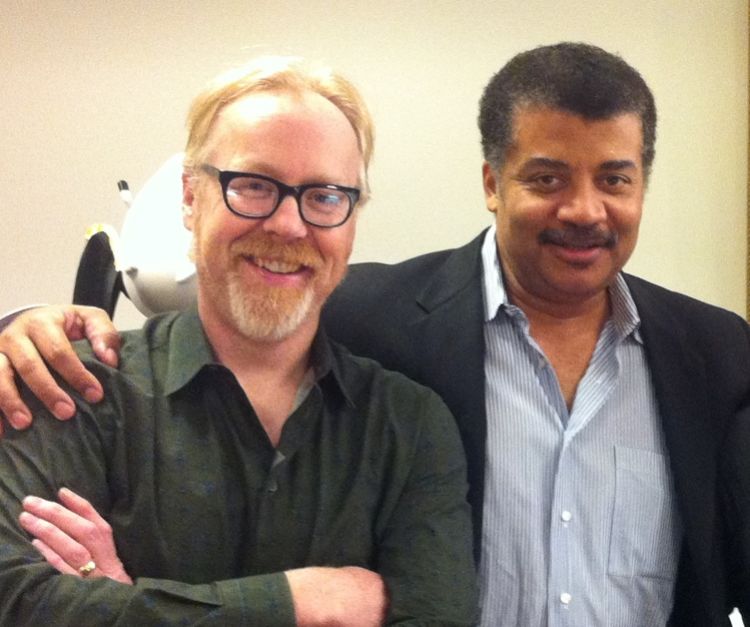
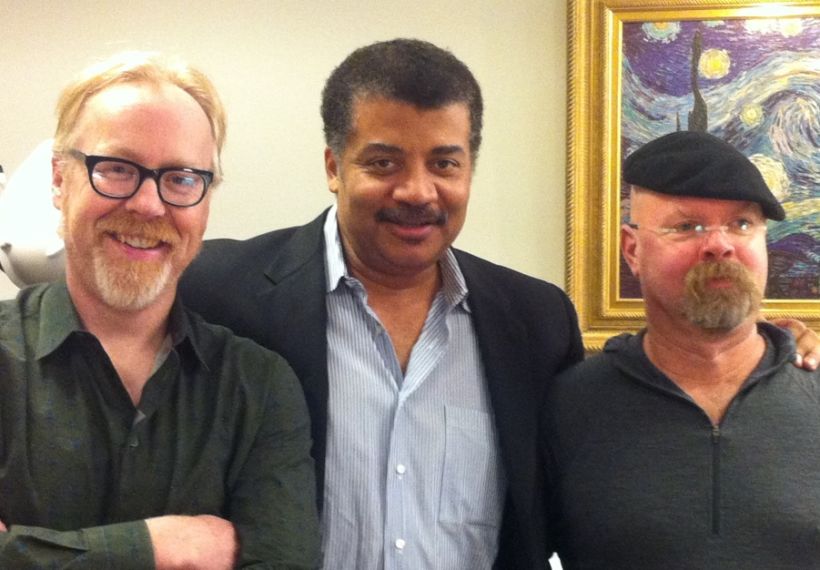
They both came through town and I had them in my office and we chatted about the genesis of their show and what were they thinking?
Do you still have an office?
Did they blow it up?
Did they blow up your office?
Because they blow up everything.
Yeah, they touch stuff and break it.
It's been a stable on the Discovery Channel for like 10 years.
Yeah, very successful show.
Wow, how many shows last 10 years?
Very few.
Very few, very few.
None of the shows I'm a part of.
Sorry about that, Chuck.
Exactly, all my pain.
So as you may know, they use the scientific method basically to test or validate or debunk.
Myths, rumors, urban legends, a certain scenes in movies that you say, could that have happened?
Internet videos that go viral, news stories.
This is what they do.
It's a brilliant show.
A brilliant show.
Let's find out just how it all began.
Let's check it out.
What were you guys thinking when you started this show?
Actually, we were hired talent at the beginning.
We had nothing to do with the pitch for MythBusters.
I won't say that we had nothing to do with the creation.
So you were pretty faces is what you're saying.
Well, it was just a job.
You know, we got to pay the rent.
Somebody contacted Jamie, said, do you want to do this show called MythBusters?
And I'm like, like that's ever gonna happen.
But just as a matter of principle, I went ahead and tried it because you got to try things or-
You mean screen test or you tried it?
So he called me up and said, listen, I got this call from Discovery about this thing.
I don't think I could do it on my own, but you're a ham, so you want to shoot a demo reel together?
I had to think of who's a ham that I know, but also somebody that's good at doing what we do because it wasn't just about talking, it was about replicating urban legends.
And the fact that we were guys that build things was part of this premise that we would actually replicate these things.
So you become a participant in the test, not just an observer of something.
Exactly.
And in terms of being freelancers where we're always trying to look at what the next avenue is, I had actually just bought a laptop, the first power book that you could edit digital video on, and it was teaching myself...
Way back in the day.
Way back, the Pismo, and it was teaching myself digital video editing.
And so when Jamie called, I had all the equipment necessary and we shot what ended up being a 14-minute demo reel, and they ended up kind of building the backbone of the show off of that demo reel.
So you got to shape the profile of the show based on how you expressed your talents.
No one told us that we had done that for several years.
Well, and you also have to understand a little bit of background.
Adam and I, we're not exactly friends, but in fact, we don't get along very well at all.
In 21 years, we've never had dinner alone together.
But we have common interests, and I would call Adam up and come down and check this out.
I'm tinkering in the shop on the weekend.
We were professionally interested in what each other was doing.
Yeah, and one of those cases prior to this, for example, was I had gotten these cordless drills.
At that time, they were new.
They were really powerful.
NASA technology, you might add.
Yeah, 24 volt heavy duty cordless drills.
High torque.
Yeah, and so I did what anyone would do.
Wait, wait, wait, he calls me up and he goes, what are you doing?
I haven't heard from him in like four months.
And I said, I'm having breakfast with my kids.
And he goes, well, I'm down at the shop and I just built something and I'm about to strap it on.
You want to come check it out?
I strapped them on to some roller blades with a little bevel gear, kind of a reduction going right into one of the wheels and it had triggers.
And I was riding around in the shop with powered skates.
You were being the kid.
Well, I got this shop where I can build anything.
So I call Adam up and he comes down and I'm like jerking all out, trying to not get killed on these things.
It's like an early Tony Stark.
Yeah.
Trying to get the bugs out of the Iron Man suit.
I'm convinced that that sequence in Iron Man is actually semi-inspired by us.
So I was in the habit of doing these things periodically, but I call Adam up when we got this call from a production company and he comes down and we film this thing.
We actually lit something on fire and ran away from it.
Yeah, and it turned out to be what the show was.
You're being kids who haven't grown up.
You're setting stuff on fire.
You're putting rockets on your skateboards.
And it was somewhere in the second season we realized, wow, actually the structure of this show works best when we are having the most fun.
We don't see any reason to make that line between kids and adults and play.
Just because you look at a kid playing and you figure they're just doing it because they're having fun.
But they're understanding their world through these little adventures that they're having, these little experiments.
It's often very non-linear.
They're building a foundation of understanding of the world.
And there's not really that much difference as far as adults.
A lot of scientists go in this linear direction.
And there are times that that's the way to do things.
And that's very productive.
But a lot of the most important discoveries that have been made have been off to the side on some tangent.
We say this at the end of our touring show, that someone once said that the phrase that typifies real discovery is not Eureka, but, oh, that's funny.
Yeah, that was Isaac Asimov, who said that you should really pay attention to when a scientist says, that's odd, that's funny.
Nice.
Yeah, crazy dudes.
That was Adam Savage and Jamie Hyneman, the two Mythbusters.
Mythbusters.
You know what I found really strange is that these guys are living in a real-world ACME labs.
They're like Wile E.
Coyote, making rocket skates and blowing stuff up.
I don't know if they ever used an anvil for anything.
So, you know, their background is in special effects, preparing special effects for movies.
You know what I just learned recently?
There's a difference between special effects and visual effects.
I think I know the difference.
I'm still a newbie in this.
But special effects are mechanical models that you film in a way they look real.
And visual effects, you do it all on a computer.
On a computer.
Yeah, yeah.
So they're old school.
Yeah, make something.
Yeah, go in the lab and make that happen.
And what intrigues me is they know and they understand that if you play, you're doing science.
If you play without rules, just break something, try something and kids do this all the time.
You got, how many, I lost track, do you have six kids?
It feels like six.
Do you allow them to do experiments in your house?
Believe it or not, yes, I do.
As a matter of fact, my son and I.
How old?
My son is eight.
Mm-hmm.
And the last.
Good age, good age.
Good age.
The last experiment we did was we grew crystals and he kept a lot.
Crystal meth or crystal?
Starting them early, Chuck.
Breaking Bad, kiddie style.
The Nickelodeon.
The Nickelodeon version of Breaking Bad.
Crystals are gray, what kind of crystals did you grow?
Um, I'm gonna be honest, I don't know.
What, I'll hook you up later.
I'll tell you, at least you'll grow sugar crystals, for goodness sake, you could eat it, eat your experiment.
That would have been, but no, it comes in a little package, but the idea was to get him to keep a log and to chart the progress.
And I think one of the great takeaways of Mythbusters that it's trained you to think more deeply about things that happen in front of you and take good data.
When we come back, more of StarTalk's interview with the MythBusters.
Welcome back to StarTalk Radio.
I'm Neil deGrasse Tyson, co-host today, Chuck Nice.
That's right.
Tweeting at ChuckNiceComic.
Thank you, sir, yes, I am.
I follow you, by the way.
And I don't follow that many people, I just want you to know.
Well, I feel honored you're on the list.
Well, today we're talking about the Mythbusters.
They're practically legendary at this point.
Yeah, without a doubt.
The two of them together.
They visited New York, they got them in my office, and we just talked for like an hour.
Chopped it up for a while.
So let's find out what their background is and how they got into this.
It's all about special effects, which triggered their interest in this entire career that they've had for themselves.
Adam, how many films have you worked on?
I guess about a dozen.
Your most known film among that dozen?
Star Wars episodes one and two, AI.
The original one and two.
No, no, no, no, no.
That was 10 when those came out.
You were 10 when, oh, they're so cute, I'll pinch your cheek.
No, I worked on Attack of the Clones and The Phantom Menace.
Space Cowboys, I helped build the space shuttle for that movie.
I have some trivia for you, for Space Cowboys.
Yeah.
What STS shuttle mission did they fly on?
Oh, God, I don't know.
200.
Oh, that's really late.
That was very late and very wishful thinking of how long the shuttle would last.
Because where did it go?
It went to only like 134, I think.
And considering that the gravity shuttle mission was 158.
Oh yeah, that's right, in the film Gravity.
Yeah, yeah.
So they're all taking the shuttles beyond reality.
Yeah, that's how you know how unreal they could be.
NASA supplied us with all these binders of shuttle mission payload bay setups.
And the payload bay was my personal job.
And so every piece of equipment in the Space Cowboys Shuttle Bay is from a real shuttle mission.
It's just from like 30 all at once.
Which astronauts look at that and they laugh.
Yeah, because the asynchrony of it gives it away.
And here's a secret about film space stuff, which is that we looked all over and did tons of camera tests to find proper gold foil that exposed and looked right to the gold foil they use on NASA missions.
It turns out it's a Rollo wrapper.
No.
Yep, so ILM when we did it and later on at Mythbusters.
Industrial Light and Magic.
Yeah, and later on when we did our moon landing hoax episode on Mythbusters, we bought cases of Rollos and took off the wrappers and used those for our gold foil.
And Jamie, how about you?
Somewhere around 800 commercials and a couple dozen feature films.
Commercials?
Yeah.
And the feature films, Arachnophobia, Naked Lunch and RoboCop.
So this is the era of mechanical models.
We're not talking about CGI here.
Yes, that's what it is.
It almost doesn't exist anymore.
Right, you're the last wave of who could do that.
And even through the course of our experience with them, they started out with stuff like Arachnophobia were cable driven.
Those spiders and Arachnophobia had an organ grinder kind of a device that had a stack of cams and levers.
Each one pulled on a specific cable that went into the spider.
And Jamie designed that, right?
Yeah, each of those spiders would have maybe 30 little axes of movement in its legs and so on.
The funny thing when you design special effects like that, the movie then has a portfolio of artifacts left over from it.
Nowadays, there's nothing.
And it's funny when you tour through Industrial Light and Magic now, that's all they have is all those practical models, but they're growing more and more distant.
Yeah.
You name it, any kind of soft drink or car or beer or cereal.
Jamie did all the little penny commercials for Nike.
As well for Nike.
The Anthony Haraway.
Yeah, they might be as simple as pour shots, you know, if you're pouring beer or a soda.
Oh, here's a classic that Jamie worked on.
Do you remember the York Peppermint Patty commercial where the Peppermint Patty goes shh, get the sensation and you see it break?
Jamie built that and he's got it on his desk.
Yeah.
It's about eight inches in diameter.
All the Hershey's Kiss ads where they're dancing around and that was the kind of thing that we would do all the way up to the more advanced puppets and towards the end of that run, the puppets had gone from cable controlled things to very sophisticated robotic kinds of things.
One of my favorites that I think actually it was done while Mythbusters was happening was the 7up commercial where I had to take a 7up machine and put tank treads on it and it had to fire soda cans out the slot where you normally pick them up.
So the idea was 7ups bringing the soda to you.
Yeah, so this machine had electric car motors in it and these big tank treads and it was all radio controlled and it would hold a magazine of about a dozen cans.
It was like a 12 pack of 7up cans that would load in and you press a button and they would come out that slot about, I got kind of carried away.
They would come out about 400 miles an hour.
So you just tested it against the side of the building we were working in and it sounded like we were under mortar fire and then we realized we were.
Because it's not only the velocity of the can, it's 12 ounces.
There's the fact that the can is under pressure.
So now you explode a can under pressure on impact.
The beautiful thing was what was left of the can after it hit the wall was like a piece of tin foil.
It was perfectly flat.
Yeah, that thing was lethal.
Boys and their toys.
Yes, tell me about, I just love it.
So the can coming out, oh, 100 miles an hour wasn't fast enough.
Right, you need more power.
How about 400 miles an hour?
Oh my God.
I just love the fact that he turned a seven up machine into Tiananmen Square.
So it's interesting.
You never know what your background will bring into a future, into how you might capitalize on that later because here's all their background that nobody's using anymore.
Yet they're still sort of rolled it into their current creativity, how to devise the experiments that they test and how they, so that, it's a happy story.
It really is.
And you know, one of the cool things there is you get to see how many applications, real life applications science has.
Yes!
You know, it's like, who would think that, you know, here you are studying these laws and properties in school.
In school.
And then you have a job where they all actually come into play into real life on an everyday basis.
Actually, while I was tweeting during the Super Bowl, my opening tweet was, football, the greatest expression of the laws of physics in the universe.
Spin stabilized projectiles, momentum transfer, energy.
Yeah, so physics is everywhere.
We've got another clip of these guys in this segment here, where we talked about some sort of unexpected limits they came up against when they first started out as myth busters.
Alligators in the sewers, is that a myth buster-able thing?
Well, it was on our list at the very beginning, as obvious as it is.
One thing was New York wanted no part of us investigating that here.
Because you might actually find it.
Well, and then we started to really look like, well, how would we do it?
So the way we'd want to test that is go into New York sewers and assemble the same conditions that we find down there and see if you can raise an alligator in those conditions.
That would be, okay, that's the way to do it.
I mean, you're very potentially killing an alligator to do that.
Or you could be nourishing it with some kind of sewage that could turn into a super alligator.
This is part of the legend, right?
Teenage mutant ninja alligator.
So animal cruelty.
That's the thing where, you know, it's like we're never going to put a poodle in a microwave, as funny as it is to threaten to.
And actually, on our season one, we were doing promos and we said, we've got to tease this.
So we got a poodle and we put it on top of a microwave.
And Jamie goes, don't you want the treat in there?
Go get that treat.
And we got all sorts of crap for that.
Yeah, people are funny about that stuff.
I remember before this, in effects, doing commercials, some pizza commercial where they had garlic puppet that gets chopped and burned and hacked.
And we got hate mail from the public and had canceled it.
It was violence and effigy.
Vegetable killers.
It's a puppet and it's garlic.
It's odd that there you are chopping up a garlic puppet and getting mail about it.
Yet nations go to war every day and actual human beings get cut up and shot.
But you're getting mail on a garlic puppet.
Yes.
Oh my God, so we're idiots.
We are idiots, because that is the, what a salient point.
People are dying every day at the hands of other people, but you're concerned about a puppet made of garlic.
Like, I can see it now, Sarah McLaughlin comes out.
Hi, I'm Sarah McLaughlin.
Do you know a puppet that's being abused in the arms of an angel?
Hi, I'm Jim Henson's ghost.
Please stop this carnage against the puppets.
It's ridiculous.
You know, people got their issues.
That's what it is.
Absolutely.
So the point is, the Mythbusters, they collect all these urban legends and see if they can work.
What I found interesting is, they're smart enough to know that sometimes you can't do the experiment in situ and the idea, even though they didn't follow through on it, that they might create a sewer environment and a controlled lab, and then you can actually follow through on how and when and where that would happen.
Everybody wants an alligator in the sewer.
I'm certain of it.
You know what?
That's one of my favorite urban legends there is, is every time I'm waiting for the subway, I'm just somewhat hopeful that a giant albino alligator will show up instead of the end train.
An albino alligator.
Exactly.
Do you know that the, you know why we fear reptiles?
It's been interestingly hypothesized.
Why?
Because back before the dinosaurs went extinct, our mammal ancestors were running underfoot trying to avoid becoming their lunch or their hors d'oeuvres.
And so they were reptiles.
Nice.
And so deep within our DNA, we fear reptiles.
And all the old B-movie aliens, they were reptiles.
And here all this time, I thought it was because they were itchy.
When we come back, more of StarTalk Radio's interview with the MythBusters.
We're back, StarTalk Radio, your astrophysicist here, Neil Tyson.
Jack, Jack Nice, with me.
Yes.
Yeah, we're talking about the Mythbusters.
Talking about the Mythbusters.
You know, but before we get back into it, you were talking about, and I was thinking about this, how reptiles, and I was thinking, wow, that is fascinating, because everyone has a visceral fear of reptiles.
Yeah, we think it dates all the way back to when we were running away from T-Rex, basically, 65 million years ago.
Our mammal ancestors, deep within our DNA code, is a fear of reptiles.
Nice.
And look at all the B-movies, and even in Star Trek.
Even in Star Trek.
The famous Gorn.
That was a reptile if there ever was one.
Absolutely.
Right, right, so it's just fun to think about that.
That is.
And you know who checks a lot of this is snopes.com.
Have you ever gone there?
Yeah.
Oh, just go and hang out, tell other people about it.
They report on whether any of these urban legends are true or not.
Right.
And the poodle in the oven, that's the classicist case of an urban legend, and they say, no, of course it's not true, but it tells us that people fear technology that they don't understand.
That makes sense.
Yeah.
So I got another clip with the Mythbusters, and we talk about how special effects that they've worked on creates the illusion of reality, but the Mythbusters do the opposite.
Let's find out.
The thing about special effects is that you're allowed to make something look like it is doing that without actually doing that.
With Mythbusters, we have to do the opposite.
It's gotta be, everything's gotta be real.
Real, and that, otherwise we'll call you out on it.
You know in television sometimes you have to shoot things out of order, and occasionally with a location or some sort of scheduling problem, we'll have to shoot a sequence that's gonna happen before a sequence that we're shooting subsequently.
And in those cases, we'll only do that if we're really sure about what the result of an experiment's gonna be.
And every time we do that, we get screwed.
The experiment doesn't turn out the way we expect.
And so we have learned never put our eggs in one basket like that.
Never count on a specific result.
I'm a shadow length checker.
I know if you've filmed something before, it should have been after.
Because your shadows don't lie.
And usually you're not thinking of your shadow.
It's true.
I saw a documentary once.
It showed scenes in Africa, and there was a thunderstorm in the background.
I noticed that the thunder and the lightning were happening simultaneously.
So I said, what made you decide to do that?
I wasn't criticizing it.
I just want to know, at what point do you say, I'm going to fake this?
Right.
And then it looked like he was a little embarrassed.
Oh, Dr.
Tyson, you got me on that one.
They showed the actual footage and it was dissonant.
You know, where the...
Right, it actually put your attention on the wrong thing.
Yeah, it was distracting.
We had this with one of our first giant explosions.
We blew up a cement truck with 800 pounds of...
You blew up a cement truck?
Yeah.
Why?
Because we could.
The myth is that you could clean out a dirty cement truck with a stick of dynamite.
And it actually turns out that that's true.
You actually can more easily remove cement from the inside of a cement truck with dynamite.
Yeah, it's like a crusty thing that is on the inside and it's brittle and it falls off from the...
So it basically cracks and then it comes and it's like a self-cleaning oven.
Right, exactly.
So we decided to take this to the nth degree and we filled a cement truck full of dried cement and then we blew it up with Ampho and we were a mile and a half across a body of water from the explosion and the explosion took eight seconds to actually reach us.
We could watch the pressure wave coming across the water towards us and hit us in the chest and the cameraman who had been instructed, the shows about Adam and Jamie, we have other cameras covering the explosion, focus on them.
He did not turn around and get us.
So the shot that you see in the show of us jumping, totally faked.
Oh, but you knew it did happen.
Yeah, we were there and we did jump.
We just, the cameraman didn't get us.
So we actually took so long and you can't again blow up another, you can't blow up another do over.
By the way, people forget to notice that at rocket launches, because the nearest location at Cape Pinaveral is about three miles away.
But this is Florida.
So there's a lot of marshy wet areas.
So you see the shuttle launch, you don't hear anything.
And as the sound moves, you see birds starting to rise up out of the marsh.
And then you see the ripple along the thing, and then you hear...
But people are just looking up like that.
You have to know to look around and to catch the rest of that.
And it's a lovely thing, that delay.
This is why a thousand people got injured in Chelyabinsk, Russia.
That's why.
Because the asteroid that blew up over that town was brighter than the sun in early morning during their breakfast.
It was an air blast.
And so light is beaming through their breakfast window.
You know, Steven Spielberg alien style, right?
Right, right.
And so they say, hmm, what is that?
And they all walk up to the window.
Then the shock wave hits and all the glass in the entire city shatters into people's faces.
It's a good note.
If the sun comes out at night, don't look out the window.
Don't look and find out what it was.
Wait, wait.
Open the door.
The door is perfectly fine.
See, now, if that had been Compton, nobody would have gone to the window, because when you see a bright light shining in your window in Compton, you know it's the police.
Is that where you live?
Yeah.
So, again, Pete, they like blowing stuff up, and who would have thought this about cement trucks?
My goodness.
It seems to me you could just tap it on the outside to crack it or something.
How about that?
And then, do you still have a truck when it's done?
And therefore, of what use is this activity to clean out the truck if you don't have a truck left over?
Don't even understand.
Yeah.
Anyhow, when we come back with my interview with the Mythbusters, we just find out more about specific tests that they've done.
What's the most expensive one, for example?
I want to find out.
I can't.
If the cement truck isn't up there, I can't even imagine.
All right.
We'll be right back.
We're back on StarTalk Radio.
Chuck Nice with me.
Yes.
Mythbusters are crazy guys.
I love these guys.
Mythbusters are Adam Savage and Jamie Hyneman, and I had them in my office.
So there.
But I had to cordon off all the stuff in my office, because no telling what, they'd be grabbing stuff.
And breaking things, and blowing things up, and putting dynamite in your desk.
But at all times, they're testing an idea that someone had put out there.
They're not just wanting crazy people.
There's someone thinks this is true, let's test it.
The art of the test.
And in my office, I asked them, what's the most expensive episode of Mythbusters that they ever conducted?
Cool.
Let's find out.
The third time we revisited the rocket car.
It's an original Darwin Award myth, where a guy strapped a military Genesis and takeoff rocket to his Impala, and supposedly flew a mile through the air, embedded into a mountain, and they pulled his teeth out of the wreckage to identify him.
That was actually our very first episode.
So you wanted to redo that.
Well, we did it first 10 years ago.
Yeah, that's something I want to do.
Then we did it a second time where we got these really powerful rockets that blew up on the stand.
So we spent 20 grand on these rockets.
Everything we did worked perfectly.
The rockets blew up.
Took us another five years to convince Discovery to fork over enough dough to do it for real.
And this time we did two launches last summer in the Mojave Desert.
One with a car hitting a bump in the road and the other with a real straight up ramp.
But why is that interesting?
Sure, I put rockets on my car, I fly.
Well, there's two things to this.
The first-
Is the car's version of a jet pack?
Essentially, except that rockets aren't shaped like cars for a very good reason.
So the first time we did it, we put the normal JDO amount of power on the car and it only accelerated the car to 150 miles an hour.
And traditionally on Mythbusters, when we get to a place like that, we want to find out what would it take to replicate the behavior that is stated in the myth.
They get the car to accelerate to 350 miles an hour and fly perhaps roughly a mile through the air.
250 miles an hour, you go backwards in time.
The red shifting.
Marty, make the flux capacitor.
The math said to get the car up to that speed, and we attempted to balance correctly using model rocketry formulas to get the rockets in the right place.
The question is, if you have the car balanced and the rockets in the right place and they have enough power, will they actually make the car fly straight and true?
And that was the answer we hadn't fully come to as the second part of the story.
That was half of the design concern in the Apollo era.
Have you have a straight rocket, how do you point it, how do you aim it?
Well, we of course could have gone to a place where we start to add fins and do other things to this car.
We get people that say, why don't you just put fins on the thing or aimings?
And we say, that's a car-shaped rocket.
We want a rocket car.
Gotcha, yeah.
For us, there's an ethical difference.
Your formula said that you'd be able to fly at 350 miles an hour.
Yes, according to the amount of rocket power.
So, did it?
It never really got the chance to be.
They were so unstable that they...
The answer is no.
Say no.
Let me hear you say it.
The answer is no.
Did it work?
Well, the scientist in me wants to say, I guess on an infinitely straight track, maybe, but with us going off a bump in the road, it's too unstable and they bounced after about two and a half feet.
They did what I was talking about, which is they interact with the ground rather quickly.
You guys have a whole euphemistic vocabulary.
The other favorite term is catastrophic failure.
That is my favorite engineering term.
Yeah, we use that all the time on this show.
Or in rocket propulsion lore, there are rocket launches that succeed and others that are rich in learning opportunities.
So that one cost them, you know, when all was said and done, like tens of thousands of dollars just for the rockets and cars.
So they made a brief mention of the Darwin Awards at the beginning.
It was rumored that the person who did that originally, who died, of course, was eligible and possibly won the Darwin...
It turns out he didn't win the Darwin Awards, whether or not that even happened.
But you know about the Darwin Awards?
Yes, for the dumbest ideas ever.
No, no.
That's not the Darwin Awards?
Well, yes, that's an element of the Darwin Awards.
It has to be an idea that you execute that is so dumb that you end up dying from it.
Oh, I didn't know that that was a prerequisite.
And that takes your genes out of the gene pool.
Oh, there you go.
Purifying whoever remains.
Making sure that you can't breed.
Right, actually, or the act of you performing this stupid thing, if it doesn't kill you, it at least sterilizes you, which is far from a Darwinian perspective, is the same thing.
Same thing, right, because you're no longer gonna add.
So forget it, you're done.
Exactly, and so you don't actually wanna win a Darwin Award.
No.
I've got a great trick, but I can only do it once.
The first person to fall into a black hole would win a Darwin Award.
So once again, I mean, I don't wanna misrepresent the portfolio of their activities.
Yes, people love blowing stuff up, but a lot of it is not blowing up.
It's simple things and thoughts that people had and they wanted to test it.
So now here's the thing, and I'm not disparaging these guys at all.
However, if you have.
Wait, hold your however.
We're gonna go to break.
Chuck has a however.
We're gonna go to break.
We'll come back and we'll find out why you're not disparaging them.
All right, check it out.
We're back on StarTalk Radio, Neil deGrasse Tyson here, your personal astrophysicist with Chuck Nice.
Your personal stand-up comic.
Thank you.
Yes.
Everyone should have a personal stand-up comic, just to change how things look.
Right, exactly.
Well, I had a bad day.
No, you didn't.
This is what happened.
So we're interviewing the mythbusters, Adam Savage and Jamie Hyneman.
Professionally, they're special effects prop builders in the old days, and they just converted all that talent to building experiments to test popular lore.
And before we broke, you had some comment about the Darwin Awards?
Here's my point.
Okay, if you're starting with something called the Darwin Awards, which presupposes that you are the biggest dumb butt on the face of the earth, why do you have to replicate that?
Like, you know what I mean?
Seriously, you're starting off with people whose last words are, you know, hi y'all, watch this.
That's what you're starting with.
That's their last word.
That's their last word.
Why do you have to replicate that to see whether or not it's viable?
I mean, that's my only point.
You know, I'm told, although I don't remember this, someone told me that in one of Kurt Vonnegut's novels, he hypothesized what are the last words ever spoken by anyone in the human species.
Okay.
It's one scientist saying to the other, I wonder what happens if we do it this way?
Ha ha ha ha!
It's too scientific.
And that's how civilization came to an end.
So, and our next and final clip, talk about unexpected outcomes from their experiments.
Because you think it's still gonna go one way?
Right.
You don't know, you do the experiment and you find out.
Let's check it out.
Every idea you have, you have some expected outcome.
Yes.
What happens if nothing goes right?
Not because you didn't design the experiment, right?
But because the outcome was not anything you expected.
That happens all the time, actually.
And it's arguably our favorite part of this whole job.
Yeah, that's one of the biggest surprises that we had when we got into doing this, starting out as not scientists by training.
We, over time of doing this show, realized that when you fail, you can't help but learn something if you pay attention.
If we go through an experiment and everything turns out the way we expected and the way that we wanted it to.
That's not even interesting.
We just went through the motions.
You know, you would think, okay, well you pat yourself on the back for doing a good job, but you're not in a new place.
You're not in a new place and you didn't grow from that.
And for us, that's where the real value is and it's counterintuitive.
But when we go into something and we totally screw up and things didn't turn out the way that we wanted to or expected them to, we're overjoyed because we get right into it and ask questions why.
And as long as we feel like our methodology is sound, what we've got is good data and good data that doesn't match what we expected is really good data.
That's interesting.
Yeah, it really is.
One of the things that we've been able to do over the past 10 years in San Francisco is build a set of relationships with different types of locations that give us different latitudes of what we can do there.
Set stuff on fire, blow stuff up, drive cars around.
And because of those relationships, we are able, when we come to a result we didn't expect, to call back to the office and say, tomorrow's location is off, I need you to find me a totally different location to do this totally different set of experiments.
And thus, the narratives that you end up seeing edited on the show are genuinely driven by the narrative itself.
We don't write down what's going to happen.
We do write down an outline of what we expect to happen.
We almost never follow it.
But what does happen shapes what does happen.
What gets filmed.
Absolutely.
And we really feel like that has a freshness to it that the audience can smell.
And this is what I find so profound about what we've done here with this show, is that we're not looking at this like, let's do science.
We're looking at this just totally naturally, like we want to do a good job at this.
And we're realizing that when we fail, we learn things.
And so we're okay with that.
We like that.
It's not something that's artificial.
It's not in our culture, the value of a failure.
No.
You get blamed for failing.
You totally do.
Right.
And that's got to change.
Reading Commander Chris Hadfield's book about NASA being, you know, in movies, something goes beep and an astronaut in the movie goes, what's that?
And that would never happen at NASA because they've gone over every beep that could ever happen.
They've gone over every worst case scenario they could do.
And that's what makes them so good at what they do when they actually get out into space.
And that kind of culture is a brilliant way to do problem-solving.
You know, Chuck, I think that in America, I don't know about the rest of the world, but in America, we are so quick to blame you for failure.
Yes.
I think if our brain were wired so that we viewed the world as a laboratory, then failure would be viewed completely differently.
Yeah.
It would be, tell me what you learned.
Right.
What happened there?
Right.
Yeah, let's add that to the data set.
Rather than you idiot, you screwed up, you did this.
That's right.
You're fired.
People are not interpreting failure as learning experiences, and I think that's a problem.
Yes.
We got to change that.
If failure is a learning experience, then my life is brilliant.
My life is an exercise in genius.
No, here's the thing.
The difference is you don't want to fail in the same way a second time.
Oh, there's the problem.
So therein lies the rub.
There it is.
You don't want to make mistakes twice, okay?
You want to make new mistakes, all right?
And so this was one of the heads of NASA a few years ago, tried to make the point, yeah, if you're going where no one has gone before, stuff is going to happen, stuff will break, people will die.
You don't want to die for reasons that you could have foreseen.
That's the difference.
There you go.
You want to be the guy who beams down to the planet, and you know you're not coming back because you're an ensign who's never been in an episode before.
Just never wear a red shirt.
There you go.
And learn from that experience.
All right, Chuck, we're going to take a break.
And when we come back, we're going to reach into the grab bag of Cosmic Curiosity.
Yes.
We've got a lot of people out there who have questions, and they just want to answer.
Absolutely.
So I'm figuring, let's save the last segment for that.
So we'll be back in a moment.
Stay tuned.
See Chuck, this is the Q&A part.
Is this themed this time, or is it?
Well, no, these are just general questions, general inquiries from our listeners.
General, so it's a grab bag?
It's a grab bag.
Okay, I have not seen these questions before.
That's what makes this exciting, is the fact that you do not know what you are going to be asked.
We're not trying to stump you.
But if you do, I'll just say I'm stumped, go on to the next question.
See, and that's how you know that you're actually smart.
Only smart people do that.
Like, hey man, I don't know.
I don't know.
Right, it's the dummies that are just like, well you see, the reason why that is, is, is.
All right, so you're ready?
Okay, here's our first question.
This is from Trevon Thomas.
I wonder what color he is.
I'm sorry, that was wrong.
I know, that was rough.
This is from Trevon Thomas.
If the multiverse theory is true, is it possible to travel to other universes?
How would it be possible for us to exist in those universes if they have different laws of physics?
Oh, that is cool.
So, evidence suggest, well, not evidence, cogent theoretical analysis of quantum physics and general relativity suggest that there may, in fact, be a multiverse.
We have no data on this right now.
So, these are ideas at the frontier of the exploration of physics and if there is a multiverse, it means we are just one of many other universes, all with different bubbles.
There's an evil Chuck Nice somewhere on another universe.
I was gonna say that Chuck Nice had a mustache and beard, but you got one in this universe.
So, mine does not.
So, that's the good Chuck Nice.
You are the evil one.
You ever think of that one?
Did not think of that, okay?
But now it makes so much sense.
Because we all think we are good, don't we?
It makes so much sense.
Hitler's saying, I'm good.
I'm a good man, yeah.
Wow, that's funny.
You just gave me a picture of really nice Hitler.
You know what I mean?
In another multiverse.
In another multiverse.
And then the bad people don't like him because he's nice.
Exactly, exactly.
So, each of these universes would have, it's likely that they would have a slightly different laws of physics.
Perhaps a different charge on the electron, a different gravitational constant.
The gravitational constant is a term in the equations of gravity that Isaac Newton first wrote down.
And it tells you, it's a measure of how strong gravity is relative to other forces in the universe.
If those are slightly different, and you got a ticket to that universe, I'm sorry, sorry for you.
Right, things aren't gonna work out very well for you.
They will not end well.
They will not end well.
So you really do need a universe with the same laws of physics.
Because the very forces that bond the molecules and atoms in your body rely on the values of the laws of physics that are in our universe.
So, yeah, you send something else into that universe to check it out first.
Right, like, you know, what's his face?
The little robot.
I forget now.
I'll forget it.
What was the little robot?
Which robot?
You know, another Steven Spielberg robot in the world had been destroyed.
Wally, right, we're going to send Wally.
Send Wally.
No, I have a bad idea.
Send one of the crash test dummies.
That'll work.
They're cool with it.
They're down with this kind of thing.
They die every day.
Every day.
There you go.
All right, thanks for that question, Trevon.
All right, Trevon, way to go.
This one is from, oh, I love it, James Brown.
That's all.
I just had...
Let me hear that again.
So that was, as Eddie Murphy said, that's a whole James Brown lyric right there.
Right there.
So this is from James Brown.
To quote Dr.
Tyson, he's quoting you, heavy elements are forged in the cubicles of dying stars.
Crucibles.
Oh, crucibles of dying stars.
Wait, did you misread that or did he miswrite it?
I misread that.
So what do we have you for?
Aren't you college educated?
Indeed I am, but I'm only here because I'm charming.
In other words, to get protons to stick together, they need high heat and pressures.
So, why wasn't there enough pressure to create anything heavier than hydrogen and helium in whatever started the Big Bang?
Yeah, this guy has done some thinking here.
I like it.
So, good one.
So at the beginning of the universe, he knows that the conditions were just right to not only forge matter out of energy, this is where you get your protons that are the nuclei of hydrogen.
Hydrogen is the simplest element, that's the one that was up in the corner of the periodic table.
Exactly.
The whole periodic table begins there.
Yeah, right there.
Right there.
One proton.
The first step.
The first step.
And helium has two protons, and lithium has three protons, and this goes on and on and on.
Carbon has six protons.
Everybody's got a unique number of protons, and that's the identity of the element.
So here we start with hydrogen.
We take protons, slam them together, we make helium.
Okay.
So, why don't we keep making other elements in the early universe?
We do a little bit of, lithium is made, trace amounts.
And that's because the universe at that time was a little depressed, and so, needed a little lithium.
We need some, let's make some of that.
Let's make some lithium.
Some of that.
Right.
So, watch what happens.
While the universe under high temperatures could have been making heavier elements, it is also expanding, becoming less dense.
And as your density drops, the likelihood of particles colliding goes down.
Exactly.
It's the difference between living in New York City and living in rural Kansas.
Your chances of having an accident go way down when you're in rural Kansas.
Well, the chances of walking into someone by accident.
That's what I mean.
Right.
Colliding.
A collision accident.
A collision of any kind, in principle.
So, yes, and so while the universe is expanding, matter is not only becoming less dense, it's also cooling.
And so the speeds of these particles drop.
And so in fact, you can look at how much hydrogen and helium is in the universe, in parts of the universe that have not been altered severely, and go back and deduce what those conditions must have been.
At the same time, you can go back and derive these from first principles, and those two calculations match up.
And so that's why we have very high confidence in what was going on in the early universe.
And whereas in a star, you make your hydrogen, you have your helium, and you just keep going up the chain, and you are hot, you are dense, this stuff doesn't get less dense down there, it gets even more dense.
You're good, good to go.
See?
Okay, that's great.
Yeah, I said it gets more dense, it's there contained, whereas the universe is expanding and cooling.
That's the difference.
Great question.
That is a great question.
Way to go, James Brown.
James Brown.
Give me another...
All right, here we go.
This is from Brian Kearney, okay?
He says, Alan Turing's early work.
Turing.
Did you misread that as well?
No, that's misspelled.
Alan Turing.
Turing.
Turing.
Early work was on self-organizing systems.
Given a cosmic perspective, would entropy give way to equilibrium and then begin self-organization?
Or is the elegant order we see in the universe just Newtonian?
So is it all gravity's fault?
These people are doing their homework.
Yeah, some people are doing their homework.
Yeah.
Yeah, check it out.
I got to tell you, man.
Brian.
Man, you're making me work here.
You got deep.
So let me sort of unpack that.
Yes, please do.
All right.
So the universe as we expand is cooling.
Right.
The entropy is increasing.
This is the disorder in the universe, all right?
And so you can ask, if you have disorder, if disorder is increasing, how do you ever have order?
You get disorder if there's no source of energy pumping into the system.
Gotcha.
It's that simple.
So why is there order on earth?
Why is there life?
Why is there complex life rather than complete disorder?
Because we are in orbit around a sun that is providing energy.
Right.
But in the big picture, the sun will ultimately die.
Correct.
And it will not regenerate.
And anything on earth would then also die along with it, right?
Because that was our source of energy propping up the complexity of our systems against the disorder that would otherwise ensue.
Right.
So, it's only about what is your source of energy and what is not.
That's all it comes down to.
Gotcha.
Stars are a great source of energy.
They last a long time.
They're very efficient.
And so that's why you can have pockets of complex stuff going on.
They're the LED light bulbs of the universe.
They keep on going.
They just keep on going.
Yeah.
Right.
That was a stretch there, but I'm helping you.
I'm trying to make it relatable.
By the way, on the subject of LEDs, the Nobel Prize in Physics for 2014 was on the discovery of blue LEDs.
Which gave us white light.
Is that what it is?
It allows us to have white light?
Yes, because we had red LEDs and green LEDs.
That's RG.
We need the B.
There's the B.
RGB gives you white and every other color in the spectrum.
Sweet.
Nobel Prize.
Nobel Prize.
That's all it was to it.
Just one little color got you a Nobel Prize.
If I had known that.
You could have done that long ago.
Are you kidding me?
That's all it took was one little color?
All right.
Well, there you have it, Brian.
Well, we got like 30.
I don't, do we?
I don't, yeah.
We're going to have to save these questions for another time.
Man, we're out of time already.
Man, I got to talk faster next time.
No, you don't.
This was good.
This was great.
Yeah, yeah.
I learned some stuff.
All right, some stuff.
And we got to hear James Brown.
You've been listening to StarTalk Radio.
I'm Neil deGrasse Tyson, Chuck Nice.
Thanks for being with me as always.
Always my pleasure.
And as always, keep looking up.
See the full transcript




 Unlock with Patreon

 Become a Patron