It’s time for another episode of Cosmic Queries, where your own personal astrophysicist Neil deGrasse Tyson answers, sight unseen, fan submitted questions chosen by his co-host. This week, Chuck Nice asks Neil questions on a wide variety of topics that we couldn’t answer in other episodes, from alien plant life, to colonizing Mars, to whether velocity could be considered a dimension. You’ll find out if the constellations would look different when seen from Saturn, whether there’s a north pole to our universe, and why astronomers got the Milky Way’s north pole wrong in the first place. Discover why a stable black hole can’t exist inside a star, and how the expansion of our Sun will affect the Earth. You’ll learn how scientists knew to leave gaps in the periodic table of the elements, and why the moon is spiraling away from the Earth at 5 inches a year. Neil speculates on what the bright spot on the dwarf planet Ceres might be, whether we’ll explore Jupiter’s moon Europa in our lifetimes, and if we’ll find life in its subsurface ocean. You’ll also hear how NASA inventions led to grooved highway pavement and safer, cheaper LASIK surgery. On the lighter side, Neil and Chuck talk about Neil’s famous vests, the Ship of the Imagination from COSMOS: A Spacetime Odyssey, YouTube’s famous “Double Rainbow Guy,” and the wrestling move Neil always wanted to invent which he calls the “Double Tidal Lock.”
Transcript
DOWNLOAD SRT
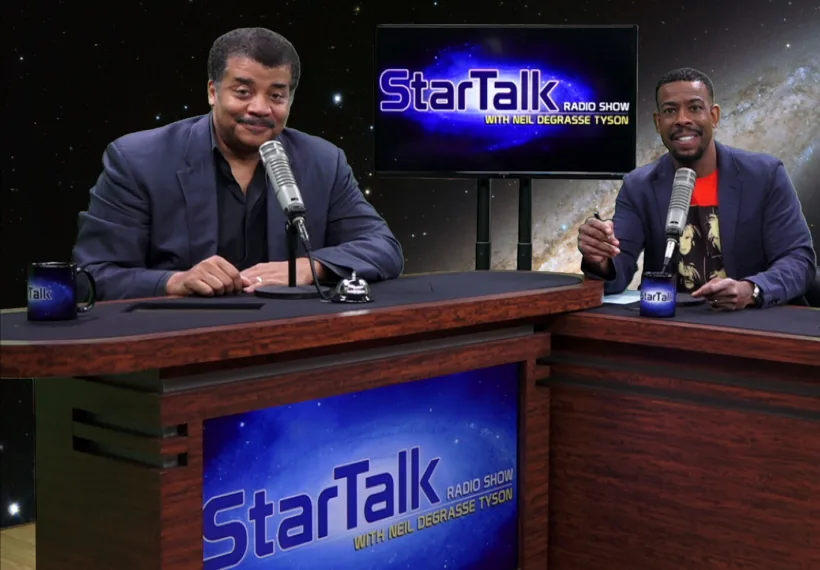
Welcome to StarTalk, your place in the universe where science and pop culture collide. StarTalk begins right now. This is StarTalk. I'm your host, Neil deGrasse Tyson, your personal astrophysicist. And I'm here in studio with Chuck Nice sitting across...
Welcome to StarTalk, your place in the universe where science and pop culture collide.
StarTalk begins right now.
This is StarTalk.
I'm your host, Neil deGrasse Tyson, your personal astrophysicist.
And I'm here in studio with Chuck Nice sitting across from me.
Yes.
Chuck Nice, comedian, how you doing, man?
I'm doing very well, Neil.
You got gigs lately?
Yeah.
I don't wanna be your only gig, you know?
I mean, you gotta.
I don't know, I still do my little TV shows that I do.
Yeah, they bring you on to comment on stuff.
Yeah, you know, the latest one, you should check it out if you can on True TV called How to Be a Grown-Up.
Why they asked me to be on it, I'll never know.
And I still do stand-up.
Okay.
Well, very cool.
I still do stand-up.
You know, I don't think I've ever seen you do stand-up.
Oh, really?
You gotta come sometime.
You send me an invitation.
No, let me resate that.
I don't think I've ever been invited to see you stand-up.
Snap.
Death.
From what I hear, I'm very funny.
That's what people tell me all the time.
So we've got another Cosmic Queries edition of StarTalk.
Yes, this one.
This is like, fans of people like Cosmic Queries.
You know, I'd rather, you know, I prefer to be like interviewing guests and stuff, you know.
Oh, well thanks.
So instead of just be here, be like Encyclopedia Man for the universe, but.
I think people enjoy the passion that you bring to the answers of the questions, you know.
It's like, I know your thing is to empower people to find information on their own or to steer them to other information.
I know that's what you like to do.
That's an educator.
That's what I wanna do, yeah.
But I think people, you don't wanna be the actual resource, like you know.
Exactly.
Like my mom used to say, I was like, what's that mean?
Go look it up.
That's what she used to say.
Mom, what's this word mean?
I don't be your damn Wikipedia page.
Exactly.
But I think what people enjoy is the fact that you bring the information in a very entertaining and very passionate, fervent way.
So that's what they really dig, not just the fact that you're giving the information.
All right, so let's do this.
Let's do this.
And I haven't seen these questions at all.
No, you have not.
And these are from?
And the category?
No category.
So these are the leftovers.
No hodgepodge.
The potpourri.
The potpourri.
That's right, Cosmic Queries potpourri.
And in math, we would call it random.
Right.
Yes, rather than potpourri hodgepodge.
Right.
Random.
Random, Cosmic Queries random.
The random edition, go.
Okay, Kasim Johnson wants to know this from Facebook and Earth, because he doesn't tell me where on Earth he is from.
Yeah, if you don't say, we're just gonna say you're Earth.
Right.
He says, is it possible for a stable black hole to exist within a stable star?
Ooh.
Yeah, that's kind of a wild question.
Ooh, no, no.
The black hole would eat the star.
Ooh, from the inside out.
Yeah.
Oh my God, that's amazing.
Yeah, that'd be nasty, too.
That would be ugly.
Ugly, totally ugly.
It's like that, the Asian drawing of a dragon eating itself.
Oh, or its tail.
Or its tail, right.
Yeah.
So no, there you have it.
Wow, look at that, man, hey.
That's a general image of a serpent.
So that snakes would eat their tail too.
And, because snakes don't have legs, so it's just a string eating itself.
It's a more clean version of the image of that, a snake eating its tail.
A snake eating its tail.
But no, but so that's eating it from the outside.
The black hole would eat it from the inside.
Well, there you have it.
Good question, good thing.
And by the way, the center of a star is where it's at its hottest, which is the source of the generation of energy.
So if your center became a black hole, you're not generating an energy for the star anymore.
And that's all she wrote.
And that's it.
So the star would just get sucked right up.
Yep, yep.
Okay, nice, nice.
All right, so Thomas Ballard.
Oh, wait, wait, now you have to do your imitation of the supermassive black hole after just ate something.
No, no, no, it was.
Was that it, no?
No, that wasn't it.
That's a middle school version of it, right?
Right, right.
No, no, it was the black hole eating any star that comes nearby and you said.
It was just a fat black hole.
Oh, no, no, oh yeah, it's a fat black hole.
And then, hey, hey, hey, oh, that was delicious.
I believe I just had a cosmic snack.
It's a fat black hole.
I believe that was delicious.
Yeah, so black hole, yeah, it would eat the star from within.
It would eat the star from within.
Thank you for the personification of the black hole.
Exactly, I can't believe I just ate myself.
All right, Thomas Valenzuela wants to know this.
You gotta admit that's a cool ass name.
That is, Valenzuela.
You can't beat that, yeah, I used to love that picture for The Dodgers.
Yeah, yeah, yeah.
All right, so does the rotation of the galaxies give us north and south orientation in the universe?
Based on something similar to the Coriolis effect, and if that is the case, could it be used as a reference to measure distances and our position versus the equator of the universe?
No, okay, next question.
No, there's some interesting backstory here.
So in physics, we have an unambiguous way of how to define what is north.
Really?
Yes.
Okay, please.
So north has meaning only in things that rotate.
Okay, all right.
If I put a book in front of you and say, what's north?
It means nothing.
It means nothing, okay.
Rotate something.
Now, take your right hand, curl your fingers in the direction the thing is rotating.
Then stick up your thumb.
Mm-hmm.
That's north.
Got you.
Got you.
And so that's how we can say if something is rotating upside down relative to north, because you'd have to twist your hand upside down, curl it.
Curl the fingers, and now it's rotating in that direction.
Now your thumb is pointing down.
It's pointing down.
Okay, so that's how we define rotation.
We did not know that the galaxy was a rotating thing until long after we had named it.
Why is it called galaxy?
Galactus is Greek for milk.
That's the milky way going across the night sky.
Because it just looked like a streak of white across the blackened night sky.
They didn't think it was literally milk, but it was the poetic reference to it.
And so that's the galaxy.
And now if you learn that it is a flattened system, and then you wanna ask, does it have a north and a south?
We, astronomers, in the early day, assigned the north pole of the galaxy to the pole of the galaxy that happened to be in the northern hemisphere of the earth, of earth sky.
Gotcha.
All right?
Because we're seeing it from the north or top part of our reference.
We would later learn which way the galaxy was rotating, and it turns out it's turning the other way.
So we are stuck calling the north pole of the galaxy the opposite of what our laws that we made for ourselves to define it as such would give us.
Yeah, so in other words, what we say is the north pole of the galaxy is in the northern hemisphere sky, but it's actually the south pole of the galaxy.
The south pole of the galaxy.
So yes, we can orient the galaxy, but the universe, we've never found a way to orient it.
There's no patch of material in one direction or another, an axis, a distribution, a plane, none of that.
The stuff is pretty random as far out as you go.
That's cool, man.
Yeah.
So we could do that here on earth because we have all of those things to measure and look at.
Yeah, there's a north pole of the solar system, which way are all the planets turning around the sun?
Because we see the sun as a center.
Which way is the sun rotating?
So that sun has a north pole.
Everybody's got a north pole.
That is cool.
And that's because we didn't know it was rotating.
We had to discover the galaxy because we're in it.
Right.
It's like, how do you know what your mother looks like if you're an embryo within her womb?
That's so funny.
You don't know.
So one of the last things we discovered was the galaxy, what the hell we look like in the galaxy.
What a great example.
How do you know what your mom looks like before you're born?
Yeah, you have no idea.
Right.
You know her voice.
You should get a selfie stick and put it out there.
What?
I'm just, there could be a way to do it.
That's awesome.
That's all I'm saying.
Selfie stick.
Let's move on to Alex Perkins.
Alex is coming to us from Earth and Alex says, hey, I just turned 30.
Hey, happy birthday, man.
How feasible is it in my lifetime to see people land on Europa?
Now, I suppose he's using the average lifespan because we don't know Alex could be hit by a bus next week.
You know, that's not, what, what, what, what?
I don't think that's the life expectancy he's planning for this question.
Alex, if you can hit by a bus next week, you ain't never seen this happen, all right?
So in the average lifespan now, I'd like to believe that before Alex turns 100, there's the positive outlook, Alex, that we might be able to send people to Europa.
That would just be very cool.
That would happen only the day we are, like the solar system is our backyard.
I don't see that as a destination itself.
I see that as just one of the many things we're doing in space, visiting Europa.
And it'd be very cool.
I talk about going to Europa all the time, go ice fishing on Europa.
It's an outer icy layer of ice and stress from Jupiter's gravity heats Europa.
By the way, Europa and Jupiter are outside of the Goldilocks zone.
So if you're outside of it, your water is evaporated because you're too close or you're frozen because you're too far away.
Jupiter pumps energy into Europa because of its gravity and has melted the ice beneath the surface.
So it's like an M&M moon.
It's got a hard candy outside and a nice watery squishy inside.
So you're out there and I want to go, like I've said this many times, I want to go ice fishing on Europa.
There's a movie called The Europa Report, which is about the man's first mission to Europa and they want to look for life there.
So yeah, I think that could happen, definitely in his lifetime.
Well, with all those oceans underneath Europa, how likely is the possibility of life?
Well, water and life go together, hand in hand here on earth.
And I've said this before, there's life every place on earth where there's water, liquid water, even the Dead Sea.
Correct.
Now, why is there life in the Dead Sea?
Why is it called the Dead Sea?
Because they, okay, there are no macroscopic fishes swimming around, but at the time they named it the Dead Sea, you know what they didn't have?
No.
A microscope.
There you go.
So there you have it.
Right.
So they're defining their world by what their senses tell them, when in fact what science is all about is extending your senses and creating new ways of detection that your biological form can't even approximate.
And then you deduce the nature of the world.
Sweet.
Great question, Alex.
And I hope you live to be 100, buddy.
Okay?
James Claver wants to know this.
He's from Bangor, Michigan.
He says, I've been reading your book, Death by Black Hole.
Oh, thank you.
It's a fan favorite, Death by Black Hole.
And you mentioned that scientists knew there were holes in the periodic table well before they were discovered.
I'm just wondering, how did they know?
Maybe a brief history of how they were originally organized.
So we know these tables.
We know that there's gaps.
How do they know there's gaps?
Yeah, so I'd love me some periodic table.
I can't get enough periodic table, just so you know.
So once you learn how to organize the elements, which is what Mendeleev figured out, a Russian scientist, right?
Once you do that, if you arrange them by how many protons are in their nucleus, very simple way to...
That's pretty simple, right?
You got four, then you're over here.
You got five, go next to four.
You got seven, skip one.
Do we have six yet?
No, not...
Well, actually, we did have six.
Six is carbon.
But do we have eight?
That's oxygen.
That could be a hard one.
Do we have nine?
Right?
And if...
No, we don't have it yet, but we got 10.
So 10 go in your 10 slot.
Right.
Well, where's nine?
We don't have it yet.
Well, get off your ass and find me some nine.
And so these are how you establish the gaps in the periodic table.
The periodic table is complete, from one up to 100 and, what are we, up to 110 or 12 or something.
So it's not like you're going to discover some other element that's going to pry it.
Right, because there's no 9.7.
There's no 9.7, correct, correct.
That's why it's complete.
Got you.
Yeah, yeah.
Some aspects of science are complete, that's how it is.
That's why it's a beautiful thing.
And it's a record of discovery over the centuries.
And I love it.
For example, the element, we discovered an element on the sun before we discovered it here on earth.
And we named it after the sun, the sun god Helios.
Helium.
Which became helium.
Which is a lot of that in the sun.
Yeah, it's like about 10% of it made of helium.
And we're running out of it on earth.
On earth, that's right, that's right.
And so helium is not uncommon in the universe.
And because we keep filling Thanksgiving day balloons with helium, actually in the old days, they would let it escape and then regenerate the helium, but now they recapture it, I've been told.
Because Macy's is the second biggest consumer of helium in the world.
Get out of here.
After the US military.
And helium has very special properties, not all of which I can divulge.
Get out.
Really?
Yeah.
Come on.
Like making you talk funny?
That happens too.
That's the best one.
It's a secret.
Not a secret.
Because that's the best one, by the way.
Great stuff, man.
So there you have it.
Periodic.
So now that, okay.
That's how you know you have a missing element.
That's what I was saying.
So now, now, now.
Go away.
Let's take it one step further.
There's an element that was missing, and we did the calculation after quantum physics was discovered, and we noticed that that element is unstable.
So even if it was ever in the universe, it would have decayed into something else by now.
So it would be like a permanent gap.
Anything that was there was not there now.
So we said, well, okay, let's just make it, make the stuff.
So we manufactured an element to fit in the gap, and we named it after ourselves.
We named it after technology.
It's called technetium.
Technetium.
Yeah.
Sweet.
Yeah.
Of course, because we made it, it can't last.
Plus we named it tech.
Yeah.
Tech means artificial.
And, in fact, technetium is a very active tool, potent tool for the radiologist, because you can set it up in ways that have different half-lives.
Six hours or 10 hours.
And you can do experiments with your circulatory system by tracking the radioactivity.
And if small amounts are okay, if it can-
Right.
And you can trace it as it moves.
As it moves.
And the half-life, it'll go away and you don't have to worry about it.
And you're done.
You leave the hospital, you're done.
Right.
Right.
Yeah.
That is brilliant.
I was once in a hospital with one of my radiation detectors, which I occasionally carry.
And-
Only you would make that statement.
Someone sat down next to me in the waiting room and the alarm started going off.
And I looked at the person, I said, okay, what are you in for?
They just did a radioactive dye test on it and he was still radioactive as he would be for the next few hours.
So I moved to another chair.
Wow.
Okay.
So we got one more before we break.
This is from Rob Z.
What do you think the bright spot on Ceres is?
Oh, Ceres.
So the largest asteroid actually has enough gravity to turn it into a round shape.
So it's the only round asteroid.
Technically, we shouldn't even call it an asteroid.
Is it a, what would it, dwarf planet there?
Oh, I've been hanging around you too long.
So objects that are just big enough to be turned into a sphere by their own gravity, but they haven't cleared their orbit because Ceres is orbiting in the asteroid belt, dwarf planet.
Pluto, big enough to be a sphere, but it's orbiting in the Kuiper belt, dwarf planet.
There we go.
So a bright spot on Ceres?
I have no idea.
I can tell you other stuff about Ceres.
It was the first asteroid discovered back in 1800 or 1801.
So obviously you're going to discover the biggest, brightest one first.
Right.
Because that makes sense.
So they thought they discovered a planet.
Planets are named after Roman gods, so they named it after the Roman goddess of harvest.
And Ceres, that's the root of the word cereal.
Right.
Whole grain oats.
That's a delicious planet or dwarf planet.
So that's Ceres.
I'm guessing it's a highly reflective, icy area of the object, because ice can be very reflective relative to any other kind of rock.
It doesn't take much to be more reflective than rock to show up blazingly in images you take of an object.
So that's my guess.
Well, there you go, Rob.
Get yourself a bowl and a spoon and enjoy some Ceres.
So we got to take a break, Chuck.
But when we come back more Cosmic Queries, Hope of a Re-Edition, all that is random in the Quizical Universe.
We're back on StarTalk.
Tyson here, Chuck Nice there.
That's right.
We're potpourri-ing together.
Yes, we are.
And we're, yes, we are.
And we're smelling good.
We're potpourri-ing together.
Potpourri-ing.
And asking me questions, drawn from our loyal fan base.
Yes.
And you haven't asked me a really crazy, stupid question yet.
And there's gotta be some in every batch.
You asked me very intelligent questions, but some of the weird ones, there are some interesting answers to them.
I'm just saying.
Yes.
I don't know anything.
You compiled this.
I'm just letting you know.
Since you said it.
And maybe I'll change my mind after this.
I don't know, because guess what?
I skipped over this question in that first segment.
And as you saw me just pick this page back up.
Yes, you picked the page back up that was in the trash.
I turned that over.
I'm gonna pick it back up, because here it is, it's from Inti Amartusa.
No, Amartusa, okay?
Okay, that's it, yeah.
Whatever you say.
You know what I think?
I think you actually have no friends ever in your life.
So you never had any practice pronouncing other people's names.
If you had superpowers, would you wear spandex?
Okay, so if you were a superhero, would you go with the spandex?
Maybe if I had a cut body, and then the spandex will show off the body, that could help intimidate criminals, you know?
Right.
Maybe, I'm just thinking, I mean.
See, I wouldn't.
I would go with a three-piece suit.
Because then I'd show up and they'd think I was just a banker, and then all of a sudden I'm like blowing stuff up with my eyes and throwing guys across the room.
You want to be like Kingsman.
Yes.
With a dapper umbrella and a cane.
And every time I show up, they'll be like, who is this guy?
Who is this banker that keeps showing up and kicking our ass?
That's good, I like the banker model, I like that.
Now yeah, no, you're right, why have spandex?
Yeah, exactly.
No, there's no, and I think in the early days, Superman was wearing pantyhose, you know, so.
Pretty much.
Yeah, blue pantyhose.
So yeah, there's no call for that, you're right.
Banker, three piece suit.
Three piece suit, man, sweet.
All right, let me put that back over there.
You know what I would do?
And I would draw from my supply of ties and each tie would have a separate different superpower that it gave me.
Now that's kind of cool.
And if you saw my tie, you know what you're dealing with.
How I was gonna kick your ass that day.
I like it.
That stuff would get telegraphed.
There we go.
All right, there you go.
So thank you, Inty.
All right, here we go.
This is from Nelson Sa.
Nelson says, what are some of the most important non-space related advances which came directly or mostly from research at NASA?
Oh, well, of course, NASA is fully focused on space.
So maybe the way to answer this is there are advances that directly helped space and things we were doing in space and other things that not only helped space, but then helped what we did here on Earth.
Maybe that's the way to answer this.
Because NASA is not researching how to make your better cup of coffee.
But they do utilize technology and technological advances.
It is always with the mission of trying to improve our duration, time, technology and space.
But that doesn't mean it can't apply to very cool things on Earth.
For example, something simple.
You ready?
Lately, if you have taken the exit ramp over most highways, and if that exit ramp has a pretty tight turn, the pavement is grooved.
It is.
Have you noticed that?
I have noticed that.
Okay, that came from NASA.
And why exactly would that come from NASA?
Because the last time I checked space, there were no off ramps.
Okay, as I understood this when it was told to me, you have the space shuttle coming in for a landing.
And the space shuttle is a glider coming in.
This is back when we actually put people in space.
How sad.
Okay, so, but in the day, way back.
I remember when.
As Bill Nye likes to do, he always puts on his old man voice when he's like, way back in the day.
You go back and when we flew space shuttles, when you come back to Earth and you're going to land, you are landing a glider.
All right, there's hardly any control over your, you have heirloom flaps and things, but you're a glider.
Now suppose it's raining or it's a little wet, okay?
You don't want the thing sliding to the left and the right.
So you put grooves in the pavement, which help align the wheels in the direction the wheel is rotating, which is the direction the road points.
Right.
There you have it.
And so this reduced the possibility of skidding and people realize, hey, why don't we put that on off-ramps?
Because if you're going too fast and you come off the ramp, you're hitting the embankment.
Right.
Okay, so now you can ask, here's the fascinating point.
You can say, why spend the millions of dollars or whatever it took to...
Why not just have somebody invent that outright?
Why?
Okay, because no one did.
However cheap you think that is, the fact is that solution only came about when someone cared about space.
Right.
And it turns out when you're going, I have found, you go into space, people gather around who care about that.
Smart people who care about that.
And those are the problems they want to solve.
You're not going to go to the smartest person in the room and say, oh, couldn't you help me prevent cars from skidding off the off-ramp of the Interstate 95?
Well, see, there's also no money in that last point.
Right.
Hey, help me stop cars from skidding off the, yeah, well, what's in it for me?
Right, right.
Why should I help you do that?
And I'm at the top of my class.
Why am I going to do that?
But if I instead say, prevent the space shuttle after coming out of orbit from skidding on its runway, you're going to figure this stuff out.
Right.
So space exploration has a way of infusing levels and dimensions of creativity in anybody who thinks about it.
And that's how you get these amazing solutions to everyday life.
Oh, man, that is a great, great point.
And I'm not even calling them spinoffs, because a spinoff would be, we got this widget in space, now you use the widget on Earth.
No.
It's not even about that.
No, no.
These are, I mean, some of these are direct applications just because they, as you see with the grooves, you find use for it somewhere else, and it's extremely important to have.
You can't think of how many thousands of lives probably have been saved by people having grooves, that simple little thing.
That simple.
And no one writes a story about the life that was not taken.
So true.
Yeah.
I know, which is why I often contemplate suicide.
Chuck, I'm joking.
I'm joking.
But it just, it was hanging there.
I had to say it.
Hey, well, that was a great question, Nelson.
And just remember that NASA will continue to suffer budget cuts.
Just figured I'd throw that in.
Just say it.
Oh, wait, wait, let me give you one more.
Just one more example.
So the docking algorithms to get the space shuttle to dock with the space station.
Right.
There are two sort of collars that come together.
And there's a laser stabilizing system that enables that to happen.
And there's software related to that and the like.
I say right as in I'm sure you're right.
I'm not saying right as in yes, you're correct because I already knew that.
Right, exactly.
But go ahead.
So what we found is that the surgery used to cut your cornea, have it rehealed to adjust your vision.
Which we call LASIK.
LASIK surgery, well, didn't always use lasers, okay.
A, B, so now that it uses lasers, how do you do that to someone if their eye might jiggle a little bit while you're trying to cut?
Right, because that's not what you want.
That's not what you want.
Two things you want, jiggle eye and a cutting edge.
And a serious circumcision.
So what they've done was adapted this laser stabilizing mechanism that allowed the cut to move with the moving eyeball in case the moving eyeball moved, and it's from the docking mechanism of the space shuttle and the space station.
So this NASA technology enabled this laser lasik surgery to be conducted safer and more cheaply than ever before.
That's why all of a sudden everybody started getting it.
Absolutely.
It's because it came out of space.
Oh, that's amazing.
Not the concept for the surgery.
No.
But just the...
The concept for the surgery came from an accident that a guy had and cut his eye.
No, honestly, he cut his eye and it healed and he was like, oh, okay, I don't know why, but I could see better, you know, but that's...
Yeah, I can imagine.
Let me try it on you.
Exactly.
Chasing you with the kitchen knife.
Yeah, I can see better because I cut my eye.
I should try to cut your eye.
I bet you I could heal you.
But that's fantastic.
Mm-hmm.
So that's an example of...
So two extremes of examples, one where vision has been improved, the other, your driving has been improved.
Yeah, right.
And both of them came out of the space program.
Yes, and it happens all the time.
That's amazing.
Hey, Nelson, great question, man.
Great question.
All right.
Here we go.
This is from Scott and that's all he says is, this is from Scott.
He says, on your premiere of Cosmos, you mentioned that the moon was pushed away by tidal friction.
Can you explain that a little bit further?
I had never heard it put like that before.
Yep.
Pushed is a very visual image, but what's really happening is that it's getting flung.
Flung is a more sort of physically accurate thing.
What's going on is the moon creates a tidal bulge on earth.
The water that's nearest the moon pulls towards the moon.
The moon is pulling on earth a little less and the water that's on the other side of the moon is pulling on even less.
All the oceanic waters form this bulge.
It's in a direct line to the moon.
Okay?
It turns out it's not in a direct line to the moon because earth is rotating and we're rotating faster than the moon is turning around it.
So we actually drag this bulge ahead of the moon.
So this bulge is actually trying to slow us down.
That's why we occasionally add leap seconds to the calendar.
And because the bulge is ahead of the moon, the moon feels a gravitational force ahead of it.
And so it wants to go faster in its orbit.
Right.
And by going faster in its orbit, it ascends to higher distances from earth.
So it's a cosmic ballet choreographed by the forces of gravity.
Gosh darn it.
That was fantastic.
So the moon is spiraling away about five inches a year from earth just because of this flinging effect of the leading edge of this tidal bulge.
Right.
Oh, Mike, that is fascinating because it's like the earth is a container holding this water.
Yes, yes.
Correct.
So instead of lining up with the gravitational pull from the moon, because the earth is a container holding this water and it's spinning, the water wants to move ahead.
We're dragging the water ahead of the moon.
And that costs us our rotational energy to do so.
That, God.
Oh my God, that's incredible.
It's physics.
I know, but I don't do that a lot.
I don't do physics a lot.
You look like a double rainbow guy.
You remember double rainbow guy, he comes around the corner of the mountain, it's on YouTube.
Right, right.
Oh, oh, oh, two rainbows.
And he starts crying.
I say, dude, it's physics, okay?
Oh my gosh, this is divine.
No, it's like, it's light, all right?
So, so I don't mean to take away the beauty of this.
By the way, there are other things that are mysteries that we don't understand that are even more beautiful.
Like women.
We are in the middle of the night.
We will listen to part of the podcast show, and we will listen to part of the podcast show, and we will listen to part of the podcast show, and we will listen to part of the podcast show, and we will listen to part of the podcast show, and we will listen to part of the podcast show, and we will listen to part of the podcast show, and we will listen to part of the podcast show, and we will listen to part of the podcast show, and we will listen to part of the podcast show, and we will listen to part of the podcast show, and we will listen to part of the podcast show, and we will listen to part of the podcast show, and when that's the case, our tidal bulbs will align, we will not be fighting the bulbs, and the bulbs will not be flinging the moon forward.
Double tidal lock?
Yeah, which was a wrestling move.
I used to wrestle.
The double tidal lock.
And I know astrophysics, you know I was trying to invent a double title lock wrestling hold, right?
So, at that point, Earth Day will equal the lunar month, and one side of the Earth will only ever face the Moon, just as today, one side of the Moon only ever faces the Earth, which is why there is never Earthrise on the Moon.
It's always in the sky if you're on that half of the Moon.
That's awesome.
Which is why that famous photo called Earthrise, taken by Apollo 8 in December 1968, it's called Earthrise, because the Earth was rising over the Moon.
Why?
Well, it's because they were orbiting the Moon, and they pull up the camera, and there's Earthrising.
That's how you get Earthrise.
But people thought, oh, Earthrise is on the Moon, just like the Moon rises on Earth, not-
No.
That's amazing.
Not until the Moon wins.
Unfortunately, I'm still stuck on double title lock, because I'm trying to figure out, do you put your legs around the person's neck, and then you're hanging off of their back, and then you grab both their knees, and then you whip it, and-
You know what I got?
No, I'll show you, off camera, I'll show you.
I never perfected it, but I had the ideas of one, and it was good.
That's pretty cool.
All right, that was-
Because what happens is you face your opponent, and then I swing you till you're out of balance, and then take you down while I'm still facing you, because in a double title lock, both sides of the orbs are facing one another, no matter what they do.
The idea is to get the person still facing you, and then as I swing and take them down.
Right.
Yeah.
That's fantastic.
Maybe get a quick one in before the break.
Okay, go.
Let's get a quick one, quick one, quick one.
All right, here's a good one, man.
Will the sky look different if we are all standing on another planet, constellations and such?
If I'm on another planet in this solar system, do I see the same sky?
Yes.
What?
You heard what I said?
You said yes.
Yeah, so here's, it's a simple answer, okay?
So the extent of our solar system is like from like the sun to Neptune.
Get over it.
No, if you look at the planets, so.
So basically, we're such a small little part.
Exactly.
We're not gonna change the frame of reference.
Exactly.
So if you look at the width of the solar system, it's like 10 light hours across.
It would take a beam of light 10 hours to cross the solar system.
That's big.
That's a long time, especially going with the speed of light.
Right.
However, as you look at the nearest stars, the stars that comprise the constellations, they are hundreds of light years away.
So if you just shift your head 10 light hours, you know, the stars don't mean a damn thing to the stars.
So you got to start moving among the stars to change your perspective on the constellations for them to take on other shapes.
And drag all the astrologers with you as they try to keep up with the new shapes.
And tell you how the universe will now affect you because of the random stars oriented in the galaxy.
That one looks like someone looking at a cloud.
What will we call it?
Chuck, we got to take a break.
We'll come back and continue.
You got more questions for us?
Yes, I do.
When StarTalk continues, more from Cosmic Queries.
Chuck, we're back, and this is Cosmic Queries, StarTalk Radio Cosmic Queries Edition.
And in this, our final segment, we're gonna save the last several minutes for the lightning round.
I don't know if we'll get through all the questions, but then we get through like a whole boatload in a short amount of time.
So let's work up to that with some continued questions and with my fully fleshed out answers.
Alrighty.
And any more weird questions?
I mean, weird questions have sometimes interesting answers, if you found any.
This is true.
What do you got?
Here's one from Jonathan Smith from Las Vegas, Nevada.
And you can pronounce his name.
You know what?
That's so true.
I'm gonna give you a little gold star each time.
Yeah, well, you know, I don't think I can really be proud of Jonathan Smith.
Is that the dude who messed with Pocahontas?
Jonathan?
Yeah.
Was it Jonathan?
John Smith.
Yeah, I thought that was him.
Yeah, I think it is him.
But who's the guy who founded the Mormons?
Oh.
John Smith.
John, I've got my people mixed up.
Oh, crap, I forgot his name.
Yeah, yeah.
Okay, but John Smith, definitely Pocahontas.
Yes.
Neil.
Yeah.
I've heard that the strongest evidence for gravity waves is the spiraling together of two neutron stars as the ripples.
Yes, yes.
However, neutron stars have incredibly strong magnetic pull as well.
Indeed.
Is it possible that the same dynamo effect that causes our sun to slow its rotation could be causing neutron stars to lose their combined angular momentum over time?
No.
Oh.
Okay.
I'll tell you why.
Go ahead.
Because we can look at the ripples that neutron stars send out as they draw near one another, and you calculate using Einstein's general theory of relativity, at what rate would it lose orbital energy to gravitational waves?
Okay.
And you write down that number.
And we have binary neutron stars in our galaxy, and they are losing energy at exactly that rate.
There's no unaccounted for need to then say, here's some other mechanism.
That's not even necessary.
It works exactly.
We know where the energy is.
We know where it came from and where it's going.
Where it's going.
But great question.
That is a very good point.
And it's how you make these deductions in the universe.
You look at something you know very well, if it accounts for everything, there's no need to keep...
You could keep looking, but why?
Right.
Yeah.
I mean, maybe it's sharing the cause, but everything I know about how I've accounted for it works.
So there's no need to...
You're done and move on to the next problem.
If it ain't broke, don't fix it.
Exactly.
There you go.
All right.
So Jesse from Vancouver, Canada, would like to know this.
Given that there is an upper limit or upper speed limit to the universe being the speed of light and a lower speed...
It's not just a good idea, it's the law.
Okay.
Buckle up, galaxies.
Exactly.
You never know.
Okay.
And there's a lower speed limit as well.
Oh, by the way, the buckling up, you only buckle up because your car changes speed, not because it exists at any one speed at all.
Well, it's the change that's pretty...
Change is what will kill you.
Right.
That's why you can be in an airplane going 600 miles an hour at 39,000 feet and they say, you may now unbuckle your seatbelt.
Right, because nothing's going to happen.
If you maintain your speed, that's not a problem.
It's if your speed changes and that's what your seatbelt is for.
I just love that they put seatbelts on airplanes as...
I get it for the turbulence, but for the crash, really?
Really?
Do you really think that seatbelt's going to help?
We're about to crash, buckle your seatbelt.
No, I'm not.
My favorite one is if you don't bring your seat back up the four inches, you're going to die in the crash.
What's that about?
You're going to be the only one who dies.
So given there's a lower speed limit, which is the absolute zero temperature, could velocity be considered a dimension like space, length, width and depth?
You have to ask, where are you going to go with that?
What are you going to do with that?
Because for example, you can have a speed and then I can slow you down with brakes.
You change dimension?
I mean, where are you getting with that?
Why?
Yeah, what is the purpose of even having?
Thinking about it that way.
If you want to, by the way, creative thinking is highly a good thing in this world.
But if you do so, ask yourself, is there something that you will now be able to explain that you couldn't before?
Because everything we've constructed about velocity and speed and all of this, it's, as Einstein said, or was it his protégé, said space tells matter how to move and matter tells space how to curve.
Yeah, it's deep.
That's a great one.
Yeah, it's deep.
So in that sense, it's not your speed, but it's the gravity that's creating the dimensionality of the fabric of space.
You can move within that.
So we move within the fabric of space.
So the velocity itself is not, there's no cause to think about it that way.
That's all.
I applaud the exercise.
Yeah, yeah, exactly.
It's very creative thinking and your answer, Jesse, is dark matter.
I'll just say.
I will never answer one question with something else we don't know anything about.
See, that's how I do it.
People do.
People say, oh, can we explain this thing in terms of consciousness?
We don't know what consciousness is, so just back up, give it space.
That's funny.
But see, you know what?
That's a great little cheat though.
It is a cheat.
It's a great cheat.
It's a complete cheat.
People do it all the time.
Yeah.
I mean, listen, because I don't know about this, well, why don't we think about it in terms of something else we don't know about?
Exactly.
That'll answer it.
Because that'll answer it, right?
That's very funny.
This is from Amanda Milligan.
She says, in every documentary-
Where is she from?
She's from Earth?
She is from Earth.
Okay.
She's just from Earth.
In every documentary I have seen lately, extraterrestrial life is animal.
How do you think plant life would evolve outside of our own world, or could there be life that exists that could not be classified as either plant nor animal, but still life?
There's a famous science fiction story, and forgive me if I forgot who wrote it, because I don't come in here with notes in anticipation of questions.
You don't know these questions, so how could you?
Right.
There's a science fiction story where the aliens came upon Earth and saw that there's like muscle tissue, and they go back to their home planet and says, they're made of meat.
Because the aliens, they're made of some spirit energy, and we're made of meat.
And another thing that we take for granted, but I can imagine an alien life form that would just freak out.
Other than salt, animals have to kill to consume food.
Other than the consumption of salt, everything else you eat was once alive, unless you live off of milk and honey.
Those themselves were not once alive.
That's still an animal by-product.
That's an animal by-product.
You have to kill something.
And even the vegetarians-
And the vegetarians were alive.
Are slaughtering carrots, and slicing them, dicing them up, and shredding them.
So the fact that we have to kill other life forms on our own planet for our own sustenance could easily be seen as one of the most barbaric things to another civilization where they all absorb energy from their host star.
Right.
Yes.
There you have it.
Because they're absorbing and not consuming.
Well, they're ingesting.
They're not ingesting.
They're an unlimited source of energy from their sun, just like planets by plants on earth.
Right.
They don't have to eat anything.
There's some that do, of course, but most, nearly all other planets don't.
The Venus flytrap is carnivorous.
And what's the other one that eats flies that smells like-
A picture plant.
There's one that-
Oh, you're talking about the one that smells like rotting parry and-
Yeah, yeah.
It smells like rotting flesh.
Yeah.
So that one, okay, so they're carnivorous.
But all the rest-
That is a picture plant.
are doing just fine with sunlight.
Yeah.
And that's an awesome way to live, I think.
If I were to evolve the human into another form, I'd evolve us with solar panels on our skin.
Nice.
Our skin would be one big solar panel.
Yeah, and that way, getting sunburned, you just recharge your energetics.
Yes.
I believe they call that Africans.
I'm just saying.
Last I heard, that's why they're black.
I say they.
I just said, that's why they're black.
That's so crazy.
Megan Morrissey says, hi.
I'm showing for the first time an episode of Cosmos in my high school earth sciences class.
Give it up for the teachers of the world.
There you go.
One of my students just asked me if a ship that is designed like a ship of imagination would actually be able to fly into space, would that be possible?
Love your show and thank you.
I'm not authorized to say whether I actually own one of these.
No, the ship of the imagination on purpose has mobility through space and time, and that mobility is empowered by my thoughts.
So there are no controls.
Plus, we had a mini discussion with Andrewian who specified in the script that the ship would be impossibly minimalist.
So I would not be wearing a badge, which would imply that I'm captain and you're not, because you should be able to fly this as well.
So the ship, no, it exists completely in my imagination as your tour guide.
So no, there is no attempt to try to make it real.
As there have been with the Starship Enterprise and other sort of sci-fi creations.
So yeah, it's not real or it can even be imagined to be real, because it exists in my mind as your private tour guide.
There you go.
You know what time it is?
Uh-oh.
It is...
I'm so bad at hitting this bell.
Damn.
There we go.
Lightning round.
Lightning round.
Oh my God.
We got a lightning round.
So I'm answering in soundbites because you still have so many I didn't get to.
Okay.
Here we go.
Jehovah Bar-era wants to know, as the sun expands and gets close to the earth, what will happen to the earth besides getting really hot?
Oh, so the story here is that it's getting hot.
That's the story.
All right.
So the gravity will be the same.
It will still orbit the sun in the same amount of time, but as it gets hot, the oceans will come to a rolling boil and evaporate into the atmosphere.
The atmosphere will itself evaporate into space as we become engulfed by the expanding sun and we become a vaporized ember orbiting deep within earth's surface.
Have a nice day.
From Andrew Lounsbury, who says, this is not relevant to science, but where did Neil get his celestial vest?
Oh, actually, I own about six vests.
And they're for different stages of how wide my belly is at different times.
But the one I'm most seen in, it was the last vest sold at the gift shop of the Hanson Planetarium in Utah, in Salt Lake City, Utah, before that closed and reopened in another identity.
And in fact, they had no more left and I bought it off the back of the salesperson.
And I've yet to see anyone else wearing this vest ever again.
So yeah, that's the one.
That person is probably so pissed off right now.
Took it off their back.
But they agreed.
I didn't take, I didn't steal it off their back.
Man, give me the vest.
You know who I am.
I'm NDT, bitch.
I'm sorry.
We're in the lightning round.
Next.
Mardicueo I Sueldo, thank you, says, Mars pioneers will be the first true 100% renewable, will the Mars pioneers be the first true 100% renewable energy human community ever?
That's the plan.
The Mars One plan is yes.
Yes.
Yes.
That's the plan.
That is the plan.
Initially, they'll get supplies, you know, supply chain from Earth, but ultimately they start making the stuff themselves.
Thank you, Marta Cuello from Argentina.
Next.
Adam Hall...
Oh, you son of a gun.
Hal LaVaca says, hello, I'm writing from Slovakia and me and my friends would like to know what does Neil think about pirating, i.e.
illegally downloading or torrenting the show Cosmos.
What do I think of it?
Because clearly they're doing that.
Apparently.
Get his IP address right now.
I don't know how much control there is over that and my guess is more people pirate it than who would ever even buy it in the first place so that the exposure is greater than it would otherwise be.
If everyone pirated, there'd be no money to actually produce the product.
So what I would say is for people who are pirating, if you're doing so, let it be because you actually can't afford it.
Right.
Right.
And then there's a way, I'd rather you knew this than you didn't.
But the minute you have cash flow, then pay that forward.
Right.
Now you're screwing it up for everybody.
Yeah.
So I can't endorse illegal behavior, but if you can't afford it and you want to learn, it's like Abbie Hoffman wrote a book called Steal This Book.
Right.
Steal That Book that he wrote, which is a way if you were without means to try to sort of exploit the system until you didn't have to.
So yeah, if someone told me they pirated it and then they came to one of my lectures and bought something else later on, fine.
It's an investment.
There you go.
So the answer is go ahead and steal it.
No, that was not the answer.
No, that was not a soundbite answer.
I was supposed to give a soundbite answer.
I give one more, and we'll soundbite that, and we're done.
Okay, so we're way over.
Okay, here we go.
One more, go.
Here we go.
With iron and low gravity, would Mars be an ideal place to build larger interstellar rocket ships and space stations?
Yes, if you build a ship and you can launch from a low gravity place, that's what you want to do.
Because half of your launch energy, leaving Earth, is just to get the hell off of Earth.
Into orbit.
The other half of your energy can take you practically anywhere else in the universe.
Certainly in the solar system.
So, yes, launch from the lightest place you possibly can.
And you know what that is?
It might be empty space itself.
There you go, Chuck, we're out of time.
That was a potpourri edition of StarTalk Cosmic Queries.
Yes, it was.
You're listening to StarTalk Radio.
Stay tuned.
More up next.
What we're gonna do, a little something which we have done before.
People love it, I love it, and it's called Kneeled It.
Had anyone ever asked me if I love it?
Don't I have a say in this?
No, it's like asking your parents, can you go out?
You know, can you go to a concert?
You never ask.
Oh, you just, okay.
Because it's like, who said you could go to the concert?
You did not say I could go to the concert.
That's how you got out, okay?
So, but this is where we take, I go on the internet, namely YouTube, and find videos of you, and then it really has nothing to do with your videos, it has to do with the comment sections underneath.
Really?
So, all the people...
You're stalking my comment threads.
Yes, so the comment threads, a lot of times, there are people who are discussing science with each other and...
Inspired by the video.
Inspired by the video and then sometimes completely disregarding the video.
So, it already takes an off-ramp.
Yes.
And it lands somewhere else.
Right.
It's just like, you know, so you'll have, like, for instance, you will say something about the globe that we live on.
And then there will be a thread, right?
There will be a thread that says, this is not a globe and we are not on earth.
And then they will go ahead and give their argument.
And so, I just loved it.
And so, the thing is, these people make these comments.
I want to read the comments to you.
And then you will tell us whether or not they kneeled it.
I'll do that.
All right, here we go.
So, this was a talk you gave with Sarah Silverman and Jim Gaff again a little while ago.
That would have been a StarTalk Live.
And so, BA.
Davis says this.
Okay, for all the overexcited nerds that keep rambling about the comedians, this format is designed, ingenuously, I might add, for the 90% of Americans that are ignorant to the world of science.
Neil deGrasse Tyson is using this as a tool to inspire and educate the part of the human race that is holding us back from furthering our future endeavors.
He is the only scientist I know of trying to bridge the gap.
He should be applauded for his efforts, not spewing nerd rage over Serif Silverman's pussy jokes.
If you have a problem with this, then you're part of the problem and not the solution.
Did he meal it?
The problem is, if you're not part of the solution, you're part of the precipitant.
I have a little chemistry geek humor there.
I would say...
And by the way, go Google that joke if you don't get it.
Seriously, learn something, all right?
Solution, chemistry, just know that.
And precipitant, right.
It's everything that is not the solution in a liquid thing, in the beaker flask thing.
All right, so I would say...
You know, it's a little rambly, but I think it's hard as in the right place.
Yeah, yeah.
All right.
And I think that commentator...
Yes.
Is...
Sorry, I can't...
There's an old joke I remembered.
What?
There's a potato family.
Family of potatoes.
Family of potatoes.
And...
Mr.
and Mrs.
And there's a daughter who goes out dating.
And brings back a potato, but the parents don't like the potato.
Right.
And she says, why don't you like my boyfriend?
And I said, he's a commentator.
I cannot believe I have made it this far in my life without hearing that joke.
Without hearing that joke!
It's not in the canon of...
That one's not there.
No commentators for me.
So I think he gets what we're trying to do.
But he's a little aggressive.
He's a little angry.
A little angry with others, and I think there are ways to handle that.
And I think he's being so aggressive that he will turn people off that ultimately we want to turn on.
All right.
I like that.
So the net result is you can feel righteous.
But like my father used to say, and thanks for coming to Memorial.
We lost him last December.
Thanks for being there.
My pleasure.
Yeah, he was 89, so there was a full life there.
And a very important man.
Like a quietly important guy, quietly important guy.
Yeah, yeah.
He did stuff in the service of keeping peace during the civil rights movement in New York City at a time when other cities were burning.
And never had any riots here.
Right, yeah.
Not over that time when Martin Luther King was getting shot.
Was getting shot.
Yeah, when he got shot.
It's still happening.
Actually, the bullets are still flying.
That's like the next...
If you were around today, what would he be talking about?
He'd probably be talking about them.
Oh, without a doubt.
Guns and economic...
Empowerment.
And disparity.
Yeah, all right, man, so don't be so angry.
If you get that angry, then what my father said was it's not good enough to be right.
You have to be effective.
That's good.
Because the urge to be right is, okay, now you can feel self-righteous, but did you accomplish what you intended?
Oh my God.
Let me tell you something, your parents had a good marriage because that man understood what it takes to be married.
I just figured it out.
Yeah.
It's not just going to...
Every little bit of wisdom helps in a marriage.
Yeah, that's for sure.
Yeah.
You can be right as a man, but it's better to be effective.
It don't get you anywhere.
You say, I'm right, you're wrong.
There you go.
All right.
That was good.
Good.
All right.
And by the way, man, I think we're all on the same team.
I know he had a little problem with the comedians, but we're here to help.
Yeah.
All right.
Here we go.
Stephen Colbert interviewed you a little less than a year ago, and you said something about how the universe is expanding and we're all moving away from one another, and this is what this person says.
Again, in the comment threads.
In the comment threads.
Okay, the universe is expanding and most galaxies are moving away from us, but wouldn't galaxy clusters stick together due to gravity?
Hmm.
So I'm interested.
This is a pretty cool assertion that somebody has made.
The assumption is that if it's a galaxy cluster and it's moving away the same way every other, do they have specific gravity that keeps them together as they move apart or they gotta say goodbye to?
Did they kneel it?
The assumption is correct.
What?
I thought they were wrong.
No.
If you are gravitationally bound now, you'll be gravitationally bound tomorrow.
Get out.
Yes.
Oh my God.
So, in other words, the gravitational binding energy, that's the official term for it, of a cluster as well as binary stars within a cluster as well as planets in orbiting a star, all of that is gravitationally bound.
That will not succumb to the expansion of that star.
So they have their own specific gravitational system inside of the larger system?
Correct.
So, as the universe expands, for instance, which it's doing right now.
By the way, I can quantify this.
Okay, cool.
Okay?
So, you can look at the speeds that the galaxies have.
Alright?
So you can write down that number.
It's like a beehive, and there they go, and some of the clusters, that's what they're doing.
Write down that number.
Then you can ask, in the expanding universe, how fast are galaxies moving away from one another?
And the farther away they are, the faster they're moving away from one another.
This is the signature of an expanding rubber sheet.
So, in other words, if I have three points, give me three points, just like, okay?
Very nice, right?
To the camera, please.
Oh, yeah.
Oh, that's right.
Here's my three points.
Right?
So, if I stretch this, okay?
Then these go.
Then the distance between these two will, let's say, separate by a centimeter.
The difference between these separate by a centimeter.
But the difference between these two separate by two centimeters.
And the third one would be three centimeters from this.
The fourth one would be four centimeters from this in the same amount of time.
So the farther away you are, the faster you are receding.
So, it turns out that the size of the universe over which you are separating at the speed that these galaxies are moving on their own is much bigger than the size of a cluster.
So you don't have this conflicting, well, am I expanding with the universe or am I still orbiting over here?
Because you see it that they are still within their, what do I call it, locale.
Yes, that'll work.
They're within their locale.
All right, I got to tell you, Frisandmove, I actually picked that because I thought that was just the opposite.
Nope, nailed it.
Nailed it!
Sweet!
Although it was a question, but the fact that he knew to ask the question.
Meant he was coming from the right place.
Yeah, exactly.
He thought about, yeah, yeah, yeah.
Will we keep the clusters or not?
By the way, there are some very extended systems we only loosely call them clusters just because you can sort of, you know, galaxy hop from one edge to the other.
Those are goners.
Those are too spread out.
They're not densely, they're too spread out and you'll lose some of the ones on the edges of that.
Yeah.
Cool.
Okay, cool.
Is that what happens when you have like colliding galaxies and then you have like little dwarf galaxies left over?
Yeah, that can happen, but generally life as a dwarf galaxy is tough.
Mostly you get eaten.
It's called galactic cannibalism.
Oh, yeah.
In fact, if you study our galaxy, there are systems of stars that are all moving together in the middle of other stars that are not.
This used to be a dwarf galaxy.
And it still holds its orbit, but the galaxy is completely ripped apart, but the stars are still trying to hang together, but eventually they'll just get scattered.
But it's the evidence of it having been recently beaten.
Nice.
All right.
The official research paper is called galactic cannibalism.
It sounds like a great group that I would love to see.
Oh, the galactic cannibals.
I would love to see them at Coachella.
See the full transcript



 Unlock with Patreon

 Become a Patron