Put on your thinking caps, because in this episode Neil deGrasse Tyson and comic co-host Leighann Lord answer questions from our fans about pseudoscience. You’ll learn all about Bigfoot and ancient aliens, crystals, and creationism. Find out which types of pseudoscience Neil feels are the most entertaining (Ouija boards), and the most dangerous (alternative medicine that leaves people vulnerable to real illness). Discover whether scientific literacy is a vaccine against pseudoscience, and why even science needs to invent methods and tools to reduce the human susceptibility to fool ourselves into thinking something is true when it’s not. Plus, Neil and Leighann discuss kids, adults and the difference between imagination, magical thinking and pseudoscience. It’s an episode that’s sure to get people thinking… and commenting.
Transcript
DOWNLOAD SRT
Welcome to StarTalk, your place in the universe where science and pop culture collide. StarTalk begins right now. This is StarTalk Radio. I'm your host, Neil deGrasse Tyson. I'm an astrophysicist with the American Museum of Natural History, where I...
Welcome to StarTalk, your place in the universe where science and pop culture collide.
StarTalk begins right now.
This is StarTalk Radio.
I'm your host, Neil deGrasse Tyson.
I'm an astrophysicist with the American Museum of Natural History, where I also serve as director of Hayden Planetarium.
We're here at StarTalk.
I think of it as StarTalk after hours, but in fact, it's StarTalk Cosmic Queries.
And I've got with me in studio the one and the only Leighann Lord.
Leighann.
Hey, I like that, the one and only.
The one and only Leighann Lord, especially since you spell your name, L-E-I-G-H-A-N-N.
Thank you.
I can't take credit for that.
That's my parents.
But thank you.
And I make a point of that because if you want to follow Leighann on Twitter, you got to spell her name right.
That's right.
She's at Leighann Lord.
Easy to find, easy to follow once you get the letters right.
It's great to have you on here.
It's so nice to be here.
So you actually, you make a living as a professional comedian.
I make a living as a professional comedian.
That is awesome.
That is crazy.
Bringing laughter where it's needed most in the world.
Exactly, exactly.
It's not rocket science, but you know, people need it.
And I like following you where you go around the country and the world.
You've been to the Middle East?
I've been to the Middle East.
With the troops?
That is so Bob Hope of you.
Oh man.
And they really are a great audience.
I love doing it.
Yeah, yeah, very appreciative.
And so it's great to have you here.
So this Cosmic Queries segment, we're gonna talk about pseudoscience.
Pseudoscience.
Yeah.
How many hours do we have for this topic?
I know, right, right, right.
So it's stuff that people think is science, but in fact isn't.
They want it to be science.
But science actually knows quite well what it is and how it works and how the methods and tools apply.
And so a big effort of people who are trying to, sort of the debunkers out there, to try to show people what science is and how we know what we know and how we know what we don't know.
How do we know what we know?
It's how we know what we know and how we know that we don't know something.
Okay, that's just as important.
That's true.
Yes, it is.
Yes, it is.
So we've called questions from the internet.
On the internet, we are startalkradio.net.
You can chat with us there.
We have, there's a blog, places to deposit your questions and comments.
There's the archive of our past shows are there as well.
Also on Facebook, you can like us there.
StarTalk Radio, that's easy to get to.
And of course, we're in the Twitterverse, StarTalk Radio.
I also tweet.
If you have patience for my cosmic brain droppings, they're-
They're brilliant, brilliant.
They're not related to just stuff that floats in and out of my head.
And I happen to have a medium to put them.
That's called a repository for my brain dropping.
Your tweets make me stop and stare into space because I'm like, wait a minute.
Not while you're driving.
Yeah, because I'm tweeting while driving.
So these questions, I think these all came from Facebook.
Is that correct?
These look like they are all Facebook questions.
Yes, they are.
Yeah, and I haven't seen them before, so this will all be very fresh.
Good, good.
And if I can't answer one, I'll say I can't answer it.
Okay, that's fair.
By the way, I, while I have a lot of thoughts to share about pseudoscience, there are people out there who do this professionally.
So I'm, so this is just a service to our listeners, but there are books written by folks who, for example, Michael Shermer, who wrote Why People Believe Weird Things.
There's a title very similar to that.
Go find him on the, you can find, and in there, customers who bought that book also bought.
So if you look at the rest, there's a whole slew of ways you can sort of read up on this.
So let's see how well I can do for this go.
All right, we have the first question here is from Benjamin Camacho Garcia.
And he says we know.
Look at you, Garcia.
Garcia, just put a little Spanish flair on it there.
Now, he says we know all kinds of pseudoscience are garbage, but which one do you find more entertaining and which one would be the most dangerous to practice?
Okay, the one I think is most entertaining is the Ouija board.
Okay, well going old school, all right.
Old school, yeah, yeah, not even.
I didn't expect that.
Don't even have to plug that one in.
Wow.
Yeah, it's the Ouija board where people gather around a table and you put your, and it's on your lap, I guess, if I remember how you do this.
It's touching your knees.
No, no.
No, no, no, it's on a table.
I did it when it's on a table.
You put it on a table.
No, no, no, you just gotta.
Well, you have the board and then you have your hands on the little device.
Everybody has to touch the pointer.
Oh, right, right.
Okay, that's one version of it.
When I first did it, that object on the board would move by gravity.
So the board would tilt and it would slide to the letters on the board.
Okay, so here this is like sort of group movement.
Yes.
Yeah, so I think that's just, it's a fun party thing.
It's like playing twister.
Without the inappropriate contact.
Without the inappropriate, or yeah.
And so I kind of like the Ouija board.
And of course it's your, what they did was, it turns out if you're blind, the Ouija board doesn't work very well for you.
Yeah, you're influencing where the puck lands on it because you can actually see it.
And it turns out if you don't know how to spell well, you actually misspell the words while you, there are fascinating experiments you can do that just summarily debunk the entire process.
So for example, are you channeling someone else's words through your ability to communicate through the Ouija board and you find out they misspell the same words that you do?
Yes, love it.
So unless your spelling profile exactly matches that of the dead person whose spirit you're channeling, you got, this is not working.
So the Ouija board, I would say, was mine.
Is your most entertaining.
Yeah, yeah.
What about now, what about the most dangerous?
Oh, the most dangerous.
These are the ones where you think you have a cure for a medical ailment and that would, this is on sort of the, what they call alternative medicine.
By the way, have you ever heard of alternative math?
Of course not, because it doesn't exist.
Have you ever heard of alternative physics?
Of course not, because there's no such thing.
Yet somehow we all wanna believe that there's something called alternative medicine.
There's either the stuff that works and the stuff that doesn't.
And the stuff that works, let's call medicine, and the stuff that doesn't, let's call that quackery.
Let's just simply be honest about this, okay?
Believe it or not, we have that in my profession too, alternative comedy.
It's called not funny.
Not funny.
So then it's dangerous.
It's not dangerous to others, it's dangerous to yourself.
Because you think there's a cure that someone claims is real, but has not undergone rigorous scientific testing, and then you forego treatment that you get through other means, and you end up dying sooner, or dying, or becoming maimed or crippled because you didn't seek the attention that it required.
So that's where the danger comes in.
So that's why I don't jump all over people who do, you know, their tarot card readings and palm readings, and you know, I don't distract myself by people who want to believe that's real.
But when the medicine steps in there, that's a problem.
You've been listening.
You are listening to StarTalk Radio, the Cosmic Queries Hour.
And I'm here with Leighann Lord.
I'm Neil deGrasse Tyson.
And we'll continue after the break.
We're back on StarTalk Radio.
I'm Neil deGrasse Tyson, your host.
I'm an astrophysicist by day, and StarTalk radio announcer by night.
No, actually, an astrophysicist can be anything they want at night, because nobody's looking.
Everyone else is asleep.
We're awake, contemplating the cosmos.
So, we've called questions from the internet, and these are all related to pseudoscience.
Yes.
And Leighann, let me just ask you, do you lean towards anything that you think might be pseudoscience?
I don't think so.
I might have before I met you.
But I think it's been educated out of me.
Oh, I like that phrase, to get something educated out of you.
Oh, can we use that?
We gotta use that.
Well, be my guest, absolutely.
Oh my God, get the pseudoscience educated out of you.
There we go.
That's why we do this.
So, you got a question.
I do, I do.
It's actually almost maybe a follow-up.
These are questions from listeners.
These are questions from listeners.
Our give-back, in a way, to we want to make sure you're a part of what we do here.
And I love the interaction with fans.
This is fantastic.
This is a question from Brian Shields, and he wants to know, sort of, what spurred the use of items such as crystals in the realm of pseudoscience?
I mean, were users attracted to their physical beauty, or did they just assume that it had more enduring qualities?
What an awesome question.
It's a great question.
So, what we have found in the history of cultures is that civilizations tended to gather together and cherish, that might overstate what it actually is in some cases, but establish a higher level of curiosity for some things over other things.
So, it's a curiosity factor because it's different.
And, by the way, there's a famous quote from Isaac Newton.
And he imagines himself sitting at the water's edge.
And as the waves come upon the shore, he says, I feel like a child on the shore, picking up one pebble over another just because it looks slightly more interesting than the rest.
Yet the ocean of truth lay undiscovered before me.
So, there he is, humbled by the fact that he knows there's a lot more to discover, but there he is nonetheless curious about the little things that are in his arms reach, one pebble being shinier than the next.
So, over history, what we've done is, you pick up shiny things.
You pick up.
I love that deeply scientific explanation.
Shiny things.
We pick up shiny things.
We wear shiny things.
Jewelry is typically shiny.
You yourself are wearing shiny things, okay?
So, I'm not talking about only ancient civilizations.
I'm talking about modern life.
So, we find silver, gold.
It goes to a high luster.
We like these things.
We collect them.
They are different from other things you find in nature.
We also, crystals are the world's first transparent solid things.
Think about that.
Yeah, I just did the head cock.
Yeah, yeah, yeah.
The dog that just heard the high pitch ring.
The world's first solid transparent things.
Yes, normally you think of solid.
It's solid, nothing goes through it.
And now I've got a solid thing that light can pass through.
That's an awesome thought.
That is pretty cool.
And there it is in nature.
There's quartz.
Quartz crystal is transparent to visible light.
Now, take that fact and say, well, can you do anything with it?
Do you realize this even worked its way into early ideas of the cosmos?
So, before we knew that earth went around the sun and this sort of thing, it was like the sun goes around the earth and everything goes around the earth because earth is the center of the entire universe.
Well, we know there are different distances because some move faster on the sky than others.
But what holds them up there?
What keeps them there?
So guess what held them there?
Something has to hold them there and completely surround the earth, but you have to be able to see through it to see the planets that are farther away than they are.
This was the birth of the crystalline spheres.
Crystal, not because crystal is a special form of mineral.
Crystal because the damn thing is transparent and you can see through it to the rest of the cosmos.
And so there was the crystalline spheres out there.
So crystals were valued simply because they were different and they were transparent.
And we always, it's a natural part of human curiosity to pick up that which is different and bring it home.
Wow.
Mom and dad aren't always happy about that.
So that's, in fact, if you want to think about it in another kind of way, those are the seeds of the birth of science, the fact that we are curious about some things that are different than others.
If you look at the, I think it was the Inuit, whatever is the culture that frequented the shores of Greenland, okay, and as we know Greenland is mostly glacier, at least for now, right, there is the Cape York meteorite, which is currently the largest meteorite in captivity.
And-
Being held against its will, everybody.
It is at the American Museum of Natural History in our Meteorite Hall, that meteorite was cherished by the local peoples.
And in fact, meteorites have been, iron meteorites have been the entire source of metal for civilizations that did not otherwise have access to iron ores beneath Earth's surface.
So Native American tribes, the Inuits, I think Eskimo is not the proper term these days, but the terms that describe the coastal peoples who fished for food and lived in the Arctic regions.
The metal that's in those cultures, in almost every case, is metal carved off of rocks that didn't match anything else in their environment, and those were iron meteorites that were exposed on the surface that had been there for tens of thousands, possibly in some cases, millions of years.
Mm, so something different.
Yes.
That was a long answer, man.
No, but that's great.
Okay, all right.
I love it.
Do you want another question?
Actually, the meteorite would not have been there for millions of years, because continental drift would have redistributed where everything is.
So if you found a meteorite in the ground, it would have fallen within the last tens of thousands of years, typically.
Yeah.
So you just footnote it yourself.
Yes, okay, thank you very much.
Caveat.
Okay, I have a question.
This might be a little controversial.
This is from Richard Conant.
And again, the theme is pseudoscience.
The theme is, oh, this is definitely pseudoscience.
And it begins with Mr.
Tyson.
Is there hope for America when 46% believe in creationism?
Yeah, are we gonna edit that out?
Okay, no, that's fine.
There is hope for America if 47% believe in creationism, provided that that 47% doesn't require that the other 53% believe it as well.
Aye, there's the rub, sir.
Yeah, so the problem is not what people believe.
This is a free country.
Believe what you want.
I will not tell you what to believe.
What I will say to you is that if you want your belief, which is not based on objective truths, it's based on what are generally known as revealed truths.
There's some sacred document that someone has truth revealed to them through whatever forces that you recognize in your religion.
And there are many of these.
There's Joseph Smith's documents and there's the Quran.
There are all these revealed truths.
If those truths conflict with objectively verifiable truths and you want to teach that as science, that's the beginning of the end of the technological foundation of your culture.
I just alert you of the consequences of this.
I will not tell you what to think or how to think it.
I just wanna say if you do this, then that's what happens.
You have been warned.
Proceed at your peril.
Yeah, you've been warned.
And by the way, there's no tradition of atheists or scientists knocking down the Sunday school door, telling the preacher, that might not necessarily be true.
No, there's no one trying to change church religious curriculum.
That's not happening.
So to have religious communities try to alter a science curriculum to meet their needs, that's a profound imbalance of what the historical relationship has been between religious communities and scientific communities over the centuries.
So the problem is not, that's not the problem.
The problem is when people want to learn science, think that creationism is science, they have been removed from the frontier of cosmic discovery.
Wow, very nicely done.
Oh, thank you.
I like that.
I like that.
And I, you know what?
I think this might actually lead into, and maybe you've already answered this in a way, but I wanted to ask it anyway.
And this is from Brandon, Brandon Rogers.
He said, what should people be doing more often in order to combat the rapid spread of pseudoscience?
And he suggests take more classes on skepticism.
Yeah, that's an excellent question.
So we always assumed in the sort of educated scientific community that if you learn science and you learn the laws of physics, that you won't be susceptible to the pseudoscience.
That it's kind of an inoculation against it.
And largely that's true.
If you're scientifically literate, it is a kind of a vaccine against those who would exploit your ignorance of natural law for their own gain, all right?
You know what I'll do after the break?
I'll give you my recipe for fighting pseudoscience.
You're still sticking around, I presume.
Yes, thank you.
All right, you're listening to StarTalk Radio.
I'm Neil deGrasse Tyson.
We'll be right back.
We're back on StarTalk Radio.
I'm Neil deGrasse Tyson.
Joining me as my co-host for this StarTalk Cosmic Queries Hour is Leighann Lord.
Leighann, great to have you.
Oh, great to be here.
Professional comedian.
Do you say comedian or comedian?
Whatever you wanna say, as long as I'm getting paid to show up.
Getting paid.
Yeah, so comedian is the feminized version of comedian.
It is, it's pretty.
I don't mind it.
My feminism doesn't extend to being offended by that.
Yeah, it's actually a pretty word.
It is, I'll take it.
So, where do we leave off in the last segment?
There was a question about...
We were talking about pseudoscience and what can we be doing to sort of combat that and is there something, I guess, in the toolbox?
In the toolbox, exactly.
So, first, science literacy just as a state of mind is quite the vaccine against those who speak pseudoscientific ways.
And you listen to them and you just...
You immediately notice where the arguments fail and then you just walk the other way.
There's an old saying, if an argument lasts more than five minutes, then both sides are wrong.
Congress hasn't heard this.
No, they...
They argue for much longer than five minutes, which means both sides are wrong.
So, you've got this.
So, here, I think in addition to just learning how science works, is there's an awesome Wiki page, an awesome Wiki page on, what's it called?
It's ways that your cognition can fail.
Okay, cognitive failures.
Maybe just a Google search on cognitive failures.
It's a whole list, okay?
And you read it and you say, my gosh.
I'm an idiot.
The human brain is not good at taking data.
The human brain is awful at interpreting what it experiences.
But we've known this since second grade.
We all played telephone, didn't we?
Yes, we did.
We had to take two or three people before the story was completely warped and distorted.
And you're being kind.
What happened is information goes in one ear and when it came out your mouth, it was different.
So, our susceptibility as humans to cognitive failure is extraordinary.
So, I think once you know you're susceptible and you read the list of ways you can be susceptible, I think that could take care of most of these.
Most of these, the attraction that people might have to what is ultimately false pseudoscience.
And I'll give you a quick example.
You know that people say, I have a lucky number.
Comes up every time.
Okay.
And in fact, when I won the lottery last week, I knew it when I bought the ticket.
So, you could say, well, that's the I'm special error.
But I am special.
Here's a good example.
Take a thousand people, give them a coin, heads and tails coin.
Tell them to flip the coin.
Anyone who's got heads, they remain standing, tails you sit down.
All right?
That's about how many left?
500 left, because I started with a thousand.
And it's what they call a fair coin, 50-50, right?
So, you do it again for who remains.
All right, 500 left, flip a coin, 250 are standing.
And you keep doing this.
And 125 are standing.
And then 60 are standing.
30, 15, eight, four.
I'm impressed by your division skills on the spot.
Two, and then there's one person who flipped heads 10 consecutive times.
And that person wins, all right?
Who does the press go to?
Does it go to all the losers?
No, they all go to that person.
And they say, how do you feel about this?
That person will likely say, you know, I felt the head's energy about halfway through.
So, I knew I was gonna win.
And they say, wow, he had this power of knowledge.
Did they ask the other people?
Had they exactly the same feeling?
No, because we're not interested in losers, we're only interested in the winner.
So.
Different and shiny.
Every time you do this experiment, somebody's gonna basically flip heads 10 consecutive times.
Have you ever flipped heads 10 consecutive times in your life?
No, all right, but if you did that experiment about a thousand times?
I'd be the person.
Chances are, in those thousand times, chances are you'd flip heads 10 consecutive times.
I know what I'm doing for the rest of the day.
So there's always gonna be a winner here, but that doesn't mean the person who won is special.
But you're that person, you think somehow the gods were on your side.
So that's one example of a way to misthink information that's laid bare right in front of you.
So you study that page, so every science class should come along with here's how the brain fails you.
And this will double down on the vaccine that being scientifically literate can do for you.
So that double whammy there, that's a good start for you.
Oh, yeah, and then you see it in others and you have the urge to try to fix it.
And then they'll tell two people and they-
And so on and so on.
You could wipe this out in a week.
Wow.
Because it doesn't take higher learning to see the susceptibility of the human mind.
And by the way, scientists are also susceptible to this.
It's just that we know we're susceptible.
And we invent methods and tools to reduce our susceptibility because we're honest with ourselves about it.
That is what science is.
That's what the scientific method is.
Scientific method is not hypothesis, test, blah, blah, blah.
It can be that, but that's not what it is at its heart.
At its heart is do whatever it takes to not fool yourself into thinking that one thing is true when another thing is true.
This is also very good relationship advice, everybody.
I'm saying this has multiple uses here.
Just, can I add a question to this?
Trying to figure out how the brain fails.
Yeah.
What age do we start this?
Oh, well, let's do that when we come back from our break.
You're listening to StarTalk Radio.
Neil deGrasse Tyson, we'll be right back.
We're back at StarTalk, After Hours.
Actually, I think of it as that, but it's really StarTalk Cosmic Queries, and I'm being helped out here by my co-host, Leighann Lord, Leighann.
Yes.
Your awesome question reader.
Thank you.
No pressure.
Quick questions from the internet.
These, I think, were from Facebook, is that right?
Yeah, yeah.
And you handed me a question right when we had no time to answer it.
What was it, just before the break?
Well, my question is, you were talking about the ways to sort of inoculate yourself against pseudoscience, and you were saying that we should study how the brain fails.
You know, if you've got that, you've got half the battle.
And my question to that is, well, at what age do we start introducing this?
Oh.
Wow, okay, so the little baby Einstein case.
This is how your brain's gonna fail you.
It's not even here yet.
Who here's how it's gonna fail?
Here's, in my experience, in my experience interacting with kids, kids are not susceptible to pseudoscience.
The pseudoscience that they ever talk about is because they hear adults mentioning it, right?
Kids are just simply naturally curious about the natural world, and they ask natural questions about the natural world.
And then the adult says, oh, the moon is in the wrong house, and the Jupiter is aligned with Mars, and they hear this.
But left to themselves, as kids curious about their environment, they are the least susceptible to pseudoscientific thinking, or to mystical thinking, or to magical thinking.
And what I have found is, and this is not a formal study, it's just my sort of walks through life.
When puberty sets in, and life gets really complicated.
It ruins us all.
Does he like me?
Does he not like me?
Will I have money for this?
Will I be hurt?
Will I do well on my test?
Will I, all of a sudden life descends on you, and you realize you're not actually in control of the things that are going on in your life.
And so there's a susceptibility to that which asserts it can bring control to your life outside of your own initiative to do so.
These are rub these crystals and you'll heal yourself.
Read your horoscope and it'll make your day better.
Walk this way, talk this way, chant this way.
And all of a sudden you believe that now the world is not just you and your control of yourself, that there are these forces that you get to blame when things don't go well in your life.
So, I would say the critical phase is basically middle school.
When hormones start kicking in and they're susceptible to thinking that they are not in control of their destiny.
And they are looking at these crutches.
Yes, exactly.
They're emotional, intellectual crutches of life.
Shed the crutches, walk on your own power, become scientifically literate.
Oh, that would make an awesome poster, wouldn't it?
It would.
All I can say is, dude, where were you when I was 12?
Where were you, sir?
Wow, that's great.
Okay.
So, what else you got?
All right.
I have a question from Ed Travis.
And wow, Ed, really?
Ed says, my wife wants a machine that can translate dreams into physical images.
How impossible is this?
That's awesome.
That sounds like something that would show up on the movie, on the Fox series Fringe.
Yes.
They're always like reading minds and making the mind do things.
Why not?
Really?
I think that neuroscience is in its infancy today.
And I think that is one of the most fertile scientific frontiers that currently exists.
Neuroscience, you know, we know the brain, you know, we're a sack of chemistry is what we are as humans.
A sack of chemistry.
A conscious sack of chemistry.
You are a walking t-shirt slogan manufacturer, sir.
Well, humans, we are conscious sacks of chemistry.
We know we are because that's why medicine works, all right?
You put chemicals in you and it changes what you think, how you feel, how alert you are.
What do you think caffeine is?
It's influencing your alert state as Leighann Lord holds up her cup of Dunkin Donuts coffee.
So, I notice that Dunkin Donuts is not Starbucks.
You're on a budget now?
Wow, yeah, because what I'm making here at StarTalk really doesn't finance my higher coffee desires.
We'll have to cover you on the next cup of coffee.
So, I think that's a brilliant idea and a brilliant suggestion.
And I would put that as a sort of science fiction-y but still within reach.
Still within reach.
What would be great is if it was a live image of what your dream was.
And then, well, maybe you wouldn't want that, actually.
So, you have the dream and then wake up and see the dream.
Well, you could.
Or others can watch you dream in real time.
That sounds a little invasive.
That's a little invasive, so maybe not.
Maybe not.
Maybe not.
Okay, let's pull back on that one.
But maybe you can put it in your library of dreams and relive them by just popping in the disk.
Right, right.
So, brain activity is simply chemicals and chemical interactions among neurons.
And given that, once we know what a certain kind of chemical interaction means in terms of an image, in terms of words, in terms of faces, you just draw it up, have a little machine that draws it.
That would be the cool future of neuroscience.
When we come back, more StarTalk Radio.
We're back on StarTalk Radio's Cosmic Queries.
Leighann Lord is my official question reader.
And today's topic is pseudoscience, and we've got questions from our listener base.
You call it a fan base.
I don't think of them as listeners.
Okay, listener base.
Maybe if they're listeners.
They are fans, but I think of them as listeners, okay.
They are listeners.
They are our partners in education.
There you go.
How do you bureaucracize the answer?
Now, I kind of, if you don't mind, I want to backtrack just a little bit.
You were very kind in saying when you thought sort of we should be educating kids about inoculating themselves against pseudoscience.
But you said that little kids, in your experience, don't really engage in magical thinking.
Or they're not susceptible to pseudoscience.
And I don't know about that.
Listen, kids have magical blankets.
They have imaginary friends.
No parent wants their kid to have an imaginary friend.
Because you said most of this comes from the parents.
And there's stuff like that that doesn't.
Okay, so I would put a line in the sand between what people do that is the expression of their imagination, maybe gone a little too far, and things that you do that you think are actually controlling your behavior and conduct.
If you think there's a monster under the bed, you could actually check for that.
You're just too afraid to, all right?
Okay, is that pseudoscience, or is it, you're not really in control of your imagination at that point?
I can tell you that adults don't worry about monsters under the bed.
I'm not-
Unless they've been imbibing something really strong.
So I am not worried about the monster under the child's bed influencing them as an adult.
This is, this childhood thinking about fairies and kingdoms and the kiss of the prince and all of this.
This is, if you put a child out in the middle of the street and you say, I mean, put them out in the open and say, what do you believe is affecting your life right now, they're not gonna say the fairies, they're not gonna say the monster under the bed.
You take an adult who is susceptible to pseudoscience, they're gonna give a list of things that they will assert is in control of their life, for influencing their life, that they cannot influence.
And so, it's a different kind of thing.
So I agree, you have kids with great imagination and it's fun and it's the seeds of so much fantasy and literature even.
Stephen King.
Yes, Stephen King, if you wanna get bloody, but Alice's Adventures in Wonderland.
If that's not an LSD trip, I don't know what is.
And it's Pinocchio, his nose grows.
These are fantasy stories and kids love to have fun and to play.
But what I'm saying is we don't need to stop them from thinking about a monster under the bed because that doesn't carry into adolescence.
None of that carries into adolescence.
Okay.
Don't step on the crack, you break your parent's back.
That doesn't, it stops.
I don't need to stop that with other efforts.
It stops itself because they simply outgrow it.
I'm talking about stuff that adults don't even outgrow.
And that list of those things you don't find in children.
Okay, okay.
Kids are not afraid of black cats.
They want to pet the kitty until an adult says, that's a black cat, that's bad.
So they gotta be told by someone who's older and not as wise to be afraid of a black cat.
Well, I, I, I.
You got any more questions?
You got a whole sheet there.
I do, I do have another question.
Go for it.
I do, okay.
All right, here's, this is from Boravai.
And they want to know, I used to watch the TV show Ancient Aliens.
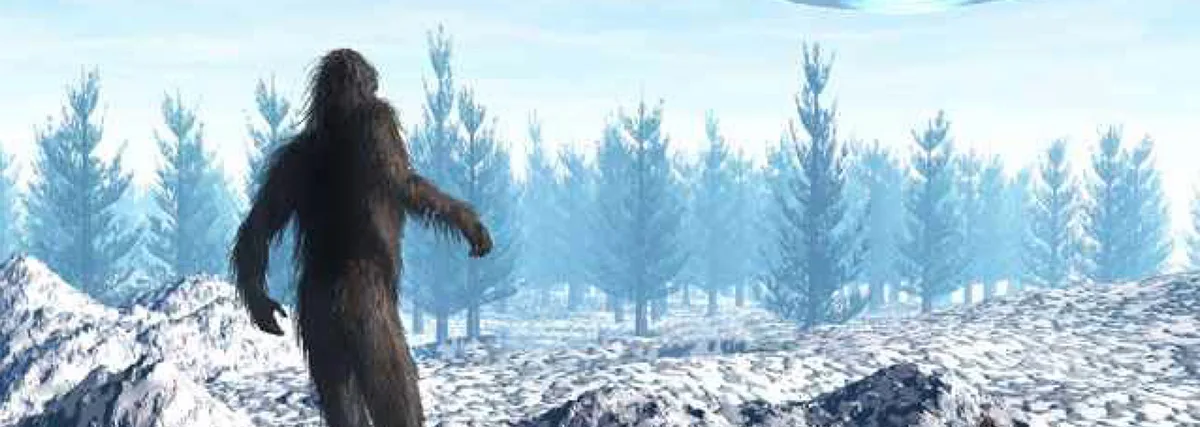
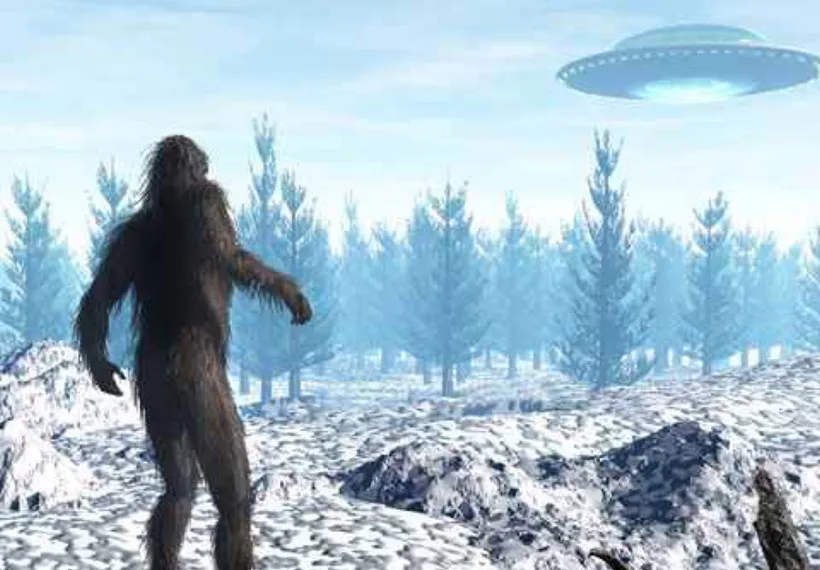
And at one point they've stated that Bigfoot may be a prisoner from outer space.
Much like how England used to send prisoners to Australia.
Do you think we would eventually send prisoners into space?
Wow, that was a long way around against that.
Wow, really?
Ancient Aliens.
Wow, that's a long way around.
Okay, so first it'd be kind of cool if Bigfoot, if some powerful alien civilization said, Earth is a good place to send our criminals.
Let's send Bigfoot there.
I wonder what crime did Bigfoot commit?
Stole a candy bar.
You know, one of, who's it, Mitch Hedberg, the late comedian Mitch Hedberg, you know what he said of Bigfoot?
He said, you know what's even scarier than Bigfoot?
Would be if Bigfoot is actually out of focus.
Every picture we have of Bigfoot, it's a fuzzy photo.
If he's actually out of focus, that would be really scary.
So, yeah, I would hope Earth is not a good place to put some prison colony for misbehaved aliens from another planet.
Though it would explain a lot.
I would like to believe that, I believe in the future of neuroscience, and I think if you go far enough in the future, we would find a way to cure people who are career criminals so that we would not need prisons for them at all.
Therefore, we wouldn't need to look for a planet upon which to send them.
And the historical analogy here is England sending their prisoners to Australia, an isolated continent island in the middle of the Southern Hemisphere Pacific.
But now, isn't that the slippery slope, doctor?
Yes, it is.
Because if we start correcting criminal behavior, what else are we?
What is a crime in one generation versus another?
You're absolutely right.
That's a whole other show.
It is.
Leighann, thanks for being on StarTalk.
Thank you for having me back.
After Hours.
This is StarTalk.
The Cosmic Query segment.
So, you've been listening to StarTalk Radio.
I'm Neil deGrasse Tyson.
So we're back.
We've been talking about pseudoscience, and look what the cat dragged in.
Chuck Nice.
Yes, sir.
Fresh with claw marks and all from that cat.
Thanks for stalking us, Chuck.
Of course.
We've got Bill Nye.
Bill, old friend and buddy, and CEO of the Planetarium, and newly new bestseller on New York Times with his book on evolution, and we'll call it Undeniable.
Undeniable.
Congratulations on that.
And we have by Skype, the one, the only, Elise Andrews.
Elise, hello.
She freaking loves science.
And she, how much do you love science?
You?
I really, really love science.
Check out her Facebook page, IFLS.
I freaking love science.
And you'll get the proper translation of that acronym, of that abbreviation.
So we're coming off a show on pseudoscience, and Elise, you've got nearly 20 million likes on your Facebook page.
And you have some filter, I presume, about what you put on as your aggregated science and what you don't.
How do you know that there's not some crackpot idea that somebody has and they're posing as real science?
Or maybe there's science that other scientists that got published in a real journal, but is itself kind of fringy.
How do you slice and dice this?
I mean, I think the most important thing is you, there's so many ways you look at it.
First thing first, you obviously go back and read the actual paper rather than the press release.
You can look at the journal that was published.
If it was published in a high level journal, it's maybe a little bit more trustable than something published in a non high level journal, something with a lower impact factor.
You can look at the study, you can look at the sample sizes, you can look at everything else.
And I mean, you can usually get a feel if something's dodger, if something's not.
You can look at the other coverage.
And I think it's one thing I've realized is that it is important to cover something.
Even if I'm not impressed with the study, I think it's important to cover it anyway and to express that, because people ask my opinions.
People will come to me with stories published in this website or in that website, and they'll say, what do you think about this?
What do you think about this?
So I think it's important, even if I am skeptical, or even if I don't agree with it, to still write about it and to still say that.
Can you give us an example, a recent example?
Off the top of my head, no.
Because so much of what you publish is dead on.
It seems so cool.
Yes, we've been all impressed by its reliability.
But how about this?
Could you, might you publish, might you post something that you know is scientifically controversial and then just talk about the fact that it's controversial among scientists?
Yeah, absolutely.
Absolutely.
And I think that's important.
I think people need to know that everything isn't always dead set, that there's gonna be disagreements and there's gonna be arguments.
There is not, there are not gonna be arguments.
Wait.
So, so let me ask the three of you, when it comes to the contradictions in science and, more importantly, new discovery, often you have people who say, well, see, you were wrong.
Well, that's, we love that in science.
Yeah, and so, but they try to use that as a means of talking about or affixing unreliability to all science, people who are attacking science.
Or then any other idea should have equal value.
Right, or to say, right, more importantly, well, see, that's why we say this.
Okay.
So how do you deal with that?
Chuck is asking this because a friend of his feels this way about science.
Yes.
Isn't that true, Chuck?
Well, listen, and I have a friend, okay, and his name is Buck Rice, and he has a blog that will be sponsored by ExxonMobil that is titled Climate Change, The Jury's Still Out.
All right, so Elise, how do you do that?
Look, I think those people are completely lacking logic, to be honest.
It doesn't really make any sense to me that you would say that science can't be trusted because science holds its hands up and says when it's wrong.
That's the great thing about science is that we have the ability to be wrong, that we're constantly finding new evidence and say, okay, this is what we thought before, we've got new evidence and this is what we know now.
To me, that's an indicator of reliability that you can trust science to hold its hands up and say, we fucked up, here's now what we know, here's what we've learned, here's the evidence.
To me, if you've got a school of thought that holds on to something in the face, in the flying in the face of the evidence, that's something you can't trust.
You know, I think-
I just, I don't understand it.
At least that's awesome.
I think if you actually said it just like that, you would have more fans.
More than 19 million.
More than 19 million.
Yeah, we just, we effed up.
But you know, you get into this thing where it's the progress of science.
That's what is also hard for people is, for example, you can't think of a planet, used to be a planet, now it's a plutoid.
I got no problem with that.
It's a process.
Chuck, have you had your plutoids checked?
Yes, I have.
There's a solve for that.
From what I understand, I now have to have a colonoscopy.
No, so do you guys, you guys go to that?
See, I never, I don't go to that, I don't go to that scatological root with the word plutoid.
But my found that-
Everyone else does, okay?
I found that-
Well, I think Chuck and Neil are-
Chuck and Neil are of a certain age.
Yes, and we're both fans of Katie Couric.
Yeah, we're still in middle school is the problem.
So, speaking of which, middle schoolers have no problem with this.
You say there used to be nine traditional planets, now there's eight and there's a whole new class of planets called plutoids.
It's an example of a low stakes thing that people are just passionate about.
And whereas, when you get to a high stakes thing, people are really passionate about it.
But Bill, I want to distinguish between someone who says God created humans because the Bible says, and God created humans because we found scientific evidence to support it, right?
One of them is sort of religious stogma.
And the other one is putting a science patina on it, so that someone who says, I believe science, and there is science in the Bible.
So you must have confronted that.
Oh yeah, so I don't know if you got this far into this thing in Kentucky, but the guy has observational science and historical science.
In other words, if you weren't there, it doesn't count.
The evidence is lower than it is.
That's right.
Unless you were there, unless you saw it.
That's right, doesn't count.
And it's just hugely ironic because if you do know anything about forensics and about the criminal justice system, you know that eyewitness testimony is the least reliable evidence out there.
Believe me Elise, I'm a black man.
I do know that.
I think you weren't, weren't you the guy?
He was the guy.
I saw him.
Officer, that's the guy.
Bill gets it.
That's the guy.
Right, right.
I swear, that voice, I know that voice.
So now let me ask you guys this, let me ask you guys this.
So recently the Pope came out and said, hey, let's not be idiots about this.
Science is science and we don't have to, you know, we don't have to.
Evolution, not a magic wand.
Right, not a magic wand.
And I said more power, okay Catholic Church.
So how about that?
Do we write you a check Catholic Church?
Thank you.
You've now joined the last two centuries, you know, welcome aboard.
To be fair, they've accepted evolution of the Big Bang Theory since the 1990s, something like that.
So he…
I'll go for that.
Correct.
Thank you for clarifying that, Elise.
So it's been in the doctrines.
In fact, an earlier one was, yes, evolution is cool, but humans became humans when, in the evolutionary track, when God breathed the soul into the first set of those primates that then became human.
This was the parameters around that.
It's your clock, man.
Right, right.
And plus, of course, the Big Bang itself was first written down by a...
It was a Jesuit...
It wasn't Jesuit, actually, but he was a monk.
He was a...
Monkish.
He was a Belgian priest, a Belgian priest.
Belgian priest.
Speaking Flemish.
Tell me his name again.
I'd ask astrophysicist historian, man.
I'm a mechanical engineer.
I can tell you about Petrov's laws.
I'll get it before the end of...
In the next 90 seconds, I swear you all have it.
So, in any event, so all the latest Pope did, he added punctuation, I think, to those remarks.
Reiteration.
Hey, let me ask us this, Elise.
So did you hear about this debate in Kentucky about evolution?
You and Ken...
Yeah.
In the United Kingdom, you heard about that?
Well, I live in Canada.
Usually, I'm just visiting family at the moment, and I did hear about it, yeah.
Obviously, I mean, I posted about it.
I was writing about it.
No, I mean, by you, I mean the populace of the United Kingdom.
I don't know what the media was like here at the time I wasn't here.
In Canada?
Did it make it?
In Canada, yeah, it did.
It made it.
So here's what I'm driving at.
Why did he bring that up now?
Why did the Pope go out of his way to mention this now?
I don't know.
I don't know.
I find it really bizarre anyway.
It kind of cracks me up when I…
I mean, American evangelists, when the Pope thinks you're taking the Bible too seriously, it might be time to rethink your life choices.
Rethink life choices, Elise Andrew, ladies and gentlemen.
Rethink life choices.
When he thinks you're taking his whole religion thing too seriously, just take a step back and look at yourself.
Now, of course, it was the UK that separated from the Catholic Church just because their king couldn't get a divorce.
Let's be fair about, in disclosure here, but…
Oh, but so I did remember the priest.
A whole new one for himself.
The priest's name is George Lamatra.
Look at you.
George Lamatra.
And he's got some stuff over the vowels.
Right.
Lamatra.
Some grobs and how-goos.
He was a physicist.
Elise, we gotta call it quits here.
Thank you for dialing in to StarTalk Radio, and I hope this is not the last time we reach for you.
No problem.
Thanks for having me.
Excellent.
And Bill?
We're all shaking each other's hands.
I was reaching.
I was reaching for space here.
Elise.
Bill Nye, thanks for coming by.
Oh no, it is I who must thank you.
And Chuck, always good to have you.
Thanks for agreeing to be dragging off the street for this very last segment.
Yes.
All right, guys, this is Neil Tyson, Neil deGrasse Tyson signing off from StarTalk.
As always, keep on looking up.
See the full transcript



 Unlock with Patreon

 Become a Patron