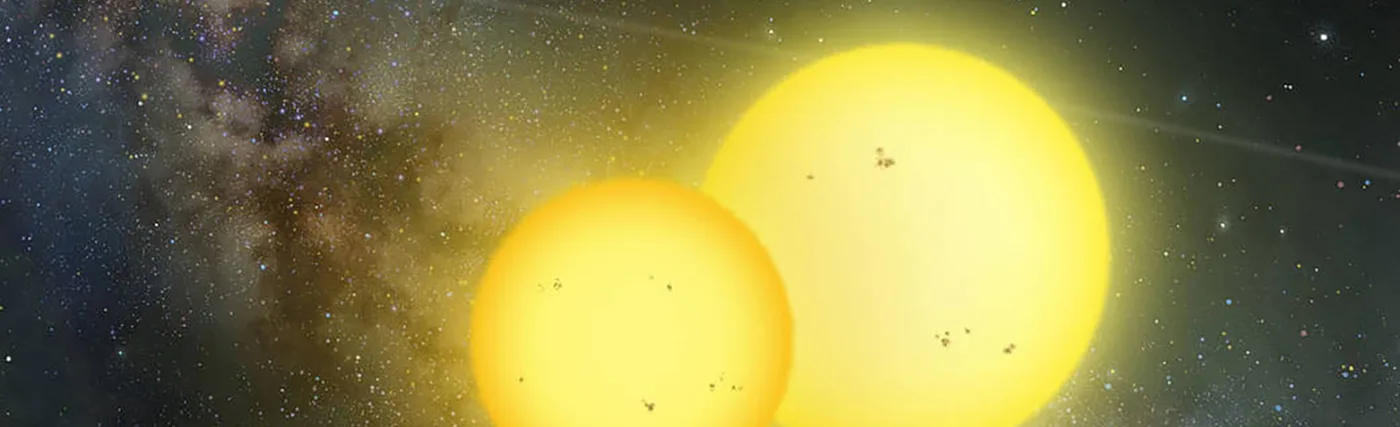
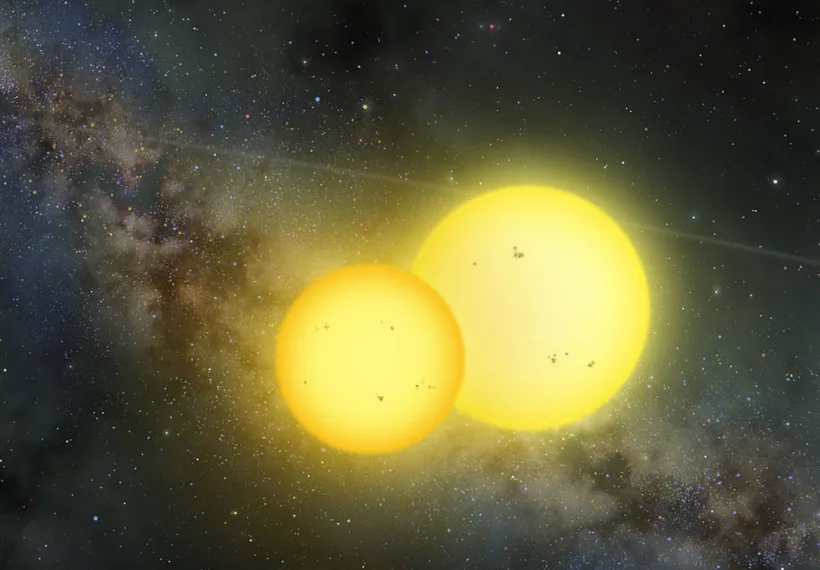

Detail from an artist’s rendering showing the Kepler-35 double star system. Image credit: Lynette Cook / extrasolar.spaceart.org.

Extended Classic: Cosmic Queries – Office Hours

Shown: Detail from an artist’s rendering showing the Kepler-35 double star system. Image credit: Lynette Cook / extrasolar.spaceart.org.
  • Free Audio
  • Ad-Free Audio

About This Episode

Now extended with more questions about Jupiter, brown dwarfs, humanity’s intelligence, Isaac Newton, the speed of sound, Star Wars, exomoons, and more.

It’s time for office hours with your own personal astrophysicist! Join Neil deGrasse Tyson and comic co-host Chuck Nice as they answer fan-submitted Cosmic Queries on an array of topics from across the universe to right here on Earth. To start things off, Neil and Chuck delve into the discussion on finding life elsewhere in the universe, what happens if there’s no life to be found, and why the religious debate will be even more fervent if extraterrestrial life is discovered. You’ll learn about space dust: what it is, how it’s formed, and why it wasn’t found in the early infancy of the universe.  Discover whether time expands the same way that space does, and how we can detect it happening. 

In the new segment, we discuss what it would take for Jupiter to become a star. You’ll learn about brown dwarfs. We address humanity’s intelligence and whether or not we’re intelligent enough to understand our place on the universe. Neil tells us what he would ask Sir Isaac Newton if he were alive today. We also explore the speed of sound, and Neil shares a gripe about Star Wars. Plus, we discuss the hunt for exomoons and why they’re harder to find than exoplanets. 

NOTE: All-Access subscribers can listen to this entire episode commercial-free here: Extended Classic: Cosmic Queries – Office Hours.
Transcript

DOWNLOAD SRT
Welcome to StarTalk, your place in the universe where science and pop culture collide. StarTalk begins right now. This is StarTalk, Cosmic Queries edition. This particular edition, I'm kind of tired of naming them other things, and I think maybe...
Welcome to StarTalk, your place in the universe where science and pop culture collide. StarTalk begins right now. This is StarTalk, Cosmic Queries edition. This particular edition, I'm kind of tired of naming them other things, and I think maybe Chuck, my co-host, the idea came up, maybe we should call these Office Hours. Office Hours. Just to get a little academic flavor back in it. Yeah, right on. Okay, let's experiment with that. It's Cosmic Queries, Office Hours edition. Yes, let's do that. Chuck, good to have you. Good to be here. You've been in Aruba for nine days. Yes, my friend, I was in Aruba for nine glorious days. You're sporting a nice tan. And thank you, I've been working on this tan for nine days and 40 years. And, but I have to tell you, after nine days in Aruba, and I do not mean this in an unpatriotic way at all, I hate America. What? No, I'm joking, please. We do have some nice beaches. I've been to a few nice beaches here in the States, but I got to tell you, that Eagle Beach, when they call it the second nicest beach in the world, they're not lying. The sand is just the right consistency. You can like the beach without hating America. What's that? You can like the beach without hating America. Yes, but it increases my love for the beach when I actually juxtapose it against my hate for my own country. No. Which, by the way, people do not write me, I love this country, this is the best country on the face of the earth, even when I don't agree with what this country is doing, I still love it, okay? So, and all of you need to take a lesson from that, okay? Do people write to you about that? Yeah, people write to me, like, people write, people get very upset, they feel as though somehow we're being political on this show, and, you know, I write them back because I know for a fact, whether it's you or Bill Nye, and I've met many of your colleagues, that you, especially you and Bill, you are not seeking a political bent, you are not seeking to deliver a political message ever. It is always about critical thought, it is always about the truth, it is always about the science, that is what it's all, and it's always about educating people or getting people to become curious for themselves so that they go find out for themselves. Yeah, yeah, that works. Yeah, and so, like, it really pisses me off when people write and say, oh, I like this show before you guys got all political, just because you don't agree with the science. Well, so, it reminds me of the moniker that Harry Truman had, they called him Give Him Hell Harry. Give Him Hell Harry, yeah. They said, Harry, why are you always giving people hell? And he said, no, I just give them the truth. Right. They think it's hell. Right, there you go. I like that. I just give them the truth, they think it's hell. So you got questions for me, what do you have? Yes, I do. Office hours are open. Office hours are now open, I feel like. What is it, Charlie Brown when he used to go see Lucy and see the doctor is in. Oh yeah, oh, flip the sign over, okay. Flip the sign over. All right, so yeah, we've got our queries from all across the internet, and we always start with a Patreon patron question. Because we are that low. Yes, we are. No shame in this game, baby, give us some money. I don't know if I'll ever get over this fact, but okay. Give us some money, we'll do what you want. If you support the show, you get your question up first. Right, you give us some money. Go to the front of the line. We will be your science whore. Okay, that was too much, Chuck. Take it down a notch. All right, here we go. This is Kyle Yokum from Patreon who says this. Kyle Yokum, good name. Yeah, that's a pretty good name. And he spelled it phonetically for me, so, you know. He knows you need help, that's good. It's so true. It's like, don't F this one up, Chuck. Yeah, that's right. So he goes, my name is pronounced Kyle Yokum, and I, oh, I should do it a different way. My name is pronounced Kyle Yokum, and I'm from Tennessee. Tennessee. He says, it seems statistically impossible for life not to exist elsewhere in the universe, but I try to consider all the possibilities to keep an open mind. If we were able to look throughout all the visible cosmos planets by planet and found no life at all, given our current understanding of the universe, what might be our best scientific explanation for why we would be alone? That, so first, let me reaffirm the statistical unlikelihood of that before I then comment on what happens if it's true. All right. Keep in mind that if life only began yesterday on Earth, it would have taken four and a half billion years for that to happen. That's a lot of time. A lot of time. It would be pretty clear that whatever it is we call life was hard to happen. Nature was struggling for billions of years. But that's not what actually happened. We have the ingredients of life on Earth, hydrogen, oxygen, carbon, nitrogen, other, and they're all here on Earth as they are everywhere else in the universe, practically everywhere else in the universe. These are the most common ingredients out there. One for one. Number one ingredient in the universe is hydrogen. Number one element in life on Earth is hydrogen. Number two in the universe is helium, but it's chemically inert, can't use it. Right. So put that, you can breathe it. Right. It's great for parties. Great for parties, but you don't interact with it chemically. It's good for YouTube videos. So next in the universe is oxygen. Right. It's the next most abundant element in life on Earth. And that oxygen and the hydrogen come together as water. Right. And you will also find hydrogen and oxygen in other molecules, but we're mostly water by weight. Next is carbon. We're carbon-based life. Right. And so carbon is next in order in life. It is next in order in the universe. So these ingredients for life on Earth are everywhere. And so the recipe for this is actually the universe itself. The universe itself. The universe itself. Now, so you have the ingredients. Now you need conditions. So whatever were the conditions on the early Earth, we have to ask were they unique in the galaxy or are they approximately repeated elsewhere? In our current catalogs, we have rising through one or two dozen planets in the Goldilocks zone of their host star. Right. As are we on Earth. So you have all the base ingredients and in the tiny little blip of the universe we have explored in search for planets, we have found one or two dozen planets in their Goldilocks zone. So now you ask how long would it take? So you look on Earth and the evidence, and recent evidence shows we have possible signatures of life on Earth as early as 4.2 billion years ago. Okay. Earth only began 4.5 billion years ago. So, but let's even pull that in because that was very recent data and maybe it'll be overturned. Before that, the best evidence puts it at 3.8 to 4 billion years. That means Earth was around for like a half a billion years, then there was life. Then something happened. Something happened. All by itself, there it is. The ingredients, the time, and the conditions. The conditions, and it's not billions of years, it's half a billion years. So however much challenge we have creating life in the laboratory from simple organic molecules, nature managed to do it all by itself. So hence the statistical unlikelihood of it. But if we go around and search every single planet in the galaxy, which is more realistic than the whole universe, are we gonna travel between galaxies? We don't know how to do that yet. We ain't there yet. But our whole galaxy, still. And there's no other life? That would force us to look back to Earth and ask, was there something truly unusual that happened on Earth? Our star is an odd location of our planet, the mass of our planet, the fact that there's water, the fact that none of that is, so we'd have to find something that was unusual to enable it happening here and then have it happen nowhere else. Alien DNA, boom! Which of course negates the entire supposition of this whole question. It means it came from somewhere else. Exactly, right. But no, but then if it came from aliens, we'd have to find the aliens. We'd have to find the aliens, right. That's why I said it negates the supposition of the entire question. Exactly, exactly. Go ahead. So science would then turn to wondering what would be sort of uniquely, it would have to be a one in a billion, well, however many planets are out there, it would have to be so rare that it would have happened one in that many planets. Right. Okay, so let's say there's 10 billion planets. It'd be one in 10 billion chance of something happening on Earth. But the same thing is, like you said, all of those planets have the same building blocks that we do. Yes. So what could that one thing be? That's what I'm saying. Science would have to turn to then try to answer that question. Oh, I got you. That's what it would be. I got you. That's all. So we would just have, right. So you would have to isolate that one difference. And it's very hard to come up with a strong idea about how and why something is when you only have one example of it. Right. So it's kind of like when the scientist goes into the laboratory and he's looking for the recipe for superhuman strength, but he keeps putting together a combination of all these things and he just can't find it. Or at least he'll find, he'll make it, but then the subject will explode after like five minutes. So it's super strong. And then all of a sudden, a small dog enters the laboratory and knocks over all the ingredients and they come together in a little slurry and they start sparkling. And he falls down and slips in it. And then he gets up and he's a superhero. There you go. That's the only, that's the one in a hundred billion thing. That's the thing. And may I add, that is how the Powerpuff Girls were made. Are you for real? Yes. Awesome. By the way, how do you know the Powerpuff Girls, which I love? Powerpuff Girls, you gotta love me some Powerpuff Girls. I do not know their origin story. You don't know their origin story? I did not, but I do love the Powerpuff Girls because I have a daughter and a younger daughter. So there's the father, who's a scientist, who's in the lab, he's in his basement in the lab. He's trying to mix these ingredients to create the perfect children. Really? To create the perfect girls. And so he mixes together sugar, spice, and everything nice. And as he stirs it, there's an accident in the lab and chemical X pours into this ingredient. And then there's an explosion and out come three adorable little girls with superpowers. I had no idea. Chemical X, the Powerpuff Girl. Chemical X is the Powerpuff Girl. Oh, that's cool. So that's your scenario. Yeah, that is my scenario. That's very cool. All right. Well, there you have it, buddy. Kyle, that's it. So here, just let me just add because you know where he's going with that. Yes, of course. So you might ask, will there be something that will compel scientists to say, oh, God did it? Well, yes. Because this is fundamental. Many religions would assert that Earth is the purpose of the universe and the life on Earth, human life on Earth is the object of God's affection. We're in the universe. So, I can tell you that, that, I don't know how quickly anyone would start thinking that, but what I can say is that if life on Earth were divinely created, and somehow we're forced to that conclusion, it does not force us to any other divine conclusion. Right. Right. That would be the extent of what you could conclude, because you would be able to now isolate the fact that this is indeed a creation. However, what you cannot do is infer from that creation the intentions of that creator. Or all the tracks that people have put forth that according to their respective religions was divinely revealed. Exactly. You must behave this way and worship on this day and eat this food and don't eat that food and treat each other this way and not the other way. All of this is sort of the packaging of ancient religions as well as modern religions that are not required by the scientist who might land there if in fact Earth is the only place with life in the universe. Well, once again, as a scientist, what you would do now is you would have to say, now I need definitive proof that I am supposed to act this way or eat this way. So we need other kinds of evidence. I need other evidence. So now that the evidence has actually said, yes, we are, this is the one thing, we are the ingredient X, the chemical X, chemical X is God. By the way, you'd have to also add the fact, also add the fact, and I posted this during the Super Bowl, where if the football field is a timeline of the universe, where one goal line is the Big Bang and modern day is the other goal line, then the thickness, the width, the thickness of a blade of turf in the far end zone equals the time from cavemen to modern day. Holy crap. So, if, according to the Catholic Church, which accepts evolution but asserts that at some point God breathed a soul into primates and that would make us humans distinct from other primates, that would have happened somewhere in that blade of grass. So my point is, if you're going to say God created the universe and created humans in his image, which is what one might find in Christianity, it would be kind of hard to account. And we're the only life in the universe for such that. It would be hard to say, well, what… What does that add other stuff for? You got the whole rest of the timeline. If really all this was created for us, why do we miss out on 13 billion years of history? Why do you wait so long? These would be sensible questions that philosophers would ask. And then, well, yeah, and the answer would be because he hasn't… There is no time for him, and so it's no big deal, no matter how long. You got the answer already. Yeah, the answer is there's no time for God because he is from everlasting to everlasting. Therefore, time and space exist within him, so he does not have to worry about time or space because all those things exist inside of him. You got your catechism hat on. Preacher man, go for it! Listen, I know all this stuff. Go for it. He got the explanation. Yeah, that would be the explanation. But what I would say, you can flip it and say, if your religion requires that human life is the only life and is the purpose of creation, and we do find other life, will you abandon your religion? Right. Now, that's a very good question. That just flips the table. What does that do to the person who believes? Or you find an alien species smarter than we are, who can just completely manipulate us and put us in a zoo for their entertainment. They now become God? Well, so depending on what powers they exhibit, if they don't have the powers that your God and your religion assert, then you can't then directly say that they're God. Or if they look really different from us, we're not in God's image. We're not in God's image. Right. Right. And it's very, that's funny. Yeah. Right. So just to be fair in that rotisserie there. I got you. That's good stuff, man. That's almost a whole segment on that one. I know we did. And you know what? But guess what? It was really good. I mean, because, Kyle, that's a great question. And quite frankly, I found it fascinating because- You had your preacher hat on there. And listen, these are the things that people think about this stuff all the time. And to great peril for the most part, there's a lot of people who this becomes confusing and then that confusion leads to anger and- No, the only issue is if you take your belief system, then require that others believe it. Yes. It's not the spirit of America where we welcome all religions in their own personal truths. So you only really have conflict when you are so certain of your religious beliefs and so certain that everyone else is wrong in their religious beliefs and then you take arms against them. And see, I believe that that comes out of just the opposite, to be honest. It comes out of the opposite sentiment. If you know for a fact you have the truth, then you can rest easy in that truth. Well, you should be able to, you'd think. And you'd fear nothing. Right. Then there is no fear of any new information. There is no fear of varying views and opinions. There's no fear of someone having a differing opinion. You can say, okay. Well, you know. No, you'll just say they all go to hell. You've got plans for them. No, there are places for that, that's all packaged. That's a packaged deal right there. I'm sorry. Chuck, you just ate up like the last two minutes of this. We can't even get another question. How about, why don't you tease the question? What's the next question? Okay, so that's what we'll do. We will tease the question. And so this is what Michael Ranger from Twitter would like to know. What's the deal with space dust? He didn't really say it like that, but I just like the way he says it. What's the deal? What's the deal with space dust? Is it dust? Is it gas? Is it rocks? What's the deal? Good question. Yeah. We will get to when we come back to StarTalk Cosmic Queries Office Hours edition. All right. We're back on StarTalk. I'm Neil deGrasse Tyson, your personal astrophysicist. If you didn't otherwise know by now, I also serve as the director of New York City's Hayden Planetarium, which is part of the American Museum of Natural History. Chuck Nice, tweeting at ChuckNiceComic. Yes, sir, thank you. Nice. Yes, I am. Nice. Nice. So this is Cosmic Queries Office Hours. Office Hours. We're just trying to rebrand it. We'll fix you if that flies. We'll see what happens. Get a little sign. All right, put it out there. Office Hours. Get one made. The doctor is in. And you are the good doctor. So let's move back to our queries in the form of a question that we already did. We teased one at the end of the last segment. What was it? And it was from Michael Ranger. And he says, what's the deal with space dust? Is it dust? Is it rocks? What's the deal? It was really Jerry Seinfeld. It's really Jerry Seinfeld coming to us in the form of Michael Ranger. So there's a lot written on dust. And most of it, if you get into it, it's pretty nasty stuff. It's like sloughed off skin cells and dust mites. It's just cat dander. I heard that most of the dust around your house is just dead skin. It's just dead skin. Dead skin of some sort. Just be glad your eyes are not microscopes. Because the world would be nasty. It's a nasty little place. Nasty place. So dust in the universe has a very specific meaning. So if you look at clouds between the stars, these are the things that make up some of the most beautiful photographs that you've ever seen from space, especially via the Hubble Telescope. So those gas clouds, some are sloughed off from stars. Others are stellar nurseries ready to hatch newborn stars deep within. Mm-hmm. We call it the interstellar medium. And it can be in a gaseous state with just gas atoms and gas molecules, hydrogen, nitrogen, oxygen, this sort of thing. They can make molecules in the form of carbon monoxide, carbon dioxide. Hydrogen makes a molecule with itself, H2, we call it. It's stuck up hydrogen. It's stuck up with itself. But it's not the only one, nitrogen binds with itself to make N2, oxygen. So we're not alone in this. So if the gas cloud is dense enough, there'll be pockets of it. Where the molecules come together, it make really big molecules. Really, really, really big things. And we have a place where really, really big molecules come together. It behaves differently in the transmission of light from behind it to in front of it. It absorbs light in a way that turns the light red. And so we call it reddening. Reddening. Nice. Turns it red. It's called reddening. So only when it becomes large enough to do that do we then call it dust. That's all. So when it gets, okay, I gotcha. So these clumps of molecules that come together, once they do that. They make huge, huge things, right. Once they do that. Once they do that. That's when it's dust. When you have enough of that to affect the optics of the cloud, then we call that dust. And it reddens stars behind them. And so we used to think that certain stars were only red because they were behind these gas clouds. And then we learned about this phenomenon in the 20th century, by the way. So it's relatively modern discovery, given the history of astronomy. And so when we say, when I say, we are stardust, it is a figuratively and literally true thing. Because you're not going to form stars and planets until these atoms become molecules, the molecules become dust. And out of this dust cloud do you condense the planets. Nice. OK, but now, there's a little bit of a loosey-goosey there. Because typically when you form a planet, stuff heats up again. Right. And it can get so hot that it breaks apart all the dust molecules. Oh. Yeah, because heat will destroy big molecules. Right. So it's, when I say we are stardust, the dust didn't stay intact before it became us. Then it would be supremely poetically true. But nonetheless, the gas clouds that make star systems, they start out as dust. And so that's why I feel comfortable saying that. So if you want to take me to the limit, I'll then give you that full explanation. Right. You just did. Yes. So the dust itself is really on a molecular level. It's not the dust that we think of when we see dust. It's way smaller than what's going on. It's not the dust that we see, like, when a shaft of light is coming through a window in your home and you see these little particulates floating in the air. It's smaller than that. It's much smaller than that. And it's molecules coming together. And by the way, there are ways that molecules stick together that don't involve complete electronic bonds. When two atoms come together, they're sharing or exchanging electrons. So that's an electronic bond. And then when you get really big, you can have molecules attached together just because their shapes fit, or just because there's something. I found you. Oh, I can't believe we fit together like this, girl. Oh. So there are other ways that you can stick molecules together. Gotcha. And it's when that begins to happen, that's when you get these phenomena. Oh, man, that's so cool. All right. Who knew there was so much in dust? By the way, in the very early universe, before the stars made the heavy elements like carbon, nitrogen, oxygen, the universe was born with hydrogen and helium, primarily. All the rest came later in stars. In the early universe, when they had gas clouds, there would not have been dust, because you need all those other atoms to build up and make dust. Early universe tends to be rather dust-free. Nice. Right. So we were much cleaner. Much cleaner back in the day, baby. Freshly born. Yes, we were freshly born. Mm, you've got that new universe smell. Oh, very cool question, Michael Ranger. All right, let's move on to- Office hours are open. Office hours are still open. The universe. All right, here we go. Gatano Marrone wants to know this. Thanks for that name, by the way. Friggin hate your parents. Wants to know this. Says, does time expand the same way and for the same reason as space? So that's a great question. Yes. OK, time is a coordinate. All the other coordinates are stretching out. Why can't time? Can't time. Why not? So we don't have evidence of this. It would have been kind of cool if that were the case. We just don't have evidence of it. And so what would the evidence be? Well, when we look out to space, we see things not as they are, but as they once were. Because it takes time for light to reach us. That's the way my wife looks at me. As I am, but as I once was. Thank you, baby. Please don't ever see me as I am now. So it means if there's anything that was affected by time being compressed in the past, relative to today, it would manifest in the physical phenomenon that we observe. So maybe things would happen faster if time is compressed. So one second today is stretched out, one second back then is tight. If you want to put it that way. So you look back then, no, things are not happening faster. Things are not, everything is still working then the way it works now. OK. The closest we've gotten to this is a research paper that I happen to be co-author on, the lead author of whom ended up getting the Nobel Prize. But. This was a piece of a much larger research project that he did. His name is Brian Schmidt. Brian Schmidt. He's an astronomer at Mount Stromo Observatory, in Siding Springs Observatory. Mount Stromo? No, Stromo. Mount Stromo, OK. I was going to say, worst name ever. In Australia. So he headed a team that discovered that the universe was expanding faster than it should have. That it shouldn't be. And that was the co-discovery of dark energy. Accelerating universe. And this paper was early work that all came together in his big project to study what exploding stars are doing nearby and far away. So what we have in that paper, the very first measurement ever, is an exploding star far away and an exploding star nearby. They should, according to other, for other reasons, be exactly the same in how fast they get bright and how fast they become dim again. Star blew up. You can measure this. It was just a regular star, got bright, then it started getting dimmer again. We know what that should look like. And because we've modeled it, okay? So now we look at the one far away and it doesn't match. We say, how come it doesn't match? Oh my gosh. Is it a different kind of exploding star? Then you invoke Einstein's general theory of relativity to show that since that light has been traveling long ago, the universe has expanded so that time intervals of when stuff happened has been stretched out over that time in the time it took to reach us. If you take that, what we call light curve, invoke Einstein's relativity on it, it stretches to what it needs to be and then it matches exactly the nearby exploding star. In other words, the universe really is expanding and the ticks on a clock get stretched out while it is moving through the expanding universe. Wow. Holy crap. Wow. That's insane. That's what's throwing down. That's what's going down. But the event itself, we have no reason to presume it happened at any different rate than nearby. Everything we understand about an expanding universe says this is what will happen to that signal on route. And that's why you need relativity to apply to that. Otherwise, you have no handle on the universe. You wouldn't be able to say it. Right. Mysterious things going on. Exactly. Oh, my God. That's amazing. We were quite proud of that result. The first time, now it's just a routine thing. What an understatement. Oh, you know, we were quite proud of it. No, but now it's a routine thing. I mean, you just say, oh, the light curve doesn't fit. Let's see what it needs to be for being at that distance. And then you do that, and then it fits exactly. It fits perfectly. Every single time. Just fits exactly. Wow. That is really... No, no, you could assert that time was different then, and it didn't change en route here. But I would then say, I would say, because the universe is expanding, we expect that to happen. So, and when it does happen, we're not then looking for other explanations. Gotcha. If we did that in science, you'd be... Well, yeah, you never go from any place you are. You never go any place... You stay right there, just looking for other different things that it could be. And it could be when what you have is a perfectly fine explanation. And this is already working. Works experimentally and theoretically. Right. Generally, when you have that agreement, you move on. Right. Wow. Man, that was a great question. Hey, Gatano, Gatano Marrone, that was a really... I want you to apologize to Gatano's mother. I'm sorry, Mrs. Gatano Marrone. Just because you have a simple, boring name doesn't mean everyone else has to. So you have to... So you don't mess up reading their names. Yeah. Well, Mrs. Marrone, your scion is quite profound and we appreciate their question. All right. Let's get to Jet Kusunji. Wait, did they say it? Did they say it? Yeah. Tweeting to us from At the Fury. Wait, At Jet the Fury. At the Fury, okay. At the Fury. How cool is that? Do you think if in the past scientists weren't always portrayed as evil, the public would be less anti-science? And I mean, like in the movies and television, the scientist is always the bad guy. Yes. Next question. I should have saved that for the lightning round, I guess. So first of all, the scientists were not, I don't think that's the biggest problem with the portrayal of scientists, historically. Really? Because there were maybe a third of those scientists were not evil, were co-opted by an evil genius, or an evil, a ne'er-do-good-doer, whatever you call it. Right, ne'er-do-weller. Ne'er-do-weller, thank you. So, for example, in the old Superman television series, there was always some scientist that was helping the criminal do their work, but didn't really want to. That's true. A lot of times the scientist was an unwilling participant. That was even the case in Back to the Future, where the Libyan terrorist wanted Doc to make a bomb out of the plutonium. Right. And he just wanted the money for his research, so he double-crossed them. Exactly. Exactly. And so, as any good scientist should do, if you're given money to make a bomb by terrorists, right? Exactly. Who else did that is, of course, Iron Man. That is correct. He denounced... No, no. They wanted him to make a bomb. So, I'm making a bomb. Get out of here. And he made a suit. He escaped with it. But that was a little bit more for self-preservation. He needed that suit to get out of there. But then even after that, he was like, I don't want to make weapons anymore. I want to do something good with this power source I discovered. Right. Exactly. So my issue with the portrayal of scientists is not that they were more than half the time shown as evil or evil geniuses. It's that they were never shown to be completely human in all emotional dimensions. That is true. They're very one-dimensional characters. And it was like, Doc, is the world going to end or not? And you go behind the lab table and they got the lab coat on and the wire hair and they say, well, the interaction of the thing, whatever, give me it in English, Doc, and then someone else translated it. And that's all you see of the Doc. That's all you see. That's all you see. You come in and you leave. The first attempt to flesh out doctors that I know of and that I have seen was in CSI, which portrayed scientifically literate trained people as beautiful people you might want to be. Yeah, I was going to say, yeah, and they were all hot. They're good looking. Good looking. A, smart. Right. B, they have fully fleshed out characters. They fall in love. They have jealousy. They have kids. They're married. They divorce. Then they become real people like any other character that storytellers have been sharing with us. Nice. That, for me, was the transition that was most important. Right. And now make them evil or happy, who cares? Well, now you see more developed scientific characters in everything. Everything. Everything. Everything. Yes. Well, that's cool, man. Yes. That's very, very cool. Well, there you go. We're out of time in that segment. At the Jet Fury, there's your question, so... There's your answer. Welcome back, you're listening, or possibly watching StarTalk. I'm Neil deGrasse Tyson, your personal astrophysicist. Chuck, let's continue with Cosmic Queries. Yes, we shall. Yes, this is a Comic-Con edition coming from New York City, let's do it. We are here to answer your questions, whatever you'd like to know. We're relating to the cosmos, or maybe anything else. Dr. Tyson is here and wants to answer it. It's Dr. Neil to you. I love how you threaten me with a more casual form of a friend, it's Dr. Neil to you. Hello, Mrs. Johnson, it's mom to you. All right, let's jump right into this, shall we? Check out what some people have to ask. This is Matthew at M. DeGuadio says this, what would have to happen to turn Jupiter into a star? What a weird, great question. Well, Jupiter is rare among planets in that it actually gives more energy away than it receives from the sun. Yeah, yeah. And so this sort of leftover energy from its collapse in the very early days. So we think of Jupiter, by the way, it has more mass than all the other planets combined. So you say, well, could that have ever been a star? And if so, we would have had a double star system. So Jupiter, if it had like 10 times as much mass, it would have been a star. So it needs more mass. More mass. And it puts more pressure in the core, which makes it hotter in the core, and then it gets to thermonuclear fusion temperatures, and then the hydrogen ignites, and then you get a controlled nuclear fusion reactor. Here in America, we can make a hydrogen nuclear fusion reaction, but it's not controlled, and we just call it an H-bomb. That's what a bomb is, a non-controlled nuclear reaction. A non-controlled nuclear reaction. That's very cool, actually. Yeah, so then if that's what happens when it ignites and it becomes this kind of controlled nuclear reaction, what happens to a brown dwarf then? Well, so there's this netherworld between the planet and a star, and a brown dwarf is one of the words we use to describe that netherworld. Not quite enough mass to be a full-blown star, but too much mass to be an ordinary gaseous planet. So, that's a whole sub-category, a cottage industry in my field in astrophysics. Lovely. We've got top people working on it. Nice. All right, there you go. How about Jonathan Martinez at JJZ12, 112 wants to know this, Neil. Oh, right. Yes, he can call me Neil. That's Dr. Neil to you, Jonathan. Okay, Neil, what keeps you up at night? What keeps you up at night? I can tell you right now, I lay awake wondering whether humans as a species has sufficient intelligence to actually figure out the universe. By our measure, are there any other species on earth that ever had what we would call intelligence? Yes, some are smarter than others and dolphins have big brains, but we're not thinking that they're intelligent. They're not building radio telescopes. They're still just swimming around. So, intelligence plus technology, right? So here we are, we're intelligent, let's figure out the universe. Maybe our measure of our own intelligence, though we think is high, would be low to some alien that has a vastly superior intelligence to us. And maybe it is they who will figure out the universe and not we. So what I lose sleep over is worrying whether we are not even smart enough to ask the questions that should be asked that deserve an answer. Now that is a serious conundrum, because if you're not asking the right questions, you can never get to the right answer. This is why I lose sleep. That was the whole point of the question. Yeah. You don't even know what question to ask. Imagine you're a dog. Does a dog know to ask, what is the air velocity of your plane when you're flying to New York to LA, because I think I might want to get on it and visit some friends. They don't even, they don't know how to ask that question. Underdog did. I remember. Okay, underdog could speak English and walked bipedally. So, yeah, I just, I lose sleep in our ignorance. Wow. That's at night, but during the day, I bask in our knowledge. Look at that. But don't forget that as the area of our knowledge grows, so, too, does the perimeter of our ignorance. Nice. That's, wow. Wow, it's like an ignorant pizza. Like the more you know, the bigger it gets. Yes. Yeah. Yeah, but the edge is the connection between what you know and what you don't know. Right. And as that edge gets bigger, there's more perimeter of unknown. Oh, my God, this is not encouraging. All right. All right, here we go. So, this is Jonathan, I'm sorry, this is Denise Pico who is at Pico 19 says, Neil, if you got a chance to only ask one question of Isaac Newton, what would you ask? Wow, that's a good question. Oh, it's easy. Okay, ready? All right. I would say, please come forward into my time and help us solve problems that we are not smart enough to figure out. Because my boy was smart. He was a smart guy. Right. That would be the one question I have. Wait, didn't you say, did I hear you say this once, that Isaac Newton was so smart that he figured out something in the universe that he couldn't answer and then had to invent a math to answer the question. Yeah, that's right. Did you say that? Yeah, you know, yeah. Okay, let me fix what you just said. Go ahead. But at least you know I'm paying attention, all right? You said that to me one time. B plus, I'm paying attention, so Isaac Newton was asked why is it that your equation of gravity gives us orbits that are ellipses, which is a slightly squashed circle. Why that shape and not some other shape? And he said, I don't know, I'll get back to you. So he goes home and figures out why it's that shape and not others. And then his friends said, well, how did you figure this out? Well, I had to invent integral and differential calculus to help me. And then now here's the reason why. Dude, that's amazing. Basically on a dare, basically. That's awesome. Yeah. All right, cool. I knew it was something like that. I'm glad that you revisited that. All right. Here we go. This is Billy Chocolis says this. Billy Chocolis? Billy Chocolis, but not Chocolis, Chocolis. He's Chocolis. Why does the speed of sound always move constant in any density of a fluid, gas, or liquid? Intuitively, you may think the large, the source per se, the faster it might travel instead of how far. There's a spelling thing in here, but so- Keep telling yourself that, Chuck. That was wrong, man. Why you got to throw me under the bus like that, man? So the speed of sound is, so what is the speed of sound? It's the ability of one molecule to vibrate and tell the next molecule what just happened. That's all that's going on there. I'm a molecule. It goes to you and you go to the next one. Now how close packed we are, I can tell you how fast that can happen. And depending on the medium, sound moves very fast in things like steel. So you put your ear to the railroad tracks. Presumably you're doing this because you don't yet see a train. Exactly. Okay, and you might hear, so Native Americans in ancient days would put their ear to the ground, listening for the hoofs of a buffalo. So whales can communicate across depending on the frequency. Sorry, that was my whale. That was your imitation of, what's your name on? Ellen DeGeneres. Ellen DeGeneres on Finding Nemo. You can't speak whale, but I do. So that's really all it is. It's not more complicated than that. And when you don't have a medium that can vibrate and communicate to another molecule, there is no speed of sound because there's no sound. Which is why in space, not only can no one hear you scream, no one can hear you explode either. So practically every sci-fi movie in space that has sound, it would just be silent movie if they did it accurately. Don't get me started. That would ruin Star Wars. You know what I mean? TIE fighters going by going... Oh, I tweeted once, I was angry. In Star Wars, The Force Awakens, the TIE fighters go by in the atmosphere. They made the same sound they did in vacuum. It's like, no. Excuse me. I'm smarter than that. Give me a different sound. Oh, that's so funny. All right, let's move on. Tara Sweeney tweeting at TaraSweeney555 wants to know this. Is there any effort to find exo moons as well as exoplanets and how difficult is it in comparison? And I'm going to add on to that. Is there any reason to find an exo moon? Exo. Exo. Yes. Not eggs. Not exo moon. Exo. So a moon would be smaller than the... It's hard enough to find a planet. Right. Man, people are just impatient. Let's find a damn planet first. Let's find a planet first. Okay. You're like, I need the moons now. Where's the moon? We don't even have the planet yet. Look, we got planets around other stars in the galaxy, and now that's not enough for her. Well, you know, maybe it's because there's so much talk about some of the... Like Jupiter and all of its 280 million moons and then, of course, Enceladus. Up to 290 million as of yesterday. Exactly. And Enceladus with Saturn. Exactly. So here's the thing. If you have a big planet, and the moons are much smaller, so they don't leave much of a visual signature, it was hard enough finding moons in our own solar system around planets in our backyard to find moons around exoplanets. Maybe that day will come, but it's not anytime soon. B, though it's important, no one is thinking about life in the atmosphere of Jupiter, although Carl Sagan had a thought that maybe they're floaters and sinkers and things. It was more sort of an exercise in calculating if you can have an ecosystem in an unfamiliar kind of environment. Holding that one paper aside, what's interesting about Jupiter is there are moons that could be more likely to have life than anything else out there. So in our search for life, what surely the genesis of that question is, just because you found a planet doesn't mean that's the best place you might find life. It could be on one of the moons around it, and will we one day find the moons? And perhaps yes, but is beyond our current technology if the moons are much smaller than the planet. Cool. Yeah. It's a great question, actually. Yeah. I love it. Let's see. Andrew, the Canadian, wants to know. Andrew, the Canadian. I heard how you spell Canada. It's C-N-D. C-N-D? Yeah. That's how you spell Canada. C-N-D. No, it's C-A. N-A. D-A. D-A. That's my Canadian joke for the day. That's good, right? That's not bad. A Canadian told me that. C-A. N-A. D-A. C-N-D. That's how you get Canada. So, Andrew the Canadian wants to know this. When the Earth is double-tidal locked to the sun, which that's a weird thing, because I thought the Earth was going to be... Okay. Well, go on. I thought the Earth and the moon were going to be double-tidal locked. Finish it through. Go on. So, when the Earth is double-tidal locked to the sun, will there be weather systems or snow? So imagine there's no moon. So let's just get the moon out of the equation. We would one day become tidally locked with the sun. I have to calculate how soon that would be. It could take longer than how much time the sun has left, and we'd have other issues to worry about as the sun expanded and became a red giant and engulfed the orbits of Mercury and Venus and rendered Earth a burning cinder, vaporizing as it descends into the abyss of the sun center. Other than that, if we tidally locked to the sun, it means we only show one face to the sun. The other face we don't. So one face would be warm, the other face would be really cold. And I would think that neither side is where you would want to live. You could live on what we call the terminator. The boundary between the two, where you get a little bit of sunlight and a little bit of dark at your choice. But the question was not about that. What was it about? If we are doubly tied to lock, will there still be snow and will there still be weather? Oh, oh, yeah. To the sun. Yeah, yeah, yeah. So you could in principle still have weather. One of the problems is you get water that evaporates off the sunlit side and then circulates to the back and then freezes and comes out as snow and then stays there forever. Right. So all the water would sort of collect on the back side. But we'll be very advanced by then. We can just melt it and bring it back. Or if we're that advanced, get the hell off of the earth. That's what I'm saying. I'm with that. Find another planet. Okay. So we only have a few minutes left and let us know where you're actually chiming in from here on the comments. I'm actually reading the live stream right here now just from people who are with us. That's us right there in the picture. That's us in the picture and this is actually us watching us. This is so meta right now. So crazy. Here we go. And Chuck, you look marvelous in the little screen. I got to tell you something. That is where I always look good is in little screens. And here we go. Who says this? Oh, I lost them. Sorry. You lost Chuck. I lost all the stuff. So let's go. We'll go back to the- So let's go to St. Peter. St. Peter? Who says this? Would it be more difficult for life to develop on a planet in a binary multi-star system? Here's the problem. If you have a double star system of which most stars in the night sky are double and multiple star systems. Wow. Most, so dots of light that you see whip out a telescope, you see two stars, three, four multiple stars. Cool. So most of the stars are that. And in fact, in Star Wars episode four, the first Star Wars, there's that scene where Luke comes out and he's in the desert planet and he sees the two stars there. And I said, by the way, that is the only accurate astrophysics in the entire movie series. So two stars. I said, somebody finally put a planet around a double star system. And they also did it right because if the stars are very separated, you can have confused orbital allegiance for what your planet would do when it tries to count out its year. Oh, that's cool. You want to be confused in an orbital allegiance. So what happens if they're close enough together, then the planet sees one sort of smeared average gravity. You can sustain one stable orbit. So if biology requires stability in order to evolve, then if the two stars are widely separated, you're not going to have a stable climate. Plus your orbits are not particularly stable. You'll either fall into one of the two stars or you'll get kicked out. So, if you're going to look for life as we know it, you want orbits around closely orbiting planets, stars, or just single star systems. That's all. Cool. Yeah. Very good question. Excellent. Let's go with Anthony Arrufato. That was St. Peter's question. That was St. Peter. Yes, exactly. By the way, I tell Jesus, I say hi, you've dedicated a career to bringing astro-knowledge to weak commoners, and for this, we thank you. What future discovery do you secretly hope is named for you? Oh, I have no such interests or goals to have anything in this world named after me. I just want the world to be a slightly better place for me having lived in it, and that doesn't require that I be remembered for it, it just has to require that it is. So the answer, Anthony, is please name your firstborn, Neil deGrasse Tyson. And when I die, you know one of my tombstone, did I tell you? What? A quote from Horace Mann, a great educator. What's it say? What I wanted to say is, be ashamed to die until you have scored some victory for humanity. It doesn't say be ashamed to die until you got something named after you. Right, that's true. Until you've scored a victory for humanity. And then I'm good. My tombstone is going to say, you should come down here is really nice. I don't want to be alone! I'm scared! And what was Beethoven doing down there? He was decomposing. Oh, on that, we're going to say thank you to Twitter, thank you to all the people who are watching, and thank you to your own personal astrophysicist. And wait a minute, why did Twitter take away all my fan Twitter bots? Those are some of my best fans. Now, that was funny. You just redeemed yourself. Bye, Twitter bots. All right, until next time, I'll let Neil tell you as usual. Oh, as always, I bid you to keep looking up.
See the full transcript

In This Episode

Get the most out of StarTalk!

Ad-Free Audio Downloads
Priority Cosmic Queries
Patreon Exclusive AMAs
Signed Books from Neil
Live Streams with Neil
Learn the Meaning of Life
...and much more

Episode Topics