Transcript
DOWNLOAD SRT
Welcome to StarTalk, your place in the universe where science and pop culture collide. StarTalk begins right now. I'm your host, Neil deGrasse Tyson, your personal astrophysicist, and tonight we dive in and explore the oceans of planet Earth. Featuring...
Welcome to StarTalk, your place in the universe where science and pop culture collide.
StarTalk begins right now.
I'm your host, Neil deGrasse Tyson, your personal astrophysicist, and tonight we dive in and explore the oceans of planet Earth.
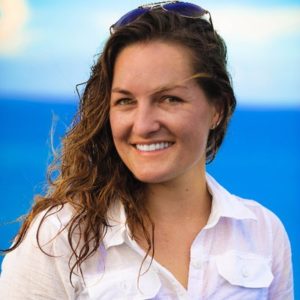
Featuring my interview with the legendary oceanographer, Sylvia Earle.
Yes.
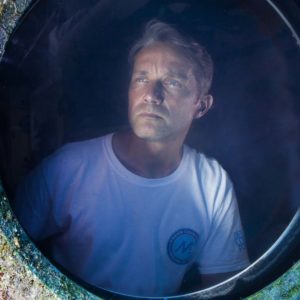
And not only that, we also have an interview with famed aquanaut, Fabien Cousteau.
So let's do this.
Oh, yes.
My comedic co-host tonight, Scott Adsit.
Scott, welcome back.
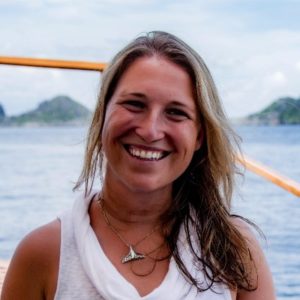
And also joining us is marine biologist and conservationist, Laure Katz.
You dive all around the world?
Sometimes.
And you do some conserving?
That's the fun part of my job.
But most of the time, I'm working to try to save some of the most special ocean places we have around the world.
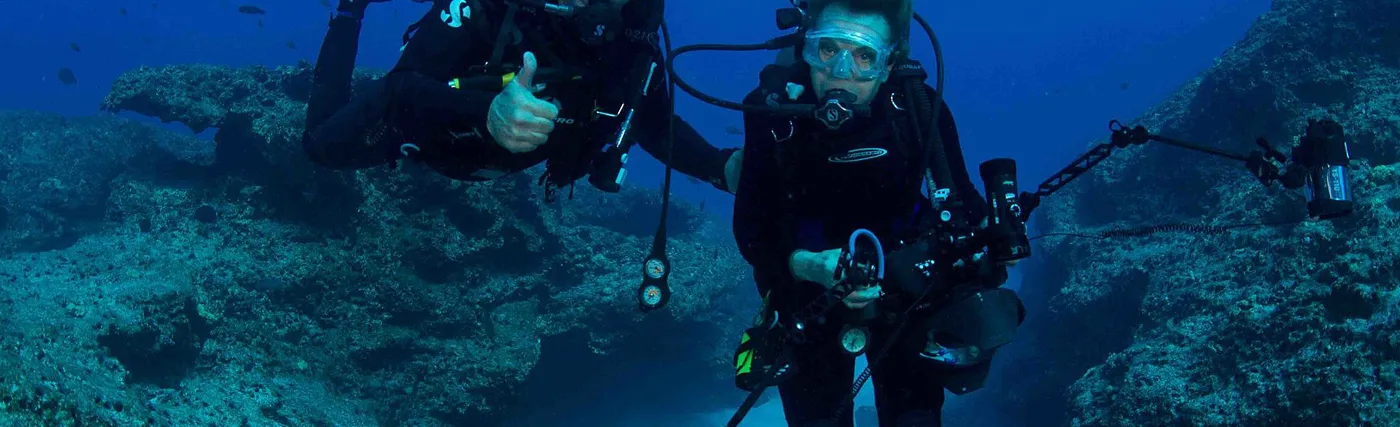
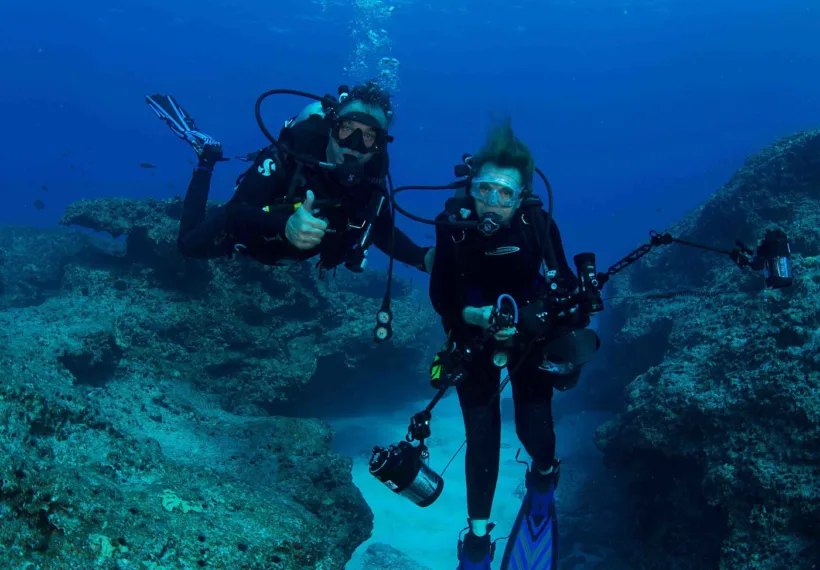
Well, we'll be tapping into your expertise throughout this entire program, because I sat down recently with one of the great pioneers of oceanography, underwater explorer and living legend, Sylvia Earle.
Let's check it out.
So, Sylvia, I heard a rumor that you were born underwater.
And then you had gills and then you just had to pretend you were human and came out and now it's just a charade when you're on dry land.
I so wish that were so.
So, what happened to you early in life where all of a sudden being on dry land was not the priority?
Well, I got knocked over by a wave when I was a little kid on the New Jersey shore.
See, that's evidence you should go away from the ocean.
No, well, that was my first thought because I couldn't breathe and then suddenly my toes touched the bottom and my head came out and I realized that was kind of cool.
That was fun.
And my mother, who was watching, mother of all mothers, instead of reaching in and grabbing me and saying, you're never going in the ocean again, saw the big smile on my face and she let me go back in.
So she tossed you back in?
Okay, so this is a parent who sees the joy in adventure and the adventure of joy.
Yeah, that's right.
I agree there's not enough parent energy supporting the experiments that children might be victims of even.
Yeah, and it's so influential when you're a kid.
But already I had fallen in love with the big craggy horseshoe crabs.
I know those.
Living fossils.
They look prehistoric, I mean those things.
They go back.
What is that?
And it's all kind of...
Yeah.
There's all this creepy stuff underneath and they got this tail and...
You know, what I felt is if I knew more than some of the grownups who walk down the beach and they, oh, don't touch that.
They'll stab you with that spiky tail.
And I said, what are you thinking?
These are nice little guys.
They never hurt anybody.
And I knew as a kid because, I don't know, you just have that empathy for other forms of life.
So you were a weird kid.
Just say that.
Just admit it.
Nothing's changed much.
Yeah, so every now and then a weird kid turns into an extraordinary adult.
It's like she's got a superhero origin story, you know?
Because she was attacked by a wave and then she devotes her life to studying her attacker.
That's exactly how that plays out.
Were you attacked by a planet at some point?
Yeah, no, no, no.
I have no superhero powers or anything.
Oh, I think everyone would disagree with that.
But it would be cool if I was attacked by a black hole and I came out with like black hole energy.
And if I didn't like you, I'd just suck you into a black hole.
Spaghettify you, indeed.
So with her weirdness turning into the adult that she is, like I got to read this list of what she is.
So she's a marine biologist, national geographic explorer in residence.
She's logged 7,000 hours underwater and led more than 100 undersea expeditions.
She's chief scientist at NOAA from 1990 to 1992.
And she's very influential in her field that so many people call her her deepness.
So she has an honorific royalty title because of this.
And so, I'm wondering, do you have an origin story with your love of the ocean, Laurie?
Yeah, it actually is quite similar to hers.
I haven't reached her deepness status, but I had a collision with a wave as well.
Although it was...
How old were you?
A toddler.
But instead of being knocked over, it was being thrown into the waves actually by my dad.
So like Sylvia's mom, I had a parent who encouraged me to love and respect the ocean, but not to fear it.
Wait, wait, wait.
Your dad threw you into the ocean.
This is to teach you to respect the ocean.
Well, to love it.
But not to respect your family.
So he would throw me into the ocean and my mom's friends thought he was absolutely insane.
That the three-year-old was being thrown into the ocean.
But every single time I'd pop up giggling my head off and so pretty soon they thought I was the crazy one.
So she mentioned the horseshoe crab, which is completely creepy.
And so is there a point where it's hard for a human to feel empathy for sea creatures if they look, if they're not furry and cuddly?
Well, I think it's hard for people to have empathy for anything that's different from them or far away.
But if you experience marine life, it's hard not to have empathy for them.
Even if they're creepy and weird?
Yeah, so let me give you an example.
I was recently diving on a reef and I saw a cuttlefish, which is a relative of squid and octopus.
So not particularly cuddly.
Isn't that the thing that has big suckers on the front?
Exactly.
And what I watched it do is take those big suckers, those tentacles, and reach it down into each branch of coral.
And I looked in close and it was actually caressing and turning each of its eggs.
And it's hard not to have empathy for a loving mom.
Yeah, but it still doesn't have the face.
It doesn't have the emotional stuff that we can relate to.
It doesn't have a vertebrate face.
Faces are very vertebrate things, aren't they?
It has eyes and it has personality.
You're special, I think, because we, I think, I need something I can relate to, something I can recognize of myself in.
And I very seldom will turn my eggs with my sucker face.
So I think that's why fish get kind of a bum deal, because they don't have a face you can look at and adore because you don't see yourself in it so much.
Well, you know, I disagree.
So manta rays are considered to be one of the smartest fish in the ocean.
And they are so smart that they actually can recognize individual humans and divers.
And the way that they recognize you is by your eyes.
So they will come and they will swim and they will look you in the eye and they'll know who you are.
Well, they know more than I do when I look at a fish then.
Eh, I think that there's a way to make connection with all of these animals.
So this is the first sort of retinal test, retinal ID?
Yeah, they'll form relationships with people and unless you actually cover up a diver's eyes, they'll know who you are.
So don't harass them.
So if you want to get away from one of them, you can just do that and they won't know you.
They'll no longer recognize you.
It's like the old fashioned photos where you're not supposed to recognize the person.
They put a little black strip across their eyes.
Like you don't recognize the body or the hair or anything else.
You know, that was how they used to do that.
Yeah.
But not anymore.
I think fish would really be advantaged by having a more expressive face.
So you want fish to have eyebrows.
That's the secret.
That's all I'm asking, yes.
So is that so hard?
Is that so wrong?
Can you do that please?
I'll work on it.
That would be your next big genetic project.
It's just for their advantage.
I mean, look at them.
Well, Sylvia Earle loves every fish in the sea, no matter what, with or without eyebrows.
And I asked her about her love of the ocean.
Just tell me, speak the love, and let's see what she says.
When I think of people who love the ocean, many of them just like sailing the ocean.
Surfing, right.
So the ocean to them is a surface.
And to you it's a three-dimensional...
The ocean is the wet part.
The wet part?
Really?
It's not the top.
Well, it is the top.
It is the bottom.
Boat people, the ocean is a surface.
Right?
No, it's the juicy part in the middle.
It's this part.
And it's alive.
That's the thing that...
If people think of the ocean, they think rocks and water.
And, you know, a place to sail or swim.
Or to dump things or to take things out of the ocean.
But no, the ocean is a living system.
So, Laurie, first remind us what it means for the ocean to be a living system.
Because to most people, it's just water.
And it contains living things.
But to think of it as a living system, take us there.
So, in the same way that a forest with birds and trees and bugs that are all interacting is a living system, the ocean is the same way.
It's not only full of life, but it's all interacting together in a connected way that kind of keeps it all functioning.
Isn't it just big fish eat little fish?
That's part of it, but there's a whole complex food web there that most people just don't see and take into consideration.
Well, I know, I mean, I study the universe, and I happen to know for sure that what happens on Earth's surface has really no effect on anything else in the universe.
They're separate things.
But for marine scientists like Sylvia Earle, like yourself, human activity can have a significant influence on what's going on in the center of your research topic.
So I just asked her about that.
Let's check it out.
If you start out as a scientist interested in the ocean and then learn that human activity is changing what the ocean is, does that turn you into a conservationist?
Does that alter you?
Well, it alters what I have available to see.
You know, 90% of the fish have been taken out of the ocean, not just since when I began exploring the ocean, but really mostly in the last 30 years.
We're really good at catching and marketing wildlife from the sea.
Half the coral reefs since 1980 have either become seriously damaged or they're gone.
In the Caribbean, I love the Caribbean, the Gulf of Mexico, it's closer to 90%.
Some places are more stressed than others, and it's partly because, yes, the planet is warming, but also we're changing the chemistry of the ocean with acidification, also owing to what we're putting into the sky, carbon dioxide, methane, the CO2.
The ocean is a great buffer and has absorbed much of the carbon dioxide, but beyond a certain point it becomes carbonic acid, and we've seen a great uptick in the...
And even if you don't know what carbonic acid is, it doesn't sound good.
Acid, acid, acid, acid, think...
Carbonic acid.
It just sounds bad.
I know it is bad, and the thought that the ocean is so big, so vast, so resilient, it's too big to fail, right?
But now we know it is failing.
What does she mean that the ocean is failing?
It's an ocean.
So, like she said, for most of history we thought of the ocean as this exhaustible space.
Inexhaustible.
Inexhaustible.
Throw your garbage there.
It turns out it's not.
We are taking way more life out of the ocean than can be replenished and we're putting way more pollution into the ocean than can be absorbed.
So, you're saying we're killing the ocean.
Well, it's not dead yet, but it's certainly, its health is certainly failing.
And this carbonic acid problem, how bad is it?
It's pretty bad.
So, what she's talking about there is a process called ocean acidification.
And the oceans absorb about a third of the carbon dioxide that humans are putting into the atmosphere, about 22 million tons every day.
Every day?
Every day.
So, it's funny, when we think of carbon dioxide as a gas, and gas we think of as light and low density, and now you're telling me 22 million tons of this gas is being absorbed by the ocean.
And once it's in the ocean, as she said, it's turning into carbonic acid.
So, in the last 200 years alone, we've increased the acidity of the ocean by 30%.
That's faster than any time in the last 50 million years.
And that's bad for marine life.
It's bad for a couple of reasons.
The first is that in those acidic conditions, we're actually eroding the shells and the skeleton of critical animals, like oysters, mussels, and most importantly, coral reefs.
And then the second is that that process actually takes up the chemical building blocks that those animals need to grow.
To grow their shells.
To grow their shells.
And you might ask why does that even matter?
But a billion people rely on coral reefs for food and livelihoods.
We say food, they're fishes that live in and only in coral reefs.
At least for part of their lifetime or life history.
And so if the coral reefs erode, how are we going to feed them?
You know, it's even worse from what I understand.
I worry every time you look at your cards here.
Something's going to pop out.
I did some research.
There's something that's even worse than carbonic acid.
What's that?
It's filling our oceans called dihydrogen monoxide.
Now this is a colorless, odorless chemical compound.
It contributes to the greenhouse effect.
It is a major ingredient in acid rain.
And if you inhale it, you die.
You can.
You can die.
And I happen to have some right here.
This is dihydrogen monoxide.
What does it taste like?
No, no, no, no, don't.
Don't.
To StarTalk, we are talking about ocean exploration and conservation.
Live right now by video call is actor and activist, Adrian Grenier.
He was the star of the HBO series Entourage, remember that?
And he's an ocean conservation advocate.
Yeah, I'm here.
So I'm old enough to remember when straws were made of paper.
And if they got too wet, they would collapse.
And I was kind of quite happy when plastic straws came around.
If you succeed and you get rid of plastic straws, how are we gonna drink our sodas?
Well, you know, I sip with my lips.
I got, you know, my mama didn't give me these beautiful things for nothing.
For drinking and kissing, right, right, right.
But listen, you know, I think we need to re-innovate, right?
The plastic straw and other plastic materials were a great innovation.
We just need to step it up again, you know.
We need to renew a vision of the future that does not have plastic in our oceans.
We're leaching almost 10 million tons of plastic into the ocean every year.
And at that trajectory in 25 years, there's gonna be more plastic in the ocean than fish themselves.
So, just curious, you're a well-known actor, and how do actors become activists?
What is that transition?
What goes on?
Do you go through some activist school?
Cause all y'all come out protesting something on the other side.
So what actually goes on in Los Angeles?
Well, yeah, I think we're very blessed in a lot of ways.
At least I am.
And at a certain point, you start to realize that we gotta give back.
We gotta find that balance.
I've lived a great life.
I've gotten a lot of the spoils of success.
And now it's time for me to do my job as a citizen, as a human and help do my part.
That's a beautiful thing.
And it's a message that we're folding into this show.
I wish I could be there.
I live in Brooklyn, but I'm in LA right now.
Okay, well, great to see you.
And maybe you can come by and visit when you come back to town.
I would love that.
All right, Adrian, thanks for calling in.
So clearly, it's hard to get people to care about something that they don't know anything about.
So so much of this exercise is awareness.
And so I asked oceanographer, Sylvia Earle, how much we know about the ocean today?
Because that could impact how much we end up caring tomorrow.
Let's check it out.
Only about 10% of the ocean has been seen at all, let alone seen or mapped with the same degree of accuracy that we have for the moon, Mars, Jupiter, Mercury.
You know, we've gotten pretty good.
Maybe space is just easier.
There's only one atmospheric pressure difference between surface of the earth and the vacuum of space.
So whereas you're dealing with, what's the pressure down at the Marianas Trench?
16,000 pounds per square inch.
But we know how to solve that problem.
It was solved in 1960.
So what are we waiting for?
Maybe it doesn't have the romance of the sky and the universe.
Beg your pardon.
Said it to the wrong person.
Ah!
So, Lori, why are ocean people so sure that the ocean is more romantic than the cosmos?
Well, I've got to agree with Sylvia on this one and I'll...
Yeah, of course you're going to agree with Sylvia on this one, okay?
See if I can convince you.
Yeah, it's going to be hard, but go on, try.
Bring it on.
I'll take the bait.
Well, for me, I think about the most romantic dives that I've ever had and experiences under the water.
That's a phrase, romantic dive.
Oh, I think so.
Okay, go on, go on.
So, the one that speaks to me the most was a time in Turks and Caicos in the Caribbean.
Imagine diving over a beautiful coral reef and then all of a sudden the reef disappeared.
I went over the edge and was above a thousand feet of blue water, just blue everywhere.
Like your cosmos, just vast open blue.
But out of it came a school of eagle rays and they came right up out of the blue, right to me, swam by making eye contact, gazing into my eyes and then swam back out into the blue.
So I don't know about you, but to me, the only thing more romantic than the mystery of finding unknown life is getting to encounter it right here.
I don't know if you're ready for my rebuttal.
I don't know if you can.
I don't know if you can handle it.
I get you, this romance in the ocean.
We came from the ocean.
But before we came from the ocean, we came from the sky.
We came from the universe.
Our atoms, our molecules are traceable to the crucibles in the centers of stars across the galaxy that exploded, gave up their lives, scattering that enrichment across gas clouds, hither and yon, from which life emerged.
That's where I came from first, and the ocean is where I came from second.
That was like a nerdy Barry White.
So, Laurie, let me ask you, Sylvia is correct.
We know more about the surface of the moon and Venus and Mars and Mercury and Jupiter and Saturn than we do of our own oceans.
So, up next, we will take a deep dive into Earth's oceans with a submarine shaped like a shark when StarTalk returns.
This is StarTalk.
Welcome back to the American Museum of Natural History right here in New York City.
I sat down recently with aquanaut Fabien Cousteau.
This is the grandson of the legendary Jacques Cousteau we all remember.
And I asked him about carrying on that great family legacy.
So let's check it out.
So were you kind of obligated to be interested in the ocean?
Would you have been excommunicated?
You're carrying some serious name weight.
Yeah, well, it's a double edged sword.
No, I was never obligated in the family, or was never expected of me in the family to carry on.
That's what I was wondering.
Because you would say, oh, I'm in the family business.
You know, it sometimes feels like a business.
We're always struggling with connecting people with the value of our life support system, this planet.
I want to hear you say that again, that the planet is our life support system.
Give me that sentence again.
The planet is our life support system.
Spoken from someone who's been underwater who needs life support.
There you go, there are correlations.
This is my, but I'm thinking Earth is just here and I do what I want and it's not supporting me.
I don't think that way.
But we take it for granted, right?
I mean, you're born, you go through your lifetime doing the basic necessities that you need to do to survive, to pay your bills, da.
But you never think about where your breath is coming from.
Laurie, where's our breath coming from?
Well, the oceans, of course.
But that's not what we're taught in school.
In school we say, oh, the leaves and the plants and the this and the, and it's very land-based teaching.
They contribute, but the oceans produce over 50% of the oxygen that we breathe.
Most of which is from little plants, microscopic, that live in the water column.
How much does space generate for us?
Please go on.
Why, thank you.
So, I mean, I think it's a good example of all the ways that we take for granted what the planet and oceans do for us.
They don't just give us the breath that we, the oxygen that we breathe, they regulate our climate.
Three out of seven people on the planet rely on seafood for protein every day.
Three out of seven.
And the oceans generate 2.5 trillion dollars for our global economy each year.
From fishing, I guess.
From fishing, from shipping, from all sorts of different industries.
And so, we often overlook it, but it's really the blue in our blue planet that makes everything else possible, including us.
So, Jacques Cousteau, I mean, he was an explorer, a scientist, a filmmaker.
Would you count him as a real life ocean hero?
Yeah, absolutely.
He invented Scuba, which makes my life a whole lot happier.
So, I'll call him a superhero.
So, I didn't know that.
And so, that's a pretty big shadow for this guy to grow up under.
But I think Fabien has done all right for himself.
And, you know, he learned to Scuba at age four.
How do you like that?
I thought I was pretty young.
I did it at 12, but he got me beat there.
So, I'm told he's officially an aquanaut.
So, that has definition to it.
Because it just seems like an astronaut, you go into space.
We got that.
So, an aquanaut, that's not just somebody who goes underwater?
No, it's somebody who goes underwater and stays there long enough that they actually reach an equilibrium with the pressure underwater and the gases in their system.
Takes about 24 hours, typically, but I think he's far surpassed that.
So, just so I understand, so on land, there's one atmospheric pressure.
We inhale that, so all the gases in our body recognize and are in balance with one atmospheric pressure.
Now you go underwater, two atmospheres, three atmospheres, five atmospheres, 10 atmospheres.
Now you breathe air that's under 10 atmospheres of pressure.
Now your body has to absorb that in a 10 atmospheric way, and that takes about 24 hours.
Is this the 10 atmospheric way?
Yeah, I'm just feeling it.
Right, right, right, right, right, right.
So, that's why you can't come back out too quickly.
Right.
Because then 10 atmospheric pressure will bust out of your body.
That can't be fun.
Right, so you have all of this gas that's been absorbed into your system.
Think about it almost like a Coke that you shake in, and it's got carbonation, it's got all this gas inside of it.
If you open that too fast, the pressure changes, and all of that bubbles out of your system.
So as long as it's in your bloodstream, it's liquid and it's fine, and you don't feel it at all.
But if you pop to the surface, you don't want that gas bubbling out.
So this acclimation takes about a day, you say?
Okay, so I understand that Fabien Cousteau accomplished this inside an underwater research station where he stayed for 31 days.
And Fabien had another recent underwater adventure that I had to ask him about.
Let's check it out.
I couldn't believe what I read, but now I have you here to confirm or deny that you have a submarine that looks like a shark.
Just tell me that's not true.
Just tell me that was a cartoon I saw or something on Spongebob.
You're right on both accounts, by the way.
It wasn't a cartoon.
It was in a comic book called Tintin.
I remember Tintin.
And that's always stuck in the back of my mind.
It was such a cool idea.
You know, but imagination, expression of dreams is what makes things possible.
Space exploration is based on that.
So is inner space exploration.
But still, you made a submarine look like a shark.
Well, the reason was simple.
You weren't getting close enough to sharks?
Well, the reason, yeah, that's exactly what it was.
I looked at them, cool idea.
Okay, right now, everyone's studying sharks.
This was a few years ago.
Everyone's studying sharks in cages, and they're throwing chum at the animal and expecting natural behavior.
Wait, wait, just to be clear, they're not studying sharks in cages.
They're studying sharks from cages.
Right, I'm sorry, yes, you're absolutely correct.
Okay, so the person is in the cage, and the shark is not in the cage.
Right, and we should always keep it that way.
Did you know about this shark thing?
I did.
I haven't had the pleasure of seeing it, but I have heard about it.
It's kind of a Trojan horse, where you can get close enough to the sharks and people come out.
Well, you would think that, but I think they actually can probably tell that he's there.
Sharks don't actually use their sense of sight very much.
They more rely on their sense of smell and a special sense that they can read electric charges or the heart rates of animals.
And so even though he's visually camouflaged, I would imagine that they can see him.
Well, to help us continue this conversation about undersea exploration, we have a professional submarine pilot standing by live right now on video call.
So, hello.
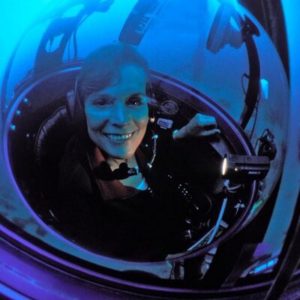
This is Erika Bergman.
You're a submarine pilot?
That's right.
And that wouldn't happen to be your submarine behind you?
Oh, what, this old thing?
So where are you?
Well, I'm in my workshop with a bunch of tools.
The submarine itself.
And I'll actually take you down right now.
Sorry, it's hard to hold.
Thank you.
So this is the hatch right here.
And when I close this hatch, it seals all of the water out.
So it's basically the opposite of an airplane.
And an airplane, when you go up, because the pressure is decreased, all of the rivets tighten down.
In our case, all of the seals are the opposite direction.
And when water presses in, it seals this hatch up here.
There we go.
It's quite heavy.
So the water pressure...
I'm very strong, don't worry.
The water pressure does your sealing for you.
Exactly.
So what's the coolest place you've been in this thing?
Vancouver, BC actually has this stunning ecosystem that I never could have imagined in a million years.
And it is, in fact, 500 million years old.
Whoa.
It's called a glass sponge reef.
And it's the first animal life form on Earth.
They're a single-celled organism that grow huge.
They look like a trumpets that have been hanging out underwater for millennia because they've been hanging out underwater for millennia.
I wonder what they say about you.
Well, Erika, thank you for giving us a tour of your pride and joy.
Sure.
My pleasure.
So coming up next, we'll explore oceans on other planets on StarTalk.
Back on StarTalk from the American Museum of Natural History, and we are featuring my interview with the legendary oceanographer Sylvia Earle.
And back in 1970, when NASA was putting men on the moon, Sylvia Earle and her team of all-female aquanauts were exploring deep beneath the waves.
Let's check it out.
There were no women involved with going in the sky at that point, but there was a team of women who were allowed to experience living underwater in isolation and to simulate in some fashion what others would come to experience in space.
The isolation.
Being remote and under, quotes, hostile circumstances.
I've never thought of the ocean as being particularly hostile, but it is true.
You have to take your life support system with you.
You're going to have a little house underwater, which we did, the Tektite Underwater Laboratory.
So you just lived underwater?
Yeah, for two weeks.
Two weeks?
There are ten different teams of people over a period of a year.
And the first year that preceded that, 1969, was just four guys stayed for two months underwater.
So is that the oceanic equivalent of the Mercury 7 astronauts?
The first set of people just testing the limits of the equipment, as well as the physiology.
And the effects on your body, yeah.
And behavior.
On all of the Tektite missions from Tektite 1 to Tektite 2, when they had these ten teams of scientists exploring the ocean, we were monitored, when we were inside at least, by teams of people who looked at us day and night and made little notes about what we were doing.
So you were like a little underwater diorama.
So that mission was called Tektite 2.
Let the record show that Tektites come from space.
And you're naming an underwater thing after space objects.
They are found in our water, though.
Because they fell from space.
I'll give you that one.
So this is the longest duration that scientists had ever been continuously submerged.
I was very impressed to learn about that, that that was happening contemporaneously with our missions to the Moon.
And I bet that's not an accident.
They share a lot of challenges, right?
So you need air, where there isn't any.
Breathable air.
You can be isolated for long periods of time.
They both have unflattering suits.
Unflattering suits?
We're trying to change that, actually.
There's a whole next frontier of spacesuits that are a little bit sexy and a little bit interesting.
What else?
Access to food.
They're both jobs that I pretend to have when trying to impress women.
Is that right?
Oceanographer.
Astronaut.
Really?
Same thing.
And how's that been working for you?
Sitting here by myself.
Did I tell you I'm an astronaut?
Is she lying?
No, she's not lying.
Of the two of you, she's the one not lying.
So why was Tech Tech II important?
Other than what she said, did it have a bigger significance in the day and for what followed?
Yeah, I think, I mean, Sylvia has been an inspiration for a whole generation of marine biologists, myself included, who saw her kind of open up that frontier and make it seem feasible for women to be part of this industry.
You know, there's still barriers, but she definitely set the path.
So we found a newspaper headline from 1970 about Sylvia Earle's mission underwater.
And you know what the headline read?
Beacon Hill housewife to lead a team of female aquanauts.
That's the kind of stuff that went down back then.
I actually have a stack of newspapers from an alternate universe where the headline.
You have access to the multiverse.
You didn't tell me that.
You gotta come over.
Over there, their headlines treat male scientists like we treat did female scientists.
Really?
So what do you have?
I got this.
Father of three finds time to walk on the moon.
How does he balance it all?
Physicist shows off some leg while at beach, writes theory.
This one.
Bossy astronomer won't quit nagging about earth revolving around sun.
All right, so I also chatted recently with famed underwater explorer, Fabien Cousteau.
You know, I had to ask him about the idea of exploring oceans beyond earth.
Let's check it out.
You may know that we're discovering oceans on moons of planets.
Sign me up, I'm there.
So, Europa, one of the moons of Jupiter, as all evidence shows that there's a layer of ice.
A float atop an ocean that may have been an ocean for billions of years.
So, when we astrophysicists go there, we're gonna have to call one of you guys up because we don't do that.
That's what you guys do.
And you have to cut through the ice.
That's another kind of thing.
And it will just send you down there and we'll just stay up top.
How you doing now?
I have no problem with that.
Bring me with you.
But it is a really, really intriguing part of what you're doing, what your discoveries are doing.
Because it has made me dream of, wow, if what is down in our oceans is so amazing, what's over there?
So Laura, do you like this idea of alien oceans?
So we can send you there too.
Sure, sign me up.
Yeah, so we talked about Jupiter's moon that was Europa.
But also there's a moon Enceladus orbiting Saturn.
These are moon planets, if you will, that are kept warm deep inside because of the gravity stress that they experience in orbit around their host star.
And so the surface is icy, but we have liquid water beneath.
And it's not fundamentally different from cutting through polar ice and reaching the lake or whatever is the ocean below.
And so it's a global subsurface ocean.
How thick is that surface?
Well, we don't want it to be thick.
So, because that makes it harder to cut through, but realistic estimates put it at about a kilometer.
And so the hole you cut to go ice fishing, it has to be really deep.
So we haven't really figured out how to do that.
Some are imagining you can get like a radioactive heat source that just melts its way down, but then you put radioactivity down in the water supply and affect whatever life might be there.
So there are issues that have to be resolved.
So if we go there, you sign up.
Absolutely.
I mean, you have no idea what you could find there.
It makes me actually think about exploring here on our oceans.
In the 70s, oceanographers found for the first time hydrothermal vents.
They kind of assumed that they were there, modeled them there, but they finally found them.
And were shocked that they not only found life in these really hostile environments, but they found life that made their living in an entirely different way than any other life form that they had found.
They actually found life that used the chemicals coming out of these vents to create energy, a process called chemosynthesis.
Rather than from the sun.
Rather than from the sun.
So if organisms can support themselves in a whole new way here on earth, think about what's possible in these other oceans.
It blows it wide open.
And you're discovering new species every what?
Every day, every year?
Well, some of the reefs that I work on in Indonesia, it's on a weekly basis that we're discovering a new species.
But so around the world, definitely on a daily basis.
Who needs space?
Last time you're invited on this.
You're supposed to have my back.
But coming up, we assess the future of our oceans here on planet earth.
Because I sat down recently with underwater explorer and living legend, Sylvia Earle.
I asked for her outlook on protecting the world's oceans and this is what she said.
Now, I think we're at that point in time that we have been able to develop the technologies with the ability to speak to other brains on the other side of the planet.
And we're connected.
We have the computers to be able to crunch data, to analyze masses of information, see patterns that we could not see before.
To give us insight, to give us some answers to who are we.
Who are we anyway?
Where do we come from?
And where are we going?
Laurie, who are we?
And where do we come from and where are we going?
And very quickly, please.
So we did come from the ocean.
So we're inherently sea creatures and we're still dependent on the ocean for our very survival.
We, as of now, know of one planet that can sustain life, this one.
And it can only support life as we know it with very specific conditions, very specific climatic conditions.
And the ocean is what keeps the earth hospitable for us.
So without the oceans, our very survival is in jeopardy.
We are at a moment in time when we actually have the capacity to change that.
We can reverse these trends.
We have the knowledge, we have the science, we know what we need to do.
The question for me is whether we're gonna have the wisdom to use it.
You're bumming us out.
Well, Sylvia Earle, no, no, no, it's the truth.
Sometimes the truth is a bummer.
Sylvia Earle actually has an initiative to protect oceans and it's called Mission Blue.
And so I asked her about that mission, let's check it out.
So the idea of blue parks, protecting the ocean.
Nobody thought we needed to protect the ocean when I was a kid.
Just the ocean version of a national park.
Exactly, a place that you deliberately say this place is special.
But here's the thing.
It turns out that it was only 0.01% of the ocean was really safe for wildlife.
Protected where the fish could do their thing in peace, whatever that is.
Now...
Where they can eat each other in peace.
They can eat each other, one another in peace, right.
So, okay, it seems it's good ideas but not enough.
My wish was to explore the ocean, to use our mighty powers to communicate, but to lead to a network of hope spots, protected areas around the world large enough to save and restore the blue heart of the planet.
So what will happen is when fish achieve collective consciousness, they'll put out maps of where these hope spots are, then they'll all cluster.
But I think we have time.
I think that especially in the next decade, next 10 years will shape the next 10,000 years in a magnified way because we still have 10% of the sharks.
We still have half the coral reefs.
So a network of hope spots for the ocean.
We've developed kind of a framework where people, wherever in the world you are, to nominate a place in the ocean that you think is important or that you love.
And you say who you are, why this place matters, what you're going to do to help take care of it.
And make it so.
It's knowing it is the key to caring.
Maybe if you care you'll do something.
You can't care if you don't know.
Hope spots, that's a good thing.
Laura, are you hopeful about hope spots?
Yeah, I actually am.
I think we still have time.
So in my work with Conservation International, I actually get to work on blue parks or marine protected areas all around the world and see the dedication of communities and governments and businesses collaborating to make these protected areas.
And we actually just reached a milestone.
So this requires international cooperation.
Absolutely.
That's why the word international is in your title.
Indeed.
In the company title, yes.
Yeah, it's a lot of work.
For everyone's benefit.
So I have a hope spot myself.
For me, it's a place in eastern Indonesia called the Bird's Head Seascape.
And there's more species there than anywhere else in the ocean.
It's the epicenter of marine biodiversity.
And I've had the privilege for almost a decade of working there with indigenous communities, governments, to help create a network of large marine parks or these blue parks.
And we're now seeing that they're working.
So we're now measuring fish and coral coming back.
Local fisheries are rebounding.
And people have more to eat.
And so seeing that and those communities, that's what gives me hope.
Well, that's a good note to end on, I think.
Well, if I can offer some parting thoughts.
I happen to love the ocean.
We went a lot as a kid.
And you go to the beach and you go to the edge and you chase the wave, the wave chases you back.
There seems to be a kind of a magnetic draw to the shoreline that is the boundary between land and water.
And that forces me to wonder whether deep down within our DNA, genetically, we have a memory of having come from the water.
Because so many of us are drawn to it.
So there's something about it that keeps us coming back.
And I will not stand in denial of what might be a search, this genetic search for where we came from.
Whether or not you knew explicitly that that was true, you feel it sitting there hearing the ocean come to the shore, watching the sunset over the water, looking at the seashells.
I don't know.
There's something about it.
I think it's real.
And I think not enough people take that the next step and ask what's going on down deep within and how does my life depend on it?
We came from there and we depend on it.
And that is a Cosmic Perspective.
You've been watching StarTalk.
I've been your host, your personal astrophysicist, Neil deGrasse Tyson, and as always, I bid you to keep looking up.
See the full transcript



 Unlock with Patreon
 Become a Patron