


 Unlock with Patreon
About This Episode
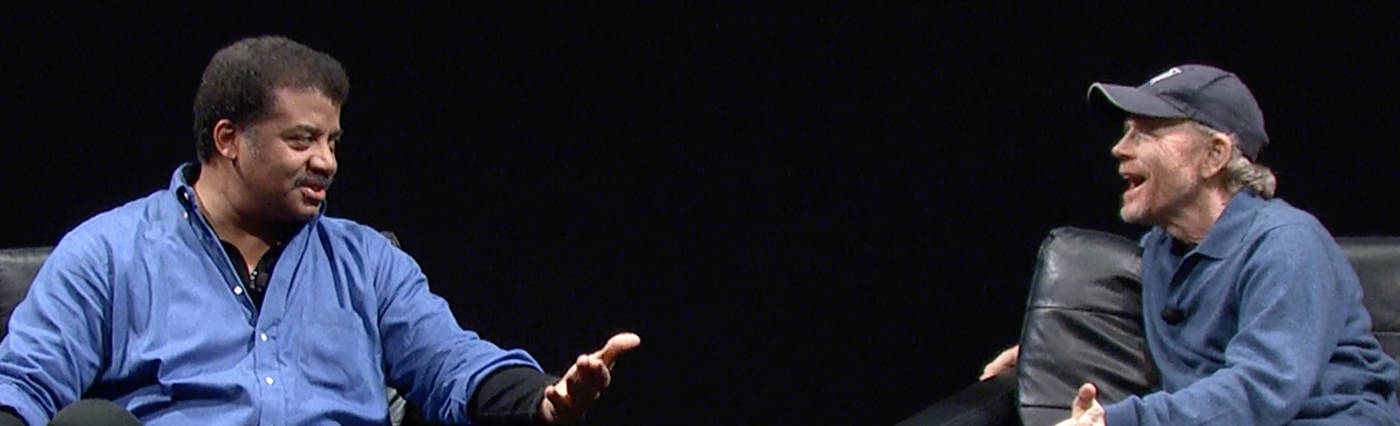
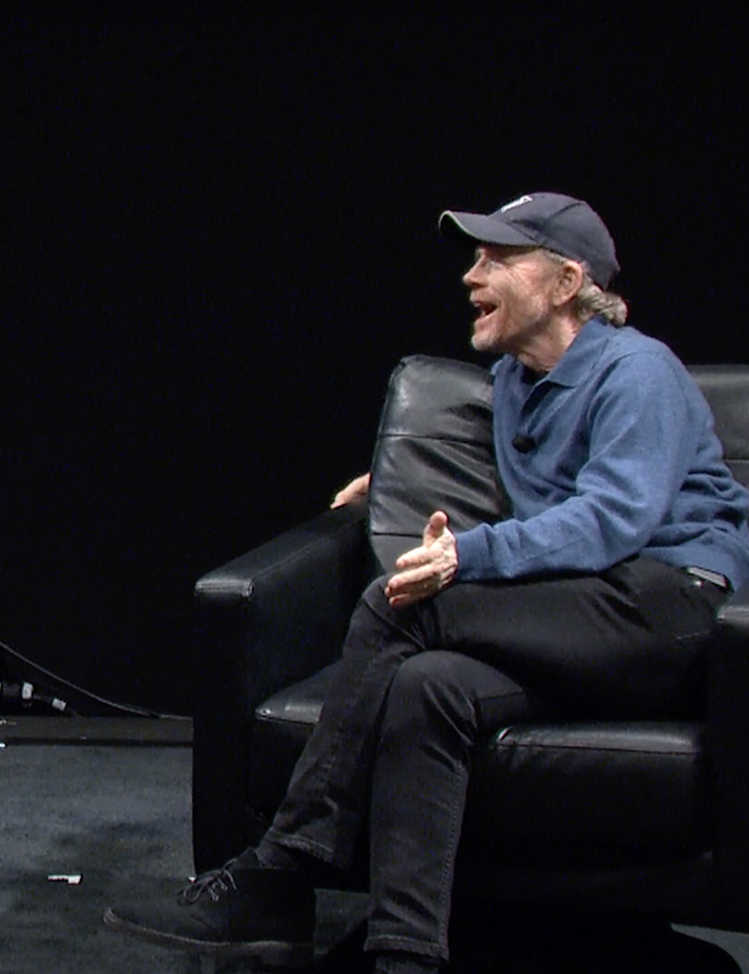
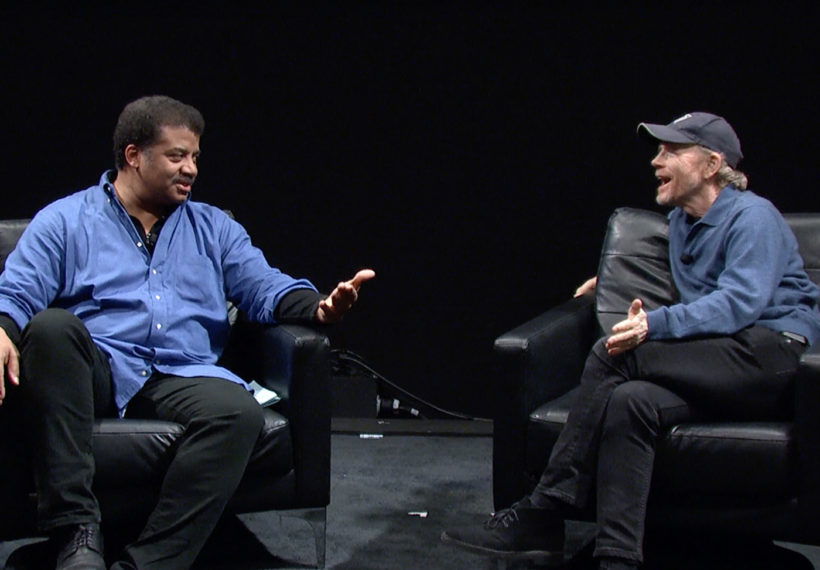
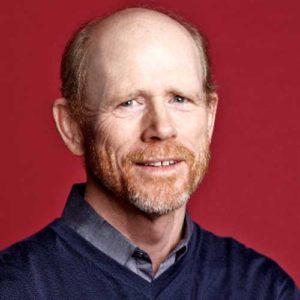
“I have no special talent. I am only passionately curious,” said Albert Einstein. We beg to differ. On this episode of StarTalk Radio, Neil deGrasse Tyson, comic co-host Harrison Greenbaum, and astrophysicist Janna Levin celebrate the life and legacy of Einstein himself, accompanied by Neil’s interview with director Ron Howard, who directed the National Geographic Genius series that explored Einstein’s life.
Ron shares why he agreed to sign on to this Einstein project after rejecting multiple scripts for Einstein movies. Find out what Ron found most interesting about Einstein besides his discoveries. Harrison tells us about his close family connection to Einstein. You’ll also find out why Ron thinks making shows and movies based on true events, like Apollo 13 and A Beautiful Mind, is liberating.
Explore Einstein’s theory of general relativity and how it re-shaped the universe around us. Investigate Einstein’s use of Gedankenexperiments – “thought experiments.” We reflect on Einstein’s annus mirabilis, or “miracle year” of 1905, in which he came up with the theory of special relativity, the E = mc2 equation, and his Nobel-prize winning work on the photoelectric effect.
Learn about Einstein’s complicated relationship with the atomic bomb. You’ll also hear about what Einstein called “the happiest thought of his life.” We look at the different types of genius, ponder if genius like Einstein’s could happen in today’s world, and reflect on the importance of collaboration. Janna explains the peculiar rhythm of conversation that occurs when physicists are working together. Lastly, you’ll find out how relativity played a factor in Neil meeting his wife. All that, plus, we investigate the relationship between genius and mental stability.
NOTE: All-Access subscribers can watch or listen to this entire episode commercial-free here: Einstein’s Genius, with Ron Howard.
Transcript
DOWNLOAD SRTFrom the American Museum of Natural History in New York City, and beaming out across all of space and time.
This is StarTalk, where science and pop culture collide.
StarTalk, I’m your host, Neil deGrasse Tyson, your personal astrophysicist.
And today’s episode is all about Einstein, and we’re featuring my interview with Ron Howard.
What does Ron Howard have to do with Einstein?
He actually directed the first season of National Geographic’s Genius series.
And if you’re gonna start a series about the world’s geniuses, who better to do it with than Einstein?
And I bumped into Ron Howard at South by Southwest in Austin, Texas.
And I nabbed some quality time in conversation with him about that project.
To talk about Einstein, I know the man, I know his work, but I don’t know him as well as my friend and colleague, Janna Levin.
Janna, welcome back to StarTalk.
Thank you, it’s good to be here.
Yeah, so, Janna, you are a professor of astrophysics at Barnard College in Columbia University.
And you’re a theorist.
Yep.
And you care about complicated cosmic stuff.
Yeah.
Like, what the space-time continuum is doing.
I would say everything I think about has something to do with space-time.
Excellent.
So do all of us, though, actually, right?
Where am I going for lunch?
When?
Example, when?
And when are we gonna have lunch?
Let’s get a cup of coffee.
Where, you know, what?
So, yeah, we all think about space-time whether or not we know it.
Yeah, so thanks for, you’ll offer commentary on some of what comes out in this interview.
And we’ve got Harrison Greenbaum.
Harrison, welcome back.
Thank you, yeah.
Excellent.
My family has a connection to Einstein because my great-grandmother’s brother, Louis Lewinter, was part of the group that helped get him out of Germany to New York.
So we have like a letter in the family of gratitude from Einstein for helping save his wife’s life.
Wow, you should ensure that.
His letter about religion sold for something like $2 million recently and a few months ago.
I have a couple of phone calls to make.
So, welcome back.
Yeah.
And you’re wearing a shirt with, I recognize the quote, that the universe is under no obligation to make sense to you.
And who said that?
Neil deGrasse Tyson.
So you wear that on my show.
I think it’s funny.
Aren’t you wearing a quote by him?
No, I’m not wearing a quote by him.
No, thanks for wearing the shirt.
It’s one of my more important quotes out there.
I’m happy to spread the love of this.
It was his laundry day, it was the last time I had him.
But that shirt is apropos to this topic because so much of Einstein’s work doesn’t make sense to anybody.
It makes sense on paper maybe to physicists who study it, but to the rest of everyone, what the hell was he saying?
So hence, the universe is under no obligation to make sense.
So, and just to be clear, so you’re a comedian and a magician.
That doesn’t make sense to my parents.
So I have to play the obnoxious way.
So, does that, so, so, is that why you’re not married?
Okay, so I married a musician and we said, okay, maybe you should just tell my parents that you’re a magician.
And then when they find out you’re a musician, they’ll be so happy.
When they find the truth, they’ll be happy with the list.
The greater of the lower truths.
Right, exactly.
It’s like the old Sandy Marshall joke, or Jay Marshall joke where he talked about you, I want to grow up and be a magician.
And his parents were like, you can’t do both.
That’s good.
Very good, very good.
And you’re tweeting at Harrison Comedy?
Yeah.
And Janna, you’re tweeting at Janna Levin.
Yeah.
Good, got your, you don’t have to say the real version of you.
That is you, yeah.
So why don’t we go to our first clip?
First clip of me in conversation with Ron Howard.
We all know who Ron Howard was.
He’s Opie from, what’s that show?
The Andy Griffith Show?
The Andy Griffith Show.
And he’s a life in Hollywood.
And he was in the original musical The Music Man as the kid with the lisp who sang about the…
Gary Indiana, Gary Indiana, not Louisiana, Farrah Spencer, you’re a girl.
I may have played that part in middle school.
Oh, he sings too.
So let’s check out my interview with Ron Howard talking about Einstein.
You’re handed a project of arguably the most important human being in the 20th century.
Well, and now you get, now, how, how did you, where did your audacity come from to say, I got this, Einstein, Opie’s got this, all right, I’m listening.
Well, I’ve read movie scripts about Einstein and periods of Einstein’s life before, and I never felt that they were, that that was the right platform for it, it was the right outlet for it, it was always too limiting.
And when this script came from a company called Odd Lot, a writer named Noah Pink did a first pilot hour, of course, Walter’s book, and we began to think about breaking it into episodes, his life was so eventful, and I have tackled some true stories now at this point in my life.
And what I was excited by were all of the human twists and turns, and so I do have enough confidence in our ability as storytellers, my ability to sort of get the big ideas across in an accessible way.
Because we’re not doing your job, we are telling the story of a life, and we’re trying to make it as clear and be as accurate as we can in terms of the science, but this is not the deep understanding, this is more holistic and it’s more humanistic.
And he has so many twists and turns in his life, it’s impacted by his own behavior.
It turns out he was kind of a bohemian dude in a way, you know, and a thinker.
He had a lot of relationships and working at a patent office because he was a bit of an outsider.
You know, his Judaism and religion worked against him.
In Germany, yes.
In Germany at that time in a serious way.
You know, he wound up being on lists, you know, like let’s get it, let’s get him.
And so he faced all kinds of hurdles.
And the surprising thing about Einstein is sort of his, is kind of where he kept showing up and having an impact throughout that first half or so of the 20th century and the lasting reverberation of what he learned and the discoveries he made.
And I think as a dramatist, this is probably the most exciting thing, how close the world came on numerous occasions to sort of blocking this guy’s ability to sort of offer us his insights.
Yeah, so that’s a good sort of profile of the series.
It’s Einstein as a person and you get to know who he is and what he does and why he mattered.
And it was inspired by the book by Walter Isaacson, Einstein, His Life and His Universe, I think it was.
Einstein’s Life and the Universe back in 2007.
It was a best-selling book.
So Janna, how did Einstein change our view of the world?
Because up until Einstein, when I think of classical physics, it’s things fall, things are heavy, that’s there, this is here, you know, we kind of, the universe was a manifestation of how it should be.
How it’s experienced.
How our senses bring it to us.
So what happened with Einstein?
Well, one aspect of Einstein’s revolution that I love the most is that he wanted to adhere to such simple principles that he was willing to throw away things that seemed so experientially real, just what you’re describing, in order to adhere to those principles.
When you say throw away, you mean my life experience might prevent me from thinking the way I should.
So let me discard that for the moment and open up my head.
Yeah, to realize that just because this is the familiar experience we have, we are these limited creatures.
We know that we can’t see across the entire spectrum of light.
We have a very narrow band that we can see and we discovered there’s light out there and well outside what the eyes can see.
Wait a minute, we can see visible light.
Visible light.
Yeah, because the sun shines, peaks in the yellow, so do our eyes.
I mean, clearly we’re bound by this.
We can’t see x-rays and gamma rays, but they’re out there and we can build other instruments.
So even just the idea that the world is much better from our perception.
Just to make it clear, because not everyone knows this, that these words that we use in so many different contexts, ultraviolet, infrared, x-rays, radio waves, gamma rays, that’s all light.
That’s all light.
It’s just light we cannot see, and you need special detectors and machines to use them, to generate them.
And our eyes see this very narrow part of this entire electromagnetic spectrum, and we just see the red, orange, yellow, green, blue, Roy G.
Biv.
So continue.
Sorry, I thought it was Mike.
Except for gamma, which you can see when you get me very angry.
Oh yes, Mr.
Hulk, yes.
So Einstein was faced with a very serious constraint, a very serious limit, which was the limit of the speed of light.
And this was discovered before he was working on this, that light had a fundamental speed, that it seemed to be a fact of nature, which is very bizarre, super strange.
I mean, the speed of a basketball is not a fact of nature, right?
It can stop, it can go faster, it can go slower.
Light can do none of those things.
It can only go at just one precise speed.
And most people were trying to say, well, that’s clearly wrong, because that doesn’t make any sense.
Now, what is speed?
Speed is distance you travel over time.
And so Einstein said, I believe it, right, divided by time.
And Einstein said, I do think that that’s right.
And there were reasons why he was driven by that limit to force him to say there must be something wrong with distance and time, something wrong with space and time in the way we conventionally think about it.
So he put all his confidence in the speed and not in his life experience of space and time.
That’s right, he knew one had to go.
And you could ask, why did he choose the speed of light over everything else?
And that is because imagine this thought experiment.
I’m floating in empty space and I don’t think I’m moving.
Now I think I’m alone.
I don’t see the earth.
I don’t see anything.
I have no frame of reference.
Suddenly Bob, another astronaut floats past me.
And I say, Bob, you’re moving.
And I only know you’re moving because you’re moving past me.
But Bob’s experience is exactly that he’s not moving and he’s floating in empty space and he’s stationary.
And I floated past him.
And it was very important to Einstein.
Wait, who’s right?
Right.
How do you know his name was Bob?
And obviously the answer was Bob.
No, so precisely.
I want to know the backstory, the friendship.
You know, like, you know, car, auto shop, name tag.
So he thinks about this, neither of them can be preferred.
And so he believes that the speed of light is a fact of nature.
And so he says they both have to measure the speed of light, even though they’re moving relative to each other, which just seems impossible.
And so he said, it’s so important to me that neither of them be preferred because how would you possibly choose?
That I would rather suggest that they have different perceptions of space and time from each other.
And that is why, although they’re measuring the same speed of light in an impossible circumstance, it’s because they are not perceiving the same space and the same time.
Janna, that is the most brilliant explanation.
Thank you.
Of the birth of relativity that I have ever heard.
I really greatly appreciate that.
I’ve worked on it for years, I’ve thought about it.
Well, it just spilled out of your mouth.
No, no, no, that is brilliant.
So, if I can add some punctuation to the end of that sentence, he wrapped everything else around the requirement that they both measure the same speed of light.
That’s right.
And in doing so, it distorts time.
It distorts space.
And it interferes with our classical understanding of nature.
And he did that to preserve the speed of light.
Exactly.
So, space and time are relative, but the speed of light is absolute.
It could have been called the absolute theory.
If Einstein had a microphone back then, he’d drop them all.
So, tell me about his famous year, 1905.
So, it’s this incredible year where Einstein is actually-
Anis Mirabilis.
The Miraculous Year.
Einstein’s technically unemployed as a physicist, although he’s gamefully employed as a patent clerk.
And he has what he calls the physics department.
Which is-
No, literally one of his professors called him a lazy dog.
And Einstein said of himself, when I was a student, I was no Einstein.
What did they say before Einstein?
Because now when you hear something dumb, you’re like, all right, Einstein.
But before Einstein, I was like, all right, nudist.
All right, Maxwell, Rutherford.
So list what he did that year.
So that year, he discovered, he writes down the special theory of relativity, which we just discussed.
He discusses something called the photoelectric effect, which has to do with the quantum nature of light.
And it verifies that light has a quantum particle nature, as well as a wave nature, which was shocking.
And Brownian motion-
The duality, the wave particle duality.
Exactly, we think of light as a wave, and he showed that it actually behaves like a particle under certain circumstances.
And Brownian motion was similarly about the quantum aspect of matter.
So you imagine dust floating around in the sunbeam in the window.
That’s an example of Brownian motion, where the dust particle just sort of randomly moves around.
And that’s because there’s all these quantum, these little-
The atoms are-
They’re colliding.
And then finally, after special relativity, which is actually technically a consequence of special relativity, he writes the paper of the most famous equation in modern history, which is E equals MC squared.
And where he realizes that energy is like the time component in some sense of momentum, and it has the energy of moving in space, has a kinetic energy.
The energy moving in time has an energy, even if you’re not moving in space.
And that is E equals MC squared.
And that’s contained in the matter itself.
That’s right.
It’s like the kinetic energy of your motion in time.
Yeah, and thus spotting a ton of terrible tattoos.
I’m sure there’s a lot of people with E equals MC squared who does not know that that’s what it means.
You can see them on StarTalk social media.
Look at the good ones.
And then he turned 26.
And then he turned 26.
No, that was at 25.
I’m 32 and I’ve been eliminated from two reality shows.
Is that the best thing?
All of this was sitting in his drawer that he called the physics department in the patent office.
Let’s pick up my next clip with Ron Howard talking about the genius series that aired on National Geographic Channel.
Again, when we think of Einstein, we don’t typically think of him in the context of the scientific community at the time because he’s so singular.
But looking at the treatments for several of your episodes, you reach in to places where other scientists who are famous in their own right, actually, play a role.
Einstein, met them, could you name a couple of them?
Well, you’ll have to help me because of radiation.
Well, there’s Wilhelm Röntgen, he discovered x-rays.
He won the first Nobel Prize in Physics.
It was all timed out for when Alfred Nobel set up the foundation.
And of course, then there’s Lennard, who taught Maleva Marich.
Maleva Marich was a very influential person in his life, as Einstein’s first wife.
Some say she might have come up with relativity herself.
Well, some say that.
After living with Einstein, the relativity thing.
Time got stretched.
I don’t know.
She was a great mathematician and helped him a lot with the math and was definitely there with him.
And he needed collaborators.
He needed people to work with and bounce ideas.
And Marie Curie is the character in this as well.
Yes, we have Fritz Haber, later another winner, very important factor in his life.
But Einstein was also very much a humanist, unlike, say, John Nash, who was sort of focused in his world and brilliant but troubled in other ways.
Mathematician in a beautiful mind.
Mathematician in a beautiful mind.
Einstein, he played the violin.
He loved sailing, he loved nature, he loved women.
He liked the world and he was interested.
Violin, sailing, nature, women, the world.
Oh, and then there’s the physics.
Then there is that physics thing.
The physics, oh, the physics on the side, oh yeah.
So Janna, let me ask you, how important is collaboration?
If you’re a lone genius, does collaboration even matter?
Do you need my help?
Yes.
Harrison’s secretly all these years been had my back.
He’s got your back.
Had my back.
Or is lone genius a trope that we want to be true but never is?
I mean, it’s not true for me or in my experience of other physicists.
I know some very brilliant physicists.
I don’t know any lone geniuses.
And one of the most wonderful aspects of theoretical physics is collaboration.
And it’s one of the things I’ve tried to explain to other people, physicists don’t like to be alone.
I mean, there are times you need to be alone, but there’s nothing more adorable than seeing physicists sit around a table and you watch the rhythm of how they’re talking.
There’s splurts, right?
There’s this energetic roar.
And then they’ll go.
I think I just made it up.
Great word.
What did I mean?
Splurges, splurges, what did I mean, Neil?
Let it be a word.
Can you guys edit that post-introduction?
No, loving the word.
It’s a splat and a splurge at the same time.
I’m loving it, go.
Our engineer just looked up the definition.
It’s definitely not what I meant.
That’s even worse.
I used a real word incorrectly.
It does not happen often.
I’m pretty good with my vocabulary.
So, but they’ll have these very energetic conversations where they’re talking intensely, and then you see them just kind of go quiet.
How many people, four or five people, sit around together and will comfortably sit quietly for minutes?
Usually have to talk about sports or something.
Right, no, they sit quietly for minutes.
And sometimes I just watch it from the other side of the room, and then somebody pops up again with the next idea that they had clearly all collectively gotten stuck on.
Well, that’s what happened a thousand years ago in Baghdad, a city open to travelers and traders of all different cultures and backgrounds and beliefs.
And across the table, ideas were shared, ideas were contested.
And only the best ideas rose up out of that.
And over that period, you had the golden age of Islam, where great advances in mathematics and medicine and engineering.
So yeah, across the table is a major part of the progress of science.
So thanks for bringing that.
Absolutely, and at the Blackboard, it’s a pleasure.
Thank God it’s not like a table of comedians, because when we sit around, we just insult each other excessively.
And no one gets a word in.
We’re talking about Einstein with Janna Levin.
And when we return, we’re going to get inside Einstein’s mind on StarTalk.
We’re back on StarTalk, featuring my interview, obtained back in 2017 with the one and only Ron Howard, who so many of us know as a child actor, and then he had his entire life unfold in Hollywood, right on through Happy Days as playing a teenager.
In his later years, he’s a director, and in this particular example, he directed the multi-part Genius series, inaugurated with Albert Einstein, which aired on the National Geographic Channel.
So this whole StarTalk is about Albert Einstein.
So let’s lead off with my next clip, interviewing Ron Howard, and we’re gonna get inside Albert Einstein’s mind.
Let’s check it out.
If there’s a lesson as an ambitious, creative, brilliant person, what he did was he would look at, he would apply this sense of logic to his life and also problems of science.
And if there was a gap, and he went, hmm, that to that, that’s an assumption.
Let’s dig into that assumption.
And that was sort of his little superpower, his willingness to go there.
This is the power of science literacy, not as measured by how many things you know, but how is your brain wired for inquiry?
Right, right.
How do you ask the next question?
That is something that’s not taught in school.
And what you’re-
So that was so inmanipulate, the exhibit said it’s like, whoa, look what that person’s got.
And I think it’s teachable, just-
It requires a kind of an endurance, but somebody has to support that.
Kind of a, you know.
You gotta keep at it.
Yeah.
Because the answer’s always not just there.
If it was just there, somebody else would have had the answer.
So you gotta dig deeper.
Now, fortunately, as you know, like Tesla, he was a visualist.
Tesla the person.
Right.
It was a person before it was a car.
Okay, are we clear on that?
Well, Tesla could visualize problems being solved, plans materializing, and of course, Einstein was great at the thought problem.
The great thought experiment.
Thought experiments, yeah.
Yeah, in German, Gdanken.
Our show is in English.
So Janna, the thought experiment, what word was I trying to come up with there?
Gdanken.
Gdanken experiment?
Yeah, Gdanken experiment.
Oh, just a Gdanken experiment.
So that’s thought experiment.
Yeah, and people in English say Gdanken still, experiment.
We still do.
Physicists will say it that way.
As an homage to Einstein, because he was German.
Right, exactly.
So what is a thought experiment?
So a thought experiment is literally when you just.
They’re cheaper than real experiments.
They’re significantly cheaper.
You need some food and coffee.
A little caffeine, you know.
It’s a way of challenging what you think you know and understand by eliminating all of the extraneous stuff.
So for instance, we already talked about astronauts floating in empty space.
Now I cannot do that experiment in reality.
I can have astronauts floating near the Earth, but they’re gonna see the Earth, it’s confusing.
So the thought experiment is to remove.
The Earth is their reference frame.
The reference frame.
And so that confuses this argument I’m trying to make.
So the thought experiment is imagine that the astronaut is floating in empty space with no frame of reference.
And then by eliminating all of the stuff that was confusing you, all of the extraneous interferences, you allow your thoughts to hone in on only the essentials.
And then stuff becomes clear.
Yeah.
He taught us this as a technique and we absolutely use it all the time.
So imagine I’m standing at the event horizon and I do this.
Imagine this is an eliminating.
Event horizon of a black hole.
Right, event horizon of a black hole.
Whatever it is, we can invent all the time experiments that we only do in our minds.
And so what that also means is you need to know enough physics to constrain the idea but be open enough to new physics to have a new discovery emerge from that thought.
Yeah, here’s a beautiful thought experiment that is due to Einstein, that he called the happiest thought of his life.
He was thinking about gravity.
And so when we think we’re heavy in our chairs, we think that’s gravity.
Lying in bed, it feels heavy standing in an elevator, heavy on our feet.
He imagined, well, I’m gonna do it in the elevator context.
You feel heavier on your feet.
There’s something wrong with all those examples is that there’s something in the way, something extraneous.
The elevator, the chair, the bed.
Why do I need those things to talk about gravity?
Why do I need an elevator, chair and a bed?
So instead, he cuts the cable of the elevator.
He says, imagine what would happen if you were falling freely in this elevator.
It has no windows, you can’t see anything outside.
So before you cut the elevator, you’re standing in the floor of the elevator and you have a weight.
Right, if you dropped your keys, it would fall to your feet, okay?
You dropped your water bottle, it would fall to your feet.
You cut the cable, suddenly you’re floating in the elevator cab because you and the elevator are falling at the same rate.
Your keys, you let go of them, are floating in front of you.
Your water bottle is floating in front of you.
You would feel as though you were an astronaut in the International Space Station.
In fact, you wouldn’t be able to do an experiment that told you you weren’t an astronaut in the International Space Station.
And until, of course, the unhappy end when you hit the ground.
So he called this a happiest thought of his life because he realized what you’re doing in a gravitational field when it’s just you in gravity is you’re falling freely in the space time around.
So to him, gravity was no weight at all.
Was no weight at all.
It’s weightlessness, not heaviness.
So Earth is weightless in orbit around the sun.
That’s right.
So we talk about how heavy is the Earth.
It’s just zero.
Yeah.
And so the astronauts in the International Space Station are doing that experiment, but just in a better way.
They’re falling, but they’re also cruising at such a rapid rate, parallel to the Earth, that they always clear the horizon.
They mercifully never crash into the surface of the Earth.
And, but they are always in freefall.
The International Space Station.
So if they fall, if they fall a mile downward, they’ve traveled so far along the Earth that Earth’s curved downward a mile.
That’s right.
So they just fall.
So they are falling, but they never hit the Earth.
They fall on a circle.
And there’s Einstein’s second important idea, which leads to general relativity.
The first is you’re just falling around the Earth.
The second is if you can fall on a circle, spacetime is curved, what you’re really doing is you’re falling along the natural curves in spacetime.
And it leads him to the idea of the general theory of relativity, that gravity is really curved spacetime.
The lesson here is Einstein was a badass.
Yeah.
I think we got this one.
It’s some beautiful stuff.
It’s some beautiful, beautiful she.
Yeah.
As long as you don’t say the T, you don’t have to bleep it.
No bleeping it.
It’s a beautiful she.
Is there also something very important that happened in relativity class when you took it?
Oh yes.
How did you know this?
I Googled it.
Oh, you Googled it.
I met my wife in relativity class.
I did not know that.
The John Archibald Wheeler, a big relativist of the middle.
I of course know your wife.
Yeah.
And she got her PhD in mathematical physics.
Amazing.
And so, yeah.
That’s thanks to Einstein also.
And so I noticed her first in that class.
That’s amazing.
And then relativity.
Yes, I met her in relativity class, yeah.
So Einstein’s not the only genius in the world.
A good one and important to us.
I’m right here.
No.
I don’t know how many people remember or know that Ron Howard directed the movie A Beautiful Mind.
Oh, right, of course.
Which was about John Nash, the economist.
Yeah, after the book.
Tortured genius.
Mathematical economist.
Mathematical, but he got his Nobel Prize in economics for his work.
So I asked Ron Howard about that.
Check it out.
With Beautiful Mind, I wanted to understand what those eureka moments were like.
I talked to, I went to university to university, talking to people who knew Nash.
Do you know Simon Chappelle?
Does that name ring?
No, no.
Mathematician at NYU knew Nash a little bit.
And a very colorful Hungarian professor.
And he was able to explain it in very similar terms.
He said, all right, look, here’s the way I would describe John Nash and people of that sort of ilk.
He said, if you say that scientists, elite scientists, are sort of on the boundary of what’s known and unknown, and we have the light and the dark.
So you sort of say there are those people who are pushing the boundaries.
That’s, you know, those are those elite scientists.
He said, there are three types.
And the people on the very front, all they want to do is push the light out a little further, take what they’ve got, that discovery that it exists, that there’s more that exists, is kind of enough for them.
They don’t care about application.
They toss it over to their shoulder to the next, you know, sort of level of genius that says, oh, wow, I know what to do with this, turns it into something.
And then he said, there’s a third type, and I think this was John Nash.
And if it’s a war against darkness, they’re paratroopers.
And they go into the dark, and they come back to the light and show you what they’ve found.
So they don’t leave a safe foot in the circle.
No, they just go all the way in.
And he said, some of them don’t make it.
Well, some of them, like, don’t come back.
Don’t come back, yeah.
Right, right, right, right.
I agree entirely with that.
And the risks of putting both feet out of the circle are real.
But you’re right.
Every now and then you need one to do that.
Because they’ll find something where there were no preconceived path there.
Right, right.
Because the Parachup is in the breeze.
Right.
You don’t even know where the breeze came from.
Right, right.
And there’s a crocodile pit here and there’s a pot of gold there.
And half of them bring back the pot of gold.
So Janna, I don’t know if you know, I was at Princeton while John Nash, when John Nash got the Nobel Prize.
And I’d occasionally see him walking by.
My office was adjacent to, in the astrophysics building there, Peyton Hall it’s called.
There’s a long walkway where I had a very big sweep of traffic.
I could see people going back and forth.
Occasionally I’d see him and he was just always just deep in thought.
And you know they’re deep in thought because they’re not looking where they’re walking.
You know, it’s just kind of the head bobs and there isn’t…
Now not everyone knows how to read that.
It’s very important that you can read that so you respect that that person is working.
Yeah, they’re at the office, the brain office.
And other people can walk by and they don’t even know they’re there.
So do you have any way to compare one genius mind to another?
Maybe Einstein to John Nash?
No, I absolutely believe that minds are unique, which is why it’s frustrating that we do, in science, sometimes limit the pool of people we look at or we think about, or we look at a scientist or we think about a scientist.
We’re restricting access to the range of genius that is out there.
That’s right, and all minds are different.
We do get trained and sometimes the training is too severe.
So as in that clip, the people who are more afraid to go out into the darkness, the training is so severe that you are trying to replicate one great mind with their progeny.
Because they have a sense of how that worked.
So they are trying to duplicate that.
Right, but the ones that blow us away are the ones that just are different.
Kurt Gödel or Georg Cantor’s mathematical examples, the Einstein, the John Nash.
I mean, these are people who just thought differently, and it’s a wonderful thing.
So why are some sort of normal and others, they might say they just went crazy.
They went off to deep end mentally.
Whatever the proper word is, I don’t know.
But the point is, we see genius manifested in all the spectrum of mental stability.
I’m just curious if you have any insight there.
Well, I have thought about this quite a lot.
Not necessarily for personal reasons.
No, of course not.
We’ve researched from other people.
My friend.
Your friend.
My friend was concerned.
I do think that it’s not just the genius of the mind, it’s the kind of person who has not invested primarily in their own comforts necessarily, their own career ambitions, probably don’t even consider what they do as a career.
Or not even value social interaction the way so many others do.
Escalating the ranks, securing the most money.
And so people-
Kissing ass.
Kissing ass.
So people who are already on that fringe and have that mind are in a kind of super precarious position and also super wonderful position.
They’re the ones with the opportunity to go into the complete darkness because they’re going to, because they have that, they don’t have the attachment to what they’ll lose if they do.
Oh, that is brilliant.
And then, yeah, that’s a recipe for a little-
He single-handedly invents, discovers the laws of motion, laws of optics.
On a dare, he invents integral and differential calculus.
Then he turned 26.
He had great hair also.
Like, you didn’t know he had those like flowing locks?
Well, I think-
I think genius is in the follicles.
When we come back, I have some insight into those flowing locks.
You can’t see me, but I’m fluffing my hair.
Janna genius locks.
When we come back, more on Isaac Newton’s hair on StarTalk, where we’re talking about Albert Einstein and his genius.
Thank you This is StarTalk.
We’re back on StarTalk.
In addition, we were exploring Einstein and his genius mind.
And I’ve got the help of Janna Levin.
Janna.
So good to be here.
I didn’t know until this episode of StarTalk how deep into Einstein you are.
Oh, yeah.
It’s more than, it’s not just regular physics knowledge.
It is, you know this man.
The man is interesting.
And Harrison, welcome.
Yes, I’m happy to be here.
I’m fascinated by all these hair-related questions.
The one who’s losing his.
Speaking of mustaches, yeah.
I’m the only one who doesn’t have one.
A mustache?
On the set.
It’s a sign of genius.
That or the flowing hair.
So we got it all covered.
We’ve covered the whole thing.
Yeah, so in this segment, we talk about other dimensions of Einstein.
In my conversation with Ron Howard, who directed the first installment of National Geographic’s Genius series, and that first series was about Einstein.
Let’s check out Einstein’s politics in this segment.
Do you get into his work on, you said he was a humanist, he had very strong statements about racism in America especially, and just how people are treated.
He had very, so it was the politics of Einstein.
Well, he gets dragged into it.
And during the course of his life, he became so eminent, so important, and with that controversy, especially given his religion, but he was dragged into that.
They asked him to be the first Prime Minister of Israel.
When Israel was first birthed.
And he was sort of dragged kicking and screaming into it.
And then at a certain point, again, I think applying that logic that he did to his personal life, that he did to his work in science, I think he felt that he was an absolute pacifist, but he believed that the bomb needed to be developed because he knew the people who were working on the problem in Germany.
And he wrote the equation that enabled it in the first place, equals MC squared.
That’s where you get the energy out of the atom.
Which he didn’t work actively on the bomb, largely because Hoover didn’t want him to, and he didn’t really, I don’t think, really wanted to, and later fought hard along with, I don’t know, a number of other eminent scientists to try to convince the government not to ever drop it on people.
Janna, tell me about Einstein and the bomb.
Is that simple or is it complex?
I think it’s quite complex, and I think it was for so many of the originators of the ideas of quantum mechanics that went into the creation of the bomb.
There’s a great line in the play Copenhagen where the character Niels Bohr, who is one of the inventors of quantum mechanics, says to his wife, I don’t think they thought of a way to kill people using quantum mechanics.
And of course, wow, right?
Because to them, it was just-
I should’ve done that play.
I don’t remember that line.
Yeah, because to them, it was just ideas, the world of ideas.
They had no intention of making a weapon.
It was inconceivable.
And here they are under the pressure of the war and they urgently feel they need to build the bomb because of the implications of their colleagues.
The community of physicists, because their colleagues that they developed quantum mechanics with, some of them are on the other side.
And then they have this incredibly complicated relationship because almost all of them really pull back after the use of the bomb in the war and urge control and regulation and limitations and don’t want the H-bomb, the hydrogen bomb.
The next level up.
Which is much more powerful.
Weren’t there some who pulled back after they saw that Germany was collapsing?
Yes, some people thought they should not have used the bombs in the war.
Right, because Japan was not working on the bomb.
That’s right.
And Germany was out of the picture.
And Germany was out of the picture.
So therefore the motivation, the triggering motivation to make the bomb in the first place had evaporated.
That’s right.
And so of course there must be just tremendous, just complicated experiences.
I mean Oppenheimer had the line, we are destroyer of worlds.
You remember exactly what the line was when he first seized the test?
We are, yeah, it’s the from the Bahagavad Gita.
Yes, I am something, I am destroyer of worlds.
Yes, I am death, I don’t remember.
Okay, well the engineer will Google it.
I see him, his fingers stabbing away.
So I think the feelings were complicated at every stage.
And of course here we are, where we’re still a species, the only species we know of on earth that’s capable of wiping itself out.
I don’t know, I feel like the dolphins could do it if they wanted to.
They could figure out some way to get rid of themselves.
But they’re better shepherds of their own survival.
That’s right.
And therefore it won’t happen.
They’re jumping out of the water, like, oh my God, why are the dolphins doing this?
It’s fascinating, dolphins don’t try to manipulate their environment to the extent that we do.
And that is just fascinating difference between human beings and other intelligent species.
Although beavers totally manipulate their environment.
We’re not the only ones in town.
That’s true.
Does their technology escalate?
Or is it the same as it was?
I have this balloon filled with termites.
Maths distraction.
So on this next clip with Ron Howard, I had, he’s a movie director in his later life.
So I had to ask him, and I had to sneak into this topic and ask him about science and movies.
Check it out.
So you combine all these factors.
He’s a brilliant scientist.
He’s got a social life.
He’s got a bohemian dimension to him.
He’s politically controversial.
He shapes 20th century politics with his discoveries.
And he moves in circles of the shakers and movers of the day.
Why wasn’t this done decades ago?
Why do we have to wait till 2017 to hear all of this?
Again, I honestly think it’s what’s happening in television and a channel like National Geographic with everything that it stands for, saying, you know, yes.
We want you to do it.
We want you to do it with authenticity.
We’re willing to support it and market it.
And it fits, you know, it fits what our audience needs.
And this is a really exciting time.
I have a different answer.
What’s that?
They figured out they can make money off of science.
Hey, okay.
And we have good evidence of that.
For example, though not this network, of course, the Big Bang Theory, though they be caricatures, you are eavesdropping on the geeky lives of people who are completely scientifically literate and it’s the number one show on television.
So anyone who’s paying attention to that fact and saying, okay, I want to get me some science, make money off of that.
Well, I’ll tell you, with Apollo 13, when I had the opportunity to make that movie, that was the first story that I got involved with that was based on real events.
And I was mortified by it because I thought, well, I’m not going to be able to be as creative and inventive and cinematic and so forth.
I’m going to be, you know, sort of locked into these facts.
And at the end of the day, I found it was very, very liberating.
Because when people know it’s based on real events, they really lean in.
It’s a different kind of mindset.
So you were worried, as a creative director, that the facts would constrain your storytelling.
Yes, and that, you know, I might not be able to be as dramatic or as exciting as I wanted to be.
And I realized that’s not the point with this kind of story.
In fact, the facts are part of the entertainment value.
They’re part of the mystery.
They’re part of the discovery.
So, Janna, do you have a favorite movie about a scientist?
Oh, that’s an interesting question.
I’ve actually been interested…
There’s a few.
There have been a few.
There have been a few.
I have to say, I got a little more interested in Scientists in Plays, which then were turned into movies.
We talked about Copenhagen.
No, I know.
Theater.
Hilariously, I…
My favorite scientist is Rick and Morty.
I don’t know, but hilariously, I kind of hate theater.
And this is one of the family jokes.
Like, I almost always walk out halfway through a play.
Like, I am not a huge fan of theater.
Like, it’s really hard for me to get over the bump where I love it.
So, I’m sorry about that out there.
I know that that’s bad.
I think I just muddied my…
Do I have to leave?
Do I have to leave?
The press is the part of me that is a performing artist.
And the Jewish part where you paid for the ticket.
So, I…
But I do love books and I love reading and writing.
And so, plays just naturally came more easily to me on paper.
So, I was reading them.
So, I read Proof, which is a fantastic play about math.
I saw it on Broadway.
Yeah, but it’s a fictionalized story.
Did you see it with Mary Louise Parker?
Yes, I did.
I heard it was fantastic.
I didn’t see it.
I became Latter-day friends with her.
We talked about that, yes.
It’s about a woman who is a math genius, but no one knows it.
And is it her father or her brother?
Her father.
Her father is also a math genius, but then gets addled later on, but no one knows it.
But she keeps writing the theorems down, and they think it’s his and not hers.
And no one believes it could ever be her, because the dad was the genius that everyone knew.
It’s a really terrific play.
Yeah, it’s brilliantly.
And that did get turned into a movie.
And then another one that comes to mind is Arcadia by Tom Stoppard, where the characters talk about chaos and complexity, and iteration and computation, and it’s just a multi-layered, beautiful, like really interesting.
So those are, it’s more about the characters, I think, than biopics sort of stuff.
I asked her what favorite movies, and she gives me the books of plays.
My nerd level is deep.
That the millions of people have read.
You’re talking to someone who thought it was biopic.
So I wondered if Ron Howard was holding anything back.
Something he wasn’t fully letting on about his life and his personality.
Check it out.
Do you have some secret geek underbelly that is only, you’re carefully letting us know about movie by movie, but in fact, you go home and you’re just geek man?
I do look at the Science Times.
Okay, okay.
Yeah, but I skim it.
This would be the, in Tuesday, the section of the New York Times that features science.
Right, right.
I enjoy that.
But what I discovered, by the way, my 10th grade science teacher, Mr.
Dowd, if he’s still alive, and I kind of hope he is, he would be smirking to see me in a conversation with you.
Did you mess up in his class?
What did you do?
What?
Confess here and now.
Did you blow up the chem lab?
What happened?
There were no explosions, but I wasn’t too big on dissecting the frog.
Neither was the frog.
I’m sure.
And I couldn’t quite remember the new, I don’t know, nucleases and other things at that time.
So I was a little lost, but he got me through it.
He got me through it.
But no, it’s really the drama.
I mean, through Apollo 13 and other stories, I realized that this kind of curiosity that I do have about how the world works, I’ve always been fascinated by teams of people who are trying to problem solve under a kind of duress.
And I began to realize this sort of pressure that scientists feel.
I realized there’s a great deal of drama and that there’s also a tremendous amount of insecurity.
And I began to understand that process.
And I could connect it to the creative process because you’re going into realms, you’re coming to understand things that kind of can’t be articulated or explained other than this notation that most people can’t grasp.
And it’s an act of creativity and discovery and it takes a kind of bravery.
So we’ve got to wrap this up.
Harrison, do you have any sort of deep thoughts you want to share with us about genius or creativity?
Well, I did a little research into Einstein and realized his second wife was his cousin, so that blew my mind.
So it turns out everybody has a little bit of a freak flag to fly.
Including Einstein, who married a woman who was his first and second cousin.
So I feel a little bit better about where I stand.
I didn’t know there was such a freak flag.
I’ve never seen those flying.
I fly on many of them.
Janna, give us some parting thoughts.
Well, this idea of genius I think is really appealing to us as human beings.
But it’s fascinating to me to realize that if it hadn’t have been Einstein, it would have been somebody.
And that’s really important that we remember that.
He gave us lots of special things besides just the discovery of relativity.
He gave us a way of thinking about it.
And that is unique to him.
But I do think that there’s this competition between the universe and us.
Cage match.
And I think the universe has really good odds.
I’m betting on the universe on this one.
Man versus the universe.
I’m taking the spread.
Let me follow up on a point that you just made.
Often we see the word art and the word science conjoined.
College of Arts and Sciences, so many universities have such a place.
The history of art and science.
They are two sides of the same coin.
But there’s actually a fundamental difference between the two of them.
Let’s take Van Gogh’s Starry Night, the painting.
If he didn’t paint that, no one else ever would or ever will.
If Beethoven didn’t compose his Ninth Symphony, no one else in a quadrillion years would compose the Ninth Symphony.
But Einstein, with all of the genius that he has manifested, if he were never born, someone or some combination of people would have come up with the special theory of relativity.
Not as early as he did.
It would take a little time.
The general theory of relativity, which is one of the greatest achievements of the human mind, eventually someone would do that.
So for me, scientific genius is not that you stand apart from everyone else.
You just arrived at the bus stop sooner than others.
And so really, the discovery of the universe is for us all.
It’s just a matter of when.
More than it is a matter of who.
And that is a cosmic perspective.
You’ve been listening to, possibly even watching, this episode of StarTalk featuring my interview with Ron Howard at South by Southwest in Austin, Texas a couple of years ago.
And we were talking about Einstein.
I want to thank the organizers of that conference and Ron Howard himself for giving us his time.
And let me thank my co-host, Harrison.
Thanks for joining me.
Oh, my pleasure to be here.
I love this.
I would love to.
Fly your freak flag whenever you want on StarTalk.
You want to keep going.
You don’t want to ignore the end times of the show.
I was going to say, I know where your office is now.
And Janna, you’re just up the street, but you’re too much of a stranger.
You got to come back more often.
I’ll be here anytime.
Anytime you put that light out in the sky.
The Neil signal.
So thanks for coming back for this.
And we’ll surely tap your expertise again.
I’ve been your host, Neil deGrasse Tyson.
This has been StarTalk.
And as always, I bid you to keep listening.


 Become a Patron