


 Unlock with Patreon
About This Episode
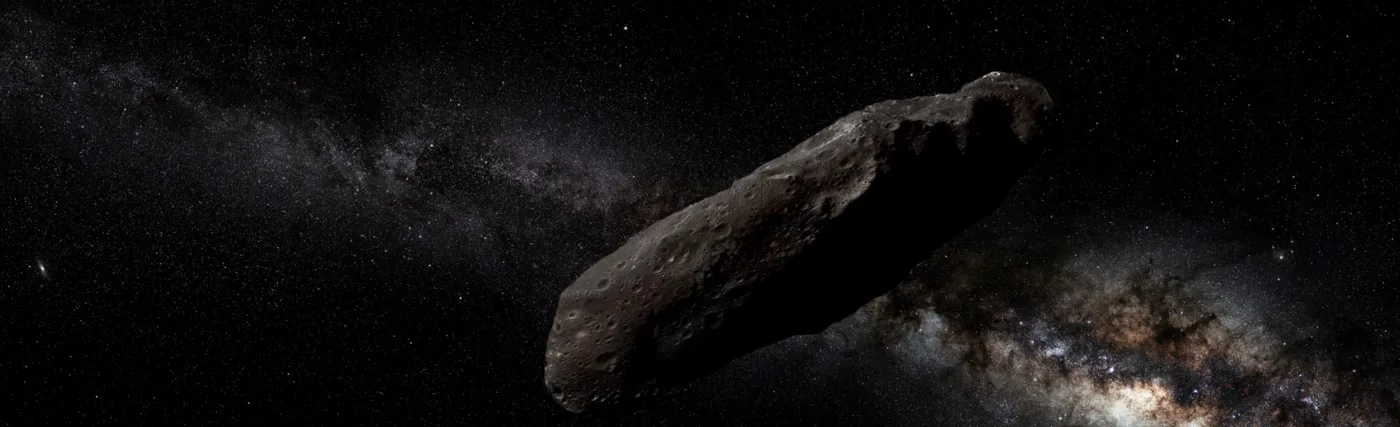
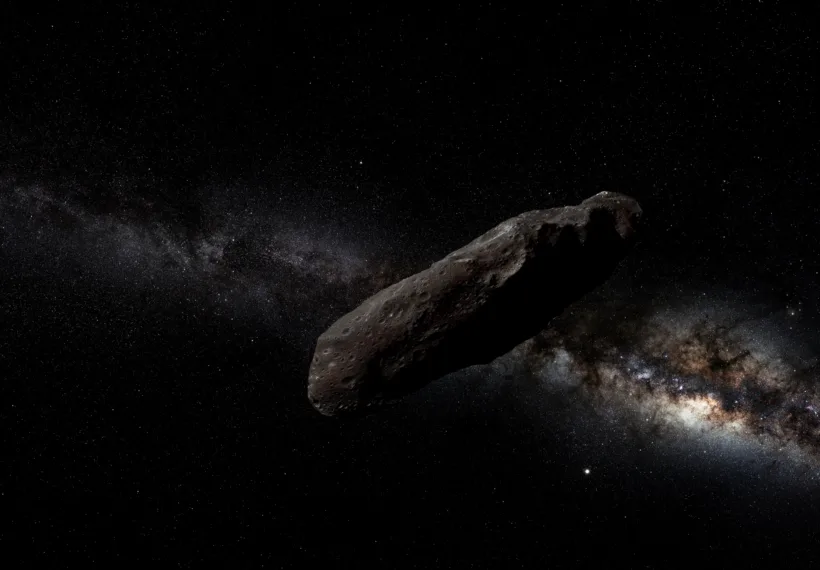
Why did Oumuamua, the first discovered interstellar object, accelerate faster than it should? Neil deGrasse Tyson and comic co-host Chuck Nice dive into the mysteries of the newest objects in the solar system: “dark comets” and interstellar objects with astrophysicist Darryl Seligman.
We kick things off by revisiting one of the most fascinating astronomical events of recent times: the discovery of Oumuamua in 2017. This interstellar object, detected by the Pan-STARRS telescope, left scientists baffled with its hyperbolic orbit, indicating it came from beyond our solar system and would never return. Learn how its unexplained acceleration expands our conventional understanding of celestial objects.
Darryl sheds light on the mysterious forces at play, from hydrogen ice sublimation to radiation pressure, that could be propelling Oumuamua. Discover how these anomalies might suggest a new category of “dark comets” that harbor icy material but evade detection due to their low albedo and lack of dust tails. We discuss how this could change how we detect and study such objects, potentially uncovering more interstellar visitors.
Plus, what role might dark comets play in our understanding of the origins of water on Earth? As we look ahead, the upcoming Vera Rubin Observatory promises to revolutionize our understanding of these enigmatic travelers by scanning the southern hemisphere’s sky with unprecedented precision. Learn about the Japanese Hayabusa II Mission to go to a dark comet. Darryl predicts a surge in interstellar discoveries that could expand our knowledge of these elusive objects and even hint at their role in delivering water to Earth. How might the discovery of more interstellar objects with the Vera Rubin Observatory impact our understanding of the solar system and the galaxy?
Thanks to our Patrons デーモン, Howard Chang, Kelly Houle, John Herron, Justin Hanson, Melshore Walker, Andrei L, JENNY JONES, Rebecca Fishow, Alin Simionoiu, Steve C, Johnathan Gregory, Jake Evans, Jim Shorts, Jessica Hudzik, William Komanetsky, and Thierry Querette for supporting us this week.
NOTE: StarTalk+ Patrons can listen to this entire episode commercial-free.
Transcript
DOWNLOAD SRTSo Chuck, I love havin spankin brand new PhDs come here as a guest.
Because we get spankin brand new information.
Yes, and to learn that there’s a whole new kind of object in the solar system, dark comets.
Yes.
I think he coined the phrase, too.
Yeah, well, not a doubt.
And of course, when you encounter a dark comet, you get superpowers.
Which we’ll think of.
Coming up, new information about what’s flyin around our solar system on StarTalk.
Welcome to StarTalk, your place in the universe where science and pop culture collide.
StarTalk begins right now.
This is StarTalk.
Neil deGrasse Tyson here, your personal astrophysicist.
Got Chuck Nice with me.
What’s up, Neil?
All right, man.
I hear you’re working on a stand-up special.
Yes, we are trying to sell it right now.
So if you’re at-
It’s all done.
It’s done.
If you’re at Amazon or Netflix, hi.
Okay.
Well, good luck with that.
Yeah, thanks.
Good luck with that.
So you know what we’re gonna talk about today.
What’s that?
Dark Comets.
Ooh, sounds like a Marvel movie.
I’m Dark Comet.
I’m Dark Comet.
I’ve seen the term, and I don’t know how they all define it.
Okay.
Because my specialty is like galaxies and cosmology and like, we’re going on in the solar system.
That’s too small for you.
No.
Comets.
Oh yeah, we can’t be bothered with comets, can we?
Dark Comet, we have one of the world’s experts on this subject, Darryl Seligman.
Darryl, welcome to StarTalk.
Thank you for having me.
Yeah.
So you are an assistant professor at Michigan State University?
Yeah, well, starting next year, I’ll be an assistant professor.
Right now, I’m an NSF fellow.
Oh, that’s between your PhD and your first tenure track job.
Yes, exactly.
So he’s brand new.
Wow, look at that.
Just birthed by the National Science Foundation.
Look at that.
So the National Science Foundation has what’s called a postdoctoral fellowship, where once you get your PhD, it’s money, you just do whatever the hell you want.
And it’s like freedom that wouldn’t otherwise be there if you immediately went right into academia.
So, Darryl, what was the title of your thesis, if you can remember it?
Because I barely remember the title of my thesis, because there’s a lot of words and a subtitle, but it’s about comets.
Well, it was actually about interstellar objects.
Interstellar objects.
Okay, well, let’s start there.
For the longest while, we presumed there was stuff flying between the stars.
That’s right.
But nobody ever saw one, because occasionally, you’d expect them to pay us a visit.
Or at least pass through.
That’s what I mean.
They’d just come in and go out.
And we’ve been looking for centuries.
Yeah.
And your main topic of study is something that doesn’t exist yet.
Oh, well, no, I was pretty lucky, because when I was a third-year graduate student, I was doing just pure fluid dynamics for astrophysics.
And then as a third-year graduate student, a muamua was discovered.
So just to be clear, so fluid to an astrophysicist is what?
A gas.
A gas, exactly, okay.
So liquids and gasses are both fluids to a physicist.
Right, right, okay.
So then why does a muamua have anything to do with fluid dynamics?
Well, it doesn’t have too much to do with fluid dynamics, to be honest, but it was such an exciting opportunity that we just kind of dropped everything else we were doing.
We dropped everything else we were doing, and we’re sort of working on that.
So I don’t know how closely you were following back in 2017, but it was one of the most exciting times for astronomy because basically this thing got discovered and it was also moving super fast.
So it was only observable for a couple of weeks from ground-based telescopes and then upwards of three or four weeks.
Would you expect it to be moving fast if it’s coming in from interstellar space?
Yes, you would expect it to be moving fast.
And why would it be faster than anything else?
So because the planets are all moving in the same direction around the sun, a Muamua comes in and it’s coming from a totally different direction, and then it looks like it’s moving really fast compared to our motion.
Because we’re going in opposite directions to each other.
Yeah.
Okay, got it, got it.
So Muamua, we found this thing, called it a Muamua, which sounds Hawaiian.
It does.
It is Hawaiian.
Was it discovered by a telescope in Hawaii?
So it was picked up by PANSTARS, which is a telescope in Hawaii that is funded by the Department of Defense, and they’re looking for near-earth objects.
So small kilometer scale objects that some of which, yes.
Small, yes.
It’ll knock you on your ass, but it’s a company.
Exactly.
So some of those objects are potentially hazardous.
So it’s very important that we find them with ample time to do something if…
If they’re gonna hit us?
Exactly.
Ample time to kiss your ass.
But you need enough time to get that out of the way.
So it seems to me, from what you say, PanStars had no expectation of finding interstellar objects, but it has the ability to do so regardless.
Is that a fair statement?
Well, that is true, but I think they originally designed PanStars hoping to find interstellar objects, because for the last couple of decades, I mean, we know the solar system has ejected a good amount of material in interstellar objects, so it’s not much of a stretch to imagine that other planetary systems would also be ejecting material, and we would see them, and the only difference is you just see a small body, but it comes across the night sky and looks hyperbolic.
But the fact that we hadn’t seen any, we were trying to put limits on the number of them in the galaxy based on not seeing any, but the hope was that PanStars would find one.
Right, so if you don’t see any for a certain amount of time, you can say, there can’t be more than this number, otherwise we would have seen it, statistically.
Yes, that’s exactly right.
Now you said it was hyperbolic, tell me what you mean there.
Because some people are hyperbolic.
A different sense of the word, hyperbolic.
Yes, so it’s the flavor flavor of comics, of comics.
We knew it was hyperbolic because it was like, yeah boy!
So it came into the solar system and left, and it’s never coming back.
Because hyperbolic means that its orbit is not bound to the sun.
Got it.
So everybody else has an orbit that is bound to the sun.
That’s right.
So it had to be like a circle or an ellipse.
Right, okay.
So these comics that we see every once in a while, like a Halley’s, right?
So that’s bound to the sun.
That’s why we see them every once in a while, because they’re going around and coming back.
That’s exactly right.
It’s like 170, 76 years.
So you’ve only seen that once.
Why you gotta do that to my life?
Because I ain’t living to 152.
Come on.
Cut a brother a break.
You will not be 152 years old.
I know I have hypertension, but damn.
Just saying.
Yeah.
So hyperbolic.
So that would be the best evidence that it was not a member of the solar system, because comics are coming in from far away all the time.
That’s right.
So why isn’t it just an asteroid?
Why do you know it’s a comet?
So there is kind of a continuum between comets and asteroids.
Uh-oh.
So now we, okay.
So now we get into word issues.
That’s right.
Word definitions.
Uh-oh.
Yeah.
So the things that formed at large distances from the sun, they have ice in them.
Which hasn’t evaporated away.
Exactly.
Over the years.
Eons, yeah.
Exactly.
So when that, a comet gets close to the sun, the ice will heat up and sublimate, producing a dust tail.
And that produces a bright, beautiful cometary tail.
I can’t say evaporate.
Yeah, can’t say.
Right, it’s sublimates.
Sublimates gotta use the real word.
Of course, yes.
To regular folk, it’s just, it’s evaporating.
Yeah, exactly, but no.
Sublimates, remind us what sublimates means.
So that is when the ice, well, not just in a comet, but when ice transitions straight to the gas form.
Straight away, without nothing in between.
Yeah, so, they call it dry ice.
Oh, okay.
That just smokes away.
That, right.
You’ve never seen liquid dry ice, have you?
No, you haven’t.
Right.
It goes right to the, and now, ladies and gentlemen, coming to the stage.
It goes straight from the ice to the smoke.
To the smoke.
Yeah, in fact, if you have an ice tray in your freezer, you go away on a long vacation and come back, the ice cubes are littler.
Yeah.
Have you ever checked this out?
I have seen that.
Yeah, you see them, they shrink up inside the actual tray.
Yeah, they’re actually sublimating.
Okay, so keep going.
I interrupted you.
We’re distinguishing between on the continuum of asteroids and comets.
Right.
We expected that the interstellar objects that get ejected from other planetary systems, that they most likely would have formed at large distances and then had a lot of ice in them.
So we’d expect them to be comets.
Is that because if they form at a large distance, they’re not strongly held by the gravity of their host star?
Yeah.
So they can be knocked off?
That’s exactly right.
Okay.
And if they form at a far distances, then they haven’t been close enough to their host stars for the ice to lose the ice.
Yeah.
So you get a double force going there.
So may I ask if they are forming at such large distances from their host star, what happens to get them to be kicked out so that they’re now slingshotted out into, hey, I see you.
I’m on my way.
Yeah.
No, that’s a great question.
So and it’s a good question because we also don’t know the answer.
Stop asking a guest questions he can’t answer, Chuck.
But the most likely thing is you basically have something like a deep space maneuver for a spacecraft where you slingshot off of a planet, but you have that with something as big as Jupiter.
We have their version of a Jupiter.
Yeah, their version of a Jupiter.
So something with Jupiter’s mass at around five astronomical units.
Then if you get, if a small body gets close to that planet, it could get slingshot out.
So Jupiter is like a proxy sun, or a Jupiter type.
It acts like it would be the sun.
Well, it messes with the orbits of things that go by.
It’s more like when you get close to Jupiter, you start feeling its gravitational influence much more than the sun, and then that will change your orbit.
Gotcha, gotcha.
Okay, now I get it, I get it, I get it.
Jupiter intervenes.
Intervene, that’s right.
But also, presumably, given enough time, this other star system may get tugged on by other stars that happen to wander too close.
Yes, that’s exactly right.
That it also can happen.
Okay, so again, why are you thinking this was a comet instead of an asteroid?
So, Oumuamua, in every way we expected, acted the exact opposite.
So, the biggest thing was it had no cometary tail whatsoever.
So then, why call it a comet at all?
Well, then it was initially called a comet because they made a mistake, actually, at the Minor Planet Center.
Then they changed it to say that it was an asteroid, because it looked inactive, which means that it doesn’t look like a comet because it doesn’t look like it has a tail.
It doesn’t reveal fluff.
That’s exactly right.
But then, we realized as we were trying to get follow-up observations with the Hubble Space Telescope and the Spitzer Space Telescope that the object had a non-gravitational acceleration.
So, Spitzer specializes in infrared, if I remember correctly.
Yes, that’s exactly right.
Okay, good.
So, you want to combine different tools out of the toolkit of the observational astronomer to see it in as many ways as you can.
Yeah.
Okay.
And Spitzer is really great, like looking in the infrared is really great for comet science, for some of the same reasons you use it for things like exoplanets, but because you can see typical cometary gases like CO2 and CO that you wouldn’t be able to see from the ground.
So, Spitzer named for Lyman Spitzer.
Oh, okay.
Former chair of the astrophysics group at Princeton University.
And I have one of his books on the show.
I was going to say, you sound like you know him.
So, I keep interrupting you.
That’s okay.
Keep going.
Go.
Essentially, it had this non-gravitational acceleration, but no apparent dust coma.
And then an important point is that these non-gravitational accelerations, we see them on.
So, first of all, what that means is that the object, you look over time at its position in the sky, and then you figure out its orbit, and then you realize that its orbit could not be explained just from the sun’s gravitational influence.
So, there must be an additional force acting on it.
And we measure that.
That’s what you mean by non-gravitational.
That’s what I mean by non-gravitational.
So, we measure that in comets all of the time.
So, there are many comets with non-grav, and I might even slip up and just call them non-gravs, but these non-gravs have been measured, and that’s happening because as that ice sublimates, it produces like a rocket-type recoil effect.
Okay.
So, every little bitty jetty thing that comes off, that’s a force operating on its trajectory.
Yes, that’s exactly right.
So, that alone is not unusual or uncommon.
That alone is not uncommon.
But it didn’t have any fuzz.
That’s right, exactly.
And you want there to be fuzz if you’re gonna be non-gravitational.
That’s right.
So, you’re in a conundrum.
Yes, and there is another kind of important point, which is that you will also see asteroids accelerating non-gravitationally.
It’s just that their non-gravitational accelerations, for example, they can be caused by solar pressure, radiation pressure, they’re much, much weaker.
So, a Muamua’s non-gravitational acceleration, the weird thing is not that it had one, and it’s that it had one with no dust coma, but it was much stronger than those that could be operating on an asteroid.
So, because I think asteroids, many of them are very dark, so that they would absorb sunlight.
Yes.
And that if you were absorbing momentum of photons.
So, it’s like a solar sail at that point.
Oh, yeah.
Well, the solar sail would reflect light.
But in either case, the light pressure is acting on the system.
Okay, so it’s a nice conundrum.
And by the way, because I’m a big reader of the history of science.
Why wouldn’t you have a conundrum for an object that has never been detected before?
Yes.
A class of object that we’ve never seen.
Yes.
Why wouldn’t it be filled with things that That don’t make sense.
That don’t make sense.
Well, it basically made me think like, I am really grateful for a Muamua because I feel like a Muamua, if you look back for the last couple of decades, it was the most intensely studied small body over a very short period of time.
So there were something like 700 and something observations over the span of a couple of weeks, just of this one object.
It’s evidence of how unusual it was.
Right.
But because of that and because we then had to point Spitzer and Hubble at it, we then had to get the trajectory really, really accurate.
And then we noticed this non-gravitational acceleration.
So it made me think, maybe there are just these other objects in the solar system that are doing the same thing.
It’s just we had never noticed them before because how do you detect comets?
You see their cometary tails.
You don’t see the non-gravitational accelerations are actually dark comet.
Yes.
There we go.
Is there a consensus?
Because we’re now eight years into it, right?
So you should know something by now.
So I would say that, well, I would like to say that me and Jenny Bergner’s recent theory about a muamua is the consensus, but unfortunately, there are a lot of theories.
When Einstein had a theory, you had a hypothesis.
We had a hypothesis, yes.
So say that again.
Neil gets very touchy about his theories and hypothesis.
Okay?
Fair enough, I respect that.
You’re in my office, here in the Hayden Planetarium, in human natural history.
You’re gonna say it right, okay?
You’re in very good company, by the way, of people who are like, no, you have a hypothesis.
Okay, go ahead.
So Jenny Berger and I have this recent hypothesis.
This is a collaborator.
A collaborator of mine who’s a professor at Berkeley.
Essentially, a muamua was similar to a dark comet.
The acceleration was driven by the outgassing of volatile, ice-like material, but it just had very little dust coma, and that’s why we didn’t see the dust coma for whatever reason.
Okay, so that would explain it.
Yes, that would explain it.
A little bit after the fact, it’d be better if you had predicted that such a thing would exist, but now you’re just forced to sort of clooge an answer, which sounds plausible, but have others followed behind it?
So there’s a lot of argument about what the type of volatile that was driving it.
Explain to people what volatile is, because any normal person thinks if something’s volatile, it means it’ll burst into flames.
So geologists have a whole separate usage of the term, so catch us up on that.
Yeah, it just is about what type of ice could be driving the acceleration.
So a volatile thing is what?
Something that has ice in it.
Oh, only that?
I thought it just…
When I say volatiles, I just mean ice is basically, because when you put them in space, they will sublimate.
Okay, so I thought anything that can turn to gas is volatile.
Is that not true?
That is technically true.
Water in space is volatile?
Yes, so water in its ice phase is what I mean by volatiles.
Okay, and you wouldn’t find a swimming pool of liquid water out there anyway.
Got it, okay.
So in practice, it all starts as ice.
It’s ice that can sublimate.
Yes, yes.
These are your volatiles.
Ice of any kind, not just water ice, but ammonia ice, I guess, maybe some more.
CO2 ice, dry ice, water ice.
CO2, CO, nitrogen.
Nitrogen ice, okay.
Yeah, so they have that on Pluto.
So there is nitrogen ice on Pluto.
So to back it up, essentially in the Solar System Comets, the primary driver of activity, the main thing you see is water ice.
And then you also see CO2 and CO, which is carbon dioxide and carbon monoxide.
So those are the typical ones.
But with the Muamua Spitzer, the reason they looked at that is you would identify CO2 and CO.
Because those have spectral signatures in the infrared, with Spitzer especially capable of detecting it, in ways that Hubble would not be able to.
That’s right.
So another issue is that without getting too much in the details, essentially water could not be providing the acceleration.
Because there was not enough energy from the sun.
To sublimate the water.
Yeah, that’s right.
Sublimate enough water to provide enough push to get the acceleration.
But a much better accelerant is hydrogen.
So our hypothesis, not theory.
He thought about it too.
He was like, so Howard, I’m going to say it because I’m here.
Okay.
The hypothesis is that there was water ice in Oumuamua, but then as it travels through the interstellar medium, it’s exposed to these very high energy particles called cosmic rays, and that will break down some water and trap hydrogen in there.
And then as the ice heats up, as Oumuamua comes through the solar system, it will just gently release this trapped hydrogen.
Which has a greater impulse to accelerate the object than just evaporating water would.
That’s right.
So it’s both the fact that hydrogen is a lot lighter than water, but also it takes much less energy to sublimate hydrogen than water.
Wow.
Okay.
So, but you said there’s nearly a thousand papers on this object, and you’re saying, but you and your colleague have this hypothesis.
Right.
Are you lone wolves out there?
No, no, no.
So essentially, it comes down to, can you, can a hypothesis explain all of these mysterious properties?
Another thing is you could have the acceleration driven by radiation pressure.
It’s just, for that to work, it would have to be ultra thin or ultra low density.
So, Amai Amora Martin at Space Telescope has this idea that it was an ultra low density fractal aggregate, which basically means it’s a very large snowflake.
So it’s large but very low density.
That’s right.
Right, so there’s a lot of…
So you can push it.
That’s right.
You can push it.
Yeah.
That’s right.
So the solar photons, which very subtly push asteroids, could subtly push this thing.
So because it’s not harder, because it doesn’t have a orbital companion, there’s no way you can know the mass of this thing.
You have to make assumptions about it.
So yes, that’s totally right.
Yes.
That is a detail that I intentionally swept under the rug, but yes.
No, this rug here is clean.
All right.
So is that the betting person’s explanation?
The way to test this was, is there another one of these objects?
And I seem to remember there was.
Yeah.
So there was another one, another interstellar object, but this was 2I Borisov.
So that was detected in 2019.
And that was very clearly a comet.
So that had a big dust tail.
Okay.
But the exciting thing is that the Vera Rubin Observatory and LSST, which I’ll probably refer to it as, is coming online just next year.
Vera Rubin, another astrophysicist, died a few years back.
She discovered dark matter in galaxies back in the 70s.
So we named a whole observatory after her.
And this is an observatory unlike any other, in what important way?
Right, so it is coming online right now at the beginning of next year.
That would be 2025.
2025, right.
What’s the observatory gonna do?
So it’s going to observe the entire Southern Hemisphere almost every night.
So it’ll be like Pan-Stars now, which is in the Northern Hemisphere.
But it’ll look almost every night to see anything moving in the sky.
But it goes almost five orders of magnitude more sensitive than Pan-Stars.
So five powers of 10.
Yeah, so we’ll be finding many more moving objects in the solar system.
We should be finding many more interstellar objects.
I think people don’t appreciate that if you just go to a telescope and get images and bring them home, you don’t know if anything is moving on that image.
Right.
You got to get it over a period of time.
Basically, snapshots.
You need exactly those kind of data to see if something goes bump in the night.
That’s right.
So the Rubin telescope should blow open the whole field.
Yes, absolutely.
Got you.
Wow, that’s pretty cool.
So it’s pretty exciting.
It is.
Are there any other explanations for this?
Aliens.
Come on, guys.
Why are we trying to act like we’re not going to talk about the elephant in the room?
That’s the easiest explanation.
But it’s got to be, right?
Like ever.
Or ancient astronauts or something.
So I feel a little jealous, because if Amuamua got kicked out of some other solar system, star system, and we’re a star system, red-blooded star system, we ought to have some Amuamua’s of our own.
I’ve been kicked out of better star systems than this.
Yeah.
Essentially, in the last couple of years, since Amuamua, we’ve discovered these seven objects within the solar system, which are near earth objects, actually, which is what Amuamua was initially.
They thought it was a neo?
They thought it was a neo, that’s right.
You’re picking up on the abbreviation also.
So they thought it was a near earth object.
So these are near earth objects, which are bound to the solar system, unlike Amuamua.
So they have elliptical orbit, not hyperbolic orbit.
That’s correct.
We discovered significant non-gravitational accelerations on all seven of these objects, which are also inactive, which means that they don’t have comet-like tails.
Oh, okay.
So therefore, you can’t credit the normal comet for that non-gravitational outgassing.
That’s right.
But the accelerations we found on these Dark Comets, I mean, Dark Comets is just a name I made up.
I think people like it, but…
How could you not?
So these objects, essentially, their non-gravitational accelerations are too strong to be explained by the, similar to Oumuamua, the accelerations you see on other asteroids.
So, we have the hypothesis…
That’s awesome.
That’s awesome.
We have the hypothesis that these objects are like comets and that they have icy material in them, even though they are close to the sun and have been there for a long time.
But they are, for whatever reason, not producing a large dust coma.
Could you have a layer of something other than ice that encases ice within it?
So that prevents a full up exposure to sun’s energy?
Yeah, absolutely.
That was an idea that I wrote a paper on that could have, for a mua mua, like the interstellar medium, the cosmic rays basically could have produced an insulating shell around it that could have prevented outgassing, but that was before we knew that the non-gravitational acceleration was there.
Right, so just to repeat what I think you said, you have an object that’s icy, has volatile ises, but cosmic rays basically turn the outermost layer of that ice into an insulating crust.
Yeah, that’s right.
Because the water molecule gets broken, and now it’s no longer frozen water, it’s just hydrogen and oxygen.
What happens to the oxygen?
Essentially, well, it depends where it is.
Like in the idea that Jenny Berger and I had, hydrogen and oxygen would be entrapped within the ice.
But separately, from each other?
Yes, separately from each other.
But this is more like you can create a kind of tar-like material on the, it’s kind of like asphalt, almost.
But that’s not what happened.
So then what?
Yes.
So where’d you get your carbon?
Oh, it would have been there originally.
Okay, well, and you get that in the CO2 or the CO, and carbon is not rare in the universe.
This is cool, so.
But then how’s it re-released then?
Because you insulated it, but then…
The one thing is, I was gonna say, though, is that that certainly is not what happened to Omumu’o, because I wrote that, it took, like, it was discovered in October, and then it was May when The Acceleration was published, so I wrote a paper before The Acceleration was published that explained it like that, and that’s, I was certainly wrong about that.
It’s just that what I was saying was that…
How many branches of life?
You gotta love it.
You gotta love it.
You gotta love to say, I was wrong.
Yeah, well, listen, that’s what makes science so great.
It’s like, we’re right today, we’re not tomorrow, we’re right tomorrow about what we weren’t today.
What did you just say?
It sounded good, I think it was.
No, but just to be clear, we don’t always say we’re wrong about things that have been objectively shown to be true.
When I say, oh, E equals actually equals MC cubed, we didn’t know, who knew?
It was MC squared, we’re good there.
And so if you’re in mid hypothesis, and it’s being tested, that can come and go.
And if you’re first out of the box with an idea, that’s highly susceptible to later data that shows up.
But nothing better than you yourself.
Correct.
Making that adjustment or correction.
That’s right.
Than somebody else coming along and going, yeah, guess what, man, you’re a dumb ass.
This is the way it works.
The official science term.
Yeah, that’s super cool, man.
Well, I guess one thing is that these non-gravitational accelerators, like you were asking why hadn’t we seen them before in the solar system?
So they’re very difficult to detect.
And so with the Dark Comets, it’s been, most of them have been known about.
There’s one that I’ve been known about for more than 20 years.
It’s just people have been monitoring it for 20 plus years, trying to get the, trying to measure the position.
And we finally noticed.
So Davide Farnukia at NASA JPL basically has to figure out the trajectories of all the bodies in the solar system and include it in the fits for those non-gravitational accelerations.
So there’s kind of people all over the world who are monitoring objects that we know of and seeing if any of them could be potentially hazardous.
So you use the term to fit for it.
What you mean, I think, is if it’s pure gravitational, there’s a formula where you can forever predict the future trajectory.
But if you’re not fitting the future trajectory, you have to fit it some other way mathematically.
Right.
And so you add these other terms that you think you understand.
Yeah.
And you also, I mean, you does it numerically just with a supercomputer, but you basically try all different types of accelerations.
Numerically means you can’t do it analytically.
Every step has to have a computation that gives you a position in the trajectory.
That’s hard.
Whereas if it’s analytic, you can just run the formula and it’ll get you the whole way.
It’s both effective, but one of them admits that we don’t fully know the physics of what’s going on, so we have to fit the model, fit a model to it.
So with the hydrogen and oxygen and comets and all of this, does this affect anybody’s sense of where the water on Earth came from?
Right.
Yeah, so this is also kind of based on this student who’s been working with me, who’s just starting, just started this last year.
You just got out of graduate school.
You got students already.
Good for you, man, I love it.
Man.
So that’s Aster Taylor, who had a paper published that discussed the possibility that dark comets could have brought water to the Earth.
More so than other comets?
Well, people used to think that comets delivered water to the Earth, and we still don’t know where the Earth’s oceans came from.
And part of the reason that we’re now not sure if comets delivered the water is because we have spacecraft measurements of water in comets, like the Rosetta mission went to 67P, and some of the isotopes, which is some of the things about the water in that comet did not match that that we’ve measured in the Earth’s oceans.
This would be deuterium, I guess, right?
Yes, so that’s one of them.
So the deuterium to hydrogen ratio.
Yeah, so hydrogen is just one proton in the nucleus, and the protons define what we label the element to be.
So now you throw in a neutron.
Okay.
It’s still hydrogen, but now it’s like a little heavier.
Right, so you can’t just, it’s gotta be hydrogen, something else.
Something’s gotta be, you gotta do something with the main.
Right, and so we call it deuterium.
How stable is deuterium?
Well, it’s not that it’s stable, it’s just the important thing is that the amount of deuterium compared to hydrogen isn’t going to change from processing.
And it depends very critically at the temperature of formation.
It won’t change chemically.
Right.
So if the comet doesn’t match that in the oceans, you can’t credit the comet for delivery.
That’s correct.
So we don’t know for sure, and Aster was very careful to say this in the press releases and news articles about their paper, but we can’t say for sure that Dark Comets could have contributed water to the earth, but they are a new, entirely new population of small bodies that are in the new source, potential source.
They’re in the vicinity of the earth and they potentially have volatiles.
So we would need follow-up observations to figure out if they match up, but the Hayabusa 2 mission, the JAXA space agency mission.
JAXA, Japanese exploration agency?
Yeah, it’s basically Japanese NASA, but their Hayabusa 2 mission.
It’s JAXA.
Not NASA, but JAXA.
I’m sorry, that just sounds very racist.
NASA came first, Drew.
This is America.
Listen, I don’t have a problem with it.
So their Hayabusa 2 mission, in the extended mission, it just so happens is going to a dark comet.
So in 2031, we’re gonna have…
That’ll blow it open.
It might, well, it’s at least going to rendezvous with it, but we’ll have enough sensitivity to measure things like outgassing or dust if it’s there.
So at the very least, the worst-case scenario, we’re gonna have an answer to all this in 2031.
Now literally, comets are dark, even when they don’t satisfy your definition, right?
We think of them as these white things moving through space, but their material is very dirty.
How reflective is a comet?
Well, it’s difficult to say because you don’t always see, most of the time you don’t even detect the nucleus or the rocky part of the comet.
You just see the tail.
But asteroids, for example, like asteroids typically have albedo is the word we use in science, but that’s how reflective they are.
So albedo is between something like 0.04 to 0.1, which is like 10-ish percent.
That’s black.
Yes.
That’s black.
Okay.
Yeah, albedo is between zero and one.
If it’s one, it’s like a mirror.
Right.
If I remember, the moon is about 7% albedo.
Okay.
And what is Pluto?
So there are parts of Pluto, like there’s a glacier of nitrogen or nitrogen ice, actually, and that has an albedo upwards of like 90%.
Oh, wow.
So it’s very reflective.
So it’d be a bright spot if you look at it.
Oh, you know, I read an article once that was talking about another reason why Pluto is in the planet is because it reflects so much that it makes it look much bigger than it actually is.
Well, initially, I think that would have thrown off our measurements.
Right.
But now we got up close and personal.
Yeah, well, now we’ve been there now.
Yeah, we’ve been there now.
We’ve been there, done that.
So what’s in the future of what you’re up to?
So the Rubin Observatory is the most exciting thing, but it should be finding upwards of tens per year interstellar objects.
Yeah, but this will be serendipitous.
You can’t say, go look at this object or look here and discover an object.
You’re waiting for the data to come to you or to you.
But also Rubin should better characterize the orbits of all of the known small bodies in the solar system and find a bunch of much smaller ones.
So given that we have kind of just hit the tip of the iceberg in terms of finding these dark comets, I would bet that we’re gonna find many, many more dark comets than subtle non-gravitational accelerations.
So that could kind of revolutionize how we think of even comets and asteroids.
All right, cool.
Wow, look at you.
Cool, what’s especially delightful to learn is that you are entering a field right when an important telescope that feeds that field will be coming online.
Yes, you’re going to have so much data.
Oh, yeah, in fact, tell them how much data is coming off of the Rubin telescope.
Yeah, it’s a huge amount.
It’s like, can you be quantitative, please?
Tell Chuck how much, huge.
I just don’t want to say it wrong.
Oh, good.
Because I don’t know.
Yes, not only knowing what you don’t know, it’s knowing if you don’t think you know something.
So, last I checked, it was 20 terabytes of data a day.
That’s crazy.
A day.
That’s a lot.
And you’re right, though.
It’s huge.
Yeah.
It’s huge.
Yeah, I mean, a big worry is the interstellar objects.
I mean, Muamua was actually moving pretty slow.
So, if they’re moving much faster, we might not even link them.
So, we have to figure out computer algorithms so that in that data, we could find fast-moving interstellar objects and potentially dark comets.
Because they’ve gone too far from one image to the next.
So that our biases prevent us from connecting the dots.
Literally, your computational algorithm to connect things doesn’t find it.
And another thing is, you asked about…
You can’t discover something your algorithm doesn’t know to look for.
And then these dark comets, I mean, Muamua revealed that it had a non-gravitational acceleration, but we weren’t looking for strong accelerations on things that had no commentary tail.
So, if something has a way stronger non-gravitational acceleration than even a Muamua, we would never link it up.
So, we have to basically make, and an exciting thing, right, with these interstellar objects, they come and leave and they’re never coming back.
So, to follow them up, you have to find them in real time.
So, it’s actually, there’s a huge amount of effort right now that we’re working on trying to make sure that we do find anything exciting so that we can get the follow up.
That makes sense, because if you miss it, you missed it.
Yes, exactly.
Period, it’s gone.
Well, I like the idea of an entire new class of object in the solar system that had eluded our algorithms and our telescopes.
That’s because they’re aliens.
So, Darryl, this has been delightful and enlightening.
And thanks for catching me up on the latest.
Super cool stuff.
Thank you.
Let me see if I can wrap this up in a bow.
What intrigues me most about science in general, especially in my field, is we recognize, we admit, we confess that all we know of the universe is that which our methods, tools, tactics and telescopes reveal to us.
But at no time should we ever think this is all there is.
We once thought that when all we had was our five senses, no one could imagine that anything would, could or should exist outside of your five senses until the microscope, the telescope, both invented around the same time, broadened our sense and understanding of what actually exists in the universe.
That continues to this day.
And every new bit of technology, every creative thought associated with those new technologies brings new objects, new phenomena into the portfolio of what makes this universe.
And all of that contributes to the majesty of not only what the universe is, but what the universe will become to us as we continue to explore.
And that is the Cosmic Perspective.
Darryl, be good man.
Thank you.
And we look forward to many fruitful discoveries.
When you get some good data from Ruben, you come back.
And we’ll talk about it.
All right, Neil deGrasse Tyson, your personal astrophysicist.
Keep looking up.


 Become a Patron