


 Unlock with Patreon
About This Episode
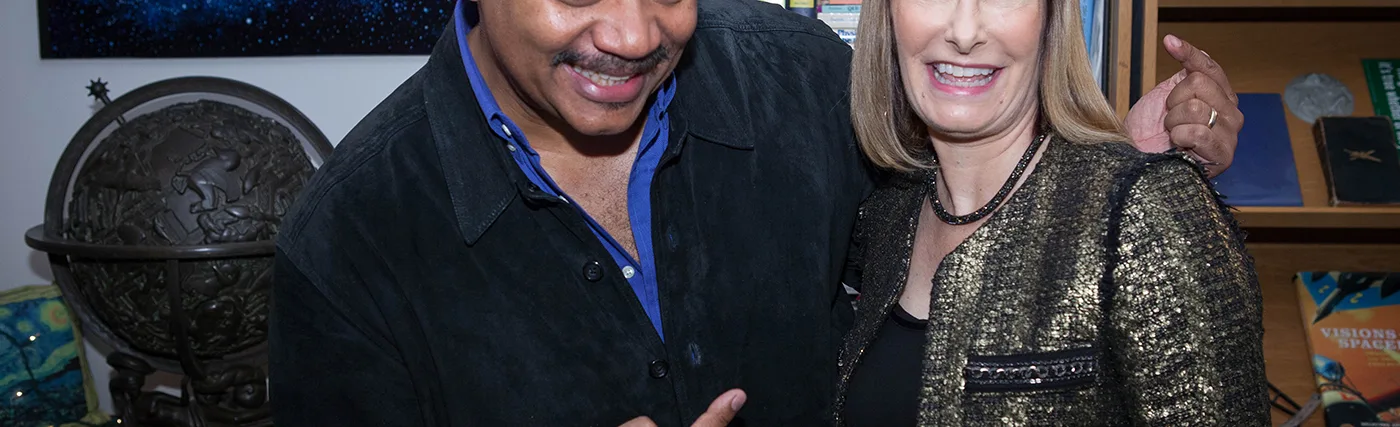
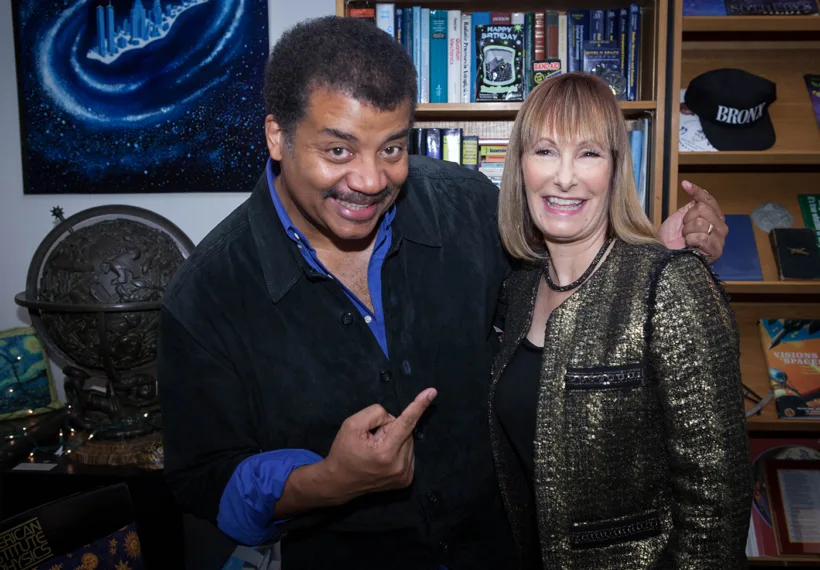
The Terminator, The Walking Dead, Aliens, and a lot more. Those are just some of the producing credits for this week’s main guest on StarTalk Radio. Neil deGrasse Tyson sits down with producer-extraordinaire Gale Anne Hurd to explore what it takes to bring great science fiction to life. Neil is joined by comic co-host Chuck Nice, science fiction expert Jason Ellis, PhD, and volcanologist Janine Krippner, PhD.
Because science fiction comes in many different forms and through many different avenues, there are many ways to get into it. You’ll learn how Gale’s childhood love of Marvel comic books and science fiction novels translated into a career “making what she likes to see.” She tells us how she served as a science fiction consultant to her local library to make sure their stock was up to date. Jason shares why not being able to see Star Wars in the theater sparked a rebellious love for science fiction.
You’ll hear about the history of science fiction and how it combines the STEM fields and the humanities. We debate if science fiction informs the future of every technological invention. You’ll find out about a lawsuit H.G Wells brought upon military figureheads because he claimed they stole his idea from one of his science fiction stories. Explore using science fiction as social commentary. Discover more about the famous kiss between Captain Kirk and Lt. Uhura, and how William Shatner and Nichelle Nichols purposely flubbed takes to make sure it stayed in the episode.
We take a deep dive into Dante’s Peak as volcanologist Janine Krippner stops by to share her take on the film. She explains why she thinks it’s still the best volcano movie even with its flaws. Gale gives us a behind-the-scenes look on how she fought for even more scientific realism to be in the film but encountered pushback from the studio. Neil also confronts Gale on the famous scientific inaccuracies of Armageddon. Chuck shares his love for The Expanse, we discuss Interstellar, and Neil tells us about his involvement in The Europa Report.
Lastly, you’ll also find out the differences between creating science fiction for television and film. According to Hugo Gernsback, the father of science fiction, sci-fi should be 75% romance and 25% science – is that still the goal? All that, plus, Jason caps it off with a story on how he was criticizing the film Sunshine right in front of director Danny Boyle’s family.
NOTE: All-Access subscribers can watch or listen to this entire episode commercial-free here: Creating Science Fiction, with Gale Anne Hurd.
Transcript
DOWNLOAD SRTFrom the American Museum of Natural History in New York City, and beaming out across all of space and time.
This is StarTalk.
I’m your host, Neil deGrasse Tyson.
You’re a personal astrophysicist.
And today, we are talking about sci-fi in literature and in movies.
I got with me my co-host, Chuck Nice.
Hey, Neil.
So Chuck, we have between us, Jason Ellis, who’s an assistant professor of English at New York City College of Technology, City Tech, we call it.
And you teach a course on science fiction.
That’s right.
They didn’t do that when I was in school.
There were no courses on science fiction.
We were learning all these folks, they were all dead and talking about a time and a way with no way understood.
Yeah, they were like, no, it’s about real science.
Okay, you have to, you don’t even know real science.
You have to know that before you can, do you have to know real science before you write science fiction?
We’re getting there, Chuck.
We had a whole show, Chuck.
We let it happen organically, Chuck.
Okay, so we’re talking about this relationship and we’re featuring my interview with Gale Anne Hurd.
Gale Anne Hurd, if you, I’m a credit watcher at the end of shows, I don’t know if you were.
You’re one of those people.
On TV it’s hard because they roll the good one.
In the movies?
In the movies.
I’m the last one out and they’re asking me get the hell out, okay?
Let me tell you something, people who make films love you because that is the ultimate sign of respect.
And you, as you know.
Is to sit and read the credits at the end of a film.
Right on down to who supplied the food.
Right.
The food truck.
Craft services by, you know, Reggie.
Reggie and son.
And so you teach a course on science fiction and as I understand this, you curate their science fiction library.
That’s right.
We got a donation of over 600 linear feet of materials, including 4,000 magazines.
You’re measuring books by feet.
Right, if you think of like a standard shelf as three feet wide, I mean 600 feet long, that’s a lot of books.
That’s a lot of books, dude.
And so you’re the man for that stash.
I help coordinate it with the library, but it’s a really tremendous resource that we have now.
And a lot of science fiction first appears in magazines, if I remember correctly, is that correct?
That’s right.
More so in the past than today, but certainly it’s a very vibrant publishing industry in science fiction magazines now.
Like Astounding Science Fiction’s having their 90th anniversary this year.
Astounding Science Fiction’s 90th anniversary.
Wow.
So Gale Anne Hurd is a producer, and I think her first day on the block was The Terminator.
Good movie to start out on, start your career.
What a baptism that is.
Did the whole trilogy.
She’s got Armageddon under her belt.
But don’t get me started.
That movie violates more laws of physics per minute than any other movie that has ever been made.
I love it.
So did Dante’s Peak.
So these are films that are different branches of science.
Dante’s Peak of course is a volcanoes.
Also did of course The Walking Dead for television.
Wow.
So science fiction, science fantasy.
And so when did you first get into science fiction?
Because you’re an academic professional at it.
Right.
I guess I’ve had a lot of-
A lot of academics, it’s something from childhood.
It is, it is for me too.
My first like strong memory I remember is when I was three years old, watching-
Three?
Three years old.
Nice.
I remember from back when I was three.
It’s like probably the only thing I remember from back then, but it was like burned on my brain.
I’ve seen the Millennium Falcon deftly maneuvering between the asteroids in a trailer for The Empire Strikes Back when it first came out.
And it was playing the drive in.
My folks saying, no, we’re not going to drive in to see that.
And so it was this tension of the desire to see this fantastic spectacle on the screen and being told I couldn’t.
So then on, so you got imprinted.
Yes, and it’s something that stuck with me throughout the years.
Since then, all right, all right.
Did you ever get to see Star Wars?
I’ve seen it hundreds, thousands of times, probably.
So did you, was it the, which medium were you most enchanted by, the film, TV, or?
It was primarily film, originally.
And then, you know, television became a part of it later on.
And I didn’t get into, like, reading science fiction until I was a teenager.
Until you learned how to read.
Well, I had to learn how to read first, but.
Yeah, happened a little after three.
Just a few months.
But it was strange for me to get into reading science fiction because I originally, you really enjoyed reading science popularizations.
Like, you know, Einstein’s Relativity, Stephen Hawking’s A Brief History of Time, Mirror Matter, other books like that.
You know, Carl Sagan, his works.
And it was one of my friends, Marty Magden, Boy Scouts.
So popular non-fiction science.
What you’re talking about.
Who worked at the local Barnes and Noble.
I was having him order new books once the library was out of stuff that I could read.
And he said, you know, Jason, you ought to try out science fiction.
And so he introduced me to Asimov and Bradbury and Clark and got me into reading it.
It’s the Trinity.
Yeah.
Three of the early grandmasters, yeah.
Uh-huh.
Okay, very cool.
Very cool.
Early, dude.
So of course I had to know how Gale Anne Hurd got interested in this.
And so let’s check it out.
So I’m looking at this filmography and it has very strong overlap with the geekosphere.
I am.
I’m a geek, I’m a nerd.
Before there were words to describe it.
Were you a girl nerd?
Oh my God, yes.
Are you kidding?
Oh my gosh.
So how early did this manifest?
I started reading comic books when I was six.
And I mean, this is how geeky I am, all right?
But I don’t think girls did back then.
I looked at the ads and the back was all for guys.
No.
No, but I loved them all and I would admit I was a Marvel girl.
Guilty as charged.
And then I graduated into science fiction novels.
Both, YA, which YA didn’t exist back then.
It wasn’t its own category, really.
No, it was still children’s, children’s books.
And I became so obsessed with it that I actually advised the local library, this is Palm Springs, California, and suggested what books they should acquire in science fiction fantasy.
You were out ahead of the librarians.
And then I started writing book reviews and predominantly about science fiction fantasy and art.
You know, people who read a lot disappoint me if they do not take that wisdom that they’ve acquired and somehow share it with others.
Because you’re keeping it all locked up into yourself.
And the fact that you’re writing reviews, you’ve satisfied my…
Thank you.
You’re okay by me on this.
You’re okay by me on this, that you’ve obtained some kind of insight into the human condition, into storytelling, and then other people get to know about it, so.
I mean, I was a passion, I was not only passionate, but I was proselytizing for the genre.
So Jason, other than sheer entertainment, is there some other value you can ascribe to reading science fiction?
I ask that because if you read novels, people can be entertained by novels, but at the end of the day, you also gain a little extra insight into the human condition and human emotion and love and hate and war and peace.
So there’s an extra, and maybe if it’s embedded in a history, you learn a little bit about the history of the world.
So in sci-fi, what else do you get out of it?
I guess one of the things that I like about science fiction is that it combines the STEM fields with the humanities.
So it’s-
Science, technology, engineering, math.
Right, exactly.
And so instead of just having a story about science and technology, it looks at how science and technology affects individuals and society.
And it’s through those means that we get to your ethical questions, philosophical questions.
Very good.
Absolutely, yeah.
I think that’s one of the things that drew me to science fiction as a kid was, my first encounter, I would say, wasn’t reading, it was Star Trek.
And what I really liked was not the spaceship and not the fact that there were aliens, but the fact that all of mankind worked together.
And I thought that was the coolest thing in the world, that all these different people were on this ship and they never ever talked about their differences.
Not once.
Interesting.
They never ever acknowledged that anybody would, and then they would meet these creepy, crazy looking aliens and they would never say like, what’s up with your face?
You know, they would just say like, you’re some ugly alien.
That never happened.
They were objectively ugly.
They made them objectively ugly.
It’s so funny.
But it never became a topic.
And it never, but it was never anything that, like no one’s appearance ever became an issue.
So Jason, let me ask then, is science, hold aside the reader, is science fiction a way for the writer to offer social commentary?
Oh, certainly.
And I think the Gene Roddenberry, Star Trek is an excellent example of this, where not only are you showing how people work together, you have equality amongst the sexism inside the crew.
And also you can think about how the first kiss between a white person and an African American on television was in Star Trek.
And it was largely not just on the part of Gene Roddenberry wanting that moment to happen, but also the part of William Shatner and Nichelle Nichols you’re wanting it to happen because they would flub the takes when they were told not to actually kiss for the cameras because the producers and the studio was like, we don’t want to see that on TV.
But you know, Shatner and Nichols, they kept messing up those takes, but always nailed the ones where they were actually kissing because they knew how important that was for people to see that on television.
And of course, Bill Shatner really liked kissing Lieutenant Uhura.
Well, so the weird thing is, of course, when they did kiss, they got mail from some southern states objecting to this on television.
But I don’t think they ever got mail when Shatner was kissing the green aliens.
Green aliens, not even human, okay?
That’s okay.
I can’t believe you’re kissing an alien.
Dude, that’s amazing.
So apparently, so there’s social commentary.
But not all authors think about that kind of effect, I presume.
Is that correct?
I would say so.
But even if someone isn’t intentionally providing some social commentary, science fiction is extrapolating from the here and now.
Whether it’s something that’s in the far future or an alien world or even extrapolating to the past like with steampunk.
It’s everything based around the authors or the directors, filmmakers, attitudes, beliefs, knowledge, et cetera.
So science fiction is a conduit to the future.
And it’s not only movies, of course, but comic books and other media.
And so I asked Gale Anne Hurd about whether any of this background that she enjoyed with science fiction influenced her choice of movie that she elected to produce.
At the risk of stating the obvious, your geek roots in comics, comic book stories, science fiction, they manifest in this filmography strongly.
So what are you, what the hell are you, how are you doing?
What is going on here?
I make what I’d like to see.
And my newest show is Falling Water for USA Network, which is-
Oh, I have yet to see that, but everybody’s telling me to see it.
It is.
Everybody.
Fantastic.
Everybody.
So why weren’t you listening to them?
Okay, tonight, I’ll dig up some episode.
Okay, thank you.
Tonight.
Thank you, you should.
Okay, because I felt bad.
I got to know what the pulse is out there.
It’s because it is, I mean, if you liked Inception, that was a great amuse-bouche for Falling Water.
Because-
Because Inception, these are the nested dreams of reality.
And we’re following in Falling Water, we’re following three different characters who are all seeking something, something that’s missing from their lives.
There’s a shared dream among them or something?
It turns out that one of the conceits of the show is that we’re all dreaming separate tiles of a large mosaic.
And certain powerful dreamers can leave their dream and enter yours or mine or anyone’s.
And just think of the power that that will have and how valuable they will become to people who want more control than they already have over the world.
So Jason, can you assess the causes and effects of the chicken egg technology shown or imagined in science fiction?
Does it become real?
Is something that we do in science that then gets adopted, but they take another step?
What is that relationship?
I think it’s a very complex relationship, one where both feed into each other.
It’s like a feedback loop that works in both directions.
So as science and technology create new innovations, those things get incorporated into the science fiction that we enjoy and the comic books that we enjoy.
But at the same time, people come up with new ideas, try to stretch the boundaries of possibility, such as Jerry Pornell, and I forget the other author’s name, wrote a book in the 1970s, The Moat in God’s Eye, and they imagined-
The Moat.
The Moat in God’s Eye, in which they imagined personal computers, pocket computers that you would carry around.
And 30, 40 years later, then we had that reality.
You know, it’s funny because Jeff Bezos just did an interview-
The head of Amazon.
The head of Amazon did an interview where he talked about Alexa being inspired by the way people talk to computers in the sci-fi movies and TV shows that he saw when he was a kid.
And I thought about it, I was like, that’s so funny.
Like, in all sci-fi, people talk to the computer, they go, computer, working, you know.
It’s like, it’s so, and now we do that.
And it’s almost always a female voice.
And it’s almost always a female voice, you know.
But even 2001’s Space Flight, he’s talking to the computer.
Oh, how, how?
You know, I’m sorry, Dave.
Like, you know, I can’t do that, right?
So it’s weird that we now actually do that.
And we take it for granted that we say, you know, okay, Google, or hey, Alexa, or Siri.
And we take it for granted, it’s so weird.
But I would say that it’s not just that one-way street of science fiction imagining this new possibility and it comes reality, but also that the things that are discovered, the new things that are found in science and technological innovation also feed their way back into science fiction.
Because the thing is like with really the way like the iPad works, or really the way that Alexa works, the way that we understand it now, wasn’t envisioned in science fiction.
We can trace it back and see where there might be a little bit of inspiration, but it wasn’t the thing itself.
Okay, so this is the complex elements.
It’s more a tapestry of information coming together.
That’s right.
As opposed to a linear track that you can establish.
Right, there’s a really good example of this, if I can share it, with HG.
Wells.
He wrote The Land Ironclads, a story about the first modern battle tank.
And it was some years later, Major General Swinton invented the tank for the British military with the advent, or it led into the advent of World War I.
Later, Wells sued Swinton, claiming ownership of that invention of the tank.
And then Swinton showed up at his house and blew it away.
With an actual tank.
You just wrote about it, I made the thing.
Who’s suing who now?
Luckily, it didn’t have to go that far, but Wells did lose that court case, and I think rightly so, because even though he was able to show that Swinton had read the Strand magazine that the story appeared in, science fiction is something that I think can inspire, give people ideas.
It can provide motivation for new research, but it isn’t necessarily like the actual patent application.
We’re gonna take a break.
When we come back, more of my interview with Gale Anne Hurd, the producer of really cool sci-fi movies and TV shows, when StarTalk returns.
This is StarTalk.
This episode all about science fiction as it’s represented in film, in books, in comics, in television.
Featuring my interview with Gale Anne Hurd, who’s a prodigious producer of just this kind of product.
And…
Say that five times fast.
Prodigious producer of this kind of product.
Let’s pick up where I just asked her about how much does she think about the accuracy of science in sci-fi films, let’s check it out.
I’m looking at the Terminator, Aliens, Alienation, The Abyss, that was all underwater there.
And this just goes on and on and on.
Armageddon.
So I gotta tell you my relationship with Armageddon.
So let me say of Armageddon, that I found the movie thoroughly entertaining.
Just the writing, the timing, that mixture of actors, the wit, the emotion.
It was just fun.
That’s my first of all comments.
That being said, in my community, Armageddon is one of the films we reference in science class for how many laws of physics are violated.
Well, what’s really funny is the last thing I was hearing about was if an asteroid was coming, that people have decided that some of the science in Armageddon, which we know was faux science, was actually like not the worst.
We were not the worst.
I probably have another one in there.
And by the way, we could spend an entire hour on Dante’s Peak.
I mean, the volcanologists, because this is the thing.
So we were like, we have a Cascades Volcano, you know, they don’t have lava, pyroclastic flows, et cetera.
And the studio…
Pyroclastic flows?
So…
So, the studio, which we’ll go and mention, said, no, no, volcanoes have lava.
It’s like, there are different kinds of volcanoes.
We had a volcanologist named Jack Lockwood, who was fantastic.
And I kept saying, you know, I kept sending him scripts, saying, I’m sorry, I can’t get this changed.
So, we tried to get other things right, in terms of the earthquakes and the pyroclastic flow that we did have.
Let’s bring in a geologist.
I’ve got Janine Krippner on Skype.
Janine, welcome to StarTalk.
Thank you very much.
So, you’re a volcanologist.
So, this is, you know, Spock.
He’s a volcanologist.
Live long and prosper, Janine.
You’re a volcanologist with the Smithsonian Global Volcanism Program.
That’s actually a thing.
And also a science communicator and blogger for In the Company of Volcanoes.
So, that’s a thing.
You haven’t melted yet or anything.
You’re one of these people who walks up to volcanoes and studies them.
Yes, I am.
But I study the pyroclastic flow side of things, not the lava flow.
So, your expertise is where Dante’s Peak got it exactly wrong.
No, they got it, well, the pyroclastic flow was great.
Wait, so they were able to include pyroclastic flow with lava, but the lava part was false?
The lava part’s completely wrong.
For that particular volcano?
Yes.
So, briefly, tell us about pyroclastic flow.
So, pyroclastic flow is basically very unclassed.
Chuck knows it, but for the rest of us.
I’m going to go get some coffee now, Janine, because, you know, pyroclastic flow, that’s where I’m a Viking.
What do you think it is?
She’s calling you out.
Yeah, exactly.
Chuck just left for coffee.
So, tell us about it.
It’s this really fast, really hot cloud of hot gas and hot volcanic rock.
So, it’s basically a racing cloud of death that goes down a volcano and can destroy everything in its path.
So, they showed that very, very well in the movie.
In fact, that was the scene where I watched it as a 13-year-old girl going, that’s what I’m going to study for the rest of my life.
Wow, talk about inspiration.
That is cool.
Wait, wait, wait.
Just to clarify, listen to what she just said.
She said, I saw this rolling cloud of hot death and I want to study that for the rest of my life.
Very cool.
So, how would you generally rate the science in Dante’s Peak?
Is it one of the best volcano movies?
Because, you know, the Pompeii has been done five or six times, you know, since movies could be made.
Where would you rank that?
I would rank it at the top.
By a very big margin.
Oh, okay.
High praise from Caesar.
What would you say they did best?
And what would you say they did worst?
The best, I mean, I’m a bit biased, but the pyroclastic flow was fantastic.
The ash plume was great.
The ash spreading out over the town was fantastic.
The uncertainty around the eruption as it’s leading towards eruption is pretty good.
The monitoring that they’re using, the different tools like seismicity, measuring the gas is fantastic.
Not so great was the volcanic ash.
I have a major beef with the volcanic ash.
And of course the lava flow, that’s the volcanic elephant in the room.
And they did the lahar really great too.
That mud flow that wiped out the bridge and killed our fearless leader, unfortunately.
And with the outrunning of the pyroclastic flow, so they make it into the mine shaft, it looks like everything’s okay.
Really that really hot scorching gas cloud probably would have got them a bit there in the end.
And so what was the problem with the ash?
You said I had a real problem with the volcanic ash.
Why?
They have used wet newspaper, so it looks fluffy and really soft.
But in reality, volcanic ash is pulverized rock crystals and glass.
So it’s really nasty stuff.
It can collapse roofs.
It can cause breathing issues.
You do not want it in your eyes.
It’s horrible.
So ash is just the wrong word.
It’s a wrong word.
It’s not ash.
It’s not ash.
It’s volcanic glass.
Volcanic pins and needles.
Yeah, exactly.
Volcanic shards.
Shards.
That’s what it is.
It’s volcanic shards.
Volcanic doomy bits.
Yeah.
So, how about the banter among the science folk in the movie?
Because that takes research to get that right.
How did they do there?
I think they did pretty good.
Especially the coffee addiction.
That’s a really important part of being a scientist.
Probably in many fields.
The galant nature of Dr.
Harry Dalton is a bit too much.
We would always want more data.
We wouldn’t want to go straight and scare the crap out of the townspeople.
That’s not what we do.
Until you have enough data to do so.
Right.
Exactly.
But don’t try to play like you don’t want to scare the crap out of the townspeople.
You hear what Chuck said?
Chuck, repeat that.
I said don’t play like you don’t want to scare the crap out of the townspeople.
Because you know that’s one of the parts of your job you enjoy most.
I haven’t got to do it yet, so I’m not sure.
I have to come back to you on that one.
So, just to repeat, you are certifying Dante’s Peak with all of its shortcomings as being the finest scientific, the most representatively accurate volcano movie ever made, head and shoulders above all others.
Including Joe in the volcano.
Joe in the volcano?
As a doctor in volcanology, yes, yes I do.
And could the fact that New Zealand has had some unfortunate encounters with earthquakes in recent decades, Christchurch being almost completely destroyed, has that had an influence on your curiosity about the raging earth?
I was actually on my way long before that.
I look a lot younger than I really am.
If you say so yourself.
But no, living in New Zealand, I grew up around volcanoes.
So I always loved volcanoes since I was, gosh, since before I could remember.
So yeah, the landscape I grew up in is definitely made an impact.
Can I ask a question just unrelated to sci-fi?
This is actually very, very real.
There are some people who advocate for the denial of climate chaos and being caused by humans that say that volcanoes are kind of the culprit here, that they dump more CO2 into the atmosphere than anything else could ever do so and that we’re wasting our time trying to mitigate human activity with respect to producing carbon.
What do you say to those people?
I can see why people think that.
In fact, people don’t even realize just how much activity there is when they think that.
But in reality, volcanoes on land and underwater produce less than 1% of carbon dioxide than people do.
So it’s so true on any…
It’s just not.
So let me bring this to a close and ask you, is there some volcano movie that you can imagine wanting to consult on that takes it in another direction or it’s uncharted territory for the science fiction media?
Ah, goodness, that’s a good question.
We’ve done the supervolcano thing that’s been overkill.
How about underwater volcanoes or ice volcanoes as we have on some of the moons of Jupiter?
That’d be a neat one to do.
Would we be in space or is this…
Oh, astronauts on a planet that has ice volcanoes.
How about that?
Actually, I will see that movie.
Because a good movie, dude.
Because we think of volcanoes as a place where hot things come out.
But it’s only a place where there’s high pressure.
And you can have high pressure on a place that’s very cold.
Where something boils at 100 degrees below zero.
And so now everything is icy to us.
But you have high pressure volcanic circumstances on these other places.
Okay, so if we get that to happen, we’ll make sure you are on the list for their consultants.
I would absolutely consult.
There need to be more scientists consulted on movies.
As I’m sure you will agree.
Well, excellent.
So thanks for coming up, bringing your expertise to us.
My pleasure.
Excellent.
Thank you.
That was very cool.
She was very cool.
Yes.
I like the idea of the ice volcanoes.
But Jason, do you have any volcanic sci-fi literature that you dig?
Not in literature.
What is it, 1967?
Can you dig it?
I’m a mad cat.
I’m digging it, baby.
I say the same thing to my students.
They probably don’t know what I’m talking about.
I don’t know why I just turned into Sammy Davis Jr.
there.
No, no, no.
You didn’t turn into Sammy Davis.
You turned into Austin Powers there.
So what volcanoes do you dig?
Well, I can’t think of any in literature that I’ve read about, but I am thinking in terms of the movie that you just pitched to the volcanologist that we spoke with, a Europa report.
It seemed like part of the story centers on like how unstable the surfaces where they land on Europa, which those you could either see or maybe turn in different ways to be like ice volcanoes and the inherent danger of studying an environment like that.
Cool.
Cool.
That is very cool.
Do you know how I know about the Europa report?
Because I’m in it.
Are you really?
Yes.
Get out.
No, I’m not.
It’s my office.
I’m getting out.
What are you doing here?
It was a cheap shot.
First, it’s a nicely done lower budget sci-fi film.
It’s called the Europa report.
They try to take a different angle on how you might make a movie.
This is a mission to Europa to see if there’s life there.
The entire movie are just the cameras stitched together from the different cameras in the ship and outside the ship.
Throughout the entire movie, it’s like camera three, camera six.
Someone walks with a camera eight.
It is the report of this mission assembled by basically the video cameras positioned around the ship.
That’s the premise for it.
They used a clip of me being interviewed by the news saying, I want to go to Europa because it has an icy surface and an ocean below.
I want to cut a hole and go ice fishing on Europa to see if anything swims up to the camera lens.
So they used that clip of me.
They used that clip.
It paid me too.
Get out!
I forgot it was like $1,000.
I said, yeah, good.
Found money.
It is.
Let me think.
Okay, do it.
So it was an interesting attempt and you’re right, the surface is very unstable because it’s ice sheets floating on water that is being heated and there are heat sources.
And so when you heat water under ice, the ice is not stable.
It breaks.
It refreezes.
Right.
And you can have an ice phenomenon that you might not otherwise be familiar with.
That’s cool, man.
Yeah, I think I read where they see the fissures change on Europa.
And that’s how they know that this ice is melting and refreezing and melting and refreezing.
And if you find life on Europa, we’ll call it.
No.
Europeans.
Oh, no.
Help us.
Help us, Europe.
We’re going to take our next break when we come back more on StarTalk.
We’re talking about sci-fi in movies, TV and literature.
StarTalk.
Neil deGrasse Tyson here.
You’re a personal astrophysicist.
By the way, we are recording this in my office at the Hayden Planetarium of the American Museum of Natural History, right here in New York City.
Better known as the Cosmic Crib.
The Cosmic Crib.
We haven’t done some Cosmic Cribs lately.
We’ll come back to Cosmic Crib, do some episodes.
We got Chuck Nice, of course.
Jason, professor, a professor of sci-fi.
You know, that should not be allowed.
That’s too fun.
Yeah, that is a pretty cool title.
How many kids take your class?
Is it one of the more popular classes?
It’s one of the more popular classes, yeah.
Look how he’s so casual.
Just happens to be the most popular in all of campus.
I’ve taught in Georgia Tech as well as here at City Tech and students always want to sign up for it.
Very, very cool.
Well, we’re featuring my interview with Gale Anne Hurd, one of these highly prolific producers of really innovative science fiction material from the Terminator trilogy right on up through The Walking Dead on television, which went through how many seasons was that up to?
Clearly she’s not, it’s a shame she hasn’t come into her own.
She’s gotta figure out her, she’s still figuring life out.
She’ll get there.
So I had to ask her, what was it like to work in two completely different media?
Television, where there are multiple stories that, or you can develop more subtleties within a story over many episodes, and a movie where you gotta go and get the job done and get out.
So I had to understand.
How does that work?
Let’s check it out.
What I’ve discovered having been both a feature film producer and a television producer is that with a feature, you spend two, maybe three years making a two and a half hour film.
It’s a one-shot deal, yeah.
And so you’ve got to get all that character in, you’ve got to get all that plot in, you’ve got to wrap it all up.
And with a series, a series like Falling Water, we have 10 hours to do this.
So those 10 installments?
Yes, they’re 10 episodes.
So it’s a 10-hour movie?
It’s essentially yes.
So we get to learn so much more about the characters, dive so much more deeply, not only into that, but into the mythology, into the world.
And into the conceit of the storytelling.
Yes, and the stakes are so much greater because you can unfold them and, you know, unspool it more slowly and get more and more invested.
Because when you do a movie and you have to get all of that out in the hour and a half, two hours, it looks very forced.
Exactly, and not only that.
To completely open up a character.
And that’s one of the constraints of the medium.
And television is much different.
You know, you can, once you’re connected, you know there’s going to be so much more.
I mean, the idea, I mean, like, let’s say a film like Inception, there’s not a sequel.
So if you really wanted to follow these characters into the future, that’s not happening.
Or if it does, it’ll happen, you know, five, ten years later.
So tell me, Jason, tell me about the difference between developing a cool science tech storyline and developing the characters within the story.
Because it’s clear that a movie has a harder time developing people than a 10-hour movie or a 10-hour TV series would.
So how, as a consumer of this medium and a teacher of it, how do you split that?
Well, whenever you’re thinking about, like, television, obviously you have a lot more time to develop not only the characters, but do the world-building necessary for the audience to really engage in the ideas of the show, like with Star Trek, for example.
World-building, I like that.
But whereas, like a film, you have to jump right in and get straight to the point.
Otherwise, you could either lose the audience or it could slow the pace of the film down so much that the audience begins dozing off.
Also, another issue that relates both to series and film has to do with novels, that when you write novel or short story, you can provide interiority, you can provide the thoughts of the characters, which you can’t really do on film or television other than like flashbacks.
In awkward ways.
In awkward ways, exactly.
Except Japanese anime, where they’re always doing that.
That’s all they do, is give you the interiority of what the character is thinking.
It’s always what the character is thinking at all times.
Is that a word, interiority?
I don’t know.
It is, yeah.
I just heard him say it.
And you picked it up like that?
Yeah.
You act like you knew that word your whole life.
Hell no, no.
I knew it for 30 seconds and that is all I need.
So that’s interesting how clumsy it can be to get inside someone’s head without having them be a whispered narration over their thoughts.
So what’s a mechanism as a writer that you can use to portray the thought patterns of a character without doing that, you know, that they’re showing the close up of the face and it’s just like…
And they look off at a glance.
And they’re looking off and it’s just like, I don’t think I can do this.
I’m not sure if I can make this happen.
Like, you know, what can you do?
And maybe really good actors can convey those emotions just by their facial expressions.
Oh my God, you’re absolutely right.
Yeah, like Meryl Streep.
I think that’s one of her strongest points.
So back to your expertise here.
So tell us.
But you’re exactly right that things about like nonverbal information from facial expressions, the way a person carries themselves, the tonality of their voice, but also your film techniques like the cinematography, the way the shot is framed, the color scale that’s used for background or foreground.
The music can carry some emotions too.
Which you don’t have in a book.
Right, right, right.
And this is the thing is not to say that one medium is superior to another.
Each of them have different affordances, things that they can do and constraints, things that they can’t do in order to tell a story.
And I think a master for storyteller uses the medium’s affordances to their maximum capability to be able to tell the story but also involve the audience and those emotions and those characters.
I have affordances too, by the way.
I just learned two words today.
How’s your affordance?
So nowadays with streaming services, where they’ll drop an entire series all at once, do you think the future of sci-fi is bright because now sci-fi can have their own and have the same kind of treatment as other long, dramatic stories that have been dragged out from multiple episodes have done in the past?
I think so.
Maybe a good example would be The Expanse.
Yes!
Oh my God!
I was just about to say that!
So do you…
I’m sorry.
I’m sorry.
He didn’t give you that affordance.
I know.
I get very excited.
But that is a trim…
People listening, if you get the chance, watch The Expanse.
I found it by mistake, and four days later, I was sitting there unshaven and smelly.
I was like, this is so good!
There’s no higher compliment in modern times.
Exactly.
But they do the science well.
And who’s streaming this?
I think it’s Amazon, if I’m not mistaken.
But they do the science well, and it was cool because I sit at the feet of the master all the time here, and I get to hear and learn a lot about what really happens in space.
And one of the things that they do very well is let you see that in zero gravity, you are a helpless little baby.
Yeah, yours is one of the most helpless states you could ever be in.
There is nothing you can do.
And they do it really well.
But anyway, I’m sorry, I got excited.
I interrupted you.
Go ahead, the expanse.
But you make a really good point about, like, you stumbled onto it by mistake, right?
And I think that with streaming services and this new way that we’re consuming media actually may introduce science fiction to more people now because they just stumble onto things or try something out in a way that was harder to do in the past where you had to tune into the channel at a certain day, a certain time.
And if you didn’t, well, then you just, you totally missed it.
But now with things being shared on social media, recommendations, or things that you find just browsing through Netflix or Amazon.
And no one’s gonna jump in the middle if they can start at the beginning.
Exactly.
So you got them.
And the cool thing about the expanse is they take the geopolitical relationships between countries that we have right now, and they expand that to become inter-solar relationships between people who are born in the asteroid belt, in the Kuiper belt, people who are born on Mars at 38% gravity, and earthers.
And so over this long period of time, human beings have kind of, you know, not really evolved.
So if they’re born on Earth, are they birthers?
That was good, Chuck, that was good.
I’m gonna give it to you, only because I’m a birther.
But yeah, and it’s really, it’s very funny because the prejudices that we hold towards one another here on Earth now just becomes different prejudices that we hold towards each other based on which planet or which region of the solar system that you’re born in.
So Jason, let me ask you, are there untapped possibly low-hanging fruit available for the sci-fi author now that we have these media, these new ways of delivering storytelling?
I think so, and Netflix has jumped at this with the streaming of the series Black Mirror, I think.
But no, they take things that we’re all very familiar with and just push it a little bit into the future, near future science fiction.
So that it’s, you can almost touch it, but not quite.
Right.
Just almost touch it enough to scare the bejesus out of you.
Right.
Right.
Yeah.
But it’s through this platform of being able to stream a series of movies or just watching one individual episode, I think it immerses people in these ideas and gets them thinking about them in a way that science fiction is given to as opposed to other media where it’s more just about a dramatic story.
So there’s another aspect to this storytelling that I think I briefly discussed with Gale Anne Hurd.
And it has to do with not only are you imagining the science, but how much of the science are you getting right and what value that might have to your audience.
Let’s check it out.
So now I think, and I’d like to get your verification of this or falsification, I think we live in a time where if you get the science right, there is an entire other following that the movie will pick up in the blogosphere where people compliment the science that it gets right and it gets talked about for months beyond the normal marketing period.
Like The Martian?
Like The Martian.
Like The Martian.
And so I’d like to believe that gone are the days we just make stuff up because you think it looks better and then you alienate an entire community of people who could have praised you for doing it accurately.
And the more we are in this era that I’m thinking we’re entering, the more pressure there is on producers, directors to bring in a scientist and maybe…
By the way, we had scientists on each of those films.
I don’t believe you had a single scientist on Armageddon.
We’ve had multiple scientists on Armageddon.
Including futurists from NASA.
In fact, we even shot in the neutral buoyancy tank.
In Houston.
Yes, that’s it.
In fact, there was a whole scale model of the Hubble telescope submerged there so that the astronauts who would be servicing it, you know, it’s kind of…
It’s not perfect zero-G, but you get that floaty feel to it.
And so, yeah, that’s good.
Good.
But I’m saying…
I am not arguing with you.
At least we knew that we were breaking those laws.
So, Jason, how do you feel when you see bad science in a film?
I don’t think it’s necessarily always a bad thing, but I would say that it’s unfortunate today, because obviously audiences are more well-educated, and I think there is a certain expectation that the science is right.
Do you agree with me about the blogosphere?
There’s a whole geek community that cares about real science.
Oh, I think that you’re absolutely right about that.
But I can also say, as a warning, like When Sunshine by Danny Boyle was released, I saw it in a theater in Liverpool, England, and after the film was over, I was complaining to all my friends quite vocally about how bad the science was in parts of it, especially about restarting the sun.
And unbeknownst to me…
Sorry, I didn’t see the movie, but the restart, that sounds kind of cool, though.
It is kind of cool, except it’s a very small nuclear package that they use to kickstart things.
To kickstart the sun?
Matters of scale here.
We get a big lighter up there.
Wait, my pilot light went out.
Yeah, go on.
What unbeknownst to me was that Danny Boyle’s family was sitting in the row behind me, and they kind of leaned over and gave me some dirty looks.
It made me a little uncomfortable.
And I thought about it, and it’s obviously a tremendous success for someone to be able to make a film, right?
To realize their artistic…
At all, at all.
At all, right?
But I do think that if you were going to be putting these millions of dollars toward making a film, why not make it a film that has more real science that can teach people as well as entertain them?
True, true.
I mean, sometimes it’s like, what’s the movie where they basically play around with the tenets of string theory, and Matthew McConaughey.
Interstellar.
Thank you, yes.
And so I loved all the questions that they posed in the movie, but then it comes down to love.
So I never thought about it until this moment.
Maybe Interstellar spent too much time on getting their science right and not enough time on the emotion and the interpersonal stories that would be embedded within it.
Yeah, there’s a balance.
Yeah, there’s got to be a balance.
Otherwise, yeah.
So you can praise it for its science, but then if there’s no story, if the story is not otherwise convincing novelistically, then what do you have at the end of the day?
Because I think we’re all fundamentally storytellers, story listeners, even as adults.
Yeah, absolutely.
I think it’s core to being a human being is really stories, you know?
Related to this is Hugo Gernsback, the father of science fiction, started the first science fiction magazine in April 1926, Amazing Stories.
And he defined science fiction in part as being 75% romance and 25% science.
That’s early.
And so even from that beginning point of what we think of as modern science fiction, there was this idea that you have to have a balance between being able to tell a story that is about people while bringing in to show how science and technology influences and affect people and how people respond to those challenges.
Nice.
Excellent.
I’m going to go home and write a story right now.
The way I think of this is, yeah, you should try to get the science right, but don’t let that stop your creativity.
But often there’s newly discovered science in any branch of science that might be more creative on its frontier than you can be trying to make stuff up.
Ooh, so why not reach for that edge?
My field, that edge overflows.
We gave you wormholes, black holes, the vacuum of space, anti-matter, photons, lasers.
We gave you that.
Jason, do you see him bragging?
I don’t mean to brag.
But, because I can tell you, there’s a famous quote from JBS.
Haldane, and it’s, the universe is not only stranger than we have imagined, it may be stranger than we can imagine.
Which to me says that there’s no greater source of material to mine for science fiction storytelling than the science itself.
Just make sure you get that three quarters romance.
Alright, and that is a Cosmic Perspective.
You’ve been listening to, possibly even watching, this episode of StarTalk.
I want to thank you, Jason, thank you, Chuck, for this episode.
Thank you guys, this was great.
And until next time, as always, I bid you to keep looking up.




 Become a Patron