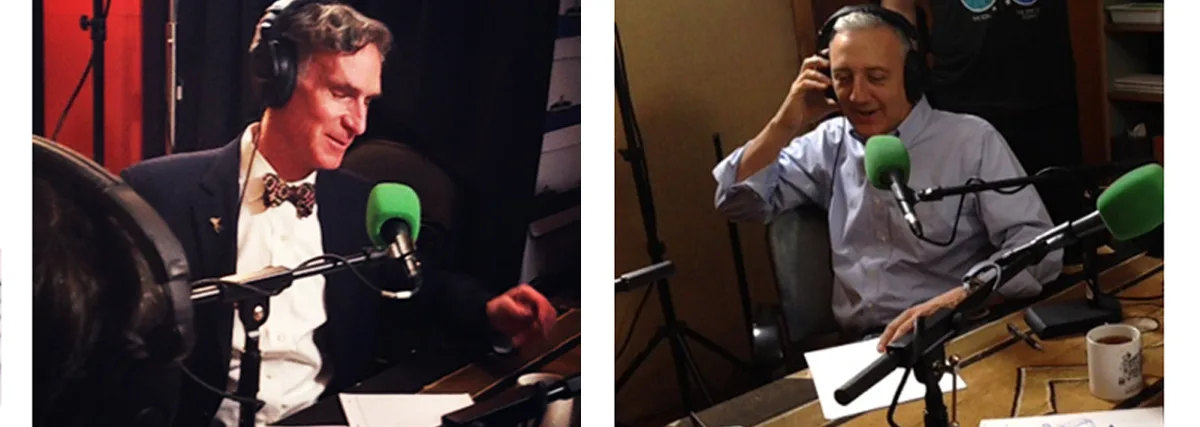
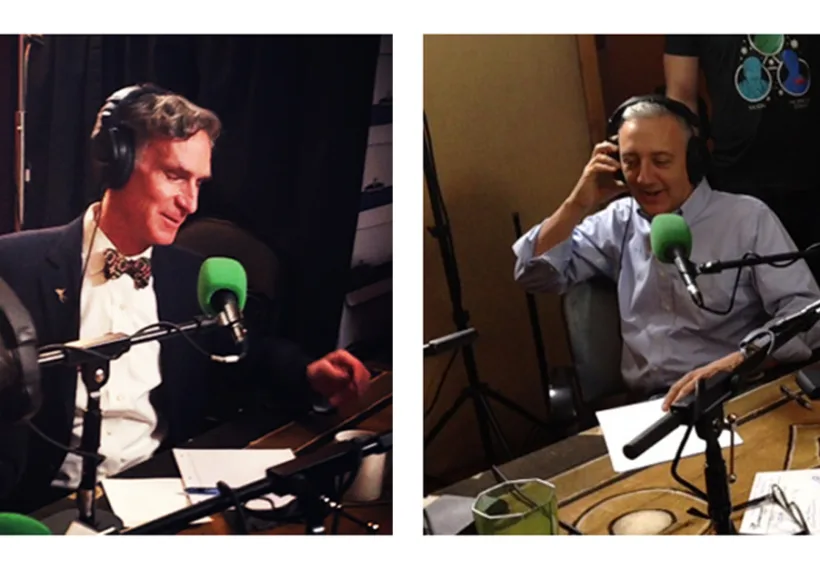
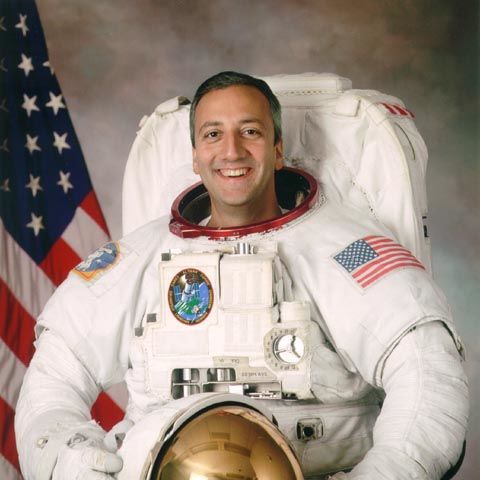
Neil’s off this episode, working on the new COSMOS series for FOX, but guest host Bill Nye the Science Guy, co-host Eugene Mirman and guest Astro Mike Massimino have a world of fun answering your questions. Bill explains how electromagnetism works, who Michael Faraday was, what NASA’s MAVEN mission will be searching for when it reaches Mars, and why you might not want to wear magnets on your wrists to improve your health. You’ll get updates on the state of 3-D printing, liquid metal batteries, carbon nanotubes and super conductivity. Find out how NASA shields astronauts from radiation, what would happen to a fish (real or Swedish) in a giant water bubble floating in space, and how spacecraft move through the void without anything to “push against.” Join the gang as they speculate on warp drives, light speed travel and teleportation. Plus, the Science Guy puts on his engineering hat to discuss the biggest challenge faced by mankind today: climate change.
Transcript
DOWNLOAD SRT
Welcome to StarTalk, your place in the universe where science and pop culture collide. StarTalk begins right now. Now. Welcome to StarTalk Radio. Bill Nye, the science guy here, guest hosting for my beloved colleague, Neil deGrasse Tyson. I'm here...
Welcome to StarTalk, your place in the universe where science and pop culture collide.
StarTalk begins right now.
Now.
Welcome to StarTalk Radio.
Bill Nye, the science guy here, guest hosting for my beloved colleague, Neil deGrasse Tyson.
I'm here with Eugene Mirman and Mike Massimino, whom we call Mass, because it's a complicated name.
It's hard to pronounce Massimino.
Yeah, I'm glad, I'm lucky I got it right.
You can't tell, but I literally just tried and failed, and I just gave up.
He gave up, just didn't know what I just meant.
That aside, gentlemen, I want to point out, this is Cosmic Queries edition, StarTalk radio, so we take your questions out there in the land of, yes, the cosmos, which includes the earth and social media.
So earth and up and down.
Wait a minute, so try one.
Here we go, here we go.
Sebastian Michalache from Romania asks.
I bet he's got a nickname too.
I probably am saying it wrong, but you know what, with confidence.
Anyway, from Romania, he asks, which was the most important breakthrough in the history of electronics?
I think the ability to generate electricity in the first place was a big breakthrough.
Instead of just getting it, if I may, just getting it from chemical processes.
Is he looking for a transistor?
I don't know.
Or is he looking for a starter in an automobile?
Or is he looking for fuel cells?
Fuel cells.
Basically electricity and then everything.
I think electricity is the big breakthrough, but then there's been some very interesting accomplishments.
I just wish you were like tape recorders.
Like the light bulb.
Well, for me, the story.
Radio, of course, because we're on radio.
Well, the story for me is Michael Faraday.
So Michael Faraday is sticking the magnet in a coil of wire and he induces a magnetic field to move a compass at the other end of the table during a lecture, the Christmas lectures in London.
A woman comes up to him and says, but Mr.
Faraday, of what use is it?
And he says, madam, of what use is a newborn baby newborn babe?
In other words, he knew this electricity had some fantastic properties, but he didn't know what it was.
He didn't mean that you could eat it.
Yeah, newborn babes not that useful.
It's a long time ago.
It was a different time.
But in the course of human history, it wasn't that long ago.
No, just a little bit ago.
Yeah, it's all in the blink.
Just before Hogan's Heroes, I believe.
Older reference lost on many of these.
Hogan's Heroes, I'm pretty sure was after World War II.
It probably was.
This was before World War II.
It didn't foreshadow World War II.
Let's take another question on Cosmic Query, StarTalk Radio.
Okay, Jess Nudalo asks, yeah, Jess Nudalo asks, what's new on the subject of high temperature or even room temperature superconductors?
Are we getting any closer to grasping how it works and will this knowledge in conjunction with 3D printing create a new industrial age?
Sounds like he's making a prediction of his own, doesn't he?
Yeah, he's like, am I right?
What do you think?
He's a sage.
We'll see.
Maybe she's a sage.
3D printing is fabulous.
What's the state of superconductors and room temperature?
Well, I don't know that though.
We have superconductors that work at sort of liquid helium temperatures.
Everybody wants to get into it.
It's kind of cold though, isn't it?
Yeah, four Kelvin.
Yeah, four Kelvin sounds cold.
It is cold.
It's even colder than like Canada.
Yeah, so it's like super Canada.
But wouldn't it be good if they work with liquid nitrogen?
Wouldn't it be good if they worked with frozen water?
Yeah.
But it's a long way off as far as I know, but that doesn't mean it can't be done.
What I would do, where I king of the first, is invest again in these nanotubes, in the getting carbon atoms to arrange themselves in these extraordinary tubes where they have very, very low electrical resistance.
All right.
Let's do it.
The 3D printing thing is here.
Yeah.
I suppose we 3D printed carbon tubes.
Whoa!
Oh, could we ever do that?
Is that a thing in the future?
It seems very reasonable to me, but I'm not a carbon tube printer.
But it's quite amazing.
Have you guys ever 3D printed?
I've never done that.
They have them, and they're affordable now, sort of, for universities.
You can get them at Staples.
Really?
Yeah.
Wait, so how much are, like, meaning a few thousand dollars?
Yeah, less than $2,000.
Oh, wow.
And then you can make your own salt shakers.
I can't wait to go home and make salt shakers.
I think you're going to get...
People can't see this because it's radio, but Eugene's eyes have just lit up.
He's ready to get out of here and go buy a 3D printer.
But, you know, they use them, we have them in the labs in the shops at Columbia, for example, and the students learn how to use them and they do incredible things with them.
The next generation of kids will be like, why aren't you 3D printing that?
Why are you going to a store to buy something like this?
So it's additive machining.
If you've not thought about it, generally when you shape something, you remove material.
Generally.
But this is a process by which you add material.
Oh, meaning you don't cut out.
That's right.
It's quite a different idea and you can make shapes that were literally impossible to make heretofore.
It's quite a time to be alive.
It's exciting.
That's great.
All right.
And a Sapien asks, what is the most revolutionary engineering challenge that humanity must overcome in the next 20 to 30 years?
Well, I'd say it's climate change.
So how are you going to do that?
I would say it's going to be engineering the whole earth.
I mean, thinking of the whole earth as a system and getting people to work together to manage that system, which would be engineering.
Engineers use science to do what?
Solve problems.
And?
Make things where you can party with.
Break things.
Create parties.
Make things and solve problems.
So basically, climate change.
That's what I would say.
We have a lot of people in the world and a lot more coming in things like water and healthcare and transportation.
All those things that are gonna face us, engineers need to solve.
Yes, all right.
That's a very reasonable and correct answer.
Oh, it's correct.
Yeah.
Okay.
Deplorable perception.
That is probably not someone's real name.
I am guessing that is some form of pseudonym.
Unless their parents were diabolical.
Yeah.
Thank you.
Yeah, so here's his question.
I like that I'm like, it's a guy.
How will we solve the looming question of energy storage?
That's a great question.
I am all for the liquid metal batteries.
These are batteries that have magnesium floating on a layer of molten salt, essentially table salt.
And at the bottom is a layer of antimony or antimony, which is the one that's atomic number 51, I believe, next to tin on the periodic table.
And so you pump.
So far, this is all correct.
Where's our fact checker?
So you pump in energy and it gets hot and it's molten and it works.
How long does.
And it's a battery.
And how long does the storage.
Well, as my understanding, as long as it's hot, it's storing electricity.
So you'd put these things in the basement of every building and the basement of every New York skyscraper, of every school and library.
You produce electricity with sunlight and wind and wind during the day, you store it underground, you're ready for it all night.
And we revolutionize society.
And whoever goes into this business gets, dare I say it, rich!
It's an opportunity for somebody.
If we could find ways to efficiently store electricity, better batteries, we would change the world and make a much higher quality of life for everybody.
So we have to move on, gentlemen.
I include you, Eugene.
Thank you.
And we'll be back after this.
Check us out at www.startalkradio.net.
We will be right back.
Welcome back to StarTalk Radio.
Bill Nye, the science guy here, guest hosting, yet again, the time of my life, with Eugene Mirman and astronaut, Mike Massimino.
Call him Mass.
We're here, he's an engineer.
Mike, Mass is an engineer.
Eugene, you are a...
Comedian.
Comedian.
I'm an engineer, but when I was in eighth grade, I got a negative eight on a math assignment, just to give you a sense of my knowledge of math and science.
So you do understand the number line, and you appreciate negative numbers.
And I appreciate that that is an absurd thing to get.
Very unusual.
What did your parents say when that happened?
I think they were disappointed in a teacher that would stick to logic.
They defended you.
Well, I think they wrote him a letter saying he breeds a disgust in math.
Did they go and say he deserves at least a minus four?
It was like, you should give him a zero.
He earned it.
All right, gentlemen.
Here we go.
This is the Cosmic Queries edition of Star Talk Radio.
And so where we take your questions and eat them from your Facebooks, your Twitters, all the electric computer questions that the kids send in.
What do you got there?
Here we go.
Julian Razo asks, what is magnetism?
How do magnets work?
I know there's those things that stick to your fridge, but the force is all around us and protects us from solar bursts.
I like that that's, at the end, it's a question.
It's a question?
That's true.
He's in the band Insane Clown Posse.
Nevermind.
It was really-
Really?
No.
But they have a song about magnetism.
It was really the early stuff.
Now they're just completely overproduced.
But that said, magnetism is generally thought of as a current, a flow of electrons, which have an electric field, which induces a magnetic field, through a term coined by my personal hero, Michael Faraday, all one word, electromagnetism.
Now, Mass, you're an engineer.
You took a lot of physics.
I did.
But I'm just amazed to hear it.
This is Bill Nye, the science guy explaining magnetism.
Well, as best I can.
Yes, we're going with the physics.
When we have a permanent magnet, well, when we have a permanent magnet, we think of a virtual current.
That is to say, it's as though there's a current flowing in the magnetic material, iron, cobalt, nickel, or some of these fabulous, rare earths.
But in the earth, which the questioner referred to, to which the questioner referred, in the earth, we have somehow a spinning giant mass of, by our standards, very large mass of molten iron, which carries a lot of electrons, which are in motion, which induce a current, which creates a magnetic field.
Which is very important for our survival.
It keeps our atmosphere in place.
It would be a whole nother.
Our atmosphere is kept here by magnets.
Partially so, yes.
If we did not have our magnetic field, we would, in fact, there's some theories, if you look at Mars, which does not have a magnetic field, that why did earth survive?
And as far as we know, at least on the surface, there's nothing obvious that's living on Mars.
If we could fill Mars' core with a hot giant ball of iron that spun, would it spin naturally if it was there?
Well, Mars is spinning at about the same revolutions.
If we could get it in a magnetic field, it might have had a different destiny.
Could it create, would an atmosphere be created if a magnetic field was added to it?
It might be able to be captured possibly.
So it's generally believed that since Mars was smaller than the earth, it radiated more heat into space, cooled off, solidified, and any molten motion of metal inside came to a standstill.
And then the solar wind, little particles streaming off the sun, stripped the Martian atmosphere away.
And while we all sit here, just a couple weeks ago, I went to Cape Canaveral for the launch of the MAVEN mission.
Cool.
Mars Atmospheric Volatile Evolution, space craft.
It's a tortured acronym, but they're going to assess the-
It is a cool acronym.
MAVEN's pretty good.
It's pretty good.
They're going to assess the atmosphere, learn more about the atmosphere of Mars and what happened there, why Mars is different from the Earth.
And that will, I guarantee you, questioner, that will tell us more about us and our, dare I say it, place in space.
So what I'm getting from this is, theoretically, we could create an atmosphere on another planet using a great deal of iron and a bunch of various-
And scuba tanks.
Scuba tanks.
Basically, scuba tanks, a handful of whales.
All right.
But a magnetic field is very important.
It's the first step is a magnetic field.
Then we do the thing from Search for Spock where we bio-engineer a planet, but okay.
You've got a crazy plan there, Eugene.
That is crazy.
I don't know what you're even talking about, but it sounds good.
It's not that crazy of Ethan.
I'm looking at Bill Nye, the science guy, just for confirmation on this, but it sounds good.
When you start getting into the Star Trek movies, there's going to be some inconsistencies.
Terraforming a planet is just not that easy, but-
I'm not saying it's easy.
I'm just saying here's a few ways we could do it.
Don't underestimate the magnetic field.
Exactly.
Well said.
Awesome.
All right.
So Lorenzo Alfondo Castanon Gonzalez asks, I would like to know more about magnetars.
Can humanity one day create such a strong magnet, and how much would such a magnet advance technology?
I don't know what magnetars are.
Do you know what a magnetar is, Bill?
No, it sounds like-
Bill doesn't know, forget it.
Well, it just sounds like-
A very powerful magnet?
A musical instrument that somehow uses magnetism.
And if I guess if one's big enough, you could influence a lot of people.
It's a deadly theremin.
He's talking about some huge strong magnet, obviously here.
He definitely is.
By the way, we in the skeptic community are troubled deeply by people who wear magnets believing that it's going to influence their health.
Really?
There's no evidence-
Not even on the wrist?
There's no evidence.
Take off your magnet, Eugene.
Yeah, yeah, I know.
Oh my God, wouldn't I be embarrassed if I was wearing a bunch of magnets?
There's no evidence at all that we can see.
No evidence at all that magnetism affects your health.
It's just so little.
Next time you get an MRI, magnetic resonance image, just notice how much magnetism it takes just to get a few positrons to move around just a little bit.
Yeah.
Let alone wearing it as a magnet hat.
Yeah, it's just not gonna do it.
All right.
Well, so that's good to know.
Okay.
So Jason Hyatt has a question.
The earth has a magnetic field that protects it from space radiation.
Is there any reason why a magnetic field could not be used on a spacecraft, either for the whole ship or as an emergency shelter?
An MRI scanner produces a very strong magnetic field.
Why not a magnetic field generator a la an MRI to protect astronauts?
What a coincidentally happy question, right there.
Yeah.
If you had a strong enough magnet, yeah, you could pull it off, but our problem so far is generating enormous magnetic fields takes a lot of energy.
That's a lot of power you need.
Really?
How much?
A lot.
Like as much as like a coffee maker that's supercharged.
It'd be a little more than that, yeah.
So like a boat, like a giant boat, a cruise ship.
Like a diesel engine on a pretty large, like a tugboat diesel engine.
Okay.
That's more than you would have on your average spaceship.
Because of how heavy and giant and weird it is.
Yeah, you don't want any big stuff like that.
You don't want to fly with a truck into space.
But just imagine.
Kind of defeats the purpose.
Just imagine if we had solar panels big enough and some superconducting situation in the icy blackness of space, and you could create a magnetic field strong enough.
That's actually a science fictional kind of cool engineering question.
But I think when, at least right now, early in the 21st century, we humans can't crank that out.
We can't make such a thing.
But who knows what the future holds?
But if we started doing more space exploration, we would potentially come up with that technology down the line.
It seems like something, if you had that much power, it seems to make sense.
Power.
But there's other, we do other things for space radiation.
Like suits?
Like space suits, water's a pretty good insulator, actually.
Oh really?
Yeah, and shielding, and we try to understand how much you take.
We always wear a dosimeter when you go into space, to measure how much radiation you're taking.
What are you exposed to, like when you went?
It's a pretty good dose.
It also depends on where you are.
Spacewalks, you get more than when you're inside the spaceship at a higher altitude by where we were at Hubble as opposed to where the space station is.
Oh wow, just a few tens of kilometers make a big difference.
That's right, in the length of time you're gonna be there, and if there's solar flares when you're up there, so it's a bunch of factors.
But it's nothing, if you fly in space for over a year or so, like some people have a combined over a year stay, they have to track it and make sure you're okay.
That's when you start getting a little bit curious.
But we have astronauts who have flown.
Scott Kelly's gonna be up for a whole year is the plan.
He's already been up over six months in his life.
So he has to insulate himself in water.
Yeah, he's gonna stay out of the sun as much as he can.
But when you say water, you jacket the spacecraft.
Well, for example, water can, yeah.
So if you have a water bag, like on the space stage, and you wanna get some extra shielding, if you were to line the outside of your spaceship with water, for example.
Do you line the outside, or is there a layer of water in the inside?
No, there is no layer of water.
I'm saying if you were trying to, if you were worried about a solar flare, for example, in your spaceship, and you had water bags, that would help you shield.
That you would just add.
So you'd just like.
Yeah.
So instead of using your water.
Well, you're taking water anyway.
Yeah, so you use it as a shielding.
Can you drink irradiated water?
It's not that irradiated.
It's fine, you're not gonna, yeah.
Oh, it's fine, it's great.
Yeah, it's no problem.
It's great.
Nah, it's nothing better than irradiated water from space.
In fact, there's probably a market for it.
There's probably somebody who really wants this stuff.
It's a pretty cool bar in Brooklyn that sells it.
Whole Foods is gonna sell it.
Actually, that's a pretty good question, Eugene.
That's not bad.
But with that said.
I'm gonna go ask them when I get back home.
Wait a minute.
Hold that thought, you guys.
We will be back shortly at StarTalk Radio.
Welcome back to StarTalk Radio, Bill Nye the Science Guy here hosting this week for Neil deGrasse Tyson, who's on radiostical sabbatical, I suppose.
Now, unlike many of you, I'm here with Mike Massimino, who flew in space, and we call him Mass.
Yep.
That's what they call him.
I'm an engineer.
But you're also an astronaut.
And I'm here in New York City, on loan at Columbia.
I like that you're on loan.
Engineering school.
I'm on loan.
I really like the idea of borrowing astronauts.
And there's no late fees, as far as I can tell.
And the other voice you hear, of course, is Eugene Mirman, our providing color commentary.
Yes.
Here on the most visual medium of StarTalk Radio.
Now, this is, as you may know, if you're just joining us, this is another Cosmic Queries edition of StarTalk Radio, where we embrace your questions.
Yeah.
You, the listeners, viewers, wait, you, the listeners, iPodcaster absorbers, who use your social media to provide us with your Cosmic Queries.
Eugene.
Here we go.
Wow.
Wayne Shaw wants to know, if one were to warp space to travel a vast distance, would people existing in the space that is being warped between takeoff and destination, and destination notice anything unusual?
Well, they don't in the movies.
The people in between.
The in-betweeners.
It's like someone's hanging out, so some people on some planet.
So we're assuming there's someone else out there that's gonna get.
I'm charmed by the idea that, of course, since you're going through a space warp, then of course you can see whether, understand that these things are big fun when you're trying to create a science fiction television show where you really don't have time to have people not speaking English, and you gotta get up and down from a planet and travel around various quadrants in the galaxy, or galaxies, but these things are more theoretical than they are, and so we will see how people do as they go between extraordinary destinations through unproven theoretical spaces in space.
Would they notice, I think this person suspects they might have seen something.
Would we notice anything unusual?
Right, right, this person is like, I saw something weird at my house.
I saw something unusual.
My hamburger special looked a little bit different today than it did the other day.
Is it, someone warped speed through the diner?
Well, it's the government.
Something funny is going on here, I think.
Yeah, so Josh Corona asks, in the game.
That's not a very good science name.
No, Corona's a good science name.
It's a solid name.
In the game Portal, they have a gun that can create what is essentially a wormhole in a wall.
With the ability to shoot two holes, one an entrance and the other an exit, i.e.
the floor ceiling, all right.
Is this possible in the laws of physics?
Oh sure, you'll be fine.
Just go get the gun and shoot it this way and then very quickly shoot it the other way before the other hole closes.
So, there.
Two holes in.
Good to know.
Oh, he has another question.
How bold.
I need to stop playing more video games apparently.
I don't know what this kid is talking about.
Okay, so he also asks, if you had to guess which wood could be first achieved first, light speed travel or teleportation?
So teleportation is like they did on Star Trek.
You get all like wobbly, and next thing you know, you're somewhere else.
But haven't scientists already teleported light?
Isn't that a thing that somebody did in a lab?
Just everybody.
No.
First of all, as far as we know.
We're missing out on something.
Light speed already exists.
First it's the portal game where a guy's shooting holes or worms or whatever it is.
Where have I been?
You've been in space on the government payroll.
I think I've missed out on a lot of things, Bill.
Light, some guy teleported?
No, no person.
What does that mean, guys?
No person did.
Let's start with the first one.
Right now, we don't know of any way to send something that has mass beyond up to the speed of light.
Right.
Right now.
There may be a hole in other physics yet to be discovered.
Perhaps this questioner will be the person that makes the discovery.
Yeah, he's gotta stop playing the game portal.
Yeah, and go back to physics class.
And then the second thing, teleportation where you turn mass into pure energy.
Not me.
No, I was gonna say.
But you could be an example.
You can turn Massimino into pure energy, beam him down to what we generally refer to as the planet, and then he's reconstituted.
That would be converting mass into energy back into mass.
Could be done, but consider E equals MC squared.
It's a tremendous amount of energy to convert even a small amount of mass into something.
Well, so even.
So maybe just a piece of corn?
Let's start with something instead of a person.
Or should we start with just one element?
Well, I think if you could get anything, a carbon atom would be pretty extraordinary.
Even hydrogen.
But in that sense, you're saying teleportation is potentially theoretically possible before.
Just shooting from the hip, yeah.
But going faster than light right now.
I'd take either one.
How far are you going to teleport?
You see, light speed travel, Eugene, can get you places quickly.
Yes, I'm not sure about the teleport.
How far are we going?
Are we going like an elevator?
Or are we going to Mars with this?
I think we might just.
I got a feeling we need the light speed first.
It might just be Boston.
Because if you teleport somewhere, yeah, Boston, we can get there anyway.
So I'm going to teleport you to Mars.
You're going to get this.
There's no place to go.
Right, because there's no restaurants there.
Exactly, I think we need light speed travel first.
Check the place out.
Well, he's not asking what we need first.
He's asking what's more realistic.
And the answer I think is.
I know, but I don't know.
I'm not a Swami.
Sounds like teleportation.
You think so?
Barely.
That's what Bill says.
Yeah.
I'd take either one.
I'd rather light speed travel.
Let's go fast.
Let's enjoy it.
Let's punch it.
Let's enjoy the ride.
This is Star Talk Cosmic Queries.
Yep.
We encourage you all to check us out on www.startalkradio.net.
If you've got SoundCloud, YouTube, iTunes, Pinterest, Instagram, Tumblr, I say party on.
Start with Facebook and just go wild.
And of course, when you're listening to Star Talk Radio, stay tuned.
Welcome back to StarTalk Radio.
Bill Nye, the Science Guy here, hosting this week your Cosmic Queries, your Questions from the Cosmos.
And I am here with an astronaut, an engineer, and so far, a gentleman, Mike Massimino.
It's still early, Bill.
It's all a mess.
And of course, everybody's favorite, Eugene Mirman.
Eugene, there you have questions on pieces of paper, queries from the Cosmos.
I say pick ones.
Let's do it.
David Tarazas asks, what does a rocket push against in space to gain momentum or navigate?
Oh, mass.
That's your thing.
That's what we do in space.
And it's a great question because if you don't have any gravity, so when you navigate your spaceship, you need to point it in different directions.
There's a couple ways to do it.
Hubble Space Telescope, for example, has no fuel on board, so there's no rocket.
Can you believe that?
How does it turn?
Someone pushes it?
Little kids?
No, there's no one there to push it.
There's nobody there.
You said no fuel.
You didn't say no little kids.
You didn't say no a lot of them.
It's reaction wheels.
No lions.
It's reaction wheels.
What's reaction wheels?
Reaction wheels spin wheel, and they have big control moment gyros, which is kind of the same thing on the space station.
These things spin.
They spin up, and it creates a reaction, and that reaction creates an opposite reaction.
You spin them in a certain direction, and you'll get a reaction in the other direction, and the thing will point where you want it.
Are they sort of gyroscopes?
Exactly, that's it.
Yeah, spinning, that's one way.
The other way we did on the space shuttle, and on other spaceships do this.
In fact, the space station has this on the Russian end, what we call thrusters.
What is it?
It's gas.
Pshh.
Could be nitrogen, could be something else, but just a gas.
There we go.
It sounds like that.
I said, you can't hear them in space.
You can't hear it in space.
It's just sadness.
You hear it inside of the spaceship shaking.
It is, yes.
So anyway, these thrusters were released there.
Again, it'll cause an action, which is the release of a gas and a little rocket, and then you'll have a reaction the other way.
So on the space shuttle, we had large and small thrusters, different varieties all over the spaceship, mainly in the front at the nose and in the back that you would fire to get the correct orientation.
Just like you have the steering wheels on a car in the front.
Yes, exactly.
You can steer all you want.
You're not going to go anywhere.
Your control surfaces do not work because there's no air.
When you're coming down on the shuttle, even because it looked like an airplane, it will not be active until you pick up atmosphere.
So the way you turned and pointed and steered that space shuttle was with these little thrusters that would fire jets.
That's the one accurate thing from gravity.
But let me back up on this question.
Let me back up on this question.
Is there anything to push against?
And the whole idea, when you watch the rocket leave the ground, it gives you the impression that the flames and gases are pushing against the Earth.
But that's not really what's going on.
You're throwing hot gas out the back of the rocket so fast that the reaction is the rocket goes off in the other direction.
Stand on a skateboard and throw a bowling ball to your best friend or maybe your enemy.
And you will find that the skateboard goes off in the other direction.
It works whether or not you're on the Earth or in space.
So basically the rocket fuel is just the biggest bowling ball we can create.
And goes fast.
More or less.
And we don't throw it at our enemies.
Okay, Melissa Kay asks, if you had a large enough space sphere of water floating in the space station, could a fish swim in it?
Oh, how cool.
Yes, in fact we've done this with Swedish fish, the candies.
But Swedish fish don't have to live.
No, but theoretically I think that would work.
Water is, I mean you could have a tank of water and have a fish float in the air.
I don't see why we wouldn't be able to do that.
And water itself works just on surface tension.
So it doesn't splatter.
So if you were very creative, you could get a glob of water and try to get a fish inside of it.
And have a fish in it, you wouldn't even need a tank.
No, but you have to be really careful because as soon as it hits something, it'll splatter and create a mess.
You don't want the fish nosing, nuzzling his or her way out of the sphere of water.
Right, but I'm pretty sure there have been experiments with fish in space.
And so yes, this is definitely possible.
Because they'd have something to play.
It would be a nice Christmas gift.
You know, imagine having a little pet fish floating around, we have to get pets flown and this would be a good way.
So right now we've had fish as experiments, this would be like a nice little gift.
What animals have been in space?
I mean, with astronauts, not just like monkeys that can't make it back or something.
Right, or the dog Lyca.
Yeah.
It's been, there's been spiders in space, there have been some rodents in space that were used for experiments.
No pets though, again, it's all experiments, we need pets.
Let me ask you this physics question, Mike Mass.
Yes.
The fish are gonna breathe air dissolved in the water.
When you have a glob of water in space, does the air bubble its way out, effervesce, or does it stay in there?
It will, it depends, it can stay in there.
If nothing's acting on it, it will stay in there.
In fact, this is a problem with our drink bags, Bill, when we space walk, because you don't want air in your drink bag.
No, no air in your drink bag.
So what we do is, when you fill your drink bag, when you fill a bag of water, your drink bag for your space walk is see-through, you can see that there might be air pockets.
We rotate the bag, we spin it, I'm spinning right now to get the air.
The bucket over your head.
That's right, you spin it to try to get the air to one location and you suck it out.
So you can get air pockets and you wanna get rid of it.
With those air pockets, we'll be right back on StarTalk Radio.
Welcome back to StarTalk Radio.
Bill Nye, the science guy here, guest hosting as we take your cosmic queries on StarTalk this week.
And we have come to the last segment of this show, which means the lightning round, my friends, where we take your questions from you, the cosmos, and put them on the air for your, let's say, electromagnetic enlightenment.
I'm here with Mike Massimino, call him Mass, and Eugene Mirman, Mirman.
You're lucky you got a name like Nye.
Yeah, that's all I can do, it's really new.
If you had a name like, you know, Nyeowicz or Belsky.
You guys, I appreciate your...
You've been spoiled, Bill Nye.
That's a very simple name.
Simple enough, but with that said, gentlemen, it's the lightning round.
We can't, we just gotta press.
Okay.
Eugene, read one.
So these are supposed to be fast answers.
Fast.
Like lightning.
Marco Horvat from Bakersfield, he asks, people that see UFOs claim to see strange lights.
Why on earth would a spaceship of an advanced civilization need lights on the outside of their ship?
To see where they're going, like headlights?
I don't know.
I think we need more evidence that these are actually UFOs.
Oh, that.
Yeah, yeah.
Yes, the answer is.
I think they're seeing airplanes.
Yeah, yeah, they're seeing other stuff.
That's what I think they're saying.
So that's the answer.
Mike Johnson from Barstow, California asks, how close would an alien civilization have to be to discover Earth using the same technology we have here?
Oh, that is a fabulous question.
Now, just to talk more about me, when I took astronomy from Carl Sagan, this is the first question.
You did, really?
Yeah, did you put it back?
No, I was just in the room.
I was just one guy.
Must have been a fun class.
It was cool.
So we had this image of this organism eating little organisms, ingesting them and spitting them out.
This is astronomy?
Yeah, and it turned out to be an image of a swimming pool taken from a satellite.
And so you have to get extraordinarily close to really determine whether or not something's alive or you'll get fooled.
Right, but I think they need to be pretty close to us.
Couple meters.
Yeah, we just left the solar system now, right?
With Voyagers, so they couldn't be much further than that, I guess.
So hopefully they're just on the other end, but yeah.
All right, here's a question from Matthew Brown.
Is there a theoretical limit to the size of a sun?
I keep seeing graphics comparing our sun to larger and larger solar giants.
Just how big can they get?
Well, but you get to be a few hundred solar sun diameters, you become a black hole.
Really?
Yeah, you become a star that has so much gravity, light doesn't escape.
A black hole is, in a sense, a star.
So would you describe it as over a million whales?
Yeah, big whales.
That wouldn't be inaccurate, but it wouldn't be the most accurate way to describe it.
A big whale, you're talking about a big whale.
Well, but over a million by a factor of, I guess, 10 to the 19th or something, yeah.
Like the whale that's hanging from Neil's museum.
Exactly.
For those of you who have been to New York City to American Museum of Natural History.
So a sun that was too big would just become a black hole, it would collapse.
Yeah, well, that's what apparently it does, they do.
Oh, great, now I know how to make a black hole.
Thanks.
Look out, world.
Jason Paisley asks, when the sun gradually expands, will its expanding mass push earth farther out of orbit before earth becomes consumed?
No, it won't push it out, it will absorb it.
Yeah, so the earth would stay about in its same orbit and then the sun will expand to cook.
It's not gonna be a good day, either way.
The sun is an earth eater.
Yeah, we don't wanna experiment with that either to find out.
Okay, David Loza asks, what if neuron receptors in the human body were to react at the speed of light?
Well, they react at the speed of electromagnetism between atoms.
It's pretty quick, isn't it?
But what if we change that?
In other words, I get it.
This would be, instead of acting, instead of acting, instead of having the...
Diabolical.
Instead of having the neurons go at chemical speeds, they would go at light speed.
Well, I guess it would be, what's that, a factor of about a million.
Maybe 10 to the seventh.
Might be 10 million.
Okay.
It's really fast.
What would be the advantage?
Could we run faster?
Yeah, what could we get out of it?
I guess we could do everything faster.
Really?
Could we think faster?
A million times faster?
It seems to me, yeah, but then it has to be hooked up and there has to be, you have to address capacitance issues.
And we are made of a liquid chemical brain.
Yeah.
It'd be tough to enjoy things.
Speak for yourself, Bill.
It would give a new meaning to take a moment and relax.
I just did.
Take a second and relax.
All right, here's a question.
Coffee breaks would be like instantaneous.
Okay, Jacob Seymour asks, is the shape of a black hole a sphere with high density in the middle, pulling space in toward the center, or is it a flat disc with a point of high density pulling it down in the middle like a funnel?
I believe it depends.
And this is where Neil deGrasse Tyson would be more into this.
This is a Neil question.
I'm not an astrophysicist, but.
I can answer it incorrectly though.
It's an oar, take a shot.
Well, just whenever you have any asymmetry, this gravity's pulling all this stuff together from extraordinary places in space, they're not gonna come in perfectly evenly, so in general, they will start spinning, like the ice skater when she pulls her arms in.
And so you'll often get a disc that is measurable, perceivable, detectable, so the answer, I believe, is it depends, and Neil can get on here and light me up.
See, that's a pun, see, because it's a black hole, get it?
Ha ha ha ha ha, that's brilliant.
Well, you guys, thank you all for listening to Cosmic Queries here on StarTalk Radio.
I have been joined by MASS, Mike Massimino, astronaut who flew in space, and of course, Eugene Mirman.
Turn us up loud on StarTalk Radio, podcast it, blast it.
See the full transcript



 Unlock with Patreon

 Become a Patron