Infectious disease expert Laurie Garrett is back to answer your questions about viruses. First, she describes two current outbreaks: H7N9 influenza, which killed 25% of the people in China who got it, and MERS-CoV, or Middle Eastern Respiratory Syndrome Coronavirus, a genetic relative of SARS. With pilgrimages like the Haj in October, MERS is a serious pandemic concern to the worldwide health community. Next, Laurie explains how viruses like Ebola and HIV jump from bats and primates to humans through “zoonosis” and why they’re so lethal when they do. She tells Neil deGrasse Tyson and Chuck Nice how we’re developing human engineered microorganisms in the lab, including nanobot viruses, and a competition where high school students invent new life forms. All this, plus a fungus that turns ants into zombies, pathogens that spread via rain, the dangers of the anti-vaccine movement and, unfortunately, so much more.
Transcript
DOWNLOAD SRT
Welcome to StarTalk, your place in the universe where science and pop culture collide. StarTalk begins right now. This is StarTalk. I'm your host, Neil deGrasse Tyson. I'm an astrophysicist with the American Museum of Natural History. That's my day...
Welcome to StarTalk, your place in the universe where science and pop culture collide.
StarTalk begins right now.
This is StarTalk.
I'm your host, Neil deGrasse Tyson.
I'm an astrophysicist with the American Museum of Natural History.
That's my day job, but by night, I'm your host.
I've got with me in studio, Chuck.
Nice, Chuck.
Hey, Neil, how are you?
You know, we did a show on zombies.
That was one of our most popular shows.
We had Max Brooks on who wrote the story for the movie, the feature movie.
World War Z.
World War Z.
World War Z.
And it was so popular, we thought we should do like a follow on Q&A to it.
And so we brought in studio back to StarTalk.
Laurie Garrett, Laurie, welcome back to StarTalk.
There's Laurie.
There she goes.
She's with the Council on Foreign Relations and perhaps best known for Pulitzer Prize winning journalism and author of the book, The Coming Plague.
You're an expert on infectious contagious diseases.
What do you like at parties?
My boss does call me Debbie Downer.
Debbie Downer, exactly.
Your book sounds very hopeful.
The Coming Plague.
So we are in the Cosmic Queries edition of StarTalk and Chuck, you're gonna be reading questions.
By the way, normally you read the questions to me.
Yes, I do.
Because they're on the universe.
But now we solicit questions on viruses.
Yes, we have.
So I'm pretty, like, not much I could say about that.
We had to bring in Laurie for this.
Got a little subject expert here.
There we have it.
So let's not waste any time.
Get straight to it.
Questions drawn from our listener audience.
That's correct.
The fan base and the listeners from Facebook and everywhere else.
Facebook, Twitter, email, any kind of means.
And our footprint.
Yeah, so go for it.
All right, let's jump right into this.
And this one comes from Facebook and it's Heidi Myers.
And Heidi would like to know, why aren't there any more outbreaks?
Billions still live in poor sanitation and cramped quarters cheek to cheek with newcomers from lightly traveled areas.
Bush meat is still eaten by many and transportation is even faster than it ever was.
It is due to vigilance.
Sorry, is it due to vigilance or are the diseases evolving into endemic conditions faster than they used to?
Her first sentence was, why aren't there any more outbreaks?
And that is incorrect.
Well, I think she means pandemics.
Pandemics.
That is incorrect.
Okay.
We just have been battling in the last four or five months, too.
Who's we?
We, the global community, the-
The global community of disease fighters.
Of disease fighters.
You guys are like the Justice League of viruses.
Well, that's what Dan Brown says.
Yeah, so we've been fighting two.
One is called, sadly, H7N9.
It's a form of influenza that emerged in China, seemingly out of nowhere.
Wait, wait, wait.
Why do we always blame other countries for the start of influenza?
Where's the one that has America written all over it?
Do we even call it something else?
That would have been the H1N1 swine flu of 2009.
Why don't we call that the United States virus?
Well, it was American swine.
Oh, really?
Was that the technical name?
Well-
American swine.
Sounds like a cool new punk group.
Just don't call it American woman.
So the H7N9 is an influenza that emerged in, first seen in Shanghai.
And it was coincident with, in January, 20,000 pig carcasses floating through the Wangpu River, the central river of downtown Shanghai.
That'd be like having 20,000 dead pigs come down the East River.
So these in Shanghai-
Was by the way, would be an environmental improvement upon the East River.
Just saying, just saying.
So these are, in the question, by the questioner, referring to squalid areas where they're, why aren't they-
That would not be Shanghai.
Shanghai is pretty decked out.
It's a truly advanced, you know, super hyper modern city, 23 million people.
And all of a sudden along comes this virus.
The connection to the dead pigs never established, very controversial inside China because pork is the number one protein source for most Chinese.
So we're not gonna talk about, you know, what might be in your pork.
But that virus spread all the way up to Beijing and all the way down close to Hong Kong and caused havoc.
And seems to have stopped because they shut down the live animal markets.
However, it also stopped coincident with what is weather wise, usually the end of flu season.
So we're all very anxiously waiting for next fall.
Is this going to come back with ferocity?
That one had a very high kill rate.
It was around 25, 26% of the people who got it died.
Holy moly.
But that's not as bad as the one we're now very worriedly watching, which has another unfortunate dubbing.
It's MERS-CoV, which stands for Middle Eastern Respiratory Syndrome Coronavirus.
Oh, God.
Okay, right.
But let's just call it MERS for the sake of argument.
This is a virus that is genetically very close cousin to SARS.
Remember that from 2003?
Spread to 31 countries.
Still have my mask from the SARS case.
Still sporting it.
He never gives up the old antiquated devices.
So I won't go there.
So this MERS virus emerged, it seems to be from Saudi Arabia.
It seems to have originated possibly in the Al-Aqsa region, which is an oasis in the desert near Bahrain in the eastern part of Saudi Arabia.
So once again, not squalid areas.
No.
And a lot of the cases were in downtown Riyadh.
Urban, big city, the major port of entry for people flying in and out of Saudi Arabia.
What has people very concerned, and there's an emergency summit underway right now in Cairo called by WHO, what has the whole-
World Health Organization.
World Health, it has the whole Middle East freaked out is that Umrah, which kicks off Ramadan, is just a couple weeks away.
That's right.
And then in early October, you have the Hajj.
On both occasions, you have mass Islamic pilgrimages to Saudi Arabia.
So if you've got a respiratory virus that is transmissible-
Wow, by air.
By air and by close contact-
Like kissing.
Like being in the Hajj, elbow to elbow, going around the tomb of Muhammad repeatedly with millions of people, then you have potential for serious spread.
Man, that's a party I don't want to go to.
Yeah, well.
And the problem is the Hajj has a long history of being a time for disease to spread.
And it is the responsibility of the Saudi state to ensure that this religious pilgrimage is safe for all-
Otherwise it becomes a communal bath that everyone takes in disease.
So basically for Heidi's question, squalid conditions, not all that bad of a thing.
No, no, I don't think-
Not the problem.
Plus I don't think that's Muhammad's tomb.
I think there's a stone inside of there, a sacred stone.
You're right.
I stand correct.
When we come back, more on infectious diseases, when StarTalk Radio comes back with Laurie Garrett as our special guest.
We are back, StarTalk Radio, Cosmic Queries edition, with a special guest, Laurie Garrett, an expert on infectious diseases.
Is that what's on your business card, Laurie?
Come on now.
Gosh, what a downer turn off.
At Pollard Surprise winning, congratulations on that.
And Chuck, nice, in studio with me.
Hey there.
You're reading questions that we solicited after we saw the success of our zombie show.
Yes.
Because zombies are a model for the spread of disease, and the whole show is about the spread of disease.
Zombies are very popular.
Well, they make good movies, but there's analogies to it that have very real application.
When we ended the last segment, you mentioned that during the annual pilgrimage to Mecca, if there's a disease outbreak in that area, and then you have all these Muslims coming from around the world, and then return, if they catch the disease, that is like the ideal way to spread it.
That's how you, the textbook way to spread a disease.
I just want to say that it's not alone among the rituals of our cultures in the Catholic Church.
There is, particularly in the South American traditions, you would kiss the foot of the baby Jesus, and then the priest would like wipe it with a cloth, but use the same cloth to wipe it every time, which would then gather whatever mouth germs you might have had.
So there's quite, there are traditions that are cultural, religious, that are not necessarily in the best interests of your survival.
Right.
When there's an outbreak ready to happen.
I was recently in Burma and I hiked, I did a lot of walking through Buddhist temples.
I didn't realize that one of them was a temple that required I climb a mountain, but you had to take your shoes off at the bottom of the mountain.
And as you climbed up, you passed a lot of very angry monkeys that had left their leavings along the trail.
So by the time you got to the top, a lot of monkey on your feet.
Yeah.
That's your ultimate funky monkey.
That's worse than monkey on your back.
Yes, it is.
Monkey on your feet.
I'm gonna call that mountain Mount Nevermind.
Yeah.
That's how I felt by the end.
Yeah, I'm not doing that.
So Chuck, you got another question.
We're Cosmic Queries edition here.
We have a call?
Yeah, we're gonna go to the call.
We have Beth.
Oh, I'm sorry.
We have Natalie, who I like to call Beth sometimes, just because I'm like that.
That was lame.
That was a lame comeback on that, just so you know.
I'm watching you here.
But go on, Natalie?
So Natalie is on the line, and she has a question.
You go, Natalie.
Hello, Dr.
Tyson.
I actually had a question about some recent advances in what seems to be virus, let's say, technology, in that it seems a lot of the viruses we encounter now actually originated in other species.
And so I was wondering, is this level of species crossing common to viruses, or is there anything that we're doing as human to encourage the formation of these multi-species viruses?
Awesome question.
That is very...
Thanks, Natalie.
So obviously, that's going to have to go to Laurie Garrett, our infectious disease expert at the table.
Laurie, what do you have to say about that?
Well, very smart question.
And both of her posit answers are correct.
So we have this process we called zoonosis.
And that's the transmission of viruses, or bacteria for that matter, that are typically in one set of species of animals, and then boom, they jump to another.
So zoonosis has two O's, which is short for zoo.
Right.
And zodiac comes from that as well, 12 animals, yeah, go on.
But they spell it wrong.
So it should be zodiac.
Well, at any rate, zoonosis actually is a very dangerous process, because typically when a microbe jumps for the first time to a species that has not seen it before, that species has no particular immunity to it.
And the virus is very, very ill, typically in that first leap.
And so, for example, I was in the Ebola epidemic in 1995.
And that was a virus that had just jumped from bats through chimpanzees to humans.
And so it came in, in its initial wave, it was more than 90% lethal.
And after it passed through humans for a while, it dumbed down, if you will, it became less and less lethal.
Now, is that dumbing down a result of our defenses or the virus itself in its replication?
But why would a virus ever dumb down?
Yeah.
Well, I don't want to say this in a way that sounds like I'm anthropomorphizing and putting a brain into a virus.
We love it.
We like that.
We like that stuff here.
Anthropomorphize the whole freaking universe, so you can do it for a virus, go.
And the virus is, it's in the virus' interest to remain in your species so that you walk around and spread it, whereas if it gets you so sick that you're immediately flattened out and therefore not particularly likely to infect others, go back to your zombie model.
You want the zombies walking around trying to touch other humans and turning them into zombies.
You don't want a zombie to immediately drop on the floor and not move.
So it can't be perfectly lethal.
It has to only be mildly lethal so you have a chance to spread it.
So why doesn't it maximize that sort of, let me not kill you immediately factor?
For like, I would say maybe 60 years.
So that would be HIV.
It is a brilliantly adapted virus to the Homo sapiens species.
Because it doesn't kill you immediately.
It takes 10 years or more if you're untreated.
And during that time, for most of that time, you're contagious to your sexual partners, to your-
Who don't know.
Or who don't know.
And much of that time, you have no symptoms.
So you're unaware that you have a dangerous disease that you can give to others.
So you're the perfect viral carrier.
It's a perfect viral situation.
But to go back to Natalie's question, there are two key points here.
One is we are stressing our planet in so many ways that millions of species of creatures that carry viruses and bacteria inside of them are being forced close to human habitation.
They're displaced.
They're displaced.
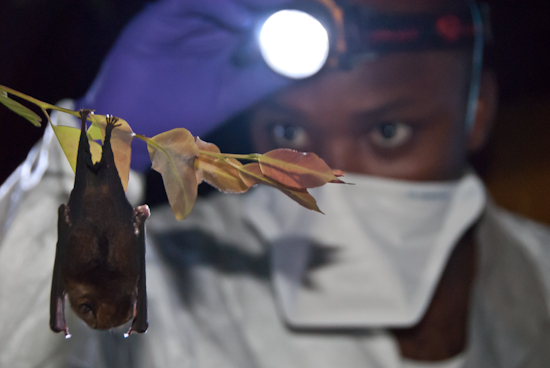
Bats are at the top of the list, and bats turn out to be the natural carriers of the MERS virus, the SARS virus, Ebola, Marburg, Lyssa, Nipah.
We can go down a huge list.
Why don't they all die from these diseases?
Because apparently they do, they're immune to them.
Oh, they're immune?
They seem not to die.
They seem to be carriers.
They may get sick, but they don't get lethally sick, and they pass it in when they chew on fruit, and they spit out the pits and so on.
The viruses are encased in that spittle, if you will.
And then our domestic animals, pigs or horses or what have you, say, whoa, there's some nice cheap food.
Right.
And they go chomping up and they get infected.
Were you just imitating the sound of a pig?
Ha ha ha.
Which I'm just-
By the way, it was pretty good.
It was actually good.
I'm not a sippy pig.
So she's right that human activities are putting us in greater risk.
The other is, of course, we have a huge trade in exotic animals.
There's all kinds of people who for all sorts of, I think, dumb reasons, like to collect exotic species.
And it's usually illegal to both collect and smuggle.
So all of it is sub rosa and therefore not easily controlled by health officials.
And this is the way that, for example, we had prairie dogs dying across the Midwest at one point from a virus that had never before been seen in North America.
And it was all because of smuggled animals.
I thought it was because they were so adorable.
They were dying of cuteness.
I don't know if anybody in Texas would tell you that a prairie dog was cute.
That's true.
So, Nadia, I think we hit that one.
Natalie.
What I called?
Natalie.
Natalie, I think we got that.
Did we get that one for you?
I think so.
Thank you very much.
Yeah, okay.
The answer is, it's our fault.
There you go.
Thanks for calling in.
All right.
So, Chuck, we got two minutes.
What do you got?
Okay, let me find one that's very quick.
Can fit in.
Ants in the rainforest have been known.
This is from Madeline Reed Lueck.
Ants in the rainforest have been known to be attacked by a fungus which zombifies the ant and forces it to do unnatural fungus aid behavior.
Is it possible for a fungus like this to attack human beings?
Well, I don't know that we've actually seen a fungus that turned people into zombies, but we certainly see fungi that execute all kinds of clever activities to force the behavior of whatever they infect to facilitate spread of their spores.
Absolutely.
So, there'd be macroscopic viral behavior.
You might argue that's what athlete's foot in a gym is.
Absolutely.
Or the particular fungus that causes you to scratch your genitals.
Oh, now you're sounding like Book of Mormon.
There's a particular passage repeatedly in that.
I can't say on the radio.
That's if you don't bathe, Chuck.
Just FYI.
But, okay, so fungi, since they taste good, they have a way to get into all of our bodies.
Not all fungi taste good, but there are those that do and certainly...
But yeah, we are surrounded by spores that are bacterial spores, fungal spores.
They drift in the air and in some cases, they luck out and land in a proper location in your personal ecology to cause disease.
Nice.
So that's where it is.
There we have it.
So basically, the answer is yes, one day you will be a zombie made from a fungus.
There's your answer, Madeline.
Now that you put it that way.
All right, when we come back, more of our infectious disease Q&A inspired by all the zombie mania.
We've got Laurie Garrett in studio, Pulitzer Prize winning expert on infectious disease.
We'll be right back.
We're back on StarTalk Radio.
I'm Neil deGrasse Tyson.
In my day job, I'm the director of the Hayden Planetarium at the American Museum of Natural History.
But by night, I'm your host.
Why are you laughing, Chuck?
Just trying to get the mood going.
I don't know, but I...
You sound like Barry White.
I was gonna say, I have a slight erection.
TMI on that one.
So our zombie show was so popular with Max Brooks and talking about just zombies as a model for the spread of infectious diseases that we had to do an entire Q&A on it.
And we've got Laurie Garrett in studio.
Absolutely.
Who's a journalist who somehow finds herself in every place where major outbreaks have occurred in the world.
I'm not even gonna ask how that happened.
All I'm gonna say is, I think we found our primary suspect.
So Chuck, this is Q&A.
So these questions from our readers, from our listeners, so what do you have?
Okay, so this one comes from John Vera via Facebook.
If we were to make contact with alien life, would it be possible for us to contract diseases from them?
If so, would our immune systems be able to adapt to alien diseases, seeing as how we've never encountered them before?
That is such a good question.
Can I take a first pass at that?
Since we're talking about aliens.
No, here's an interesting point, I think.
In principle, we could catch a disease from aliens, but I think it's highly unlikely.
Really?
Yes, because they'd be completely different from us.
Typically, this jumping of species from one, it's like there's something similar, sort of, from one species to another.
It might have a vertebrate, you know, legs, arms, you know, a head.
We don't ever catch, we will never catch Dutch elm disease, okay?
And trees don't catch the flu, all right, that I know of.
Right.
Or whooping cough.
So the more remote, and correct me if I'm wrong, Laurie, the more remote a species is genetically from you, the less likely they're gonna have a disease that can jump to you.
Okay, now.
So therefore, aliens would be the maximally remote kind of life to you, because they would have evolved on some other planet with some other DNA, if they had DNA at all.
Laurie.
That was awesome.
Let's get the either confirmation or rebuttal from Laurie.
Laurie.
Well, Neil.
You are partly correct and partly very wrong.
Oh, and let me start with the wrong part.
Where was I wrong most?
Well, in 1963, when JFK gave the let's go to the moon speech.
Well, you have two.
One was in 1961 and another was 1962.
Okay.
A then record young Nobel laureate, Joshua Lederberg, said, Mr.
President, I think we need to have a meeting here because if we go to the moon and we take our human microbes as hitchhikers with us to the moon.
Unavoidable.
To the moon.
And there is any life form at all that we don't know about on the moon, our microbes might kill that life form.
And conversely, if there's any life form on the moon, we might bring it back with us.
His question spawned a very large effort by NASA to deal with the possibility of one direction or another spreading disease, which by the way was picked up by Michael Crichton and became his famous book, Andromeda String.
One of my favorite books of the era, actually.
And there is a lot of theoretical talk that life was seeded by asteroids carrying life forms of some form or type or essential nucleotide elements.
So there's that side.
The other side, however, the flip side that is sort of right about your answer, is the experience of Australia.
So as far as we know, the Australian continent had no placental mammals except Homo sapiens until the Europeans came.
And so it was, you know, lots and lots of creatures that carried their babies in pouches.
A lot of marsupials.
A lot of marsupials.
And the infectious disease rate from all verbal records, because there are no written ones, of the Aboriginal peoples was very, very low.
And indeed, they were said to live extremely long lives into their 90s, until the Westerners came, and then they were obliterated by one disease after another.
Because the Westerners are similar, same species, and so now they can catch the same disease.
Right.
And they brought with them all sorts of mammals.
Dogs and cats and pigs and horses and so on, and all of a sudden...
Stuff that the continent of Australia never saw before.
Never saw before.
Got you.
Excellent.
Excellent example out there.
So basically, here's the answer.
If these aliens are not traveling...
This is the Chuck Nye summary.
If these aliens are not traveling with horses and cows...
Then we're cool.
We're fine.
Or what was it?
Tribbles?
The trouble with tribbles?
If they bring tribbles, we're in deep dudo.
We're in deep dudo if they bring tribbles.
There's your answer, John.
Well, that was fascinating, I got to tell you.
And seeing you two actually go back and forth made it even better.
I'm all a titter.
Yes, so this concern with the NASA astronauts led to the quarantine of the Apollo Moonwalkers when they came back.
You might remember the scenes where they're in like Winnebago or something.
Exactly, yes.
And there they are sort of waving through the window.
They were analyzed for possible infectious agents.
And the duration of time in there got less and less for each subsequent.
And we find out, no, the moon is completely hostile to all life.
So basically you just come back and say hi.
Well, we come back more on our special edition Cosmic Queries on Viruses and Infectious Diseases.
We are back on StarTalk Radio, the Cosmic Queries edition.
Chuck, nice, thanks for doing this again.
Always a pleasure.
You're a reliable guy reading these questions out for us.
I love it.
And these are all about sort of viruses and infectious diseases spawned by the success of our zombie show.
Yes.
Think of zombies as an infectious agent, and you got it, there it is.
Yeah, they're a great model for the spread of disease.
Great model, and we couldn't have done this with me alone, because I can bring the cosmos to the table, but not infectious diseases.
So I've got Pulitzer Prize winning Laurie Garrett.
Laurie, thanks for, this is your second time on StarTalk.
Yeah.
I hope it's the beginning of something big.
As long as you don't carry any infectious agents with you.
So Chuck, what's, you got another question?
Yes, I do, and it's actually coming from Chris, who is on the phone.
Oh, excellent, excellent.
Let's go straight to it.
Chris, thanks for calling into StarTalk.
Cool, thanks for taking my call.
Yeah, what do you got?
Wondering about nanobots.
Didn't know if they could be considered a virus, or not, because they're not alive, or could they, nanobots, be controlled to where you guys have just mentioned the zombies, maybe they can be self-aware and turn you into a zombie, or.
So just to clarify, there's been a lot of loose talk with the prefix nano.
Right.
Nano literally means one billionth.
Right.
So a nanosecond is a billionth of a second, a nanometer is a billionth of a meter, and so nanobiology and nanotech technically means things that are the size of a billionth of a meter, very tiny tools, life form, whatever it is you're doing.
Lately, I've seen people talk about nanobots, which are just little robots that crawl around on your desk.
Right.
I mean, they're small, so call them a small bot, but save nano for when you really mean it.
Or an iPod.
And so Chris's point, of course, is if we can make viruses that we control that are sort of machine, machines, but are small like viruses, we can infect you with something that we've manufactured in the lab.
Well, there is nanotech that is targeting disease.
And there is a lot of talk about-
That would be nanobots for good.
Yes.
The positive force of Marvel comics would have you.
These nano agents, which are still very much in the, I would say the front end of the research process, it is imagined would target, for example, killing cancer cells.
So they would recognize something on the surface of the cell that said, I'm a cancer cell, and then go in and kill it with a poison or what have you.
But in the hands of the diabolical evil genius.
Well, the question really is to ask, is there a way to make a nanobot self-reproducing?
If a nanobot-
The way life would, the way a virus-
If a nanobot could be self-reproducing, then indeed you could have an out-of-control infectious problem.
Because it would have to replicate itself in order for that to happen.
Yes.
Like a virus would do.
Like a virus.
So then you're really walking the line between what's man-made and what's-
Right, at some point, we're not controlling machines, we're controlling biological molecules.
Well, and then the other thing that is going on-
What's the difference at that level?
The other thing that's going on now is that we have this, we have this dichotomy of purpose where people in public health want to know what's going on with viruses in the natural world, so we're ready and we make our countermeasures, our vaccines and what have you, but on the other hand, there's a lot of folks that say, well, the best way to answer that question is to do man-made evolution.
Let's direct the evolution of viruses in the lab, manipulate them, turn them into monster viruses and see, you know, what does it take to be a monster virus?
So, last year, two different teams, one in Wisconsin and one in Rotterdam, indeed made a super killer form of flu in the lab and a whole lot of people said, why in the world would you do such a thing?
Yes, why?
And those are now sitting in freezers, right?
We kept them.
Last month, not to be outdone by Americans because, you know, they don't want to be outdone by Americans with anything, the Chinese A-Lab in Harbin made 127 man-made flu viruses, of which five readily spread in the air between guinea pigs and killed them.
Oh my God.
So this is the new cusp that we're on is, oh, we're trying to do it for good.
We're trying to see in advance what nature might do.
But in the process, you're putting in a freezer, Armageddon.
People and people were afraid of physicists.
The biologists are plum crazy.
You are not lying, man.
Oh my God.
I'll take an atom bomb any day over this.
Yeah, I got to tell you, in the fraternity of science, you guys are animal house.
Well, if you don't like that, check this out.
No, stop there.
No, no, no, no, no, you got something worse than that.
You got 20 seconds, go.
Synthetic biology, there's a competition called iGEM.
In order to compete, high school students and college students have to make a novel, not pre-existing microorganism.
In 2012, there were 248 competing teams, meaning 248 previously non-existent microbes were made by high school and college students.
That's the end of the world right here, is what you just told us.
When we come back, more of our special edition infectious disease cosmic queries.
We'll see you in a moment.
Bye We're back in the final segment of StarTalk Cosmic Queries Edition.
As you know, the final segment is the lightning round.
Yes.
Laurie Garrett, we didn't warn you in advance of this, but your questions cannot last more than five seconds, at most 10.
Otherwise, you'll hear a bell, and we go on to the next question.
Are you ready?
Okay.
This is just so we have a lot of backlog questions here.
We want to get people on the air here.
Are you ready?
Chuck.
Here we go.
The question asker, ready, go.
From Twitter, this is Noah Stevens, at Noah Stevens, if we measure deadliness as the percentage of global population killed, what is the most deadly plague in history?
The 1918 influenza.
Whoa.
Great year, unless you had the flu.
Whoa, whoa, is that worse than the plague in the 14th century?
In terms of total numbers, yes.
In terms of percentage of population, plague was the worst.
How many people died in 1918?
It depends on, somewhere between 75 and 100 million.
Whoa, okay, that's twice the number of deaths in the Second World War.
Go.
Don't get the sniffles in 1918.
Yes.
This is from Mahasin Abdullah.
In the case of viruses and vaccines, if a disease gets eradicated, okay, will future generations still have to get vaccinated for those diseases?
No.
None.
Nice, good.
Oh, she's getting the hang of this.
She's good, all right.
So once it's gone, it's all gone.
AKA smallpox, we don't vaccinate anymore.
All right, here you go.
From Amanda Pau, this is, okay, what do you think is the most interesting historical plague or epidemic, viral or otherwise, and why is it so fascinating?
Plague.
It completely reshaped Europe forever.
The politics, the food.
The culture, the status of the church.
Okay, which plague had many outbreaks?
Which one is special?
14th century.
The big one.
The black plague.
Black plague, black death, black death.
Okay.
Why it's got to be a black death?
Yeah, all of a sudden, that's a bad thing.
Here we go.
This is from Zack Sells.
If a global epidemic broke out in the third world, how long would we expect it to take to reach across the planet?
Also, are we more susceptible to a pandemic now because of air and sea travel or less vulnerable due to the improvements in the medical community?
No way to answer the first one because it depends on the dynamics of the spread of the particular microbe.
And the second one, of course, we're more vulnerable because we're moving around more.
Okay, so mobility matters greatly.
And have we actually counteracted that vulnerability through medical technology?
Well, better to counter it with surveillance.
Gotcha.
So we need an NSA for viruses.
Good.
Gotcha.
Next.
This is from Courtney Lake.
What is the simplest way you have found to explain herd immunity?
Have you ever encountered an anti-vaccination believer to the science of vaccines in your community?
Not just people who don't believe in vaccines.
Is there any science for that?
Well, there's plenty of science for why herd immunity helps and works and what happens when it's not working.
And we have a measles outbreak out of control in Wales right now, because the anti-vaccine people won over so much of public opinion that people stopped getting vaccinated.
Whoa, Wales.
Wow.
So just look to Wales, Courtney.
There's your answer.
All right, next.
From Jared Connor, could pathogens be spread in the atmosphere?
A recent study done by Georgia Tech researchers found that E coli amongst a great deal of bacteria that formed a sort of bacterial sphere in the upper atmosphere.
Yes, we now have proof that pathogens, particularly sporulating ones, can spread in clouds and rain down in locations far away.
Oh man, that is one time you do not want to make it rain.
Do you stay inside when that happens?
Well, you don't know it's coming and you don't know it's there.
You don't know it for nothing.
Next.
Okay, here's a good one from Al Girardi.
We're still in the lightning round.
We're still in the lightning round.
Man, she's killing it.
She's better than I ever was.
She's killing this.
Come on, baby, you're slowing it down.
Okay, what is the minimum size, sorry, from Al Girardi, what is the minimum size of a population that can support a viral infection?
What is support, what am I, I don't know.
So in other words, for the virus itself to be able to continue on its life, what's the minimum number of people you need in a community so it can spread and continue to be a virulent?
In theory, one, if that, if it's a slow growing microbe and a slow replicating one, for the duration of your life, you can be the host for it.
Gotcha, so in theory, you could just be a virus, I could be a virus of one, like the army.
You got it.
Nice.
Okay.
Next.
This is from Richard Fox.
Has the link between a chicken virus and obesity been proven?
First time I ever heard there was a link between a chicken virus and obesity.
I think by chicken virus, he means like a whole chicken and eating one in a sitting.
Fried chicken, let's see if we have one more in here.
One more in, one more in.
Last one, go.
Here we go.
Quick.
Do the viruses used to transfer gene traits into GMO cores survive in crops?
No.
Bang!
Wow.
Laurie Garrett.
She rocked it.
Holy.
You crushed that lightning round.
That's all you got?
That's all you got?
Well, I do have more questions.
Who should call you out?
That's the best you can throw at me.
Let's see if you can get this one in.
If the human body's temperature rises when it gets a virus, couldn't that be an explanation for what the planet is going through right now?
The planet is pretty much created, so we couldn't have similarities.
Your temperature rises because of your immune response.
A fever is part of your immune response against a microbe.
Not a good analogy to the planet.
Except in The Matrix when the Smith said you are a virus.
Virus on the Earth.
Laurie, Garrett, thank you for being on StarTalk Radio and illuminating our inquisitive listeners on infectious disease.
That was awesome.
And viruses.
You've been listening to StarTalk Radio.
Chuck, thanks for being here.
Laurie, thanks again.
I'm your host, Neil deGrasse Tyson.
And StarTalk Radio has been supported in part by a grant from the National Science Foundation.
As always, I bid you to keep looking up.
See the full transcript



 Unlock with Patreon


 Become a Patron