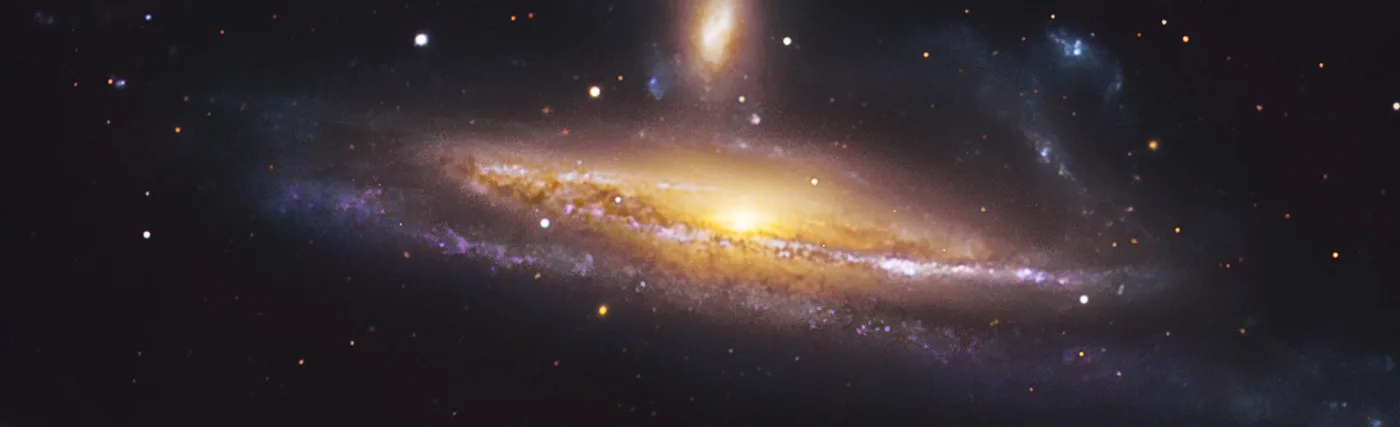
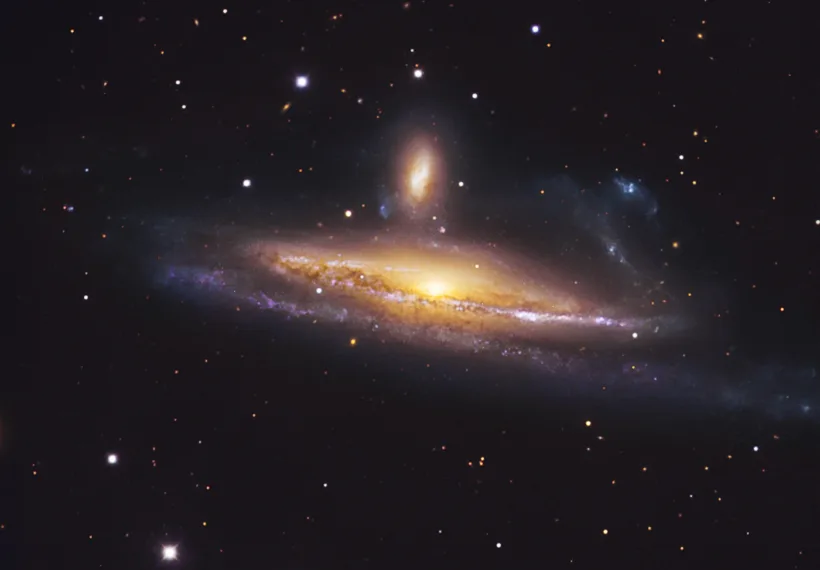

A photo of colliding galaxies NGC 1531 and 1532 by ESO et al.

Cosmic Queries: Until the End of Time, with Brian Greene

Galaxies NGC 1531 and 1532. Image Credit: ESO/IDA/Danish 1.5 m/R.Gendler and J.-E. Ovaldsen.
  • Free Audio
  • Ad-Free Audio
  • Video

About This Episode

On this episode of StarTalk Radio, Neil deGrasse Tyson and comic co-host Chuck Nice are answering fan-submitted Cosmic Queries with the help of theoretical physicist and author Brian Greene. Brian has been a frequent guest on StarTalk and always tends to blow our minds when he shows up – this time is no different. The topic for this episode is Until the End of Time, which also happens to be the name of Brian’s new book!

How far will we journey into the cosmos during our lifetime? Neil and Brian ponder this but they also debate how long humanity will last in general. Will we outlive the predicted length of existence we’ve seen from other species? Will we destroy ourselves? What happens if we send a crew into interstellar space and when they return everyone is gone? You’ll learn how long it takes just to get out of the Milky Way alone and what humans would be like if they grew up never knowing the Earth. 

We explore free choice and free will. Brian tells us why he thinks we don’t have either. Discover more about time: is it made of something? You better believe we talk about string theory. Brian shares why spacetime itself could be stitched together by the threads of quantum entanglement. You’ll hear how dark energy could rip the fabric of spacetime – and why that might not be as catastrophic as it sounds. You’ll also learn why black holes shrink down if spacetime rips apart. 

We dive into the meaning of life: Is there any? And, if there isn’t, what’s the point in living? Brian explains why he thinks physics should guide us and also set us free. Neil and Brian discuss the role of religion and if that would change if we were contacted by extraterrestrials. You’ll find out where the universe ends. Lastly, we investigate entropy in the universe. All that, plus, discover more about the simulation universe and if the human brain will ever figure out human consciousness.

Thanks to our Patrons Jamie Boneleye, Evan Blackburn, Matthew Pounsett, Chris Behrensmeyer, and Brett Armstrong for supporting us this week.

NOTE: StarTalk+ Patrons and All-Access subscribers can watch or listen to this entire episode commercial-free.


Transcript

DOWNLOAD SRT
Welcome to StarTalk, your place in the universe where science and pop culture collide. StarTalk begins right now. StarTalk, Cosmic Queries edition. Neil deGrasse Tyson here, your personal astrophysicist, and as is, not always, but most of the time, Chuck...
Welcome to StarTalk, your place in the universe where science and pop culture collide. StarTalk begins right now. StarTalk, Cosmic Queries edition. Neil deGrasse Tyson here, your personal astrophysicist, and as is, not always, but most of the time, Chuck Nice. Hey. Co-host. Good to be here, man. We just fist bumped in front of our guest. Yes, we did. How about me? There we go, now we'll do a three-way fist bump. A community property of fist bumpers. Brian Greene is our guest. That's right. We're doing Cosmic Queries, Until the End of Time. I didn't just pull that out of an orifice. I was going to say. It is actually the subtitle of this book. And that's actually the title. Oh, it's the title. What's the subtitle? Mind, Matter, and our Search for Meaning in an Evolving Universe. That kind of means everything, right? That is. But doesn't the universe automatically elicit questions of what is my purpose, my meaning? Why? That's why we have them here to talk about this for the show. Oh, cool. I thought we were doing a cooking show. So we solicited questions. Yes, we did. About this book. I don't know if people read your book already. Is that possible? I'm looking at the questions. I just know he's got a fan base out there. And there are several of the questions of people who have already said, they say, in your book. Okay, so Brian. Look, look at this one right here. Your book, Until the End of Time, brings me to the conclusion. Wow. All right. So this is the Venn diagram that overlaps his fan base with our viewers. Because we solicited it from our viewers. From your base, yeah, great. Our people, your people. I love that. All right, so Chuck, you got the questions. Just to remind everybody how this works. It's Cosmic Queries. And these are solicited from our fan base. That's right. I have not seen them. Certainly our guest hasn't. That's right. Chuck, you might have seen them. I've read them before. And Brian Greene and I have very strong scientific overlap. But we're going to get his view on this. And I'll just sit back and listen. And if he's full of shit, I'll tell you. No, you won't. I've never heard that before. Plus, I should have said it differently. No, you won't. Brian Greene knows almost all the astrophysics I know. And I only know some of the physics he knows. So he can take my physics to new places. That's very gracious. I don't know if it's true, but it's very gracious. And he's a good mathematician, too. All right. I mean, I'm going to say yes to that. Because he's an astrophysicist and a physicist. Math is a language of the universe in which he is fluent. I'm delighted to have an all-time friend and colleague. Well, let's do this. And as usual, we always start with a Patreon question, a question from our Patreon patron. Wait, wait, wait. Excuse me. Go ahead. Brian Greene is professor of physics at Columbia University. Wow. And also joint appointed in the Department of Mathematics. Wow. And he and his spouse co-founded the World Science Festival here in New York City every year where science and art and music come together to celebrate science. Wow. He does this. That is incredible. He's not just some person who's sitting between us right now. Right. This is Brian Greene. He's still that. He's still that. I don't want to undo the fact that he's a person sitting between us. I don't want to demote him from personhood. I think this is his fourth book. Yes, right. His first book that anyone knows about was a mega bestseller, which was? The Elegant Universe. The Elegant Universe. He's one of our leading strength theorists. This was a way to share not only the frontier of his research with all the rest of us, give us a sense of hope that maybe one day we'll understand everything. Cool. Or not. Or not. So, that was a mega bestseller. And we shared publishers back then. We had the same publisher. Oh, Norton? You were with WWNorton. Then he got so famous he found another publisher. And then he published another book after it didn't do as well as the first book. I just want to just hang some publishers. You're just giving your publisher some cred right now. Dirty laundry out here. Brian Greene, Alfred Knopf publisher. Let's do this. Alright, here we go. As I said, we always start with a Patreon patron because they give us money. And this is Michael Tobias. He says, Hello, Neil and Brian. I often wonder how far we will journey through space within our lifetime. Will we be able to achieve interstellar travel or will the human race go extinct before we have the opportunity and technology? Now, he started off with our lifetime, but I think he means the lifetime of the species of human beings. Because our lifetime, the answer is no. And I am not an astrophysicist at all. Okay, we're done with that. No, but within the lifetime of the human species. First of all, what is the lifetime of the human species? What would that be? A few million years. Well, that's a guess, right? If you look at the historical trend. The life expectancy of mammal species. One in three million years. Yeah, but we're so much special, right? We have this thing on top of our head that enables us to figure things out. So either that is going to be our own destruction, because we can build things that can kill ourselves, or we'll be able to figure out a way of living beyond the traditional lifetime of many species. So, unclear. But if you take... But let me answer that question. There's what's possible in the laws of physics, and there's what's within reach with our engineering. Absolutely. So give me your read on that. Well, the laws of physics constrain any speed of any spacecraft traveling through space to be less than the speed of light. So if you're not going to play games with imagining that, we can actually warp the fabric of space and have warp drives. That's real. Yeah, well, it's unclear that we'll be able to achieve that. It's real in every movie I've ever seen. I agree. But taking the speed of a craft to be less than the speed of light, then I mean achieving great space travel is challenging, right? Now, the weird thing is, because time slows down when you have a spacecraft or a clock of any sort that's in motion, you could have a spacecraft going out near the speed of light, and we on Earth would watch its clock, and its clock would be ticking off time so slowly that to the person on the ship, they would be able to go much further than we would think they would be able to if we didn't take that into account. So, you know, we could send some intrepid voyager out into space, and they could go near the speed of light, and they could go arbitrarily far in their lifetime. In their lifetime. Yes. Then they come back home and everyone would have forgotten about them because hundreds of thousands of years would have passed. Or millions or billions of years. You're absolutely right. Right. So that's not what people are imagining when they're thinking of space travel. I mean, so... But it really matters, you know, if we were to take, you know, a group of our species and send them out into space, it really would be within their lifetime that they'd be able to, according to laws of physics, go arbitrarily far. And so it's kind of... Now, you're right, the people back on Earth, they perhaps would be long extinct, you know. Wow. Imagine you come back and your species isn't even around. And the roaches took over. And the rats... Right. And they say, wait a minute. You come back and there's a museum that the rats have and they're the skeletons of humans there that long ago terrorized the... Or they could even have an homage, an exhibit to the spacecraft that left 100,000 or a million years ago. And you can sort of see the origin of your own trip. That's kind of cool though. I mean, you could actually... Okay, so you can, but no one else can really participate in that. Unless they're part of the literal journey itself. So now what about this in terms of when you say you put these people on a ship. So you take a colony of people, you put them on a ship. And now they go and they're looking for some place to live. And now you're just seeding the universe. Or at least another part of our galaxy, because you can't really say the universe. The Milky Way. Because we're not going to... How long would it take us to get out of the Milky Way? Millions of years to the nearest galaxy. There you go. But with that... Sorry, sorry. Well, it's hundreds of thousands. Hundreds of thousands of light years across. Just get the numbers right. So, our galaxy is about 100,000 light years across. So, if we watch you travel at the speed of light, it'll take us 100,000 years to observe that. But you could live an arbitrarily short amount of time, depending how fast you go. So, that being said, you in principle could go to the Andromeda Galaxy two million light years away. We are long gone here, maybe. Unless we're as smart as Brian wants to believe we are. And so, yeah, you could go to another galaxy. But in practice, you want to pass by stars, not the void of empty intergalactic space. Exactly, right. You want to go someplace where there is something. But Brian's point that I take to heart is, when I think of these ships, I think that they're generational ships, and they have to be really fertile people, make babies, babies grow up. But what's odd is you will be giving birth to children who will never have known Earth. And that's kind of diabolical to me, because they would not have had free choice to have taken that trip. Do you have any moral sense of it? Well, I don't think any of us have free choice or free will. So if you want to get into that part of the conversation... Okay, let's just pull out two of those worms from that can. Ow! Holy moly! Alright, we'll get back to that. I can't... Yeah, that's a big one right there. I don't have a certain bandwidth. Alright, so let me ask you... I'm glad to be reminded that you can send a colony of people and they can get anywhere they want in their lifetime provided they travel fast enough. So now let me ask you this. Let's say they're going to go someplace even further. We're talking about true interstellar travel. Intergalactic. Intergalactic. Because they're going to another galaxy. And then they're coming back. And they have kids and kids... What would that do? And maybe this is outside of your purview. I don't know. What would that do to us as a species? Would they be that much different from not having any of the effects of being on this spinning rock, going around this little teeny star that we live in right now? That's beyond my purview. I would say that it is possible to speciate. One of the ways you split a species is you strand a variety of yourself in a place and then there's no more communication. That's why every freaking animal looks so different in Australia. But you still need sufficient time during their isolated periods, and in this case it could only be even a handful of generations. But there still would be generations, as you said, who would never have experienced life on planet Earth. But you also need pressure to select against some features and promote others, so that those features then become something else that are not recognizable to where you came from. So you need that. And if that ship is exactly the environment that Earth has always been, and always will be, you're not really creating a circumstance where there's a pressure to... A pressure. But if you create a reality show where it's Survivor on the ship, and then you have artificial pressures, yeah, you could drive the species into some different places. That's kind of wild. So it wouldn't be natural selection, it would be artificial selection. Yeah, that's right. You just inject them from the ship. Alright, we're going to space you. Alright, let's do the next question. Alright, here we go. This is Cheyenne Leo, who is also from Patreon. I hail from Canada and I love your books. I've been wondering lately, what is time made of? I might be a little out there, but I was thinking that it must be made of something, because presumably it was created in the Big Bang and it interacts with things like light and gravity. Light takes time to get there, gravity slows it down in extreme circumstances, etc. etc. So if it can interact with other forces, shouldn't it be made of something? I love that question. It's a great question. When is something more than just an idea? When does it become a thing? Well, this is an idea that is starting to become a thing right now. So it's certainly the case that the intuition of the question is right on target. When we look at ordinary material objects in the real world, they are made of stuff. They're made of molecules, made of atoms, made of subatomic particles. Could that idea be relevant for space and time themselves? And people have thought about this for a long time, but recently there have been developments in a variety of fields, string theory being one of them, where we're starting to catch a glimpse of what the ingredients of space and time might actually be. And in fact, there's work that's being done that shows... You're not talking about a time particle. Not really a time particle per se, but it's easier to talk about this in space, even though space and time are really the same thing. But we have some evidence that space itself may be stitched by the threads of quantum entanglement. So this idea of quantum entanglement that links together distant objects in a way that makes it appear as though they're right next to each other in terms of their physical properties, it may be that the threads of quantum entanglement are the stitches in the fabric of space-time itself. Is this where you get to the idea that in the distant future, where dark energy accelerates us ever greater, that it might accelerate us faster than quantum phenomenon can keep up, creating a tear in the fabric of space-time? Yeah, and in fact, you don't even need to know about the ingredients in the fabric of space-time to come to that conclusion. You didn't even pause when I said that. That means it could really happen. Yeah, so the idea that the dark energy might get stronger over time. So right now, we all know that there is dark energy pushing the distant galaxies away. We've spoken about this before. We actually have. We actually have spoken about this before. But it's possible that that dark energy gains strength over time, which means that it would not only drive the distant galaxies away ever more quickly, but it would start to drive even planets away from their stars. And it would even drive electrons away from the nucleus of atoms, which would rip matter apart. And yes, you're right. Depending on the very nature of spacetime, it could be that this dark energy growing over time might sunder space itself, might rip the fabric of space apart. That's amazing. You're talking about the actual tearing of the universe itself. I don't even want to think about that. Now I should point out that since you brought up the tearing of the fabric of space, a paper that I wrote with a couple of colleagues years ago was the first mathematical demonstration within string theory that the fabric of space can rip apart in a manner that would not yield a catastrophe. The fabric of space would repair itself and it would just be a new behavior within the repertoire of things that space can accomplish that Einstein would never have thought of. But Einstein didn't think about quantum mechanics and the general theory of relativity. When you unite them, as string theory does, you get new things that space and time can do. One of them may be tearing apart. And it repairs itself. And it repairs itself. It may not be as catastrophic as you think. And an ointment for that. We have a salve. Put some ice on it. But actually it's not so much a salve. The strings in string theory can surround the tear and form more of a band-aid. So it's more that the strings form a band-aid that protects us from the rip in the fabric of space. And there's math behind this. It's not like a crazy guy. You look very skeptical at this. I did too, because that sounds... Don't hide behind this math behind it. No, I'm not hiding. I'm just trying to let you know. I'm just saying, math can talk about some crazy stuff that had nothing to do with reality. And you know it. Don't tell me there's math behind it. Of course. This emerges right from the most natural interpretation of the equations of string theory. So I'm not standing on my head to make this happen. Okay. That's an important point. Because there's a lot of stuff that we think about where you have to go out in left field to try to get the explanation. But if this flows out of your stuff naturally, it's a beautiful thing. Very cool. Can I tell you what else happened? Black holes shrink down to a very small size, very small mass, and they transmute into elementary particles. So black holes that you normally think as being kind of this big thing out in the cosmos, different from the fundamental constituents of matter, when space rips, the process that repairs it involves black holes turning into particles. See, now he just made that up. You had me until the universe repairs itself. Black holes are the doctors and the nurses. Oh, man. No, we got to wrap this segment. We're taking too long to answer this question. No, no, we're not. This is great stuff. When we come back. Oh, I wish we were here every day, Brian. Oh, that was amazing. More Cosmic Queries, Until the End of Time. Questions from the heart of the cosmos. Welcome back, StarTalk, Cosmic Queries. We've got Brian Greene here, the one, the only long time friend, colleague, love this man to death. He's been a friend of StarTalk from the beginning, from the beginning. This is not his first rodeo with us here. So Brian, congratulations on your fourth book. Thank you. And got a great write up in the New York Times, very enthusiastic write up. And even when he was criticizing it, he was praising it. Yeah, right. It's like, oh, it got complicated, but it needed that. And I kind of liked it. And it got me into it. You know, it was like one of those kinds of things. So who actually reviews your books? I'm serious. Like you two guys, you write these books. Who is it that sits down and says, okay, let me go through here and see- And see Brian's mother? That's so funny. Intermittent employee for the New York Times. Yes, son, I have to tell you, I don't know about this cold thing about black holes and particles. So no, really, who is it? I mean, I would say there's not a lot of people that can do that. There's science editors. That's their job. If they can't handle it, then they don't review it. There are plenty of newspapers that don't review science books. Oh, actually the number of reviews of science books is going down because newspapers are really winnowing the staff so people can do it. They're cutting their staff so they can't afford it. Wow, wow. So this just to give him credit because he's in the club. Dennis Overby, longtime science writer and editor. One of the best really. For the New York Times and he leans cosmological. Although when we demoted Pluto here, he wanted to dip into that. When I said, this is not your beat, this is too nearby for you. But I think he wanted some Pluto street cred. So he did a little Pluto article on our demotion. And was he for or against your postulate? He was antagonistic. Oh, okay. But anyhow, he's a long-time editor and he has a book of his own. So the real meta question is who reviews the book? And so did you two actually review his book? I think he wrote a book, The Lonely Hearts of the Cosmos, which was about two astronomers trying to find the scale of the universe. Was that the book I'm remembering? I don't remember the details. Okay, but it was biographical. The astronomers who had access to big telescopes. And you're there at night looking up at the night sky with the telescope and nobody else, Lonely Hearts of the Cosmos. Okay, that sounds about right. Okay, no, I'm joking. All right, here we go. Let's get back to our questions. This is CS TOE 1. Hold it lower so people can see your beautiful face. Oh, I'm sorry, here we go. CS TOE 1, I forgot we're on camera too. Hey, do you think the laws of physics are finite and knowable? Can we ever fully understand the universe in its entirety? If so, what forces might we be able to manipulate that are beyond us now? That's a very, very cool question. No, it's a deep question. Because, look, you look around the world and there are intelligent beings walking around, dogs, right? And they don't, we think, understand the general theory of relativity or quantum mechanics. So these are intelligent brains. Although when I say that, I always think the dogs are about their barking and say, ah, he thinks we don't understand general relativity. But seeing if that's really the case, then why do we think that the human brain would be able to understand it all? We may have limitations on the deep truths that we're able to grasp. Now, having said that, there's no evidence that there's any limit to what we can figure out. We haven't hit the wall, right? We did develop quantum mechanics. We did develop relativity. Wait, wait, wait, wait, wait. You and your compatriots have been at this strength theory thing for 30 years. Yeah, here we go. Maybe, maybe that's the wall. It could be. Maybe you guys aren't smart enough. You found the wall. But here's what I would say to that. Let me hold up a mirror to you here, okay? Who's the one who can't find, who's at the edge of the wall? See, but that would only be the case if we were sitting here saying, we can't make any progress in understanding the mathematics of strength theory. We're making incredible progress, but the thing is, and the part that you're responding to, which is completely justified, we haven't been able to make contact with observation or experiment. But that's not all that surprising when you're dealing with a theory whose energy scale is like 10 to the 15, 10 to the 16 times greater than that of the Large Hadron Collider, the most powerful machine in Geneva, Switzerland. So I agree that we have hit roadblocks, but it's not us theorists, it's the experimenters. And if I might chime in here. If I might chime in here, let me just add. That's the dog saying, we have a solution, but you just. There's your answer, guys. You're neutering us and you're taking us too. And you're feeding me Alpo. Okay, cool, man. Oh, that's a great answer. That's a great answer. Wait, wait. So let me go ahead. Let me give a nuance to that question and hand it back to him. All right. Do you believe there may be missing laws of physics that will help us get further or that kind of all the laws of physics are there? We just need to be more creative with what we've got. Yeah, I think it would be hubris. That's a little bit of that. Yeah, it is. It's a different tact. Yeah, to think that we really have it right now would be sort of the classic act of hubris, right? I mean, every time we thought we figured it all out, there was a new law, there was a new particle, there was something else to find. So I would imagine at sufficiently high energy scales, we're going to find new stuff, new particles. New energy scales would be beyond where anyone has gone before. Yeah, so right now. Bold to boldly go. Yeah, so let's say we've basically gone on the order of 10,000 times the mass of a proton, roughly speaking. Energy. Energy, energy scale. And we haven't found anything new yet. But I would imagine that between that scale and the so-called Planck scale, which is where the fundamental laws of quantum mechanics and gravity come together, that's 10 to the 19 times the mass of a proton. So that's 19 orders of magnitude bigger than a proton. And we've only gone up to sort of four orders of magnitude bigger than a proton. So in that range, I suspect there's going to be something new to be found. Because just in all fairness, to those who have come before us, they would be working in a tabletop, right? And there would be some phenomenon they don't understand, and then they'd experiment with it, and then they isolate it and name it and characterize it and mathematize it. Yes. And so our basic known four forces of nature come out of that kind of experiment. Exactly. Kind of tabletop plus simple particle accelerators, right? And astronomical observations. And observations. So what you're saying is that's a regime that manifested some aspects of nature that we have figured out in a tidy way. Yeah. But there could be bigger questions we don't even get to yet because we haven't tested the regime and that regime is not on our tabletop. Exactly. Okay. Yeah. That means the future of physics is big money, big accelerators. That is one way. The loan candle burning. It's that, but I also like to think that if we're sufficiently clever, we might find indirect ways of probing realms that you think would require that big machine, but maybe we can be smarter about it. On Star Trek, it's just all computer simulations. By the way, just as a signal to my people being clever, it was how are you going to put a big telescope in orbit? You can't make a rocket that wide. Build it. Let's build it. Well, you can build it in space, or you can get a mirror that unfurls. All of a sudden, the engineers say, hey, I got this. Let me be clever and figure it out. So we've actually overcome many challenges that previously were considered intractable just by clever people. I'm echoing your point. Yeah, exactly right. That is super cool, super cool, super cool. All right, here we go. This is Janesh from Instagram. It says, finding slash creating your own meaning is fine, but objectively, what do you think, Brian, is the actual meaning of this creation? Because meaning is it, that's a big part of where you try to go in this book. And the answer that I give to that question, right, to develop completely and more fully, I should say, not completely in the book, is that there is no ultimate meaning floating out there in the void, right? Throughout these... I gotta go through all these pages to find out that there's no meaning? Well, I'm gonna give you the... I gotta read this for you to tell me there's no meaning? Cliff notes. Cliff notes right here. So the cliff notes are that we are the product of the mindless, purposeless laws of physics. We are all just bags of particles governed by those ironclad mathematical... Echoplasm. That's it. And what we have the capacity to do, which is remarkable, is impose order, impose coherence, impose purpose and meaning on the external world and the internal conscious experience. And so it's not as though there are two things. The real answer that's floating out there in the void, awaiting our discovery and sort of the internal one that we manufacture, it is only the internal one that we manufacture because there is nothing else. How do you know this? I don't know this beyond my experience in a lifetime of working with the laws of nature, the particles of nature, and trying to give explanations for the things that we observe in the external world. So the particles are your gods? Well, you know, there is a place for religion. You need to answer that question way faster than that. Oh, well. My altar has some neutrinos on it, but... No, no, but honestly, seriously, I do think there's a role for religion that some of our colleagues step on and dismiss out of hand entirely. And what would that be? Well, it's not to understand the external world. No one can use any religious doctrine to calculate the electron's magnetic moment to nine decimal places, which is what we can do routinely with quantum field theory. But if you think about religion and the spiritual journey as something that doesn't illuminate the external world, but rather the internal world of conscious experience... Which many people go to for meaning in life. Yes, exactly. Then there is a role for it, and you don't judge it by whether it can explain the external world. That's not what it's meant to do. You judge it by whether it is a satisfying way of trying to understand your place in the universe. 90% of religious people would say that. The other 10% who are fundamentalists... Yeah, of course, go a different direction. Get their science out of the Bible. I agree. And that's problematic. Enlightened religious people are where you're coming from. That was a little journey. I liked it. I still think he's got an altar in his home. A neutrino altar. I'm pretty sure. He sacrifices to the particle gods. I'm pretty sure. I'm pretty sure about that. All right. Okay, let's move on to Leigh Bird. So, Leigh Bird from Facebook says, Hello, Dr. Tyson and Dr. Greene. My wife has asked, where does our universe end? Not how, but where does our universe end? And I would like to say, are there more than one ending? Is there an ending and then more endings? Are there levels of endings? That's a time ending rather than a place ending. Well, that's what I'm saying. But is this a place ending? That's what I'm hearing. You think it's a time ending? Where? I don't know where, but it's a place. So, there's a place ending. Where's the sign that says stop here? It can't go any further. It breezes out. And look, the quick answer is we don't know. But the possibilities are space could go on infinitely far, in which case there never would be an end. That's a strange idea to us beings that live in a finite environment. But nevertheless, the math allows that as a real possibility. Or space could be curved, which means you could go out in that direction and ultimately circle back and return to your starting point. So there again wouldn't be an end, but nevertheless, the space would be finite in its extent. So these are sort of two big possibilities people think about. So you could travel in infinitely finite space. You could go infinitely far, but it would be a finite extent. Like the surface of the Earth. Yeah, like the surface of the Earth. So the answer is you don't know. Neither do you. You're asserting I don't know. You didn't ask me. I can tell you this. Yes. We look out to the edge of the observable universe and we see light that has been traveling for 13.8 billion years. That gives us evidence of the Big Bang for that part of the universe experiencing it at the time it emitted that light. That horizon continues to push out. As long as we keep seeing evidence of the Big Bang, we are still moving into a universe that is our whole. Imagine the day where that horizon washes over the last bit of matter that experienced the Big Bang. Then the information coming to us about the Big Bang ceases and all of what we know of cosmology would have no data set at that point. At that point, basically the moving horizon, which gets one light year away from us per year, at that speed, would have overtaken the last matter of the universe and that would be the edge of the universe. You agree with that? Well, there's a version of that that I think I can agree with more precisely, which is I meant no, but you… He's a guest on my show. He's a guest. He's got to be polite. Hey, by the way, I am taking notes. I got to learn to talk to my wife like this. I have got to learn how to talk to her like this. It's like, would you agree? Well, there's a version that I would agree with more precisely, dear. Everything but the deer. Exactly. He didn't say deer, but… Throw the brother a deer. At least. So, even right now, with the accelerated expansion of space, we can do calculations that show us quite clearly that the distant galaxies that we have used to figure out the space is expanding, they are going to disappear over the cosmological horizon. And we will not be able to see them in roughly a hundred billion or a trillion years. So the evidence that we've used to even figure out that space is expanding… Is going away. Is going away. What you're saying is the matter that is giving us this information will overtake the moving horizon. Yes. And then it's a point. It'll basically drop over a cliff at the edge of space, which is the horizon, because it's moving away so quickly. You're outrunning your headlights. Yeah. That's what you're doing. That's cool, man. We got to take a break. Oh, really? I know. This is so good. I know. I forgot we were doing a show. I know. Of course, I still get my deer out of that. Deer. Right. StarTalk, Cosmic Queries, Brian Greene, Chuck Nice, we'll be right back. Hey, we'd like to give a Patreon shoutout to the following Patreon patrons, Jamie Bonolai and Evan Blackburn. Thanks so much for helping us bring the cosmos down to Earth. We couldn't do it without you. And for those of you who would like your very own Patreon shoutout, go to patreon.com/startalkradio and support us. StarTalk, we're back. Cosmic Queries, Until the End of Time. Search for meaning in the universe, and Brian Greene goes there. And how many pages, Brian? Oh, it's only 300. A lot of end notes. That's why it looks so thick. That's a nice picture of you. Thank you. Yeah, nice picture. Oh, wow, and it's recent and handsome. Yeah, it was five minutes ago. Not like a Tinder picture. You're like, wait a minute, this dude is 23. So Chuck, give us the questions. This is the last thing. Let's see how many we can squeeze in. Real quick, we'll get around. Quick, let me just ask a quick question for myself. All right, we're able, this is hypothetical, because we're not able to, but we're able to get beyond this horizon that you were talking about. We're able to observe that there, whatever, right? But now we are outside of the universe that was created at the Big Bang. What is time in that place? Well, it could be the same as time here. So that cosmological horizon is, as Neil was pointing out, just the distance that we can possibly see because light has had the time to travel from it to us since the Big Bang. But it could be that time applies throughout this realm of space, and it could be that it looks out there, much like it looks in here. It's not as though you pass through it and you'd be in some entirely new domain. However, it's possible that it could be different. Since we've never been there, the math suggests that it will be the same, but were it different, that would be shocking and wonderful. Wait, wait, but Brian, let me take issue with that. Yeah, please. Dear. The horizon is not a real place. It's just the property of where we are and the speed of light. Yes, so that's what I meant. Well, when I'm a ship at sea, and I go to my horizon, whatever 10 miles away, now I have a new horizon and I'm still at sea. Exactly. So why are you telling me something different is going to happen? No, that's my point. I believe that that will be the case in the universe, but it's also conceivable. That is not what he said. No, no, but it's conceivable. You would agree that when you take your ship, it's possible that when you reach your current horizon, it could be that things are completely different. It could be the dragons are there. It could be the gates of hell. There'd be dragons. You've never been there. Or you'd have to presume that at exactly that distance, and you were in the middle of where all those dragons were, and that's kind of- I can't go wrong with that. Yeah, so if I didn't say it clearly, I suspect, and the math strongly argues, that it will be the same out there. But it's conceivable that it would be different. But I get what I really get out of that, and maybe it just helped me out here. What you're saying, then, is what we are seeing is a reference. That's what we're seeing. We're not really seeing an edge. We're not seeing, we're seeing a reference, is what we're seeing. Any more than a ship can see. That's not the edge of the Earth. You can think it's the edge of the Earth, and it might be the edge of the Earth. It probably isn't. However, uh-oh. Uh-oh. Oh, getting too much time to think. I should point out, I should point out that in a universe where the spatial expansion is accelerating, that cosmological horizon would actually have a temperature. You're right. It's not a real location in space, but from that spot, we would have heat emerging that would give a background temperature that at the moment would be about 10 to the minus 30 Kelvin. So it actually has a physical presence, even though it isn't in some sense just a reference. It's a thing to measure. Oh, I love that. It's a thing to measure. That is awesome. I love things to measure. Moreover, can I point out, just since we're going on this tangent, that temperature that comes from that distant cosmological horizon may imperil the future of thought itself. Uh-oh. So one of the things I describe in the book is that in the far future, any kind of- It's the end of thought. It ends like this, I'm cold. Never hears the idea. So any cogitating being, through the act of thought, has to release heat, right? Second law of thermodynamics. And if it's the case that that cogitating being can't release its heat, it will burn up. And because of the heat emitted by the distant cosmological horizon, in the far future, a cogitating being will not be able to release that heat. And if it thinks one more thought- But that's not very much heat. I know, but in the far future- That's all you got? That's all you got. Oh, that's all you got? Yeah. So you're saying, oh, this is scary. Don't tell me this. Oh, now I'm sad. Yeah, now you're gonna read the book. No, okay, no. Now, let me repeat what I think you said. Yeah. That every act of thinking is a thermodynamic electrochemical process, as far as we know. Yeah. So that creates heat that needs to dissipate so that you can have your next thought. Yeah. If the bath, the thermal bath in which you were immersed has a greater temperature than the temperature of your thoughts, then your thoughts will back up and overheat and you can't sustain that. Yeah, that's the basic idea. Like an overloading phaser. Yeah. Yes. Very good. But now it's the brain of the thinking being. But now it's the brain that's actually doing it. So it tries to think. We forgot all about the overload and it self-destructs. Self-destructs. Wow. All right. Let's get back to this. We're short on time. Okay. What do you got? Here we go. This is Juan, nine Juan on Instagram. Nine Juan. He says, hi Neil and Brian. It's not nine Juan Juan. It's just. It is nine Juan Juan. It is? Okay. That is correct. You were absolutely right. It's nine Juan Juan. And he goes, hi Neil and Brian and maybe Chuck. My question is the following. Hypothetically, if we were living in a universe where we can increase or lower the entropy, would it be possible to travel in time? Greetings from Montreal. I really love the podcast and it makes my commute all the time. So let me reshape that so more people can be part of that. So as you know and as you've written, the increase of entropy is one of the arrows of time. So if we somehow had control over entropy in the universe to reverse it, will that imbue us with powers over the arrow of time? I don't think so. So you're right, we often do think about entropy and its relentless increase as an arrow of time. But if it were to reverse itself, time would still carry on in the direction that it was always traveling. We would just see some weird things happening in the environment around us. We might see, for instance, eggs on break or candles on burn, but it wouldn't be time going backward. It'd be those physical processes going backwards. So now if everything went backwards, that would be something else, but that's not what the question is. It's just we're able to reduce entropy in some regions. So if we're able to reduce entropy of the universe, because we know we can do it locally. That's what life is. Life is organized matter. So it has lower entropy than it would otherwise have if life did not form. We're using energy from the sun basically to do this. So if we somehow did have power over entropy of the entire universe, do you think that would have any consequences at all? Well, yeah. I mean, it would radically change our predictions for what will happen in the far future, you know? Things that our understanding of nature is so intermixed, intertwined with an increase in entropy that if entropy systemically decreased, we'd have to rethink what would cause and what was effect. That's right. And we'd have to rethink where we are headed in the far future. That's really cool. Let's do this one. And I have to rewrite one of the chapters of my book. Team Forsythe Observatory on Instagram would like to know, Hello, Neil, Brian and Chuck. What do you all believe would be the world's religions response when we are contacted from another civilization outside of our own existence? Give it to me. There you go. Yeah, I don't think it will make all that much of a difference. I think the nature of reality for a scientist would change completely because now we'd have a second instantiation of life out there in the universe, which would be a radical moment. But I think for the world's religions, intelligent life. Even better. But for the world's religions, I don't think that there'd be much of a difference because they have a certain perspective on where we've come from and why we're here and what we're doing. And I don't think that the existence of additional intelligent life would really change things in any substantial way. Oh, okay. Let me just put, let me do this for both of you. Here's the deal. That same thing. But now, here's the deal. Those beings tell us, we put you here. Now, what do the religions do? Well, so there's already a religion about that. What? They're called the Ray aliens. What? I'm just saying, I'm just saying. Is it true? Really? The Ray aliens. So this religion is a religion where God is not God as imagined in the Hebrew Bible, but God is an intelligent race of aliens that created us. Really? And so there's strong overlap with a God, because if a God created us, then they're the external thing. There's a creator and a whole deal. Right, so there's a whole religion that's already there, is my point. So they would just be like, told you. But to your point, there are some religions or some branches of religions where it is very important to them that the universe was created for us and for no other life. They would have an issue with this, but most religions have gotten past that. And religions are more than just belief systems, they're also institutions. And institutions generally have their own survival as a fundamental part of what they do and why they do it. And moreover, there are so many religions already practice on planet Earth, and each one needs to deal with the existence of the others. The other religions. And they're able to do that by virtue of saying ours is the real one and theirs is not. So I think we'd have that same kind of response if aliens came down. But to your point about Rayalien, if that's the name of it, there's also the simulation hypothesis, right? If we are all just a simulation of future supercomputer, then again, there's a godlike being, the kid in the garage who's fired up the supercomputer. And again, you don't have anything supernatural. And yet we would be the outcome of a creator's desires, wishes, whims, because that kid fired up that simulation. So he has another altar and it's a kid. The kid god as well as the powerful god. It's not those altars. All right, let's see if we can get another one in. This is Oskott. He says on from Twitter, since the beginning of our civilization, the human mind and consciousness have evolved so much. Can the human brain figure out the human consciousness? In what ways can we confidently predict that we will acquire the ability to comprehend the majesty of the cosmos? So do you get into consciousness? I do, yeah, there's a whole focus on it. So we got to go quick. What's your take on it? My take is that consciousness is an exquisite physical process, but nothing more than a physical process. It is simply particles coursing through a gloppy gray structure inside our heads, again, fully determined by physical law. Do you think it was emergent? Yes, it certainly emerged by virtue of the organization of this structure inside of our heads. I don't think there's anything else beyond the particles and the laws of physics required for consciousness to exist. I mean, do you? No, I'm not convinced by so much of what's written about consciousness. I mean, the fact that there's so many books on consciousness, it means no one knows anything about it. The evidence you don't know anything is people keep writing about it. How many people are still writing about Einstein's general relativity? The book is on the shelf. Of course, yeah. But I agree. I think everyone agrees. It is the grand mystery. Where does consciousness come from? And many take the approach that we know historically, people use with life. People thought vitalism. It couldn't just be particles in the laws of physics. You got to inject something else, a life force. Nobody talks that way any longer. Some Christians will talk about a soul. Right, but few scientists think that way any longer. Similarly, there are some scientists who think you have to inject something into the particles and the forces to get conscious self-awareness. I think 100 or 1000 or whatever number of years from now, people will look back and smile at how quaint that idea was, but there's nothing more than particles and physical laws. What was the question about consciousness, though? Will we be able to understand consciousness and then using that, be able to understand or comprehend the majesty of the cosmos? So let me reshape that. Is there a level of consciousness that awaits us that will enable us to appreciate the cosmos even deeper than we already do? Yeah, I certainly hope so. I think as we learn more about reality, we reshape our sense of who we are and what the grand mysteries of existence are. And I think that's a beautiful journey that we've been on for thousands of years, and it will carry onward. Those are some final thoughts. Those are very good final thoughts. Brian, you don't come by often enough. Invite me, I'll be here. We have to invite him more often than the rate at which he writes books. Alright, Brian, always good to have you. Thank you, sir. Chuck, my boy. Alright, this has been Cosmic Queries. I'll just have to say it, the Brian Greene edition. Alright, Neil deGrasse Tyson here, your personal astrophysicist, as always bidding you to keep looking up.
See the full transcript

In This Episode

Get the most out of StarTalk!

Ad-Free Audio Downloads
Priority Cosmic Queries
Patreon Exclusive AMAs
Signed Books from Neil
Live Streams with Neil
Learn the Meaning of Life
...and much more

Episode Topics