Transcript
DOWNLOAD SRT
Welcome to StarTalk, your place in the universe where science and pop culture collide. StarTalk begins right now. Welcome to StarTalk. I'm your host, Neil deGrasse Tyson, your personal astrophysicist. And today's topic is on higher dimensions in space and...
Welcome to StarTalk, your place in the universe where science and pop culture collide.
StarTalk begins right now.
Welcome to StarTalk.
I'm your host, Neil deGrasse Tyson, your personal astrophysicist.
And today's topic is on higher dimensions in space and in time.
And for that, I have a new co-host, Harrison Greenbaum.
Harrison, welcome to StarTalk.
I'm very excited.
Where have you been all our life?
I've been around in another dimension watching you guys.
It was another dimension.
Glad to have you.
And I hope this topic is something you feel good about.
Absolutely.
Okay, because even if you don't, I got somebody else, just in case.
Let me introduce an old time friend, John Allen Paulos.
He's a professor of mathematics at Temple University over there in Philadelphia.
Philadelphia.
There you go.
He's written some books.
Most recently, A Numerate Life.
Sounds very autobiographical, is that correct?
It's a mixture of math and memoir.
Oh, I like that, math and memoir.
That's beautiful.
And Harrison, you're tweeting at Harrison Comic.
Harrison Comedy.
Harrison Comedy.
Yes.
Well, we'll...
Oh yeah, tens and tens of people read it.
Tens and tens.
So John, I called you onto the show because we always get questions because part of the show is gonna be cosmic queries and we always get questions about dimensions, sometimes informed by movies that people saw, but there's other things about dimensions that I think are just awesome that people wouldn't even necessarily know to ask.
And I brought you in because you're my mathematician at arm's reach.
Harrison, do you have your own mathematician?
I have a calculator on my phone.
But I think everybody should have a mathematician at arm's reach.
Yeah, I was a psych major.
We had our own statistics.
We had statistics for psych, which was not as heavy as...
Like it was like a tone down...
Yeah, like this is a medium.
Like, okay, we got it.
So, let me walk through what I'd like to explore.
And I want to hear how you would plug into it.
So, we are all familiar with living in three dimensions.
And we measure them all the time.
We have height, width and depth.
And mathematically would just be X, Y, Z.
That's how we do that, right?
And we're good with that.
We can move in any of these directions at any time.
We have full fluidity in the spatial dimensions in which we occupy.
Now, there's a fourth dimension we talk about, time.
We are moving forward in time, but we don't have access to the past.
So, we are forever prisoners in the present transitioning from our past to our future.
So, that's a different kind of coordinate.
I don't wanna worry about that just yet.
I just wanna imagine that we have like a fourth spatial coordinate that you can move around in.
That would just seems to me to be really cool.
But before we get there, let's start small, okay?
So, let's imagine a two-dimensional being.
That's something that only has height, sort of, and width, but not depth, all right?
So, this would be like the Edwin Abbott's book, Flatland.
Flatland, right.
Flatland.
Could you just remind us about the themes of that book written like 100 years ago, right?
Right, he talks about what he calls Flatland, which is a two-dimensional surface.
And he was a mathematician.
He was a mathematician, and circles, and lines, and polygons move around on this two-dimensional space.
So, polygon is just a, it's like a stop sign.
Right.
As an example of a square, a stop sign, this sort of thing.
Yeah, well, the interesting thing about Flatland, though, is there's a lot of social commentary built into it.
He criticizes Victorian values, especially with regard to women.
Women are just lines.
Really?
And the way they communicate is by wiggling their back part.
And it's very hierarchical.
Very hierarchical.
The polygons that have more sides are above, superior to triangles, for example.
The ideal is a circle.
Yeah, even in two-dimensional universes, people gotta divide themselves out.
Right.
So, there's a social hierarchy.
Right.
But then, he imagined a third dimension.
He's taken to the third dimension.
One of these creature characters in 2D.
Yeah, he's a creature in 2D, but a third dimensional entity comes and takes him up and shows him what the third dimension looks like.
And he goes back and he kind of proselytizes for the existence of this.
We have this very parochial view of the universe.
It's actually much greater, but the little beings, the two-dimensional beings, don't like that.
They can't even conceive of it.
They're very parochial.
Yeah, they can't conceive of it.
They get angry because they can't conceive of it and they think he's some sort of quack or whatever.
So instead of squares, you have cubes.
Instead of triangles, you might have a pyramid.
Three-dimensional versions of those things.
Right, yeah.
And as the sphere comes down onto Flatland, the circle, its intersection with the Flatland gets bigger and bigger as the sphere descends or ascends.
So if you were a Flatlander and you saw a point grow into a circle and the circle gets bigger and bigger, it gets to some maximum diameter and then shrinks back down and then disappears, that would be completely mysterious to you.
But if you live in a higher dimension, in three dimensions, you would say, oh, that's just a sphere passing through your two-dimensional universe.
And it might be possible to infer the existence of the third dimension from that very process.
Here's the circle gets bigger and bigger and then smaller and smaller.
They'd have to be able to imagine a circle, though.
Imagine a sphere, yeah.
Where some Flatlander makes a ton of money as like their copper fields.
Weird, look at this point, whoa.
He has television specials.
So here's what's interesting to me, which gets kind of freaky fun, okay?
So when we, as three-dimensional space beings, look at a two-dimensional world, every creature is completely transparent to us.
We can see their entire innards.
Whereas they cannot see their own innards because the boundary of those innards is the outer, quote, surface of what they see.
And that's all they see, right.
And they just see that line, the textured line, but they can't see through that line unless they cut it open.
Or they see a point, if it's a polygon or a triangle coming towards them.
Okay, so that tells me that a four-dimensional being looking at us would have access to every one of our interior organs and that would just be completely mysterious to us.
Right, and a four-dimensional, I mean, you get into these standard puzzles.
If there was a fourth dimension, even if you were locked in a cubicle jail, you could step into the fourth dimension and escape.
In the same way you can escape from a circular enclosure by going into the third dimension, and escaping.
So you can imprison an ant by drawing a box around it, if an ant only really lived in 2Ds.
You can imprison it, but we as three-dimensional people, just step over it.
But to do so, it has to engage a third dimension for it to then come back down.
And so, it is out of their mental awareness.
Right.
So, let me ask you, are we not only prisoners of our timeline, are we prisoners of our three dimension?
What will it take?
You're the mathematician.
You have calculated in higher dimensions before.
What will it take to escape our three dimensionality?
Well, I mean, three physical dimensions.
The three-ness was probably established in the early moments of the universe, after the first moments after the Big Bang.
Yeah, the formation of the universe.
Right, the energy was sufficient to pop out a new dimension, but once it cooled a little bit, the third dimension was locked in, at least.
So people are using the second law of thermodynamics to explain the three-ness of the dimension, and whether that's the case or not, there are lots of alternative theories, but that's one.
And it's a little bit like a phase transition.
You need energy to change phases from water to gas or whatever, and you need energy to bump up the dimension.
Or to melt ice to liquid.
Right, to bump up a dimension, and now it's cool.
I think about phase transitions all the time, because it's a fancy term.
We use it in physics, but it's for a very familiar thing.
But it's so familiar that we no longer are astonished by it when we should be, okay?
Here is this liquid, and then it becomes completely solid.
Why aren't we freaking out every day about this, right?
It happens when you take out your parents' vodka and you replace it with water, and then the thing explodes in the freezer.
You're like, ah, you damn phase transition.
Floor it again.
Yeah, so you were replacing the vodka with water, so they wouldn't know.
Right, but that expands, and all of a sudden there's an exploding bottle.
This sounds like you have such expertise at this.
Perhaps.
I already put a diet Coke can in the freezer and leave it there for a day, and it comes out of the hole.
Right, right.
So it's a, well that would be, that's a different.
That's a different, going in the other direction.
No, no, if you expand, that's a separate phenomenon.
Yeah, right.
From just the phase transition.
Yeah, so what you're saying is we missed a few phase transitions in the early universe.
It could have been four-dimensional, five-dimensional.
Right, and these are defective dimensions, if you believe in strength theory there.
But here's another interesting thing I learned.
If you're a two-dimensional creature, you cannot have a digestive track.
Or even a brain, actually.
I mean, if you push it, I mean.
Well, no, a brain, not as we would know it, but you can imagine some network of lines.
But a digestive track in us is a hole through a tube and has two ends to it, right?
Okay, or three, but let's keep it at two for the moment.
So you eat food, comes out the other side.
That's a hole through us.
But that tunnel is completely enclosed by our flesh, okay?
Okay, so now let's draw a two-dimensional being and it has a mouth, and then it opens its mouth.
You put food in.
If that food goes through it and then comes out any place, that being is in two separate pieces.
Right.
Unless the mouth closes and the anus, for lack of a better term, opens.
So.
This sounds like somebody who's also thought about Flatlander sex.
How does it work?
Yeah.
What are we gonna do with all this?
Yeah, the top people we need working on this.
So it would open its mouth, consume the food, close its mouth, then it'll hold it.
It's gotta like re-seal or something.
That way it's still together as one thing comes and it's gotta open that.
Okay, all right, okay, I got this now.
Unless you need to keep the food away from the rest of the body.
Like there's a reason it's being separated from the rest of us.
No, but no, it gets absorbed in.
Through the walls.
They need nourishment.
Yeah, yeah, that's where the nourishment comes from.
Didn't you take Bio 101?
So it's these things that intrigue me.
And that's why I brought you on, just to sort of wax.
Wormholes is another topic that's very intriguing.
Yeah, yeah, I love wormholes.
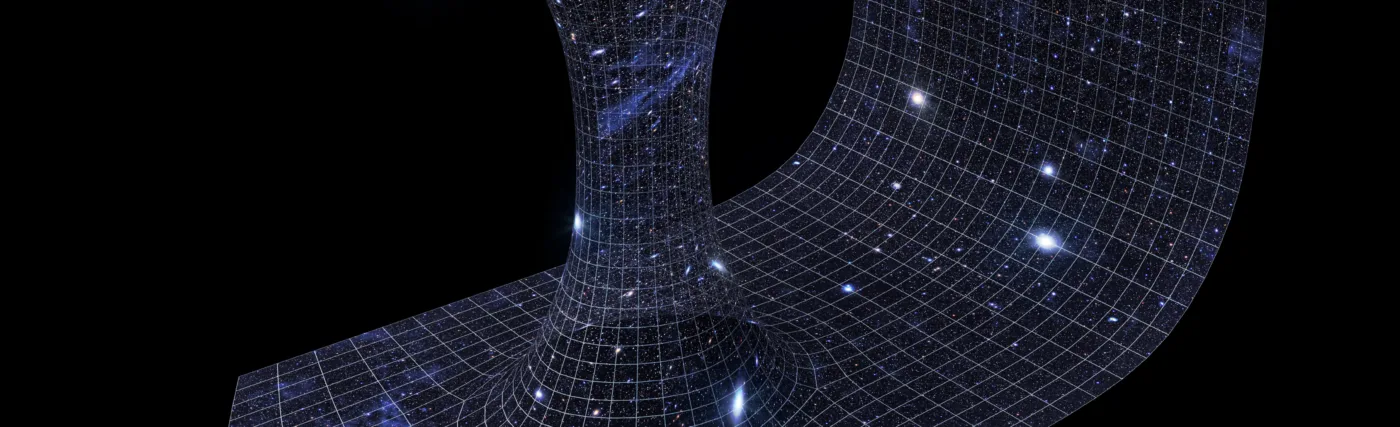
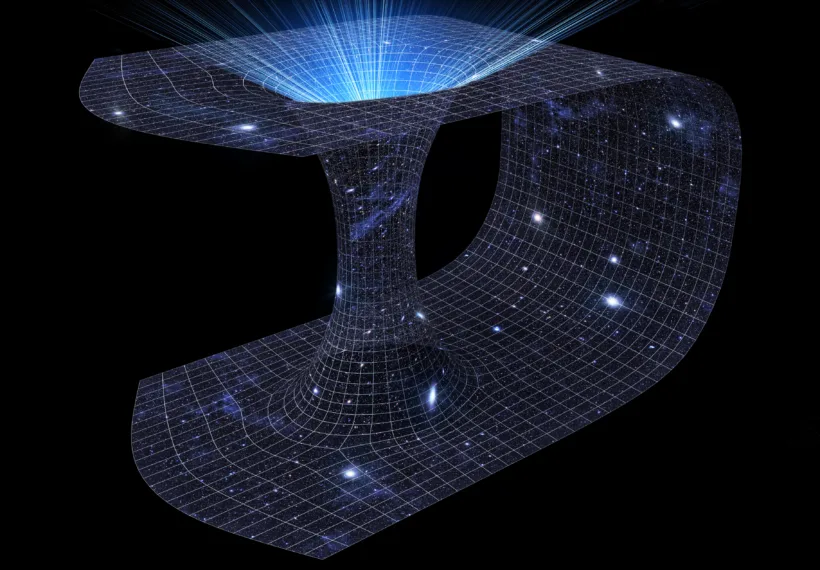
But you need, you know, we always show a wormhole with one reduced dimension, because I guess we can't otherwise conceive of it, right?
We show a rubber sheet, and there's like a punk, you know, a stretch of piece that goes through it, and it comes out the other side.
But that rubber sheet is our way of representing a full three dimensions.
Right, it's just two.
Right, it's really, so do you see the movie Interstellar?
Yes.
Okay, so they're coming upon.
I like the part with the Joker.
So they're coming upon a wormhole through space, and it's just, it's a sphere.
And you say, well, that's not a hole, but yes, it is.
Because it's a hole in every direction.
So you go in and you come out another side, but that requires a higher dimension for it to happen.
And that's just, that's just cool.
So what I, you know what I want?
I want.
But in any dimension, is that movie fun to sit through?
Well, if you read the book, there was a tandem book, man, I guess you didn't get the book.
The book is, it's an explanatory book, The Science of Interstellar, written by one of the co-executive producers, who's a professor of theoretical physics at Caltech.
Nice.
Yeah, and it's like a coffee table book, but a lot of pictures and things from the movie, and it explains everything.
That's awesome.
Yeah, so you read that, and then you, Then I get back to it.
Then you reserve judgment.
You call me in the morning.
I like the time stuff.
The time stuff is really nice.
Yeah, it's good, it's good, it's good.
So, I just love thinking about dimensions.
I also like thinking about a hypercube.
A hypercube.
Tesseract.
Tell me about hypercubes.
Hypercubes are just cubes of four and higher dimensions.
Yeah, yeah.
I like the math, too.
He's so like Dezikoff.
It's just, it's just a higher dimensional cube.
Yeah, we have these, hey, I got one in my pocket.
Actually, if you look at the ordinary sense of dimension, which is some feature or aspect of a person or thing or whatever, you can have very high dimensional entities.
I mean, if you allow, for example, look at a person, this height, his weight, his whatever, plus what he likes, the degree to which he likes it, the brands he likes, his almost any dimension.
You could have 50 dimensions.
You look at eHarmony, 100 dimensions.
What's interesting about that, if you think of a person as a 100 dimensional person, almost everybody on Earth is on the edge of the hypercube, because if you take a square, a 10 inch by 10 inch square to use parochial units and you stay a half an inch away from the edge, you know, only, what is it?
9 times 9, 81% is in the interior and the rest is in the exterior.
But now if you take a cube and you take a look at a half inch around each one, then it's 9 times 9 times 9.
It's only about 73% in the interior.
The percent goes up.
The percent goes down.
No, no, the percent of what is in the edge.
The percent of what is on the perimeter goes up.
Right.
And then you have 4, it's 62%.
If you have 50 dimensions, almost everybody is in the edge, around the edge.
So in that sense, my father used to love this saying.
He says, there's two kinds of, you probably heard it, there are two kinds of people in the world.
There are very strange ones and the ones you don't know so well.
And so we're all really strange because we're all in the periphery of this hypercube that describes us as a collection of dimensions.
So does that mean eHarmony works or not?
I am not.
You're on the dating scene.
I'm on all the apps.
I'm on Tinder.
I'm on J Swipe, which is Jewish Tinder.
It's like regular Tinder, but if you both swipe right, you get half of her father's business.
It's great.
Wait.
So do you feel like your dimensionality is properly represented in your social profiles?
I think they should ask if you understand hypercubes and that could really get out.
I use astrology.
That's my big thing.
There you go.
I sit a girl down and I go, do you believe in horoscopes?
And if she says yes, I end the date immediately.
Oh, I see.
That's a filter.
Right.
She's like, what's your sign?
I'm like the exit.
It's worse in between you and I.
That's if you're hyperliterate, you'll...
back when Cosmos was airing, there was a comic that was really cute.
There was a speed dating, right?
And one person says to the other, have you seen Cosmos?
And the person says, what's Cosmos?
And the person says, next.
I said, whoa, that's good.
That's like putting some academic pressure on your speed date encounter.
So let's continue the hypercube.
So describe to me how you get there.
Because when I think of it, I think about, start with a line, and the line is one dimension because it only has length, and it's bounded by two points, each with zero dimension.
Points doesn't have height, width, or depth or anything, okay?
That's kind of interesting to me.
But I only see a cube if you hand it to me.
But wait, so watch.
No, no, no, no, watch, watch.
So now I take this line, and then I sort of rotate it out into an axis, then I get a square.
So a square has two dimensions to it, but it's bounded by four one-dimensional lines.
That's just kind of interesting.
So now I take that square and slide it up to get a cube out of it.
So now a cube has six sides, each bounded by two-dimensional surfaces.
It's called a die.
A die.
A die, yes.
Excuse me.
Okay, so now if I want a four-dimensional cube, I take this three-dimensional cube and pass it into a fourth dimension and thereby I end up with eight sides, each a cube.
The side is itself a cube and we just can't think of that.
But you're a mathematician, you've been doing, can you think in four dimensions or is it still weird for you?
No, you still have to resort to cross-sections.
I mean, there are animated versions of the tesseract where it rotates.
The tesseract is the four-dimensional cube.
It's the four-dimensional cube where it rotates and you look at the various cross-sections and you can get a little bit of a feel.
But no, I mean, some people, I mean Thurston, late mathematician at, I think it was at Princeton, did have a kind of visceral feel for four-dimensional entities.
But most people, most mathematicians.
Okay, so I don't feel so bad.
No, you don't.
Got to take a quick break.
When we come back, we will be joined by a good friend and fellow physicist, James Kakalios.
Some of you know him as the world's expert on the physics of superheroes.
There's some higher dimensionality going on there.
We will bring him in to the conversation as well as queries from our families.
We're back at Mashable Headquarters in New York City for StarTalk.
Topic of today is Higher Dimensions.
And I got help, I got mathematician right here, John Paulos.
And coming in on video call, John Kakalios.
How you doing, man?
I'm doing great, how are you?
Excellent, you've met my co-host for today, Harrison Greenbaum.
And wait, wait, for those of you who see this on video, you have superheroes dangling from your wall.
Now, I know you wrote the book, The Physics of Superheroes, but they appear, little versions of them have appeared to have invaded your den.
You may think of them as action figures, Neil, but to me, they are lecture demonstration tools.
Oh, that's how you explain that to your mother and to your wife, yes.
And my department chair, yes.
You've been expensing a lot of action figures.
Moving on.
So, one of your favorite books of mine is The Physics of Superheroes, but that's not your latest book.
Remind me of your latest book.
The latest book is, oh, and hair.
I happen to have it right here.
Who says this isn't the Marvel age of shameless plugs?
The Physics of Everyday Things.
Excellent, excellent.
So, you're everyone's sort of man-about-town physicist.
There are people who cover astrophysics.
There are people who do the Higgs boson.
I cover all the nitty gritty stuff that surrounds us every day and explain how physics is useful not just to explain colliding neutron stars, but also to explain our Fitbit.
Very good to know.
I got rid of my Fitbit.
You got rid of it.
It measures your motion based on wrist activity.
I was like, I don't need people to know they run a marathon at 4 a.m.
every evening.
So what we've got here, we're in the Cosmic Queries section of our StarTalk.
Harrison, you've collected questions.
All the questions.
Bring it on.
All right.
Bring it on.
I got two experts here.
I could just go to the Bahamas right now because we got all the expertise you need for higher dimensions and so much of people's access to higher dimensions and knowledge of higher dimensions comes from superhero movies.
So let's see what you got.
Yeah.
So the first question comes from our Patreon.
So thank you for supporting us.
And this one is from Orlando, Florida.
So he's near a superhero theme park.
We've seen compelling theories that postulate everything from 4 to 26 dimensions in our physical world.
What's so special about the fourth dimension?
Is there anything mathematically unique about it compared to what we consider spatial dimensions?
I think we pretty much answered that, but...
Ooh.
Yeah, so John...
Is there anything mathematically unique about it?
It's physically...
I mean, there are arguments for it, as I said.
The second law of thermodynamics suggests that once the early universe cooled a bit, it didn't have enough energy to...
To birth out another dimension.
To birth out another dimension if you wanted the second law to hold.
So the fourth is beyond us.
You're saying we're stuck with four dimensions.
Yeah, we're stuck with three and one.
Yeah, four dimensions.
So I mean, there are these other, you know, deficient, for lack of a better term, dimensions if you believe in string theory.
But, you know...
Okay.
I mean, there are lots of theories.
I mean, Kant had his own theory.
But I don't want to get into Kant.
Immanuel Kant.
Immanuel Kant.
Okay, yeah.
But he didn't know anything about cosmology.
No.
One thing he did, he made a distinction that many people derided between numina and phenomena.
Numina is the way things are.
They will never know.
Phenomena is the way we see things.
We are a priori categories.
And in a way, I mean, in physics, it is something we'll never know.
In the extra dimensions and other universes, we'll just never know.
In physics, we don't give a rat's ass about what something is if what it is is not revealed to us through a measurement.
Yeah, but...
Would you agree with that?
It is kind of disturbing that of all the extra dimensions, none of them are in the time domain.
They all seem to be extra spatial dimensions because if they were in the time domain, then maybe we could move back and forth in time the way we move back and forth in space.
And in fact, science fiction stories have sometimes suggested that that would be how time travel would occur.
So help me on this.
So if we had more than one time dimension accessible to us, does that mean we can just go off in one time coordinate while freezing our movement in the other time coordinate and do things with our life and then return and then continue?
Because that's what I do spatially.
Why not?
No, presumably that would be in fact the case.
That's kind of cool.
Yeah, so I can't remember where.
It might have been even an HG.
Wells short story about that might be a way of achieving time travel that they discovered that there's other pathways just so you can get from one point to another taking alternate routes.
Alternate time routes.
Spatial routes, we do it all the time.
But spatially, you'll take a shortcut, you'll go backwards to where you once were, you'll visit your old haunts.
It's like a time shortcut.
Yeah, so you could have a time shortcut.
That would be interesting, but they never want to add another time dimension when they need to add dimensions.
Is this anything different from the wiggly wobbly timey wimey time of Dr.
Who?
I think that ultimately, the reason why there are only extra spatial dimensions is in fact just that.
To avoid saying, well, they kind of postulate, time travel is not going to happen, so everything has to stay, all the extra dimensions are spatial.
Well, time travel always leads to the grandfather paradox.
You go back and tell your grandfather, unless the universe splits there, one universe, your grandfather.
That's the many worlds.
That's right, you can go back in time, but it's an alternate so you can kill as many grandfathers as you got bullets.
Would Trump be president?
There's nobody who's using their time travel to come back and be like, what are you doing?
I'm working on it.
I'm working on it.
All you have to do is prevent your grandfather from meeting your grandmother.
Or delay when they had sex by 10 minutes.
There's this guy with blood on his hands.
He's like, you just had to go to the library.
Oh my God.
Let's go to the next question.
This gets us to our next one from Justin Collado in Facebook.
How much cannabis do I have to smoke to get to the fourth dimension?
I'm assuming he's in Seattle.
Or Colorado.
We've got good places for that.
What are you looking at me for?
Okay, so John, when you get deep into your math, how much cannabis is required to reach different dimensionalities in your analysis?
You don't know?
That's an experiment that you could perform.
In my particular case, it would probably be a tiny amount since I don't ever engage in such.
So I think a tiny little bit and I'd be in the fifth dimension.
Okay.
Time slows down when I use it, so that's a way of changing the fourth dimension.
So is that for you?
For me, yeah.
My friend.
My friend in Colorado.
Who smokes?
I don't know anything about that.
This is from the StarTalk website.
Is there a study of physics that delves into the zero-D dimension?
Every other dimension possibility is looked at, like in string theory, but why is the possibility of dimensions lower than one excluded from that line of thought?
Well, technically they're not, because that's what a singularity is in the center of a black hole.
That's what the singularity was at the birth of the universe.
That's the definition of a singularity.
So now, here's the problem.
And James, correct me if I'm wrong here, or if you think differently about it, what's interesting about these singularities is that we know in advance that's where Einstein's general theory of relativity breaks down.
We need a new way to gain access to what's going on in the universe at those points of singularity.
And it's been said that's where God is dividing by zero.
We're like, you're not supposed to do that.
So, and string theorists are supposed to be lining up to handle that limit, that limiting case.
So, yes, this writer needs to think of singularities as the zeroth dimension.
And James, could you add to that?
I would, so, along what you just suggested, Neil, the tricky part is that if you're going to base, you say physics is only cares about things that you can measure and what the evidence is and at the singularity, we have no evidence and all of our equations break down, it makes it rather tricky to then have a theory that accounts for the singularity and then presumably would then account for things that we're observing today to try to justify.
I hadn't thought about that.
What you're saying is you can't use a macroscopic object to measure a zero-dimensional thing.
Or going back to that point, you know, of the singularity, it's like where's the evidence, you know, we say, what's the evidence or what's the data that you're going to use?
You have to be there, but you can't be there if everything is singular.
All right, next question.
So this is sort of related, we touched on it a little bit, but this guy on the website, Gary F.
Anderson, he said, supposedly before the Big Bang, dimensions didn't exist.
When the Big Bang manifested itself, dimensionality suddenly came into existence.
Did that dimensionality expand at the speed of light?
Or did it just instantly pop into existence creating an infinite, empty universe?
Well, everything we know says that we were endowed by the matter, energy, space and dimensionality from the transition from an extremely high temperature universe to one that's much cooler, and we're freezing out these properties as the universe expands and cools.
So, James, would you add or subtract anything from that account?
Not at all.
I'm a humble but lovable solid-state experimentalist.
Don't blame me for this Big Bang stuff.
No, but this is not my area of expertise, so I will defer.
You get this at different stages of the extremely early universe, and so we're stuck with the universe we have.
Get over it.
We've got time for one more before we take a break.
Green Meteor from Instagram said, is death the fourth dimension?
Ooh.
Sounds seem like more of the zeroes dimension.
You just disappear.
Yeah, I would agree.
Death is the zeroes dimension.
I'm going with that.
We've got three and O here.
We're going with it.
We've got another one.
Bring it on.
Richard Adams on Facebook says, do accounts of powerful deities make more sense when you consider higher dimensions?
Ooh.
Well, you know, when you think about like the Flatland example, that if we lived in a flat dimension, a three-dimensional person who could put things in and out of our flat dimension would seem extra physical, would seem beyond our realm or our understanding.
And is that what Thor is to Earth?
Thor exists in higher dimensions.
They have access to space-time dimensions that we don't.
Isn't that correct?
Presumably.
Well, you're my comic book guy.
Don't tell me presumably.
They've gone back and forth on that.
I'm saying, oh, it's magic.
Or saying that there's a scientific, it's just like hyper-science.
Or back to, it's magic.
So, I think the takeaway here is that it's clear that if you live in a higher dimension relative to some community of beings, you are all-powerful and all-knowing in ways they will never understand or imagine.
Yeah, I think that's right.
I think that's right.
Yeah, I think the answer is basically yes.
Yeah.
It's indistinguishable from what a higher, and deeply religious people will say knows all and is all-powerful.
They will describe powers to God any of us would give to a higher dimensional being.
Yeah, I think that would be a trivial And we could have a hierarchy of gods too.
The fourth dimension, the fifth dimension, the sixth dimension.
Yeah, yeah.
So I just need to find a flatland and be God.
Is that your first thought?
Is that what you read?
Yes, the cult of Harrison.
There will be a bunch of flatlanders giving me two-dimensional offerings.
Like the tiny insects you are.
Well, when we come back, more cosmic queries on higher dimensions will be in StarTalk Returns.
We're back on StarTalk Cosmic Queries Segments.
We're talking about higher dimensions beyond the three-spatial and one-time dimension with which we are familiar.
I've got math professor John Paulos.
I got my co-host, Harrison Greenbaum.
And on video call, I've got James Kakalios, one of my favorite people out there of them all, Mr.
Superhero Expert.
So we got questions from our fan base.
So what do you have?
Alex Lanter from Twitter wrote, is a tesseract a fourth dimensional object?
Follow up, what is a tesseract?
So that's weird that this person doesn't even know what it is, but he's asking about that.
Well, because he's seen it in the movies.
So obviously the word tesseract has its origins in mathematics.
And it was then co-opted by the Marvel universe, I presume.
So earlier in our first segment, we talked about the tesseract just as a four dimensional cube.
So if you can tell us what role does it play in the Avengers pantheon?
Not so much the Avengers.
The Fantastic Four at one point had their headquarters that was kind of a tesseract so that they could be on just a warehouse on the New York wharf and yet have managed to have the facilities of a skyscraper there.
It was a real estate device?
Well, so...
Exactly, it was a real estate.
It was a real estate.
It's bigger on the inside, trust me.
So it's bigger on the inside, like Dr.
Who's police call box, the TARDIS, like Mary Poppins' bag, which she pulls mirrors and lamps out of it, like Hermione's purse in Harry Potter.
The wardrobe from Lion, the Witch and the Wardrobe?
Or is that really more of a portal?
No, more a portal.
I thought of that more as a portal rather than a container inside.
What's the movie, I'm remembering, where the Tesseract was in a NASA facility?
Oh, they were talking about, so the Tesseract was actually one of the Infinity Stones.
That was in the first Avengers film.
I know it.
Yes.
Yes.
That's that blue glowing stone.
That has been later identified as the space Infinity Gem or Infinity Stone that gives you ultimate control over space.
It was viewed naively as a Tesseract, just basically as a portal or some way to go from one point to another.
Now it's recognized that it would give you control over any point in space.
What do you say, now it is recognized, was there some team of researchers that took crack team of like, what do you mean now it came to be realized?
Yes.
When Thor went into that little mystic pool in Avengers 2, Age of Ultron, he recognized that what they were dealing with were the Infinity Stones.
We saw a purple power Infinity Stone in Guardians of the Galaxy.
The Vision has a yellow mind stone that gives you powers.
Okay, so Tesseract was just a holding word.
They needed a cool word until they could figure out how to do more with this thing.
Right.
Okay.
Now, there's a Trump Tesseract Tower.
The Trump Tesseract.
Okay, so that'd be a building you walk into.
It's way bigger on the inside than it would be on the outside.
There's a joke in there somewhere.
Oh, come on.
There's so many.
I'm going to use my Tesseract to go back in time.
I was nerding out because isn't there also the cosmic cube, which is like that?
Okay, so they were referring to the Tesseract a little bit as the cosmic cube in Captain America, First Avenger, and then in the Avengers movie.
In the comic books, the cosmic cube is a cube that when you're holding it, you can change reality.
So in some sense, it was like the reality stone, Infinity Gem, in that you could just change.
So suddenly if the red skull was holding the cosmic cube, we could suddenly be in a world where Germany won World War II.
So a different outcome of events in the world.
A whole different reality, where everyone has like a third eye or a forearm.
You could change any aspect of reality.
That was primarily through the comics rather than through the films.
Yes, except that in Thor, the dark world.
God, it is so sad.
I know all this.
We weep for you.
I'm on the same boat.
I lost my virginity in college, so we're fine.
The ether that Thor and the dark elf Malekith fought over turned out to be identified to be the reality stone.
So that is introduced into the Marvel Cinematic Universe, and we'll be seeing that presumably in Avengers 3 and 4.
So these are other space paths, not time paths.
So other realities that you were referring to.
There is a time stone.
We haven't seen that one yet, though.
So next one.
Sorry, we have seen it.
We saw it in Doctor Strange.
Doctor Strange in the Eye of Agamotto had the time stone.
That's why he was able to trap Dormammu in the time loop.
Oh, spoiler alert.
All right.
This next question comes from Nanook Shacook.
Let it be.
It rhymes.
All right.
Could it be plausible that the edge of the universe is merely the end of a dimension and possibly the start of another dot, dot, dot, just a thought?
Well, so it turns out variations on the multiverse idea have it that there are pockets of the universe that are expanding in such a way that other expanding zones don't know about each other.
Okay.
So the independently expanding zones within sort of the space that spread out among this metaverse, if you will, this multiverse.
And so the edge of your universe is technically the edge of your reality.
But I learned this, James, I don't know if you knew this.
I learned this like a week ago from a cosmology colleague of mine that you can have one edge of an expanding universe bump into the edge of another expanding universe.
And that would show up as a circle because these are expanding bubbles, which two bubbles intersect, you get a circle.
And that would show up in sort of the cosmic microwave background.
Flatland, the sphere coming down.
The sphere coming through.
So I don't think we can think of it so much as another dimension, but it certainly would be the boundary between your universe and other universes.
And so that's got to be pretty good if you found a way to portal from one to tunnel from one to the other.
You do a lot of tunneling in your microphysics, don't you?
Yeah, actually we do.
All I know is that if one universe bumps into another universe, your insurance rates are going up.
No, you get one forgiven collision.
Oh, you get one.
It's no fault.
One freebie.
The mulligan.
Yes.
All right, Harrison, what else you got?
All right.
Since the Higgs field is from Gavin Minton on Facebook, since the Higgs field creates mass and masses particles do not experience time, does that mean that the Higgs field creates time?
Is time simply a bizarre emergent property of the Higgs boson?
I love it.
I don't know if it's true, but I love the idea.
What do you think, James?
That sounds great.
Right, because without the Higgs boson, you would have no particle mass and only particles with mass experience time.
The question is, can you experience time if there is no mass and no speed of light particles?
Can you even imagine time?
Or maybe time has no meaning because there is no sequence of events for you to measure.
What do you think?
I think that's exactly right, what you just said there.
Time is the thing that we use to kind of order what comes first, what comes second.
If they are occurring all simultaneously, then…
It's not all simultaneous or nothing is happening anywhere, then time has no meaning.
The thing is that different particles interact with the Higgs field.
They couple in different ways, which is why they have different mass.
And yet, no matter how they couple to the Higgs field, they all seem to experience time the same way.
That's an interesting point.
So even the high mass particles experience time at the same rate that a low mass particle does.
But different unstable particles decay at different rates than do other unstable particles.
So that's one of the great mysteries that you get.
This particle decay in 30 seconds, this one in six minutes, reliably, predictably every single time.
Well, one thing that strikes me is that often in these speculations, the interplay between the English language and physics is very nebulous.
I mean, even, I mean, Pancre once said that you could, the mathematician and the physicist, that you could insist that the universe was Euclidean.
And if you did, you'd have to introduce fictitious forces and strange torques and accelerations.
So you pick your physics, geometry combination and you can make it whatever you want to some extent as this conventional view of philosophy of math.
But if you do pick it one way, you've got to change the physics.
And so-
So this reminds me of the quote, was it attributed to Einstein, where it's time is invented to make motion look simple.
That's a-
What do you think of that?
Inventional theory of time, right?
It's like when I-
That's a good one.
As a comic, you made a comic to say you have two minutes left.
So I always joke, can we light people based on how long their set has felt?
That's good.
Because he's been on stage for an hour according to my perception.
It's a relativistic theory of stand up.
Yes.
The time dilation of comedic capacity to entertain.
Speaking of time going slower than it should.
Let's go.
Let's talk about the movie Interstellar.
How do you feel about the accuracy of the presentation of the fifth dimension in the movie Interstellar?
That's from Lookayoyo89 on Instagram.
Yeah, I have issues with the interior, the black hole in the library and he sees I'd like that their attempt to portray that we're the sort of infinite boulevards basically of space.
I'd like the attempt and I can't come up with a better attempt, so who am I to judge it?
But if you asked me, I would say that's probably not what it's actually like.
But I don't know how else to say why that's so.
James, what do you think?
Actually, didn't he, existing in a higher five-dimensional space, he was able to move around then in time because he was able to then go to like when his daughter was young or some later time.
And so, it was the same notion that he was in what we've been talking about before, about Flatland.
He was actually able to move around in a higher dimension.
And I just don't know how he could do sort of Morse code with book titles, but from the backside of each book.
How well do you know your books that the other side of the book, you can identify the title?
He's on the other side of the shelf.
He's on the other side of the shelf, poking them through.
Oh yeah.
I have issues.
He can travel through five dimensions, but he can't go to the other side of the book.
Just turn around.
Turn the brick around, right?
We've got time for like one or two more questions.
All right, go.
Those will be sound bite mode.
Okay.
All answers in sound bites.
Cool.
This one's good.
This is from Tony from El Paso, Texas.
Is it possible to fabricate an artificial dimension?
And if so, could we theoretically create an artificial dimension and send people there to solve our overpopulation?
I'm not authorized to respond to that from my knowledge of national security.
That would be cool, James, if you can manufacture a dimension.
I could go into this, but it involves proprietary technology right now.
So both James and I are silent on this.
I think it's the Trump Tesseract.
I think we've already spilled the beads.
No, it would be really cool if you could do that.
Well, I mean, wormholes, I mean, something like that.
I mean, wormholes strike me as sort of like entangled particles writ large.
What I want is a box on my desk where, because I already stack, the surface is already covered and I already got stuff stacked, but now I need something to put it in a fourth dimension.
Oh, see, I have, yeah.
The stacked pages must look really mysterious to ants on the surface of the desk because the pages just disappeared, but they actually were elevated into a third dimension.
And you could store way more papers up in a third dimension than you ever could two dimensionally on the surface of the desk.
So I'm thinking now if I have boxes, I'll just need a four-dimensional portal and put all the boxes in the four-dimensional portal.
I could do that forever.
Am I right there, James?
I think it will not violate any point of entropy because no information will be preserved.
No, I'm not saying put it forever.
You can access it later if you want.
I'm just talking about the stacks that I have right now.
If I had any physical objects, I would have like a Schrodinger's cat.
I would have a cat that's dead and alive simultaneously.
That's creepy.
It would be awesome for Halloween.
Yes, it would be awesome.
Are you trying to get out of feeding it or changing the litter box?
Right, you wouldn't have to because at that point it's dead, but then it's not.
So rather than take care of it, he said, I will now have dead cat for the day.
I don't have to take care of it.
I think it's no accident that dimensions sound like dementia.
Oh, let's do one more question.
All right.
The last one.
This is one is from Call Him Bob and his name is Bob.
So call him Bob.
Is there an upper limit to the possible number of dimensions?
And if so, how do we know and why does it exist?
Well, physical dimensions, I mean, the dimensions in the everyday sense, there's no limit.
You could go e-harmony, there's 100 dimensions, but physical dimensions, it's not clear.
I mean, 26, people used to talk about, but I don't know if there's any physical limit.
Yeah, I don't know either.
Do you know, James?
No, I don't think I think the only limit would be what's the evidence, you know, the evidence right now is three spatial in one time.
And there are proposals and suggestions for higher order dimensions, but are smaller, and we'd have to access them at higher energy.
But until we find them, you know, and once you figure out how to find them, there's no reason to cut it off.
But it's what's the evidence if I found it, I'm not telling anybody.
But just to be clear, mathematically, there is no constraint on how many dimensions you can invoke in an in an equation or an infinite dimensional vector space, infinite dimensions, physically.
So then there can never be somebody beyond your there can be an infinity plus one deity that 10 year old kid with your biggest number, you know, a billion billion and one infinity.
You lost that a couple of times.
We got to wrap this up.
James.
Always good to have you.
Pleasure.
Thanks.
Anyway, we can get you next time.
Next time you come through New York.
Just make sure to stop by.
We will wrap a show around you, bring your action figures.
John, thanks for being on StarTalk.
It was a great pleasure.
Is this your first time on StarTalk?
It is.
We will find a way to get back to you because I would love me some math.
Anne Harrison, welcome.
Thank you.
We will get you back for sure.
This has been StarTalk, the 4D Cosmic Queries edition.
I've been your host, Neil deGrasse Tyson, your personal astrophysicist, and as always, I bid you to keep looking up.
See the full transcript



 Unlock with Patreon



 Become a Patron