


 Unlock with Patreon
About This Episode
Can you make something invisible? Neil deGrasse Tyson and comedian Negin Farsad discover the science behind invisibility with professor of physics and optical science, Greg Gbur. What would real-life invisibility look like?
Can you be invisible in other parts of the magnetic spectrum? We discuss transparency versus invisibility and how metamaterials help us interact with different wavelengths. What does light have to do in order to make something invisible? We break down invisibility cloaks and other invisibility devices from fiction.
Could you make yourself invisible to all parts of the electromagnetic spectrum? We explore the main challenges in achieving invisibility and the difference between passive and active invisibility. How useful of a power would it be?
We discuss the interaction between waves and matter. What makes some waves reflect off matter and others pass through? Learn about x rays and how they work, plus, an at-home invisibility trick using prisms. Finally, could you make someone invisible to time?
Thanks to our PatronsDan, Nick Taylor, Beth Fitzpatrick, Jim, Laura Gilsman, and Gregory Greenwood for supporting us this week.
NOTE: StarTalk+ Patrons can watch or listen to this entire episode commercial-free.
Transcript
DOWNLOAD SRTWelcome to StarTalk, your place in the universe where science and pop culture collide.
StarTalk begins right now.
This is StarTalk, Neil deGrasse Tyson here, your personal astrophysicist.
Today’s edition is a Cosmic Queries on the subject of invisibility.
We all want to be invisible at some point in our lives.
And I got with me, Negin Farsad.
Negin, welcome back.
Hello, Neil.
I’m so excited to be here and to be talking about this crazy topic.
This is a crazy topic.
And those who are meeting you for the first time on this show, all right, you’re a host of Fake the Nation, okay?
You’ve got a podcast of your own there.
And you’re also a regular on Wait, Wait, Don’t Tell Me.
I think I’ve been on that twice and I didn’t do very well.
They asked me questions.
I got them all wrong.
They never invited me back.
And most…
You know, they usually help guests just get the questions right.
So they must have had something against you in particular, not to help you.
They usually rig those tests.
Yeah, it’s a delightful moment of conversational comedy in Wait, Wait, Don’t Tell Me on NPR.
Absolutely.
Of course, is it still on NPR?
Absolutely.
Excellent.
And you’re also a host of recently the Succession Recap.
You know, I’ve seen episodes of Succession.
I don’t want that recap.
I don’t know what’s going on or why or should it be happening.
I don’t understand it.
I don’t want to understand it.
And you’re going to recap it?
No.
I mean, Neil, you have no idea these recaps are like just out of control.
We get so deep into the psychology of billionaires.
It is fun, ridiculous, and we have no idea what we’re talking about because none of us are billionaires.
It’s too weird.
It’s the family tensions and everything.
I don’t want it.
Yeah, okay.
All right.
I’ve read a little about this, but we have people out there who are experts in invisibility.
And we’re not talking about the CIA or anybody like that.
We’re talking about actual physical optics of invisibility.
And so we combed the landscape.
And we found Professor Greg Gbur.
Greg, welcome to StarTalk.
Hey, thank you.
Great to be here.
You’re a professor of physics and optical sciences at University of North Carolina at Charlotte.
So your research focuses on classical optics, the wave nature of light.
So classical as opposed to quantum optics, I guess.
Is that how you distinguish that?
Yeah, that’s exactly it.
Light is a wave, not as a particle.
So you’re not in denial of it being a particle.
You’re just saying you care about it when it manifests as a wave and you’re good with that.
Yeah, that’s about correct.
I find the wave properties just really elegant and beautiful and fascinating.
And even though we’ve known lights a wave for over 200 years, there’s still so many interesting things to discover.
And you’re author of a book that just has an audacious title, Invisibility– let me get the title right here– The History and Science of How Not to Be Seen.
Oh my gosh, released in 2023.
So you’re the right guy for this, I’m guessing.
I hope so, yeah.
Alright.
So Negin, we’ve collected questions from our Patreon members.
Now the barrier of entry to become a Patreon member has been reduced.
So you can actually have access to our questions and not only special recordings of our questions and answer sessions, but also you get to get one of your questions submitted.
And that’s for like $5 a month.
Which I’m sure costs less than all orders of coffee you could possibly put at Starbucks.
I’m pretty sure, is that right?
I mean, absolutely.
And that includes tip, I think.
I think, right, right.
Totally, totally, totally.
Okay, so what do you have for us, Negin?
Okay, so Dylan from Flagstaff asks, This question sounds weird, but can you be invisible in other spectrums of the electromagnetic field?
It’s one thing to be invisible from visible light, but how about ultraviolet or infrared?
I love that.
And let me just preface that, Greg, by saying, you know, technically a window is invisible, right?
Because you can’t see the window if you see what’s on the other side of the window.
The window is just kind of not there.
So this whole thing of invisibility, could you just put it on some kind of foundation so that we can know how to think about the questions that are getting asked?
Sure.
I mean, I do draw usually a distinction between transparency and invisibility.
So a window is very hard to see, and we all know that in a lot of cases you just can’t see it at all.
But how clumsy you are, yes.
Ten-year-old Negin definitely didn’t see the sliding glass door that she walked into.
There’s nothing more embarrassing than that.
So embarrassing.
Well, now I feel bad because when I give talks I often use a GIF of people walking into glass doors to highlight the point.
So, yeah, we tend to think of windows as transparent because they always do, in almost every circumstance, reflect a little bit of light.
And when we tend to think of invisibility, we think of something that isn’t going to reflect light and it isn’t going to disturb the light that passes through it or around it so that the object becomes in principle undetectable for whatever spectrum of light you’re considering.
All right.
So, visible light.
This questioner clearly knows about other bands of light in the electromagnetic spectrum.
And I’m happy to– I’m always jumped to point out that windows are transparent to visible light, but are almost opaque to infrared light, right?
So if our eyes were tuned to infrared, wouldn’t the window just be opaque?
It would be like a wall.
Is that a fair statement?
I think so, yeah.
Yeah, okay.
So now, in whatever you do to make something invisible, give us an example, and then tell me how you might do that in a different band of light.
So what’s your favorite band of light to render things invisible?
Well, you know, I’m always partial to visible, but I mean– Okay.
Call him old-fashioned, Neil.
He’s just partial to visible light.
I’m a traditionalist.
None of those fancy waves for me.
So, actually, one thing I can say is that the first experimental test that somebody did to try and demonstrate at least the principles of making an invisibility cloak, they did it for microwave wavelengths, which are longer wavelengths, you know, closer to the radio wave spectrum than the visible spectrum.
And they did that because the wavelengths are longer.
It turns out it’s easier to design the structures that will do this light guiding and hiding of a hidden region.
Wait a minute, Greg.
Greg.
Microwaves, that’s what police radar guns use.
So, can I make my car invisible to the police radar gun?
You know?
I don’t want to, you know…
But, Neil, what are you trying to get away with out there?
It sounds like this guy knows how to…
He’s never paid a ticket in his life.
Well, dang, I mean, you just gave me a new application.
And one that’s surprisingly plausible, actually, because the little structures you need to design to fabricate sort of an invisibility cloak at microwave ranges are more on the order of millimeter-sized structures or centimeter-sized structures, which are a lot easier to do than to try and make structures for visible light, which is on a billionth of a meter scale of the wavelength kind of thing.
Oh, you’re saying your tools and the bricks you’re using to make the object, the construction elements, have to be on the size or smaller than the size of the wavelength itself.
That’s exactly right.
And that’s a great way to put it, is sort of little building blocks, because if I can already jump in to use the technical attention-catching term metamaterials, cloaking devices and invisibility were part of this, what they called a metamaterial revolution.
The idea that if you mess around with the structure of materials on the scale of a wavelength, you can suddenly get all sorts of optical behaviors that you don’t get in a material in its natural state.
So, okay.
So, all right.
So, what’s an example?
So, now you meddle with my material and then I become invisible.
What did the light do that was behind me that now comes straight to you to make you think I’m not standing here?
The kind of the traditional invisibility slope.
Traditional.
Negin, you had one of these.
So classic.
All-fashioned.
Okay, go on.
These are the ones that people first introduced in like 2006 theoretically.
And those, the idea is you design your materials such that they guide light around a central hidden region.
And kind of like the analogy that they often use is like water flowing around a rock in a stream.
The idea is as the light goes in, it takes a detour around the hidden region.
And then it goes on its way exactly like it came in.
It goes out the way it came in.
So that in principle, you don’t know it took that detour.
And you keep saying materials.
Are you like essentially talking about an invisibility cloak?
Am I allowed to say cloak on this podcast?
I think you can.
Right.
Was that a term before Harry Potter?
Invisibility cloak?
I don’t know.
This is one of my favorite little mind-bending things, or at least for my mind, that when I was researching the book, I was kind of going through scientific papers, trying to find the earliest examples I could of scientists talking about invisibility.
And I suddenly happened upon a paper from Science News in, I think, 1942 or so.
And it was titled Cloaks of Invisibility.
Oh, there you go.
And my heart literally skipped a beat.
I was just like, boop.
I thought I was going to rewrite two-thirds of the book and kind of re-figure everything out.
But it turned out they were talking about just regular camouflage.
You know, hiding things in camouflage, having somebody hiding in a spider hole under the ground.
And that’s a wartime paper as well.
Right, 1942.
So you’re not invisible.
You just, no one notices you.
Right.
That’s where you get kind of, for me, I kind of say that you have to be careful.
The word invisibility is incredibly suggestive and incredibly vague.
So, Negin, have you ever seen those people who are painted into a pattern on the wall?
No, totally.
That sounds like what that book was about, which is more just like an arts and crafts project.
And only if you move do you see them, but if they position themselves just right, all the patterns of paint, they just disappear into the wall.
I’ve seen models do that and others, you know, who don’t mind people painting on their bodies, you know, this sort of thing.
All right.
So, Greg, what you’re saying is, you can do this in principle for any band of light.
It’s just easier for longer wavelengths of light.
That’s what you’re saying here.
That is exactly it.
The longer the wavelength, the easier it is to make the fundamental building blocks you need to make to kind of construct the light-guiding material.
So, you just say this like, of course, you can do this with the material.
So, what precisely are you rearranging at the level of the size of your bricks to enable the light to go around it the way water goes around a rock?
Well, this is where it’s…
I still have a hard time coming up with a good example that visualizes it, but I’ll give a historic example, which is the founder of metamaterial theory is John Pendry.
And in the late 1990s, he was contacted by a company that was making…
I got to interrupt.
The way you say that, I’m thinking he’s in the late 1890s.
No, the late 1990s.
Dude, I was alive then, right?
Yeah, but that was still the 1900s.
You know what I mean?
It was a long time ago now.
Dude, I was alive then.
Give it a little more respect in that, please.
We still had landlines.
All right, I’m sorry to jump in.
All right, continue, please.
So what happened is this company contracted John Pendry.
They said, we made this great new paint, and it’s made out of carbon, and it’s really good at absorbing radar waves.
But we do not know why it does this.
So radar is microwaves, right, basically?
Yeah, or longer wavelengths.
And that was sort of the funny thing, is they made this great material.
The only problem is they had no idea why it worked.
So they brought in Pendry, who was this condensed matter theorist, who looked at it, and Pendry realized that, naturally we tend to think of carbon.
You’ve got diamond as one form, you’ve got graphite as another.
And he found that the carbon that they had fabricated was on this very small submicroscopic level, a bunch of tangled little threads of carbon that were all woven together and tangled up.
And I tend to describe it that the radar waves kind of hit this forest of carbon and get lost in it.
And then they eventually get absorbed.
And that was sort of the revelation that, hey, just because they took the carbon and instead of just having it in this sort of natural graphite form, they scrambled it up into this tangled mess, it suddenly had very different optical properties.
So this is what we do for stealth airplane coatings.
They don’t reflect back the radar at all.
This absorbs the signal so you don’t even know it’s there.
Exactly.
That’s a form of invisibility once again.
And I suspect that the company that Pedri was working with, that the material that they discovered is probably very similar to what’s used in stealth aircraft.
But the people that do the stealth aircraft aren’t talking.
So we don’t know.
Let’s get another question.
See if we can slip one in before the break.
From James Myers, they write, Let’s assume we have a full spectrum cloaking device.
If that device consumes energy, wouldn’t it show up in the infrared?
What kind of audience do we have?
I mean, you’re smart.
It didn’t even occur to me that a thing would require some sort of energy consumption.
If you’re going to absorb energy, you’re going to get hot.
Period.
That’s pure thermodynamics.
So yeah, Greg, what about that?
That’s the sweat.
Yeah, two things I can say about that.
One, well, yes, let’s start with yes.
That’s one of the interesting things about sort of what has happened with cloaking research as the years have progressed now is that people start with these really idealized models of invisibility cloaks.
And then they started to realize that there were all sorts of limitations to these idealized models and all these practical considerations.
And yeah, infrared radiation would be a very big consideration.
If your object is ending up hotter than the surrounding environment, you’re probably not going to be able to completely hide it that way.
But one thing I can mention, which is kind of mind-boggling in and of itself, is people have theoretically speculated that you can actually apply some of the mathematics of cloaking to the equations of thermal heat flow as well.
And they’ve theoretically said you can make a thermal cloak, that heat diffusion works very different from the way waves propagate, but the equations are close enough that you can kind of adapt it and you can design an object that kind of keeps the heat away from the middle of the region for a period of time, like a super thermos.
Like air conditioning for an object?
Kind of.
Kind of more like a do not enter sort of barrier.
That it kind of forces the heat.
Instead of the heat going into the middle of the region, it goes around the region first and it eventually kind of seeps in.
Not exactly the same thing as hiding infrared radiation.
But if we distribute it that way, you could probably create the shape of something that people would think is not dangerous to you.
Yeah.
Yeah, if you can sculpt something out of the radiate, that’s interesting.
Well, when we come back, we’re going to talk more about going invisible on Cosmic Queries with my co-host Negin Farsad and our special guest, Greg Gbur, who is a world’s expert on going invisible.
And StarTalk continues.
Hey, I’m Roy Hill Percival, and I support StarTalk on Patreon.
Bringing the universe down to Earth, this is StarTalk with Neil deGrasse Tyson.
Thanks watching.
We’re back, StarTalk, Cosmic Queries, the Invisibility episode.
Who would have thought I’d get to say that?
We’ve got an Invisibility expert, Professor Greg Gbur, Professor of Physics and Optical Science at the University of North Carolina, Charlotte.
And of course, I got Negin Farsad.
Negin, you got all the questions for us.
Absolutely, and should I just dig right in?
Yeah, yeah, just give me another one.
Give me another one.
From Tom B.
Knight, we have a sort of foundational question.
He asks, how could you make something invisible to all parts of the electromagnetic spectrum?
So just nuts and bolts, how do you do it?
So yeah, based on what you’ve already told us, Greg, it sounds like you’re only restricted to one part versus another.
Can you take out every part of the electromagnetic spectrum?
Is that something you could do?
That’s actually been one of the big challenges in invisibility.
Even trying to make something invisible to the whole of the visible spectrum turns out to be a bit of a challenge.
That would be red all the way through, violet, right?
Yes.
The full visible wavelengths, yeah.
Yeah, and there’s kind of one thing we could say is there’s a practical challenge, which is that in order to make it invisible to all parts of the spectrum, you’d have to make it a cloak that has properties for every wavelength separately and the light’s all going to propagate a little differently.
There’s also a fascinating fundamental issue, which is that this goes back to my picture of a cloak guiding light around a central region and sending it on its way.
Well, that means the light’s taking a detour through the material.
And that means that compared to a light that would have just gone straight through, the light that takes a detour is going a longer distance.
However, so in order for it to be truly undetectable, it’s going to have to go faster than light that went in a straight line path all the way through.
Now, the problem with that is if you’re trying to make an invisibility device that works in air, the speed of light in air is pretty much the speed of light in vacuum, which means that your invisibility cloak would have to have the light be going faster than the vacuum speed of light in the cloak.
So what you’re saying is, just to recap, you’re saying for the light to go around the object and come out the other side, and you have no way to detect it, it has to come out the other side at the same time it would have come out the other side without having to go around the detour.
Exactly.
Otherwise, there’s a time delay from that blob of light relative to all the light around it.
But why would you even notice that?
Well, you would actually notice it in an image, at least some way downstream of your light beam.
Because there’s this delay in the light coming out, it would act kind of like a lens.
What a lens does when it focuses is it delays part of the light selectively to the other, which gives you some sort of curvature.
So if you have this time delay imbalance, that’s effectively going to give you some sort of focusing effect.
Greg, can I just tell you, as a person with regular eyeballs, maybe this puts you at ease, I would notice.
You know what I mean?
If that light was just like a touch slower, I’d be like, cool, that light’s doing its own thing.
I’m not here to judge.
Take your time.
Whatever you got to do.
I just, I’m here to look.
That’s it, you know?
Yeah, that’s, that’s, that’s, there you go.
There you go.
You get enough people with messed up eyesight.
No one’s going to notice.
That’s actually been part of the trend in a lot of the invisibility research since these sort of early theoretical papers, as people said, well, you know, we’ve been talking about can we make something perfectly invisible?
And in principle, it’s possible.
In practice, there’s a lot of problems.
We don’t really need something perfectly invisible.
If we make something 90% invisible, that’s probably going to be pretty good or 99% or something like that.
And that’s people walking into play class windows.
Okay.
But not to put words in your mouth, but if you were to make the entire electromagnetic spectrum invisible through an object, then you’d have to have materials serving every band of light in that electromagnetic spectrum, because there’s no one solution fits all.
So that would be a problem.
It would be a huge surface, a very thick skin around the object, because every layer of the skin is going to handle different wavelengths of light differently.
Is that a fair statement?
Yeah.
I think that pretty much hits it, exactly.
So, you usually don’t see people looking at sort of super broadband invisibility cloaks.
They’re really happy right now if they can study a cloak that’ll block or make invisible some parts of the spectrum and try to learn from that.
So I tell people, is it the B-2 bomber, which looks like the Batplane, that has, I’ve read, the radar cross-section of a bumblebee, right?
So you’re looking for this bomber and nothing’s showing up, right?
And however, you could just go outside and look up and you can see it because it’s not stealth in visible light.
It’s only stealth in radar light, right?
And so it will matter.
It can matter ultimately, right?
You have to know how they’re trying to detect you to then be prepared for that.
Exactly.
Just want to verify.
Verify.
All right.
Negin, what else you got for us?
Well, I have from Chris Plotts.
He writes, if invisibility is bending light around an object, wouldn’t that mean that someone who was made invisible would be unable to see in the spectrum that bends around them?
I suppose another type of invisibility where the image behind a person is projected in front of them would get around this, but that itself would only work against people probably in a pretty narrow band directly in front of the invisible person.
They’d be obvious from the sides.
Seems like invisibility has issues.
Man, we got good people out there.
What happens to the person being made invisible?
Can they see anything?
Well, if the way I say it is, yeah, if the invisibility cloak works as intended, then yes, nobody can see you, but you can’t see anything.
So then it’s like the least fun superpower.
I don’t even know.
I guess you can eavesdrop pretty great, but you can’t see anything?
That sucks.
There are kind of a couple of workarounds of this.
The questioner is correct.
Yeah.
That the person would not be able to see outside of their own eyeballs in the wavelength that you’re using to make them invisible.
Yeah.
That’s crazy.
That’s crazy.
Yeah.
And I mean, there are a couple of workarounds, and science fiction authors have done a good job of this, too.
One workaround is you simply have some sort of detector or sensor, and now you start to imagine a vehicle instead of something you’re wearing on yourself.
Or a periscope of some kind.
Yeah.
That detects in infrared or ultraviolet that in a spectrum that’s not being shielded.
Now, another thing that people have proposed, and I should stress that a lot of this is all, if it’s been done, it’s been done on a tiny, tiny scale.
So we’re not talking about somebody looking over your shoulder right now without you knowing.
But people have also proposed that you can actually build the cloaked structure as part of your invisibility device.
If you know how your, the thing you’re trying to hide is scattering light, you can design your cloak to cancel out that scattered light.
It becomes a wave interference effect.
So you can kind of in principle design a cloak where you get some of the light in as a detector, but the cloak itself has been designed to account for the fact that part of the light has gone inside.
And there for what?
Well, ideally the cloak itself is now, is still invisible because it’s blocking any of the light scattering off of you, but some of the light from outside is coming in to where you can see it.
Oh, okay.
So this would be a solution to that problem.
Yeah.
Okay.
How far are we from this being available at H&M just for purchase?
In the back corner, it’s the Poncho’s invisibility cloaks.
And does the cloak have pockets?
I’m just thinking about practicality here.
Good question.
One thing, though I always go out on the limb and I always get these things wrong, it’s really hard to predict.
Right now, it seems like it’s really, really hard to try and make something perfectly invisible in this cloaking sort of sense.
So I’m not sure whether anyone will ever completely get it to work in practice.
It might just be too hard and not worth the trouble to try and assemble these building blocks to make this thing.
Though somebody will still probably try.
And there’ll probably still be some limitations like we’ve talked about.
I use that to reassure people because when I tell them I do little work in invisibility, you know, they can start to worry that I’m dooming us all.
But in fact, if you had perfected it, how would we know?
We would never know.
My skating coach keeps telling me I need to give her an invisibility cloak and I keep telling her I already gave it to you.
Don’t you know where it is?
She can’t find it.
All right, so you’re the author of the newly released book, Invisibility– The History and Science of How Not To Be Seen.
So is that out yet at the time of this recording?
The book just was released on April 11th of this year.
April 11th, 2023.
Okay, excellent.
So Negin, tell me what else you got.
Well, we have from Kayla Hunter the question.
In the Avengers movie, they had a helicarrier that turned completely invisible.
In this scene, it looked like the ship was covered in a layer of individual panels that caused this visual effect once the stealth mode was activated.
What’s the science behind that?
And is it possible with the technology we have today to execute something similar?
So this is like a switch.
You can just turn it on and make…
I think James Bond had a version such as this where his Aston Martin could just, on command, could go invisible because of something on the skin.
So have you researched the authentic physics of these documentaries called the Avenger series?
These science documentaries.
A little bit, I can say, yeah.
And here I can distinguish between what we often call passive invisibility versus active invisibility.
And passive invisibility is where you design the structure to guide the light, but you don’t mess with it.
You just let the light go around the hidden object and go on its way.
And so the object just sits there and the light just does what it does.
Active invisibility is this idea like the James Bond car, like the Avengers, actually like the 2020 Invisible Man movie, where the idea would be you’d have a bunch of cameras on one side and on the other side you’d have a bunch of projectors.
And so if you have the object completely surrounded on one side, it’ll always be taking in the scene, a computer will process it all and put it all out on the other side.
Now, one trick with that is it’s a little more difficult than a lot of people would think.
Because when we take a photograph, we get the still image of a scene, but if you’re trying to recreate the actual true light field that’s hitting the side of an object, you don’t just record how much light is it in a location.
You need to know which way the light is coming from.
And this is kind of like the person who talked about the projection image, the questioner earlier, that you can project an image on somebody and it’ll look correct from one direction, but if you step two feet to the side, it doesn’t look good anymore.
Right, because you’re not capturing the entire reality of what’s going on on the other side, which is every light beam from every angle coming in.
Interesting.
And it wouldn’t be a projection, I wouldn’t think, in these modern times.
The side coming towards you would just be clad in some high-resolution pixel LEDs or something, right?
Isn’t that what that would be?
Yeah, and the projection that comes out the other side would also have to project light in all these different directions.
These pixels would be recording light coming from all these different directions.
On the other side, it would have to send them all out on other different directions.
Well, let’s close out this segment and come right back for segment three after this break.
And we’re talking about invisibility.
Not only now, but possibly in the future and even in science fiction.
We’re back, StarTalk, Cosmic Queries, the invisibility episode with Professor Greg Gbur from the University of North Carolina, Charlotte, and of course, Negin Farsad.
Negin, I also saw you, I said this last time, but I just want to recapture my emotion when I saw I’m channel surfing, and there you are on TV, chilling with Hillary Clinton.
Yep, yeah.
Just remind me what show that was.
Hillary Clinton and Chelsea Clinton have a show on Apple TV called Gutsy Women, and it’s about gutsy women.
They wrote a book about gutsy women in history, and then the show is an attempt to kind of show gutsy women who are alive.
And you’re a living gutsy woman?
And I’m a living gutsy woman.
If you wrote a book called How to Make White People Laugh, that’s gutsy.
Yeah, so it was one of the honors of my life.
You can check out that show on Apple TV.
Okay.
And what captured their interest?
Was it your book, How to Make White People Laugh?
I mean, it was probably my book, and it was partly I’ve sued the Metropolitan Transit Authority in New York City for the right to put up funny posters about Muslims.
I’ve done a lot of work around like activism, comedic activism, around immigrant rights and Islamophobia.
And so that’s something that I think caught their interest.
Wow.
I didn’t know any of that about you.
I’m multi-layered.
I’m not wearing no invisibility cloak.
Exactly.
You’re wearing invisibility clothes.
That’s a different kind of clothing.
Exactly.
So, Greg, I’m going to have to call you out on this right now.
So far, you’ve been all talk.
Have you built one of these things yet?
Have you or are you just Mr.
Theory?
Yes.
Making like the cloaks as people are trying to do them is actually very difficult.
And people have made some simplified cloaking devices.
The biggest one I’ve seen was big enough to hide a cat, which may be very happy.
But it was also an imperfect cloak.
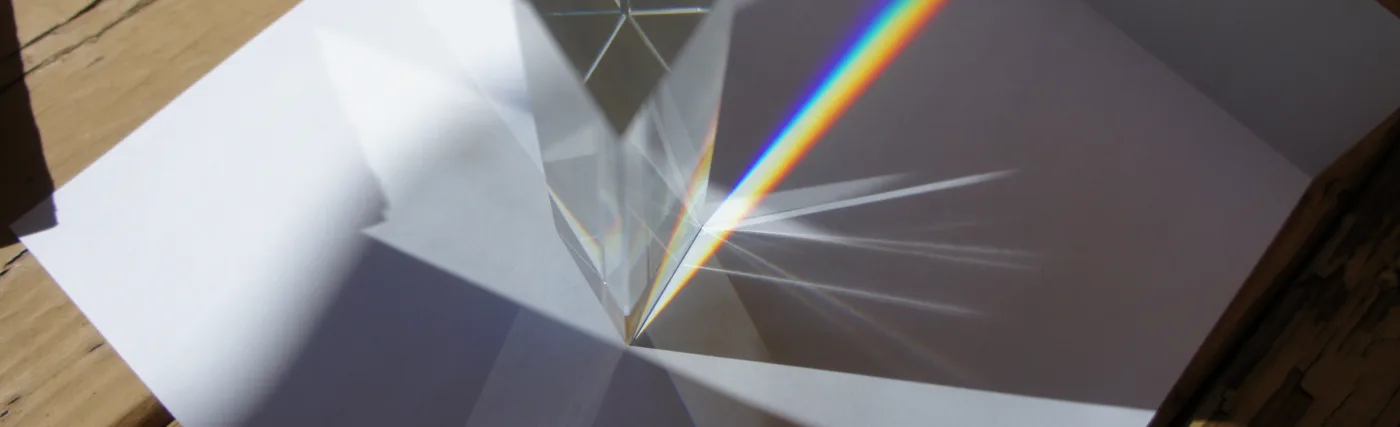
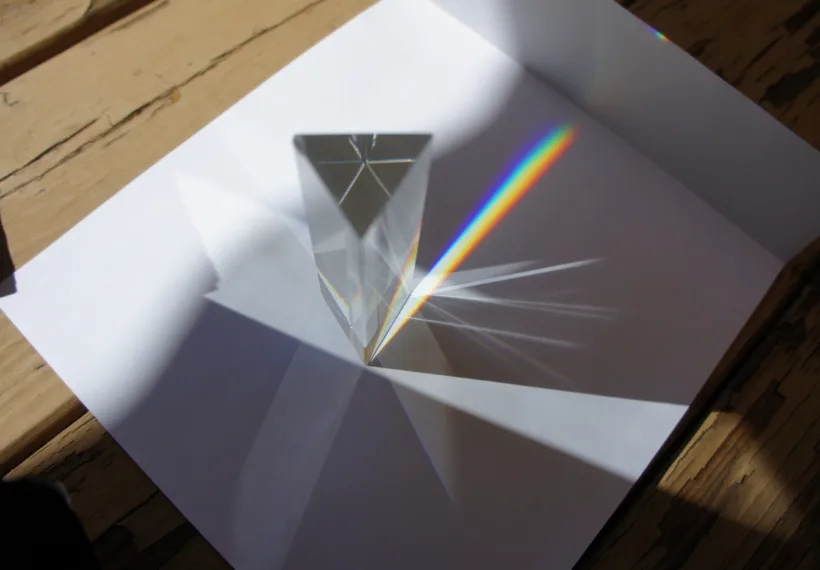
Now, one thing that I have done is, and I wish I brought it, and I wish I’d thought of doing that, is you can do a very nice light-guiding trick using prisms.
And I guess it’s a classic trick that a friend introduced me to.
You put together eight prisms in just the right way, and this is sort of me using my fingers as the top view, and the light rays will reflect off the prisms and do a detour around the central region.
So you can stick your hand in the central region, you can stick your fingers in there, but while you’re looking through the prisms, you can see everything on the other side.
Oh, I see.
So the light is internally reflected within the prisms as it comes around the curve.
That’s exactly it.
It’s total internal reflection, so all of the light is perfectly reflected inside.
And it’s not really an invisibility cloak the way that we would like to imagine.
It’s a fun optical trick.
And it demonstrates that idea that, yeah, we can send light around a central region, and it will still work very convincingly.
By the way, Greg, I love that your friends are showing you like, you know, optical tricks, because my friends are the type of people that are teaching me to take Alka-Seltzer when I have a hangover.
So, I need to hang out with better of your friends.
You need people who have eight prisms in their pocket, right?
Exactly.
All right, Negin, you got another one.
Yes, from Christopher Bax, they write, can you explain a bit about what the interaction between light and matter is that makes some wavelengths of light reflect off matter and other wavelengths pass through?
For example, visible light reflects off skin, but x-rays can look through it.
Are there existing or theoretical materials that would not interact with visible light and would be visible to the naked eye?
I love that.
Yeah, so what’s going on on the surface?
This is all classical wave optics, right, for you?
Yeah.
Yeah.
And so, first of all, with x-rays, part of what happens with x-rays is there are such high-energy particles, if I dwell into the quantum world for a moment.
He said light was particles.
My whole life is a lie.
I’m warning.
No, no, in all fairness to him, as an astrophysicist, we want to detect objects in the universe that radiate in all these different bands of light.
And it turns out it’s more sensible to reference high-energy light as particles and low-energy light as waves.
So no one thinks of a radio wave particle.
Radio particles.
We don’t think of it that way.
It’s hard to think of gamma wave or X-Wave.
X-Wave.
X-Wave.
Elmer Fudd.
So the fact that particles slipped out of your mouth is very consistent with anything I have to think about when we talk about bands of light and detecting them.
But go on.
Yeah, and I have a little historical side note on that, but I can come back to that in a moment.
Otherwise, for visible light, part of the trick, people actually, including my own research, I did my PhD work on crude invisibility in 2001 before it was cool.
And there was a…
What did you say?
Crude invisibility?
Yeah.
Crude, okay.
As opposed to refined.
Like the modern invisibility theories are really elegant and powerful and you can do all this stuff.
Back in the day, I was doing very primitive versions of that sort of stuff.
Back in the aughts.
In the aughts, yeah.
I remember it well.
We were young and innocent then.
Back in the aughts.
Yeah, aught three.
But part of it, part of it, so back then, there were, it was widely thought that you couldn’t make things invisible and part of it was this reflection problem that there didn’t seem to be perfectly reflected, perfectly non-reflecting materials that would be non-reflecting for any direction that light’s coming in.
But people found out and demonstrated or at least rediscovered that if you make the right material that has, and I’ll get a little technical, has a magnetic response in addition to an electrical response and also is what we call an anisotropic material, then you can design materials that don’t reflect any light at all.
Even if their optical properties are different from air, light can just go in without reflecting.
And that was a big piece of making invisibility work.
And so…
What was the question, Negin?
The question was about explaining about the interaction between light and matter.
Yes.
So if light gets absorbed and doesn’t get completely from all angles, but x-rays go straight through you.
So why aren’t they interacting with our skin the way visible light is?
Yeah.
And that goes back to the particle thing.
That x-rays are so high-energy.
You know, they’re kind of…
What do you use as an analogy for something just going right through you without stopping?
A freight train going through your body?
It just charges right through.
Yeah.
There’s nothing…
An x-ray is so high-energy, it just, for the most part, doesn’t interact with anything in your body, and it just goes straight through because it’s got so much energy, and it’s so out of…
It oscillates at a frequency that is much higher than any of the frequencies that the atoms in your body are oscillating at.
So they don’t even notice each other at that level?
They don’t, yeah.
They pass in the hall, they don’t talk.
And so that’s the advantage of x-rays, is that they just are so high-energy, they don’t interact with matter very well because, yeah, the best way to describe it is this frequency difference.
Atoms tend to have these natural frequencies they vibrate at.
And it so happens that those natural frequencies they vibrate at are comparable to the frequencies of visible light.
So we see a lot of stuff.
X-rays have super high frequencies, very different from the frequencies at which atoms are vibrating, so there’s very little interaction.
So it’s fascinating to think about it that way.
That means for any two things to interact at all, there’s got to be some resonance between the frequencies.
Otherwise, it’s ships passing each other in the night.
That’s a lot of the way it works.
Pretty cool.
I’m learning that all these wavelengths are very standoffish, very hard to befriend, you know?
That’s right.
Yes, they are.
You just have to know the right frequency.
You have to be on their wavelength.
It’s the same concept.
All right.
Well, Tom Lindelius actually writes from Sweden.
He asks, would it be possible to light a room in such a way that everything in it would appear black and white?
About 15 years ago, my physics teacher claimed that it was possible, but she never told me how to actually do it.
I think so.
I think so.
Let me take a stab at this, Greg.
So, if you know in advance what color everything is, okay, if you know…
Oh, black and white?
Yeah.
Oh, okay.
I’m thinking of something different.
Because what’s very cool is if you get a very deep red light, for example, like one of these emergency lights that light a hallway, and you take a Coke can, a red and white Coke can, and bring it up to that lamp, you cannot see the white stripes.
Because the red reflects the red light, and the white reflects the red light, so the whole can just turns red.
And you can do fun light experiments this way.
And if you take that Coke can and put it in front of a deep blue light, the red only knows how to reflect the red.
Blue, it’s going to absorb it.
You’re not going to see any light coming.
That turns black.
The white turns blue, and the can becomes black and blue.
So the weird thing is, the color something is, is not what it absorbs.
It’s whatever comes back to your eyes.
If nothing comes back to your eyes, it’s black.
Now, that’s my starter here, Greg.
Can you turn a room into only things that are black and white by choice of wavelength of illumination?
I don’t know if that’s possible.
You can do that?
I’m not sure.
I’ve never really thought about it before.
I think you might have been on the right track, that if you have a room that has only certain colors in it, you might be able to tailor the illumination to sort of selectively ignore or reflect or absorb certain colors.
You find a frequency that’s not represented by any object.
Yeah.
And then all of those colors turn black.
Yeah, and so it wouldn’t be…
However that frequency would be reflected just as itself from anything that’s white.
And so everything that’s white would be the color of the light.
Everything that’s not the color of the light would be black.
But you wouldn’t get white.
Because if you got white at all, the white has all the colors and it would show you the colors of the stuff that’s turning black.
So I don’t believe your science teacher.
Your teacher was lying.
But also I feel like if you could do…
Basically, we’re talking about Instagram filters here on like a room, like in a three-dimensional, like in real life, then you’d be rich, Greg.
Maybe this should be your next venture is how to do Instagram filters in real life.
That’s, you know, that’s…
Greg, you know, you missed out.
Did we just, did the three of us just form a business?
So, Negin, one last question.
That might be all we have time for if that.
Here we go from Kenneth Von Smelsmore from Atlanta, Georgia.
They write, if invisibility cloaks work by bending or manipulating light, and if we can see into the past, due to the time and distance it takes for light to reach us, then might it be possible to make time invisible?
Yeah.
Ooh.
I actually do have a good answer for that.
And in a sense, which may not be exactly what the questioner is asking, people have made what they call time cloaks.
And what they did is, so you picture this picture that I made where I said, okay, there’s this hidden region, there’s a cloak around it, and the light goes around it like that.
And so imagine this is like the horizontal position, this is the vertical position.
Replace one of those axes with time.
And now, at least in a picture, you’ve made a time cloak.
You can make, you can design a structure where it kind of hides events in a certain time regime from light.
And now you sound dangerous.
Now I worry about, Negin, I don’t know about this.
I know.
The main message, I think, for all of us is that Greg is, we should all be very scared right now of Greg.
He’s a very dangerous man.
Especially of Greg, yes.
People occasionally say that about me, and then I say, but I am kind of lazy, so it all kind of balances out.
A lazy diabolical nemesis to the superheroes.
Yeah.
Well, Greg, it’s been a delight to have you.
And the next time you have a full up cloak that they can sell in H&M, Negin will be online to buy it.
Absolutely.
You want to come back and tell us about it.
But it’s a delight to get this kind of insight, because we’ve seen it discussed and we’ve heard about it, but we didn’t know people were actually doing it.
So good to know that you exist in this world.
And Negin, great to have you again.
Oh, always fun to be here.
And I cannot believe we talked about invisibility cloaks.
This was a dream.
For a whole show.
That’s right.
All right.
This has been StarTalk, Cosmic Queries– The Invisibility episode.
Neil deGrasse Tyson here.
Keep looking up.



 Become a Patron