In this Cosmic Queries episode, astrophysicist Neil deGrasse Tyson and comedian Colin Jost answer fan questions about telescopes. How large can telescopes be? Could we invent a telescope to observe gravity or dark energy? How would our sun look from a telescope near Deneb? Can amateur astronomers access big observatories or the Hubble? From Arecibo to Atacama, you’ll learn how radio and microwave telescopes work, and why we don’t get nuked making microwave popcorn. Find out why Neil is determined to save the James Webb Space Telescope by “kicking some congressional butt.” Finally, explore the future: a giant array of telescopes floating in space, held in position by laser telemetry, with a baseline wider than Earth’s diameter. Because, as Neil says, “When it comes to telescopes, size matters.”
NOTE: All-Access subscribers can listen to this entire episode commercial-free here: Cosmic Queries: Telescopes.
Transcript
DOWNLOAD SRT
Welcome to StarTalk, your place in the universe where science and pop culture collide. StarTalk begins right now. I'm your host, Neil deGrasse Tyson, your personal astrophysicist, and this is StarTalk. Colin Jost, Colin, welcome to StarTalk Radio. So you...
Welcome to StarTalk, your place in the universe where science and pop culture collide.
StarTalk begins right now.
I'm your host, Neil deGrasse Tyson, your personal astrophysicist, and this is StarTalk.
Colin Jost, Colin, welcome to StarTalk Radio.
So you wrote for Saturday Night Live some years ago, do you still?
Yeah, I've been there seven years now.
So you're still there?
Yeah, I'm still there, I'm one of the supervising writers there now, and it's been great, yeah, it's been a good run.
Excellent, excellent, and I did a little bit of homework on you, so you were a comedian dude in college as well.
Yeah, I worked for this magazine called The Harvard Lampoon.
This magazine called?
This magazine called, where Conan O'Brien and people started out, and so I did that basically way more than I did any of my classes, including my astronomy classes.
So you slunked out of school, is what you're telling me here, okay?
All the great ones slunked out.
I got through, I got through.
I didn't matte in it and just leave early.
Oh, gotcha, gotcha, gotcha.
So we're in the Cosmic Queries part and we just came off an entire hour on telescopes.
And so we called from the internet, all ways that our listeners reach us, by telephone, by Facebook, by tweets.
And so I haven't seen any of these questions, but you've been reviewing them and just-
Fire away?
Bring it on.
This is great.
So this first one's from Facebook.
It's from a guy named Dominic Irizarry.
And he wants to know, aside from the Arecibo Observatory and the VLA in New Mexico, are there any other large-scale operation radio telescopes in use today?
And if so, what are we looking for, or are the scientists using them looking for, aside from SETI data, which I don't even know what SETI is.
Okay, so SETI, the Search for Extraterrestrial Intelligence.
Oh, oh, yes, okay, gotcha.
That's just the acronym.
Of course I knew that.
Yes, of course, you would just, of course.
I was slow playing it.
So just to get people on the same page, the Arecibo Telescope is a single-dish radio telescope embedded in a natural crater near-
In the island of Puerto Rico, and it's an awesome, it's otherworldly actually.
Nothing in the area looks like it, and you think it just landed from space.
That telescope had sort of a cameo appearance in the film Contact.
That's where Jodie Foster and Matthew McConaughey established their love interest in each other.
As each sentence gets utter, they get an inch closer to each other, and then cut to the next scene, they're under covers together in bed.
So that's what happens when you're hanging out at telescope.
Always.
Always, and the VLA, the very large array telescope, that's a set of much smaller radio telescope dishes that are on tracks.
And so this array can be expanded to be 14 miles across, or it can be compressed.
And depending on the size, depending on the extent of these dishes on those tracks, will determine what your resolution is of what it is you're looking at.
And do those combine kind of Voltron style?
They brilliantly combine in an awesome feat of hardware and software, the signals from all those dishes combine to make a single image of what you're looking at.
And the farther apart they are, the more resolution you have for what it is you're looking at.
You might say, well, why not always view things with a far apart configuration?
The problem is it's not as sensitive when the dishes are far apart.
When they're close together, you can hear, you can see dim radio signals.
When they're far apart, you need a bright signal, but you can get very good detail about what's going on.
So those remain two of a few leading radio telescopes in the world.
The one that's getting all the recent attention, however, is one called ALMA, the Atacama, for the Atacama desert, large array, okay?
Did I get all my large millimeter array?
ALMA, A-L-M-A, Atacama Large Millimeter Array.
So millimeter is a wavelength of light just short of what we typically call radio waves.
Millimeter light is microwaves.
And so microwaves are, if you remember what a wavelength would look like, you draw a crest and a trough.
So the height of two, the distance between two consecutive crests, that's the wavelength.
Microwaves have anywhere between a millimeter and a centimeter typically.
And beyond a centimeter, you go up to meters and things, that's radio waves.
That's how we've divided the kingdom there.
But in fact, it transitions smoothly from one to the other.
But if you Google ALMA, you'll find an extensive discussion of what it is we're targeting with this brand-newly, freshly opened array.
Where is that?
Which desert?
That's in Chile.
It's the Atacama Desert.
In fact, it's high altitude.
And I think that the Atacama Desert has the record for the lowest rainfall of any place in the world, like an inch a decade or so.
I don't know if that's the exact-
I'm not gonna dispute it now.
It's very low.
I don't know the exact number, but you don't wanna live there.
And that's important because water in the atmosphere interferes with microwaves we're trying to get from the universe.
And so you wanna go to the driest possible place you can.
And the Atacama Desert is just such a place.
By the way, the fact that water interferes with microwaves, we exploit on the other end of this and make microwave ovens.
Water as a major food additive, of course.
So there you have something you wanna eat.
You wanna heat it up.
It has water in it.
You put it in a microwave cavity.
You beam powerful microwaves across it.
That water absorbs the microwaves and it heats the food.
See, I never knew.
I just thought it was just that spinning plate.
It just moved so fast that it just started bursting into flames.
I think three out of five people surveyed still say, they use the word nuke it.
They think it's something nuclear.
And it's so not nuclear.
It's ordinary microwaves.
And that's why the holes, if you look at the screen, by the way, microwaves pass through glass.
And all microwave ovens have a glass door.
So what prevents them from coming out?
Look on the other side of the glass door, you'll see a mesh, a screen mesh.
So that prevents it?
Check the size of those holes.
If they are larger than, you don't want the hole to be larger than the size of the wavelength of the microwaves.
Otherwise, it will pass right on through.
So there's no way of getting them, if they can't sneak in somehow, if they hit at the right moment of their wave.
Any more than visible light can sneak through the wall of a room.
It's just not transparent to microwaves.
A mesh that you could otherwise see through using visible light with much smaller wavelength, microwaves can't make it through.
Yeah, so we got smart people figuring, smart engineers.
You're listening to StarTalk.
Stay tuned for another segment.
Welcome back to StarTalk.
Here's more of this week's episode.
Well, so we're in the Cosmic Queries part of our telescope show, and we left off talking about microwaves and how they don't come out of your microwave oven, because you ask, where in the universe might you find microwaves?
And in fact, they're everywhere, coming to us from the depths of space.
But they also come from regions of the galaxy where stars are being born.
So they help us map gas clouds, sort of the birth sack of stellar nurseries.
You mean, are they almost like, in the way there's a Big Bang, the Big Bang may start over again in different areas?
Yeah, so the Big Bang births all the matter and energy in the universe, but now what do you show for me lately?
So the matter and energy, we have gas clouds that condense and form galaxies, and condense and form stars and planets and people.
So in there, different bands of light, including microwaves, probe different parts of the universe.
And for the longest while, we thought it was just visible light, red, orange, yellow, green, blue, violet.
And then we realized, oh, there's ultraviolet and x-rays and gamma rays and radio waves.
The universe is trying to talk to us in more ways than our eyes can see, thus the birth of this whole suite of telescopes.
And so you asked, where are you going to get microwaves?
So I was talking about ALMA, the Atacama Large Microwave Array.
In everyday life, microwaves are what is used for your cell phone communication.
Most communications are microwaves, exactly.
And the walkie-talkies are all microwaves.
If you had sensitivity to microwaves with your eyes, you can tune it, let's say.
If you tune them to microwaves and look around, first you'd be able to see through walls, because why else would your cell phone work inside of a room unless the microwaves can see through the walls?
We're getting through.
Can get through, exactly.
So is that where x-ray, you know, there's x-ray vision, but should we be working on microwave vision?
Microwave vision is just as good as x-ray vision.
In fact, it's better.
It's better.
We got to talk after this.
We'll talk.
And so, so, so microwaves, if you tune into that and went by those cell phone towers, they'd be ablaze with light.
They'd be the brightest things on the horizon.
You wouldn't even see the streetlights.
You'd be seeing the microwave towers.
And you see people walking on the phone as they go down the street.
The whole, the phone would be aglow.
Now, is there, is there danger to that?
Do we know?
There are people who would claim there is, but there is no reliable evidence to say so.
Are you concerned at all or not?
No, not in the least.
Yeah.
Then I'm, I'm sorry.
In fact, I sleep with all my cell phones, you know, all around me.
I know, I know.
I end up doing it.
Not by choice, always.
I've been on a couple of conversations with people who would have thought they were going to continue, but then I was asleep.
What'd your, what'd your, what did that night cost on your, on your credit card?
Or in my personal account life.
So what other, you got other questions that came in.
Yes.
Here's one from Facebook.
It's from Tim Geeran Jr.
And if you were on, it says, if you were on a livable planet near Deneb, I don't know if that's.
Deneb is one of the stars that traced the constellation Cygnus the Swan.
If you were on a livable planet near Deneb with a telescope looking toward Earth, would our sun be in a constellation?
Can we, with our computer technology, visualize what the night sky would look like from that planet?
Totally.
Oh my gosh.
Yeah, we've got three-dimensional coordinates of all the stars in the neighborhood out to several thousand light years.
And so, oh yeah, you can transpose what the night sky would look like on any of the, by the way, it wouldn't have to be a livable planet.
Right.
It could be from any place.
Just from any point in space.
Apparently, he wants to move.
Yeah, I guess.
But he wants to know the view first.
The view.
Was he creating a real estate brochure?
Exactly.
Yeah, he's not looking at ones that don't have photos.
So the nighttime view.
So I don't have off the top of my head what this part of the night sky would look like.
But what matters is not what the constellation looks like, because they never really look like what they're supposed to anyway.
There's like three out of the 88 that sort of resemble what they're purported to be.
To be, yeah, exactly.
For example, do you know the constellation Apis?
A-P-U-S?
You ever hear of it?
No, no, I don't know.
It's a bird of paradise.
It's got four stars in it.
It's like somebody is smoking something to call these five stars a bird of paradise.
I'm not going there.
So you know what we did when we rebuilt the Hayden Planetarium?
I had in a fit of, I don't know, in a fit of irresponsibility, I thought to myself, you know what I want to do?
I want to sneak into the star ball and update all the constellations to stuff that matters to us today.
You know, put in this guy, the Prius, you know, the cell phone, the laptop.
It's like two dots are a Prius.
Yeah.
I mean, he's just, why not?
Or just make them box line.
Actually, there are, there's a constellation called Triangulum, which is just a triangle.
We got you already.
They got real there, yeah.
They got so real as to be boring, right?
So what's fun about the constellations of the ancients is that they're embedded within their mythologies and what mattered in their everyday lives.
So it's a window to the past and back then very few people were literate.
So it was a way, it was kind of the library books of the day.
You'd go out with people, you'd say, oh, here's Perseus and he's saved Andromeda and all the stories.
It's quite a bit of storytelling.
So I'm thinking today, it's time to update the constellations.
Yeah.
I think of the ice cream cone, there's some that have V shapes and I like ice cream and I have conus major, conus minor, we could do that.
Like a one scoop, two scoop.
Exactly, a two scoop constellation.
So who knows what they'll look like, but they'd be subject not so much to what they literally look like, but what the cultural imperative is for those who are-
It's like cloud gazing where you're just reflecting your own personality as much as we-
It's very Rorschach.
Yes.
This next question I'm very curious about too, it comes from Facebook from Brandon Fifth Patrick and he asked, can amateur astronomers buy time on space telescopes?
Who decides how the Hubble gets used and by whom?
What about terrestrial observatories?
Can you go and buy time, rent time?
Yeah, excellent question and the big ones no.
The big ones are all for professional use and even so, they're quite expensive.
I mean, they're tens of thousands of dollars a night to run them.
Even for universities to rent them out or for companies.
Yeah, universities that own them, you're paying for the physical plant, the maintenance, there are engineers there at all times, there's the food services.
You're living nocturnally on the mountaintop and there's an entire support store.
Somebody built the road to get to the mountaintop, so it cost money and so even if they could afford it, it's not available to them unless they applied competitively for time.
There's something called the TAC, the Telescope Allocation Committee.
Every telescope has it.
Usually quarterly or semi-annually, you apply for time.
I want to use that telescope with this filter and that detector to observe this object for that long, for this reason.
That's all in your proposal.
All the proposals get put on a table and the Telescope Allocation Committee reviews them, figures out how much total time is requested.
Can it be wedged into the total time available?
If not, they come at you and say, we're going to cut you in half.
We're not going to give you time at all.
We like this one better than that one.
We think this will be more fertile as a research path.
This gets done in every time period.
Some people get telescope time and others don't.
And is it a little bit bidding too, like money or is it?
No, no, no, no, no.
It's all based on the scientific.
It's always scientific.
So you can't be like, I want to check out this girl.
That would not work.
That's less convincing.
And as far as I know, no one has blocked their way onto it.
Because plus, if you buy because your research isn't good, we know it.
We'll know you can't hide if you're not good.
And so this is the self-checking that goes on in science as an enterprise, right?
You can't, there's a limit to how long you can try to pull the wool over someone's eyes because you're incompetent.
Because it's ultimately still science.
We will so reveal this fact.
It cannot hide.
So the Hubble, what we talk about is what is the award rate of your applied time.
Depending on how competitive one cycle is versus another, as many as two thirds of all proposals won't get awarded time.
And so then you try again and try to come up with a better idea.
And that's how that goes.
Now there are other telescopes that are not on the frontier but still exist and still have time available to them.
Most of the big observatories have some telescopes where they give access to amateur astronomers.
And so what you do is call the main office of the various observatories.
You're listening to StarTalk Radio.
Stay tuned, more up next.
Welcome back, here's more of StarTalk.
So, we are in the Cosmic Queries part of StarTalk Radio for the show on telescopes.
And Colin, you're just pulling these off the internet, off of Twitter.
I haven't seen any of these questions in advance.
What do you have for me?
Yeah, we were just talking about the Hubble Telescope, and Brandon Fitzpatrick continues.
He had another question about the Hubble, which is, is it possible to build a telescope on Earth that's just as good as the Hubble?
So in what ways do telescope operators account for atmospheric distortion, and he wants to know when is that going to be retired, and are there going to be plans for replacing it?
Yeah, first of all, that's an awesome question, but there are several parts to that.
Let me back up for a minute.
It turns out data from the Hubble Telescope, once it's obtained by the people who request it, they get to study it and analyze it in all the ways they had intended.
Then the data gets posted, and it essentially becomes public at that point.
So while you can't apply, typically apply as an amateur to command the Hubble Telescope, you can actually apply to mine the pre-existing data.
Maybe there's a question you could ask of those data that the original people had not considered for them.
Exactly.
And in fact, we had big plans, it fell a little short, but we had big plans of creating something called the National Virtual, the International Virtual Observatory, where all the data from all the telescopes would be in one place, and you say, observe this part of the sky in these wavelength bands, and you'd go into the data and you'd send a worm through and you'd find all the images taken and all the various wavelength bands you cared about and would find them in the repositories of data that hadn't been looked at for years possibly, and we'd bring it back to you and you would have the chance to discover something that no one even thought to ask.
And so it's called data mining.
That's what it's called as a procedure.
Now, in terms of Hubble, we have telescoped far more powerful than Hubble.
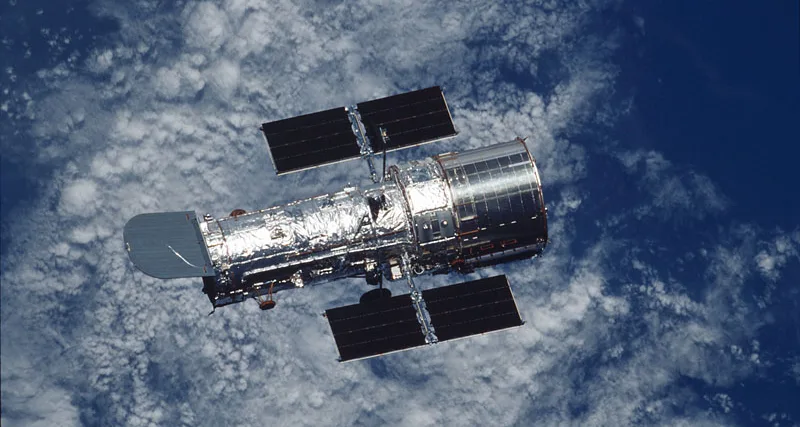
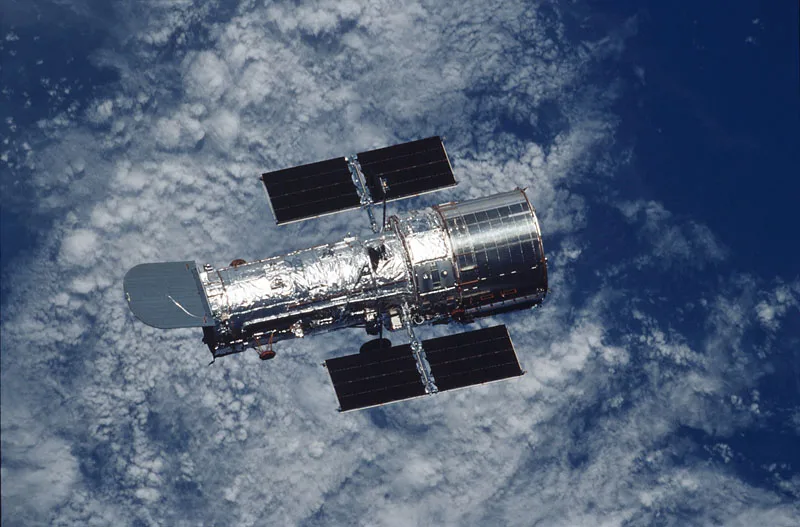
Hubble is only 94 inches in diameter.
Only it's big.
It's 94 inches in diameter.
The Keck Telescope, it's a pair of them in Hawaii, those are 10 meters across.
What's that in inches?
That would be...
I'm bad at.
80 million versus 94 inches.
The Keck Telescope can see much, much dimmer things in the universe.
The bigger your telescope is, the dimmer you can observe.
The advantage of Hubble being above the atmosphere is that the atmosphere renders the sharpness of images fuzzy.
You go above this fuzz layer, and then you see the universe as the universe intended to be viewed.
Over the years, however, we've invoked special technology, borrowed from the military, that allows us to compensate for the fuzzing effects of the atmosphere.
And it's called adaptive optics.
It will deform the shape of the mirror in real time with what it reads as going on in the turbulent layers of the atmosphere, and exactly compensates for it in a remarkable feat of engineering and software so that you can get very close to the sharpness of the images of Hubble.
Like a contact lens or something.
Yeah.
It's constantly updating.
Constantly updating.
It's an awesome bit of hardware that we now have called adaptive optics.
And so now is that making telescopes like the ones in Hawaii getting to that level?
It has greatly improved the usability of telescopes or given them a new lease on life.
There are objects that were just too fuzzy to do any work with them.
Even though your telescope was big enough to detect them, you were detecting just something that was fuzzy.
Now we can detect them and we have sufficient detail.
It compensates so you know more about it.
Exactly.
Interesting.
This next question is from DeRay Pringle, Mr.
Pringle, who had a great one.
Just the same guy from...
Same guy, but he's multi...
He's got a lot of topics on his mind.
Pringle, is he related?
I don't know.
He asks, do you think the James Webb Telescope will end up getting cut due to budget shortfalls?
Yeah, not if I have anything to do with it.
I'm kicking some congressional butt.
Let's hope then this is the real Pringle.
This is the Pringle family in there.
He's willing to chip in.
Can I use that joke?
Chip in.
Very good.
Very good.
Thank you.
I'm professional.
Thank you.
Keep your distance from my professional glow.
So, the question surely arose because the budget, there were cost overruns on the James Webb Telescope, I mean, by a factor of four even.
And there was great worry that Congress would just get fed up with this and cut the budget.
And my response here is the James Webb Telescope, which is going to, it's going to, it's not going to just go in orbit around the Earth.
It's going to go a million miles on the other side of the Moon, and we're going to park it there, far away from Earth, far away from any contamination.
And it's going to observe galaxies being born in the early universe.
It's a telescope unlike any other and required extraordinary engineering innovations to make it happen.
And I say, if you're going to have a cost overrun on anything, let it not be the highway system you're building or anything else you've done a million times before.
Why be surprised that if you encounter a cost overrun on something you have never even attempted, that's going to advance human understanding of the universe.
You're listening to StarTalk.
Stay tuned for another segment.
Welcome back to StarTalk.
Here's more of this week's episode.
So, you got questions, more on telescopes.
Yes, I had a question too, because, you know, obviously, Curiosity is now on Mars.
Curiosity is the rover, yes.
That's the rover, yes.
And I'm wondering what, is there any sort of opportunity there to establish, to build either a telescope, or is there any sort of telescoping technology they're sending over with that?
Does that aid us in any way?
No, not really.
From that vantage point.
Yeah, no.
I mean, Mars is a little farther out, away from the sun, but it's not so much closer to the rest of the universe that that gives us any kind of telescopic advantage.
It's so, no.
And plus, you might ask, would we use a telescope to see our way just on Mars?
That's not necessary when you have a rover.
You can just...
Maybe the rover got lazy one day.
Hey, I'm just pulling out the telescopes on this one.
I think I'm just gonna sit here.
Just gonna sit.
No, get off your duff.
I'm gonna travel all the way here from Earth.
Give me a second.
Give me a second.
So, yeah, we just send it there and it's got tools to actually dig into the rocks and analyze the chemical composition of them.
So, that's something a telescope can't do.
So, yeah, when you're there...
Maybe just do it in person.
Forget...
Yeah, just do it in person with your own damn rock.
And so, yeah.
Why watch pornography when you could have a girlfriend, right?
I mean, that's basically...
Oh, that would be a corollary to that theorem.
Yes.
I'm trying to take it, put it in real layman's terms.
Exactly.
All right, so this next question is, it comes from Google Plus from Paul Stewart, and he's wondering, we keep producing larger and larger telescopes.
Is there any limit on how large they can be?
No, in fact, we are taking it to...
We are...
That's what we're doing.
So, check out...
Here what we're about to do.
We're about to say, okay, the bigger the telescope, the more light it can collect.
All right?
It's like a bucket and you're trying to collect rain.
The person with the bigger bucket collects more rain than the person with the little bucket because we're passive receivers of light that comes from the universe.
We can't hurry the light along.
We can go grab it before it gets here.
We sit here and wait for it to reach us.
Big telescopes gather more light and see dimmer things.
Not only that, the wider the telescope, the more precise, the sharper the resolution will be for what it is it's observing.
Why is that?
Is it just because you're gaining more information?
You have a much, your angle of the, so the way it works is the wider your, the diameter of your detector.
So by the way, it doesn't have to be one solid detector, such as the VLA.
You can be spread out.
Then you have to be clever about how you combine them.
So the wider is that field of view, the smaller is the angle that you can accurately observe on that object.
And the smaller that angle is, the better is your resolution.
That's all.
So for example, if you're not wearing your glasses, but you should, and you take a look at a lawn, it'll just look like a green carpet.
Put on your glasses, you see blades of grass.
If you had even better resolution, you'd see insects crawling within it.
And then you could see the cells and then you could see.
So you can imagine having much better vision than even perfect human vision.
And you'd see right on down to the threads in the fibers of the grass.
So this is the challenge of big telescopes.
You want a big telescope to accomplish this.
The frontier of this is we're gonna float telescopes in space and have a baseline that's wider than the diameter of the Earth.
Well, chew on them.
You're listening to StarTalk Radio.
Stay tuned.
More up next.
Bye Welcome back, here's more of StarTalk.
So we were talking about telescopes, and we were talking about the size of telescopes, and how that affects it.
Size, size matters.
Size matters for telescopes.
Yeah, it does matter.
And now, I...
Bigger is better.
What about material-wise?
Like, what it's created from?
Here's the problem.
There's a limit to how big you can make a telescope on Earth because it's subject to gravity, the 1G force of gravity.
Structurally, that's why the largest radio telescope in the world is sitting in a crater that cradles it.
The size of that telescope is so large, you could not hold it up and steer it.
In fact, it's an unsteerable telescope.
You have to wait for stuff to drift into its field of view.
This is the Arecibo Radio Telescope in Puerto Rico.
You have to wait for stuff to drift into its field of view just to observe it.
Is it because the material is so heavy?
No, it's that the, well, not that the material itself is heavy, but the size of the structure is so unwieldy, given the gravitational forces that operate, that you just, we have no knowledge of materials that could sustain it.
So what we learned is forget Earth's surface, go into orbit where you have zero G.
And when you have zero G, the structural integrity of your materials is no longer relevant, not at least with regard to the stress of weight, because it still matters in terms of temperature fluctuations and things, because it gets hot and cold as it goes in and out of Earth's shadow.
But other than that, you can make structures that are otherwise unstable.
In fact, the Hubble Telescope, if brought to Earth, would be unusable as a telescope because it is not structurally stable under its own weight.
So, and not only that, in terms of the detectors and the material that focuses the light, for regular light, you'd use glass, is very reflective.
It's a familiar surface that you put the silver coating on and it reflects.
Radio waves, you don't need glass.
You can just use wire mesh.
The size of the hole in your surface just has to be smaller than the wavelength of light that you're trying to reflect.
Interesting.
That's all.
Now, was the Hubble built in finished in space if it was structurally unsound here?
Oh, no, no, sorry.
So, it was...
Or it was just unusable.
It was unusable.
Gotcha, but it wouldn't have fallen apart.
As a steerable telescope.
I thought it was like a couch that you have to build in the room or something.
Yeah, I'm saying that.
Yeah, so when it was opened up and the solar panels were exposed, then you have a zero-G telescope.
The space station itself is structurally unstable.
I don't know, that's the thing of the size of a football field.
With booms hanging out and solar panels and pieces screwed in together, there's no way that could sustain itself and any kind of force of gravity at all.
That's a nice, yeah, that's a freeing thing.
This question is from Facebook, from Watson McKeel.
And the question is, could there ever be such a thing as a gravity telescope, a device that could measure not the effects of gravity, but gravity itself, or dark matter or dark energy telescope, and what would the universe look like through one of those devices?
Okay, so it's an interesting question, just to see the gravity field.
Right now, we only know gravity by its influence on the movement of other objects, right?
So, in a sense, all the telescopes and the software and the detectors that have been brought to bear to discover exoplanets, in a way, those were gravity telescopes.
We were observing the response of the host star to the tugging upon it of the planet in orbit around it.
So we're observing the effects of gravity through the light emitted by the host star.
And-
Is this almost asking, is there a way to show the negative space?
Yeah, I don't know, we have no way, no, I don't know any way to show that.
But we do have what are called, there's the Laser Interferometric Gravity Wave Observatory, abbreviated LIGO.
And that's a telescope that's to observe, that's a telescope to observe, that's a telescope to observe ripples in the fabric of space and time that come our way.
And this is predicted by Einstein.
Einstein said there should be something called gravity waves.
Maybe he came from the future into the past and showed up looking pretty cool.
And then it was like, oh yeah, I know this is.
Trivial.
I guess, yeah, maybe the bears are gonna win in 85, maybe, I don't know, maybe.
Not bears.
So what you have there is if two black holes collide, that's an awesome disturbance in the fabric of space time.
And that ripple moves through space and it comes across the telescope, the telescope can then measure it.
The birth of the universe itself has a gravitational signature.
These gravity wave telescopes would be brought to bear to observe them.
But otherwise, just to see gravity sitting there in empty space, I don't know of any way to do that.
And what about observing dark energy or dark matter?
Oh, well, again, we're observing the effects of dark energy and dark matter.
And that's the effect of when you see the universe expanding.
Exactly.
Thanks for listening to StarTalk Radio.
I hope you enjoyed this episode.
Many thanks to our comedian, our guest, our experts, and I've been your host, Neil deGrasse Tyson.
Until next time, I bid you to keep looking up.
See the full transcript



 Unlock with Patreon

 Become a Patron