You’ll hear about The Outer Space Treaty of 1967. We ponder the creation of an international space federation –don’t get too excited, Star Trek fans – to represent the entire Earth, similar to the United Nations. Neil explains why this is this most sensible idea if every nation wants to be a player on the space frontier. Find out how land ownership would function on Mars. You’ll learn about the Homestead Act and if we could model land ownership on Mars in a similar fashion.
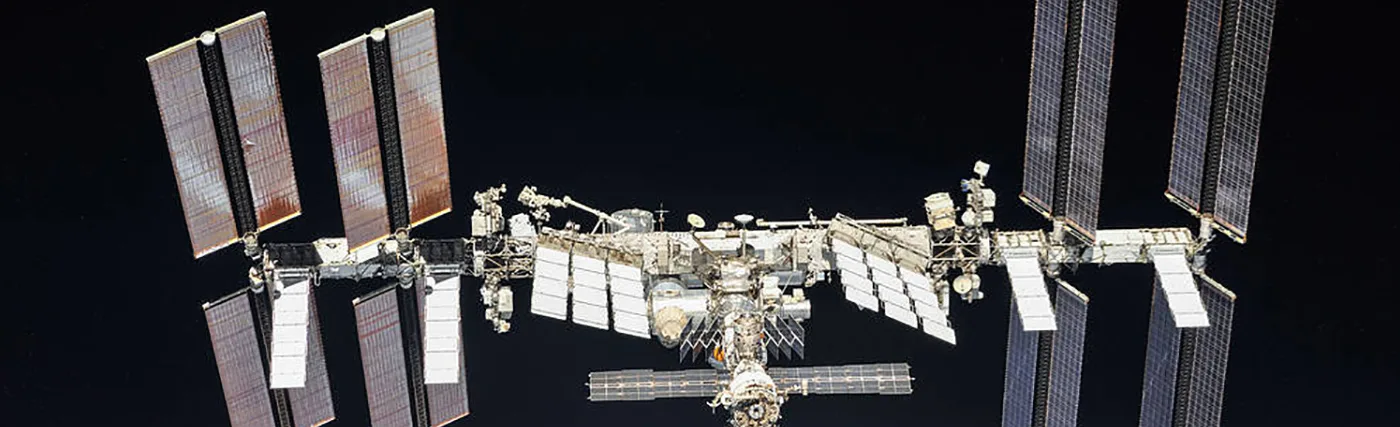
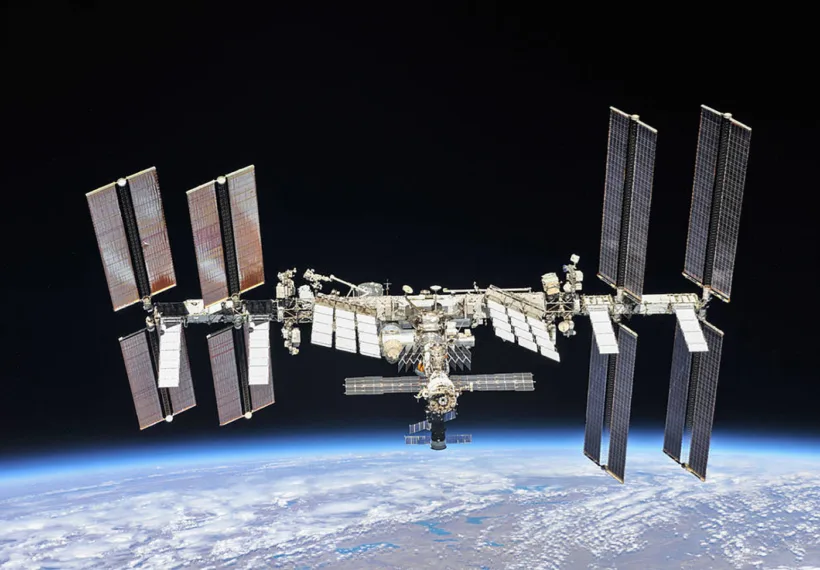
Get details on a Space Force-type branch of the armed forces that already exists. We explore the military advantages of space including reconnaissance and satellite work. Investigate just how much “beating the Communists” propelled the United States to get to the Moon, and why we haven’t been back, or further, since. Discover more about the “benefits” of war. Neil shares his vision of what he would want space exploration to look like in the future. Find out if we should send all the world leaders into space to develop their own cosmic perspective. You’ll also hear Neil’s favorite quote about space from Apollo 14 astronaut Edgar Mitchell. We debate the merit of the International Space Station and if NASA should keep funding it until it’s retired. We also ask, should there be an updated version of ISS?
Transcript
DOWNLOAD SRT
From the American Museum of Natural History in New York City, and beaming out across all of space and time. This is StarTalk, a special Cosmic Queries edition, all about space exploration. And who do I have with me? But...
From the American Museum of Natural History in New York City, and beaming out across all of space and time.
This is StarTalk, a special Cosmic Queries edition, all about space exploration.
And who do I have with me?
But the one, the only, the classic, Eddie Brill.
Eddie, welcome back to StarTalk.
That's my pleasure.
Not your first rodeo with us.
No, no, no, this is, I've done other rodeos.
Literally your second rodeo.
Yeah, I've done another rodeo before.
One other rodeo.
Yes, and I'm looking, you know, I'm looking forward to it.
I actually reached out and said, I want more rodeo.
You want some, another rodeo in your, in your, in your, in your.
I'll ride bareback with you the whole time.
So Cosmic Queries, you all know how this works.
We solicit questions from our fan base and all of our social media platforms.
They're collected.
Eddie's got them right here.
I haven't seen them.
If I don't know the answer to something, I'll say, I don't know, that's how this works.
Okay, so Eddie, you, you, you, did you like science as a kid?
What was your, what's your science profile?
Um, in high school, math and science was my thing.
I liked it.
I loved it.
And I had great teachers along the way.
Maybe that's it.
And that was it.
I'm, you know, they were just, you know, there was one guy who was so funny, very Southern.
I, I was born in New York, but I grew up in Hollywood, Florida.
And we had an incredible high school with incredible math and science teachers.
And this one guy was like, you remember the elements, you know, of your mouse dies, bury him.
You know, he would like, bury him.
He would do these kinds of puns.
And I still remembered all these years later.
Oh, cesium was the first part of it.
Like you see the mouse, you try to catch him, cesium, you know, or something like that.
All right, so what do you have for me?
Go, bring it on.
Okay, well, right away.
By the way, just to be clear, if this topic were on a subject that was not necessarily in the center of my expertise, we'd bring in a third person with that expertise.
So it's only you and me, because it's space exploration.
I got this.
Yeah, this is you.
I got this.
This is good.
And this is kind of interesting to me.
Do you think that should there be an international organization of space exploration, I'm usually pretty good at reading till just that moment, like a space agency without borders, as many smaller countries who can't afford an independent space organization could contribute to space exploration.
Do we have the name of that person?
Who is that?
That person is Sampan Gozal.
From where?
Facebook.
Facebook, okay.
So, that's a really good question.
So, what you're asking about is a kind of United Nations counterpart with regard to space.
Now, it turns out the United Nations has a space unit within it.
They're the ones who came up with the seminal, 1967 treaty for conduct in outer space.
1967, we were on our way to the moon, Russia was doing their thing, everyone's looking on, is it gonna weaponize, what's gonna happen, space warfare.
And they thought it was time to jump in and say, let's lay some groundwork here.
So, it's a treaty on the peaceful uses of outer space.
And it's got, it's very kumbaya, you know, there's a lot of, if you're in trouble, I'll come help, no matter what's happening on earth, it's got some of that in it.
But it also says that you have the right to protect yourself in case a rogue element shows up.
And in there, that's a huge, that's, you know, what does it mean to protect yourself?
If you have a satellite that's inching towards me and I'm afraid of it.
Right, you have to call the, hello, am I able to destroy this?
Right, right, yeah, what is, you know, so there's slop in there for sort of militaristic interpretation, but basically that was a first foray into this concept that maybe space needs to be an international community.
And more than 100 countries signed that treaty, including the United States.
Do you think it was a good idea at the time?
Good idea at the time.
I think it needs some freshening up, but still, that's just a treaty.
That's not an organization.
So what they're really asking for is what they did in Star Trek.
You know, there's the United, the Federation, that is all countries as one space agency.
And the deck of Star Trek, it had, we got the, what do we have, the Scottish guy, we got the Japanese guy.
Of course, the white male is the head of everything.
Right, of course.
Yeah, the bad actor.
Actually, William Shatner, he's been a guest on the show and he's been a friend of the show, so.
So I'm not gonna bad mouth him.
Yeah, no, he's not a horrible actor.
He's just a very deliberate actor.
Actually, he was in two episodes of The Twilight Zone.
Yes, I remember the one on the wing.
Oh, with the monsters outside the plane.
But anyhow, it seems to me that if everyone wants to be a player, the only sensible way to do this is to have a united space agency.
And then Earth can make decisions collectively in the interest of the future safety of the Earth.
The best example of this is suppose an asteroid's coming.
All right, now we don't know where it's going to hit yet.
Okay, oh, it's aimed for the Indian Ocean.
All right, well, does India have a manned space program?
No, not today.
So what, are we going to let India flood from a tsunami?
No, you want a centralized way to protect everybody no matter where the asteroid strikes.
Do you think everyone's on board?
If I tell you you're going to be knocked out by an asteroid and you want to protect against that risk, sure.
Plus, if I'm going to provide you a hurricane information from satellite images, and there's a lot of space assets that serves our interest on Earth's surface internationally.
Monitoring of climate, if a volcano erupts and there are gases that encircle the Earth, as Carl Sagan famously said, air molecules do not carry passports.
They go where the hell they want, whenever they want.
So if there's pollution here, either human caused or volcanic, you're going to want to know air currents and how that tracks.
If something happens in the ocean, you want to know how that tracks.
And the best way to monitor this is from space.
And like I said, you don't want to go extinct from an asteroid strike.
Right.
It's like when you used to smoke on an airplane and they only had certain rows for it.
That was crazy!
It didn't go anywhere else.
Are we that old to remember that?
I remember sitting there, this is the smoking row, this is not the smoking row.
Okay, well, I smell your cigarette.
The molecules are going to the exit row.
So yeah, I think you're gonna want that.
And there's sensible ways to think about this.
Everyone pays what they can afford and maybe you'll index it to their GDP or whatever is the sensible economic measure.
So everybody is a participant in this.
And as a nation gets wealthier, their contribution gets higher.
If they actually then have a space program of their own, they might specialize in some aspect of space exploration that other people don't.
For example, the space station.
And if you notice this, there's a robotic arm on the space station, okay, that help retrieve satellites and do things.
And that robotic arm says Canada on it.
Interesting.
And you got the little, the flag and it's called Canada arm.
Canada arm, yeah, that's very cute.
They're being a little cute there.
And for some reason, the engineers figured out, no matter what angle this arm is, every photo of it says Canada arm in full view.
So that's why I asked you about, can everyone get involved?
Cause the ego of like, well, here I am Canada and here's my little thing.
Exactly.
So they made a better arm than we did.
We said, let's use it.
And so I'm thinking different countries would have different expertise.
And then you have this sort of assembled, an assembled collection of the brilliance of all nations of the world in a common mission to explore the universe.
Sounds lovely.
Wish we could do that with everything.
With everything.
Oh, so on that subject, my great skepticism with the kumbaya of the peaceful use of outer space is, cause it says in space, you cannot attack, you cannot do this and we must all be peaceful.
I'm saying, if you can get this to work in space, why can't you get it to work here on earth?
Right.
Yeah, if you want me to believe that this will work in space, do it here on earth first.
That's great.
Well, if they do it in space first, then we can say, hey, look, it works there.
Let's do it at home.
Oh, you know, that's another way to look at it.
Oh, that's good.
Yeah, I think that would be good.
There was a, there's a question.
In math, it's called an existence proof.
We don't know how to prove it exactly, but you know, you have an example of it existing.
Right.
So there must be some way to make that happen.
All right, bring on another one.
All right.
Well, this is from Ronald Gamboa from Facebook as well.
If China makes it first with people to Mars, are they allowed to build a wall to keep Americans out?
That was cute.
I'm reminded of some other comic, forgive me for not remembering who did it.
The first humans arrive on Mars and the Martians, a gathering of Martians show up at the landing site and they say, colonists go home.
I don't know who does that.
That's really funny.
So, I have two answers to that.
First, if you're the first on Mars, you do what the hell you want.
Second, walls worked when you only moved around on foot.
Right.
So a wall is not going to stop a spaceship from landing anywhere.
That's the literal answer to that question.
Right.
The more figurative reply is, there have been attempts to establish whether you own what you land on, because the Western way is just own stuff, right?
And then you want to own it, I'll sell it to you, because I own it.
Now.
Like Columbus, where he said, I discovered America, and it's like, well, we live here.
It's like if I went to your house and said, look, I know you live here and you have a lease, but I discovered your house, now get out.
Yeah, so the challenge is, what will it take to motivate people to explore space?
And a successful formula, I don't know if there are other formulas that could work better, but we know a successful formula in the United States was the homesteading rules, okay?
Holding aside that half the time there were homesteading on native land, okay, back then.
Let's hold that detail aside, very important detail.
Hold that aside.
Just conceptually, the idea was, as I came to understand homesteading, is there's land out there, nobody knows what to do with it.
Oh, you wanna go to that land?
Okay, if you go to that land and build a home and make a farm, you own that land.
You get to keep that land.
It's still part of America, but you get to keep that land.
So this is homesteading.
Wow, I get to own land?
Let me go.
And so you end up settling land out there without anybody forcing you.
Just the simple spirit of exploration and the spirit of ownership ended up opening huge swaths of territory to quote settlements.
And so maybe space would operate in that way.
If you land on that asteroid, it's yours, okay?
Because you paid to land on the asteroid.
Right.
It's your investment.
And your responsibility.
And your responsibility, exactly.
All right, let's see.
We have here Oliver Gilchrist from Instagram has written, I mean, he's not from Instagram, I'm sure he's from another place, but he went through Instagram.
He said, do you think there's any advantage in putting military in space?
So, it's probably inspired by the Trump Space Force comments.
And let me just make it clear, I've said this many times, but I'll say it again.
Just because something is spoken by President Trump doesn't mean it's crazy.
Just to make that clear, okay?
Just because he said it does not automatically mean it's crazy.
Because out of the 8,000 lies of 2018, there is probably some truth.
What I didn't count, but I'm just saying.
So, in that particular case, we already have a Space Force.
It is a branch of the Air Force.
It's called the US Space Command.
They've been monitoring space since we've been in space.
Not only they, but many intelligence agencies.
Because space is a reconnaissance platform above all else.
No pun intended.
Every pun intended.
And so, we don't think of intelligence gathering as warfare as much as we think of weapons as warfare.
But it is.
It is a fundamental part of the planning, waging of war and the maintenance of peace.
So, space is the ultimate high ground.
We've had spy satellites in space from the beginning, from the 1960s.
Under the auspices of the Air Force.
So, if we're going to say, let's pull it out from under the Air Force and make it its own agency, I don't have a problem with that.
We did that already with the Air Force.
During the entire Second World War, it was the US.
Army Air Force.
It was a branch of the Army.
The late 1940s, the war is over.
We figure, you know, the command and control is different if you're in the air than if you're on the ground.
The soldier is not a grunt-wielding, weapons-wielding person in the brush.
It's you need pilots.
The engineering of your tanks is different from the engineering of your airplane.
Everything is different.
So let's make that its own thing.
Nobody complained.
No one today is saying we should have never made the Air Force.
That was not a good idea.
So as long as space is a frontier where we have untold assets in space, forget the value of the satellite itself, the value of what it enables for being in space.
There is no Uber without satellites.
There is no business model for them without satellites.
So there's the cost of the satellite and there's the commerce that it enables.
UPS tracks their trucks.
You want a date tonight on Tinder?
We are using satellites to find you.
You're a date tonight.
Did you swipe right?
It goes up to a satellite, comes back.
Is it a two mile radius, a hundred meter radius?
This is all calculated.
So military, you want them not only to protect your borders or other traditional ways a military would execute its mission, you also want them to protect your assets.
So we got to wrap up this segment.
That was a great question.
And when we come back more with Eddie Brill on Cosmic Queries of Space Exploration.
The future of space and the secrets of our planet revealed.
This is Star Talk.
We're back, Neil deGrasse Tyson, your personal astrophysicist.
We're here in my office at the American Museum of Natural History, where I serve as director of the Hayden Planetarium.
And I've got Eddie Brill helping me out here.
Eddie, thanks for being my co-host.
It's my pleasure.
It's also great to be in this building.
Oh, yeah, if you could, yeah, this is...
I spent a lot of my childhood here.
So, questions on space exploration.
Yes, okay.
SMBower3 from Instagram had written...
The third or three?
Yeah, I think it's just three.
I think SMBower1 and 2 are dead.
And this guy is the grandson of SMBower.
I would put a the in between the name and the numeral.
Right, he should have done that.
Or she.
SM could be Sarah Marie Bower.
We landed on the moon in the 60s with the technology of a basic calculator.
With the amount of advanced technology crammed into our smartphones, why haven't we advanced beyond the moon in the 50 years?
Great question.
I've written so much on this topic.
This just means SMBower3 hasn't read anything I've ever written.
That's what this means.
That's my own snap.
So, if you read the literature surrounding that moonshot, we're Americans.
It's in our DNA.
We're explorers.
You can't keep us down.
We're humans.
We've got to explore, and then we explore the moon.
Everybody's saying we're on the moon by 1969.
We'll be on Mars by 1980.
We were not on Mars by 1980.
By 1973, we had stopped going to the moon altogether.
We have not been out of low Earth orbit since 1972.
So, what's up with that?
It's because whatever you were thinking about why we went to the moon was not why we went to the moon.
What did Kennedy say?
We're going to the moon not because it's easy, but because it's hard?
Right.
And because of the thing?
The thing!
And we'll do the other thing.
What?
And we'll do these other things.
We'll go to the moon and do the other thing.
Because there was no R in the word.
He's got that Brookline, Massachusetts accent.
So, what he should have said was, we're going to the moon because we have to beat the communists.
And he kind of did say that in one of his speeches to the joint session of Congress.
Where he said, we're going to go to the moon and put a man on the moon and return him safely to Earth.
A few paragraphs before that, in that same speech, he says, if the events of recent weeks, this is 1961, Yuri Gagarin had just come out of orbit.
We didn't have a rocket that wouldn't blow up on the launch pad that could carry people, yet, okay?
So, if the events of recent weeks, he would not even utter the man's name.
Are any indication of the impact of this adventure on the minds of men everywhere, that we must show the world the path of freedom over the path of tyranny?
That was the battle cry against communism.
Then you window dress it with, oh, we're explorers.
But who's writing the checks?
The people who are scared, witless, about being overrun by communists.
That's why we went to the moon.
Once we saw that the Russians didn't have a spacecraft and they were not going to the moon, we were done.
Mars was not, Mars is not even a thing.
I can tell you this today.
If China says, we're going to put human beings, no, we're going to put a military base on Mars, we'll be on Mars in 10 months, okay?
One month to design, fund and build the next spaceship.
Nine months to take the trip there and we will, and that will be our motivation.
And we might window dress it again and say, we're going because we're explorers.
Because the other thing.
Because the other thing, the war thing.
So war is one of the greatest drivers of the expenditure of financial and human capital there ever was.
Name three of the most expensive things humans have ever done.
Just name one.
Name one.
I would say the technology of smartphones.
Or am I answering it, not understanding the question?
I'm talking about projects.
Yes, yes.
And the history of civilization.
I would say man on the moon.
Man on the moon, okay.
We went there because the Russians threatened us.
Great Wall of China, very expensive.
It's military.
Keep out the Mongols.
Do you know that the turrets on the Great Wall of China are separated at the exact distance that is twice an archer's killing distance?
Wow, how intelligent.
Okay, so an archer here will kill you, an archer there will kill you.
Right.
So you're not coming up that wall, okay?
So it's a military project.
The voyages, also economics will do it.
All the period of great voyages of Columbus and Magellan, these were all economic projects.
Right, bring back gold.
Queen Isabella didn't say, oh, Chris, bring back a slideshow of the plants and people that you met.
We so love to see your trip log.
No, here's a satchel of flags.
Wherever you land, plant one for Spain in the name of the crown.
There it is.
Hegemony, economics and war.
So that's why we haven't been back.
I got you.
This is from Jonathan Gerac, from Facebook.
Sorry, Jonathan, I got your last name mispronounced.
But Mars is the hot topic these days, and I think eventually we will get there.
What do you think will be the next big prize in the sky after Mars?
I don't think that way.
Okay.
I don't think in terms of prizes.
I think in terms of capability.
What do I mean by that?
I mean if you build a warehouse of space launch vehicles, okay?
And you're Eddie, you say, hey, I want to mine an asteroid.
And you go into the rocket box store, okay?
I have one in my neighborhood.
And you go in with your shopping cart.
I need three boosters to get me to orbit, two boosters to get to the asteroid, two other boosters to come back, I need these tools, and I'm off.
And a Starbucks coffee.
Because I need a booster for myself.
And so that's your trip to an asteroid.
Okay, I'm a scientist.
I want to look for life on Mars, okay?
I need a rocket that will do that.
I get a robot, I get a this, I get a that, and that's my configuration.
And then I go, oh, military has some issues.
They need to check out the backside of the moon in case there's a thing hiding there.
That's a different configuration.
I see space not as what is the next moon shot?
What is the next prize in the sky?
I want to think of space as our backyard.
When you go out your back door to your backyard, you're not predestined where you're going to go.
You want to run anywhere your urges take you.
By the way, a little known fact, the cost of going to the moon is about the same, if you adjust dollars for inflation, it's about the same as the total cost of the US interstate system.
Wow, there you go.
So where am I going to go with that?
It's the interstate.
Did we just build a road from New York to Chicago?
You could do that, but that's kind of restrictive.
Suppose you like farmland.
Suppose you, and you want to go there.
Well, so you build a road there.
So the interstate connects more than just the major cities.
It connects little cities too.
It enables the creativity of people with vision and dreams to build a nation as the collective expression of our, of our urge to dream.
For me, that's what space is.
Let it, let it, let it, let all of space be the target of all of our dreams.
That's fantastic.
I had a dream that one day space would be explored.
I have a nightmare that no one's going to build a road.
You know, what, what's interesting about that question is people always want more.
They want to know what's, what's more instead of savoring what we have and enjoying what we have.
I think we need a little bit of both.
Because if you only savor what you have, because they're the people who say, why are you going into space?
We have all these problems on earth.
Okay, let's fix the problems on earth.
So let's go back 10,000 years.
You're in the cave.
Okay, I want to explore across the valley.
No, we have cave problems.
Let's solve the cave problems first.
And then we don't have the luxury to go out to cross the brook or go over the mountain or cross the valley.
To grandmother's house.
You've got to solve the cave problems.
That's what you sound like to me.
If you say, let's savor this and not continue to explore.
Yeah, you're right.
I think to me the combination, it's just like when you're eating.
You just want to savor the food that's in your mouth instead of just going for the next bite.
But at the same time, prepare yourself for the next bite to be.
It's both.
I like that.
Alright.
Okay.
You've got more.
This is Alexis from Hong Kong.
Isn't that Amazon's thing, Alexa?
Alexa, play the hits of Hong Kong.
When do you think we will start sending the world leaders into space?
If we could do that now, who would you send?
Oh, no, no, no.
So you don't send one at a time.
Just send them all.
Yeah.
Tell them it's a meeting.
We're having a meeting and there's going to be a lot of money there.
Okay.
So my favorite quote ever from Apollo 14 astronaut, Edgar Mitchell.
And he was changed going to the moon.
He was a different person.
You think they all were changed?
Most were.
I don't think Neil Armstrong was.
Right.
These were steady folks.
Why wouldn't you be changed?
Right.
Yes, of course.
But I mean, deeply emotionally, like you're a different person.
There are a few of them that got really different afterwards.
But people like Jim Lovell and Gene Cernan, the last man on the moon, Apollo 17, I got to be friends with them.
And they seem like pretty regular folk.
Do you think anyone got changed for the worse?
Any of these in your study?
A few went to alcohol.
I mean, if we count that as being worse.
Yeah.
From Apollo 14.
You develop an instant global consciousness, a people orientation, an intense dissatisfaction with the state of the world and a compulsion to do something about it.
From out there on the moon, international politics looks so petty.
You want to grab a politician by the scruff of the neck and drag him a quarter million miles out and say, look at that, you son of a bitch.
All right.
That's wonderful.
So take all the politicians out.
Right.
Put them all on the plane.
Okay.
This is from Bunders85 from Instagram.
Do you think NASA should keep funding the ISS until it's retired?
Because I sure as hell do.
LOL.
Bunders laughs.
So International Space Station, it's the largest sort of engineering project ever.
Okay.
In terms of cost.
More important than that is it's hugely international.
As we were discussing before, different countries contribute different bits and pieces to that.
It is the greatest collaboration of nations outside of the waging of war.
And so for me, it's more than just what science are you doing.
It's a symbol of hope for cooperation, international cooperation among us.
So there was a, I haven't checked the latest on this, but there was a caucus in Congress that wanted to turn the Space Station into a national lab.
What that would mean is there are funds available to keep it going, and you want to do an experiment, then you don't have to pay for the launch vehicle to get the experiment up there.
It's built into the cost of running the lab.
You get to do your science there.
I haven't, forgive me, I haven't checked on the latest planning on that.
But the Space Station is not going to be up there forever.
One day, we're going to dump it into the Pacific Ocean, the great toilet bowl.
Yeah.
It will get wrapped in all the plastic.
The plastic, shrink-wrapped plastic.
That would be funny if it hit the plastic mat.
And then it would furl all the plastic, it would solve all of that issue all at once.
Because the Pacific Ocean is like a third of all longitude on Earth, is the Pacific Ocean.
So if you're going to drop something, and you don't have much precision doing it because it tumbles out of space, that would be where to do it.
I don't have a strong opinion on sustaining the space station or not.
It would be unfortunate if to sustain it meant you couldn't then explore other things.
Right.
But the fact that we built something the size of a football field in zero G, somebody should be taking a bow for having done so.
Do you think there should be a new, different, better space station once this one is...
I'm not a should person.
Right.
I'm just not.
Because that means I'm telling people what they should do.
I gotcha.
Even if I sound like I'm doing that, I'm actually hardly ever, mostly never do it.
I just want to alert you of the benefits or drawbacks of a decision that you might make.
I'm saying the space station is the greatest collaboration of nations outside of the waging of war.
Next would be like the Olympics and maybe the World Cup, but this is the top.
But what happens to the Olympics after they leave the country, what's left of these empty stadiums that end up rotting and going away?
Well, this could be a problem with the space station as well.
So, remember the space station was conceived in the Cold War.
This is how that happened.
It became the International Space Station when the Soviet Union dismantled.
And then you have these brilliant Russian scientists.
Oh my gosh, we can't let them go to our enemy.
We got to get them.
So, hey, you want to join us and be scientists and put this together?
And so, the United States and Russia as the two flagship countries made that the International Space Station.
Do you think there are good guys and bad guys in this kind of thing?
In this kind of war?
There are always bad guys.
But do you think that...
Grow up!
Well, that will never happen.
We've got to take a break when we come back more on the exploration of space in our Cosmic Queries edition of Star Talk Radio.
The future of space and the secrets of our planet revealed.
This is StarTalk.
StarTalk is back, Eddie.
Let's keep doing this, Eddie Brill.
Stenhouse 94 says, Do you think we will send another Voyager-type mission when the planets line up perfectly again?
Also, with the newer technology, could it enter interstellar space quicker and overtake Voyager 1?
Ooh, okay, so Voyager 1 and 2 were given enough energy to leave the solar system entirely.
Others don't travel fast enough, and so they're forever bound to the sun.
Not that that's a problem, it's just a fact.
And those spacecraft that have enough energy to leave, you may remember, affixed to the side of them were messages for aliens.
Because if these are never coming back to the solar system, maybe they'll be picked up by alien civilizations.
And of course, they wrote it in English, because aliens speak English.
Yeah, right.
Chopped at Sears.
No, we used scientific pictograms to represent some of our basic knowledge and understanding of the physical world.
So those got out there with those extra speeds because they got what's called a gravity assist by falling in behind Jupiter.
And you can do this for any planet, any object, actually.
You fall in behind it, it picks up the orbital speed of that object, and it slingshots out the other side with extra energy.
Because these are small craft.
They're not launched with enough fuel to do that.
They gain the energy by slingshotting around these planets.
So Voyager was good because we hadn't really gone to any planets before.
So it was a grand tour.
All the planets lined up.
Brilliant.
There was a multi-cushion pull shot.
Okay, you slingshot here, you slingshot there.
And so when we say they're lined up, they're lined up orbital dynamically.
Not that they're just in a straight line.
It wouldn't be good if they're in a straight line because by the time you got to one, they've moved.
You get to this one, they've moved again.
It's like playing the theater in the round.
It's like, hey, what happened?
Right, right, right.
Exactly.
What was I looking at a moment ago?
So if we go to Mars, we don't go to where Mars is.
We go to where Mars will be nine months from now when we arrive.
We have very smart people calculating how to make that happen.
Right, it's like a quarterback who throws the ball.
To where the runner is going to be, exactly.
Otherwise, you're not a good quarterback, right?
It's like turn around on the 10-yard line and the ball will be in your arms.
Yes, exactly, which is amazing.
It's amazing, completely amazing.
So right now we have enough reconnaissance data on the planets to no longer just do a flyby.
Because those grand tours were flybys.
You wait years and it's been three hours going by your planet.
Now we go to the planet and stay.
The Cassini mission was 10 years in orbit around Saturn, 10 to 12 years.
That's good.
That's what you want to do that.
You don't want to just fly by.
All that work for a few hours.
No, no, no.
So no, we're not in flyby mode now.
We're in let's go there and hang out mode.
And that's what we're doing.
So that would that grand tour was in the early days of our exploration of the solar system.
And generally you want to do recon on a place before you land.
Pretty cool.
Before you hang out.
And that's what it is.
Right.
Okay.
And here's from Woody from Patreon.
So Patreon, these are our supporters.
Yes.
Yeah.
And so you were actually supposed to read that question first.
Oh, is that how that works?
I'm sorry, Woody.
We are so crass.
We say if you're becoming a Patreon member, we will answer your questions on the air.
Woody, I didn't know that.
Now, Woody is funny because he said he's from Adelaide and in parentheses, he wrote rattle aid.
So, you know, Woody should have gone first.
Sorry, Woody.
But thank you for being a Patreon member.
And here's his question.
Good.
What is the goal line for scoring in the new space race?
And which event in the space Olympics will likely have the most benefits to keep our planet livable and further mankind?
Oh, okay.
Let me give a biased answer there.
Okay.
I would say asteroid defense.
You want to know what the next high bar is?
Not only for us as Americans, but for we as citizens of planet Earth.
We don't want to go by way of the dinosaurs.
They were unlucky.
By the way, they were around for 300 million years, that whole line.
And that is way more than the time that has elapsed since they've been extinct.
So, if an asteroid didn't take them out, there's no reason to think they wouldn't still be here.
That we'd be dinosaurs and our human mammal ancestors, tiny rodents running underfoot trying to avoid being hors d'oeuvres for T-Rex.
They would have still been there.
No reason to think that.
Any different from that.
So, you know if the dinosaurs had a space program, they would have swatted that asteroid out of the way, to protect their 300 million year legacy.
So, I'm just saying, you want to know the next high bar, or the next goal line?
Asteroid defense.
You know how I think we can do it?
You can fold business interests in it.
Because asteroids have minerals, mineable minerals, so you have mining rights to asteroids.
They say, oh, by the way, while you're up there, could you deflect it over a few inches, so that later on it doesn't hit Earth?
Or there's another one coming that's got good gold and the minerals on it that's headed towards it.
Go mine it until there's nothing left.
Like Afghanistan.
Very similar.
Why is that similar?
Because in Afghanistan there's so many minerals.
I didn't know that about Afghanistan.
And also heroin, which makes...
That's a mineral of sorts.
Yeah, there's a lot of money to be made there, and it seems that's why I believe we're over there and destroying it yet saving the precious minerals.
Right, but the difference is that's a sovereign country.
Whereas an asteroid nobody's living, that we know of, is living on an asteroid.
There's one guy named Joey.
He's like, I'm the king of this asteroid.
Kiss my asteroid.
Okay, well thank you Woody, and again I apologize for not putting you first, but I gave you extra time in the hello.
Okay, this is from CP Monster from Instagram.
I often lie awake at night, and that's all he says.
No, no.
I often lie awake at night thinking about the boundary of space.
Where does it end, if at all?
Seems to be something I cannot wrap my head around.
Very poetic, this CP Monster.
Here's something he doesn't even think he needs to wrap his head around.
If I ask the question, where is the boundary of Earth's surface?
Is he losing sleep on this?
Is he saying, if I keep walking I might hit an edge.
Where is that edge?
I don't know about it.
I have existential angst thinking about it.
No, he doesn't question it at all.
He already knows you can have a thing that has no edge.
And that's Earth's surface.
So it's not a prerequisite that a thing has to have an edge.
He just wants it to have an edge so he can lose sleep on it.
So not only that, the universe might be infinite.
We don't know.
Infinite doesn't have edge either.
It just keeps going.
And that's edgy.
That's where that is.
That was a dad joke right there.
I'm a dad.
That's legit.
A legit dad joke.
By the way, there's a broader issue here.
What is the human brain's capacity to contemplate infinity?
We had no need to develop that in the planes of the Serengeti trying to not get eaten by a lion, okay, in our evolutionary past.
There's no need to understand infinities.
So the discovery of infinities and what it means mathematically, what it means in a calculation, it's very hard for us.
My first concept of infinity was being told that the flame at John Kennedy's funeral was an eternal flame.
I said, eternal what?
What do you mean?
It will burn forever.
I'm thinking, I'm a little kid at this point, I'm thinking, isn't there fuel that runs out inside the thing?
And so the point is it's not on a schedule where they light it and don't light.
That's really what they meant.
That was my first encounter with eternity.
Right, well here we are many years later talking about it, which keeps that flame alive in a sense.
Oh, very good, very good.
Also there's in the last movement of Handel's Messiah, it's forever and ever and ever and ever and ever.
Right.
It's like that's a long time.
That's, yeah.
We've got things to do, Handel.
If they had infinity, they would have said for infinity, get on with the next verse, you know.
That's right.
And when you were learning about infinity in math.
In calculus, typically.
In calculus, yeah.
How did that affect the math of that time?
You know, not you, but when people are looking at infinity, how did that affect?
Oh, you get to solve Zeno's paradox.
What's that?
You know Zeno's paradox?
I don't.
You've got to get out more, do you?
I do.
Okay.
I've been here the whole week.
I don't go anywhere.
Let's say you're here and the wall is over there.
Okay, you walk towards the wall.
And so I say, well, you have to cover half that distance, right?
And then once you're there, you have to cover half that distance.
And then half the remaining distance and half the remaining distance.
And you keep doing this forever.
Therefore, you will never reach the wall.
Right.
This is Zeno's paradox.
But you do reach the wall.
So how do you reconcile these two?
You need to understand that on the flip side of the word infinity is infinitesimal.
You can have an infinite number of these steps that all converge in a finite amount of time.
So, because they become infinitesimally small.
So what happens is even if you don't love thinking about it, you learn to grow accustomed to it.
And that's what happens in math class.
What is an integral?
What is a different?
Well, you use it enough.
That's how it works.
I see how and why it works, but I don't feel it in my heart.
You just grow accustomed to it.
Yeah, because there's all these theories in math and, you know, in geometry, algebra, theories.
And, you know, some people...
They're called theorems.
The theorems.
And they were...
Some were proven wrong and some were proven right or maybe looked at and improved over time.
Some, yeah, but math is very cut and dried.
It's either works or it doesn't.
It's either proven or it doesn't, and you discard it.
So a theorem generally, to earn the name theorem, it works.
I gotcha.
You're good to go.
That's why I became a comedian and dropped math and science.
Were you the class clown where the teacher said, what, are you a comedian?
Well, yeah, as a matter of fact, I am.
All right, but no funny stuff.
What?
I don't get it.
Yeah, that was the problem because I was really good in school, but I had more fun getting laughs.
Because once you get a laugh, it's so addictive that you chase that laugh for the rest of your life.
And everyone in my family, especially my mom, is just a very funny group.
And I liked math and science.
I loved math and science.
Loved.
But when it came down to it, I thought getting laughter was...
Well, there's science jokes out there.
Yeah, there are.
A photon checks into a hotel.
Yes.
A bellhop says, you have any luggage?
And the photon says, no, I'm traveling light.
Let's have one more question.
Let's make sure we find someone who I haven't said before.
Okay, we did that one and that one.
And here on this last page.
This is from Cooper Holland.
What a great name, Cooper Holland.
On Instagram, advice and or motivation for an undergrad STEM major?
Oh, I would say physics or engineering.
There are no unemployed physicists.
First of all.
Just think about it.
If you're walking the street, there's the musician, there's the artist, there's the people you see trying to get your money.
They're never physicists or engineers.
They're also not attorneys either.
They're playing professions where generally you're almost always gainfully employed, but industry and the moving frontier of civilization will always need the efforts of a physicist, and especially engineers, because physicists understand how nature works, engineers build stuff.
And then you can choose electrical engineering, mechanical engineering, aerospace engineering, civil engineering, all manner of engineering.
So, yeah, that will guarantee a job, a stable employment, a two-car garage.
You know, and it's interesting, when you do comedy or when you're learning comedy, I went to Emerson, which was phenomenal, now has a comedy program where you can graduate.
Not only do you, I mean, you can't teach stand-up, but you can also learn movement and to be a better performer.
You can learn voice and articulation to be able to do different things.
What in the sort of STEM program or the science programs can someone do in addition to just the regular course structure?
Here's the thing, if you major in physics and or engineering, people think when you major in something you're learning about a subject, a history, and I learn about Roman history or African history or Asian history, and that's a body of knowledge I have gathered over my four years of college.
That's not what physics and engineering is about.
Physics and engineering is you learn how the world works so that when you face a problem you've never seen before, you say, I have methods and tools to attack that problem I have never seen before and I've never been taught it because I know the underlying principles that make that happen.
So think of it as a utility belt that you walk around with, badass at the OK Corral, I'm ready here.
You got a problem?
I can solve it.
I can apply this kind of a calculus or this kind of math or other kind of math or this kind of engineering insights.
So it is not a body of knowledge.
It is a toolkit to access the operations of nature.
That answers my question.
So Eddie, you got projects now?
Yeah, I'm working on many, many things.
My stand-up is constant.
I'm doing it all over the world, which makes me happy.
Just in Bangladesh doing stand-up.
Are you serious?
Yeah, they were wonderful.
It was an interesting combination of it's like America where 1% of the people have all the money and they're the people who hired me.
And they travel around the world and speak other languages.
And then you see the gross 99% of the people who are struggling and it's hard to watch.
But it was a great education for me as well as great fun.
But to do comedy in a completely, in a culturally different place and to succeed at that, is that because you're tapping something that is common among all humans?
That's the answer.
Or is it because American culture is everywhere?
That's another good point.
You know, like, I will get...
Well, first of all, what you said...
Because science is everywhere.
In 1980, it is, it is.
And the same thing with humanity.
It's like, in 1989, I first went to Europe to start working.
And what I learned was if you write for humans, as opposed to writing for an area, you know, in addition, you can write for the area, but you write for humans.
Everyone has dreams, so if you do jokes about dreams, that works out okay.
Or love or hate or...
And those you can tap into.
But one thing I've learned is the difference in education around the world, where I have a joke where I talk about something that...
Old MacDonald had a farm, and do it in different languages, and talk about...
It's not going to do the joke, but when I'm halfway through it in England, they'll laugh because their education system, they understand that joke.
Where not always, but in the United States, people have to hear the whole joke, get it, and then they'll laugh.
You've got to know your audience.
I go to each town, I try to do some research, and it's good.
At the same time, I'm still producing.
I'm putting together a project called The Art of Comedy.
I'm working also with someone famous, I won't say their name yet, on their book and a book of my own.
I've written 320 short stories so far.
Oh, wonderful.
Okay, excellent.
Eddie, always good to have you, man.
My pleasure.
With your second rodeo.
This has been StarTalk, Cosmic Queries Space Exploration Edition.
I'm your host, Neil deGrasse Tyson, and as always, I bid you to keep looking up.
See the full transcript



 Unlock with Patreon

 Become a Patron