We waste no time getting into the relationship between real science and science fiction. We debate if science fiction informs real science, or vice versa. You’ll hear about Kip Thorne’s work on wormhole travel that was used in Carl Sagan’s Contact. Charles tells us about his brief encounter with Ray Bradbury where Ray explained how his writings about Mars were heavily inspired by real Martian science. We look at Twenty Thousand Leagues Under the Sea: A Tour of the Underwater World to see if it inspired the creation of nuclear technology.
You’ll find out what type of star system would create the variable-length seasons in Game of Thrones. We discuss ways that pop fiction can make science more comprehensive to the audience, and investigate if time travel plot devices are just lazy writing. Charles and Chuck tell us some of their favorite examples of time travel, including Star Trek: Voyager and The Time Machine by H.G. Wells. You’ll also hear about tachyons: What they do, how they work, and why they’re still hypothetical. All that, plus, discover which “Hollywood” trope Charles is tired of seeing on the big screen.
Thanks to this week’s Patrons for supporting us: Wilson Teixeria, Jeff Prime, Christopher Cohen, Adam Giacobbe, Janes Isham, and Patrick Cooney.
NOTE: StarTalk+ Patrons and All-Access (Legacy) subscribers can watch or listen to this entire episode commercial-free.
Transcript
DOWNLOAD SRT
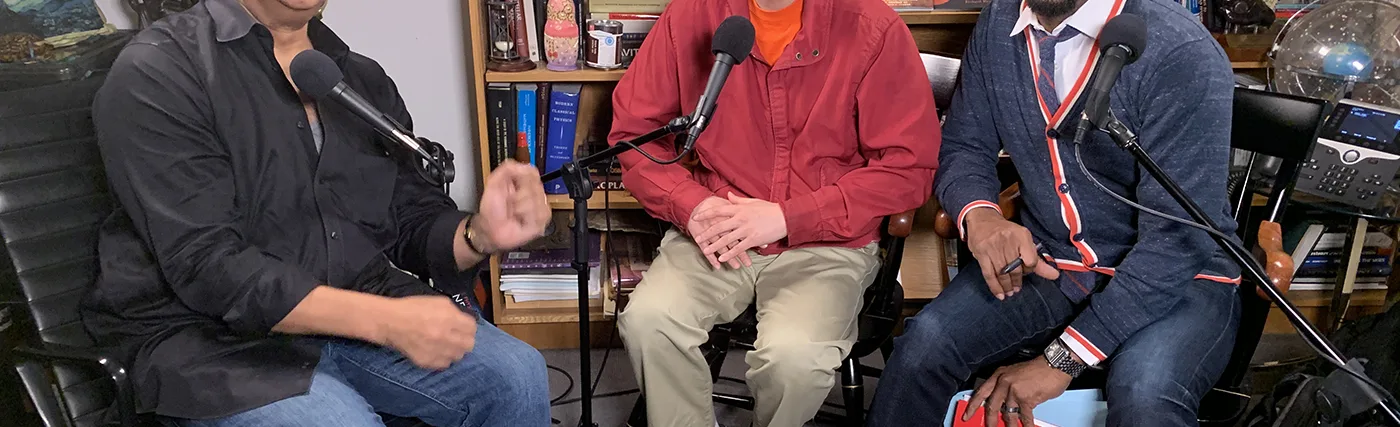
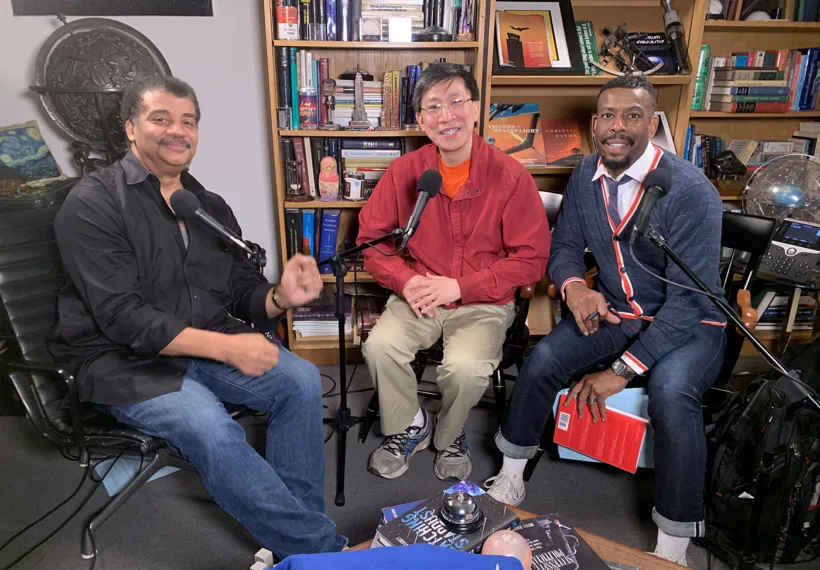
From the American Museum of Natural History in New York City, and beaming out across all of space and time. This is StarTalk. I'm your host, Neil deGrasse Tyson, your personal astrophysicist. I serve as the director of New York...
From the American Museum of Natural History in New York City, and beaming out across all of space and time.
This is StarTalk.
I'm your host, Neil deGrasse Tyson, your personal astrophysicist.
I serve as the director of New York City's Hayden Planetarium right here in New York City, and we are in my office.
I've got with me Charles Liu, friend and colleague, and geek spirtis is what he carries.
And Chuck Nice, as always.
That's right.
This is Cosmic Queries, the science of pop fiction, the sequel.
We had so many questions, and Charles and I took so long answering them damn questions that we had to spill into an entire other display of these questions and answers.
So let's just get right in it.
This is pop fiction, science of pop fiction, Infinity Wars.
No, no, no.
That's when it was Infinity War.
This one is Endgame.
Oh, Endgame.
Would you get your sequel straight?
I really need to get my sequel straight.
All right, Charles, what do you have?
Here we go.
Okay, here we go.
Camilo Orozco from Facebook says, do you think science fiction can influence real science in the development of groundbreaking technologies?
All the time.
Or is it that the groundbreaking technologies are actually informing the science fiction?
Vice versa.
They're all the same.
I'd differ.
You'd really disagree.
And I won't even beg to differ.
I'm just differing.
I'm not even begging.
I absolutely think that fiction informs science.
No, you're wrong.
And let me tell you why I am convinced of this.
Let me tell you why you're wrong first.
No, no, no, let him, let him.
No, no, this is great.
I'm wrong first.
Who do you want here first?
Can I tell him why he's wrong before he says anything?
Oh wow, that's interesting.
That's because he's saying he already knows what you're gonna say.
He's basically saying, I know what you're gonna say.
I've already been there.
It's faster than light communication, you see?
Hold on, okay, go ahead, go ahead.
There is no doubt that the creativity of science fiction authors and their imagination of a future has influenced the look, feel and design of technology.
But it is very hard for you to find a case where the fiction has triggered some spark in a scientist's mind and they make a scientific discovery because of it.
You can probably come up with one or two, at most, examples of that.
But the influence of technology, of imagined technology, unreal technology, no end of that and I'm with you there.
Now, let me hear you.
All right.
I had the pleasure of speaking with Ray Bradbury once.
This is almost 15 years ago, I think.
It was on a radio show.
He was the featured guest and I was fortunate to be on there with him for a few seconds.
What radio show was it?
This was one of the daytime talk shows.
I don't even remember which one it is anymore.
NPR, was it?
It was not involved with a major, it was a different thing.
It had to do with the fact that Mars.
I'm just wondering how often you get to hang out with Ray Bradbury.
I'm trying to get to the bottom of this.
Well, I was just hanging out with Ray Bradbury.
It was a one-shot deal, it was a tremendous pleasure.
And I treasured those few minutes for that moment.
But basically he was on, because we were about to land a new rover on to Mars at that time.
And he wrote heavily about Mars.
And he wrote heavily about Mars.
In fact, the Martian Chronicles by Ray Bradbury are some most important ones.
And we had a conversation about how fiction informs the scientific process and the scientific process informs fiction.
And he said absolutely what you said, first of all, right?
That he was inspired to write much of the Martian Chronicles based on the scientific discoveries or the purported discoveries of people like Percival Lowell and things like that, the canals and so on.
But then he went on to talk a little bit about how many letters he had received over the years where they were space scientists, they were planetary scientists, they were other kinds of science based people who said, your Martian Chronicles inspired me to make this discovery or inspired me to look into that and do that.
And he didn't give me specific examples, but the point is, I believe that that happened.
I need some examples here, Charles.
I will give you one specific example.
By the way, of course science fiction can trigger you to want to become a scientist.
Well, sure.
That's fine.
That has value.
But don't tell me.
The actual discovery itself.
An actual discovery, I don't see that.
Jules Verne, 20,000 Leagues Under the Sea.
The Nautilus, right, is this wonderful submarine.
And we named the first nuclear submarine after Nautilus.
Which is, I think, on display in Connecticut.
I think it's Mark Bald, but I think it's a museum.
Okay, in Groton.
Yeah, with the naval base.
Right.
What happened was that Jules Verne didn't know nuclear power, of course.
But he did know, he said, how is this wonderful submarine powered?
And Captain Nemo, right, tells the scientist who he rescues because he torpedoed their ship, right?
How this happens, this is harnessing the power of nature itself, you know?
How matter and energy can get combined to propel the ship forward.
He had no idea about nuclear power, and yet, a century later, we had nuclear submarines, named the Nautilus, going around.
Right, and ask anyone who discovered nukes from Marie Curie through Einstein, through the Manhattan Project.
Oh, here it comes.
Did you discover these nukes because you read 20,000 Leagues Under the Sea?
The answer's gonna be no, I'm sorry!
But what they discovered was...
What the influence is, we named the ship after them.
We named the first space shuttle, the Enterprise, after...
It didn't go into orbit, but it didn't go into orbit.
But the first mock-up, space shuttle, was named the Enterprise.
But there are many ships named Enterprise before Star Trek was called Enterprise.
But the Enterprise...
Space shuttle.
Space shuttle was named after the Star Trek Enterprise.
I believe you.
What I'm saying is...
You know how I know that?
Because we have it on display here in New York.
And when it came in, piggyback on the 747...
Captain Spock was standing on the...
I was there at JFK when it...
First it did a double flyby, it was showing off.
It was like, look what I got on my back here.
Okay, and then it landed, and then we had a whole ceremony, and Leonard Nimoy was there.
Yeah, that's my only time I met him.
He died a couple years later.
Wow.
Yeah.
Yeah, so what I'm saying is...
So, Charles, I think you're stretching here.
I do not think so.
I believe that the people who put a nuclear...
Chuck, jury, judge?
You know, here's the thing.
I would say that for most of what we see now in science fiction, the technology is informing what is on the screen because they get to take it to the next level.
Right.
So it's like...
Well, there's a symbiosis, for sure.
Like, for example, in the movie Prometheus, very interesting pocket technologies they had.
They had little birdie things that they tossed into a cave and they flew and took a...
They scanned the whole cave.
They scanned the entire cave in three dimensions.
It comes back.
And it's basically a drone.
It's basically mini drones that came out of their pockets.
Little things like that.
They had an automatic surgery pod where you'd go in and program what you wanted the surgery to be and it would conduct the surgery autonomously.
So yeah, you take what you know is possible to the next level.
But then you look at something like a ray gun, which, I mean, you can go all the way back to Buck Rogers, right, and they had ray guns.
And right now, the military is working on the ray gun.
The equivalent of what would be a ray gun.
So I don't know.
I mean, it seems to go both ways.
Technology, we're not inventing new science for that.
Okay, well, no.
That's my only point.
So if your point is about New scientific principles.
If you're talking about scientific breakthrough, then I'm gonna say yes, you're right.
That's what I'm saying.
You're not gonna find scientific breakthrough that is informed or inspired Generally not.
By science fiction and literature.
The closest we get to this, I think, is Kip Thorne, speaking of the development of the wormhole in Contact, in the movie Contact, because he said he was approached by Carl Sagan, and he said, how can we justify this scientifically?
And then Kip Thorne went and did a calculation, added some extra physics that was not known before to wormhole calculations, and then there he actually published a paper inspired by Carl Sagan trying to get this science right in the movie Contact.
So that is rare, though.
That's all I'm saying.
I just say it didn't exist.
You said it didn't exist.
I said it didn't exist.
We haven't recorded it.
So whatever you...
No, I'd rather just fight about it.
I'd rather just fight about what we might have said.
All right, that was a fascinating discussion.
I don't care if we ever got to anything or not.
All right, here we go.
Let's go with Henry T.
6565 from Instagram.
He says this, how much stronger is vibranium than the strongest metal we have?
Oh, sorry.
That's a little crazy, but then again, there's some more.
Is it strong enough to stop bullets point blank?
Also, and here's a better question.
Sorry, sorry, Henry, but it is.
Also, is there anything close to the powers of a Black Panther suit that can in fact absorb energy and redistribute it or use that energy as a weapon?
Okay, I'd like that.
That's a good question.
So energy, you can move energy from one form to another.
No problem there.
If you had a way to absorb the energy of a bullet in a usable way a second time, that's a very realistic future scenario for armor.
Would you agree, Charles?
Yes, I would.
I would right now.
Oh, we agree, let the record show.
We agree on most things.
Yeah, actually, it is true.
We do agree on most things.
Okay, let me give the example of people who can wear those suits that look like old armor, like big time, very heavy metal jacket, armor.
And then they get shot by like a Van de Graaff generator, big lightning bolts and so forth.
And because it acts like a Faraday cage, the people inside are unharmed, right?
So you can, for example, protect yourself against a lightning bolt gun or something like that, a lightning bolt weapon, by wearing basically a fully encapsulating you kind of chain mail, right?
So-
It just has to be able to conduct electricity.
And if you are covered in something that conducts electricity, the electricity cannot get inside you.
It gets stuck on the outer side.
It's a fascinating reality that was discovered by Michael Faraday 150 years ago.
Because when you get struck by lightning, you are the conductor.
That's the problem.
Well, that's why you're basically safe in a car that gets hit.
Because the car is a metal shell.
Unless the car is made of fiberglass.
Unless it's fiberglass, and then you're toast.
Oh, so anybody who gets struck by lightning in a Corvette.
Or if it's a convertible, then it doesn't help you at all.
But you see, I could imagine a circumstance where in addition to the metallic conducting suit, built in are many, many, many high-efficiency capacitors, where we wind up being able to store that energy in a quick way.
Electrically.
Right, but now then you need the technology to take it from the capacitors, which are essentially batteries, into a new generator and then be able to channel it back out as a lightning bolt.
So there's some technology barriers there.
And you lose energy in every transformation of energy.
And then your suit's gonna get really hot.
So the temperature's bad, so you need air conditioning.
And then you have to have like a super nuclear powered thing.
If you can put the electricity in a capacitor, why would you get hot?
The capacitor because you're storing the energy now.
The loss of the energy as you're turning it back into lightning.
Oh, sorry, okay.
So in the changing of the energy, you're getting heat.
But you can store energy with no heat.
A gallon of gasoline is room temperature.
But you can blow up the room, right?
So you can store energy chemistry, for example.
The issue is the time.
Can you turn it around, right?
So in Black Panther, the movie, not the comic book, by the way, which has a different definition of vibranium.
I'm sorry, it's true.
That's the comic book version of, I read the book first.
Well, Black Panther character.
Isn't it?
It is.
To just show it off.
And it's like, your argument is invalid because you didn't read the comic book.
And the actual storyline.
Actual storyline.
One of my prized comic books in my collection is the July 1966 issue of Fantastic Four number 52.
The debut of the character, the Black Panther.
You own that?
Yes.
Wow.
It's an old beat up copy.
So it's not really worth anything.
But it's a great value.
It's really, really interesting.
And to sort of take a look, half a century ago at what Stan Lee and Jack Kirby envisioned this amazing city and this amazing technology to be.
So vibranium in the real, I'm sorry, it is, the real canon of Black Panther is not a hard metal.
It's not the hardest metal, but it has a very unique property where it can absorb any impact.
So the hardest metal in the Marvel comic universe is adamantium, which is this invented alloy, right?
But Captain America's first shield had vibranium and adamantium together in an alloy, which made it even more powerful, the claws of the Wolverine.
And so his shield was better because it had a combination of vibranium and adamantium.
So it could absorb impact and be hard as a striking weapon.
So that's what we mean.
By the way, the interesting properties of something is never only is it how hard it is.
That's right.
It's how to distribute energy.
Is it flexible and not break?
Is it light for how strong it is?
All of this matters.
Right.
So this is why I was very glad that Vibranium was really only a small piece of the overall plot of the movie Black Panther.
It's a great, great movie and the technology and the pseudoscience was holding it up.
The whole movie began with this theft at a museum based on...
Well, the point was that the Vibranium was only a plot device.
The plot itself transcended the technology and the superheroism, right?
Which is what made that movie so great in my opinion.
So in that case, right, can you have something that distributes energy?
So Kevlar, for example, absorbs energy, but it's not metal, right?
And it's in bulletproof vests.
Have you ever seen Kevlar get hit by a bullet in slow motion?
No.
So watch, so watch.
So the bullet hits it, and then waves get set up in the fabric, and it sends the energy and distributes it.
Disperses it.
Disperses it, right.
So it still gets hurt.
You still hurt when you get hit with a bullet.
But the bullet doesn't enter your body.
It could even break a rib, but it doesn't go inside you and mess up your organs.
And therein lies the problem with a hard metal like vibranium.
If it's bulletproof, yes, but the energy of the bullet slug still transmits through the metal into your body to some extent.
So that distribution of energy is what's necessary.
Now, can we, like in the same way as we did with the electromagnetic pulse, allow the grab or the capture of that kinetic energy to be redirected outward as a punch or as a force thing, that technology does not exist.
It does not exist.
Yet.
Wow.
God, okay, cool.
Well, that was a lot, man.
That was a lot.
That's great.
One other thing just about distributing energy.
Yes.
Have you ever put on football gear?
Yes.
Oh, you have.
Okay.
So the shoulder pads, right?
They're like layered in these sort of slats, right?
Have you ever just hit, just get somebody to hit you on the shoulder?
You barely know you got touched.
Yeah.
It completely distributes across the entire chest area.
The chest plate and everything.
The chest plate and everything.
So it's really about spreading out the energy so that the literal and figurative impact on you is diminished at any single spot where it takes place.
At least on your shoulder.
At least on your shoulder.
Yeah.
But your kneecaps are still exposed.
Yes.
Chuck, another question.
Here we go.
Daniel J.
Saltzman from Instagram says, If you could pick one superhero that Neil would be, who would you choose?
We got to go on commercial break.
All right.
We'll be back with StarTalk.
We're at the Cosmic Queries sequel to the science of pop fiction.
When StarTalk returns.
And I know a little bit, but you know who knows a lot is Charles Liu.
Charles, a resident geek-in-chief.
Glad to be here, thank you.
Glad to have you on this.
Chuck.
Yes.
You're reading questions to us.
Yes, I am.
What do you have?
And just remind you, this is a spillover from a whole other show.
Yes, it is.
Questions we didn't get to.
Okay, what do you have?
This is pop fiction, end game.
As Chuck Liu said in the beginning of the show, Daniel J.
Saltzman from Instagram said, hey Chuck, if you could pick one superhero that Neil would be, who would you choose?
So I'll let Charles Liu go first.
Batroc the Leaper.
Batroc the Leaper?
Yes, Batroc the Leaper.
Is that even real?
Yes, is one of Captain America's great enemies.
Mostly yes and a high pitch like, idiot.
When, who and when was that?
Okay, Batroc the Leaper is essentially a terrorist who was really, really good at Savate, which is the French style of martial arts where you kick people a lot.
I have very good leg agility.
That's right.
That's exactly why I thought about that.
Oh really?
Now, as it turns out, the character Batroc the Leaper does show up as a villain in the first Captain America movie or the second Captain America movie.
Either it was the original, like the first Avenger or the Winter Soldier.
I can't remember exactly which one.
But you-
Captain America.
Yeah, in the Captain America movies in the Marvel Cinematic Universe.
And they completely changed the character, of course.
But the bottom line is yes, you would be the heroic version of Batroc the Leaper because your legs just remind me of like someone who would just go in and just clean house with one round house after another.
With a round house kick.
Nice.
Okay, well thank you.
Batroc the Leaper.
Batroc the Leaper.
Thank you.
So I'm gonna make you a world-crushing Hulk.
But, so world-crushing Hulk is actually Banner and Hulk at the same time.
So Banner is still like, he's still smart as hell.
He's like super smart like Banner, but he's like crazy strong like the Hulk.
But at the same time.
At the same time.
And but I'm gonna give you.
So he's an articulate Hulk.
He's an articulate Hulk, right.
He wears glasses.
Yeah, he's actually wearing glasses.
But can I have my own skin tone?
I don't wanna be green.
Well, I was about to say, but with one caveat, you're gonna be black and they're gonna call you the bloke.
The black Hulk?
You'll be the bloke, right?
And then when, and your thing is like, right before you get ready to throw down, you like, yo, back up off me sucker.
Like, right?
And then that lets them know like, you're about to like crush.
So Hulk goes Hulk smash.
Okay, and I say.
And bloke goes, back off off me sucker.
Okay, and anybody who says that, you know to not just go the opposite direction.
So most fights I wouldn't even have to have.
No, exactly, because they're like, oh yo, he about to go world crushing on us.
Okay, I'll be the bloke.
All right, there you go.
All right, so let's move on.
This is Mjim4 from Instagram.
Wow, okay.
Hey guys, long time follower and fan here.
I'm curious right now about photon energy and how it reacts with the human body.
Captain Marvel can create an immense photon blast from her body.
How much power would it take to cause serious damage from a photon blast?
Can the human body harness photon energy for themselves?
His name is Matt Martin from British Columbia.
Okay, so I have a cool beginning to that answer.
Chuck Charles will probably come in on this.
So a couple of things.
Photon is a carrier of light energy.
And light can be any wavelength.
Like you have radio waves.
We call them waves, but they're radio photons.
Radio waves, let's go in order.
So radio waves, microwaves, infrared, red, orange, yellow, green, blue, violet.
Roy G.
Biv, that's the visible part of the spectrum.
You go beyond the violet, you are ultraviolet, x-rays, gamma rays.
This is all the words we have available to us to describe the breadth of the spectrum, okay?
Some of these photons go right through you.
Radio waves pass right through you.
Microwaves mostly pass right through you.
So the idea that you would capture, what effect do they have on you?
None, because they pass right through you, okay?
So now we gotta talk about the ones that would have an effect on you.
So visible light reflects off of you, okay?
So that's depending on how light your skin is, okay?
If you're really, really pale, you reflect most of it.
And if you're Miles Davis, nobody can see you.
Damn, Chuck.
Wesley Snipes, invisible.
So, so you can, so you will either reflect or absorb the light energy.
You get onto ultraviolet.
Now it has penetrating powers into your skin.
Ultraviolet goes down to the dermis.
So you get sunburn.
You get sunburn and skin cancer.
That's correct.
And you go to x-rays.
And we all know those go through you.
But they'll absorb in your denser material, your bones.
That's why they show up.
So something gets absorbed.
So you can also get cancer from too much x-ray exposure.
Right onto gamma rays, which together, class, turn you.
Into the Hulk.
Into the Hulk.
Or the bloke.
The bloke.
The bloke?
The bloke.
Bloke, I thought it was the bloke.
It could be bulk.
It could be bulk.
It should just be bulk.
I thought it was bloke, but no.
Hey, bloke.
Bloke.
So, you would need ways to capture the photons that might otherwise bounce off of you or go through you.
And in our field, astrophysics, we exist entirely to create detectors that capture these photons.
Radio waves, X-rays, gamma rays, visible, infrared, ultraviolet, that is what we do.
That is all we do is find ways to capture these photons.
Well, we get meteorites too.
Okay, so then, now you wanna capture them and use them again, or how much damage would they cause?
You need a lot of them.
And we have lasers for this.
Lasers amplify photonic energy.
And what you ask is, how much energy does it take to bore a hole in you?
Give me a laser with that much energy where you absorb that and it'll bore a hole in you.
You can just do a simple energy calculation.
That's it, that's it.
So, Chuck, it's like a bajillion photons.
You need a lot of photons.
You need a lot of photons.
A typical photon.
Because for example, if you walk into a dark room and turn on the light, you don't say, whoa, that bolt broke.
Look at all those photons.
Oh my gosh, they're knocking me down.
Um, astronomers and physicists use a unit of energy called the electron volt.
It's actually energy, even though it has the word electron.
Okay, go ahead.
Might as well.
A typical photon of visible light, like the stuff coming from lamps in your room, is a few electron volts per photon.
Okay, but it requires literally a trillion such photons to get the total amount of energy that a flea uses to hop from one place to another.
So you need many, many more trillions of such photons to be focused in such a way to even affect you even more than just like a bright ray of sunshine.
What scientists created a system of measurement?
In units of flea jumps?
In units of flea jumps.
And why?
It's actually a trillionth of a flea jump if you think about it.
That's kind of crazy.
One photon.
Yeah, one photon is about a trillionth of a flea.
One visible light photon.
But gamma ray photons, sometimes.
Each one has way more energy than a visible light photon.
In fact, the most powerful gamma ray photons that we've ever detected have almost as much energy as a baseball.
A thrown baseball.
Yeah, if you throw a baseball.
Here's how I've heard about it.
Wait a minute, that's a single photon?
It's a cosmic ray.
It's basically a charged particle that has so much energy it could accelerate you on the speed of light.
You can execute a golf putt with the energy hitting a golf ball.
Yeah, so these individual particles are extremely penetrative.
They literally go right through the earth and along the way they're bashing all kinds of atoms and molecules and things like that.
And those kinds of particles are the kind that supposedly create the mutations in Homo superior that give us the X-Men.
Ah ha!
Oh, I didn't know that.
X-Men are Homo superior?
That's what they call themselves.
Because they are evolved or they're the nested.
I would say they are Homo different.
Nowadays we say that, right?
I don't go value judge that flames come out of your eyeballs.
I'm just gonna call you different.
Well, you and I agree with that.
But back at the time in the comic books, okay, when the first X-Men.
This guy's such a comic book snob.
I am, I'm sorry, but it's true.
Back when the original comic, The X-Men, came out in the 1960s, Charles Xavier said you.
The children.
Yeah, the illustrator of the story.
Oh, sorry, Xavier, of course, of course.
Stan Lee and Jack Kirby helped create these characters.
But Charles Xavier tells.
You're talking about Jean-Luc Picard.
Yes, right.
At that time, yeah.
A similar bald individual tells his X-Men, right, which at that time were the Beast, Marvel Girl, and Cyclops, and the Angel, say you are homo superior, and you have to help all of humanity because you are superior to the others because of mutations.
And the first villain they fight is Magneto, who is also a villain, right?
And so the.
But how do you get the gamma ray reference in that?
The gamma ray created them.
Created them.
Yeah, because, yes, the energy came through it.
Yeah, so to kill with light is a very hard thing.
And lasers, even powerful lasers are, the weight of the laser that could do damage to you as a weapon is huge.
It's not.
The Fantastic Four was created because they were bombarded by cosmic beasts.
They were not mutants, but then they were mutated by this kind of radiation.
So the military, of course, as others do, have non-lethal weapons for crowd control.
And one of them is a microwave beam.
And so what happens is there's a crowd developing and you want to disperse the crowd.
You say, please disperse, and then they get angrier.
You just whip out the microwave.
You just put a microwave beam in there and it penetrates into the dermis, it heats it up, and they want to escape the beam, and they run.
But it's not the microwaves that are hurting them.
It's the microwaves causing the heat, causing the water molecules in your skin to get hot.
It's because you absorb the microwave, and that turned into heat.
That's you.
You're responding to the heat.
You're responding to the heat.
Right.
So could you just hold up?
It's a technicality, but it's a very important distinction.
Could you just hold up a burrito?
Yeah, yeah, you could.
Right in front of you.
Right in front of you.
No, wait, right here first, right down here first, and then everywhere else.
I'm a burrito.
No, that would work.
But so the bottom line to the question is that using photonic energy to blast people, it would require a huge amount.
All right, all right.
That was good, that was good.
All right, here's another one.
This is Kevin Kalikamaka, who says, what kind of star system would create the differences in the length of seasons throughout the history of Game of Thrones?
Oh.
Problem is, of course, the Game of Thrones seasons change widely, right?
That's okay, you can do that.
Entire generations can go by.
But not only that, it's also unpredictable, right?
You can't say, oh, well, we can see the seasons growing longer, the winter's growing longer, and then they grow shorter, and then they grow longer in predictable periods.
And so there has to be something that's injecting some chaotic or stochastic process into the thing.
But we've got chaotic systems in the universe.
So my hypothesis is the solar system in which the Game of Thrones planet must exist has other, like, rogue planets and moons and so forth that are going in such crazy things that it will cause the orbit and the orbital tilt of that planet to change.
If you just have two bodies, a planet and a star, it's just gonna have an orbit.
You have an orbit.
And like Charles is saying, if you throw in some other interesting objects that have rival strengths of gravity that the planet has, then you can tug on the planet in interesting ways, chaotically, and therefore put into effect a non-periodic set of seasons.
So our seasons on Earth are caused because our Earth is spinning as it's tilted.
So you can imagine that one of these chaotic items comes by and it causes a tilt, go just a little bit further.
That just increases your winter by decades.
But then another one comes by later and tilts it back a little bit and causes that summer to be much longer as a result.
Things like that.
So you can really-
Like the Milankovits.
Right.
So you would have to be in such a way that you're only affecting the tilt because if you start affecting the orbit as well, then the distance to the host star changes and that would be manifest in the storytelling.
Right.
And it's not.
You would totally see it.
So it's a tilt issue, I'm pretty sure.
So it's really just the tilt of the planet.
And that would have to be if you want to affect the seasons.
But there would have to be some erratic, there would have to be other erratic bodies that are affecting the.
Which is not hard.
A three-body system is chaotic.
Okay, there you go.
Two-body is deterministic, three-body is chaotic.
For this, you're gonna need five or six.
Five or six bodies.
So Neil, looking on the internet, this is something that's going viral.
Ant-Man will kill Thanos by going into his butt and then expanding so that he explodes from the inside out.
Back to the normal size.
Or he could be a giant now, so he could actually expand to.
Okay, first, first, that's nasty.
Because if Thanos is as powerful and as evil as he is, he's gonna have powerful evil poop.
Okay, so I would not want to find myself in that environment.
But second, I wouldn't think.
Second, why not put something else in there that expands?
Why does it have to be your own self?
I'll bet you Thanos has quantum butt armor that would prevent that from happening.
Just saying, just saying.
Quantum butt protector, quantum butt panels.
I don't know, I'm just saying, if you just want to go in and expand and kill him, you don't have to be the person to do that.
Send some other quantum thing in there to do it.
Right, to do it.
By the way, you can look at Thanos.
You know he does Kegels, so, tighting up my butt cheeks.
That's what I'm gonna do.
You are imitating Eddie Murphy, imitating Mr.
T.
In Eddie Murphy's movie.
Very, very good, that's exactly it.
Time for one last question in this segment.
Oh my God.
And then I gotta go.
I'm gonna leave, Chuck, I gotta leave you with Charles for the third and final segment.
Oh my God.
Yeah, I got places to go, people to see.
Parents are leaving.
Party, party, I want you on your best behavior.
Last question, go.
All right, last question, okay.
This is Adler.
Last question, what I can help Charles even though he doesn't need my help.
I can pretend I can help him.
Okay, go.
This is Adler Tsai, how can pop fiction make science more comprehensible to the audience?
Now this man is thinking about the good of all with respect to pop fiction and science.
I want to hear your answer too, because we're both scientists but also educators and we care about imparting knowledge, wisdom, insight into an audience that is science based.
So for me, you can't require of a story to teach science.
I think it can get pedantic and no one's gonna read it.
But what you can do is tell a story that's so compelling regarding some scientific idea that when you come out of that, you say, I want to learn more about that idea and you become a self-starter, self-learner because you just have to learn more.
And for me, that is the best kind of pop culture scientific force that you can invoke.
Charles.
I have two sides of that same coin you described.
First, I do believe you can have real, legitimate science presented in a movie.
So you can do that but what you do is you show what real science does and in real ways.
But then the second part is you have to be able to distinguish between what is actual known science and what is science fiction.
If you can tell or communicate to audiences, real science does this and this is now we're going to the quantum realm which is fake science or highly speculative, then people can tell the difference between what is scientific and non-scientific.
You're not gonna make a movie where we say, okay, here we're making stuff up.
You, why not?
In the previous 10 minutes we weren't.
Actually, you can do that and in fact there are some movies who have done that very well.
Such as?
Well.
See, none.
Some of.
That's not right.
Why don't we talk about that some other time?
Oh, you can talk about it after I leave.
We gotta end this segment but I gotta run but I will leave you in really, really good hands with my friend and colleague, Charles Liu and he's got his co-host, Chuck Nice.
Nice.
Hey, we'd like to give a big StarTalk shout out to the following Patreon patrons who help us as we make our journey through the cosmos.
Adam Jacoby, James Esham and Patrick Cooney.
Thanks a lot, guys, for your support.
And if I said your name wrong, how about some phonetic spelling, please?
Unlocking the secrets of your world and everything orbiting around it.
This is StarTalk.
Welcome back to StarTalk.
I'm Charles Liu.
You can call me Chuck if you'd like.
And I am sitting in, filling in as a guest host for this brief segment for the wonderful Neil deGrasse Tyson.
And with me, of course, is Chuck Nice.
That's right.
Always a pleasure to work with you.
Yeah, now we can have some fun.
Neil's gone.
Okay, we are wrapping up our episode of the sequel of Pop Fiction.
That's right.
Cosmic Queries.
Cosmic Queries.
Let's do it.
Here we go.
This is Alex Atanasio wants to know this from Facebook.
All right, Alex.
Are time travel plot devices just lazy writing?
Yes.
Now, come on now.
No, they really are.
Are you?
No, seriously.
Come on, Chuck.
Don't you think the time travel captures the imagination?
It does, and it's very exciting, but the problem really is that you can do anything you want the moment you time travel, right?
So it is lazy writing.
Now, there are some exceptions where the time travel actually is core or key to the story.
I think, for example, of The Terminator.
Yes, absolutely.
Where the whole point of the creation of the storyline comes from the travel time, and everything gets knit in nicely.
Everything's a paradox.
It works out nicely.
But if you use time.
It's actually well done.
But using time travel to say, oh, look, they've destroyed everything.
And then, oh, we can repair everything.
That is lazy.
We'll go back in time and repair.
But you know what?
If you don't take it too seriously, you're okay.
So for example, there is a TV show called DC Legends of Tomorrow.
And they're almost like an old style entertaining TV show where they don't take themselves too seriously.
They do time travel, but they do silly things like unicorns ripping people's hearts out, things like that.
So by not taking themselves too seriously and doing these time travel anomalies in a lighthearted way, then it becomes part again, sort of like Terminator, but in a funny way where it becomes part of the joy of the story as opposed to like, just come on, man.
You can do better than just flip everything back in time.
All right, your favorite time travel, anything.
My favorite time travel, anything.
Anything time travel, that's your favorite.
Steve, I'll give you mine.
Okay, go ahead.
Mine, Homer Simpson and the Toaster.
Homer Simpson and the Toaster, man.
You can't, I'm sorry.
That is a true classic.
You know, I am again showing my sort of bias to the past in the classic, but I think the best time travel story has to be The Time Machine.
Wells.
Wells, yeah, because the way that he talks about both going into the future and then to the end of the world and things like that, he's using that time travel as a way to imagine things as opposed to a plot device to fix things.
I think that's a really, really great way to sort of put time travel on the proper map of things.
I will also mention one more.
This is pop fiction, right?
There is a time travel story in Star Trek Voyager.
Yeah.
Where the story isn't that important because of course the time travel, you know, gets all resolved by silly, goofy things and so on.
So it comes back.
But what happens is the timeline gets changed.
And of course the Star Trek Voyager people save the timeline.
And then there's a person from the future comes and says, you've saved the timeline.
Thank you.
And so the captain, Catherine Janeway asks, by the way, you're from the future.
Do you know whether or not we get back home safely in time?
You know, safely, do we get back to earth?
Right.
And the future time traveler says, I'm sorry, I can't tell you that.
That would violate the temporal prime directive.
And it was like the ultimate irony because always in Star Trek, there was throwing around the prime directive.
We can't give you this.
We can't do this for you because it's the prime directive.
But now they are the victims of a prime directive.
I thought that that was a very nice way to sort of use the time travel lazy plot device as a sort of one way to squeeze in that little kind of cool storytelling piece.
Cool little storytelling element.
And I believe Janeway's answer to him was, what a dip.
That's probably what she would have said.
Cool, cool, cool, cool.
Kerry Hoshin from Facebook wants to know this.
Have any of you been asked to appear on or work with any of the current sci-fi movies or television shows?
If so, which one?
And if not, which one would you want to make a cameo appearance?
Now we know that our friend Neil does a whole bunch of these things.
So, you know, the answer is yes.
Just go on to IMDB or some other thing.
You'll see all the things that he's done.
A myriad of things he's done.
Now, what would you like to do?
Chuck, what would you like to be on?
What sci-fi, TV show, movie, whatever would you like to do?
There's only two.
Really?
It's only two and I hope that it can happen in some way before I die.
Oh, which ones?
Star Trek and Star Wars.
Anything in Star Wars and anything in Star Trek.
As long as I have a speaking line, I just want a speaking line.
But like a real role.
I want a role.
Yeah, you want a role.
Would you play Lando Calrissian, for example?
Would you play Han Solo?
Would you play Princess Leia?
Now you just settled it for me.
It's totally Leia and I'm Jabba the Hut Leia too.
I'm wearing that little outfit.
I'm laying up on Jabba with that little chain collar around my neck.
Oh, please.
As soon as Hans comes in, I'm just like, Hans.
That's so 80s.
But it's true.
It's true.
There's some attraction to it.
But no, the other stipulation I would make is that I would like very much to be me.
I don't want to be in prosthetics.
Ah, so you don't want to be painted.
I don't want to be painted and I don't want to be an alien.
I want to be me because I want to be able to say, look, dude, that's me.
Dude, I'm in Star Wars.
That's me.
I would rather be painted, quite frankly.
I do want to be an alien and the reason I want to do it is because then I can be shown as someone who is not me.
The science fiction of it all is where you can really put aside the anchor to reality.
And so I would like to play an alien with a significant role with two heads.
Oh, cool.
I don't know exactly what show would allow me to do that but I would like to have some sort of CGI or makeup thing where I have two heads and I can talk at the same time with both heads.
And then we can either sing together or talk to one another or otherwise interact in ways that people with one head ordinarily don't, right?
Right now, up to now, sci-fi.
One of your heads is your internal conversation.
Oh, yeah.
That would be a comedic thing, whatever.
I'd be like, yes, that would be wise.
No, wouldn't you, dorkhead?
Right?
Yeah.
Super cool.
That's what I would like to see myself doing someday.
All right, cool, cool, cool, cool, man.
All right, great question, Jerry.
Wonderful.
All right, let's go with Marco Vitt, who says, in several programs like The Flash, they mentioned tachyons or tachyon drives in Star Trek, or they link them to time travel.
Yes, they do.
Although it's theoretical, could it possibly work and how would it work?
Okay, tachyons were invented decades ago to try to think of ways that the universe could exist where you have faster than light travel.
But tachyons are things that can only move faster than the speed of light.
Whereas with our regular matter.
They would have to, in order to move faster than light, they would have to exist faster than light.
They could only exist faster.
They could not slow down, for example, and become photons, would travel at the speed of light or other particles in our universe, which always travel slower than the speed of light.
In fact, this is one of the traumatic experiences of my youth.
Well, it's not that bad.
But what happened was that in high school, there was a scientist, an astrophysics theoretical researcher, who came to our high school and gave an afterschool talk.
And we're talking about relativity and things like that.
And then I actually raised my hand in the Q&A session and asked him, do you think that the existence of tachyons, and he just said, they don't.
No, it's not happening.
I'm like, oh, no, I've been crushed.
You know, that kind of thing.
Well, I wasn't crushed.
But he was just basically trying to say, shut that down right now because it is completely fictional, right?
So in the sense that tachyons do travel fast in the speed of light and you can try to think of it as a way to get through the time barrier or whatnot.
Sure, go ahead and do it like fictionally.
But you and I have already discussed in the past few minutes that we think, or at least I think, I hope you think, maybe you think too, that time travel is a lazy plot device.
So we don't need those tachyons to travel in time.
They're put in there so that the flash can go back and forth and do goofy things like flash point or change things or have Aobard Thawne live like six or seven times even though he gets killed eight or nine times, goofy things like that.
So that's my opinion.
Lay off the tachyons, folks, lay off the tachyons.
All right, cool, there you go.
Hey, listen, that's a sobering thought, but still fun to think about when you consider them for science fiction.
Right, imagine if you're having a science fiction environment where there are creatures that can only travel fast in the speed of light.
Their definition of time and causality are completely different from ours.
Right, absolutely.
And so we have a really neat dichotomy that is barrier.
The barrier is indeed the speed of light.
And so I think that would be a fun thing to explore in that aspect of things.
So whether it's possible or not is highly not.
But whether it's a fun thing to play with and to think about, sure, definitely.
Absolutely.
All right, this is Dustin Parmley.
Dustin says this.
Is there something you're just tired of seeing Hollywood get wrong?
Something that they just can't seem to get right?
Over and over and over.
Where can I start?
PS my eight-year-old daughter and I love listening to you guys.
Oh, wonderful.
Wonderful.
Chuck, I gotta let you start.
What's the thing?
Is there a trope, a particular trope that you just hate and it happens over and over again?
Yes.
And there are numerous ones that I hate all the time.
But I want to hear your ideas first.
Because you live the tropes, right?
As a comedian thinking deeply about scientific issues, you're always wondering what do people look at if you say something and they're like, oh, that's so true.
Like, oh, yeah.
You have that insight.
Talk to me.
For me, when it comes to science fiction, it's the fact that when superpowers are given, they're normally given by some catastrophic accident that ends up creating someone with these incredible powers.
And like, if you just look at the laws of physics, catastrophic events are called catastrophic events for a reason, right?
It's very unlikely that anything good would ever come out.
So like a blast of radiation.
That's the one that I hate the most.
Radiation.
Radiation is never going to lead to anything good for human beings.
That's all there is to it.
That's just it.
You're gonna die.
That's the end of it.
Right.
You're gonna die.
But that's the one I hate the most, is that somehow we take radiation and it turns into superpowers.
Yeah.
That's one of my ones that I don't like either.
But I think you've expressed it much better than I could have.
I think I will just give one trope which I think is so stupid.
It's the damsel in distress.
Oh, good one.
That the hero has to come and save because, oh, the person is so helpless, the super heroes must be the ones to save them.
That bothers the crap out of me.
Okay.
You know, I just can't.
And these days-
You know, there was a Spider-Man that tried to deal with that.
Which Spider-Man movie?
I forget which one.
But anyway, the whole idea was like, all of New York kind of rises up along with Spider-Man.
Because the idea is like, we're all in this.
That's right.
That's right.
Okay.
The rest of us sit around and like, oh, we're just so helpless and you have to have this hero to come in.
I like stories when the hero or the heroism, heroism is part of the story writing as opposed to the overall like the whole point, right?
This creature is created and now they're here to save the world.
Cool.
Anyway, so I want to thank everybody for listening to us today.
I think we're going to wrap up.
Chuck, what a pleasure to hang out with you and to do this.
Are you kidding me?
It's always important.
And now you have to channel Neil for a second.
Neil, it was great to be with you earlier in this episode.
Charles, I am always honored to be in your presence.
Well done, sir.
Yes, exactly.
I don't know if that was like Neil deGrasse Tyson or Wharf.
Wharf deGrasse Tyson.
Wharf deGrasse Tyson.
There you go.
We will have our honor back, brother.
And with that, we're going to wrap up this episode of Star Talk.
I'm Charles Liu.
You can call me Chuck and here's Chuck Nice.
You can call me Charles.
All right.
As Neil would say, keep looking up.
See the full transcript



 Unlock with Patreon

 Become a Patron