To start, we dive right into speed of light communication. If two parties are communicating light years away from each other, how would they be able to share the same sense of time during the conversation? You’ll learn how Star Trek’s “subspace” solved this problem. We discuss how the Doppler effect impacts our real-life space communications today.
You’ll find out which science fiction and superhero movies Neil and Charles appreciate given their level of, or purposeful disregard for, science accuracy. We take a hard look at the 1966 Batman movie and discuss the infamous “shark repellent”. You’ll also hear about Attack of the Killer Tomatoes!, Dr. Strange, and others. And, Neil gives us details on his cameos in The Last Sharknado: It’s About Time and Ice Age: Collision Course.
You’ll hear about stealth technology and ways it could be used. We ponder the science of invisibility when a fan asks if it’s possible to disguise a city like Wakanda disguises itself in Black Panther. Neil and Charles tell us what superpower they would want that’s enabled by gene-editing. Re-visit Franz Kafka’s iconic story “The Metamorphosis.”
Transcript
DOWNLOAD SRT
From the American Museum of Natural History in New York City, and beaming out across all of space and time. This is StarTalk, where science and pop culture collide. I'm your host, Neil deGrasse Tyson, your personal astrophysicist, and this...
From the American Museum of Natural History in New York City, and beaming out across all of space and time.
This is StarTalk, where science and pop culture collide.
I'm your host, Neil deGrasse Tyson, your personal astrophysicist, and this is a Cosmic Queries edition on science in pop fiction.
Ooh, what does that mean?
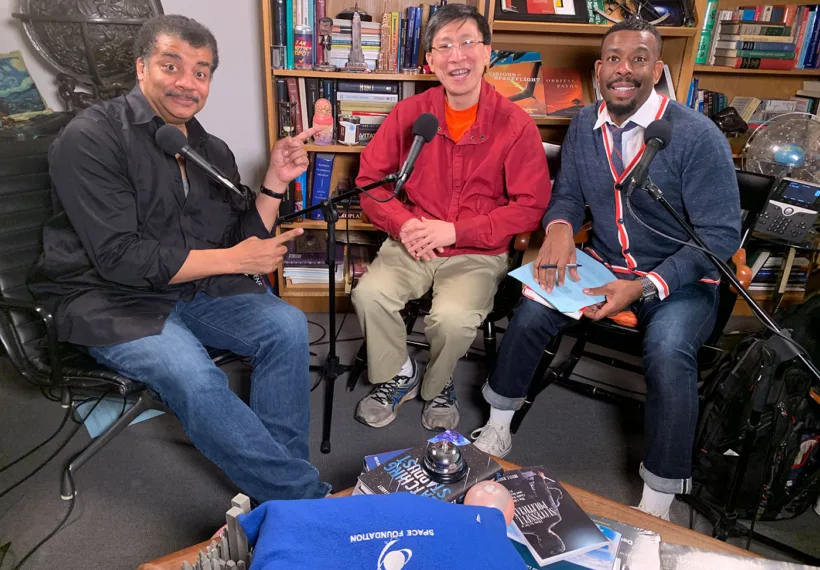
I got my resident geek in chief with me, Charles Liu.
Charles, welcome back to StarTalk.
What a pleasure to be here.
You're like such a regular on this show.
Because there's certain categories of expertise that you just plug that hole, and we just sit back and enjoy.
I live to serve.
Thank you for having me.
There he goes.
And Chuck Nice.
That's right.
As always, dude.
That's right.
Always a pleasure to be here, man.
All right, so you got, we solicited questions.
We have science and pop fiction.
And pop fiction.
So it's movies.
Pop fiction is what?
Television, you know, maybe comic books.
So it could be superheroes.
It could be just sci-fi.
It could be sci-fi.
Sci-fantasy.
Right.
All of the above.
Right.
Whoever's putting science in their fiction, we're gonna talk about it.
Okay.
That's right.
I think of pop fiction as the kind of fiction that you would watch while eating popcorn.
Okay.
So pretty much anything else.
All right.
So Chuck, what do you have?
All right.
You can call me Charles if you'd like.
And you can call me Chuck.
Yeah.
We're interchangeable.
You were Chuck in college, right?
Yes.
You were Chuck in college?
I'm still Chuck now.
By the way, I was Chuck in high school.
Yes, I was.
How were you Chuck in high school?
I hung out with a couple of friends who noticed that I was always jovial and I...
Who, Peppermint Patty?
Pig fan?
No, it was they noticed that I chuckled a lot.
And so they had their own nickname for me that no one else had.
And it was Chuck, which was short for Chuckles.
Oh, how cute.
And it ended after high school.
Not that I didn't stop laughing, but no one really cared.
Right, and then you became Dr.
Hibbert.
So we really have three Chucks.
With Chuck, Chuck, Chuck.
Chuck, Chuck and Chuck.
How much wood could a wood chuck, chuck?
All right, here we go.
This, we always start with a Patreon patron because they support us financially and we're whores.
So this is from, this is from Mike Walterich on Patreon.
And this is what he says, on shows like the Orville and many others, they often communicate with people light years away.
They never explain how they do it.
Maybe there's a wire that passes through a tiny wormhole to connect Earth.
What I'm wondering, though, is if they were able to reliably share the same sense of time for the duration of their conversation, would one of them sound like a chipmunk and the other sound like they're in slow motion, what other weird effects might occur?
That's a great question.
That's a really great question.
Because, you know, we're so distracted by it, well, that wouldn't make noise in the vacuum of space.
And this person's thinking deep.
Yes, he is.
About conversations.
We have this issue with communicating with the Mars Rover.
Right.
The Mars Rover.
What's the delay on the Mars Rover?
It's on average about 20 minutes.
You'll just say, watch out for the cliff, and it's too late.
So you gotta make sure.
Watch out for the cliff, Jesus.
What?
That's why the Rovers all have some kind of AI on them to know where they're headed and how dangerous it might be.
Right.
Regardless of what command we give them.
Yeah, because it's like having a lousy parent at the playground.
So, clearly they're communicating with people much farther away than just Earth to Mars.
So, I'm thinking it's gotta be some wormhole channel.
Charles, you got an opinion about that?
In Star Trek, specifically, there is this construct called subspace, which transcends regular space and time.
And basically anything that happens in subspace, you can just assume works just as if you and I were next door to each other or in the same room.
In real time.
Yes.
But that completely doesn't affect the entire rest of space and time.
It's really a false, entertaining, convenient construct.
It'd be cool if that were the thing, right?
Right, it would.
And perhaps someday that will be the stuff.
But if that were the case.
Wait, wait, wait, wait.
So, Verizon Fios, eat your heart out.
Right.
The problem, of course, is that if you can have this transluminal communication, you really mess up causality.
You can really have an issue.
Like, let's say I somehow am magically able to tell that Mars rover, watch out for the cliff, in instantaneous time.
And then the rest of the signal, where somebody else is watching that rover, it takes 20 minutes for us to see that that rover avoided the cliff.
And so you're really turning into a strange opportunity to twist what's causing what, who's causing things.
And all of physics starts to break down under those circumstances.
So superluminal communication, or faster than light communication, is approximately as challenging as faster than light travel to our ability to understand how physics works.
And in fact, this is just the movement of information has tremendous consequences, if not done according to the universe in which we have laid down our laws of physics.
But is there a coherent set of laws of physics that will allow superluminal communication and not mess things up?
At the moment, no.
So let's say for this-
We're waiting for someone else to be born.
Pretty much.
Einstein Jr.
Take us to, all right, take us to the next step.
Little Einstein.
Yeah, well, so the comments about whether or not you sound like a chibok or you talk really slowly is-
At low frequency.
You can speak slowly at a high frequency.
That's right.
But the idea is-
You know my favorite scene ever was in, was in, what's that riding hood movie?
Little Red Riding Hood movie?
Hoodwinked.
Hoodwinked.
Hoodwinked.
The chipmunk.
No one understood the chipmunk.
The chipmunk said, Bling, bling, bling, bling, bling, bling, bling, bling.
And you just think, oh, it's being a cute little chipmunk.
And then the detective says, I think I know what's going on here.
He records the chipmunk and then plays it back in slow motion.
He plays it back and it says, I was witness to it.
It's this slow, deliberate, low-frequency voice that's translating the chipmunk.
Right, so that kind of effect is what we call the Doppler effect, right?
Especially the Doppler effect for sound, and Neil, you and I understand that very well.
Just when we're out on the streets in New York and the ambulance goes by or something like that.
Well, they go by too slowly to have any Doppler effect at all.
Well, in New York they do, yeah.
No Doppler effect.
Every time I see an ambulance in New York, I'm like, that guy's dead.
I'm just saying.
It's like sitting at a light for 20 minutes.
It's behind you and nobody knows how to move.
And nobody's moving and it's trapped on the street.
It's just, all right, sorry, go ahead.
You need drones to carry these folks.
So if you're going through a wormhole, you're not having these Doppler effects.
That's right.
So you're not gonna have frequency changes or anything.
If you're close to a black hole, sort of like in the movie Interstellar, you do have things change in terms of light and sound and those kinds of things.
But in order to really predict what's happening in terms of superluminal communications, I think we are well beyond normal science as we understand it now.
And like the Orville, we're totally in fiction.
Okay, all right, all right.
All right, hey Mike, what a great question, man.
Way to go.
All right, let's go to Chris Mangrum from Facebook.
So we're done with the Patrons?
Yeah, for now.
For now, we'll get back to them.
You know, get back to them.
I don't want to be that much of a whore, you know.
Buy me dinner first.
Come on, man.
Here we go.
This is Chris Mangrum from Facebook who says, have you ever watched a superhero sci-fi movie that hadn't made you cringe and if so, what was it?
I think that, let's frame that positively.
Is there a superhero or sci-fi movie that you have watched and appreciated the amount of science that was built in and the level of science accuracy?
That's really what this, I think Chris, that's really what you're saying.
You just put a positive spin on the same question.
I'm putting it positive in a positive frame.
Let's trade off.
Give me a movie and I'll give you a movie and we'll go down the list until we cry.
In terms of movies, superhero movies that, maybe we can do like, how long did it take before I started to cringe or something like that, right?
The movie that made me cringe least, it was interesting, the 1966 Batman movie.
The original Batman movie?
No, that's the one we had shark repellent in a spray can.
That was also the one, wait, where they all became powder?
Yes, in the United Nations.
They used heavy water to bring them back?
And they went, boing, and then they completely become two, and they're identical to each other except they're speaking each other's languages, right?
Which, by the way, is almost as believable as the Tower of Babel.
Anyway, go ahead.
The reason I did not cringe at that one is because I knew.
What fraction of our audience even have seen that movie?
Well, you didn't ask me that question.
You gotta be like 80 years old to have seen that movie.
I know that on college campuses, on many college campuses, there's the annual watching of the Batman movie.
Gotcha, okay.
We owe me closer to the screen, huh?
Robin, I do believe that man stole my walker.
So, my cringing was, okay, I even allowed there to have been shark repellent in a spray can.
Yes.
Okay, this is pre-
But there was Batmanta repellent and there was Eel repellent, whatever it was.
Here's my thing.
My issue was, how big is his utility belt to just always happen to have shark repellent?
He didn't have the Bat Shark repellent on him at that time.
It was in the vehicle, it was in the Batcopter, and the shark was attached to the Batman's leg as he was coming up on the rope ladder, and he said, quick Robin, hand me the Bat Shark repellent.
And so from the cabinet that had the Bat Shark repellent, Batmanta Ray repellent, Bat whatever repellent, he grabbed the bat.
A repellent for each kind of bad, aquatic, it's like a spice rack of repellents.
And he grabbed the thing and sprayed it and then they fell down and then exploded.
Okay, I thought it came from his utility belt.
Okay, so now, explain.
So the reason it wasn't cringe worthy for me is because I knew that it was totally goofy to begin with.
Right, and in a sense, I prefer movies of that genre that don't take themselves too seriously.
Like Mars Attacks.
Yes, if they're obviously messed up, then I don't really worry too much about how they, what bothers me, yeah.
That's Mars Attacks, I'm sorry.
Really?
That's not Mars Attacks.
Yeah, the aliens just say ah, and they were destroyed only by, should we spoil the movie?
I don't know if you should do that.
No, let's not spoil the movie, but it turns out something completely-
You're worried about spoiling Mars Attacks.
Something completely unexpected saves the world.
Now the kids have something to go look at.
So in that vein, my movie where I just said, okay, I am leaving all the reality behind, no matter what, suspending all disbelief.
Attack of the Killer Tomatoes.
Yes, attack of the Killer Tomatoes.
So the tomato's just jumping and smothering people.
And I said, okay.
It was like, okay, I'll give it to them.
My only regret is I still don't know if you're a fruit or a vegetable.
Same kind of genre.
Okay, for current, actual, say Marvel, DC, Disney, whatever.
For real superhero, for real.
For current universe superhero things, the least cringe-worthy sci-fi superhero movie that I've actually seen is Dr.
Strange.
Dr.
Strange.
And the reason that doesn't cringe me, is that a verb, to cringe?
You just made it one.
An active verb.
I cringe, but like to cringe somebody.
You made it an active verb.
Okay, all right.
The reason it doesn't is because it's all magic.
Because the premise of the movie is that none of this is science anyway.
Or as Reed Richards would say on his, the Fantastic Four comic series, he regularly would say, I acknowledge.
Show off now, the comic series.
Well, that is the only real series.
This cinematic universe stuff, that's all well and good.
It's icing on a cake that was baked in the comic strips.
We know what the canon actually comes from.
Yes, he acknowledges, he's like the greatest scientist in the world, right?
But he says, I acknowledge that science, that magic is a science I do not yet understand.
He did say that.
That's right.
And so as a result.
So did Princess Bubblegum, by the way.
I'm sorry.
Yeah.
And what movie was that?
Well, it's not a movie, it's a series.
Oh.
It's called Adventure Time.
Oh, yes.
Is that the one where they don't have elbows?
Yeah, that's Adventure Time.
They don't have, they're like little noodle arms.
Yeah, okay.
But all she says is basically science, I mean, magic is just science unexplained.
Or in science, we don't understand it.
Clarke said, right?
Yes.
Any sufficiently advanced technology is indistinguishable from magic.
Oh, from magic.
No, from science, no.
Any indistinguishable, any sufficiently advanced technology is indistinguishable from magic.
Yes.
Good, now, I don't mean to boast.
Okay, you can line up for autographs later.
But I have a cameo in Sharknado 6.
Excellent.
And I play Merlin.
Oh wait, I can't tell you.
I play Merlin.
Oh, this is a, the plot line takes you back to Medieval times.
I play Merlin.
There's a time warp that opens in the vortex.
Of course there is.
Okay?
And the sharks, as they go through the vortex, they end up cross-breeding in this vortex with dragons.
And so you have shark dragon tornadoes back then.
Okay.
Shark dragon natos.
And I play Merlin, performing actual science that everyone thinks is magic.
Because you're still a scientist.
I'm a scientist and that was, I was true to my roots.
Now you do realize that you can say no to these projects.
Okay, mom.
We gotta bring this segment to a close.
That was a great question.
Yeah, have fun with that one.
When we come back more on Star Talk, where we're talking about the science of pop fiction.
We're back on Star Talk Cosmic Queries, the science of pop fiction.
And we have decided, with the help of Charles Liu, my friend and colleague, and resident geek-in-chief, that these are things you might watch while eating popcorn.
Pop fiction.
Made in your science oven.
By the way, I think popcorn is one of the most extraordinary foods ever.
Right.
How many things do you say, gee, I wanna turn that inside out.
Right.
And then eat it.
And then eat it.
Just every cow I see.
No, okay.
All right, technically, you're kinda doing that.
But just, if you look at a kernel, in one instant, and then the next instant, it's completely inside out.
And if you didn't tell someone what had just happened, they would think it's two completely different foods.
We'll see, and you're absolutely right.
That's my only point.
There's nobody who could look at a kernel and then look at a popcorn, like, flourished, and say, oh, that came from that.
And it was specifically designed by nature to be absorbent of butter.
So this is the perfect food.
It is.
And almost no calories.
Oh, yeah, it's all air.
So you gotta load up the butter calories.
Otherwise, what are you doing?
Yeah, I tried eating air popcorn without butter.
It's like, what am I doing?
I kinda like it.
No, no.
The question is, does it taco, you know?
Does it what?
Oh, you guys don't know this?
Yes, this is the 21st Young Generation thing.
Can you put this particular food into a taco shell and eat it?
Oh.
Taco as a verb, does it taco?
Right, does it taco?
Yes, does popcorn taco?
Oh, taco, well, popcorn definitely tacos.
Tacos fit in anything.
Especially if you put a sauce on it.
Do you know what else?
Styrofoam also tacos.
Now how somebody knows that, I don't even wanna know.
Do we wanna ask?
I don't even get it.
Don't go there.
How do you know the styrofoam tacos?
The edible kind.
Not the polystyrene stuff.
You mean the starch popcorns.
Yeah, the starch-based popcorns that don't kill you if you eat them, right?
But they're not really.
Plus you can put them in the toilet and they just dissolve.
Right, they're designed to disintegrate.
Do they taco?
And turns out they do.
What about that?
The same is true with popcorn.
Is dissolving the same thing as disintegrate?
I don't think so.
They just dissolve and mortar.
But dissolution is a form of disintegration.
I'll give it to you.
Thank you.
Nicely done, fellas.
I gotta tell you, these guys make even eating a taco that much more exciting to listen to.
It is the joy of the geekiverse.
Wait, wait, wait, but Chuck, how would you know in advance if you're a three-year-old, whether you're eating the polystyrene looking corn or the starch looking corn?
I have the answer to that.
When you don't end up in the hospital, right?
You ate the right one.
I have the answer to that.
I have the answer to that.
I have the answer to that.
I have the answer to that.
I have the answer to that.
We have a question.
However, Morani is Swahili for warrior as well, so.
But not with the bellow on it.
All right, what do you have?
Hey Chuck, will it one day be possible for entire societies to disguise themselves in plain sight as Wakanda did in the Marvel universe?
How close are we to developing invisibility technology?
So let's get the top presentations of that.
So you have the cloaking device on Star Trek.
And also one of the James Bond movies with Daniel Craig.
I forgot which one it was called, but it has something called adaptive camouflage.
So you could park it and whatever it was in front of, it would bring that pattern to the car and you'd walk by it and you just thought you were looking at a normal scene.
So there's that.
There was also cloaking in Chicken Little.
Okay, excuse me.
Is my cinematic repertoire too large for you?
Anytime you're referencing Chicken Little.
The sky was not a real sky.
There were hexagonal tiles that the aliens had put over the earth and the tile is an exact image of what is behind it.
And when a tile fell down, it fell to the ground and Chicken Little looked at it and touched it and it immediately became the floorboards.
And it put it on the table, it became the table.
And so there's five minutes of this movie doing experiments with the hexagonal tiles.
So basically it's cloaking by not becoming invisible but by becoming what is behind it.
Camouflaged, perfect camouflage.
One kind of invisibility.
And then you have, what else?
That's unnoticed.
What were you.
Saying, Chuck?
Last bit on invisibility.
Last bit is that I think that when we think about invisibility, we want to be able to take it with us.
The motion of being invisible is more important than just being able to render something not visible from any other point.
In a static plot.
And this is the value that Harry Potter had.
That's right.
You go wherever the cloak is.
That's really the most important thing right now, the technology is not just to make something not visible, but to make something not visible as it moves around to everybody, from every point.
And in fact, the lab experiments you're describing, it is only invisible from one direction.
One exact direction.
Because the optics only conspire for that point of view.
Not from the side.
That's where we start.
Okay, we'll start there.
By the way, one other thing, militaristically, invisibility just means you're not reflecting a radar signal back.
Which we already have that.
That's called stealth technology.
So that is a kind of invisibility that accomplishes what the Star Trek stealth things were doing.
But in a militaristic sense.
Very cool.
Another DARPA project, by the way.
Stealth was a DARPA?
I think so.
We can verify that.
We've got top crack researchers here.
Defense Advanced Research Projects Agency.
Are there any other technologies?
Yeah, I do know it was Lockheed.
Are there any other technological applications for stealth technology?
That's redundant.
Are there any other applications for stealth technology outside of absorbing radar that we might find in life?
Well, sure.
It's not just absorbing radar.
It absorbs all electromagnetic rays.
Anything you're shooting at, but not all of it, because some of it has to do with the shape of the plane.
Everything has to do with the shape.
That causes it to flow over.
It's the material, the shape.
The B-2 bomber, which looks like a bat plane, the shape is because when the radar signal does reflect, it doesn't reflect back to the direction it was sent from.
So it doesn't reflect, it deflects.
It deflects.
And there are multiple reflections within the physical body.
You don't want any of them going back to where it was.
They now have stealth Navy ships.
And you look at their shape, it's like, oh, that's a funky kind of shape.
I've seen them.
They're very cool.
And the masts have certain shapes just to minimize and reduce the radar cross section.
And it's just like, why is that lost whale shooting a torpedo?
Cool.
All right, here we go.
This is Yusul Lopez.
What's the first name?
Yusul.
Or Yusul.
Yusul was the name of the character.
Is it Jessie or Jussie?
Yusul was the name of the character.
Yusul was the character in Dune by Frank Herbert.
It was the nickname given by the Fremen to Paul Atreides.
You were too good, Chuck.
We are unworthy.
I saw the movie.
The book was too thick for me to read.
I saw the movie in the 80s.
I didn't read the book and the movie was too damn long.
The movie should have been longer.
What I like is they have their language translator.
Where it's this thing you put in front and you speak and not the other side.
But now our iPhones do that.
I know.
This is what Yusul or Yusul Lopez says.
This is specifically for you, Neil, but I'd like to know what Chuck thinks about the answer should be.
So a couple episodes back, there was a reference to the bat signal and a guest jokingly mentioned that Neil should have a Neil signal.
I'm curious, Dr.
Tyson, what would your Neil signal in the night sky be?
Oh, that's easy.
Yeah, yeah.
We already have one of these.
There's a web page on Amazon that sells sanctioned T-shirts that are designed by fans but inspired by my work or my words or my image.
But it's all sanctioned and the fans get a fee and everything.
Everybody's happy.
And one of them is just simply a silhouette of my hairline and a mustache.
That's it.
That's the Neil signal.
And that's kind of me, right?
I got this sort of widow's people thing.
Very Eddie Munster, your hairline.
No, but Eddie Munster came to a point.
No, yours is natural though.
And I think when I see that, I think of myself abstracted.
And you want a simple iconography for the bat signal.
So the Neil signal, in case you get stuck in an argument with a flat earther and you need help, you just send up the hairline and the mustache.
And Dr.
Tyson will not show up to your house.
But he'll solve the argument for you.
That's cool, man.
All right, Chuck, what would you think it would be?
I think it would be a ball in a box.
The iconic structure of the Hayden Plantarium and Rose Center for Earth and Space.
See, your silhouette is great, but it's a little too detailed.
A little bit of clouds and you look like Bozo the Clown.
Yeah, you're right.
So you have to have basic shapes that are immediately recognizable.
And if we do that, because the Rose Center for Earth and Space is a glass cube and a ball inside containing the Hayden Plantarium, that iconography would mean, if I'm not available, we get some of our other staff.
There you go.
Tremendous talent.
You need an astrophysicist to help settle your argument.
It doesn't have to be me.
I don't have unique knowledge in this world.
Now I'm going back to the hairline and the mustache.
Somebody's just like, let's call Neil, and they put up the ball in the box, right?
And all of a sudden, like, you know, just some intern shows up.
But we got badass interns, let me just say.
No, you do.
This is true.
But I like the ball in the box.
Very, very, very thoughtful.
Chuck, what's the next question?
Okay, here we go.
This is Daniel J.
Lay.
And he says, this is for Chuck and Neil.
What superpower would you like to have that could be theoretically enabled by gene editing?
Good one.
Very X-Man.
Yes.
On that one, I have an answer, Chuck.
You have an answer?
I do.
We don't have time to give it.
We gotta go to break.
Take a break, and when we come back, Chuck and I will argue about what genes we will edit to try to get some kind of superhero superpower.
Superpowers.
Hey, a special shout out to our Patreon patrons who make the trip through the cosmos possible for StarTalk.
This week, we want to say thanks to Samir Cope, Jesus Rodriguez and Ronald Warmerdown.
If I said any of those names wrong, then you need to give me some phonetic spelling.
Thanks again, guys.
This is StarTalk.
StarTalk, we're back, Tyson here, Chuck Liu there, Chuck Nice there, Charles Liu, Chuck Nice.
Chuck Liu, Charles Nice.
That's right.
You tweet, don't you, occasionally?
Chuck Liu, at C-H-U-C-K-L-I-U.
Chuck Liu, L-I-U.
It's just because Charles Liu has already taken.
Oh, that's too bad.
Well, no, it's actually better.
It reminds me of my college roots.
And you are?
At Chuck Nice Comic.
Chuck Nice Comic.
That's my name and what I do.
You actually have to tell people you're a comic.
Well, you know, I'm not that good at it.
That means your tweets were not.
I'm not that good at it.
Just in case you forgot.
I'm like, what is this tweet?
Oh, he's a comedian.
Right, by the way, it was originally Chuck Nice Black Comic, but I figured, okay, one of them is, they'll figure it out.
He also has another tweet, he also has another Twitter handle that he doesn't publicize so much.
It's at Chuck Nice Go Go Dancer.
Is that right?
No, that's not right.
No, I thought I saw that.
That wasn't you.
That was just for you.
Oh, I'm so sorry.
All right, so read this question again.
Okay, so right before we went to the break, Daniel J.
Lay asked a great question for Neil and Charles.
What superpower would you like to have that could be theoretically enabled by gene editing?
Ooh.
Chuck, you go first.
Charles, you go first.
I would say, and I know this might seem a little goofy, but with gene editing, the best thing that I could hope for for myself is that my genes make it so that I will stay as mentally and physically in perfect health as long as I want to.
It's not a superpower.
It is.
Immortality.
But it's healthy immortality.
Superpower is somebody's in distress, and you go help them.
Yes.
And he's like this, I'm gonna stand here and watch you.
Watch you die while I live forever.
While I live forever.
Charles.
If I am immortal, then I will have the opportunity to learn all the medical technology, all of the information over the centuries and the millennia.
And that way I will be able to help people, not by being some crazy guy in a costume.
Medical knowledge over the centuries includes like bloodletting and this sort of thing.
Well, and it depends on whether that bloodletting is worth keeping or not.
But for example, nowadays, a strong, not a strong, these days medical people actually use leeches.
To help get rid of hematomas.
To get rid of bad blood.
That's right.
Right?
So, I just-
I want to make it so that I have great value to society without my having to stand out as some sort of a beacon or a flag post.
Does that make sense?
So, I think that is a-
I think it's a tremendous-
Okay, Charles, no one is making a movie about that.
Maybe not.
Oh, well, there was The Fountain.
It's The Man Who Reads.
Fountain of Youth, yeah.
Yeah, that was the one that Darren Aronofsky put together.
That was starring Hugh Jackman and Rachel Weisz.
Hugh Jackman.
Yeah.
That's the brother of Hugh Jackman?
All right, Neil, what was yours?
So Charles is going to live forever.
I've thought about this, actually.
And if gene editing is what is allowed, because the X-Men stuff is extreme.
You're not gonna edit your genes and spit fire.
That's not gonna happen.
But what you're allowed to do is you can ask the animal kingdom, what are the things that are exhibited in all the animals of the world?
Because we all have DNA in common.
And I'm gonna say, give me some of that.
Okay.
Animal man.
So, what I would do is I'd say, give me genes that a snake has where I can open my mouth five times bigger than my head so I can finally eat the sandwich at the deli.
Pastrami sandwich at the deli.
Okay, but that's not a superpower.
That's just, I wanna throw that in there, just for the, okay.
Snakes can detect in infrared.
Insects can see deeply in the ultraviolet.
Which is why bug zappers work, because they're ultraviolet.
And they said, I gotta go to the ultraviolet.
And then they die.
So I wanna be able to see infrared, see ultraviolet.
Also, I wanna be able to gene edit other people so that I can help regenerate the limbs of veterans who've lost limbs defending this country.
Cool.
And newts can regenerate limbs.
Exactly.
Humans can't.
It is in the genome of the tree of life to regenerate limbs.
And so I wanna be able to have that to then impart that in fellow humans.
And so that everybody gets their limbs back.
For me, that's, it's not super power, but it's a power that I think would be greatly valuable.
Being able to regenerate limbs.
I mean, that's a pretty good power.
That's a great power.
And again, no one's gonna make a movie out of that, but people will take a look and what?
You explained that no one would make a movie out of my power.
It's true, but notice that the two of us were thinking about powers that don't turn us into these godlike creatures that do stuff to people, but rather that allow us to be part of the society that matters, because that's sort of, in a sense, that's kind of what the impulse of science is.
I don't know.
Yes, I agree.
That's what we're thinking about.
Right, right.
And if there's a way to think about superpowers, maybe that's the best way to do it, where we can create the powers.
You know, we have these folks going out and fighting cosmic villains or anything like that.
But why not take some of that wonderful technology and heal people?
Like in Black Panther, for example, when the Black Panther's sister saves the life of that gentleman that was working with them.
You know, their super technology was being used for good and used for a societal benefit.
That's the kind of thing we do.
Well, I'm going with super strength and sprouting wings like a beetle so that I don't have wings all the time because, you know, that probably get on my nerves when I'm trying to sleep.
Oh, so you want wings that tuck in under an exoskeleton.
Tuck in under an exoskeleton, pop out when I want to fly and then super strength.
And by the way, I'm not helping anybody.
I'm going on a life of crime.
So you'd be a super villain.
I'd be a super villain without a doubt.
And then you guys could figure out a way to stop me.
You would be like called Kafka man.
Kafka man?
Yeah, from the metamorphosis.
No, that was a cockroach, not a beetle.
You don't think so?
What?
In Kafka, that was a cockroach.
Oh my gosh.
Well, that's your interpretation.
Excuse me, that was a cockroach.
Wasn't it?
I thought I read that.
You didn't read the story, it's a short story.
No, I don't think so.
Everybody read that story.
No, I don't believe I have.
I thought you were an educated man.
No, I'm not.
Chuck, how can I fight?
I'm trying to fight you, Chuck.
I'm not supposed to agree with that.
It's an abstract commentary on the dehumanization of man.
Okay, I'm gonna read it tonight.
Metamorphosis.
The metamorphosis.
Definitely read it.
It's a short story.
I'm sure, yeah.
You read it in like ninth grade, Chuck.
I probably read it and don't even know that I've read it, to be honest.
Okay, well there you have it.
All right, listen, that was interesting.
That was interesting.
All right, oh wait.
So a guy goes to bed and he wakes up as a cockroach.
And his thoughts.
Don't make me.
And he has thoughts about what that means.
And it's just kind of a, it's a meditation.
And the reaction of his family members to him.
Yeah, it's a meditation on, on a, on a thing.
On, on, right, on, it's an existential story.
Yeah, yeah, exactly.
That, that, that questions, what is your life?
I get it.
All right, here we go.
Let's go to Vaughn Murray.
Actually, he is a Patreon patron.
Sorry that it took this long to get to your question.
Oh, that wasn't right.
All right, Vaughn, here you go.
This is what he says, Dear StarTalk experts and Chuck.
Oh, that's cold.
That was cold.
Oh, that's cold.
Why you gotta do that, bro?
Yeah, why you go there like that?
Why you gotta go there?
Oh, damn, treat me like I'm cop, man.
All right, here we go.
My friend and I got into a space discussion about future starship design.
Sci-fi franchises like to make use of the simulated gravity on starships and space stations by way of centrifugal force, or centrifugal force, which is a rotation section, in a habitat section.
We all know what they are, okay, as earliest evidence in, what was it, 2001, a space odyssey, right?
Okay, would it be realistic to use this idea for long-term space travel?
So, yep.
Yep.
Okay, next question.
And next question.
Vaughn, there's your answer.
The point is, there's all this research on the medical effects of zero-G, none of which would be necessary if our long-term spaceships had rotating habitats.
And you don't have to be in there 100% of the time, but you go in there to get your sea legs back, and you lift weights, you do whatever.
Your bone density stays the same, everything, because you're, so now how fast would I have to spend to give you one G?
It depends on the radius.
Which is where we are.
It depends on the radius.
So the radius of this.
Entirely.
So you'd have to, so the smaller the radius, the faster.
The faster it has to spend.
And the larger the radius, the slower it can go.
So you want to make it as big as possible.
As big as possible.
Right, and remember in space, since there's no air resistance.
But why do you have to make it as big as possible?
Who cares?
It doesn't matter.
If it's small, then your inner ear has issues with the rotation.
If it's small, if you are large, relative to the size of the thing.
But I'm saying, if it's still big relative to you, then the size doesn't matter.
But it's gotta get to that size.
But I'm sure there's a particular size that's gonna give you the one G, right?
No, no, any size.
In fact, do this, right?
Take a bucket of water and swing it fast enough over your head so it doesn't fall out.
That's one G.
No, that could be zero G.
It could be weightless up there.
It could be one G, that's right.
I take that back.
Sorry, bad example.
No, you're right.
But I'm just saying.
Because that's what happens on a roller coaster when you go.
Yeah, yeah, you're weightless at the top.
You're weightless at the top.
The relevant formula is that eccentricity.
Oh, no, wait a minute.
Wait, wait, wait, this would work.
This would work.
Because V squared over R.
No, no, no, no, watch.
This would work.
Because if it is zero G at the top and it's not falling out.
Right.
That would be one G if I were in zero G.
Sure.
You lost me, man.
I'm sorry.
No, no, so the force up is now counteracting the force down.
Because we're doing this experiment in one G.
Right, so the cancellation, so that is one G.
That's where zero G is the thing.
But in space, it would be one G in space.
So the point is, it's not hard to figure out the speed.
By the way, you wouldn't even need one.
You can do 8.8 G.
You can get ready for the next planet you visit.
Mars is.38% of our gravity.
So you can change the rotation to get accustomed to being on Mars.
It can be a very fun, interesting exercise.
The equation is the centripetal acceleration equals velocity squared divided by the radius of rotation.
So all you do is measure how far it is.
You can figure how fast you have to spin.
How fast you have to spin.
And by the way, I did the calculation for the rotating section in 2001.
Ah, okay.
And they rotated that three times too fast.
Really?
Yes.
So people were really bulking up?
No, no.
So it was a heavy gravity space station.
No, no, here's the thing.
Okay, they surely knew what speed it would have to be to be 1G.
Right.
It was already rotating slowly.
Right, so it was too boring for the camera.
Too boring for the camera.
That's really what it is.
It's too boring for the camera.
You want it to be stately but still doing something.
So this rate, where they match the rotation of the shuttle to go into the station, that's 3G.
And I said to myself, if you slow this down by a factor of three, whatever the number is, you're...
You got a terrible boring shot.
It's a slow, boring movie.
So I gave it to them.
Gave it to them.
All right, well, I just thought that they were trying to get some extra resistance work in, while they were heading to the moon.
Oh, that's cool.
All right, next question.
All right, that was actually a really cool question.
All right, even though.
All right, here we go.
Ooh, Greg Vaughn.
We went from Vaughn Murray to Greg Vaughn coming to us from Instagram.
This...
Oh, wait, wait, one other thing.
Sorry.
Before we get back to the G.
So if you don't have rotating sections, then you need to invent something that shuts off gravity.
Right.
And we know of no such thing.
We're not even close to knowing such a thing.
So in any sci-fi film where they go, enact artificial gravity, it's just, in other words, they're saying, enact the BS.
Ha ha ha!
Turn on the BS so that we don't float.
So that we don't float around.
Now, I don't mean to boast.
Captain, the BS is not working.
Ha ha ha!
I don't mean to boast.
Go ahead.
But I had a cameo in Ice Age 5.
All right.
Wait, in Ice Age 5.
That is definitely not a boast, sir.
The scrat, that little, that little.
The little squirrel looking thing.
Squirrel chip monkey thing.
He's on a ship.
There's a scene, it's like a throwaway scene.
It's not relevant to what's going on down on Earth.
But he accidentally hits the gravity changer knob.
Because he's just accidentally doing stuff.
And there's a scene where it's like 20G, and he's flat on the ground, and he's lifting up his top jaw, and he can't.
I mean, they're very creative about how it would be in the high, as he changed the Gs.
But anyhow, just wanted to say.
That's funny.
That's great.
So guys, we've got only one minute left.
Chuck, you got a fast one.
Okay, here's a fast one.
Greg Vaughn wants to know this.
Is there a real quantum realm?
Oh, that's a reference to Ant-Man.
Yes, it is.
Can you shrink down so far that you have a whole new universe which doesn't follow the laws of anything and get trapped in there for decades and things like that?
Well, there is a quantum realm.
The question is, can you function as a normal person in a quantum realm?
The answer is you can't, of course.
Why you gotta be like that?
No, no.
Why you gotta be like that?
But the bottom line is, yes, there is such a thing as a quantum realm.
We can actually do something in it, completely different story.
So, the Tompkins in Wonderland series.
Did you know the Tompkins in Wonderland?
Written by George Gamow.
So, George Gamow wrote a series, a famous physicist.
A mid-century, 20th century physicist.
Helped to figure out the theoretical underpinnings of the Big Bang Theory.
Yes, yes.
All right.
Made the first prediction of the cosmic microwave background.
And he said it would be five degrees, and it turned out to be three degrees.
What a loser.
George is rolling in his grave now.
Way to go, Neil.
All right.
So, anyhow, so he had a series of stories where he changed the physical constants of nature in those stories.
So in one of them, the speed of light was 60 miles an hour.
So then you are driving down the street and then he describes how things change.
In another one, you can change Planck's constant.
And so then as you walk, the quantum realm changes.
So you walk through a door and you diffract, walking through a door.
All the things that happen to particles happen to you.
Okay, that's cool.
That's very cool.
And so, but Ant-Man, I think they had to make up a bunch of stuff in order to let that story roll.
But I'm glad they used the word quantum.
Yeah.
That's all.
Oh, okay.
And they almost used it right.
Almost.
They used it right enough to get you to go see the movie.
Exactly.
It shows that they have some concern.
Some concept.
Some concern for this.
And more broadly, the Marvel Universe, as we know, many of those superheroes were once scientists.
Correct.
Dr.
Banner, even Spider-Man.
He was in his science class.
Well, they all screw themselves up while they're doing an experiment that goes horribly wrong.
I'm just saying that science matters there in ways that it doesn't seem to matter in the DC Universe.
Ooh, ooh, blood drawn.
All right, we gotta wrap this up.
It's Star Talk.
Chuck, Charles Liu, thanks as always for being on the show.
Chuck Nice.
Always a pleasure.
My man.
You know it.
I'm Neil deGrasse Tyson, your personal astrophysicist.
We are signing off StarTalk.
See the full transcript



 Unlock with Patreon
 Become a Patron