Science Fiction meets science fact in this episode of StarTalk Radio, and, not surprisingly, the facts win. Join astrophysicist Neil deGrasse Tyson and comic co-host Eugene Mirman as they explore force fields, transporter beams, lightsabers and Dyson spheres. You’ll find out why rotation is a more efficient way to generate gravity on a spaceship than magnetism, and why controlled gravity and anti-matter reactions are unlikely methods of propulsion based on the laws of physics. Time travel is on the table, too, from the mechanics of tachyon fields and the Flux Capacitor to Star Trek’s warp drive and faster-than-light travel in Star Wars. Neil ponders whether time is static, as in 12 Monkeys and The Time Machine, or malleable, as in Back To The Future. Neil and Eugene discuss Sliders’ depiction of parallel universes and whether mathematical equations can predict the future like in Isaac Asimov’s Foundation series.
Transcript
DOWNLOAD SRT
Welcome to StarTalk, your place in the universe where science and pop culture collide. StarTalk begins right now. This is StarTalk. I'm your host, Neil deGrasse Tyson. I'm an astrophysicist at the American Museum of Natural History, where I also...
Welcome to StarTalk, your place in the universe where science and pop culture collide.
StarTalk begins right now.
This is StarTalk.
I'm your host, Neil deGrasse Tyson.
I'm an astrophysicist at the American Museum of Natural History, where I also serve as the Frederick P.
Rose Director of the Hayden Planetarium.
And I'm here in studio in New York City with Eugene Mirman.
Eugene, thanks for being back on.
It is great to be here.
And do you know your task today?
Yes, it is to ask you what?
No, I don't know?
It is true.
You've culled these questions off of our Facebook presence or Twitter, and these are questions on what topic?
Science fiction.
Okay, I haven't seen these questions before.
No.
But this is the Cosmic Queries edition of StarTalk Radio.
Yes.
So let's get right to it.
Let's do it.
What do you got?
Jason Billew asks, Dr.
Tyson, do you believe there is potential for a math theory that can predict future events like the one at the center of the Foundation series by Isaac Asimov?
Wow, okay, so we have math equations.
Yes, we have two.
Better.
We have the Pythagorean Theorem and then one other.
And pi r-squared, right.
Yeah.
Right, so we have equations which when coupled with physical phenomena in the universe, become what we call physics.
Yes.
Physics is the mathematical representation of the physical reality in which we're embedded.
So everything a physicist does with the already established laws of physics typically involves a prediction.
Right.
And so we can predict when the sun will rise to very high precision.
Yeah.
Rotate the slowing down of the rotation of the earth, the where the moon is, where planets are.
You know, when we go to Mars.
With our probes, we don't aim at Mars in the sky and then travel there.
Right.
We aim for where Mars will be when we arrive.
Yeah, because we're smarty pants.
Right, exactly.
So in that, there's Earth is moving, Mars is moving, the spacecraft is moving.
We have equations for everything.
Yeah.
Well, almost everything.
Yeah, yeah.
And so it is the nature.
Except for how to make a rock and roll hit.
Uh-huh, or best-selling book.
I mean, the universe still brims with these mysteries.
Yes.
But the point is, physics is the prediction of the future.
And if physicists went around predicting the future and not telling people how they did it, they would be the greatest seers.
Temples will be made to them.
The fact is, we tell you how we do it.
And also you, yeah, you can only predict so many things with it, like if you blew up the moon, it would change.
Yeah, it's interesting what would happen if Earth didn't have a moon.
We can calculate the consequences of that.
There's certain things we can't calculate because chaos arrives.
And it's hard to predict detailed weather more than a week in advance.
You can get your sense of climate.
Oh, they can do it, they're just wrong.
Exactly, you can't predict it with high precision.
So it's what we do all the time.
That's the takeaway there.
Okay, next question by Justin Copen.
Almost all sci-fi spacecraft are shaped similar to an aircraft with wings and a tail, et cetera.
If a spacecraft is launched from space and has no need to actually enter an atmosphere, is a sphere the most functional shape for a craft?
Yeah, it depends on how you want it.
Good, great question.
Depends on how you want to live in the ship, right?
You want to have like an 80s party.
One of my gripes, it's not a gripe, but an observation of the original Star Trek series and the series to follow it, and the series to follow that was that the Enterprise, as portrayed, was cool aerodynamic looking.
But the Enterprise really never spent time moving in and out of atmospheres.
It was built in space.
Built in space, and well, actually, it was built to exist in space, and it was the, and as it moves, when it parks at a planet, it parks in orbit, and then you beam down to the planet.
Which you find even less realistic.
Well, I give it to him, because it saves them money having to always show the ship land on a planet.
Yes, a lot of inventions are simply money saving schemes.
In Hollywood, exactly.
It's cheaper to beam them in than to show a ship moving through an atmosphere and landing.
So this, I was an insider in the creation of Star Trek series, told me that, this is not firsthand information, it's secondhand.
The point is, if you only ever exist in the vacuum of space, you do not have to be aerodynamic.
You could look like a dish rag.
Right, you could be a floating, yeah, oven mitt.
Yes, an oven.
It just simply doesn't matter.
So you might as well design it in a way that serves your needs, and that's what they did in the film 2001.
That ship was not, there's a sphere out front.
If you remember that, it was the, what was the name of that ship?
The?
Jason?
No.
It was a sphere up front, but then it had all the engines that went back from it, and inside the sphere, there was a rotating gravity simulator.
So you just make it how you need it, and who cares what the damn thing was like.
So it wouldn't even matter what it looked like, unless you had to get it from a planet into space.
Correct.
That's where it would kind of matter.
However, objects that large, typically they're not structurally stable sitting at 1G.
Right.
They would fall apart.
So you really would want to build it in space, and it really wouldn't matter.
Is there an ideal way, or no, it could be an oven made of dishrag.
Those are similar, but still.
It simply doesn't matter.
You build it to the efficiency of the needs of the crew.
Right.
Not for any aerodynamic equipment.
So you could easily have a flying, like a dance club from one place and another place for like acoustic folk music, and then some food.
I'll give you an example.
The Cassini spacecraft to Jupiter, to Saturn, is there orbiting Saturn right now.
There was a probe that was attached to the side called Huygens, named after Christian Huygens.
It was a brilliant, I think it was Dutch.
And was there a barbecue joint in that little space?
Like Franklin?
This deployed and descended down into Saturn's moon Titan itself, which had an atmosphere.
So we all knew this.
So you have your spaceship, which is not aerodynamic.
It's got radio transmitters and things, and dishes and things.
And the probe was aerodynamic and could descend into the atmosphere.
It had a drogue chute.
It landed and took pictures.
So you just, you design, you get the engineers to design what your needs are, and then you're good to go.
And then you're good to go.
All right, that's a great answer.
Thank you.
All right, keep it coming.
Matthew Ian Stanford from Warring, Pennsylvania asks, what is the feasibility of force shields, energy shields, et cetera?
Are we anywhere near that sort of technology?
Yeah, I thought long and hard about force fields.
And no, we're not.
Not even from telekinetic women?
We're just not.
So here's the best example of a force field we have.
It's a bug zapper, all right?
So the bug flies into the electrical zone of this mesh that is itself electrically charged.
You come near it, the electrical charge wants to go through the bug once the bug is made available to it.
And so the thing discharges across the tiny little gap through the bug.
So that doesn't just sort of prevent you from entering, it kills you on entering.
We could create such a thing as that.
So we could create, so like if a bunch of mosquitoes flew from another planet to get us, we could murder them all with an energy shield that would kill them.
That would completely kill them.
But to have something that you touch and then recoil back from.
That's unlikely, but you could create a shield that would murder aliens.
If the aliens were mosquitoes.
What if the aliens were bigger like elephant aliens?
When we come back, more Cosmic Queries after this.
We're back on StarTalk, the Cosmic Queries edition.
I'm Neil deGrasse Tyson, your personal astrophysicist.
And in this edition, we're answering questions about...
Force fields.
Whoa, science fiction, sorry.
Science fiction.
Science fiction, but we're specifically right now still talking about force fields.
That's the voice of Eugene Mirman.
When we left off at the last segment, I guess I didn't bring closure to the force field question.
Yeah, so we could have a force field around the Earth that would protect us from mosquitos.
Could we have one that would protect, and it would kill them.
Could we have one that protected us against like aliens the size of elephants?
Would that matter?
Here's the best force field I can think of.
You have a static charged door knob, and I tell you, don't come through the door.
But I wanna come through the door.
Don't come through the door.
And you touch the door knob and you get shocked every single time.
So it works on lab animals.
So you wanna set up a series of doors in outer space that aliens will try to touch and then fail.
So here's something you have to consider.
If we had radio vision eyes, we'd be able to, radio waves, we'd be able to see through wooden doors.
And so the door is only sort of solid and opaque in certain bands of light.
So if your goal is to just see through some kind of zone, you don't just find some band of light that can penetrate it.
If your object is to pass through it, I don't know of a field such as so commonly portrayed in science fiction films.
Like I said, other than you completing a circuit and a bolt of lightning going through.
So an energy field that didn't kill people is very unlikely?
No, which is nothing we've invented yet and nothing I know how to even think about.
Well, maybe you and I after the show will create a force field.
And I don't claim total on every question here.
I'm just giving you my, my degrees in physics equipped me to respond to these questions.
Somewhere in the NSA, someone is laughing and calling us fools as they develop a totally harmless field.
The NSA National Security Agency, they're in Virginia.
Yeah, I didn't wanna give it away to our enemies, but okay.
If you drive down the Baltimore, Washington parkway, there's a turnoff to the NSA.
I always wanted to turn off and just bust in the front door and say, oh, what's up?
That's history, but go on.
Definitely shouldn't leave a sign.
Okay, Jeffrey Bethel asks, is artificial gravity possible without using centrifugal devices?
Good question, Jeffrey.
I don't know any other way to make artificial gravity.
Oh, really?
Yeah, there's gravity for free that you have and then you spin something up.
So spinning, so even tiny tornadoes in your shoes, is that at all helpful?
Here's the problem.
You can make an attractive force using magnets, but magnets.
A magnet suit that made people float any way they will?
Magnetic force is so much stronger than gravity.
We have evidence of this, right?
I can take a magnet and hover it over a pile of paper clips and there's the entire mass of the earth holding on to those paper clips and they just pop up and talk to the magnet.
Right, so the entire mass of the earth's gravity is insufficient to keep the clips down.
So you'd need like a really weak gravity maybe?
And you'd wear magnetic boots and...
You sound very unconvinced.
I know, just rotate the damn thing and then you get your gravity.
And the good thing about rotating is you can, the speed of rotation affects how much total sort of centrifugal force there is out there.
And so you can go in one-tenth G, one-half G, two G.
If you're going to a heavier planet or a planet with higher gravity, you can practice for that by just dialing in what planet you want to go to.
So I think the rotation solution is really good.
I don't have a third.
How likely are helicopter shoes?
Like a shoe that has, that you could fly with your shoes.
I'm almost making sense, but you get what I mean.
So helicopter shoes.
Shoes that had some sort of propellers.
Yeah, here's the problem.
Here's the problem.
And then your hands would have them too?
Yeah, so here's the problem.
You need an energy source.
And in Iron Man, they solve that.
They put one in his heart.
He's got one in his chest.
And they just tell you it's this huge, a source of energy.
You need that to be flying around.
You can't just put propellers on you and then believe that that is sufficient enough to fly.
Where you're getting your energy from.
And the rate at which a human being creates energy is insufficient for our own body to launch ourselves into flight.
So we need assistance.
Okay, so then the answer is yeah, helicopter shoes possible.
No, only if you have Iron Man's chest.
Right, right, right, only if you have a, okay.
And then if you have his chest, you don't need rotating blades, just use rocket propulsion, yeah.
In your iron suit.
Yes, in your iron suit.
Sounds good.
Brian Mikowski asks, is it possible to have a ship that generates its own gravity field in front of it to actually pull the ship forward and have the gravity so strong that the ship would eventually break the speed of light?
Yeah, so the two things going on there.
So one of them, is that even possible?
Yeah.
All of our laws of physics tell us no, because what would happen is the ship is just sitting there and not moving at all.
How much momentum does it have?
At that point, it sounds like very little, maybe zero.
Yeah, exactly.
Thank you, Eugene.
Yeah, well you have to understand I got a C minus in science.
Zero momentum, and so based on the laws of conservation of momentum, it cannot simply put itself into motion with its own anything unless it either loses mass out one end or something external to it is yanking that has nothing to do with it is pulling on it from the other side.
Well wait, what if it's shooting gravity in front of it?
I mean, I think that's sort of the question.
Is it possible to shoot gravity?
There's particles called gravitons, which have never been discovered, but we're pretty confident they exist, that are the propagators of the gravitational force.
If we could wield gravitons, since we've never captured and isolated a graviton, I don't know its properties enough to know how we can exploit it for nefarious purposes.
And so it'd be intriguing how we might work with a graviton.
Until then, I don't know any way you can just start still in space and just propel yourself forward and continue that forever.
So if it's possible to control the force of gravity through gravitons, which we don't know how they work exactly, maybe, but not likely.
The laws of momentum would still have to be in play.
So you'd have to, something would have to leave the spaceship.
The space shuttle.
Kids, we could throw kids out of the spaceship.
The space shuttle, which starts on the pad at what speed?
Zero.
Zero, good.
How does it then just start going up?
It sends fuel out, it sends exhaust out the back so that the total momentum of the system remains zero.
Okay.
All right, Mark Hawkinson.
Oh, that's because momentum one direction cancels the momentum in the opposite direction, that's why.
So you can have things in motion, but they have to be in opposite directions and then they cancel.
This is the recoil of a weapon.
If you fire a weapon, something has to recoil back into your chest, unless it's self-propelled, like a self-propelled rocket launcher, that sort of thing, or a bazooka is self-propelled.
Otherwise, the guy would completely get thrown backwards who's holding the bazooka.
So a simple bullet that comes out of a gun has a recoil and the momentum in your shoulder equals the momentum of the bullet entering the target, period.
The reason why the gun doesn't go into your body and destroy your organs is because it has this huge butt at the bottom that spreads out that energy across your shoulder and then your whole body absorbs it.
Whereas the bullet, on the other hand, is a very tiny cross section, goes straight into your body.
Right, so the handgun, it's the heavy butt of a gun.
Heavy butt, yes.
Nice.
Okay.
That's the recoil momentum so that the total momentum remains zero.
Yes, agreed.
And if you want your bullet to have more momentum, you have to run with it when you shoot.
That's what you should always do.
Just to help out that bullet.
If you really wanna hit the guy, you gotta really run and shoot.
Run fast with your gun.
Yeah, add a mile an hour to the bullet.
Mark Hawkinson asks, can an antimatter reaction cause a spaceship to have negative mass and allow faster than light travel?
No, so it was intriguing when antimatter was hypothesized and discovered.
It was the natural question to ask, does antimatter have anti-mass?
And if it has anti-mass, does it have anti-gravity?
All right, so these were intriguing.
You know, where does the negative sign go is what the question turned out to be.
During that, antimatter has opposite properties only in its quantum state, which is a shorthand for saying particles have spin and there's measurements of particles that exist in the quantum world, and they're opposite for antimatter and the existence of their mass is not.
And it's an unfortunate fact.
Otherwise, we would be so rocking the universe.
If we had antimatter, like if we could even just shoot something the size of a dime of antimatter.
If antimatter had anti-mass, we'd be all over it.
We would love it.
All up in it.
Ha!
All right.
So next question.
Let's get another one quick.
A quick one, yeah.
Okay, because Ian Probst really wants to know, if faster than light travel was possible, could one theoretically see the Big Bang occur by traveling away from the fixed point in space that it occurred in for X amount of time?
If you travel faster than light, you can travel backwards in time and just visit the Big Bang yourself.
Nice.
Yes, that's how that works.
How likely is that?
It turns out that Einstein's equations allow you to travel faster than light.
Yes.
And I will get back to that after the break.
I don't know, we all have to go, bye.
And the solution is, StarTalk Radio Cosmic Queries Edition.
We'll be right back.
This is StarTalk.
The Cosmic Queries edition, Neil deGrasse Tyson here, your personal astrophysicist, answering your questions submitted to us throughout our social media outlets.
Facebook, like us there, by the way, if you like us.
Yeah, even if you don't.
Like us anyway.
Do it.
And we tweet, StarTalk Radio.
Eugene, you tweet.
Yeah, Eugene Mirman.
And you can like me on Facebook, why not?
Only if we like you, yeah.
Yeah, yeah, obviously.
You can't dislike me, but you can personally.
You call these questions from the internet, I haven't seen them.
It's all on sort of science fiction concepts.
So the question was about traveling back to the Big Bang by being able to go faster than the speed of light.
And you're saying you actually could do that.
I'm saying, I'm not saying we could do it or that we know how, but Einstein's equations, that in a basic read of them tells you that material objects cannot reach the speed of light.
But you can put something, a material object in there that exists faster than light and then the equation has no problems with it.
What does that mean?
What it means is Einstein's equations do not work when material objects are given the speed of light in the equations, they blow up.
You're dividing by zero essentially.
But if you go beyond that, the equations work just fine.
And so you can ask what are the properties of these objects?
If you had a Prius that was already going faster than light, you're fine.
You're fine.
And we, and if you like.
Same thing for a Porsche Cayenne.
I stick with the Porsche, not the Cayenne, and not the SUV.
Yeah, the Porsche mini van.
That's right, that's really a mini van.
That's not an SUV.
No, yeah, it's a mini van.
What the hell is Porsche making a, what did?
We'll talk to them.
This is how they're gonna sponsor the show.
To prove it.
Yeah, so here's what happens.
We had a name for such objects, for such particles, if they existed, and we took it from the Greek root of tachios, meaning fast, and we call them tachyons.
And the tachometer on a watch comes from that same root, which measures speed of things, the tachometer.
We don't have those anymore.
No, who would use a tachometer?
We just use a watch.
You just use a watch.
But old timers know what I'm talking about.
So they exist faster than light, and one of the other properties is that they would live backwards in time.
Uh-huh.
And if that's the case, and you're that-
Like that lady on Doctor Who.
Yeah, actually, yeah.
So if you live backwards in time, just go back to the Big Bang and just watch it happen.
But then it would be hard to return to the future.
No, you just gotta find a way to zip around the speed of light again and then go forward.
So you go fly around the sun.
Yeah.
I'm glad that we've worked that out.
All right, Scott Auld asks, In Star Wars, the spaceships often travel at the speed of light.
If time stops or does not exist at the speed of light, how do they know when to stop?
I hope I read that correctly.
That is a beautiful, alert and brilliant question and you are correct.
Yeah.
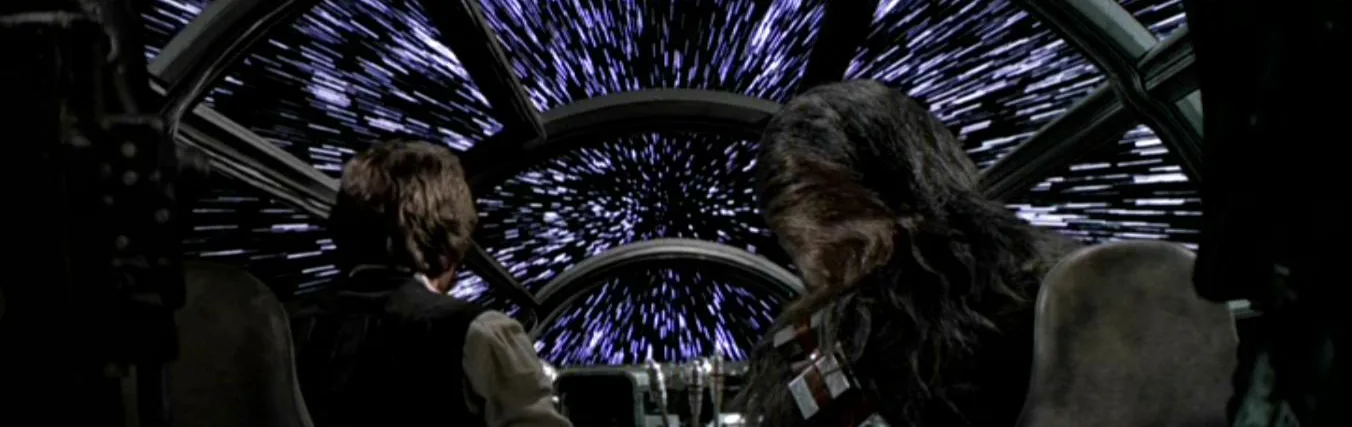
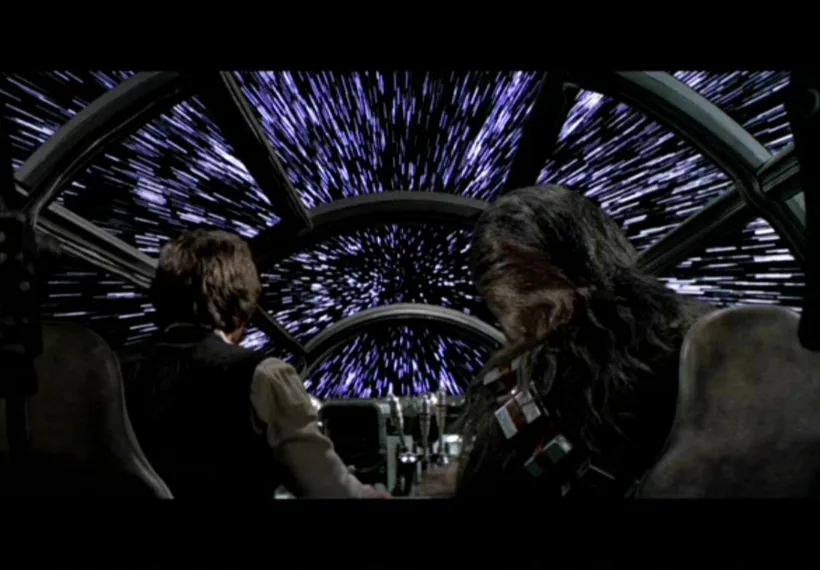
At the speed of light, when they reach hyperspace, which is beautifully displayed at first in Star Wars and then Star Trek copied it, although Star Trek was the first to have the concept of warp speed that I know of on television, not in movies.
Well, it was first in a Buddy Holly song.
So, yeah, if they're actually going at the speed of light by some way that they cheat, time identically stops.
And if time stops, they would not know how to come out of speed of light.
And the way light knows how to stop, it hits something.
It hits something.
Right.
So these spaceships should theoretically be just crashing into stuff and then that's how they ride.
I've never asked how they, now there's a way to travel faster than the speed of light by not actually traveling faster than the speed of light.
And you use the warp drives of Star Trek.
And there's where you're going and where you are.
Space has some fabric to it.
You warp it, you cut a little hole, like a wormhole, travel through the wormhole, come out the other side, unwarp the space and you're where you need it to be during the TV commercial.
So that is not technically beating a beam of light on its own journey.
Right.
You cut a hole and then you just walk through it.
You're legitimately cheating.
And it's not clear to me whether taking that route would stop time for you and I'd have to do the calculations.
It probably wouldn't, because you could travel slowly.
You go like 50 miles an hour as long as you cut space.
Exactly, you can cut it as tight as you want or as loose as you want in 50 miles an hour.
Would be fine.
That would be lame, though, for the Starship Enterprise.
Pretty funny if it was just a guy walking through folded space using all the energy of all the known stars.
Or a guy on a tricycle, yeah.
Yes, on a tricycle going to new worlds.
Okay, here's another question.
Mark Hawkinson, ooh, I think he had a question earlier.
This guy's lucky.
While it isn't canon confirmed, there have been theories about the flux capacitor in Back to the Future.
Captured tachyon particles and created a field of them around the car at 88 miles per hour.
Should we discover tachyons would creating a field to time travel be possible?
We don't know if tachyons would actually be able to actually have fields.
So if they're neutral, there is no field.
But if there is a field, I think he, what's funny is he's not just asking if time travel is possible, he's asking if the flux capacitor would specifically work, which is a very funny way to limit, like it's like we know how to time travel.
Don't ask me about that, ask me about, right.
So we're talking about Back to the Future, of course, and 1985 film.
And so it's not obvious to me that tachyons would have any particular field at all.
That word we invented, we people around when this early 1970s, that was invented to describe anything that traveled faster than light.
And so the field theory of things that are traveling faster than light would be fascinating.
But it's not obvious that those fields would be fundamentally different from fields on the other side of the speed of light.
It's just not obvious.
So I'm not prepared to say, wrap your vessel in tachyons, have it interact with your flux capacitor.
And like in Snow White and the Seven Dwarfs, the tachyons will float your car over into the past, right?
So I just can't feel that.
But it's a fun idea though.
Great for a science fiction story yet to be written.
We are listening to StarTalk, Kaz McQuarrie is back in a moment.
StarTalk, the Cosmic Queries edition.
Your personal astrophysicist here, Neil deGrasse Tyson, with the one, the only, Eugene Mirman.
Hello.
So, you're reading me questions about-
I am, science fiction.
Science fiction, so give me more.
So, Tom Giacinto asks, my favorite debate with my friends is the static 12 monkeys versus variable back to the future concepts of time travel.
Which do you subscribe to and why?
Yeah, if I remember correctly, the 12 monkeys scenario was one where you can't change what you know already happened in the past, even if you go back in the past to attempt it.
So, that could be quite frustrating.
It means you kind of-
Meaning you would go back and kill Stalin, but nothing would happen.
No, it depends on when you killed him, right?
You'd kill him when he was a little baby.
Right.
That's when you kill anybody.
So, in one scenario, you can't do that because forces would prevent you from accomplishing this.
What kind of forces, like a Dyson sphere?
No, I'll give you an example.
In the original Time Machine by HG.
Wells, you remember he had a girlfriend or some lady friend of his who died by getting hit by a bus and then he said, oh, that's bad.
Let me prevent her from crossing the street.
And so, she doesn't cross the street at the time the bus goes, and then she gets mugged and killed from a mugging, and then she prevents the mugging and then something else killed.
She dies in every scenario.
Yeah.
And so-
That doesn't sound realistic.
Well, he's saying maybe there are certain fundamental truths about a past that are already embedded in place, but I have an observation of this.
The very fact that she didn't cross the street is a different past.
Yeah.
Just because she died in five different ways.
She's doomed to die, but so is everybody.
Yeah, she dies, but why say that death is something that's constant, but not the fact that she stepped in dog poo?
Her death is no less of an event in a history of time as anything else that she does.
So it's rather artificial to sift it for events we care about, her death, and say that's what's constant.
When she didn't get hit by the bus, the bus driver didn't hit anybody, how about in the life of the driver?
Yeah, he's thrilled he didn't kill somebody.
He didn't kill somebody in that new universe, the mugger killed her.
So those universes are fundamentally different without specific reference to your loved one's death.
So which one do I subscribe to?
I like changing the past.
I had to pick one.
Next question.
Okay, Andrew Thomas Kellogg asks, would travel to parallel dimensions be anything like it is conveyed in sci-fi, sliders or Star Trek, for example?
Yeah, would it be parallel universes with like a few things off where you're like, Hitler has a silly hat?
Yeah, interesting thing about this whole slider concept is while you're moving into a higher dimension and then returning, you disappear entirely.
It's like the ant stuck in a page where if it's a prisoner of the page and then I want to move it to another place in the page, I pick up his friend, move the friend into the third dimension where I live, and then the other ant says, whoa, what happened to my friend?
She disappeared.
And then you put her back into the page and then she appears out of nowhere.
She's just fine.
She just had a view of the third dimension.
Oh, I see.
So what would it be like in those worlds?
Would they have a lot of the same historical events that we had, but all slightly different?
I think we would be taken from this dimension and then put on a different piece of paper.
Or we'd be put on a-
Oh, yeah, fine, fine.
The journey through those would be awesome.
Just imagine how your brain would react to hyperdimensional things.
So once you put back in, oh sure, it's just another place.
And if you have access to the time dimension as well as space dimension, I can pluck you out from the now and put you 30 years ago or 10 years ago.
Oh, that'd be so fun.
I wouldn't love to be in Mad Men, except for most people.
Except for anyone who's female, or any non-smoker.
Yes, exactly.
Okay, Nicholas Garrett Nepple-Kline asks, are there any known ways something such as a lightsaber could be made with technology as it is now?
Light itself is non-material.
So even if you reflected it back and forth quite a bit.
It wouldn't cut people in half.
Well, unless it was, okay, you can imagine a really intense laser, but here's the thing.
Yes, it could cut things, but when it hit another lightsaber, they would just pass through one another.
They wouldn't block like two swords would.
So sure, you can imagine a lightsaber that would cut things the way a laser would, but two lasers cross each other without any incident at all.
So the best defense against a lightsaber is mirror gloves.
Mirror gloves and a lightsaber, I'm on it.
A mirror would so work for that, I think.
So lightsabers are possible, but they wouldn't clink against each other.
They're not out of the reach of known laws of physics.
You have to stretch a little, but they wouldn't be like swashbucklers.
Couldn't pull that off.
But it would be an awesome, threatening thing that would cut things in half.
Yeah, but we already have that, and then there are lasers.
Yeah, but not in a sword.
And we have automatic weapons, right?
Yeah, but not a laser sword.
No, a laser sword, you have to actually be next to the person to kill them.
Okay, whereas we have weapons that do better than that, all right, that can kill you 300 yards away.
So...
You are not gonna convince me that I don't want a laser sword, and you are not gonna convince people listening they don't want a laser sword.
StarTalk Radio Cosmic Queries Edition, and we'll be back in a moment.
We're back, StarTalk After Hours, the Cosmic Queries edition on...
Science fiction.
Science fiction, that's the voice.
And the possibility of some things.
The voice of Eugene Mirman.
Eugene, when we left off, you kept trying to say you want a lightsaber.
I'm saying, at some level, I'm not impressed with a lightsaber, because I can just shoot you from 300 yards away.
Yeah, but you're limiting the point of a lightsaber to battle.
You're not saying like, oh, I'm camping, I wish I had a lightsaber to gather wood, or to open a can of tuna, or yeah, cut things up.
I'm just saying, I don't, you know, it's like-
We have knives.
I wanna kill that guy, so I'm gonna walk right up to him within his arm's reach and then try to kill him.
Yeah, but what if it could replace steak knives?
Don't tell me you wouldn't really love grilling and cooking and eating out.
Bow and arrow is more effective than a lightsaber.
I'm sorry.
To murder things at a distance, but not to cut a piece of meat.
Right, yeah, bow and arrow can't cut a piece of meat.
Or open cans, you're right.
Open a can of beans in space.
We are in the lightning round, okay?
I got my bell, we'll test it.
All right, we're gonna get soundbite answers because we never have enough time to get to all the questions, but we're gonna get to as many as we can now.
Ready, go.
Edis Turali asks, would being beamed up to different locations from Star Trek's Beam Me Up, Scotty, be plausible in the future?
We so want that to happen.
And what I recommend, there's a book called The Physics of Star Trek written by my friend and colleague, Lawrence Krauss.
He's a former guest on StarTalk.
He speaks at length about the Star Trek transporter.
We can teleport light though, can't we?
The point is, you need the information about who you are.
So just fax it over and then reassemble you over there.
But the question remains, are you still you?
Next.
You would have to shoot yourself.
Joe Walker asks, can you explain the application, feasibility, engineering, logistics, and just overall coolness of a Dyson Sphere as shown in Star Trek Next Generation episode, Relics?
Dyson spheres, if you want energy, what are we doing now?
We're digging it out from under each other's feet and killing each other for it.
Which we enjoy.
Meanwhile, there are hurricanes, tornadoes, earthquakes, that's energy that's trying to kill us.
One day we might be able to harness that.
But that's still-
A machine that eats tornadoes and gives us light bulbs.
Exactly, or draws the energy from earthquakes.
But there's another source of energy out there, the sun.
Why not snare every photon that comes from it?
Right now we only intersect the cross-section of Earth in the huge sphere at Earth's orbit.
Why not create a sphere at Earth's orbit and put solar detectors everywhere on its inner surface and snatch every photon from the sun?
That's a Dyson sphere, and we would be awesome energetic species if we did it.
We don't know how to do it just yet, but there's nothing.
Do we not know how to do it?
There's nothing preventing us in principle.
That's great.
There's no law of physics, even though it's very distant from an engineering standpoint.
Next.
Go.
Matt Wilson asks, in the Asimov.
Mount Wilson?
Matt Wilson.
That is a place in California.
Oh.
Yeah, okay.
Great, well that place wants to know this one thing.
In the Asimov Classic Foundation series, the home planet of the Galactic Empire, Trantor, is essentially one city, as in the city covers the entire planet.
What would be the effects on the atmosphere and weather patterns were something like that to exist without bodies of water?
I imagine the planet would not be habitable no matter how modern the city.
No, if you made a city that covered the entire planet and you knew how to do that, then you just control your own damn weather.
I mean, you have geoengineering.
Right, right, if you could do that, you've solved the problems he thinks are problems.
Exactly, which is my Greek big gripe.
Matt, silly man.
No, which is my big gripe about people saying, we're going to destroy the earth, we have to move to another planet.
But first, we have to terraform the other planet.
And I'm saying, if you could terraform the other planet and turn it into a planet that you can live on, then do the same thing here on earth, and then you don't have to leave it in the first place.
We could terraform countries we don't really care about.
Next, go.
Guillermo Mura asks.
Guillermo.
Yeah, Guillermo.
Guillermo.
William, it's William in Italian.
Oh, okay, well, then why not just write William Mura?
Okay, all right, go.
Isaac Asimov's, Jesus, everybody loves this Asimov character.
Isaac Asimov's foundation.
What does Jesus have to do with they loving?
It's an exclamation.
From slang.
Go.
Isaac Asimov's foundation.
There is a device that can turn any metal into gold.
Is there anything closely resembling this in the present?
Can materials change their properties and become something else by machinery?
There's something called modern alchemy and we do it every day in a particle accelerator.
You can take particles, slam them together, make bigger ones, take big particles, slam other things into them, break them apart.
So you can literally-
Can we turn like silver into wine?
You can.
The only thing that would really be lead into wine.
That would be a little harder.
You need to make the carbon and the hydrogen and the oxygen from your silver.
But you can turn one kind of atom into another.
You can turn lead into gold.
You can turn gold into lead in a properly designed particle accelerator.
The problem is.
That sounds unnecessary.
Unnecessary.
The problem is the energy to turn lead into gold is greater.
The cost of that is greater than just going down to the corner store and buying gold on your own.
Next.
Well, in a few years, maybe in three years.
I guess the price is coming down on turning lead into gold.
So it's really an issue of energy.
Once we have the energy, we'll have all the gold we need.
Right, and then the price of gold, then it wouldn't be valuable enough to even do it in the first place except for industrial needs.
Right, okay, go on.
Next, quick.
Okay, Kevin Conmey.
Okay, Minority Report had a bevy of technologies that seemed entirely plausible.
Many of them have come into existence in some limited form in the 11 years since the movie's release.
Memphis, Tennessee is using an IBM program named Blue Crush, criminal-reducing, utilizing statistical history to predict crime.
What other movies got it right in terms of theories or technologies?
Ooh, you know what, well, okay.
Star Trek created iTunes.
You know, Star Trek predicted doors that open automatically when you walk up to them.
Yeah.
No, there's no, that question is an entire episode of StarTalk unto itself.
Yes, we will get into that next time.
We've gotta end.
This has been StarTalk.
Oh, this has been StarTalk, the Cosmic Queries edition, funded in part by a grant from the National Science Foundation.
I'm Neil deGrasse Tyson, Eugene Mirman, thanks for chilling with me.
We'll see you next time.
As always, keep looking up.
See the full transcript



 Unlock with Patreon

 Become a Patron