



 Unlock with Patreon
About This Episode
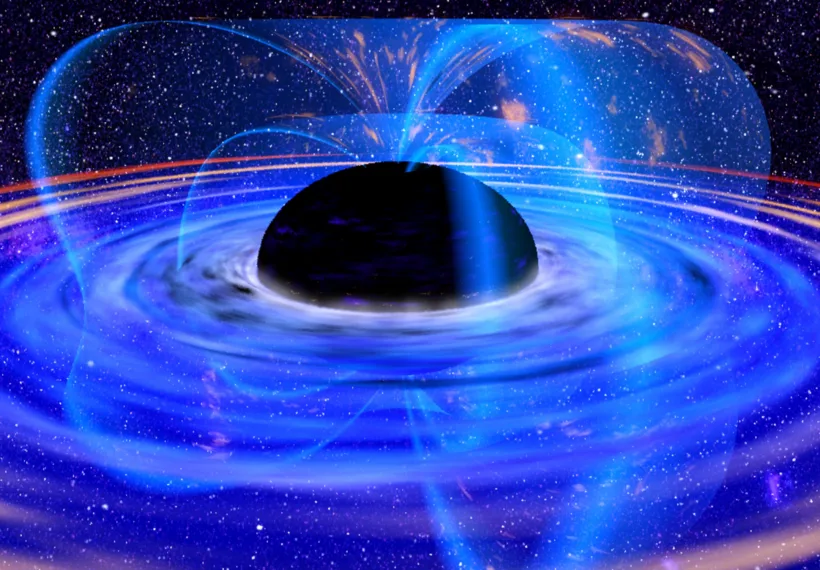
What is the black hole information paradox? On this episode, Neil deGrasse Tyson and comic co-host Chuck Nice explore the Higgs Boson, quantum entanglement, and black holes with particle physicist Brian Cox.
Is mass actually a property of matter? Find out about matter’s interactions with the Higgs Field, the ATLAS Experiment at CERN, and what would happen if the Higgs Field malfunctioned. Discover the quantum field: What would it look like in the early universe? What would happen if light had mass?
If nothing can travel faster than the speed of light, how does the universe’s expansion travel faster? Or entangled particles? Learn about the speed of information and how quantum entanglement works. Could you send a signal across the universe using entanglement? Find out about wormholes, quantum computing, and using entanglement for encryption.
We explore the black hole information paradox and the entanglement within a black hole. What happens when a black hole evaporates? Are there wormholes? We discuss the work behind finding fundamental problems in the universe and what physicists do when they’re wrong. How small is a Planck length? All that, plus, we learn that sometimes… Math is hard!
Thanks to our Patrons Detlef Van de Wal, Devon Gogel, Jay Salmon, Jacek Kono, Jordan Hume, Brynjar, M J, and Yoni Liberman for supporting us this week.
NOTE: StarTalk+ Patrons can watch or listen to this entire episode commercial-free.
About the prints that flank Neil in this video:
“Black Swan” & “White Swan” limited edition serigraph prints by Coast Salish artist Jane Kwatleematt Marston. For more information about this artist and her work, visit Inuit Gallery of Vancouver.
Transcript
DOWNLOAD SRTWelcome to StarTalk, your place in the universe where science and pop culture collide.
StarTalk begins right now.
This is StarTalk, Cosmic Queries edition.
Neil deGrasse Tyson here, your personal astrophysicist.
Got with me, Chuck Nice.
Hey, Neil.
You’re the man for Cosmic Queries, you know this.
I hope I’m the man for something.
People love hearing you mispronounce their name.
What can I say?
I have to tell them it’s not on purpose and they don’t believe it.
They think you’re better than that and then you’re just messing with them.
Well, listen, I appreciate your raised expectation.
And much like my parents, you will find that I will not meet those expectations.
Every comedian says that about their parents, I’m sure.
Oh, God, yes.
So, Chuck, you know, we had Brian Cox on for Cosmic Queries and people went ape over that.
Super popular.
How are you doing, Brian?
Very well, thank you.
And I, well, Chuck can’t pronounce my name wrong, can he?
That surely, I’ve got the short possible.
It’s still true.
However, Brian could happen.
I’ll go with that, Sandra.
Exotic, isn’t it?
So, let me remind people, Brian Cox is a theoretical particle physicist in the UK and he has a huge public following, having hosted many programs on BBC.
I forgot all the names because they blend together.
Is it like the Solar System Universe?
One is the Solar System, one is the Universe.
And then, as you know, you ran out of titles, so then we did the Universe and the Planet.
And then we’ve run out now.
I don’t know what to do next.
Maybe the next show should just be like, look, it’s me, Brian.
That’s all we’re talking about.
Come on, you already know.
It’s me, Brian.
Cosmos.
Yeah, right.
You can’t use Cosmos.
Right, right.
But I think between Brian in the physical Universe and who’s everyone’s favorite grandpa in the UK who hosts the shows, all the naturalists…
Excuse me, Sir David.
Oh, that’s right.
Indeed.
Indeed.
As we look upon the frozen tundra, we see here the majestic bobbin as it makes its way.
That’s good, Chuck.
Everybody loves Sir David Attenborough.
Yeah, so the two of you basically split the natural and the physical Universe in your public presentations of it, and it delights everyone.
But I happen to have you on the show specifically for your expertise in cosmology and in relativity, black holes, big bang, particle physics, because this goes beyond where I have total control over what I know.
It’s a hell of a lot harder than capuchin monkeys, okay?
Take that, Sir David.
I would say one of the simplest things from the outside, anyway, is a black hole.
It’s a very, very simple equation that describes it.
Whereas a monkey is a very complicated thing.
No one will ever understand the monkey.
Black holes will throw their shit at you.
There you go.
Or rip your face off while you’re looking at it.
So Chuck, we’ve solicited questions from our fan base.
And I’m delighted about this overlap.
I mean, Brian and I are just trying to bring the universe down to Earth to whoever is going to listen.
And we’ll just keep at it, you know, until, you know, for all our natural days.
So Chuck, give it to me.
What do you have?
All right.
This is Jennifer Gildea or Gildea.
She says, hello, Dr.
Cox, Dr.
Tyson and Dr.
Lotsa laughs.
A question from my son Colin.
Dr.
Cox, can you tell us more about the theorized near-destruction of Earth and what stopped this catastrophe just after the Big Bang?
And could such a disaster ever be caused by the Higgs particle in the future?
Is there any way to detect when or if such an event might occur?
Now, there are many things mixed in that soup right there, and many of them are way, way apart on a timeline, but there you have it.
Well, let me tighten that a little.
Yeah, go ahead.
Does the Higgs boson delighted that it got discovered at CERN or weren’t you affiliated with CERN?
Is that right?
You had an appointment there?
Yes, it’s on the Atlas experiment.
Beautiful, and in fact, there’s a fun rap video that describes the experiments that are conducted at this European organization for nuclear research, and they describe the Atlas experiment.
In this rap video, it’s great.
You’ve seen it, I’m sure, Brian.
It’s a huge camera, basically, so it’s one of the big detectors that observes these high-energy particle collisions that the Large Hadron Collider generates.
And those are the questions.
The one way to think about it is that it recreates the conditions that were present less than a billionth of a second after the Big Bang.
Yeah, so what’s interesting is you can create something even though we weren’t there for it.
We can simulate it, not just on a computer, but in real life.
So this Higgs particle– just give us a minute on the Higgs particle and the Higgs field, and then I’ll come through the back door into that question.
So the Higgs particle was theorized actually back in the 1960s.
It’s a remarkable story because it was a mathematical way of giving the fundamental building blocks of the universe mass.
So for the electron, for example, or the quarks that build up protons and neutrons.
So at a fundamental level, it was difficult to write down mathematical equations that describe nature as we see it without doing something rather clever.
You can’t just stick the masses of the particles in.
And remember, the mass of the electron was known since 1897.
So we know this thing has mass.
But it was very difficult.
And so…
Wait, wait, wait, Brian.
Wait, just a moment.
It’s already a big step to think to ourselves that the mass comes from something, right?
Isn’t just the mass a property of matter?
And now you’re telling me it’s not a property of matter.
It’s a property of something else handed to the matter.
Yeah, it comes in this picture, which, as you said, has now been shown to be correct, right?
Because we discovered the Higgs particle.
The mass, the most fundamental level, comes from the interaction of these things, these particles, with the Higgs field.
We call it a field, so you can imagine it as something that fills the universe.
And so, I mean, you get mass from all sorts of things.
So most of the mass actually doesn’t come from that.
Most of it just comes from…
It’s really through Einstein’s equation equals mc squared.
So energy equals mass, and mass equals energy.
And so you can get mass by just things sticking together.
So most of the mass of the proton, for example, which is one of the building blocks of the nucleus, comes from the quarks sticking together inside the proton.
But at the most fundamental level, yes, the particles, the building blocks like quarks and electrons have mass, and that comes from their interaction with the Higgs field.
There’s a kind of picture that people use, which is one of those– it’s a bit hand wavy, but it’s a reasonable picture.
Imagine pulling some things through, you know, what do you call it, treacle or syrup?
I never know which way to call it in the US.
Is it treacle?
Maple syrup.
Syrup, yeah.
Yeah, I was going to say that nobody has ever said, would you care for some pancakes and treacle?
Treacle?
I have no idea what that is.
Everyone will know, but I’ve been giving these talks around the country, these lectures, and I know things like, I know that an object in the mass of the sun, if you squash it down to three kilometers in radius, then you get a black hole.
It’s called the Schwarzschild radius.
I don’t really know it in miles, and so I have to multiply everything by 0.6 in my head.
So I know all these numbers.
Dude, you guys handed us miles, all right?
Don’t put blame on us.
That came from your people, your kindred souls of generations gone by.
And then you try to confuse us later on.
Anyway, if you have something move through maple syrup, then it sort of slows down, it acquires a kind of momentum-like quality to it.
And that’s one of the ways that people describe the Higgs field.
It’s not the best description, but what we’re saying is that we now know that at the most fundamental level, little points, the smallest particles we know of, acquire mass through an interaction with this thing called the Higgs field.
And the point is that it wasn’t doing that very early on in the history of the Universe.
Then as the Universe cooled down, just after the Big Bang, then the Higgs field kind of flipped, and this property of it switched on.
So things acquire mass at some point.
Is it possible, could something happen in the Universe, getting back to the person’s question, could something happen in the Universe where the Higgs field malfunctions and the masses get confused and Earth dies?
Somewhere in there, there was the end of the Earth multiple times.
Earth’s going to die before that could possibly happen, right?
So you can relax, you’re going to die for other reasons.
Relax, yeah, exactly.
You’re going to die for ten other reasons.
There you go, Jennifer, take up smoking.
Yeah, but even the solar system is going to be a real mess, right?
But before the sun is going to, as you know, it’s going to start swelling up in about a billion years, isn’t it?
And then I think, you know, ultimately, it’ll be a red giant, it’ll be a mess.
I don’t think it will quite engulf the Earth, but it can get really…
Not quite, but it’ll totally, it’ll totally torch us, yes.
So that’s good, so relax.
I mean, half of the horizon will be the sun when it rises.
Just imagine that, right?
That’s how big it will be in the sky.
And yeah, yeah.
As the oceans come to a boil and they evaporate and you lose the atmosphere.
So yeah, and we’re putting it at about 6 billion, 5 to 6 billion years.
But beginning back to this person’s point, is there a scenario where the end of the Earth would come about for some particle physics reason rather than from an astrophysical reason?
I know is the basic answer.
The thing to say about the Higgs field, so you can picture it as a kind of a valley.
Imagine a high valley and then a lower valley.
So if you had a little something rolling around in a valley that was high up and it rolled around just the right way, it could flip out of that valley, roll down the hill into the lower valley.
And the Higgs field looks a bit like that.
So over the very, very, very, very immensely long times, it is possible, yes, that the Higgs field will change character, will change…
As it did in the early universe.
That would change the laws of physics that we see.
So really we would completely reconfigure the universe if that happened.
And Chuck, reconfigure is euphemism for completely destroy.
Right, Brian, in the hood, they say, let me reconfigure your face.
And it is interesting, actually, that the…
So there’s another element to these predictions, which is called the top quark, which is the heaviest fundamental particle that we discovered.
And the mass of that is intimately related to these predictions.
And they are kind of on the edge of stability.
But I just want to reassure people, by edge of stability, people are talking about trillions of years…
If you imagine the half-life of a radioactive atom, a nucleus, right?
You know, the uranium or something, and it takes billions of years for half of these things to decay.
It’s like that.
So you’re talking trillions of years before you have a chance that this thing sort of reconfigures.
That’s basically the point.
So it’s not something that some people should worry about, which is why I say that, you know, no, that’s not going to destroy the Earth because it’s not going to happen on time scales to that length.
What’s interesting to me, if in trillions of years the universe reconfigures, it could reconfigure to a whole other combination of laws of physics, right?
Yeah, you’re saying things like you’re changing the mass, the electron, for example.
You might, the photon, part of light may not be massless.
If you change the character of Higgs field, it could give light mass rather than the W and Z bosons, which is to do with, if you’re a student, you’ll know radioactive beta decay, it’s there to do with that.
So then light would be making a schlep, then, a schlep across the universe if it wasn’t massless.
By the time we get here, be like, Jesus, I’m so tired.
It’s inconceivable.
We can’t conceive of the universe with massive, where particles of light are massive and electrons are different mass.
The possibilities appear to be endless.
I should say this is right at the edge of our knowledge, so we don’t really know, but it’s interesting.
So yes, the point is that basically we do have theoretical scenarios where the Higgs field can change and change character, and that would change the things that we call the laws of physics.
Wow.
And would have consequences vastly greater than just the destruction of the Earth.
That’s pretty cool.
Or rather the reconfiguration.
The reconfiguration.
I’m sorry, people, Earth is now going to be a vacation spot for another dimension.
Rearrange the deck chair.
We got to take a quick break.
When we come back, yeah, I know, that went quickly, but we learned all about Higgs bosons and a little bit of the history of it.
When we come back more with my friend and colleague from across the pond, Brian Cox.
So we’ll be right back with Cosmic Queries.
Hi, I’m Chris Cohen from Hallworth, New Jersey, and I support StarTalk on Patreon.
Please enjoy this episode of StarTalk Radio with your and my favorite personal astrophysicist, Neil deGrasse Tyson.
We’re back, Cosmic Queries.
Of course, I got Chuck Nice on this.
And I have to call him a special guest, Brian Cox.
You know, we don’t get him often.
Brian Cox, a friend and colleague and a physicist extraordinaire.
Now, we just spent the whole first of three segments talking about destroying Earth with the Higgs boson.
So, Brian, my favorite analog for the Higgs field, did I tell you this?
It’s– if I’m in LA, I refer to– the Higgs field is like a party field in Los Angeles, okay?
So, you go into a party, and nobody knows who you are, and you have to get to the bar, which is at the other side of the huge room.
And you could just walk there and get there pretty quickly.
But Beyonce enters, and people crowd around her, and she can only move much more slowly to the bar.
So, she has a much higher party mass than someone that nobody’s ever heard of in Los Angeles.
So, is that an exact mathematical animal?
It’s the interaction that causes the mass, delivers them.
Correct.
And it’s different from your molasses, because your molasses probably has sort of the same formula for the force on it.
Maybe that’s also true for the Higgs boson.
I don’t know.
But the V-squared resistance to motion, like air resistance, right?
But here, in the party field, you’re right.
They’re one-on-one interactions that completely define everything about it.
And who gets to the bar faster?
So, Beyonce never gets to the bar.
That’s how that works.
And that is why, based on my career, I am drunk.
Because you got to the bar real fast.
I can’t even get away from the bar.
It’s like I couldn’t get to the bar fast enough.
Who’s that guy?
Nobody knows.
So, give me another one.
What’s the next question you got for us?
Elaine Bredeaux says, Hey guys, Elaine here from Montreal, Canada.
Why do we say that nothing can travel faster than light when the universe is expanding faster than light and entangled particles communicate with each other faster than light?
And also, why we say that a black hole is so dense that even light can escape it?
Well, it makes it sound as if there is actually light inside the black hole trying to get out.
But to me, if a star gets spaghettified and reduced to a stream of atoms while entering the black hole, there is no fire in that light going on.
Only atoms!
Am I right?
So there, Brian!
Well, let’s take the one which Neil can talk about as well.
Let’s take the easy bits first.
So, yes, so often we describe space-time as the fabric of the universe.
The title of Brian Greene’s great book, The Fabric of the Universe, and indeed light travels at the speed of light over that thing, that surface, that fabric, and nothing travels faster than it.
And that’s really built into the geometry itself, and it allows the universe to respect cause and effect to all sorts of things, right?
So it’s absolutely fundamental.
And actually, we should say, going back to the previous question, it’s massless particles that travel at the speed of light.
Light happens to be massless, because it doesn’t interact with the Higgs field, going back to the previous thing.
So light is not the special thing.
It’s actually things without mass, right?
But the expansion of the universe, you can picture, you really can picture it like a sheet.
Well, it’s often described as a rubber sheet, just a stretchy kind of sheet.
And it stretches.
And so the distance between two points increases over time.
If you just stretch any old thing at a constant rate, but it’s very big, then if you have very distant points, then they recede from each other very quickly.
And indeed, no matter what the expansion rate is, you can get so far apart that these things will be receding from each other faster than light.
But it’s not that they’re moving, they’re not moving through the universe faster than light.
It’s the universe is just stretching rather sedately.
So if the universe is a medium, then they’re not traveling through the medium.
The medium itself is doing the moving, and they’re just kind of sitting there along for the ride?
Yes, yes.
They literally ride along with the stretch of the universe.
It’s called a co-moving volume and all sorts of things.
But just to be clear, astrophysically, they could be moving on their own.
They could be orbiting other galaxies.
They could have their own motion.
But that motion itself is in the fabric of the universe.
And the expansion of the universe is a level above that.
So, for example, Andromeda, the galaxy is coming towards us because it’s close enough that the gravitational interaction between the Milky Way and Andromeda completely overwhelms the stretch.
But if you go out to large enough distances, then the stretch wins and everything flies apart from everything else.
But Neil said that they can be absolutely stationary in the fabric of the universe.
I mean, you’ve got to be careful.
These are models, right?
And these are pictures.
If you look at what Einstein’s equations tell you, they just tell you you’ve got points and you can define some distance between them and you can see how that distance changes.
And that’s it, really.
But yes, that’s the point.
There’s nothing strange about the fact that things can recede from each other faster than the speed of light.
That just is a property of something that just stretches with things in it.
Well, keep going.
There are more things in this list.
Because I think the questioner has a point where here we are saying speed of light is the limit and now we’re saying, no, space can stretch faster than the speed of light.
We have quantum entanglement, which moves faster than light, and tunneling is faster than light.
All of this.
So maybe we should stop saying nothing moves faster than light.
You can certainly say that information doesn’t travel faster than the speed of light between two places or two events, whatever you want to call them.
Quantum entanglement is a great thing.
For those of you that don’t know what it is, it’s…
Yeah, give us a minute on that.
Can you imagine, I always describe it in terms of quantum coins, right?
So you can have these…
You have a quantum coin, which is heads 50% of the time when you look at it and tails 50% of the time when you look at it.
But the key weird thing about quantum mechanics is that it will not be heads or tails until you look at it.
And we can have a huge philosophical discussion about what that means and there’s a whole literature on it, but just that’s the way that nature behaves, right?
So the coin can be both heads.
By the way, just to be clear, Brian, just because we don’t want to mislead people here, it has nothing to do with your eye-brain connection.
It’s not that you look at it, it’s that if you make a measurement of it, no matter what’s making the measurement.
100% correct.
It’s very, very important.
There’s nothing to do with your consciousness or anything else.
But it’s an entangled state of two quantum coins.
And I do this to my live show, actually.
I write it down.
You can have a pair of quantum coins, and they can be in the state heads-tails plus tails-heads.
Heads-tails plus tails-heads.
So that’s what they are.
If you look at them with the caveat you said, then they could be heads-tails or tails-heads.
Never heads-heads or tails-tails.
So they’re always all those things.
They’re always heads-and-tails.
But then in the so-called Copenhagen interpretation of quantum mechanics, if you look at them, they will then become…
If you look at them with the caveat Neil said, you’ve got to be careful with language, then they will be in one or other of those configurations.
The key thing of entanglement is you can separate those callings then, but they’re still in that entangled state.
You’re very careful about it.
And we’ve done this.
Quantum computers work like this, right?
So you separate them.
They’re still in that entangled state.
And then as the questioner said, it is true.
You then make an observation of one of them.
Even if it’s a billion light years away, the other ones then tails.
Because that was the state it was set up.
If that one’s heads, that one’s tails.
If that one’s tails, that one’s heads.
So that’s quantum entanglement in a nutshell.
And it is indeed, Einstein called it spooky action at a distance.
He didn’t like it at all.
So there is.
However, however, the really important thing to say is you can’t signal using that process.
Even though you might intuitively think I could send Morse code or something, I could send dots and dashes, I could say yes or no.
Immediately across the universe, I could answer a question, yes or no.
You can’t with that.
It’s really built into the structure of the theory.
So even if you might think that the spirit of relativity is being broken, the letter of the law is not, because information doesn’t travel faster than speed of light in that sense.
So what about all this talk about the future of entanglement possibly being the foundation for encryption?
Oh, yeah.
So this is often described.
If you think about that entangled system, it’s a very rich system.
It’s much richer than just two bits.
They call qubits these things.
You gave the simplest possible case.
Yeah, yeah, and so generally you can entangle things, photons, for example, or electrons.
You can entangle them.
And the point is that the structure, the information potentially you like is much richer.
It’s often entanglements in quantum computing is called an information resource, right?
So you’re right.
So you can do things with this.
You can build very powerful computers.
They’re very good at certain things at the moment, one of which is breaking encryption.
They’re extremely good at factorizing large numbers, which is what our banking is built on.
So yes, they are part of our technology now.
This property of the universe is part of our technology.
Oh, by the way, Chuck, do you know who has the world record for most distant entangled particles in the world?
No.
Someone asked me that the other day, and I didn’t know what the distance is.
Oh, so they’ve done it from Earth to orbit.
China did it.
So it’s the Earth orbit distance, and they’ve also done it in fiber optics, which I think is harder, right?
Because it’s not just open air, so to speak, and there could be more ways to break the entanglement and preventing the great distances.
So, unless I saw this 50 kilometers entangled via fiber optics, which means this could work across a city scale, for example.
That’s amazing.
It’s a very good question, because how difficult it is to understand, really fundamentally.
There’s Lennard Susskind, who’s one of the great black hole theorists, a great theoretical physicist, who wrote, by the way, a brilliant book called The Theoretical Minimum.
He did really interesting quantum mechanics, and you really want to get down into it.
His book, The Theoretical Minimum and Quantum Mechanics, is superb.
Isn’t he the guy who’s like a big exponent of the holographic universe?
He invented that, really, with Gerald O’Toole.
He came up with a theory, which he works on, called ER equals EPR.
EPR is really this entanglement.
Einstein, Podolsky and Rosen.
In the 30s, I think it was, Einstein, with these two colleagues, did a lot of work on entanglement, really trying to understand it and see what it meant for reality.
ER is Einstein-Rosen, which is wormholes.
So there is a picture of quantum entanglement, which has come to the surface in trying to understand black holes, that you can picture these things being separated by, as I said, light years, these quantum coins or whatever you want to call them, being linked with the wormhole, which links them together.
And so that’s a very kind of cutting edge, advanced way of looking at it, which is not altogether widely accepted, but a mainstream in the study of black holes and how information gets out of black holes.
Well, but at least that feels better than this happening in the middle of empty space, right?
I mean, if you connect it with a wormhole, however exotic that is, I can feel that, all right?
I’m with you on that, all right?
And then the structure of the universe is all connected by wormholes pairing up entangled entities.
What we’re looking at is something called emergent space time, which is very cutting edge.
Sean Carroll, actually, you will know, wrote a good book on this.
Sean called a physicist at Caltech.
So this idea is that space time emerges from quantum entanglement.
So I think it’s true today.
The general view now in the other cutting edge is that entanglement and space and time are intimately linked.
And we’re beginning…
So you’re losing me on…
I don’t want to take up the show because now I’m lost on the…
I am lost on this entanglement, entanglement and the black holes because you’re talking about…
What she says in the question here is you’re talking about spaghettification, reduced to a stream of atoms, and then you were talking about the information coming out.
So maybe I’m too sci-fi in this reconstruction of this information.
How do you do that without losing all the information?
If you come down to the atoms themselves get broken apart, I don’t understand how that would actually…
that entanglement would then be anything on the side of reconstitution.
What would it be?
It would just be a big mess.
It’s a brilliant question.
Oh my God, it is?
See?
Chuck is about to pop right there.
Okay, no, I’m just saying, don’t be afraid not to know what the f*** people are talking about because you might end up asking a brilliant question.
Brian, we’ve got to take a break.
When we come back, we’ll pick up and see if all of Chuck’s gaskets were blown.
Alright, we’ll be right back with Cosmic Queries with Brian Cox, just blowing our mind as he can do on StarTalk.
We’re back to the third and final segment of StarTalk, Cosmic Queries, Brian Cox.
Physicists extraordinaire, just helping us decode the universe, one particle at a time.
And Chuck, if you were with us, Chuck blew a gasket at the end there, trying to understand what happens if particles go in a black hole, does the black hole remember what the thing was, and if the information comes out again, does it remember?
And if information is what’s moving through wormholes, given the fabric of the universe, Brian, you’re messing with us here, but keep at it.
It’s called the black hole information paradox.
It’s been around since the 1980s, based on Stephen Hawking’s very famous paper in 1974, which showed that black holes radiate.
Black holes ain’t so black, Stephen said.
They radiate, they glow like holes in the sky.
It’s called Hawking radiation.
And ultimately, because they glow like holes in the sky, and it’s to do, actually, with entanglement, quantum entanglement in the vacuum of space and the event horizon of the black hole.
Anyway, they evaporate.
They’re gone then.
One day they are gone.
And it’s now widely accepted that all the information that fell into the black hole over time, including the star that built it, the whole lot, ends up imprinted, heavily scrambled, as Chuck said, really scrambled up and imprinted in the Hawking radiation that came out.
So if you were, and this is very much in principle, if you were an almost omniscient super being with the world’s the biggest quantum computer you could possibly imagine, and you managed to stick all the Hawking radiation into the quantum computer, then in principle, you could reconstruct what happened over all that time.
So this is gluing back together a shredded document.
It’s a transporter, basically.
In principle, if you burn a book, very 2022, right?
Yeah, don’t get, just get another analogy here, come on, Brian.
In principle, if you could gather everything that came off the book, you could reconstruct the book.
So, and we think fundamentally in physics, physics is deterministic, this is what determinism is.
Information is not destroyed.
It’s scrambled up and imaginably difficult to reconstruct things.
But in fundamentally, in principle, we think that information is conserved in the universe.
Black holes appeared to violate that, because it appeared that stuff that fell in never came out.
And actually, but when you…
All right, now, wait a minute, now, now I got to get, okay, I’m so sorry, man, because I just, I can’t go through without just knowing this, because Neil and I, on a show, we’re doing an explainer.
Give me a second.
We’re talking about black holes, and then we’re talking about virtual particles that appear outside of the black hole.
Is that indeed information from within the black hole?
That’s the thing that we have.
Snap!
Well, I think, Chuck, the way to think about it is it came out of the energy of the gravitational energy that is the field that the black hole makes.
So, it kind of doesn’t matter in that case whether it’s on one side of the event horizon or the other.
Am I right here, Brian?
I mean, it’s just the black hole giving up itself.
Okay, yeah, there are lots of ways to think about it.
I mean, in Stephen’s paper, actually, the 1974 one.
Stephen, Stephen’s paper.
Not Joey’s paper, not Jimmy’s paper.
Stevie Reno’s paper.
He does give this picture, which is that, so the vacuum, empty space is heavily entangled.
And he says this is not, he writes in the introduction, it’s not the best, it’s not an exact picture, but it’s good enough, right?
So you can imagine these particles popping in and out of existence all the time in the vacuum of space, and they’re entangled, right, in and out, in and out, like that.
And if you think on that, when there’s an event horizon of a black hole, you can have this situation where one of them is on the inside and one of them is on the outside.
You shouldn’t think of them crossing the horizon.
You can have this situation where one of them is inside, one of them is outside.
They’re entangled.
The one that’s outside can go away and take energy away from the black hole, as Neil said.
And the one inside, you would think, just stays there, and it eventually goes to the singularity of whatever’s happening.
Wow.
But because the black hole evaporates, and it’s gone one day, then the thing that this was entangled with, the one that went out into the universe, is gone.
So that’s the destruction of information.
And that’s the heart of the information paradox.
So it’s a different way of producing radiation.
If you burn the book, then everything’s in contact with it itself.
You know how the smoke and the ashes are being produced, right?
But it’s different the way that a black hole glows.
Wait, wait, so it’s still entangled with the particle that escaped?
Yeah.
Is the particle inside the event horizon still entangled with the particle that escaped?
Yeah, but then the problem is then the black hole goes.
So the problem, and actually the problem actually comes about halfway through the black hole’s life.
It’s called the page time for the exepers.
But broadly speaking, you can think of it as saying these things are entangled.
I can’t just destroy entanglement because if I do that, I destroy information and in some sense destroy space as well.
It’s often referred to as the glue that holds space together.
But you can’t just erase entanglement.
But then if you’ve got all these Hawking radiation particles emitted for trillions of years that are all entangled with the interior of the black hole, and then the black hole is gone, then you have a problem.
So that’s the black hole information problem.
Okay, but so again, getting back to the point of the speed of light.
These, you’re inventing, or you and partners in crime here, are inventing wormholes as the medium between the two entangled particles.
No, actually, interestingly, historically, yes, Leonard Suskind and others had this picture, this ER equals EPR picture that I described.
But actually, the modern picture is, they’re not being invented, it’s often described as gravity itself.
It seems that Einstein’s theory of general relativity kind of knows more than you give it credit for.
So you get these geometries, these shapes of space-time that are really, they’re emerging from the theories, so you don’t put them in by hand.
Because it sounds like someone’s just fudged it, right, just made up something and gone, oh, let’s just have wormholes all over the place.
That’s really not how it’s happening in the calculations.
People are doing calculations and then it’s beginning to look like there are wormholes backing up this speculative idea that was offered a few decades ago now.
So that’s the way it’s going.
So, you know what blows my mind is the idea that things we just accepted blindly as that’s just how it is.
And when you accept something as how it is, you no longer ask a deeper question.
And you’re just content with all that, it’s curved space because matter curves space, space tells matter how to move.
And we’re done here, on to the next problem.
And you kept thinking about it.
You and your peeps kept thinking.
I mean, it’s not me, I should say it was it was initially.
Take credit.
They’re not here.
Brian, they’re not here.
Just take the credit.
They’re not here.
Who cares?
It’s widely said that, you know, sometimes we tell these stories in physics, don’t we?
We glorify people when we put them on pedestal.
But it is widely said that that Stephen Hawking initially asked this question.
So he really pushed it and said, my calculation from 1974 suggests that black holes destroy information.
And he really pushed it.
And people like Leonard Stuskind and Gerard Tsehuth initially, a prize winner, really pushed back against it.
And that was the beginning of this field in the 80s.
But you’re right.
It’s people just not saying, oh, it doesn’t matter.
It’s a fundamental clash of principle between quantum mechanics and general relativity.
That’s the value in it.
And just to be clear, when scientists disagree, that’s a fun fact, because something’s going to break, something’s going to be discovered, some new data is going to reveal.
Intellectual cage match smackdown.
It’s the most wonderful thing.
I mean, everybody who worked on it from the initial moment, you dream of discovering a fundamental problem with your world.
I was wrong.
There’s something wrong here.
And that’s the difference.
So do you, okay, here’s a question for both of you then.
Do you, as a scientist, think that when someone comes up and disproves something or proves something else, one or the other, that your wrong supposition made that happen?
Is it like everybody gets to take credit?
Or is it because…
Well, I’ll take that first, so I want to get Brian’s reaction to that.
It’s possible to be interesting and wrong, okay, rather than uninteresting and wrong, right?
So the geocentric universe with Earth in the middle, that was interestingly wrong, all right?
They were trying to fit things, and that had a lot of intellectual capital invested in trying to understand it, but it posed the problem that attracted people’s interests.
And so anytime we talk about Copernicus, we also talk about Ptolemy, right?
He’s in the conversation here.
So, Brian, people who you have to stand on their shoulders even to say they’re wrong, that still has huge value, right?
Absolutely.
I mean, as I said, Stephen Hawking initially, he had a bet with, maybe it was John Preskill, who is a very famous quantum information physicist, and a physicist who works on black holes.
They had a bet, a Hawking bet, that information was destroyed in black hole evaporation.
He then conceded after some work by Maldacena, actually, and others.
He conceded– this is the holographic stuff.
You mentioned holography.
You came from holography, this.
So he conceded it and said, I was wrong.
And he was delighted.
He changed his mind.
And the bet was that he had to give John Fresco some encyclopedias.
So they had a bet on encyclopedias.
John, being American, wanted baseball encyclopedias.
And Stephen was going to get cricket encyclopedias.
In the last edition of The Brief History of Time that Stephen added to, there’s a great story at the end where he said he had to give John Fresco the baseball encyclopedia.
And he says in The Brief History of Time, given what we’ve just discussed about the things and the ashes and the smoke and all the information, he said, I should have given them an urn and burned them.
The ashes of the encyclopedia.
There’s an example of, first of all, Stephen Hawking’s great humor because he was extremely funny.
But secondly, it shows how delighted, he was delighted to have to change his mind, you know, after on a position that he’d held for decades, actually.
Oh, yeah.
Yeah.
Very cool.
I would add that reporters writing about scientists and people, there’s this sort of belief out there that we all just want to agree with each other, right?
And don’t want to rock the boat.
They talk about a person’s cherished theories, they don’t want to give it up.
And the best of the scientists would just as soon have a go away if it’s replaced by something amazing.
And let me tell you this, Brian.
If I won a bet that was that fundamental about the operations of the universe, I would have come up with something a little more interesting than encyclopedias.
I’m sorry.
They all engage in ridiculous bets.
The point is, as you said, the reason they do that, but all this community of people do it is because you don’t want to be right.
You just want to understand nature.
You know what?
I say that to my wife every argument we have.
Every argument.
Look, I don’t want to be right.
I just want to understand, okay?
What the hell are you talking about?
What are you talking about?
Well, you can liken yourself to Stephen Hawking and Kip Thorne.
And then come back.
All right, quick, you know, we have like one minute left.
I can’t believe we only did three questions.
I know.
Chuck, let’s see if Brian has soundbites in him.
One more question.
Here’s a great one.
This is George Radier who says, Hello, Dr.
Tyson, Dr.
Cox and Lord Nice, which is greater the number of hypothetical plank-length objects stacked in a six-foot tall human being or the number of six-foot tall humans stacked head to toe in the largest star we’ve ever discovered?
I know that…
There’s definitely the plank-lengths.
No matter…
He didn’t even have to finish that question.
But the number of humans you could possibly stack in the universe, then it wouldn’t be the number of humans because there’s a finite number of plank-lengths in a human and there’s quite possibly an infinite number of humans you could stack in…
Well, in the observable universe, it’s a good question.
Now, that might be…
Yeah, then there’s an edge to it, yeah, in that sense.
So 43 billion light-years out to the horizon, then how many six feet…
What’s 43 billion light-years divided by six feet?
George, I got to tell you, George, if you’re listening, I got to tell you, you did it.
You finally see what it takes to get two scientists to just go off in a tangent.
I mean, my answer would have been, bro, stop smoking so much weed.
That would have been my answer.
And you two are sitting there just like, well, you know, the universe does have an edge, okay?
Well, yes, 43 billion light years, exactly.
So, Brian, take us out with your best attempt to get people to appreciate how small a plank length is.
Take us out with that.
It’s, I haven’t got the numbers on top of my head.
I should know how many plank lengths across the proton.
I do know that.
And I’ve forgotten it.
I’ve forgotten it.
Man, man.
You know what?
You know what?
I forgot too, Brian.
Chuck knew it.
You know what?
It’s just…
Silly little information like that just seems to slip right out on you.
I absolutely know it because I’ve just written…
I’ve written a book on it and I’ve never…
Okay.
That’s awesome.
Okay, but what happened…
Check that means in this show we just drain Brian of all available knowledge and he’s this pile of weeping goo on the other side here and he’s got nothing left, okay?
10 to the minus 35 meters, isn’t it?
Right?
It’s 10 to the minus 35 meters.
That’s.000035 knots.
So, if you wanted a meter, this is about 10 meters, it’d be a million, million plank lengths.
Wow.
10 to the 36.
So, there you go.
Okay.
We’ve got a million, million, million, million, million plank lengths in one meter.
That’s about right.
It’s about one and a half there, whatever, something like that.
Once you start using exponents, I know that I don’t understand the number.
I know I can’t conceive of it at that point.
It’s like, what would a distance…
Give me a distance.
We will leave…
Oh, and I’ll leave you with one thing here.
That plank length is basically the digital structure of the fabric of the universe itself.
Is that like a pixel?
A pixel?
When we think of them, it’s the pixels of the universe.
Massive discovery in black hole physics made by Jacob Bekenstein back in the 1970s is that if you say, how much information can a black hole store?
It’s called the entropy of the black hole.
Then it’s the area of the event horizon in square plank lengths.
That does look like space is pixelated in that sense.
All right, dudes, we got to end it there.
So, Brian, I know you’re on Twitter as Professor Brian Cox.
What are you on Facebook and everywhere else?
Prof.
Brian Cox on Twitter, at Prof.
Brian Cox.
Facebook, something like that, yeah.
Something like that?
Okay.
I think my Twitter copied into Facebook.
I join you on Facebook.
You got it.
Because I think, you know, Twitter now is just a people’s show.
It’s accessible.
It’s accessible.
Small sentences at each other.
So, there we are.
Yeah.
Yeah.
All right.
And Chuck, we can find you.
Chuck, nice comic.
Yes.
But I’m going to change it to Black Max Planck.
It’s okay.
We’ll see.
We’ll see.
Tell me how that goes with you, okay?
You okay?
I don’t mind about being wrong.
You can have your thing.
I don’t mind being wrong.
All right, guys.
We’re done here.
We are so done here.
This has been StarTalk Cosmic Queries edition with one of our favorite guests, Brian Cox.
Always good to have you, Brian, Chuck, as always.
Neil deGrasse Tyson here, your personal astrophysicist.

 Become a Patron