


 Unlock with Patreon
About This Episode
Are you ready to get trippy? On this episode of StarTalk Radio, Neil deGrasse Tyson, comic co-host Harrison Greenbaum, and astrophysicist and StarTalk All-Stars host Janna Levin answer fan-submitted questions about the most far away and most far out ideas, concepts, and theories about our universe.
Explore the idea of a holographic universe. Find out what it is and why it might exist. What would it mean for our universe to be holographic? Can two-dimensional objects give off the illusion that they are three-dimensional? Discover more about the behavior of the “time dimension” and how it relates to this concept. And, if we’re in a holographic universe, should that change our behavior?
Investigate white holes, which are the opposite of black holes. You’ll learn about where the idea of white holes originally came from, and where the idea currently stands in modern-day astrophysics. We also ponder negative mass and its place in theoretical physics. Get the story on dark matter and dark energy and why the mystery surrounding them might be due to a lack of human comprehension. You’ll also hear more about our sun and its properties.
Discover more about black holes and if there can be black holes within black holes. We calculate how many black holes there might be in our universe. You’ll also find out how close, and small, a black hole could be. Get details on what awaits us inside a black hole. Explore how time gets wibbly-wobbly when you fall into a black hole.
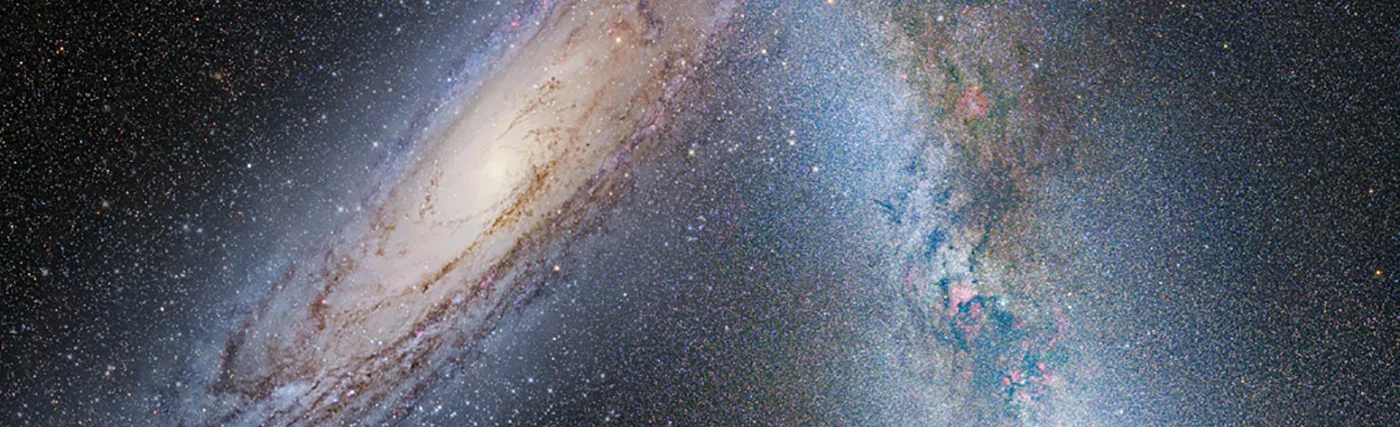
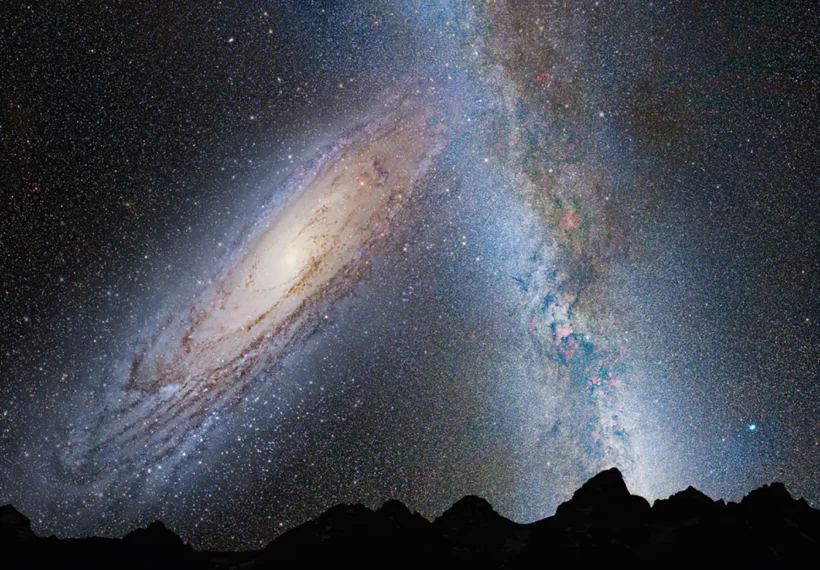
Janna tells us about the long journey to detecting gravitational waves by LIGO and how it served as the subject of her book, Black Hole Blues and Other Songs From Outer Space. She also shares why the book almost had a very disappointing ending that transformed into a world-changing discovery. Lastly, Neil and Janna explain how the universe can be expanding at the same time that our own Milky Way galaxy is on a collision course with the Andromeda galaxy. All that, plus, we try and imagine what’s beyond the observable universe, if anything at all.
NOTE: All-Access subscribers can watch or listen to this entire episode commercial-free here: Cosmic Queries – Out There.
Transcript
DOWNLOAD SRTFrom the American Museum of Natural History in New York City, and beaming out across all of space and time.
This is StarTalk, where science and pop culture collapse.
This is StarTalk.
I’m your host, Neil deGrasse Tyson, your personal astrophysicist.
And today’s episode is Cosmic Queries, the Out There edition.
We’re talking about not just astrophysics, but the extremes of astrophysics in space, time and dimensions.
While I have some expertise in that topic, I don’t have all the expertise necessary to pull this off.
So we called in my friend and colleague, Janna Levin, Janna.
Thank you for coming.
I love being here.
Not your first rodeo?
Yeah, not my first rodeo, but I haven’t been in your office in a long time.
Okay, well, it’s gotten messier, just so you know.
In kind of a good way, almost like a, I don’t know, curatorial way.
The curatorial way.
And helping me bring some levity to this topic is the one and only Harrison Greenbaum.
Harrison.
How you doing?
Welcome.
I do think we need to get Marie Kondo up in here.
Oh, really?
You have to see which things spark joy.
It all sparks joy.
Get the hell out of my office.
Exactly.
We’ll barricade it.
We’ll barricade it.
So you’re a comedian and a magician.
Yes, absolutely.
That’s crazy.
Oh, yeah.
Dude, stay here.
I don’t want you to disappear.
Classic double threat.
Don’t make my guest disappear today, right?
I use my powers for good.
I’m a good witch.
And so we’ll find you at harrisongreenbaum.com.
Yeah, absolutely.
For your tour schedule and everything.
And also maybe Comedy Central will book me if thisismywebsite.com, which I did register.
Oh, really?
We all froze for a second.
It’s a very long domain.
For some reason, it was available.
There’s a real beat there.
So Janna, you’re an expert on the large scale universe, on black holes.
Your recent book was Black Hole Blues?
You know, you said it better than anyone ever.
I once got you to say the whole title, which you might not remember, was Black Hole Blues and other songs from Outer Space.
And you did your best DJ voice, Neil.
I can’t, I don’t know if you know if I have it recorded.
Really?
Yeah.
Well, let me try it again.
The Black Hole Blues and other songs from Outer Space.
Does that work for you?
Put that on your ringtone.
Exactly.
I’m a big fan of the blues in general, so I was enchanted by the title.
So Harrison, if you remember, this is also not your first rodeo, but you’re not a regular on the show.
For Cosmic Queries, we solicit questions from our fan base through all the social media channels and then some.
And you, the co-host, are the only one who’s seen these questions.
I haven’t seen them.
Janna hasn’t seen them.
And you’re just gonna read them.
And Janna and I will try to answer them.
And we can’t answer, we’ll just say, I’ll say I don’t know.
She’s not gonna say I don’t know.
Oh yeah, I might just make some stuff up.
Who’s gonna call me out on it?
I’m gonna call your stuff, maybe I’ll call you out on it.
By then I’ll be home.
So Harrison, so what do you have for us?
Since you haven’t seen these, I could just be making these up.
That would be hard though, I think.
Yeah, all right.
All right, so we’ll start with that.
We’ve got good people who listen to our stuff, so.
The first question says, how do you make Harrison a regular?
That came from my mom.
Definitely on the sheet.
No, so here’s a Patreon question.
Patreon?
Yes.
Oh, so you, out of all those questions, you went and found the Patreon question and put it first.
Absolutely, every time.
That is kissing ass, you realize this.
Got to do it.
Zachary Spradlin from Patreon, and thank you for supporting.
The question is, given your vast knowledge of physics, I’m sure they’re talking to me, what are your thoughts on a holographic universe?
Would 100% empirical evidence on a holographic universe change how you behave on a day-to-day basis?
Imagine if we could access the Universal Holographic Database.
Whoa.
No, Janna.
It’s like a three-parter.
I’ve tried to fully understand the holographic universe, and I only kind of skimmed the surface of it.
So if you have a deeper-
It’s pretty spectacular.
If you have a deeper sense of this, I would totally want to know.
Yeah, it’s not something I specifically have worked on, but I pay very close attention to it in the hopes that one day I’ll have a good enough idea to actually jump in the fray.
Okay, and just to be clear, so when you do your work, you’re a theorist.
Yeah, very pen and paper.
Yeah, old-fashioned.
Old-fashioned.
Totally old-fashioned pen and paper.
So you’re really cheap.
You’re a non-expensive scientist.
If you want to give me a grant, I can do my research.
Couple thousand dollars.
Seriously, lowest level in terms of equipment and supplies.
I think somebody will buy you a Macbook.
And that’s only to check my social media.
A very large iPhone?
We can get this done.
You and I got this, we got this.
So just so people know, you’re a professor of astrophysics at Barnard College in Columbia University, which is right up the street here, which is great.
Okay, so go on.
So the holographic universe.
So a hologram, the whole idea of a hologram is that you really have two-dimensional information, but it creates the illusion of being three-dimensional.
That’s just what a hologram means.
Yeah, because when you look at it, like your credit card might have a holographic bird on it.
Right, but it’s a two-dimensional object.
Of course it’s two-dimension because it’s flat.
It’s flat, but it looks like a full three-volumed thing.
So the reason why these physicists coined it holographic is precisely because they’re imagining that all of the information that is required to understand the universe can be encoded on just a surface as opposed to in the full space.
So for a black hole, this arose because if you look, a black hole doesn’t physically have anything at its surface, but we imagine the event horizon as a surface, the region beyond which no information can escape.
And the idea was that everything about the black hole, that all the information the black hole could possibly contain is equivalent to the amount of information that can be packed on the surface and nothing more.
And you cannot, and they’ve proven this over many years, back since Hawking, you cannot have more information than the information you can pack on the surface.
And the reason why this happens-
You’re saying more information can’t get into the black hole than can be stored on the surface of the event horizon.
Yes, you can prove that the information content of the black hole scales like the surface area of the black hole, the event horizon, and not like the volume.
And so the idea would be, well, we could maybe make an object-
I did that calculation.
I used to have those hologram stickers of like cats.
Does that get me anywhere close to understanding?
So it’s one thing to kind of think about that, but then it took really years before people like Leonard Susskind started saying, oh wait.
He’s a physicist at Stanford.
He’s a physicist at Stanford and just an incredibly creative thinker.
Leonard Susskind.
Yeah, and great New Yorker from the Bronx.
Bronx in the house.
Bronx in the hologram.
He’s got that tough guy accent still.
So he really started to think about this.
Let’s say I try to have information that actually scaled the volume.
So that’d be a lot more information than you would think you could pack on the surface and you can prove that, well, then you just make a black hole.
And we know about black holes fundamentally that you cannot have more information in the black hole than you can put on the surface.
But what does it mean to put information on a surface that does not exist?
That’s very subtle.
So it’s really the idea.
There’s two ways to say it.
One is to just say, oh, the information content of the black hole has been proven to scale like the area.
And then the string theorists started to think, well, maybe that physically means it’s like there on the horizon.
That as-
The event horizon.
The event horizon.
That as something falls into the black hole, it might appear to the poor astronaut that thinks they’re falling into the black hole that they have crossed the event horizon and met their fate in the interior.
But to us on the outside, it may appear, and this is a string theory suggestion, that it’s actually physically smeared on the outside in the quantum string states that are permitted on the outside and that it never gets inside.
So what about the fact that if I watch someone fall into a black hole, I see their time slow down.
Yes.
And at the event horizon, it has stopped.
Exactly.
So can we say that all this stops at the black hole as far as I can see?
I mean, it certainly is driven by some of those early confusion about that.
So it does seem, for as far as we’re concerned, it never crosses.
Right.
But to the astronaut themselves, they just fall straight in.
They say, all right, true.
So it’s literally suggesting, like quantum complementarity created this hole, there are two things that seem incompatible that can exist at the same time.
It’s literally suggesting that the astronaut both falls in and does not.
And is smeared on the surface.
And smeared on the surface, but there’s no single person in the universe who would be able to experience both things.
So no single person has a contradiction.
Ooh, I see it’s a-
When you talk about encoding information on the surface, do you mean like the way like there’s a California tattoo on Adam Levine, where we know he’s from California?
He’s only tattoos on the surface.
That’s all he is.
It looks like a three-dimensional body.
But it’s really just skin tattoos.
So tell me something, if I think people freeze at the surface, then they’re not living out their lives.
We’re living out our lives.
How could we be, in every hologram I’ve seen, it’s a frozen image.
Or it repeats in some trivial way.
So that’s why we would see them freeze.
But I’m not frozen.
So how can I be a hologram?
So, oh, I see what you’re saying.
So it would be-
Wait, wait, I don’t think I’m frozen.
Yeah.
Is that the end of the Mary Tyler Morgue opening credits where she like freezes her hat?
Oh, she freezes there when she flips up her hat.
Is that what we’re talking about?
Harrison, how old are you?
I have no age.
We’re just a fan of Mary Tyler Morgue.
How does that show go off the air since-
We’re at the edge of a black hole, so my life has been stuffed.
Since 1872, that show has been off the air.
Just want you to know.
So I would say the idea that holograms are frozen is just a technology problem.
You certainly could make a hologram that was updating the information on the surface and therefore moving in time.
So it doesn’t have to be frozen to be a hologram, but it does have to be two dimensional and nonetheless appear three dimensional.
Why can’t we be a three dimensional hologram of a four dimensional space?
Well, that’s not that.
Not bad.
If a hologram is one dimension less.
Yes, it could be the case.
And there’s definitely.
And aren’t we four dimensions?
Three space and one time?
Yeah, so there.
Don’t go back on us on that one.
I’m not going back on you on that one, but there is some confusion about that time dimension.
Whether it behaves as a space dimension.
It clearly does to some extent.
Whether it’s a full-blooded space dimension.
But to some extent it doesn’t, because I can turn left and right, but I can’t go forward in space.
I don’t think my car has that center.
But I can’t go forward and backward in time, right?
So I can’t do both directions in time.
And I can see things in both directions.
I can see something to the right, and I can see something to the left.
I can see something in the past, where the light travels across the universe and gets to me, but I cannot see something from the future.
So we are prisoners of the present, forever trapped between a past we cannot access and a future we cannot see.
I think that’s the new opening to The Twilight Zone.
I’m excited for the reboot.
Cue the music!
Okay, so that’s cool.
So let’s get back to the question.
If we know…
Just one question could keep us busy the whole time.
100%.
If we are 100% sure that we are a hologram, should we behave any differently?
And who are we a hologram to?
Yeah, so this is…
On whose black hole surface are we?
Right, so then, well, so people have a harder time understanding holography in the cosmological context, moving away from the black hole.
But the idea is the black hole is the terrain on which we learn fundamental thinking.
So we should use the lessons that we can only learn there, the evidence that only exists there to understand the whole universe.
As a cue, as proxy.
Right, so then we turn out and we say, oh, the universe is expanding so rapidly, we have a cosmic horizon.
We do.
There is a region beyond which we cannot see as long as the universe expands at this pace and the light can never get to us, race though it might, because the expansion of the universe will exceed it.
So we are analogous cosmologically to a black hole and we are inside its event horizon.
Yeah, it’s like an inverted one and we’re inside the event horizon and there’s stuff beyond it that we’ll never know about us and we’ll never know about them.
And so can we make a holography of that?
And then yes, can I make a holography of just you and I?
But you see, we have so much less information than the maximum we could pack on us that that’s why we haven’t tested whether or not we’re holographic animals.
So, you know, holography requires a more sophisticated thing than just like printing words in a book, which is not holographic, but it’s way less than the maximum amount of information than you can pack.
And the hologram is an example of packing a lot more, right?
So if you made a human being that was packing the maximum amount of information that they possibly could, they would turn into a black hole.
Or they’d have a really full backpack.
So holography doesn’t say you can’t have things with less information that are just not as extraordinary.
It just says that’s the maximum that we can have.
And so it’s all an illusion.
We really are two-dimensional.
You’re flipping me out a little bit here.
So let me just say, and I’m an astrophysicist, right?
So why did you all of a sudden, without anybody’s permission in this conversation, equate matter with information?
Because when I think of matter, concentration of matter, as a star guy, I studied stars, you pack in the matter, and you get a black hole.
Now you’re saying you’re going to pack information, and you’re going to get an information black hole.
Is that the same thing?
I think that the shift that I’m feeling and that I’m learning from other people as well is that matter is just information.
So what does it mean to say an electron is matter?
What we mean is it has a certain charge, it has a certain spin, it has a certain number of quantum properties, and those quantum properties qualifies information.
And it completely defines what the thing is.
And there’s no such thing as an electron that’s a little bit heavier or a little bit lighter, spins a little faster, a little slower, has a little more charge or a little less charge.
Which is freaky.
There’s no such thing.
Every electron is identical to every other electron.
There’s literally no history to it.
Which one is that one?
The only thing that I need to know is its position in space.
Exactly.
So the idea there is the electron is simply the collection of information about it.
And that is its identity.
And so then we start to think, well, what else does it mean to be physically real is just that list of quantum properties.
So I think that the shift is to say, look, it’s just math and information.
And we got to stop thinking so concretely, you know, feeling.
We know that this is an illusion.
I can’t put my hand through your leg, even though we both know it’s mostly empty space.
We are mostly empty fricking space.
Yeah, voids, two voids.
That’s the secret to one of my tricks.
I won’t tell you which one.
Because you’re also a magician.
So there’s a famous comment, I’m going to paraphrase it, and it might be apocryphal, but it’s great anyway.
Rutherford, who discovered that the atom was empty?
I think it was Rutherford.
Yeah, I mean, he did the nuclear stuff.
So what you do is you get a really thin gold foil, like aluminum foil, this is gold foil.
Hammer it really thin.
That’s when I assume Trump wraps all the sandwiches in it.
Very Trump gilded, everything.
So then you hang it there and you fire particles at it.
And you ask, how often does a particle hit a gold atom and how often does it pass through?
Because you make it really, really thin.
And it turns out most particles pass right through the foil.
No damage done.
No damage done, not deflected, nothing.
And he concluded that most of atoms are completely empty space.
And he’s rumored the next morning, after having contemplated this, that he was afraid to step onto the floor getting out of his bed.
Fear he might fall through the floor.
Because he alone on Earth knew how empty matter actually is.
I figured that out by looking at Republican heads.
Very empty.
Reading their tweets.
So is it fair then to say that, so in astrophysics, there’s something called a degenerate state, which is not a statement about its moral fiber.
I would say most comedians are in a degenerate state.
Degenerate state has to do with whether two atoms or particles can occupy the same state at the same time, the same configuration.
And electrons, two identical electrons, cannot be in the same place at the same time.
They have to be separated.
So there’s a pressure because there’s a limit to how close you can get them.
And now based on how you describe it, I’m thinking if you do that, you’re putting too much information in one place.
Ooh, that’s an interesting idea.
Look at you, Neil.
So the Pauli exclusion principle being caused by an information limit.
Want to write a paper on that?
Let’s do it.
Oh my God, I’m going to be up all night now.
Let’s do that.
Ah, I love it.
All of the degenerate states.
It’s an information problem.
I think that’s a lovely idea.
We’ll talk about that later.
We got to take a break?
Do I get co-credit?
Am I going to be in a paper?
Yeah, Harrison made us laugh during this paragraph.
Moral support.
I was the cheerleader.
So we come back more Cosmic Queries, out there.
Unlocking the secrets of your world, and everything orbiting around it.
This is StarTalk.
We’re back, StarTalk Cosmic Queries, the Out There edition.
All parts of the universe that are far away and freaky.
And we’ve got some good expertise for that in Janna Levin, Janna.
Good to have you, of course, Harrison.
So this is the second segment.
You’re reading questions.
The first segment, we got through only one question.
Yeah, but it was a doozy.
It was a doozy.
All about holograms.
So what else do you have for us?
This is from Facebook from Nate Gaudioso, and he said, could the entire known universe be the result of a white hole?
Ooh.
Do you wanna try it?
Well, let me put white holes on the map and then you take it from there, okay?
So back in the 1970s, when the mathematics of black holes was being explored and formulated, it might’ve been late 1960s, but it was not deep back in the century.
It was like that late, if you will.
People noticed that the equations that give you a black hole have a legitimate opposite solution to them.
So let me test, Harrison, let me test your ninth grade math knowledge.
You ready?
Okay, what’s the square root of nine?
Three.
Okay, so what’s three times three?
Nine.
What’s negative three times negative three?
Also nine.
So nine has two solutions, doesn’t it?
Right.
Square root of nine is negative three.
Plus or minus, yeah.
Yeah, and positive three.
You only gave me one solution.
Right.
The solution you preferred.
Right, but there’s the dark side.
I’m just looking at the negative side.
So some questions in science, the mathematics of them reveal that there are two answers that are completely authentic and legitimate.
And when people were studying black holes and the mathematics of black holes, a second, in Einstein’s equations, a second solution emerged that was everything a black hole is except the opposite of that.
So things only ever came out of this space.
And so it would be white if you were to look for it in the universe.
So they said, let’s look for these things.
And people thought maybe quasars, which are very bright distant objects in the universe, maybe those are the white hole versions of black holes.
And then he said, we have a white hole and a black hole.
Maybe they’re connected.
And this was the introduction of a wormhole.
Wormhole would connect a white hole to a black hole.
Everything goes in a black hole, comes out the other side.
So we look for the properties of a white hole.
Quasars did not satisfy those properties.
And we kind of gave up on them.
So no one’s looking for white holes anymore.
So that’s the farthest I can take it.
Right, so it is a really intuitive idea that-
Did I get anything wrong?
I think I got-
No, yeah, that sounds great.
It’s very natural to imagine.
So let’s say everything falls into a black hole and you think, it goes where?
And that’s the whole crisis about the black hole is not the event horizon and all of that.
The whole crisis?
The whole crisis.
The word must have gotten stuck in my head.
So the idea would be that you can sew on a white hole onto the interior of a black hole.
And it kind of makes sense because these singularities that people run amok on the streets because they don’t want them to exist in nature and they probably don’t exist in nature.
And the singularities are so problematic that wouldn’t it be better instead of having this infinite energy, infinite curvature of space.
Infinite density.
Infinite density, literally a hole in space.
The matter gets there in finite time and then what?
You don’t know what happens to it.
It’s literally like a cut in space.
It’s something where physics breaks down fundamentally.
So people had the idea, well, let’s get rid of the singularity and throw the black hole onto the Big Bang, which is also a singularity.
And so you get rid of both and you repair it.
So you’re saying at the center of the black hole, it birthed in another universe.
Yes, so that is really-
I’m talking about inventing a whole fricking universe.
Yeah, of course, you got a black hole.
Yeah, whatever.
I’m still stuck on the plus and minus negative three.
What I love the most about that is it means that the black hole, small as it might be on the outside.
So let’s say our sun became a black hole by some intervention, because it would naturally collapse to a black hole.
It’s not big enough, but if it were, it would be only about six kilometers across.
You have a very small object on the outside, but on the inside, it could be as big as a whole universe.
So it’s like Doctor Who’s Tardis.
I was like, that really sounds like a Tardis.
Yeah, that’s, hit the geek buttons right there.
It’s bigger on the inside than the outside suggests.
And one way it could be big is it could be a whole Big Bang.
It could be a whole universe.
Now, the reason that’s sort of fallen out of favor is because there are reasons to suggest that if that were true, that the universe would become very unstable to these things.
Because if there’s just some random probability for a black hole spontaneously creating a universe in its interior, it would be, even though seemingly unlikely, it would just be such a, what sort I’m looking for, such an enormous proliferation of them that it would actually make the world unstable.
And so it’s sort of fallen out of favor.
No, it depends on who you ask.
There’s no instability in the world.
So some old-fashioned relativists who only think about space and time still like the idea.
Relativists is someone, an expert on Einstein’s relativity.
Yes, and studies primarily space-time.
And those who study things like string theory and particle physics are more skeptical about the idea because their work seems to suggest this instability.
So sometimes the camps are split on this still.
It’s gonna be a very tense dinner party.
So what you’re saying is wherever there’s a black hole, there’s another universe.
If that’s the case, yes.
This would be like a Swiss cheese in the higher dimensional.
That’s right.
But that universe, okay, so space and time switch places interior to the black hole.
So while you’re imagining a universe which is spatial, the black hole would be in its past and therefore inaccessible.
So it would look like the big bang was solely in the past.
It wouldn’t be a place you could go to in the new universe.
It would be a time in your history.
We gotta take a break.
No.
They’re just now getting rid of CBD products in New York.
Oh man, time is terrible.
No, just if I repeat what I think I heard you just say.
If you fall into a black hole, the universe you came from, you will see the entire future history of the universe unfold in front of you in an instant.
Yes, so the black hole is bright on the inside.
Bright on the inside, bigger and brighter on the inside.
Yeah, there you go.
Yeah.
All right, give me another question.
I just don’t want to let any of the alt-right know about this white hole because they’ll be like, see, I told you there’s another one.
All right, this is from a Patreon candidate, Frank contributor.
Frank Kane, which I think, is he related to Bob Kane?
That’s the guy who made Batman.
What’s, probably not, but Batman, shout out.
What’s your take?
What is your take on negative mass?
I’ve read that if it exists, we can hold open wormholes, travel backward through time, make a warp drive and all sorts of crazy stuff.
If the math set is possible, do you think that means it really is possible?
Ooh, so start there first.
If you have a mathematical understanding of a theory that is working, does everything that comes out of the math have to be true?
I mean, we don’t obviously know the answer to that question, but it does seem like nature always finds a way.
I mean, we’ve been sitting here talking about black holes.
So black holes were originally just a thought experiment on paper.
And Einstein thought nature would protect us from their formation.
He didn’t actually think they were real.
He thought the math was accurate and beautiful and interesting and important, but not that it could possibly form.
He could have predicted black holes and just the idea was so preposterous.
He literally said, oh, there’s much more important things to think about right now.
And the fact that nature figured out a way to make them by killing off a few stars is just kind of amazing.
And it seems to happen over and over again, these seemingly implausible concepts end up being challenged by our limited, our limited intuition is challenged by nature actually doing it.
So the point is, the universe is big enough with enough things happening that even a completely rare thing is gonna happen.
Or unlikely thing.
Now, I’m gonna contradict myself and say, now, if I’m playing devil’s advocate, I would say the square root of two, yes, but the square root of nine, the square root of two, I would say doesn’t exist in physical reality as far as we know.
It’s only in our minds that it exists.
I can’t make anything that has length square root of two because it will eventually end at some finite digit, which is an approximation of square root of two, but it’s not square root of two.
The decimals go on forever, like pi.
Yes, irrational numbers, the decimals go on forever.
But any length of anything or any measurement of any kind will only be a rational number and an approximate to an irrational maybe.
So we can’t measure pi ever, and we can’t measure anything with square root of two length.
Bumming me out.
No, but I want a pi with diameter pi so it just goes on forever.
I could always be baking it.
So you can say, well, maybe I just gave you an example that proves that not every mathematical concept can be realized in physical reality.
Okay, but I’ll give you a pass on that one.
In golf, what’s it called?
Give you a…
Oh God, you’re asking me sports questions.
Mulligan, give you a mulligan, I think.
There you go.
There’s your mulligan.
All right, so now, tell us about negative mass.
So negative mass is problematic.
Does it exist in anybody’s formula?
Not that we know of.
We have seen negative energies in very subtle contexts where you have two plates that are very close to each other where you can create a negative energy in the quantum states between the plates.
So this is when?
I’ve dated some girls with negative energy.
So you’re talking about like a capacitor plate, like metal plates.
Yeah.
You get a really, really close.
Yeah.
So they’re closer to each other than the wavelength of the particles in the matter that comprise them.
Yeah, in some sense, it’s like saying, if I can’t have a water wave between two walls, whose wavelength is longer.
Than the width of the walls.
Than the width between the walls, exactly.
I mean, not a standing wave.
And so, the idea is that it prunes some energy, meaning that in some sense, there’s less states on the inside because of this than there are on the outside, where you have a whole continuum of possibilities.
So, that’s negative energy between the two plates.
It can create, under certain circumstances, a negative energy, and then you will see a pressure on the plates.
The plates will either push apart or move together.
If matter and energy are equivalent, E equals MC squared, if you’re gonna give me negative energy, why can’t you hand me negative mass?
Yeah, I mean, it.
There.
Well, here’s, okay, so here’s the problem with the negative mass is that it seems highly unstable.
So if I literally had a particle who’s like the electron whose fundamental mass was literally negative and whose E equals MC squared energy was literally negative in that sense, then it would be possible to make tons of these and balance it with the generation of positive energy, respect conservation of energy, right?
So that I could get an infinite energy resource by making negative energy particles because that would have to, by energy conservation, lead to the creation of a positive energy somewhere.
And then when you bring them together, they annihilate and then you have…
Well, I don’t know.
Maybe they’re not antiparticles.
Maybe they don’t annihilate.
They just might have negative mass.
So in other words, I could have zero energy in my laboratory and I could have the best energy company conceivable.
Starting with zero energy.
Zero energy.
It costs me nothing to make negative energy particles because I just have to create, whether I like it or not, positive energy in response, meaning I can generate incredible positive energy at essentially no cost.
And that is just not, it would be so unstable.
It sounds good at first, like we power New York City at no cost.
We get rid of fracking and coal and all of these fossil fuels.
But we also destroy the universe in a completely unstable event where the negative energy runs out of control, creating infinite positive energy and the whole thing blows up.
Harrison, I think it was.
It sounds like the plot of a super villain.
You were going to when this episode aired.
I think it was Kurt Vonnegut in one of his books.
I don’t remember which book.
Who said the last sentence ever spoken in the universe was by a scientist.
Was this him?
Who says to the other scientist, let’s try it this other way?
This is the scenario you just described.
The whole universe goes unstable and disappears.
So some people say, look, I have an observation that proves that there’s not negative mass particles and that’s the fact that the universe appears to be stable.
And we’re here.
For 14 billion years.
All right, give me another one.
All right, we got Mike Berry.
This stuff is out there square.
This is right up my alley.
Man.
I was worried you were gonna ask me about stuff that happened more recently than like half a billion years ago.
Oh yeah, no, no, no.
In which case I’d be lost.
I’m good with that.
We got Mike Berry on Facebook and he said, I’ve never heard this explained.
If the observable universe is roughly 15 billion years old, as we just said, and a star like ours lasts 12 billion, how can our sun be a third generation star?
Oh.
So I would say 14 billion is a little bit closer.
A little bit less than 14 billion.
What’s a billion among friends?
Between friends.
Between astronomers.
Yeah, among astronomers.
Yeah, we’re around a third generation star.
So life expectancy is not relevant to what generation you are.
So, because the generation that we speak of is we think of the stars that create the elements that are then scattered back into the universe and give another generation this enrichment.
Those stars live 100,000 billion years.
Much shorter lived.
They didn’t have the heavy elements.
Precisely because they were first generation.
So, you get the high mass stars don’t live very long.
And fortunately, they blow up.
If they didn’t blow up, they keep their heavy elements and the carbon, nitrogen, oxygen, silicon that’s in our bodies would be forever locked in stars and the universe would have never had life, would not have even had planets.
Because these high mass stars make these elements and explode, scattering their enrichment across the galaxy, it enables the next generation of stars to have slightly more of this.
The next generation of stars have even more so that you’d expect the frequency of planets and other interesting chemistry to take place with all the elements on the periodic table.
The later your generation is, the more chemical latitude you have.
This is also the story of the Greenbaum family.
Oh, is that right?
A previous generation living shortly, exploding.
Oh, I see.
And you are particularly enriched.
Exactly, with a lot of chemical latitude.
We got time for one more before we take a break.
Sure, we got Jezebel Lorelei from Facebook and she writes, what’s the small, or Jezebel Lorelei.
Whoa, that’s a movie name right there, okay.
What’s the smallest a black hole can be and is there a name for the atom that is one neutron less than that atomic weight?
It’s definitely less than a neutron’s weight.
So no, wait, actually it’s not.
Are those two different questions?
There’s a comma.
There’s a comma?
Those have been jammed together.
Don’t you know the trick of answering the question you can and want to, regardless of which one you’ve asked?
She’s gonna answer the one she knows she can answer.
So, I can’t remember the actual number of the small, so we do know, it is conceivable, that a microscopic black hole could be made under very extraordinary conditions.
Now, we say that the limit of the mass of it is related to the strength of gravity, and that gives us a scale of how heavy it could be, and it’s heavy compared to things like electrons, but it’s incredibly light compared to anything else on the, exactly, so I think it’s about the weight of a little pile of sand.
Imagine a modest pile of sand.
That would be about the weight it could maintain and be consistent with what we think is the limit of the strength of gravity, and it would be an incredibly tiny microscopic black hole.
I mean, I can’t even.
Oh, that’d be really small, yeah.
But wait a minute.
I should know the number, 10 to the, what is it?
10 to the minus 45 seconds after the Big Bang is around the time of quantum gravity.
So if I multiplied that maybe by the speed of light, I would roughly get the size of the black hole or something like that.
But anyway, you can ask me later.
I’ll crunch some numbers.
Okay, 10 to the minus 15 meters or something.
So, but black holes evaporate.
So they can become so small that they don’t exist at all.
Oh, good point.
So those black holes are incredibly unstable to evaporation because the idea that Hawking foisted on it.
The late Stephen Hawking, the amazing Stephen Hawking, that black holes, although they let nothing out, they somehow still evaporate.
That tremendous paradox that we’ve been grappling with since the 70s.
He also realized that the temperature is colder the bigger the black hole.
So they evaporate more slowly the bigger they are.
So we’ve never seen an astrophysical black hole evaporate because they’re way too cold for us to perceive evaporation.
The big ones that are made by dead stars.
A microscopic one made in the early universe would presumably evaporate in an instant.
And it would be, it would, so people have looked for that.
They’ve looked for little explosions, high energy explosions in the very early universe to see if there were primordial black holes.
Small person, but yeah, we haven’t found them though.
Yeah.
Yeah.
Oh, right.
Yeah, we got to wrap up this segment of Cosmic Queries The Out There Edition.
We’ll be right back.
This is StarTalk.
DARTALK, Cosmic Queries, the OUT THERE edition.
This is the first time we’ve done an Out There edition.
I think we have to do this more often.
This is fun.
And Janna, you’re like a neighbor up the street at Barnard and Columbia.
Yeah, absolutely.
I just take a stroll.
Yeah, yeah, we’ll have to have a bat signal.
Say, are you out there?
We need you here for an out there.
Ed Harrison, again, thanks for being on StarTalk.
So you got Cosmic Queries for us, what more do you have?
Let’s make this entire segment the lightning round.
They used to give me a bell.
Well, I don’t know what happened to my bell.
But a lightning round, so this will just be more soundbite answers just so we can get to more questions, okay?
Absolutely, so we have Tony underscore le738 on Instagram says they’re an opposite to a black hole that just spews out things.
White hole.
Been there, done that.
A thing that just spews out endless garbage, Trump.
Okay, Ben Ratner at Ben Makes TV on Twitter.
What is your favorite recipe for a good soup?
Primordial soup.
For me, a good soup would be all the basic ingredients that are the foundational to biochemistry.
Carbon, nitrogen, oxygen.
Carbon is the stickiest element on the entire table.
It can make more kinds of molecules than any other elements combined.
So, give me a soup with carbon, nitrogen, oxygen in it, and I can show you life.
So, I just happen to have a can of primordial soup on my shelf.
For those who don’t have video, it’s Wallace’s condensed primordial soup.
Can you read the ingredients on the primordial soup?
The ingredients I used to be able to see.
Is this a real thing?
Oh yeah, okay.
Quick and easy instructions.
Mix soup, one can of seawater, lightning, heat, uncovered in early years.
It’s like the early earth here.
For two to three millennia, save the simple molecules to form larger, more complex molecules.
For a creamier soup, use one can of organisms.
Okay, so that’d be the best kind of soup at all.
I prefer a split pea.
All right, keep going, Harrison.
All right, we got Joshua Wilham from Facebook.
We’re still in quick mode, lightning mode.
If you could subtly know the answer to any question, what question would you choose?
Subtly knowing the answer is so disappointing.
As a scientist, the whole fun is figuring it out.
I don’t know if I subtly want to know the answer to any question other than when’s my Uber coming or something.
I think you just have to look at your phone.
That’s not a mystery on that one.
Although they have physics that are unbelievable, where like the car just jumps through a building and you’re like, that was some physical possibility.
Or just as a flip around and, you know.
An Uber discover a black hole in the city.
I don’t know how it jumped across.
Wormhole, a wormhole through the building.
So for me, the answer I want is to the question we don’t know yet to ask.
Because the day we learn what that question is, I no longer care.
I will wait the day where the next question comes that I didn’t know to ask.
And this is strongly resonant with Janna’s answer, where the quest to the answer, science is not so much about answers, but the search for answers.
And that’s where you learn, you stumble on things, you discover the structures of things you didn’t even know that was a question you needed to ask.
So yeah, I’m all into the search.
So these are-
I’d like to have the answer, just not suddenly.
I don’t want it to be never either.
Never is frustrating.
Very good, that’s a very healthy posture.
Otherwise, there’s a psychological problem you have.
Yeah, exactly.
I like the escape room, so within 60 minutes.
That’s generally when I get the answers.
All right, we got Scott York at Instagram.
Could dark matter or dark energy be any indication of alien technology that is beyond human comprehension?
Ooh.
Don’t look at me.
This feels more like an yeah.
Okay, here’s what I was, I’ll give my answer, and then why don’t we hear your answer, okay?
Just because there’s something in the universe we don’t understand, doesn’t mean it’s aliens.
It doesn’t mean it’s magic.
Otherwise, my VCR was made by aliens.
You still have a VCR?
Exactly, the fact that I have a VCR.
Oh my God, we really need to get you that grant, my God.
Reflect alien intervention somehow.
First, you talk about Mary Tyler Moore, and you’re talking about VCRs.
How the hell old are you guys?
I’m sorry, my beeper went off.
So, I think, wait, what was the question again?
Could dark matter and dark energy be evidence of aliens?
It’s tempting, it’s always tempting, to ascribe something completely extraordinary as the cause for something we don’t understand.
We’ve been doing that forever.
But as a scientist, you have to resist that because the history of that exercise is one of abject failure persistently.
So, to say, oh, it’s actually magic, or it’s actually God, or it’s actually an alien, and then you study it and it’s reducible to known forces, or maybe you’ll discover a new force, but it’s still not magic, it’s still not God, and it’s still not aliens.
So, if I’m betting, I would say, it’s probably not as much as we would really love it to be.
Now, the place we should be looking for aliens is a place we actually know where to look, which is on exoplanets, where there really is a very serious prospect that there are aliens.
Now, having said that.
These are planets orbiting other stars.
Yes, exactly, planets orbiting other stars.
We think that in our Milky Way, of which there are hundreds of billions of stars, that there are probably more planets than there are stars in the Milky Way.
And so, that’s suddenly a stunning number that we didn’t realize, what, 20 years ago.
Yeah, but you’re just talking about some kind of living organism.
Right, I was gonna say, don’t be disappointed.
We’re talking about serious ray gun aliens, you know?
Absolutely.
They’re aliens, right?
Air 51.
They’re probably more like the kind of thing you wipe off your shoe, which is sad.
Some primordial ooze that is itself a mat of life.
That’s so, you’re so unfun with that.
It’s true, but unfun.
Who knows?
All right, Kaye Futch from Instagram.
How many black holes are there?
So, in our galaxy, we just said that there are a few hundred billion stars in our galaxy.
About 1% of them at the end of their lives are going to be big enough to collapse all the way through to become black holes.
And so, that’s a lot, right?
Yeah, 1% of 100 billion is a billion black holes.
It’s a billion black holes.
And in addition to that, we know that there are tens of thousands of black holes around the supermassive black hole at the center of our galaxy.
So, the center of our galaxy harbors a black hole a few million times the mass of the sun.
And it has tens of thousands of black holes specially segregated around it.
So, that’s just our galaxy.
Now you’re saying in the observable universe there are as many galaxies as there are stars in the Milky Way.
You got a lot of black holes out there.
And all evidence shows that every red-blooded galaxy like the Milky Way has got a supermassive black hole in its center.
Yeah, so we’ve got hundreds of billions of those.
Those, yeah.
And hundreds of billions times a billion of the smaller ones.
Surrender now.
It’s the worst Milky Way candy bar that’s realistic has a black hole in the middle of it.
Jeek.2 at Instagram wrote, can a black hole eat another black hole?
And if so, would it contribute to its growth?
Absolutely.
Like a Pac-Man theory of black holes.
Absolutely, one of the most-
Pac-Man, wait, your references are so classic.
Oh, I love it, but I have to make fun of it.
Can we come to your house and see what you’ve got the set up there?
I’ve done a couple of 80s escape rooms recently, so it’s on my mind.
Do you have a cell phone?
It’s very large.
Wait, why was it, oh yeah, black holes eating other black holes.
That is, one of the most exciting things that’s happened this century is the direct recording of the sound of space-time ringing due to the collision of two black holes, which if you want to call it them eating each other, you could.
They merged and they created a bigger black hole.
So each one was about 30 times the mass of the sun.
And so we know that there’s a black hole out there in that rough direction, as far as we could ascertain, that is 60 times the mass of the sun.
And yes, they get bigger.
They get bigger by almost as much as you would think.
The energy that they lost in terms of like, literally equals MC squared energy that wasn’t the sum of the parts came out in this ringing of space-time.
And it was recorded by LIGO, this fantastic instrument.
It happened in, must have been 2015.
It’s a new window to the universe that’s measuring the ripples in the fabric of space rather than the ripples in the energy of light.
And this is what Black Hole Blues was all about.
I was writing it while they were on this campaign.
Yeah, and they hadn’t succeeded while I was writing.
And I was really writing it precisely ties in with what we were talking about earlier about the pursuit.
And it was 50 long years that they strove to build this instrument.
So wait a minute, the title of your book is Black Hole Blues.
Is that because you didn’t think they would find it?
Yeah.
And then they found it, and now your book has the wrong title.
Yeah, so amazingly, Ray Wise, who won the Nobel Prize alongside Kip Thorne and Barry Barish for that discovery, said to me about a month before the detection occurred, if we don’t detect black holes, this thing is a failure.
And so I got the title really thinking about Ray saying that, that he’s now in his 80s, he started this as a young man, and it was the Black Hole Blues.
But they told me well before the book came out, they told me about the detection.
So I didn’t want to rewrite it, because I think it is all about the pursuit, but I do have a lovely close where they make the discovery.
Okay, I didn’t get to that close yet in your book.
All right, give me more.
All right, we got Michelle Acampora from Facebook.
If everything is supposed to be expanding away from each other, how come our galaxy is on a collision course with Andromeda?
Okay, I got this.
I got this.
I’m going to have to throw down afterwards.
I got this.
So the expansion of the universe is think of it as a stretchy fabric that if, and it doesn’t matter where you are, you’ll think you’re at the center of that stretching, and you’ll see objects moving away from you in every direction.
Objects that are near you will not be moving away as fast as objects that are farther away.
Because every, let’s say for every meter, it stretches 10 centimeters, okay?
Well, that means at two meters, it stretches 20 centimeters.
At three meters, it’s 30 centimeters.
That’s how stretching works in the fabric.
So all galaxies have speeds relative to each other.
If you have a nearby galaxy, it’s going faster than the stretching speed of the universe in the space near me.
So my gravity overcomes anything the universe is doing for things nearby.
So nearby galaxies are going on like the universe is not expanding, they don’t really care.
Their gravity is strong enough to create motions that overcome the expansion of the universe itself.
But we’re not going to collide with a distant galaxy because the stretching of the universe is taking us away faster than that can ever happen.
I just wanted to make reference to, I think it’s Annie Hall, the line where the character won’t do his homework because he’s the kid, because the universe is expanding and his mother says, you live in Brooklyn, Brooklyn is not expanding.
And it’s true, Brooklyn is not expanding for precisely the reasons Neil just gave, that the earth is bound together more strongly than the expansion can tear apart.
The universe in this section, this expanding universe is not gonna break apart the earth.
But now a bunch of developers have brought Brooklyn and it is expanding at an incredible pace.
All right, so we got Kyle Toth from Venice, Florida.
What lies beyond the observable universe?
Do we have an estimated size of the entire universe?
Ooh.
I love this.
Janna, take it.
And by the way, we were still kind of in speed mode, but we’re gonna end with your answer to this question.
That’s a lot of pressure.
It is conceivable that the universe is actually finite in the same sense that the earth is finite.
If I leave New York City and I walk in a straight line as possible and I go for as long as I possibly can, I come back to New York City again.
It is conceivable.
Without ever falling off an edge.
Without ever turning left or right, falling off an edge, going forward and backward.
So you can walk forward forever.
Forward forever.
And just keep coming back around and around and around again.
Now, if the whole universe is like this, I literally would leave the Milky Way in a spacecraft.
I would travel in a straight line, watch the galaxy recede behind me, not turn left, not turn right, never stop forward, not fall off the edge of the universe, but see the Milky Way approach in front of me again.
How many podcasts?
We need a mic drop on that.
That was an audio mic drop right there.
How many seasons of this podcast would you have to listen to before you start the Milky Way again?
That’s right.
We would look back and because light has a finite travel time, we would hear podcasts from our past.
Like you could look back and see yourself as a child if you waited long enough for the light to come back around again.
From the other direction.
From the other direction.
And so we could actually resolve serious quandaries by being like, well, if we wait a billion years, we can actually watch it again.
Just to get the argument straight about who said what over dinner, who broke the plate, right?
There’s this sad old astronaut alone, like I told you, Jammus, this was all worth it.
Okay, so that’s a finite universe, but just as equally the universe could be infinite.
And we’re just our own observable pocket within some infinite universe.
Right, it is also possible that the universe is infinite and beyond the observable universe is this infinite stretch of space.
But you know, Einstein said only two things are infinite, the universe and human stupidity.
And then he said, I’m not so sure about the universe.
That sounds like we should end on that note, doesn’t it?
Janet, it was great, and I’ve been loving your book, Black Hole, the Black Hole Blues.
Harrison, thanks for coming back on StarTalk.
Oh, my pleasure.
And harrisongreenbaum.com.
We’ll look for your stand-up gigs and you’re also a magician.
And I’ve been your host, Neil deGrasse Tyson.
This has been StarTalk.
And as always, I bid you to keep looking up.



 Become a Patron