Are you ready to learn the answers to some of the most intriguing questions about our galaxy and beyond? On this episode of StarTalk Radio, Neil deGrasse Tyson and comic co-host Sarah Rose Siskind answer fan-submitted questions on an eclectic collection of cosmic topics. You’ll get the answer to one of the most frequent questions we get asked: why is there no center of the universe? Learn about the expansion of the universe and how our inevitable collision course with the Andromeda galaxy overrides the expansion rate. (Don’t worry. You’ve got a few billion years before this galactic merger will take place.) Explore the history of how the Big Bang got its name and whether there’s a more appropriate name. Discover more about the remnants of the Big Bang, the Cosmic Microwave Background radiation. We also ponder déjà vu – could it be the intersection of two distinct timelines overlapping at an exact moment? Neil tells about a time when he had déjà vu and how the truth behind what was happening was both unexpected and surprisingly familiar. You’ll hear about the difference between a cemetery and a graveyard. Find out if E = mc2 functions the same when applied to dark matter and dark energy. Investigate whether there could be a universe hiding inside of a black hole. Discover whether there’s a way to see the reverse side of the Big Dipper and Neil gives instructions on how to perform a cool light experiment to understand the geography of stars. Finally, Neil tells us why “Flat-Earthers” still exist and shares how he stays positive in a world in which an increasing number of “science skeptics” are increasingly vocal with their indefensible assertions.
Transcript
DOWNLOAD SRT
Welcome to StarTalk, your place in the universe where science and pop culture collide. StarTalk begins right now. This is StarTalk, and I'm your host, Neil deGrasse Tyson, your personal astrophysicist. And today's edition of StarTalk is Cosmic Queries. Whatever...
Welcome to StarTalk, your place in the universe where science and pop culture collide.
StarTalk begins right now.
This is StarTalk, and I'm your host, Neil deGrasse Tyson, your personal astrophysicist.
And today's edition of StarTalk is Cosmic Queries.
Whatever the hell came off the internet, that's what we're doing today.
And my co-host today, it's Sarah, hello!
Hello, Neil!
It's the first time we're doing this together.
And I hope that I get initiated.
I hope that there's some sort of weird induction process.
And you got a whole comedy background, right?
Do you have a whole comedy background?
With the Harvard Lampoon?
I was at Harvard, I did not do the Lampoon.
We didn't do the Lampoon.
No, no, they were jerks when I was there, so they didn't take me.
Was that how that works?
Actually, the year that they don't take you, they become jerks.
It's this weird bylaw of the organization.
So we're getting the Lampoon rejects.
You've reached that low point.
That low point.
No, actually, my dad was on the Lampoon, and I didn't wanna join for that.
You have a comedic dad?
So what is a dad joke of a comedic dad?
They're worse.
Are they better or they're worse?
They're so much worse.
They're so much worse.
I get accused of dad joke.
I just say something I think is kinda funny.
On Twitter, thanks dad.
It's like, how did they know?
I'm thinking I'm being clever, but I'm just being a dad.
At least you have jokes.
There's no mom joke territory.
That's true.
Yeah, what's that about?
I don't know.
I'm just saying standards here.
Because the weight of the world is on the shoulders of moms.
Yeah, they don't have time to joke around.
We got time for that.
Not a joking matter.
So as usual, these questions are collected from our internet fan base.
Yes.
From Instagram, Twitter, and Facebook.
Very cool.
Guy on the street.
Yeah.
It's totally legit.
And I don't know if you're better at pronouncing people's names than Chuck Nice.
We'll decide that in this episode.
Yeah, we'll see about that.
I'm just gonna say it loudly and confidently, and I think it'll be convincing.
Even if it's wrong, it's confident.
Yeah, exactly.
I mean, they don't know.
They're not gonna bust in the door and be like.
No one else will know, you mean.
They'll know.
No one else will know.
Yeah, so what's the first question?
All right.
So the first one actually has a guide to pronouncing the name.
It comes from Yanniv Koss, our Patreon, Patreon, and his name, he says.
They all get their questions answered first.
Oh yeah, no, yeah.
Just buy this right.
First class citizens, absolutely, yeah.
Blessed be his name.
Yanniv is pronounced like Yanniv, and it rhymes with achieve.
That's what it says on the question.
Although he addresses it to Chuck, which I'm gonna take as a personal intro.
Yeah.
So my question to Dr.
Tyson, are we near the center of the universe?
And as a personal follow-up, is that center, as I've long suspected, me?
Oh.
Yeah.
Oh, that's your follow-up.
That's my follow-up, but this is just about the center.
You are the center.
I made it better.
Sarah, you are the center of your own universe.
Thanks, Neil.
All right, that's it, interview's over.
But you're not the center of anyone else's universe nor the universe itself.
Yeah, the universe has no center.
And just because you can put the noun and verbs together to make a sentence that sounds like it should have an answer, where is the center of the universe, are we there, does not require that it has an answer.
For example, here's a question that you know not to ask.
Where is the center of Earth's surface?
Unless you're a flat-earther and think we have a disk, which would have a center.
Which we all know you're a big fan of.
Big fan, big fan.
But the spherical Earth, you know to not even ask that.
You know this.
So it turns out the universe has no center.
Because everything in this universe was at the same place at the same time, and we call that the Big Bang.
So it kind of had a center, but it's not accessible today.
You have to go backwards 13.8 billion years, and the whole universe was at its own center in that moment.
It's interesting because a lot of the questions actually were kind of off this topic, and somebody even said explicitly, I can't imagine the universe as anything but a sphere.
It seems almost innate that we think of it as like a physical space with a center.
Yeah, so, but that's fine.
I'm just saying, one way to visualize this is to take away one of the dimensions, because our brains are too feeble to imagine four dimensions or five dimensions.
Let's take away a dimension and put the whole universe on the surface of a balloon.
Draw little spiral galaxies.
If you inflate the balloon, all the galaxies get farther away from all other galaxies.
And if you are on a galaxy, you say, are we at the center?
No, where is the center?
Are you at the center?
Nobody gets to say they're at the center.
You know why?
Because the center is not on that surface.
The center is when the balloon was smaller, when the balloon was infinitesimal 13.8 billion years ago, and when that happened, everybody was at the center.
So I was at the center then.
Okay, that's all I needed to know.
At that one moment.
That's really all I needed to know.
In the past.
And allow me to remind you that the opening quote of my current book, Astrophysics for People in a Hurry, which is a really cheap plug for that book, but I have to say this.
Yeah, I have to say, I grade that a C.
A C minus, C plus, I opened it with just how to set you straight and say the universe is under no obligation to make sense to you.
Oh yeah, I remember that.
I love that introduction.
That's all it is and that's, I put it in that book printed for the first time.
Yeah, no, that was a fantastic introduction because it was touching on a feeling you didn't realize you had.
Ooh, I like those.
Yeah, no, absolutely, it really tugged at that emotion.
Okay, moving on to our next question.
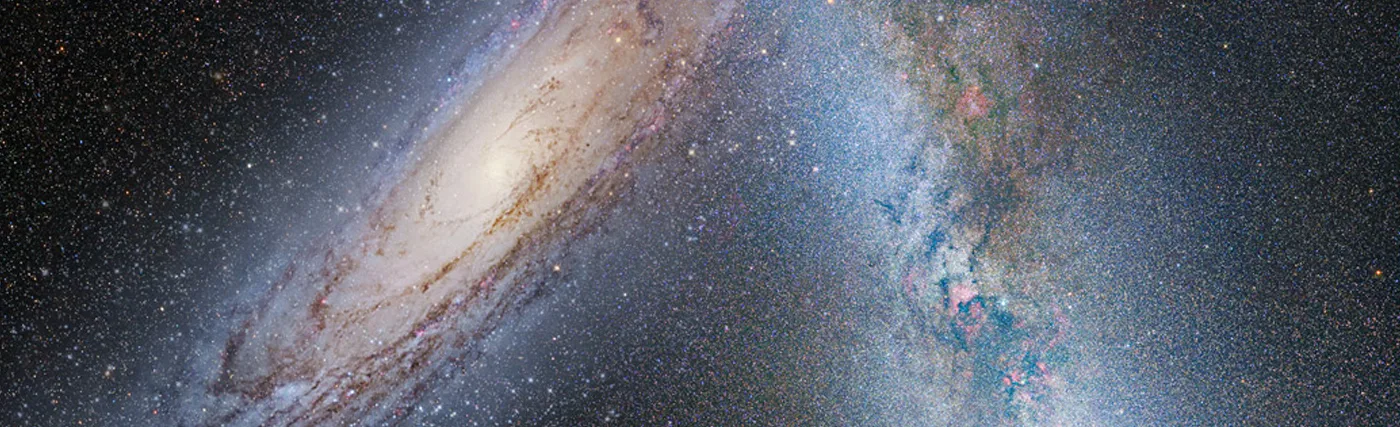
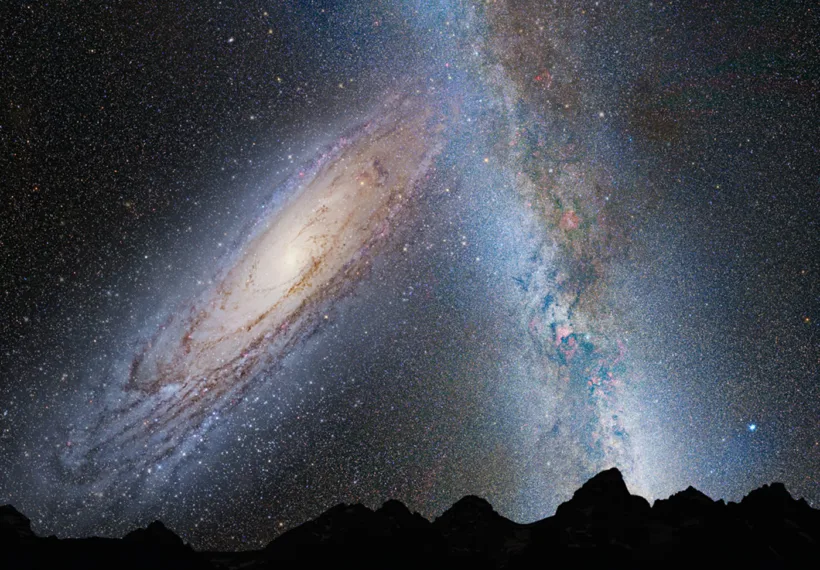
This one, it comes from user named Ollymeamcd98 on Instagram who says, if all galaxies in the universe are expanding away from us, then what is the cause for the Andromeda galaxy being on a collision course with our own?
Excellent question.
I know.
Beautiful, that's beautiful.
So let's go back to our rubber sheet analogy and a moment ago it was the surface of a balloon.
Let's just put us all on a rubber sheet and you have this rubber sheet that's expanding.
So you're my neighbor galaxy and you're my closest galaxy.
Let's say you move away from me at one inch per second, let's say.
You'll look to your neighbor galaxy and you'll see it move away from you at one inch per second.
It will see its neighbor galaxy move away from it at one inch per second.
I will see your neighbor galaxy move away from me at two inches per second.
I will see that galaxy's neighbor galaxy move away at three inches per second.
So the farther away you are from any point of observation, the faster is the measured expansion.
Because everything is expanding uniformly.
And it just adds up.
I thought everything was accelerating.
That's another level on top of this.
That's over time.
It's on top of this that's happening.
But that will neither, we don't need to reference that now to answer his question.
So basic expanding universe.
We are expanding.
So, in other words, if you invoke that, then I would see, so as you go back in time, you would see that the expansion was greater, okay, as the time had moved on.
Because as you look out in the universe, you are looking back in time.
So you see things not as they are, but as they once were.
It's beautiful.
That is gorgeous.
It's beautiful.
In fact, there was an Italian movie called La Correspondenza.
Could you say that a couple more times, please?
La Correspondenza.
Could you leave that as my voicemail message, please?
And it starred Jeremy Irons.
And it was a love story.
Big fan already.
Me too, I'm a big fan of his.
It was a love story, and he played an astrophysicist.
And he had a.
No wonder you liked it.
He had a terminal disease, had to go abroad.
His love interest did not know he was ill, and he actually died.
But he had preloaded letters to arrive to her long after he died.
Huh.
So that his spirit, his energy would still be alive in her heart.
Mm-hmm.
And this was analogized to starlight.
A star may have died.
Mm-hmm.
But it's light, continuing to travel through space, reminds you of its continued existence long after it is gone.
La Corresponden.
Did I get that name again?
That is absolutely gorgeous.
Yeah, yeah, it's beautiful.
So the key to immortality is just send a bunch of mail that you've delayed.
So the post office, when they're delayed in their mail, they're just like, we want to extend your legacy.
Yes, yes.
That's because of the delays.
They're doing it on purpose, yes.
Right, exactly.
You know, the question was asking about reference points of expansion, but I feel like I, since graduating from college, see my own reference point as expanding.
Like I am expanding away from myself.
So fatso, everything is expanding.
Well, so you expand from what you once were.
Provided you view college commencement as the beginning of learning rather than the end.
That's true.
I mean, isn't the graduation speeches are called commencement, which means beginning, because you're supposed to.
Well, the whole celebration is a commencement.
Right.
And then there's a commencement speech.
Right.
So it's intended to mean beginning.
Right.
And you would know there's a gate at Harvard where if you enter the Harvard Yard.
Would I?
Through that gate.
As an undergraduate, you were there.
Yeah.
One of the gates says, enter to grow in wisdom.
Yes.
Have you read the other side of that gate?
Leave to get dumber?
Excuse me.
So it says exit to serve better thy country and thy kind.
So yeah, you exit and now you grow.
I always found it ironic though that it is, there's a huge superstition about that gate which is if you go through it before you graduate that you won't ever get to graduate.
Which to me, it feels like a very ignorant superstition to have about a gate that's all about.
It's a completely ignorant superstition for one of the highest institutions of the land.
To be holding forth.
Yeah, no, I was not into superstition.
Yeah, but it still pervades Harvard.
Superstition.
Superstition, I like that.
Getting back to your fellow's question.
So the nearby galaxy will be receding from you slower than all other galaxies that are farther away.
Okay, fact number one.
Fact number two.
All galaxies have movement relative to one another.
And it turns out that the movement of Andromeda at its distance from us is greater than the expansion of the universe between us.
Oh, so it's coming towards us.
So it can overcome the expansion of the universe being so close to us.
If the Andromeda galaxy were at any farther distance, the expansion of the universe would override it.
So generally you have nearby galaxies colliding towards one another because their gravity overcomes the expansion of the universe.
This is how you have colliding galaxies at all.
Yeah.
So it's a great question.
It is.
It's a matter of what is the distance to the object.
It is interesting because I was researching the collision course with the Andromeda galaxy on our own and it said the prediction was four billion years.
Yeah, I think it's a little longer than that, but.
Yeah, because that's sooner than the sun is like set to collapse.
Yeah, so it's a technicality.
The systems are huge.
The Andromeda galaxy and the Milky Way galaxy, they're huge.
So you have to ask, when are you gonna say is the moment that they start colliding?
What is that moment?
And so is it when the outer reaches, the suburbs hit one another?
When their nuclei hit one another?
Or when they've settled down into one giant mass, double the number of stars that the two separate systems had to begin with.
And so if you add all that up, it's hundreds of millions of years for the system to settle into a new galaxy.
So it's not accurate to think of it as a single moment.
In time.
So you could easily say it will begin as early as five billion years, but all the action is gonna happen later.
Okay, so you're more patient.
All right, so moving on to our next question from Lucas Lantz on Instagram.
Could it be possible?
You know, I just said it confidently, I committed to Lantz.
Because it's fancy.
Because it says official.
Lucas Lantz.
It's Lucas Lantz and then official, so I pronounced it officially.
Oh!
I mean, it's officially recognized.
On Instagram, it says, could it be?
Could it be possible that a deja vu is a phenomenon where two different identical timelines in two different identical universes cross paths and create some sort of mental link between me in my timeline and me in the alternate timeline?
Yes.
Wow, okay, and next question.
I mean, I don't think we fully understand deja vu.
Yeah.
Was it George Carlin who said, sometimes I go into a place and I'm certain I've never been there before?
That's a vu jadet.
I think it was George Carlin.
I like that, yeah.
So actually, forgive me for not knowing what the literal translation of deja vu is.
Yeah, it means already seen.
Already seen, so the vu is the scene, deja vu.
So, I don't have a problem.
With that theory?
A hypothesis.
A hypothesis, excuse me.
There's the theory of gravity, the theory of relativity, quantum theory, and Freddy's theory, right?
I was about to say, yeah.
Lucas Lange, Lange's theory.
Lange's theory.
So, I think there's more to learn from that.
I think our brains are more complex.
No, we've come to recognize how complex they actually are.
But just because something happens in your brain doesn't mean it is the measure of an objective reality.
And most of human experiences do not, sorry, most of human curious brain phenomena does not take root in objective reality.
I have very low confidence that this idea will bear fruit.
Deja vu is intersecting parallel universes simply because your brain, I could put you in a room, throw some simple drugs into you and you'll hallucinate.
Look at what happens to your brain with the tiniest of chemical disruption.
You don't have a more acute sense of reality, you have a lesser sense of reality.
Reality is measured by recording devices in the room that you happen to be sitting.
No, I saw a green clown and a bit.
Yep, yep.
Have you heard of AE.
Housman's poem about a penknife?
No.
He says, I need but stick this in my heart and down will fall the sky and earth and heaven shall depart and all of you will die.
And it's about how he thinks if he kills himself that the rest of the world will depart because that's what it feels like.
I figured out that that's what the poem is.
Did you really think that poem needed explanation?
You see, Neil, a poem is this phenomenon where...
That was not one of the obscure poems.
The Midnight Ride of Paul Revere.
This poem is about a man named Paul Revere who rode a horse at midnight.
No, some poems thankfully don't need full...
It was for the viewers at home, Neil.
Well, no, but I like your response to his question about deja vu and being in your head.
It reminds me...
The point is, we read a lot of things, we see a lot of things, and we don't retain active knowledge that they sit in our memories.
We could have had things described to us and then we make a picture of what was described.
You don't have deja vu every place you go into, and you don't even have it every day.
Once a week, once a month, a couple of times a year.
So all the places you've been in, surely is gonna be one that matches up with some book you read, some movie you saw.
I had deja vu, I forgot where I was, in Louisiana, somewhere in the south.
And I was in some conference, and we drove by a cemetery.
Not a big one, kind of a church.
You know the difference between a cemetery and a graveyard?
Oh, they're spelled differently?
Yes, it's a difference.
You don't know the real difference?
No, I really don't know the difference.
I'm all proud of it, because I only learned it like a week ago.
Okay, so a graveyard is attached to a church.
Oh, okay.
Cemetery is wherever the hell it is.
Hence, it's the yard, it's the yard of the church.
Yeah, yeah.
So, I passed this cemetery, it might have been a graveyard, I didn't remember if there was a church near it.
I said, it was kind of like Twilight?
Yeah.
I was like, I've seen this before, but I know I'd never been on that.
So, I had a deja vu.
And then the bus driver said, and we just passed the cemetery that was the backdrop in Michael Jackson's The Thriller.
Oh!
There you go, there you go.
You know, and the weirdest thing is, we've had this conversation before, Neil.
We gotta take a quick break before we come back to Cosmic Queries, we want.
Yes, yes.
Yeah, we are.
Sarah, it's our first time together.
Yes, it is.
How am I doing so far?
Like 12 people observing, make sure that, because Chuck is normally like sitting right there, and the queries, people are phonetically spelling their name.
Yes.
And the queries, people are phonetically spelling their name to help Chuck along.
So collect it from the internet.
Just grab a bag.
Happy to feel it.
If I don't know the answer, I'll just tell you.
Yeah, loudly and confidently.
All right, this one's actually my favorite question.
Really?
Yeah, I'm just gonna throw it out there.
From Brandon Bagley on Facebook.
What would be a more accurate name for the Big Bang?
There is no more accurate name.
Oh.
The Big Bang.
And what many people don't know is that there's a great astrophysicist, Sir Fred Hoyle, who was not a fan of the Big Bang back when there was enough slop in the data to not have to vote strongly one way or another.
He was convinced that the universe was in a steady state.
He knew the universe was expanding, so how do you have an expanding universe that's also in a steady state?
You would have the universe spontaneously create atoms out of the vacuum, and then they would make new galaxies, and they would mix in with the old galaxies.
So statistically, the universe just looks the same forever.
It's been expanding forever, and it gets rid of the origins problem.
Then the idea of a Big Bang arose.
This was consistent with Einstein's general theory of relativity, and then George Lamatra, who is a Belgian priest and mathematician, he figured out if you turn the equations backwards, all the universe would have been in one place at one time.
Then there's a guy named George Gamow, who calculated what that should look like, and there'd be a residue left over from this moment, and it would be this background in microwaves.
And so all this got laid out, and Fred Hoyle wasn't having any of it.
And he pejoratively referenced this idea as the Big Bang.
He was making fun of it.
Right, but it stuck.
It stuck.
It stuck.
And we are loving it.
That's like when you get a nickname to stick, like you just, you know, you sort of appropriate it.
Yep, yep.
You kind of use it.
Then they can't use it against you.
Yeah, exactly.
Right, right, right.
And so there was the thought that there was enough gravity to halt the expansion and have it repeat.
That had philosophical attraction to people because it meant the universe didn't have to have a beginning in total.
We're just on a cycle.
Who knows what cycle?
Maybe it's been going on forever.
Yeah, rinse, firm press.
That's right.
This concept of a beginning, somehow people, people either really want it or they really don't want it.
There's a bifurcation of attitude towards it.
That's like a Rorschach test of what people want to see.
It is.
You know what my wife told me before she was my wife, but she has a degree in physics.
Somehow still managed to be your wife after this comment.
Yeah.
No, no, she said, she wondered whether there was a split between men and women about the steady state universe and a cyclic universe.
Men don't have the cycles.
Women do.
Oh, that's interesting.
Yeah, so just what is your philosophical leaning towards an idea, and if that philosophy emanates from the life that you lead and know and resonate with, you could have this split between men and women.
And so she hypothesized that.
So then guys say like, oh, so the universe is super big.
Trust me.
The universe is stable.
Yeah, no, Fred Hoyle, I actually like looked.
He wanted the steady universe, not the cyclic universe.
He wanted to go steady.
Go steady.
Ooh, very good.
He has a pretty good quote about it.
He says that words like harpoons stick and are hard to pull out.
Yeah, I like that.
I actually think that an answer to Brandon's.
Part time, it was that he dabbled in whaling.
He was obvious.
Fred Hoyle?
Oh, you're making this up.
Nobody dabbles in whaling.
I'm glad that I could get you on that though.
Yeah, I haul whales as a hobby on the side.
Just part time, yeah, exactly.
Part time whaler.
So, once he said it pejoratively, it stuck, then he had nothing on us at that point.
And then the observation confirming the prediction, Nobel Prize was given, but he went to his grave pretty much still a denier of the Big Bang.
So, getting back to my point, if the question was what better term would I have for it?
There are people who, if the universe would re-collapse and then start as a bang again, they call that the Big Crunch.
I don't know why they wanted to say crunch.
If you look up that phrase, it's there.
Because gas clouds and stars, they don't go crunch.
Potato chips, crunch.
Crunchy things, crunch.
The universe is not crunchy.
So I just thought it was not the Big Crunch, it would be the Big Squeeze.
Huh.
What about just the really big bang to convey this?
I mean, it seems to me like, it's also, even if it were the big bang proper, it's not exactly an explosion.
Well, we accept that the signature looks like, if you exploded a grenade, for example, or how about the Chrysanthemum fireworks?
You know that one.
All right.
Well, some of them, they are volume filling, right?
And so the outer edge, well, how did it get out that far and reveal itself at the same time, something that only went halfway far out, right?
It must have been going twice as fast.
Because they both sort of exploded at the same moment, but one is twice as far away as the other.
It was moving twice as fast.
That's an explosion that started this.
So it's not completely wrong to think of it as an explosion, except that when we think of explosions, we think of an explosion in the pre-existing space.
In space, right.
Whereas this is the explosion of space and time and matter and energy itself.
So it's of a very different nature, but you get a little bit of the ways of insight into it if you think about it as an explosion.
Then you say, okay, I'm done with that, what more is it to me?
And then you learn that it's the expansion of space and then you move on to deeper ideas.
Yeah, I mean, well, now the big problem with the term the Big Bang is there's trademark encroachment from the TV show.
Oh, yeah, so I don't know if you knew this, if you Google the Big Bang Theory, the TV show comes up before the creation of the universe.
The universe should sue.
For me, I'm thinking, am I happy about this or sad about it?
Is it good that people are watching the show?
It's got scientists.
So my personal jury is still out on that.
I don't know if that's good or bad.
It just is.
We'll take it up with the show later.
All right, hey, this comes from Grady Butler IV on Facebook.
He's got a Roman numeral.
Right, oh, does he?
Yeah, he absolutely does.
So we don't mess around.
Chicks dig the Roman numerals, I'm told.
Oh, do they?
I don't know.
Neil deGrasse Tyson IV?
I have no Roman numerals behind my name.
Why do they have Roman numerals?
Why don't you use Arabic numerals?
That's just not as cool.
Oh, yeah, or you could just do like irrational number numerals.
Yes.
You know, to the pie.
Neil deGrasse Tyson to the pie.
Yeah, you have a son.
Why didn't you do like a Neil deGrasse Tyson E or something?
Yeah, no, because that's not how I roll.
That's not how you roll?
My name does not manifest in either of my two children.
Yeah, I've never understood the desire to be like, mm, that's gonna be me, property of Sarah.
Right, I just, that's not what I do.
Yeah, okay, that's good enough for me.
But Grady the Butler IV, after we've hated on his name, from Facebook says, hey, Dr.
Tyson, so I've heard a lot about cosmic.
We're hating on his name.
We were celebrating his name.
Wondering whether the day will come where they will use Arabic numerals.
Okay, hey, Dr.
Tyson, so I've heard a lot about cosmic microwave background radiation, what we were just talking about.
A lot of physicists mention it, but don't really explain it.
So what exactly is it?
Oh yeah, that's a great question.
So in the early universe, it was really, really hot.
So hot that the atoms were all ionized.
So they lose their electrons.
So you have this soup of negatively charged electrons and atoms that want the electron but can't hold onto them because the soup of energy is so high.
It turns out that electrons wreak havoc on light.
If you're a light beam and you try to get through a crowd of electrons, you're not getting through.
The electrons see you will scatter you to and fro.
So they're like bouncers.
They're bouncers.
They will push you, scatter you, reverse you.
So there are no free sight lines through ionized gas.
There's no free sight lines through plasma.
That's why the sun is opaque.
It's just gas.
Yeah.
You punch your fist through it.
Nothing's gonna stop you.
You'd be vaporized, but holding that complication aside, it's not a minor step.
There's no surface there for you to touch down on.
It is a glowing plasma.
And I had a tweet in reference to that with my end of the sun tweet.
When was that?
Back in March.
And I forgot the whole tweet.
Something like in five billion years, when the sun dies, it will expand.
Its plasma surface will expand and engulf the orbit of Mercury and Venus.
It will render Earth a burnt cinder before it vaporizes us as we go up in a puff of smoke into the vacuum of space.
Have a nice day.
But that was the tweet.
The point is, I'm referring to the sun as plasma.
The early universe was once all plasma.
Yeah.
Okay.
At the temperature that the sun was.
So what happens as we expand, we cool.
Oh, now there's not so much energy to ionize the atoms and all the electrons find an atom.
Clearing the deck for light to transmit freely.
Now the free electrons are no longer there to bat to and fro the light that wants to pass through.
So we now make complete atoms and light emerges at 3,000 degrees.
So before there was a plasma state of matter but no light.
No, this plasma, sorry, it's glowing just the way the sun is.
It's light.
Right.
Oh, there's definitely light.
Could anyone, like, if there is?
Yes, you just can't see through it.
I see, okay.
You see it, you just don't see through it.
Now watch, it expands and cools, electrons join, universe becomes transparent, the universe expands by a factor of a thousand.
And it turns out the amount you expand is a factor in how much colder it is.
If it was 3,000 degrees in that moment, what's one one thousandth that temperature?
Of 3,000?
Three?
Three.
Right now, the universe is three degrees.
How'd you do in your math class?
So what color light is three degree light?
Because 3,000 degree light is like reddish ember.
Remember, that light has now redshifted to today.
That temperature went from 3,000 degrees to three degrees because it got diluted from this expansion.
What color is three degree light?
Microwaves.
Wow.
Period.
Period.
Mike, we are bathed in the microwave remnants of the formation of the universe.
The cooling of the universe.
Cooling of the universe.
Now, if you go back in time, there won't be microwaves.
Those would be red and then right on up to white.
Ultraviolet?
There's some ultraviolet in it, but it was not that hot.
You get ultraviolet at 20,000 degrees, 30,000, 50,000.
This is much cooler than that.
I'm just saying that we see microwaves because of how late we are in the universe relative to the formation of this.
We call it the cosmic microwave background.
Which, to me, sounds like something like somebody with munchies in college is looking at a cosmic microwave.
I don't know if you're old.
When did you graduate college?
2014.
It's like yesterday.
I mean...
It's yesterday.
1914.
1914.
Let me pinch your cheek.
In the day when you had to get up off your ass to change the TV channel, if you put the TV channel between two channels, this is before remote controls...
What happened?
Universe collapse?
What God?
What happened?
Collapse of the space time.
You don't get clean signals that are broadcast, because there's information coming through an antenna.
What you have is what we call static, the snow that's on the screen.
Some percent of that snow is the Cosmic Microwave Background.
Oh, my God.
2% of it.
That's...
You're measuring it.
Yeah, it's everywhere.
That's intense.
And so, now that we don't have TVs where you have to change the channel, it doesn't exist anymore.
You can't do it.
It no longer works.
Should I leave?
Right.
Right.
Boy, that's awesome.
Okay.
We have time for a very short question before we go to break.
This one comes from Antonio Montoya.
I don't think that's your real name.
Antonio Montoya.
God damn.
From Facebook says, how far must I travel to see the backside or the reverse view of the Big Dipper?
Ooh.
Yeah.
Interesting, right?
Ooh.
You know, I forgot how far away the Big Dipper is.
I just forgot.
Just say something confidently.
But I can tell you this, that the Big Dipper stars are not sort of in a line.
Yes.
And if they were in a line, you could go to the other side and then see the Big Dipper in reverse.
But if they're not in a line, you can't do that.
So I've done this exercise with all the constellations.
None of them look like...
You have a lot of free time, Neil.
Me and the universe go way back.
So you go to the other side of these constellations, they look nothing like what they would do from this side.
Yeah.
As they would from the other side, from above or below.
Yeah, it's not just reversed.
Here's something you do.
I did this with classes.
It's fun.
Get a long room that can go completely dark.
Give seven people pen lights or just their smartphone will work and orient them in the shape of the Big Dipper.
Bring some really close and some farther away, then have them turn on their lights and you turn off the main lights of the room.
Stand at the end of the room.
You have no sense of the distance to them because you can't see them.
Right.
Just the brightness.
Just the brightness.
That's all you can see and you see a perfect Big Dipper.
But as you start moving closer to them, Big Dipper is completely gone.
So there's nothing real about these constellations contrary to what millions of people in the world think, who get their instructions for their day's life from the stars.
So take a quick break, our last break, before we get to the third and final segment of Cosmic Queries.
Exciting conclusion.
We're back, StarTalk, I'm Neil deGrasse Tyson.
We are in the Po-Puree edition of StarTalk.
Sarah, keep it coming.
Okay, all right, so the first one comes from Lynn Hughes in Fall City, Washington.
She says, I get discouraged by all the anti-science rhetoric these days.
How do you stay so positive?
What do people ask that gives you hope?
And what responses are most helpful.
When talking to science skeptics?
Just a dumbass?
I'm a gravity skeptic.
Yeah, I'm a skeptic that the sun exists.
No, there's no such thing as a science skeptic.
You are a science skeptic skeptic, is what you are.
Yes, yes, I think I understand what that means.
So what do I do?
Why do I stay positive?
It's because everyone likes beating politicians over the head.
And they simply bring forth, in an ideal case, and in most cases, they bring forth the wishes of their electorate.
So if you're beating a politician on the head, you're really attacking the electorate.
As an educator, for me, the target of my affection and interest will always be the people.
Yeah.
And not the politicians that they elect.
It's like getting mad at a scale instead of getting mad at your weight.
Exactly.
I want to repeal the law of gravity because I gained three pounds last week.
That's not how it works.
So I think of myself as an educator in that context.
And to equip the general public with the methods and tools to analyze the moving frontier of science, to process information about what is the state of science in the world and what is science and how and why it works.
And hope springs eternal.
My favorite quote of them all is that, and this too shall pass.
That's pretty good.
How did that go over with your kids when you were being grounded?
Right, right.
So yeah, the anti-science, it'll come back and bite everyone in the ass.
I don't beat people over the head.
I say, look, if you don't like science, here are the consequences.
You will die sick and hungry and poor.
But just that.
Just that.
That's it.
I've said this a zillion times, innovations in science and technology are the engines of tomorrow's economy.
And not only that, it will assure a continued access to your health, your wealth and your security, without which just move back into the cave and throw rocks.
Because that's where you belong if you were always a person in denial.
I think to the question she asked about how you stay so positive, I know for one thing you have a great sense of humor about it.
Like some people.
I don't have a sense of humor.
I don't think of it.
I think of it just that the universe is hilarious.
Oh, a hundred percent.
And I'm revealing this to whoever will listen.
Because I'm not actually telling a joke, right?
Have I told a joke?
No.
But the universe is funny.
And I found that people learn more when they're laughing, or at least when they're smiling as a minimum.
So why not celebrate the hilarity of the universe in ways that have people, empower people to learn ever more?
And go to comedy shows with comedians, because they'll learn about the universe.
Love me some comedians.
Yeah.
Okay, so moving on, sort of in the same vein, Cy Hunter on Instagram asks, why do flat earthers still exist?
Question mark, exclamation point, question mark, exclamation point.
Yeah, so flat earthers, I've analyzed this problem.
Yes.
And I've concluded that the existence of flat earthers is the manifestation, the simultaneous manifestation of two facts.
One, we live in a country, the United States, that protects free speech.
Two, we live in a country, the failed educational system.
Combine those two.
Combine those two, you have flat earthers.
The flat earther hypothesis for the existence of flat earthers, I kind of love that, applying science to them.
They exist in an unstable state of rage.
It appears to be stable, but it's, I'm not, so I say, go ahead, think earth is flat.
I'm not going to stop you.
It's a free country.
At least we tell ourselves that.
It's a free country.
But you should not look for a job to head NASA.
There's certain job categories you should stay clear of.
And not only for those, there's folks who are afraid of the number 13.
Oh, yeah.
Yeah, there are elevators that don't go to the 13th floor.
More than half of elevators have no 13th floor.
I studied this.
Oh, my gosh.
Along Broadway in Manhattan, you can't go to every building.
But Broadway has plenty of tall buildings.
Yeah.
It's statistic.
It's about half.
So is that floor empty or is it just the 14th floor?
So for some buildings, it goes from the 12th floor to the 14th floor.
Yeah.
For some buildings.
For other buildings, they put all the mechanicals on that floor.
Oh, my gosh.
But it's still a floor.
It's still a floor, but they hide it, the mechanicals.
Yeah.
So now what were we talking about?
Flat Earthers.
Flat Earthers.
They still exist.
Thank you.
Yeah.
So, free speech.
Go right ahead.
You look exhausted by this topic.
No, no, no.
You're just...
I'm not going to fight you.
If you want to think about it, go ahead.
You know, you're...
Just get...
You know, there are plenty of jobs for you.
If you're superstitious about the number 13, plenty of jobs for you.
Go right ahead.
But let's hope the people who are hiring also know how that should go down.
Because if they don't, that's the beginning of the end of an informed democracy.
I think that there's a lot to why people think the earth is flat because it seems to be this comforting, like, conspiracy theory that, like, scientists are trying to cover up knowledge that we don't know yet.
It's just odd that anyone would think scientists would be leaders in covering up knowledge.
That we somehow would be conspiring.
That somehow we're all conspiring to make the world look like it's getting hotter.
Right.
You might say, well, why?
Personal advantage.
What, exactly?
What could possibly motivate us as a diverse community of scientists?
And I don't know.
So I'm too tired.
I'm too old.
I can't chase people.
I wish that these mics were dropable.
Unfortunately, they're in a steady state condition.
Okay, let's see.
Here's a very interesting one I've never considered before.
Mr.
Nate Cap on Instagram asks, could there be a universe inside a black hole?
Yes.
Oh, wow.
Yeah, next question.
Next question.
Lightning round.
So the equations of spacetime, as you follow them across the event horizon toward the singularity, allow an entire new universe to open up in front of it.
So, as you fall into a black hole, your time ticks slower and slower.
And...
It's a great anti-aging technique.
Well, yes.
Yes, it is.
Exfoliating.
Yeah, yeah.
I don't know about the exfoliating.
So you do this, and time changes for you.
So as time changes for you, you will see the entire future history of the universe unfold before your very eyes.
As the new space-time opens in front of you.
It's very hard to remain funny and have jokes when you just constantly blow my mind, Neil.
So are you tempted then to go into a black hole because you could see?
If I had to die, yeah.
That's how you would go?
Oh, yeah.
Better get hit by a bus or die in a cancer or something.
Oh, absolutely.
I'll die falling into a black hole.
Yeah, right.
Spaghettification.
Yeah.
All right, okay.
So moving on to our next question.
Oh, I like this one.
Roger Rachuba on Facebook asked, does E equals MC squared, does that equation work with dark matter and dark energy?
As far as we know, we have no reason to think it wouldn't.
So whatever it is that's causing the dark energy, if it one day shows itself to have mass, it's going to join the rest of all of the mass out there as a constituent.
Now, dark energy, we don't know what that is.
If it has mass, we don't know.
But yeah, E equals MC squared is fundamental.
In fact, it's true for everything.
Everything.
I'll give you an example.
If you take a spring and dissolve it in acid, and then measure the temperature of the acid, you'll get some value.
If you take a spring, compress it first.
Pumping energy into it and put that in the acid and dissolve the acid, the temperature of that acid is higher than the temperature of the acid that you dissolved the unsprung spring.
Okay, so it takes the energy, the potential energy.
Right.
So E equals MC squared, that E and that M work no matter what.
It is completely fundamental to all phenomena in the universe.
Huh.
Yeah, I mean, it's interesting.
I tend to view dark matter and dark energy as sort of like normal matter and energy but with like an evil goatee.
Sort of evil twin cousin.
And then I imagine E equals MC squared was sort of evil.
Why are goatees evil?
I don't know.
It could be early illustrations of the devil, maybe head goatee.
Potentially, I don't know.
Somehow it got the branding of the goatee went downhill.
It was some guy maybe who started it.
The mustache, I feel like is making a comeback.
You're in luck.
You have a mustache soul patch situation.
Yeah, yeah, soul patch.
Is that common?
I've never shaved the upper half of my mustache in my life.
The upper?
It doesn't grow.
Yeah.
Oh yeah, it's kind of hovering around the lip.
Yeah, the lower half of the upper lip.
Yeah.
So I always figured that E equals MC squared would have some sort of inverse relationship with dark matter, dark energy.
No, just if it's matter at all or energy at all, it can fit into that equation and convert to the other.
Wow, okay.
No matter what.
Oh yeah.
It's just more evil.
It's dark.
Give me that.
Okay, all right, let's see.
My next question, and I think probably our final question for...
We have time for one more question.
Yes, okay.
We never did the lightning round, yeah.
We didn't do a lightning round.
Oh, okay.
So our last one comes from KingJMathias on Instagram.
What are your thoughts?
King?
Yeah, apparently it's a king.
So thank you, your honor, your royal, your highness, for reaching out to us on Instagram.
Of what?
Probably Instagram, I'm guessing, or his mom's basement.
All right, so KingJMathias on Instagram asks, what are your thoughts on China planning to get rid of all the space junk with lasers?
You hear about this?
Yeah, so space junk is bad.
I think we haven't been visited by aliens because they saw the space junk and said, forget that.
Y'all just.
Right, right.
Put my ship at risk because you're garbage.
Yeah.
And so a couple of things you can do with lasers, you can vaporize the target, you can accelerate it out of orbit.
Right.
Put it on a different planet.
You can do multiple things, but I will say that that's a big cleanup job because it's not like a spilled thing on the floor in your kitchen.
It's scattered all over the solar system.
So it scatters all over.
And then you hope it doesn't come around to kill you again.
Ideally, we would vacuum it all up and send it into the sun where it will vaporize or bury it or something.
That somehow feels like a cop-out.
It somehow feels like we should just be having less junk out.
We should handle our own junk.
Don't pass the buck to the sun.
That's the sort of cosmic sweeping under the rug situation.
In one of the most famous books ever written on gravity, it's called...
Gravity?
I don't know what I was expecting.
It's gravitation.
They talk about a black hole and how you could use it to cycle garbage.
Wait a second.
We see a black hole, this giant cosmic phenomenon.
Beautiful cosmic phenomenon.
Great place to put our garbage.
Right.
In case Earth gets too filled up with garbage, non-biodegradable garbage, just toss it into the black hole.
So, Sarah, we got to call it.
I think we do.
Sarah, thank you.
It's your first time.
I survived.
I'm still alive.
First time.
It was okay for me.
I'll take it.
I'll take it.
We need upside potential there.
You have been watching and possibly more likely listening to StarTalk.
Sarah, thanks for being on the show.
I am Neil deGrasse Tyson, your personal astrophysicist and as always, I did you.
Keep looking up.
See the full transcript



 Unlock with Patreon

 Become a Patron