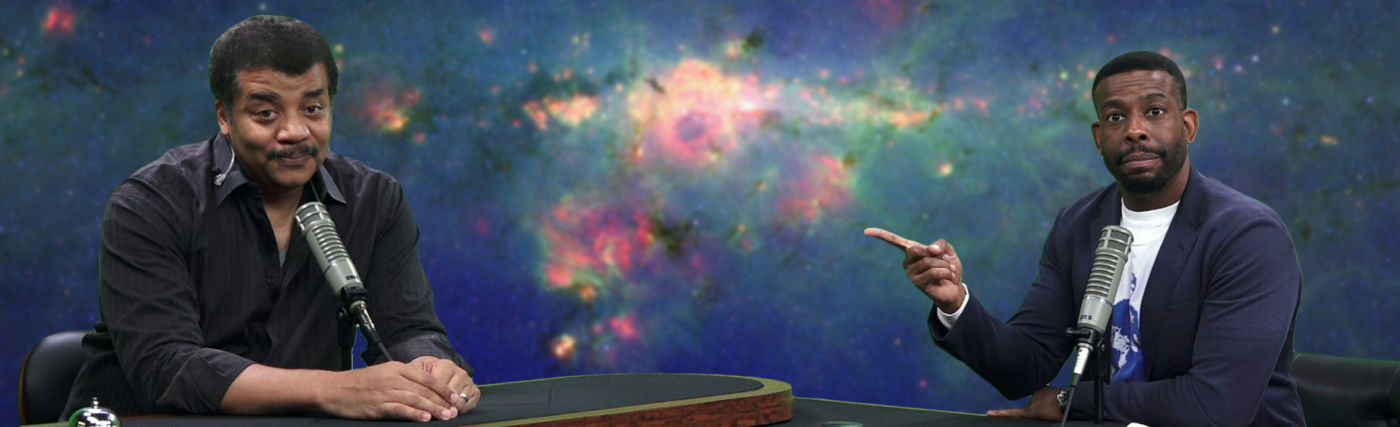
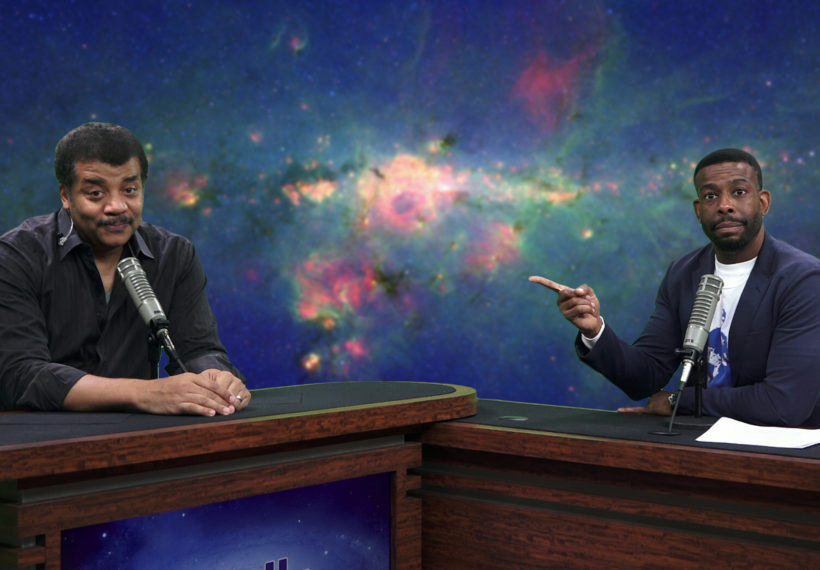

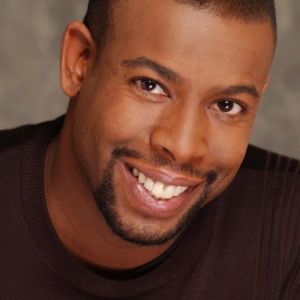
Ben Ratner’s photo of Neil deGrasse Tyson and Chuck Nice.

Cosmic Queries – Office Hours

Credit: Ben Ratner.
  • Free Audio
  • Ad-Free Audio

About This Episode

It’s time for office hours with your own personal astrophysicist! Join Neil deGrasse Tyson and comic co-host Chuck Nice as they answer fan-submitted Cosmic Queries on an array of topics from across the universe to right here on Earth. To start things off, Neil and Chuck delve into the discussion on finding life elsewhere in the universe, what happens if there’s no life to be found, and why the religious debate will be even more fervent if extraterrestrial life is discovered. You’ll learn about space dust: what it is, how it’s formed, and why it wasn’t found in the early infancy of the universe.  Discover whether time expands the same way that space does, and how we can detect it happening. You’ll also hear about Neil’s teaching past, which comes as a surprise to Chuck, and about Neil’s suggestion for a curriculum change in schools. You’ll also learn about finding reliable news sources and learn why Neil is annoyed about the early portrayal of scientists on television and in the movies. All that, plus, our Lightning Round with questions about intergalactic space war, communicating with ET, and what future technology will seem like magic to present day humans.

NOTE: All-Access subscribers can watch or listen to this entire episode commercial-free here: Cosmic Queries – Office Hours.
Transcript

DOWNLOAD SRT
Welcome to StarTalk, your place in the universe where science and pop culture collide. StarTalk begins right now. This is StarTalk Cosmic Queries edition. This particular edition, I'm kind of tired of naming them other things, and I think maybe...
Welcome to StarTalk, your place in the universe where science and pop culture collide. StarTalk begins right now. This is StarTalk Cosmic Queries edition. This particular edition, I'm kind of tired of naming them other things, and I think maybe Chuck, my co-host, the idea came up, maybe we should call these office hours. Office hours. Just to get a little academic flavor back in it. Yeah, right on. Okay, let's experiment with that. It's Cosmic Queries office hours edition. Yes, let's do that. Chuck, good to have you. Good to be here. Always a pleasure. You've been in Aruba for nine days. Yes, my friend. I was in Aruba for nine glorious days. Sporting a nice tan. And thank you. I've been working on this tan for nine days and 40 years. But I have to tell you, after nine days in Aruba, and I do not mean this in an unpatriotic way at all, I hate America. What? No, I'm joking, please. We got some beaches. We do have some nice beaches. I've been to a few nice beaches here in the States, but I gotta tell you, that Eagle Beach, when they call it the second nicest beach in the world, they're not lying. The sand is just the right consistency. You can like the beach without hating America. What's that? You can like the beach without hating America. Yes, but it increases my love for the beach when I actually juxtapose it against my hate for my own country. No. Which by the way, people do not write me, I love this country, this is the best country on the face of the earth, even when I don't agree with what this country is doing, I still love it, okay? So, and all of you need to take a lesson from that, okay? Do people write to you about that? Yeah, people write to me like, people get very upset, they feel as though somehow we're being political on this show, and you know, I write them back because I know for a fact, whether it's you or Bill Nye, and I've met many of your colleagues, that you, especially you and Bill, you are not seeking a political bent, you are not seeking to deliver a political message ever. It is always about critical thought, it is always about the truth, it is always about the science. That is what it's all, and it's always about educating people or getting people to become curious for themselves so that they go find out for themselves. Yeah, yeah, that works. Yeah, and so like, it really pisses me off when people write and say, oh, I like this show before you guys got all political, just because you don't agree with the science. Well, so it reminds me of the moniker that Harry Truman had, they called him Give Him Hell Harry. Give Him Hell Harry, yeah. He said, Harry, why are you always giving people hell? And he said, no, I just give them the truth. Right, they think it's hell. Right, there you go, I like that. I just give them the truth, they think it's hell. So you got questions for me, what do you have? Office hours are open. Office hours are now open, I feel like, what is it, Charlie Brown when he used to go see Lucy and see the doctor is in? Oh yeah, flip the sign over, okay. Flip the sign over. All right, so yeah, we've got our queries from all across the internet, and we always start with a Patreon patron question. Because we are that low. Yes, we are, no shame in this game, baby. Give us some money. I don't know if I'll ever get over this fact, but okay. If you support the show, you get your question up first. Right, you give us some money. Go to the front of the line. We will be your science whore. Okay, that was too much, Chuck. Take it down a notch. All right, here we go. This is Kyle Yokum from Patreon who says this. Kyle Yokum, good name. Yeah, that's a pretty good name. And he spelled it phonetically for me, so, you know. He knows you need help, that's good. That's true, that's so true. It's like, don't eff this one up, Chuck. That's right. So he goes, my name is pronounced Kyle Yokum, and I, oh I should do it a different way. My name is pronounced Kyle Yokum, and I'm from Tennessee. Tennessee, okay, you got it. He says, it seems statistically impossible for life not to exist elsewhere in the universe, but I try to consider all the possibilities to keep an open mind. If we were able to look throughout all the visible cosmos planets by planet, and found no life at all, given our current understanding of the universe, what might be our best scientific explanation for why we would be alone? That, so first, let me reaffirm the statistical unlikelihood of that before I then comment on what happens if it's true. All right. Keep in mind that if life only began yesterday on Earth, it would have taken four and a half billion years for that to happen. Okay. That's a lot of time. A lot of time. It would be pretty clear that whatever it is we call life was hard to happen. Nature was struggling for billions of years. But that's not what actually happened. We have the ingredients of life on Earth, hydrogen, oxygen, carbon, nitrogen, other, and they're all here on Earth as they are everywhere else in the universe, practically everywhere else in the universe. These are the most common ingredients out there. One for one. Number one ingredient in the universe is hydrogen. Number one element in life on Earth is hydrogen. Number two in the universe is helium, but it's chemically inert, can't use it. Right. So put that, you can breathe it. Right. It's great for parties. Great for parties, but you don't interact with it chemically. It's good for YouTube videos. So next in the universe is oxygen. Right. It's the next most abundant element in life on Earth. And that oxygen and the hydrogen come together as water. Right. Okay, and you will also find hydrogen and oxygen in other molecules, but we're mostly water by weight. Okay, next is carbon. We're carbon-based life. Right. And so carbon is next in order in life. It is next in order in the universe. So these ingredients for life on Earth are everywhere. Right, and so the recipe for this is actually the universe itself. The universe itself. The universe itself. Now, so you have the ingredients. Now you need conditions. Right. Okay, so whatever were the conditions on the early Earth, we have to ask were they unique in the galaxy or are they approximately repeated elsewhere? In our current catalogs, we have rising through one or two dozen planets in the Goldilocks zone of their host star. Right. As are we on Earth. Right. So you have all the base ingredients and in the tiny little blip of the universe we have explored in search for planets, we have found one or two dozen planets in their Goldilocks zone. So now you ask how long would it take? So you look on Earth and the evidence, and recent evidence shows we have possible signatures of life on Earth as early as 4.2 billion years ago. Earth only began 4.5 billion years ago. So, but let's even pull that in because that was very recent data and maybe it'll be overturned. Before that, the best evidence puts it at 3.8 to 4 billion years. That means Earth was around for like a half a billion years, then there was life. Then something happened. Then something happened. All by itself, there it is. Ingredients, the time. And the conditions. The conditions, and it's not billions of years, it's half a billion years. So however much challenge we have creating life in the laboratory from simple organic molecules, nature managed to do it all by itself. So hence the statistical unlikelihood of it. But if we go around and search every single planet in the galaxy, which is more realistic than the whole universe, are we gonna travel between galaxies? We don't know how to do that yet. We ain't there yet. But our whole galaxy still, and there's no other life, that would force us to look back to Earth and ask, was there something truly unusual that happened on Earth? Our star is an odd location of our planet, the mass of our planet, the fact that there's water, the fact that none of that is, so we'd have to find something that was unusual to enable it happening here and then have it happen nowhere else. Alien DNA. Which, of course, negates the entire supposition of this whole question, right? It means it came from somewhere else. Right, exactly. But no, but then if it came from aliens, we'd find the aliens. We'd have to find the aliens, right. That's why I said it negates the supposition of the entire question. Exactly. Go ahead. So science would then turn to wondering what would be sort of uniquely, it would have to be a one in a billion, well, however many planets are out there, it would have to be so rare that it would happen one in that many planets. Right. Okay, so let's say there's 10 billion planets. It would be one in 10 billion chance of something happening on Earth. But the same thing is, like you said, all of those planets have the same building blocks that we do. Yes. So what could that one thing be? That's what I'm saying. Science would have to turn to then try to answer that question. Oh, I got you. That's what it would be. I got you. That's all. So you would have to isolate that one difference. And it's very hard to come up with a strong idea about how and why something is when you only have one example of it. Right. So it's kind of like when the scientist goes into the laboratory and he's looking for the recipe for superhuman strength. And then all of a sudden, a small dog enters the laboratory and knocks over all the ingredients and they come together in a little slurry and they start sparkling and he falls down and slips in it and then he gets up and he's a superhero. There you go. That's the one in a hundred billion thing. That's the thing. And may I add, that is how the Powerpuff Girls were made. Are you for real? Yes. Awesome. By the way, how do you know the Powerpuff Girls, which I love? Powerpuff Girls. You gotta love me some Powerpuff Girls. I do not know their origin story. You don't know their origin story? I did not, but I do love the Powerpuff Girls because I have a daughter and a younger daughter. So there's the father, who's a scientist, in the lab. He's in his basement in the lab. He's trying to mix these ingredients to create the perfect children. Really? The perfect girls. And so he mixes together sugar, spice, and everything nice. And as he stirs it, there's an accident in the lab and chemical X pours into this ingredient. And then there's an explosion and out come three adorable little girls with superpowers. I had no idea. Chemical X, the Powerpuff Girl. Chemical X is the Powerpuff Girl. Oh, that's cool. So that's your scenario. Yeah, that is my scenario. That's very cool. All right. Well, there you have it, buddy. Kyle, that's it. So here, let me just add, because you know where he's going with that. Yes, of course. So you might ask, will there be something that will compel scientists to say, oh, God did it? Well, yes. Because this is, you know, fundamental, like many religions would assert that Earth is the purpose of the universe and life on Earth, human life on Earth is the object of God's affection anywhere in the universe. So I can tell you that that, I don't know how quickly anyone would start thinking that, but what I can say is that if life on Earth were divinely created... And somehow we're forced to that conclusion. It does not force us to any other divine conclusion. Right. Right. That would be the extent of what you could conclude. Exactly. Because you would be able to now isolate the fact that this is indeed a creation. However, what you cannot do is infer from that creation the intentions of that creator. Or all the tracks that people have put forth that according to their respective religions was divinely revealed. Exactly. You must behave this way and worship on this day and eat this food and don't eat that food and treat each other this way and not the other way. All of this is sort of the packaging of ancient religions as well as modern religions that are not required by the scientist who might land there if, in fact, Earth is the only place with life in the universe. Right. Well, once again, as a scientist, what you would do now is you would have to say, now I need definitive proof that I am supposed to act this way or eat this food or I need other evidence. So now that the evidence has actually said, yes, we are, this is the one thing, we are, the ingredient X, chemical X, chemical X is God. By the way, you would have to also add the fact, also add the fact, and I posted this during the Super Bowl, where if the football field is a timeline of the universe, where one goal line is the Big Bang and modern day is the other goal line, then the thickness, then the thickness, the width, the thickness of a blade of turf in the far end zone equals the time from cavemen to modern day. Holy crap. So, if according to the Catholic Church, which accepts evolution but asserts that at some point God breathed a soul into primates and that would make us humans distinct from other primates, that would have happened somewhere in that blade of grass. So, my point is, if you're going to say God created the universe and created humans in his image, which is what one might find in Christianity, it would be kind of hard to account and we're the only life in the universe, such that. It would be hard to say, well, what? What is all that other stuff for? You got the whole rest of the timeline. If, really, all this was created for us, why do we miss out on 13 billion years of cosmic history? Why do you wait so long? These would be sensible questions that philosophers would ask. Right. And then, well, yeah, and the answer would be because there is no time for him and so it's no big deal, no matter how long. You got the answer already. Yeah, the answer is there's no time for God because he is from everlasting to everlasting. Therefore, time and space exist within him so he does not have to worry about time or space because all those things exist inside of him. You got your catechism hat on. Preacher, preacher man, go for it. Listen, I know all this stuff. He got the explanation. Yeah, that would be the explanation. But what I would say, you can flip it and say, if your religion requires that human life is the only life and is the purpose of creation, and we do find other life, will you abandon your religion? Right. Now, that's a very good question. That just flips the table. What does that do to the person who believes? Or you find an alien species smarter than we are, who can just completely manipulate us and put us in a zoo for their entertainment. They now become God? So, depending on what powers they exhibit, if they don't have the powers that your God and your religion assert, then you can't then directly say that they're God. Or if they look really different from us, we're not in God's image. We're not in God's image. That's funny. Right. So, just to be fair in that rotisserie there. I got you. I got you. That's good stuff, man. That's good stuff. Almost the whole segment on that one. I know we did. But guess what? It was really good. I mean, Kyle, that's a great question. And quite frankly, I found it fascinating because... You had your preacher hat on there. And listen, these are the things that people think about this stuff all the time. And to great peril, for the most part, there's a lot of people who this becomes confusing, and then that confusion leads to anger. You only really have conflict when you are so certain of your religious beliefs and so certain that everyone else is wrong in their religious beliefs, and then you take arms against them. And see, I believe that that comes out of just the opposite, to be honest. It comes out of the opposite sentiment. If you know for a fact you have the truth, then you can rest easy in that truth. Well, you should be able to, you'd think. And you'd fear nothing. Chuck, you just ate up the last two minutes of this. We can't even get another question. How about, why don't you tease the question? What's the next question? Okay, so that's what we'll do. We will tease the question, and so this is what Michael Ranger from Twitter would like to know. What's the deal with space dust? Is it dust? Is it gas? Is it rocks? What's the deal? Good question. What we will get to when we come back to StarTalk Cosmic Queries Office Hours edition. All right, catch you in a minute. If you didn't otherwise know by now, I also serve as the director of New York City's Hayden Planetarium, which is part of the American Museum of Natural History. Chuck Nice, tweeting at ChuckNiceComic. Yes, sir, thank you. Nice. Yes, I am. Nice. Nice. So this is Cosmic Queries Office Hours. Office Hours. We're just trying to rebrand it. We'll fix you if that flies. We'll see what happens. Good little sign. All right, put it out there. Office Hours. Get one made. The doctor is in. And you are the good doctor. So let's move back to our queries in the form of a question that we already did. Teased one at the end of the last segment. What was it? And it was from Michael Ranger. And he says, what's the deal with space dust? Is it dust? Is it rocks? What's the deal? It was really Jerry Seinfeld. It's really Jerry Seinfeld coming to us in the form of Michael Rangers. So dust in the universe has a very specific meaning. So if you look at clouds between the stars, these are the things that make up some of the most beautiful photographs that you've ever seen from space, especially via the Hubble Telescope. So those gas clouds, some are sloughed off from stars, others are stellar nurseries ready to hatch newborn stars deep within. So we call it the interstellar medium. And it can be in a gaseous state, with just gas atoms and gas molecules, hydrogen, nitrogen, oxygen, this sort of thing. They can make molecules in the form of carbon monoxide, carbon dioxide. Hydrogen makes a molecule with itself, H2, we call it. It's stuck up hydrogen. It's stuck in with itself. It's not the only one, nitrogen binds with itself to make N2, oxygen, so we're not alone in this. So if the gas cloud is dense enough, there'll be pockets of it, where the molecules come together and make really big molecules. Really, really, really big things. And we have a place where really, really big molecules come together, it behaves differently in the transmission of light from behind it to in front of it. It absorbs light in a way that turns the light red. And so we call it reddening. Reddening. It turns it red, it's called reddening, right? So only when it becomes large enough to do that do we then call it dust. That's all. So when it gets, okay, I gotcha. So these clumps of molecules that come together, once they do that. They make huge, huge things, right. Once they do that. Once they do that, that's when it's dust. When you have enough of that to affect the optics of the cloud, then we call that dust. And it reddens stars behind them. And so we used to think that certain stars were only red because they were behind these gas clouds. And then we learned about this phenomenon in the 20th century, by the way. So it's a relatively modern discovery, given the history of astronomy. And so when we say, when I say we are stardust, it is a figuratively and literally true thing because you're not gonna form stars and planets until these atoms become molecules, the molecules become dust, and out of this dust cloud do you condense the planets. Okay, but now, a little bit of a loosey-goosey there because typically when you form a planet, stuff heats up again. Right. And it can get so hot that it breaks apart all the dust molecules. Oh. Yeah, because heat will destroy big molecules. Right. So it's, when I say we are stardust, the dust didn't stay intact before it became us. Then it would be supremely poetically true. But nonetheless, the gas clouds that make star systems, they start out as dust. And so that's why I feel comfortable saying that. But if you want to take me to the limit, I'll then give you that full explanation. Right. As you just did. Yes. So the dust itself is really on a molecular level. It's not the dust that we think of when we see dust. It's way smaller. It's not the dust that we see like when a shaft of light is coming through a window in your home and you see these little particulates floating in the air. It's smaller than that. It's much smaller than that. And it's molecules coming together. And by the way, there are ways that molecules stick together that don't involve complete up-atomic electronic bonds. So when two atoms come together, they're sharing or exchanging electrons. So that's an electronic bond. And then when you get really big, you can have molecules attached together just because their shapes fit. Just because there's something. I found you. I can't believe we fit together like this, girl. Oh. So there are other ways that you can stick molecules together. And when that begins to happen, that's when you get these phenomena. Oh man, that's so cool. All right, who knew there was so much in dust? By the way, in the very early universe, before the stars made the heavy elements like carbon, nitrogen, oxygen, the universe was born with hydrogen and helium, primarily. All the rest came later, in stars, okay? In the early universe, when they had gas clouds, there would not have been dust, because you need all those other atoms to build up and make dust. There you go. Early universe tends to be rather dust-free. Nice, right. So we were much cleaner. That's cleaner back in the day, baby. Freshly born. Yes, we're freshly born. Mmm, you got that new universe smell. Oh, very cool question, Michael Ranger. All right, let's move on. Office hours are open. Office hours are still open. The universe. All right, here we go. Gaetano Marrone wants to know this. Thanks for that name, by the way. Frickin hate your parents. He wants to know this, says does time expand the same way and for the same reason as space? So that's a great question. Yes. Okay, time is a coordinate. All the other coordinates are stretching out. Why can't time? Can't time. Why not? So we don't have evidence of this. It would have been kind of cool if that were the case. We just don't have evidence of it. And so, what would the evidence be? When we look out to space, we see things not as they are, but as they once were. Because it takes time for light to reach us. That's the way my wife looks at me. As I am, but as I once was. Thank you, baby. Please don't ever see me as I am now. So, it means if there's anything that was affected by time being compressed in the past, relative to today, it would manifest in the physical phenomena that we observe. Okay, so maybe things would happen faster. If time is compressed. So one second today is stretched out, one second back then is tight. If you want to put it that way. That way. So you look back then, no, things are not happening faster. Things are not, everything is still working then the way it works now. The closest we've gotten to this is a research paper that I happen to be co-author on. Woo. The lead author of whom ended up getting the Nobel Prize. What? Which was a piece of a much larger research project that he did. His name is Brian Schmidt. So he headed a team that discovered that the universe was expanding faster than it should have, that it shouldn't be, and that was the co-discovery of dark energy. Accelerating universe. Accelerating universe. And this paper was early work that all came together in his big project to study what exploding stars are doing nearby and far away. So what we have in that paper, the very first measurement ever, is an exploding star far away and an exploding star nearby. Okay. They should, according to other, for other reasons, be exactly the same in how fast they get bright and how fast they become dim again. Okay. The star blew up. Right. You can measure this. Right. It was just a regular star, got bright, then it started getting dimmer again. Okay. We know what that should look like. Because we've modeled it, okay? So now we look at the one far away and it doesn't match. We say, how come it doesn't match? Oh my gosh. Is it a different kind of exploding star? Then you invoke Einstein's general theory of relativity to show that since that light has been traveling long ago, the universe has expanded. Mm-hm. So that time intervals of when stuff happened has been stretched out over that time, in the time it took to reach us. Mm-hm. If you take that, what we call light curve, invoke Einstein's relativity on it, it stretches to what it needs to be, and then it matches exactly the nearby exploding star. In other words, the universe really is expanding. And the ticks on a clock get stretched out while it is moving through the expanding universe. That's the whole thing. Wow. Okay. That's insane. That's what's throwing down. That's what's going down. But the event itself, we have no reason to presume it happened at any different rate than nearby. Right. Everything we understand about an expanding universe says, this is what will happen to that signal en route. And that's why you need relativity to apply to that. Otherwise, you have no handle on the universe. Yeah, you wouldn't be able to say, right. Just be mysterious things going on. Exactly. Oh my god, that's amazing. Yeah. Yeah, we were quite proud of that result. The first time, now it's just a routine thing. What an understatement. Oh, you know, we were quite proud of it. No, but now it's a routine thing. I mean, you just say, oh, the light curve doesn't fit. Let's see what it needs to be for being at that distance. And then you do that, and then it fits exactly. It fits perfectly. Every single time. Just fits exactly. Wow. That is really... No, you could assert that time was different then, and it didn't change on route here. Okay? But I would then say, I would say, because the universe is expanding, we expect that to happen. So, and when it does happen, we're not then looking for other explanations. If we did that in science, you'd be... Well, yeah, you never go from any place you are. You never go any place, you know, right, right. You stay right there, just looking for other different things that it could be. That it could be when what you have is a perfectly fine explanation. And this is already working. Works experimentally and theoretically. Generally, when you have that agreement, you move on. Right. Wow, man, that was a great question. Hey, Getano, Getano Morone, that was a really... I want you to apologize to Getano's mother. I'm sorry, Mrs. Getano Morone. Just because you have a simple, boring name, this doesn't mean everyone else has to. So you have to, so you don't mess up reading their names. Yeah, well, Mrs. Morone, your scion is quite profound and we appreciate their question. All right, let's get to Jet Kusanji. Did they say it? Tweeting to us from At The Fury, wait, At Jet The Fury. At The Fury, okay. At The Fury, how cool is that? Do you think if in the past, scientists weren't always portrayed as evil, the public would be less anti-science? And I mean, like in the movies and television, the scientist is always the bad guy. Yes, next question. I should have saved that for the lightning round, I guess. Okay, so first of all, the scientists were not, I don't think that's the biggest problem with the portrayal of scientists, historically. Really? Because there were maybe a third of those scientists were not evil, were co-opted by an evil genius, or an evil, a ne'er-do-good-doer, whatever you call it. Right, ne'er-do-weller. Ne'er-do-weller, thank you. So for example, in the old Superman television series, there was always some scientist that was helping the criminal do their work, but didn't really want to. That's true. A lot of times, the scientist was an unwilling participant. Unwilling participant. Unwilling participant. True. That was even the case in Back to the Future. That is true, yes. Where the Libyan terrorist wanted Doc to make a bomb out of the plutonium. Right, and he just wanted the money for his research, so he double-crossed them. Exactly, exactly. So, as any good scientist should do, if you're given money to make a bomb by terrorists, right? Exactly. Now, who else did that is, of course, Iron Man. That is correct, he denounced. No, no, they wanted him to make a bomb. Yeah. So, I'm making a bomb, get out of here. Right, and then he made a suit. And then he made a suit. Escaped with it. But that was a little bit more for self-preservation. He needed that suit to get out of there. But then even after that, he was like, I don't wanna make weapons anymore. I wanna do something good with this power source I discovered. Exactly. So, my issue with the portrayal of scientists is not that they were more than half the time shown as evil or evil geniuses. It's that they were never shown to be completely human in all emotional dimensions. That is true. They're very one-dimensional characters. And it was like, Doc, is the world gonna end or not? And you go behind the lab table and they got the lab coat on and the wire hair and they say, well, the interaction of the thing, give me it in English, Doc. And then someone else translated and that's all you see, the Doc? That's all you see. That's all you see. You come in and you leave. The first attempt to flesh out doctors that I know of and that I have seen was in CSI, which portrayed scientifically literate trained people as beautiful people you might want to be. Yeah, I was gonna say, yeah, and they were all hot. Good looking, A, smart, B, they have fully fleshed out characters. They fall in love, they have jealousy, they have kids, they're married, they divorce. Then they become real people, like any other character that storytellers have been sharing with us. That, for me, was the transition that was most important. And now make them evil or happy, who cares? And now you see more developed scientific characters in everything. Everything. Everything. Everything, yes. Well, that's cool, man. That's very, very cool. Well, there you go. Out of time in that segment. Yeah, at the Jet Fury, there's a question. So there's your answer. When we come back, we'll do more of the Office Hours segment of Cosmic Queries on StarTalk. StarTalk, Cosmic Queries, Neil deGrasse Tyson here. This is the Office Hours edition, which is just what we've called, you know, Pope- Cosmic Queries, Pope- Cosmic Queries, Pope- Galactic Gumbo. Gumbo, that was a good one, Galactic Gumbo. So. Maybe we should take a fan vote to see what- It's not a bad idea. I'm kinda leaning into the gumbo, but Office Hours is so natural and so quaint, and I used to hold Office Hours when I was teaching. So it's just, you're there, you know, and it's like selling lemonade. You're not chasing after people, it's just there. That's funny. And you either show up or you don't. Wait, I didn't know you taught. What, what, what, what, jeet, ah, ah! I did not know that. Of course I did. I taught for years and years. That's gotta be weird. There are people out there who is like, that guy used to be my teacher. Yes, yes, yeah, they're out there. That's cool. Well, there's a larger set that were out there for classes that I TA'd for. I was a teaching assistant while you were a graduate student. Right. And there's thousands of students from that era. And then afterwards, then I teach, I taught intro astronomy and some advanced classes. You must have been very good. And I'll tell you why. Because with the notoriety that you now hold, which is fame for doing bad things, by the way. No, it's not. Yes, it is. Notary country, notorious. Let me tell you something. Notorious, I'm just telling you. According to three separate sources, you are the second famous scientist of all time from three different separate sources. You're the second most famous scientist in all of scientific history, okay? The first, and it's... I would list like Copernicus and Newton and Galileo. That's because you're a scientist. Darwin and Einstein and Feynman. Okay, but see... Stephen Hawking and... See, you... Democritus. We're talking about America, though, here, man. See, all those people you just mentioned, you gotta read. To know about them. You gotta read. So, in a random sample, I gotta tell you, in a random... Just look at TV. Also, too, in a random sampling, what's going to happen is, whatever's the first person that pops into your head is who you're going to say, okay? So, I understand what you're saying. Like, oh, Einstein, clearly, I get it. But, no, if you just were to stop somebody on the street, the first thing that's going to pop into their head is the person that they're most familiar with. Most in their face. Right, and so according to the surveys, it's Carl Sagan, you, and then Stephen Hawking. Wow. Good for Carl Sagan. The boy's been dead for 20 years, and he's still keeping it going. But you know what? It goes to show the power of media, though. Because most people know Carl Sagan because they know him from seeing him on television and seeing him on The Tonight Show. I've seen him billions and billions of times. Billions. Billions. So, what I'm saying is you have to- To immortalize the turtleneck. That's true. Nobody word better. But what I'm saying is you have to have been a really great teacher. And the reason is, with being as notable as you are, there would be a plethora of people on the internet going, yeah, I had that guy as a teacher. Oh. He fucking, I'm sorry, oh my God, I'm sorry. He freaking sucked. Oh. You understand me? It would have come back in your face. There's no way you could be as ever present as you are with the media presence that you have and have been a bad teacher because it would be too many opportunities for people to go on social media, to go on all different kinds of platforms and say, oh, I had that dude as a teacher. He sucked. And that's not out there at all. So you had to be great. Okay, well, thanks for those brilliant deductions. But I'm still saying Notorious means you are famous for doing something bad. Okay, I know what those are. Well, thank you for patronizing me. No, no, no, I mean, notoriety comes from Notorious. Notorious, correct. No, you're right. But no, so that's great. You used to be a teacher. Yeah, yeah, probably. There are probably five or 6,000 students out there who were my former students. Cool. I graded their homework and their exams and everything. Oh, yeah. That is so funny. I didn't know you didn't know this. I did not know that. I wonder if these people kept their papers now. I got an A plus from Neil deGrasse Tyson. I don't know that I signed them, though. Yeah, I guess so. See, my teacher signed mine, but it was with a note that said, please come and see me. See me. This is Crabapple. There must be done about your son. Go to the principal immediately. What do you have? Office hours. All right, here we go. Here we go. Jessica Schaffner from Facebook. And Jessica says this. How can the average consumer of news know which sources are the most reliable? Taking it a step further, how can we find sources that are unbiased and reliable? So now the only reason I ask that is because, as a scientist, I know that you have a discipline, as I'll call it, for all information, because I know all scientists do. That's a good word. Yeah, yeah, so, all right. There's no way escaping this. If you want to be insulated from complete charlatans out there, creating websites that are either outright fake or websites they think are true, but if you knew anything about the physical universe, you would know that they were not. So there's no other way around this. Science literacy is an inoculation against the claims made by others where they would be exploiting your ignorance of the laws of nature against you in their favor. Right. Okay, so, your education, your base of education matters here. But of course, the catch-22 is you wanna get educated from the internet. Okay, so, in the days when you learned via books, there were editors at publishing houses and publishing houses had integrity and they had- Standards. Standards. Right. And you had to get through a copy editor, a content editor, a final editor, the editor-in-chief. All of my early writings had these kinds of filters. And I would take, on my purpose, we take it to colleagues of mine who would give it a fresh look. As I'm writing about science, if it's their expertise and I'm stepping a little bit out of my expertise, they might have insights that I don't have. So you have to recognize the possibility that you could be wrong at all times. Only then do you then seek out supporting or conflicting information that you then have to sift through. All right. So I would say, short of curricula in the school system, having a new branch called how to be internet savvy. That's something we need. Which is not there. School systems still views us as empty vessels where they pry open your head and pour in information. And then they stitch it back up and say, now go forth. Go forth. Go forth. Go forth, young Frankenstein. Frankenstein. Never gets old, I'm sorry. Frankenstein. So, what am I saying? I'm sorry. Instead of stitching your head up, instead of you go forth. Go forth. Okay, so in there, the curriculum has to have added elements that basically is a BS detector. A baloney sandwich detector. So in there, you invoke. You say, all right, does this website have something to gain by having me read their content? Are they trying to sell me something? Are they, generally, people who are highly educated are sort of less susceptible to things that would exploit ignorance. Because when you're educated, you have less ignorance. Right, there's a wider base from which to work. Exactly. You have a wider base of information from which to work. You're a little better protected. So if you're gonna choose a website, I would lean towards.edu websites. Ah, nice. Many universities, whole courses are online. Look at that. Whole courses are online now. On all manner of topics. That's good stuff. Okay, and now I don't know if you can be a.edu, obviously which stands for education, site and then not be an educational institution. I don't know, but check, track institutions. Especially the big ones. UC Berkeley, MIT, just the University of California system, the University of Minnesota, University of Chicago. These huge places tend to have a lot of courses and a lot of professors who are eager to put their stuff online. And I've brushed up on many a topic just by looking at somebody's course curriculum that they were teaching. So- Great, that's a great, I've never even considered that. That would be content. Then stay with the EDU, then look at political commentary there. Look at the political science classes because they'll be more likely to compare and contrast rather than to try to get you to do one thing or another. Okay, so you might say, oh, but wait a minute, academia is a bastion of liberal whatever. You might say that, but don't confuse knowing what is true with that which happens to be true conflicting with your political philosophy. These are two different issues. So just I wanna make that clear. Okay, we gotta go to lightning round. Lightning round, let's do it! What do you have? Okay, here we go. Next after dot coms, I mean dot edu's would be dot orgs. Museums are dot orgs, for example, and things like that. Okay, let's find out, let's go. All right, here we go, lightning round. The lightning round, Kerry Bailey coming to us from Twitter says, how ill-prepared is Earth for an intergalactic space war such as in the Avengers? Ha, ha, ha! Ha, ha, ha! Well, I'm pissed off that, you know, in my day, superheroes would stop the criminals in the street. Right. Make your life safer. Exactly. Now, they're all just fighting each other. Yes. And why do they gotta come to Earth to fight each other? Why some other damn planet? Well, you know, that's because we have better special effects now. Because back in the day, they had to just fight in the street there, but now we can knock down whole buildings. That's why they always come to New York. Why you fighting in my city? You never see the Avengers fight in Iowa. Because there ain't nothing to knock down. They destroyed four cornfields. This is crazy. Like. No, but yeah, have your fight on some other damn planet, or do it in the Mojave Desert, but stay out of my streets. There you go. New York, all right? So no, we're not prepared. We direct them to the fighting zones. Fight somewhere in the Siberian tundra, whatever. So no, we're not prepared for this. No. Okay, there you go. Anthony Fisher from Facebook would like to know, if you could ask an ET, an extraterrestrial intelligence, just three questions, what would they be? Please help us save us from ourselves. That's question one. Question one. Question two, I would pull out a periodic table of elements and a few other pictographic aspects of our scientific discovery and say, how does this match with what you guys have found in this universe? Because if they speak any language, it's gonna be science and math, not French or English, even though the Bible was written in English. So your point of communication is gonna need to be something mathematical or scientific, contrary to what was part of the story message in the film Arrival. They needed an anthropological linguist. It's like, no, that ain't how that would go down. They flew here in a spaceship that's floating over your thing. It ain't hieroglyphics. It ain't gonna be hieroglyphics. There's some science at work there. Let's get that figured out. Third question might be, have they figured out the origin of life and the origin of what was around before the universe? Those are our biggest outstanding questions. That's what I would do. All right. Then I'd take them to lunch. Give them a beer. Wait. I was gonna say, what if you are lunch? Take them to a bar and see what more they'll divulge. There you go. Tell them for one last question. Okay, go. Dycheon, VX9 wants to know this. Is sufficiently advanced tech is indistinguishable from magic. What future tech will look like magic to us today? Good question, dude. So, I can't answer that, but what I will answer is, let us take your smartphone. Today's smartphone. Right. Today's smartphone was magic 11 years ago. That's pretty true, yeah. That's why, what? Oh my gosh. You could do that. You could find grandma's house. You could what? It's got GPS in it. Porn right in my hand. What? Oh my God. You'd have all of Beethoven symphonies right there. The entire, every religious text in the world right there. If it takes up too much space, just delete it, right? People would, I think about what I would show Isaac Newton and what would make his head explode. So that is, I think, the best example that we have today that in our own lifetimes would have been viewed as magic. Just complete outright magic. Another one is, have you seen the extremely thin flat but curved panel TV? Oh God, yes. It's like a sixteenth of an inch. Oh God, they're beautiful. You look behind and say, where's this guy, how you doin this? There's the rest of the example. So 10 years ago, that would have been magic. As we're lifting 100 pound flat panels, tryin to connect them onto mounting brackets. So I like thinking what today was magic 10 years ago, and there's a lot. So yeah, I just, I think investments in sci-tech will keep that goin. And on my deathbed, one of the things I will regret was not being alive just another 10 years more to see what the next thing will be. What the next thing will be. What the next thing will be. Nice. Chuck, we gotta call it a quits here. All right. All right, Chuck Nice, always good to have you, man. Always a pleasure, thank you. All right, thanks for coming back from Aruba on your vacation of nine days. Didn't wanna do it. Next time you're gonna call in your next thing. I'm in Aruba, I ain't comin back, so deal with it. Honey, I'm never comin home. You've been watching, perhaps, but more likely listening to StarTalk, Cosmic Queries, Office Hours edition. I've been your host, Neil deGrasse Tyson. Until next time, keep looking up.
See the full transcript

In This Episode

Get the most out of StarTalk!

Ad-Free Audio Downloads
Priority Cosmic Queries
Patreon Exclusive AMAs
Signed Books from Neil
Live Streams with Neil
Learn the Meaning of Life
...and much more

Episode Topics