



 Unlock with Patreon
About This Episode
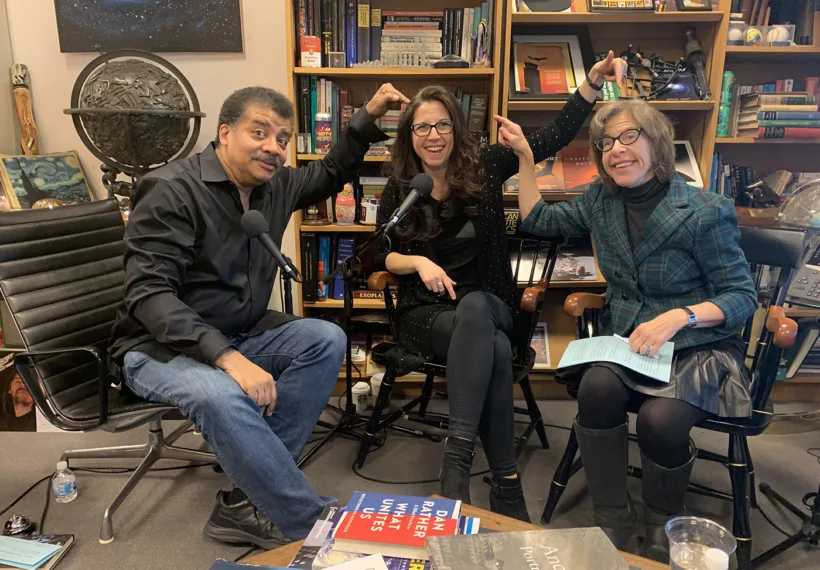
On this episode of StarTalk Radio, we try and solve some of the mysteries of the ever-evolving, ever-eluding human brain. Neil deGrasse Tyson is joined by first-time comic co-host Jackie Hoffman, and neuroscientist and StarTalk All-Stars host Heather Berlin, PhD, to help answer fan-submitted questions on an array of neuroscientific topics.
You’ll learn how male and female brains differ. We explore the colorful world of psychedelic drugs. Find out why taking psychedelics is like putting your brain into a dream state. We discuss how psychedelic drugs allow unfiltered information from the world to enter your brain. Heather shocks Jackie by revealing that everyone is hallucinating most of the time as we try and break down the nature of our reality. We also discuss the idea that some people claim to see insight into the universe and beyond when experimenting with psychedelics.
Next, investigate our reality and if it’s possible that everything we experience is a figment of our imagination. As part of the discussion we take a look back at movies like The Matrix and Total Recall. You’ll explore turning certain sensory information into different sensory information, like when a blind person turns visual information into audio information for the brain to process. You’ll also discover more about synesthesia.
Finally, we explore the current state of mental health awareness. Dive into dreams as we break down the importance, or non-importance, of what your dreams are about. Neil and Heather point out the merit and flaws of Freud’s The Interpretation of Dreams. You’ll find out what it means to “focus” on something. We ponder whether or not brain transplants will ever become a reality. We also wonder if you’ll be able to implant memories. All that, plus, we ask, “Do you need a brain to feel pain?”
NOTE: All-Access subscribers can watch or listen to this entire episode commercial-free here: Cosmic Queries – Neuroscience.
Transcript
DOWNLOAD SRTFrom the American Museum of Natural History in New York City, and beaming out across all of space and time.
This is StarTalk, where science and pop culture collide.
This is StarTalk.
I’m your host, Neil deGrasse Tyson, your personal astrophysicist.
And this episode of StarTalk, a Cosmic Queries edition, is focusing on neuroscience.
And we go to our go-to person for that, and that would be the none other than Heather Berlin.
Heather, welcome back to StarTalk for the millionth time.
Thanks, I love, always love being here.
You’re all excellent, thank you, thank you.
And you are a neuroscientist at Mount Sinai, is that correct?
Is that a good way to say that?
And you focus on what people are thinking when they don’t know they’re thinking?
But no, I studied brains and how they relate to human thoughts, behaviors, whether they’re conscious or unconscious.
Okay, that’s scary, actually.
And we have a first timer here, my co-host, Jackie Hoffman, Jackie, welcome.
Thank you, Neil.
You’re a comedian?
I am, an actress slash comedian.
In that order?
Well, yes.
Right now, I’m doing more acting than comediening.
And I had a hysterectomy at Mount Sinai.
Oh, congratulations.
That’s a TMI, is that a TMI?
I hope they did a good job.
It’s uterus awareness week.
Uterus awareness, okay.
So let me join you in that and say I was born in Mount Sinai.
Really?
Yes.
And both my children were born in Mount Sinai.
Okay, but I never had a hysterectomy there.
No, that’s…
You never know.
Roll you into the wrong room.
So Jackie, you also an actress, you had a role in Legally Blonde 2.
Yes, Neil remembered my joke, my line.
What was it?
It was one line, your dogs are gay.
Okay.
It changed the world.
I would have given you more lines than that if I were producer of Legally Blonde 2.
Thank you.
Okay, so also you are in a all Yiddish production of Fiddler on the Roof, off Broadway, right now.
That is correct.
That’s crazy.
With English subtitles, don’t panic.
Okay, Yiddish has gotta be like that’s how it would have been.
They would have been speaking Yiddish.
That is correct, yes.
Singing and dancing Yiddish.
And your character is?
Yenta the matchmaker.
Yenta, you can’t get more Yenta than being Yenta.
Shadchan, as we say in Yiddish.
So basically, you’re playing my grandmother.
Very cool.
So since this is Cosmic Queries, we solicited from our fan base questions for this episode on neuroscience.
Great.
And what a topic that has become, Heather.
There was a word no one knew 20 years ago, and now everybody’s into it.
So.
I mean, I knew about it, but I mean.
Okay, not that nobody knew.
Nobody else knew.
And so, Jackie, you have the questions.
I haven’t seen them.
Neither has Heather.
And these are questions.
Bring it on.
Let’s see what we’ve got.
Okay, our first comes from John Emerson from Patreon.
I don’t know what that is.
That’s our, they’re a support website that help fund our operation.
Oh, nice.
I thought it was a tequila.
So that’s why you’re reading their question first.
I see.
That’s one of the perks, of the many perks you get as being a Patreon supporter.
The patrons at Patreon, Patreon, thank you.
Okay, I’ve heard that men are from Mars and women are from Venus.
Well, that a little bit involves you, Neil.
Yeah, that’s my expertise, Mars and Venus, all right.
I’ve heard that men are from Mars and women are from Venus, but are there any neurological differences between these two planetary species?
That’s a good question for Yenta the matchmaker, too.
It’s actually, it’s been controversial in the past because often it’s not been PC to say that there are differences between men and women’s brains, but there are, there are.
They’re both sort of anatomical differences, neurochemical differences, hormones that affect brain chemistry like oxytocin, things like testosterone and estrogen affect how the brain works.
So we know that, for example, on average, and these are all, again, on average, women have slightly larger hippocampi, which is the part of the brain that has to do with memory.
They tend to store emotional memories better than men.
They tend to ruminate on things a little bit more than men, as we might know anecdotally.
And in terms of the way their brains are wired up, it’s slightly different.
Female, female, yeah.
Language, which tends to be lateralized, meaning that it’s more localized on the left side.
Lateralized would mean it’s featured more, for anything, would mean it’s more on one side than the other.
Exactly.
Lateralized.
Lateralized.
So it tends to be more lateralized than men, meaning that more of their language is just on the left side, whereas women tend to have language in both hemispheres, like parts of the brain that are dedicated to language processing.
They tend to use more words just behaviorally during the day than men.
So there are certain aspects of the woman’s brain, both anatomically and physiologically, that differ from men, and they express themselves in different ways, behaviorally, emotionally, in terms of cognition.
So has this gotten resistance from society to even have that conversation?
There’s some, because then the idea is like, well, then there’s this myth, like, okay, well, a bigger brain must be better.
Men, on average, have a physically larger brain, but that’s not true in terms of intelligence, in terms of cognitive function.
It’s about how it’s wired up.
It’s not about the size.
But people did get scared away from this because the idea, famously, I think it was Larry Summers at Harvard who said…
Then president of Harvard.
Yes, exactly.
Women tend to not do as well in math and tech and that kind of thing.
And those things are just not true.
They tend to work in different ways, but there’s no differences in terms of intelligence and correlated to brain size and the rest.
So I think it’s okay to say there are differences and it’s neither good or bad.
It’s just different.
So I thought his argument was the averages are all the same, but men show up wider on the distribution.
So if you try to find the highest performing man, it comes way out on the high performing side.
You also have a much lower man on the other side, lower than you find the lowest woman.
They tend to be more on the extremes.
Right, right.
But again, that’s on average.
So that means that there are women who are at these extremes as well.
On average tend to be more at the men, more at the extremes in terms of that bell curve of IQ.
But if you look at it overall.
A bell curve of anything, right?
I mean, isn’t the shortest person ever a man?
Is that true?
Tom Thumb, I thought, was pretty small, yeah.
But I don’t know if that means that in one average, yeah, I mean, that’s very, you know, an N of one.
But women tend to live longer than men.
So in that sense, we are at the extremes.
We also look at a personality, like for example, charisma, right?
There’s some very charismatic men out there.
And at the other extreme, you have completely, complete sociopaths as men.
Men do the most heinous social things ever, right?
So again, we have these extremes that the men are overpopulating.
Right, or they just might express them in different ways.
Like one idea, just to go off a little bit on a tangent, but people who are sociopaths, men, mostly more diagnosed than men, have these kinds of impulsive behaviors, or they act out aggressively in others, and then they’re categorized as that.
But women also can tend to have those extreme behaviors, but they’re more likely to be introverted and act it out on themselves, like self-harming behavior.
So there are similar expressions of, like, let’s say impulsive behavior, but they’re expressed different ways, and then they get categorized into different disorders.
So Jackie, are you from Mars or Venus?
Which are you?
Saturn.
Me too, me too, me too.
Thank you, excellent.
Put a ring on it.
Thank you, Beyonce.
Hey Jackie, got another question.
Yes, I do, here’s one close to my heart from Herbal Vores on Instagram.
How do psychedelics work and what is the effect on the brain?
And for personal reasons, I’d like to extend that question to marijuana as well.
But did you just add that to the question?
I did, am I allowed to do that?
You control the questions.
You want to slap in your own questions?
So I mean, that’s a pretty broad question.
And there is a whole variety of different types of psychedelic drugs and they all affect the brain in different ways.
So it’s not like…
Let’s just go LSD.
Let’s just do…
Let’s just go LSD.
I think that’s a good one.
Nice and good one.
Okay, so what LSD does in general is that it lowers activation in certain parts of the frontal lobe, which have to do with kind of…
You have sensory information coming in and the frontal lobe is kind of making meaning out of that information so that it makes sense of it all.
When you have decreased activation in that part of the brain, the kind of meaning maker part of the brain, you’re having a whole bunch of sensory information coming in without a filter, let’s say.
So it’s being experienced in a different way.
You also have increased activation in the limbic areas of the brain, these subcortical areas of the brain.
So more information is coming from within.
It’s not being sort of organized in a logical way.
Because limbic, is that the reptilian thing?
Emotional, reptilian brain, exactly.
And the other thing, so it is almost like being in a dream state because during dreams, we see a similar pattern of activation, right?
You have decreased prefrontal cortex, increased limbic.
So you’re having emotions and thoughts that don’t necessarily make sense, that don’t have a clear narrative.
But you’re also getting this sensory information that’s unfiltered.
And the other thing that’s really interesting is that when you look at the way the brain is kind of sending information back and forth, usually it’s in a very kind of, you have certain pathways that the brain sends information.
But when they’re on LSD, there’s much more distributed network of information.
So it’s kind of like you’d see these a lot of straight lines and paths, and now they’re crossing larger distances within the brain, the information.
So it’s just a whole different pattern of activation.
So that makes you feel weird and trippy.
Well, when we have time later, I’ll ask you about all my prescriptions.
Their effect on what’s left of my brain.
What you’re on right now, that’s what we wanna know.
The point, though, I think that’s the most interesting is that we all are kind of hallucinating all the time.
Right, our brain is making up a story based on these signals that are coming in.
And then we often say that when we all agree upon it, we call it reality.
Yes, yes, this is a fascinating and important point.
Because if you have your own understanding of reality and no one else can corroborate it, that’s just, we declare that it’s going on in your head.
We don’t declare that you have some special insight into a reality that none of the rest of us have.
Is that fair to say, as from a brain person’s perspective?
We all are making up our reality in our mind, but again, if nobody else is agreeing on what you’re experiencing, then it’s likely just being generated internally.
And scientifically, we have to assume that, otherwise, what, you know.
What do we base reality on?
What do we base reality on?
Tree falls in a forest and nobody hears it.
Does it make a noise?
Is this why you asked about the marijuana?
That’s a perfect segue to this next question.
Well, I don’t know if I’m done with this.
So, what do you say to people who would argue that when their brain has been altered by whatever, peyote, artificial chemicals, whatever, that they’re claiming insight into the universe?
What do you say to them?
I’ve had these discussions with people.
So, let’s say they claim they see a spirit god and they get insight into the workings of the universe.
I think it’s important to understand that our brains are a physical mechanism and a lot of things just like dream states are it’s creating its own internal world.
And so often when we’re in a fully awake, non-psychedelic state where there’s a certain part of our brain that tells us whether information is being internally generated or coming from externally.
Sure.
And when you’re people with schizophrenia, for example, they don’t have that proper check in place.
So, they think they’re hearing voices that are coming externally in because they’re not, their brain isn’t telling them no, it’s you internally being generated.
So, when you’re on these drugs, it’s similar like when to a schizophrenic, things are being generated internally from your mind, but you’re misinterpreting them as coming from someplace else, like from a spirit god or somewhere else, and that, or maybe you’re getting some great insight that’s coming from somewhere.
So, the people talking to themselves on the street and who are not on a cell phone, they’re really talking to themselves.
They’re not talking to some other entity.
But they are imagining, but they experience it as if it’s another entity.
Yeah, but, I mean, look, this is not to say that there isn’t some great, like, you know, answer that’s coming through in different ways, but it is curious that, well, people who get these messages when they’re in these psychedelic states are usually related to their underlying personal or religious belief systems that they have in place already.
It folds in together with it, yeah.
Yeah, which leaves me to believe that it’s internally generated, not externally.
Very good data on that.
Thank you very much.
Jackie, what you got next?
Well, I’ve got this real trippy one from Kevin Kalakimaka on Instagram.
Is everything we experience a figment of our imagination?
Pretty much.
That dovetails right in.
Yeah, yeah, that’s pretty much, that’s pretty much it.
I mean, I wouldn’t say everything we experience a figment of our imagination.
Wait, if I pinch you, that’s not imagination?
The way I experience it is created by my brain.
Imagination, actually I’d have to say no because imagination.
All right, it says yes or no, come on.
Okay, well.
Make up your mind.
No, moving on.
Suspended hearings?
Did you have you ever?
Kevin, what do you think?
No, no, let me insert something here.
In the movie The Matrix, everything is happening inside their brains.
Yes.
Their sense of pain and joy and love and hate and hunger and all of that is inside the brain.
Yes.
Yeah, that is true.
So everything you experience is pain.
Every sensation you have is happening inside of your brain, right?
Yes, but.
So therefore, to the question is, so the answer to that is yes.
Everything is a brain experience in your life.
And you couldn’t have had a plausible plot in the movie The Matrix unless that was true.
Yeah, but when you say, when this is the differentiation I’m making, imagination in the sense of not correlating to something that’s external to your brain.
So you have a creation of an experience in your brain of what you’re perceiving that could either be created internally, which I would call imagination, or that’s coming externally from your senses in.
And so yes, they’re both creations of your brain, but one is based on external data and the other coming from it.
And the externality is where we all rally around to say that’s the reality.
Yeah, but the truth be told, we could create a whole sort of matrix world just based on sensory inputs that aren’t really there.
You wanna go on a vacation to Al Capulco, sit in this chair and implant the memories of it in you, and now you wake up and say, wow, I had a good time in Al Capulco.
It is just as good.
We are beginning to blur the line, or better, probably better.
Probably better, if you can know how to do it.
Because you can skip all the boring parts, like the taxi rides.
Waiting for your luggage.
Exactly.
Right.
Fast-forwarding, but with your brain.
Time for one more for this segment.
What do you have, Jackie?
Ooh, that’s a tough choice, but I think I’ve got one.
Brian’s side on Instagram.
If sight is the process of the brain creating an image of reality after it interprets the signal from the eyes sent when they interact with the electromagnetic field, can a blind person create an image based on the signal sent from the other senses to the brain?
In other words, can a blind person see something?
Yeah, yeah.
So it depends on, okay, so our brain is…
Wait, you know something?
What?
That’s a really good question.
Should I wait till after the break?
Yeah, I wanna wait till after the break for the answer to that question.
Cliffhanger.
And since the word electromagnetic was mentioned in there, I would just say that’s the word we use to describe the entire spectrum of light, not only the visible light, Roy G.
Biv, red, orange, yellow, green, blue, indigo, violet, but the infrared, ultraviolet, x-rays, gamma rays, microwaves, radio waves, all of that is the electromagnetic spectrum.
Only a tiny slice of it are we sensitive to with our eyes.
So what’s interesting is we have this mechanism called our eyeballs that takes that and turns it into an image, and it’s all neurological at that level.
Well, once your people get good at neurological stimulus, I don’t see why you can’t take any external stimulus and turn it into an image in a brain, even of someone who is blind.
When we come back on StarTalk, we’re gonna find out how can the blind see?
Heather has the answer to that.
The future of space and the secrets of our planet revealed.
This is StarTalk.
We’re back on StarTalk Cosmic Queries Neuroscience Edition.
And we had went to our go-to neuroscience person, Heather Berlin.
Heather, very nice.
I got Jackie Hoffman, a first-timer, as my co-host.
Plus you tweet at JackieHoffman16.
I do.
What is the 16?
I don’t know, my manager picked it because there was another Jackie Hoffman.
That’s your query cosmic answer.
Cosmic with a K.
That’s the lamest answer I’ve ever heard.
I know, it’s the truth.
Ever.
Heather, you’re tweeting.
I’m honored to have the lamest answer ever on this show.
Heather, you tweeted Heather Berlin?
Heather underscore Berlin.
Because the same reason.
I don’t like the underscore, it’s so ugly.
Because you have to keep changing your keyboard.
It’s so much work.
Because sometimes you can’t see it, I prefer the dash.
Yeah, I’ve never been an underscore guy.
Now it’s a little bit too late, but you could have told me that before.
She’s worth it though, she’s so worth the extra key.
It’s worth the underscore.
Thank you, Jackie, for the endorsement.
So, we last left off with a question about can you, I’m gonna slightly rephrase the question.
Knowing that we have multiple senses into the brain, can you take one sense and turn it into another to possibly grant the sense of sight back to a blind person?
But maybe the sense of smell or touch.
And isn’t there this brain, we call it a disorder, called synesthesia?
Yeah, does that relate to this answer?
There’s a lot here, so let me just say that it depends on when the blindness occurred.
So when you’re born, it’s in many ways, it’s the gray matter, it’s like a blank slate.
And then it starts to differentiate based on the inputs it’s getting.
So the visual cortex in your brain gets inputs from the retina via the optic nerve, sends information, and then over time, it keeps getting inundated with that visual information, so it starts to become the visual cortex, where you experience visual imagery.
Now, there are experiments, let’s say, with weasels, where they take them early on and they redirect that visual information to what’s normally the auditory cortex.
And over time, they start to see with their auditory cortex, okay?
So you can, depending on how you change the inputs to the brain, you can kind of change what sensory processes.
So there’s a malleability if it happens early.
Early, right.
Now, if you take an adult blind person who’s already kind of formed their sensory parts of their brain, what you might experience is that if they were born blind and now they’re an adult, they have, what we do see in people is that they have a more well-developed auditory cortex because they’re getting much more auditory input.
They’re relying on it more.
And it kind of recruits other parts of the brain.
And some can sort of have a weird sense of seeing via sound.
So they experience it in different ways.
And the other part of this is that there are programs now, like neural implants, where you can actually, they can get information from the real world, like through a camera.
Directly, you implant it directly into the visual cortex.
And it will stimulate the visual cortex as if it’s information coming from the eyes.
And people can begin to sort of start to see strange sort of images.
Not like seeing the way you and I do, but.
Anything is better than seeing nothing.
Exactly.
And as you perfect this technology over time, we might be able to really stimulate the parts of the visual cortex so the person can see.
We already do that now auditorially with the incocular device.
A NASA invention, I might add.
Ah, all the things come from NASA.
And there’s a famous talk show host who got that NASA implant and his Rush Limbaugh.
He was going deaf.
I only learned this recently.
He went like almost completely deaf.
And then he got the operation, which so it actually hears for you and converts external sound waves into impulses that your ear canal would have otherwise done.
Yeah.
And I don’t think you hear the sound as you normally would, but you can hear differences in sounds that you retrain to learn what a word is when you hear those impulses.
And can I say one thing about synesthesia?
Yeah, sure.
Because it’s really cool.
Sure.
So synesthesia is where people sort of have a crossing of sensory areas in the brain.
So for example, they’ll see colors in sounds or something.
They’ll hear things in written text.
And so this one study was really interesting where they found that certain people always saw letters as certain colors.
Like in A, they’d be like A is obviously red.
B is blue.
C is green, whatever it was.
And what they did is they did a large study across all these synesthetes who had that particular-
Synesthetes?
Yes, synesthetes.
That’s a thing?
That’s a thing.
Synesthetes.
There’s a whole community of synesthetes.
And they all, they did a survey and they all saw A as red and B as blue.
And it was a strange sort of coincidence, we thought.
And then they all happened to be born around the same time when this particular Fisher Price, you know, those magnets that you would put on the refrigerator like refrigerator and letters and numbers.
And their synesthesia directly correlated with that Fisher Price set that came out when they were kids.
So basically when their brain was in the early stages of development and they were exposed to it, they learned an association between those colors and letters which remained into adulthood.
So it had to do with a cross wiring in the brain.
Maybe that’s why I associate every letter with food because they were on the refrigerator.
So I have, I am an amblyopeet, I have amblyopia in my right eye.
So what I understand is now my brain is not telling my eye to look at things.
It sits there like a useless hulk and my whole life is on my left side.
I have no vision out of the right eye.
When I cover the left eye, it can look at things, but my brain is not talking to it.
Oh, and you were born with this?
I was born with it.
Ambly-topia?
Ambly-opia.
I just called myself an amblyopeet, just to keep up with the…
Just so you can hang.
You just want to hang with the other peets.
I’m amblyopeet.
Everybody tweeted you who’s an amblyopeet.
You can build a community.
But no, I think that, so basically it’s interesting, you can only see out of it when you cover the other eye?
Yes, that’s correct.
But you probably can, it probably is getting visual information in, but the other eye is dominant.
Yes, the doctor said if, God forbid, anything happens to the good eye, the bad eye will grow and learn.
Exactly, exactly.
It’s almost like, it’s basically like a lazy eye, that it, because the other eye is so dominant, you kind of, over time, don’t utilize the information coming from that eye, and the other one becomes stronger, the other one becomes weaker, and so, yeah.
When I was a child, they covered it with patches, the good eye, to try to, and it was pointless.
I just kept walking into furniture, which would explain a lot.
We can talk about head injury in the next segment.
Next, what do you have?
Okay, from Serena Rockauer on Instagram, what will it take to bring mental health awareness into the mainstream?
Why is it still such a stigma?
What is it about intelligence in unconventional ways that makes it so taboo?
I don’t understand the second half of that.
I think that’s probably more of a, like, why some people say that people with mental illness are just intelligent in different ways.
I think that’s probably related to that.
But I think that…
Yeah, tell me about the history of mental, the stigma of mental illness, the history of that.
Because it’s sort of an invisible disorder in the sense.
Like, if you break an arm, it’s very clear it’s a physical problem or, you know, you’re the hardest-having problems.
You can look at the physicality.
And the brain is so complex and there’s so much going on in terms of neurochemicals and neurophysiology that when things go wrong in the brain, they’re hard to just look at and see physically.
And they express themselves in these sort of subjective states.
A person, you never can really tell if they’re depressed.
They tell you, I feel depressed.
I went to 10, what are you?
Exactly, exactly.
And so it’s all subjective.
And because of that subjectivity, people have questioned the validity of it because you can’t take a microscope and see it.
So now as a cognitive neuroscientist who works in psychiatry, part of what we do is to say, look, these psychiatric illnesses, this is the underlying brain dysfunction.
And we need to get away from this stigma like it’s all just in your mind, like it’s not a real physical thing.
And say, no, the brain is a physical organ, just like you would fix a bone with a cast.
If the brain is improperly working, you can take this particular medication that’s gonna say affects your serotonin receptors.
It’s just another physical problem.
But because it expresses itself in a subjective way, there’s a stigma behind it.
So I think we’re starting to get away from that stigma.
I would think so too.
You know what I base that on?
How candidly people just say, oh yeah, my therapist told me the other day.
When growing up, you would never tell anyone that you had a therapist for any reason.
And now people are just out with it.
People just meet, right?
And so for me, that’s one measure of an acceptance factor that’s going on in society.
It can also manifest itself in embarrassing ways too, mental illness.
You know, someone on the street can, gah, gah!
I do that for a living.
You bark at people, that’s what you do.
Yeah, but I do bark at people for a living.
But you know, I think that creates such a stigma and it’s frightening.
It’s frightening that could be me and it’s frightening, it’s just, what is that?
You can’t predict the next moment of their behavior.
People use those extreme cases.
You know, like, I worked with psychiatric patients in the ER at Bellevue at one point and these were really severe.
These were people, you know, those are the ones you pull off the street and you bring them in the psych ER and they’re really out there.
They strap them down, right, yeah.
And you give them something to calm them down, you know.
And so people look at those extremes and say, wait, am I the same as that, you know, like paranoid schizophrenic?
And, you know, to be honest, I’ve worked with paranoid schizophrenics who are not at that extreme, who are really like nice, decent people and they just happen to be having these, you know, strange delusions and we can change it with drugs, which is amazing.
You can give them a drug and they no longer have these sort of crazy ideas.
Better living through chemistry.
Yeah, not that I’m a huge proponent of drugs, but I think, you know, if it’s broken, you have to find ways to fix it.
Yeah.
Jackie, what else you got for us?
Okay, loving this.
Monica Stewart from Facebook.
I had a brain tumor, a meningioma, the size of a baseball, removed through a craniotomy last year.
How could it get so big before affecting my motor function, speech, memory, et cetera?
What do we know about brain tumors in general?
Y’all are my heroes, sending love from Texas.
Texas, Texas in the house.
That’s a good question.
So Heather, yeah.
Of course, in Texas, they grow their tumors bigger.
Of course, everything’s bigger.
Everything’s bigger in Texas.
You got a baseball-sized tumor.
Everybody else has got a golf ball-sized tumor.
Yeah, so it’s not just in the brain.
Tumors in other parts of people’s bodies, they don’t even know until they go out there and then it’s always analogized to a fruit or an athletic football.
So what’s going on there?
Well, this is, it depends on where the tumor is.
What did she say she had, a meningioma?
Yes.
So that grows in the meninges of the brain, which is basically like that.
Yeah, you could’ve got that one.
That was an easy one.
You would’ve got that one.
The meninges, is it a meninges?
The meninges are basically like the sort of membrane covers around the brain.
And you can get these growths.
So it’s not directly in the sort of brain tissue, but what happens is it can get really big and the problem is it starts putting pressure on the brain.
So depending on where it’s located, if it was located right next to where like, let’s say the language area was, and it started pressing and pressure, you might start having problems with your language.
So, but depending, it could be in an area where it’s relatively benign and that you won’t get these immediate problems or memory problems because those are subcortical areas.
You’re saying it was putting pressure on an unimportant part of her brain.
Well, I mean, they’re all important, but sometimes they don’t.
What did you just say?
You just said, Jackie, didn’t she just say that?
Well, a less verbal part of the brain.
I was listening with my eyes.
Which one?
Yeah, so it depends on where it is that it will express itself in ways that are obvious to you.
Like it might express itself in other ways and it might be that, you know, the pressure over time, you’ll start having other symptoms like headaches or but not necessarily the ones like motor problems, but the different types of tumors.
So there’s some tumors like glioblastoma, which is very deadly, which is growing inside the brain tissue and it’s getting-
That’s in the glioplast part of the brain.
Very, oh, good job, Neil.
Damn.
But that’s more insidious and it gets in kind of the nooks and crannies and actual cortex and that’s when we go in to remove it, you can never really get all of it because there’s these tiny little tentacles that get in.
So they always grow back, they grow back and that’s why people don’t usually tend to live longer than a year after that.
So, and with the meningiomas, like 90% of them are benign, which is also good.
So you can remove it and it usually won’t grow back.
But yeah, so there are a whole variety of different tumors that have different effects on the brain.
And kind of ideally want one to have, to affect you at the smallest stage it can so that you can get to it sooner.
Yeah, that’s the whole thing.
That’s the thing, right?
Yeah, so maybe a smaller tumor would have given her motor problems or speech problems, say something’s wrong, oh, the tumor is a golf ball rather than a baseball.
But sometimes they don’t even go in and, if it’s benign, they might wait a while to go in and remove it anyway, even when they find it.
Because there’s some risk with surgery, and depending on where it’s located.
There’s risk opening up your skull and poking around your brain?
Hi, Jackie, what else you got?
My uterine one was 22 centimeters, by the way.
Why does the brain, oh, this is from, and that’s the end of my story on Instagram.
Why does the brain create images in the form of dreams when we sleep?
Do dreams have meaning or function, or are they just a random collection of images?
What are the physiological advantages of dreaming?
Thank you from Nicky Hush.
Nicky, good question.
Gotta do that fast.
Or, or give me part of the answer, and then we save the rest of the answer for the third segment.
Should I give you part of the question?
How about this?
Let me give a short version of that question.
We can answer that before the break, and then you give me, give the…
The long answer.
The long answer to the longer question.
So, people want to believe that their dreams give them insight into some future events.
The dreamers, they, they…
My sense of that is the answer is no, but people feel like they have access to the future through their dreams.
Why?
Damn, Heather!
Okay, after the break.
We continue with our special edition of Cosmic Queries, the Bureau of Science.
The future of space and the secrets of our planet revealed.
This is StarTalk.
You are.
StarTalk, we’re back, Neuroscience.
Our go-to person, Heather Berlin.
Our go-to person now, I like it.
Your go-to, your go-to.
And Jackie Hoffman, Comedienne extraordinaire.
Your go-away-from person.
So, we left off, someone asked.
About dreams?
About dreams.
And all I can think of is Sigmund Freud’s book on the interpretation of dreams.
Where have we come since then?
Yeah, so I think Freud was right in certain things and not in others.
He was certainly on point with his whole theories of repression and dissociation and suppression.
I think his interpretation.
And also, it’s subconscious, right?
Oh yeah, of course, id, ego, super ego, unconscious.
That whole, that was good.
The whole theory of consciousness and unconscious processes.
However, his whole interpretation of dreams was kind of fringing.
I tried reading it and it was like, this is all bullshit.
Yeah, it is, it is.
I’m sorry, guys.
But there’s a lot of theories about why we dream.
I mean, the shortest answer is that it’s random neural firing and you only dream during REM sleep, by the way.
So when your brain is in a certain, you go through different stages of sleep.
Rapid eye movement.
Exactly.
Or the rock group.
I never thought of them that way.
That’s it, anyway.
That’s what I said, that’s why they name themselves that.
You heard a nurse say, you didn’t know that?
I didn’t know that, I didn’t know that.
Why’d you schooled you on REM?
Yes, okay, but there are different stages of sleep, like deep sleep, and then your brain goes, but when it’s in the sort of this dream state, it’s almost like a waking state, and so your brain in a way is conscious of what’s going on, not always.
Sometimes you dream, you don’t remember you dream.
That’s right, but usually you’re dreaming in that state, and it’s random firing of the brain, doesn’t make sense.
Wait, wait, if you dreamed and don’t remember you dreamed, then how do you know you dreamed?
Well, you can look at, you don’t know.
It’s like a tree, is this the tree question, what did you dream for?
You said you dreamed, but you don’t remember it, then how did you know you dreamed?
Well, you don’t know, but we assume.
Was it your electrodes again, so they’re dreaming.
There’s an interesting, just a side note, there’s a case of people who don’t remember things, they only have a short memory, and so they just feel like they’re just waking up and being conscious for the first time every minute, because they keep refreshing, refreshing, refreshing.
So, but you could have a conscious experience and not remember it, but it’s still, you had that experience in the moment.
But the point is that these dreams don’t, a lot of it is a cleaning out, so you take in a lot of information, a lot of stimulation during the day, and the brain has to decide what’s important enough to re-instantiate, to keep, and to reinforce, and to kind of throw away.
Re-instantiate?
Or reinforce.
That’s a word?
Yeah, I don’t know, did I make it up?
I might have made that up.
Re-instantiate.
Or just instantiate?
No, it’s all new, every syllable of that word, it was new to me.
I might have made up a word.
No, that’s fine, I like made up words.
But you get what I’m saying.
Do you instantiate the first time, Neil?
You re-instantiate.
Thank you very much.
I bet you it’s a real word.
So what it does is it reinforces the important information and consolidates, that’s a better word, it consolidates the information and then it gets rid of other stuff that’s sort of junky.
And so in that whole process, your brain is firing, there’s no one’s firing, and there’s, if you’re in one of those brain states during sleep where you’re sort of conscious, that information is gonna manifest itself in a kind of a dream state.
It’s gonna be based on things you’ve been exposed to in your life, it’s gonna be based on memories, things that your brain has, information your brain has taken in over the course of your life or over the course of the day.
So you’ll place meaning on it when you wake up.
You’ll try to make sense of it, because that’s when the prefrontal cortex is re-engaged.
Remember that meaning make your part of the brain.
But in the actual dream, it’s more like a flow state, or like what we see in people who are in flow states or meditative states or psychedelic drugs.
So I hope that answers the question.
I don’t know, there’s a lot, I mean, you could have a whole series on dreams.
Okay, so suppose there are people who don’t dream or don’t remember any of their dreams.
Are they less mentally with it?
In other words, are dreams good to remember or bad to even matter?
One theory is that it’s a threat rehearsal so that you can actually work out things in your dream states that help you in real life.
For survival.
Yes, for survival.
So there is some aspect of it that might be important to help people for survival in the sense that it’s a good thing.
And some people have recurring dreams.
Right, right, and that might be, and then Freud might have it right there where there’s some issues that are being suppressed that they might want to work out in their dreams.
So is it false that we do dream every night, we just don’t always remember it, or?
I mean, the theory is that we dream every night.
Again, it’s very hard to prove, but we don’t always remember it.
And there is some validity, I don’t want to throw Freud completely under the bus, that when you have, in the waking state, certain suppressed memories and thoughts, that when the prefrontal cortex is on, it can keep things at bay, like emotions and memories.
And when it’s releasing that inhibition, you can, those things can come to the surface and then come out in dreams, like things that you normally are not aware of in your waking state.
So it is a way to access the unconscious, but not to like predict the future.
I have actor’s nightmares constantly.
Oh, really?
Like anxiety dreams that actors have, and it’s a real thing.
Like you’re on stage and you forget your lines.
You don’t know why you’re there, you don’t know what you’re in.
My last one was I sang something wrong and the composer and lyricist were right in my one good eye line.
So that’s just your normal, like your anxieties and fears manifesting themselves.
Do you have those dreams in Yiddish?
I don’t express that enough during the day.
Because your character is Yiddish?
I dream in color but not in Yiddish.
I dream from right to left.
For those just joining us, Jackie is Yenta in Fiddler on the Roof in an all Yiddish version.
With English subtitles.
Don’t panic.
All right, give me another one.
Okay, here’s a quickie, this is good.
Did jellyfish, for instance, feel pain?
Oh, I like that, I like that.
So, you don’t need a brain.
Or a lobster, because people eat lobsters.
They scream when you put them in the water.
You know that actually it’s illegal now in the EU to cook lobsters alive, because we claim them, they’re conscious.
There’s enough evidence that they experience pain and that they have consciousness.
So, you don’t, the answer is…
So, instead of putting them in the boiling water, you kill them some other way.
First, yeah, and then you can more compassion way.
Also, octopus, I think that’s what it is as well.
You can’t also kill an octopus in a way that, because we know that they’re very smart and very conscious.
So, is there a neurological primitivity where you would say they’re not really feeling this pain in some animal out there?
Okay, so the answer is you don’t need a brain.
You do need some sort of nervous system.
Oh, right, of course, you can have a nervous system without a brain.
Without a brain.
And so, like a jellyfish has that in its tentacles.
It kind of has like a neural net.
And so, if you give it some noxious stimuli or you like poke its tentacle, it will move away.
It will retract.
If it’s feeling pain, yeah.
I mean, as we always say, I don’t know.
Birth warms will move away from pain.
Right, so it’s about like, that’s how we kind of have to measure it behaviorally because even with the human, the pain again, it’s a subjectivity.
When you go to the hospital, something’s wrong.
They say, okay, on a scale of one to 10, how painful is it, right?
No, now they have a smiley face or a sad face.
Oh yeah, that’s right.
Yeah, because people-
The numbers, the numbers.
They couldn’t handle the numbers.
The numbers were too much.
Too much, too much.
It’s gotta simplify.
But yeah, so we don’t know, but we can tell, okay, look, you retract as if you’re feeling pain.
So I was at a whole meeting where we were talking about animal consciousness and how low down the sort of food chain does it go.
And we had a whole discussion about fish and fish, can they feel?
And the answer is yes.
I mean, they, again, they have a noxious stimuli, they’ll retract from it, they record a memory, so they’ll avoid that stimuli again.
So it’s as if they’re experiencing something.
So how do they kill the lobster before you cook it?
I don’t know.
Lethal injection.
By the way, by the way, we had on StarTalk, I interviewed the founder of PETA.
Oh.
And many people associate PETA with just being, you know, all veggie, no killing of animals.
To hear her speak, the philosophy was very different.
It was not that she’s against killing animals.
She’s against the infliction of pain on animals.
And I said, well, what about lobster?
She said she has people working on some kind of anesthetizing first pass at the lobster before you then put it in the boiling water.
Just to show you the purity of that mission statement.
That it’s, and so I bet you, if there was a package of that sold next to lobsters, people would buy it, of course.
Yeah.
Of course, I think people would do that.
If you’re rich enough to buy the lobster, you got enough money to buy the lobster anesthetizer before you cook it.
And just wait, minor correction.
I think it’s the illegality in the EU is of, for octopus, or octopi, I never know what.
Octopoid.
Octopoid, not lobsters.
I just remembered that in the recesses of my mind.
So you can still horribly damage a lobster when you boil it alive.
However, I think that the real issue is about how animals are treated, and if they are killed in a way that doesn’t cause them drama or trauma or stress.
Drama.
Drama.
We don’t want drama either.
The drama queen.
I do.
Or like, you know, Temple Grant.
We have an actor here who wants drama.
Well, can I, can I, my drama, I bit a drama?
I know it’s lame, but I still do it.
Anytime I cook a lobster, before I put it in the water, I remove the rubber bands from the claws so that it can try to bite me as it’s one last act of survival.
That is like really sadistic, I think.
You went deep into that lobster mind.
If I’m cooking it live, at least give it a chance to fight back.
So I take off the rubber bands and then they pop open, the claws pop open, and then it can try to bite me.
And I have to then triumph over, of course I do, because I’m smarter than a lobster.
Give him one fighting chance.
One last chance.
It’s just, it’s my own.
So we can die with dignity.
Dignity, thank you.
Thank you, thank you.
Oh my God.
Well, there’s other things.
So tell me about Temple Grandin.
Who, by the way, has been a guest on StarTalk.
She’s great.
One of my favorite shows.
Oh, so interesting.
Temple Grandin.
So she has autism and she was sort of very much aware of she can sort of empathize with how the animals were feeling.
And she created this whole system of when they go to slaughter, that they would gently be like, so it wasn’t stressful for them or sort of anxiety provoking.
They would get like sort of guided through this sort of, they were kind of like tunnels into the slaughterhouse in a way that was so they couldn’t see what was happening in front of them.
And it was like this really humane way to bring them there without just throwing them in and giving them all the anxiety of stress that they’re about to.
Corraling them and then here they are.
Yeah, and so I thought that was really humane.
Plus the people in the vegetarian movement that hate her for that because she made it that much more humane to kill an animal that the vegetarians didn’t want killed in the first place.
Yes, yes, so we can go deeper into that.
But the answer is you don’t need a brain, but you need, I think, a nervous system.
Okay, cool, we gotta go lightning round, Jackie.
Lightning.
So we just have to do quick lightning.
Yes, sound bites, we’re gonna do sound bites.
Okay, here we go, Jackie, give it to me.
From Sampongosal on Facebook, how are memories physically stored in the brain?
Also, can we implant fabricated memories in some way?
Yes, in the brain via long-term potentiation, which is a physical process that connects neurons to each other or makes them sort of, what fires together, wires together.
That’s the quickest.
Hebbian synapse, it’s called.
Cool, so the more they fire together, the more they will remain connected in such a way that they form a memory.
Next one, quick.
I’ve always been your Sancho on Instagram.
What does it mean to focus on something?
How does it work?
Ooh, good one.
That means attention, it’s attention.
And what it is is that there’s part of your brain called the dorsolateral prefrontal cortex that’s activated.
There’s way too many syllables, you all gotta work on that.
When you’re the DFLPC, anyway, no, DLFPC.
Anyway, so you can engage certain parts of your prefrontal cortex that filter out extraneous information and your kind of mental energy is focused on a particular bit of information.
So part of the focus is taking away things that would distract.
Yes, yes, and that’s why people have problems with their attention is that they’re too easily distracted.
They’re not good at focusing in because of the distractions.
Cool, got it.
What, I’m sorry.
Give me one more.
Jack Perry ate on Instagram.
Will a brain transplant or full body transplant ever become a reality?
That’s what I want to know because you have the Lou Gehrig’s disease, folks, where their body decays, what is it, ALS?
And then you have the Alzheimer’s, folks, where their brain goes away.
And I’m thinking in the future, you get the brain of the ALH person and put it in the body of the Alzheimer’s person.
That would be great.
Then you get one whole human there.
Yeah, if only we could reconnect and regrow.
Is that gonna come?
I don’t think we’re close to it, okay?
So I’m gonna have to say no, but maybe in the next hundreds of years, 200 years, maybe?
But if we can figure out how to repeat generally.
We can put a man on the moon, you can’t do a brain transplant.
I’m really, I highly doubt it.
Yeah, I’m gonna say no.
That’s a no.
There’s a lot of reasons why, we’ll get into it later.
Well, Dr.
Frankenstein did a brain transplant.
Yeah, he was.
He got the abnormal.
That’s true.
They did one on Star Trek, too, with Spock’s brain.
I remember that.
We can probably replace a brain with silicon at some point.
Silicon-based.
Silicon-based brain.
But I don’t know about taking a biological human brain and putting it on another body.
What, you mean silicon, the element on the periodic table, you mean a computer brain?
A computer brain.
Yeah, so the idea is if you can replace one neuron with a silicon chip that does exactly the same function on and off and then another and another and another, at some point, in principle, you can replace the whole brain.
And create a brain.
Yeah, and inside a body.
But would it dream?
Oh.
We have run out of time for the special neuroscience edition of StarTalk Cosmic Queries.
Heather, as always, thanks for being such a friend of StarTalk and you’re one of our StarTalk All-Stars and it’s always great to have you back.
And we don’t see enough of you.
So we should do every episode on the brain, don’t you think, guys?
Everything involves the brain.
Come on, let’s do it.
Jackie Hoffman, great.
I’m going to try to get tickets to your Yiddish production, English subtitles, of Fiddler on the Roof, particularly with you playing Yenta.
That’s got to be hilarious.
I like to think so, with my brain.
Boy, this was exhausting and I was the stupid one.
So you’ve been listening to, possibly even watching, this episode of StarTalk.
I’ve been your host, Neil deGrasse Tyson, your personal astrophysicist.
As always, I bid you to keep looking out.
Okay, thank you guys.



 Become a Patron