It’s time to explore the fascinating, mind-bending mysterious corners of the universe. Neil deGrasse Tyson and comic co-host Chuck Nice welcome theoretical physicist Sean Carroll to answer fan-submitted Cosmic Queries about some of your favorite cosmological mysteries. Explore the “Tired light” hypothesis, the Doppler effect, and how we measure light from distant galaxies. You’ll learn about the cosmological multiverse and the evidence we would need to prove its existence, which includes the “collision of universes.” You’ll also learn about the quantum multiverse, the Many-worlds interpretation of quantum mechanics, the “superposition” of an electron, and quantum entanglement. Sean explains the energy differences between gravitational waves and electromagnetism and which one would make a better power source. Discover more about the maximum energy of a particle, the definition of temperature, and black holes. Lastly, per request, Neil and Sean break down String theory in a language that Chuck can understand. All that, plus, our Lightning Round brings questions on dark matter, general relativity and the fabric of spacetime, and much more!
Transcript
DOWNLOAD SRT
Welcome to StarTalk, your place in the universe where science and pop culture collide. StarTalk begins right now. This is StarTalk, and I'm your host, Neil deGrasse Tyson, your personal astrophysicist, and I also serve as the director of New...
Welcome to StarTalk, your place in the universe where science and pop culture collide.
StarTalk begins right now.
This is StarTalk, and I'm your host, Neil deGrasse Tyson, your personal astrophysicist, and I also serve as the director of New York City's Hayden Planetarium at the American Museum of Natural History.
And my cohost today, Chuck Nice.
How are you, buddy?
Feeding at Chuck Nice Comic.
Yes, sir, thank you.
Well, yeah, I love your tweet.
Yeah, well, thank you.
Are you good?
I love yours, too.
This is a Cosmic Queries edition of StarTalk.
And we've subtitled it Mysterious Cosmology.
I know a little bit of cosmology, but not enough to handle this.
Just a little bit.
Right, because we had a Stephen Hawking show, and all manner of questions were-
Just bandied about and flying around like crazy.
Flying, raising, hurt with some of those questions.
Slapped upside the head.
And so we just put them all in one spot and into this Cosmic Queries.
And so I've got with me, helping me out here is a friend and colleague, Sean Carroll, theoretical physicist.
Sean, welcome to StarTalk.
Thanks, great to be here.
Yeah, so you are a research scientist at Caltech and you specialize in quantum physics and the fabric of space time.
And that's kind of like exactly what we need, what kind of expertise we need in this moment.
I'm here to lay down the expertise.
And most recently, you're author of The Big Picture.
You know, that takes some gonads, you know.
Let me tell you, that's right.
I'm supposed to show it, here you go.
Oh, there you go.
There it is.
There it is.
You can buy it right now from your phone on Amazon.
And it's subtitled, On the Origins of Life, Meaning and the Universe Itself.
Wow.
See, that's what I'm saying, I take gonads.
That's a big statement.
Claiming that you got it.
That's serious, yeah.
And so Sean, so we have our questions solicited from our fan base and Chuck will read them.
And you and I will tackle these, mostly you.
Yeah.
In answering these.
All right, so let's get right in.
Yeah, let's get right into it.
We always start with the Patreon patron.
It's someone who supports us monetarily on Patreon.
And in doing so, they get certain perks.
One of which is that we will read their question before anyone else's.
I don't even pretend, like, it's just.
Straight up, here's what we're saying.
We're whores.
Yeah, yeah, buy your way into the Cosmic Query list.
We can be bought.
Okay.
And so, that's it.
So Chris, read you.
Just to be clear, Patreon is a source of income to StarTalk, has enabled StarTalk to experiment by branching out into other places.
So playing with science.
That's right.
Which you're a co-host of.
The show, I'm with Gary O'Reilly.
Gary O'Reilly's intersection of sports and science.
That's correct.
It helped birth that entire concept.
Because it gives us the opportunity and the resources, more importantly, to do different things.
That along with startalkallaccess.com, which is another way that you can support us so that we're doing our, you know, we'll get to do more.
And it's all for you, baby.
It's all for you.
All right, what do you have now?
So Chris Riu says this.
What's the name again?
Riu or Ryu or...
Chuck, Chuck.
Listen, I am going to butcher every name and you know it.
You know I'm gonna butcher these names.
We should say when Chuck is doing Cosmic Queries, only John Smith should write in.
You know what, that'd be funny.
Look at this, another John Smith?
Another John Smith.
Who would have thought about it?
Oh my God, John Smith.
And look at this.
But Chris says this.
Dear Sean, what is the meaning of life?
No, I'm joking, man.
I've just made that up.
He says this.
I love this question.
Hey, this is one of my favorite questions that has never been answered.
So here you are, Chris.
It is widely accepted that the further a star is from us, the faster it is moving away.
But can we really assume that during a 13 billion year journey, that light would not have passed through anything else that could slow it down?
Seems like an unlikely journey to me, signed Chris Ryu, PS.
Chuck.
It's pronounced rye like the bread and you like the guy who's gonna butcher my name.
Is that really in there?
No, I just put that in.
I just put that in there.
And he's coming to us from the UK.
Let me start with the football and I'll throw it to Sean.
Okay.
First of all, he's probably referring, Chris, we don't know if it's male or female actually.
So he referred to stars, Chris referred to stars being in the universe shifted in their spectrum.
He's probably referring to galaxies, right, because stars in our own galaxy, we all orbit the center of the galaxy together and there's nothing cosmological about that.
But when you go out beyond our galaxy, you get to other galaxies and we speak of the light from galaxies that are shifted because of the expansion of the universe.
Okay, so I just want to correct that upfront.
Now I throw the football to Sean.
Sean, where do you want to take this?
Yeah, I mean, it's a very natural question, right?
What we actually observe is light from distant galaxies with what we call a spectrum.
That is to say, is the light blue?
Is it red, yellow?
What's the wavelength of it?
And we can compare that to what the wavelength was when it left because different atomic processes give us very, very different, very, very specific colors that the light had.
And what you almost always see is a redshift.
The light moves from some short wavelength blue light to some longer wavelength red light.
One obvious explanation for that is the Doppler effect.
When something is moving away from you, it gets redshifted.
If a sound moves away from you, it's a lower pitch, right?
Longer wavelength stretched out, yeah.
Longer wavelengths, yeah.
And we can interpret that in general relativity, in Einstein's theory of space and time, as space itself is expanding and stretching these wavelengths.
So, that idea fits perfectly.
It fits all the data we have.
We have not only distant galaxies, we also have the leftover light from the Big Bang.
We have the leftover elements from the days when the early universe was a nuclear reactor.
You're telling me we're all just leftovers here today?
We're all leftovers.
We're all the, you know, what leftovers have been doing, stewing in our own juices for the last 14 billion years.
But of course, as a scientist, you should consider alternative possibilities.
Maybe the light is redshifted because it slowed down, like the questioner said, or maybe there's what we call a tired light hypothesis.
Maybe light just gets worn out.
After traveling for all these billions of years.
Can we please talk about the tired light?
Because I just love the idea of light just going, ah, God, what a, God, this has been a rough billion years.
These light years are pretty good.
These light years are just taking it out on me.
I'm telling you right now.
It was officially called the tired light hypothesis to try to compete with the redshift hypothesis.
So what is the tired light?
And I'm sorry, because this is the first, and listen.
I've never heard of this.
You and I have been together for a very, very long time.
I never told you about tired light.
You have never told me about tired light.
It's a whole thing for like decades.
Oh yeah.
Oh man.
Better take out the better cosmologist.
Whoa, I got him on the east coast here.
With all your palm trees out the window in your California home.
Yeah, and so what was the idea behind the tired light and has it been debunked?
Go ahead Sean, you started it.
Sean, can you please?
Yeah, I know.
So it's wrong, the tired light hypothesis.
But it was, you know, when you see something amazing, like almost all galaxies have this redshift, you try to come up with all the different ideas you can.
And one is just that we don't understand light very well.
It sort of leaks out energy as it travels through space.
Maybe by literally bumping into things or maybe just that's how the laws of physics work.
Turns out it's wrong for many reasons.
One reason is this really fun thing.
If you look at a supernova in a very distant galaxy, it gives off light.
We can measure its redshift, figure out how far away it is.
But it also takes time for the supernova to get bright and then to get dim again.
If tired light were right, the time it takes for a supernova to go up and down in brightness would be the same no matter how far away it is.
It would just be redder and redder.
The further away it was.
But if space is expanding, then it takes longer for the light to get to us that started out later.
So not only is the light redder, but it takes longer for that supernova to go up and down in brightness.
That's the prediction of general relativity of the expansion of space theory.
And then you look at it and it's bang on.
That's exactly what we observed in the universe.
That's very, very cool.
So because of the time in that small process, that we're able to know that tired light is wrong.
Well, so by the way, may I announce here and now?
Okay.
That the very first paper to show this stretching of the light curve of a supernova, I'm co-author on.
Get out!
Yes!
Oh!
I'm sorry, Sean, maybe I'm hanging out with the right cosmologist.
I was setting him up.
So, I was not the first author on that paper.
I participated and contributed data to it.
The first author was Brian Schmidt, who would later collect all of his supernova data and show that, in fact, there's this acceleration of the expanding universe and then go to Stockholm for the Nobel Prize.
Nice.
I don't know why, but I'm like freaking proud of you right now.
I got to say, Brian got to start as my office mate in graduate school.
We each got a piece of Brian.
I was going to say, I got to find out a way that I can be associated with Brian right now.
Yeah, have him on the show.
Oh, man.
Well, that is super cool.
That is, hey, Chris, thank you so much for that question because that was great.
I actually learned something.
That is fantastic.
All right, let's move on.
Next question here comes from Marr00725.
I believe it's probably an artificial life form.
This is Marr00725 from Instagram.
It's an intelligent bacterium.
Yes, exactly.
We have a sensor bacterium who just writes in and says, hello there.
What makes scientists think that there could possibly be parallel universes other than dimensions, and what kind of evidence would we find in order to confirm that such a thing actually exists?
That's a small question with a hell of a lot of stuff in it.
Yeah, yeah.
So Sean, let's assume this person is referring to the multiverse rather than just because parallel universe has no formal meaning.
But yes, Sean, I could do this, but we'll let you take this.
Sean, Sean, I'm going to go out and get some coffee.
You handle this one, all right?
No, no, you don't want to miss this.
This is good because there are, as Neil says, there's more than one way to have parallel universes or a multiverse.
Let me just at least mention two because they're both quite realistic.
There's lots of ways that are kind of fun to think about, but there are two that scientists take very seriously.
When you say realistic, you actually mean plausible, right?
Plausible, I would say there are people who think the chance is at least 50% that this is true.
There you go.
Wow.
Grown-up people with jobs, as professionals like.
Not sci-fi writers for Hollywood.
People who write papers.
One way is what we call the cosmological multiverse, which is just the idea that really far away, there are regions of, frankly, what is our universe, but there are regions where things look so different that it might as well be another universe.
The laws of physics could look different.
Different particles, different forces, maybe even more than three dimensions of space.
Right?
And that's something you're welcome to imagine, but in modern physics, it's actually a prediction of certain theories about the early universe.
String theory, eternal inflation, all these crazy speculative ideas.
It's not that we just sat around and said, hey, dude, maybe like the universe is full of stuff far away, it's that we started with a very simple theory, followed its predictions and realized that it predicts the existence of this cosmological multiverse.
All right.
So that's one idea.
So that's one idea.
Wait, wait.
But so all you did was justify that the thoughts about a multiverse are authentic and genuine, but you didn't, I think the real part of that question is if they do exist, how would we know they're there?
Good.
Exactly.
So there's the good news and the bad news.
Of course, we don't have any direct evidence right now.
The idea could be completely wrong.
This is definitely in the realm of a speculation, not something that we have confirmed.
We could, the good news is, actually find direct evidence for it.
If there was another region of space that was far away but not too far away, these regions of space where things look different often appear in the form of bubbles of space which grow near the speed of light.
These bubbles can literally bump into each other.
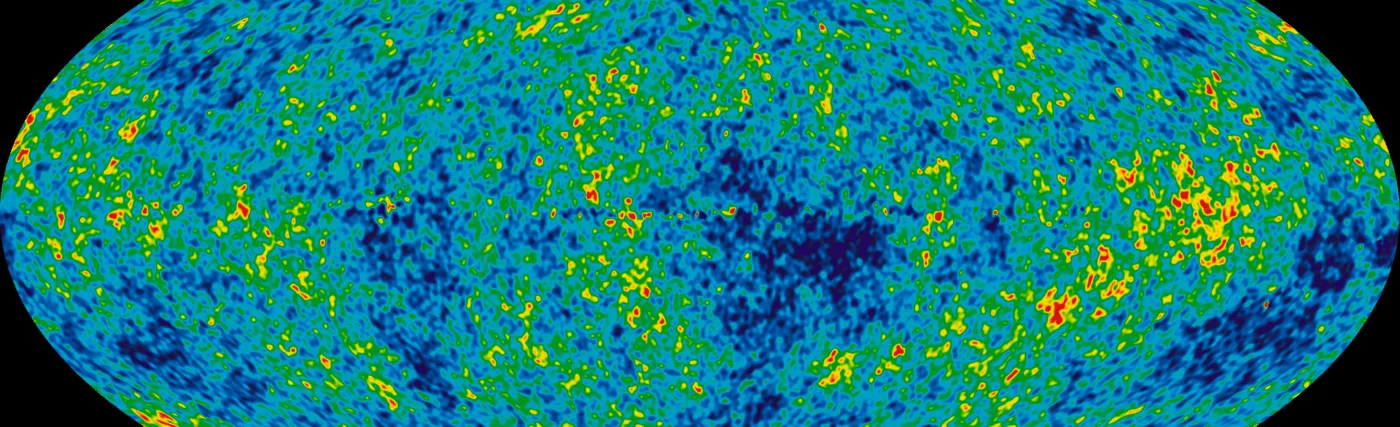
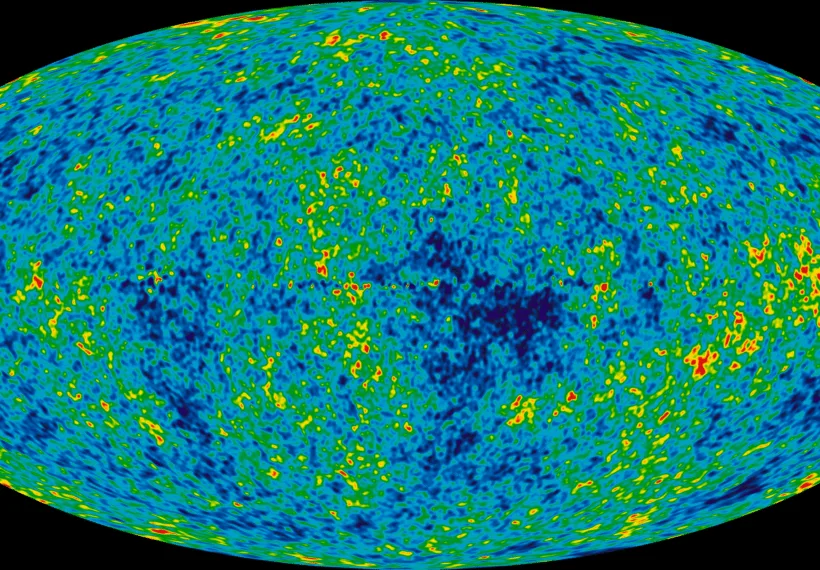
We could have what is basically a bruise on our universe at early times that would appear as a circle, circular pattern in the cosmic microwave background, the leftover radiation from the Big Bang.
Just a sec, so you're going to get a circle because two spheres, when they intersect, the intersecting membrane is a circle.
Exactly right.
Okay, cool.
So, so go ahead.
So, we're looking for that.
We haven't seen it, but maybe it's just too faint to be seen.
And these collisions of universes, that's what you're talking about.
Yeah, exactly.
Now, is it?
That's right.
Well, you know what?
I'm getting ahead.
I'm going to let you finish and then I'm going to ask my question.
So, go ahead.
So, we're looking for these collisions and we would see them as the circles that would be an imprint on the cosmic background radiation that we observe as the universe.
As an example of how you might see it.
That's how you might see it.
Okay, go ahead.
I'm still with you so far.
The bad news is you might not see it.
Even if you work with something.
You could be a scientist too.
They might never bump into each other.
They might be too far away.
In fact, it's kind of weird if they did bump into each other, but it was only barely noticeable, not really obvious.
That seems like a little delicate balance there.
So, chances are even if the cosmological multiverse is true, we'll never know for sure.
It will be an idea that's on the table and what we'll be asking ourselves is, is imagining the existence of such a multiverse helping us explain features of our universe or is it just a waste of time?
That's what cosmologists will have to decide.
All right.
Interesting.
One kind of multiverse.
The other one that I got to mention because I think it's actually 90% likely to be true is the quantum multiverse, what we call the many worlds interpretation of quantum mechanics.
You may have heard that depending on which street corners you hang out at that-
Physics street corners.
I was going to say, we're getting into some dangerous territory right now.
Have the extra coffee now.
Yo, man, I got that quantum physics.
When you talk about electron, electron spin, they could be spinning either clockwise or counterclockwise.
You observe it and you see always that it's one way or the other.
It's never in between.
But when you describe the electron when you're not looking at it, it's in a superposition of both possibilities.
And that's the miracle and the danger of quantum mechanics is that what the electron is when we're not looking at it is different than what you see when you look at it.
And the important word here is superposition.
There's both possibilities are there.
It's not that we don't know.
It's that really there's both at once.
And if you believe that, if you believe that an electron could be in a superposition of spinning clockwise and spinning counterclockwise, then you should believe that a person who goes and looks at the electron could be in a superposition of I saw it spinning clockwise and a superposition of I saw it spinning counterclockwise.
And if you believe that, you should believe that the universe could be in a superposition of there were people who saw it spinning clockwise and there were some people.
And so it just falls out of the formalism of quantum mechanics, whether you like it or not, that the natural evolution of stuff is to go from one universe, here is an electron in a superposition of two different spins, but then someone comes and looks at it and the universe splits.
Now there's a universe where you saw it spinning clockwise and a universe when you saw it spinning about spinning counter-clockwise.
Again this is not definitive, this is not absolutely proven, this is something that is speculative.
I personally am a huge fan of the idea, but there's nothing wrong about this.
Why would the act of observing it have to be the moment when the universe splits?
Why can't the universe just exist in both states at the same time?
And then when you observe it, you figure out which one of those you happen to be in.
Oh, that's a damn good question.
You know what?
You might want to look into the science thing.
That's a really good question.
You could do that professionally.
Yeah, so that's the idea.
This is invented by a guy named Hugh Everett back in the 1950s.
His idea was, you know, everyone in quantum mechanics believes the electron can be in a superposition and when you look at it, you see it spinning one way or the other.
His idea was just that, no, actually both alternatives remain real, but they separate, they branch.
And you ask exactly the right question.
Who says they branch?
You know, why is that?
And ultimately, we finally understand that.
Like Everett didn't really understand the answer to that question.
But it's because you keep bumping into the rest of the universe.
It's because of the quantum feature known as entanglement.
The observer looks at the electron and becomes entangled with it and then the observer becomes entangled with the rest of the universe and there's no going back.
That's an irreversible process.
So it is as if these two separate branches of reality had become separate worlds.
So, oh, go on, man.
This is just...
We got to take a break after that.
I know.
I need a second just to digest that.
And by that, I mean we'll be back next Tuesday.
Damn.
This is StarTalk.
We're going to take a break from Cosmic Query's Cosmology edition with Sean Carroll of Count Tech.
We'll be right back.
We're back on StarTalk Cosmic Queries Edition, a cosmological excursion with the help of Sean Carroll, research scientist at Caltech, Department of Physics, specializing in quantum physics, theoretical physics, and all the ways that touches the fabric of the space-time continuum.
That's good.
So Sean, what does your business card say?
I just want to know how badass it is.
It's not that badass.
I just stick with theoretical physics.
I have a little picture of ink mixing into water to indicate the increase of entropy in the arrow of time.
Nice.
Well, you might want to change that and go with bad mother effer.
That's my card.
You're probably right now that I think about it.
Plus, the dude wrote a book called The Big Picture on the origins of life, meaning, and the universe itself.
There are no other books to be written after that book.
After that, it's all done, right?
You know?
Because you kind of got me with the meaning.
That's where everybody wants to get into the thick of it.
That's right.
I'd be happy to have the books in every hotel room around the world.
Top drawer.
That's funny.
You got to change your name to Gideon.
Chuck, what do you have for us?
All right.
Let's jump right back into it.
This is Preston, I think it's Preston Cha, Preston Cha, Preston Chao.
All right.
All right, Preston.
Here you go, buddy.
Here's your question.
You'll know who you are when I raise the question.
If at absolute zero, particles have the minimal amount of energy, what is the maximum amount of energy a particle can have?
Wow.
Is that, can we even know that?
So Sean, let me again throw you the ball after I touch it.
I'm going to play center on this one.
You give me an audible.
Running sleep slicker.
This is an audible, Sean.
So I think we learned in quantum physics that this absolute zero temperature, there's still a probability that it is not at that absolute lowest temperature.
Sean will pick this up in a minute.
Recently, Sean, I learned about discussions about there being a highest possible temperature.
And then when I read into it a little further, I became less convinced of it.
And I just want to hear what your reflections on these two extremes that we hear about in chemistry class.
A cold is possible.
Cold is an absolute zero.
Is there a highest possible temperature?
So where can you take us on that?
Yeah.
So the shortest possible correct answer is we don't know for sure.
If you think about it, high as I was going to say means...
You got to be honest.
We know a lot.
We don't know that.
High temperatures means high energies means it's hard to make things that are actually at such temperatures.
For one particle, there's no such thing as what the energy is because of what we call relativity.
It depends on what frame of reference you're looking at it in.
It's the energy of one particle is its mass times the speed of light squared.
If it's just sitting still, it's more if you're moving with respect to it.
But when you have a bunch of particles, that's when you have what we call a temperature or a whole bunch of energy because they have a mutual velocity, right?
If they're sitting still with respect to each other, they can be near or at absolute zero.
If they're moving fast, they're bundling up and they're packed densely, then they can have a lot of energy.
Just to be clear, just because Sean said this very quickly, and I think we should pause.
Temperature as a concept exists only in an ensemble of particles.
You can't say, what is the temperature of this one particle?
The question has no meaning because of the way temperature is defined, so I just want to make that clear.
Sean, go for it.
And is that because of energy?
Is that the deal?
Like the sitting there by itself, it has to have something else?
Sean, unless there's some other way we think of temperature beyond the sort of the average vibrational energy of particles in a package?
No, that's plenty good enough.
Temperature is the average energy of whatever is shaking around.
Okay, and it could be a solid object because the things are still wriggling in the solid object.
Exactly.
Okay, cool.
That's right.
And so you might think, well, you know, things can wriggle as fast as they can, or maybe you say, well, oh, they can't move faster than the speed of light.
But the energy of an individual particle, if you were just Albert Einstein's thinking about special relativity, the energy can go infinitely high.
Here is the problem.
If you have a bunch of particles moving with an enormous relative velocity, you pack an enormous amount of energy into a small region, you hit a limit because you eventually make a black hole.
A black hole is the maximum amount of energy you can have in a region of space.
It's not really fair to assign a temperature to the black hole, a small black hole.
Black holes have temperature, Stephen Hawking worked that out in the 1970s, but now we're beyond the realm where we can think of that temperature as the average velocity of shaking or energy of shaking of some individual atoms.
It's the black hole itself.
Is the black hole temperature, is it comfortable, is it like sweater weather?
If it's a big astrophysical black hole, it is incredibly cold, the temperature.
The temperature of a black hole is colder than the temperature of the desolate reaches of intergalactic space.
A tiny little black hole has a high temperature, so they will actually just disappear, explode in a puff of radiation being given off.
There's a maximum temperature you can reach there called the Planck scale, the quantum gravity scale, this amount of energy that was invented back 100 years ago as sort of the most we can fit into a tiny little region of space.
Cool.
So if small black holes are hot, that wouldn't be so bad, it's the humidity that...
It's not a dry heat, that's the problem.
It's a dry heat in the small black hole.
Exactly.
There you go.
All right.
Next one.
That was great.
Lots of queries.
All right, here we go.
Woo, Rick Henkel.
Yay, Rick, with the freaking great name, Rick Henkel from Facebook says this, is there any way to capture gravitational waves and use them as an energy source or are we limited to observational uses of gravity waves?
By the way, love the show.
And the reason I love this question is because there was an episode of Star Trek where they actually used gravitational waves as a method of transport because somehow they were able to get the gravitational waves to allow you to travel faster than warp speed.
So they're surfing the waves.
Surfing the wave.
And so, and by the way, you did not need an energy source.
Once you created the gravitational wave, you could surf it without them without the means of an energy source.
And so, you know, I'm sorry, that's and that was a movie, by the way, I was about to say I'm talking to two astrophysicists about a make believe science fiction.
That's all right.
That's all right.
And I'm just like, yeah, man.
So Sean, let me reshape that question in another way.
So when we think of light waves, you know, we come from the stars and we can capture them and measure them and do what we want.
And it's an energy and and depending on how we detect them, they'll manifest as photons and they can trip trigger detections in a CCD, right?
And this we get digital photography is how that works.
So with a gravity wave, there's still we're still detecting it as waves, not as gravitons.
Right.
Would there be a difference in our ability to exploit it if we detected them as gravitons as distinct from waves?
Yeah, I think that all these questions are sort of bundled up into the same answer, which is no, because gravity is too weak.
That's the basic story here.
There's an enormous amount of energy emitted in gravitational waves.
When these events that we've been recently seeing in LIGO, the Gravitational Wave Observatory, they're seeing two black holes spiral together and make one big black hole.
That emits gravitational waves and you can count how much energy is emitted.
For that few seconds that the black hole is emitting gravitational waves, its total energy output is greater than that of all the stars in the observable universe emitting light.
It's really bright in the sense of emitting gravitational waves, but utterly useless in the sense of transporting energy or anything like that, just because for the most part the gravity waves just go right through us.
You don't even notice them.
You need a four kilometer long vacuum tube to notice the very, very, very tiny displacement of mirrors.
He didn't have enough berries there.
He had four berries and it takes like nine berries.
Nine berries.
Very, very little.
Anyway, if you want to send energy or you want to observe something or something like that, electromagnetism and light will always be more efficient.
The traditional thing to do is to say, you know, look, I have an object here, randomly found on his office desk.
And look, even though the entire earth is pulling it down with all the gravitational strength it can muster, my little electromagnetic impulses in my arm can lift it up.
I win.
My electromagnetism is better than the earth's gravity.
Take that, gravity, you big ****.
Exactly.
And that's why we're not going to see individual gravitons, individual particles of gravity.
They're there.
No, I was going to say, when you say we're not going to see them, is that because they don't exist or is there a graviton, is there a particle?
Here's a calculation we do in like the second month of your first class in physics.
Okay, well, right when you get into electromagnetism, so maybe the second semester of your first class in physics, you're asked the question, what is the relative strength between electromagnetic forces and gravitational forces?
How do they compare?
Right?
Right.
And you can calculate that.
Right?
So you know what a factor of 10 is.
Excellent.
Right?
So you can ask how much, so electromagnetism is stronger than gravity.
Always.
How many factors of 10?
How many factors of 10, 10, you do that 40 times.
Is it 40 or 42?
Which is it?
I'm a cosmologist.
What do I know?
Call it 40.
Let's go with 40.
There's no difference.
It's counting.
How about, let's use 42 because it shows up in sci-fi literature.
So there's like 40, 42 orders of magnitude difference in strength.
Right.
Between gravity and electromagnetism.
So all Sean is saying here is that these waves are out there, but relative to everything else that's holding us together, this is a non-thing.
It's not an issue because it's so much weaker.
So much weaker.
So it's not that it does not exist.
Right.
It exists at a level so unusable to us that it becomes more an intellectual exercise that we were able to detect it at all, not as some way, oh my gosh, now we have a new way to make a gravitational wave weapon.
You know?
Right.
Right.
Right.
But let me ask you that, Sean.
So could you surf a gravity wave if you are sort of low enough size or energy or whatever?
No.
This is the last time we're asking you back.
You know, again, you are not cooperative at all.
Last time we ask is no, I'm not asking this man back on the show.
It's always no but.
You got to like follow up.
There's something very, very similar to that idea.
I mean, a gravitational wave, sadly, it's just going to go right by it.
It's not going to be very good at pushing.
But what you could imagine doing is hopping into your specially designed spaceship and constructing an amount of energy, both positive energy and negative energy distributed around the spaceship to warp space time around you so much that from the point of view of someone outside you seem to be going faster than the speed of light, but you're really not.
Well, another way to say it is, isn't it true, Sean, that in general relativity, space is not constrained by the speed of light, space itself.
Oh my God.
So if you move with the fabric of space, then the sky's the limit.
It's no telling how fast.
Is that a fair way to characterize this, Sean?
Well I think what I like to remember is the word relativity in general and special relativity.
You shouldn't be talking about speeds at all unless you're talking about relative to what.
And in relativity, in general relativity, like you say, there's a limit that says you can't move faster than the speed of light relative to something that is at the same location as you.
If you're talking about the speed relative to something very, very far away, then it's apparent velocity, like you say, yeah, it can be well greater than the speed of light, but it's not really the same thing you're comparing.
By the way, I like, and not because, you know, that I've known him longer, Sean, but I like Neil's explanation better.
So, Chuck knows who pays him, right?
Yeah, I was going to say that, but okay, yeah.
No, no, no, no, that-
Whatever he's paying you, Chuck, I'll double it.
And good night.
So, we're going to take another break, and when we come back more of Cosmic Queries with my co-host Chuck Nice, and friend and colleague Sean Carroll when we return.
We're back on StarTalk.
I'm your personal astrophysicist, Neil deGrasse Tyson.
Chuck Nice.
Yes, sir, how are you?
And we've, this is a Cosmic Queries edition?
Specializing in sort of cosmological phenomena.
Absolutely.
I can only take it so far.
I had a few classes in it, but we've got Sean Carroll from Caltech on Video Call, because he lives this.
Yes, it's right.
Who you need in this Cosmic Queries.
And Sean, you tweet as well.
What is your Twitter handle?
I do, I'm on Twitter, Sean M.
Carroll.
So Chuck, what question, Jim?
All right, let's jump right back into it.
And I gotta get to this one early in our segment, because I really, I want you guys to tackle this.
All right.
Bring it on.
And this is Beginner's Mind at Dharma World on Twitter.
And this is what he says, very simply.
String theory, in your own words, please.
Bang, that's it.
And I love it.
I love that, and so what I'm going to ask is make pretend, which you really don't have to, because I'm right here, that you're talking to Chuck Nice and make me understand string theory.
Okay, because now that is a challenge.
So Sean, go for it.
We all know-
Sean will do it and then I'll tie a bow on it when he's done.
All right, Sean.
This is the easy question.
Really?
That's the weird thing, yeah.
Okay.
You know, if you think about what we know about atoms and molecules and things like that, they're made of particles, right?
There's an electron, there's a proton.
Inside the proton, there's quarks.
And in quantum mechanics, these particles are just points.
They're just infinitely tiny little points.
So string theory is the following idea.
What if, instead of points, the world was made of little loops of string?
And you say, well, what is the string made of?
And the answer is no, no, no.
The stringy stuff is what the world is made out of.
This is the, the er stuff, the fundamental thing.
And you might say, well, that's a silly, why would we ever even ask that question?
Particles seem to work fairly well.
If you take a string and you look at it, it's really, really tiny.
It looks like a particle, so that's okay.
And people invented this back in the 60s, early 70s, trying to explain the strong nuclear force, the forces that holds protons and neutrons and quarks and gluons together.
Okay, now we'll tie the bow on the thing, okay?
So, first of all, I will lose this battle, but I want to say to Sean here standing flat-footed that I'm gonna start calling it not string theory, but string hypothesis.
Ooh!
We have evolutionary theory, quantum theory, gravitational theory, string hypothesis, okay?
Oh, well, you know what?
I don't know if this has ever happened to you.
You've just been downgraded.
I did it with Pluto.
I've been down this road before.
Sorry, Sean, but United is dragging you off of this flight.
So, and correct me if I'm wrong, Sean, if the universe is the strings, then depending on what the circumstances of a string is, it will manifest to us as one particle or another.
So that is what would make the string more fundamental than the particle itself.
Okay, okay, yes, right, because it's the whole stuff.
It's the stuff.
The kit and the caboodle.
It's everything.
Caboodle especially.
Right.
Okay, I got you, yeah.
So, the power of this is its capacity to explain everything.
It's because it's the fun, by the way, this good little historical philosophical, the word atom, proposed by the Greeks, you know what it means in Greek?
No.
Indivisible.
Oh, wow, so it's supposedly the smallest thing that can't be cut.
Right, exactly.
Now we know that's not right, because we split atoms.
That's what I'm saying.
So, you keep dividing things, it gets smaller and smaller, and there'll be some point where you can't divide it anymore, and that was known as the atom, okay?
And then the alchemist said, wait a minute, if this is a lead atom, but I like gold atoms.
I can actually rearrange this thing and make gold.
Let me stir the lead to get gold, but all they're doing is stirring atoms.
And if you want to make gold, you got to get into the nucleus, but no one knew about the nucleus.
Right.
So now you find that you can split atoms, and people freaked out.
Atom smashers and splitters, and oh, that's where God is.
That's what people freaked out a hundred years ago.
They said, oh my gosh, what are you doing?
And then you split that, now you have the fundamental particles.
You have protons and neutrons and electrons.
That's the fundamental particles.
Then we poke inside the neutron and the proton, and then you get quarks.
Right.
So Sean, what's inside a quark?
Yeah, maybe the strings.
A piece of string.
A piece of string.
I would be so pissed off if it was just a little bit of string.
Like string cheese.
As a matter of fact, I'm going to start a company called Quark String Cheese.
Okay, so.
So Sean, just a physics question.
I can think of these strings of energy.
Can we call them that?
Is that fair?
String?
I can think of them in configuring such that one would look like a quark, one would look like an electron.
I get that.
How do they configure so that they would have different charges?
Electrical charges.
Now, how do you do that?
Listen, this is outside my pay rate, my pay grade, because how do you just wiggle a string?
That's not the simple question.
The simple question is, what is string theory?
Why they have different charges?
The simple version of the answer is because they're vibrating differently.
So what are you saying?
It can vibrate in a negative way and in a positive way, and then you get-
Yeah, or you can imagine going around the string clockwise or counterclockwise.
There's different things that can happen.
Different ways that strings can be either loops or the whole blind set.
There's different loops to the string?
Is that what it is?
It's like different loops?
That's what he's saying.
So as you configure the string in different modes, it manifests to us as different particles and different charges.
This is what you're saying.
That's what I'm saying.
Yeah, yeah.
Now you're a professional string theorist.
This is awesome.
No, it's cool and it's hugely promising and powerful, but it's not without its critics, is my point, because of the, can you predict this experimentally?
Can you experimentally verify the predictions made?
Is it beyond our reach?
Is it, you know, so the whole book's criticizing string theory for this reason, but it's cool.
It doesn't make it any less cool.
No, it's super cool.
All right.
Sean, that was a, hey, what a great, great question, beginner's mind.
We're coming up on the lightning round.
Lightning round.
Okay.
All right, guys, here we go.
Give it to us.
Time for the lightning round.
Mark Erick Svensson says, or Svensson says this from Facebook.
Are gravitational waves significant enough to affect experiments in particle accelerators?
Ooh.
Good question.
All right, Sean, what do you have?
No.
Good answer.
And we are off to flying start.
Dee Saltzman from 1983 from Instagram says this.
There is no way that this is the first big bang.
So why do all of our theories have the universe ending in nothingness with no matter?
Ooh.
Let me, let me reword that a little bit.
Sean.
Sean, how is it that we could be in the only one universe that had one beginning and one ending?
How's that even possible?
Why aren't there others of these out there?
And why, if there are, why don't we know about it?
And what's up with all of that?
I think there could be a lot of others.
I wrote a whole book about it.
You can buy that one too, From Eternity to Here.
But we don't know.
Oh snap.
Read the book.
But what'd you say?
I missed your last bit.
But we don't know is the final answer.
Maybe this is the only universe.
We gotta be humble about what we do and don't know.
But we agree experimentally that this universe, in its only ever existence, is on a one-way trip.
On a one-way trip.
One birth and a...
And nothing.
I can't promise you that in the future our universe will not give birth to other baby universes.
Oh, there you go.
I'm the baby daddy of the universe.
Baby.
You could be baby daddy.
The universe got the baby daddy happening.
All right, here we go.
Sean, this would be some sector of the universe that spawns another one within the one that we currently enjoy.
Not within, in addition to.
We would really get something that pinches off and goes its own way as a separate universe.
All right.
There you go.
Let's go.
Next one.
Okay.
O.
Galanis wants to know this.
People keep asking why there is something instead of nothing.
Why is nothing normal or expected while something needs a special explanation?
It's a little existential, but I know what he's saying.
That's where we go.
Sean, do it.
I think the answer is why not have something rather than nothing.
The subtext of that question is exactly right.
Something is just as natural and expected as nothing would be.
There's not that much to be explained.
Okay.
That was it.
Listen, it's the lightning round, people.
Lightning round.
It's the lightning round.
Nope.
That was it.
He's doing good too.
Yeah, he is.
He's killing it.
He's killing it.
Caleb Bingham from Facebook wants to know this.
Do you think that dark matter might be regular matter from a parallel universe that doesn't react to light or in our universe, making it possible for us to see it?
Thank you.
Caleb from Bingham.
My answer to that is yes.
Sean, what's your answer?
My answer is no, because it's not just that it's dark, it's that it behaves differently.
Dark matter doesn't dissipate and clump together like ordinary matter does.
No, no.
Well, wait, Sean.
If this is gravity leaking from an adjacent universe, as I understand, I don't claim full understanding of the limits of field theory, but as I understand it, gravity is not contained within the space time in which it's found, isn't that correct?
It can leak out.
If that's the case, it could be an adjacent universe whose gravity we feel made by ordinary matter in that universe, but here we mysteriously...
And that's why it doesn't behave the same way.
And we're looking at how come it's not clumping because it ain't your matter, it's somebody else's matter.
Okay, Sean, I love this gravity smack down.
It would clump with itself in its universe and still be clumping.
Yes, in its universe, but in our universe it wouldn't because all we're feeling is the gravity of it.
But we would feel the gravity of clumpy stuff.
Yes.
Not of stuff that is all spread out and it is spread out.
Caleb, here's your answer.
We don't know.
I was thinking about Sean's point there.
Next one.
Next one.
One more question.
One more, one more.
This person is trying to mess with me.
I'm a human boy.
Human boy.
I'm a human boy.
What does the general theory of relativity tell us about the fabric of space-time itself?
Yes, it tells us that the fabric of space-time has a life of its own, that it's dynamical, that it moves and stretches and warps in response to the stuff that we see in the universe.
That was a damn good question.
I mean, damn good answer, Sean.
I'm going to quote, was it Einstein or John Wheeler who said, space tells matter how to move and matter tells space how to curve?
That was Wheeler, exactly right.
John Wheeler.
He's a pitty guy.
He would have been good on lightning rounds too bad.
I actually had him for relativity in physics in graduate school and I met my wife in relativity class.
Well, that's the only thing that's relative that means something.
That's what I'm talking about.
He became your relative.
Thank you, Mr.
Wheeler.
Just a quick question here before we take it out.
I'll give my own question to Sean.
I'm not always on video call with the dude.
So Sean, what is the chances that we are in a false vacuum and could possibly tunnel to a more stable state in the universe, changing all the known laws of physics and we all die?
Yeah, the chances are depressingly large.
What a happy question.
Just to clarify, so you can imagine me at the bottom of a well, and if you displace a ball up the side of the well, it'll roll back to the bottom.
So it's kind of stable, okay?
But suppose there's a deeper well adjacent to this one that is lower.
If this ball ever saw that, it would go there.
It would have to go there.
It would have to go there, right?
So if you sort of pushed it up the hill, it'll roll down.
It'll never come back to that high state.
But quantum physics says you can actually tunnel through the walls that could separate two states.
Tunnel, just barrel right through.
Then you're here.
And if you show up here, you sink to a whole other thing.
And Sean, you're a betting man.
You're saying, oh my gosh, this could really be true.
Yeah, it could really be true.
Again, a bad news, good news situation.
The bad news is it's very plausibly true.
And in fact, there's a little bit of a hint, right?
Because for good reasons, you might imagine that the true vacuum, the vacuum that is the most stable and wouldn't decay, would have exactly zero energy in empty space, would have exactly zero vacuum energy or cosmological constant.
A false vacuum that was temporary and will eventually decay would have a non-zero positive energy in empty space.
Our universe has a positive energy in empty space.
That's exactly the kind.
That's the bad news.
The good news is we wouldn't know it because we would be instantly dead if we did underwent this transition.
No time to worry.
In fact, it doesn't even happen at the speed of light.
It happens instantly.
Instantly.
Right?
It's essentially the speed of light, but you don't see it coming because the doom comes just as fast as the warning of the doom coming.
That's the good news.
Sweet.
Oh, God, I'm going to sleep so well.
Cosmically reassuring.
Sean, it's been great to have you on the show.
Your latest book, The Big Picture with the audacious subtitle on the origins of life, meaning and the universe itself.
Sean, always great to chat with you.
Thanks for keeping up the fight over on the West Coast.
And we try to maybe get you back on the show a couple more times.
If we can.
Happy to be on.
Thanks so much for having me.
Chuck, always good to have you.
This was fun.
On StarTalk.
I'm Neil deGrasse Tyson.
I've been your host.
This has been StarTalk.
And as always, I bid you, look it up.
See the full transcript



 Unlock with Patreon

 Become a Patron