What are the facts surrounding some of the most common doomsday predictions dominating popular culture today? Astrophysicist Neil deGrasse Tyson and comic co-host Chuck Nice examine Cosmic Queries from our fans through the rational lens of science and history. For instance, what does the end of the Mayan Long Count Calendar really predict, and more importantly, is there any justifiable scientific concern about its implications? Could a solar flare cause the end of the world? What is the likelihood of an extinction-level asteroid impact? They’ll also touch upon UFOs, black holes and white holes, surviving a new ice age, and subterranean dinosaurs. Plus, you’ll find out the real reason Pope Gregory replaced the Julian calendar with the Gregorian one. (Hint: it has to do with a Jewish holiday!)
Transcript
DOWNLOAD SRT
Welcome to StarTalk, your place in the universe where science and pop culture collide. StarTalk begins right now. And this is StarTalk Radio. I'm your host, Neil deGrasse Tyson. I'm an astrophysicist with the American Museum of Natural History right...
Welcome to StarTalk, your place in the universe where science and pop culture collide.
StarTalk begins right now.
And this is StarTalk Radio.
I'm your host, Neil deGrasse Tyson.
I'm an astrophysicist with the American Museum of Natural History right here in New York City, where I also serve as director of the Hayden Planetarium.
I'm here in studio with Chuck Nice.
Chuck Nice comic that you tweet by.
That's right, my friend.
Last I Check.
Well, thanks for coming back on.
Always a pleasure.
This is the Cosmic Queries portion of StarTalk.
I like to think of it as StarTalk After Hours.
The after party.
The after party.
StarTalk after party.
And we're talking, the subject today is calendars.
And I know you've done some thinking about this.
You had some run-ins with people.
Yeah, I had a, you know, I was just in Dallas.
And you know, there seems to be this huge preoccupation with the Mayan prediction of the end of the world, which I suppose is connected to their calendar.
And.
More on that.
Well, I'll get back to you on that, but go on.
What happened in Dallas?
So in Dallas, there was this, we now know, was a huge meteor that crossed the spans of the sky.
And it left a trail, and it kind of looked like a jet stream, and it confused a lot of people.
So everybody's like, what is this?
What is it?
It's a UFO, is it this or that?
But we know that it actually happened because people got cell phone pictures, they took video, and you know.
Anyway, the news media goes out and they start interviewing people, and I was shocked at how many people thought it had something to do with this Mayan end of the world thing.
And I couldn't believe it.
I could not believe it.
Okay, so first of all, anyone who sees this streak of light across the sky and doesn't know what it is, well, to them, it's a UFO.
That's what the U stands for.
Unidentified.
Is it flying?
And it's some kind of an object.
So I got no issues with people seeing stuff that they don't know.
It turns out the more you know about the night sky, the more you know about cloud formations and weather systems and the stars of the night sky and meteorological rarities, the less likely you are to see something that you cannot explain.
Right.
It's just that simple.
You want to have a broader base of knowledge when you observe something before you start jumping to some conclusions.
So by the way, Earth plows through several hundred tons of meteors a day.
A day?
A day.
Okay, now that, you just, okay.
Did you hear that?
Did you hear that small explosion?
That was my mind being blown.
All right, so this is Earth, because the solar system.
Wait, several hundred tons?
Tons, tons a day.
Wow.
A day, okay.
And so you, and you see some of that, because, well, some of that falls in the daytime.
You don't see it because it was light, but the sky's even lighter, right?
So it doesn't show up.
It doesn't call attention to itself.
And then at night, are you looking up?
Was it cloudy?
Was it overcast?
Was there a full moon, which put glare in the sky?
So you don't catch all of it when it falls.
But, and most of it burns up as what we call a meteor streak.
Some of it's big enough to land.
And then the meteor becomes a-
Meteorite.
Meteorite, there you go.
And so, yeah, yeah.
And so, but if you're prone to connecting bits of information in superstitious ways, you'll see a meteor not knowing what it is.
You read about the Mayan calendar, you heard about the apocalypse, and your brain just connects the dots.
And then you become certain that the world will end.
Yeah, so this is a, so I mean education is an important part of this.
That's all.
It seems that people, people, I've met some people who are only happy when they know the world is gonna end.
There's a guy at a party who walked up to me and said, I hear you're an astrophysicist.
I said, yes.
Well, tell me about the end of the world and the Mayan prediction, is that, is that real?
He was looking all concerned, right?
But kind of intent, right?
A bright-eyed concerned.
And I said, no, it's a hoax perpetrated by the scientifically illiterate on the scientifically under-informed.
Well, that took the joy out of that.
Well, then he walked away dejected.
Of course.
Exactly.
He walked away hunched over like I somehow ruined his day because the world was not gonna come to an end in the way he had imagined it.
But let's put some facts on the table.
The Mayans had a calendar and the calendar cycled and they had a short count calendar and a long count calendar.
And the long count calendar restarts basically the end of December this year.
People studying the Mayan calendar after the fact, not the Mayan scholars, by the way, but people who are kind of amateur amateur ancient culture studyers, they were sure that because the Mayan calendar restarts, that that would correspond with the end of the world.
And they knew the Mayans had technology and science and they knew they had some kind of technological abilities and then asserted that the Mayans had deep insight into the future of the world that even modern day astrophysicists do not.
That the Mayans know that the world is gonna come to an end because on December 21st, the sun, the earth and the center of the galaxy align.
And that alignment means kaput, we're all done.
Well, if you don't know physics, yeah, you might be prone to say that.
But if you know physics, physics 101, you can calculate the force of gravity, the extra force of gravity that this would render on earth.
And you can show that it's ignorably insignificant.
But then you might think, well, maybe it's just the little bit you need to be the tipping point for things that want to go bad and are just sort of held there with the tiniest of force.
And you just need a little bit to tip it.
Well, all right, if you're scientifically literate, what you do next is say, how often does that happen?
By the way, science literacy is not what you know.
It's how is your brain wired for asking questions?
So someone says the world's gonna come to end on December 21st because of this alignment.
Just ask how often does it align?
It aligns every year on December 21st.
Oh, really?
So where were you last year?
Exactly.
You know, so when you study how the actual universe works, you're in a position to then inoculate yourself against the charlatans out there who would have you believe the world would end and as a result, want you to join their cult or to hand them money.
Or here's what you do.
Test how strongly they believe it on December 20th.
Say, please sign over all of your assets into my name.
Right.
Then see how much they believe.
Exactly.
Because they will need it if the world's not going to be here, you know.
That's a good test right there.
It's a good test.
So in this StarTalk after hours, StarTalk Cosmic Queries, I guess you've got questions there for me, which I haven't seen.
No, you haven't.
And they're culled from our presence on the internet.
And when we come back, you're gonna ask away.
Drop them in my lap.
Chuck Nice, thanks for being back on StarTalk Radio.
I'm Neil deGrasse Tyson.
We'll be back in a moment.
StarTalk, Cosmic Queries.
I'm Neil deGrasse Tyson.
We're in the After Hours part, and I brought Chuck Nice into the studio with me.
Yes.
Yeah, we've got questions you're gonna hand to me, culled from our presence on the internet.
Absolutely, my friend.
Thank you for coming in to do this.
Oh, it was a pleasure.
We're talking about calendars, and we left off with the Mayan calendar.
By the way, the Mayans were big fans of the planet Venus.
Oh.
And its visibility in the sky, and Venus is a striking object.
By the way, it itself is probably the most mistaken object for a UFO of any object in the night sky.
Venus.
Because it gets really bright, and it looks like it's hovering.
Really bright, it's like plain headlights headed straight toward you, except it doesn't come in for a landing.
Yeah, so it totally messes with people's understanding of the night sky.
And the Mayans were totally, totally digging Venus, and they kept track of when do you see Venus in the morning, and when do you see it in the evening, and how long do you see it, and when will we see it next, and when it goes away, when will it come back?
And you look from culture to culture and throughout history, people worship different things about time reckoning, and the calendars are then based on different things.
So the Chinese calendar is moon-based, lunar-based, and so are many other calendars out there.
The calendar we're all familiar with here in the West, and which was so successful a calendar, that it spread around the world, we used the Gregorian calendar, named after Pope Gregory.
And that replaced the Julian calendar.
It's a better calendar.
They're forged in the same spirit as each other, as one another, but the Gregorian calendar is simply more accurate.
And that's the one we use, and it's not based on the moon, it's based on seasons.
And why?
Because we plant stuff, right?
You wanna know-
It makes sense, you wanna know when the-
Right.
You wanna know when winter's coming, when your crops work.
That matters more than any other kind of reckoning-
To you when you're in agrarian culture.
And so we make sure that the first day of spring happens on March 21st, or thereabouts, every year, all the time.
So the seasons are attached to the calendar dates throughout the year, and our Gregorian calendar enables that.
Do you know what the switch was between the two?
Most people don't know.
No, I don't.
The Julian calendar was, all right, well how long does it take Earth to go around the sun?
Well, what's your answer to that?
The Earth to go around the sun?
Yeah, yeah.
Isn't it, what, 365 days?
Yeah, yeah, yeah, or a year, 365 days, but the answer to that is no, it doesn't.
And the Romans knew this.
It takes 365 and a quarter days to go around the sun.
But you can't have a calendar that has a quarter of a day sticking in it.
What do you do with a quarter of a day?
Aw man, I would do so much.
With that extra six hours.
Oh, that'd be so awesome.
That's a resourceful guy right here.
But how do you manage a quarter of a day on a calendar?
It just doesn't work, because everything we do is organized around days.
So what the Romans said was, let's pocket that quarter of a day.
Let's put it in our pocket and save it up.
Right.
For how many of these should I save up?
Well, you gotta save up four.
Four, exactly.
So every four years you get a day.
Slap the day back in there.
Right, so you get your quarter of a day, but now it's glued together with three other quarters.
You get a full day to relive every four years.
And now your year divides nicely with the days that you live.
Right.
And that's the Julian calendar.
And that was in place until October 4th, 1584.
I have to check on that.
But early 1580s.
And so what they noticed is that that overcorrects for our time to go around in the sun.
You're putting in too much extra time.
So you're slowly accumulating days that you shouldn't have.
That you don't have.
That you don't belong.
You don't belong there.
Yeah, you put a day in every four years, you're adding too much.
And every so often, you gotta take out one of those days.
So they knew Black History Month was coming.
Ha ha ha.
Ha ha ha, the 28 day month.
Right, right.
So what they did was, Pope Gregory was very concerned about this because the first day of spring was migrating backwards in the calendar.
Uh-huh.
Because you can determine that from the sky, not just from what your calendar says.
And for the sky tells you, the first day of spring is March 20th, and then March 19th, and March 18th.
And so over the years, from the Roman days until the 16th century, the first day of spring and migrated back to March 10th.
Holy crap.
Yeah, I know, I know.
People were freaking out.
And it turned out Easter, which was defined as the first Sunday after the equinox, was at risk of landing on Passover, where you had overlapping rituals between Christians and Jews.
And the Pope said, we'll have none of that.
Okay, so they had to change the calendar in such a way so that they would never overlap again.
That was his motivation.
That was his motivation.
It wasn't just, oh, I have this cosmic need to keep correct time.
It's, I don't want Easter to look like Passover.
Right, right.
I gotcha.
I don't want your matzah in my bunny.
There you go.
Except the fact, of course, the Last Supper was a Seder, right?
That's so true.
But that information is suppressed in the Catholic Church.
So, I don't know if it's suppressed actively, but I remember growing up and they never told us that.
No, they didn't.
Right, right.
It was left out of that conversation.
And you didn't even know Jesus was Jewish.
Exactly.
I see what you're saying there.
Exactly, that's part of the thing.
So, what happens?
So they hire astronomers and they create an observatory.
This is the birth of astronomers at the Vatican.
And these are Jesuits who are nicely educated folks at the time.
And they study the calendar and they study the seasons and they study it and they said, look, we gotta first jumpstart the stuff.
So they took 10 days out just to get back to stand to regular, all right?
So March 10th, we went back to March 20th, 21st.
And those 10 days came out of the month of October in 1584 or 82, I forgot what day.
And so there it was.
And the issue is about paying rent.
How much rent do you pay?
Yeah, exactly.
But what awesome power you have.
We just ripped 10 days out of a month.
And so upon doing that, then they said, you know, every hundred years, that's when you've put in a full day too much.
So take the day out.
So every hundred years, there would be a leap day, but there isn't.
Okay, that made no sense to me whatsoever.
1900 is divisible by four?
Okay, no it isn't.
It is, it's divisible by four, yes.
It is?
Yes, 1896 is a leap year, 1900 would be a leap year.
Okay.
Okay, normally a leap year?
Yes, you're right, 1900.
Right.
No leap day.
1800, divisible by four, no leap day.
1700, divisible by four, no leap day.
There would have been, but this is the rate at which you have to take the days out.
I gotcha.
Ones per century to make up for putting one too many in.
One too many in.
So every hundred years, no day.
No leap day.
Right.
Except that overcorrects too much in that direction.
Now you gotta put one back in every now and then.
How often do you do that?
Every 400 years.
400 years.
Yes, yes.
So now it would be 400 years when you would have taken a day out, now you put the day back in.
This sounds like a damn cell game.
So, all right, all right.
So that took us to the year 2000.
Right.
The year 2000 was only a leap year because it's the 400 year cycle of putting the leap day back in.
But most people just say 2000 is divisible by four.
Of course it has a leap day.
Right.
They had no idea how profound that leap day actually was.
So, oh my God, that is the corrector day of corrector days.
Yes.
That's what that is.
Exactly.
That is awesome.
And that corrector is over the longer baseline of time.
Right.
So, that's the corrector day and that's the Gregorian calendar that was set up in 1584.
You got it.
The year 2000.
Yes.
Not only a great Conan bit, but also the corrector day of corrector days.
In the year 2000.
I remember that.
And they kept doing it after 2000.
That was crazy.
That was great.
You got a question for me about it.
You got barely a couple minutes left before this segment, but we'll come back.
But what do you got?
All right, so, man, these are some deep questions that these people are getting into.
That's good.
It means we got some, yeah, I'm good with that.
I'm trying to find one.
Okay, is there an, this is from Haley Kramer, is there an anti-Big Bang?
And will the universe expand or will it eventually just collapse and implode on itself?
An anti-Big Bang.
An anti-Big Bang.
Well, you know, the greatest calendar of them all would have begun at the Big Bang, right?
Correct, right, because the beginning date of a calendar is completely arbitrary, right?
The Muslim calendar begins in the time of Muhammad and the Christian calendar begins in the time of Jesus and the Jewish calendar begins in the time of Moses, you know?
And so everybody like dates it to their guy, right?
And if you had the calendar to end all calendars, it would begin on in the Big Bang, basically.
We don't know if there was an anti-Big Bang, right?
Like the big squish, the big squeeze?
All data show that the universe will continue to expand forever and not slow down and re-collapse, which it's philosophically unsettling to many that we have a one-way calendar.
Even the Mayan calendar recycled itself, right?
In their long-count calendar, which ends in December of 2012.
So no, there's no known anti-Big Bang.
Yeah, so I feel bad to say that, like I'm disappointing them.
But that's just what the universe is.
And I've stopped layering my own expectations and requirements upon what it is, what it wants to be.
We'll be back in another segment of Cosmic Queries on StarTalk.
Thanks We're back on StarTalk, the after-party.
Cosmic Queries section.
I got Chuck Nice in here, culling questions from the internet that came to us on our website, startalkradio.net, on our Facebook page, StarTalk Radio, on our Twitter stream at StarTalk Radio.
I don't think we're that hard to find out there.
No, not at all.
We got that handle that's working for us.
StarTalk is a good handle.
Yeah, so we were talking about calendars and a little bit sprinkled with some apocalypse in there.
Yeah, well, because everybody's not concerned, but there was this great, I don't know, panic over the Mayan calendar, the end of the world.
Yeah, tis the season to think about the Mayan.
Yeah, by the way, I've done a little study on this and every decade somebody is putting forth an end of the world hypothesis that would happen within their lifetime, within that decade.
It's good business.
I think it's good business.
It's good business, man.
It's good for the cult business.
Yeah.
And I, but I think the psychologist should take a look at that.
Why it is that we're only happy when we're sad, okay?
Well, speaking of that, here's a, I love this, Torrin El Torro.
That's the person's name.
Torrin El Torro Pellethorpe, okay?
Would it be more likely for such an apocalypse to come from within our own planet, such as earthquakes, tsunamis, volcanoes, et cetera, or is it more likely to come from space, such as a giant meteor?
Yeah, so there are a lot of ways the Earth and the universe want to kill us.
In fact, in my book, Death by Black Hole, I spent a whole chapters on this.
All the ways the universe wants to kill us, all the ways Earth wants to kill us.
And I don't know if we should take the hint or what, get off the planet while we can.
And a quick statistic is that most species of life that ever lived on Earth is now extinct.
Extinct.
Rendered extinct from forces operating on Earth and from cosmic forces delivered to Earth, such as asteroid impacts.
So, anyone who says Earth is some haven, yeah, it's a haven for life in general, but not for the survival of a species, where every day of its life, it is a struggle to survive.
So, first, so-
So Mother Earth is basically a serial killer.
A serial killer.
There you go.
Exactly.
Now, in terms of ways Earth can kill us, we have enough power, either by our own intent or by our own accident, over Earth systems that we may be the source of our own apocalypse.
Yes.
So, you know-
So our greatest threat right now is us.
Is us, yes.
And that would be sort of global climate change.
I mean, if we went into another ice age, that's essentially the end of civilization as we know it.
And by the way, Earth doesn't need us to go through an ice age.
It's done that before.
Humans survived it last time.
But we weren't dependent on like farmers and distribution channels, bringing food to your refrigerator, you know.
So you're telling me that ancient man was far better equipped to deal with an ice age than modern man.
Who would you bet your money on?
Trog the ice dweller.
Right.
Or Chuck Nice.
Or Chuck Nice.
Who believes roughing it is a holiday in express.
So if I put both of your butt naked on an ice floe and I sit and make it a reality show, you know, who's gonna survive?
Yeah, I'm betting on the Kate, you know, on Trog.
Yeah, I gotta give it to you.
Yeah, yeah.
Cause you say, well, where's my cell phone?
And where's my, Trog is up there making the fire, rubbing the sticks.
Trog, Trog, are you getting any service here?
I swear I got no bars.
What's going on?
So, yeah.
And so, yeah, we would serve, civilization as we have established it would not survive it.
And dare I say not even the very primitive civilizations that are still on earth, like the very backwoods aborigines from Australia, because they're not accustomed to snow, for example.
That's not even in their culture.
So we have the power now to bring an ice age upon us or to bring a heating episode upon us by the force that we are exacting on our environment.
If the global climate changes in ways that our systems cannot respond, that would be widespread death, given how we now are dependent on the equilibrium and stability of the system that we created for ourselves.
Well, there's your answer, Torrin.
You're doomed.
Okay.
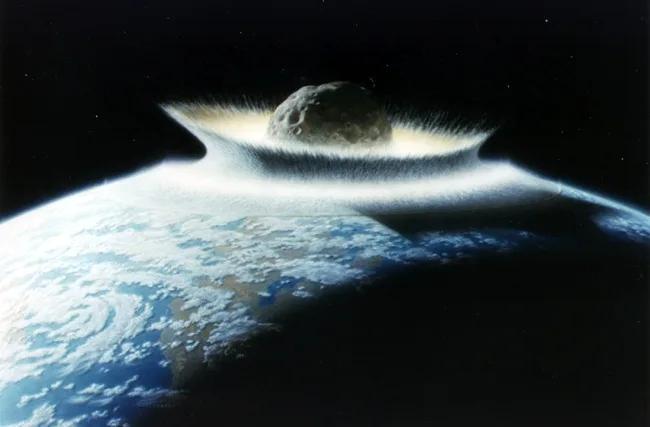
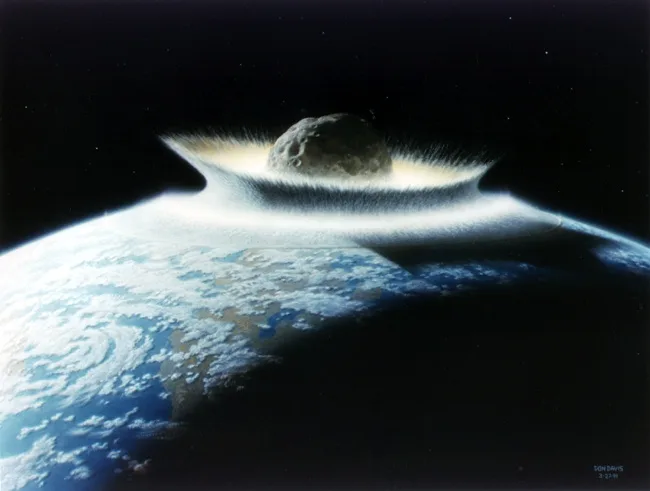
Oh, by the way, an asteroid will take us out overnight.
Right, because that's a quick tip.
That's what that's, well, actually, no, if you're on the other side of the Earth from where the asteroid hit, what happens is the first asteroid vaporizes anyone who was there.
If you were close enough to say, oh, look, an asteroid, okay, that's it.
Those were your last words.
Those were totally your last words.
Now, after that, the atmosphere gets altered in a way that can ignite the forests of the world, creating a soot layer, knocking out the base of the food chain that relies on photosynthesis.
And when this happens, if you're on the other side of the world, you will slowly die from the absence of food.
Right.
Because your food chain got knocked out at its base.
Yeah, so you'll starve to death, the others will vaporize instantly.
I'd go with the vaporization if I had to.
Yeah, that'd be my choice too.
I'm gonna get it over with.
I'm gonna hang around and die a slow death.
Okay, so.
We gotta go quick, we gotta go to break.
I got a quick question.
Okay, here's a real quick question.
Is there any such thing as a white hole?
I mean, it says, I know about black holes, and this is Lauren Brothers.
Is there any such thing as a white hole?
Yes.
Details after we come back.
I can't believe you said yes.
Now I gotta hear this.
You'll get the detail.
This is StarTalk Radio.
We'll be back in a moment.
StarTalk Radio, the after party.
Cosmic Queries with Chuck Nines.
Yes.
Chuck, thanks for coming back on StarTalk.
Always a pleasure.
I'm your host, Neil deGrasse Tyson.
We left off.
Yes.
At the break, we left off.
I am fascinated because Lauren Brothers asked, very simply, I know about black holes, what about white holes?
Is there such a thing that exists?
First of all, Lauren, you shouldn't be so racist, but other than that, you said that there is.
Well, white holes exist on paper, mathematically, yes.
There are white holes.
And I'll explain.
And it's for really cool, but we'll have to go back to school for a couple of seconds.
All right, let's do that.
Are you with me?
I'm with you, man.
Can I bring it on?
Please bring it on.
All right, so you remember when you first learned how to square a number?
Okay, yes.
Three times three is nine.
Nine, cool.
Four squared is 16.
And then you learn how to take the square root.
Right.
And then that's when you learned that a square root has two answers to it.
Okay.
Do you remember that?
What is the square root of nine?
Three.
And?
Three.
Okay, Chuck Flunk, that year in school.
Okay, so three times three is nine, but negative three times negative three is also nine.
Is also nine, right.
Is also nine, exactly.
So it turns out that the equations of gravity that enable us to predict the existence of a black hole and then later discover them, have a second solution built into them.
The mathematical opposite solution to that of the black hole.
Exactly, and so you would only get to that by going to that second solution.
Right.
Like the square root of nine is three.
And negative three.
And negative three.
Because negative three times.
Times three equals nine.
No, times negative three equals nine.
Exactly, so you go to that other solution that you might have just swept under the rug and you find out, wow, I have an object here on paper where everything that happens to a black hole happens in reverse for a white hole.
Stuff only ever comes out of a white hole.
Gotcha.
Nothing can ever go in.
So it's highly radiatively bright.
You would see this thing across the universe.
And at the time, the quasars were still a mystery.
Not your TV.
The quasar is a cosmic object that glows brightly at the farthest reaches of the universe of the brightest things we know of in the cosmos.
Right around that time, we asked ourselves, could quasars be the white hole of a black hole somewhere else in the universe?
And how would you, so is a white hole related to a black hole?
Yes.
They'd be connected to one another with a wormhole.
With a wormhole.
And that is the birth of the wormhole.
Gotcha.
Because everything that goes into a black hole, where does it go?
Right.
It's gotta go somewhere.
Gotta go somewhere, it comes out the white hole.
Gotcha.
Everything was tidy and everything was beautiful.
Tidy whitey, baby.
Tidy whitey.
And so we looked around.
You can ask, what should a white hole look like?
You can write down an equation for the light that comes out.
And we didn't find these anywhere in the universe.
I hope it looks more like Brad Pitt.
So it was, so it exists on paper and we're ready for them if we ever find one, but we've never found them.
Fascinating.
Yeah.
That, dude, that was great.
Yeah, yeah, and what's cool is a hole in three-dimensional space connecting with a worm through another, it could be two different parts of the whole universe.
That's awesome.
Right.
All right, so here's a quick one from Christopher Matthew.
Well, Chris Matthews, look at that.
When is Jesus coming back?
At 4:27 p.m.
no.
Hey man, I'm just reading the questions.
Okay, all I know is that if you go back to the time of Jesus and look at what people wrote, everyone who writes about Jesus, who is a follower, is certain, not everyone who writes, but many who wrote about Jesus at the time they wrote, from when Jesus walked the earth to today, are certain that Jesus will come in his second coming within their own lifetime.
And that would signal the end of days, right?
So there's a nice compilation on the web of all the times people said Jesus was coming back.
He was coming back.
And so all I can say is that this exercise in judging when Jesus is gonna come back is one of abject failure in the past.
Gotcha.
So to continue this going forward would be futile in my judgment.
I hear you.
So Jesus, more comebacks than Madonna.
All right.
Gotcha.
Gotcha.
Plus, of course, all Jews are sure that Jesus never came the first time.
Right.
Right.
So there's differences of assessments of what is objectively true in the world when you actually spread out what all the religions are saying.
Okay.
Yeah.
So I'm gonna say that you're, I'm just gonna go out on a limb here and say that you don't think Jesus is coming back.
I'm just, hey listen, I could be wrong, Neil.
I could be wrong.
I'm just saying.
But something tells me you think Jesus isn't coming back.
The evidence, the previous folks who felt deeply connected to that possibility have all been wrong.
So where am I gonna take that?
So you're just gonna say the past performance.
The past performance.
Is an indication of future performance.
Yes, I take my cues from what has failed before.
I got you.
When we come back, more from StarTalk.
We'll be joined by Jesus.
See you in a moment.
Welcome back to StarTalk Radio.
I'm your host, astrophysicist, Neil deGrasse Tyson.
I work at the American Museum of Natural History in New York City, and I also serve as the director of the Hayden Planetarium there.
And I got in-studio with me, Chuck Knife.
Better known as Jesus.
You had to be listening to the previous segment to follow that one.
And that's why you should never leave this show.
Oh, thank you, Chuck.
Thanks for that plug.
So, this is the Cosmic Queries, the StarTalk, sort of, after the after party.
And this is our last segment.
Let's see how many questions we can get in.
All right, let's do this rapid fire.
This is all on calendars and apocalypse and all the crazy things people think.
Absolutely.
And Megan is thinking about a doomsday.
And she says, could you talk about the consequences of man's dependency on technology and how a doomsday solar flare could wipe out certain technologies that affect our daily lives?
Excellent question.
So the sun goes through an 11-year cycle, and it's very trackable by just simply how many spots it has, sunspots.
And the more sunspots appear, the higher in the cycle it goes till it peaks, and then it drops back again.
And other things link to that, like how much ultraviolet light is coming from the sun and how is the sun any brighter?
And it cycles every 11 years.
As you approach the peak, there are more explosions on the sun, solar flares.
They're going off in every direction, often.
Occasionally one of them heads towards earth, and it's a big pie of solar plasma that heads towards us.
And plasma, not blood plasma, it's physics plasma, which is charged particles.
So you can get one on our way, and here it comes, and it takes a little while to get here because it doesn't travel as fast as light.
The physical particles moving from the sun in this big plasma pie, it hits earth.
A magnetic field guides these particles, directs them towards the poles, renders the atmosphere a glow, and we get aurora.
Right.
Aurora borealis and aurora australis.
I love it.
Oh, it's good.
Is it good for you?
Yeah.
It's good.
That was great.
That was good, all right.
So.
Oh, the colors.
If this flare is particularly potent, then these particles, these charged particles, can reach lower in our atmosphere and affect our satellites, our communication satellites.
They can get closer to earth than they otherwise would.
And our satellites, they run on electrical currents.
If you have charged particles swarming electrical devices, you can create short circuits.
Basically, you can knock out.
Knock out our communications.
You can knock out communication satellites.
Now, there's a frontier of satellite technology, which is called hardening the electronics.
Called hardened.
If your satellite is hardened, it means it is resistant to radiation blast.
And so going forward, the more we are dependent on satellite communications, the more it is in our interest to make radiation hardened satellites.
But yeah, so really big flare could sort of leave us blind and communications blind.
And the grid can also be affected, the electrical grid.
Because if it gets really low, it can reach the earth and short circuit electrical grids.
Right now with the new grid that they're trying to put in to America.
The smart grid.
The smart grid, we're trying to make that resistant to this as well.
So, we're, we got top people working on it.
But yes, we are susceptible.
Fortunately right now, the sun is not really that.
The sun's chilling.
The sun is chilling.
The sun is chilling right now.
The sun is, it's approaching solar maximum, which is next year.
But it's gonna be a very tame solar max compared with others.
Nice.
You got it.
All right, let's move on to Jack Warfield.
Jack Cat Warfield.
What if dinosaurs are really living very far underground and are very intelligent?
Should we be ready for a dinosaur attack?
Look, I'm more afraid of zombies than, than dinosaurs.
Yes.
I'm, I'm, I'm stocking food for the zombie attack, not the dinosaur attack.
Not the dinosaur attack.
Well, first of all, we're pretty sure that unlike in the film, in the story Journey to the Center of the Earth, there aren't these huge empty places under earth.
It's, earth is a solid thing.
And if you're heavy, you fall to a lower spot.
One of the reasons why earth is a sphere, spherical, and not some other craggy potato shaped cosmic object is because everything fell as close as it could to the center.
If you get as close as you can to your own center, you end up a sphere.
It's a basic law of calculus.
I thought I ended up a very peaceful person.
If you went close to your center.
If I got to my center.
So if you get all your parts as close to your center as possible, you end up in the shape of a sphere.
So I can't believe that there are huge empty pockets within the earth where huge beasts continue to roam in the dark.
Right.
I'm not convinced of that.
There are dark places where huge beasts roam and that's the bottom of the ocean.
Yes.
All right, but they're not dinosaurs.
The big dinosaurs with the big teeth, they did not survive the asteroid.
So they are living underground.
They're just oil now.
So there you have it.
Soon to exact their revenge on our ecosystem by us increasing our carbon footprint.
That is the revenge of the, which actually mostly vegetation is our oil, but it's fun to think of dinosaurs being a part of that as well.
All right.
One quick question.
I don't know if we have time for that.
Aaron Beck, I read years ago that the moon moves away from the earth about an inch every year.
How far does the moon have to be in order to really affect the earth?
In other words, can the moon go off on its own?
Can it do that?
The moon will continue to spiral away from us until earth's rotation equals the length of the month, and then they'll become tidally locked.
Yeah, yeah.
That's a whole other topic.
Chuck, we gotta bring that one up again, cause we gotta wrap this up.
This is StarTalk Radio brought to you in part by a grant from the National Science Foundation.
Chuck, thanks for coming back to this.
Man, I love it.
You've been listening to StarTalk Radio.
I'm Neil deGrasse Tyson, bidding you to keep looking out.
See the full transcript



 Unlock with Patreon
 Become a Patron