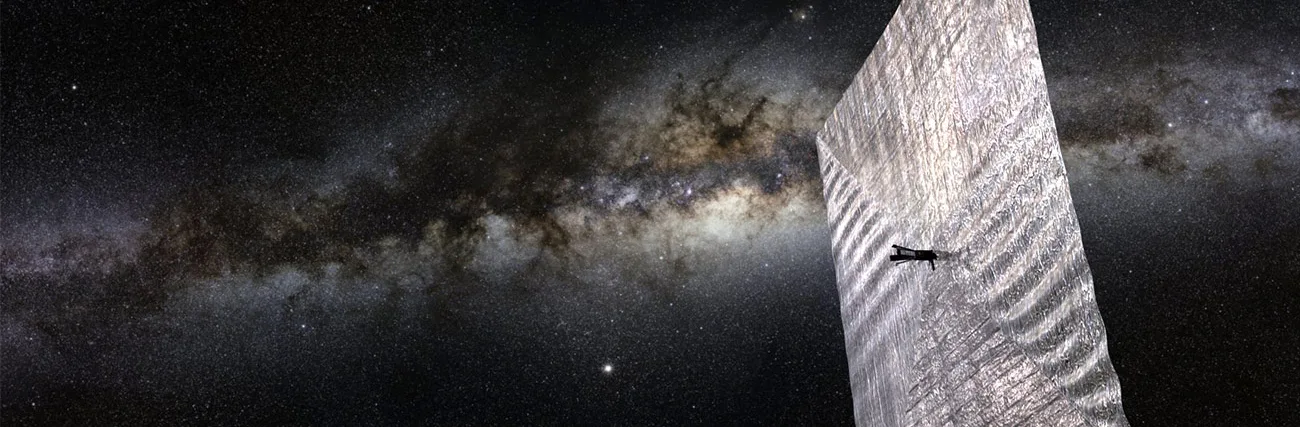
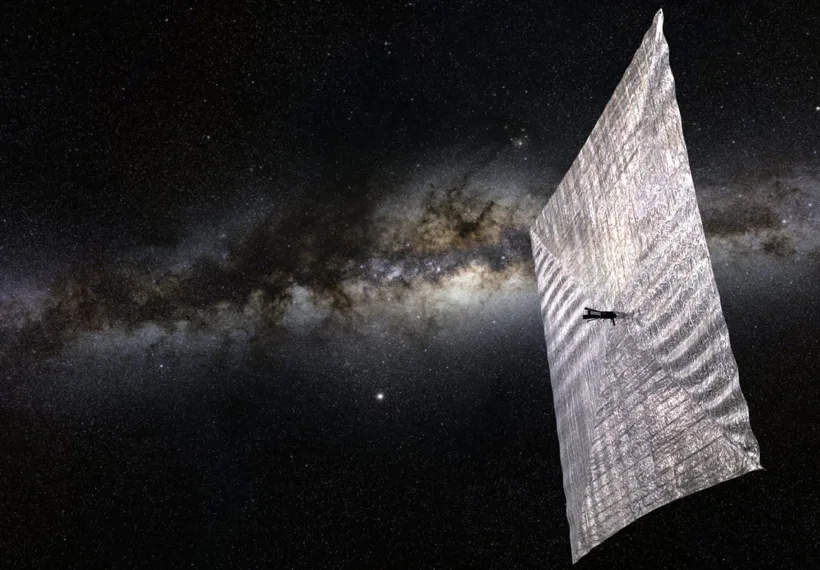
In May 2015, the non-profit Planetary Society will launch its first LightSail spacecraft for a “shakedown cruise” in Earth orbit. So who better to answer fan questions about the program than their CEO, Bill Nye, and his co-host Chuck Nice? You’ll find out how this tiny spacecraft (30 cm on a side) with a big solar sail (32 square meters of aluminized mylar) will get into space as the secondary payload on an Atlas 5, and what it will do once it gets there. Bill explains how LightSail will be pushed through space by sunlight, because even though photons may not have mass, they do have momentum. Learn about cubesats, and why the US Air Force is so interested in them. Explore practical applications for solar sail technology both here on Earth and out in space, from deflecting asteroids to traveling to Proxima Centauri. Plus, discover why the Society’s first attempt at a solar sail in 2005 ended in failure – and why this time things will be different.
Transcript
DOWNLOAD SRT
Welcome to StarTalk, your place in the universe where science and pop culture collide. StarTalk begins right now. Welcome to StarTalk, Bill Nye here, your guest host this week. I'm here with my colleague, charming associate, Chuck Nice. Chuck, good...
Welcome to StarTalk, your place in the universe where science and pop culture collide.
StarTalk begins right now.
Welcome to StarTalk, Bill Nye here, your guest host this week.
I'm here with my colleague, charming associate, Chuck Nice.
Chuck, good to see you.
Hey, Bill, good to be here, man.
And this week is Cosmic Queries, in which we answer your questions.
That's right, we call the questions from the internet and all of our various incarnations, Twitter, Facebook.
The social media that the kids use.
All the social media, all the kids.
With the electric computer machines.
Yeah, exactly.
So this week our focus, thank goodness, Chuck, is me.
We're talking about the Planetary Society, the world's largest non-governmental space interest organization advancing space science and exploration.
And in the interest of full disclosure, you are the fearless leader.
That's right.
Of the Planetary Society.
I'm the CEO and just so you all know, Neil deGrasse Tyson was involved with this.
So I had Carl Sagan for Astronomy back in the disco era.
Took one classroom, but it redirected my life, changed my life.
Wow.
And so I joined the Planetary Society, which he and two other guys started.
Lou Friedman, who's an engineer at JPL and Bruce Murray, who was the head of the Jet Propulsion Lab during the Voyager missions, the Viking missions, the hey hey days of JPL.
Right.
And so I got on the mailing list.
And then when Carl Sagan had this misfortune of getting this extraordinary, very difficult to deal with form of cancer, he died.
And I was asked to speak at his memorial service because his kid, Sam especially, liked the Science Guy show.
Yeah.
And then I got on the board of directors.
And then Neil was asked to be on the board of directors.
Okay.
He was this rising star in astrophysics.
Now he is, of course.
Yes.
Galactic glow.
Galactic, right.
Galactic overlord.
Yes.
So anyway, then we, the Planetary Society, because of the fame and accomplishments of Carl Sagan, Right.
We are recognized enough to give Stephen Hawking an award, the Cosmos Award.
Oh.
And so we went to Cambridge.
Oh dear.
Of course, yeah.
And that's, when you're with Neil, and I don't know how much time you spent, there's a lot of wine.
Yes.
There's a lot of flowing wine.
Neil and Bacchus are good friends.
Yes, well acquainted.
And now I'm the CEO.
I don't really, I'm not sure how that happened, but I've been the CEO for over four years.
And for the first time since the 1990s, we're growing.
And the exciting thing is, this goes back to Carl Sagan.
We're gonna launch our own spacecraft first week of May.
Wow.
A solar sail.
A solar sail.
Which is a extraordinary thing, if I can use that noun.
It gets pushed through space by sunlight.
Yes, now that is-
That seems crazy.
It does seem crazy.
It is really intriguing though.
And you say, Bill Nye, CEO of the Planetary Society.
Yes.
I thought light had no mass.
How can it possibly have momentum?
When I walk down the street, even if I'm John Denver and there's sunshine on my shoulders, I don't get high.
I don't get a push.
Right, even if I'm walking on sunshine.
Yes.
Or you might as well be walking on the sun.
Okay, that's not going anywhere.
So the thing is, whether in classical physics-
Once you get to sting, the references stop, right?
They should, yeah.
Whether in classical physics or through relativity, light has momentum, photons have momentum, and this is a fun little thing you can do in your head if you're out there and you're a physics person of any kind or just if you've ever watched US football.
Momentum.
Yes.
Is the multiplicative, it's when you multiply mass times velocity, mass times speed.
Right.
And direction.
So if you have a football player that is more massive and he's going faster, he has more momentum.
Right.
And so along this line, let's take E equals MC squared, which everybody loves.
Now let's divide both sides by C in your mind's head.
Oh, right.
Then E over C, some packet of energy divided by the speed of light equals some mass times the speed of light.
So some mass times some speed is momentum.
And that's it.
So it's just something to think about.
It's just, anyway.
So you get those two players coming together, concussion, basically.
That's right, yeah.
And then, but unlike the NFL, we're not in denial.
So this thing, we're gonna have this very large sail deployed from this almost, you would almost describe it as tiny spacecraft.
So it's like a sailboat, but in space.
Yes.
It's a sailboat in space.
And furthermore, you steer it by tacking the same way you steer a sail.
That's amazing.
It really is.
And so we have footage now on the website of Carl Sagan in 1976 on The Tonight Show with Johnny Carson describing solar sail.
And he had a model of it and so on.
And this thing is visually very, very similar.
I mean, as Mr.
Scott would say.
Well, you know, that's funny you say Mr.
Scott, because the first time I learned or knew about a solar sail was from an episode of Star Trek.
And I thought it was like so cool that they came up with this crazy idea.
And then I read about it that they did not come up with that crazy idea.
Well, it's consistent with the laws of physics.
Exactly, that they co-opted that crazy idea.
So let's get to the questions.
Okay, so what we have before us is a number of questions from our listeners and sometimes viewers if they're on YouTube.
And they've submitted these questions specifically for you to answer, Bill, with respect to the LightSail.
And you do not have the questions, only I do.
I have not seen the questions.
You have not seen them.
So just for the sake of disclosure, Bill does not know what I'm about to ask, but these are your questions.
Let's get to it.
This one is from Joe Foster.
And he comes to us from at Foss Do Nut or Donut.
They're good donuts.
The good donut, the Foss donut.
Let's say, let's just go with that.
Exactly.
Here's what Joe wants to know.
What are you hoping to learn from this launch?
I mean, what's the purpose in terms of information?
So the biggest picture is if you had solar sailing spacecraft that were operated very well, you could lower the cost of any mission to any destination in the solar system by, I don't pick a number of factors of tens of thousands because there's no fuel.
So as we say, you can trade time for money.
If you have time, you're a space agency.
For example, Rosetta, that spacecraft took 12 years to get out to the comet.
If you have time, the solar sail is fantastic system because when you think of a regular rocket, the engine might run 20 minutes.
That's a huge rocket.
Engine might run nine minutes.
It's just full blast.
Wow, that was a smaller one, I'm pretty sure.
The first one was pretty big.
Yes, but solar sail is just in space.
And so day and night, wait, in space, there's no night.
So it gets a tiny push continually for continuously rather, for as long as it's in space.
And so we're approving this technology.
And the big thing is NASA and well, the world now has a standard called a CubeSat.
A CubeSat?
Cubical satellite.
Cubical, oh it's CubeSat.
CubeSat.
CubeSat.
10 centimeters by 10 centimeters by hours is 30 centimeters, which is smaller than a loaf of bread.
It's really weird.
And when things get that small, the electronics have to be very small, the software has to be very efficient, everything has to be really good.
And so we built this spacecraft, estimates vary, for about a fifth of what it would have cost a regular space agency to build.
Wow.
Because we just had passionate guys and we were supported by 46,000 members around the world.
And so we hope to prove that solar sailing is practical on this scale, which would enable universities, private corporations, everybody to participate in inexpensive cislunar spacecraft that's between the earth and the moon and out to destinations in the solar system.
Unbelievable.
I mean, very believable and extremely cool.
Okay, so now let's touch on what you just said about getting up to speed and continual speed, because our next question is from Ben Schenker.
And Bill says, I mean, Ben says, Ben says, I'm Bill.
You are Bill.
It's a blur in here.
It really is, it's just, it's all a mush here.
Up here, that's my mind.
That's what your wife was saying.
At first, she thought she were kidding.
And now she's, what is she, 17 years into it?
That's right, you are absolutely correct, Bill.
17 years in.
Well, she reminds me.
She realizes that she's been tricked.
She shakes her head.
Yes, she does.
Here we go.
Ben wants to know this.
How long would it take for a LightSail ship to get to a useful speed?
And I'll put an addendum onto that.
What exactly is a useful speed?
Yeah, so the first thing is, you gotta get a chemical rocket, that's our state of the art, to get into above the atmosphere.
Right.
And so we are a secondary payload on an Atlas V, a venerable rocket that is descendant of the rocket that launched John Glenn, for example.
Oh, very nice.
It's an engineering descendant.
Nice lineage.
Yeah, that's right.
So once you're in space, see the Planetary Society tried to launch some solar sails, 2005, on a Russian rocket that was leftover from the Cold War, and it didn't work very well, and our members would not, they would not let us try that again.
No more leftovers.
That's right.
So it's on a real Atlas V, brand new, smells new.
Anyway, and you.
It's got that new rocket smell.
Gets above the atmosphere, and then if you, for example, wanted to go to the moon, it would take you about a month to get to the moon.
Okay.
And then if you want to go beyond that, it starts, you start computing years.
But the thing is you can go to destinations no one's ever thought of practically, like catching up with a comet would take about the same amount of time as the, for example, the Rosetta mission, because it's always getting a push.
It's always getting a push.
Always getting a push once you're out, out, out there.
Right.
But what we're going to do with LightSail, as we call it, LightSail, is go around the earth, show that the thing deploys, show that the antenna works.
It's quite an important thing.
You might not have thought about it, but when you're in low earth orbit, if you are not a great big space agency with US naval ships all over the world and the means to have stations on exotic coral atolls in the middle of the ocean, most of the time, you're not over the land.
Most of the time, there's nobody listening to your little beep, beep, beep, beep.
And so these sort of things have to be carefully worked out.
And then we're gonna try steering.
Can we twist the sail?
Imagine this in your mind's head.
You have to go edge on toward the sun and then face away, going away from the sun.
And that's how you build orbital energy.
So we're gonna run tests like that.
Wow, that's fascinating.
Very, very cool.
Well, there you go.
It was built just by people, just by people who thought it was cool.
There you go, Ben.
There's your answer.
Let's move on to Sharon Smith Snodgrass.
That's her name.
Snodgrass.
My dad was a prisoner of war with a guy named Snodgrass.
Really?
That's what he told me.
I don't know if it's a true fact or a false fact.
Chuck, I wasn't there.
He told me that.
Grownups tell you stuff.
This is true.
So go ahead.
How far away from the sun can the light sail travel before there's no further means of propulsion?
And at that point, can it change direction?
Or is it on a one way trip in the last direction that it was propelled?
Well, nominally, it's getting a push indefinitely.
I mean, that is to say, as a first cut, you're always getting a push.
Consider, for example, that Pluto, which will be visited by a spacecraft in July, the word visited, flying by, except in space, there's no sound, it just goes.
That right.
So it'll.
Let's hear that again, shall we?
There you go.
The plutonium atmosphere grows when there's just the tiniest bit of sunlight on it.
Everybody believes it's making some ice turn to a gas.
And then as it moves away from the sun, that shrinks.
So even way the heck out there at Pluto, there's enough sunlight to influence a whole planet.
So there will be enough sunlight to influence a spacecraft.
And then if you want to go crazy, which is fun to do.
Yeah.
We put a laser in your mind's eye on the moon.
We launch a solar sail and we have made an agreement with international governments and the Federation is running things at that point.
And we beam a laser on a spacecraft for a solar sail spacecraft for 10,000 years.
And it goes to Proxima Centauri, goes to the next star system.
Pushed by humankind's 10,000 year, nothing breaks.
We all agree this is worth doing laser system.
But if you think about it, it is the only known technology that could take us to another star system.
It's quite cool because there's always a push.
Always a push.
Always a push.
And we can, for Sharon's question, we could artificially, from what you're saying, we could artificially create that push if necessary.
So you'd have solar panels all over the far side of the moon, running a laser that somehow redirects itself and is always aiming at the Chuck Nice Memorial solar sail spacecraft.
I mean, these are some complex issues.
I'm not saying it couldn't be done.
It couldn't be done.
It's complex, but it's cool.
But it's cool to think about.
It really is cool to think about.
Very cool.
And it's related to LightSail and the Planetary Society.
Absolutely.
Okay, well, we got a couple minutes here.
So let's go to John Thompson.
And he's coming to us through Twitter.
At Aviation is his handle.
He says, with respect to the LightSail, how are they built?
And is there a top speed?
Well, everybody's dream is to get to 100 kilometers a second.
But this spacecraft's not capable of that.
So here's why.
To get to those speeds, you'd have to get close, closer and closer to the sun.
Right.
And we don't have the materials that can take that right now.
But this spacecraft, the sail itself is made.
That's right.
But this spacecraft is made of mylar, aluminized mylar.
It's inexpensive material.
In fact, it's so inexpensive, how inexpensive is it?
It's so cheap that they sent us a sample, which was big enough to make the first set of sales.
Like it was so cheap.
But anyway, the booms, as they're called, are often called tape measure booms because they resemble a steel tape measure that you use to size your carpet.
Or if you're a contractor sawing wood or what have you.
And they're extraordinarily stiff.
They're made of this cobalt steel.
Ours were made at the Air Force Research Lab in Kirtland Air Force Base in Albuquerque, New Mexico.
And we have a proprietary mechanism to wind these things, which are four and a half meters long.
So they retract.
Yeah.
Well, they extend.
That they extend.
But we have proposed retract and extending.
So if you think about it, you ever had, when you have the tape measure extended.
Right.
And you let go of the lock, it goes back in.
Well, what we do is push them into the thing.
So they're loaded.
Like a spring loaded.
It's spring loaded.
Yeah.
And they are extraordinary springs.
They're really, they're just cool.
And they, they consist of two ribbons, stitched welded together and stitch welding is a term they made up and it's just a laser.
It's very cool.
So it's a high tech thing that guys have been working on for decades and we have combined all these technologies and we're hoping for a successful flight the first week of May.
Fantastic.
You're listening to Star Talk Radio.
I'm your host sitting in this week, Bill Nye with my co-host Chuck Nice.
We'll be right back.
Welcome back to Star Talk Radio.
I'm Bill Nye sitting in for Neil deGrasse Tyson.
And this week, it's a big one for me.
I'm here with Chuck Nice.
We're taking your questions, your cosmic queries, and it's a big week for me because we're talking about the Planetary Society, of which I'm the CEO, and specifically our LightSail spacecraft, which is our solar sail spacecraft, which we're going to launch.
The nominal date is the 6th of May, but these dates slip around.
By the way, Chuck, I didn't tell you, it's an Air Force payload.
An Air Force payload.
This is to say, the primary payload is something that the Air Force is doing and they won't really tell us what it is.
There's a lot of speculation that it's just a spy satellite or it's the X-37B lifting body, but no one's really sure.
Anyway, so it's really cool, you guys, when you think about rocket science, this part of it's not that hard.
The primary payload or the thing where they've paid a lot to load on is some Air Force thing, and it's on top.
Then below that is the secondary payload, which is where we are, and it's seven of these very small satellites, these CubeSats, 10 centimeters by 10 centimeters by 30 centimeters, smaller than a loaf of bread.
And so we're on there, and after the primary payload is off, then these seven little ones go spring, spring, spring, spring off into space with these cool stainless steel sort of jack-in-the-boxes.
So it's very cool.
But let's get back to the questions.
Very exciting week for me.
Very cool.
All right, let's go to Dan Owens.
Dan, how have you been?
Dan's doing very well, from what I can tell.
And this is what he says.
What is the top speed of a solar sail could feasibly reach before losing the sun's influence?
Now, here's the real question.
After that, could it be propelled by an onboard photon source, or would that be the equivalent of trying to blow your own sail?
Yeah, it's trying to blow your own sail, exactly.
That's trying to blow your own sail.
However...
I can't say that I haven't done that.
So think about Dan Owens.
Yes.
Think about it this way.
Suppose you had solar panels, and you soaked up sunlight, and you powered a laser on board your spacecraft.
Your solar panels are on a spacecraft, by the way, not like on your wrist watch or something.
Which I have one, but that's not really...
It's not the same.
It's not in outer space, for example.
So then you'd shoot the laser off some way, hoping, I mean, and expecting that you'd get a push.
Like if you were holding the famous thing that will stand on roller skates, and you have a bowling ball, and you throw the bowling ball to somebody, you go off the other direction.
Because of the conservation or momentum.
The momentum of the bowling ball going that way will be equivalent to your momentum going this way.
Well, imagine you did this.
You soaked up sunlight, drove a laser, you shoot the laser.
Well, back up, back up, it's simpler than that.
If you have just a mirror in space, the photon bounces off the mirror and gives you a push.
There you go.
Whoa.
And so that's what the solar sail is.
You don't even need the old fan in the sailboat trick where you've got the electric fan in the back of the sailboat.
All you need is a mirror.
That's right.
In space.
In space.
Because you have a fan, which is the sun.
The sun is your fan.
There you go.
So anyway, by the way, if you have just a black surface, there's an expression in physics called a black body, a perfectly absorbent material.
Yes, we have that saying in my family.
I was going to let you do it.
Anyway, you get a push, but you get twice as much push, theoretically perfect.
If it was a perfect mirror, you get twice as much push.
And so this thing is made of super shiny mylar.
And making out of mylar, it makes it a little cheaper than if you made it out of other better, fancier plastic like aluminized, Kapton, polyimid, imid.
But the mylar, the thing is going to burn up in the atmosphere this first flight because the man is only taking our spacecraft.
The man has only taken our spacecraft to 250, 400 km, you know, 150 miles and stuff.
And they're still up there, although you and I would suffocate in a few moments, there's still a few air molecules and so it will drag it down.
A tiny bit of atmosphere that will.
But we are going to launch a second light sail in May of 2016.
That one on the mythic modern super Falcon 9 from SpaceX.
And so that one will be at a much higher altitude and we will get solar propulsion much more easily.
Now, this first test is the first test.
Ha!
That's right.
And we're very hopeful that things will.
See, NASA has tried deploying these sails on another spacecraft called NanoSail D.
And by the way, NanoSail, NanoSatellite, NanoSat, that's another word they like.
Instead of CubeSat.
But CubeSat is a standard that people have settled on.
And by people, I mean mostly universities.
And the Air Force is quite interested in CubeSats.
Anyway, they tried this and it didn't deploy right.
The tape measure booms didn't boom.
And so we believe we have solved that problem.
And of course, the guy who solved it is 12 years old.
He's 26.
Right.
Of course.
And he just wrote an app and he's now a billionaire.
Right?
That's how it works.
No, no.
These guys, they're young guys and they're men and women and they're passionate and they've just done outstanding work.
It's really exciting.
Fantastic.
Well, Dan Owens, thank you for that great question.
And your answer is the sun is your fan.
Always remember that.
All right, let's move on and let's go to...
The sun is your fan.
The sun is your fan.
I don't want to forget this.
Take it, Chuck.
Sorry, you guys.
Joey Pirosco from...
And I love it that Joey writes from Green Bay, Wisconsin here.
Hey, Bill, the light sail technology is phenomenal.
However, how will you prevent microscopic space debris from penetrating or completely destroying its fragile mirrors or as you called it, mylar, that it needs for propulsion?
This is a really great question, Joey.
I am interested right now.
And Bill, I love the look on your face.
Let's have it.
So two things, Joey.
First of all, three things.
First thing, thank you for your question.
That's an outstanding question, and many people have wondered that.
But we'll start with there's not that many micrometeorites.
Really?
I mean, we all worry about it.
Yeah, because that's what you hear about when you...
And space debris.
It's serious freaking mess.
It tore a hole in my suit.
See, that's never happened.
For example.
Is that all Hollywood?
No, it's all sort of common sense, but there's just not that much stuff.
It's just not a lot of stuff out there.
With that said, the sail manufacturers have embedded this ripstop feature.
And when you look at the...
And by that, I mean their strands or fibers built into the fabric, into the shiny plastic super thin stuff.
And if you look at it edge on, at grazing angle, you can see the lines and they're about two centimeters apart, about a little less than an inch apart, going this way and going that way.
And so to keep it from tearing mostly and just handling it with humans with those cool little white gloves on, when they fold it like origami in this clean room.
Anyway, that's a great question, but we think we've addressed that.
Micro-meteorite going at 10 kilometers a second or seven miles a second, we'll just go right through it.
Right.
It's not like you're up there with a utility knife going, rah, rah, rah.
Yeah, like the old pirate with the knife in the sail.
There'd be just poke a hole, but there is ripstop built into it.
So this ripstop weave, so to speak, actually keeps it from tearing.
Like a run in a stocking.
Exactly.
Keeps it from continuing on.
And this is an old trick, and it's called a clay polymer.
Mylar is a brand name, like tissue or frisbee.
A clay polymer, and polymer's plastic, and clay means it has an alkaline.
It has an oxygen-hydrogen hanging off the end, and it does something to make this plastic have these wonderful properties.
That's fantastic.
Hey, Joey Perosko, that was a really great question, my friend.
We do love you, Joey.
Nice job.
Okay, let's see here.
All right, this is a nuts.
These people are thinking, man.
This is Eric.
Well, Chuck, you're choosing good ones.
No, you know what?
I'm kind of going, well, I am choosing good ones.
This is Eric Schard.
Eric Schard would like to know, would light sails be a viable approach to deorbiting comets to aid in terraforming Mars?
Excellent.
Excellent.
Piece of cake.
Excellent.
Nothing to it.
Nothing to it.
Yeah.
Come on.
They would be ideal for changing the orbit of comets.
Okay.
Now, along this line, hold it.
This isn't Chuck.
Who's this?
This is Eric Schard.
Eric.
Eric.
Along this line, Eric, keep in mind that there might be a shorter term, more important use of this, closer related to your question.
Instead of changing the orbit of comets, we might want to change the orbit of an asteroid.
That's what I was thinking.
So it doesn't hit the earth.
That's what I'm saying.
Like, for instance, Apophis is actually going to go through that keyhole, and we are doomed.
God, you're down, Chuck.
Exactly.
Right?
Apophis' name for the god of anxiety is going to miss us.
The god of worry is going to miss us, but when it was discovered, it looked like it would not miss us.
And, as we always like to say, it may be wrong.
We may be wrong.
There are probabilities here involved.
But imagine this, Eric.
You would have a solar sail that would catch up with an asteroid, which is not trivial, catch up with it, and then poof, you know, smother it, blah, just get on top of it.
And then the shininess would change the momentum, would change, take sunlight momentum and change the path of the asteroid.
Just ever so slightly.
And so then now to get back to the biggest picture of your question of taking comets, which might be full of ice, and smashing them into Mars so that we can terraform Mars.
Terraform being a word that to you and me makes sense, but if you talk to Og, the cave guy, he would think you'd kind of lost your mind.
Okay, it's a whole planet.
We can barely manage the planet that we live on.
We have enough trouble with managing water here.
And we don't do it very well, by the way.
Okay, I went with enough trouble.
You could go with suck.
Yeah, we suck.
Let's not sugarcoat it.
Right, but with that said, you guys, about terraforming Mars, there's a reason Mars doesn't have much of an atmosphere, and that's the solar wind scrapes the atmosphere off.
The solar wind are these particles that stream off of stars, and in our case, the sun, and they've scraped the Martian atmosphere away because Mars isn't quite big enough to have a magnetic field, to stay molten, to create a magnetic field, which makes the charged particles come streaming into the poles instead of sideways tangentially across the surface.
So you guys, terraforming Mars.
That's it.
No, but I mean-
It's not gonna happen.
It's just not that easy, okay?
It's not that easy.
There's nothing to breathe, there's nothing to eat, and it's freaking cold.
You guys, we live in this world, on this world, where humankind has migrated all over the place.
Everybody's from East Africa, Chuck, your people, much more recently than my people.
Went north-
Yeah, my people are, East Africa is Detroit.
It's like that.
But, actually, well, we can get a whole digression on skin color, but it has to do with ultraviolet light.
You go north into Mesopotamia, then you migrate across Eurasia, then there's this ice age, all the snow is frozen up in the mountains, so we can just walk to Sarah Palin's place in Alaska, then south, killing everybody.
By everybody, I mean all the big mammals and eating meat, and then we just migrate across all the way down into South America, it's cool, but we're running out of places to which to migrate.
That is so true.
You're not going to be able just to leave the earth and go to Mars.
It's a very complicated and long distance.
However, if you want to send spacecraft to Mars to study its environment, and I recommend that we all do that, I cannot help but recommend solar sailing as a means of inexpensive propulsion for, let us say, citizen research.
For people who are interested in interplanetary missions, you could embrace a solar sail spacecraft, not unlike the LightSail, which the Planetary Society is going to launch the first week of May.
Did you see that circle of life there?
Brought it back around, Eric.
Did you see that, Eric?
That was fantastic.
Oh, great.
Well, there you have it.
Forget about Mars.
Not going to happen.
The solar wind comes trolling in across the atmosphere.
All right.
Take a chuck.
The musical stylings of Chuck.
Thank you very much.
Please avail yourself of some of the mints here in the Stardust Lounge.
Tip your servers, try the chicken.
Let's go with a real quick question, because we have just a little bit of time left here.
With Logan, I guess it's keeps.
Logan says, all the talk is about propulsion of solar sail.
My question is, how does it stop?
Make flight path corrections, et cetera?
Standard rockets?
Wouldn't that defeat the purpose, though?
Yeah, so you seldom stop in space.
Yes, when you land on the surface of Mars, you stop, but mostly you go into orbit around things.
And by that, I mean, you start out in orbit around something, Chuck.
The big thing you start out in orbit around is?
Earth.
The Earth for our solar system.
For our solar system.
But everybody actually-
It's the sun for the star.
Even when we're on the Earth, we're in orbit around the sun.
Even when we're orbiting the Earth, rather, we're in orbit around the sun as well.
Correct.
So you seldom stop.
You go out there on just the right trajectory to get captured by, let us say, Mars's gravity or the moon's gravity.
That's the most, it's a much more common thing in a spacecraft mission.
And LightSail is ideally suited to that.
It's ideal for that.
So it's gonna be an exciting launch.
It's supported by Planetary Society members around the world.
And we don't stop, basically.
We don't stop.
But the LightSail will, sorry, burn up your membership dollars at work.
But it's gonna be a fantastic mission and we're gonna learn a lot about it.
And not only that, I'm Bill Nye, your guest host this week on StarTalk with my co-conspirator, Chuck Nice, and we'll be right back.
Welcome back to StarTalk Radio.
I'm sitting in as your host, Bill Nye.
I'm here with my co-conspirator, Chuck Nice.
Yes.
And it's Cosmic Query time, where we take your questions.
But this week, I am very excited as the CEO of the Planetary Society to take questions that all have to do with our solar sail spacecraft, our LightSail spacecraft.
LightSail.
Which launches the first week of May on an Atlas V, and the Planetary Society, everybody, is the world's largest non-governmental space interest group.
We advance space science and exploration so that citizens, enabling citizens of the world to know the cosmos and our place within it.
And so we advocate in US.
Congress for good space policy and it's limited extent in Europe and a very limited extent in Israel, the meeting this year is in Israel.
A very limited extent in India and in Japan, but we have members around the world who have a great interest in advancing space science and exploration and that's why we built this very cool solar sail spacecraft.
Chuck.
Yes, sir.
You've got questions.
I've got great questions so far.
I have to say that our audience has been thinking quite in depth about this LightSail and we've had some really, really interesting questions.
You don't have to sound so surprised.
They're your fans, okay?
They're smart people.
This is true, they are.
So let's, well, I don't know if this person is actually screwing with me, you know.
This radio, Chuck, just don't give them too much information.
All right, so it's Derrick Iswig-Chaya.
Okay, that's it, I did my best.
All right, well, it's using Roman characters to describe a language that they weren't made for.
Absolutely.
But we're doing our best, go for it.
Okay, how big of a sale is required for this project, and does the size of a sale actually matter?
In other words, bigger sale, faster than a boat?
Yeah.
Is that the deal?
Yes, and it's more, it's not just the bigger the sale exactly, it's the bigger the sale relative to the mass of the whole thing.
Right.
So this sale is 32 square meters, it's quite large, compared to this thing, which the spacecraft, the bus, as it's called, is smaller than a loaf of bread.
And this will be the highest acceleration spacecraft, solar sail spacecraft launched.
It'll have the most oomph for its mass.
The Japanese Aerospace Exploration Agency, JAXA, launched this very cool, Icarus spacecraft a few years ago that was a demonstration that they could do it and it worked fine.
But it ended, it was intended, the whole spacecraft was intended to end up in orbit around Venus, but it missed.
And so now it's in an orbit about the same distance from the sun, but not around Venus, about the same distance as Venus is from the sun.
So we are close friends with our buddies at JAXA who got a lot of experience by deploying this thing.
It worked really well.
But because of the 600-kilogram spacecraft, 600-kilogram spacecraft, it didn't get as much acceleration, strangely enough, as LightSail will get here the first week of May.
Well, that's interesting.
Now here's the follow-up to that question for the same person.
It'll be several weeks after that when the sail's deployed.
And the atmospheric conditions have to be just right and so on.
Those are some disclos, disclaimers.
So I'm not sure if Derek is trying to express a disbelief in LightSails, but says, in addition, how much funding is put into figuring out an efficient fusion reactor?
That's a separate issue.
That's what I was gonna say.
Like, are you saying like, LightSails aren't gonna work, so we really need a fusion reactor?
Actually, the LightSail does work on a fusion reactor.
Maybe that's what his tie is.
And where is the fusion reactor, Chuck?
Take a shot.
Take a shot.
Where do we have a fusion reactor at a safe distance?
I'm gonna say that would be the big plasma ball in the sky.
The sun.
There you go.
That's right.
The sun is our fusion reactor.
Chuck, he's the real deal.
So it's, the sun provides the hydrogen and the protons combined to make what we'd nominally call helium atoms.
And in that process, release a tremendous amount of energy, photons, which will push the light sail.
But investing in a fusion reactor is something we do here in the United States as taxpayers all the time.
And fusion reactors are always, in my experience, 40 years away.
They're always 40 years in the future.
But that doesn't mean-
No matter what time it is that you're thinking about them.
My whole life, 40 years.
But that doesn't mean somebody won't figure it out.
I'm not being dismissive.
But the Planetary Society's not really into building fusion reactors.
We're into taking advantage of the natural fusion reactor, which we call the sun.
Very cool.
Let's take another question, Chuck.
Let's take another question.
All right, this is from Denard Springle coming to us from Google Plus.
And Denard says, the first attempt at the light sail by TPS was sadly a tragedy.
TPS, everybody, means the Planetary Society.
Okay, thanks.
2005, Cosmos One crashed in the Barents Sea, which I had not really noticed before.
It's in the Arctic.
It's part of the, it's an area of the Arctic Ocean.
Lead on.
He says, and this is not instilling a lot of confidence there, Denard, will there be a third attempt if the same should befall the second attempt?
So if the same fate befalls our.
LightSail A.
Our LightSail A.
We have LightSail B, which launches in May of 2016.
Okay, so there you have it.
We have two spacecraft, yeah.
If you're a Planetary Society member, thank you, because one of the things that my predecessor did do was get everybody by sending letters to people, get everybody to build a second spacecraft.
Once you have the design, building the second one isn't nearly as difficult as you may imagine.
I tell you mass produce cars, for example.
Exactly.
Making the hardware is one thing, but it's really it's the software, man.
That's what just takes people a long time to get it to really actually work, actually.
You can get it to almost work right away, but almost work is a lot like not working.
But we got to work it.
And so everybody's very excited.
So that's a great question.
Almost work is a lot like not working.
So there you have it.
That was a good question.
Way to go there.
Dinard, I appreciate you.
Pardon me for that.
Will the lights, oh sorry, let me back up here.
This is from Andy.
That gets me every time.
I don't care.
And the more that the showing our age, I mean, you don't really, there's rewinding now is not a what your mechanical thing.
Yeah, that's true.
It's no click on a click.
Yeah, exactly.
Andy Bracken wants to know, will the LightSail be used in the future for missions to the planets, just our outer planet?
Is this basically the future?
The future.
Can you make this the future?
Yeah, we claim it is.
So as we say, if you have time, you can trade that for money.
In other words, LightSails will go wherever you want.
Well, as long as you don't get too close to the future, the sun with our current materials will go a long way over a long time.
But yes, missions to Mars and Jupiter have been discussed at length.
And there's guys who are, people who are into this and they run the numbers, they do calculations on this.
And yes, it's all quite doable, but the longest journey, Chuck, starts with but a single step.
And so that's why we're doing LightSail A here in May.
Fantastic.
So basically all of your unmanned missions, this could be.
Oh yes, yes.
This could be the thing for all of your unmanned missions.
Yeah, yeah.
But the big thing is the cost is so much lower than a chemical rocket that CubeSats, as they're called, whether or not they're LightSails or not, are made by universities, by small companies.
And now, which has really helped things, the Air Force is quite interested in CubeSats and they want to fly an armada of them, a flight of them, I guess, in the Air Force.
We don't have armadas, we have flights.
Things in formation, CubeSats in formation, and they would look for, they'd be used as a wide aperture radar or what have you.
And along this line, in May, we are gonna have a companion mission.
The CubeSat is gonna be part of a Georgia Tech proximity mission where the spacecraft keep their stations relative to each other, like ships at sea.
Oh.
Yeah, so it's very cool.
But Chuck, coming up on four minutes left in the show.
Yes, we are.
And I think you know what that means.
I believe that means it is time for our lightning round.
Where we take your questions, we answer them very quickly.
Here we go, the first question from the lightning round.
Chuck Nice.
How easy would it be to repair the LightSail if micrometeoroids peppered it like a shotgun shot?
So this isn't just one tear like we talked about earlier in the show.
This is a shotgun shot, like pop, pop, pop, pop.
Well, it'll still have a little bit of propulsion with the shreds of sail that are still there, but that shred, that ripstop feature, I think will keep that shotgun eventuality from eventuating.
Sweet.
What is the ideal, oh, oh, oh, first of all.
It's lightning round, Chuck.
I'm sorry.
I'm screwing up the lightning round because I did not give the last person's name, which is Gabe Zabato, okay?
Gabe Zabato, thank you.
But next question.
Okay, this is from Jesse Robinson coming from Google+.
What is the ideal speed of travel and how long will it take to achieve that speed?
Well, first of all, when you're in low Earth orbit.
It doesn't matter.
You can go, you know, the ultimate goal, by the way, is to get to 100 kilometers a second, where you're going very close to the sun and get slung way the heck out of the solar system.
But in the meantime, we're in low Earth orbit.
So in nautical miles, you're going seven miles a second.
Seven miles a second just to get started.
There you go.
Aaron Kelly, who's coming to us from Twitter says, Ocean sailing ships use a keel and a rudder to leverage the wind on the sails and steer.
Is there an equivalent for the light sail?
I love this question.
Yes.
So what we do, two things.
We have, first of all, we have torque rods.
These are twist rods that react against the Earth's magnetic field.
There's electromagnets.
They're about this long, Chuck.
OK.
20 centimeters.
And the very fine wire one.
So electricity comes onto solar panels, which are part of the spacecraft, and you twist against the Earth's magnetic field.
Then the other thing is there is an old technology, which we love, gyroscopes, which in spacecraft often go by the expression momentum wheels.
They run electric motors, keep them spinning, and they twist, whoo, whoo, whoo, twist against gravity and orbital motion.
Fabulous question.
We are steering and tacking the LightSail spacecraft.
Steering and tacking.
Steering and tacking.
I love the whole gyroscope thing, man, that's sexy.
Okay.
Nelson is amazing.
That's the name of the, that's the name.
Nelson is amazing.
Nelson is amazing.
How would you predict a solar sail could revolutionize, okay, life on Earth?
In other words, how does it change international travel for us down here as opposed to travel up there?
Well, what it would do, if practically, you wouldn't get on a light sail and fly around.
You are too massive.
You can't breathe in space.
And so you can't breathe in space.
But what could practically happen is the future of, let us say, air traffic control could involve CubeSats flying in formation to make excellent, high quality, inexpensive, high reliability radars.
Could happen.
All right, I think we have time for just one more.
And this is Brett Shock.
He wants to know, can the sail be revved up in orbit for a few years and then hitch a ride?
Well, yeah, we're gonna run for about a month, which is very traditional, because so little of the time are you over land to get telemetry.
We're gonna run for about a month before we deploy the sails.
And we are also planning to run tests of extending and retracting the sails, the same way you furl and unfurl sails on ships at sea.
You have been listening to StarTalk Radio with your guest host, me, Bill Nye, and my co-conspirator, Chuck Nice.
That's right.
Thank you very much for your excellent questions.
Consider the Planetary Society, our LightSail spacecraft, the first week of May.
Keep looking up.
This is Star Talk Radio.
See the full transcript



 Unlock with Patreon

 Become a Patron