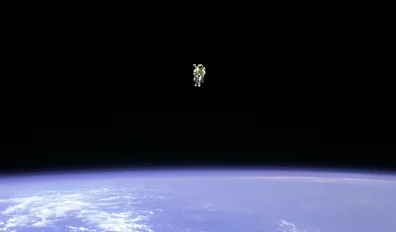
What challenges and perils await humanity on our journey into space, and will we be up to the task? In this episode of Cosmic Queries, astrophysicist Neil deGrasse Tyson and comic co-host Chuck Nice discuss why pressurized space suits are required on a spacewalk, how the Sun’s ionizing radiation can harm human biology, and other short and long term dangers of space exploration. Neil also talks about dangers we bring with us into space, like the impact of charismatic leaders on off-world colonies. You’ll find out more about the human side of the colonization of Mars, from the comfort food NASA’s cooking up, to the emotional value of pets, to the feasibility of the Mars One project. Discover the conditions on Mars under which water can coexist as a liquid, a solid and a gas at the same time, known as water’s “Triple Point.” On a lighter note, Neil and Chuck speculate on sports in space, and for Harry Potter fans, how zero gravity will impact Quidditch, brooms, and the Golden Snitch.
Transcript
DOWNLOAD SRT
Welcome to StarTalk, your place in the universe where science and pop culture collide. StarTalk begins right now. Now. This is StarTalk Radio. I'm your host, Neil deGrasse Tyson. I'm an astrophysicist with the American Museum of Natural History right...
Welcome to StarTalk, your place in the universe where science and pop culture collide.
StarTalk begins right now.
Now.
This is StarTalk Radio.
I'm your host, Neil deGrasse Tyson.
I'm an astrophysicist with the American Museum of Natural History right here in New York City.
And in studio with me is my cohost, Chuck Nice Comic.
Chuck, when did the word comic apply to human beings rather than what you see in the Sunday paper?
You know, I'm not sure.
I think once I put it on my Twitter handle.
Chuck Nice Comic plugs his Twitter handle.
That's a good plug.
That was really smooth.
That was smooth, smoother than usual.
This is StarTalk after hours.
It's the Cosmic Queries part.
Many StarTalk episodes.
What we do is we collect questions on a specific topic from all of our media outlets.
And we're almost everywhere.
Google Plus, where else are we?
Look over to my...
Facebook.
Yeah, definitely.
Yeah, definitely, Facebook, you can like us there.
StarTalk, I mean, Twitter?
Twitter.
Yeah, StarTalk Radio is our Twitter handle.
Just Google StarTalk and find the medium you like the best, and there we are.
There's a veritable corneacopia of StarTalk for you to avail yourself of.
That had way more syllables than necessary.
He's just showing off your eight vocabulary words you picked up this past week.
What are you talking about, eight?
I got those this morning from a calendar.
So these are questions, I haven't seen these before, but the theme today is human performance, and it's with emphasis on space, what your body would do in space, and can it work, does it work?
And so you got them and hand them over to me.
And I haven't seen them before, so some numbers I might have to pull out of the ether, but we'll check them over the breaks.
And if I don't know an answer, I'll just say, Chuck, I don't have a clue, go to the next one.
We know that's not gonna happen, but that's cool.
And I must say, I am impressed with the fact that you sit there, you have a computer in front of you, but I notice that you always make sure that you close it before we start this.
And I think that's your way of saying, that's right, that's right.
That's right.
The computer up here is where this is coming from.
Bring it on.
Okay, all right, so let's go to Facebook first.
I mean, we got some Google Plus and we got some Twitter here, but let's go to Facebook first.
I'm gonna start off on a fun note.
This is from Matthew Vicksel, okay?
What could the future of sports look like in space?
Will Harry Potter fans get a chance to see a version of Quidditch implemented in microgravity?
What effects would increased or decreased gravity have on water sports?
So two, three real questions there.
I'm more concerned about the Quidditch, but.
Last I checked, in Quidditch, they fly, right?
So one of the advantages of flying is that you're not so much thinking about gravity, because you can go anywhere in the three dimensions that space gives.
It's we people who can't fly who are limited to the two dimensions of Earth's surface.
So the broom, which they steer by leaning left or right, and has natural lift to it.
If you were in the vacuum of space, free falling anywhere, then there is no sort of net gravity force on you.
The buoyant force of the broom would be unnecessary.
In fact, if it still had a buoyant force, it wouldn't know where to buoyant you towards, right?
If it wants to lift you up, and in space there is no up, you'd have brooms go in every which direction.
Not knowing.
So basically, Quidditch would look like a Chinese fire drill.
Yeah, it would be quite a random looking, so you'd have surely the wizard, so they'd specially design a broom for the specific purposes of space, Quidditch, that's first of all.
Now, there are two kinds of space, Quidditch, you might imagine.
One that's in the vacuum of space and the wearing space helmets, or one that's on a planet that has an atmosphere and it just has a slightly different gravity, right?
So if it's a slightly different gravity, it's the same game.
It's the same game.
Same game, so that's not even interesting.
But if you're in the vacuum of space, then, let me see, so there'd be no atmospheric drag on anything you throw, and the, what do you call the little birdie thingy with the flappy wings?
Oh, now it's killing me.
Oh, you know, we now have a zillion Harry Potter fans saying, oh my gosh, we just lost.
I think it's the snitch.
It is the snitch.
Yes.
Nice job.
That was impressive.
I got it all from my kids.
So the snitch, of course, we presume, is it doesn't have broom powers, but is actually aerodynamically supporting itself with flapping wings.
Oh, so yes.
Like a hummingbird.
Like a hummingbird style.
Yeah, so wings are useless in Zero G.
That was the odd thing about naming the lunar module the eagle.
That kind of worried me a bit.
In 1969, Apollo 11, the lunar module.
What does Neil Armstrong say when he lands?
Houston tranquility base here.
The eagle has landed.
And their patch was an eagle extending out its wings.
This is because every mission has a uniquely designed mission patch.
This one had wings extended outward and it was hovering over the lunar surface.
No, that doesn't work.
Okay, a bird on an airless planet is a brick.
So yeah, the snitch, they'd have to redesign the snitch for that one.
So it could be fun, but yeah, yeah.
A swimming pool.
All right, if you brought a swimming pool to Mars, the atmospheric conditions of Mars, it is very low temperature, very low atmospheric pressure.
Okay, right.
Now do you remember what happens if you go to mountain tops?
What happens to the boiling point of your cooking if you're part of water?
It takes less time.
No, it takes less time to bring it to a boil, but it takes longer to cook it because now it's cooking at a lower temperature.
It'll boil like 180 degrees, 170, when it should be 212.
The higher you go in altitude, the thinner is the air, the lower the temperature of your water, lower is the temperature that water boils, all right?
If you keep dropping the air pressure, the boiling temperature continues to drop.
There isn't a pressure at which the boiling point equals the freezing point.
And that is the condition on the surface of Mars.
Get outta here.
It is the triple point of water where water coexists as water, liquid and gas.
Dude, get outta here.
And so if you had a swimming pool, it would be evaporating and there'd be ice chunks in it and you'd be swimming in the water surrounding the ice.
So it'd be really different.
You'd need swimming events where you'd navigate the icebergs that are in your pool.
And the water would just be smiling, happy, and would stay that way.
Yeah, it's called the triple point.
That's awesome.
You got it.
When we come back, more of StarTalk After Hours, Cosmic Query edition.
Bye We are back, StarTalk Radio, After Hours edition, The Cosmic Queries.
And today, we're doing Questions Called from the Internet, Listener Queries, all about human performance in space or anywhere else.
Yeah, but space is cool, so we can focus on that.
I got Chuck Nice in here with me.
Chuck, just briefly, you're on a TV show now, and I laugh every time I read the description.
It's great.
You go into people's homes and do what?
I go into people's homes and they take me.
People let you in their homes and you do what?
Yeah, I was gonna say, that's a different show where I'm just going in.
People take me on a tour of their homes.
They live in very weird, strange, or unconventional dwellings, and I show up at the door, and they're like, come on in, and I kind of hang out with them.
And you're with a camera.
I'm with the whole crew.
This is like 60 minutes with a camera at the door.
It's very cool.
It's a very cool thing.
I just pop in on them, and it's a home invasion show.
Home invasion show.
It's a home invasion show.
Home Strange Home.
Home Strange Home on HGTV.
Crazy stuff.
Good luck with that.
Yeah, and they got another season, you said.
So we're in hiatus right now, but we'll be back.
Excellent.
It's gonna be great.
Season two coming up.
You said you were high?
Oh, hiatus, I'm sorry.
That's always the case.
I am still reeling from the triple point of water that you bought up.
I learned a lot when I'm here.
We left off the last segment with this, yeah.
And this is something I've never even heard of, but it makes perfect sense, the way you say it, that as the atmospheric pressure is less and less, then water now can reach an equilibrium point where it can boil, be liquid.
And freeze.
And freeze.
At the same time.
All at the same time.
Yes.
Blown away.
Yeah, and it's well known in physics, and it's called the triple point.
The triple point.
And it's a combination of pressure and temperature, and you adjust one and the other, and you can find out where all three forms of matter are just happy coexisting.
So in fact, it's not simply water that happens to be evaporating.
It is boiling water.
It's boiling water.
With ice cubes in it, and you have steam, water, and ice, all in one stable form.
And not every place on the Martian surface does this, but there are many places that do.
It's very near the triple point of water.
And so, if you're gonna have a swimming contest in a place that's near the triple point of water, you just have to rethink how you navigate the icebergs.
Kind of like swimming in the East River at one point.
You would have to navigate the bodies that are floating.
You gotta get around them.
Exactly.
Plus, if it's boiling, you remember the scene in Lion King 1 1⁄2.
Where Pumbaa's in the hot tub.
In the hot tub, yes.
And it's bubbling.
And then Pumbaa gets out.
And it stops bubbling.
It stops bubbling.
Okay.
Simba says, I'm out of here.
So, yeah, so it's basically a jacuzzi simply by exploiting the laws of physics.
Nice.
Yeah, that's pretty cool.
All right, next.
All right, let's move on.
Let's move on.
All right, this is from.
Oh, by the way, during the Olympics, I was constantly tweeting what all these events would look like in space and on the moon and on Mars.
And it was fun.
If you're into mining archival tweets, you go to my Twitter stream, Neil Tyson.
I think the cleanest way to do is just go to the Twitter page, right?
And then you find me and just scroll down.
Take a while, but just the dates are there.
Go to when the Olympics were, and you'll see a whole bunch of tweets about swimming and gymnastics.
And I was worried that if the gravity were low enough, that if you jump on the springboard, you'll just go in orbit.
Just never come back.
Never come back.
Never come back.
God, that's my dream.
All right, okay, let's go to Jeffrey Runyon, okay?
And Jeffrey Runyon is coming to us through Google+.
He says, if humans are ever going to travel to Mars, what are we going to eat along the way?
Food has a major psychological aspect to it.
If people are going to be under enormous stress in close quarters for two years or plus, two plus years, they're going to need more than astronaut ice cream to keep them going.
Of course, and there's an entire branch of psychologists that are in the employ of NASA at the Johnson Space Center at Houston, whose sole job is to worry about the mental health of astronauts.
Let's just get that up front.
Really?
Yes, there is, okay?
That's number one.
Number two, about the food, I actually visited the kitchen, the Cosmic Kitchen at NASA at Johnson, and you meet the chef who's making food that can last 10 years without refrigeration.
I had a steak that had been in a packet on the shelf for five years, unrefrigerated.
So some foods, they just irradiated.
Why does food decompose?
Because there are microbes in it, eating it before you have a chance to get there.
That's why it's not a natural thing in the universe for something to decompose.
That only happens on Earth, where there are microbes everywhere, smaller than your eye can see.
But if you leave out a slab of meat, they'll start chowing down on it, okay?
So make sure you take this trip and there's no microbes on your food, so you irradiate it, so there you have it.
All right, now there are other problems.
The molecular structure can break down, so the meat or whatever other food you can start tasting mealy.
So there's not only the taste of the food, but there's texture.
So you gotta be, you wanna worry about that.
All astronauts take comfort food with them.
There's meatloaf, okay?
There's rice and beans, there's tortillas.
Tortilla's great because it doesn't make crumbs when you eat it.
Regular bread you eat, it makes crumbs, and the crumbs are floating around the space station, could end up in a duct somewhere, all right?
Tortilla doesn't make crumbs.
So there are a lot of foods, international foods at that, and especially evident in the International Space Station.
You start comparing food from different nationalities, and you know, yo, what's cooking over there?
And who's got a better smelling dinner for the evening?
So the point is, they do think about what food to bring, and you want enough of a diversity of food that you can spread the love to different kinds of food groups and different nationalities.
But the bottom line is you don't need more variation of food than most people would ever have in their own lives.
I bet you there's no more than two or three kinds of breakfast cereals you ever eat, is that correct?
You are correct.
That's correct.
And think about that.
You know, there's not that many different things.
And how many times do I eat a pizza and love it?
You know, at least 20 times a month, practically.
It is the perfect food.
It is the perfect food, exactly.
So, and I will still eat me some astronaut ice cream.
So, oh, by the way, the trip there would take about nine months.
The alignment of Earth and Mars, that alignment happens about once every two and a half years, where you minimize the energy to get there.
And when you launch, it takes about nine months.
But Earth and Mars are not still lined up for you to come back.
You have to wait a few more years for that next alignment to help you come back.
So a total round trip Mars mission is going to be three or four years.
So what you really want is like gardens on Mars.
You're going to create a habit, a hab module, and you can grow pigs and cows if you're carnivorous.
Exactly.
Or celery and carrots if you're veggie.
And you know, go to town.
By the way, one of my favorite bands ever, Gardens on Mars.
Oh yeah, excellent.
Excellent.
So what else you got?
Here we go.
Brian Lefkowitz, Neil, your favorite planet is Saturn.
How would the rings look from the surface?
Weird.
From what surface?
From the surface of Saturn.
Or the surface of the rings.
So when we see Saturn, we see those rings.
If you're on Saturn, what are you seeing?
Okay, so first of all, I have to confess, my favorite planet is Earth.
But after Earth, it's Saturn.
And of course, Saturn being a gas giant has no surface.
So if I dropped you on Saturn, and you want to look at the rings, you will descend down to the center of the planet through the clouds with no rings in sight.
What?
Yeah, well, actually, what will happen is you'll reach a point where the gas is under so much pressure, it is the same density as your body.
Oh my God, I've reached that point myself.
And you'll bob up and down like a cork at that location.
But there's probably a very solid center, but it's probably farther in than where you would, so you need a way to sort of float, you'll get it like a balloon or something and float in those outer regions of Saturn.
Once there, the rings are awesome.
How do I know?
Because we have the Cassini spacecraft.
And Carolyn Porco, who has a Twitter handle, I think it's Carolyn Porco, actually, what a concept.
I call her Madam Saturn, and she is the keeper and the taker of these images that the Cassini spacecraft has produced of the Saturnian system.
And you look at those images in super duper high res, it is as though you are there.
And the coolest thing is these rings are stunning, but edge on, they disappear.
That's how thin they are compared to their width.
Well, yeah, they essentially disappear.
Galileo first saw this in his telescope because he's looking at Saturn, and he thought Saturn had these big ears.
I mean, he playfully called them ears.
Saturn went edge on, it depends on the orientation between Saturn in its orbit and Earth, but he observed long enough so that in the cycle of that relationship, Saturn went edge on and then the rings disappeared.
The ears disappeared.
And he said, could Saturn have eaten his children?
If you remember your mythology, that's exactly what the god Saturn did.
What a literate reaction to a cosmic phenomenon.
You're listening to StarTalk Radio, back after the break.
We are back on StarTalk Radio.
I'm your host, Neil deGrasse Tyson.
I'm your personal and private astrophysicist.
Chuck, Chuck, Chuck, what are you laughing?
Chuck?
Nothing, it just sounds so dirty.
Oh, it's like, wow, I never had my own astrophysicist.
Well, the show has developed this huge listener base, and I feel like, you know, we belong to one another.
Yeah, that's cool, I know what you're saying.
I feel a relationship.
I love it.
I get Chuck Nice here.
Chuck, you collected questions from the internet.
Yes.
And they're all about human performance in space and anywhere else.
Yes, yes, and pretty, gotta give it to these listeners, man, some very inventive and thought-provoking questions.
Excellent, so you mean they're no crazy people.
Oh no, they're still them.
Oh, you're editing them out.
Oh no, I'm gonna bring you those, too.
Ha ha ha ha.
I'm gonna bring you those, too.
Go for it.
Okay, here we go.
How will science attempt, this is from Heather, I'm sorry, Michelle Webb.
How will science attempt to prevent the founder effect on isolated populations of humans if we travel to and or colonize another planet?
I'm not completely sure what she means by founder effect, but I can imagine.
There's one of the great episodes of Twilight Zone showed this colony that had landed on a planet and colonized the planet on a level where they're having children and everyone's getting older and the goal was to sort of reproduce themselves.
And the person who was sort of the leader of the pack upon landing ended up with a bizarre, ended up assuming a bizarre and perverse level of control over that colony.
So in other words, why do we say that some people who are our leaders are just crazy?
Because we have examples of other leaders who are not crazy, right?
All right.
And you can say, no, I don't want that.
I want this other one.
So then you leave this leader and go vote for the next one, or you do something to change it.
If you have only one leader, a founder of a colony, and you know of no other kind of society, and you're born into it, it can lead to, psychologically, it can lead to some disturbing and distorted understandings of what human interaction would or should be.
Now, what I'm not sure about is this founder effect that we imagine that could happen on planets.
Why wouldn't that have happened in tribal societies long ago?
If you're a tribe and you're distant from other tribes, because you migrated there or emigrated there, or you wandered there, and you got a tribe of, let's say, 30 people, that can get weird, I suppose.
So I don't know what checks and balances might have existed in early man, early troglodytes.
Probably a big club to the head.
Club.
I don't like this founder.
I forgot about the club.
The club is the great equalizer of this, right?
How to handle idiot leaders.
I think the solution is you send more than one charismatic person, and then no one takes over, and you don't end up being completely lost under the control of that leader.
You know, here's a good example, Jonestown.
Right.
Jonestown, who's listeners old enough to remember Jonestown?
Jonestown Guyana.
Guyana, 1970.
Jim Jones.
1978, Jim Jones.
Jones named it after himself?
That's right.
First time there's gonna be a problem.
Submitted evidence A, you know.
Let's all go to Chuckville.
We know we're in trouble now.
We're going to Chuckville.
So you create a community, and you're the only man.
I mean, and you're charismatic, and other people are prone to be followers.
Right.
Oh my gosh, no telling what'll happen.
So we already did the experiment, you know.
It's there in Jonestown.
It's there in Jonestown.
So my hope is that you'd set up more than one colony so that they could fight each other.
Right.
Exactly.
And now you've created Earth.
Look at that.
You happy now?
There you go.
All right, one more before the break.
Okay, here's one.
I would like to know what Neil thinks about the Mars One project and if it can really be successful.
And this is from Jonathan Partida.
Can it really be successful Mars One or is it a pipe dream?
Well, you need people who invent projects like that in our midst, otherwise we'll never go anywhere.
So there's an entrepreneur from the Netherlands who has it in mind to first send some reconnaissance spacecraft to Mars.
And then every two years, two and a half years when our position with Earth and Mars line up for a minimum energy transfer of the craft to send astronauts there and build a colony.
And so it's ambitious.
I think it's a little too ambitious.
I don't think, I mean, somebody's gotta do it.
And there's always someone who says you're too ambitious.
So I don't wanna be one of the ones that said, see, told you so, as they were drinking martinis on the, you know, on Valles Marineris there.
But, so I think it's great that we have people thinking this way.
My worry is that they might be over-dreaming and there might be some investors who think the destination is closer than it actually is.
So my hope is that it's all transparent and the risks and the timetables and the costs are all made open and the more of this, the better.
So there you have it, investor money, but just know you'll never see a return.
All right, when we come back more of StarTalk Radio, I'm Neil deGrasse Tyson.
This is StarTalk After Hours, the Cosmic Queries portion of the show.
We are back, StarTalk Radio, I'm Neil deGrasse Tyson.
Chuck Nice, in studio with me in New York City.
Chuck, love having you on the show.
Love being here, man.
Thanks for doing this.
You've been reading questions to me, called from the internet, on space exploration and human endurance and human performance, and broadly, just what's up with that?
Right, exactly.
So, you know, here's what's funny, because you were talking about Mars One, and just before the break, Mars One, and Jonathan asked about whether it will be a pipe dream.
Okay, but now Heather comes behind Jonathan and says, Heather Laird says, can we bring our cats to Mars?
Because I'll go if I can bring my cat.
Okay, so a couple of things.
Getting to Mars is not simply, can you create a spacecraft that'll accomplish it?
If you want to set up a colony, you need to create sustainable resources there.
The entire history of the space program is one where you're packing your bag with everything you're gonna need and use while you're there, including the water, the food, everything.
And you leave this trail of garbage along the way and you come back with nothing.
All right, that's how that works.
If you're gonna sustain a colony, you need sustainable food sources, you need sustainable energy sources.
All the things that we take for granted here on Earth, because it's beneath our feet or coming out of a faucet in the wall, needs to be configured in your colony on Mars.
And I don't know that we're there yet.
I bet it's easier to get there technologically than it is to figure out how to stay there.
How to stay there.
Yeah, it's a whole other need and requirement of that colony.
Then the people have to be able to get along.
And by the way, pets, getting back to the cat question, bring a certain level of tranquility to many people.
They form an important psychological support for them in ways that other humans don't.
So perhaps one of these Mars missions should bring the dog and the cat and the chinchilla, whatever it is, whatever it is you pet.
Maybe there's the arc, you know, the animal arc that brings over all the pets that we know and love.
Or maybe we'll just have a mechanical stuffed animal, you know.
Right.
To make that work.
So there you go.
So there's your answer, Heather.
You can bring your cat, but you're going to have to eat it.
Eventually.
From what I hear, they're delicious.
All right, let's move on.
Let's go to Facebook again.
And this is Torin El Toro.
Torin El Toro.
That's the most interesting man in the world.
If you got a name like that.
Exactly.
I don't always drink Dos Equis, but when I do, I drink it with a straw.
Okay, so what sort of dangers, short and long term, do people face when spending time in space?
I guess he means short and long term physical dangers.
Yeah, so space, you could get hit by a micro meteoroid and it would blast a hole through you.
And you can be hit by a smaller, slower moving particle and it will just create a hole in your pressurized suit and you will depressurize and it'll boil your blood.
You could run out of oxygen and suffocate.
You can get to your destination and if there's no food, then you starve.
You can, if you're heating, materials within your suit are not working.
The side of you facing the sun will rise to 200 degrees and the side of you facing away will drop to 200 degrees below zero.
And unless you set up a rotisserie, you will simultaneously burn and freeze one half of you versus the other.
What else might happen?
Yeah, that's kinda cool.
Okay, so you would actually become a bomb pop.
Like that's cool.
If you happen to go when the sun belches, the sun burps up plasma pies into space, and if that happens to be headed your way, you'll be exposed to ionizing radiation that will alter your DNA in ways we cannot predict.
Oh, let's just hope it's the way that turns me into the Hulk.
Except that most ways will kill you.
There you go.
I know, I know.
And so, yeah, but you know, have a nice day.
Or you could burn up re-entering the atmosphere, your engine could explode coming back.
So space is supremely hazardous to human biology, and in fact, all biology.
Right.
That's all I'm saying.
So that begs the question, do we really belong there?
There are people who want to genetically engineer a human that is just happy in space.
And I just don't know how you're going to do that because all life in space is hostile to essentially all life.
So you can genetically engineer it in some other life form, but it's still life.
Right.
Right, it's not, you know, Megatron, it's life.
Right.
So it's soft tissue life.
We're running out of time in this segment alone.
When we come back, more Cosmic Clarities, the After Hours edition.
We're back, StarTalk Radio.
The After Hours edition, Cosmic Queries.
Chuck Nice comic, you come in and you help me get through these.
Yes, sir.
Questions from our listeners.
My pleasure to do so.
And we got a bunch of questions left.
These are questions you pick, I haven't even seen them.
I have no idea what I'm going to ask you.
I got a bunch of them left, so I think we should move to our lightning round.
Oh, okay.
I got a lot of questions here, but not a lot at the time.
All right, go for it.
All right, ready, here we go.
Richard Branson.
Oh no, it's Brandon Richardson.
I'm joking.
If I could comprise a team to build a spaceship to go to the moon, would there be any government agency that could stop us?
So if you were able to actually have the resources to build a spaceship to go to the moon, can the government say no, you can't go?
You can probably find some country that'll let you do it.
I don't think, well, you would need a local municipality to let you launch, and there's safety regulations and there are rules about what gets sent up into the atmosphere.
You have to know that there aren't any satellites.
You gotta know stuff, all right?
And it's not clear that America would let you do that just yet.
There had to be some version of the FAA, the FSA, Federal Space Administration, as opposed to the Federal Aviation Administration.
That would be cool.
New agency, I'd love it.
I think the trend now is to promote commercial access to space, so I think all looks good, but if you want to do that now, because you got something you're gonna roll out of your garage, I don't think you can do that in America.
Go find some other country to do it.
So there you go, buddy.
Your answer is Australia.
Okay, moving on.
Wayne Elliers says, why does a person need a pressure suit to stay alive during a space walk?
Why isn't something like scuba gear sufficient?
Ooh, well, in space, if you're not facing the sun, it is so cold that every rubber part of your spacesuit will get so cold that it will become brittle.
And if you move within it, it will shatter like glass.
And that's where it begins.
Ha ha ha ha.
It just gets worse from there, Wayne.
It just gets worse.
But most of the reason why you have the pressure suit is so you can maintain temperature, a constant temperature.
So it's your own body heat.
Yeah.
Okay, here's Alex Basso.
Pressurized suit around your body, right around your face.
You need the pressurized air, otherwise you suffocate.
Next.
Gotcha.
Ding, Alex Basso.
On other planets where life presumably exists, would the skies be blue like on Earth or would there be different colors?
Isn't that a good question?
Yeah.
Well, for most kinds of atmospheres we can dream up, the sun's light, which is all ROYGBIV, red, orange, yellow, green, blue, indigo, violet, the whole spectrum is coming from the sun.
Right.
So we get a blue sky because the blue section of that spectrum gets scattered by particles in the atmosphere and doesn't come straight through.
If you take blue light out of ROYGBIV, what's left?
Red, orange, yellow.
And so sunsets are, the sun is red, red, yellow, and the sky is deep blue.
So that is such a common phenomenon that you'd expect nice, beautiful red sunsets and blue skies.
You could probably, for a science experiment, create an atmosphere that would invert that.
That would be cool.
Cool.
A blue sun and red sky.
Nice.
But particles that we know of don't, that's not really what dust and other things that are natural to kick up in the sky.
Next.
Very quickly, a follow up question from Chuck Nice wants to know.
If there were particles in the air, like a firmament of water vapor, could you have a sky that would be a constant rainbow?
Yes.
Okay, next question.
Next question.
No, the good thing about it is, you can get rainbows that circle the sources of light in the sky, right?
And so, the thing about rain is that it's not up there in the high elevations, it's down where you are, because it's raining, right?
But if you get it high up enough, you get things like star bows, you get moon bows and sun bows, you get rainbows and other kinds of configurations.
Sweet.
Next.
Sarah Harper wants to know, is there a scientific reason for us to return to the moon?
Now.
You know, we landed in six spots.
Imagine you're an explorer, imagine if you will, you're an explorer, and you land in six random spots on earth, and you then declare, I know all there is to know about earth.
First of all, all six of your locations would have been in the ocean.
Yeah, that's true.
No, maybe five out of the six if you landed randomly.
And so you'd say earth is mostly water, and you'd be right.
But that's all you'd know.
That's all you'd know.
Worst explorer ever.
Ever.
So I'm partial to Mars, because it once had running water and might have life.
But there are moon people out there that so desperately want to go back, and I'm not gonna stand in their way.
Next.
Good, so speaking of Mars, Ian Stewart McPherson wants to know, if Mars had standing water in the past, how would the tides?
It's now sitting.
Please.
That's corny, sorry.
Go, we gotta go quick, we're running out of time.
If it had standing water in the past, how would the tides have worked with two moons?
Well, Mars' moons are so wimpy.
Oh my gosh, they're like 10 miles across.
Oh yeah, oh my gosh, no.
So basically, two of their moons doesn't equal one of ours.
Bob, no, our moon is thousands of miles, 2,000 miles across, and you got 10, they're like little, little, oh.
Look at you with your galley moons.
Galley moons, galley moons, galley moons.
Yeah, no, it ain't no significant tides on Mars.
Give that one up.
But two tides, by the way, Earth has two tides, one from the sun and one from the moon.
That's why during full moon, the tides are higher because the tides line up, and the high tide from the moon and the high tide from the sun add together and you get your super high tides.
Gotcha.
Chuck, we're out of time.
We are out of time.
We gotta run.
StarTalk Radio, the after hours Cosmic Queries edition.
You've been listening to StarTalk Radio brought to you in part by a grant from the National Science Foundation.
As always, I am Neil deGrasse Tyson bidding you to keep looking up.
See the full transcript



 Unlock with Patreon

 Become a Patron