


 Unlock with Patreon
About This Episode
Is our universe inside a black hole? On this episode, Neil deGrasse Tyson and comic co-host Chuck Nice answer questions about wormholes, spacetime, quasars, white holes, and more with astrophysicist Charles Liu. What would a wormhole look like to us?
How will the JWST help us learn more about the birth of stars? What are the implications of a wormhole created on a quantum computer? Is quantum entanglement a strange extraordinary thing or is it normal? We explore the idea that the fabric of spacetime is woven out of wormholes and how we might use them.
Is our universe in another universe’s black hole? Is a black hole a perfect particle? Learn if the universe is a perfect particle, about Hawking radiation, and the existence of a holographic universe. Can white holes exist? Is there any evidence for them? We discuss Molecule Man and Franklin Richards from The Fantastic 4. What would you do if you could control the universe?
What would a wormhole look like to us if we were to find one in space? If the power of telescopes were unlimited, what would be the farthest object we could see? Discover the cosmic microwave background, quasars, and black holes at the center of galaxies. What is an active galactic nucleus? All that and more on another Cosmic Queries!
NOTE: StarTalk+ Patrons can watch or listen to this entire episode commercial-free.
Transcript
DOWNLOAD SRTThis is StarTalk Cosmic Queries.
Neil deGrasse Tyson here, your personal astrophysicist, and I got with me my co-host, Chuck Nice, and our resident geek-in-chief, the one and only Professor Charles Liu.
And in this episode, we’re going to learn what Charles Liu would do if he had the molecular power sufficient to control all matter and energy in the universe.
We’re also going to know whether white holes exist, and what would a wormhole look like if you saw it?
All on this episode of StarTalk.
Welcome to StarTalk, your place in the universe where science and pop culture collide.
StarTalk begins right now.
So, Chuck, what do you have for us?
Yeah.
Okay, just jump right in.
Let’s do it.
We’ve got Christopher Bax.
Christopher says, Hi, Charles.
Can you, yeah, screw Neil and Chuck.
What, we chop over here?
Okay.
Christopher was really waiting for Charles Liu to be on the show, man.
He was like, but he says, Hi, Charles.
Can you share the ways in which you hope the James Webb Space Telescope will enhance our understanding of star formation and galactic dynamics?
Great question, Christopher.
Thank you so much for that question, by the way.
Yeah, I’m really lucky.
I have a small connection with one of the largest programs in the first cycle of James Webb Space Telescope observations.
It’s called Cosmos Webb.
And indeed, for 270 hours, we’re going to point the James Webb Space Telescope and map one area of the sky.
Actually, Neil, you were involved in the original Cosmos Hubble Space Telescope.
In the earlier collaboration, that’s right.
Yeah, that’s right.
Yeah, so what we do in our field is we find one area of the sky that somebody happens to look at quite a bit, and we say, let’s hammer it with better data and see if we can get even more knowledge about these bits and pieces of what’s there.
So keep going.
What James Webb adds to the picture are two main things.
One thing is that it’s just so darn big, right?
It has 10 times the collecting area of the Hubble Space Telescope, not to mention improved instrumentation and technology.
So we’re really getting, by a conservative estimate, 100 times better data with the James Webb Space Telescope than with the Hubble in those areas.
The second thing that’s so cool is that it’s…
Charles, I always knew the Hubble was just a piece of shit.
I would not say that.
I know.
The Hubble Space Telescope is the greatest scientific instrument of its generation.
There’s no doubt about it and it will never…
But actually, Charles, it’s the greatest there ever was.
If you ask how many research papers and how many collaborators, that combined, there is no other scientific instrument or experiment that rivals the Hubble legacy.
Just thought I’d put that out there.
That’s right.
There’s another really important legacy to that, Neil, and the reason that the papers are being written with such huge numbers is in fact that NASA and the United States government had the wisdom to put all of those data into a public realm domain for people to continue to do archival research even after the initial scientific exploration was finished.
This is something that was radical in the 1990s.
No one thought of putting everything out.
Chuck, people coming later might have different questions for the pre-existing data than the original people did.
So in a way, Charles, we’re crowdsourcing the creativity for how people will access the data.
That’s absolutely right.
But if you’re getting 100 times the data from James Webb, then it’s going to blow that away.
Right.
In the James Webb’s case, it’s the quality that supersedes the quantity.
Because the data are so much more exquisite.
And then the other part, which, sorry, we’re finally getting to why it’s so cool, is because it is primarily focused in infrared wavelengths as opposed to optical wavelengths.
Now, what that means is it’s at a whole area of the electromagnetic spectrum, which we haven’t been able to explore in nearly as much depth as we ever have before.
So this is a tremendous part of that.
You’re opening another window to the universe.
I know we say that all the time, every time you open a new window to the universe, it’s some telescope or some instrument.
But in this case, it’s literally true as opposed to figuratively.
So with James Webb, that infrared sensitivity gives us the ability to look in places that were previously obscured.
So star formation in galaxies and the dynamics of much of the stars and gas in galaxies happens in areas that are heavily obscured in such a way that optical information can’t get to telescopes like the Hubble.
So James Webb can pierce through those foggy veils and give us a chance to look at stars that are moving in ways that we’ve never been able to see them before.
But able to look at, say, stars forming, stars being born in the process when they’re still enshrouded in very thick layers of nebular gas and dust.
These are the things that you can really look at, that you have never been able to look at before.
Then finally, I will just say that, for example, in the Cosmos web observations, we are able to look at galaxies that are incredibly far away, as well as galaxies nearby that are obscured.
As a result, not only do we have to look nearby, we can look far away, and so we get statistical information about thousands and thousands of galaxies that are billions of light years away.
That gives us a chance to see the historical aspect of star formation and those kinds of galactic dynamics.
Remember, when our sun was born, that was four and a half billion years ago.
You’re looking way the heck far away in order to see what the universe was like at that time.
You’re not looking nearby to find out that information that’s coeval, sort of the chronologically relevant information.
What I like most about James Webb is you get to see the birth of galaxies as well as far away and the birth of stars nearby.
That’s exactly right.
That’s the right way to say it.
The Milky Way galaxy formed about 10 billion years ago.
If we’re looking at galaxies 10 billion light years away, co-moving, then that means that we’re looking at what our Milky Way galaxy probably looked like when it was just starting to form.
James Webb gives us the ability to look at that and even older galaxies too, so that we really have a sense of how galaxies are born, how stars are born within those galaxies, those very first stars, those very first black holes in that matter.
If that galaxy had a JWST looking in our direction, they would see the birth of our Milky Way right now.
That’s right.
Wow.
They would be looking.
They would just be now be reaching them.
That’s right.
So now when you’re surveying the canopy of the universe with James Webb in infrared, does it make that cool predator sound effect like wow?
Yes.
In fact, I put a microphone up to it.
It’s pretty awesome.
Then you have Arnold.
Arnold showing the only emotion that he really doesn’t know how to show, which is fear.
All right.
What’s the next one?
Chuck, what do you have?
All right.
Let’s just go right down here.
Trevor Mills says, greetings Dr.
Tyson and Dr.
Liu.
What are the implications behind the news earlier this week of the simulated wormhole created on a quantum computer?
How does it change our view of physics?
A simulation of quantum on a quantum.
It really doesn’t change our sense of physics at all.
It just gives us another tool to understand the kind of physics we think exist out there but we have a hard time seeing or detecting.
Quantum computing is a really neat frontier, still largely untested, where you’re trying to find ways to count zeros and ones in a probabilistic sense instead of in an absolute numerical sense, arithmetic sense.
That gives you the possibility of doing certain kinds of calculations super fast.
There isn’t anything yet that tells us in these simulations or other simulations, that there’s new physics.
But what it can do is eventually show us what we should look for when we’ve got our telescopes like James Webb or whatever, and we’re looking for things like new phenomena or old phenomena that were long predicted, and we didn’t know what they look like before.
There might be quantum influence in ways we had not predicted, I guess.
Yes, it’s a good way to think about that.
I mean, think about this.
The Event Horizon Telescope observations that were released a few years ago, where we actually were able to see the structure of the light surrounding a supermassive black hole in the Virgo supercluster, remember that, and also the more recent release of data showing the image of the black hole at the center of the Milky Way galaxy.
Those pictures were produced through a lot of observation and a lot of image processing, but we needed to know if it would be close to actually what we’d expect to see.
So models in computer land were conducted 20-25 years ago to see what we might see, if we ever had a telescope that could look like that.
Sure enough, when the actual images came in, we were able to compare them to those previous models to see if we were actually looking at what we thought we were looking at.
And the answer is yes.
So if instead the real universe has showed you a big X instead, you’d know we were way off in some important way.
Survey said, that would be time to find another set of telescope observations.
Yeah.
But I think this quantum wormhole that was recently reported, the claim was that information was able to move basically instantaneously across some dimension of the circuit that was extremely small, that rivaled the Planck length or something.
So the claim was that it was the lamest wormhole you could ever think of.
A wormhole not much more than a Planck length.
And so they’re making these claims and it’s not clear what we’ll mean later on.
And is it just an analog to a wormhole?
I mean, there’s some questions that people had of it.
One person mocked it and say, it’s like me drawing a wormhole on a piece of paper and declaring I just discovered a wormhole.
So it’s related to it.
But I liked your answer.
I already did that several years ago.
Well, we don’t want to mock anybody’s hard work.
So I’m sure it’s very interesting.
But yeah, Neil, you’re absolutely right.
We don’t know yet if it’s saying anything real in terms of new physics or it’s actually created some phenomenon that we’ve been looking for out in nature.
Oh, by the way, I got something recently.
This blew my mind.
Are you ready for this, Charles?
Uh-oh.
I’m bracing myself.
Brace yourself.
So you know about virtual particles popping in and out of existence, okay?
Okay.
So many of them popping in and out of existence are quantum entangled.
And if that’s going on throughout the vacuum and they’re all quantum entangled, and it may be that if you think of quantum entanglement as two particles being connected via a wormhole, where they have instantaneous access to each other, then it may be that the very fabric of space-time is woven in wormholes.
Oh, what a great model.
Like a mycelium network?
We got to send a discovery out there and see if that’s actually true.
So discovery from 2001 of Space Odyssey is you going far back on this.
Star Trek Discovery.
Yes, they travel around just as Chuck was saying in my CM drive.
Discovery to me is the ship from 2001.
Yes, I understand.
That’s cool.
So it may be because we don’t have any understanding of space-time other than it’s just there.
And if wormholes are how entangled particles relate, then entangled particles are everywhere.
And the wormholes may just be the threads out of which space-time is woven.
That is a neat model.
That’s a cool way to talk about it.
And you know that leads right to the point.
My colleagues who actually do things like researching quantum entanglement and so forth, they’re basically saying, yes, quantum entanglement clearly exists.
But the question right now that they’re trying to solve is, is it a really neat, weird, kooky thing that we can take advantage of in some sort of almost supernatural way?
Or if it’s just ordinary and plain and that it’s all around us, so what’s the big deal?
This particular model seems to be the second.
Yeah, and if it’s ordinary and it’s all around us, it means it’s not as mysterious as, you know, instantaneous action at a distance.
How does it even know it’s a wormhole?
Period.
We got it.
We got it.
Wow, we just can’t send a spaceship through that wormhole, unfortunately.
Not through those wormholes, but we’ll work on others.
Right.
All right.
But yeah.
Chuck, give me another.
Yeah.
Okay, here we go.
Wiener says this, or is it Wiener?
He says, how crazy is the idea that our universe is actually in a black hole where the Big Bang was actually the creation of the hole and the outer edge is the inside of the event horizon?
Okay, let me take this one, guys.
Let me take this one, guys.
You got this one, Chuck.
Yeah, I got this one for you, guys.
Take a check.
Yeah, man, that’s really damn crazy.
No, stop smoking so much weed.
Right.
We’ll get to that question when we come back from our break.
We’ve got my favorite variety of Cosmic Queries grab bag with my friend and colleague, Charles Liu.
We’ll be right back.
I’m Joel Cherico, and I make pottery.
You can see my pottery on my website, cosmicmugs.com.
Cosmic Mugs, art that lets you taste the universe every day.
And I support StarTalk on Patreon.
This is StarTalk with Neil deGrasse Tyson.
We’re back, StarTalk Cosmic Queries Grab Bag.
And if it’s Grab Bag, you know we’ve got Charles Liu in the house.
Thank you so much.
And Charles, you’ve got a podcast you’re hosting now.
Is that right?
Tell me about that.
I do, yes.
Well, the podcast is called The Luniverse with Dr.
Charles Liu.
Oh, I see what you did there.
Look at that.
I can’t take credit for it.
My wife and my kids were the ones who said this was it.
LiUniverse, yes, it’s a lovely name.
I talk with people who are really on the cutting edge of science, mostly younger people, people who have interests beyond just the straight and narrow in astronomy, physics, all kinds of science and technology.
I care about them as human beings.
And so we talk not only about the stuff that they’re doing, all the hard work, all the frontier stuff that Neil, you and I are too old to get off the top of our heads.
But also, about the things that they like to do.
Are they geek fans of comic books or movies or science fiction or all?
The full person is on display.
That’s really what we want to see, right?
Individual aspects of things, the cool science is great.
But I like to know the people because these are the people that are going to be leading our civilization forward into the future.
By the way, in that vein, Charles Liu, I wrestled in high school and I remember an article in Scientific American, which every article has an about the authors section.
And there was an article where one of the physicists who wrote the article was a national champion in Greco-Roman wrestling.
And odd that that should matter to me, but it did.
It somehow mattered that I wrestled and so did this famous physicist.
And so if you’re exploding that whole thing out, showing everybody what kind of people scientists are, that’s a long overdue gift to the public’s understanding of who and what we are and what the hell we do.
You’re creating deeper connections to the people behind the science instead of just the science itself.
Very cool.
All right, Chuck, this is Cosmic Queries.
Let’s keep going.
Let’s keep going.
Here we go.
Back to Mr.
Weiner’s question who said, hey, are we in a black hole, actually in a black hole, where the Big Bang was actually the creation of the black hole and the outer edge is the inside of the event horizon?
Right.
That’s our universe.
Yeah.
People have actually asked this question scientifically.
The answer is probably not, but maybe.
And the Big Bang would not be the creation of that black hole, but rather some other event in space time.
Inside of.
Right.
Inside of the black hole.
The thing is, we have often wondered, right, is a black hole a perfect particle in the sense that nothing can ever come out of it and whatever is inside stays inside, kind of like Vegas, right?
But actually, we realized, thanks to the work of Stephen Hawking and others, that black holes can in fact lose energy and eventually mass, which is equivalent to energy in that situation, eventually evaporate.
And so a black hole is not a perfect particle.
But then people said, you know what?
Maybe a universe is a perfect particle.
And in fact, there are some ideas, something called a holographic universe, for example, suggesting that all the information inside the universe, all the I’s and T’s and dots and crosses and all the particles, matter, energy, whatever, quantum states are all imprinted on the interior surface of whatever that perfect particle is in which we exist, whether it’s the universe or whether it’s a black hole-like thing that we don’t even begin to understand.
So the answer is we’re probably not in a universe, but our universe is probably not a black hole, but it could be a black hole-like structure.
Look at that.
I’m going to add to this.
So Charles, I did this calculation.
You might have done it also.
If you take the full mass of the observable universe and write it down, okay, then get the size of the observable universe out to our horizon.
That is the size of an event horizon of a black hole with that mass.
I do remember doing that calculation in graduate school.
Yes.
You do that actually using Newtonian mechanics.
You assume a flat universe, and you assume that the universe is homogeneous and isotropic, and then you’re there.
Oh, sorry, everybody.
We’re using big terms.
No, no, but it’s just a mass and a radius.
All I’m saying is it’s intriguing, back to your guy’s question, that the properties of our event horizon in some bulk ways resembles the mass and size of the event horizon for a black hole contained within it.
That’s what I’m putting out there.
Well, you’re absolutely right.
And the fact that Isaac Newton already did the physics that showed that to be the case long before Karl Schwarzschild figured out the radius of a black hole or a singularity, long before we got the first images of a supermassive black hole using the event horizon telescope, just gives a sense of the brilliance and the foresight of these wonderful scientists that came before us.
Look at that.
Let’s do that.
All right.
All right, Chuck, give me more.
Let’s move on to Becky Bazmagian.
Do you believe white holes exist?
Have we found evidence of them or is this still just theoretical?
Why does the event horizon always appear as a disk?
Why doesn’t it appear to swirl on all sides?
What determines how light falls into a black hole?
Okay, that’s a lot, Becky.
I got them all in for you.
Normally, I only pick one, but I got to tell you, they’re all good questions.
Go on, Charles.
First, white holes.
Yes.
A white hole is the outer parts of the black hole, and the sense is where the black hole only has stuff coming in, white holes only have stuff going out.
We don’t think white holes exist because if they did, we’d have seen them by now.
We have enough observational capability to know what a white hole would look like.
We don’t think one exists.
Furthermore, we think that black holes do eventually give off their energy.
They lose mass in the form of something called Hawking radiation.
In a sense, a black hole is not absolutely only a one-way street.
White holes, I wouldn’t worry about them.
They probably don’t exist.
Unless the singularity is a gateway to another dimension.
Right.
If it were, our black holes could in fact send information as white holes to another dimension or another universe.
But then other black holes from other universes ought to be sending their stuff into our universe.
And we just don’t see that stuff.
And maybe that’s what dark energy is.
If it were dark energy, it would be coming in in a different way.
We should find a particle.
We should find some sort of streams of energy that we should see, right?
If you have a macroscopic wormhole, but somehow you’re doing this microscopic dark energy distribution across all of space and time, that doesn’t quite match up.
Unless we can go back to the previous segment and we think that wormholes are ubiquitous, but at the microscopic level.
Now, that’s a different kind of wormhole with virtual particles, right, Neil?
But in that case, you might be able to have a huge number.
It would be like a membrane, and then what you’re talking about would be more like pressure than actual, you know, a particle.
Chuck is asking questions, but he’s not a Patreon member, and so he shouldn’t be asking questions.
He’s all face in the camera, not all open in the camera.
No, you got great questions, Chuck.
And then remember that those membranes that you’re describing, right, are not two-dimensional membranes, like a mucous membrane in our bodies, but rather multidimensions.
And in fact, membranes are part of a theory that allows us maybe to connect with other dimensions.
For example, something called Randall Sund from theory, or just something else called M theory.
The M could stand for membrane or magic or whatever.
Yeah, but in higher dimensions, I don’t think they call them membranes, they just call them brains, I’m pretty sure.
Well, it’s apostrophe B-R-A-N-E, right?
Yeah, so there are M brains and N brains and P brains.
I’m like the P brain, you guys are like the M brains and the N brains.
Wait, another thing.
So this bit about the event horizon being a disk, Charles, I think it’s just the accretion disk around the black hole that we always see.
That’s not the event horizon itself.
Right, the event horizon is usually spherical, right?
It can be toroidal if you have a lot of rotation going on in the black hole, right?
Remember the no hair theorem of black holes, where the rotation and the electric charge and the mass of a black hole can affect how it moves or what the event horizon looks like, but not much else.
And so perhaps, yes, when we think about the accretion disk of a black hole, it looks like a disk and is a disk, but when you take a picture of a black hole environment, you’d actually see the event horizon in those pictures.
They’re actually very small.
Even for example, the pictures…
It’s down in the center of the accretion disk.
That’s right.
So even the picture, for example, of the supermassive black holes that have been released by the event horizon telescope, you don’t actually see the event horizon itself.
It’s in that sort of dark patch within the bright ring, but it’s only taking up about one third of the diameter of that ring.
That black blotch that you see is actually representative of something called the photon capture radius, which again is not a black hole, which again is not the event horizon itself.
An accretion disk, you know, anytime a black hole eats, the material generally doesn’t fall straight in first.
It swirls, and in the swirling is very natural to form an accretion disk.
Charles, that happened like on my watch, right?
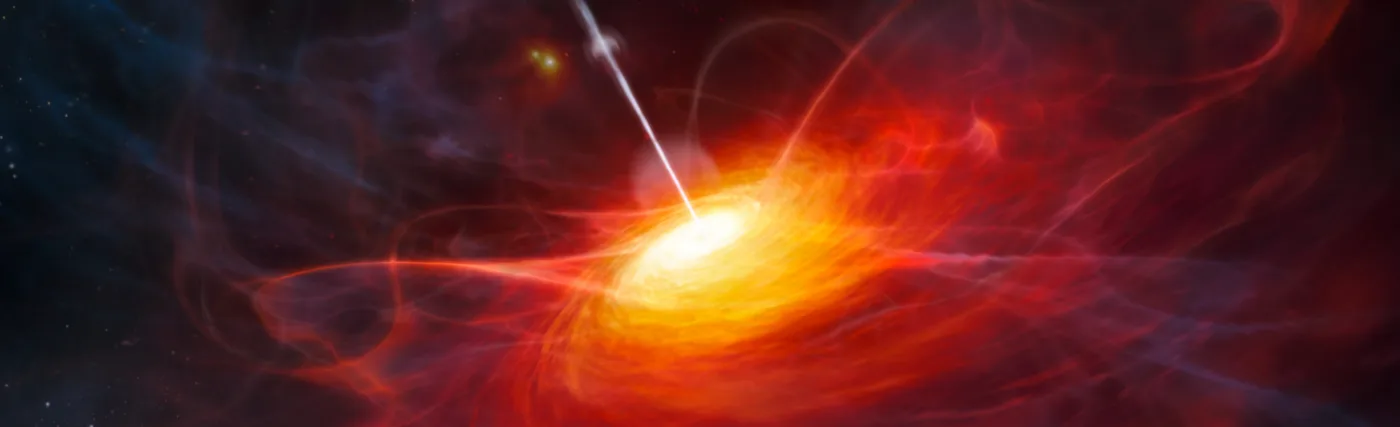
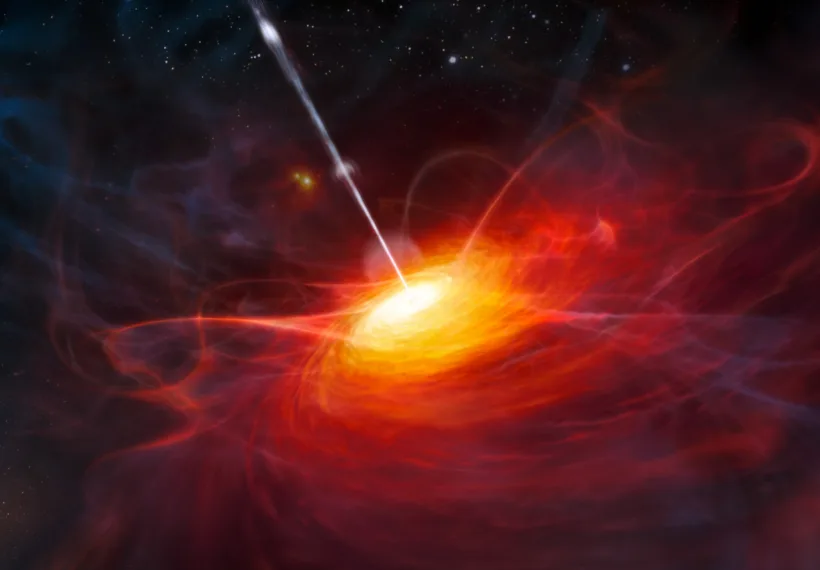
When I was in school, we figured out that it was natural for matter to then form a disk, and then the disk would give you jets, and the jets then give you the features of quasar.
It was a whole thing going on while I was in graduate school.
And that was fun to watch.
I learned it as ancient history.
That was when you were in graduate school?
Yeah.
We had to develop the black hole physics first in the 60s and 70s, and then I’m in college in graduate school in the late 70s and 80s.
So that’s when it really took shape.
I see.
Yeah, the computational stuff, because you have to bleed away the angular momentum in all the other axes.
You need the 70s computers before you even come near it.
Couldn’t have made the calculations until we had the IBMs.
Right.
All right, Chuck, give me some more.
Yes, I was going to say, do you guys want some tapioca pudding?
What the hell is happening here?
What?
All right, here we go.
Hello.
Oh, this is Frederick DeCamp who says this.
Hello, our beloved geek in chief.
I loved your episodes on superhero physics and would like to know what are your thoughts on Molecule Man or Franklin Richards?
What would you do with that kind of power?
Wow, great question.
Molecule Man.
Well, for those of you don’t know, Franklin Richards and Molecule Man are both characters that usually show up in the Fantastic Four series.
They’re wonderful characters.
The Molecule Man literally has the power to transform molecules and move them around and basically control over all of matter and energy.
Franklin Richards is the mutant son of Reed Richards and Susan Storm, and together they somehow imbued him with also cosmic powers, the ability to create entire universes.
Charles, why do you know this?
Why?
How do you know who we’ve married to and what his kids’ names are?
Why do you know this?
It’s a thing.
Let me tell you something.
He also knows their social security number and their bank account information.
Maybe that’s what I would do if I had their cosmic power.
Oh my God.
Franklin Richards and the Molecule Man actually combined together at the end of the Marvel Secret Wars series, the more recent version of the Secret Wars series, to repopulate the multiverse which had been destroyed by the Beyonders in a cataclysmic fight.
Dr.
Doom tried to save the universe and the multiverse, did his best, didn’t quite work out.
But thanks to Reed Richards’ help, what happened was that the Molecule Man and Franklin Richards were able to do that.
What they would do is that Franklin was able to imagine and think up universes, what kinds of laws of physics or what kinds of other kinds of rules that these universes would live by, and then the Molecule Man would be able to infuse himself into that universe together with Franklin’s ability to inject and basically create an entire universe.
So they slowly, piece by piece, piece by piece, they were able to reinstate the universe, one universe at a time, they were able to reinstate the multiverse.
So what would I do if I had that kind of cosmic power?
Probably nothing.
Because if I had that kind of cosmic power, what would I want other than that?
But to watch the universe and see the cool stuff that’s happening, to enjoy friendships, good food, beautiful sunsets, knowing that anytime I needed or wanted anything, I could have it.
Instead, let me just see what the universe offers to me.
Oh man, that was way too Zen.
I have thought about this.
If you have true cosmic power, what do earthly concerns affect you?
They affect you, not at all.
Let me tell you what you just did there, Chuck.
What’s that, Chuck?
You came over to me and you said, you know, Dorothy, the power was with you the entire time.
And then I look at you and I go, why the hell did you say that to me?
When you found me by the house with the crazy lady and the shoes like you should, you could have sent me home.
You could have sent me home.
I’m walking 15 miles down this stupid yellow brick road, the damn scarecrow and the lion and the rusted out, broke ass tin man, okay, only to come up here for you to tell me I could have been home this whole time.
Yes, and to which the wizard should have said to Dorothy at that point, well, why didn’t you come right to me, man?
Why didn’t you just show up?
I didn’t know Chuck had Wizard of Oz issues.
I didn’t know this.
It all just came out in therapy.
Yeah, Chuck, you have some violent opinions about that story, don’t you?
No, but I’m saying that’s super Zen.
It’s very cool.
I mean, and it makes a lot of sense.
If you have everything, then you need nothing.
Then why try to do anything except sit back and enjoy all that is there for you, which is everything?
That is the lesson.
And once I’ve enjoyed it, I would like to share it with anybody who is interested.
That’s what I would do.
Nice.
Well, there you go.
There’s your answer.
That’s the lesson of the day.
So on that Zen moment, let’s take a break, and we’ll come back with our final segment of Cosmic Query’s Grab Bag with the one and the only, Charles Liu, our resident Peking Sheep.
We’re back, Cosmic Queries’ Grab Bag.
Charles Liu in the house.
Hey, hey, hey.
Chuck.
So Chuck, what more do you have for us?
Go.
This is Eric DiCarlo from North Kingston, Rhode Island.
He says, greetings.
Have we ever detected a wormhole in space?
Would a wormhole appear the same as a black hole?
What would a wormhole look like if we saw it?
Would we know what we were looking at?
Charles, wouldn’t it just look like a black hole?
Wouldn’t it?
A wormhole would look like a black hole, yes, but the difference is-
On our side of it.
Right.
The difference is because you don’t have infinite density in a singularity for a wormhole, you would look black, but it might not have all the other gravitational effects that we see around the black hole.
Things like the general relativistic distortions, where time starts running funny and things like that.
And objects going in presumably would not have to turn into light, moving at the speed of light, because presumably the wormhole does not have an event horizon the same way a black hole does.
And you won’t see it get spaghettified or anything.
That’s right.
So there’d be a way to distinguish the two, even though they’re both exit holes from the universe.
Yes.
Oh.
Yeah.
No, that’s interesting.
I hadn’t thought that through.
That’s a good one, Charles.
Yeah.
But the answer is we haven’t found one yet.
But that’s a very good question.
In some observations that are coming up in the next few years, there will be the opportunity to find out.
And a point I wanted to make earlier is that we, with the question, Charles, of how do we know there are no white holes out there, part of what it is to make discoveries is to know exactly what you’re looking for if you’re looking for something that’s predicted, right?
That’s right.
So we know exactly what a white hole would look like in space.
And everything we’ve seen that’s a dot of light turns out to be starlight, not white hole light.
So unless a white hole is masquerading as a star, then this wouldn’t be the white holes that we know and understand and love.
So right now it’s just relegated to science fiction.
So yes.
Great point.
All right, Chuck, keep going.
This is Gabe.
Greetings from Okinawa, Japan.
Wow.
Nice.
Yeah, how cool, right?
If the power of our telescopes were unlimited, what are the furthest objects we would be able to observe?
Also, would it be possible to observe the most distant objects appear over the years as their light finally reaches us?
Looking forward to hearing the answer.
Thank you, Gabe.
So that last bit, Charles, was would we be able to see objects turn on when the light finally reaches us?
I think that’s how I interpreted that.
Yes, that’s a good thing.
Yeah, I interpret that too.
Yeah.
So you got that, Neil.
You know the answer to that question.
Well, I mean, the cosmic microwave background is sort of the birth of separation of matter and energy and the form.
So when we see galaxies form, that is them turning on and giving us their light.
So if the universe were 15 billion years old, you’d see a galaxy being born whose light took 15 billion years to reach us.
That’s a continuous thing.
It’s a continuous thing all the way up to the point where light can travel freely through the universe.
And that is that moment we call the cosmic microwave background, right?
Because if you can imagine, say, we were living in a foggy space and you can only see so far before the fog is so thick that any light just bounces off and we can’t see it anymore.
Right?
The cosmic microwave background is what’s referred to as that surface of last scattering where no matter how powerful your telescope is, you can’t see through it.
It’s just opaque.
So at that point, that might be considered as far as we can possibly see, which is about based on our current observations and models, about 380,000 years after the Big Bang.
So we can pretty much see if we had unlimited telescope power all the way back to that cosmic microwave background distance, which Neil was talking about.
Right.
But wait a billion years and you’ll see that very same phenomenon on galaxies that are not 13.8 billion light years travel time, but another billion years beyond that.
That will always be happening.
That’s right.
That cosmic horizon continues to grow.
You’re always watching the universe being born.
Correct.
If we’ve lived billions of years, then we would be able to watch those things turning on over a long period of time, but right now, basically every observation we make is a snapshot.
It’s a few hours, few days, a few months.
We don’t see galaxies turning on during that time, but we do see certain other things turning on.
For example, we might see a supernova explosion that happens in that period of time.
We can see certain stars, perhaps, as they’re very young, get hot enough and bright enough that they burn through the cocoon that was shrouding them, and we could see new stars being revealed to us over the course of years or hundreds of years or something like that.
You certainly can do that.
Yes.
Chuck, just a couple of minutes left.
What do you have for us?
Michael Lloyd says this, greetings and salutations, my name is Michael and I’m from McKinney, Texas.
I’m so glad to be with Super Geek Chuck Liu.
Sir, your ability to recall details from Star Trek is incredible.
The example that sticks out in my mind is how you would call up next generation name Tapestry.
Great episode.
Season seven.
They were angry Nausicaans who pierced Picard through the heart, and that was when he was a kid, but then there’s all this thing about him dying.
It’s a near-death experience talking to Q.
That’s a great episode.
It’s a wonderful episode.
Q takes him back and allows him to see what his crazy, his life would be.
Okay, forget that.
My question.
Focus, people.
Focus.
How can one focus when you’re talking about great Star Trek episodes?
Come on.
My question regarding a hypothetical object called a gravistar, a blending of the terms gravitational vacuum star, which was proffered to help reconcile our understanding of black holes, dark energy, et cetera.
Are you familiar with this term?
No.
Okay.
Well, there you go.
And let’s move on.
Here we go.
Here’s some lightning round.
The term gravistar, I can sense what they were trying to do with it.
But such an object is unnecessary because the current figures that we have is enough to explain the things that we’re trying to look for.
I don’t think you need to create something called a gravistar at the moment, which is why I say no glibly.
But it’s always fun to think about new unusual objects.
Yes, that’s true.
That’s a good answer.
Shred 672 says, hello, Charles, Dr.
Tyson, Lord Nice.
My name is Garrett Romero.
First timer here.
I understand quasars to be active galactic nuclei, but I’m confused.
Are they themselves the galaxy or just the center of a Tootsie Pop?
Can they be both?
How violent are they?
And happy holidays.
Thank you so much.
The active galactic nucleus is, as its name implies, the nucleus of a galaxy.
And that nucleus happens to be quite active.
So in fact, a quasar is a kind of active nucleus.
So is, for example, something called a liner or certain other kinds of different things.
So the active galactic nucleus term, known as AGN by astronomers, basically is an overall catch-all phrase for all kinds of different kinds of phenomena that are produced.
And it’s at its core a supermassive black hole.
And around it is stuff falling into it.
But what variation you see in active nuclei comes from how massive that black hole is, what it’s doing there in the middle, and how things are swirling into it, either fast or slow or quickly or in the same direction or opposite and things like that.
So Charles, once again, that happened on my watch.
That’s right.
Did not know what the quasars were.
It was just this intense source of light, very small and far away.
And again, the black hole physics got developed, and people started exploring what the computers would tell us.
And what emerged after, I’m not exaggerating, thousands of research papers trying to tackle this, observations contesting with theories, was that the quasar is not itself the galaxy.
It is the center of what is otherwise an ordinary galaxy.
And how come you don’t see quasars nearby?
Because they’re all far away in the early universe, because those black holes were eating everything in their vicinity, and when they were done, the quasar shut off, leaving you with a supermassive black hole in the center of your galaxy.
And Charles, that was at the same time we were deducing, could every galaxy have a supermassive black hole in its center?
That’s right.
We didn’t know.
That’s right.
We didn’t know.
So, all that was coming together.
I would say that the moment that all astronomers came to the consensus that what you described was correct came from the groundbreaking study led by John Bacall using the Hubble Space Telescope.
Oh, look at that.
Just to affirm this.
So a quasar is a phenomenon, really.
It’s not a static object.
It’s a phenomenon, like Charles was saying.
How massive is the black hole?
How is it eating?
In what manner is it eating?
Is it eating roachously?
And this was a fascinating catch basin.
One of the great solved mysteries of the closing decades of the 20th century.
That’s right.
And today, the latest, one of the people that I interviewed for the Loonaverse is research and the research of that group that that person’s involved with is about asking whether active galactic nuclei can happen in places other than the nuclei of galaxies.
Can you get a quasar that’s off center?
The answer is yes.
And nowadays, there’s so much cool research because we now understand what active nuclei are.
We’re questioning whether or not the name is even correct.
It’s pretty cool.
Oh, wow.
Well, that’s what grab bags are all about right here, trying to close the loop on what we’ve been doing.
That’s a grab bag.
That’s great stuff.
Charles Liu, it is a delight always to have you.
Oh, thank you so much for having me.
And like I said, we are unworthy when you are in our presence.
We’re all in this together, Neil.
We are always happy to do this together.
That’s what it’s for.
And, you know, I do this to you all, too, because my worthiness is also quite limited compared to all your wonderful awesomeness.
So thank you so much.
Really enjoy yourselves over the next few.
All right, guys, this is it.
StarTalk Cosm Aquarius Grab Bag, one of my favorite versions of that genre.
Neil deGrasse Tyson here, your personal astrophysicist for StarTalk.
Keep looking up.


 Become a Patron