The pull of gravity (the fundamental force, not the movie) is irresistible as Neil deGrasse Tyson and comic co-host Leighann Lord grapple with weighty fan questions about matter and the curvature of spacetime. You’ll learn about gravitons (even though we’ve never directly detected them) and find out how we would know if a gravity wave passed over us. Dive into Isaac Newton’s equations. Discover why gravity is essentially irrelevant to particle physics, and why the electromagnetic force, which is 10^40 more powerful than gravity, is much more important to particles like the Higgs boson. Explore how the laws of physics manifest differently at different scales, and the importance of surface tension versus gravity to insects. (You’ll also find out why there are no giant spiders.) All this plus Einstein’s General Theory of Relativity, anti-matter, hypothetical elements and gravity guns.
NOTE: All-Access subscribers can listen to this entire episode commercial-free here: Cosmic Queries: Gravity.
Transcript
DOWNLOAD SRT
Welcome to StarTalk, your place in the universe where science and pop culture collide. StarTalk begins right now. This is StarTalk Radio. I'm your host, Neil deGrasse Tyson, your personal astrophysicist. I'm also the director of New York City's Hayden...
Welcome to StarTalk, your place in the universe where science and pop culture collide.
StarTalk begins right now.
This is StarTalk Radio.
I'm your host, Neil deGrasse Tyson, your personal astrophysicist.
I'm also the director of New York City's Hayden Planetarium at the American Museum of Natural History, right here in the Big Apple.
I've got with me co-host, Leighann Lord.
Leighann, welcome back to StarTalk.
Thank you, good to be back.
We don't get enough of you here.
Where are you?
You don't call, you don't write, you don't text.
I do tweet.
But not to me, how do we know you're there?
I do tweet to you, but you're so busy with your millions of followers.
Billions and billions of followers.
So this is a Cosmic Queries edition of StarTalk.
And you know the drill, I've not seen any of these questions.
You have not.
They're solicited by our social media folks.
And a topic is tossed up, and then everyone sends in their questions, and they know that it's gonna come to me.
But I haven't seen them, so if I don't know the answer, I'll say, I don't know, go on the next one.
Wow.
So I will be very candid if I don't know something.
Or I will say, I don't know it, but here's the answer I think it should be, if that's the case.
And so let's just start right out.
Well, you know, the subject is gravity, and I had a chance to briefly look through some of these questions, and nobody.
Gravity, not the movie, specifically, but just gravity as a physics thing.
Right, gravity as a force.
Okay, I know a few things about gravity, so I feel comfortable in this particular Cosmic Queries.
Oh, good, good, because of all the questions that I looked at, not one of them is, what is gravity?
Okay, well, that's good, because I have no idea what the hell gravity is.
Yeah, folks ask some really intricate stuff, and I'm like, mm-mm, I need more basics.
Well, you could start with one, what is gravity?
Yes, what is gravity?
You're taking co-host privileges.
I am, and I'm putting my question out there first.
What is gravity?
You have no idea.
Okay, next question.
No, here's the difference.
We can describe gravity, we can say what it does to other things, we can measure it, predict with it, but when you start asking like what it is, I don't know.
So did I accidentally ask a deeper question than I meant to?
Yeah, no, you were meant to ask deep questions.
Apparently I was.
In life.
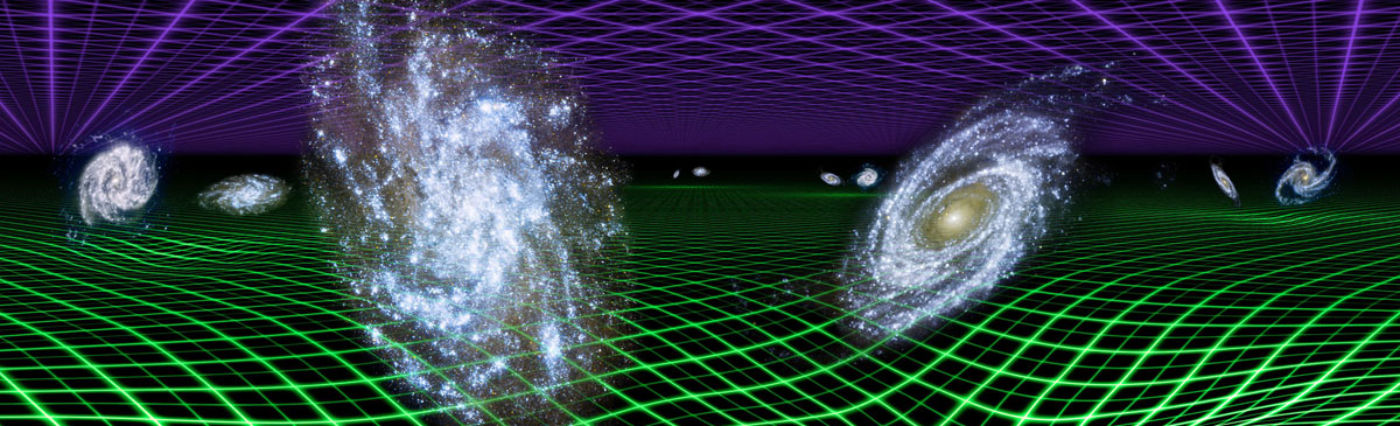
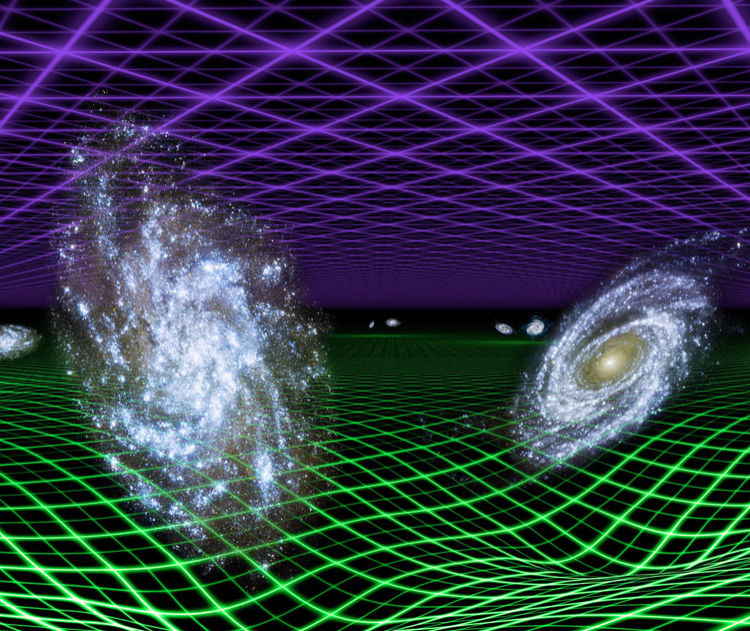
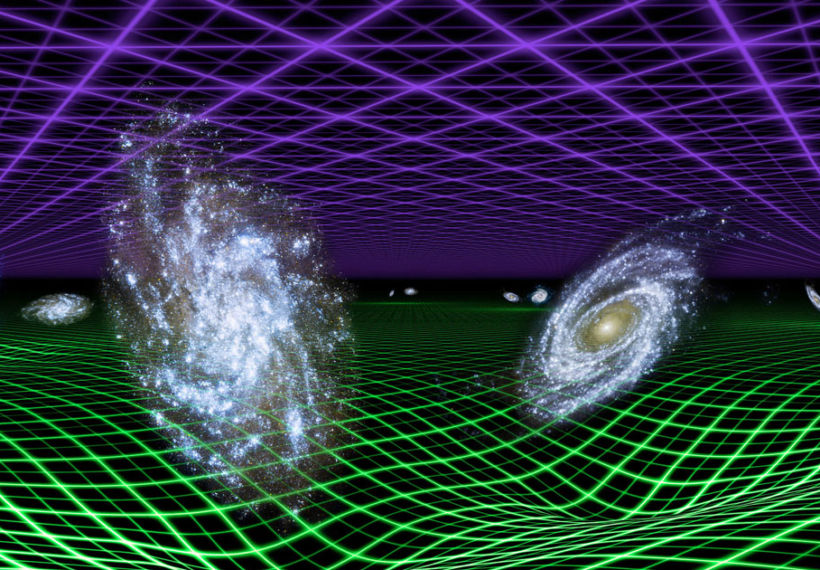
So, to say what is it, I think in an Einsteinian answer, we would say gravity is the curvature of space and time, and objects will follow the curvature of space-time and we interpret that as a force of gravity.
That's probably the best answer I can give to a what is gravity question, or why is there gravity.
That's the best I can do there.
I think that's a good start.
And I can also say that Einstein noted that matter tells space how to curve, space tells matter how to move.
Say that again.
Isn't that beautiful?
It is.
No, no, I wanna get that.
So matter and energy will curve the fabric of space.
And it's that curvature that tells other matter how to move in the curvature of space itself.
And so Einstein juxtaposed those in a poetic phrase where he said, matter tells space how to curve.
Did I get that right?
Yes.
Matter tells space how to curve, space tells matter how to move.
It's beautiful.
That is beautiful.
It is beautiful.
It sounds like the opening to a dance lesson.
How do we begin?
So that is your co-host privileges.
Thank you.
For the first question.
So much.
That warmed up the crowd.
It did, I hope so.
And now some more intense questions.
This one is from Rostan Rodriguez or Rostan.
And it is-
Can I add before you begin?
Yes.
That I majored in physics in college and in graduate school, my PhD is in astrophysics.
But there's a course I never took that I regret.
It was a little too hard for me at the time.
It's probably still too hard for me.
And I rely, no, I love poetry.
And I rely on others who are familiar in these areas to tell me what is and what isn't.
I've never taken a graduate course in field theory.
And graduate field theory is the full analysis of the forces of nature at their deepest and most mathematical levels.
And so I read about them, but I've never calculated with them.
And so if any of these questions go there, I'll just say I didn't take that class.
Well, that is something you and I have in common.
Because with my degree in journalism and creative writing, I too did not take field theory.
Okay, proceed.
Yes, from Rostan Rodriguez, the question is, what is gravity fundamentally made up of?
Is it a result of some quantum phenomena, or is there any particle responsible for gravity?
How fast do the gravitational waves travel through space, and what decides the limit of that speed?
Lot of questions.
I love it when people, because that sounds like they were burning within him, and he couldn't get to sleep.
He can't sleep at night.
He had to get him off his chest.
He is pacing.
I love it.
So gravity, before quantum, by the way, Einsteinian gravity was conceived before quantum mechanics was discovered.
So Einsteinian gravity is 1916.
This is where matter curves space, and objects respond to that curvature.
That's what we call gravity.
When quantum physics came in, where everything was accountable as a particle wave duality, if you have something that are gravity waves, Einstein predicts the existence of gravity waves, then there ought to be a particle counterpart to that gravity wave.
Then we said we'll call it gravitons.
Just the same way any particles, any matter at all will have a wave version of it from a quantum mechanical point of view.
So gravity waves were predicted to move at the speed of light in Einstein's equations.
And if you have a graviton, the propagator of gravity, that would also move at the speed of light.
So there you have it.
Now we've never detected a graviton.
Or directly have we detected, nor have we directly detected gravity waves.
But we have top people working on it.
There's the laser interferometric gravitational wave observatory, shortened to LIGO, is a multi-location observatory that uses high technology, lasers and interferometers where it knows the distances between two points and long tunnels accurate to like the width of the nucleus of an atom.
So that if a gravity wave comes across and it slightly jiggles the space between these two measured points, it will measure it, it will know it.
And that would become the first detection of a gravity wave passing across us.
So what makes gravity waves?
When gravity changes somewhere in the galaxy.
So if you have two stars orbiting and then they collide, then there's a ripple in the gravitational wave continuum that's out there.
And that's what you would then see.
If a star plunges into a black hole, these are disturbances in the gravitational field.
And those disturbances are the gravity waves that get measured.
So we got top people working on, we've never measured them, but they're predicted to exist.
Not only from Einstein's general theory of relativity, his theory of gravity, but also from quantum physics.
So we can detect, but not measure.
Did I understand that?
No, we can detect the existence of gravity, but the graviton that propagates it, to know that that is a particle, the gravity wave that tells us when something got disturbed in the universe, those have yet to be directly detected.
We have indirectly detected gravitational energy by two pulsars orbiting one another.
They have such high gravities at their surfaces, and you orbit them near one another, that system is unstable.
It radiates gravitational energy.
And if you're radiating gravitational energy, then the system orbits closer today than it did yesterday.
And as it keeps doing it, they orbit closer and closer and closer, and they eventually just collide.
The measurement of binary pulsars, giving up the gravitational ghost led to a Nobel Prize in Physics.
Joe Taylor and Russell Hulse.
Russell Hulse was one of the Bronx High School of Sciences eight Nobel laureates.
Nice.
Yes.
That's as many as the country of Spain, by the way.
I know, that's crazy.
Wow.
And I now feel more prepared for that category on Jeopardy.
All right, what else you got?
I have a question from Tristan Brooks.
Some theorize that gravity is a side effect of the multi-dimensional geometry of space.
But I've also heard talk of a graviton particle, which we just talked about.
Is it possible it could be both?
If not, what is the more likely candidate for explaining gravity, in your opinion?
Yeah, I think the big challenge now, by the way, as I understand what is going on behind the string theory door, which is occasionally closed, they try to open it and then, if you're not a string theorist, you have no idea what they're doing behind there.
Right, you think there's a cat in a box somewhere and that's a whole different experiment.
But they're smart people and you give them the room to think.
I like that, give them room to think.
I like that.
Well, because they're not actually very expensive.
These rooms where people think?
Exactly, rooms are cheap, your brain you got for free.
Throw in a pad, a pencil and a laptop.
And energy.
A strength theorist and let them go to town.
I don't have any problems with that.
In the world of strength, gravity comes out of some of their calculations as I've come to understand it.
That's a good thing because we know gravity exists.
As a minimum, you want your theory to explain at least what you already know, but then come up with predictions to then test it even more deeply.
Here's the point.
There is no reason to think that gravity does not also have a quantum manifestation of itself because everything else has a quantum manifestation of itself.
I have a quantum manifestation of itself?
Yes, you do, but it's very averaged out because you're a macroscopic entity.
Did you just call me average?
I'm sorry, I misheard you.
No, I called you macroscopic entity.
That was the name calling that I engaged in.
I'm not sure how to respond to that.
And we know from small, how matter manifests in small sizes, that it can reveal itself as a wave, as a particle, depending on how you measure it and on the circumstances under which you conduct the experiment.
So it's a very human thing to say, is it this or is it that?
Is it a planet, is it not a planet?
Is it less filling or is it great taste?
Is it gum or is it candy?
These are sort of false dichotomies.
Something can be both, but our language forces us to require that it fit into one word or another.
What we're not recognizing is that it's not a fault of the object or the concept.
It's a defect in our language.
And if our thoughts follow language, we have trouble thinking of things that fit more than one category.
I think that's the source of most human ailments in the world, cultural ailments.
Are you gay or are you not gay?
Are you black or are you this or are you that?
Are you male or female?
And it's like, chill out.
Just let things be what they are.
Allow there to be a spectrum in all that you see.
So that doesn't necessarily just mean a broadening of language, but a broadening of the way the human mind thinks.
I think that once you learn language, the language shapes how you think more than your thoughts shape what language does.
It takes a very creative person to start inventing words for thoughts that they had for which no words applied.
There's an age after which your thoughts are-
That's the word Icky.
Your thoughts are constructed from the vocabulary available to you.
And you have to be very creative to have a thought for which there's no vocabulary to account.
And when you do, that's how you invent new words.
And Shakespeare put tons of words into the English language and the English language that that man had thoughts beyond all.
Or it could start with just saying, I don't know how I feel.
And then there comes the exploration of finding that word.
Yeah, but typically that's not what people do.
They find a word that exists.
And then they force it into the words that exist.
And then that becomes the manifestation of their thoughts.
So I think most of the world comes in flavors and not just is it A or B or black or white or up or down.
And so there's a swirl.
Yeah, even gravity or quantum physics.
That got way more philosophical than I don't think that.
I liked it.
I have a question which I think is, you almost touched on from Daniel Owens, excuse me, from Dan Owens.
How closely related is the Higgs boson to gravity?
Would a further understanding of the Higgs give us more insight into gravity?
I don't know any direct connection between the Higgs boson and gravity.
What's interesting about particle physics is that gravity is essentially irrelevant to everything that's going on down there.
It is as irrelevant to particle physics as gravity is irrelevant to most insects.
You see insects just crawl up the wall or crawl on the ceiling?
Annoyingly so, yes.
Right, do you say, yo, there's gravity, you should be falling, you should be, you know, so at different size scales in the universe, different manifestations of the laws of physics will predominate.
So for an insect, surface tension of liquid matters more than anything.
That's why you have the Jesus spider.
Have you ever seen the Jesus spider?
It's called the Jesus spider, it's cute.
It walks on water.
Oh, I thought because it died and it came back in three days.
No, that's right.
Was it the third day?
On the third day, he wrote, yeah.
Well, there's arguments about what constitutes a day and, you know, was it just a bad weekend?
Yeah.
Okay, so it can walk on water and you say, well, if I try to walk on water, if I'm not Jesus, I will fall through the surface of the water because the insect is responding to the surface tension of the water, which overrides the forces of gravity entirely.
Entirely.
That's why, so the world of the insect is very different from the world of us.
And that's why you can't take an insect and make a human-sized version of it and have it have any success doing what it was as an insect.
So a lot of sci-fi movies get that wrong?
100% of them get it wrong, okay?
Giant ants, giant spiders.
There's a reason why there are no giant spiders.
They have to have really thick rhinoceros legs and we'd call them a rhinoceros.
You can't just scale it up.
The laws of physics, it's all the same laws of physics, but it manifests differently depending on your scale.
See, I was gonna ask that.
Does that mean insects have a different physics?
Like are there insects in little lab coats with different results than we get?
Their lab scientists probably would not yet have discovered gravity.
Really?
Yes, yes.
So now you're a particle responding to either a positive charge or negative charge.
Now you've got electromagnetic forces, which are 40 orders of magnitude stronger than gravity.
40 orders of, 40 powers of 10 stronger.
So in other words, you take an electron and a proton and say, well, they're mass, right?
How much do they attract each other gravitationally?
You can calculate that, write down that number.
Now you do your equation for how much they attract one another because they are of opposite electrical charge.
Write down that number.
The electrical charge force of attraction is 10 to the 40th power stronger than gravity.
So if you were a particle, you would never discover that gravity exists.
Unless you had an experiment that can measure to the accuracy, to the precision of 40 powers of 10.
And that ain't happening.
Not on my calculator.
Not on my calculator.
So I don't see any connection.
There could be some subtle particle physics correspondence that I don't know.
But generally, when you talk about particles and particle physics, you're not thinking about any large scale gravitational phenomena.
Moving on.
Yeah.
We have, oh, we have so many questions.
Oh my gosh.
This one is from Ben Bonifant.
And it says, if you were in deep space and there were no stars or planets or spaceships around, or spaceships, he just threw in spaceships.
That's awesome.
Would items of small mass accelerate toward you noticeably or would the gravitational force be too small?
You like that.
What he's asking is, if I'm alone in space and nothing is competing with me for my gravitational attraction, would I start seeing everything drift towards me?
The answer is yes.
Everything drifts.
Gravity doesn't stop.
And while my force of gravity as a human being is not very large, doesn't matter.
The little paper clip that floated out of my pocket, there it is, it'll start drifting towards me.
So it'll be slow and not very interesting, but yes.
So this is the cute single guy that walks into the bar.
Everything then starts to gravitate toward him or the single woman.
Yeah.
Because.
This is the bar analogy.
The bar analogy.
To the cosmos.
Trying to keep it real for the little people.
So this is your upcoming book, Everything I Learned About the Cosmos, I Learned From the Bar.
It's from.
Yeah, Leighann walks into a bar.
The cosmos according to Leighann.
We'll come back for the next segment.
You got more questions for me?
I do, I have a ton of questions.
This is StarTalk Radio, we'll be right back.
We're back, StarTalk Radio.
We're on the net, on the internet, startalkradio.net.
You can download archival shows there, everything.
And you can find us on iTunes.
We're all over the place.
What's the other one?
Stitcher, on Stitcher Radio.
Stitcher, yeah, yeah, very cool.
And StarTalk has a Twitter handle.
It's StarTalk Radio.
Yes.
I interact with it very frequently.
Interact?
Yes.
You guys tweet, I retweet.
Oh, nice, nice.
I at you guys.
And you are Leighann Lord on Twitter?
Yes, I'm Leighann Lord on Twitter.
Can I say what my Twitter handle is?
Please do.
It's Neil Tyson.
And who doesn't know that?
Just everybody.
But people come to me and say, will you be tweeting Cosmic?
No, I suppose I could, but then I would just be your news source.
They want me to tweet current events in the universe, but it's not what I do.
Current events in the universe.
We get some of that too in the Cosmos.
I like that.
Cosmos is immune to current events, but it's really just, when I have random crazy thoughts, I just put them down on page.
So anyhow, we are a Cosmic Queries edition of StarTalk.
And today's topic is?
Gravity.
Gravity, and I've not seen these questions.
No, you have not.
Called from our social media, and I'd love to hear them.
And if I don't know the answer, I'm just gonna come out and tell you.
Okay, go.
Well, I have a question, and I love this person's name.
It's Fritz Omikfitz.
I'm sorry, Fritz Omikfitz.
I have to assume it's real, because our fan base doesn't lie to us.
No, never.
Right, they're pretty cool.
Okay, Fritz Omikfitz, okay.
Even though gravity is the weakest of the four fundamental forces.
See, he knew that.
Remember from the last segment, I told you how weak it was.
The man is on the case.
Yes.
Fritz, you happen in here.
Okay, go on.
Yes, since it's the weakest of the four fundamental forces.
It's not just the weakest, it's the stupidly weakest force.
Stupidly weakest?
It is not just weaker.
It's not like you are weaker than I am, because I can bench press 200 and you can bench press 100.
No, it is, you're weaker than I am because I can bench press 200 and you can't lift anything, all right?
Well, maybe gravity is smart enough to get people to do the work for it.
Maybe that's what's going on.
Although I will say the four fundamental forces sounds like a rap group from the 70s.
Oh, the four forces.
You can see them coming out dressed the same.
Back then, people used to dress the same.
The four tops, the Temptations, the Supremes.
So, yeah, that is a Motown group from the 60s that was never formed.
Never done, the four fundamental forces.
So what's the question?
Okay, even though gravity is the weakest of the four fundamental forces, does it act on a larger scale than say the weak nuclear force?
In other words, is gravity the only force that keeps a planet orbiting a sun or do the other fundamental forces have a large role in that?
So he assumes everybody knows what the other fundamental forces are.
I shouldn't, I wouldn't even have to mention that, but they are.
But for the purposes of maybe a co-host who doesn't know.
So we've got gravity.
That with which we are most familiar.
The next most familiar force to us humans is the electromagnetic force.
That's what holds your flesh together.
Oh, thank goodness.
That's what makes magnets repel and stick.
That's why we have material objects in the world.
Another force is the weak nuclear force.
And another force is the force within the nucleus of the atom that holds particles together, like protons, it holds them together.
Even though two protons of the same charge would want to do what?
They're like charges.
What would they do?
Like charges.
Hang out together?
Opposite charges attract, like charges repel.
I'm thinking of a dating sense that I would like to.
I would like to be with someone who had similar interests.
So no, it's the opposite.
So opposite charges attract, like charges repel.
To cram two protons into a nucleus, you need something to make that happen.
Because they want to repel each other awesomely.
And so we need a really strong force to do that.
It's called the strong nuclear force.
So there's the strong nuclear force, the weak nuclear force, electromagnetism?
Electromagnetic force.
Electromagnetic force and then gravity.
Gravity.
Which you say with disdain.
No, it's funny.
Because it's the weakest.
It just occurred to me, electromagnetism.
It's just an electromagnetic force, but if you say electromagnetism, it sounds like a political or cultural movement.
Yeah.
Like there's vegetarianism.
I'm into electromagnetism.
We just start a movement.
We are the electromagnetisms.
Yes, and our opening act.
Is electromagnetics.
Will be the four fundamental forces.
So those are the four fundamental forces.
And two of them actually in the 1970s were merged into one.
They were learned to be different sides of the same coin.
If you go back into high temperature, high density, two of those forces come together and they become one.
And the name of that force is the electroweak force.
So electromagnetism and the weak nuclear force are manifestations of the same force.
So technically there's only three known forces, distinct forces in the universe.
But this merging together, stapling together of forces, that has set people on a path to try to merge all the forces.
They're saying, if it worked for two of them, and before we knew about electromagnetism, there was electricity and there was magnetism.
And research in the 19th century said, hey, these are.
Direct quote, that's exactly what they said.
They said, hey.
Hey.
So that magnetism and electricity were discovered by Faraday and others to be the same phenomenon, but just measured in different ways.
So hence came the word electromagnetism.
So now electromagnetism emerged with a weak nuclear force or the other electroweak force.
There you have it.
So we really only have three forces.
So after saying all that, I forgot the question.
I know, I was about to say, do you remember the question?
Okay, does it act on a larger scale than the same weak nuclear force, or in other words, is gravity the only force that keeps a planet orbiting the sun, or do other fundamental forces have a large role?
Yes, the strong and weak nuclear forces have very short range.
Yeah, the short nuclear force drops off precipitously as you move, you go too far away from the nucleus, it has no, it does not manifest at all.
You can describe the force, you can describe the strength of the force as you move away, and it goes to zero very quickly.
So you don't have a universe of planets guided by the strong nuclear force.
All right, so now, how about the electromagnetism?
If matter were not neutral, you would never notice gravity in its presence.
If a planet were made of negative charges and the star it orbited was made of positive charges, you would never even know that gravity existed.
That's how overwhelming the electromagnetic force would be on the operations of matter in the universe.
It just so happens that matter does not like staying separately charged.
It will do all it can to recombine negative charges with positive charges.
That's why we have lightning strikes, thousands of strikes, was it every minute?
Count up all the lightning discharges in the world.
I forgot the number, but it's some huge number.
It's going on all the time.
Rebalancing this going out of equilibrium between positive and negative charges.
It does not like staying out of balance.
So, whole planets will not just exist as a negative charge thing.
It's gonna find a positive charge, merge and you've got a neutral planet.
It'll do that instantly.
Do you realize you could take the electrons, the negative charge particles, out of one cubic centimeter of the nose cone of the space shuttle.
Space shuttle is something we used to use to get to orbit.
I just.
I've heard tell.
For our younger listeners out there, this is how the United States used to get to orbit.
Okay, so if you took out the negative charges, put it at the base of the launch pad, which means that cubic centimeter at the tip of the shuttle is entirely positive charge now, okay?
You remove the negative charges from their positive charge, put it at the base of the space shuttle, ignite the solid rocket boosters and the main engine, it will not be able to take off.
Because it's missing a piece?
The attractive force of those negative and positive charges will overwhelm the strength of those rocket engines.
So you kind of put a, what are you, a low jack?
No, it's not a low jack, you locked it by?
Yeah, yeah, yeah, you prevented anyone from stealing it off the launch pad.
Nice, is anybody out there working on this car technology?
Low jack for the space shuttle, yeah, because there's such a high, fenceable item out there.
Well, I'm automatically seeing, you know, regular market, you know, how can I adapt this to my Honda?
I just take something out of the front fender, put it on the back and my car's not moving.
I can't stop laughing because I'm picturing the space shuttle up on blocks.
The space shuttle's up on blocks where someone stole the hubcaps or something.
I love it, I love it.
But they couldn't drive it away, so they could only strip it down.
So what would have happened while you did that is they would immediately reconnect with one another through electrical currents moving through the space shuttle.
Or a lightning strike would bring them together and then that neutralizes it and then it would take off.
So the only reason why gravity dominates the universe is because electromagnetism finds itself neutral nearly all the time.
That's the only reason why.
Otherwise, you wouldn't even know gravity existed and we would be dominated by electromagnetic force.
So maybe gravity's not so weak after all.
Which leads me to wonder, is there some force 40 orders of magnitude weaker than gravity that cannot manifest in our lives because we are swamped by the force of gravity itself?
I lay awake at night wondering about that.
And now so will I.
That's my job, so that you will lose sleep based on cosmic distractions.
I appreciate it, I appreciate it.
I have more questions though.
Okay, from Dan Parenti.
Other than Mr.
Tyson himself, what is, quote, the great attractor?
Does its force affect us, and if so, how?
I love that.
The great attractor, I haven't been up on the latest research on the great attractor, but I was around when it was discovered, and the great attractor, if you look out into the universe, beyond our own galaxy, we live in the Milky Way, and there's the Andromeda galaxy, and there are galaxies in the Virgo cluster.
That's what defines the Virgo cluster.
There's a bunch of other galaxies there.
And there's the general expansion of the universe, which we measure in the speed signatures of these galaxies.
We got that.
But you can also measure other movements of these galaxies by secondary methods.
And when you do this, this research showed that there was a whole field of galaxies all with an extra bit of motion in one particular direction.
It was called the great attractor.
Okay.
It was mysterious.
And so hence it had this mysterious name.
We didn't call it the great sun god or great galaxy.
It was just the great attractor.
And so, no, it doesn't affect us at all.
I mean, it's just stuff moving in the universe according to the gravitational fields in which they are embedded.
We are on earth, moving in the gravitational field of the sun.
The sun is moving, dragging the entire solar system with it in the gravitational field established by the galaxy.
The galaxy and Andromeda are moving within our own mutual gravitational field.
We will one day collide.
And the Andromeda and the Milky Way are moving within a general gravitational field of the Virgo supercluster of galaxies.
And just recently, a larger system of galaxies was discovered of which the Virgo supercluster is just a part.
Oh dear.
Oh yeah.
Feeling more insignificant every day.
That's my job.
To think that the job of the cosmic perspective is to convey to all of us that we are a small part of a much larger universe.
Well, I love the visual in Cosmos.
So the last minute of the last hour of the last day of the calendar, the last second, I was like, wow, I'm not even here yet.
Yeah, you're not even here yet.
Yeah, I haven't even been thought up yet in the universe.
Not really.
You sneeze and I'm gone.
I have a question.
Well, actually this question isn't mine.
It's from Mary Kathleen, who is from Newark, Delaware.
Yay, Delaware.
How many women have two first names?
It's usually the guys, right?
Oh, I thought you wanted it.
Jesse James.
I thought you wanted an actual count.
Oh, you were gonna count them.
No, no, no, there are 1,275,502, oh, three, three.
All right, so what do you have?
So for Mary Kathleen, why is the Milky Way going to collide with the Andromeda Galaxy?
Oh.
She wants to know why, because she knew we were just gonna have this conversation.
Well, it turns out we're falling towards one another.
So that's kind of when you.
It's love.
It's, love at first sight.
We've probably been falling towards one another from the very earliest times in the universe.
So it was meant to be.
And we think it was meant to be.
And by the way, it'll be a spectacular train wreck, but we will survive it for sure, unless there's a fly.
We meaning?
We, the solar system.
Unless there's a sort of a fly by looting of our planets.
The stars are so far away from one another that they will just pass through.
Our stars of our galaxy will pass through the stars of the other.
What won't pass through one another are huge gas clouds where stars are born.
If one gas cloud collides with another, they will stick together like two heart marshmallows passing in the night.
And when they stick, they will ignite huge waves of the birth of stars.
And so, colliding galaxies tend to be regions of heavy duty star formation, births of stars.
And while the rest of the stars sort of slide back and forth, until they achieve a new equilibrium in a larger galaxy that would be in need of a new name, because the two galaxies from which it came would exist no longer.
Because they've merged?
Because they've merged.
Yeah, so we've been that way since the beginning.
And we're close enough to one another that the expansion of the universe is not interfering with the fact that we are falling.
And Andromeda is one of the few galaxies where we have motion towards one another.
Instead of all the rest of the galaxies out there that are far away where the manifestation of the expanding universe overrides any local motion they might have with their neighbor.
Got it.
You got it.
You got one more, we got a few seconds left in this segment.
Well, she had another part to her question.
How does gravity override the expansion of the universe?
Well, she's right on the case here.
She really is.
Okay, gravity wouldn't unless you're very close to one another where the strength of gravity is strong enough.
When you're close, you feel the force of gravity to be very high.
And when you are a bound system, planets orbiting stars, stars orbiting a galaxy, galaxies orbiting one another, then the expansion of the universe will not override you.
And so that's why nearby things, you don't have to worry about the expansion.
You don't have to think about the expansion of the universe when you're describing their motion relative to one another.
So it's an excellent question.
We're listening to StarTalk Cosmic Queries.
I'm with Leighann Lord.
We're back, StarTalk Radio, Leighann Lord, my co-host.
Leighann, you do stand-up, right?
I do.
That's one of my favorite genres of art.
I know, I tell people that you're a huge stand-up comedy fan.
Completely.
And when I give public talks, I use a handheld microphone, just like you guys do.
And you're very funny.
No, they say, do you wanna use a lavalier?
No.
Do you want a pin mic?
No.
I wanna have a relationship with my acoustic device.
And now I'm frightened.
But now, interestingly enough, why do you do that?
What does that do for you?
Because I wanna, I like having it implement.
I pretended it was a spacecraft docking with me and I was a wayward asteroid, and I get to show that to the audience.
If nothing's in my hands, my hands cannot be as useful to the delivery of content as they otherwise would be.
So that's why.
That's why.
So we are in Cosmic Queries edition.
Cosmic Queries.
Of StarTalk, topic?
Gravity.
All right.
I haven't seen the question, so send them at me.
And by the way, in this segment, if we don't get through all of them, we switch over to the lightning round.
Just warning you up front.
And we have a bell just for that purpose.
Not the bell.
Okay.
All right, go.
All right, I have a question from Luke Dickinson, or Dickison.
Does gravity repel anti-matter?
Does gravity exist?
Oh, excuse me, does anti-gravity exist?
And where are the hoverboards?
That's funny, because people born in the era of Back to the Future, they want the hoverboards.
I'm old enough to have seen the 1960s, I want the flying cars.
You need to downscale your expectations.
That's what that is.
Is that what that was?
No, it was a Back to the Future thing.
You think they, no, I don't believe that they downgraded their expectations.
They just had something else that looked cool that they could do.
Uh-huh, and what do kids today want?
Exactly, they've downscaled to rollerblades.
Nobody thinks of flying cars to go joy riding in them.
They think of them so that they would have less traffic.
But anyone who's thinking of a hoverboard is ready to just rock the slopes, right?
Okay, so a couple of things.
Gravity attracts anything.
The way the equations of gravity work, by the way, when anti-matter was first predicted and then discovered, by the way, the physicists got that before the sci-fi people got a hold of it, just so you know.
Let's set the records right.
Anti-matter is real.
We've had it since, what, the 1940s, 1930s, when it was predicted and then discovered.
And so, we got that, we got that one, just so you know.
And in the movie, what's the Dan Brown story movie?
Angels and Demons, the Vatican apparently had some vile of anti-matter and it was rare.
Look, we get that all the time.
Wait, it's like, that's not, it would destroy the world and the church had to control it.
Dan, he could have called me up and I could have said, call it Unobtanium or something that we don't know about yet.
Oh, don't even say Unobtanium.
That will send me into an hour long rant.
You do not have time for that.
That's another show.
It is.
So, all I'm saying is, if you run the equations of gravity, they are such that it does not matter what the thing is that's falling or even what its mass is.
It will fall at the same rate as anything else.
That's why heavy things fall at the same rate to earth as light things do because the mass of the object divides out from the equation that tells you how earth attracts things to it.
So, it's a fascinating feature of the mathematics of gravity and the equations that describe it.
Now, if you want to get super geeky, it's, do you?
Are you ready for this?
I'm not saying I'm ready, but I want to do it anyway.
You ready?
This is for geeks only, okay?
Everyone else, cover your ears.
Geeks only, you ready?
You ready, Leighann?
I'm ready.
Okay, Isaac Newton's equation for the force of gravity is mass of the first object times the mass of the second object divided by the distance between them squared.
That gives you the force of gravity between those two mass of objects.
M1 times M2 divided by the distance between their centers squared.
Okay, got that?
Got it.
For us, one of those masses is Earth, the other one is the mass of you.
Got that?
Okay, that is the force of gravity, that is your weight.
That's how much you, that equation gives you your weight.
How do you lose weight?
You can either remove mass from the Earth, or remove mass from your body.
How plausible is that first option?
Because I'm having a difficult time with option two.
There you go, so that is gravitational mass.
Now, I want to ask how quickly will that object accelerate me?
So this is second equation we attribute to Newton, F equals ma, force equals mass times acceleration.
Everybody should have learned that in high school, even if not physics class, physical science class.
F equals ma.
So I want to know what my acceleration will be in the presence of the gravity.
I take mm over r squared, set it equal to m times a.
And the a is the acceleration I experienced in the face of that gravity.
But I have an m on both sides of the equation.
Guess whose m that is?
That's your m.
Your m is on the right hand side and on the left hand side of the same equation.
And in algebra.
They cancel each other out.
They cancel each other out.
So the acceleration of gravity on earth depends only, only on the mass of the earth and the distance between the center of you and the center of the earth.
And it has nothing to do with your mass.
That's why heavy things fall at the same rate as light things.
So if you come up with anti-matter, anti-matter goes in one side of the equation and in the other side of the equation and it cancels out.
It doesn't matter.
So even if something had anti-gravity, it's gonna be accelerated to the object at the same rate as everything else.
As long as it has a mass that shows up on both, even if it has anti-mass, even if that M is a negative number, whatever that means, it's negative that cancels on both sides.
Got it.
There you have it.
So, me and a girl twice my size both get shoved off the top of a building or hit in the ground at the same time.
Basically, unless she's really large and then she'll have more air resistance and she'll be, yeah, she'll have a terminal velocity.
If you get shoved off a 12-story building, the air ain't gonna help you.
I was about to say, get me a donut.
All righty.
So, you know, I just ate half of that segment talking about giving you that one answer.
And we already, like, we only have like seven minutes left, I'm afraid, Leighann.
No, no.
It is time for the lightning round.
Okay, did you hear that?
Did you hear it?
There we go, okay.
All right, lightning round.
Lightning round, so you'll ask me questions.
I will give you soundbite answers, which are, I maintain soundbite answers in me because anytime I'm interviewed on the evening news, they can't listen to a lecture, there's no time.
I gotta give them a 30 second reply, and that's all they want.
If I give them more, they're gonna edit it to that.
So here I'm gonna hand you pre-edited morsels of cosmic content.
For questions you have not heard.
Go.
Question from Jason Carey.
Yes.
What could we achieve with the new propulsion technology that would come from the hypothetical element, Z equals 45, that possesses anti-gravity properties?
Yeah, if you had, if you actually had some anti-gravity propulsion device, it would always have to be sort of in front of you somehow, right?
And then you'd be falling towards it, but then you have to be constantly moving this thing for you to fall towards it.
So you run into the problem of the sailboat where a person brings an electric fan onto the sailboat to blow air into the billowed sail to move forward.
Nature doesn't work that way because the fan has a recoil force, plus where would you plug it in, in your sailboat?
But if you could, if a battery operated, the fan has a recoil force that exactly will cancel anything it's doing to your sail.
So if you try to travel with some anti-gravity attraction device in front of you, I don't know how you would keep moving it in front of you.
That takes the same energy it would have taken for you to fall towards it in the first place and you end up going nowhere.
So I don't fully know how you would make an anti-gravity element pull you across the galaxy, much less to the piggily wiggly.
From Alexander B.
Kowakowski.
Lightning round, read fast.
All right, how realistic is the idea of a gravity gun?
That was fast, that was short.
How realistic is the idea of a gravity gun?
I don't know, forgive my ignorance.
I wouldn't know what you would want a gravity gun to do.
What would it do to you?
I don't know, make you feel heavier?
I don't know.
Yeah, you aim it at someone, they can become so heavy, their muscles can't move their body, and they're sluggish in place, and then you go cuff them.
So maybe the gravity gun, I got it, the gravity gun has Higgs boson fields in it.
And I aim, because Higgs boson grants mass to particles that are, that's what it is, it's a very, it's called the god particle, because if you were a particle, that's the particle you'd want to be.
The Higgs field grants mass to other particles.
So a Higgs gun would influence the mass of what it is you point it at, and you can make, basically have them, have no mass at all, or have so much mass, they can't even lift their own weapon.
There you go.
There we go.
I think we're a long way away from such a gun.
Which answers this question.
Yeah, try to make peace, and then you don't have to kill the person with the gravity gun.
All right, from Jacob Martin from Plano, Texas.
If we were able to create and accumulate enough.
It's flat in Plano, Texas, by the way.
It's very flat.
If we were able to create and accumulate enough of an extremely heavy material, something like element 118, but heavier, could we create a gravitational force strong enough to affect tides, orbits, et cetera?
Good question.
So, just because you have a heavy element doesn't mean when you make a solid object out of that element that that is heavy.
Because the element decides how close to its neighbor it's going to exist in whatever is the lattice that you have constructed.
So that in fact, the densest elements on the periodic table are not at the heavy end, they're kinda in the middle.
In fact, my favorite dense element is osmium.
A cubic foot of osmium, cubic foot, just take a cubic foot of osmium would make the world's best paperweight.
It weighs about 1,800 pounds.
It weighs more than small cars.
A little chunky.
A cubic foot.
So we do have heavy things.
What matters here is not what the mass is, but what, yes, mass matters and density matters.
But for stuff that's gonna fit in your lab, no, the gravity is not gonna have that effect.
You have to make a whole lot of it.
And do we have enough material?
Do you know how much total gold has ever been, gold is very dense as well, much denser than lead.
In fact, it makes a better analogy to something being heavy than lead does.
You say, I got a lead foot when you're driving a car, you say, I have a gold foot.
You say, oh, it's worth a lot.
No, it's heavier than lead, right?
So, gold, gold is the total amount of gold ever mined in the history of the world would fill a barn.
That's it?
That's it.
So you don't have that much of these rare elements to try to create so much of it, to then try to affect tides or do other gravitational things to the earth.
So give up on that one.
I didn't answer that fast, damn.
Okay, go, you got two minutes left.
Michael Jesus Shores.
Okay, two minutes left.
All right, all right.
I'll go this one, I love this one.
This is from Twitter.
How close does my-
Who's the person?
Who's the person?
Twitter him.
Twitter him.
Oh, there we go, I'm sorry, it was on another page.
It's Dave Steele, Dave underscore Steele.
Okay, and the question is, how close does my girlfriend have to be so that her force of gravity is equal to the force of gravity of the closest star?
Ooh.
Science and romance.
I'd have to calculate that, but I can tell you, we have done this calculation for, I think I'm gonna end on this.
Uh-oh.
Because I won't be able to follow it with what I'm about to tell you.
We have done the, I have done, and others have done the calculation for the gravity of the obstetrician who birthed you and its effect on you.
And when you do the math, the gravitational force of the obstetrician on you, the brand new fetus who just emerged, is greater than the gravitational force exerted on you by the planet Mars.
But no one talks about, in astrological circles, the effects of the obstetrician on your personality or on your sex life or social life or financial life.
No.
Why not?
And suppose you were born with an open window and Mars was in the sky, so you felt the light of Mars.
How about that?
But now ask what is the wattage of the birthing lamps relative to the brightness of Mars?
Compare these and then you realize the folly of such proclamations.
But you're interjecting logic where people just want feelings.
Sometimes logic wins the day.
That's all the time we have.
Leighann Lord, thank you.
Thank you.
For being my co-host.
You've been listening to StarTalk Radio, brought to you in part by a grant from the Alfred P.
Sloan Foundation.
I'm Neil deGrasse Tyson, your host.
As always, bidding you to keep looking up.
See the full transcript



 Unlock with Patreon

 Become a Patron